


alphaspirit.it // Shutterstock
Why leaders are working more and leading less
Most leaders wouldn’t describe their workplaces as chaotic. The tools are in place. The systems mostly work. And on the surface, things feel manageable.


But beneath that sense of control, those systems come with a cost. Software is quietly reshaping how leaders spend their time, and what gets pushed aside as a result.
Recent workplace research suggests this tension between “manageable” and costly is becoming more widespread. Reporting in Forbes has described a growing phenomenon known as digital tool fatigue, where the accumulation of apps, platforms, and notifications begins to undermine productivity, collaboration, and leadership effectiveness rather than support it. Employees describe spending increasing amounts of time switching between tools, tracking down information, and keeping up with conversations — work that feels necessary but is rarely high-impact.
To understand how today’s tools are affecting real workdays, Buddy Punch surveyed U.S. professionals about their tool environments, how their time is allocated during the week, and what work is most impacted by software management. The findings reveal a consistent pattern: Even when tools feel manageable, they demand far more attention than most organizations realize.
Key Findings
- Most respondents (71%) say their tool environments are manageable, yet tools still absorb a large share of leaders’ workweeks
- More than one-third of the time is spent coordinating or troubleshooting tools, crowding out higher-value leadership work
- Innovation, strategy, and people-focused work take the biggest hit from software demands
- Simplifying tools is widely expected to improve morale, speed decisions, and free up leadership time
Buddy Punch
When ‘Manageable’ Still Has a Cost
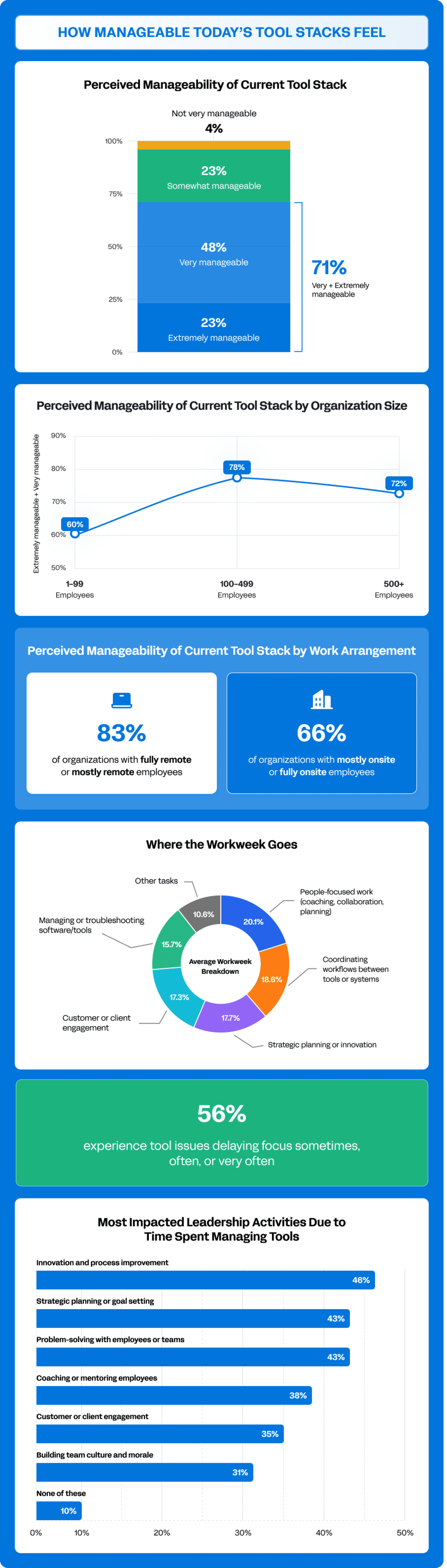
According to the Buddy Punch survey, most respondents (71%) say their organization’s current set of tools is extremely or very manageable when it comes to supporting both operational needs and people or team priorities. That sense of control is especially strong among mid-sized and large organizations (100+ employees), suggesting that scale often brings structure rather than disorder. As companies grow, they tend to formalize processes, define ownership, and invest in clearer systems… all of which can make complex environments feel easier to navigate.
The work model plays a role as well. Fully or mostly remote organizations stand out as the most manageable overall, outperforming hybrid and mostly onsite workplaces. This points to the power of clarity. When expectations around how work happens are consistent — rather than split across multiple modes — systems tend to be designed with more intention, reducing friction over time.
Still, manageability doesn’t mean tools fade into the background. Even when systems feel under control, they continue to demand attention from leaders at the end of the day.
The Work That Quietly Takes Over the Week
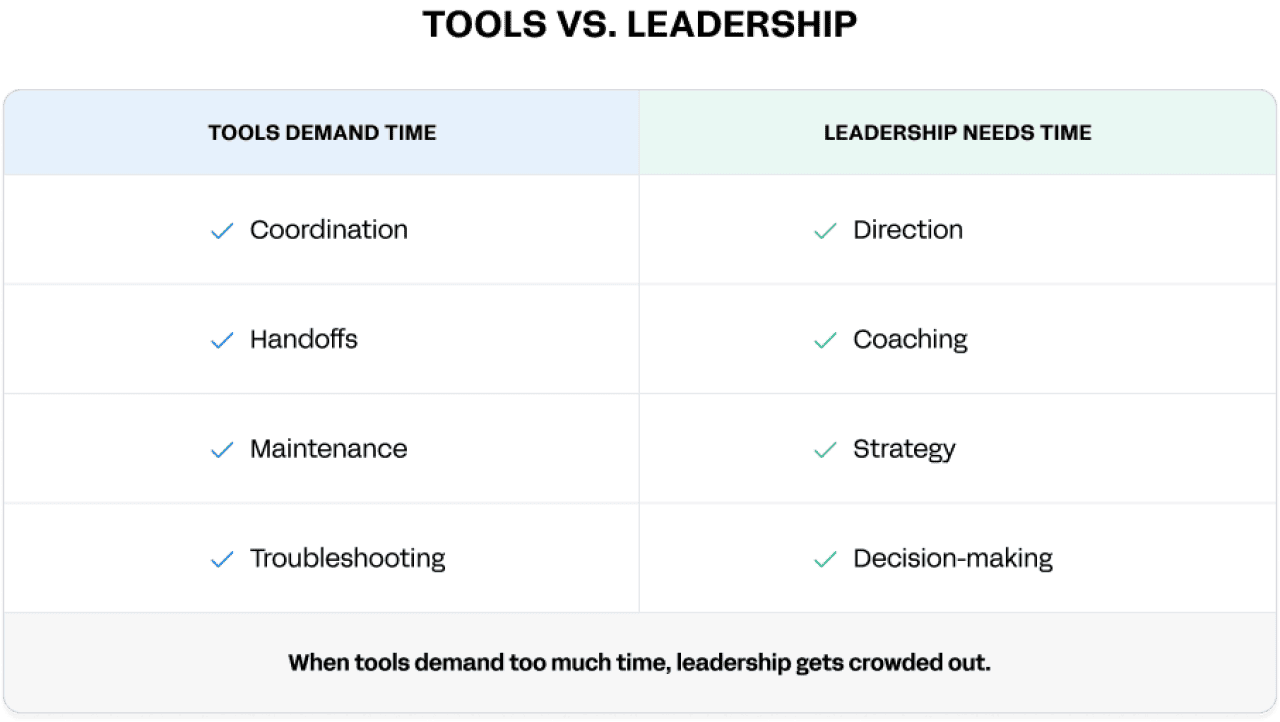
When respondents broke down how they actually spend their time at work, more than one-third of the average leadership workweek was consumed by tool coordination and troubleshooting combined. That’s a substantial share of time devoted to keeping systems aligned, moving information between platforms, and resolving issues — work that supports productivity without advancing leadership priorities.
Meanwhile, core leadership activities like strategic planning, innovation, and people development account for barely half of the week. These are the activities most closely tied to leadership, growth, and long-term impact, yet they often compete for leftover time rather than being protected priorities.
This imbalance helps explain why many leaders feel constantly busy but rarely ahead. The issue isn’t effort or engagement. It’s that too much energy is spent maintaining the infrastructure leaders rely on to manage teams.
Focus Is Fragile in a Tool-Heavy Environment
Software doesn’t just consume time directly. It also disrupts it.
More than half of respondents say software or tool issues derail their focus sometimes or more often. These interruptions aren’t rare breakdowns or exceptional failures. They’re routine moments — think small glitches, sync issues, or workarounds — that repeatedly pull attention away from the task at hand.
Academic research also points to the cost of fragmented attention in modern work. Studies from Stanford University suggest that frequent task-switching and system interruptions make it harder to sustain focus and complex thinking. As work becomes more digitally mediated, the cumulative impact of small interruptions can quietly reshape how time and attention are spent.
Over the course of a day or week, this fragmentation adds up. Even manageable systems can make it harder to sustain deep thinking, strategic planning, or meaningful one-on-one conversations. Leadership focus becomes reactive rather than intentional.
Buddy Punch
What Leadership Loses First
To understand how leadership is reshaped when tools demand more attention, respondents were asked to identify up to three areas of their work most negatively affected by time spent managing or troubleshooting software.
The losses show up most clearly at the top of the value chain. Innovation, strategy, and problem-solving take the biggest hit, with nearly half of respondents saying tool overhead directly undermines the work that drives improvement and direction. These are the activities that shape where teams are going next, but they’re often the first to be squeezed.
Only 1 in 10 respondents say their higher-value work is untouched. For everyone else, software demands actively crowd out coaching, culture-building, and client focus. Over time, this shift changes what leadership looks like in practice, even if job titles stay the same.
What Leaders Would Do With Time Back
When asked how they would reallocate time if software and tool demands were reduced, leaders showed remarkable alignment.
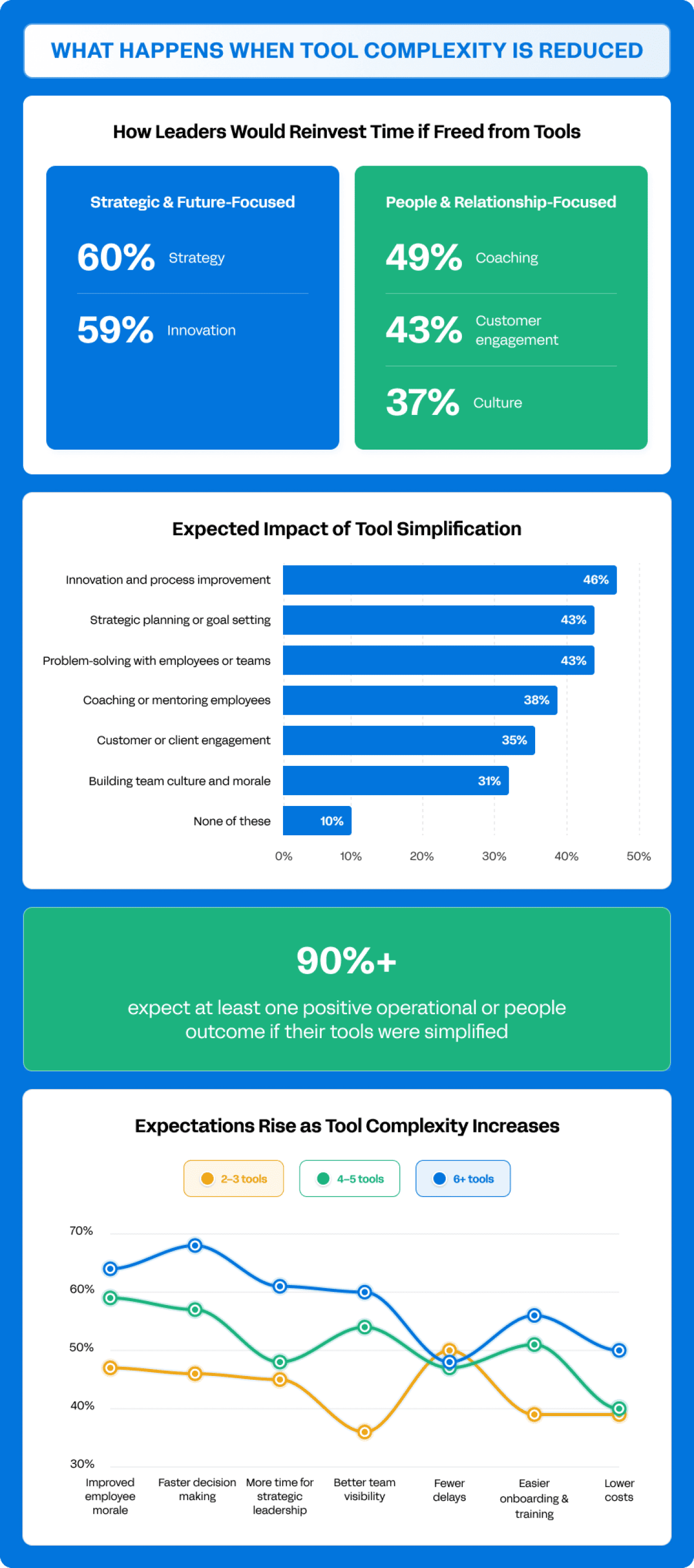
Most say they would spend that time on strategic planning, goal setting, innovation, and process improvement. Rather than filling reclaimed hours with more administrative work, they envision reinvesting in activities that strengthen organizations over time.
A large share would also redirect that time toward people-facing work. Roughly half would prioritize coaching and mentoring, while more than 4 in 10 would focus on deeper customer or client engagement. In other words, time saved from tools wouldn’t vanish. It would flow back into leadership, relationships, and trust-building.
And when leaders imagine where reclaimed time would go, the appeal of simplification becomes obvious. Reducing tool overhead isn’t just about efficiency — it’s about restoring capacity for the work that drives teams forward through leadership.
Why Simplifying Tools Feels So Impactful
The pressure to simplify isn’t happening in a vacuum. As new technologies are layered onto already complex systems, the cost of fragmentation has intensified. Research cited by Harvard Business Review and others suggests that leaders are being asked to manage “automated chaos” when organizations add tools faster than they redesign workflows or clarify how work should happen. The result is more activity, more output, and more interruptions without a corresponding increase in clarity, focus, or effectiveness.
Against that backdrop, it’s not surprising that leaders expect broad gains if their organizations simplify or consolidate their tools. Most anticipate higher morale, faster decision-making, and more time available for strategic leadership. Nearly half also expect better visibility into team performance, fewer tech-related delays, easier onboarding and training, and lower costs. Tool simplification is seen not as a narrow IT fix but as a lever that affects how leaders operate day to day.
These expectations rise sharply for companies that use more tools. Leaders at organizations using six or more tools are far more likely than those using just two or three to anticipate improvements across morale, speed, leadership capacity, performance visibility, and onboarding if their environments were streamlined.
This pattern suggests that as tool ecosystems grow more complex, the friction they create becomes more noticeable and more costly. At that point, consolidation feels less like optimization and more like relief.
Buddy Punch
Rethinking the Trade-off Between Tools and Time
The key takeaway here isn’t that most leaders are failing at technology. It’s that many have quietly normalized how much time their systems demand and stopped questioning whether that tradeoff still makes sense.
When tools feel manageable, it’s easy to assume the problem is solved. But the real opportunity lies in stepping back and asking different questions: Where does coordination happen? Which systems require the most hand-offs? Where are leaders spending time maintaining workflows instead of guiding teams?
For many organizations, the next step isn’t adding another platform or rolling out new features. It’s simplifying what already exists. Reducing overlap. Clarifying ownership. Aligning tools more intentionally with how work actually happens.
This doesn’t require eliminating technology or rebuilding processes from scratch. Even small changes like consolidating platforms, standardizing workflows, or making tool decisions with time impact in mind can free up meaningful capacity. Capacity that can be redirected toward leadership, strategy, and people development.
Most importantly, leaders should treat time as a first-order design constraint, not a side effect. Tools should protect focus, reduce friction, and make it easier for leaders to lead.
The real advantage won’t come from managing software more efficiently. It will come from creating systems that demand less management in the first place.
Methodology
This survey was conducted with 534 U.S.-based adults aged 18 or over who are currently employed full-time or part-time as a small business owner, operations manager, leader, or another management professional with operations responsibilities. All respondents had been with their current organization for at least three months; were actively involved in operations management, people management, and oversight or use of work tools or software; and worked at organizations that use at least two tools or software platforms to manage day-to-day work. The survey was fielded online from Aug. 19 to Sept.3, 2025. Results reflect descriptive statistics with no weighting applied.
This story was produced by Buddy Punch and reviewed and distributed by Stacker.
Topics:
Careers & Education

.png)