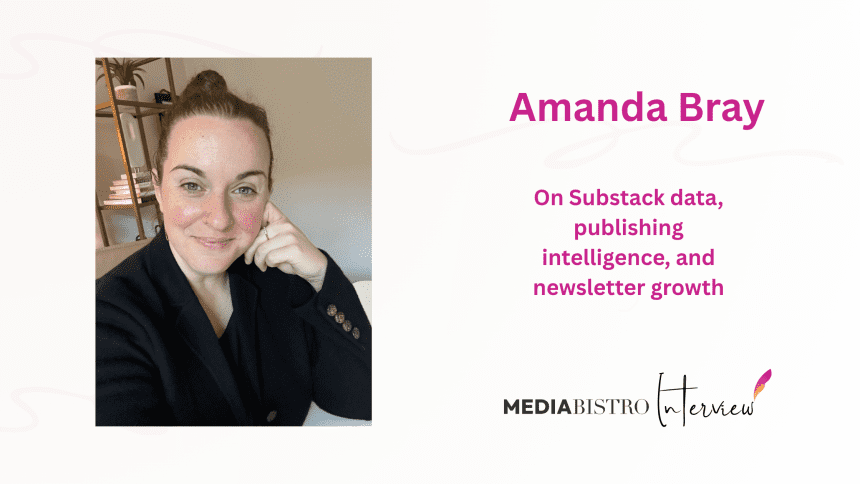

Amanda Bray’s career reads a little like a map of everything the media industry has been through in the last two decades. She started at a college newspaper, moved into book publishing, then spent years in corporate content and editorial consulting before landing on Substack in 2022. And that’s where things got interesting.
What she found wasn’t a writing problem. It was a data problem. Creators with serious editorial chops were publishing good work, building real audiences, and making decisions in the dark. Open rates told them almost nothing. The dashboards weren’t built for publishers who needed to understand whether their audience was actually engaged or just passively subscribed.
Also on Mediabistro

So Bray, who had spent years parsing data for media teams and individual creators, built SubSight, a tool that connects what you publish to how readers actually behave inside your publication.
She’s also been running The Publishing Spectrum, a Substack publication of her own, since 2022, and advising founders, authors and communications teams on how to turn expertise into public-facing messaging that actually reaches people. She’s also a certified mindfulness meditation instructor, which turns out to matter more in her editorial work than you’d expect.
We talked to Bray about what the data really shows when a publication stalls, why the 1,000-subscriber mark is a genuine creative crossroads, how AI is collapsing the distance between a creator and their own instincts, and why the toughest editor you’ve ever worked for might still be your best strategic resource.
For anyone building an independent publishing presence, this one is worth reading closely.
You spent years in newsrooms, book publishing, and editorial roles before becoming the data person for Substack creators. How did that shift happen? Was there a moment you realized the dashboards weren’t giving writers the full picture and that this was something really important?
“Pretty organically, to be honest. Substack became a creative incubator for me in 2022, and by early 2023, I realized I had a growing list of engaged readers — and knew almost nothing about them. It turned out nobody knew much of anything about the reader experience on Substack, or their own publication’s data. So in summer 2024, I hosted an online survey, and something like 62% of the 400+ respondents identified as readers rather than writers. That gave us our first real sample data for the Substack subscriber experience with questions like, ‘When does a paid subscription start to feel pricey?'”
“As I kept paying attention to how the Substack community talked about data, two pretty distinct camps emerged. One group felt that looking at their numbers was a kind of creative betrayal. The other wanted to understand their audience but didn’t know where to look — or what was worth looking at. Simple things I took for granted, like knowing which essays were actually driving upgrades, weren’t organized anywhere a creator could use them to make meaningful editorial decisions. So a lot of my early guidance in my newsletter was basically me trying to come up with legible directions and teaching people to go treasure hunting in their own back end.”
“Behind the scenes, word spread that I could make data ‘magic’ happen by parsing through CSV files. From there I started working with media teams and individual creators to help them understand their audiences, navigate editorial pivots and make real business decisions about their future on the platform. SubSight grew directly out of that work.”
A lot of Mediabistro readers have serious editorial chops already. Many are looking to apply these to their own creative projects. What habits from legacy media actually help on Substack, and which ones trip people up?
“Coming from legacy media, you can trust your creative sniffer way more than you probably realize. That impulse to chase a story? Build around it. Start with your natural curiosity and then shape a steady editorial queue from there, not the other way around. Learn how to flex when your instincts push you in a new direction. Readers are much more agile than the editors you’re likely used to. Give your best stories to your readers without hesitation — because that ability to see how all the pieces of a narrative fit together is your biggest asset on Substack. It’s also, in some cases, your greatest roadblock.”
“A lot of folks from legacy media are used to an internal publishing structure where at least a few editors make the final call on what goes to press. That scaffolding disappears when you publish independently, and the absence carries a very specific kind of weight. The tendency to drift without it is deeply human — it happens to writers at every level.”
“On Substack, you’re suddenly the reporter, the designer, the editor and the publisher. What I see happen most often is that legacy media folks default to staying inside familiar editorial lanes while quietly struggling to build the cadence and responsiveness that an independent publication actually requires. That’s where data becomes almost non-negotiable if you don’t have the budget for a team and a crew of consultants. Data is the clearest way to see how your work is actually moving through an audience — month over month, piece by piece. Without it, you’re building a publication on instinct alone. Which works, until it doesn’t.”
You talk about “publishing intelligence” and built a tool called SubSight around it. What does that look like in practice, and can you share a moment where the data told a creator something they’d completely missed?
“If you’re going to be competitive on Substack, you have to be working with the trust built between author and audience. That trust is real and measurable — but if you don’t know what it looks like, how to track it or how to detect when it’s waning, you’re missing a core piece of publishing intelligence.”
“In practice, data usually helps creators do two things: define what ‘active’ actually means for their specific publication (beyond basic open rates and paid upgrades), and then understand what percentage of their readership meets that bar. Knowing the real number focuses your nurturing efforts considerably.”
“What most people discover when they run a data audit or upload into SubSight is that a substantial portion of their audience never leaves the inbox. The best active rate I’ve seen is around 25% — and I define ‘active’ pretty modestly: one unique email open plus one unique post view in the last 30 days. Most publications are sitting closer to 10%. The rest of their list is what I’ve started calling ‘headline surfers.'”
“Here’s what’s interesting though: the data itself isn’t usually the surprise. It’s what people do with it that matters. I’ve had creators look at their numbers and decide, ‘Well, if that’s what’s happening, I want to spend my time somewhere else.’ (And I help support the path to leaving or shifting their strategy on Substack.) And I’ve had others say, ‘I didn’t realize that many people were actually reading — I want to keep going.’ The data becomes permission, one way or the other.”
“SubSight exists to give creators that visibility — to see the actual movement inside their publication so they can make a real decision about what comes next.”
You mentioned one client with under 1,000 readers who got a paid upgrade from her first invitation sequence, and another with 200,000+ who drove 1,500 upgrades using the same approach. What were those invitations actually doing that most creators miss?
“For starters, both of them had their creative output in a really balanced place: editorially strong, visually distinctive and still agile enough to follow the movement in their audience. The smaller publisher is a solo producer — creatively consistent from post to post, bright language, playful editorial structure, analog photography throughout. A real emotional ethos that never wavers. The larger publisher had a team of four just for the podcast side: serious journalism, a clear mission, recognizable names almost every week and a paid offering that was evolving in real time based on direct audience feedback.”
“The quality of experience was steady, week over week, in a way that quietly builds trust. There’s no question about a bait-and-switch once someone upgrades. No wondering whether what they paid for will eventually transform into something unrecognizable. That steadiness is rarer than it sounds.”
“So when I was looking at both publications’ editorial calendars and following the data, what I could see was an open relational door — a real warmth between these writers and their audiences that was already there. We built editorial segmenting and messaging that reflected who they were and what their readers were already responding to. And then we used a sequence to interrupt their audience’s regular programming with a warm, genuine heads-up — we tried to make it sound like an invitation, not a pitch.”
“The thing they both had was a steady editorial line on the horizon. We just helped make it visible to the people who were already looking for it.”
“It’s probably not fair to say it works every time. But I will throw my full support behind a good writer who genuinely cares about their people. There’s something real there that audiences are hungry for right now — and when you meet it with the right invitation, it just tends to work and build momentum.”
You’ve worked with publications from a few hundred subscribers up to 190,000. Writers tend to stall around 1,000 and again around 10,000. What do you typically find when you look under the hood at those plateaus?
“Around 1,000 readers, Substack creators are usually standing at a real crossroads: do they want to keep being a blogger who doesn’t answer to anyone? Or do they want to take this thing at least a little seriously and step outside their comfort zone?”
“What makes that moment interesting is the specific kind of person who stalls there. A lot of them built their following on a kind of creatively cool indifference — and then quietly realized that a flourishing newsletter could actually make them less miserable in their daily life. That’s a compelling realization, but it requires commitment and some risk. There’s usually a threshold where they have to stop thinking like someone with a Substack and start thinking like a creative publisher who’s protecting something worth protecting.”
“The 10,000 plateau tends to split pretty cleanly into two different problems. Half the people I work with at that stage need to get honest about what actually differentiates them in the marketplace — a word a lot of creators cringe at, but it’s unavoidable. You are in competition. The other half have a differentiation story that’s working fine; what they’re missing is a serious retention plan. They’re so focused on bringing in new readers that they’re not tending to the ones who are already paying. At that level, churn is quiet but it’s constant — and if you’re not measuring it, you won’t see it until the numbers stop moving the way you expected.”
Your work sits at the intersection of messaging, audience behavior, and publishing “in the age of AI.” How is AI actually changing the job of running a publication right now?
“I think AI is changing the job of running a publication in a way that’s similar to what Substack did to email marketing. Before Substack, creatives were duct-taping together Squarespace, Mailchimp, scattered social media accounts and cold-call networking just to maintain a list. Substack packaged all of that into something legible for people who’d rather be doing creative work. Personally, my creative capacity quadrupled when I let Mailchimp go — when I stopped managing complex promotional logistics and just followed my curiosity. Each month Substack keeps eliminating more of the soul-killing administrative work. That’s the template AI is now running.”
“AI, when used well, is letting people stay more squarely inside their craft. Even my own data work has felt the shift: 18 months ago, I was spending hours on audits — charging market rate for them — because large media teams were trying to make audience-level decisions without any reliable month-over-month picture of where their readers were coming from or how they were actually engaging. A large-scale data audit is probably still useful for larger teams that have complex business structures and people on staff. But for the solo creator or journalist who just got laid off? The real cost of a data audit was prohibitive, and I took that access to heart. Once I saw that AI could organize and the creative boundaries I could build into an app, I knew how to work in the same data audit pattern recognition directly into how SubSight reads everyone’s data. Work that used to require hiring someone like me is now more economically accessible.”
“That’s what AI does at its best for independent publishers, I think. It collapses the distance between you and your own creative instincts — and makes the savvy publisher part less expensive to be.”
We notice that you’re also a certified mindfulness meditation instructor. We could probably use some of that training ourselves. Does that show up in how you work with clients, especially the ones who are burned out or creatively stuck?
“Yes, and probably more than I even fully realize yet. The meditation training gave me a very particular sort of skill: I learned to notice what’s actually happening underneath what someone is presenting. In a session, that might mean tracking where someone’s breath changes or where their energy drops. In editorial work, it shows up the same way — I’m listening for where the writing goes flat, where someone starts performing instead of speaking, where they’ve unconsciously smoothed something over that actually had life in it.”
“A lot of my clients come to me in a kind of creative freeze. They’re not stuck because they have nothing to say — they’re stuck because something in them has decided it’s not safe to say it yet. That’s not a straightforward craft problem. It’s usually something deeper. Likely to do with personal history, imposter syndrome or nervous system misfirings. And the tools I’ve developed over the years — things like somatic scans, breath-based prompts, specific kinds of freewriting — are designed to help the writing surface before those internal mechanisms can block it.”
“I’m still deepening this part of my practice. But I’ve watched it work enough times over the years to trust it: when someone stops trying to get the writing right and starts letting it come through — something really does shift. That’s what I’m trying to guide writers and Substack creators through inside editorial partnerships.”
What are you enjoying reading these days, and what are two or three Substacks you think every media pro should be subscribed to (besides Mediabistro’s, of course)?
“Honestly? I read almost nothing about publishing strategy, Substack tactics or AI. I’ve enjoyed a few of Claudia Faith’s AI experiments recently. But I find that the more I surround myself with people doing strange, meaningful, funky things, the better my own work gets.”
“So: Rose Florence’s The Rose Period is one that wows me every time — everything she shares makes me feel more welcome inside the world of art history.”
“Tina Hedin is a writer trying to answer the question: What happens after the worst happens? (Equal parts rip-your-heart-open and deeply, eternally joyful writing.)”
“I’d also say: find the people doing things that have nothing to do with your beat. Cooking is an essential part of my creative life — it’s just not what I write about — so Caroline Chambers and Emily Nunn are always in my rotation. And my friend Jeff Warren runs a meditation meetup he calls the ‘Do Nothing Project’ which is maybe the most useful creative advice I’ve encountered in years.”
If a Mediabistro reader finishes this piece and wants to do one thing in the next 48 hours to better understand their own publication, what would you tell them to do?
“Besides uploading their data into SubSight? I’d ask them to imagine the toughest editor they’ve ever written for — and ask what that person would say about their editorial strategy. Where would they push? Where would they raise an eyebrow? That internal ping is useful data. It often points directly at what you’ve been quietly avoiding in your own creative output.”
“The second thing I’d recommend: start paying attention to what percentage of your audience is moving out of the inbox and into Substack itself. Inbox readers are fine — the majority still read there — but the publication experience you create inside Substack can do a lot of the relationship-building work for you. If almost no one is clicking through, that’s worth understanding especially in the context of your goals. It’s also worth noting the nuance here in this guidance: staying in the inbox is actually fine for some of the people I work with; they’re getting speaking gigs and media callbacks from what they publish. So it really does come down to what you’re hoping to build and how you are intentionally guiding readers to join in.”
“As a general rule, though, if no one is clicking through and your strategy relies on them upgrading to the whole publication experience, it may mean your subject lines are doing all the work, or it may mean your in-app experience hasn’t been bolstered enough yet. Either way, it tells you something about where your readers actually live — and that shapes everything from how you structure your posts to what kind of community you can eventually build.”
Topics:
Interviews