

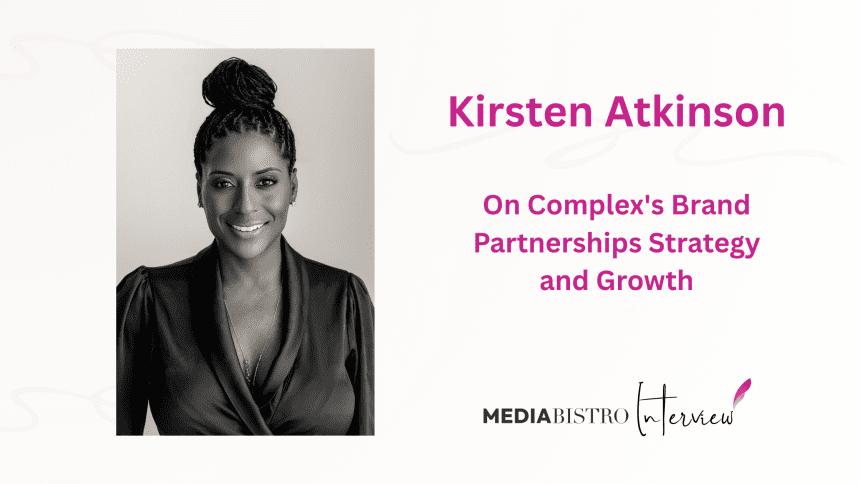

Kirsten Atkinson has spent more than 25 years in media, advertising, and marketing, but her title at Complex barely hints at the scope of what that job actually involves. As SVP of Brand Partnerships and Sales, she oversees the West Coast sales strategy for a platform that isn’t quite a publisher, isn’t quite a retailer, and isn’t quite an event company. It’s all three, and knowing how to sell that to brands is its own discipline.
Her path to this role took her through Starcom, Mindshare, OMD, nearly a decade at Team One running Lexus media, a groundbreaking Lexus x Marvel Studios campaign for Black Panther, and eventually into sales at NBCUniversal and BuzzFeed before landing at Complex in 2021.
Also on Mediabistro

Along the way, she co-founded the ThinkLA DIG Diversity Summit, the first advertising conference of its kind in Los Angeles, and earned recognition from Ad Age, Black Enterprise, and Adweek. This year, she received the Clark Atlanta University Spirit of Greatness Award from the HBCU where she earned her degree in Mass Media Arts.
Mediabistro spoke with her about what it actually looks like to sell a ComplexCon partnership, how to measure success in a commerce-driven collab, and what media professionals need to know if they want to make the same career pivot she did.
A lot has changed at Complex since 2021, with new ownership and new scale. How has that changed how you work with brand partners?
“When I joined Complex in 2021, the business was owned by BuzzFeed and was still more weighted toward traditional media monetization, digital advertising and branded content made up a larger portion of the mix, while commerce and experiential were meaningful but not yet operating at today’s scale.
Since then, NTWRK and Universal Music Group acquired Complex and the model has become much more diversified. Today, digital advertising and partnerships remain a core driver, but they sit within a broader ecosystem that includes e-commerce and large-scale experiences like ComplexCon and Family Style.
The simplest way to describe the shift is that we’ve moved from a more traditional publisher model to a more balanced platform built around content, commerce, and experiences, giving brands more ways to show up in culture and more ways for us to deliver measurable value beyond impressions alone.”
ComplexCon drew 70,000 attendees and 400-plus brands. What does a partnership at that scale actually cost, and how does the ROI conversation compare to a traditional media buy?
“The investment really depends on the shape and ambition of the partnership. At that scale, brands aren’t buying a standard media package, but accessing a highly engaged cultural audience across multiple touchpoints at once: live experience, creators, social, content, commerce, and hospitality.
Because of that, the ROI conversation is different from a traditional media buy. Instead of focusing primarily on reach, frequency, or CPM, we look at a broader set of outcomes: brand heat, earned media, social engagement, creator participation, data capture, commerce performance, and whether the brand created a moment people actually talked about.
It’s less about ‘how many impressions did I buy?’ and more about ‘did we create cultural relevance and measurable business results at the same time?'”
That’s a meaningfully different sales conversation than anything her media buying background prepared her for. But it’s one she’s clearly made her own: Complex was named alongside Google, Netflix, Sephora, and the WNBA as one of BizBash’s 10 industry innovators in experiential marketing in 2025.
The Fanatics x Complex x Takashi Murakami x MLB collab reportedly hit 5x MSRP on StockX. How does Complex measure success on a commerce-driven deal like that versus a standard brand integration?
“For a commerce-led collaboration, success starts with demand and performance — sell-through, speed to sell-out, conversion, and overall consumer response. But we also look at what that demand signals culturally: did it generate conversation, did it travel organically, and did it deepen the brand’s relevance with its audience?
A standard brand integration is often measured by awareness and engagement. A commerce-driven deal adds a more tangible layer of proof: consumers choosing to buy.
The most successful partnerships do both. They work as storytelling and as product, and when you see strong aftermarket demand, it’s a signal that the collaboration resonated beyond the campaign itself.”
On Making the Pivot From Media Buying to Brand Partnerships
Atkinson’s first 17 years were spent on the agency side, planning and buying media for automotive brands at Starcom, Mindshare, OMD, and Team One. It’s the kind of foundation that teaches you discipline, process, and how brands make decisions. What it doesn’t necessarily teach you is how to build cultural products from scratch. That part came later.
For anyone thinking about making a similar move, and it’s one of the most asked-about transitions in media right now, her experience is worth paying close attention to.
What skills from your traditional media background transferred directly, and what did you have to learn from scratch?
“A lot transferred directly. Traditional media teaches you how to understand client objectives, build strategic plans, manage complexity, and prove value against outcomes. It also gives you a strong foundation in audience strategy and how brands make decisions.
What I had to build more intentionally was the commerce and partnership side, how products are developed, how drops and retail mechanics work, and how to structure deals that bring together talent, brands, and distribution.
The biggest shift was moving from ‘how do I place media effectively?’ to ‘how do I build something with cultural impact that people actually want to participate in?'”
What does your team look like today?
“My team is intentionally cross-functional, primarily spanning sales, working in lock step with strategy, creative partnerships, and integrated marketing. We have people from traditional media backgrounds alongside those with experience in branded content, digital marketing, event marketing, and influencer management.
That mix is important because the work itself spans far beyond a standard media sale, it often includes content, live experiences, creators, and product-driven thinking all within a single partnership.”
It’s a structure that mirrors what’s happening across the industry more broadly, where the line between a media sale and a creative production has all but disappeared. The roles that are growing are strategists who can hold a conversation about content, events, product drops, and CPMs in the same breath.
On the Realistic Path to Making This Pivot
For someone in a traditional media sales or planning role who wants to make the same kind of transition, what’s the realistic path?
“It’s a series of adjacent moves. Start by getting closer to integrated partnerships, branded content, experiential, or commerce-related work within your current role. Raise your hand for opportunities that require strategic thinking, not just execution.
The people who make the transition most successfully tend to keep their media foundation while expanding their skill set. If you can still speak fluently about planning and measurement, but also understand creators, partnerships, and consumer behavior, you become much more valuable.”
That’s practical advice that echoes what we’ve heard from other media executives who’ve reinvented their roles over long careers.
What was your big break?
“I’ve been fortunate to have leaders throughout my career who trusted me with bigger opportunities before I felt fully ready for them. My ‘big break’ wasn’t a single moment, but a series of chances to step into new challenges and prove I could grow into them. Whether I was executing the first Live, Immersive Fashion Show at NYFW or launching the award-winning Black Panther vehicle partnership, these moments led me to the work I’m doing today.
Like most careers, it’s been a combination of preparation, relationships, and timing coming together over time.”
The Black Panther campaign she’s referring to was the Lexus x Marvel Studios partnership she led at Walton Isaacson, which won for Best Branded Entertainment. It remains one of the most-cited examples of how an automotive brand can show up in culture without feeling like an interruption.
Atkinson’s career shows the importance of staying curious past the point where most people get comfortable. She spent years building expertise in one area, then used it as a foundation to move into something new. The pivot she’s describing is about knowing your business and client demands well enough to take the relationship somewhere the job description didn’t originally include.
If you’re looking for roles in brand partnerships, integrated marketing, or cultural commerce, you can browse current job listings at Mediabistro.
Topics:
Interviews
