Mediabistro Logo Mediabistro Logo
  • Jobs
    Search Creative Jobs Hot Jobs Remote Media Jobs Create Job Alerts
    Job Categories
    Creative & Design Marketing & Communications Operations & Strategy Production Sales & Business Development Writing & Editing
    Quick Links
    Search All Jobs Remote Jobs Create Job Alerts
  • Career Resources
    Career Advice & Articles Media Industry News Media Career Interviews Creative Tools Resume Writing Services Interview Coaching Job Market Insights Member Profiles
  • Mediabistro Membership
    Membership Overview How to Pitch (Premium Tool) Editorial Calendars (Premium Access) Courses & Training Programs Membership FAQ
  • Log In
Post Jobs
Mediabistro Logo Mediabistro Logo
Search Creative Jobs Hot Jobs Remote Media Jobs Create Job Alerts
Job Categories
Creative & Design Marketing & Communications Operations & Strategy Production Sales & Business Development Writing & Editing
Quick Links
Search All Jobs Remote Jobs Create Job Alerts
Career Advice & Articles Media Industry News Media Career Interviews Creative Tools Resume Writing Services Interview Coaching Job Market Insights Member Profiles
Membership Overview How to Pitch (Premium Tool) Editorial Calendars (Premium Access) Courses & Training Programs Membership FAQ
Log In
Post Jobs
Log In | Sign Up

Follow Us!

Careers & Education

Is interest in a 4-year college degree drying up? Not really.

Is interest in a 4-year college degree drying up? Not really.
By Matt Barnum for Chalkbeat
5 min read • Originally published January 9, 2026 / Updated March 13, 2026
By Matt Barnum for Chalkbeat
5 min read • Originally published January 9, 2026 / Updated March 13, 2026

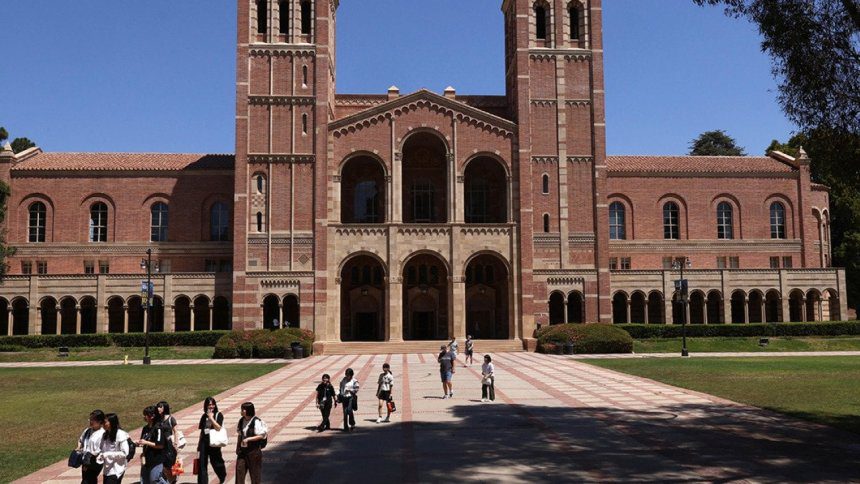
Students walking through Dickson Plaza by the Royce Hall on the UCLA campus in Westwood, California.

Genaro Molina // Los Angeles Times via Getty Images

Is interest in a 4-year college degree drying up? Not really.

American colleges are under siege.

The Trump administration has waged a legal and rhetorical battle against the country’s elite universities. Voters have grown increasingly skeptical of higher education. Some high school students are questioning the value of a college diploma. In turn, there’s been a veritable firehose of news stories about a generational pivot away from college due to some combination of ruinous costs, close-minded campus cultures, and appealing alternatives.

It is a disorienting experience, then, to examine the cold, hard data of higher education.

College tuition has become more affordable in recent years. The economic return on a bachelor’s degree has stopped growing but remains near historic highs. After a post-pandemic dip, four-year college enrollment has almost fully recovered to near-record levels. Students are increasingly flocking to flagship public universities like UCLA and the University of Michigan.

Whatever the problems of higher education, the narrative has raced far ahead of the reality.

Much of this mistaken story stems from a simple confusion: conflating enrollment in two-year and four-year colleges. While it’s true that fewer people are in community colleges, the number of students seeking bachelor’s degrees hasn’t changed much. “It’s been roughly flat for the last 10 years,” says Joshua Goodman, an education economist at Boston University. “That’s very much not the narrative.”

Chalkbeat unpacks the disconnect between the data and the vibes.

The costs vs. benefits of college

It is often treated as a well-established fact that the price of college is soaring. That is no longer the case. For the last couple of decades, net tuition has, if anything, trended down at private and in-state public universities, according to data compiled by the College Board. Since household earnings have gone up during this period, college tuition appears to have become somewhat more affordable in recent years, not less.

“When I talk to members of the public this has not penetrated at all,” says Dominique Baker, a higher education professor at the University of Delaware.

The reality has been underappreciated because colleges’ sticker prices have been rising at an almost linear rate. But list price has become increasingly disconnected from the real price thanks to growing financial aid.

A data graph showing net tuition and fees over time at four-year colleges.

Thomas Wilburn // Chalkbeat

What about the economic benefits of a four-year college education?

On average, those with a bachelor’s degree still earn far more than those without. The “college-wage premium,” as economists call it, stands at about 75%. This figure has stagnated since the early 2000s, but it remains at or near its highest point in a century.

You may have seen headlines about careers that don’t require a degree but that come with lucrative salaries. Such examples certainly exist, but they are exceptions to the average. The Bureau of Labor Statistics projects that the non-degreed occupations with the most new positions all earn under $40,000 annually. Those include home health aides, order stockers, and fast-food workers.

This does not mean that every student who attends college will see a return. The wage premium is a simple correlation and refers to those with a degree, which about one-third of college enrollees do not obtain. The decision for any individual student about whether to go to college depends on their chances of completion, the careers they’re interested in, and the cost.

Still, rigorous studies have repeatedly found that, on average, students benefit economically from seeking a four-year degree.

“There’s not a case to be made that it’s a worse deal now than it was 10 or 15 years ago,” says Jeff Denning, a higher education researcher at the University of Texas at Austin. “I’m not aware of any data that would suggest that.”

Four-year college enrollment has held steady, though two-year enrollment has fallen dramatically

For the last few decades, a little more than 40% of recent high school graduates have enrolled in a four-year college. These numbers have been fairly stable, even as high school graduation rates have risen.

A data graph showing college enrollment rates over time (from 1975 to 2020).

Thomas Wilburn // Chalkbeat

Other data shows a dip in four-year enrollment in the wake of the pandemic, followed by a bounce-back in recent years. The number of people pursuing bachelor’s degrees is now just 1% below pre-pandemic levels, according to a recent estimate.

While flagship state universities have generally seen enrollments rise, colleges with worse student outcomes, like the University of Phoenix, an online for-profit college, have seen drops, notes Preston Cooper in a report for the American Enterprise Institute.

The biggest decline in college enrollment has been at two-year schools, which are largely open-enrollment public institutions that most students attend part-time. Until a recent upturn, attendance at these schools has been falling consistently since 2010.

Here’s where the conventional narrative about the college decline falls apart: Community colleges’ costs are very low and they have not been at the center of the cultural and political backlash to higher education. The prevailing narrative has focused on bachelor’s degrees, which community colleges typically don’t issue.

What explains the two-year college decline, then? A new study coauthored by Goodman of Boston University shows that much of this is driven by economic trends. When job options are plentiful, community college is less appealing. Recently, as unemployment has ticked up, so has two-year enrollment. Another explanation is that more potential students have become wary of the value of two-year programs since the completion rates are quite low.

Reality may soon mirror perception

We may one day look back at this particular moment as a golden age of four-year colleges, even though it doesn’t feel like one.

There are signs that real tuition is going up as schools face new cost pressures. The perception of higher education has in fact declined markedly, which could eventually limit public funding and depress enrollment. (Or perhaps not: Enrollment has been rising over the last couple years at the height of the college collapse narrative.)

Another imminent challenge: At least for a while, each year’s high school graduating class is likely to be smaller than the last due to lower birth rates. Generative AI is an additional curveball, as some suspect it will devalue white-collar work and, in turn, a college education.

The irony is that the colleges likely to bear the brunt of these challenges are the country’s less-selective, less-known schools, not the elite institutions that have come to embody higher education in the public mind.

This story was produced by Chalkbeat and reviewed and distributed by Stacker.

Topics:

Careers & Education
Careers & Education

Are trade skills now more valuable than a college degree?

Are trade skills now more valuable than a college degree?
By Daniel Donovan for Skillit
6 min read • Originally published January 12, 2026 / Updated March 13, 2026
By Daniel Donovan for Skillit
6 min read • Originally published January 12, 2026 / Updated March 13, 2026

Technical College students climb 35 foottall wooden poles with a harness and spikes on their boots to train aloft with rigging to complete the 16 week course and earn a climbing certificate before moving into a apprentice position for the electric utility field.

Al Seib // Los Angeles Times via Getty Images

Are trade skills now more valuable than a college degree?

Going to college used to be a defining milestone in the classic American Dream. But as costs rise and returns on investment shrink, many young people are rethinking what “success” looks like and redefining the traditional path altogether.

A new study by Skillit finds that a growing majority of Americans now view trade skills as more valuable than a college diploma for landing a high-paying, stable job. This shift is driven by mounting frustration over tuition costs, student debt, and the threat of AI in the white-collar workforce.

The data paints a clear picture. Americans are turning to the trades not out of nostalgia but out of necessity, seeking stability, affordability, and a tangible path to prosperity.

Key findings:

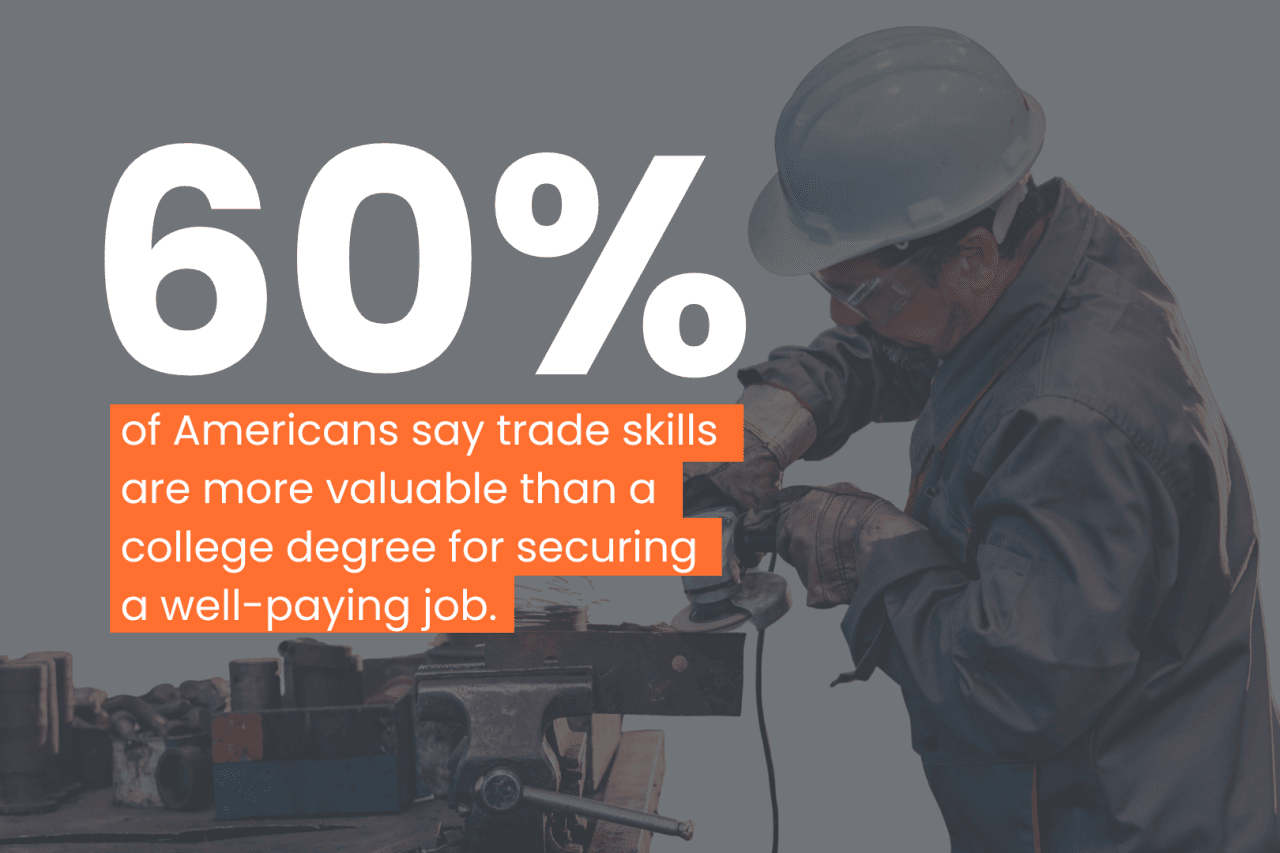
  • 60% of Americans say trade skills are more valuable than a college degree in securing a well-paying job.
  • 39% believe a trade or vocational skill offers greater long-term career stability than a college degree.
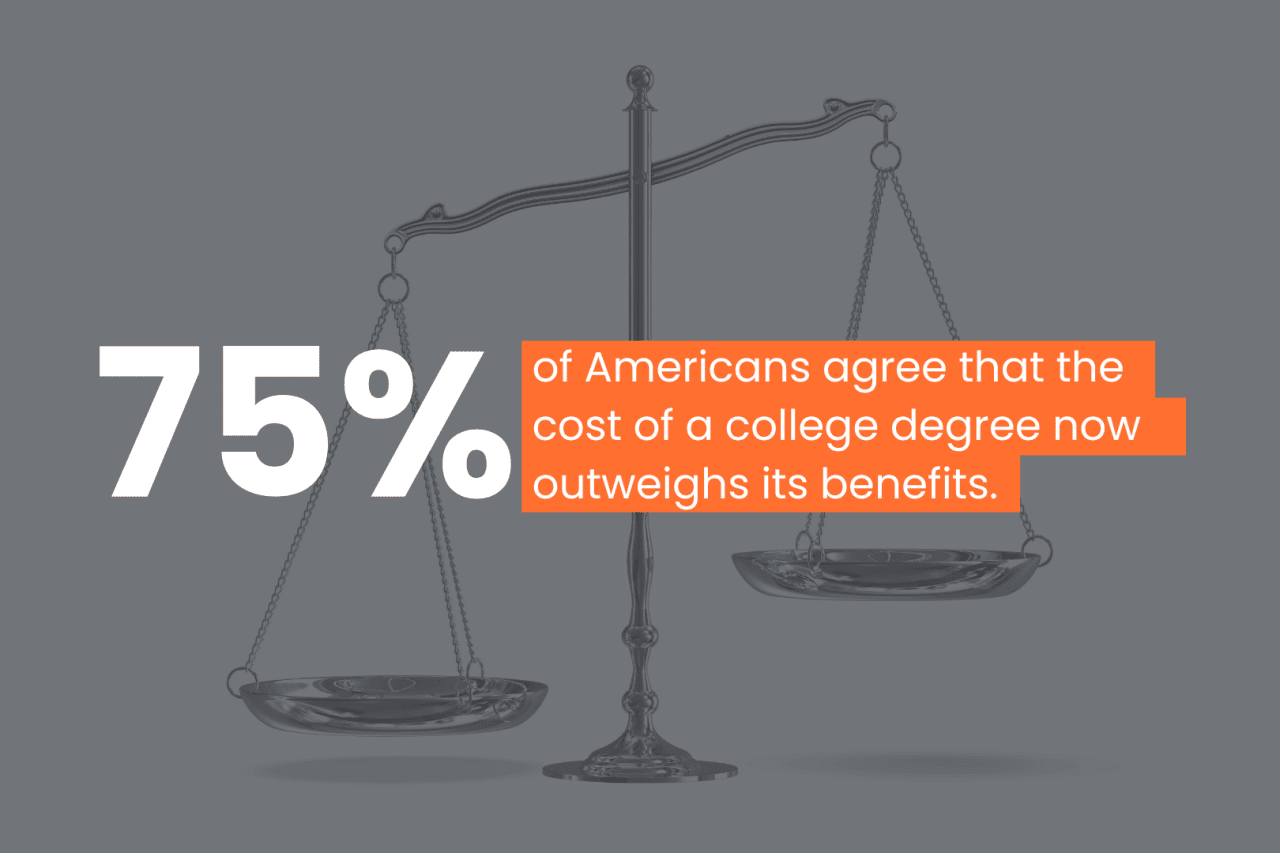
  • 75% agree that the cost of a college degree outweighs its benefits in 2025.
  • 68% say trade or vocational skills deliver a faster return on investment.
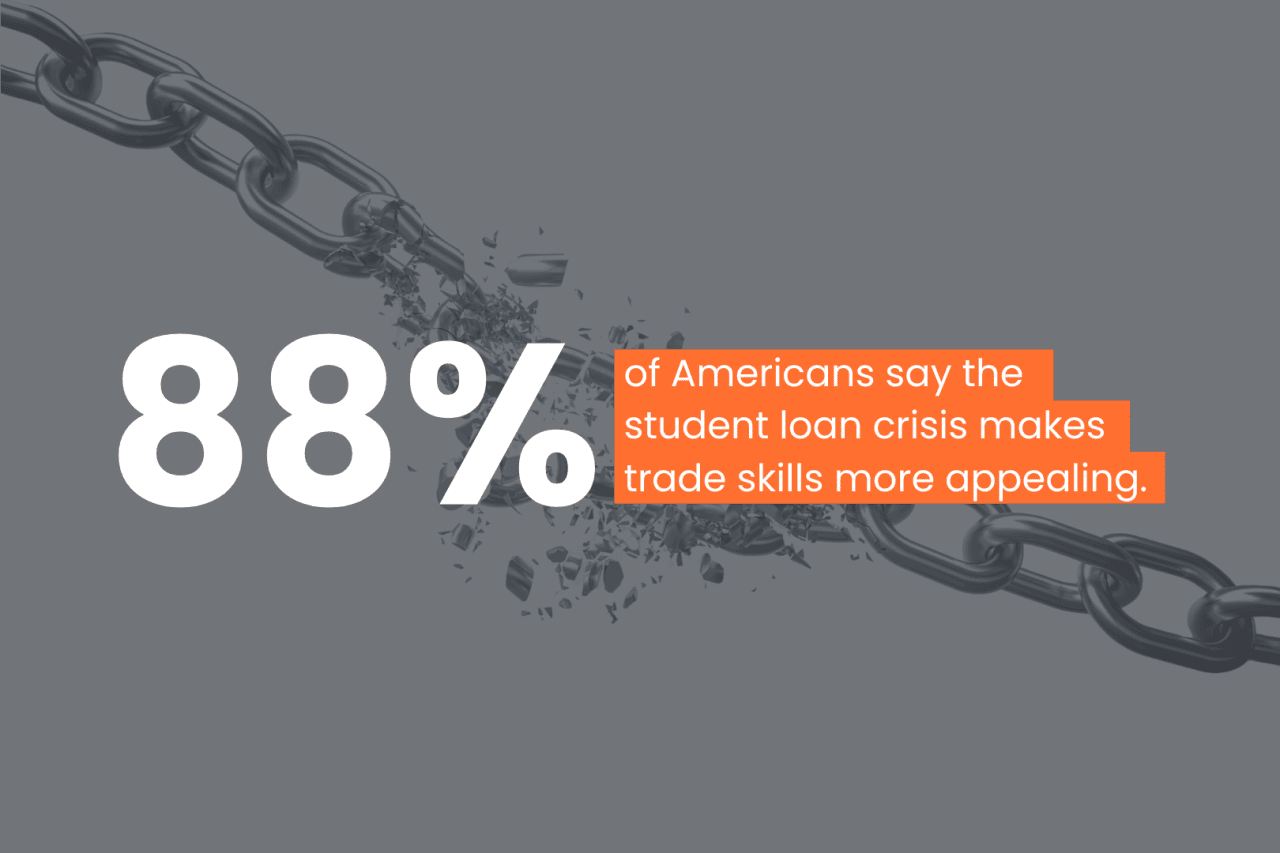
  • 88% believe student loan debt makes trade skills more appealing.
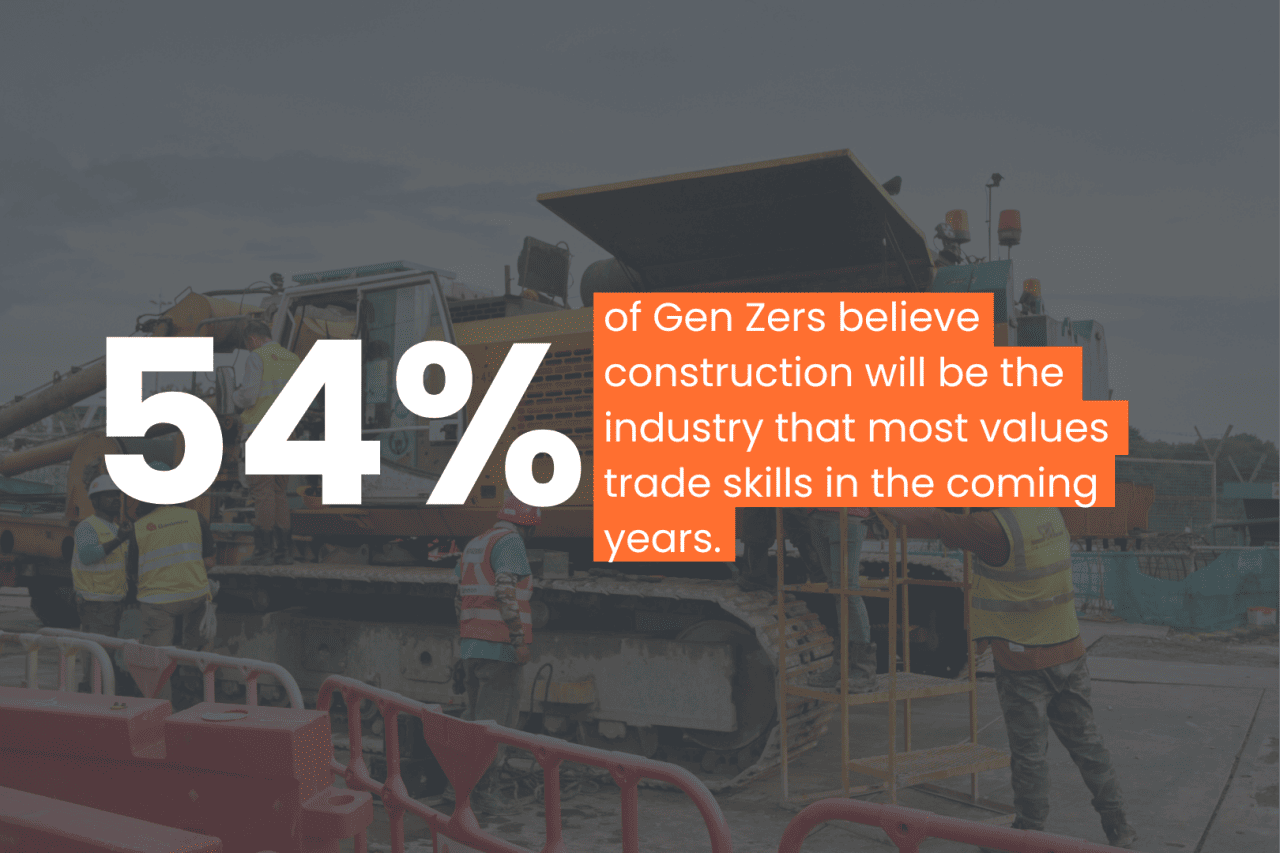
  • 54% of Gen Zers believe construction will be the industry that most values trade skills in the coming years.
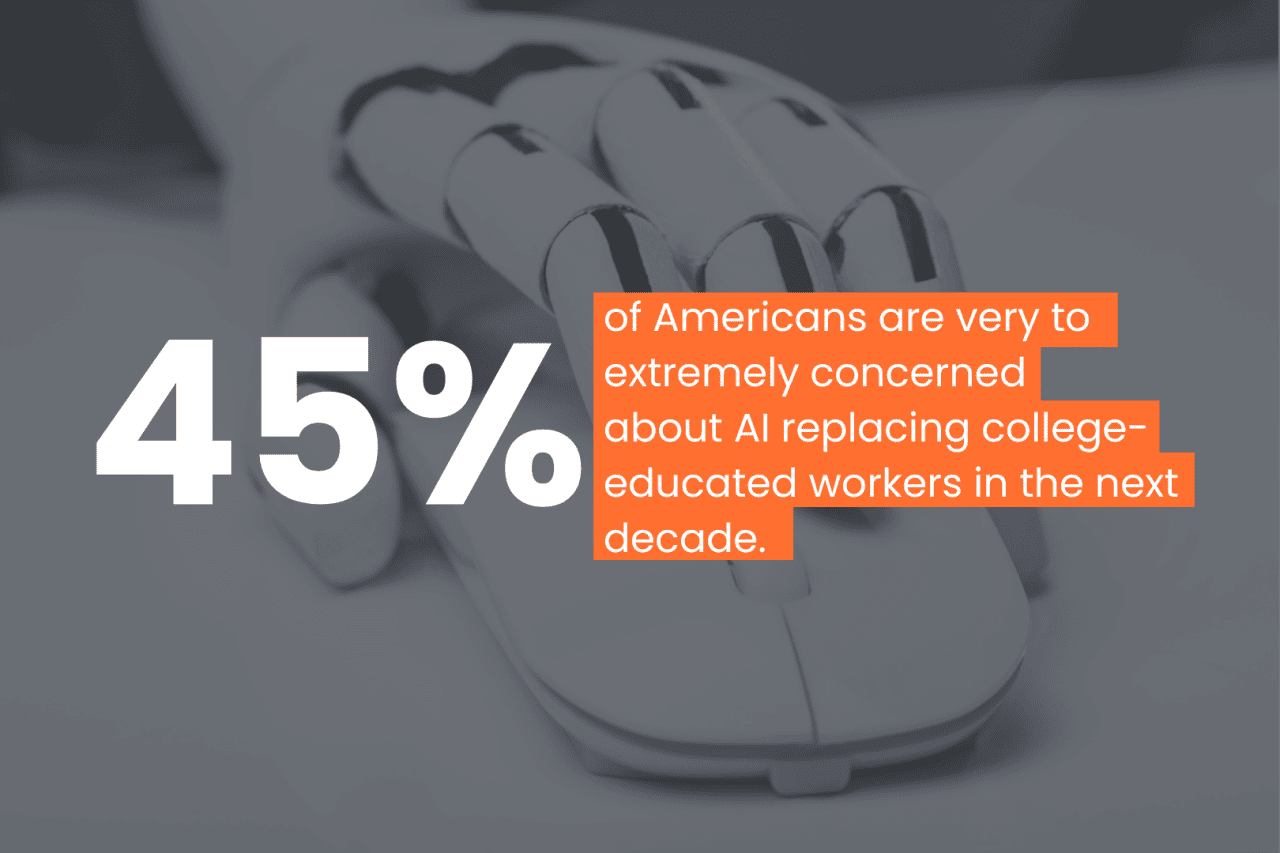
  • 45% are very or extremely concerned that AI will replace college-educated workers in the next decade.

The New American Dream: 60% Believe Trade Skills Outweigh a College Degree

Infographic showing that 60% of Americans say trade skills are more valuable than a college degree for securing a well-paying job.

Skillit

Public perceptions of higher education are changing fast. Rising tuition, record debt, and a shortage of skilled labor have flipped the old hierarchy of “college first, trades later.”

The survey found that 60% of Americans now see trade skills as more valuable than a college diploma for securing a well-paying job.

For many, it comes down to economics. Paying more than $100,000 for a degree that does not guarantee employment feels increasingly irrational. Trade certifications, in contrast, are faster, more affordable, and directly linked to income. During economic downturns, trade work often proves more stable than traditional office jobs.

From Layoffs to Longevity: Americans View Trades as the Path to Stability

Many Americans are no longer just chasing higher salaries. They are looking for careers that last. Widespread layoffs in tech, finance, and media have shattered the illusion of white-collar security.

Nearly four in ten (39%) Americans now believe a trade or vocational skill offers greater long-term career stability than a college degree.

That shift reflects a growing awareness that trade jobs are recession-resistant and harder to outsource or automate. In 2023 alone, roughly 200,000 tech workers lost their jobs, a stark contrast to the chronic worker shortages in plumbing, electrical, and construction trades.

The Tipping Point: Is Higher Education Pricing Itself Out of Value?

Infographic showing that 75% of Americans agree that the cost of a college degree now outweighs its benefits.

Skillit

Higher education faces a credibility crisis. Tuition keeps climbing while wages remain stagnant, and the student debt debate has polarized the nation. Many now feel that a four-year degree no longer delivers a return worth the price tag.

According to the Education Data Initiative, tuition and fees now average $18,981 for the 2025–26 academic year. Meanwhile, 75% of Americans in this survey say the cost of college outweighs its benefits, a striking consensus that signals a cultural tipping point.

The rising cost of higher education has turned what was once a rite of passage into a financial risk. More Americans are choosing shorter, cost-effective paths that lead to stability and prosperity sooner.

Skip the Debt, Start the Paycheck: Americans Recalculate Education ROI

Americans are not just comparing salaries. They are calculating the time to payoff. The traditional degree path often delays earning potential by four to six years, making it feel like a long, expensive gamble.

The survey found that 68% of Americans believe trade or vocational skills lead to a faster return on investment than a four-year degree.

That math checks out. Most trade programs take less than two years to complete and cost a fraction of university tuition. Graduates enter the workforce sooner, earn earlier, and carry little or no student debt, giving them a financial head start in today’s fast-moving economy.

Debt-Free Dreams: Student Loans Drive Americans Toward the Trades

Infographic showing that 88% of Americans say that student loan crisis makes trade skills more appealing.

Skillit

Perhaps the most powerful force behind this shift is the student loan crisis. With total U.S. student debt now exceeding $1.7 trillion, Americans are increasingly skeptical of higher education’s promise.

An overwhelming 88% of Americans in this study say the student loan crisis makes trade skills a more appealing option in 2025.

For many, the math is simple: Four years and six figures of debt versus one year and immediate income. The trade path offers financial freedom, a debt-free route into the middle class that can feel both practical and empowering.

Gen Z Sees Gold in Hard Hats: Young Americans Bet on Construction’s Future

Infographic showing that 54% of Gen Zers believe construction will be the industry that most values trade skills in the coming years.

Skillit

For Gen Z, the appeal of skilled trades is both economic and cultural. Many have grown up watching economic instability and value transparency over prestige.

Construction, in particular, stands out. The industry faces one of the largest labor shortages in decades, with the average worker now in their mid-40s and retirements accelerating. At the same time, federal investment in infrastructure, housing, and clean energy is fueling a boom in demand for skilled labor.

The survey found that 54% of Gen Zers believe construction will be the industry that most values trade skills in the coming years.

This generation does not see construction as “old-school.” They see innovation through drones, 3D modeling, modular design, and sustainable building practices. To them, building is not just a job; it is a way to shape the future.

The Automation Anxiety: Is AI Coming for White-Collar Jobs?

Infographic showing that 45% of Americans are very to extremely concerned about AI replacing college-educated workers in the next decade.

Skillit

AI has upended assumptions about which jobs are safe. For the first time, it is white-collar workers, not blue-collar ones, who are worried about being replaced.

This survey found that 45% of Americans are very or extremely concerned that AI will replace college-educated workers in the next decade.

This fear is not unfounded. A Goldman Sachs analysis estimates that AI could affect up to one-quarter of U.S. jobs, largely in degree-dependent fields once considered secure.

Trade work remains grounded in human skill, physical precision, on-site problem-solving, and trust. These roles are difficult to automate. As AI enters traditional “safe” careers, Americans are rethinking which professions are truly future-proof.

The Revival of Skilled Work

What this research reveals is not the decline of higher education, but the reemergence of skilled labor as an equally valid and valued path to success.

This shift represents a broader cultural correction, a renewed appreciation for the people who build the American Dream rather than simply manage it.

The trades are reclaiming their place at the center of economic stability and social value, not as an alternative, but as a cornerstone.

In 2025, many believe that success is not defined by a diploma on the wall, but by the skill in your hands, the pride in your craft, and the freedom to build a life on your own terms.

Methodology

The findings presented in this report are based on a comprehensive survey conducted by the Skillit team. Skillit surveyed 1,000 Americans in October 2025 to gather insights into their perceptions of higher education versus skilled trades.

The survey was administered online using a third-party polling platform, ensuring a diverse sample of participants from various demographic backgrounds, including age, geographic location, and income level across the United States.

All responses were collected anonymously and aggregated for analysis. The data was then processed to calculate the percentages that form the basis of the key findings discussed throughout this article.

This story was produced by Skillit and reviewed and distributed by Stacker.

Topics:

Careers & Education
Careers & Education

AI tutors, with a little human help, offer “reliable” instruction, study finds

AI tutors, with a little human help, offer “reliable” instruction, study finds
By Greg Toppo for The 74
6 min read • Originally published January 16, 2026 / Updated March 13, 2026
By Greg Toppo for The 74
6 min read • Originally published January 16, 2026 / Updated March 13, 2026

Concept of AI-powered tutoring illustrated with a person dressed professionally that looks like a teacher whispering from behind toward a robot's head.

Eamonn Fitzmaurice // The74; Getty Images

AI tutors, with a little human help, offer ‘reliable’ instruction, study finds

An AI-powered tutor, paired with a human helper and individual-level data on a student’s proficiency, can outperform a human alone, with near-flawless results, a new study suggests.

The results could open a new front in the evolving discussion over how to use AI in schools — and how closely humans must watch it when it’s interacting with kids, The 74 reports.

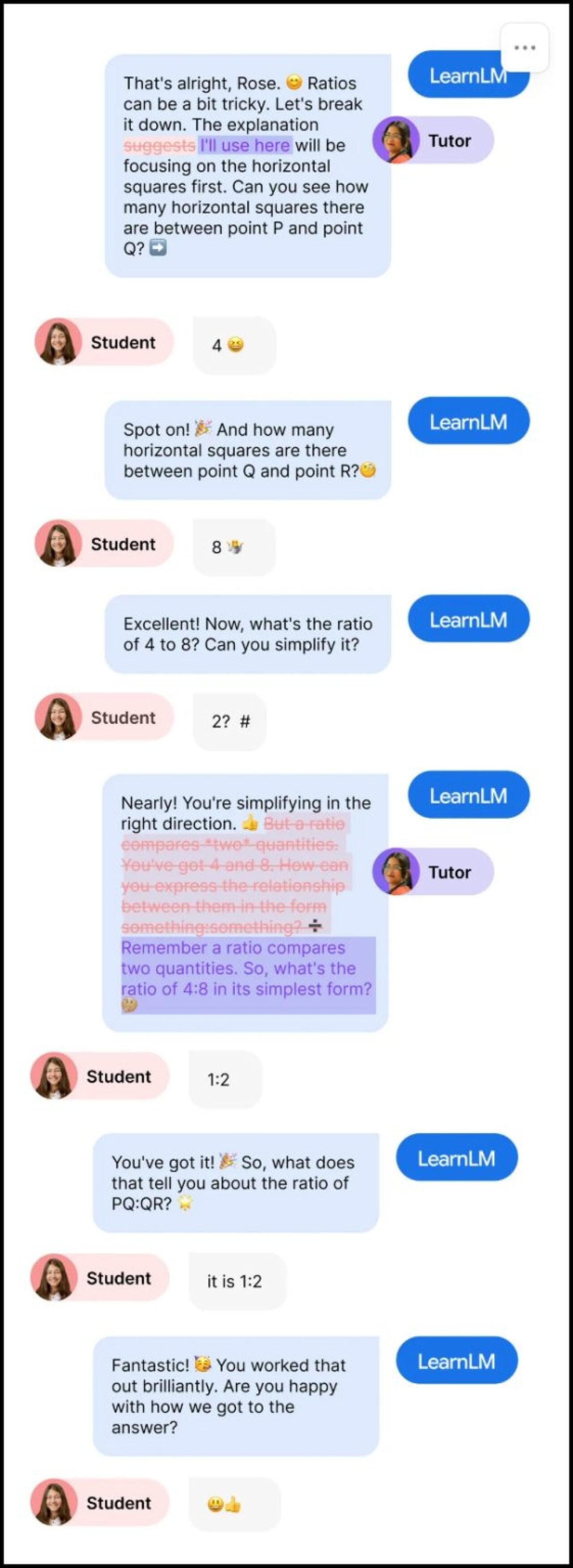
In a randomized controlled trial involving 165 British secondary school students, ages 13-15, the ed-tech startup Eedi.com put a small group of expert human tutors in charge of a large language model, or LLM, offered by Google’s LearnLM. As it tutored students on math problems via Eedi’s platform, it drafted replies when students needed help. Before the messages went out, the human tutors got a chance to revise each one to the point where they’d feel comfortable sending it themselves.

Students didn’t know whether they were talking to a human or a chatbot, but they had longer conversations, on average, with the “supervised” AI/human combination than simply with a human tutor, said Bibi Groot, Eedi’s chief impact officer.

In the end, students using the supervised AI tutor performed slightly better than those who chatted online via text with human tutors — they were able to solve new kinds of problems on subsequent topics successfully 66.2% of the time, compared to 60.7% with human tutors.

The AI, researchers concluded, was “a reliable source” of instruction. Human tutors approved about three out of four drafted messages with few to no edits.

A sample exchange between a student and an AI tutor, with replies edited by a human before they were sent out.

Eedi Labs

Students who got both human and AI tutoring were able to correct misconceptions and offer correct answers over 90% of the time, compared to just 65% of the time when they got a “static, pre-written” response to their questions.

And the AI only “hallucinated,” or offered factual errors, 0.1% of the time — in 3,617 messages, that amounted to just five hallucinations. It didn’t produce any messages that gave the tutors pause over safety.

The results suggest that “pedagogically fine-tuned” AI could play a role in delivering effective, individualized tutoring at scale, researchers said. Interestingly, students who received support from the AI were more likely to solve new kinds of problems on subsequent topics.

The key to the AI’s success, said Groot, was that researchers gave it access to detailed, “extremely personalized” information about what topics students had covered over the previous 20 weeks. That included the topics they’d struggled with and those they’d mastered.

“We know what topics they’re covering in the next 20 weeks — we know the curriculum. We know the other students in the classroom. We know whether they’re putting effort into their questions. We know whether they’re watching videos or not — we know so much about the student without passing any personally identifiable information to the AI.”

That guided the AI’s strategy about whether students needed an extra push or just more support — something an “out-of-the-box, vanilla LLM” can’t do, she said.

“They don’t know anything about what the teacher is teaching in the classroom,” Groot said. “They don’t know what misconceptions or what topics the students are struggling with and what they’ve already mastered, so they’re not able to dynamically change how they address the topic, as a human tutor would.”

Human tutors, she said, generally have “a really good sense of where the student struggles, because they have some sort of ongoing relation with a student most of the time. An LLM tutor generally doesn’t.”

All the same, even master tutors typically don’t go into a session knowing a student’s comprehensive history in a course, including their misconceptions about the material. “All of that is too much information for a human tutor to read up on and deal with while they’re having one conversation” with a student, Groot said.

And they’re under pressure to respond quickly, “so that the student is not left waiting. And that’s quite an intensive experience for tutors that leads to a bit of cognitive overload,” she said. The AI doesn’t suffer from that. It needs less than a millisecond to read all of those contexts and come up with that first question.”

Even with their personal connection to students, human tutors can’t be available 24/7. Groot said Eedi employs about 25 tutors across several time zones who are available to students from 9 a.m. to 10 p.m. every day, but to give students broader access would require hiring “an army of tutors,” she said.

The new findings could encourage schools to use AI as a kind of “front line” tutor, with humans intervening when a student is “derailing the conversation, or they have such a persistent misconception that the AI can’t deal with it,” said Groot. “We think that would be an interesting way to collaborate between the AI and the human, because there is still a really important role for a human tutor. But our human tutors just cannot have conversations with thousands of students at once.”

The new study, published on Nov. 25 on Eedi’s site and scheduled to appear in a peer-reviewed journal next year, differed in one important way from recent studies that looked at AI tutoring. Researchers at Stanford University in October 2024 examined AI-assisted human tutoring, in which tutors primarily drove the conversation. But in that case, the AI acted as a kind of assistant, providing suggestions behind the scenes. In the Eedi study, it was the other way around, with AI driving the conversation and humans overseeing it.

Robin Lake, director of the Center on Reinventing Public Education at Arizona State University, said the study is important in and of itself, but also in the context of broader findings elsewhere suggesting that, with proper training and guidance, “AI can be an incredibly powerful tool — and certainly has a potential to take tutoring to scale in ways that we’ve never seen before.”

Under controlled circumstances, she said, it’s also “outperforming humans — that’s really important.”

Lake noted a June study from Harvard researchers that examined results from 194 undergraduates in a large physics class. They presented identical material in class and via an AI tutor and found that students learned “significantly more in less time” using the tutor. They also felt more engaged and motivated about the material.

Liz Cohen, vice president of policy for 50CAN and author of the recent book “The Future of Tutoring: Lessons from 10,000 School District Tutoring Initiatives,” said the study provides “valuable evidence” about new kinds of tutoring.

But one of its limitations, she said, is that it relied on 13-to-15-year-olds. “So immediately I have a lot of questions about if the findings are applicable for younger students, especially using a chat-based model,” which may not be a good one for such students.

She also noted that there are many questions around student persistence with AI tutors, including what happens when students get frustrated or aren’t sufficiently engaged in the work?

“I still mostly think that entirely AI tutoring programs are biased towards students who want to do the work or are interested in learning,” Cohen said, “and it’s pretty easy to see that students who aren’t bought in or are frustrated are going to give up more readily with an AI tutor.”

She noted that her 12-year-old daughter has experienced problems persisting in an AI-powered math tutoring program. “She gets frustrated if she can’t get the answer and then she doesn’t want to do it anymore, so I think we need to figure out that piece of it.”

This story was produced by The 74 and reviewed and distributed by Stacker.

Topics:

Careers & Education
Careers & Education

Many young adults are barely literate despite earning a high school diploma

Many young adults are barely literate despite earning a high school diploma
By Jessika Harkay for The 74
9 min read • Originally published December 5, 2025 / Updated March 13, 2026
By Jessika Harkay for The 74
9 min read • Originally published December 5, 2025 / Updated March 13, 2026

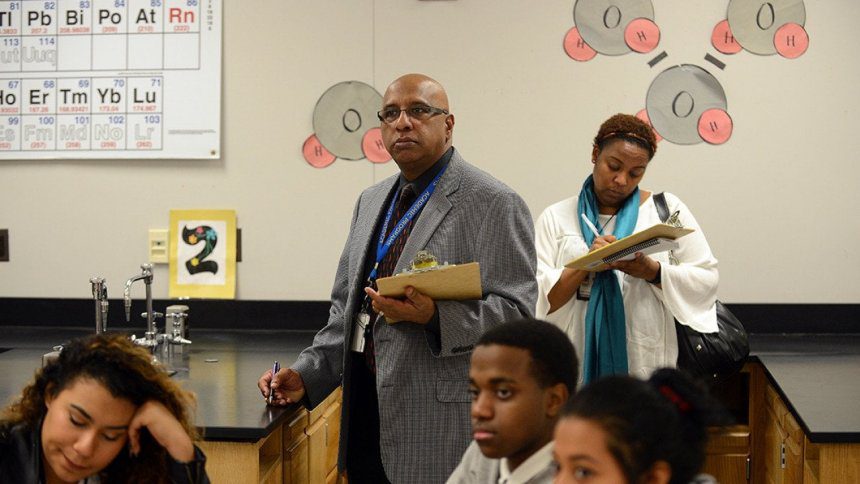
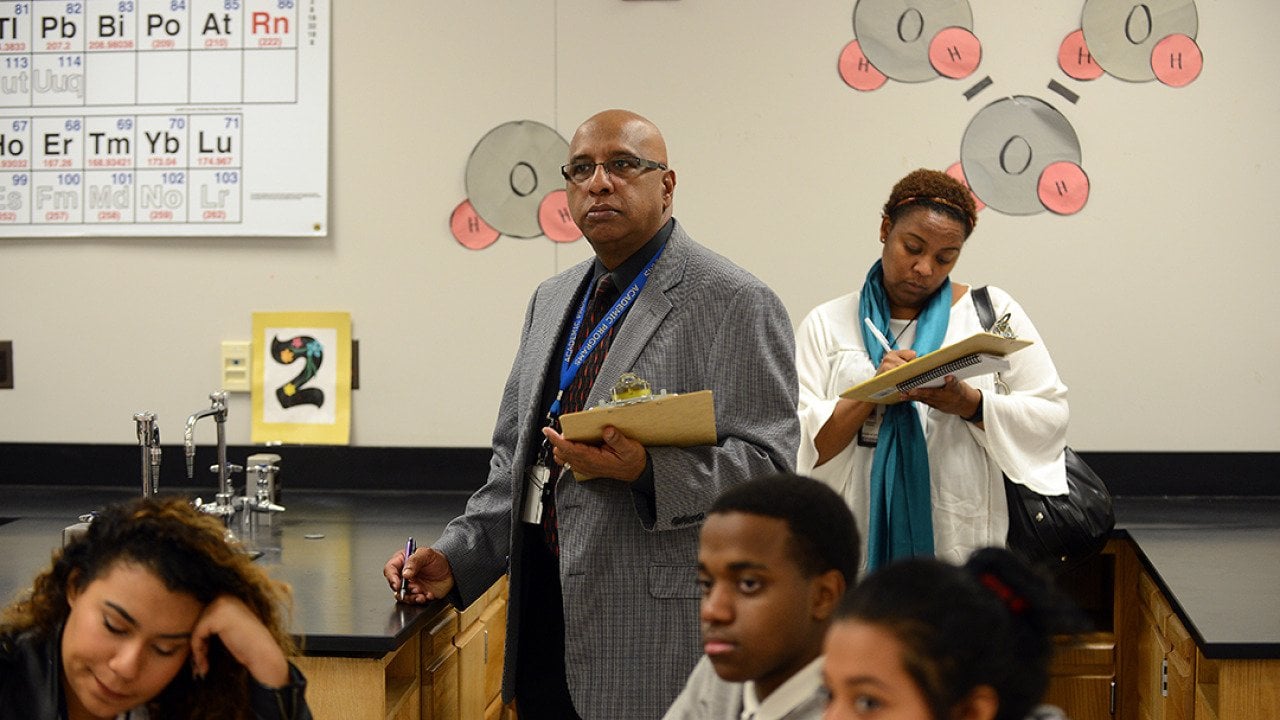
Godfrey Rangasammy, Supervisor of Science, background center, and Tanisha Johnson, a Science Coach, right, background, observe a chemistry class as Literacy coaches at Northwestern High School in Hyattsville, Maryland.

Astrid Riecken for The Washington Post via Getty Images

Many young adults are barely literate despite earning a high school diploma

One in 4 young adults across the U.S. is functionally illiterate — yet more than half earned high school diplomas, according to recently released data analyzed by The 74.

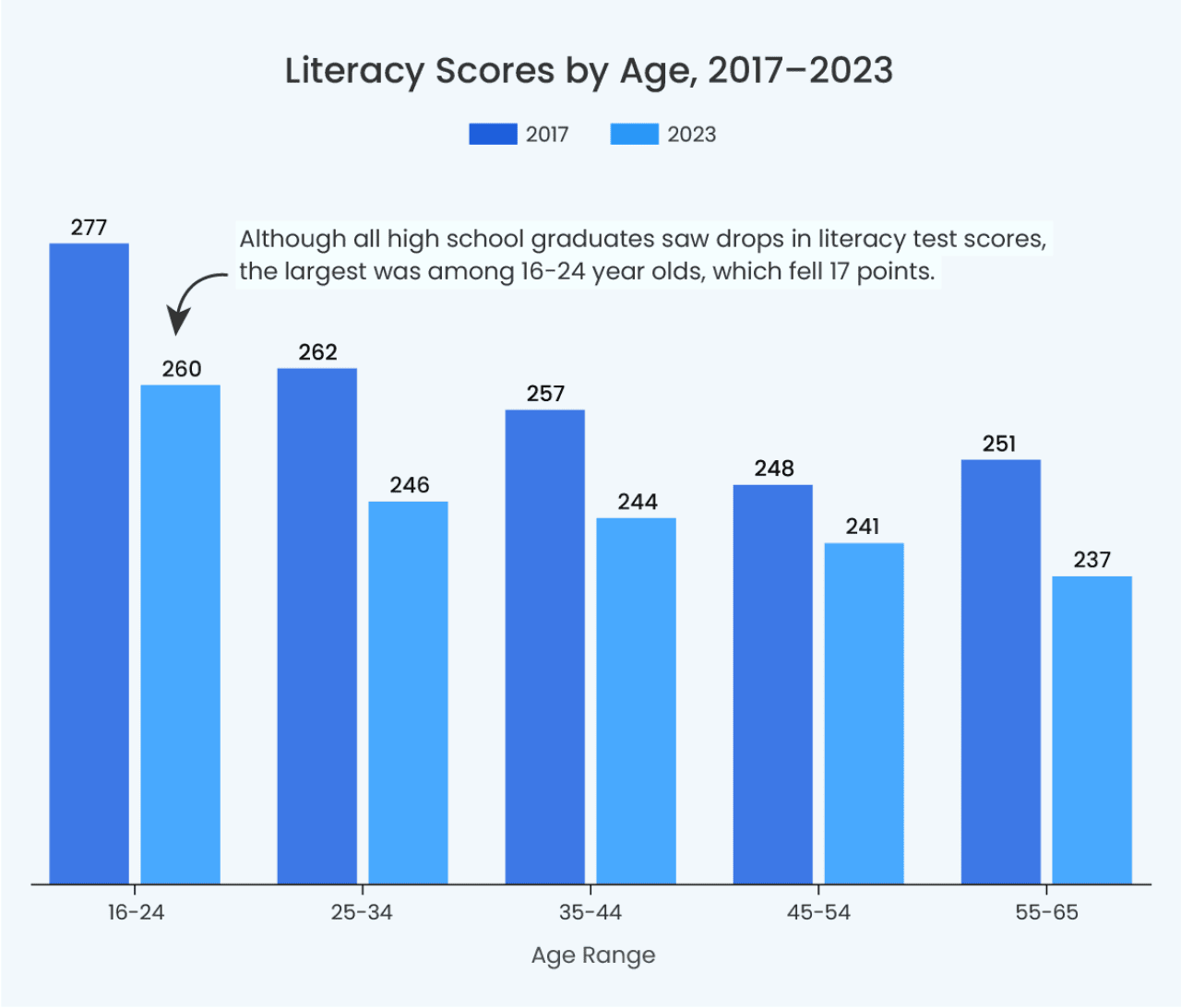
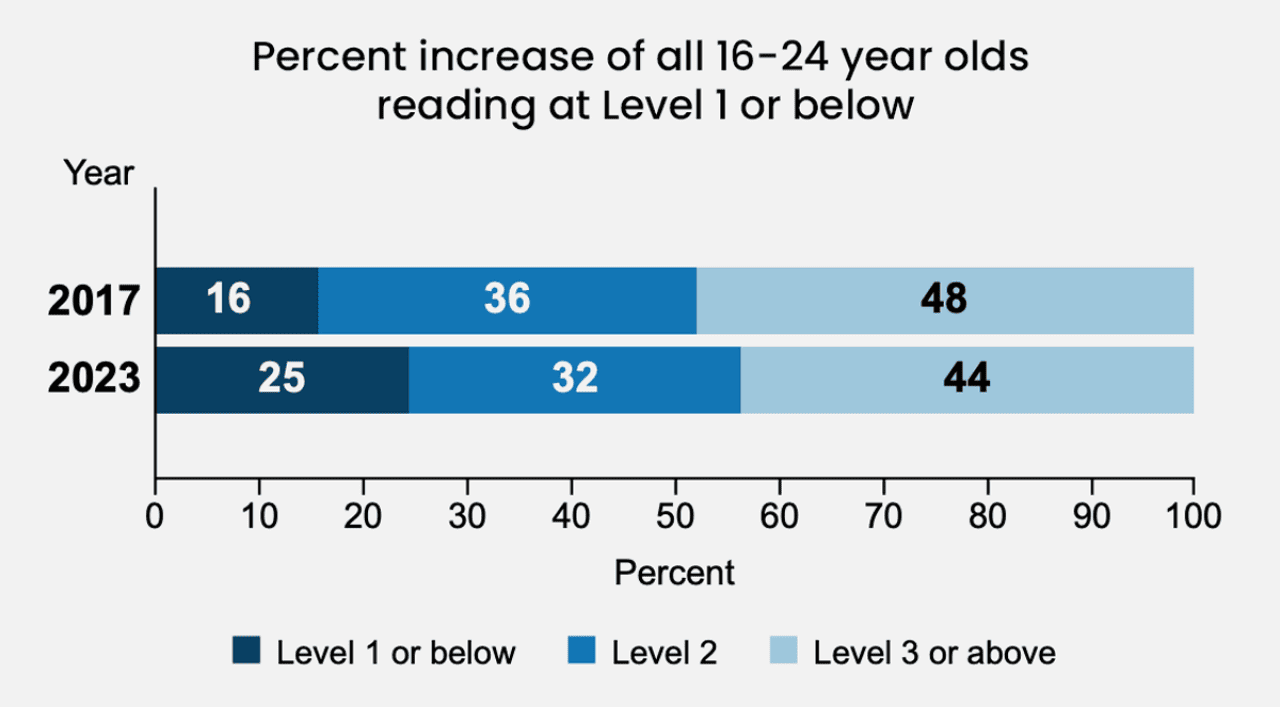
The number of 16-to-24-year-olds reading at the lowest literacy levels increased from 16% in 2017 to 25% in 2023, according to data released in December from the National Center for Education Statistics in partnership with the Program for the International Assessment of Adult Competencies.

In 2023, a total of about 5 million young adults, equivalent to the population of Alabama, could understand the basic meaning of short texts but could not analyze long reading materials, according to further analysis by the American Institute of Research.

The nine percentage-point increase is in line with an unprecedented decline in the literacy rate among all adults in the same six-year period.

But even more troubling is the AIR researchers’ finding that while the percentage of young adults with high school diplomas increased from 50% to 55% between 2017 and 2023, that group also saw the largest decrease in scores on tests measuring literacy skills compared to older adults with diplomas.

A data bar chart showing literacy scores by age in 2017 vs. 2023.

American Institutes for Research

“We know that over 20% of [young adults] that get their high school diploma do not have the skills commensurate with that,” said Sharon Bonney, chief executive officer of the Coalition on Adult Basic Education, a national adult education nonprofit. “So, when we have this ‘Make America Skilled Again’ agenda, but people can’t read, write, speak the language or do math, they can’t get good jobs and better jobs. They can’t be skilled up.”

Education experts blame the overall increase in functional illiteracy in part on poverty and housing instability, a growing population of students with high needs, and the pandemic shutdown of schools, which affected some of those in the 16-to-24-year-old group. Many adult education programs were also shuttered during the pandemic.

But researchers also believe the data may point to more troubling trends among young adults: Students increasingly passed through their school years without acquiring needed skills, a disconnect with curriculum — and a changing standard of what level of literacy is needed now that technology can provide information without most people having to think twice about it.

“When you talk about literacy, what are we talking about? Is it reading, writing, filling out forms? Or really understanding and critically questioning what it is we’re consuming?” said Limor Pinhasi-Vittorio, professor and department chair of counseling, leadership, literacy and special education at Lehman College in the Bronx. Because the latter “for sure is gone for the majority of the adult population.”

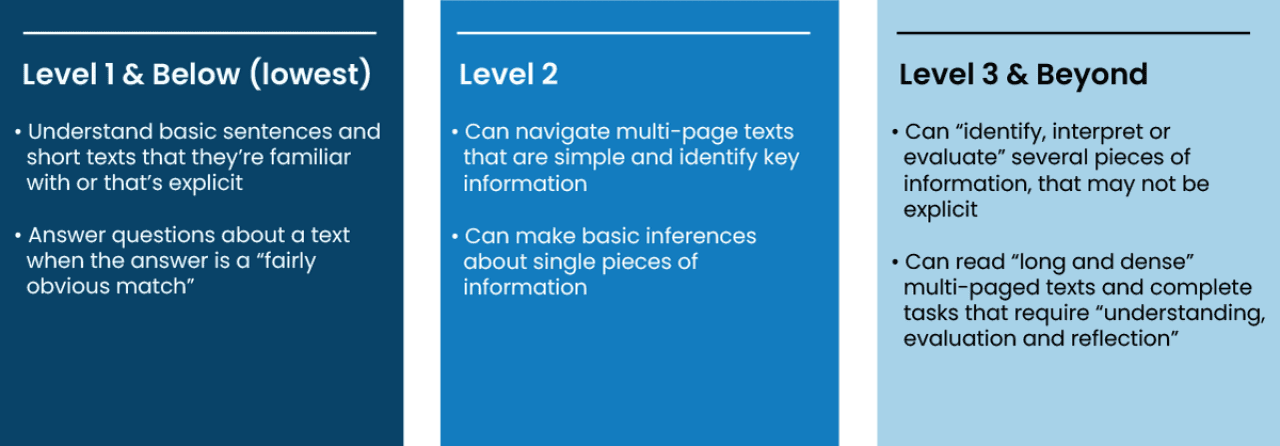
Adult literacy levels are measured through a test where individuals score on a 0-to-500-point system. The scores are then grouped on a scale of one to five. Readers at Level 1 and below only understand basic and explicit short texts, such as reading a menu at a restaurant. At the highest literacy level, it includes the ability to critically evaluate, infer and dissect complex ideas in written material.

An infographic showing definitions of levels of literacy on blue backgrounds.

Program for the International Assessment of Adult Competencies (PIAAC)

‘They’re pushed through’

Most efforts to improve literacy have centered on early intervention before third grade, as a student’s reading level at that age is viewed as a key indicator of their future success.

Nearly all states have implemented legislation for evidence-based reading instruction. Initial K-3 efforts appear promising, including in Indiana, where test scores show younger students making gains and bouncing back from the pandemic. But there’s still concern about older students who were in the early grades during the pandemic and may not have gotten help and are still struggling.

“The most effective literacy instruction is still one-on-one or small group instruction, and that’s very difficult to do at scale in the K-12 system,” said Andrew Roberts, president of the Barbara Bush Foundation for Family Literacy. “So if you have some of those background skills, you’re able to get where you need to get, but if you’re struggling, … that’s where we see people really fall off that cliff.”

Curriculum changes from a “learning to read” model after third grade to “reading to learn” through high school, many experts said, and if a student is behind from the beginning, it’s almost impossible to catch up.

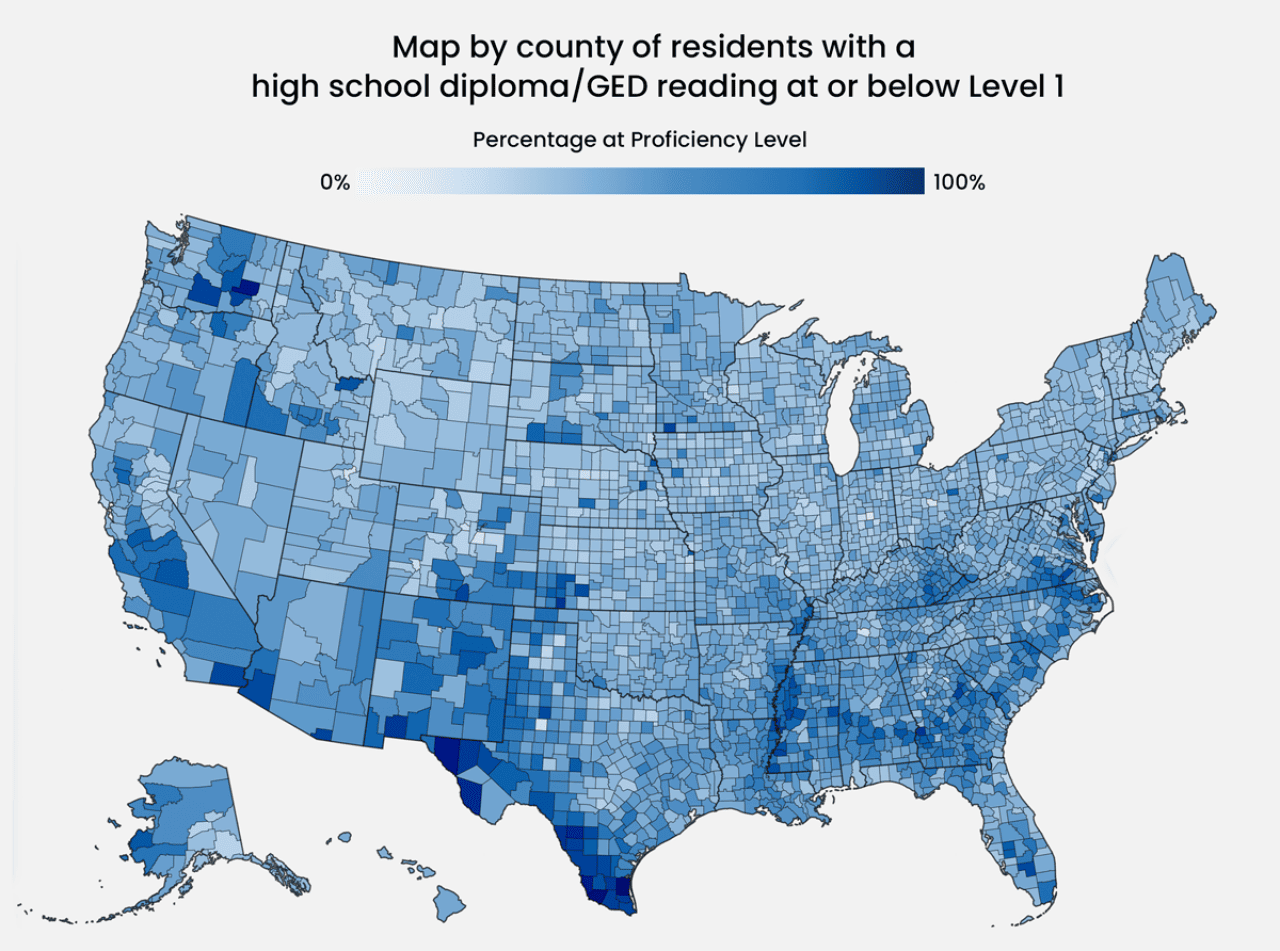
The numbers by county show the results can be devastating.

For example, in Star County in southern Texas and Adams County in central Washington state, more than 80% of high school graduates are reading at Level 1 or below. In countless other counties across the country, the Level 1 literacy rate for high school graduates is higher than 60%.

“In high schools, oftentimes [students] do get pushed along,” Bonney said. “If we’re seeing in one county that [functional illiteracy is] super high, then to me, that says that the school system has a real issue — like why are they pushing students along that don’t have skills?”

U.S. Skills Map: County Indicators of Adult Literacy showing percentage of residents in the U.S. with a reading level below level 1 that have a high school diploma.

Program for International Assessment of Adult Competencies

Some literacy advocates believe that passing a student through grades can be part of a more intentional effort to inflate graduation rates, but there’s also a belief that it’s a product of strained classrooms and a student’s ability to fly under the radar.

“Every couple decades, we’re changing the style of teaching, but the problem is the same,” Pinhasi-Vittorio said. “I’m not only talking about money, but populations that have the resources … to help the students, they will be able to. But, in areas that they don’t, they’re falling between the cracks.”

When students fall between the cracks, they also get resourceful, Roberts added.

“They find ways to hide the fact that they don’t read that strongly. … We find adults who have gotten into their 30s and struggle with reading, and people close to them don’t even fully know,” Roberts said. “There’s a lot of coping mechanisms that allow people to get by, maybe not getting by with As on their report card, but getting by enough that they’re passing through the system — friends doing homework for them — all these types of things.”

How literacy is changing

Researchers view literacy as a spectrum that goes beyond knowing the basic skills of reading and writing. After students grasp foundational reading skills, the next levels of literacy develop through practice — which some kids aren’t getting because they don’t connect to their lessons. Easy access to online sources and AI also means they don’t really have to engage with the written word deeply anymore.

Pinhasi-Vittorio recalls that when she was in school, she had to read through a set of Britannica Encyclopedias for research papers. Now, however, “you don’t even need to read and write.”

“You can just read it to the computer or the phone, and the phone will write it down,” Pinhasi-Vittorio said, adding that technology has changed the way students process information.

Students take what they get from internet searches at a surface level without disseminating it. “My concern is that we are skipping one step,” Pinhasi-Vittorio said. “The teaching needs to be different. … We need to build attention with students, which we didn’t have to do before.”

Rebuilding student interest into their lessons is part of the issue.

“A lot of the low-functioning literacy is stemming from connectivity,” she said. Students don’t deep dive into topics they don’t care about. They stop paying attention and don’t connect to their reading when they think what they’re learning in the classroom doesn’t have any “relevancy to their lives.”

A data bar chart showing percent increase of all 16-24 year olds reading at Level 1 or below between 2017 and 2023.

National Center for Education Statistics

Literacy skills can often be concentrated in topics that a student cares about or areas that play a role outside of school. For example, a student could be “very literate” in a church environment and able to dissect the Bible but struggle when it’s a text in the classroom, said Rachael Gabriel, a literacy professor at the University of Connecticut.

“For kids graduating from high school, I think there are some texts that they have trouble with, and I think there are a lot of texts that they can read that we don’t care about,” Gabriel said. “Their literacy is very likely to extend far beyond what is tested, and it may or may not show up well on the way that we’ve been testing literacy for a long time.”

So by better adapting curricula and testing in a way that mirrors a student’s background and interests, measured literacy levels will improve, Gabriel argued.

“I think the goal is just awareness and flexibility of how texts are changing across all the different contexts, where they want to be powerfully literate, where they want to be able to create and critique and participate,” she said. “It is important to teach skills explicitly, and if we teach them in a context that is relevant and engaging and has a real purpose in the world, kids learn faster and better.”

Researchers acknowledge the importance of having a baseline for literacy skills that all students should have, but how it is measured can continue to improve.

“Literacy skills are really foundational building blocks for learning everything more complex,” said Marco Paccagnella, an analyst at Organisation for Economic Co-Operation and Development, which manages the Program for the International Assessment of Adult Competencies. But many assessments were “designed and conceptualized 10 years ago.”

“The tasks that are part of the assessments mostly reflect the demands on people back in the days. There’s always a tension between adapting the assessment based on what is required of people at a particular moment in time,” Paccagnella said. “So, yes, you can say people are less able to engage with longer texts and difficult texts, but that’s maybe also because they don’t really need to now because the way we consume written information has fundamentally changed.”

The push is already being put into action as the National Assessment of Educational Progress (NAEP), which was last changed in 2004, is expected to roll out a new framework in 2026 to better measure literacy in different subject areas and disaggregate data further based on student background.

A belief that the worst is yet to come

The growth in low-literate adults wasn’t a surprise to many who have tracked reading levels throughout the years or who have worked with adult education programs. In fact, they expect the problem to get worse in the upcoming years.

Federal funding for adult education, which had already been stagnant for over two decades, has played a major role in the fact that less than 3% of those who need the programs actually received services, ProPublica reported in 2022. Many programs have monthslong waitlists.

“From 23-24, we saw 415,000 people-plus who could demonstrate additional achievement gains in literacy through outside programming. We saw over 80,000 people get their high school equivalency degree through adult programming,” Roberts said. “There are paths, but the funding level is just really low, and you’re not able to meet up the demand. It’s like a big spigot coming in and you’re kind of a small spigot going out with the people you’re able to serve.”

The programs are in further jeopardy after a recent proposal from the Trump administration called to end all federal funding for adult education programs with a $0 line item in the FY26 proposed budget.

“If kids are coming or graduating from high school with low reading skills and they don’t have access to educational opportunities as an adult to address those low skills,” said Todd Evans, senior director of programs at advocacy and literacy training nonprofit ProLiteracy, “that number will just keep growing and growing and growing.”

This story was produced by The 74 and reviewed and distributed by Stacker.

Topics:

Careers & Education
Careers & Education

10 European countries with great study options for US students in 2026

10 European countries with great study options for US students in 2026
By Ameer Hamza Arbani for HousingAnywhere
12 min read • Originally published December 8, 2025 / Updated March 13, 2026
By Ameer Hamza Arbani for HousingAnywhere
12 min read • Originally published December 8, 2025 / Updated March 13, 2026

Three female university exchange students studying together around a sunny courtyard table.

Manu Padilla // Shutterstock

10 European countries with great study options for US students in 2026

Studying abroad in Europe can be one of the most exciting choices you make as a student. It is a chance to experience new cities, meet people from around the world, and challenge yourself academically and personally. Europe offers a wide range of opportunities, from historic universities and cutting-edge research programs to vibrant student life and cultural adventures.

Each country brings something different to the table. In the U.K., you can join some of the world’s oldest universities and research communities. Germany combines affordable tuition with strong industry connections. The Netherlands offers lively campuses and many English-taught programs. Spain and Italy provide rich culture, warm weather, and lower living costs. Scholarships, exchange programs, and part-time work opportunities make it possible to study in Europe even if you have a limited budget.

Studying abroad does come with challenges, so preparation is key. You need to plan for visas, housing, and local regulations. Deadlines and requirements vary depending on your program, so checking official sources early is essential. This guide from HousingAnywhere walks you through the best European countries for U.S. students, highlighting universities, academic programs, student life, and practical advice. With the right preparation, your study abroad experience can be both successful and unforgettable.

United Kingdom

The United Kingdom continues to be a leading destination for international students, offering world-renowned universities and a wide selection of academic pathways. Some of the most popular institutions include the University of Oxford, University of Cambridge, University College London, London School of Economics, and King’s College London. These universities attract students globally due to their academic excellence, strong research output, and diverse student communities.

Students can choose from a broad range of bachelor’s and master’s degrees, supported by several significant scholarship opportunities in the U.K. Key postgraduate schemes include Commonwealth Scholarships, Chevening Scholarships for non-U.S. citizens, and Fulbright programs available to U.S. students in specific categories. Many universities also offer merit-based awards, departmental scholarships, and funding for joint-degree or Erasmus+ mobility programs, helping to reduce tuition and living costs for international students.

There are also mobility and joint-degree options through Erasmus+ and Erasmus Mundus Joint Master programs, which are accessible through partner or collaborative degrees.

In terms of post-study opportunities, the U.K. offers the Graduate Route, which currently allows graduates to remain in the country and work for two years after completing most degrees, provided they apply before the end of 2026. For those applying later, this period is expected to change to 18 months. Work-hour allowances on a student visa depend on the university’s sponsor status, so it is essential to verify institutional guidance.

Studying in the U.K. also comes with a few challenges, such as a competitive housing market, especially in London, and the risk of agent scams in private rentals. Early planning and careful verification of letting agents are strongly recommended. Students also note that department culture, course quality, and the support of supervisors and peers often have a greater impact on satisfaction than the overall university ranking.

Germany

Germany is a popular destination for international students due to its strong academic reputation, affordable tuition, and robust connections to industry. Some of the most well-known universities in Germany include Ludwig Maximilian University of Munich, Technical University of Munich, Heidelberg University, Humboldt University Berlin, and the University of Freiburg. In addition to research universities, Germany has a wide network of Fachhochschulen (Universities of Applied Sciences), which focus on practical and applied learning.

Germany has more than 420 higher-education institutions, including research universities, Universities of Applied Sciences, and specialized institutions in art, music, and other fields. Students can choose from a variety of programs, including many English-taught master’s courses. Scholarship opportunities in Germany are available through programs such as the German Academic Exchange Service (DAAD) and Fulbright Germany, which support both full scholarships and exchange funding. Public universities often charge low or no tuition fees, especially at the undergraduate level.

One of the main advantages of studying in Germany is the combination of affordable tuition and strong industry links. Paid internships in Germany are common in fields like engineering and IT, giving students practical experience while studying. Residence permits generally allow students to work part-time, although rules vary by region, and graduates may receive a limited time to search for a job after completing their degree.

Studying in Germany also comes with some practical challenges outside academics. Bureaucracy and registration hurdles are commonly mentioned, including registering at the Bürgeramt, choosing health insurance, providing proof of language proficiency, and, in some cases, attending Studienkolleg, a prep course for those whose foreign qualifications are not recognized by Germany. Many students also note that “free tuition” does not mean low living costs; semester fees, rent, and language requirements can make everyday life expensive, despite the absence of high tuition fees.

Netherlands

The Netherlands is a popular destination for international students due to its high-quality education, extensive English-taught programs, and vibrant student life. Some of the most sought-after universities include the University of Amsterdam, Delft University of Technology (TU Delft), Leiden University, Utrecht University, and Wageningen University. The country is especially known for its top-ranking English-taught master’s programs.

Dutch higher education offers numerous bachelor’s and master’s options in English, along with scholarship opportunities at both national and university levels. Students can also access funding through Erasmus+ programs. Many universities provide scholarships specifically for master’s students, helping reduce tuition and living costs.

Studying in the Netherlands comes with several practical benefits. Non-EU students are generally allowed to work up to 16 hours per week, or full-time during the summer, with a proper employer permit. Dutch health insurance is mandatory if students work. However, housing support is limited, and students are advised to begin their housing search as early as possible to avoid high rents or scarce availability. Paid internships in the Netherlands are common, particularly in fields like engineering, technology, and business, giving students valuable work experience alongside their studies.

Most students in the Netherlands highlight aspects of daily life that impact their experience. Biking culture is a defining feature, making commuting easier and reducing transportation costs. On the other hand, housing scarcity, local registration requirements, and the cost of living in the Netherlands are frequently mentioned as major stress points.

Spain

Spain is a popular destination for international students, offering strong academic programs, rich cultural experiences, and relatively lower living costs compared to Northwestern Europe. Some of the most recognized universities in Spain include Universidad Autónoma de Madrid, University of Barcelona, Pompeu Fabra University (Barcelona), and Complutense University of Madrid. Spain is particularly known for programs in humanities, business, and an increasing number of STEM courses taught in English.

Students can access numerous scholarships at both the university and national levels, including Erasmus+ and Erasmus Mundus programs, as well as some regional grants. Spain is also a popular choice for semester exchanges and language immersion, making it attractive for students wishing to improve their Spanish while pursuing studies.

Studying in Spain comes with practical benefits. The cost of living is generally lower than in Northwestern Europe. Non-EU students on a student visa are usually allowed to work part-time, though rules vary by region and type of visa. Spain has also introduced streamlined visa procedures to attract displaced international students as part of recent policy initiatives.

Most students in Spain note two recurring challenges. Language matters for real integration, while many courses are offered in English, daily life, social interaction, and many internships in Spain require a decent level of Spanish. Additionally, university administration can be slow; students frequently mention bureaucratic delays with transcripts, credit recognition, and administrative approvals.

France

France is a popular destination for international students, known for its strong academic institutions, selective Grandes Écoles, and vibrant cultural life. Some of the most recognized universities include Sorbonne (Paris), École Normale Supérieure (ENS), Sciences Po, École Polytechnique, and HEC Paris. The Grandes Écoles system remains highly selective and prestigious, especially in business, engineering, and social sciences.

French higher education offers numerous master’s and Grandes Écoles programs, with scholarship opportunities available through Erasmus+, university-specific awards, and government or regional scholarships for international students. Public university tuition is generally low for both EU and non-EU students, though tuition at Grandes Écoles tends to be higher. Internships in France are also available in major cities, including those with strong research labs to provide students with practical experience alongside academic study.

Studying in France comes with several practical benefits of student life. Student discounts and monthly transport passes are widely used, helping make city life more affordable. Students also note differences in grading and exam culture, with some institutions placing heavier emphasis on final exams rather than continuous assessment.

Italy

Italy is a popular destination for international students due to its rich cultural heritage, high-quality universities, and relatively affordable living costs outside major cities. Some of the most recognized universities in Italy include Sapienza University (Rome), University of Bologna, Politecnico di Milano, and Bocconi University (business). Bologna is historically significant for international students and is closely associated with the Bologna Process, which shaped European higher education standards.

Italy offers a wide range of humanities, architecture, and arts programs, with English-taught master’s degrees available at institutions such as Bocconi and Politecnico di Milano. Scholarship opportunities in Italy are available through Erasmus+ and university-level awards, helping to reduce tuition and living expenses.

Studying in Italy provides practical benefits such as low tuition at public universities (region-dependent), vibrant cultural life, excellent food, and relatively affordable living outside Milan and Rome. Part-time opportunities and paid internships in Italy are available for students, although some may require proficiency in Italian.

Most students in Italy report challenges related to daily administration and course access. Course scheduling and class availability can be limited, especially for English-taught labs, making early registration important. Additionally, local bureaucracy and language requirements often impact internships and other practical aspects of study.

Sweden

Sweden is a popular destination for international students due to its high-quality education, innovative research, and strong focus on English-taught programs. Some of the most recognized universities include Karolinska Institutet, Lund University, Uppsala University, and KTH Royal Institute of Technology. Sweden offers a wide range of English-taught Master’s programs, particularly in science, technology, and health disciplines.

Scholarship opportunities are available for non-EU students through university-specific or national programs, although these are often competitive. Exchange students can also benefit from Erasmus+ programs, which facilitate semester mobility and joint-degree options.

Studying in Sweden comes with several practical benefits. The country is known for its high quality of life, access to healthcare mechanisms for students, and strong social services. Students are generally allowed to work while studying, though living costs in Sweden are relatively high compared to other European countries.

Most students highlight cultural and academic experiences that shape daily life. “Fika” (coffee breaks) is frequently mentioned as an important social and networking activity that helps with integration. Academically, coursework often involves group work and independent learning, which suits students who thrive in collaborative or self-directed environments.

For the student visa/residence permit, non-EU/EEA students planning to study for more than 90 days need a residence permit from the Swedish Migration Agency.

Switzerland

Switzerland is a top destination for international students, particularly in STEM fields, due to its globally recognized universities, cutting-edge research, and strong ties to industry. Some of the most notable institutions include ETH Zurich, EPFL (Lausanne), University of Zurich, and University of Geneva. ETH Zurich and EPFL are especially known as global leaders in engineering, technology, and natural sciences.

Swiss higher education offers a wide range of master’s and doctorate programs, with scholarship opportunities available through EPFL and ETH for select students. Exchange students can also access Erasmus+ programs for semester mobility and joint-degree options.

Studying in Switzerland comes with practical benefits such as excellent research-industry connections and high salaries for internships. However, students face a very high cost of living, including food, transport, and housing, and there may be stricter work and permit rules for non-EU students depending on the canton.

Most students note that internships are extremely competitive, especially at major laboratories or companies. Networking, professors’ recommendations, and proactive engagement are often crucial to securing these opportunities. Students currently studying in Switzerland also highlight the cost shock, warning incoming students about everyday price levels in Swiss cities.

Portugal

Portugal is becoming an increasingly popular destination for international students, offering a combination of quality education, lower living costs compared to Western Europe, and a warm climate. Some of the most recognized universities include the University of Lisbon, Nova School of Business and Economics (Nova SBE), University of Porto, and Católica Lisbon. The number of English-taught programs is steadily growing, especially at the master’s level.

Students can access scholarships through Erasmus+ partnerships, local university awards, and regional programs. Portugal is particularly attractive for language students and those seeking an affordable European study experience, while still benefiting from a supportive academic environment.

Studying in Portugal provides practical benefits such as lower living costs, a mild climate, and increasing services for international students. Work opportunities may vary, and Portuguese language skills are often helpful for internships and social integration, though English is widely spoken in major cities.

Most students highlight aspects of student life that impact their daily experience. Portugal has a small but growing international community, making it relatively easy for newcomers to settle in. Some specialized programs are smaller, so students are advised to check course offerings early. English is commonly used in cities, but learning Portuguese can enhance internships and social interactions.

Ireland

Ireland is a popular destination for international students, particularly English-speaking students from the U.S. and other countries, due to its fully English-language environment and strong academic institutions. Some of the most recognized universities include Trinity College Dublin, University College Dublin (UCD), and University of Galway. Ireland offers a wide range of undergraduate and master’s programs in English, making it accessible to international learners.

Students can access scholarships through Erasmus+ exchanges with partner institutions as well as national scholarship schemes. Ireland is also known for its vibrant startup and technology sectors, providing numerous internship opportunities, especially in Dublin.

Studying in Ireland comes with practical benefits. Student visas typically allow part-time work of around 20 hours per week during term, with full-time work permitted during holidays. Various post-study schemes allow non-EU graduates to remain and work for up to two years, depending on their qualification. The country’s strong alumni and industry networks, especially in tech and startups, are frequently cited as major advantages by students.

Most students report both academic and lifestyle considerations. Small cohort sizes in some programs foster close peer networks, which can be valuable for support and job opportunities. On the other hand, the cost of living in Dublin, particularly for housing and rent, is a frequent challenge.

Studying in Europe gives you more than a degree. It is a chance to explore new cities, meet people from all over the world, and gain experiences that shape your future. Each country has its own style of teaching, student life, and opportunities, so the best experience comes from choosing a destination that matches your goals and personality. When planning your move, apply for your visa as soon as you have an unconditional offer. Check university deadlines carefully because technical, design, medicine, business, and selective master’s programs often have earlier rounds or require tests and interviews. Always confirm proof of funds on official embassy or immigration pages since the required amounts are updated every year.

With careful preparation and research, studying abroad can become one of the most rewarding experiences of your life. Understanding what to expect from visas, deadlines, and funding requirements makes navigating bureaucracy much easier and lets you focus on your classes, internships, and cultural experiences. Europe offers a unique combination of world-class education, career-building opportunities, and personal growth. Planning ahead and staying organized will help you turn your study abroad adventure into an experience that leaves lasting memories and practical skills long after graduation.

This story was produced by HousingAnywhere and reviewed and distributed by Stacker.

Topics:

Careers & Education
Careers & Education

Burnout and AI are redefining healthcare work in 2026

Burnout and AI are redefining healthcare work in 2026
By Priya Rathod for Indeed
5 min read • Originally published December 9, 2025 / Updated March 13, 2026
By Priya Rathod for Indeed
5 min read • Originally published December 9, 2025 / Updated March 13, 2026

A hospital nurse experiencing burnout at work.

PeopleImages // Shutterstock

Burnout and AI are redefining healthcare work in 2026

The U.S. healthcare workforce is heading into 2026 under mounting strain, with two in five healthcare workers reporting that their jobs feel unsustainable. New national data from Indeed’s Pulse of Healthcare report shows that burnout, staffing shortages, and rising administrative demands are pushing many clinicians to reconsider their future in the field, with some questioning whether they can remain in healthcare at all.

Dr. Darien Sutton, a board-certified emergency medicine physician and ABC News medical correspondent, discusses with Indeed the deep emotional fatigue echoed across the field and shares how employers can support, rather than add to, the day-to-day demands of patient care.

Burnout is reshaping how workers think about their careers

Burnout remains one of the most persistent issues for healthcare workers, driven by chronic understaffing, administrative overload, and a lack of meaningful support.

Indeed surveyed 924 U.S. healthcare professionals nationwide and found that unmanageable workloads and lack of support, compounded by chronic understaffing are driving this crisis.

“People aren’t just looking for another job in the same hospital—they’re looking for another career,” Dr. Sutton said. He described a “rare kind of heartbreak” many clinicians feel: a “level of disdain for something you love” that becomes unsustainable over time.

Much of this frustration stems not only from patient care responsibilities but from feeling buried under systemic issues and administrative demands.

“We’re doing the work, navigating the healthcare system, and managing the complaints,” he said. “And often, the people who could help are several floors away, behind closed doors.”

This disconnect contributes to employee turnover that’s expensive and destabilizing. Replacing a single healthcare worker costs employers six to nine months of salary, according to the report, and every departure weakens continuity of care.

Most wellbeing programs miss the mark, workers say

Work wellbeing isn’t about surface-level perks like free lunches or discounted gym memberships. While many healthcare organizations have invested in wellness initiatives, the data suggests these efforts often fail to address employees’ real needs.

Today, healthcare workers want structural support: communication, reasonable workloads, safe staffing levels, and time to recover. From a business perspective, investing in these fundamentals not only improves workplace culture but also strengthens retention and patient outcomes. According to Indeed’s report, 80% of healthcare workers say existing well-being solutions are ineffective, often because staffing constraints prevent participation or programs don’t address the root causes of burnout. Workers report being short-staffed 43% of the time, underscoring why surface-level initiatives fail to make a meaningful impact.

Organizations that prioritize staffing and communication see lower turnover rates, highlighting how structural support directly impacts retention and patient care. Even small, everyday moments like acknowledging a colleague or slowing down enough to listen without multitasking, can shape how supported workers feel.

What this means for job seekers

Healthcare professionals looking for new roles, or even considering leaving the field, are facing tough questions. Staffing shortages keep demand for workers high, but burnout and administrative overload are pushing many to rethink what they want from a job.

One clinician at Indeed’s 2025 “Careers in Care: Off The Clock” event for healthcare workers described that struggle, sharing that she voices her concerns at work but still feels unappreciated. “I express to my boss all the time that I’m tired. I don’t want to quit and leave my clients, but I just got off of a leave of absence to come back to the same thing.”

A recent jobs report from the Bureau of Labor Statistics underscores the opportunity: Payrolls added 119,000 jobs in September, with healthcare and social assistance driving the gains, contributing 57,100 jobs. For job seekers, this means openings are there, but finding the right fit matters more than ever.

When considering a new role or workplace, job seekers should focus on signs of structural support. Asking questions about safe staffing ratios, communication practices, and leadership engagement can reveal whether an organization truly prioritizes its people. Look for employers that actively listen, provide protected time off, and use technology to reduce administrative burden without replacing care. These characteristics can help identify workplaces that invest in long-term wellbeing rather than just filling shifts. Finding an environment where care for patients doesn’t come at the cost of caring for yourself is essential for healthcare workers today.

AI is easing workloads, but clinicians worry about what it might replace

60% of healthcare organizations already use AI, mostly in support roles like clinical note-taking, automated charting, and patient education. These tools help reduce administrative burden, which affects 40% of shifts and is cited as the top threat to well-being.

But despite optimism about the efficiency AI brings, healthcare workers remain cautious. Their top concerns include:

  • Erosion of clinical judgment
  • Loss of human interaction
  • Privacy and surveillance risks
  • Job displacement and devaluation

Half of healthcare workers expect AI to reduce their workload, which is the single biggest benefit they associate with the technology. More than half say clinical documentation tools that streamline recording patient encounters and writing notes would have the greatest impact on their work.

“AI can make us more productive,” Dr. Sutton said, “but we have to make sure it’s not replacing the care.” The future of AI in healthcare will depend on thoughtful implementation and how organizations balance efficiency with the trust and human connection patients rely on.

Workforce stability depends on staffing

Many of the challenges that healthcare workers face point back to one foundational issue: staffing.

“We have to start with staffing,” Dr. Sutton said. “Protected time off, safe standards, and basic resources are not optional. They’re what the system needs to function.”

67% of healthcare workers say reducing task overload through proper staffing and technology would give them more time with patients, improving both care and job satisfaction. Adequate coverage also makes it possible to respect time off and keep patient-to-provider ratios safe.

When staffing falls short, pressure builds everywhere. Communication breaks down, morale dips, and the emotional strain of the job pushes more people to question whether they can stay in the field.

Building a more sustainable workforce

The report found that simple recognition programs, like recurring shout‑outs or employee‑of‑the‑month initiatives, are among the most impactful ways to foster appreciation. More than 80% of workers say regular leadership check‑ins affect their well‑being, yet most report they rarely happen. Healthcare workers also point to mental health days outside of PTO and access to counseling as critical supports, with two‑thirds saying these initiatives would improve conditions.

Workers aren’t looking for complicated fixes. They want adequate staffing, leadership that listens, and time to recover. Employers must decide whether to act on what their workforce is telling them before the cycle drives even more people out of the field.

As Dr. Sutton puts it, “Remembering why you started this in the first place is so important. We can’t lose sight of that.”

This story was produced by Indeed and reviewed and distributed by Stacker.

Topics:

Careers & Education
Careers & Education

The advantages of becoming a part-time fitness instructor and where to start

The advantages of becoming a part-time fitness instructor and where to start
By Joy Prouty for Zumba
9 min read • Originally published December 12, 2025 / Updated March 13, 2026
By Joy Prouty for Zumba
9 min read • Originally published December 12, 2025 / Updated March 13, 2026

A fitness instructor leading a class.

KOTOIMAGES // Shutterstock

The advantages of becoming a part-time fitness instructor and where to start

Part-time fitness instructors enjoy a lucrative side hustle while staying fit — and helping others stay fit, as well. If you’re interested in becoming a fitness instructor while still managing your other responsibilities, this guide from Zumba on the benefits of being a part-time instructor is just what you need to get started.

Why Should You Become a Part-Time Fitness Instructor?

There are many advantages of becoming a fitness instructor, including enhanced convenience, flexibility, and earning potential. If you’re considering starting a career as a part-time fitness instructor, here are some of the benefits you can enjoy.

Provides a Low-Risk Way to Test the Career

Becoming a part-time fitness instructor allows you to test the waters before quitting your day job. If you’ve never worked in the fitness industry, a part-time role can give you firsthand experience in what it’s like.

A part-time career can show you if you have the capacity and entrepreneurial spirit to succeed as a full-time fitness coach. It can also provide a profitable side hustle while you enjoy the stability of your full-time career. If being a part-time fitness instructor is not a good fit, it won’t be a major loss, as compared to embarking on a full-time fitness career.

Helps You Find Your Specialty

When you become a part-time fitness instructor, you get to explore different formats without committing to one permanently. You can try out one-on-one coaching or group training to evaluate if you prefer to work with individuals or groups. You can also try out different niches like dance-based workouts, weight training, and weight loss specializations.

Gives You a Flexible Schedule

Working part-time makes it easier to schedule your sessions around your life. You can create boundary hours where you’re free from work and coordinate times with clients that work for both of you. It also makes it easier to plan your sessions ahead of time and take time off for vacations or special events when you need it.

Offers Enhanced Earning Potential

With part-time fitness training, you can earn extra cash to help with bills or fund extra costs when needed. You can also set your own hourly rates, giving you more control over your earnings. The more clients or classes you take on, the more income you receive. With marketing, location, and the right clientele, you can create a fruitful stream of income.

Rewards You With Purposeful Work

Being a part-time fitness instructor gives you a rewarding way to make money. You can empower clients with the skills to keep themselves fit and reach their health goals. When you help a client reach their fitness goals, you help them build their confidence, which can be deeply fulfilling for both parties.

Brings You Additional Health Benefits

Workers with too little physical activity and sedentary behaviors are at higher risk for chronic illnesses. As a part-time fitness instructor, you get to make money while exercising, allowing you to stay physically active at work. Compared to typical desk jobs, fitness instructors get more movement, supporting overall health.

An infographic showing the advantages of becoming a part-time fitness instructor.

Zumba

Top Skills for Part-Time Fitness Instructors

Part-time fitness instructors are highly skilled at striking a balance between motivation and accountability. If you’re interested in pursuing this career option, here are some of the top skills needed.

Empathy and Communication

As a fitness instructor, empathy is vital to enjoying your career and making sessions more enjoyable for your clients. Empathy helps you relate to your clients better and understand what some of their challenges may feel like. Compassionate coaches offer a supportive approach that makes clients feel heard and valued.

Communication is an important tool for conveying empathy and compassion while still keeping clients motivated. Part-time trainers have more time flexibility, but they may also have more strict scheduling, especially if they’re balancing a full-time job. They need to have the communication skills to show compassion when clients are unable to make it to sessions, but also be able to motivate them to stay consistent.

Passion for the Industry

Anyone wanting to work in the fitness industry should be passionate about helping people reach their fitness goals and about general health and wellness topics. Passion will help you offer the best service possible to your clients.

Your passion for fitness shines through, and your infectious positivity can help you draw in new clients. It also improves your professional longevity, keeping you motivated throughout your career.

Time Management

Being a part-time fitness instructor calls for excellent time management skills. You want to be able to follow up with clients, make it to sessions on time, and still strike a good work-life balance. Here are some tips to manage your time better as a part-time fitness trainer.

  • Consistency: Schedule days for workout sessions and at least one day for handling admin and marketing tasks. Create a reschedule policy to ensure that clients also consistently show up, helping you stick to your schedule and helping them stick to their goals.
  • Time-blocking: Time-blocking is a technique that allows you to focus on one task at a time, helping you avoid procrastination and distraction. Aim to set a few time blocks a week where you write comprehensive fitness plans or organize your group classes.
  • Planning: Part-time fitness instructors can plan their sessions ahead of time, making scheduling easier. Proper planning can help you meet your commitments to clients while still hitting your objectives outside of your fitness career.

Finance and Tech Skills

Part-time fitness instructors need to have excellent financial skills to invest in their business and stick to a budget for months when client levels may be low. It’s important to strike a balance and book the ideal number of clients to keep the business running smoothly without taking on more than you can handle as a part-time instructor.

You’ll also need to budget to reinvest some of your profits into your business for factors like marketing, equipment, and rent. Before you start your business, ensure you fully understand all the factors that would affect your financial stability, like revenue, client dropouts, and festive seasons.

Tech skills are also essential for any business owner, including part-time fitness instructors. You’ll need to communicate with your clients via digital platforms, advertise your offerings on social media, and handle digital payments.

An infographic listing steps on how to become a part-time fitness instructor.

Zumba

Where to Start Your Journey Toward Becoming a Part-Time Fitness Instructor

Are you ready to start your career journey and enjoy the advantages of becoming a fitness instructor? Every fitness instructor has a different route, but here are some important steps to pursuing this profession.

Decide on Your Setting

According to the U.S. Bureau of Labor Statistics, 55% of fitness trainers work in fitness and recreational sports centers. Part-time trainers have various class settings to choose from. They can also choose to keep their sessions more informal and unstructured. Here are some of the top options you may have as a part-time fitness instructor, including their potential pros and cons.

  • Big-box gym: These types of settings offer many time slots, budget-friendly membership options, and steady foot traffic. However, there are also more policies to follow and lower pay, which may not be conducive to part-time work.
  • Community center: Community centers are generally affordable and family-friendly, and they receive great word-of-mouth marketing. That being said, there’s limited equipment. Fees also need to be affordable for the community, so pay is moderate.
  • Corporate wellness: Enjoy perks like consistent attendance and predictable daytime hours when teaching in corporate fitness settings. Just keep in mind the potential limitations, such as conservative programming, strict policies, and limited time windows.
  • Private studio: Teaching in a private studio gives you more control over programming and higher earning potential. However, it may also come with higher rent, no walk-ins, and additional marketing costs.
  • Online: Online instruction gives you optimal time flexibility — you can work from anywhere and create scalable content. Of course, there are factors like marketing fees, platform fees, and music licensing to consider. Growing your online customer base can also be challenging in a highly saturated market.

Choose Your Niche

As a part-time fitness instructor, you have many fields in which you could specialize. Choosing a niche can help you stand out from the competition and attract the right target market. Here are some popular options.

  • Group fitness instructor: Group fitness instructors are passionate about working with medium-to-large classes. They have the skills to facilitate groups through strength, equipment-based, and hybrid exercise formats.
  • Nutrition coach: Nutrition fitness instructors specialize in providing individualized nutrition coaching. They help clients overcome negative eating habits and build healthier ones.
  • Weight loss specialist: These part-time fitness instructors typically work one-on-one with clients, helping them overcome physical and psychological challenges associated with weight loss goals. They are passionate about helping their clients get healthier and feel more confident through diet plans, weight loss guidelines, training methods, and psychological exercises.
  • Corrective exercise specialist: This is a rewarding and lucrative part-time fitness business. These trainers specialize in helping clients reduce their injury risks and move more efficiently for improvement in muscle growth, stamina building, and other fitness categories.

Create Your Instructor Portfolio And Package

A strong portfolio and package can help you find more customers as a part-time fitness instructor. It can help clients see what they can expect from your training and learn more about what makes you qualified to help. Your portfolio should include your professional strengths, qualifications, and experience. You can also include testimonials, success stories, and any before-and-after pictures.

To craft a compelling package, include promotions that speak to your clients’ challenges. Include a measurable goal like “8-Week Fitness Boot Camp” and clearly define what they can expect from each one. Present your package in a visually appealing format that’s easy to understand. Aligning the package with your brand voice can help build trust and consistency.

Earn the Right Certification

To become a part-time fitness instructor, you need to earn the right certification for the niche you wish to practice in. Typically, you’ll need a high school diploma to enter the occupation, but some employers might opt to bring on fitness professionals with a degree in fitness or health care-related fields. Common examples of other certifications include kinesiology, exercise science, and physical education.

Most fitness instructors also need certifications that help keep their clients safe, such as CPR and first aid. New trainers may also need to shadow a more experienced trainer before they can train clients on their own. It’s important to get these essential health safety certifications so you can keep clients safe in case of emergencies.

Part-time fitness instructors also have certifications to match their niche. For example, Zumba instructors typically take Zumba instructor training courses to facilitate their classes successfully.

FAQs

Becoming a part-time fitness instructor is a rewarding way to earn extra money while making a difference. Here are some commonly asked questions to bring you clarity.

Is Being a Fitness Instructor a Good Side Hustle?

Being a fitness instructor is a good side hustle because it’s a fun way to earn some extra cash and stay fit at the same time. The median annual wage for fitness trainers and instructors in May 2024 was $46,180. Part-time trainers can choose their availability, area of specialty, and fees, giving them control over their earnings.

Can You Become a Part-Time Fitness Instructor?

Yes, you can become a part-time fitness instructor and help clients reach their fitness goals at your earliest convenience. Part-time trainers still need relevant personal training certifications, but they generally have more freedom over the settings and times they can work.

What’s the Difference Between a Full-Time and Part-Time Fitness Instructor?

A full-time fitness instructor works longer hours — typically a standard work week, around 35-40 hours. Part-time fitness instructors have more flexibility with working hours, so they can work according to their capacity. They also have more freedom to choose their ideal setting and clientele.

Reap the Benefits of Becoming a Part-Time Fitness Instructor

Becoming a part-time fitness instructor brings unmatched flexibility, convenience, and benefits. With the tips mentioned in this guide, you can start your journey successfully while enjoying working from diverse locations. You can turn your passion for fitness into a lucrative side hustle that allows you to build your health and wealth.

This story was produced by Zumba and reviewed and distributed by Stacker.

Topics:

Careers & Education
Careers & Education

Most common financial conflicts between kids and parents and tips for getting ahead of them

Most common financial conflicts between kids and parents and tips for getting ahead of them
By Beth Mowbray
5 min read • Originally published July 8, 2022 / Updated March 13, 2026
By Beth Mowbray
5 min read • Originally published July 8, 2022 / Updated March 13, 2026

Kids sit and learn about money at a bank.

Liz Hafalia/The San Francisco Chronicle // Getty Images

Most common financial conflicts between kids and parents and tips for getting ahead of them

Parenting children of any age has its ups and downs, and part of the job is navigating a variety of conflicts as children grow and mature. One of the most common conflicts are those related to money.

GoHenry analyzed the most common financial conflicts between kids and parents based on a study from LendingTree and further research. LendingTree, along with Qualtrics, surveyed 1,051 parents of children under 18 in January 2022. One in 4 parents who participated in this survey reported recently arguing about money with their child.

Money does not have to be an ongoing stressor in parent-child relationships, though. Parents can get ahead of potential conflict by starting to discuss finances with their kids at a young age. The earlier and more often these conversations come up, the more knowledgeable and prepared children will be for their financial futures.

Kids want to have these conversations, too. In fact, half of children in a 2021 survey conducted by T. Rowe Price said they wanted their parents to talk to them about saving money, and 1 in 3 would like to discuss how to budget.

Read on to learn about the most common conflicts parents and children have about finances and tips on how to turn these conflicts into learning opportunities.

Teenagers ride rented scooters.

Robert Alexander // Getty Images

#5. Parent didn’t give child money to do something they wanted

Children often ask their parents for money to go out and do things. As the old saying goes, money doesn’t grow on trees, so parents must say “no” sometimes. These situations can be opportunities to teach kids about money and financial responsibility.

Differentiating between wants and needs can be a powerful lesson. Children also learn by watching their parents, so modeling financial responsibility is a great way to encourage children to make positive choices with their own money.

Teaching budgeting skills will follow children well into adulthood, while also helping them save money to do something they want. When budgeting for special events, there are simple steps and strategies parents can use—even with young children: setting a goal, planning the amount that needs to be saved, encouraging progress, and celebrating when the savings goal is achieved.

Two girls window shop.

Alexi Rosenfeld // Getty Images

#4. Child’s spending habits

Sometimes, the things children want to spend their money on—not to mention the cost of these items—are not aligned with parental expectations for smart spending. Parents can work to prevent arguments about their children’s spending habits by teaching money-saving strategies from a young age.

Help kids be specific about their savings goals. It is important to not just set goals, but to break them down into smaller steps and clearly establish where the money will be saved—a piggy bank, a savings account, or even a debit card for kids.

Just having a plan to save money isn’t enough. Kids should learn to track their spending as well. Parents can encourage this behavior by providing opportunities for children to earn their own money via allowances.

Two boys talk next to a hot dog vendor.

Robert Alexander // Getty Images

#3. Child’s allowance amount

Allowances are an important way for parents to teach their kids not only how to manage their money but also the value of working to earn that money. Three in 4 parents pay an allowance to their children and about 1 in 3 set this payment somewhere between $11 to $20 per week, according to Investopedia.

However, setting the amount of the allowance can lead to arguments between parents and their kids. One way to mitigate this is to start paying allowances when children are as young as 5 or 6 years old. Establishing a clear amount in advance and explaining how this amount has been determined is another useful strategy to avoid conflict. For example, some parents pay children based on their age, while others assign a dollar amount to each chore or task the child completes.

Happy girl makes a credit card purchase on a laptop.

Lysenko Andrii // Shutterstock

#2. Child used credit card without permission

Nearly half of parents in the LendingTree survey said their child used their credit or debit card at least once without permission. With the average amount spent coming in at $534, it’s no surprise this is one of the top financial conflicts between kids and parents.

While the American Academy of Child and Adolescent Psychiatry acknowledges stealing as a “normal” behavior in very young children—who often take things they find interesting without understanding the repercussions—theft by older children can occur for many reasons that must be properly addressed. Older children may steal to show off for or feel more accepted by their friends, to give gifts to others, and even as a way to seek attention or express anger toward their parents.

So how should parents approach their kids when they steal? Child and adolescent psychiatrists recommend clearly labeling the behavior as unacceptable but not lecturing or condemning the child for their actions. Ensuring the child returns or pays back what they have taken is a powerful and effective learning lesson.

Teaching kids about properly using credit cards can also build good habits, such as establishing a prepaid card or authorizing a child to use a credit card—with features activated to track their spending.

Girl throwing a tantrum in the grocery store.

antoniodiaz // Shutterstock

#1. Parent didn’t buy something child wanted

Teaching children to regulate their emotions and respond appropriately when they don’t get their way is a common challenge for parents. Cleveland Clinic pediatrician Edward Gaydos recommends a number of strategies parents can use to help increase their children’s compliance and avoid unwanted behavioral issues.

Setting clear behavioral expectations and limits, then sticking to them, is crucial for kids. This includes being specific with those expectations and following through with discipline when needed. For example: A child should understand in advance what behavior is expected when out in public at a store. If the child throws a tantrum when their parent will not buy them an item they want, the child should understand the consequence for this behavior, and the parent must then follow through with implementing that consequence.

It is also important to keep in mind that managing children’s behavior shouldn’t be focused on punishment. Positive reinforcement, such as praising a child when they engage in desired behaviors, can be very effective.

Topics:

Careers & Education
Careers & Education

Top party schools in every state

Top party schools in every state
By Beth Mowbray
15 min read • Originally published January 23, 2023 / Updated March 13, 2026
By Beth Mowbray
15 min read • Originally published January 23, 2023 / Updated March 13, 2026

Top party schools in every state

Many schools tout their high average GPAs, beautiful campuses, or competitive admission rates. However, few can boast a rich campus social life as a truly distinguishing feature. While academic rigor is arguably one of the most important facets of college life, four years of all work and no play can take a tremendous toll on some students. In fact, taking regular breaks from work has been shown to boost productivity—within good reason, of course.

Many college attendees seem to be well-aware of that fact already. According to a survey published by Niznik Behavioral Health in 2021, 27% of college graduates said they enrolled in college not to further their education, but to party. The same study found that those who partied the most in college were more likely to report job satisfaction later in life, compared to their counterparts who partied one day or less per week.

Using data released by Niche in December 2022, Stacker compiled a list revealing the colleges and universities with the best party scene in each state and Washington D.C. Factors in this 2023 ranking are access to nightlife, athletic culture, and Greek life, as well as student polling data. For each school, Stacker also included the national party scene rank, location, acceptance rate, and net price (average annual cost for a student to attend, after financial aid). States are listed in alphabetical order.

See which school in your state was ranked highest for its ability to play hard (and in some cases, work hard as well).

Alabama: The University of Alabama

– National party scene rank: #4
– Location: Tuscaloosa, AL
– Acceptance rate: 80%
– SAT range: 1070-1330
– Net price: $20,518

The best parties at the University of Alabama are built on two pillars: Greek life and Alabama Crimson Tide football. Tailgating is a popular game day activity and UA has boasted the largest fraternity and sorority memberships in the U.S. since 2011.

Alaska: University of Alaska Southeast

– National party scene rank: #775
– Location: Juneau, AK
– Acceptance rate: 64%
– SAT range: not available
– Net price: $10,506

Overlooking a lake in Juneau, University of Alaska Southeast’s beautiful campus is the perfect backdrop to let loose. However, when it comes to the national average, Alaska’s schools are relatively low-key partiers. Students in Alaska tend to revolve their social activities around taking advantage of the outdoors (perhaps taking a few beers with them for the campfire).

Arizona: University of Arizona

– National party scene rank: #42
– Location: Tucson, AZ
– Acceptance rate: 85%
– SAT range: 1090-1350
– Net price: $15,620

According to a poll of University of Arizona students, football games against rival Arizona State University generate the biggest annual bashes. A close second is the school’s huge pool parties, which are so legendary they’re the reason former NFL player Rob Gronkowski decided to attend this university.

Arkansas: University of Arkansas

– National party scene rank: #60
– Location: Fayetteville, AR
– Acceptance rate: 78%
– SAT range: 1090-1280
– Net price: $16,759

Going out is a regular occurrence at the University of Arkansas, and there tends to be a range of options for students. Most of the biggest parties, like Row Week, happen during the latter half of the week through the weekend around the fraternity houses.

California: University of California – Santa Barbara

– National party scene rank: #1
– Location: Santa Barbara, CA
– Acceptance rate: 37%
– SAT range: 1230-1460
– Net price: $17,223

The University of California’s Santa Barbara campus, located on the beautiful California coast, promotes having a good time year-round. However, two annual celebrations make this university stand out as the best party school in America: Deltopia, a wild spring break street party, and Halloween, where both the community and school offer long lists of events.

Colorado: University of Colorado – Boulder

– National party scene rank: #25
– Location: Boulder, CO
– Acceptance rate: 84%
– SAT range: 1130-1350
– Net price: $21,198

St. Patrick’s Day and Halloween are two huge party holidays at the University of Colorado – Boulder. For over 10 years, marijuana has been legalized for recreational use in the state, so it’s no surprise students also love to celebrate the unofficial cannabis holiday known as 4/20.

Connecticut: Yale University

– National party scene rank: #67
– Location: New Haven, CT
– Acceptance rate: 7%
– SAT range: 1460-1580
– Net price: $17,511

Just because it’s an Ivy League school doesn’t mean it doesn’t know how to party. The academically rigorous university is Connecticut’s biggest party school, with flagship events such as Spring Fling, where big-name artists like A$AP Ferg perform. One of the school’s biggest events, the 80s-themed “Safety Dance,” was even canceled in 2012 because it became too rowdy.

Delaware: University of Delaware

– National party scene rank: #30
– Location: Newark, DE
– Acceptance rate: 66%
– SAT range: 1150-1330
– Net price: $19,747

Delaware may be one of the smallest states, but its ability to throw a good party shouldn’t be underestimated. The University of Delaware has an A+ party scene grade, thanks to events like St. Patrick’s Day, UDance, and homecoming weekend.

Florida: Florida State University

– National party scene rank: #3
– Location: Tallahassee, FL
– Acceptance rate: 32%
– SAT range: 1220-1350
– Net price: $12,815

Florida State University’s social scene revolves mainly around Greek life and sports—with football game days being the rallying points. Students love to tailgate and party when ESPN College Game Day broadcasts its show at the school.

Georgia: University of Georgia

– National party scene rank: #7
– Location: Athens, GA
– Acceptance rate: 48%
– SAT range: 1250-1460
– Net price: $16,580

University of Georgia not only knows how to throw down by Georgia’s standards, but by national standards as well. The biggest parties revolve around the weekends in which the Bulldogs go head-to-head with rivals such as the University of Florida Gators.

Hawaii: University of Hawaii at Manoa

– National party scene rank: #482
– Location: Honolulu, HI
– Acceptance rate: 84%
– SAT range: 1070-1280
– Net price: $15,193

Parties aren’t what they used to be at the University of Hawaii at Manoa, where annual Floatopia parties—imagine an ocean full of people in floaties—and Pro Bowl parties were all the rage. The Pro Bowl hasn’t been played in Hawaii since 2016, but the school hosted a fun welcome-back foam party in fall 2022 and nearly one-fifth of UH Manoa students polled say there are many party options throughout the week.

Idaho: University of Idaho

– National party scene rank: #145
– Location: Moscow, ID
– Acceptance rate: 74%
– SAT range: 990-1220
– Net price: $14,929

At the University of Idaho, weekly celebrations tend to start on Wednesdays, raging on through the weekend. Homecoming in the fall is the biggest event, and second come certain signature frat parties, like Mardi Gras, Jock Jams, and Beta Rave.

Illinois: University of Illinois – Urbana-Champaign

– National party scene rank: #10
– Location: Urbana, IL
– Acceptance rate: 63%
– SAT range: 1200-1460
– Net price: $13,517

Although students report plenty of parties on any given week, the University of Illinois – Urbana-Champaign is known for one annual event in particular: Unofficial. For over 20 years, this has been UIUC’s unofficial St. Patrick’s Day celebration, as the real holiday typically falls over spring break when undergrads are away from campus. Students celebrate Unofficial by wearing green, hosting tons of parties, and hitting up local bars.

Indiana: Indiana University – Bloomington

– National party scene rank: #16
– Location: Bloomington, IN
– Acceptance rate: 80%
– SAT range: 1120-1350
– Net price: $13,191

Students at Indiana University – Bloomington look forward to the famous “Little 500” every year, in which people compete in relay races on bicycles. It’s a big sporting event that rallies students and even residents of the surrounding area.

Iowa: University of Iowa

– National party scene rank: #17
– Location: Iowa City, IA
– Acceptance rate: 84%
– SAT range: 1110-1310
– Net price: $17,452

When the Iowa versus Iowa State football game comes around, students at the University of Iowa take tailgating just as seriously as the sports event itself.

Kansas: University of Kansas

– National party scene rank: #36
– Location: Lawrence, KS
– Acceptance rate: 91%
– SAT range: 1070-1320
– Net price: $20,054

March Madness holds true for students at the University of Kansas in particular, thanks to the school’s wildly successful basketball team. The team has appeared in the tournament consistently every year for the last 32 years, so basketball season usually invites much cause for celebration.

Kentucky: University of Kentucky

– National party scene rank: #79
– Location: Lexington, KY
– Acceptance rate: 96%
– SAT range: 1070-1280
– Net price: $19,831

Much like their University of Kansas counterparts, University of Kentucky Wildcats fans love to party around basketball season. The team has been in the Final Four 17 times, with its last win in 2015. March Madness on State Street is usually where the festivities are held.

Louisiana: Tulane University

– National party scene rank: #2
– Location: New Orleans, LA
– Acceptance rate: 11%
– SAT range: 1340-1500
– Net price: $47,413

Tulane University students can find parties almost every day of the week, but no celebration tops that of Mardi Gras, where students join locals for parades, bead-throwing, and King Cake-eating.

Maine: University of Maine

– National party scene rank: #166
– Location: Orono, ME
– Acceptance rate: 92%
– SAT range: 1050-1260
– Net price: $16,365

When it comes to the party scene at the University of Maine, giving back is key. The school’s biggest event, Maine Day, includes a barbecue and parade. Maine Day also includes service projects for students, staff, and alumni to participate in.

Maryland: Morgan State University

– National party scene rank: #59
– Location: Baltimore, MD
– Acceptance rate: 74%
– SAT range: 910-1070
– Net price: $16,651

The most popular parties at Morgan State University center around celebrating the school itself. In the fall, Homecoming Week is chock full of events like pep rallies, parades, a Homecoming Gala, and the homecoming football game. In the spring, I Love Morgan Week recognizes student achievements with fun celebrations like concerts and carnivals.

Massachusetts: University of Massachusetts – Amherst

– National party scene rank: #45
– Location: Amherst, MA
– Acceptance rate: 65%
– SAT range: 1200-1390
– Net price: $22,505

The University of Massachusetts – Amherst is best known for The Blarney Blowout, a weekend of epic house parties all across town in early celebration of St. Patrick’s Day. Halloween weekend, or “Halloweekend,” also brings a full slate of campus-sponsored events. Campus dining halls even host a lobster dinner for students to take advantage of before heading out to party.

Michigan: Michigan State University

– National party scene rank: #20
– Location: East Lansing, MI
– Acceptance rate: 76%
– SAT range: 1100-1300
– Net price: $16,655

From Wednesday through Saturday, students can find parties of all kinds and sizes at Michigan State University. Few, however, can rival MSU’s celebrations around their games against rival University of Michigan.

Minnesota: University of Minnesota – Twin Cities

– National party scene rank: #56
– Location: Minneapolis, MN
– Acceptance rate: 70%
– SAT range: 1240-1460
– Net price: $17,729

For over 100 years, University of Minnesota – Twin Cities students and alumni have enjoyed a week’s worth of parties and activities during Homecoming. Spring Jam is also a popular one-day campus-sponsored event offering music, rides, food, and fun for students and the surrounding community.

Mississippi: University of Mississippi

– National party scene rank: #13
– Location: University , MS
– Acceptance rate: 88%
– SAT range: 1010-1230
– Net price: $13,540

Students at the University of Mississippi love their varsity sports teams and nearly half of those polled say football season brings the best parties. Greek life is also popular at Ole Miss, especially when the weather turns warm and fraternities throw spring parties with themes like Woodstock and Groundhog Day.

Missouri: University of Missouri

– National party scene rank: #53
– Location: Columbia, MO
– Acceptance rate: 82%
– SAT range: 1110-1320
– Net price: $16,930

Partying at Mizzou starts early, with Syllabus Week kicking off the debauchery on campus. This is the time in which classes first start, so teachers usually hand out syllabuses for the semester and end class early. Homecoming is also a popular time to get rowdy.

Montana: Montana State University

– National party scene rank: #254
– Location: Bozeman, MT
– Acceptance rate: 81%
– SAT range: 1090-1320
– Net price: $17,656

The annual football game against rival University of Montana—known to students as Cat-Griz based on the school mascots—tops the list of best Montana State University parties. With the school’s location in the northern Rocky Mountains, it’s also no surprise students love to hit the slopes—perhaps have a beverage to warm them up afterwards.

Nebraska: University of Nebraska – Lincoln

– National party scene rank: #116
– Location: Lincoln, NE
– Acceptance rate: 78%
– SAT range: 1110-1320
– Net price: $17,341

The University of Nebraska – Lincoln gets most excited about football games, Halloween, and their homecoming parade. However, students can find some celebration or another throughout the week.

Nevada: University of Nevada – Reno

– National party scene rank: #163
– Location: Reno, NV
– Acceptance rate: 87%
– SAT range: 1060-1260
– Net price: $16,359

When the University of Nevada – Reno goes up against the University of Nevada – Las Vegas for their annual football showdown, parties erupt all around campus. Despite the fact that UNLV had kept possession of the Fremont Cannon for several straight years, the Reno Wolf Pack still shows up to flaunt their school spirit.

New Hampshire: University of New Hampshire

– National party scene rank: #129
– Location: Durham, NH
– Acceptance rate: 85%
– SAT range: 1090-1280
– Net price: $24,847

Despite past concerns about students taking things too far and appropriating Mexican culture, nearly half of University of New Hampshire students surveyed report Cinco de Mayo remains the biggest party of the year. Varsity sports are also popular on campus, making homecoming another top annual event.

New Jersey: Rutgers University–New Brunswick

– National party scene rank: #24
– Location: Piscataway, NJ
– Acceptance rate: 67%
– SAT range: 1180-1410
– Net price: $17,835

Like many other schools, students at Rutgers party hard on football game days and Halloween. Rutgers Day, a celebration highlighting university accomplishments, also tops the school’s list of best parties. This event occurs annually on the last day of April and includes food, live music, and many other exhibits.

New Mexico: New Mexico State University

– National party scene rank: #250
– Location: Las Cruces, NM
– Acceptance rate: 63%
– SAT range: 950-1150
– Net price: $11,467

Students at New Mexico State University love to cheer on their Aggies. On football game days—especially those against rivals University of New Mexico and University of Texas at El Paso—tailgating is the most popular way to party.

New York: Syracuse University

– National party scene rank: #8
– Location: Syracuse, NY
– Acceptance rate: 69%
– SAT range: 1180-1380
– Net price: $47,177

The biggest annual student party at New York’s Syracuse University is Mayfest, a giant outdoor concert held in the spring. In the fall, Syracuse rings in the new school year with Juice Jam, another large concert.

North Carolina: North Carolina A&T State University

– National party scene rank: #47
– Location: Greensboro, NC
– Acceptance rate: 57%
– SAT range: 960-1130
– Net price: $9,541

Homecoming is huge for North Carolina A&T State University students, with a packed calendar making it the best party of the year. Along with the typical pep rallies and football game, Homecoming Week offers events like step shows, concerts, a fashion show, and the “Gym Jam,” a massive party held in the school’s basketball arena.

North Dakota: University of North Dakota

– National party scene rank: #119
– Location: Grand Forks, ND
– Acceptance rate: 87%
– SAT range: 1000-1230
– Net price: $16,780

Hockey is a popular sport at UND and big game days make for great parties. Students cheer on their Fighting Hawks against rival team the Minnesota Gophers and get really amped when the team makes the Frozen Four, the annual NCAA men’s hockey semifinals.

Ohio: Ohio University

– National party scene rank: #14
– Location: Athens, OH
– Acceptance rate: 87%
– SAT range: 1050-1250
– Net price: $23,307

Fest Season at Ohio University is a spring party tradition over multiple weekends. Beginning early in the morning and lasting all day, the events range from house parties to street parties such as High Fest and Congo Fest. Sadly, the huge concert lineup known as #Fest (The Number Fest) was shuttered in 2020.

Oklahoma: University of Oklahoma

– National party scene rank: #33
– Location: Norman, OK
– Acceptance rate: 83%
– SAT range: 1100-1300
– Net price: $21,836

At the University of Oklahoma, school spirit runs strong, with Greek life and football dominating the social scenes. Students start festivities early with “Thirsty Thursdays” before their weekends even start.

Oregon: University of Oregon

– National party scene rank: #80
– Location: Eugene, OR
– Acceptance rate: 84%
– SAT range: 1090-1290
– Net price: $17,646

Partying in the Pacific Northwest is done best at the University of Oregon, where students rally around Civil War, the aptly named football game against rival Ohio State University. Students also participate in Whistler College Weekend, a popular Canadian ski trip.

Pennsylvania: Penn State

– National party scene rank: #12
– Location: University Park, PA
– Acceptance rate: 56%
– SAT range: 1160-1360
– Net price: $26,151

Though football is usually cause for celebration at Penn State, the school also loves to celebrate St. Patrick’s Day in the form of State Patty’s, where students flock to local bars to day-drink.

Rhode Island: Providence College

– National party scene rank: #111
– Location: Providence, RI
– Acceptance rate: 54%
– SAT range: 1210-1360
– Net price: $37,284

Providence may be home to an Ivy League school (that would be Brown University), but it’s also home to Providence College, which holds the title of the best party-scene in the smallest state. Students get especially rowdy at Golf Party, a day when students dress in their finest pastels and flood Eaton Street for all-day celebrations.

South Carolina: University of South Carolina

– National party scene rank: #26
– Location: Columbia, SC
– Acceptance rate: 68%
– SAT range: 1140-1340
– Net price: $21,784

Ahead of the Gamecocks’ annual game against rival Clemson, students at the University of South Carolina gather for Tiger Burn, a rally and party where students set a giant Clemson tiger ablaze.

South Dakota: University of South Dakota

– National party scene rank: #130
– Location: Vermillion, SD
– Acceptance rate: 91%
– SAT range: 1000-1200
– Net price: $18,480

Besides Greek Life, pride at University of South Dakota is showcased during the weeklong campus tradition, Dakota Days. Students participate in a parade and many night parties during D-Days (also known among students as Hate State Week—a dig against their rivals at South Dakota State University).

Tennessee: Vanderbilt University

– National party scene rank: #31
– Location: Nashville, TN
– Acceptance rate: 12%
– SAT range: 1470-1570
– Net price: $25,804

Every spring since 1971, Vanderbilt University’s Rites of Spring has rallied students together for fun and star-studded slates of musical performances from some of the top artists in rock, indie, hip hop, and rap.

Texas: University of Texas – Austin

– National party scene rank: #21
– Location: Austin, TX
– Acceptance rate: 32%
– SAT range: 1210-1470
– Net price: $16,892

During RoundUp weekend, Greek fraternities and sororities at the University of Texas – Austin host the biggest parties and performers at their houses. Students can also delight in crawfish boils per Southern tradition.

Utah: University of Utah

– National party scene rank: #240
– Location: Salt Lake City, UT
– Acceptance rate: 79%
– SAT range: 1130-1350
– Net price: $12,881

University of Utah’s Crimson Nights bring students together during the first week of school. Students host parties, participate in school-sponsored activities, and get free food. Students also tend to party before the big football game against Brigham Young University, dubbed the “Holy War.”

Vermont: University of Vermont

– National party scene rank: #195
– Location: Burlington, VT
– Acceptance rate: 71%
– SAT range: 1160-1350
– Net price: $20,235

Students at the University of Vermont have a unique way of celebrating the semester’s end: the Naked Bike Ride. On the night before final exams begin, students gather to take off their clothes and cycle around campus. Equally as popular, many students gather on the Redstone Campus at 4:20 p.m. on April 20 to celebrate the unofficial marijuana holiday by—you guessed it—smoking together.

Virginia: University of Virginia

– National party scene rank: #23
– Location: Charlottesville, VA
– Acceptance rate: 23%
– SAT range: 1320-1510
– Net price: $19,043

At the University of Virginia, Foxfield Races reigns king of all celebrations. The bi-annual event features students breaking out their preppiest attire and partying before the horse races at Foxfield get underway.

Washington D.C.: Howard University

– National party scene rank: #5
– Location: Washington D.C.
– Acceptance rate: 39%
– SAT range: 1130-1260
– Net price: $23,233

Over 60% of students surveyed say Howard University has plenty of options for those looking to party Wednesday through Saturday. Homecoming is hands down the most popular time of year for parties at Howard. The university fills the week’s schedule with fun events ranging from bar crawls and block parties to step shows and a day of service.

Washington: Washington State University

– National party scene rank: #41
– Location: Pullman, WA
– Acceptance rate: 80%
– SAT range: 1020-1210
– Net price: $17,931

At Washington State University, Halloween is such a big social event that it has turned into “Halloweek,” where students dress up in different costumes every day and prolong the holiday as long as they can.

West Virginia: West Virginia University

– National party scene rank: #11
– Location: Morgantown, WV
– Acceptance rate: 84%
– SAT range: 1030-1230
– Net price: $13,087

Students are welcomed to the West Virginia University campus each fall with FallFest, a large gathering where people can enjoy concerts, film marathons, and dance parties.

Wisconsin: University of Wisconsin – Madison

– National party scene rank: #6
– Location: Madison, WI
– Acceptance rate: 57%
– SAT range: 1260-1460
– Net price: $14,030

The University of Wisconsin has a special Halloween tradition in the form of Freak Fest. Students buy tickets and gather on Madison’s State Street for the area’s largest Halloween party and music festival. Unfortunately, the pandemic shut down the fest in 2020, 2021, and 2022, and it’s future is in jeopardy.

Wyoming: University of Wyoming

– National party scene rank: #245
– Location: Laramie, WY
– Acceptance rate: 94%
– SAT range: 1040-1240
– Net price: $12,224

During the weekend, the University of Wyoming has parties that range from house bashes to large-scale frat parties. Students get especially rowdy around homecoming, Halloween, and finals week.

Topics:

Careers & Education
Careers & Education

100 colleges whose grads go on to earn the most

100 colleges whose grads go on to earn the most
By Martha Sandoval
26 min read • Originally published February 28, 2023 / Updated March 13, 2026
By Martha Sandoval
26 min read • Originally published February 28, 2023 / Updated March 13, 2026

100 colleges whose grads go on to earn the most

Many colleges and universities help prepare students for life after finals and dissertations by setting up virtual job fairs, providing online office hours for career development, and contacting companies to create co-op programs for potential student hires. While finding high-paying jobs can sometimes be challenging, plenty of schools have a history of placing their graduates into big companies. And despite graduating with higher amounts of debt, bachelor’s degree holders earn about 60% more every week than those with just a high school diploma, according to the most recent report released by the Bureau of Labor Statistics in April 2024. 

Still, a Pew Research Center report published in May 2024 found that many Americans wonder if college is worth the financial investment if it means accumulating debt. According to the survey, 29% of adults say a four-year college degree is only worthwhile without loans. And those loans continue to increase—as of November 2025, student debt stands at over $1.841 trillion nationwide. The U.S. job market isn’t what it used to be, either. Just 22,000 new jobs were added to nonfarm payrolls in August 2025 (the latest data available), compared to the 186,000 new jobs added every month in 2024 on average. On top of that uncertainty, recent college grads face an average unemployment rate of nearly 4.6% thus far in 2025.

With these numbers in mind, it’s essential to find out where the price of college tuition will genuinely pay off. Stacker compiled a list of the colleges whose graduates earn the most, using 2021 data—released in 2023—from PayScale. Colleges are ranked by the highest mid-career earnings, with ties broken by early-career earnings. Mid-career earnings are median salaries for alums with 10+ years of experience, and early-career earnings are for alums with 0-5 years of experience. Slides also include the percentage of students earning degrees in STEM—science, technology, engineering, and mathematics—as well as the percentage of those who report that their work is not only important to them personally but also, they believe, has a positive effect on the world at large, defined here as “high meaning.”

Many schools produce yearly reports of graduated student placement, which usually include whether the alums are employed, attending graduate school, applying to graduate school, in a fellowship program, serving in the military, or searching for jobs. While some fields dictate some prerequisites before full-time employment—such as a paid internship or mentor program—it’s not uncommon for new graduates to be thrown right into the working world with jobs at major companies like Amazon, Citi, and Google.

Did your school make the list? Read on to find out and learn other morsels of information, like the non-aquatic environments where Coast Guard trainees go on to work, which schools employ “micro-internship” programs, and the surprising #1 on the list. And be sure to check out related Stacker topics, such as college majors that make the most money.

#100. Carleton College

– Mid-career pay: $125,200
– Early career pay: $62,100
– Percent high meaning: 45%
– Percent STEM degrees: 42%

In a 2015 survey of Carleton graduates, only 6% of students were seeking employment. Others were busy with careers and graduate school. Multiple grads go on to work at big companies like Amazon, Google, and Thomson Reuters. Carleton has also produced several Pulitzer Prize winners.

#99. Occidental College

– Mid-career pay: $125,300
– Early career pay: $60,300
– Percent high meaning: 50%
– Percent STEM degrees: 22%

Through the Seal Awards, established in 1965, Oxy (as faculty and students call the small liberal arts college) pays a yearly tribute to inspiring alumni with outstanding accomplishments in community service and professional fields. The college’s prestige was boosted in recent decades when one of its former students became President of the United States: Barack Obama attended Oxy for two years, before transferring to Columbia University.

#98. Missouri University of Science and Technology

– Mid-career pay: $125,500
– Early career pay: $72,600
– Percent high meaning: 51%
– Percent STEM degrees: 81%

The Missouri University of Science and Technology has traditionally placed 90-100% of its graduates with an SAP Certificate of Excellence. Students go on to work at SAP, BMW, Boeing, Deloitte, and many other top companies.

#97. Loyola University Maryland

– Mid-career pay: $125,800
– Early career pay: $64,200
– Percent high meaning: 41%
– Percent STEM degrees: 9%

Historically, 95% of Loyola graduates are employed or pursuing graduate school within six months. These alumni land at top firms and organizations, including Bloomberg, Deloitte, the National Institutes of Health, the Wall Street Journal, and some of the nation’s most-celebrated graduate schools.

#96. Emory University

– Mid-career pay: $125,800
– Early career pay: $68,400
– Percent high meaning: 46%
– Percent STEM degrees: 23%

The School of Medicine is the most prestigious of the nine schools that make up Emory University. Graduates may land a job at Emory Healthcare, the largest medical system in Georgia, where 2,800 physicians specialize in 70 different fields.

#95. Johns Hopkins University

– Mid-career pay: $125,800
– Early career pay: $73,500
– Percent high meaning: 59%
– Percent STEM degrees: 34%

JHU is the oldest research university in the nation. Founded in 1876, the school has produced many notable CEOs, scientists, conservationists, and authors, as well as winners of Oscars, Grammys, Emmys, and Pulitzer Prizes, and a U.S. president: Woodrow Wilson.

#94. Washington University in St. Louis

– Mid-career pay: $126,400
– Early career pay: $70,000
– Percent high meaning: 43%
– Percent STEM degrees: 31%

The WUSL School of Medicine is one of the largest academic clinical practices in the nation. It employs almost 1,800 physicians, who provide clinical care at more than 60 sites. Twenty-six Nobel laureates have been affiliated with the institution.

#93. Case Western Reserve University

– Mid-career pay: $126,600
– Early career pay: $72,100
– Percent high meaning: 47%
– Percent STEM degrees: 35%

Case Western’s law school churns out scores of lawyers ready to enter the workforce, and its medical school is regularly ranked among the best in the country. Alumni in other programs include Craig Newmark, founder of Craigslist.

#92. Boston College

– Mid-career pay: $126,800
– Early career pay: $69,000
– Percent high meaning: 43%
– Percent STEM degrees: 16%

Economics, finance, biology, and political science number among the most popular majors at Boston College. Alumni have gone on to hold top leadership positions at companies like Goldman Sachs, Google, and Condé Nast.

#91. Villanova University

– Mid-career pay: $126,900
– Early career pay: $70,700
– Percent high meaning: 41%
– Percent STEM degrees: 21%

Villanova reports that over 98% of graduates have a successful placement rate, with over 70% employed and others involved in continuing education or other pursuits. Finance and consulting are the top two fields recent Villanova graduates enter.

#90. Illinois Institute of Technology

– Mid-career pay: $127,000
– Early career pay: $70,300
– Percent high meaning: 50%
– Percent STEM degrees: 59%

Recent engineering and science graduates from the Illinois Institute of Technology have gone on to work for hundreds of companies. The median first-job salary for graduates is over $70,000. A number of students continue their education with graduate studies at Harvard, Johns Hopkins, and Cornell.

#89. College of the Holy Cross

– Mid-career pay: $127,100
– Early career pay: $65,600
– Percent high meaning: 48%
– Percent STEM degrees: 21%

Many Holy Cross grads work in technology, health care, financial services, education, and politics, and a handful of alumni enter the Peace Corps or AmeriCorps Vista.

#88. The King’s University

– Mid-career pay: $127,500
– Early career pay: $64,300
– Percent high meaning: 37%
– Percent STEM degrees: 0%

The King’s University was founded in 1997, and many students receive credit for experiential learning. The school offers 16 accredited vocational ministry degrees and has been ranked one of the top online Bible colleges in the U.S.

#87. Bentley University

– Mid-career pay: $127,900
– Early career pay: $72,500
– Percent high meaning: 37%
– Percent STEM degrees: 7%

Bentley touts a 98% job placement rate, and according to The Princeton Review, it’s #1 in career services. The school site features a collection of blog posts about internship preparation, and alums include Jay Leno (who joked during a commencement speech that he was unfocused in college).

#86. Middlebury College

– Mid-career pay: $128,000
– Early career pay: $66,100
– Percent high meaning: 48%
– Percent STEM degrees: 21%

The most popular undergraduate majors at Middlebury are econometrics and qualitative economics, computer science, political science and government, environmental studies, and neuroscience. The institution prides itself on teaching its students to be “independent thinkers, committed to service, with the courage to follow their convictions and to accept responsibility for their actions.”

#85. University of California-Davis

– Mid-career pay: $128,000
– Early career pay: $66,800
– Percent high meaning: 53%
– Percent STEM degrees: 34%

STEM majors are in abundance at UC-Davis, with biological sciences and neurobiology, physiology, and behavior being popular majors. The school holds internship and career fairs to help future graduates.

#84. Northwestern University

– Mid-career pay: $128,000
– Early career pay: $68,800
– Percent high meaning: 45%
– Percent STEM degrees: 22%

Only 3% of recent Northwestern graduates say they are actively job searching—the rest are employed, pursuing graduate school studies, or serving in the military. Business and financial services was the top field for recent grads, with many of the alumni based in Illinois, California, or New York. One graduate even went on to host his own talk show.

#83. Fairfield University

– Mid-career pay: $128,500
– Early career pay: $67,700
– Percent high meaning: 37%
– Percent STEM degrees: 12%

Fairfield boasts a 99% placement rate post-grad. Well-known alumni include John L. Flannery, who in 2017 was named chairman and chief executive officer of General Electric.

#82. Maine Maritime Academy

– Mid-career pay: $128,600
– Early career pay: $71,100
– Percent high meaning: 58%
– Percent STEM degrees: 44%

At least 90% of graduates of the Maine Maritime Academy are usually employed within 90 days of graduation. However, not every alum goes right to the seas. Students have gone on to work for Tesla, PepsiCo, and Siemens.

#81. University of the Sciences

– Mid-career pay: $128,700
– Early career pay: $63,400
– Percent high meaning: 72%
– Percent STEM degrees: 22%

Many alumni of the University of the Sciences have gone on to illustrious careers in pharmaceuticals, including the founders of Burroughs Wellcome Fund. The university offers a career resources library for all students and alumni.

#80. Boston University

– Mid-career pay: $128,700
– Early career pay: $66,400
– Percent high meaning: 42%
– Percent STEM degrees: 27%

With over 36,000 students—an uncommonly large number for a private research institution—Boston University is classified as R1: Doctoral Universities – Very High Research Activity. Among its alumni you will find eight Nobel laureates, 23 Pulitzer Prize winners, and several Rhodes, Marshall, MacArthur, Fulbright, and Truman scholars. The telephone was invented in a BU lab in 1876 by then professor, Alexander Graham Bell.

#79. Wake Forest University

– Mid-career pay: $128,900
– Early career pay: $65,300
– Percent high meaning: 41%
– Percent STEM degrees: 15%

Nike, FedEx, and Volvo gobble up Wake Forest graduates, who are in high demand. Historically, 97% of grads are employed or in grad school six months after graduation. Those who choose to continue their studies often attend Ivy League colleges and others like Duke and Notre Dame. Finance and consulting are the top fields for recent Wake Forest grads.

#78. Virginia Military Institute

– Mid-career pay: $129,000
– Early career pay: $69,700
– Percent high meaning: 67%
– Percent STEM degrees: 48%

VMI deploys the Handshake program, a virtual portal with over 500 companies offering jobs and internships. The most recent data shows that more than 200 new graduates were commissioned in the U.S. Armed Forces. Other cadets went on to work for the American Red Cross, Bloomberg LP, and General Motors.

#77. New Mexico Institute of Mining and Technology

– Mid-career pay: $129,000
– Early career pay: $70,500
– Percent high meaning: 58%
– Percent STEM degrees: 94%

New Mexico Tech offers a Cooperative Education/Internship Program to help students get a leg up on their job search. Recent graduates have found work as software engineers, geologists, and research scientists. Lockheed Martin, the United States Air Force, and the Forest Service number among the employers that hire New Mexico Tech students.

#76. Massachusetts College of Pharmacy and Health Sciences University

– Mid-career pay: $129,200
– Early career pay: $68,200
– Percent high meaning: 70%
– Percent STEM degrees: 1%

The Massachusetts College of Pharmacy and Health Sciences provides students with a series of fellowships and residencies. Students can pursue fellowships that are centered on academics and research, biopharmaceutical studies, and more traditional programs. The postgraduate Year 1 residencies are affiliated with seven Boston hospitals, and one in Worcester/Manchester.

#75. Barnard College

– Mid-career pay: $129,300
– Early career pay: $64,300
– Percent high meaning: 56%
– Percent STEM degrees: 20%

More than 90% of Barnard graduates are working or in graduate school six months after graduation. A majority of students end up working in financial services, tech, education, nonprofits, and journalism. Columbia University is the most common graduate school attended by recent Barnard graduates: It boasts top business, law, and medical schools.

#74. University of California-Los Angeles

– Mid-career pay: $129,300
– Early career pay: $66,500
– Percent high meaning: 49%
– Percent STEM degrees: 33%

Almost two-thirds of UCLA graduates completed one or more internships, leading to jobs at Facebook, Disney, and Intel. The research, finance, and computer science sectors hired the most UCLA graduates. The school also has micro-internship programs through Parker Dewey that prepare students for future success.

#73. Gettysburg College

– Mid-career pay: $129,500
– Early career pay: $61,800
– Percent high meaning: 43%
– Percent STEM degrees: 23%

The National Football League, the State Department, and MTV are some of the companies where you can find recent Gettysburg grads. Some students even took internship opportunities to land work with NASA. This Pennsylvania college also has a special initiative for entrepreneurship and social innovation.

#72. Wesleyan University

– Mid-career pay: $129,600
– Early career pay: $67,000
– Percent high meaning: 47%
– Percent STEM degrees: 20%

Graduates of this university are often drawn to careers in arts and entertainment, health care, and the nonprofit sector. Booz Allen Hamilton, the management and IT consulting firm, hires many Wesleyan grads, while those who pursue graduate education enroll in schools including Princeton, Cambridge, and Oxford.

#71. New Jersey Institute of Technology

– Mid-career pay: $129,600
– Early career pay: $69,200
– Percent high meaning: 52%
– Percent STEM degrees: 76%

NJIT places students with companies like Apple, Panasonic, and Verizon, among many others. Virtual open hours were set up by the school’s career services department as an additional resource to assist students and alumni in navigating the job market.

#70. Vanderbilt University

– Mid-career pay: $129,600
– Early career pay: $71,500
– Percent high meaning: 46%
– Percent STEM degrees: 25%

Vanderbilt guides students toward careers that are a good complement to their studies. Two U.S. vice presidents attended Vanderbilt, including Al Gore.

#69. Franklin and Marshall College

– Mid-career pay: $129,700
– Early career pay: $61,600
– Percent high meaning: 40%
– Percent STEM degrees: 24%

Established in 1787, Franklin College—the original institution that later merged with Marshall College to become F&M—was the first bilingual higher education school in the nation (classes were imparted in English and German). It was also the first one to accept female students.

#68. Loyola Marymount University

– Mid-career pay: $129,700
– Early career pay: $63,200
– Percent high meaning: 38%
– Percent STEM degrees: 9%

Loyola Marymount had a 97% placement rate in 2020, with 70% of graduates employed. Some of the top employers of LMU grads are Apple, Google, Disney, and Microsoft.

#67. Kettering University

– Mid-career pay: $130,300
– Early career pay: $75,700
– Percent high meaning: 42%
– Percent STEM degrees: 75%

Kettering prides itself on setting up students for careers in STEM. The school employs a co-op program, connecting students with 420 companies, including Dupont, Ford Motor Company, and Mitsubishi.

#66. California Polytechnic State University-San Luis Obispo

– Mid-career pay: $130,800
– Early career pay: $70,500
– Percent high meaning: 51%
– Percent STEM degrees: 39%

Cal Poly-San Luis Obispo’s “learn by doing” philosophy ensures that graduates are prepared to help solve the world’s challenges. An estimated 95% of grads find employment within 9 months of graduating.

#65. Embry-Riddle Aeronautical University-Prescott

– Mid-career pay: $131,200
– Early career pay: $73,000
– Percent high meaning: 58%
– Percent STEM degrees: 40%

ERAU-Prescott offers a variety of unique degrees including forensic biology, space physics, and simulation science. It’s not uncommon for alumni to start their own companies—Katalyst Space Technologies was created to explore innovations in satellite operations.

#64. Pomona College

– Mid-career pay: $131,300
– Early career pay: $70,200
– Percent high meaning: 51%
– Percent STEM degrees: 33%

Pomona reported that 96% of graduates find jobs or fellowships, are accepted to grad school, or accept a service opportunity within six months of graduation. Amazon, Microsoft, and Accenture are some of the notable employers of recent Pomona grads. Those continuing to graduate school enrolled at prestigious universities like Harvard, Yale, MIT, and Stanford.

#63. University of California-Santa Barbara

– Mid-career pay: $131,400
– Early career pay: $63,600
– Percent high meaning: 48%
– Percent STEM degrees: 29%

Beyond the usual in-person events, UC Santa Barbara added virtual career fairs to help current students find jobs. The school has also produced a Nobel Prize winner—Carol W. Greider—who won the award in 2009.

#62. University of Virginia-Main Campus

– Mid-career pay: $131,700
– Early career pay: $69,800
– Percent high meaning: 44%
– Percent STEM degrees: 23%

UVA’s Career Center offers a Career Guide to help about-to-graduate students get the best start. The school also has the #1 alumni network of all Virginia Public Schools, according to the Princeton Review.

#61. University of Chicago

– Mid-career pay: $131,700
– Early career pay: $70,700
– Percent high meaning: 38%
– Percent STEM degrees: 25%

Recent graduates of the University of Chicago found employment at companies including Citi, Goldman Sachs, and J.P. Morgan, and were employed in 40-plus countries on six continents. More than 90% of law school and 80% of med school applicants were accepted into graduate programs.

#60. Union College (New York)

– Mid-career pay: $131,900
– Early career pay: $68,400
– Percent high meaning: 45%
– Percent STEM degrees: 44%

Union College touts the 12th-best career services department, according to The Princeton Review. Finance, banking, and engineering are the most popular field for recent graduates. The school also has a robust international internship program.

#59. Tufts University

– Mid-career pay: $132,000
– Early career pay: $70,700
– Percent high meaning: 48%
– Percent STEM degrees: 27%

Tufts’ class of 2021 had a 95% placement rate. Finance, health sciences, and engineering were among the top industry sectors employing Tufts grads. Outside of Boston, Tufts grads mostly spread out to New York, Washington D.C., San Francisco, Seattle, and Chicago.

#58. New York University

– Mid-career pay: $132,100
– Early career pay: $67,900
– Percent high meaning: 42%
– Percent STEM degrees: 23%

Ninety-five percent of 2021 graduates were working six months after graduation, and NYU resources were responsible for almost three-quarters of those jobs. Many had secured jobs before graduation. Top fields for NYU grads include entertainment/media, health care, and financial services/banking.

#57. Samuel Merritt University

– Mid-career pay: $132,600
– Early career pay: $99,500
– Percent high meaning: data unavailable
– Percent STEM degrees: 0%

Located in Oakland, California, Samuel Merritt places graduates in the Bay Area and beyond. The school specializes in nursing, podiatric medicine, occupational therapy, and other fields. Recently, Samuel Merritt teamed with Kaiser Permanente to strengthen the nursing corps in the Fresno area.

#56. Yeshiva University

– Mid-career pay: $133,300
– Early career pay: $68,400
– Percent high meaning: 33%
– Percent STEM degrees: 9%

Yeshiva University’s 2021 post-graduation survey reported that 95% of graduates had a destination within six months. Accounting, education, and financial services were popular career paths for grads.

#55. University of Southern California

– Mid-career pay: $133,300
– Early career pay: $70,400
– Percent high meaning: 47%
– Percent STEM degrees: 23%

USC sees hundreds of companies recruit their graduates each year—Chevron, iHeartMedia, and NBC Universal are just a few examples. At the prestigious Annenberg School for Communication and Journalism, 99% of 2021 journalism graduates with a bachelor of arts found jobs. USC’s film school counts George Lucas and Judd Apatow among its alumni.

#54. Amherst College

– Mid-career pay: $133,400
– Early career pay: $68,700
– Percent high meaning: 41%
– Percent STEM degrees: 35%

Amherst students have won a number of scholarships and fellowships, including the Fulbright, Gates, and Rhodes. Google, J.P. Morgan, and Bain & Co. are some of the big-name companies hiring Amherst grads, who can pick from 42 majors for a Bachelor of Arts degree.

#53. George Washington University

– Mid-career pay: $133,600
– Early career pay: $66,000
– Percent high meaning: 47%
– Percent STEM degrees: 20%

George Washington University offers an extensive career coaching program, preparing students for jobs in Washington D.C. and beyond. A third of George Washington graduates work for nonprofits or in public government. Health care, PR/marketing, and legal/law enforcement are among the most popular fields for George Washington grads.

#52. University of California-Irvine

– Mid-career pay: $133,800
– Early career pay: $65,100
– Percent high meaning: 50%
– Percent STEM degrees: 38%

During the pandemic, UCI set up virtual career fairs for specialized fields like STEM. Engineering, applied innovation, and pharmaceutical sciences are popular majors that offer unique collaborations with organizations like the National Institutes of Health.

#51. University of California-San Diego

– Mid-career pay: $135,300
– Early career pay: $69,300
– Percent high meaning: 53%
– Percent STEM degrees: 52%

UC San Diego grads are evenly spread out through a number of fields. While technology is the most popular sector for recent San Diego alumni, the fields of research, consulting, economics, and environment/energy/sustainability account for 50% of jobs. The geographic range of employment is impressive—20% of San Diego grads found jobs in Asia.

#50. Brandeis University

– Mid-career pay: $135,700
– Early career pay: $64,500
– Percent high meaning: 46%
– Percent STEM degrees: 35%

Brandeis’ MBA program is particularly robust. Fully 100% of students who wanted one got an internship or field project or both, and 92% of grads were employed within 6 months of graduation. More generally, 98% of all 2022 graduates found employment or a graduate studies program, and while a majority of grads remained on the East Coast, many alumni found jobs in Japan and China.

#49. Bowdoin College

– Mid-career pay: $135,900
– Early career pay: $67,200
– Percent high meaning: 51%
– Percent STEM degrees: 34%

Data about Bowdoin’s 2020 graduating class showed that 92% were employed or in grad school after graduation. Students went on to work for Bain Consulting, Barclays, HBO, and other companies. The school’s most famous alums include the 14th U.S. president, Franklin Pierce, as well as Nathaniel Hawthorne and Henry Wadsworth.

#48. Charles R Drew University of Medicine and Science

– Mid-career pay: $136,000
– Early career pay: $90,800
– Percent high meaning: data unavailable
– Percent STEM degrees: 10%

Charles R. Drew University was founded in 1966 in the wake of the Watts Rebellion with the goal of halting disparities in health care. CDU offers a wide range of degrees and certificates in the medical field, including nursing, X-ray technology, medicine, biomedical science, computed tomography, and psychology. Since its onset, CDU has graduated more than 10,000 students ready to board the health care industry.

#47. Manhattan College

– Mid-career pay: $136,100
– Early career pay: $68,000
– Percent high meaning: 45%
– Percent STEM degrees: 37%

The most recent job placement numbers from Manhattan College report that 85% of 2021 graduates were employed or in grad school. Yelp, Morgan Stanley, and Memorial Sloan Kettering Cancer Center are some of the employers of Manhattan grads, who benefit from internships throughout New York City at industry leaders like the National Football League and Deloitte.

#46. Bates College

– Mid-career pay: $136,600
– Early career pay: $62,800
– Percent high meaning: 49%
– Percent STEM degrees: 23%

In 2021, 97% of Bates graduates reported having settled into careers. Bates alums can be found working in 30 foreign countries including South Korea, the Czech Republic, and Senegal. A plethora of writers and politicians graduated from Bates, including Robert F. Kennedy.

#45. Bucknell University

– Mid-career pay: $136,900
– Early career pay: $72,000
– Percent high meaning: 41%
– Percent STEM degrees: 39%

Bucknell graduates found jobs with the New York Times, Bank of America, and Deloitte. Medical and law school are other popular postgraduate paths for Bucknell grads.

#44. Columbia University in the City of New York

– Mid-career pay: $138,200
– Early career pay: $78,200
– Percent high meaning: 45%
– Percent STEM degrees: 33%

Of Columbia’s college and engineering schools’ 2021 classes, 90% of students were employed or in graduate school. These students had a median starting salary of $80,000, and over 97% of students from these schools completed at least one internship. Three U.S. presidents attended Columbia, including Barack Obama, who started a scholars program at his alma mater.

#43. Lafayette College

– Mid-career pay: $138,500
– Early career pay: $72,600
– Percent high meaning: 37%
– Percent STEM degrees: 46%

Lafayette reports that only 2% of 2021 grads are still seeking placement. Economics majors had particular success finding full-time employment after graduation, working at companies like Bank of America, Citi, and Wells Fargo & Company.

#42. California State University Maritime Academy

– Mid-career pay: $138,700
– Early career pay: $73,100
– Percent high meaning: 58%
– Percent STEM degrees: 20%

Cal Maritime is the #1 public university in California for alumni earnings 10 years after enrollment. The Equality of Opportunity Project ranks Cal Maritime as the top California college for “raising students from the bottom 20% in family income to the top 20%.”

#41. Cornell University

– Mid-career pay: $139,600
– Early career pay: $75,800
– Percent high meaning: 44%
– Percent STEM degrees: 45%

Students from Cornell’s popular College of Agriculture and Life Sciences had an average starting salary of over $62,000. Multiple graduates from the agriculture school found work in Europe and Asia. Schoolwide, only 3% of 2021 graduates were still seeking employment, according to the school’s latest report.

#40. Cooper Union for the Advancement of Science and Art

– Mid-career pay: $139,800
– Early career pay: $73,700
– Percent high meaning: 38%
– Percent STEM degrees: 65%

Cooper Union is perhaps best known for its free tuition plan, but it also has stellar job placement stats. The class of 2020 was employed within 6 months of graduating to the tune of 95%. Cooper students are hired by dozens of architecture firms and studios.

#39. Clarkson University

– Mid-career pay: $139,900
– Early career pay: $70,700
– Percent high meaning: 58%
– Percent STEM degrees: 52%

Clarkson University graduates report starting salaries more than 15% higher than the national average. Overall, 96% of Clarkson grads found placement within six months of their graduation.

#38. Rensselaer Polytechnic Institute

– Mid-career pay: $140,500
– Early career pay: $76,700
– Percent high meaning: 49%
– Percent STEM degrees: 79%

RPI has had great success placing graduates into top-paying jobs. In 2020, the average starting salary across all disciplines ranged from $54,000 to more than $100,000 (in the computer sciences). The school also has co-op programs with 3M, Apple, Toyota, and many other companies.

#37. Albany College of Pharmacy and Health Sciences

– Mid-career pay: $141,100
– Early career pay: $75,900
– Percent high meaning: 82%
– Percent STEM degrees: 3%

Albany College of Pharmacy and Health Sciences focuses on pharmaceutical sciences and public health but also has respected microbiology and clinical laboratory sciences programs. The college is ranked highly for ROI.

#36. Haverford College

– Mid-career pay: $141,200
– Early career pay: $65,400
– Percent high meaning: 48%
– Percent STEM degrees: 37%

Haverford grads enter business and finance more than any other field. Education is a close second, with many grads going on to teach at the college level. Other students were employed at international companies in Austria, Barbados, Israel, and Malawi.

#35. Rice University

– Mid-career pay: $141,600
– Early career pay: $77,900
– Percent high meaning: 53%
– Percent STEM degrees: 45%

Rice graduates most commonly enter computer/software occupations, with business and finance a close second. Accenture is a top employer, along with Microsoft and Facebook. Architecture and engineering are rising fields for Rice alums.

#34. Georgetown University

– Mid-career pay: $141,700
– Early career pay: $71,600
– Percent high meaning: 44%
– Percent STEM degrees: 13%

Georgetown’s MBA program has a near-perfect rate of success in placing graduates in high-paying jobs. As of 2022, 96% of grads got a job offer and 95% found it acceptable.

#33. Brown University

– Mid-career pay: $142,400
– Early career pay: $74,700
– Percent high meaning: 43%
– Percent STEM degrees: 40%

In the class of 2021, 71% of Brown students were employed—the sixth year in a row the school hit the 70% mark. Students found the most jobs in finance, banking, and real estate, as well as various nonprofit fields. Brown has also produced a number of famous actors like John Krasinski, Emma Watson, and Laura Linney.

#32. Duke University

– Mid-career pay: $142,500
– Early career pay: $76,800
– Percent high meaning: 52%
– Percent STEM degrees: 27%

For the class of 2022, Duke grads leaned towards jobs in technology, e-commerce, and financial services. Those who chose to go on to graduate studies, schools like Harvard, the University of Illinois, and Duke itself were among the most popular choices.

#31. Swarthmore College

– Mid-career pay: $142,900
– Early career pay: $70,800
– Percent high meaning: 46%
– Percent STEM degrees: 36%

Swarthmore saw 74% of grads from its class of 2022 successfully complete an internship. In addition, 67% of grads said they plan to enroll in graduate or professional school within five years. A majority of employed alumni remain on the East Coast. Financial services and technology are the primary fields for grads.

#30. Carnegie Mellon University

– Mid-career pay: $143,400
– Early career pay: $84,000
– Percent high meaning: 41%
– Percent STEM degrees: 67%

Hundreds of Carnegie Mellon alums go on to roles at Apple, 3M, Google, and Facebook. Grads, in large part, find work or move onto the graduate studies programs on either the coasts or stick to the Pittsburgh area (where MCU is located).

#29. University of Notre Dame

– Mid-career pay: $143,800
– Early career pay: $73,000
– Percent high meaning: 40%
– Percent STEM degrees: 29%

At Notre Dame, the class of 2021 reported only a 2% rate of grads still seeking employment. While most Fighting Irish go in to the job market post-grad, about a quarter choose graduate studies. Among the most popular employers taking ND graduates are Deloitte, Epic, and Goldman Sachs.

#28. Worcester Polytechnic Institute

– Mid-career pay: $143,800
– Early career pay: $78,800
– Percent high meaning: 51%
– Percent STEM degrees: 87%

Worcester Polytechnic Institute reported an average starting salary for 2020 PhD grads of over $100,000. The actuarial mathematics, data science, and bioinformatics and computational biology programs had particularly high rates of placing graduates into employment.

#27. Washington and Lee University

– Mid-career pay: $145,300
– Early career pay: $69,100
– Percent high meaning: 41%
– Percent STEM degrees: 19%

Washington and Lee University has a strict honor system that dates back to the 1840s. Since 1905, it has been administered by students through an executive committee. Pupils commit to not lie, cheat, steal, or violate the community’s trust. Those who break the honor vow are subject to expulsion. WLU is a liberal arts college with a catalog of 36 undergraduate majors, 41 minors, and a prestigious graduate school of law.

#26. Georgia Institute of Technology-Main Campus

– Mid-career pay: $145,300
– Early career pay: $79,000
– Percent high meaning: 48%
– Percent STEM degrees: 81%

Georgia Tech is regularly ranked as a top school for return on investment. In 2022, the average starting salary for a Georgia Tech grad was just over $54,000 with earnings averages rising to more than $61,000 after five years. Over 700 businesses have hired former Yellow Jackets.

#25. United States Merchant Marine Academy

– Mid-career pay: $145,600
– Early career pay: $86,800
– Percent high meaning: 57%
– Percent STEM degrees: 53%

The Merchant Marine Academy claims that within six months of commencement, “virtually 100% of our graduates obtain well-paying employment.” Students have postgraduate obligations to fulfill, which can include serving time in the Armed Forces.

#24. Rose-Hulman Institute of Technology

– Mid-career pay: $146,500
– Early career pay: $80,500
– Percent high meaning: 53%
– Percent STEM degrees: 97%

This school in Indiana takes job placement for its engineering students seriously. The biomedical engineering, civil engineering, and optical engineering programs at Rose-Hulman were among the departments with a 100% job placement rate for the class of 2022. Students from the chemical engineering, computer engineering, and mechanical engineering programs received offers for salaries of $100,000 or more.

#23. Webb Institute

– Mid-career pay: $146,500
– Early career pay: $85,300
– Percent high meaning: 45%
– Percent STEM degrees: 100%

Webb promotes 100% job placement after graduation. The school specializes in producing naval architects and marine engineers. Grads go on to work for the Coast Guard, Navy, and top shipbuilding companies.

#22. Lehigh University

– Mid-career pay: $147,300
– Early career pay: $74,600
– Percent high meaning: 46%
– Percent STEM degrees: 48%

At Lehigh, 97% of the 2021 class found placement after graduation. The college of business had the highest placement rate at 97%.

#21. University of California-Berkeley

– Mid-career pay: $147,300
– Early career pay: $77,400
– Percent high meaning: 49%
– Percent STEM degrees: 42%

The most recent survey of Cal-Berkeley grads reports that the majority of recent grads went into business, working for the likes of Amazon, Barclays Capital, and Deutsche Bank.

#20. United States Air Force Academy

– Mid-career pay: $148,600
– Early career pay: $80,100
– Percent high meaning: 65%
– Percent STEM degrees: 40%

The class of 2022 saw 1,434 men and women receive appointments into the class of 2022 and 1,182 inducted. Graduates must “incur a five-year service commitment,” with additional commitment depending on their training or schooling. Graduates go on to highly-respected positions such as combat systems operators or remotely-piloted aircraft sensor operators.

#19. Colorado School of Mines

– Mid-career pay: $148,700
– Early career pay: $79,300
– Percent high meaning: 59%
– Percent STEM degrees: 96%

The Colorado School of Mines provides assistance and tracking for up to two years after graduation for all students until they reach their first destinations. The school reported the fourth-highest salary potential of all public colleges and universities.

#18. Dartmouth College

– Mid-career pay: $149,800
– Early career pay: $77,600
– Percent high meaning: 44%
– Percent STEM degrees: 35%

Dartmouth’s 20122 class reported 48% of grads earning $90,000 or more. Finance and consulting are the top industries, accounting for 44% of jobs among the class. Major employers for Dartmouth grads are Amazon, Dartmouth itself, and Goldman Sachs.

#17. Williams College

– Mid-career pay: $150,300
– Early career pay: $70,600
– Percent high meaning: 39%
– Percent STEM degrees: 34%

Recent Williams grads include six Watson Fellows, two Rhodes Scholars, and 50 Fulbright Scholars. Biology and economics are the most popular majors, and many recent grads said they received important career advice from Williams’ alumni network.

#16. SUNY Maritime College

– Mid-career pay: $150,500
– Early career pay: $77,700
– Percent high meaning: 55%
– Percent STEM degrees: 36%

SUNY Maritime has consistently ranked well in a PayScale survey of the top four-year public colleges for graduates’ salary potential. Students vie for internships at companies like Carnival Cruise Line, the New York City Department of Environmental Protection, and the Port Authority of NY and NJ.

#15. Stevens Institute of Technology

– Mid-career pay: $150,900
– Early career pay: $80,400
– Percent high meaning: 48%
– Percent STEM degrees: 76%

Stevens Institute of Technology historically places at least 95% of graduates within six months after commencement. Engineering and science students can gain real world experience prior to graduation through internships and the school’s cooperative education program.

#14. Claremont McKenna College

– Mid-career pay: $151,200
– Early career pay: $75,700
– Percent high meaning: 47%
– Percent STEM degrees: 28%

Claremont McKenna is known for its economics programs, computer sciences, and international relations majors. Numerous chief executive officers graduated from the school, among them Julie Sweet, CEO of Accenture.

#13. Yale University

– Mid-career pay: $151,600
– Early career pay: $78,000
– Percent high meaning: 53%
– Percent STEM degrees: 24%

Full-time employed graduates (working in the U.S.) from Yale’s 2022 class had a mean starting salary of $76,359. Finance and consulting jobs accounted for almost 30% of jobs for recent Yale grads, with Yale itself being the top employer. More than half of those employed worked in large organizations with 500 or more employees.

#12. Colgate University

– Mid-career pay: $152,600
– Early career pay: $73,800
– Percent high meaning: 43%
– Percent STEM degrees: 27%

Bank of America, Merrill Lynch, Memorial Sloan Kettering Cancer Center, and the National Institutes of Health are among the top employers of Colgate grads. Communications, consulting, and education are popular industries for recent Colgate alumni. 60 Minutes’ Andy Rooney and journalist Bob Woodruff are notable Colgate alums.

#11. University of Pennsylvania

– Mid-career pay: $153,100
– Early career pay: $78,300
– Percent high meaning: 36%
– Percent STEM degrees: 23%

Almost half of all UPenn grads found jobs through UPenn’s career services office. Financial services was the top hiring industry, with many graduates working in consulting and technology as well.

#10. California Institute of Technology

– Mid-career pay: $153,100
– Early career pay: $93,100
– Percent high meaning: 53%
– Percent STEM degrees: 98%

Bankrate deems Caltech the best value for research opportunities, and UniversityHQ notes that graduates can expect to earn over $2.5 million in 20 years. Caltech faculty and alumni include numerous Nobel Laureates.

#9. United States Military Academy

– Mid-career pay: $154,300
– Early career pay: $84,200
– Percent high meaning: 60%
– Percent STEM degrees: 36%

After graduation, cadets enter an Army unit for three years. Some grads lead military police units, intelligence units, or small artillery fire support teams. After 20 years of service, West Point grads receive a guaranteed pension, among other benefits.

#8. Santa Clara University

– Mid-career pay: $154,700
– Early career pay: $75,800
– Percent high meaning: 46%
– Percent STEM degrees: 28%

More than 90% of Santa Clara’s graduates reported employment within 6 months. One of Santa Clara’s most famous alumni, Steve Nash, was a star NBA point guard.

#7. Babson College

– Mid-career pay: $155,400
– Early career pay: $77,800
– Percent high meaning: 43%
– Percent STEM degrees: 2%

Babson reports that 99% of graduates are employed or in graduate school within six months of graduation. Entrepreneurial spirit is encouraged at Babson: More than 5% of grads started businesses. Financial services and technology are the top industries where graduates land, with a significant number working in retail, apparel, or fashion.

#6. Harvard University

– Mid-career pay: $156,200
– Early career pay: $80,900
– Percent high meaning: 49%
– Percent STEM degrees: 20%

Harvard graduates largely go into the finance, consulting, and technology sectors. Nearly two-thirds of all graduates expect a starting salary in excess of $70,000 right out of the gate. Eight U.S. presidents graduated with Harvard degrees.

#5. Stanford University

– Mid-career pay: $156,500
– Early career pay: $87,100
– Percent high meaning: 55%
– Percent STEM degrees: 50%

Amazon, Meta, and LinkedIn are a few of the tech companies taking Stanford graduates. But not everyone at the Silicon Valley school works in tech—humanities, sciences, and engineering are also popular majors.

#4. United States Naval Academy

– Mid-career pay: $160,100
– Early career pay: $83,700
– Percent high meaning: 61%
– Percent STEM degrees: 57%

Navy graduates can hold a variety of jobs, including leading sailors and Marines on ships, submarines, or SEAL teams. Students specializing in the technical nuclear power training program can apply to the Nuclear Power School in South Carolina. Naval special warfare, naval aviation, and submarine warfare are other popular fields.

#3. Princeton University

– Mid-career pay: $161,500
– Early career pay: $81,800
– Percent high meaning: 48%
– Percent STEM degrees: 49%

The class of 2022 was business-heavy, with nearly half of employed grads going into that sector. Engineering, health care, and science and technology were also popular fields. Princeton grads average more than $90,00 per annum in earnings.

#2. Harvey Mudd College

– Mid-career pay: $166,600
– Early career pay: $97,700
– Percent high meaning: 56%
– Percent STEM degrees: 75%

About 60% of Harvey Mudd graduates hit the job market immediately, commanding a median starting salary of $87,500. Astronauts Stan Love and George Nelson are Harvey Mudd alumni, as is Eric B. Kim, a marketing visionary who worked for Samsung and Intel.

#1. Massachusetts Institute of Technology

– Mid-career pay: $167,200
– Early career pay: $93,700
– Percent high meaning: 51%
– Percent STEM degrees: 68%

Internships are big at MIT: 42% of the class of 2022 received a full-time job offer as a result of theirs. Harvard, Cambridge, and MIT were top graduate school destinations for MIT grads, while some went directly to work at Harvard, Stanford, and Princeton. Other students found jobs with industry leaders in health care, government, energy/utilities, and information and technology.


Topics:

Careers & Education

Posts navigation

Older posts
Newer posts
Featured Jobs
Kirkus Media
Editorial Intern
Kirkus Media
New York City, New York (US)

Gaia Inc
MEDIA COORDINATOR
Gaia Inc
Louisville, CO

Gaia Inc
Global Paid Media Specialist
Gaia Inc
Louisville, CO

Gaia Inc
Director of Media Strategy
Gaia Inc
Louisville, CO

Hearst Television
Account Executive
Hearst Television
Milwaukee, WI, United States

All Jobs »
PREMIUM MEMBER

Amy McCarthy Morales

Pittsburgh, PA
20 Years Experience
Master Copy Editor — Social Media Maven — Skillful Designer I take on challenging projects, create engaging content, and manage digital...
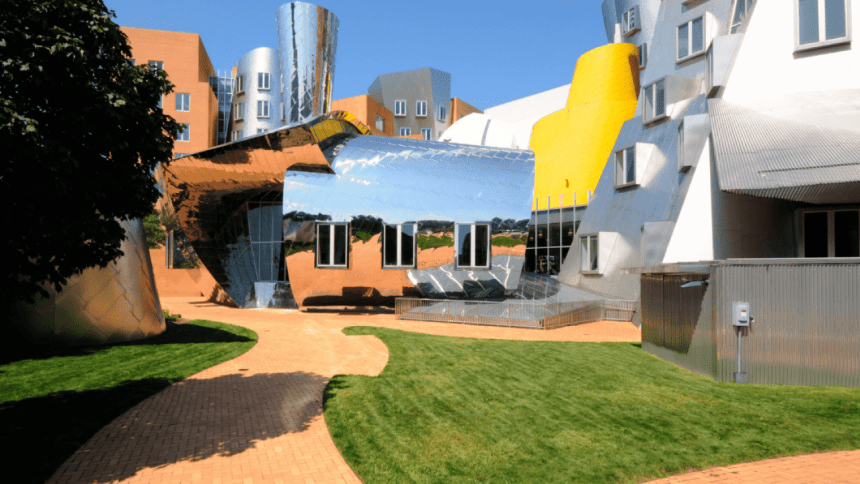
View Full Profile »
Join Mediabistro Membership Today

Stand out from the crowd with a premium profile

Mediabistro Logo Find your next media job or showcase your creative talent
  • Job Search
  • Hot Jobs
  • Membership
  • Newsletter
  • Career Advice
  • Media News
  • Hiring Tips
  • Creative Tools
  • About
Facebook YouTube Instagram LinkedIn
Copyright © 2026 Mediabistro
  • Terms of Use
  • Terms of Service
  • Privacy