
Background: Hosting a dinner party these days is like drafting a peace treaty in the middle of World War III. You’ve got one friend on the Paleo diet, one who only eats raw food, and another who avoids all grains, unless they’re sprouted. And with so many wellness tribes becoming more entrenched in their unique doctrines—and gaining more followers all the while—it can be difficult to find a media outlet that speaks to everyone.
And then there’s SELF.com.
“One of the main tenants of the coverage that we do is that wellness is different for everyone, and healthy looks different on every body,” says Amanda Schupak, SELF.com’s Deputy Editor of Features. “For some of our readers, wellness might mean really being careful about what they eat, counting macros, and doing two HIIT workouts every week. But for another one of our readers, it might mean taking her depression medication every single day.”
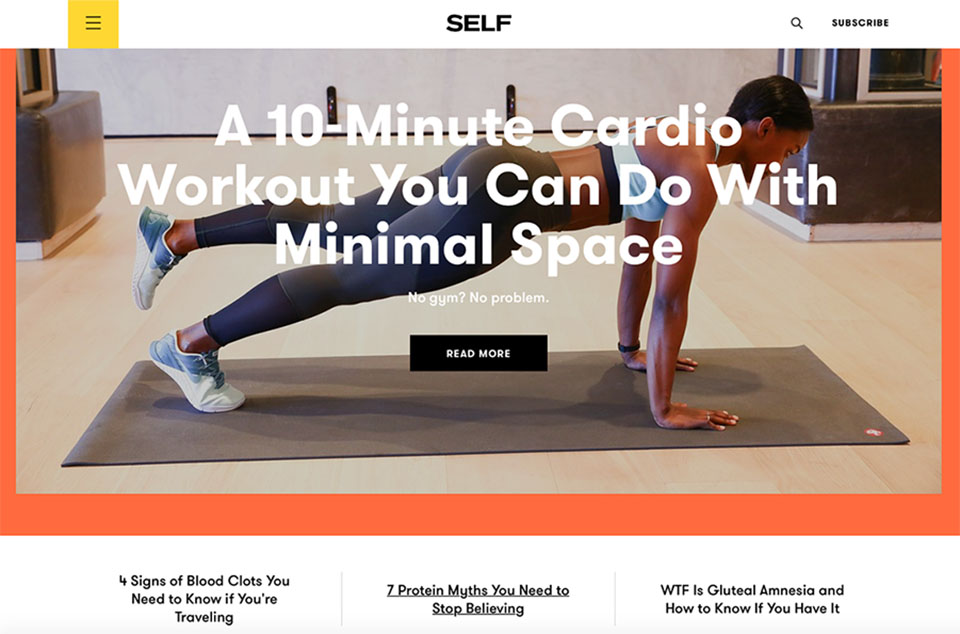
As always, SELF.com aims to help women reach their fullest potential in every area of life, including health, wellness, relationships and more. But while the premise of helping readers become their best overall self isn’t new, the publication has undergone a major change in recent months. The January/February 2017 issue was the last to run in print. Now and going forward, all of SELF’s content is online-only.
That said, the content readers have grown to love isn’t changing. If anything, the digital content will be more robust than ever, with an additional focus on some previously print-exclusive content, like celebrity features. But it’s less, “Who are you dating?” and more, “How do you deal with confidence issues when you’re on set?”
“We look at covering stories that really deal with wellness for women in all facets; so that means fitness, nutrition, and mental health,” says Schupak. “It’s really a holistic view of approaching wellness in a way that makes sense to our various different readers.”
What to pitch: Far and away, the best way to score your first byline on SELF.com is with a first-person story dealing with a health or wellness topic. “That can range from ‘I tried this workout, and I learned so much about exercise that I didn’t know,’ to ‘I started running and it changed my life,’” says Schupak.
Whatever the subject, just be sure that you can translate it into a fully reported piece with actionable takeaways for readers. So even though you believe the new spin class you attended in midtown Manhattan is the Best. Workout. Ever., most of SELF.com’s readers live outside of NYC. So if you can’t explain how the experience of riding a stationary bike in front of a bunch of strangers impacted your life in more general terms, editors are unlikely to give you a green light.
Keep in mind, though, that these first-person articles aren’t diary entries or posts on your personal blog—so you’ll still need your journalism chops. “These stories are all pretty much a combination of first-person and reporting,” Schupak says. “The bulk of it is your experience, and it is bolstered by interviews with experts who explain what’s happening with a certain disease, why a specific treatment is effective for mental health, etc.”
In considering a freelancer who wrote about experimenting with the hygge lifestyle (that is, the idea of being “cozy”), Schupak recommends pitching a lifestyle or wellness trend that you’ve recently tried, or would like to try. “It could be, ‘Here’s how long I’d do it for, and here’s what I think I could get out of it,’ or ‘I just had this experience that I’d really love to write about. Let me tell you about the experience and what my takeaway was,’” she says.
For fitness articles, focus on well-reported pieces that provide expert commentary and serviceable advice on working out (e.g “How to Choose the Right Weights for Strength Training”).
For food stories, editors won’t accept one-off recipes, but they are totally open to nutrition science, the debunking of diet fads, or tips on meal prep and healthy eating—with a caveat. “We do a lot of meal prep tips, and we do a lot of healthy eating tips,” says Schupak. “So if it’s not new and surprising, we’ve probably written about it already.”
However, if you have a food blog on which you regularly post healthy recipes, and you’d like to be included in some of SELF’s recipe roundups, you should definitely reach out to introduce yourself.
What not to pitch: SELF.com doesn’t have a dedicated news vertical, but anything that’s newsy with a particularly tight turnaround is handled in-house.
What publicists should pitch: For publicists, checking to see what type of content is currently covered on SELF.com goes without saying. Outside of that: “Put the pitch in context,” says Schupak. “We’re not going to do a review of an individual energy bar, but if that particular energy bar is formulated to be a great post-workout recovery snack, tell me that.” (At which point Schupak may run a roundup on 10 different post-workout recovery snacks.)
Percentage of freelance content: less than 50%
Percentage of freelance pitches accepted: 25-33%
Recent freelance stories pitched and published:
On “I Practiced Hygge and it’s Kinda the Best Thing Ever”: “Even though it’s not super science-y or technical, it was still reported,” says Schupak. “It did a great job of reporting on the trend while adding her personal experience. And it was written in her voice, with her humor.
On “6 Morning Sickness Remedies Worth Trying”: “This is a more straightforward listicle,” Schupak explains. “But what’s nice about this is that the writer not only did research on some common remedies for morning sickness (and how some work for some women and others don’t), but she then spoke to women who shared whether the remedies worked for them.
Etiquette: If you want to write for SELF.com, you need to send a working headline with your pitch that you could imagine seeing on the site—which means that you need to spend some time digging around to see the types of headlines that are typically used.
Beyond that, a paragraph that sums up the story idea will work. And if you’re a new-to-SELF freelancer, be sure to add a couple of sentences on who you are and what you’ve done, along with links to clips.
Lead time: Varies. Could be as quick as a couple of days, or as long as a couple of weeks.
Pay rate: Varies, based on the amount of reporting involved. But rates are competitive when compared to other large, digital publications.
Payment schedule: On publication
Kill fee: 50%
Rights purchased: All rights
Contact info:
SELF Magazine
1 World Trade Center, 37th Floor
New York, NY 10007
www.SELF.com
Twitter | Facebook
Email format: FirstName_LastName@condenast.com
Direct pitches to:
For health email Patia Braithwaite, Senior Health Editor: PATIA_BRAITHWAITE AT CONDENAST.COM
For Fitness email Christa Sgobba, Senior Fitness Editor: CHRISTA_SGOBBA AT CONDENAST.COM
For beauty (including dermatology and I Tried Its) and style pitches, email Jessica Cruel, Senior Editor, Beauty & Style: JESSICA_CRUEL AT CONDENAST.COM
EDITOR’S NOTE: Though we’ve updated this article recently, the speed at which things move in media means things may have already changed since then. Please email us if you notice any outdated info.
Topics:
How to Pitch