

Mediabistro Logo Mediabistro Logo
  • Jobs
    • View All Creative Jobs
    • Hot Jobs
    • Create Job Alerts
  • Membership
    • Overview
    • How to Pitch
    • Mastheads & Editorial Calendars
    • Browse Courses
    • FAQ
  • Showcase
  • Resources
    • Media News
    • Resume Writing Services
    • Market Trends
    • Articles
    • Member Profiles
  • Log In
Join Free Post Jobs
Mediabistro Logo Mediabistro Logo
Jobs
View All Creative Jobs Hot Jobs Create Job Alerts
Membership
Overview How to Pitch Mastheads & Editorial Calendars Browse Courses FAQ
Showcase
Resources
Media News Resume Writing Services Market Trends Articles Member Profiles
Log In
Post Jobs Join Mediabistro

Climb the Ladder

Why every college student should intern at a startup

By Jess Focht
@jessfocht
By Jess Focht
@jessfocht

8409314268_15d14d5d5c_bIf you’re an undergrad looking to get valuable work experience, the startup world might be the place for you.

The statistics are pretty clear: if you want a job after you graduate from college, you should get one or more internships under your belt first. Before you start hyperventilating and drafting cover letters to all of the Forbes 500 corporations, I’d like to ask you to consider the road less travelled.

Consider startups — those scrappy, casual, exciting companies you see on shows like Shark Tank and Silicon Valley. Startups are perpetually in need of good talent, and many offer summer or part-time internships for undergrads. I worked at Scouted (the awesome startup hosting this blog) the summer after my junior year, and it was an invaluable experience for me, helping me figure out what I wanted to do, and teaching me how to be a vital contributor to a small company.

So, if you’re looking for an internship that will be challenging, fun and make you more employable after graduation, an internship at a startup might be right for you. Here’s why.

It’s not as hard to get an internship at a startup as you might think.

Google-searching “startup internships” will overwhelm you with a jumbled catalogue of black hole job postings, but fear not: there are many databases (such as, AngelList ) that can help you sort through the vast number of internship opportunities out there.

And there are even startups that will help you work at startups (meta, I know). Scouted, is one of them. You can apply to jobs through Scouted here.

If those options don’t get you anywhere, talk to your friends, fellow students, and recent grads from your school. Chances are at least one of them has or has had a job in the startup world, and can get you connected to the right people.

And if you’re worried about the pay, you’re not alone — there’s a whole slew of questions on Quora about how much startups pay undergrads. Many startups pay their interns competitively, while some only offer unpaid internships Don’t panic, your school may also have grants in place to help you out so check out your career services website.

You can also check out this directory of grants from Harvard. And make sure to search for grants and scholarships specific to you and your field — places like Brown and Caldwell offer scholarships to students focusing on the environment, and BA Rudolph gives scholarships to women working unpaid internships in public service and science. If you want to work abroad, you can get funding from places like LIVFund, International Internships, the scholarships listed here, and many other places.

You’ll do real work on real projects that matter to the company.

Startups have tons of critical work to do, so they need their interns to contribute to business-critical projects.

My friend Matt, who just graduated from college with a full-time job offer, said this about his summer internship at a startup as a software-engineering intern:

“Interning at a startup is like running a sprint for 10 weeks straight. You have to be able to become an effective engineer, not just an intern, very quickly and drive projects to completion in short periods of time, which is why it’s such a rewarding learning experience.”

When I worked at Scouted, I took on responsibilities I never imagined I’d have as an intern. I helped out with the pitch deck Scouted used to get investors, had a say in naming the company, and helped redefine the way Scouted evaluated and presented candidates to companies looking to make new hires. I worked harder and cared more about the company because I was given all that responsibility, and I was able to take ownership of projects I can now put on my resume.

You’ll be doing things far outside your job description.

Anya, another friend of mine, told me this about being a startup intern at Birchbox last summer:

“I think startups give you a more well rounded experience since you’re often required to step outside your designated role. You learn to become a team player and ditch the “that’s not my job” attitude.”

At a startup, you’ll be exposed to every rung of the ladder and have the opportunity to contribute to every branch of the company.

By trying out different kinds of work, you can discover what you’re good at and what you really want to do. Here’s Anya, again:

“Even though I was a software developer, I got to work closely with product managers. Birchbox exposed me to the role, and by doing so, it helped me realize [being a product manager is] what I wanted to do.”

You can sparkle the way only you know how

Most startup internships don’t follow the same strict formulas corporate internships follow. If you like to work late into the night and sleep in, you can find a startup that will accommodate that. If you hate dressing up, you can work at a startup that lets you wear t-shirts to work. And, if you want to try your hand at social media marketing, coding and design and/or data analytics, you can find a startup that will let you do all of those things as an intern.

Your family and friends might be worried when you tell them you’re interning at a startup. Many worry that interning at a startup and gaining a less traditional experience means sacrificing the name recognition you might get by having an established corporation on your resume. But maybe the predictable, highly structured, tried-and-true internship programs those corporations offer just isn’t for you. Interning at a startup instead of a corporation won’t make it harder for you to get another internship or full time job later on. Like any job, it all depends on what you make of it.

But, best of all, after interning at a startup….

You will be extremely employable

After interning at a startup, you’ll have compelling stories to tell potential employers. You’ll be the expert on what your company does, and you’ll have taken ownership of business-critical projects. You’ll also have built vital connections to the startup world, which will make it easier if you ever want to work at a start up again. You may even fall in love with the hustle and try to make a career out of it.

#startup4life

Topics:

Candidates, Climb the Ladder
Climb the Ladder

Why an English degree is just as important as a STEM major

By Jess Focht
@jessfocht
By Jess Focht
@jessfocht

I’m sick of hearing about the “STEM Crisis” in America. Read any report on American education from the past decade, and you’ll see an excessive amount of hand-wringing over the fact that American students are failing to engage fully with the new gods of our modern era: Science, Technology, Engineering, and Math. According to a recent study, America is 27th in the world in math, and 20th in science. ~gasp~

Aside from the fact that grooming all of us young Americans into great Astronauts and Airplane-Builders feels like a remnant of the Cold War Space Race, and aside from all the American exceptionalism that underlies this assumption that we, as a country, should be the best in Science/Technology/Engineering/Math, I take issue with the fact that this emphasis on STEM is making the humanities an afterthought in American education, and that people think you can’t get a job without a STEM major, when, in fact, only half of STEM graduates actually find STEM jobs.

The US Department of Education has done some damage control to assuage the type of rage I’ve displayed above. They assert that liberal arts style education is still relevant. They also continue to push the STEM agenda with programs like Educate to Innovate!

I do not have a STEM degree. I am pursuing an English degree at a liberal arts college. (Quoth the haters: “How useless!” “What are you going to do with that degree? Write? Teach?”)

But I wasn’t always this way.

I’m decent at math and science, and I started out my college career as a Computer Science major, before I decided to opt out of it (I still got a minor). I had a choice between a STEM path and a Humanities one. I chose the humanities, and I don’t regret it at all.

By choosing my English major, I was able to study abroad in Glasgow, UK. With my program of study there, I read Scottish literature in the place where it was written. By reading ancient and modern Scottish texts, I developed a deep understanding of the historical precedence for the Independence Referendum Scotland was voting on at the time. Literature, as much as anything else, helped me gain a sense of Glasgow. I don’t think learning about the Fibonacci Search Technique would have done the same.

Ultimately, I decided to pursue my studies of English over Computer Science because I believe reading, responding to, and creating literature makes me a better person who’s better able to empathize with those around me, and who’s better able to zero in on the heart of any issue presented to me. There’s actually science to back this up.

I preferred my humanities classes at college to my STEM ones because we had discussions in my literature and workshop classes. We debated and created knowledge and opinions about the ideas in our readings and our writings. On the other end of the spectrum, I took a linear algebra class where I was forced to memorize theories and interpret numbers with a narrow matrix-centric lens.

humanities_graphic

I’m going a little too far. Some math needs to be broken up into bite size, matrixy pieces to make sense. And, at its best, computer science is a highly creative field. What it came down to was that, in English classes, I felt like I was becoming a better citizen of the real (not binary) world. And that’s more important to me than making scientific breakthroughs (although I sincerely hope all people don’t feel this way — we need that cancer cure now).

The STEM jobs just aren’t out there for the picking. And technical or narrowly focused education might not be the best preparation for careers in general — not just STEM careers. According to this report by the Harvard/MIT research pairing of Frank Levy and Richard J. Murnane, nowadays, “the fastest growing occupations involv[e] unstructured problem-solving, working with new information, and non-routine physical activity.” Levy and Murnane also say that the increase in “computerized work” has increased the baseline literacy level needed to be a successful worker.

My study of English definitely helped up my literacy. But, in a more general sense, two of these three skills needed for modern work — ”unstructured problem-solving,” and “working with new information” — are definitely not STEM or humanities specific. My psychoanalytic, feminist analysis of The Country of the Pointed Firs helped me develop these skills just as much as implementing a novel approach to titrating acids (or whatever chemistry majors do).

The “soft” skills gained from a humanities-focused or liberal arts education can be just as valuable as “hard” STEM skills in making productive members of society — in teaching people how to run governments and start companies and build buildings and, yes, write and teach.

Just look at me: I got paid to write this blog post. 🙂

And don’t just listen to me: the speakers on this episode of the TED Radio Hour make some great points about how critical thinking is more important than ever in the age of big data.

Topics:

Candidates, Climb the Ladder
Climb the Ladder

Millennials and work-life integration, why college students love work

By Jess Focht
@jessfocht
By Jess Focht
@jessfocht

Robin Levine, founder of Scouted, has noticed a value shift in how the Millennial generation views work.

About previous generations, she said, “It used to be all about an end-goal. You’d do grunt work in a low-level job with the knowledge that it would pay off with promotions and more money in the end.”

But for Millennials, she said, “It’s about the journey. They care less about the end results. They want to enjoy the work itself.”

Levine’s observations are backed up by data. As I’ve written about before, the2016 Deloitte Millennial Survey found that millennials, more than previous generations, prioritize their overall wellbeing when evaluating their work satisfaction. In other words, they want to maximize their wellbeing on their work “journey,” not just the financial payoffs.

0-kuodqslgngbxcvlb

Wellbeing in a general sense is taking over the old paradigm of worker satisfaction: work-life balance. Over the past few years, work-life integration has become the buzzword. Work-life integration acknowledges the fact that, with blackberries and universal wifi and smart-watches and all of that, work time and personal time no longer have the strict boundaries “work-life balance” policies aimed to establish. People answer emails on the treadmill, make calls from the bathroom, organize their calendars in bed. Work is a part of life just as much as everything else is.

Companies need to acknowledge and embrace this work-life integration to maximize the employee wellbeing millennials require.

Think about it like this. Millennials evaluate work in a similar way to how we evaluate our romantic relationships and workout routines. If I want to get married and have kids eventually, but I don’t like the person I’m dating, I’m going to move on to someone else. If I want six pack abs, but I find my 4am crossfit class incredibly painful, I’m going to switch to another program (I got remarkable results from this video!)

In the same way, if I want to make a certain amount of money, and become successful in a certain field (blog writing, for example), but my employer expects me to make edits on drafts immediately, anytime they are suggested, even at 3am on a Sunday, I’m going to find a different employer.

The other part of this is that we have the internet now, so the “finding a different employer” step is easier than ever (and so is the finding another date and fitness program). A simple search on LinkedIn will show me an overwhelming amount of companies looking for blog writers.

Millennials want work to be a source of fulfillment, and they hold work to the same standard as everything else in their lives. That’s the inevitable result of work-life integration. So, instead of helping employees balance personal and work-lives, employers should find ways to make work fit into an integrated life. Let people work where and how they want, and let them set their own limits. Give them work that is meaningful. Let them know you care.

In the end, this will probably help with productivity. Stew Friedman, writing for his book and for Harvard Business Review, claims that many successful people — Sheryl Sandberg, Michelle Obama, Bruce Springsteen — have succeeded precisely because they don’t separate their lives into work and life, but integrate work into everything else.

Topics:

Candidates, Climb the Ladder
Climb the Ladder

How to Network in Three Easy Steps

By Jess Focht
@jessfocht
By Jess Focht
@jessfocht

Three easy steps to make you dread it a lot less

Photo by Farhad Sadykov (licensed via Flickr Creative Commons)

Sometimes when you say the word “networking”, you can actually see people shudder.

There aren’t many terms that bring up such acute feelings of dread for so many people. And if you’ve ever had to stand in a corner at an event wondering how to approach someone, the anxiety can be all too real.

But you’re also not alone. Most people don’t relish the activity. And what’s more, people are coming to realize that relying too much on networking can actually exclude people.

Recently I interviewed someone building an LGBTA+ technologist community. She explicitly told me she wouldn’t be planning happy hour events. Why not? Because too much networking discourages introverts, people uncomfortable discussing their queer or trans identity. Instead the group will focus on open hacking and resource sharing.

Its great communities are harnessing new ways to connect. But odds are everyone still needs networking at some point. Whether it’s for finding jobs, funding, or mentors, the fact is that networking is often your gateway to resources.

The bottom line is that no one says you have to enjoy doing it. But that doesn’t mean you can’t be good at it. So if you want to dread less and do more, here are the three skills you need to network like a boss.

Lay your groundwork

Photo by Tim Sackton (licensed via Flickr Creative Commons)

This first step is crucial, and time-consuming. Laying the groundwork is about setting yourself up to make a plan, and be able to answer questions about yourself.

Start with social media. Do you have any public channels people can check out — like a twitter handle, or a GitHub account? Start producing content so people can get a sense of your interests, and make sure to add profiles pictures. Don’t forget to be professional. If you have a Facebook, consider adjusting changing your privacy settings to “friends only”. We at Scouted have never seen anyone get a job from their social media, but we have seen lots of people lose out on opportunities because the tone of their facebook account did not mesh with the company culture.

The next step is to update your resume, and your LinkedIn. Design your resume in whatever format works for you, MS Word: use online resume makers like Cvmkr, or a free designer program like Canva. At the end of the day, it should be one page, clean and well articulated. Your LinkedIn is arguably more important, and if you don’t have one, sign up for an account today[rl2] .

The earlier you do this, the better. Start it right now (after reading the rest of this article.) And don’t forget this is about continuity: schedule time to post on social media, and update your LinkedIn.

Do your homework

Photo by jwyg (licensed via Flickr Creative Commons)

This is the next important step, and it’s also the one you’re least likely to have learned in college. After you’ve started establishing a digital presence for yourself, it’s time to figure out what you want.

Figure out what your goal is. Are you looking to get hired? To get advice on a project? Nail down the industries you’re operating in, and learn the “big names” that shape it. Follow the social media of your industry’s trendsetters to stay on top of new developments and learn which news outlets cover them.

Once you have a better feel for the game, you’ll know who you want to talk to. Maybe it’s the professor who wrote the eminent research paper on your topic. Maybe it’s an employee at that company you decided you really want to work for. But until you do your research, you won’t know for sure, and you won’t be able to hold a good conversation once you meet them.

And perhaps most importantly prepare for every networking conversation you are having, if you know about it in advance. Know who the people are, their companies, and career paths. Make special note of common connections that may create a bond with the people you are meeting — a shared alma mater, friend or colleague or even if you grew up near each other.

Get out there (and follow-up)

That brings us to the last step of networking: The Conversation.

The last step can seem ominous. But the standards of conduct here are pretty simple: if it’s an event, make sure to follow the dress code; if it’s an appointment, be on time; if it’s an informal meeting, offer to buy coffee or help cook.

As for the talking part? Just do your best to reach out to people and introduce yourself. Tell them who you are, what you do, and what you’re looking for. Ask them about themselves, about their work, about that new development that just published in Wired. Be an active listener and don’t do all the talking. Perhaps the best advice I can give / get is to ask for advice and guidance — do not be transactional!

Most importantly, be yourself, and try to enjoy it. You’ve done all the heavy lifting preparing for this conversation. You’re ready for it, and you’re ready to learn what you came there for. If appropriate, give them your contact information and thank them when you leave.

The crucial part about this is remembering to follow-up.

If you met someone, had a good conversation, and you think there’s a chance they can help you out, then remember to send them an e-mail that same day. If you met someone and you don’t think they can help you? Send them an e-mail, too.

It’s not always about finding the exact person you need to help you out (although that’s nice). It’s about building a community who knows you and can pass opportunities your way. Sometimes the accidental meet-ups become fruitful later down the line.

Topics:

Candidates, Climb the Ladder
Climb the Ladder

Pros and cons of living at home

By Scouted.io
By Scouted.io

To Live At Home Or Not To: The Post-Grad Question

It’s a common nightmare among college seniors.  Graduating job-less, and making the slow, shameful march back into your childhood bedroom, South Park posters and all. Luckily for all of our collective self-esteems, what used to be a sign of despair has become the norm for millennials. These days, it’s fairly common for college grads to be living at home with Mom & Dad for the first few months (er, years), whether we’re job-searching or just saving our first few months of salary to prep for the insanity of NYC rent.

It certainly is a “cool thing”

I feel particularly equipped to address this subject, since I am one of these college grads livin’ the home-cooked dream. I graduated in May 2016, got a job at this dope start-up (Scouted, heyy), and moved back to Connecticut to live with my parents.

So, college seniors, if you’re trying to decide whether to save dat money and regress back to teenagehood, I give you my official “Pros & Cons of Living at Home”:

Pro of living at home: Financial Responsibility

See, I use phrases like financial responsibility now. Because I’m an adult. I’m also an adult in my ability to avoid forking over 70% of my monthly paycheck to pay for a 90 sq ft bedroom with a fake wall on Avenue D. Even though recent grads have faced one of the most compelling job markets in years, the cost of living has been steadily increasing along with it. Living at home has afforded me the ability to steadily increase my savings account, so when I do inevitably move out I’ll have a cushion to fall back on. Go me.

Con of living at home: Commuting

Turns out that commuting while living at home, well, sucks.  On average, Americans waste nearly 50 hours annually commuting with commuters in more metropolitan areas topping close to 75 hours. I personally commute nearly 3.5 hours daily, from my parents’ home in Connecticut to our office in midtown Manhattan. On top of the wasted time, paying for 10 weekly train rides cuts into those aforementioned savings. On the bright side, there’s apparently a petition circulating to bring back the bar car to my train line, so at least I can have the companionship of Bud Light en route home.  Commuting costs time, money, and productivity. Major con.

Nothing like a couple of train brews

Pro of living at home: Hanging out with your parents

I love my parents! I mean, er, they’re cool or whatever. It’s definitely an adjustment to be back home after almost 4 years of “living on my own” at school. Transitioning from sporadic visits to seeing your parents daily really reminds you of how awesome your parents are! They give great advice, like how to find the right credit card or what’s appropriate to wear in a client meeting. They stock your bathroom with the soft kind of toilet paper, and wake you up when you miss your alarm. And sometimes they have cool friends that make for great networking opportunities. Daily hangouts with the people who know you best: Pro, for days.

Con of living at home: Hanging out with your parents

Ah, the flip side. Alongside the joys of Charmin and a fully-stocked fridge, we have some downsides here. Turns out, you can’t use your bedroom floor as a closet or throw your beer on the floor when you’re done drinking it. You have to dump out your cereal bowl when you’re done with it. And sometimes your parents invite all their friends over and you have to explain to 20 (well-meaning) old people what you’re doing with your life and why you’re living at home. And of course, there’s the constant FOMO as you sit home on a Saturday night watching National Treasure while your friends send snapchats all of their awesome shenanigans.

Pro of living at home: The Fridge

Man, nothing beats a home cooked meal, especially after four years of ramen and Busch heavy. Given that I had some horrendous eating habits while at college, it is nice to enjoy a well-rounded diet that only *occasionally* includes pizza, and has all these green items that I’ve heard so much about. It is also something that brings my family together. We have just about all of our meals together and it really has allowed me to reconnect with my parents.

What a real fridge should look like….

Con of living at home: (Not) doing grown-up / real people things

Sometimes I worry that I’m missing out on valuable life experiences that everyone in their early twenties should be going through on their own. Paying bills, shopping for my own groceries, doing laundry: my current set-up requires none of these things. Am I regressing? Maybe. Is it kind of great not to worry about any of these things? Hell yes. Nevermind, I regret bringing this up.    

———-

Overall, I am very grateful that my parents are letting me live at home. And it is genuinely nice to spend time with them after a busy four years of college. But I’m also looking forward to getting to the next step – and make sure I start becoming as accomplished and successful as my parents are.  So here’s to hoping that my next blog entry is titled “The Apartment Search”!

If you want more content related to millennials, the job search, or life be sure to visit the Scouted blog!

Topics:

Candidates, Climb the Ladder
Climb the Ladder

What do you want to be when you grow up

By Scouted.io
By Scouted.io

“So, what do you want to be when you grow up?”

Ah, a question both timeless and pervasive. It follows you through elementary, middle and high school, and eagerly tags along to college, growing brighter and more urgent each day.

When you’re young, the question is fun; the possibilities are endless. I usually went with some combination of: an NBA player, a sneaker baron, or Lindsay Lohan’s official best friend (Parent Trap-era Lindsay Lohan, to be clear). My best friend yearned to be a psychiatrist when she grew up so she could “know everyone’s secrets.”

For many of us, the fun begins to diminish when college applications start. Now, the question is real. You need a “serious” response. A doctor is always a safe bet. These days, the ever-vague entrepreneur works too. I went with lawyer in my time, based on the rock-solid facts that my parent are both lawyers, and I liked to read. (Seriously, these were my reasons.)

indiana jones
This is what doctors look like, right?


Luckily, few colleges will even hold you to your intended major, let alone your 10-year plan.  But once you get to campus, you start to make decisions that inevitably narrow your options. You choose prerequisites that will guide you to a certain major, you join clubs that expose you to certain types of people, you decide to do research over the summer – or take that unpaid social media marketing internship close to home. Whether deliberately or not, your path begins to take shape.

A bit of my own story…

When I was in college, I stayed on a fairly tracked path. I went all-in on that excellently-reasoned lawyer bet: majored in Political Science, spent my junior summer as an intern investigator for the D.C. public defender’s office, and headed off to a boutique law firm to work as a paralegal after college. Nothing to it, I thought. I have this job thing on lock.

There was just one problem. Turns out, I didn’t like the law very much. I found the environment inflexible and stifling, and the work overly structured and painfully detail-oriented. The attorneys in my office advised me to “get out while I can”. (That’s an actual quote from my boss.) I got out.  Moved home.  And then started thinking about “the question” from scratch.

So, whether you’ve already started down a path or are just beginning to make choices about how and where to spend your time, here’s a few thoughts that I’ve collected along my own journey of figuring out what I want to be when I grow up. Quick spoiler alert: I’m 27, and still not totally sure. (So, take the advice below with a grain of salt!)

Pay attention to what you read, listen to and talk about in your free time.

This is what my dad refers to as the “NY Times” test. Which section of the paper do you gravitate towards? What are the websites that you bookmark and read every day (Facebook, Barstool Sports & Buzzfeed aside, people). What podcasts are you subscribed to? Most young people that I know consume a lot of media, and their options are infinite. Everyone makes conscious or unconscious choices about which topics they stay abreast on, which articles they send to friends, and the podcasts for which they eagerly await each new episode. (Recently, for my twenty-something male friends, that podcast is “Bodega Boys,” which probably doesn’t give us much insight into one’s career. But, anyhow.)

Noticing these habits is often helpful in identifying what you actually find interesting, rather than what you think you’re “supposed” to care about.

Use all of the adults in your life. Wisely.

Obviously, I did a terrible job of taking this advice, given that I had almost no sense of what a lawyer did, despite living with two for my entire life.  But, do as I say and not as I do, right? Your parents, their friends, older siblings, cousins, parents of friends – you can probably get a pretty good understanding of 10+ industries or jobs by setting up a call or coffee date with your close circle of grown-ups. Turns out, old people have had lots of life experiences and pretty good perspective on what they would’ve changed about their careers. Most importantly, ask them how they figured out what they liked, and how long it took them to get there. The answers might surprise you.

Don’t do the same thing every summer – and take notes.

You might be thinking, “I thought that I was supposed to create consistency with my resume, building my skills in a particular area so I’m super hireable when I graduate and I don’t have to live at home after college or eat Cheetos/ramen/Lucky Charms for dinner every night or…”

Yea, yea. There’s some truth to that. But it doesn’t help much to create consistency in your story, if you’re consistently doing something that you’re not very interested in. (See: my resume, circa 2011, with three legal internships upon graduation. Woops.) You have three glorious summers in college to experiment with different types of companies, locations, and jobs. Work for a startup (we’re always hiring!), then try a bigger, more established company. Maybe do a summer not in a major city, if you think you might like the small-town experience. If your school offers funding for unpaid / nonprofit internships, spend a summer working for the not-man.

And most importantly, use these experiences wisely. Do your best to take on additional responsibilities, so you can learn more about what you enjoy doing. Spend time reflecting on the projects you like and dislike, and write stuff down. Build relationships with your boss, so she can, you know, hook it up later.

Get a sales job.

If you’re completely lost about what to do, I’d follow the advice that my sister gave me a few years ago: “Get a sales job.” (She followed that up with, “It kinda sucks and it’s really hard, but I think all smart kids should have at least one experience in sales. It’s humbling as hell.”) Inspirational stuff from the fam.

40 year old virigin
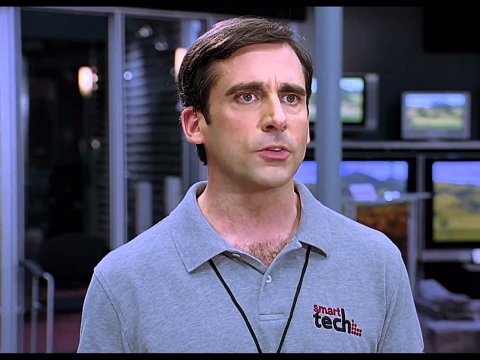
Be like Steve.


A huge percentage of jobs involve selling something to someone – whether it’s convincing your boss to implement your idea, selling yourself to a potential employer, or pitching an organization on why they should partner with your company. Being comfortable with the persuasion process will be hugely helpful throughout your career and building those skills early will inevitably make you better at your job. Unless you’re a programmer, in which case you can probably ignore everything I’ve said, and go enjoy your incredibly well-paid job. Go you.

Lastly, remember that your first job (or two, or three) don’t matter all that much.

It can be tempting to view your first job as hugely indicative of the rest of your career. Luckily, that’s almost always wrong. Here’s what’s important about your first few jobs: that you’re learning, that you’re getting insight into what you like and dislike, and ideally, that you’re meeting some older folks that are good mentors. (I know a few bosses who are particularly good at that.)

Phil Knight (founder of Nike) began his career as an accountant. Reed Hastings sold vacuums. Marisa Mayer worked at a grocery store. So did Oprah. Actually, so did Warren Buffett.

So I guess what we’ve learned today: use your college years to learn about yourself, don’t’ stress, and if all else fails, go work at a grocery store and hope it leads you to wild success.

Topics:

Candidates, Climb the Ladder
Climb the Ladder

Why finance majors dont get finance jobs

By Scouted.io
By Scouted.io

Back when I was in college, it felt like everyone majored in Econ, or Econ and something else (CS in my case).  At a school with no undergrad business program, Econ was the gateway major to that ultimate of career paths: financial services.  You know, whatever it is that investment bankers do.  I imagine we all figured knowing a thing or two about global markets and the velocity of money and all that would provide the appropriate foundation for a long and prosperous career in making it rain.

Nearly fifteen years later, unsurprisingly, finance is as popular as ever.  I got to wondering, does that dogged pursuit of finance actually help in getting a job in the industry?

Does being interested in finance help or hurt you in the job search?

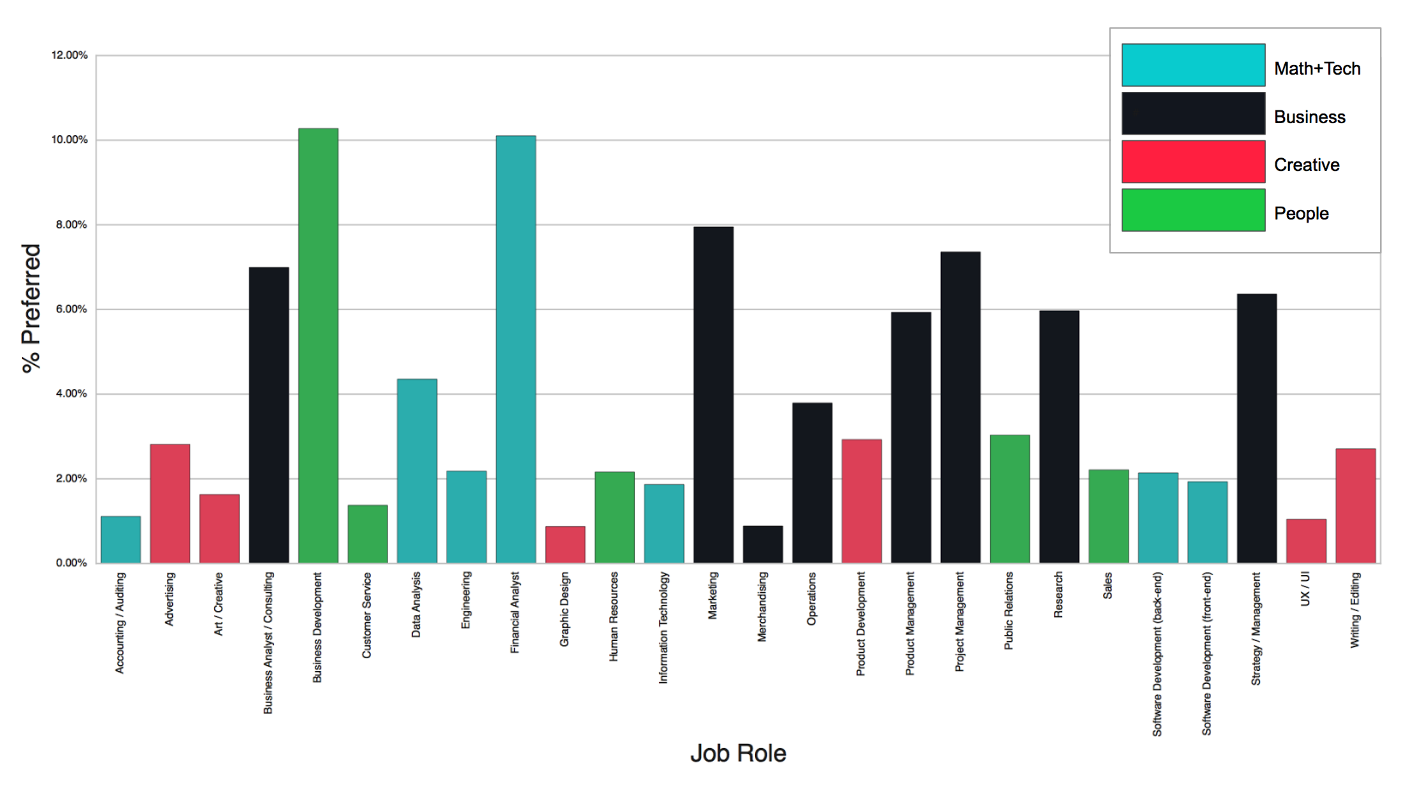
One of the questions we ask candidates up front is which of 26 job roles (things like finance, marketing, and software engineering) seem interesting.  Candidates can pick as many or as few of these as they want, and a solid 10% of the pool says they want finance (we label as “Financial Analyst”).

Candidate Job Role Preferences


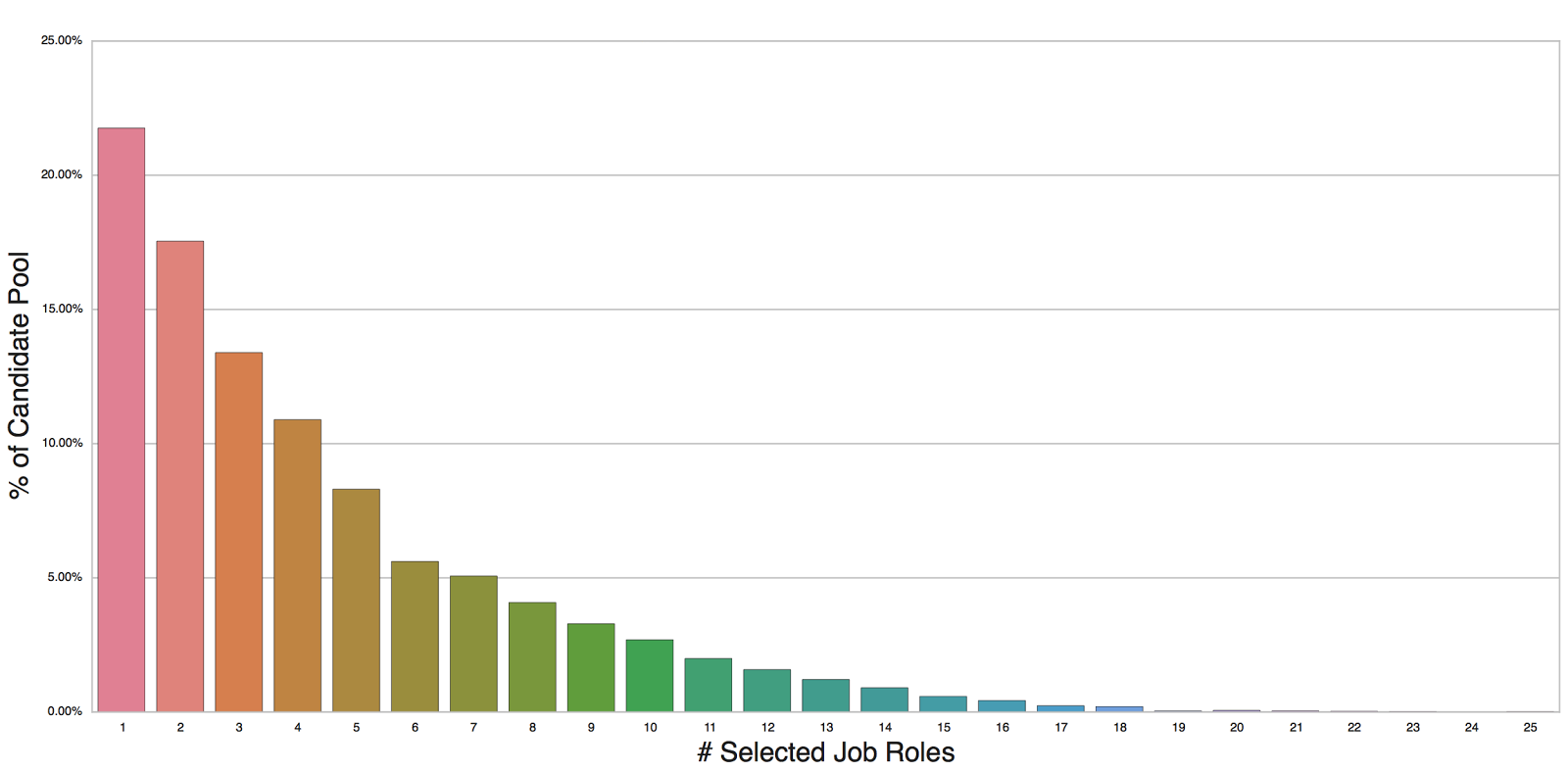
In fact, 6.89% of our candidates say Financial Analyst and nothing else!  I suppose this isn’t too surprising: ~22% of our candidates pick just one job role.  A similar number picks just Marketing.  Most of the candidate pool, however, is open to other possibilities.

How Many Job Roles Do Candidates Select
How Many Job Roles Do Candidates Select?


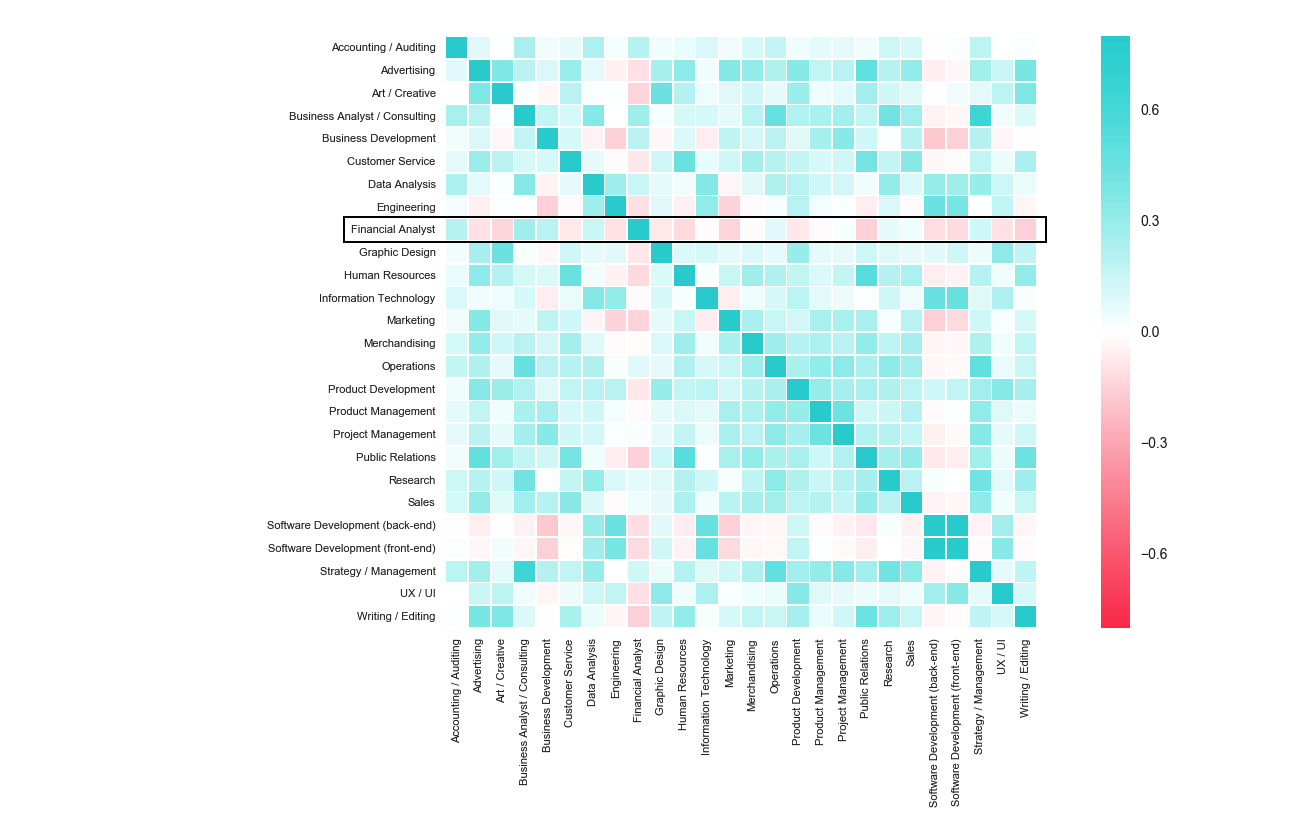
Given there are over 67 million ways of selecting job roles, it’s interesting to look at the correlations of those choices.  

Correlations of Candidate Job Role Preferences


Following the Financial Analyst row across, we can see negative (red) correlations with pretty much everything except stereotypically business stuff such as accounting, or data analysis. Clearly, folks looking for finance jobs are generally not looking for HR or writing gigs.

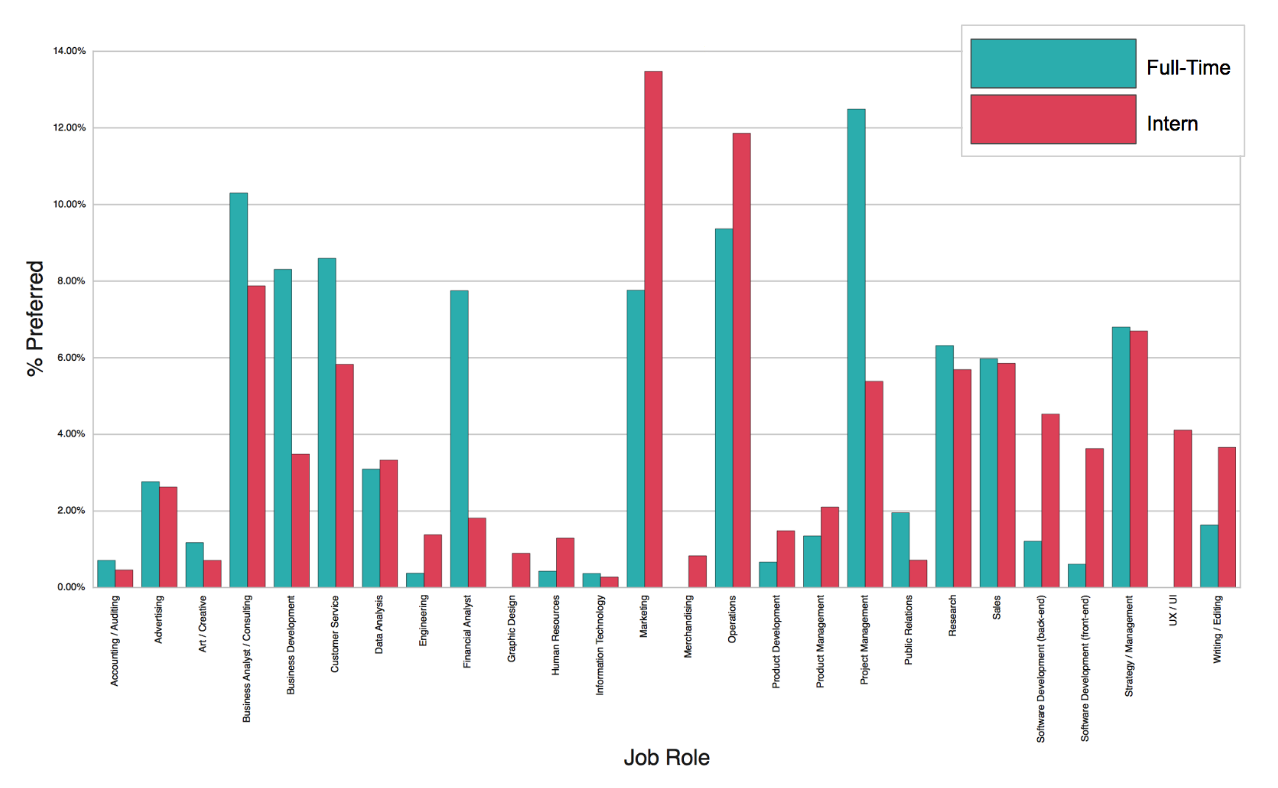
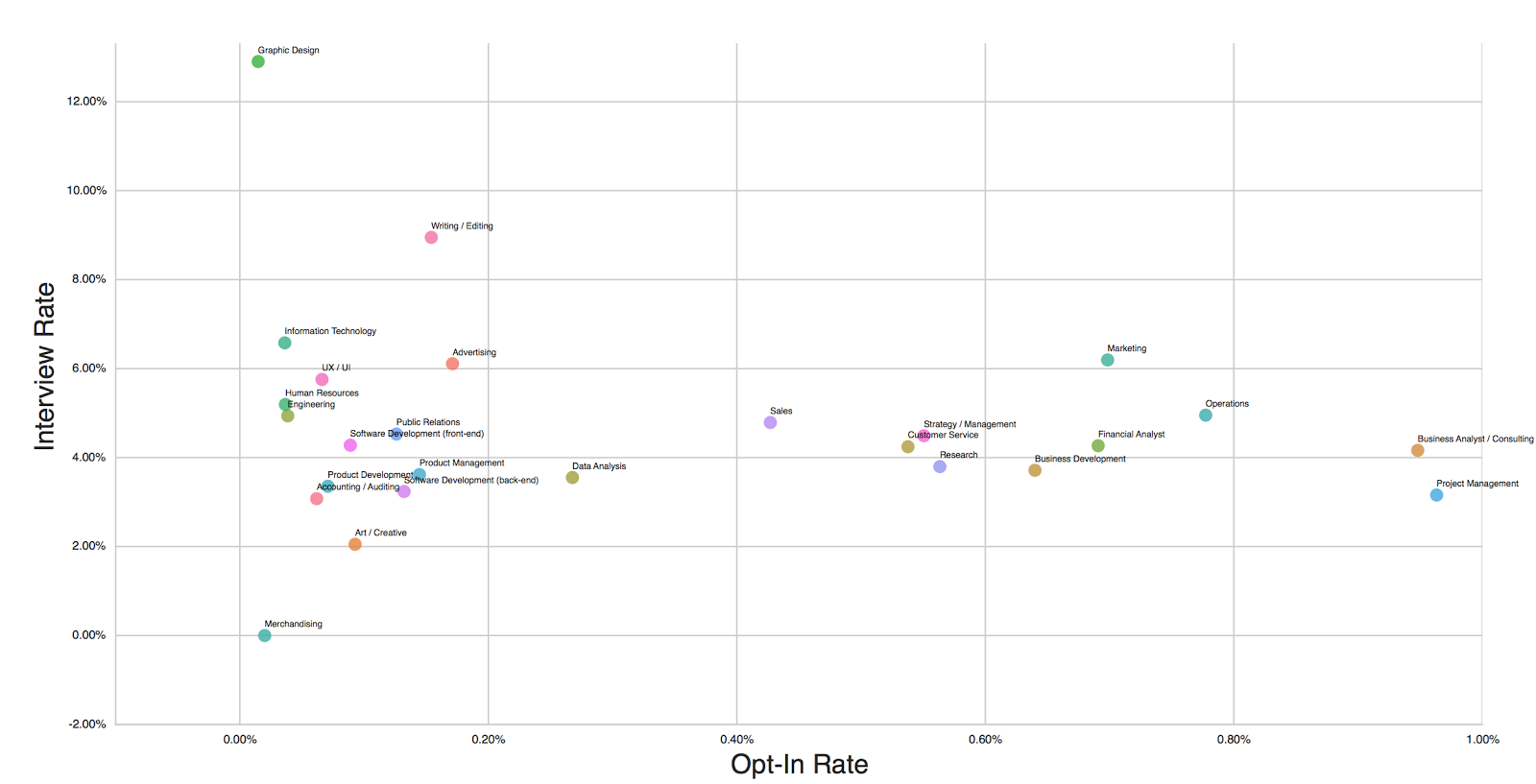
To be fair, these correlations commingle our full-time candidates with the interns.  Separating them apart, we can see similar interests most of the time, but pretty big gaps on a few categories, including finance.

Job Role Opt-Ins
Job Role Opt-Ins


A relatively bigger chunk of the full-time pool opts in for finance roles.  We’ve offered twice as many finance roles for full-timers as we’ve had for interns, so that likely has a big impact.  

Interested in writing? Maybe your secret calling is finance!

As an alternate theory, when I was looking for internships in college, I was more interested in exploring varied opportunities before settling into a career following graduation.  Perhaps this mentality still holds? In any event, here’s the surprising chart.

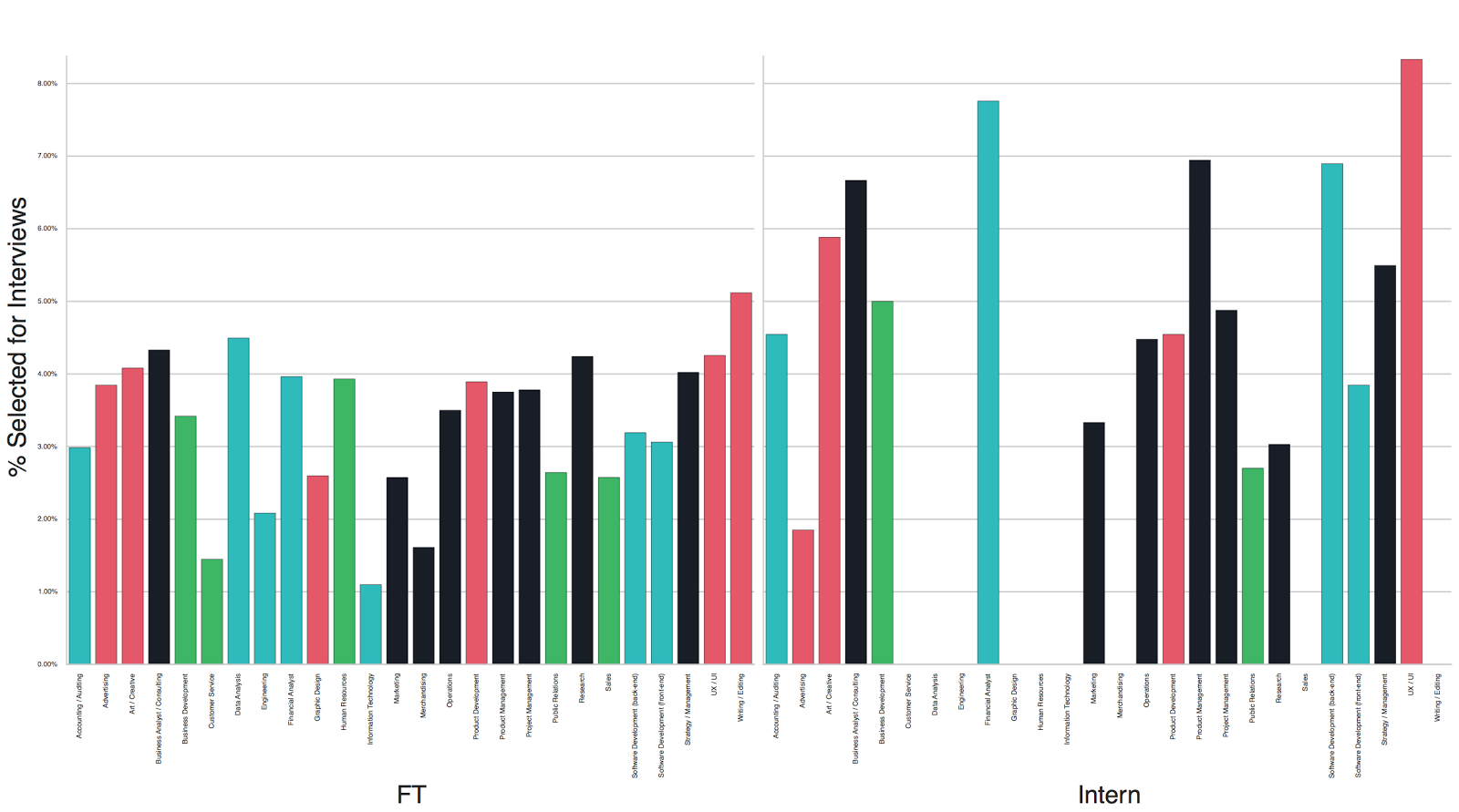
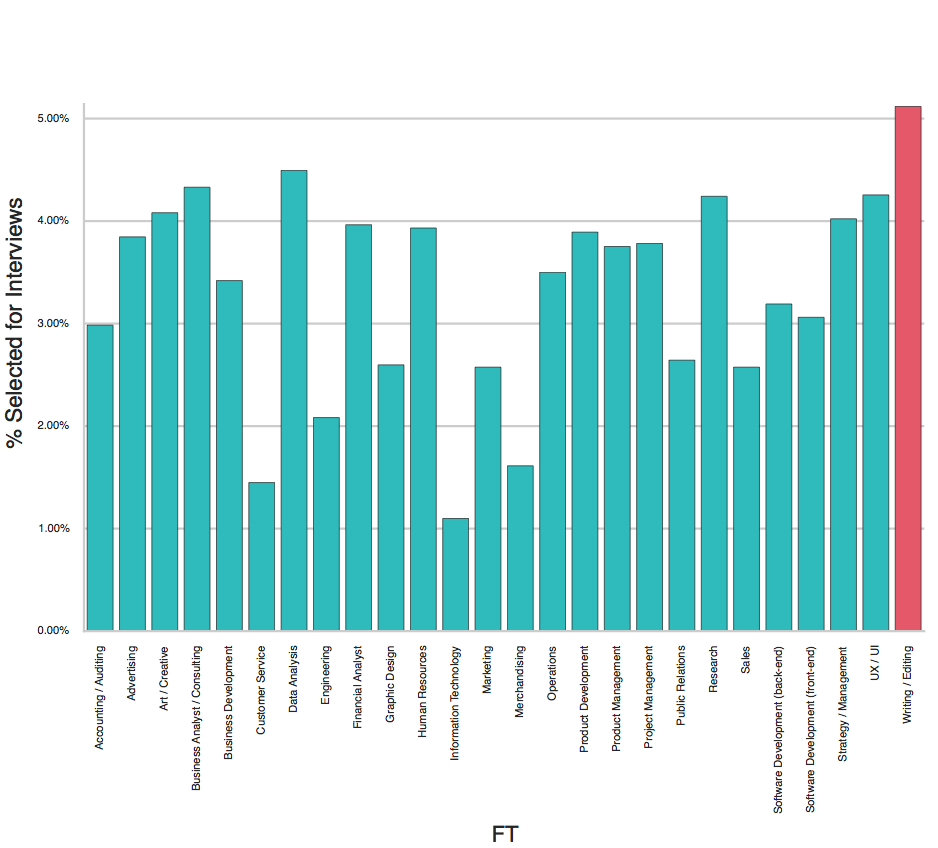
Who Gets Interviews For Financial Analyst Roles?


Of those full-time searchers who opt-in for finance jobs, it’s not the aspiring financiers who do best, but the writers and editors who’ve been most likely to see a Round-2 interview! (NB: past performance does not guarantee future results.)

Who Gets Interviews for Financial Analyst Roles?


Part of this is certainly a numbers game. We don’t have many novelists opting into our finance opportunities; but those candidates who do must be pretty strong, as they get lots of interviews.

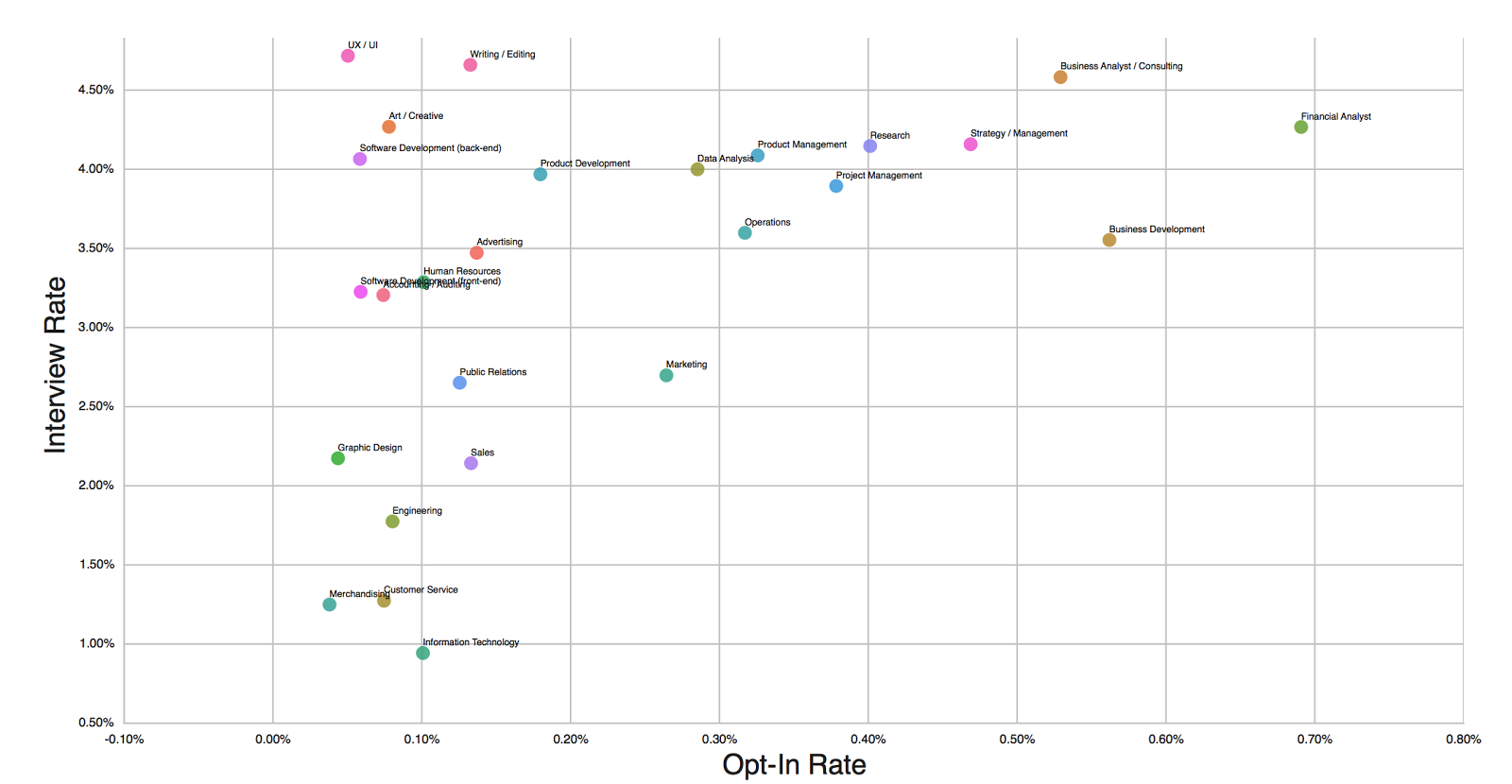
Candidate Preferences for Companies Hiring a Financial Analyst
Candidate Preferences For Companies Hiring A Financial Analyst


Of course, we can make charts tell whatever story we want, but our data shows that clients hiring for finance do not have a bias for candidates who want to work exclusively in finance. If we flip the data a bit, we can see that financial analysts are getting interviews, well, everywhere!

Where Do Aspiring Financial Analysts Get Interviews?

Conclusions

The moral here?  Even financial analysts (and engineers) have to write, and sometimes product managers do marketing, and sometimes human resources does sales.  So cast a wide net and don’t let the search parameters be a limiting factor.  Your resume may bleed finance (or Econ), but don’t let that stop you from thinking about or being considered for a job one or even two derivatives over.  And lastly, though we might not be offering traditional i-banking roles (yet!), if you’re early on in your college years, even if, ya know, you’re dead set on spending your twenties as a corporate slave, don’t be afraid to explore the physics or philosophy departments while you have the chance.

This analysis exemplifies how everyone on Scouted benefits from our data-driven approach to matching: candidates get presented with great opportunities that they may have ordinarily overlooked, yet that still fit well with their set of values and abilities; clients gain access to not just a capable, but a diversified roster of excited applicants; and we at Scouted learn how to make the job search and hiring process easier to navigate with greater and greater success rates for everyone on the platform.

[optinform]

Topics:

Candidates, Climb the Ladder
Climb the Ladder

7 ways to improve your technical resume

By Scouted.io
By Scouted.io

Looking to build your technical resume, but not sure how it differs from a traditional resume?  Read on for 7 tips to help your technical resume stand out from the masses.

Be thoughtful about your list of technical skills.

Many companies use keyword searches to filter for resumes.  If you have thousands of applicants and just want the Java engineers, a keyword search seems like a quick win.  As a result, technical resumes end up with a mess of a section labeled something like “Technical Skills,” and very often this contains a proliferation of stuff ranging from, the “yes I know this” to the “I used this once for a homework assignment in CS 101.”  While getting through that automated resume screener is clearly important, when you get to the hiring manager, anything on your resume is fair game.  When an interviewer sees a technical resume with every programming language, operating system, and development tool listed there, it screams out, “I don’t actually know any of this.” (And by the way, experienced hires are just as guilty of doing this as new grads.)  Note what you know, but be honest about what you don’t – if you still want to keep everything to beat the keyword screens, at least indicate level of proficiency in some way.

Seriously, be thoughtful about your list of technical skills.

While you’re refining that list of technical skills, consider leaving off Microsoft Excel, Google Docs, etc…  Unless you are doing VBA scripting in Excel or have worked with the Google APIs, adding these applications diminishes the perception of competency for anything else you’ve listed in the section.  In this day and age, it’s pretty much expected that you know how to use the Internet, the basics of building a spreadsheet, or writing a document.  Perhaps if you’re applying for a Powerpoint-heavy job, for example, it makes sense to keep these – there are certainly intricacies to Powerpoint such as animations and transitions, or using a master template.  If you’re looking for a software development role, saying you know “Python and Powerpoint” trivializes the time you spent actually learning Python.

Pay attention to the details.

This one is really for everyone, not just engineers: check your resume for typos, grammatical issues, changes in voice, weird capitalizations, inconsistencies in formatting and alignment, and anything else that says to a hiring manager, “I don’t pay attention to details.”  You have as much time as you need to get your resume right, and this is the easy stuff.  If your resume reads poorly when you could have taken all the time you needed to write it, what can we expect from your professional work when there are deadlines and demands?  If you are building software, the main deliverable of your work is written code.  If your technical resume is riddled with bugs, should we expect any better of your engineering? If you need some resume help be sure to check out our awesome Scouted resume template.

[sc name=“Newsletter”]

Reference work samples.

Especially if you are just entering the workforce as an engineer, it’s incredibly helpful if your technical resume refers to actual engineering work somewhere in the interwebs.  In most cases, this means having something public on github; in others, a personal website or a showcased project.  If your school policy precludes your ability to share school work or projects and you have no interesting side projects, then go do some questions on Project Euler.  An artist would share their portfolio; a musician their recordings.  Providing upfront access to samples of your work improves your credibility and demonstrates your interest and possibly even passion for the field.  Code samples also provide insight into how you approach and solve problems and communicate.

Your technical resume should be specific.

Resumes do not get read; they get skimmed.  Bullets that are generic or trite just waste space.  Saying something like, “executed on the project’s deliverables based on the specified timeline,” conveys absolutely nothing.  We know you worked on projects, we know those projects had deadlines; tell us the interesting details, results, and deliverables.  Each line in your resume should convey something of material: what did you accomplish, what did you do, how did you do it?  If you worked on a group project, what was your specific contribution?  If you had an internship, what was your impact?  If you have prior work experience, make your resume results-oriented.  This is pretty standard fare for resumes in general, but technical resumes often fall short and needlessly so.

Stick to one or two pages in length.

The consensus is that if you have less than 10 years of work experience, your resume should fit on one page.  After 10 years, two pages works.  If you have a lot of patents or are published, a third page or more is acceptable.  Young engineers especially tend to list every course and project they worked on in school, and this creates bloat.  Include the important stuff and cut the rest.  (A caveat for experienced hires: if you are using a contingency recruiter, and that recruiter asked for a non-PDF version of your resume, it’s quite likely they’re stamping their agency info at the top of your resume, butchering your formatting and probably bumping you to the next page.)

Your audience might be non-technical.

Many companies might insource the first resume screen to a non-technical or lightly-technical person such as someone in HR, or a business analyst attached to an engineering group. The contents of your technical resume should be pretty good at speaking for themselves without a tech-to-English dictionary.  This isn’t to say that you shouldn’t be technical, but rather to do it thoughtfully, expecting it’s always possible a non-technical reader will be taking a first pass.

That’s all for today! Have more specific questions? Feel free to reach out to our candidate experts at Scouted@scouted.io!

Topics:

Candidates, Climb the Ladder
Climb the Ladder

How to find your first apartment in 6 easy steps

By Scouted.io
By Scouted.io

Finding your first apartment ain’t easy. Take it from me; as someone who recently just went through the process, finding your first grown-up place to live post-college is probably the second biggest decision you’ll make as you enter the real world. It is far different from moving out of your dorm and into a fraternity house, where the only decision there is whether you have enough room for a bar and a FIFA station. Luckily for you, I recently left the comforts of my parents’ home and began looking for my first domicile. Here’s my worldly wisdom:

1. Budget

The least fun and most important part of the search – the goal here is to avoid being that bum who needs a loan from your roommates or parents to make your rent payment. As a general rule of thumb, your rent should NEVER exceed 50% of your monthly income (unless you crazy good at saving money) which is why I like to follow the 50/20/30 method:

50% of your monthly income should go to fixed costs that recur monthly: rent, utilities, subscriptions (i.e transportation, gym membership, Netflix obvi).

20% of your monthly income should go to your savings/financial goals.  We’re grown-ups now, so let’s lay the groundwork for a stable future. Whether you’re saving for a nicer apartment, student loan payments or just an emergency fund – keep a cushion around. You don’t want to be stuck looking at an empty savings account when you break your laptop because you thought it might serve as a good koozie.

30% of your monthly income is allocated to flexible spending: shopping, vacations, beer, groceries, entertainment, beer, dry cleaning if you don’t work at a startup (nerds). Essentially anything that can fluctuate and isn’t a fixed cost.

2. To roommate or not to roommate

Ah, the ultimate question. This step is often dictated by your budget and location. If you’re in Manhattan or San Francisco and don’t work for a hedge fund, you’re most likely going to need a roommate(s).  Now if you’re in a city like St. Louis or Richmond, where the average 1 bedroom is under $1,000, then you’re Gucci Mane. Decisions, decisions.

So now that you have decided that you need a roommate for financial or emotional reasons, where do you go about looking for roommates? The classic strategies still hold; you can, of course, live with a friend or use your network to find someone. But these days, there’s a bunch of new tools to try out too.  Companies like Symbi, RentHoop, Roomster offer the ability to match with potential roommates based on mutual interests, living habits or just a shared desire to avoid the serial killers on Craiglist. Find yourself a charmer!

3. Neighborhood

Job? Check (hopefully). Budget? Got it. Roommate and future bffaeaeae? Yep. Now it’s time to choose your neighborhoods. When picking a neighborhood(s) to narrow your search, you need to evaluate a couple of things. Like our first step, budget – can you afford to live in that neighborhood? Sure, living in Tribeca is nice and all but you don’t want to turn your budget in 90/5/5. Second, location, how far are you from work? What would your commute look like? Do you always have to travel for necessities? Re: Vibezzz, do you want a quiet neighborhood with families living there? Or are you the life of the party and need to be on the main strip? These are very much personal opinions, which means it is important to ask yourself and prioritize when narrowing your search to a couple of neighborhoods.

[sc name=“Newsletter”]

4. Ruthlessly prioritize

In New York, this usually means you have to give up some combination of laundry, not walking up 6 flights of stairs to reach your apartment, a mouse-free environment, or having actual bedroom walls.  Then you realize you actually have to give up all of these and still pay more than you wanted. Let’s just keep moving here.

5. To broker or not to broker

FINALLY, damn, that took a while… time to start actually looking at some apartments!!!

.

.

.

.

.

WHOA there, partner, not so fast:

Now you gotta decide if you want a real estate broker or not. This is sort of like learning to drive a car; you can either take paid driving lessons or you can learn how to drive by doing donuts in a Walmart parking lot using your friend’s 1996 Subaru Outback. One is expensive and tedious but “safe” (boring), the other is free-flowing, dangerous, and kind of fun. With a broker, you often get to see exclusive apartments, they can cut deals with landlords, and they probably know a heck of a lot more than you. The catch: the good ol’ broker fee, which can be up to 15% of annual rent. That’ll throw a wrench in the budget. If you decide to go down this route, I would definitely recommend our friends over at Triplemint who can make your life a lot easier if you need a broker. 

The non-broker option is the path less traveled. But it can work if you’re truly committed. I would recommend building a list of apartments you are interested and start scheduling showings. Websites like Zumper, Craigslist, Streeteasy (if in NYC), and Padmapper are also great resources.

6. YOU DID IT! YOU FOUND YOUR FIRST APARTMENT!

Ah, the journey is complete. You now have the perfect, beautiful apartment to call your own. Sure, it’s a 6th-floor walk-up with no AC, dimly lit hallways, and a stench of hard-boiled eggs, but who cares…you can officially call yourself an adult.

Well, you may have found your first apartment, but if you ever need a job don’t be afraid to hit up Scouted for all your first, second, and third job needs.

Topics:

Candidates, Climb the Ladder
Climb the Ladder

Top 5 scouted student entrepreneurs

By Scouted.io
By Scouted.io

You’ve gotta risk it to get the biscuit. Right? George Steinbrenner didn’t build the Yankee dynasty without some tough decisions: like firing  – and rehiring – baseball manager Billy Martin on five (!) separate occasions. Entrepreneurs, just like “The Boss,” know what it’s like to make gutsy calls and pursue their dreams. And some even live to tell the tale (though mostly through Walter Isaacson…)

Innovation alongside effective implementation has limitless potential. Read: effective. I’m looking at you, Juicero! It’s no coincidence that 10 of the top 21 richest people, according to Forbes, are entrepreneurs. With all due respect to the “Beliebers” out there, our generation will be remembered by entrepreneurial icons like Elon Musk, Jeff Bezos, and Mark Zuckerberg and the revolutionizing products they created.

Here at Scouted, we know firsthand what it’s like to start a company –  and the accompanying deletion of your mobile banking app (ignorance is bliss!). That’s why we’re super pumped to show off 5 of our amazing candidates that have demonstrated that same fiery entrepreneurial spirit during their undergraduate years:


Brad Guesman – SNOWCRASH

Physicist by day – and rockstar by night – Brad Guesman (Brown ‘20), the solo artist known as SNOWCRASH, started his own indie record label – Achilles Records. Originally producing music in his garage, Brad has begun to incorporate multimedia into his work and now stands as an artist on the rise featured on both Spotify and Apple Music. Definitely add this banger to your playlist ASAP. Not kidding.

Henry Han – Late Nite Swarthmore

Sushi chef and student entrepreneur Henry Han (Swarthmore ‘20) decided to revamp the late-night food options on campus within two months of starting his freshman year. Founder of Late Nite Swarthmore, Henry quickly developed a food delivery service that sells out of California rolls faster than Tomorrowland tickets and now features four employees. If you happen to be in Swarthmore, Pennsylvania in the wee hours of the night (God knows why), be sure to order from Late Nite Swarthmore for a midnight snack!

Edgar Thornton – BonFire Records


The Co-Founder of BonFire Records, Edgar Thornton (Harvard ‘18), manages over twenty five artists and affiliated acts worldwide. With fifty releases to date and 10 million+ plays across platforms, this student entrepreneur’s independent record label is making some noise (haaa) in the music industry. Scared to plug into the AUX? Fear no more.

Marshall Lerner – Marco Pollo Food Truck

Marco Pollo Food Truck, twice awarded best Best Milwaukee Food Truck, was started by student entrepreneur Marshall Lerner (Brown ‘20). The fried chicken themed truck caters anything from weddings and corporate parties to Harley Davidson Bike Nights, and has impressively tripled sales over the last two years. KFC’s Colonel Sanders, you’ve officially been warned!

Daniel Baigel – JumboCode

Co-founder and lead developer of JumboCode, Daniel Baigel (Tufts’ 17)  addressed the unprecedented demand of students looking for real world experience in the tech industry. Connecting engineering students with nonprofits looking for software developers, JumboCode successfully placed students with eight different organizations throughout the greater Boston area. One of their projects included building a mobile app for the Boston Marathon!


It’s amazing to see what some Scouted candidates/student entrepreneurs are accomplishing while still in college! Don’t worry you don’t have to have your own business to get a job so be sure to visit Scouted! And if you’re looking to hire one of these amazing candidates don’t hesitate to post a job on our platform.

Topics:

Candidates, Climb the Ladder

Posts navigation

Older posts
Newer posts
Featured Jobs
Hearst Television
Account Executive
Hearst Television
Milwaukee, WI, United States

Hearst Television
WISN Spring Intern
Hearst Television
Milwaukee, WI, United States

Hearst Television
Anchor Reporter
Hearst Television
Westbrook, ME, United States

Mansueto Ventures
Editorial Intern
Mansueto Ventures
New York City, NY USA

Milk Street
Circulation Director
Milk Street
Remote, Work from USA

All Jobs »
PREMIUM MEMBER

H Janover

San Francisco, CA
40 Years Experience
Professional Voice Talent with home studio Elegant and funny with a bite! Narration for film and audio tours/ storytelling; commercial and...
View Full Profile »
Join Mediabistro Membership Today

Stand out from the crowd with a premium profile

Mediabistro Logo Find your next media job or showcase your creative talent
  • Jobs
  • Membership
  • Showcase
  • Resources
  • Contact
Facebook YouTube Instagram LinkedIn
Copyright © 2025 Mediabistro made-in-ny
  • Terms of Use
  • Terms of Service
  • Privacy