


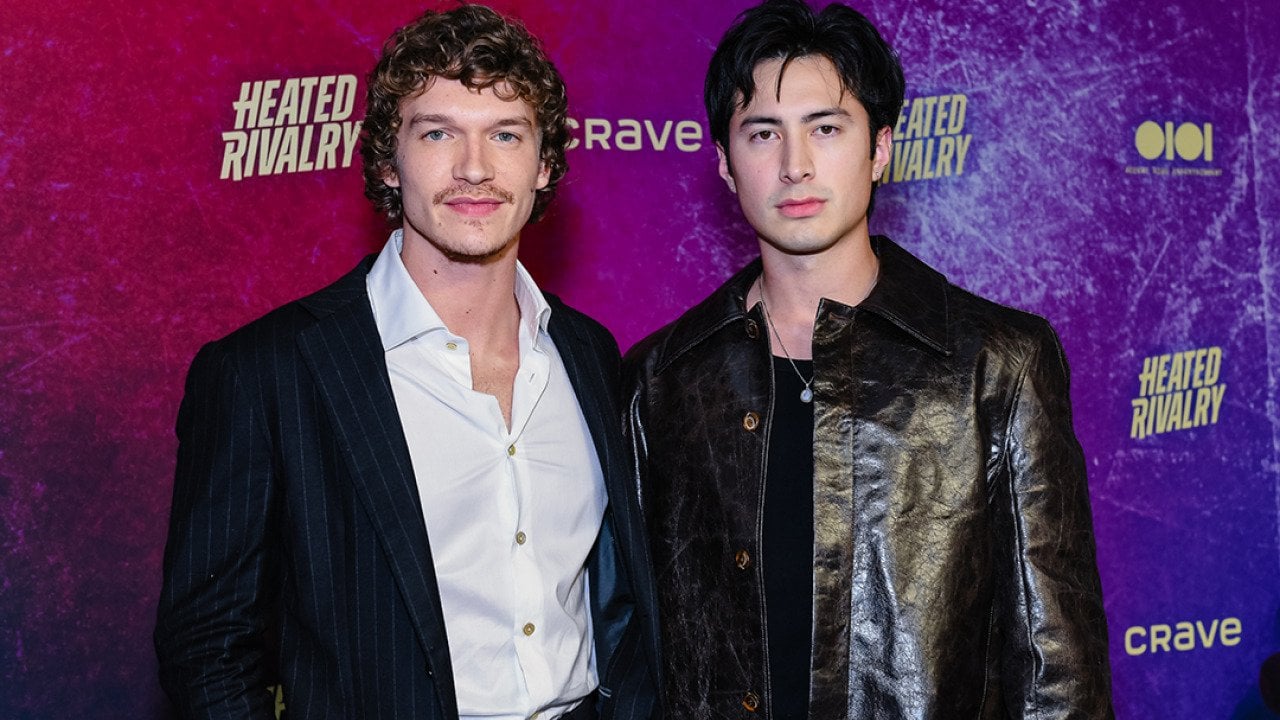
Harold Feng // Getty Images
‘Heated Rivalry’ is quietly changing how autism looks on screen, and fans are taking notice
If you’ve been online in the last few months, you’ve probably heard about “Heated Rivalry.” The Canadian series has become an unexpected smash hit with more than 10 million viewers in the U.S. alone. The show follows two professional male hockey players—Shane Hollander (Hudson Williams) and Ilya Rozanov (Connor Storrie)—who go from athletic rivals to secret lovers over a tumultuous 10-year relationship.
Also on Mediabistro


The show is a significant moment for LGBTQIA+ representation, showcasing a thoughtful, racy, and poignant love story between two masculine athletes in a way that feels fresh and inspiring. But the nuances of the show also make room for another type of representation: the subtle portrayal of autism through Shane’s character.
In the weeks following the premiere, there’s been significant online discourse about this portrayal. But if you watched and thought, “I didn’t notice that,” you may have hit the nail on the head. Thriveworks spoke with experts to explore Shane’s behavior, what’s behind it, and why this kind of subtle representation is resonating so powerfully.
What makes Shane’s autism portrayal different?
Autism representation in the media has improved in recent years, but many people still associate autism with a narrow set of symptoms: overt meltdowns, refusing eye contact, and extreme difficulty socializing or functioning. While this describes some people on the higher end of the autism spectrum (level two or three), many autistic people navigate daily life much like anyone else—just in a world not designed for them.
Autism affects about one in 100 people worldwide. Many autistic people—particularly those with lower support needs—can mask their symptoms effectively, which means they often go undiagnosed or receive diagnoses as adults.
Autism presents differently across individuals. “One thing I wish more people knew is that no one character has to represent all autistic people,” says Noor Pervez, community engagement coordinator at the Autistic Self-Advocacy Network (ASAN). “The more ways people see autism existing, the more ways people learn autistic people can be. That’s really key for people to recognize and to better understand themselves and others.”
Thriveworks’ Kate Hanselman, PMHNP, sees this value reflected in her clinical work. “A lot of my clients on the spectrum don’t want autism to define their whole life. It touches many areas and is part of what makes them who they are, but it’s not all of who they are. I think that’s beautifully demonstrated in the show: You can have a character on the spectrum in a story about many different marginalized identities, and the autism isn’t the focus.”
Hollander’s character has many facets: He’s a hockey player, half Japanese, a gay man, highly competitive, and inescapably earnest. By highlighting these other dimensions, the show allows his autism to be just another facet—a part of the whole that makes up Shane Hollander.
Why Shane’s autism isn’t the focus—and why that matters
Shane’s autism is never mentioned on screen. Instead, it was confirmed by the book’s author and the show’s creators.
This wasn’t an afterthought. Hudson Williams, the actor who plays Shane Hollander, told The Hollywood Reporter that he was aware of Shane’s autism from the start and modeled his portrayal after his father, who is on the autism spectrum. “I took a huge page out of living my life with him,” Williams said.
While visible representation is crucial, representation that centers on a character’s difference can sometimes reduce that person to a single defining trait. When the goal is solely to spotlight that difference, the focus can shift away from normalization. Both approaches are necessary, but subtle representation like this is rarer—which may be why audiences find it so refreshing.
7 subtle signs of Shane’s autism in the show
Though never explicitly mentioned, Shane’s autism appears throughout his behavior. Here are some of the traits you may have noticed while watching that hint at autism.
1. He folds his clothes before hookups.
Some scenes that stick out involve Shane pausing to fold his clothes. On its own, it’s not unusual—but stopping a hookup to neatly fold shirts, pants, underwear, and even ties might strike neurotypical people as odd.
“Part of autism is an insistence on order,” Hanselman says. Shane likes things neat, clean, and tidy, following that routine to a nearly compulsive extent. He doesn’t notice this might be strange. It doesn’t occur to him not to do it. Later, viewers see him relax more with Ilya, but when nerves are high or he’s out of his element, Shane reaches for order.
2. He’s on a strict diet.
Shane’s macrobiotic diet is mentioned several times in episodes one and four. He maintains it strictly and refuses to drink alcohol during hockey season, all framed as keeping his body in top physical form, though his commitment is shown to be stricter than that of other professional hockey players in Shane’s circle.
Restrictive eating frequently accompanies autism. Many autistic people eat only specific foods due to sensory sensitivities around textures, while others develop strict routines around meals or use food to maintain control and familiarity.
Viewers rarely see Shane break this diet. In episode four, he doubles down on it with his parents during a high-stress moment. This inflexibility helps him feel in control, finding security in a stable, predictable routine, explains Isabelle Mathewes, a researcher in the psychology department at the University of Virginia and autism advocate.
3. He sometimes struggles with eye contact (and sometimes doesn’t).
Shane struggles to make eye contact with family and friends, especially when stressed or uncomfortable. In locker rooms, for example, he often talks shoulder-to-shoulder with teammates rather than face-to-face. His mother, Yuna, even draws attention to this during conversations where Shane is frustrated or uncomfortable, likely because she taught him social skills like eye contact that came naturally to other children.
For autistic people, eye contact is often overstimulating. Autistic brains are already working overtime to process conversation and social cues while filtering sensory stimuli—something neurotypical brains do automatically. Eye contact only adds pressure.
However, Shane makes noticeable, even prolonged, eye contact with one person: Ilya. This highlights how Ilya becomes a safe, familiar space where Shane feels less need to mask and can simply be himself.
4. He feels deeply (but might not show it).
Shane isn’t highly expressive. He struggles to admit how he feels, even to himself, and struggles more to put feelings into words. However, he’s deeply earnest and can’t fully conceal his emotions.
Williams conveys this beautifully through Shane’s eyes: Fans noted how he expresses emotion through eye contact while maintaining limited facial expression. Shane’s eyes often fill with tears, though they rarely fall until the final episode. He doesn’t feel he can express feelings outright, but is incapable of fully hiding them.
For people with autism, facial expressions often don’t come naturally—they have to be learned, sometimes through training. This leads to “flat affect” (showing no emotion) or “blunted affect” (showing minimal emotion). Autistic people may also struggle to understand and communicate their emotions, though they feel them intensely.
“When I work with clients on the spectrum on expressing emotions,” Hanselman says, “I often hear confusion about why their emotions aren’t being understood: ‘I’m feeling a lot—why is it not coming across?’ The show exemplifies how intense emotions can hide under the surface.”
Mathewes also notes how this representation diverges from societal assumptions about autism. “There are many stereotypes about autistic people being emotionally stunted or limited, and autistic characters in media often have an emotionally reserved air,” she says. “It was such a breath of fresh air to see Shane cry, get mad, joke around—generally experience a full range of emotions.”
5. He’s hard to flirt with.
Shane and Ilya’s approaches to flirting couldn’t be more different. Ilya is forward and loves pushing Shane out of his comfort zone with innuendo-laden comments and texts—innuendo that Shane struggles to match or might miss entirely.
Abstract communication like sarcasm or double-entendres doesn’t translate naturally for autistic brains. Everything is literal, and implied meaning is often lost.
Shane’s literalism appears vividly in text conversations with Ilya, where Shane follows flirtatious messages with charmingly earnest answers. More subtle examples appear when Shane reacts to jokes—especially about Ilya—with alarm or confusion rather than humor, taking statements literally rather than parsing out intended meaning.
6. He struggles to process overwhelming emotions.
The clearest glimpses of Shane’s autism appear in moments of high stress or discomfort. His emotions become too strong to manage internally and escape externally, often reading as irritation or panic.
Two key moments stand out: the infamous tuna melt scene in episode four, and two scenes in episode six—at the cottage and after. In the tuna melt scene, something disrupts Shane’s emotions to an overwhelming degree. His panic causes him to leave abruptly, stumbling over words, needing physical and emotional distance from the source of his distress.
In the cottage scenes, viewers see him spiral differently—in a safer, more understanding environment. He’s given space to freak out and express disjointed thoughts with a trusted person who eventually grounds him in the present moment. His emotions are validated; there’s no rush to fix things, and he’s allowed to just be.
7. He leans heavily on his parents.
Shane’s family, especially his mother, is deeply involved in his life as both a teenager and an adult. Yuna acts as his professional manager, but viewers also see her check in consistently: reminding him about endorsement deals, telling him what to focus on, and managing his screen time.
This could simply be “momager” behavior, but Hanselman notes parallels to her clinical practice. “I’ve worked with parents whose kids on the spectrum needed far more parental support than other kids their age—involvement that extended well beyond the typical developmental period.”
Hanselman continues, “eventually Shane pushes back more, but he still spends significant time with his family. The reliance and comfort he has with his parents that he doesn’t have with the rest of the world felt related to what I see in my clients. They played that beautifully.”
Why this representation resonates
Pervez emphasizes that normalizing autism in the media is essential for acceptance. “Making autism an everyday, normal part of the human experience is key to the world treating us as people who deserve to be living our lives, among our loved ones—not people to be pitied or looked down on, but as everyday people,” he says. “Media representation, either coming directly from or with input from the autistic community, is a tool to combat fear of autistic people with acceptance.”
“I loved that the show featured someone with a successful family life, social life, and love life,” Hanselman adds. “There was acceptance—not pushing it to the background or making fun, but acknowledgment in a way that felt loving and supportive.” She goes on to say, “Here’s someone with autism who might be socially awkward at times or struggle to make eye contact, but it’s still fine to those who care about him. He gets to be successful and be a regular person. I thought that was huge for the neurodivergent community: We can know someone is autism-coded without it being ‘a portrayal of autism.’”
Finally, Mathewes hits on the importance of the “love” part of the story: “Many stereotypes paint autistic people as either uninterested in or incapable of romantic relationships,” she says. “It’s powerful to see a show that portrays an autistic man as capable of both desiring and being desired.”
The bottom line
Shane Hollander’s character shows that autism doesn’t have to be loud to be meaningful. By making it just one part of who he is, “Heated Rivalry” offers a refreshing model of acceptance—one where autistic people can simply exist, thrive, and be loved exactly as they are.
This story was produced by Thriveworks and reviewed and distributed by Stacker.
Topics:
Entertainment
