

In this article:Where the Jobs Actually Are | What Gets You Past the Screener | Standing Out in the Stack | Start Your Search
Mediabistro has noticed a decline in job search volume for “social media manager” positions, but it tells a misleading story. The work hasn’t dried up. The title has splintered.
Also on Mediabistro


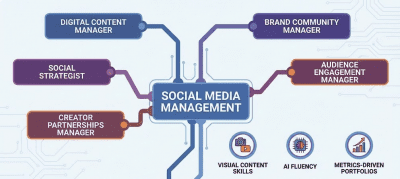
What was once a single job listing appears as five or six specialized roles: digital content manager, social strategist, brand community manager, audience engagement manager, and creator partnerships manager. Each reflects a specific slice of what social media management has become.
If you’re searching only for the exact phrase “social media manager,” you’re running a narrower hunt than the market offers. And employer expectations have climbed. Visual content skills, AI fluency, and metrics-driven portfolios are baseline requirements, not nice-to-haves.
Here’s how to search smarter and meet the raised bar.
Where the Jobs Actually Are
Search Wider Than the Title
Run parallel searches across multiple titles. The roles demand similar skill sets, but the listing language has diversified. Set up alerts for all of these:
- Digital Content Manager
- Social Strategist
- Brand Community Manager
- Audience Engagement Manager
- Creator Partnerships Manager
- Social Media Specialist (often equivalent to manager-level work despite the title)
Cross-industry demand is broader than most candidates realize. Consumer packaged goods brands, healthcare systems, financial services firms, nonprofits: they all need this work done. Don’t box yourself into agencies and tech companies.
Go Beyond the Aggregators
Major job boards surface a fraction of what’s available. The roles matching your specific skills often appear first on niche platforms and in professional communities.
Niche job boards:Mediabistro’s job board focuses on media, marketing, and creative positions where social media management sits. The American Marketing Association board skews toward marketing-adjacent roles. Industry-vertical boards in whatever sector interests you (healthcare marketing associations, fintech career sites, entertainment industry job boards) surface openings before they hit LinkedIn.
For a broader look at how social media professionals break into their first positions, our guide on landing social media jobs covers the fundamentals across experience levels.
Professional communities: Slack groups, Discord servers, and industry-specific forums regularly surface openings before they go public. The value isn’t just job leads. It’s context about what specific companies are actually like to work for.
LinkedIn strategy: Skip the “Easy Apply” grind. Follow hiring managers at companies whose work you respect. Engage with their content meaningfully: comment on campaign posts, share their team’s work with your own analysis. When a relevant posting appears, your prior engagement puts you at the front of mind.
Direct outreach: Identify brands whose social presence you genuinely admire. Reach out to their marketing leads with a specific observation about their channels and a concrete idea for building on it. This works particularly well at mid-sized companies where the social team is small and constantly stretched. You’re not asking for a job. You’re demonstrating what you’d bring.
What Gets You Past the Screener
The Technical Skills That Are Non-Negotiable
Scheduling and automation tool proficiency is table-stakes. Buffer covered seven post-scheduling apps in February 2026 alone; the tool landscape keeps shifting. Familiarity with at least two or three platforms in this category (Planable for collaborative planning, Loomly for approval workflows, native schedulers across major platforms) is expected from any manager-level candidate.
Visual content creation is essential. The line between social media manager and content creator has blurred. You don’t need to match a motion graphics specialist, but you should be comfortable designing static posts, editing short videos for Reels or TikTok, and understanding basic composition and typography. These graphic design skills are increasingly mentioned alongside traditional social media manager jobs.
AI fluency is showing up in job descriptions with growing frequency. Not deep technical expertise: practical application. Using generative tools to draft copy variations and brainstorm campaign concepts. Using predictive tools that suggest optimal posting times based on historical engagement. Understanding how AI-driven algorithm shifts affect reach.
Grit Daily reported on AI and social media algorithms this month, highlighting how these shifts are actively reshaping the space. Candidates who can articulate how they’d adapt strategy to algorithmic changes demonstrate the thinking that gets you past the screener.
Analytics and attribution have moved from a bonus to a requirement. Managers are expected to read data, not just post content. Familiarity with social listening tools like Brandwatch and native platform analytics (Meta Business Suite, LinkedIn Analytics, TikTok Analytics) is baseline.
But knowing what to do with the numbers matters more than pulling them. Which content themes drive actual engagement? Which channels produce conversions versus vanity metrics? Can you explain performance to stakeholders who don’t live on social media daily?
What Your Portfolio Must Prove
Hiring managers expect metrics-backed case studies, not screenshots of posts. A portfolio without quantified results often dies in initial screening.
Frame two to three case studies (even from freelance or personal projects) with clear before-and-after metrics:
- What was the engagement rate before your content strategy shift? What happened after?
- Did follower growth accelerate, and was it the right audience?
- Can you show conversion attribution: newsletter signups driven by Instagram Stories, product page visits from a TikTok campaign, event registrations from LinkedIn posts?
Red flags employers catch immediately:
- Portfolios that only show content samples with no performance context
- Résumés that list platform names as “skills” without strategic substance (“proficient in Instagram” tells a hiring manager nothing; show a campaign you ran and what it accomplished)
- Generic cover letters that don’t reference the company’s actual social channels
That last one matters more than candidates realize. Spend 20 minutes reviewing a brand’s social presence before writing your cover letter. Reference a recent campaign. Note a channel they’re underusing. Suggest a content format they haven’t tried. This signals you’re already thinking about their challenges.
For tactical advice on presenting your work once you land the interview, our social media manager success tips break down what strong candidates emphasize.
Standing Out in the Stack
If You’re Stepping Up From Coordinator to Manager
Your application needs to show strategic thinking and cross-functional collaboration, not just execution. Use your cover letter to demonstrate you understand:
- Channel strategy: Why you’d prioritize one platform over another for specific business goals
- Budget allocation: How you’d distribute paid social spend
- Team coordination: How you’ve worked with designers, copywriters, and product teams on cohesive campaigns
A hiring manager can teach someone a new scheduling tool. Strategic thinking is harder to install.
The Follow-Up That Gets Noticed
A short, specific note that adds value (“I noticed your team launched this campaign last week; here’s a quick thought on extending that momentum”) stands out. A generic “just checking in” gets ignored. One demonstrates you’re paying attention. The other feels like template spam.
Start Your Search With a Strategy
The market for social media management work is broader than a single job title suggests. Search wider. Present sharper. Demonstrate results.
The Bureau of Labor Statistics projects 6% job growth for advertising, promotions, and marketing managers (the closest federal classification encompassing social media management) at a rate faster than average across all occupations. The demand is there. The title is just dressed differently than it was three years ago.
Start on Mediabistro’s job board, where media and marketing roles, including the social media manager jobs hiding under new titles, are posted daily. Set alerts for the alternative titles discussed above.
The strongest applications aren’t the ones that check every listed requirement. They’re the ones that prove you’ve already started thinking about the company’s specific challenges before you’ve landed the interview.
Hiring for media and marketing roles? Post your job on Mediabistro to reach qualified social media professionals actively searching.
Topics:
Advice From the Pros