

Freelancers need to keep track of dozens of moving parts from day to day. Stories are at different stages of progression, being worked on at the same time. Various editors have specific preferences of how articles are styled and submitted. And while you’re working on assignments, a countless number of other story ideas are likely percolating in your head. So how do you manage it all — and maintain your sanity?
A few months ago, when I started freelancing full time, I would scribble a story idea on an index card and tape it to the fridge. I’d email myself ideas or write them as notes in my iPhone. I was waiting to be paid on a couple of articles and needed to submit an invoice to be paid on another. Eventually, I felt severely disorganized. There had to be a better system! I talked with a handful of successful freelancers about their methods and incorporated some of my own ideas to create a more thorough story-tracking method for myself, and to write this article.
Also on Mediabistro


Writers have their own individual systems of keeping track of assignments, but I’ve learned a good-ole spreadsheet, using Google Sheets, for example, is a standard essential. It’s just a matter of finding a format that works best for you.
Freelancer Taffy Brodesser-Akner, who now has contributor writer contracts with The New York Times Magazine and GQ agrees. On her Excel spreadsheet, a basic approach, the columns are labeled as follows: Story Idea, Editor, Pitch Date, Follow Up, Assigned?, Word Rate and Word Count. And once the story is handed in and Brodesser-Akner has been paid, she italicizes the line to indicate that assignment is complete.
Full-time freelancer Ann Friedman said she formats an Excel spreadsheet into four main groups, which are: Pitched, Assigned/In Progress, Filed/To Be Invoiced and Invoiced/Waiting on Payment. A particular story will progress from the top of the spreadsheet to the bottom from start (as an idea) to finish (a published story with a check deposited into Friedman’s bank account). See sample below.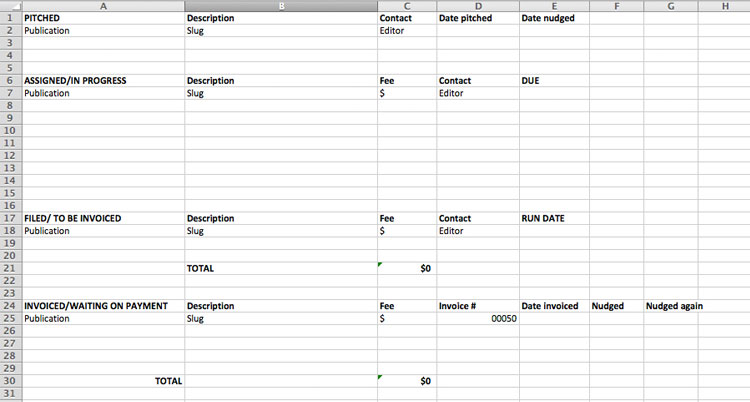
According to Ann, this method helps her to keep track of each story’s status, a necessary process because there are a variety of stories she’s working on at once for various publications, all in different stages of development.
As for me, the more detailed spreadsheet I use with Google Sheets tracks each story’s different elements and ideas. Following the progression of each story helps me make sure I’m not repetitive with any specific editor or publication, and allows me to pay attention to the ideas that worked and those that didn’t.
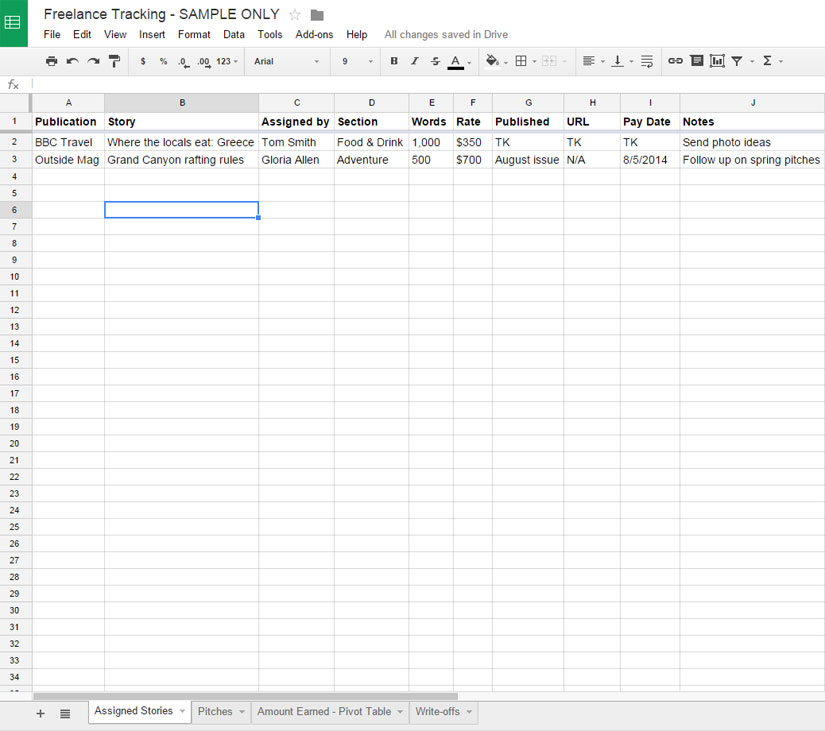
To replicate it, use four tabs for your document, and create columns for the following bulleted items:
Tab 1: Assigned Stories
• Publication
• Title of story
• Point of contact
• Section
• Words
• Rate
• Date published
• URL (if applicable)
• Payment date
• Notes (feedback/preferences from editor)
Tab 2: Pitches
• Story idea
• Working title
• Submitted (Yes?/No?)
• Pitched to (list publications you pitched)
Here’s a sample sheet:
The last two tabs can help you for accounting purposes:
Tab 3: Amount Earned
Use a pivot table to automatically calculate the amount earned per month (or whatever time periods you want to look at), based on the rate information from Tab 1. You can do this in Excel or in Google Sheets. (Here’s how to create a pivot table in a Google doc, which will allow you to access your information wherever you are logged in to your Google account.)
Tab 4: Write-offs
Finally, here’s where you can keep track of anything you can write off as a business expense. Include costs associated with networking lunches, money spent to work and use Wi-Fi in coffee shops, home Internet bills, office supplies, etc.
Many full time freelancers say their job requires a certain amount of entrepreneurial spirit — they treat their freelancing as a business that they must grow and take ownership of. Keeping track of your work as a freelancer, from publish dates to word counts and pay, will help you analyze how you progressed over weeks, months and years.