
Mediabistro Logo Mediabistro Logo
  • Jobs
    Search Creative Jobs Hot Jobs Remote Media Jobs Create Job Alerts
    Job Categories
    Creative & Design Marketing & Communications Operations & Strategy Production Sales & Business Development Writing & Editing
    Quick Links
    Search All Jobs Remote Jobs Create Job Alerts
  • Career Resources
    Career Advice & Articles Media Industry News Media Career Interviews Creative Tools Resume Writing Services Interview Coaching Job Market Insights Member Profiles
  • Mediabistro Membership
    Membership Overview How to Pitch (Premium Tool) Editorial Calendars (Premium Access) Courses & Training Programs Membership FAQ
  • Showcase
    Featured Creative Stories Submit your Story
  • Log In
Post Jobs
Mediabistro Logo Mediabistro Logo
Search Creative Jobs Hot Jobs Remote Media Jobs Create Job Alerts
Job Categories
Creative & Design Marketing & Communications Operations & Strategy Production Sales & Business Development Writing & Editing
Quick Links
Search All Jobs Remote Jobs Create Job Alerts
Career Advice & Articles Media Industry News Media Career Interviews Creative Tools Resume Writing Services Interview Coaching Job Market Insights Member Profiles
Membership Overview How to Pitch (Premium Tool) Editorial Calendars (Premium Access) Courses & Training Programs Membership FAQ
Featured Creative Stories Submit your Story
Log In
Post Jobs
Log In | Sign Up

Follow Us!

Climb the Ladder

Why Finance Majors Don’t Get Finance Jobs

Why Finance Majors Don’t Get Finance Jobs
Scouted.io icon
By Scouted
Scouted was a hiring marketplace that matched candidates to roles based on potential, serving clients from high-growth startups to Fortune 500 companies.
4 min read • Originally published May 12, 2017 / Updated March 19, 2026
Scouted.io icon
By Scouted
Scouted was a hiring marketplace that matched candidates to roles based on potential, serving clients from high-growth startups to Fortune 500 companies.
4 min read • Originally published May 12, 2017 / Updated March 19, 2026

Back when I was in college, it felt like everyone majored in Econ, or Econ and something else (CS in my case).  At a school with no undergrad business program, Econ was the gateway major to that ultimate of career paths: financial services.  You know, whatever it is that investment bankers do.  I imagine we all figured knowing a thing or two about global markets and the velocity of money and all that would provide the appropriate foundation for a long and prosperous career in making it rain.

Nearly fifteen years later, unsurprisingly, finance is as popular as ever.  I got to wondering, does that dogged pursuit of finance actually help in getting a job in the industry?

Does being interested in finance help or hurt you in the job search?

One of the questions we ask candidates up front is which of 26 job roles (things like finance, marketing, and software engineering) seem interesting.  Candidates can pick as many or as few of these as they want, and a solid 10% of the pool says they want finance (we label as “Financial Analyst”).
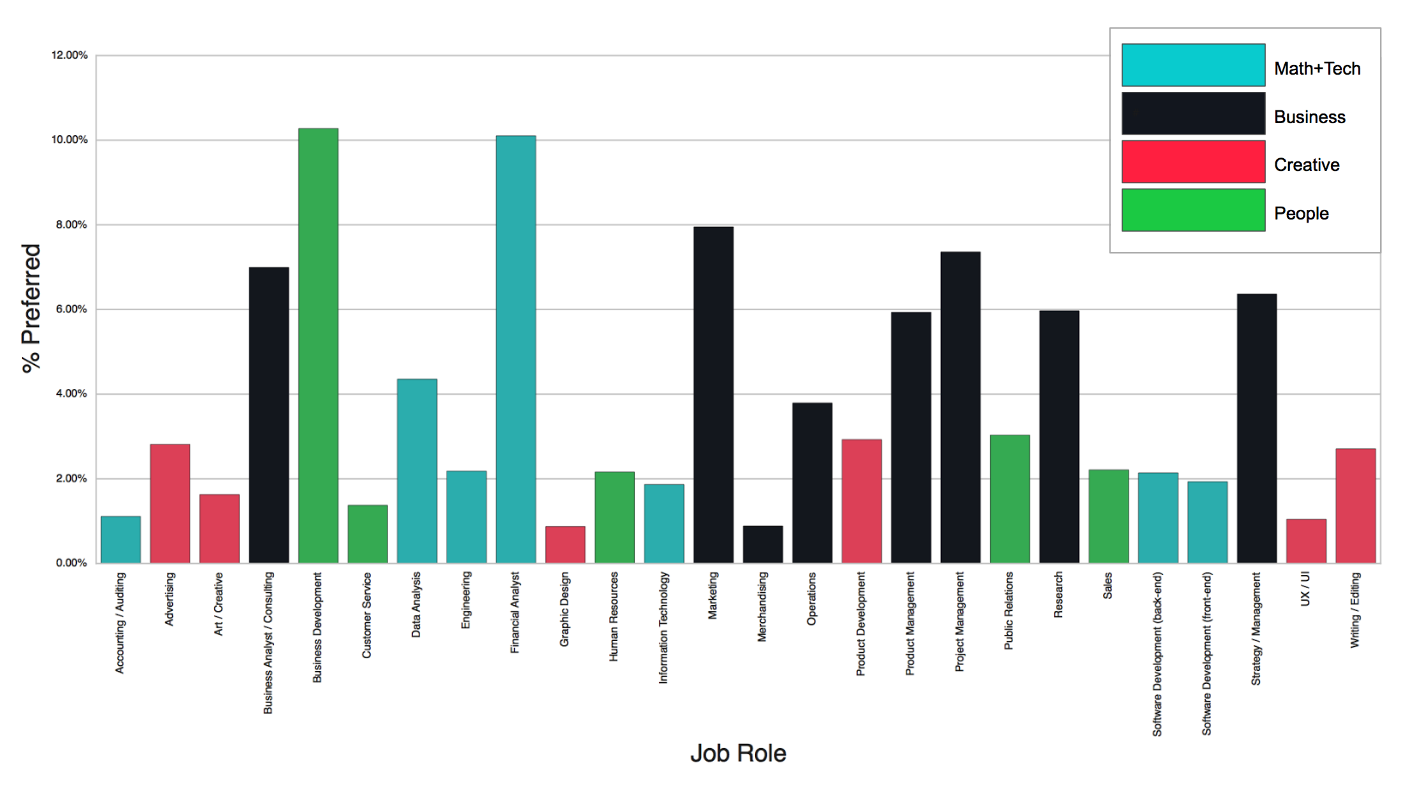
Candidate Job Role Preferences


In fact, 6.89% of our candidates say Financial Analyst and nothing else!  I suppose this isn’t too surprising: ~22% of our candidates pick just one job role.  A similar number picks just Marketing.  Most of the candidate pool, however, is open to other possibilities.
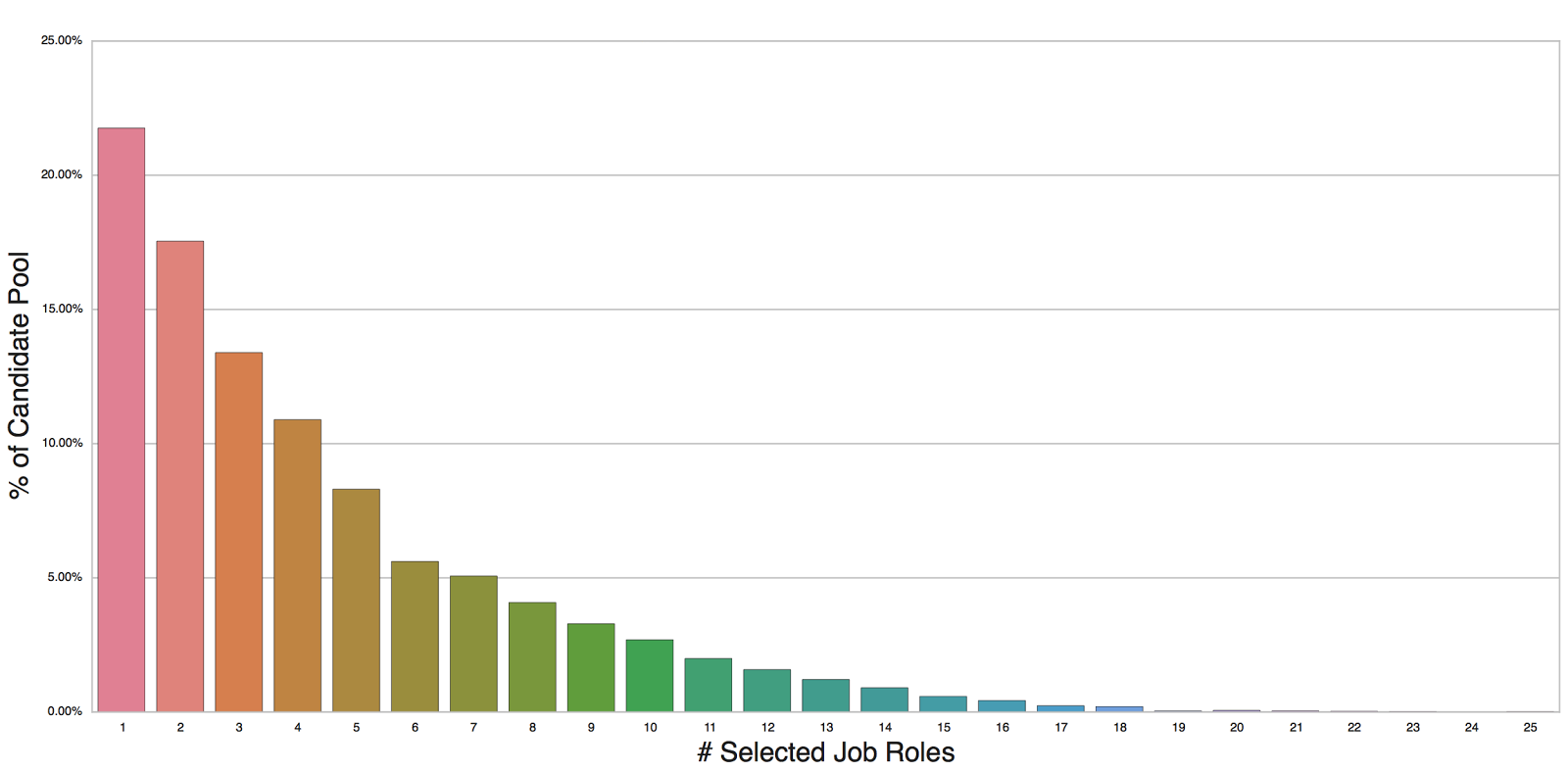
How Many Job Roles Do Candidates Select
How Many Job Roles Do Candidates Select?


Given there are over 67 million ways of selecting job roles, it’s interesting to look at the correlations of those choices.  
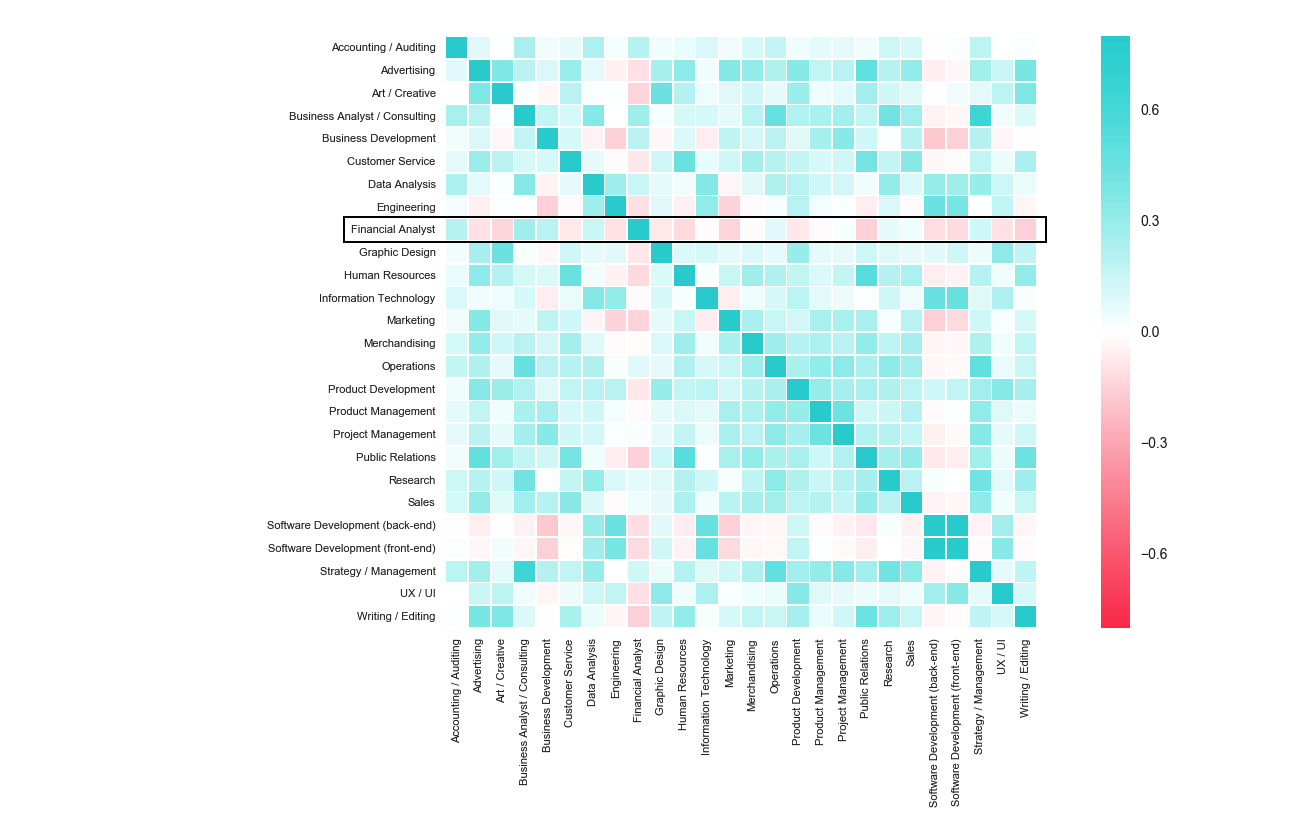
Correlations of Candidate Job Role Preferences


Following the Financial Analyst row across, we can see negative (red) correlations with pretty much everything except stereotypically business stuff such as accounting, or data analysis. Clearly, folks looking for finance jobs are generally not looking for HR or writing gigs.

To be fair, these correlations commingle our full-time candidates with the interns.  Separating them apart, we can see similar interests most of the time, but pretty big gaps on a few categories, including finance.
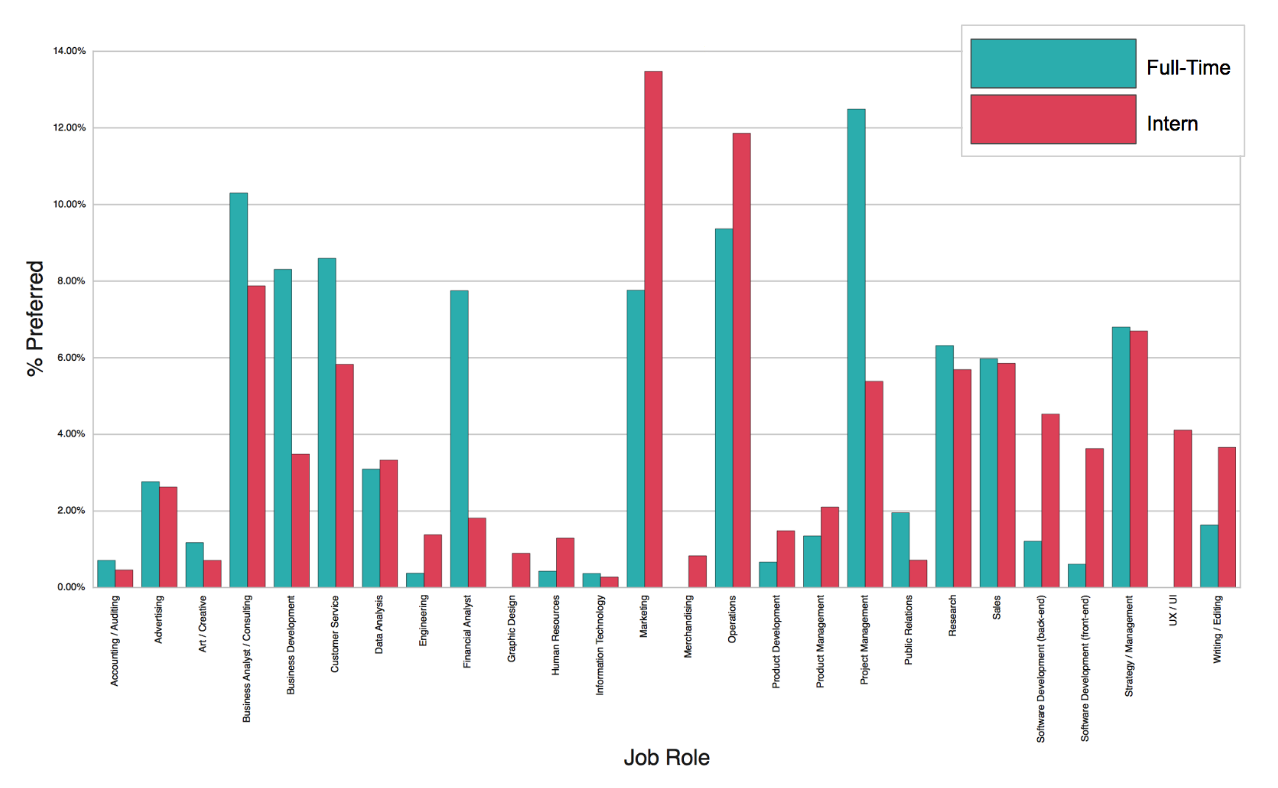
Job Role Opt-Ins
Job Role Opt-Ins


A relatively bigger chunk of the full-time pool opts in for finance roles.  We’ve offered twice as many finance roles for full-timers as we’ve had for interns, so that likely has a big impact.  

Interested in writing? Maybe your secret calling is finance!

As an alternate theory, when I was looking for internships in college, I was more interested in exploring varied opportunities before settling into a career following graduation.  Perhaps this mentality still holds? In any event, here’s the surprising chart.
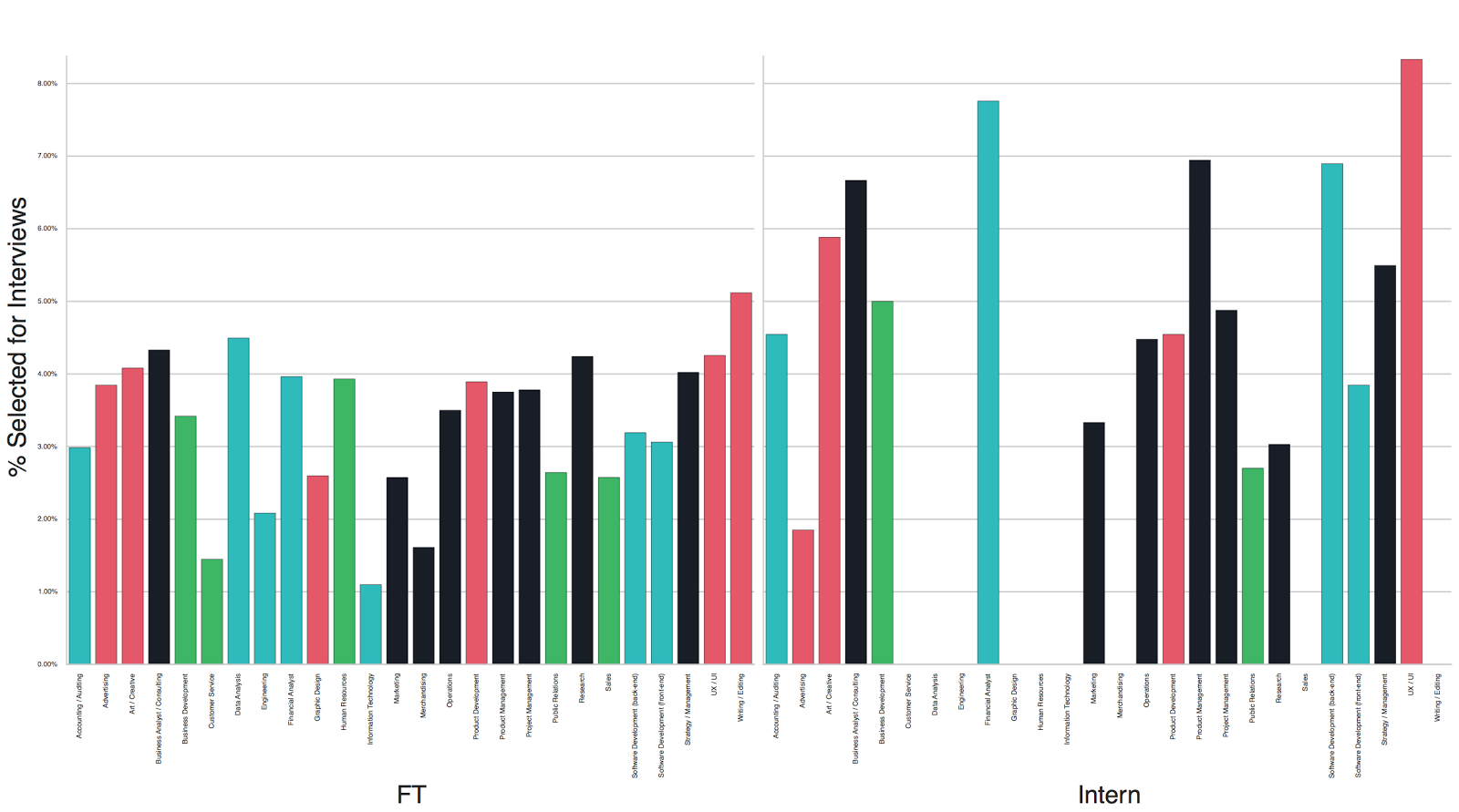
Who Gets Interviews For Financial Analyst Roles?


Of those full-time searchers who opt-in for finance jobs, it’s not the aspiring financiers who do best, but the writers and editors who’ve been most likely to see a Round-2 interview! (NB: past performance does not guarantee future results.)
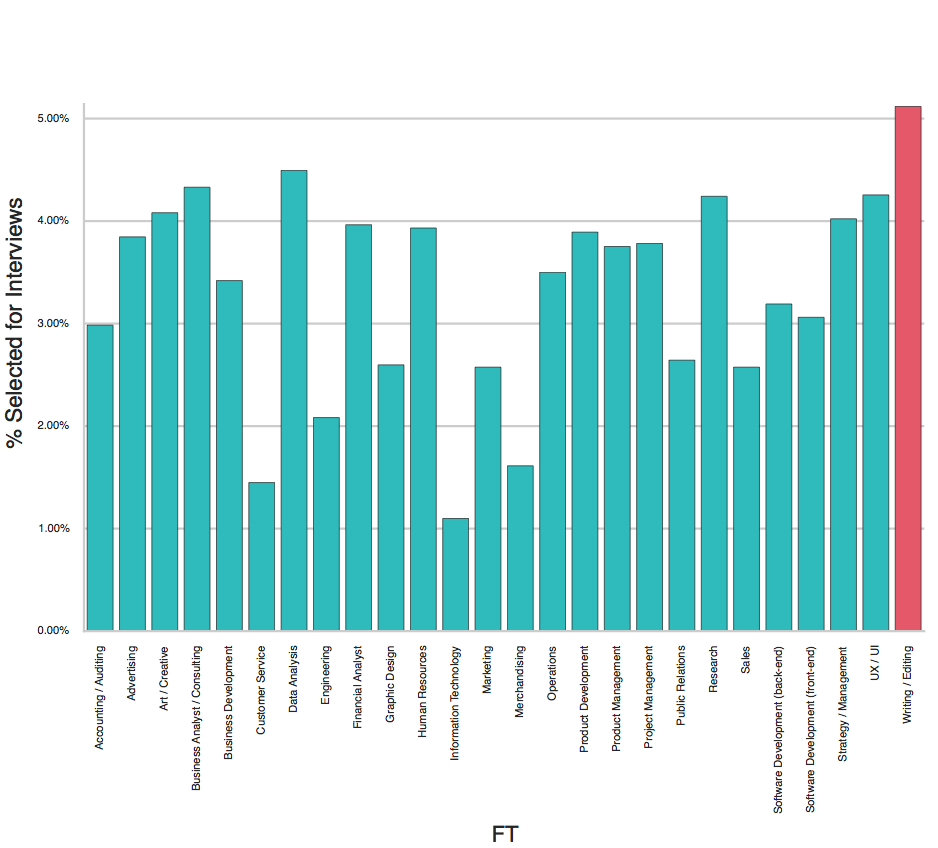
Who Gets Interviews for Financial Analyst Roles?


Part of this is certainly a numbers game. We don’t have many novelists opting into our finance opportunities; but those candidates who do must be pretty strong, as they get lots of interviews.
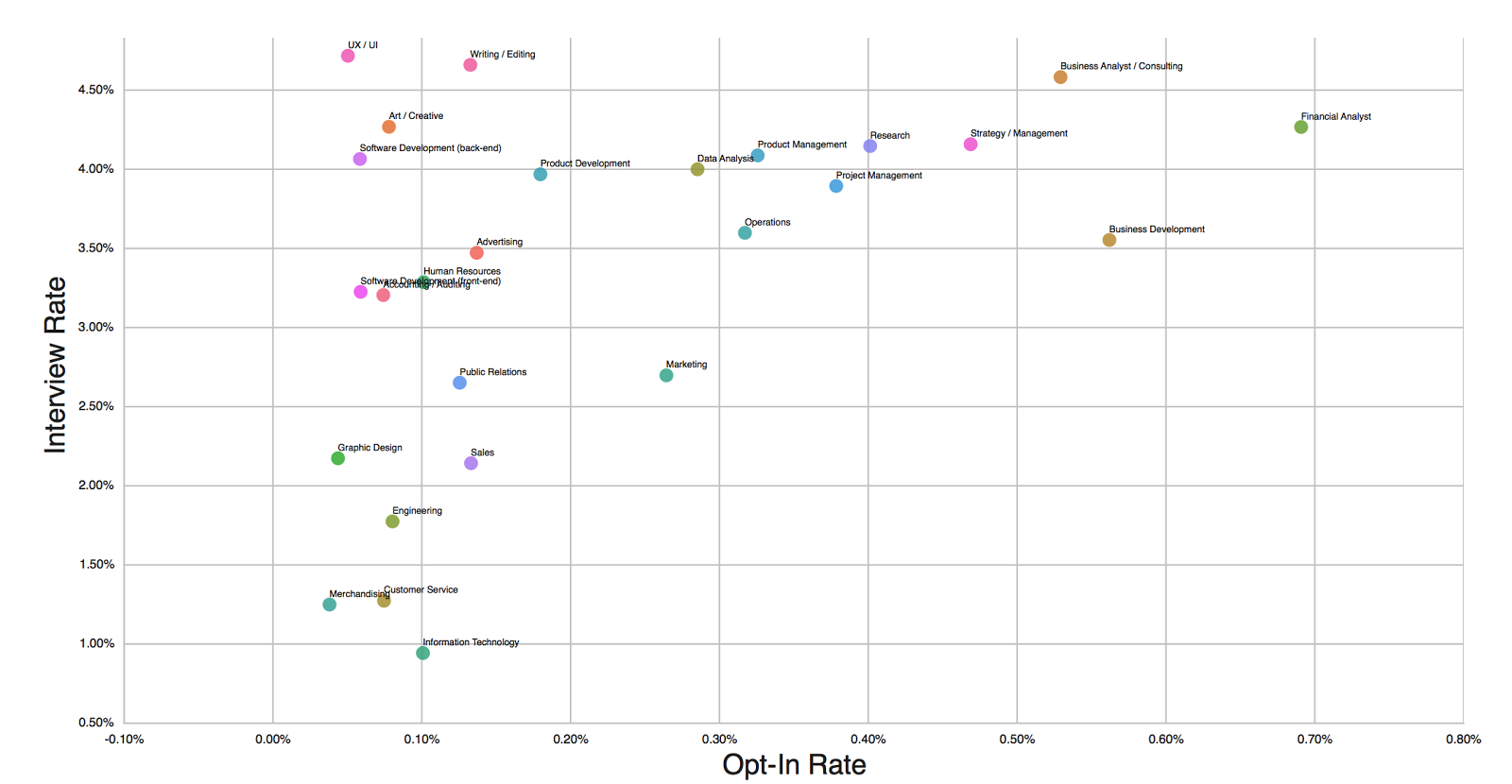
Candidate Preferences for Companies Hiring a Financial Analyst
Candidate Preferences For Companies Hiring A Financial Analyst


Of course, we can make charts tell whatever story we want, but our data shows that clients hiring for finance do not have a bias for candidates who want to work exclusively in finance. If we flip the data a bit, we can see that financial analysts are getting interviews, well, everywhere!
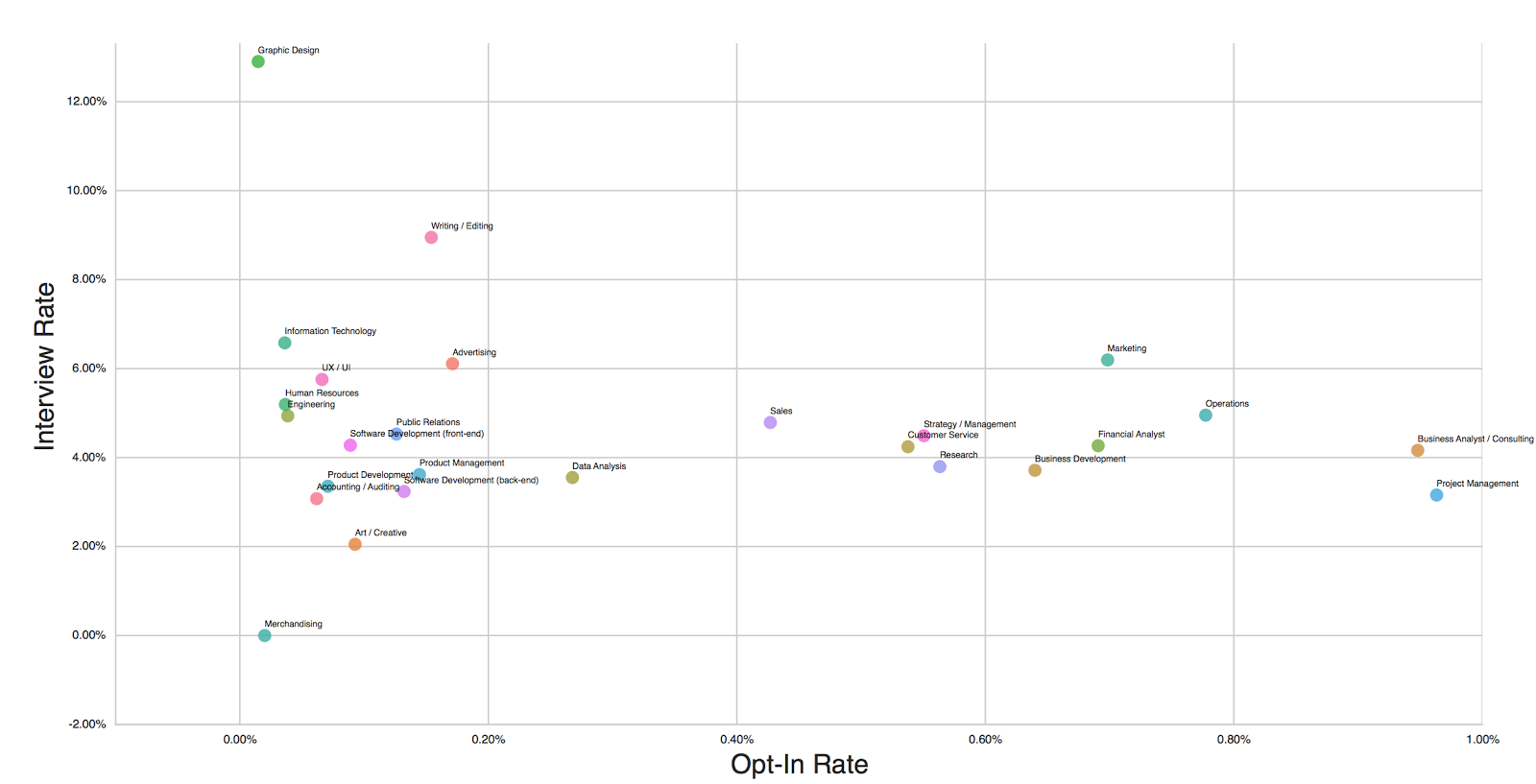
Where Do Aspiring Financial Analysts Get Interviews?

Conclusions

The moral here?  Even financial analysts (and engineers) have to write, and sometimes product managers do marketing, and sometimes human resources does sales.  So cast a wide net and don’t let the search parameters be a limiting factor.  Your resume may bleed finance (or Econ), but don’t let that stop you from thinking about or being considered for a job one or even two derivatives over.  And lastly, though we might not be offering traditional i-banking roles (yet!), if you’re early on in your college years, even if, ya know, you’re dead set on spending your twenties as a corporate slave, don’t be afraid to explore the physics or philosophy departments while you have the chance.

This analysis exemplifies how everyone on Scouted benefits from our data-driven approach to matching: candidates get presented with great opportunities that they may have ordinarily overlooked, yet that still fit well with their set of values and abilities; clients gain access to not just a capable, but a diversified roster of excited applicants; and we at Scouted learn how to make the job search and hiring process easier to navigate with greater and greater success rates for everyone on the platform.

[optinform]

Topics:

Candidates, Climb the Ladder
Climb the Ladder

How to Find Your First Apartment in 6 Easy Steps

How to Find Your First Apartment in 6 Easy Steps
Scouted.io icon
By Scouted
Scouted was a hiring marketplace that matched candidates to roles based on potential, serving clients from high-growth startups to Fortune 500 companies.
5 min read • Originally published June 7, 2017 / Updated March 19, 2026
Scouted.io icon
By Scouted
Scouted was a hiring marketplace that matched candidates to roles based on potential, serving clients from high-growth startups to Fortune 500 companies.
5 min read • Originally published June 7, 2017 / Updated March 19, 2026

Finding your first apartment ain’t easy. Take it from me; as someone who recently just went through the process, finding your first grown-up place to live post-college is probably the second biggest decision you’ll make as you enter the real world. It is far different from moving out of your dorm and into a fraternity house, where the only decision there is whether you have enough room for a bar and a FIFA station. Luckily for you, I recently left the comforts of my parents’ home and began looking for my first domicile. Here’s my worldly wisdom:

1. Budget

The least fun and most important part of the search – the goal here is to avoid being that bum who needs a loan from your roommates or parents to make your rent payment. As a general rule of thumb, your rent should NEVER exceed 50% of your monthly income (unless you crazy good at saving money) which is why I like to follow the 50/20/30 method:

50% of your monthly income should go to fixed costs that recur monthly: rent, utilities, subscriptions (i.e transportation, gym membership, Netflix obvi).

20% of your monthly income should go to your savings/financial goals.  We’re grown-ups now, so let’s lay the groundwork for a stable future. Whether you’re saving for a nicer apartment, student loan payments or just an emergency fund – keep a cushion around. You don’t want to be stuck looking at an empty savings account when you break your laptop because you thought it might serve as a good koozie.

30% of your monthly income is allocated to flexible spending: shopping, vacations, beer, groceries, entertainment, beer, dry cleaning if you don’t work at a startup (nerds). Essentially anything that can fluctuate and isn’t a fixed cost.

2. To roommate or not to roommate

Ah, the ultimate question. This step is often dictated by your budget and location. If you’re in Manhattan or San Francisco and don’t work for a hedge fund, you’re most likely going to need a roommate(s).  Now if you’re in a city like St. Louis or Richmond, where the average 1 bedroom is under $1,000, then you’re Gucci Mane. Decisions, decisions.

So now that you have decided that you need a roommate for financial or emotional reasons, where do you go about looking for roommates? The classic strategies still hold; you can, of course, live with a friend or use your network to find someone. But these days, there’s a bunch of new tools to try out too.  Companies like Symbi, RentHoop, Roomster offer the ability to match with potential roommates based on mutual interests, living habits or just a shared desire to avoid the serial killers on Craiglist. Find yourself a charmer!

3. Neighborhood

Job? Check (hopefully). Budget? Got it. Roommate and future bffaeaeae? Yep. Now it’s time to choose your neighborhoods. When picking a neighborhood(s) to narrow your search, you need to evaluate a couple of things. Like our first step, budget – can you afford to live in that neighborhood? Sure, living in Tribeca is nice and all but you don’t want to turn your budget in 90/5/5. Second, location, how far are you from work? What would your commute look like? Do you always have to travel for necessities? Re: Vibezzz, do you want a quiet neighborhood with families living there? Or are you the life of the party and need to be on the main strip? These are very much personal opinions, which means it is important to ask yourself and prioritize when narrowing your search to a couple of neighborhoods.

[sc name=“Newsletter”]
4. Ruthlessly prioritize

In New York, this usually means you have to give up some combination of laundry, not walking up 6 flights of stairs to reach your apartment, a mouse-free environment, or having actual bedroom walls.  Then you realize you actually have to give up all of these and still pay more than you wanted. Let’s just keep moving here.

5. To broker or not to broker

FINALLY, damn, that took a while… time to start actually looking at some apartments!!!

.

.

.

.

.

WHOA there, partner, not so fast:

Now you gotta decide if you want a real estate broker or not. This is sort of like learning to drive a car; you can either take paid driving lessons or you can learn how to drive by doing donuts in a Walmart parking lot using your friend’s 1996 Subaru Outback. One is expensive and tedious but “safe” (boring), the other is free-flowing, dangerous, and kind of fun. With a broker, you often get to see exclusive apartments, they can cut deals with landlords, and they probably know a heck of a lot more than you. The catch: the good ol’ broker fee, which can be up to 15% of annual rent. That’ll throw a wrench in the budget. If you decide to go down this route, I would definitely recommend our friends over at Triplemint who can make your life a lot easier if you need a broker. 

The non-broker option is the path less traveled. But it can work if you’re truly committed. I would recommend building a list of apartments you are interested and start scheduling showings. Websites like Zumper, Craigslist, Streeteasy (if in NYC), and Padmapper are also great resources.

6. YOU DID IT! YOU FOUND YOUR FIRST APARTMENT!

Ah, the journey is complete. You now have the perfect, beautiful apartment to call your own. Sure, it’s a 6th-floor walk-up with no AC, dimly lit hallways, and a stench of hard-boiled eggs, but who cares…you can officially call yourself an adult.

Well, you may have found your first apartment, but if you ever need a job don’t be afraid to hit up Scouted for all your first, second, and third job needs.

Topics:

Candidates, Climb the Ladder
Climb the Ladder

7 Ways to Improve Your Technical Resume

Technical Resume
Scouted.io icon
By Scouted
Scouted was a hiring marketplace that matched candidates to roles based on potential, serving clients from high-growth startups to Fortune 500 companies.
5 min read • Originally published June 13, 2017 / Updated March 19, 2026
Scouted.io icon
By Scouted
Scouted was a hiring marketplace that matched candidates to roles based on potential, serving clients from high-growth startups to Fortune 500 companies.
5 min read • Originally published June 13, 2017 / Updated March 19, 2026

Looking to build your technical resume, but not sure how it differs from a traditional resume?  Read on for 7 tips to help your technical resume stand out from the masses.

Be thoughtful about your list of technical skills.

Many companies use keyword searches to filter for resumes.  If you have thousands of applicants and just want the Java engineers, a keyword search seems like a quick win.  As a result, technical resumes end up with a mess of a section labeled something like “Technical Skills,” and very often this contains a proliferation of stuff ranging from, the “yes I know this” to the “I used this once for a homework assignment in CS 101.”  While getting through that automated resume screener is clearly important, when you get to the hiring manager, anything on your resume is fair game.  When an interviewer sees a technical resume with every programming language, operating system, and development tool listed there, it screams out, “I don’t actually know any of this.” (And by the way, experienced hires are just as guilty of doing this as new grads.)  Note what you know, but be honest about what you don’t – if you still want to keep everything to beat the keyword screens, at least indicate level of proficiency in some way.

Seriously, be thoughtful about your list of technical skills.

While you’re refining that list of technical skills, consider leaving off Microsoft Excel, Google Docs, etc…  Unless you are doing VBA scripting in Excel or have worked with the Google APIs, adding these applications diminishes the perception of competency for anything else you’ve listed in the section.  In this day and age, it’s pretty much expected that you know how to use the Internet, the basics of building a spreadsheet, or writing a document.  Perhaps if you’re applying for a Powerpoint-heavy job, for example, it makes sense to keep these – there are certainly intricacies to Powerpoint such as animations and transitions, or using a master template.  If you’re looking for a software development role, saying you know “Python and Powerpoint” trivializes the time you spent actually learning Python.

Pay attention to the details.

This one is really for everyone, not just engineers: check your resume for typos, grammatical issues, changes in voice, weird capitalizations, inconsistencies in formatting and alignment, and anything else that says to a hiring manager, “I don’t pay attention to details.”  You have as much time as you need to get your resume right, and this is the easy stuff.  If your resume reads poorly when you could have taken all the time you needed to write it, what can we expect from your professional work when there are deadlines and demands?  If you are building software, the main deliverable of your work is written code.  If your technical resume is riddled with bugs, should we expect any better of your engineering? If you need some resume help be sure to check out our awesome Scouted resume template.

[sc name=“Newsletter”]

Reference work samples.

Especially if you are just entering the workforce as an engineer, it’s incredibly helpful if your technical resume refers to actual engineering work somewhere in the interwebs.  In most cases, this means having something public on github; in others, a personal website or a showcased project.  If your school policy precludes your ability to share school work or projects and you have no interesting side projects, then go do some questions on Project Euler.  An artist would share their portfolio; a musician their recordings.  Providing upfront access to samples of your work improves your credibility and demonstrates your interest and possibly even passion for the field.  Code samples also provide insight into how you approach and solve problems and communicate.

Your technical resume should be specific.

Resumes do not get read; they get skimmed.  Bullets that are generic or trite just waste space.  Saying something like, “executed on the project’s deliverables based on the specified timeline,” conveys absolutely nothing.  We know you worked on projects, we know those projects had deadlines; tell us the interesting details, results, and deliverables.  Each line in your resume should convey something of material: what did you accomplish, what did you do, how did you do it?  If you worked on a group project, what was your specific contribution?  If you had an internship, what was your impact?  If you have prior work experience, make your resume results-oriented.  This is pretty standard fare for resumes in general, but technical resumes often fall short and needlessly so.

Stick to one or two pages in length.

The consensus is that if you have less than 10 years of work experience, your resume should fit on one page.  After 10 years, two pages works.  If you have a lot of patents or are published, a third page or more is acceptable.  Young engineers especially tend to list every course and project they worked on in school, and this creates bloat.  Include the important stuff and cut the rest.  (A caveat for experienced hires: if you are using a contingency recruiter, and that recruiter asked for a non-PDF version of your resume, it’s quite likely they’re stamping their agency info at the top of your resume, butchering your formatting and probably bumping you to the next page.)

Your audience might be non-technical.

Many companies might insource the first resume screen to a non-technical or lightly-technical person such as someone in HR, or a business analyst attached to an engineering group. The contents of your technical resume should be pretty good at speaking for themselves without a tech-to-English dictionary.  This isn’t to say that you shouldn’t be technical, but rather to do it thoughtfully, expecting it’s always possible a non-technical reader will be taking a first pass.

That’s all for today! Have more specific questions? Feel free to reach out to our candidate experts at Scouted@scouted.io!

Topics:

Candidates, Climb the Ladder
Climb the Ladder

Top 5 Scouted Student Entrepreneurs

Student Entrepreneurs
Scouted.io icon
By Scouted
Scouted was a hiring marketplace that matched candidates to roles based on potential, serving clients from high-growth startups to Fortune 500 companies.
3 min read • Originally published June 20, 2017 / Updated March 19, 2026
Scouted.io icon
By Scouted
Scouted was a hiring marketplace that matched candidates to roles based on potential, serving clients from high-growth startups to Fortune 500 companies.
3 min read • Originally published June 20, 2017 / Updated March 19, 2026

You’ve gotta risk it to get the biscuit. Right? George Steinbrenner didn’t build the Yankee dynasty without some tough decisions: like firing  – and rehiring – baseball manager Billy Martin on five (!) separate occasions. Entrepreneurs, just like “The Boss,” know what it’s like to make gutsy calls and pursue their dreams. And some even live to tell the tale (though mostly through Walter Isaacson…)

Innovation alongside effective implementation has limitless potential. Read: effective. I’m looking at you, Juicero! It’s no coincidence that 10 of the top 21 richest people, according to Forbes, are entrepreneurs. With all due respect to the “Beliebers” out there, our generation will be remembered by entrepreneurial icons like Elon Musk, Jeff Bezos, and Mark Zuckerberg and the revolutionizing products they created.

Here at Scouted, we know firsthand what it’s like to start a company –  and the accompanying deletion of your mobile banking app (ignorance is bliss!). That’s why we’re super pumped to show off 5 of our amazing candidates that have demonstrated that same fiery entrepreneurial spirit during their undergraduate years:


Brad Guesman – SNOWCRASH

Physicist by day – and rockstar by night – Brad Guesman (Brown ‘20), the solo artist known as SNOWCRASH, started his own indie record label – Achilles Records. Originally producing music in his garage, Brad has begun to incorporate multimedia into his work and now stands as an artist on the rise featured on both Spotify and Apple Music. Definitely add this banger to your playlist ASAP. Not kidding.

Henry Han – Late Nite Swarthmore

Sushi chef and student entrepreneur Henry Han (Swarthmore ‘20) decided to revamp the late-night food options on campus within two months of starting his freshman year. Founder of Late Nite Swarthmore, Henry quickly developed a food delivery service that sells out of California rolls faster than Tomorrowland tickets and now features four employees. If you happen to be in Swarthmore, Pennsylvania in the wee hours of the night (God knows why), be sure to order from Late Nite Swarthmore for a midnight snack!

Edgar Thornton – BonFire Records


The Co-Founder of BonFire Records, Edgar Thornton (Harvard ‘18), manages over twenty five artists and affiliated acts worldwide. With fifty releases to date and 10 million+ plays across platforms, this student entrepreneur’s independent record label is making some noise (haaa) in the music industry. Scared to plug into the AUX? Fear no more.

Marshall Lerner – Marco Pollo Food Truck

Marco Pollo Food Truck, twice awarded best Best Milwaukee Food Truck, was started by student entrepreneur Marshall Lerner (Brown ‘20). The fried chicken themed truck caters anything from weddings and corporate parties to Harley Davidson Bike Nights, and has impressively tripled sales over the last two years. KFC’s Colonel Sanders, you’ve officially been warned!

Daniel Baigel – JumboCode

Co-founder and lead developer of JumboCode, Daniel Baigel (Tufts’ 17)  addressed the unprecedented demand of students looking for real world experience in the tech industry. Connecting engineering students with nonprofits looking for software developers, JumboCode successfully placed students with eight different organizations throughout the greater Boston area. One of their projects included building a mobile app for the Boston Marathon!


It’s amazing to see what some Scouted candidates/student entrepreneurs are accomplishing while still in college! Don’t worry you don’t have to have your own business to get a job so be sure to visit Scouted! And if you’re looking to hire one of these amazing candidates don’t hesitate to post a job on our platform.

Topics:

Candidates, Climb the Ladder
Climb the Ladder

Don’t Let Trump Screw Up Your Job Search

Screw up your Job Search
Scouted.io icon
By Scouted
Scouted was a hiring marketplace that matched candidates to roles based on potential, serving clients from high-growth startups to Fortune 500 companies.
3 min read • Originally published June 30, 2017 / Updated March 19, 2026
Scouted.io icon
By Scouted
Scouted was a hiring marketplace that matched candidates to roles based on potential, serving clients from high-growth startups to Fortune 500 companies.
3 min read • Originally published June 30, 2017 / Updated March 19, 2026

While we are going to aim to stay out of the political fray on this blog, we want to be in the middle of the fray about getting hired.  So today we are taking a stance – whether you support Trump or not, DO NOT FOLLOW THE LEADER on social media.  

As pretty much everyone in the U.S. who is not living under a rock knows, there has been a lot of news about Trump and Twitter. Just today, Trump posted about “Morning Joe” co-hosts Joe Scarborough and Mika Brzezinski.  As a job seeker, this is not a wise decision. Tweeting incendiary comments, making inappropriate status updates on Facebook, and posting scandalous pictures on Instagram is not a smart move for a job seeker.  It adds unnecessary risk and thus lowers your chance of getting an interview or, most importantly, a job. (And if you don’t want to screw up your interview in general…)

Making Sure Social Media doesn’t Screw up your Job Search

We spend a lot of time explaining to candidates the value of having options.  We extol the virtues of avoiding silly pitfalls, from dressing appropriately to avoiding typos.  While recent research has shown a candidate’s Facebook drinking photos have no correlation with actual job performance, a candidate’s social media presence, fair or not, does impact their ability to get in the door for an interview (and it arguably predicts job performance at least based on 2012 data).  We know from research and from more than enough first-hand experience, how you present yourself online can cause you to lose an interview and even a job.  It recently got a group of kids kicked out of Harvard.  And the worst part is, the Internet lives forever. We recently had a candidate lose an interview for something he did in college five years ago. These things do happen.

[sc name=“Newsletter”]

Now, we respectfully disagree with the folks that will say the right company will not care. The truth is, the individual person making the decision might care, or worse: they might just say, “well, we have enough qualified candidates, – why bother with this even if it doesn’t matter to us.” There is a risk of losing opportunities and closing off doors, over what is unlikely to be an important stance and more likely to be silliness with friends or a temper tantrum.  (Side note, if you have an important stance you believe in and are posting about it all over in a composed and mature way, this is NOT meant for you).  So is the post really worth it?   

So please, for your sake, do not follow the leader.  Think before you post.  Realize someone is reading it and judging you for it.  It has more potential to hurt your options than you may realize either today or 5 or 20 years from today.

Topics:

Candidates, Climb the Ladder
Climb the Ladder

How to Prep Your Toddler for the Ivy League

From Diapers to Dartmouth
Scouted.io icon
By Scouted
Scouted was a hiring marketplace that matched candidates to roles based on potential, serving clients from high-growth startups to Fortune 500 companies.
4 min read • Originally published July 17, 2017 / Updated March 19, 2026
Scouted.io icon
By Scouted
Scouted was a hiring marketplace that matched candidates to roles based on potential, serving clients from high-growth startups to Fortune 500 companies.
4 min read • Originally published July 17, 2017 / Updated March 19, 2026

A few weeks ago during Scouted team lunch, I joked that I’d write a blog post about how to prep your toddler for the Ivy League. So, true to my word, here are my initial thoughts on college prep for my three-year old daughter, Riley.

Preparing your Toddler for the Ivy League 

Let’s start at the beginning.  From birth through kindergarten, you learn more than you do from kindergarten through the rest of your life.  I made that stat up, but it sounds pretty good.  Think about what babies need to learn: digestion, processing sensory input, communication and language, movement, socialization and sharing, standing and the physics of falling, emotions…it’s a ton of stuff.  When was the last time you learned a new language?  Babies are like sponges – at no point in our lives are we better suited to learning new stuff than we are in the earliest years of life.

Some theorize that the more knowledge you feed kids in their earliest years, the quicker they’ll learn that stuff, and the sooner they can progress to the more advanced material.  In other words, if you can get your baby processing visual signals faster, the sooner that baby will have the acuity to follow along as you read to them; the sooner you’re reading to them, the quicker they get to mastering language.  It’s a slippery slope to writing War and Peace.  The idea is that if you can accelerate all the early learnings, you can take greater advantage of the fungibility of that early sponge mind.

Exposure + Active Engagement = Success

Assuming the above was accurate, we started Riley out on a full regimen of baby exercises: flickering lights on and off to strengthen eye muscles, tickling feet to trigger the Babinski reflex, and of course flash cards on everything from words and numbers to flowers and insects.  (I’m not joking.) We kept to this routine for months, tweaking it as Riley got older each week and month, eventually tapering it off once life got too hectic.  By that point, Riley was an incredibly verbal and loquacious kid, and at least, according to her completely impartial parents, speaking at a level years beyond her age.

As Riley got older (like a year older), we started her in gymboree, swimming lessons, and Spanish. Conejo, brinca!  And soccer.  It’s not really soccer when the kids can barely stand – more just a means of getting familiar with the idea of a soccer ball, or playing outside with other kids who’d also rather eat the grass or play with the water dispenser.  Our intent and hope was to expose Riley to as much as possible and see what stuck.  She didn’t want to sit with me at the piano, but did want to dance to every song on the radio (YouTube), especially Katy Perry but never (thankfully) The Chainsmokers.

We are not tiger parenting nor in any way restricting creative play.  (We spent hours this past weekend throwing paper airplanes around.)  What we believe we’re doing is ensuring that Riley has every opportunity we can afford to find her strengths and happiness, especially at such a young age while her sponge brain is still open to the world and establishing formative neural connections.

[sc name=“Newsletter”]

Let Your Colors Burst!

Hopefully it’s obvious that I’m not actually prepping my toddler for the Ivy League. There is a moral here though: consider approaching life, especially as you think about applying to college or graduating from college, as if you still have a toddler’s sponge brain.  Try out as many different activities as you can, find what sticks, and then go deep.  Colleges and companies alike want a well rounded student body or roster of purposefully passionate individuals. Join the extra clubs so you can decide if you like them; try out for the intramural team and see if it’s your thing; go rock climbing or swing dancing because you might not have another chance for who knows how long (I spent a term doing each at Dartmouth).  Figure out what you’re good at and what makes you happy, because it’s good for you and shines on a college application or resume.  

Our ability to learn diminishes as we get older, so now is and will always be the best time to learn or try something new.  Perhaps some will find my parental advice a bit crazed, but at least consider how it applies for yourself, even if it means Katy Perry dance parties every night.


**The baby in the adorable graduation gown is in fact not Craig Perler’s toddler

Topics:

Candidates, Climb the Ladder
Climb the Ladder

Important Lessons You’ll Learn From Making Mistakes After College

Make Mistakes
Scouted.io icon
By Scouted
Scouted was a hiring marketplace that matched candidates to roles based on potential, serving clients from high-growth startups to Fortune 500 companies.
3 min read • Originally published August 3, 2017 / Updated March 19, 2026
Scouted.io icon
By Scouted
Scouted was a hiring marketplace that matched candidates to roles based on potential, serving clients from high-growth startups to Fortune 500 companies.
3 min read • Originally published August 3, 2017 / Updated March 19, 2026

When you graduate from college, adults often warn that “the real world is really hard”. This is useless advice. What adults really mean is that “you’re going to make a shit ton of mistakes”. And it’s true, you will make mistakes.  Some of your mistakes will be huge, others tiny. Some will burn like fire, others will sting and fade.  

Below are ten of the most important lessons I learned from the (mountain of) mistakes I have made since graduation: 


The definition of “smart” rapidly changes once you graduate

The “smartest” kids don’t become the most successful.  Understanding people, human dynamics and communicating effectively inevitably win out.

Pick up hard skills

Your psych 101 class isn’t worth much at midnight when you have a Q4 strategic plan with a 9 AM deadline.

Work for a manager that you click with

A manager that cares, even better.  The content may be less sexy than working for Jane Doe on the 3rd floor but the amount and pace with which you learn wins out in spades.

Be reliable

Raise your hand. Don’t be sloppy.  It’s all you’ve got going for you coming out of college (one hopes). Eventually, you will earn you your manager’s trust.  The rest is history.

The best lessons will also be the most painful

Learn to pause in these moments. Don’t rush past them.  Otherwise, you’ll wind up right back on your ass again.

Relationships matter — treat others as you want to be treated

Oh, and be genuine about it. Co-workers both low and high will bail you out of trouble more than once.

Don’t focus on “climbing the corporate ladder”

It’s the quickest way to get knocked off of it.  Instead, keep your nose down and redefine what it means to crush your role each day.  The rest will follow.

Five year plans are great

Just don’t get upset when it changes three times within two years.  If your five year plan actually had worked out — you’d be miserable right about now.

Show up for yourself

Between juggling work, friends, relationships, family — it’s easy to lose sight of the things that make you happy.  The trickle down effect is real.

Don’t lose your cynicism — and definitely remain skeptical

Just learn when and how to voice criticism. When you do?  Better not be via tweet. @POTUS.


My advice? Jump into your mistakes.  Jump big and don’t be afraid.  Push boundaries to find new ones.  The day you stop making mistakes is the day you forfeit. Just don’t forget to be diligent and learn from each of your mistakes along the way.  Mistakes are very fickle in that way. Just as quickly as they will make you, they can easily break you.

Nicole is a Scouted Candidate with a broad view of the working world. If you are interested in learning more be sure to head over to Scouted where we can help you find an awesome job!

[sc name=“Newsletter”]

Topics:

Candidates, Climb the Ladder
Climb the Ladder

What Is the Value of a College Degree in 2017?

Degree
Scouted.io icon
By Scouted
Scouted was a hiring marketplace that matched candidates to roles based on potential, serving clients from high-growth startups to Fortune 500 companies.
5 min read • Originally published October 24, 2017 / Updated March 19, 2026
Scouted.io icon
By Scouted
Scouted was a hiring marketplace that matched candidates to roles based on potential, serving clients from high-growth startups to Fortune 500 companies.
5 min read • Originally published October 24, 2017 / Updated March 19, 2026

“If you go to school, you can get a good job, and make decent living”. For decades, it’s always been this same narrative. The common dialogue is that all kids go through high school, pick a topic that interests them, study that topic heavily during college, graduate, get a job, and retire in their 60’s with a stack full of savings. As times have changed, this dialogue is becoming more and more outdated as the value of having a bachelor’s degree changes.

Does a bachelor’s degree hold as much weight as it did 20 years ago? We don’t think so. Don’t get me wrong, it does hold value, but pretty soon, we’re going to have more 15 year old digital nomads preparing to take over the world than people graduating college.

Nerd

This is something to look at.

Kids are told as they are growing up that if they take the safe route and attend college, they’ll get a great job when they graduate. This isn’t necessarily the case anymore. This is a common narrative though, isn’t it?  I was also told as a kid that if I played basketball every day and worked very hard, I would end up in the NBA. That didn’t happen, clearly. Let’s examine a few reasons why jobs aren’t coming as easy to degree holders.

The Internet Has Democratized Education

Library

Before the internet, different channels of education were a lot more difficult to access. Sure, we had libraries with access to millions of books, but the effort to look up a simple statistic, let alone learn a whole new subject, was immense. Someone would need to curate the right books, read them in the right order, and make sure they are applying what they learn at the same time. This was doable, but the barrier to entry was so high.

If in today’s day and age, getting people to download another app is enough of a struggle, imagine if we needed to ask them to go to libraries for all their information. Scary thought.

Library slide

But in reality, the internet has changed things.  

With the rise of the internet, it has been a lot easier to learn new things and even learn about new subjects in a matter of months. Sites like Udacity let people learn computer programming online. Other sites like Udemy let people learn about the latest trends in digital marketing. There are thousands of other resources like books, masterminds, and online classes that are making the process of learning almost any topic much easier.

Suddenly, education is widely accessible and instead of paying thousands of dollars a year to learn from a teacher, people spend fractions of that and learn new topics at home or at their local coffee shop. This has avidly affected the hiring landscape.

Degrees matter less to employers

Companies like Facebook, Google, and other tech giants openly hire people without a college degree, as long as they have the skills and abilities needed to thrive in their role. This is an interesting development. The companies of the 21st century are putting less weight on where someone learns skills and more on what they’ve learned and the subsequent skills they possess. This is what is called skills-based education.

The direction of hiring in the future is moving away from degrees and towards skills. Knowing what skills someone has and how they acquired them tells a lot more about a person’s potential than “where did you get your degree from.” I’m not saying degrees have no use. They ARE necessary, especially for fields like law and medicine. But with that, those degrees require extra schooling past a bachelor’s degree. This puts people with bachelor’s degrees in a weird position.

How can they compete with the growing demand for skills and not degrees? The answer is simple. They should actively acquire new skills and not rely on their degree to get them through to their dream job. While in college, it’s crucial to get ample experience outside of the classroom because employers care about real-world experience. Whether that’s getting an internship, running for leadership in a club, or working on a side project, skills get developed by learning something then applying that knowledge. Heck, you can even become a professional cup stacker! As long as you’re working on something that gives you real world experience.

cups

In a world where anyone can set up an E-Commerce store from their bedroom or build a swiping-based dating app that millions of people use (cough, tinder, cough), hungry young people need to know that a degree helps, but doesn’t guarantee success. At the end of the day, employers want people who have skills and the ability to make an impact. Many of them don’t care if those skills were acquired in college or not.

A bachelor’s degree is still a useful tool

Circling back to the value of a bachelor’s degree, one thing that College does a good job of and in particular a liberal arts degree is known for, is teaching graduates how to think and how to learn. Getting a degree means showing the ability to learn a variety of different subjects and can be a great training ground for learning how to think independently. Knowing how to learn is an essential skill that is highly valued in the workplace. Combine that with real world experience, and the bachelor’s degree can be a great investment.

In summary, if someone is going to enter a profession that doesn’t require heavy schooling, know that the bachelor’s degree may not be the only route that is needed to get there. As long as people know that employers care about your ability to do the job well and not just a fancy degree, most routes should lead to a great job. Good luck!

Does a bachelor's degree hold as much weight as it did 20 years ago? We don’t think so. Don’t get me wrong, it does hold value, but pretty soon, we’re going to have more 15 year old digital nomads preparing to take over the world than people graduating college.

Topics:

Candidates, Climb the Ladder
Climb the Ladder

10 GIFs Any Job Hunter Can Relate To

job hunter
Scouted.io icon
By Scouted
Scouted was a hiring marketplace that matched candidates to roles based on potential, serving clients from high-growth startups to Fortune 500 companies.
4 min read • Originally published December 14, 2017 / Updated March 19, 2026
Scouted.io icon
By Scouted
Scouted was a hiring marketplace that matched candidates to roles based on potential, serving clients from high-growth startups to Fortune 500 companies.
4 min read • Originally published December 14, 2017 / Updated March 19, 2026

Being a recently graduated job hunter can be a stressful time in one’s life. In times of stress, we like to use gifs as a coping mechanism, Here are 10 situations, as told by gifs, that any job hunter can relate to!

1. Realizing you need a job…

You finally realize that you’re 22 and actually need a job. The harsh realities of life come bulldozing in like a train. Because you don’t want to move back to your parent’s house, you face the reality of being a recently graduated job hunter. It appears much gloomier than college life. You take your sadness out on a glass of wine… or 4.

2. Applying for jobs.

After a while, you realize that you need to start applying for jobs because one isn’t just going to pop up out of nowhere. You drag yourself to your computer and look for jobs that suit you. After scrolling for two hours on LinkedIn (or snapchat…don’t lie), you decide to stop messing around and start applying for actual jobs. You find a few that you like, save their applications, and fill them out all at once. It takes you four hours and A LOT of typing.

3. Frustration sets in.

Looking for a job that you like is hard enough. Once you find one, some companies make their resume process miserable. When on the job hunt, you probably wish it was the same process that the common app gives to college applicants. Nope, it sure isn’t that easy. In fact, it’s much harder. Filling out applications can be grueling, and of course, you’ve felt the same frustrations this chimp feels.

4. Praying for a response.

Even through the frustrations of being an unemployed job hunter and dealing with applications, you are able to apply for a few jobs that look interesting to you. It’s all out of your control now. Your application is now sitting in a folder with dozens of other applications with people vying for the same position. There’s only one right thing to do in this situation; pray.

5. BAM you get an interview out of nowhere.

After a long two weeks of waiting to hear from the companies, you were minding your own business (on Netflix), when you get an email. YOU GOT AN INTERVIEW. You’re excited, but also shocked, wonder how you got through the application process. Why does job hunting have to be such an emotional rollercoaster!

6. How to dress for the interview…

You land an interview with a tech startup but you aren’t sure what to wear. You see on the TV show Silicon Valley, everyone wears t-shirts and jeans, but you feel like you should be a little more professional than that for an interview. Now you stand in front of your closet for hours deciding.

7. You make some mistakes along the way.

You decide to go professional, head over to the office, get in their elevator, and notice other people on the elevator wearing jeans and t-shirts. You start to get sweaty palms, wondering if you made the wrong choice. The elevator doors open, it’s a t-shirt wearing frenzy, and you feel like this.

8. But you get that second interview!

You finish up, leave the office and think you absolutely failed the interview. You had some spinach in your teeth, forgot your first name, and were laughed at for wearing a suit the whole time. There is no chance you were going to get a call back for a second interview… You go home and cry yourself to sleep… UNTIL YOU GET THE CALL BACK. Speechless? Yes, This calls for a dance.

9. Time to get that job.

You go into your second interview with the utmost confidence, as you know they like you enough to bring you back. Time to wow them with your skills. The elevator doors open again, and you walk in with a swagger.

10. YOU GOT THE JOB!!!

You deliver a flawless interview, answer all the questions with spunk, and even had your interviewers laughing. They excuse themselves from the table after an hour to discuss what the next steps are. 10 minutes later they come back and give you the news… YOU GOT THE JOB!!!!! The only thing left to do is celebrate. You already have you “I’m employed” dance ready for this moment.

Don’t hurt yourself on that backflip though! You’re an employed person now, so you gotta remain healthy.


In reality, we know the job hunting process can be a journey. Sometimes, it’s hard to see the light when you’re at the level of the wine drinking gif, but I promise you that it gets better. Being a job hunter takes a toll, but it’s worth it when you get that offer. Just keep at it and you’ll be doing backflips in no time. We hope this post gave you a somewhat relatable laugh, as we know what it’s like. Best of luck on your job search if you’re on the hunt!

Being a recently graduated job hunter can be a stressful time in one’s life. In times of stress, we like to use gifs as a coping mechanism, Here are 10 situations, as told by gifs, that any job hunter can relate to!

Topics:

Candidates, Climb the Ladder
Climb the Ladder

Essential TED Talks for Job Hunters

TED Talks For Job Hunters
Scouted.io icon
By Scouted
Scouted was a hiring marketplace that matched candidates to roles based on potential, serving clients from high-growth startups to Fortune 500 companies.
4 min read • Originally published December 21, 2017 / Updated March 19, 2026
Scouted.io icon
By Scouted
Scouted was a hiring marketplace that matched candidates to roles based on potential, serving clients from high-growth startups to Fortune 500 companies.
4 min read • Originally published December 21, 2017 / Updated March 19, 2026

Each year, millions of people enter the workforce, hungry and eager to embark on their unique journeys. Many of these young individuals are recent college graduates, who are finally ready to start their career. Although these graduates may be educated, in the increasingly competitive job market, that is simply not enough to achieve success. These 4 TED talks for job hunters explore some of the tactics, characteristics, and habits that will help young adults climb the ranks and get the dream they strive towards.


Simon Sinek: Why Good Leaders Make You Feel Safe

Simon Sinek: Why Good Leaders Make You Feel Safe

“I heard a story of some Marines who were out in theater, and as is the Marine custom, the officer ate last, and he let his men eat first, and when they were done, there was no food left for him. And when they went back out in the field, his men brought him some of their food so that he may eat, because that’s what happens. We call them leaders because they go first. We call them leaders because they take the risk before anybody else does. We call them leaders because…”

Watch the full video to find out what else he has to say about true leaders. One of the most common skills or strengths that job candidates put down on their resume is “leadership”, but the reality is that a majority of job applicants are simply not leaders. Leadership is one of those words that has been used so many times that it has started to lose its meaning.

Simon Sinek draws the picture quite well, however, of why leaders are respected and what it takes to become a leader. Next time you are at a job interview and the hiring managers asks you “What does it mean to be a leader?” your response will blow their mind.

Angela Lee Duckworth: Grit: The Power of Perseverance

Angela Lee Duckworth: Grit: The Power of Perseverance

“Grit is passion and perseverance for very long-term goals. Grit is having stamina. Grit is sticking with your future, day in, day out, not just for the week, not just for the month, but for years, and working really hard to make that future a reality. Grit is living life like it’s a marathon, not a sprint.”

Intelligence is not everything; it is not even the most important thing. From her extensive studies conducted in a wide variety of people. Angela has learned something that is not only true, but enormously inspiring. According to Angela Lee Duckworth, when it comes to predictors of lifetime success, socioeconomic background, pure talent, and even IQ pales in comparison to pure grit. This also applies to success in education as well as long-term career success. If you ever feel like a particular job might be too far out of your reach, or that you are not smart enough to learn how to do it, refer back to this video. You are capable of more than you think, and yes, grit, is a skill.

Scott Dinsmore: What is the Work You Can’t Not Do?

Scott Dinsmore: What is the Work You Can’t Not Do?

“What is the work you can’t not do? Discover that, live it, not just for you, but for everybody around you, because that is what starts to change the world.”

Often times, people ask the wrong question when making decisions on the trajectory of their life. We are constantly told to work a job that is secure, pays well, and is not too hard. Then we ask ourselves about the jobs that fit those 3 main criteria. This, however, might not be the best approach.

As Scott alludes to in his TED talk, it is absolutely necessary that we aim towards spending our careers doing things that consume us and pique our curiosity. In essence, do things that attract you, challenge you, and put yourself in the midst of that “thing”. Construct your life around what deeply intrigues you, and ask yourself, “What is the work that I simply can’t not do?”… then do it.

Seth Godin: How to Get Your Ideas to Spread

Seth Godin: How to Get Your Ideas to Spread

“The riskiest thing you can do now is be safe. Proctor and Gamble knows this, right? The whole model of being Proctor and Gamble is always about average products for average people. That’s risky. The safe thing to do now is to be at the fringes. Be remarkable.”

In this TED talk by Seth Godin, a prolific author, marketing genius, and leadership connoisseur, he highlights the importance of taking risks and being willing to stand out from the crowd. It is easy to blend in with other job applicants and be “good enough”. Being “good enough,” however, is rarely enough, especially if you want to do anything remotely interesting. Not only does Seth Godin explore the benefits of sticking out like a sore thumb, he explains how it is done by people and organizations all around us. Don’t be black and white; be a purple cow.


At the end of the day, in order to achieve unorthodox goals, it takes unorthodox habits and insight to get there. These 4 thought leaders express that you can be a true leader by eating last, by developing your most valuable skill (grit), and by finding what compels you. Do not be afraid to stand out– embrace it! Good luck on your job hunt, and keep these valuable lessons in mind. Be sure to let us know if you have any other great TED talks for job hunters!

At the end of the day, in order to achieve unorthodox goals, it takes unorthodox habits and insight to get there. These 4 thought leaders express that you can be a true leader by eating last, by developing your most valuable skill (grit), and by finding what compels you. Do not be afraid to stand out-- embrace it! Good luck on your job hunt, and keep these valuable lessons in mind. Be sure to let us know if you have any other great TED talks for job hunters!

Topics:

Candidates, Climb the Ladder

Posts navigation

Older posts
Newer posts
Featured Jobs
Kirkus Media
Editorial Intern
Kirkus Media
New York City, New York (US)

Gaia Inc
MEDIA COORDINATOR
Gaia Inc
Louisville, CO

Gaia Inc
Global Paid Media Specialist
Gaia Inc
Louisville, CO

Gaia Inc
Director of Media Strategy
Gaia Inc
Louisville, CO

Hearst Television
Account Executive
Hearst Television
Milwaukee, WI, United States

All Jobs »

No premium members available to display.

Mediabistro Logo Find your next media job or showcase your creative talent
  • Job Search
  • Hot Jobs
  • Membership
  • Newsletter
  • Career Advice
  • Media News
  • Hiring Tips
  • Creative Tools
  • About
Facebook YouTube Instagram LinkedIn
Copyright © 2026 Mediabistro
  • Terms of Use
  • Terms of Service
  • Privacy