
Mediabistro Logo Mediabistro Logo
  • Jobs
    Search Creative Jobs Hot Jobs Remote Media Jobs Create Job Alerts
    Job Categories
    Creative & Design Marketing & Communications Operations & Strategy Production Sales & Business Development Writing & Editing
    Quick Links
    Search All Jobs Remote Jobs Create Job Alerts
  • Career Resources
    Career Advice & Articles Media Industry News Media Career Interviews Creative Tools Resume Writing Services Interview Coaching Job Market Insights Member Profiles
  • Mediabistro Membership
    Membership Overview How to Pitch (Premium Tool) Editorial Calendars (Premium Access) Courses & Training Programs Membership FAQ
  • Showcase
    Featured Creative Stories Submit your Story
  • Log In
Post Jobs
Mediabistro Logo Mediabistro Logo
Search Creative Jobs Hot Jobs Remote Media Jobs Create Job Alerts
Job Categories
Creative & Design Marketing & Communications Operations & Strategy Production Sales & Business Development Writing & Editing
Quick Links
Search All Jobs Remote Jobs Create Job Alerts
Career Advice & Articles Media Industry News Media Career Interviews Creative Tools Resume Writing Services Interview Coaching Job Market Insights Member Profiles
Membership Overview How to Pitch (Premium Tool) Editorial Calendars (Premium Access) Courses & Training Programs Membership FAQ
Featured Creative Stories Submit your Story
Log In
Post Jobs
Log In | Sign Up

Follow Us!

Climb the Ladder

The Starting Lineup: Ian Robert, Head of Growth at Scouted

Scouted Early Stage Startup Employee
Scouted.io icon
By Scouted
Scouted was a hiring marketplace that matched candidates to roles based on potential, serving clients from high-growth startups to Fortune 500 companies.
11 min read • Originally published April 9, 2018 / Updated March 19, 2026
Scouted.io icon
By Scouted
Scouted was a hiring marketplace that matched candidates to roles based on potential, serving clients from high-growth startups to Fortune 500 companies.
11 min read • Originally published April 9, 2018 / Updated March 19, 2026

Welcome to our first interview/post in a series we are calling The Starting Lineup: Stories and advice from early stage startup employees. In these interviews, we will be chatting with people who were some of the first hires at their startup. We wanted to go beyond interviewing startup founders and hear a different perspective from the people who helped build the foundation of some amazing companies. Hopefully you will be able to learn from some incredibly interesting people and read about what it’s like to work at an early stage startup! So be sure to subscribe to our blog to stay updated on all The Starting Lineup interviews we have coming up!

First up we are going in-house as we interview Ian Robert who was the second hire here at Scouted. He goes into detail about the struggles, triumphs, and lessons he has experienced as a recent college grad working at an early stage startup.

General Questions/Bio:

Name: Ian Robert

Company: Scouted

Founders: Jacqueline Loeb and Robin Levine

Role: Head of Growth/Marketing

Employee/Hire #: 2

How big is Scouted: 10 people

How long have you been at Scouted: Just under 2 years

What does Scouted do: Scouted is an algorithm based job matching platform that helps companies make better entry-level hiring decisions

In-Depth Questions:

Q: How did you find/hear about Scouted?

A: That’s a funny story, I first heard about Scouted in early 2015 when I was still in college. Back then it was known as Snap! (the name has changed thanks to you know who…) I received an email from Jax and Robin saying I should sign up for this cool job/internship platform called Snap! At the time I was still looking for a Summer internship so I said why the hell not I’ll give this seemingly sketchy company my info. I only say sketchy because you know classic MVP/startup they were using Google Forms to capture my information and job preferences. Well little did I know submitting my info on this random ass Google Form would change my life…  That Summer I received 2 internship offers from startups thanks to Snap! I ended up interning for RedOwl Analytics in San Francisco (recently acquired by Raytheon) and had the time of my life.

Q: Why did you in that moment realize you wanted to work at Scouted/with the founders (Robin/Jax)?

A: After interning in San Francisco I returned to college for my senior year, I kept up with Jax and Robin as they helped me with my job search. Towards the end of the year I had a couple of offers in hand from some larger startups but nothing that really excited me. So I continued the dialogue with Jax and Robin as they helped me navigate the job search. This is really when I started to realize I wanted to work for Scouted/Jax and Robin. These two people were so dedicated to helping me find a job/career even at companies that were outside of the Scouted network that it really rubbed off on me. They were such genuine people who wanted only the best for candidates, they had created a product and service that was very high-touch and engaging with candidates. Which is something that has been lost in the job search process. Its funny to think that I had only corresponded with them via email and phone yet they were so engaged in helping me find a job. Anywho, as I talked with them more and more the conversation started to shift from where I wanted to work to working at Scouted, bada bing bada boom, next thing I knew I was working for a 5 person company…

Q: Why did you want to join an early stage startup?

A: I had interned at larger companies in the past, but after interning for a startup and living in San Francisco it was rather eye-opening. I lived and interacted with people who were working at a number of early-stage startups and it was truly inspiring to see how much they cared about their company, product, and vision. I wanted that same feeling, where I could work 60, 70, 80 hours and still feel inspired by the work I was doing because of its impact on a business/vision. This developed into me wanting to work somewhere where I felt as though my work was valued. Especially at an early stage startup the work you’re doing has incredible implications on the business. Also, watching Silicon Valley definitely had an impact…

Q: What were you hired to do and how has your role changed over time/as Scouted grew?

A: So I was hired as a Growth Associate, essentially my role was to manage candidate/user acquisition. Essentially I was to acquire as many users at the top of the funnel while ensuring that our cost of acquisition went down. Over time I sort of became a jack of all trades… I did a lot of operational stuff, did some sales, and worked a lot on our product. Today my role is still evolving, I am our Head of Growth. I manage our client and candidate acquisition at the top of the funnel, work on ensuring users are able to move the funnel in an efficient and effective manner, and I use analytics tools to find the most effective channels of acquisition. Excusing all the fancy language I essentially work on marketing, strategy, operations, data analysis, and product.   

[optinform]

Q: What was the hardest challenge you/Scouted faced when you first started?

A: At a personal level I would say, I knew more or less what I was getting myself into… One quote from Jax really resonated with me and really held true in my case. She said during my final interview before deciding to work at Scouted “the first month or so you’re not really going to know what you’re doing and that’s fine, but after that month it is going to be like someone shoved a firehose in your mouth.” That first couple of months I didn’t have a clue in the world as too what I was doing… Which frustrated me, it felt as though I wasn’t accomplishing anything. Finally, once I had my feet on the ground, that is when the firehose started, it felt as though I was doing a million different things at once. The combination of feeling absolutely helpless then feeling as though I didn’t have enough hours in a day was mind-boggling. It took time to adapt, but it was an incredibly valuable learning experience. It not only humbled me, but it helped me learn how to “learn”, prioritize, and ask for help. Learning those things early on in my time at Scouted have only paid off in the long run.

Q: What is the biggest change that you have seen/experienced while at Scouted?

A: Definitely not the coolest thing in the world, but I would have to say operation workflows. Now, what do I mean by that? Essentially it’s things like knowing how to handle a situation when a candidate asks a question, or who should we tell when we find a problem on the platform. It’s one of those things when you’re at an early stage startup where you’re not only doing a million things, but you also have to track those million things… There is no playbook, more times than not you’re doing something for the first time in company history or you’re the only one who knows how to do it. As time goes on tracking all those things started to pay off, it became easier for people to pick up and understand how things work or know who to ask. We are by no means perfect yet with a 100-page company handbook, but I have noticed a considerable difference in the 2 or so years I have been here.

Q: Has there been a defining moment(s) in your time at Scouted that you really remember?

A: Data. I know super nerdy and vague. But when we finally had a better grasp of the massive quantity of data we have stored it changed the way decisions were made. Myself and our tech team spent month’s implementing new metrics dashboards and Mixpanel (Amazing tool for any marketer/founder) Finally in October of 2017 we had a way to essentially access any interaction or piece of data. This to me was an incredible moment, it not only changed the way we were making marketing decisions, but the product and business decisions as well. Going forward we are now a more data-driven team that is able to understand what is happening within our business, users, and platform. Our decision making has not only improved but expedited and become more concrete than ever before. It wasn’t just a business change but a culture change where people are able to back up their ideas with data and create new ones with it too.

Q: What are you most excited about in the coming future for Scouted?

A: We have a number of amazing projects and initiatives at different levels of the business that are super exciting. As much as I would like to tell you, they are tip top secret. Other than that I think it’s about growing, adding more people and expanding our horizons. Every person we hire has the opportunity to create diversity and offer fresh ideas/takes on things which is super exciting.

Q: What is the one piece of advice you wish you could have told yourself before joining Scouted?

Nothing. Past Ian needed to go through the struggles and pains to end up on the other side. This isn’t supposed to be easy, there isn’t a cheatsheet or guidebook to startups. It is all about experiencing and adapting. Those first couple of months working here and being completely lost and then completely slammed was the best crash course I could have had. That being said I would have told him to read/learn even more than he did, because reading is helpful, duh.

Q: What have you learned from your founders (Jax and Robin)?

A: Since this was my first real-world job after college, finding the right set of founders to learn and grow from was high on my checklist. Jax and Robin have been incredibly influential in my growth not only in my career but in my personal life as well. With that being said I think two of the biggest things I have learned is the difference between a “doer” and an “owner” and how to explain my opinions using evidence/data. Now I am by no means an expert in either of these subjects, they are still certainly works in progress, but in comparison to where I was when I first started…

Learning the distinction between being a doer and an owner is definitely something I hadn’t really thought of. The idea that a doer can be an owner but an owner doesn’t necessarily need to be a doer was a foreign concept to me. As in someone can be running marketing side of the business and is the owner, but in order to expand and improve on that side of the business, one needs to become more of an owner where they can delegate some of the work to others. This distinction has been quite the learning experience, I have always wanted to do everything myself, but over time I realized / Jax and Robin told me that wasn’t possible. So it was about learning how to find leverage to ensure that what I was owning was still running but I wasn’t necessarily “doing” the actual task.

Being able to explain your work, everyone learns this in 4th-grade math that you can’t just put down an answer to a math problem without showing the work. Even though this is a novel concept that many, including myself, often challenged their teachers as to why do I need to show my work even though I got the right answer! When I first started at Scouted I reflected on this argument and still came to the same conclusion as 4th grade Ian, why do I need to explain this data point or this outcome? Even if it is a positive one! Jax and Robin did a great job of teaching me that in order for those positive outcomes to have real value I needed to understand how that outcome came to fruition. Looking at a positive or negative outcome and understanding how it came about has helped me replicate (or fix…) those outcomes to ensure that we can continue to grow and succeed.

Q: What is the funniest or weirdest story that you have from working at Scouted?

A: While working at a startup certainly brings out some great moments, there is one story that is still being written as we speak. About a year and a half ago, I was chatting with the team and someone said: “Ian, your hair is getting pretty long, do you plan on getting a haircut” and for some reason in that moment I decided I wasn’t going to cut my hair. And in fact, I wasn’t going to cut my hair for a long time. I proclaimed to my co-workers “Nope! I’m not going to cut my hair until we sell, IPO, go under, or I get fired!” Now many of them thought this was a joke, and so did I… That was until I really thought about the statement and realized, you know what, maybe I should stick with this challenge. Similar to the notion of believing in a product or vision, I was putting my hair and my ability to go on dates, on the line. So months went by without a haircut, then years (well a year…) after many hair ties and countless hair care products I am proud to say that it has been about 1 year and 5 months since my last haircut. Hopefully (or not…) it will be many more years until I need to cut my hair.

Q: What advice do you have for employees at an early stage startup and/or people who want to join an early stage startup?

A: I don’t know how qualified I am to give advice to young and impressionable minds. But what I can say is always be learning and be WILLING to learn. The access to education and skills has expanded greatly in recent years. You can learn just about anything on the internet or through books, ranging from how to code to social media marketing. You don’t need to spend thousands of dollars to learn these skills, if you are eager and open minded you can learn anything. With that in mind, joining an early stage startup is all about learning on your feet. If you can learn fast and be open to learning more in the future then you will succeed. 


We hope you enjoyed our first installment of The Starting Lineup: Stories and advice from early stage startup employees. Be sure to subscribe to our blog to stay updated on this series and other job search advice! If you have any people or companies you think we should interview be sure to let us know in the comments or shoot us an email!

Ever wonder what it'd be like to work for an early stage startup? We've answered that question right here on the blog! Check out our interview with Ian, one of Scouted's very first hires!

Topics:

Candidates, Climb the Ladder
Climb the Ladder

How to Build Your Resume While Still in College

How to Build Your Resume While Still in College
Scouted.io icon
By Scouted
Scouted was a hiring marketplace that matched candidates to roles based on potential, serving clients from high-growth startups to Fortune 500 companies.
7 min read • Originally published April 12, 2018 / Updated March 19, 2026
Scouted.io icon
By Scouted
Scouted was a hiring marketplace that matched candidates to roles based on potential, serving clients from high-growth startups to Fortune 500 companies.
7 min read • Originally published April 12, 2018 / Updated March 19, 2026

They say college is the best 4 (or 5 or 6) years of your life. Sure, have a blast! But don’t leave college not knowing what to put on your resume. If you’re worried about having a ghost town of a resume (except for the education section) after graduating college, we might have a few tips that will help you build up your resume, even while your occupation status still reads “Student.”

Stay active

The biggest key that any and every college student needs to remember is to stay active. Sure, you might look forward to Thirsty Thursdays, but don’t let that be the only extracurricular activity you join in this week.

Travel

Whether it’s taking a semester to study abroad or embarking on an international trip during the summer, traveling requires you to use (and learn) a lot of skills that you wouldn’t normally have to in everyday life. Travel experiences can be great for leaning transferable soft skills that a company may value when assessing a culture fit. Matador Network mentions that many of the soft skills a student may learn while traveling are great to use in a cover letter as they could help you stand out as a candidate. According to Goabroad.com, “Some of these may include phrases such as ‘problem solving,’ ‘money management,’ ‘language skills, or even ‘cross-cultural communication,’ if you successfully overcame a language barrier. Many study abroad programs have students actively participating in projects like teaching and volunteering which are also excellent experiences to include in your resume. Speaking of volunteering…

Volunteer

While it might seem like a better use of your time to take extra courses or find an internship, many are beginning to realize just how important volunteering could be to landing their dream job. In fact, LinkedIn found that “41 percent of employers said they considered volunteer work as important as paid work, and that 20 percent said they had made a hiring decision based on volunteer work.” Not only that, but the volunteer work you perform doesn’t necessarily have to directly correlate to the job you hope to have one day. This is due to the fact that employers see volunteer work as a whole to be character-building as well as a great way to learn a number of job-related skills.

[optinform]

Lead groups

Time to take charge! If there’s a club you’re already involved in on campus, or a club you wish your campus had, now might be the time to step into a leadership role. If your club already has a leader who likes what they do, we recommend not trying to take their job, but try asking if there’s any way you can help or take on responsibility in a leadership capacity. If there are clubs or other activities you’ve heard of at other schools that you wish your school had, think about talking with a dean or professor about introducing those to your own school and building interest among the students.

Join extracurriculars

Speaking of extracurriculars, don’t feel like you have to be the president of the Model UN in order to be able to put in on your resume. Many campus clubs are great not only for meeting other students who are pursuing similar careers, but also networking with alumni and potential employers. If a future employer sees that you’ve made the effort to pursue career-like activities outside the workplace, they’ll be able to see and understand just how passionate you are about in X field. Additionally, according to HerCampus, many professional associations have campus chapters that your professors may be able to tell you more about. Joining these can help you learn more about what a career in your desired field realistically looks like and can also help you to network with others who already have established careers.

Complete passion projects

What is a passions project?

So many things! A passion project could be starting a new club at your school, teaching yourself a new technical skill, managing a volunteer project from start to finish, blogging, becoming an advocate for a cause, etc. A passion project is something that you initiate yourself, learn new skills for, and follow through with until an end goal is met. It tells an employer that there are things that you care about besides receiving a paycheck twice a month and can also be a great way to show dedication, determination, and perseverance.

Freelance

It might seem like a scary thing to try to get into, but freelancing can actually be a fast track to getting some great job experience and also has a wide range of potential depending on the type of work you perform and your quality of service. If you’re not sure where to get started, try making a list of the things you’re pretty good at or do fairly often. Then, check out websites like Upwork or Fiverr for potential work you could be doing as a freelancer. If you see a job listing and think, “Hey, I could do that!” Then do it! Take on only a few initial clients on these websites and then see if you can move on to more “quality” clients later on through referrals or your own blog/website (seeing as these websites are often used by clients seeking entry-level help that will charge a lower rate). Read our post: “How to Use a Side Hustle to Get the Experience You Need for Your Dream Job”

Study a second language

You don’t have to study abroad to learn coveted cross-cultural skills. Besides the fact that many degree programs require students to complete at least two semesters of a foreign language anyway, learning a foreign language can do a lot to give you the edge when entering the workforce. Almost any and every employer will see the value in having someone on their team who can speak and understand a second or foreign language. Besides this, “being able to speak a second or third language transcends spoken dialogue. The skill enables you to relate to different cultural groups in a more personal manner. Speaking to someone in his or her own language helps break down barriers and allows everyone to feel more comfortable and confident” according to James Doherty of WinterWyman. Not only will learning a second or foreign language help you to stand out from other candidates, but you’ll also be seen as a desired commodity for global companies as well, giving you a wide range of options when it comes to future employers.

If you work, do it right

We heard that over 70% of college students take time out of their schedules to work either part or full-time jobs. And while working during college is nothing new (and probably isn’t going away any time soon) there is a better and a worse way to do it. Our best advice to college students working simultaneously while taking classes is to find a job you consider to be a “stepping stone” or at least something that will have transferable skills to a career you’d actually like to have in the future. Try your best not to waste your time in the food industry if you’d like to one day have a job in media relations.

Build relationships with your professors

There are many reasons why it would be a good idea to build professional relationships with your college professors. Besides the fact that college professors are real people and typically want to see their students succeed in their class, relationships with them can also come in handy later. Networking and building up your LinkedIn connections shouldn’t wait until graduation. If you do well in a course and have a good relationship with your professor, why not ask for a brief letter of recommendation that you can save for a future resume or ask them to endorse you on LinkedIn? It’s one thing to try to convince a hiring manager that you take initiative and communicate well in a group, it’s another thing if an academic professor can do it for you. Professors can also lend some insight into a realistic career path to take once graduating college which could save you some wasted time in the long run.

Key takeaway:

Overall, when looking to build up your resume in college, make sure what you choose to do tells a story that ultimately makes sense with what you want to do after graduating college. If you’re able to relate the progression of your collegiate activities to your career aspirations, your employer might just be able to see it too.

Do anything in college that was great for your resume? Share it in the comments below and share the post with someone who’s currently taking Intro to Psychology.

They say college is the best 4 (or 5 or 6) years of your life. Sure, have a blast! But don’t leave college not knowing what to put on your resume. If you’re worried about having a ghost town of a resume (except for the education section) after graduating college, we might have a few tips that will help you build up your resume, even while your occupation status still reads “Student.”

Topics:

Candidates, Climb the Ladder
Climb the Ladder

How to Be an Employee Who Acts Like an Owner

Employers are seeking out employees who show signs of leadership, aptitude, and ownership of their jobs. If you’ve never worked in a role that encouraged you to take ownership, it can feel like a scary amount of responsibility. We’re here to tell you that taking ownership in your role can be fun and exciting and will only help to further your career. Not sure how to get started? Read our tips below for the best ways to show ownership at your job.
Scouted.io icon
By Scouted
Scouted was a hiring marketplace that matched candidates to roles based on potential, serving clients from high-growth startups to Fortune 500 companies.
6 min read • Originally published April 18, 2018 / Updated March 19, 2026
Scouted.io icon
By Scouted
Scouted was a hiring marketplace that matched candidates to roles based on potential, serving clients from high-growth startups to Fortune 500 companies.
6 min read • Originally published April 18, 2018 / Updated March 19, 2026

During the industrial revolution, company owners wanted to break down work and production into the smallest and simplest task possible so workers could easily be trained to do one job and one job only. The less brainpower and employee had to use, the better.

These days, just about the opposite is true. Employers are seeking out employees who show signs of leadership, aptitude, and ownership of their jobs. If you’ve never worked in a role that encouraged you to take ownership, it can feel like a scary amount of responsibility. We’re here to tell you that taking ownership in your role can be fun and exciting and will only help to further your career. Not sure how to get started? Read our tips below for the best ways to show ownership at your job.

Think like a freelancer

Think about it: Why do businesses seek out freelancers? Oftentimes it’s to take care of a problem in the most direct way by hiring someone who is an expert at what they do. Businesses trust that a freelancer will see their job through from start to finish and will ensure a quality result at the end. If the freelancer runs into a roadblock along the way, they take the time to figure out how to get around it. They realize that their reputation (and their paycheck) depends on them doing the best they can do. When interviewing for their contracted work, they do their research on the project before their conversation with an employer and come prepared with clearly outlined solutions and next steps. In order to be the best in their field, they constantly seek to learn in order to stay competitive and on top of new trends. Employees can sometimes default to a mindset of “Tell me what to do and I’ll do it” whereas freelancers tend to think like doctors. They assess a situation, look for symptoms and causes, and then prescribe a solution. Doctors say, “This is how I can help you.”

Never stop learning

A company’s ownership and management love to see employees that are helping a company grow. But how can an employee help the company grow unless they, themselves, are growing?

More and more, companies are starting to strive for cultures that are innovative, competitive, and constantly moving forward. HBR has said, “As academic reviews have pointed out, people’s employability – their ability to gain and maintain a desired job – no longer depends on what they already know, but on what they are likely to learn. In other words, higher career security is a function of employability, and that in turn depends on learnability.”

This is why it’s so crucial for employees to make learning a part of their regular routine. Self-development shouldn’t just be a once-a-year occasion for any employee, but rather an ongoing habit that is worked into a weekly or even daily routine. This study shows that having a career development conversation with your supervisor more than once a year can lead to much higher levels of employee engagement at work. And with all the information available on the interweb, there is literally always something for an employee to be learning. New blogs, e-courses, podcasts, YouTube videos, and other content sources are published every single day.  If you want to be a leader within your role and department, constant learning is a must.

[optinform]

Be in constant communication with your team

No matter how big or small your company or department, being in constant communication with your team and your company as a whole is crucial. While going rogue might feel faster and more independant, initiating communication with your team will not only show leadership, but allow you and your team to work more seamlessly and efficiently as a whole. Communication and collaboration will also help you and your team to figure out your individual strengths which can help you delegate the right task to the right person and ultimately perform better as an overall team. Not to mention that what people are good at usually coincides with what people like doing. According to Businessnewsdaily.com, “One of the biggest issues workers have with their employers is communication, specifically one-way communication. While it’s great to establish rules and expectations for your employees, it’s just as critical to be open to their ideas or concerns.” So learning what those on your team like doing and are good at doing could potentially make them happier in the workplace and, consequently, more efficient. In fact, this 700 person study found that happy employees have shown to be up to 20% more efficient and productive in the workplace than unhappy ones. The takeaway? Communication and collaboration make employees happy and happy employees work better. Want to be a leader within your role/department? Communicate.

Evaluate and adapt

Remember that iPod you had in middle school that you just thought was the coolest? Now it would probably be labeled with the tag “Vintage” on eBay. Don’t be that iPod. In order to be one who takes ownership of his or her role, you need to constantly be evaluating your systems. Sure, when you first came on to the company, you were probably trained and taught to do things a certain way, but that doesn’t mean those systems and processes should never be evaluated and adapted. Sure, things might be the way they are for a reason and that’s totally ok. Just maybe be ok with asking if there actually is a reason for why things are done the way they’re done. For example, maybe your team uses a certain software that only tracks some metrics and not others. You think to yourself, “It could probably be useful if we were tracking these other metrics, too. But this is the software we’ve always used and my management team probably already knows this and is probably too busy to look into switching over to a better software.” Wrong! Ok, maybe they do, but there’s no harm in asking!

Which bring us to our next point:

Freedom vs. permission

While some may lack the motivation to take ownership of their role, others might totally want to try new things or go in a new direction, but are worried about overstepping their bounds. They may be unsure if what they want to do is “allowed” or of change is even a welcome subject, so they refrain and do their job as they were taught to do. When you first come into a new role (or even during your job interview), it’s a great idea to get a bearing on how much freedom you have within your role (or, in other words, how long your leash is). Will your department operate on a system of forgiveness (meaning, are you allowed to try new things until a mess up and then re-evaluate with your coworkers? Or do you need to seek permission before taking action?).

Our advice if there’s something new you’ve been dying to try at your job that you think might really make a difference (but you’re worried there’ll be pushback)? Do your best to state your case!

Here are a couple tips for pitching your idea to your team or management:

How can you present your great idea to your team effectively?

First, you have to do your research. Harvard Business Review gives some great advice when preparing a presentation to your management team. First, you’re going to want to build relationships with the people who matter. You know, the decision makers. Not only can you hear their initial concerns about your idea, but they can also potentially help you expand on your idea or bring up issues that you may not have thought of.  Once you’ve done that, prepare for possible concerns and questions that will be raised during your pitch. This will allow you to make your pitch in confident and not be thrown for a loop during your presentation. When making your pitch, remember to keep it realistic yet positive and simple and to the point.

Have you ever been commended for taking ownership of your role? What are ways you strive to learn and adapt to changing industries? Share your thoughts in the comments below and share this post with the friend who shared that last Facebook article with you.

Employers are seeking out employees who show signs of leadership, aptitude, and ownership of their jobs. If you’ve never worked in a role that encouraged you to take ownership, it can feel like a scary amount of responsibility. We’re here to tell you that taking ownership in your role can be fun and exciting and will only help to further your career. Not sure how to get started? Read our tips below for the best ways to show ownership at your job.

Topics:

Candidates, Climb the Ladder
Climb the Ladder

How to Manage a Side Gig While Working Full-Time

How to Manage a Side Gig While Working Full-Time
Scouted.io icon
By Scouted
Scouted was a hiring marketplace that matched candidates to roles based on potential, serving clients from high-growth startups to Fortune 500 companies.
5 min read • Originally published April 23, 2018 / Updated March 19, 2026
Scouted.io icon
By Scouted
Scouted was a hiring marketplace that matched candidates to roles based on potential, serving clients from high-growth startups to Fortune 500 companies.
5 min read • Originally published April 23, 2018 / Updated March 19, 2026

It’s not always easy to get your foot in the door of a new career, even if you just graduated with a degree in that same field. And as much as it might be fun to snag part-timeme job at the new foyo place that opened up in town, there might be something out there that’s better for your resume down the road. But, again, we run into the same problem. Unless… you decide to make some experience for yourself by taking on some clientele and doing a little work on the side. So crazy it just might work.

Starting a side gig, or side “hustle” as they call it is great because it gives you the flexibility to work on your own schedule and fit in extra projects when you can. It can also help gain you the experience you need for your dream job down the road. But it can be a big decision to get started and you’re going to want to make sure it’s something you can handle, especially if you’re taking classes or already working.

That being the case, we put together some tips for managing a side gig while in college or working. Put these to use and we know you’ll make a kick-butt freelancer.

Make time to make time

First thing’s first, you’re going to need to get organized. Taking classes or working a full time job can be hectic in and of itself. Throw in a side hustle? Your schedule is bound to fill up pretty fast. You know your schedule best. Before you even begin to take on clients (or do whatever you plan on doing for your side hustle) you’re going to need to figure out just how much you’re able to take on. If you look at your schedule and see that you can only dedicate about 15 hours to your side gig, then you might only have time to work with one or two clients during the week (obviously depending on what you do and the size of each project). It’s important to take a little time out of each week to schedule when you’ll work on each project, that way you can cut down on your prep time and time wasted when deciding what to do next.

If you’re worried about fiding enough time to manage both a side hustle and your other obligations, all you need to think about is how much time you’re really able to dedicate to it. Besides that, having work on the side can actually be a great way to up your productivity and creativity (says Google).

Prioritize like a boss

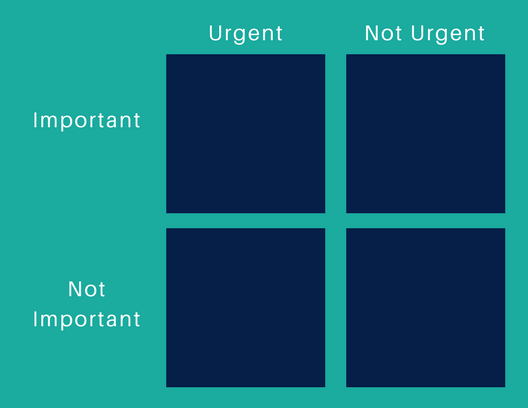
Next, you’re going to have to prioritize your time. Of course, taking classes or working a full time job, you’re going to have other assignments that you’ll need to complete along with your freelance projects. You’ll need to get really good at prioritizing each project and assignment to know when each one should be done. Might we suggest using the Eisenhower Decision Matrix? The Eisenhower Decision Matrix has four quadrants that look something like this:

No, this matrix wasn’t actually invented by President Eisenhower, but rather the author Stephen Covey who wrote The 7 Habits of Highly Effective People. He was inspired by Eisenhower’s quote, “What is important is seldom urgent, and what is urgent is seldom important.”

When you have several projects and assignments to get done along with your regular to-do list like maybe laundry or calling your mom and you’re trying to narrow down which to prioritize, try categorizing your to-do list into the matrix above. Of course, you’re going to want to prioritize the things that fall into the top left quadrant as they’re both important and urgent where whatever falls into the bottom right quadrant might be ok if saved until the weekend (there’s always dry shampoo and deodorant, right?).

Charge clients appropriately

Sure, you’re going to have to make sure you manage your time really well when you’re wearing multiple hats, but the real key is making sure it’s all worth it. Freelancers have a tendency to undersell themselves when first getting started. Sure, you might need to take on a discounted or even free client at first, but as your skills and experience improve, make sure your rates reflect that. You might be able to get some clients through websites like Fiverr or Upwork but once you have a couple under your belt, it might be time to move on to some higher paying clientele (that is, of course, assuming if you can provide a high-quality result for them. Not sure how to find new, great clients that you’d love to work with? We just happen to have a post on that right here:

How to Use a Side Hustle to Get the Experience You Need for Your Dream Job. 

One of the biggest struggles of becoming a freelancer will probably be knowing what to charge your clients. This infographic helps break down the process of figuring out what you’d like to make in a year vs expenses, billable hours, and how to use that to calculate an hourly rate!

Use all the tools

You know what’s awesome? The fact that we have so many tools that can do a TON of the “urgent but unimportant” quadrant things. Need a day planner on steroids? Try Asana. Need Microsoft office basically for free? Use G Suite (Google’s version). Our favorite part? Everything can sync with your phone. If you need to make graphics but don’t have much in the way of design skills, Canva is a great tool that makes it easy to design professional-looking graphics from social media posts, e-book covers, postcards, and even logos. If an app that helps clients book appointments without all the email back and forth sounds like the greatest thing since Amazon Prime, then Acuity Scheduling might be the app for you. All you need to do is mark when you’re free for clients to book an appointment with you and let the new clients come running!

Have you managed freelance work on the side of being a student or other employment? Share your tips below! Got a question for us? Shoot us an email or leave your question in the comments below and we’ll get back to you with our best answer!

Topics:

Candidates, Climb the Ladder
Climb the Ladder

Why You Should Edit Your Resume for Every Job Application

Why You Should Edit Your Resume for Every Job Application
Scouted.io icon
By Scouted
Scouted was a hiring marketplace that matched candidates to roles based on potential, serving clients from high-growth startups to Fortune 500 companies.
5 min read • Originally published May 16, 2018 / Updated March 19, 2026
Scouted.io icon
By Scouted
Scouted was a hiring marketplace that matched candidates to roles based on potential, serving clients from high-growth startups to Fortune 500 companies.
5 min read • Originally published May 16, 2018 / Updated March 19, 2026

Searching for a job is a lot like dating. You’re (hopefully) not going to take all your first dates to the same place, do the same things, and eat at the same restaurants. God forbid the word got out that you were the least creative first date ever, not to mention the fact that- unless you’re weirdly obsessed with bowling- you’re bound to get bored after going on the same first date time after time.

The same is true when applying for jobs. If you send the same copy-and-paste resume to every job that you’re even remotely interested in, you’re bound to get bored. What’s worse is that the hiring managers who read your copy-paste resume will know you’re bored too. By now they’ve probably read through more resumes than they will be able to tell whether a candidate is truly interested in their company and the position up for hire or if they’re just trying to get their resume into the hands of as many hiring managers as possible, hoping to get a nibble here and there. Yes, taking the time to edit and tailor your resume to the job you’re applying takes more time and work, but the ROI you’ll see is worth it!

Be keyword specific

Take some time to carefully comb through the description of the job you’re going to be applying for. What words pop out over and over again? Does the word innovative pop up throughout? Then expect the company to be looking for someone who isn’t afraid to roll up their sleeves and try something new. If you decide you can be that person, then be sure to sprinkle that word within your resume just enough to let the hiring manager understand you’re on the same page- but don’t go overboard.

What about the word data? If a company seems to be more data driven, yes, use that word within your resume and past work experience descriptions but ALSO share how you were able to benefit your last company in measurable ways. Use numbers wherever possible as they will draw the reader’s eye to your specific skills and show that you care about the results you’re able to produce. Instead of saying “Increased conversion rates,” try to say, “Increased conversion rates by 10%.” Not only will that “10%” pop off the page, you’ll be able to show your potential employer that you are results driven and effective.

Along with using keywords that are job-specific, think about what “soft skills” keywords that the company might be attracted to. If you’re new to this field, also do some research on common industry buzzwords, certifications, etc. If you need more ideas for finding keyword inspiration, check out these tips for identifying what ones to use in your resume.

Download our preferred resume template here!

Read the company website

A candidate can learn a ton about a company by wading through their website. Read through pages like their “About Us” or “Our Mission” page and read when and why the company was founded. Take notice of the company’s voice and tone in their writing, it might just reflect their personality as a whole? Do they sound casual and laid back or established and classy? This might not be a perfect indicator of company culture, but it could help. Based on what else you know about the company, use the way they write their job description and the copy on their website and filter through your own resume to make it seem as though the two go hand in hand. Forbes says that job recruiters are much more likely to pursue a candidate when they show a special interest or history with a company. If a candidate takes the time to incorporate the company’s values within their cover letter, it will help them stand out from other candidates who didn’t “do their homework.”

Filter the work experience you choose to show

Although it may seem like a good idea to list every single job you’ve had in the past on your resume, just in case a piece of experience might seem useful to the hiring manager, we want to encourage you to not do that. Although you might be able to fudge how working as a barista helped you to gain customer relations experience, if you have 2-3 other jobs on your resume that more directly correlate with the position you’re applying for so make sure to put priority on those jobs first. If it’s not explicitly clear why a job on your work history is relevant to the job you’re applying for, consider leaving it off. If you have volunteer experience or an internship that’s more relevant, prioritize that instead. If your resume has too much clutter from irrelevant work experience, you may cause the hiring manager to miss what is important on your resume.

[sc name=“Newsletter”]

Make sure your cover letter is specific and authentic

Whether or not you feel like you’re able to filter your work experience based on the job you’re applying for, you should always cater your cover letter to the company (or even the person) you’re writing to.

Ever had the terrible feeling that you forgot something after hitting “Submit” on your application only to look back and realize that you left the name of the last company you applied to on the cover letter of the company you just applied to? Not good. Don’t let THAT be the reason you get turned away from a job. When writing your cover letter, make sure you’re not simply copy and pasting for each new job and only changing the company name. Each company will have their own values and each role, even roles with the same title, will be somewhat unique. Be sure your cover letter reflects how you’d be a perfect fit specifically for each company, specifically for each role. Distinctively write why you’re excited about each new company. Although this sounds like more work- and it is- it shouldn’t be that hard to think about why you’d be excited to work at each company. If it is, it might be better to move on to a company where it’s easier to understand why you’d be excited to work for them.

If you’re struggling with knowing what to put on your cover letter, just remember that, like your resume, your cover letter should tell a story. “Ideally, the story that drives your resume will focus on a need at the company you’re applying for.” says Satjot Sawhney of Loft Resumes. Check out this post and this post for how to act like a freelancer and own the position you’re applying for.

Now it’s your turn! What work experience did you choose to leave off your resume? What are the best insights you’ve gotten from reading a company’s website before applying? Share your thoughts in the comments below!


Topics:

Candidates, Climb the Ladder
Climb the Ladder

How to Master the Art of Networking

How to Master the Art of Networking
Scouted.io icon
By Scouted
Scouted was a hiring marketplace that matched candidates to roles based on potential, serving clients from high-growth startups to Fortune 500 companies.
8 min read • Originally published May 24, 2018 / Updated March 19, 2026
Scouted.io icon
By Scouted
Scouted was a hiring marketplace that matched candidates to roles based on potential, serving clients from high-growth startups to Fortune 500 companies.
8 min read • Originally published May 24, 2018 / Updated March 19, 2026

Becoming a great networker is a skill that may not come as naturally as you think. It takes time to learn how to make a lasting impression while at the same time, not come on too strong. To really master the art of networking, you’ll have to learn how to get out of your comfort zone, try to new things and talk to new people, all while staying true to yourself and knowing what you do best. It takes patience and lots of practice to learn what methods are most effective and yield the greatest return. That being said, we have a few tips to set you off on the right foot when it comes to planting your networking seeds in order to have the best harvest down the road.

Be active

While networking events can be useful, one has to realize that most people are there for the same reasons: to build connections, get a job, make a sale, etc. Most people at those events want something or other. Instead, there are thousands of other ways to meet amazing people and build strategic relationships! Interning, volunteering, or doing freelance or consulting work can be a great way to get to know new people. But not everything you do had to be business related. Do you go to the gym? To church? Travel often? It’s simple- the more stuff you do, the more opportunities you’ll have to meet new people and build some awesome relationships!

Also read: How to Build Your Resume While in College

Be helpful

Like we said before, networking events can be useful but most people there are looking to get something out of them. Not a bad thing. But if you walked up to someone, had a 5 minute conversation and then handed them your business card, how likely do you think they would be to do you a favor a month or two down the road (or even remember you)? Going back to our point about being sincere, one of the best ways to show that you’re interested in the people you meet, is to help them with something! Unless the person you meet works in exactly the same industry and has done exactly the same thing for exactly as long as you, you probably could teach each other a thing or two. Why not offer to meet over coffee to talk about work? If they’re struggling with something work or business related and you know a way to help or even someone else you could introduce them to, do it! Being helpful is a great way for any person to show their human side and make a lasting impression on a person! It shows that you’re not just out to help yourself, but you’re actually somewhat of a decent person as well. Besides this, lending a helping hand can also give a great impression that you’re resourceful and, for lack of a better word, smart. Leaving people with that is way more effective than just handing them a business card.

Get out of your comfort zone, maybe

Now that we’ve stated the above, we might as well talk about the elephant in the room (or on the screen?). Networking is going to mean getting out of your comfort zone. Now, especially for you introverts out there, that doesn’t mean you have to pretend to be something you’re not. If the thought of walking into a room full of strangers makes you want to bury your head in the sand, we’re talking to you. Networking isn’t only an extrovert’s game. Who’s to say that your best connection isn’t an introvert himself/herself? So while networking will mean meeting new people in new places, there are vastly different ways to handle this so that both extroverts and introverts feel like they’re at their best.

For the introverts:

I love Rebekah Campbell’s advice here (she’s a startup founder and introvert) where she talks about networking as an introvert. Does she attend networking events? Sure. But she does it in her own way. Instead of walking up to a stranger and starting a dynamic conversation out of thin air, she makes sure she shakes hands with the person, learns their name and gets their business card and says she’ll follow up later. And she does! Later she’ll ask the person to meet over coffee so she and her new acquaintance can talk about her or their business in a quieter, one on one setting (can you feel the introverted sigh of relief)? So yes, Rebekah makes the effort to go out of her way to make strategi relationships, but she carries on and develops those relationships in a genuine way that makes sense for her.

All this to say, if you’re an introvert, it’s important to understand what you’re good at and where you feel most comfortable. If it’s giving a formal, rehearsed presentation and answering questions at the end, do that. If one on one conversations are more your thing, no need to feel like you’re the odd one out. Simply be intentional about the relationships you make and make sure that they are special and worth while in the long run.

For the extroverts:

While the thought of networking might not make an extrovert sweat like it does an introvert, don’t you worry, introvert, they have their own set of struggles to overcome.

If you’re an extrovert, striking up a conversation with someone you don’t know might seem like no big deal. Which is great! But extroverts may have tendencies to forget some important things while they’re making a new connection.

In his Medium post on networking, Nicolas Cole talks about the art of listening “because not many people do it.” He says, “People are so used to being met with the feeling of ‘I’m waiting for you to finish speaking so I can talk again’ that when someone comes along who listens intently to every word they say, they just keep going and going and going — and, […] they see you as a friend.”

I mean, it makes sense that if you attend a networking event to gain something, you’d have to stop talking at some point, right?

And while boldness and confidence can be attractive, it’s important to know yourself, gage the room (or the circle with whom you’re talking) and know if/when you’re coming on too strong. This goes back to not only to listening but having the emotional intelligence (or EQ) to perceive when a person might not be picking up what you’re laying down. Not everyone you meet will be a great contact for you or your company and knowing when to put your energy into a relationship and when to move on can save you lots of time and frustration in the future!

Remember their name

Sure, this is kind of obvious. Everyone likes it when someone remembers their name. Then why do we always let it go in one ear and out the other?

The honest truth is that we often end up overlooking or just waiting to get past an introduction because we’re trying to get to the meat of the conversation. Sure, the actual topic of conversation in important, but just as important is how you make the person you’re talking to feel. Like we said before, everyone likes to hear their own name.

In his advice on remembering names, Patrick Ewers says that it’s important to “Commit to the moment of introduction.” In other words, say to yourself, “I am going to remember this person’s name.” Then take actionable steps towards that. Things like repeating the person’s name back to them to make sure you got it right, write it down, associate their name with their occupation or with someone you already know with the same name, etc.

While remembering someone’s name is extremely simple, it says a lot about your intentionality and your ability to care about the person you’re talking to, something they’re bound to notice.

Follow up

Remembering names and becoming a pro at introductions is great, but it’s never going to mean much if you’re not able to turn that into a productive relationship in the future. Just like any friendship or dating relationship, building business contacts takes investment and intention. You’ll need to keep notes on the people you meet, the things you talked about, and then check in with them from time to time if you’re not already regularly interacting with them. This is where remembering a person’s name will be at its greatest value. Beyond that, you’ll want to remember the struggles or triumphs a person may have mentioned to you in earlier conversations. Remembering these things can give you a great reason (excuse?) to catch up because you can ask them how that thing they mentioned before is going and if they could use you help with anything (remember point #2). Forbes advises to “Give first, expect nothing in return.” By following up, remembering little details, and giving your own time, you’re paving your way to make a lasting and positive impression to anyone within your network.

Have a business card

While you might think that business cards are just for business owners or high-up execs, but anyone in any business can make use of having their own business card. Whether you attend a formal networking event or strike up a conversation at the dentist, having a business card is an effortless way to help someone remember who you are, your skillset or line of work, and give them a straightforward way to get in contact with you. And with many companies offering free templates and extremely inexpensive prices for printing, there’s really no excuse to keep a few in your wallet at all times, you know, just in case.

Pro tip: Always be sure to take their card, too. You can’t rely on someone to reach out to you, but you be proactive in reaching out others!

Ever been to a networking event? What did you love about it and what did you hate about it? What is your go-to tip for remembering someone’s name? Share your tips in the comments below and share the post with the person you’d drag to the networking event with you!

Topics:

Candidates, Climb the Ladder
Climb the Ladder

How to Stand Out and Get a Job as a UX Designer

How to Stand Out and Get a Job as a UX Designer
Scouted.io icon
By Scouted
Scouted was a hiring marketplace that matched candidates to roles based on potential, serving clients from high-growth startups to Fortune 500 companies.
5 min read • Originally published May 31, 2018 / Updated March 19, 2026
Scouted.io icon
By Scouted
Scouted was a hiring marketplace that matched candidates to roles based on potential, serving clients from high-growth startups to Fortune 500 companies.
5 min read • Originally published May 31, 2018 / Updated March 19, 2026

Nowadays, it seems like everyone is exploring UX design as a new and exciting career. Given the lack of formal education in this area, most people are learning it on the side online or enrolling in an expensive 10k bootcamp. The UX industry has boomed over the past couple of years, with increasing job prospects, and visibility in the tech industry.

Most new designers seeking to break into the field have finished a bootcamp, and usually end up with the same resume and portfolio as the other hundred graduates in their cohort. I’m going to talk about how to position yourself for the job you want, and how to leverage your background (no matter what it may be).

In the past, the concept of UX designer or product designer (its current definition) wasn’t super prominent in the industry. Sure, there might’ve been user interface designers, but all these new subdisciplines under the UX design umbrella were unheard of.

<source>

With the exception of some larger corporations, most UX people don’t have super-defined roles (e.g. visual designer, interaction designer, information architect, user experience researcher). The industry seems to be moving towards generalists who can do a little bit of everything on top of having solid visual and interaction design skills.

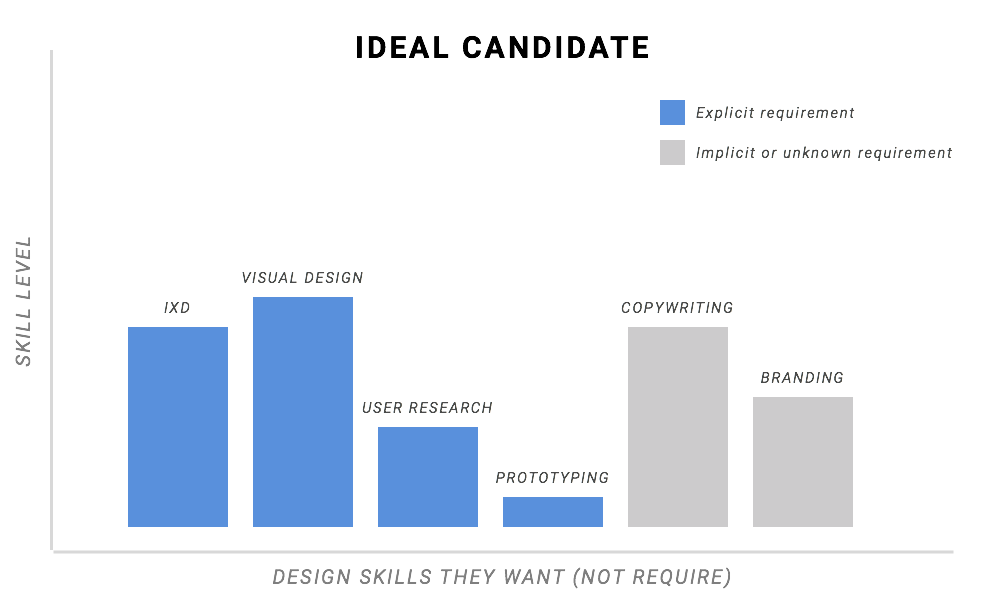
This is purely anecdotal, but from my experience and conversations with hiring people, most design jobs’ postings are generic titles like “UX designer” or “Product Designer”, but have different requirements for sub-discipline proficiency. Most job postings for designers will require basic skills in visual and interaction design, as well as proficiency in Sketch, Invision, etc. However, depending on the state of the company, its products, timeline, existing team composition, and the hiring team – there’s a need for people with specific domain knowledge e.g. user research, accessibility, illustration, branding, usability, etc.

You could get a huge advantage if you determine what sub-disciplines the job posting or company is looking for. Unfortunately in most cases, this is not explicitly obvious in the posting itself. In fact, there’s sometimes a disconnect between talent acquisition and the hiring team, or the hiring team might not even know that they need a specific sub-discipline.

In that case, you need to make the value of your sub-discipline and domain expertise known. For instance, you and probably a hundred other designers are up for a generic product designer role at a local SaaS startup. Their product and landing page is well designed, but you notice that they have inconsistent branding across their properties and appear to be using stock illustrations. Lucky for you, in this scenario not only do you have solid visual and interaction design skills, but you’re also experienced in brand identity and illustration. You could take the proactive approach, spew out some advantages and stats on the value of having a strong brand identity, and talk about how you could help the company fill the gaps with your expertise. This way, you’ve demonstrated additional value and have a leg up above all your peers.

At the end of the day, most companies are looking for the best fit, not the designer with the most years of experience under their belt. Julie wrote an excellent article about hiring for the right fit here.

“There are a thousand shades of nuance when it comes down to any particular scenario. But this may well be an example of the third reason to no-hire a designer: they aren’t a good fit.” – Julie Zhao

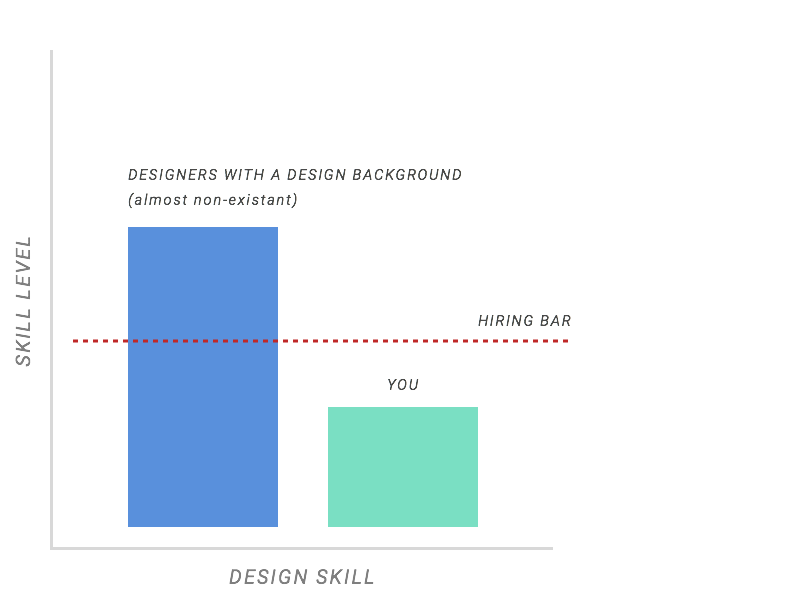
Look at the two applicants before, who do you think has a better chance of getting hired…

Ok, so if you’re just starting out in the design field, you probably don’t have any domain expertise in any related sub-discipline. But, you must have some sort of background (whether it be academic or professional) that has transferable skills. At the very least your background would have shaped at least one valuable design trait (even if that trait is patience). Heck, I studied Biomechanics, and it has arguably the least relevance to design out of any university degree.

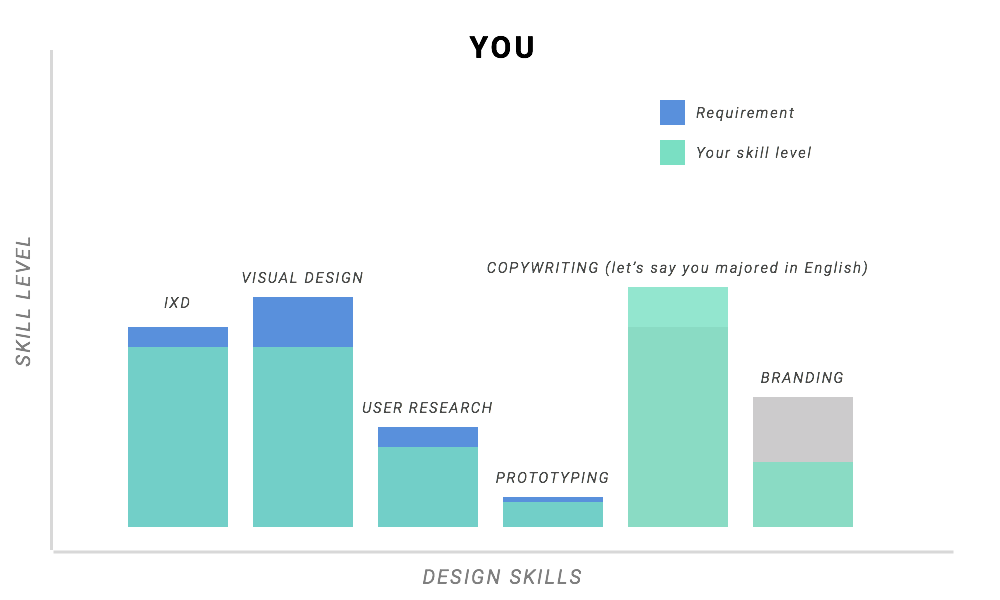
This is just a rough idea of how some common degrees are related to popular design subdisciplines.

Degree Related Subdiscipline or Important Skill
EnglishComparative literature

Communications

UX writing or copywriting
Almost any science degree User research (avoiding biases, participants, conducting studies, writing protocols)User testing
Computer science, engineering Communication with developers
Psychology (I would love to have a formal background in psychology right about now) User research and psychologyA lot of cognitive psychology principles have practical applications in design
Data or stats Understanding design-driven metrics, conversion funnels, data vis, etc.

Of course, you’re not restricted to focusing on a sub-discipline related to your background. Although you’ll have a great foundation and starting point, you should definitely focus on sub-disciplines that interest you (as much as I want to be a great motion designer, I’m convinced After Effects was designed by Satan).

Now, assuming you’ve got a solid visual and interaction design foundation, the last thing to do is apply. Applications can be a stressful process, but it’s definitely something that gets easier with time. Landing the first design job without education or experience boils down to a numbers game (at least when you’re starting out). So many factors could make or break your chances that are outside of your control. Luckily, Wealthfront and Breakout List have compiled a list of excellent companies to work for as a new designer.

  • Wealthfront Career Launching Companies List (check out previous years as well)
  • Breakout List
  • Shameless plug for Shopify’s awesome design jobs
  • Also make sure you’re getting paid what you’re worth, don’t get hustled friend

Richard works as a product designer @SHOPIFY, and helped design and launch Hatchful (www.hatchful.com), a branding assistant designed to help people launch their business. Previously, he was a designer at Sony – PlayStation Video, and cofounder of Beatcamp (www.beat.camp), a e-commerce platform that facilitates the licensing of instrumentals between producers and vocalists.

Follow Richard on Dribbble | Instagram | Medium | Uplabs

Topics:

Candidates, Climb the Ladder
Climb the Ladder

The Right Way to Turn Down a Job Offer

Ok so not all jobs are what you might have hoped them to be and that’s ok! There’s more fish in the sea. So what do you do when it’s time to turn down a job offer?
Scouted.io icon
By Scouted
Scouted was a hiring marketplace that matched candidates to roles based on potential, serving clients from high-growth startups to Fortune 500 companies.
4 min read • Originally published June 18, 2018 / Updated March 19, 2026
Scouted.io icon
By Scouted
Scouted was a hiring marketplace that matched candidates to roles based on potential, serving clients from high-growth startups to Fortune 500 companies.
4 min read • Originally published June 18, 2018 / Updated March 19, 2026

You got a job offer! Awesome!


Maybe…


Ok so not all jobs are what you might have hoped them to be and that’s ok! There’s more fish in the sea. So what do you do when it’s time to say “Thanks, but…. No thanks”?

Try to negotiate first

One of the beautiful things about the job hunt is the art of negotiation. You never know what a company might be willing to budge on and what is set in stone. So ask! Be transparent about how you’re feeling about the job and what could really help you say “yes” to their offer. At the very worst, they would say no and then you decide whether to move on or not. Best case scenario, you’re able to negotiate a situation where you’re happy to work for the company and they’re happy to bring you on board. Win-win!

Always always always be polite

However, when it comes to turning down a job offer, the first rule is the golden rule: always treat others how you would like to be treated. Do your best to keep the relationship strong and their opinion of you high. Always emphasize your appreciation in being considered in the first place.  It doesn’t matter if you thought their offer was outrageously low or if the job was nothing like what the description said. It doesn’t matter if your interviewer was your ex-girlfriend’s new boyfriend. Be nice. Be polite. You never know where you or those who interviewed you will be down the road. You could end up interviewing with them again or they may be good friends with the next person who interviews you. Your safest bet is to leave the torch at home and let the bridges stand, even if you do have a few things on your mind you’d like to say.

Connect on LinkedIn

That said, maybe you had a great experience interviewing with the company but just found a better opportunity elsewhere! No hard feelings there. If you were offered a job at all, you know the company thinks highly of your skills and may even endorse you for a few of them on LinkedIn. It’s always a good idea to connect with people you actually know on LinkedIn but connecting with those who value and can endorse your skill set? Gold.

Tell the truth

You may be nervous about what to say to the hiring manager but, when it comes down to it, they’re a real person who has some sort of understanding of how life goes. If the compensation isn’t enough, it’s ok to say that, just in a respectful and professional way. You know, something along the lines of,


“Hi John,

Thank you so much for inviting me to interview the other day. I had a great time getting to know you and the company better- it truly seems like a great place to work. Unfortunately, after looking into our area’s cost of living and taking into account my own needs [/ the needs of my family, etc], I’m afraid I won’t be able to accept a salary of less than _______. If there is any room for negotiation, I’d love to talk more. Otherwise, I will probably have to turn the offer down.”


If you are going to turn down a job because of the compensation, the important thing is that you back up why you believe you should be paid more. Does someone with the same experience in the same position in the same area usually get paid more? Then say that- nicely. More on that in a future blog post.


Of course, you could be turning down the job for a number of different reasons. Maybe you realized you don’t want to work in a medical setting, maybe it’s too far from home, maybe the place gave you the heebie-jeebies. While you don’t need to give specifics about why you’re turning down the offer, be clear and upfront that it’s a no from you and that you’re going to be moving on to other opportunities.

[optinform]

Offer Referrals

The Muse gives the advice to offer referrals to others you know who may be a better fit for the position you were offered. By doing this, you’ll still stay on great terms with the company by sharing something helpful/of value with them. By doing so, you’re keeping the door wide open for future or even current potions that may be a better fit for you.

Rip off the band-aid

This goes hand in hand with being truthful. Of course, you may need some time to weigh your options between multiple job offers, and that’s ok, recruiters often understand that. But if possible, try to keep the company in the loop on where you’re at. And then once you know it’ll be a “no” for that company, tell them as soon as possible. They’ll appreciate your candor as well as your timeliness because getting a quick response from you may mean locking down their #2 candidate faster.


Was there ever a time when you thought you’d turn down an offer but it turned into a great negotiating experience? Share your own stories and tips below and share with a friend who’s always in a good mood on Mondays.


Ok so not all jobs are what you might have hoped them to be and that’s ok! There’s more fish in the sea. So what do you do when it’s time to turn down a job offer?

Topics:

Candidates, Climb the Ladder
Climb the Ladder

How to Have a Great First Day as an Intern

How to Have a Great First Day as an Intern
Scouted.io icon
By Scouted
Scouted was a hiring marketplace that matched candidates to roles based on potential, serving clients from high-growth startups to Fortune 500 companies.
4 min read • Originally published June 28, 2018 / Updated March 19, 2026
Scouted.io icon
By Scouted
Scouted was a hiring marketplace that matched candidates to roles based on potential, serving clients from high-growth startups to Fortune 500 companies.
4 min read • Originally published June 28, 2018 / Updated March 19, 2026

The day has finally come – the first day of your new job/internship. You wake up in the morning, probably after not sleeping the night before, half because you are excited and half because you are nervous. You fix your hair and make sure all of your buttons line up. You head to the kitchen where you have a very important “first day breakfast” – you don’t know exactly when you’ll be able to eat during the day so be prepared going into it so you aren’t starving before you get a feel for things! Breakfast will also energize you and allow you to remain focused throughout the day. Listen to what you have been told for your whole life, even if it’s just for this one day, and eat something before walking out the door!

Be prepared

Leave enough time that you arrive to the office a few minutes early. Don’t go up before your expected time but to lessen your stress, plan on getting there early! Make sure you have your 30 second elevator pitch ready to go! Likely people will be asking you about yourself, where you have come from, where you see yourself going. Make sure you have a notepad ready to take notes while you listen and observe. Pay attention to your body language when you are being onboarded and be sure to show interest in what you are learning!

Don’t Doubt Yourself, Stay Positive!

Okay, now you have left the house and you are on your way to your first day. Whether you are taking the subway, are walking, biking, hover crafting, etc. I am sure you will be anticipating everything on your way. What if you are overdressed? Underdressed? What if the people on your team don’t like you? Will you know how to do what you are expected to do? Will you do it well? Will you find the office easily? Instead of letting the negative questions swarm your head, think about all of the positives here. They hired you because you are the perfect fit for this job. They have gotten to know you and want you to be yourself – the person that they were so excited to hire! Don’t let these negative thoughts get in the way of being your most fantastic self. Make sure you walk in the door poised, confident, calm, and ready to kill your first day. Be prepared to learn a lot in your first couple of days and give yourself some time to get adjusted. It is important to build relationships with the people you work with to get comfortable and acclimated to your new environment. Try not to isolate yourself and be friendly – don’t be shy!

[optinform]

Smile

My biggest, and personally most important, piece of advice for your first day is to smile. Smiling makes everything better. Even if you feel like you have just learned more information than your brain can retain and you just grin and bear it, you’ll gain the confidence you need to properly adapt. What I am saying is that flashing your pearly whites and chugging through the first day will train your brain to think that you can do this and you will be great at this. Smiling has a special power in helping to bond, building relationships, and getting comfortable. Ask questions and be receptive to the information you are learning.

Be Yourself!

All in all, for your first day/week, it is important to remember to just be yourself. Be the smart, confident, outstanding person that this company hired and show them that they made a great choice. Of course, the beginnings of things can be stressful but knowing that you are fit for the position and flashing a smile along the way makes all the difference. Don’t let negative thoughts take away the beauty of a new experience. Remain professional, ask questions, and be appreciative to those who have helped you through your onboarding and again, don’t forget to smile.

Next steps

After your first couple of days, there probably will be a few people or a specific person who has been a big part of your transition and onboarding. Be sure to express gratitude to this person for all of their help and ongoing support. No need to make a large gesture, but express your thankfulness however you feel is right!


Topics:

Candidates, Climb the Ladder
Climb the Ladder

How Studying Abroad Makes You More Hirable

Unlike most things that you likely put on your resume, studying abroad probably isn’t something you intentionally realize will make you desirable to employers. The truth is, your employer may not realize it either. It’s up to you to reflect on your past experiences and connect them to the tangible skills you have gained.
Scouted.io icon
By Scouted
Scouted was a hiring marketplace that matched candidates to roles based on potential, serving clients from high-growth startups to Fortune 500 companies.
3 min read • Originally published July 3, 2018 / Updated March 19, 2026
Scouted.io icon
By Scouted
Scouted was a hiring marketplace that matched candidates to roles based on potential, serving clients from high-growth startups to Fortune 500 companies.
3 min read • Originally published July 3, 2018 / Updated March 19, 2026

You’re back after a semester of studying abroad. You know that you just spent a semester on your own in a foreign country and aren’t the same person as when you left, but how do you synthesize all of that?! Conveying your experiences and growth to friends and family is one feat, but did you know that you should also be thinking about how to convey it to potential employers?

Unlike most things that you likely put on your resume, studying abroad probably isn’t something you intentionally realize will make you desirable to employers. The truth is, your employer may not realize it either. It’s up to you to reflect on your past experiences and connect them to the tangible skills you have gained.

Reflect on your growth and pinpoint your skills

Everyone is going to have different personal experiences depending on their program and what they’re studying. Whether you became fluent in another language, had an internship or independent study, or joined clubs and activities, your story is unique. Those things you’ll have to think about on your own, but every study abroad student has at least one thing in common: being an international student navigating immersion into a foreign culture. One day you’re at your home University surrounded by mostly American students, and then all of a sudden you’re in a country where you don’t speak the language with people that are no longer familiar to you. Navigating a new city while adapting to an entirely new culture AND still taking classes is not an easy actualization. If you’re one of the students who had the opportunity to travel on the weekends, you’re also managing completing your coursework, researching other cities, and planning weekend trips. Did you manage your own finances and deal with new currencies and conversion rates? These are some of the things that you can think about while reflecting on your semester.

According to GoAbroad.com, some examples of skills you might have picked up while studying abroad could be:

Learning a second language

Setting realistic expectations

Work ethic

Independence

Confidence

Collaboration

Cross-cultural understanding

Developed self-awareness

Empathy and emotional Intelligence

Communication skills

Money-management skills

Adapting to new environments and situations

[optinform]

Analyze your skills’ relevance and strength

After you’ve reflected and pinpointed tangible skills, think about your context. Which skills are important for you and also relevant to the position you’re applying for? Who is your employer? These questions will help direct which of your experiences to actually utilize and what skill-sets to hone in on. Putting the most relevant skills in your resume prevents you from oversharing and detracting from your abroad experience. Conceptualize bullet points as well as sections. Depending on your other information and experience, you can put as much or little of abroad on your resume as you see fit.

Skidmore recommends that you include your study abroad experience as either a part of your education or under your relevant experiences. You could even list it under both. If you’re looking for more examples, you can take a look at GoAbroad or StudyAbroad’s ideas.

Make sure to keep the experiences and skills you decide to use concise, though, because you also want to be able to expand on them in an interview setting when relevant.

Connect your skills to real stories

Be ready to use your skills in an interview setting! Putting your skills on a resume is one thing, but giving those skills life, personality, and truer meaning is another. Think back on your reflections and the real stories that demonstrate how you acquired certain skills. Be ready to share them in an interview in order to provide more background on how you have developed your skills and how they will benefit your potential employer. Think about what is relevant to you both.

So even though you may not have gone abroad with your resume in mind, it is an experience that you shouldn’t feel weird talking about and using to your benefit. It takes independent initiative to live in another country for a semester, so don’t be afraid to market yourself and your life-changing experience. Now go get hired!


Unlike most things that you likely put on your resume, studying abroad probably isn’t something you intentionally realize will make you desirable to employers. The truth is, your employer may not realize it either. It’s up to you to reflect on your past experiences and connect them to the tangible skills you have gained.

Topics:

Candidates, Climb the Ladder

Posts navigation

Older posts
Newer posts
Featured Jobs
Kirkus Media
Editorial Intern
Kirkus Media
New York City, New York (US)

Gaia Inc
MEDIA COORDINATOR
Gaia Inc
Louisville, CO

Gaia Inc
Global Paid Media Specialist
Gaia Inc
Louisville, CO

Gaia Inc
Director of Media Strategy
Gaia Inc
Louisville, CO

Hearst Television
Account Executive
Hearst Television
Milwaukee, WI, United States

All Jobs »
PREMIUM MEMBER
BB

Bhanukumar Bhanu

Bangalore, AK
2024 Years Experience
Certvalue is the top ISO 45001 Consultants in Switzerland for providing ISO 45001 Certification in Switzerland, Basel, Bern, Interlaken and other ...
View Full Profile »
Join Mediabistro Membership Today

Stand out from the crowd with a premium profile

Mediabistro Logo Find your next media job or showcase your creative talent
  • Job Search
  • Hot Jobs
  • Membership
  • Newsletter
  • Career Advice
  • Media News
  • Hiring Tips
  • Creative Tools
  • About
Facebook YouTube Instagram LinkedIn
Copyright © 2026 Mediabistro
  • Terms of Use
  • Terms of Service
  • Privacy