
Mediabistro Logo Mediabistro Logo
  • Jobs
    Search Creative Jobs Hot Jobs Remote Media Jobs Create Job Alerts
    Job Categories
    Creative & Design Marketing & Communications Operations & Strategy Production Sales & Business Development Writing & Editing
    Quick Links
    Search All Jobs Remote Jobs Create Job Alerts
  • Career Resources
    Career Advice & Articles Media Industry News Media Career Interviews Creative Tools Resume Writing Services Interview Coaching Job Market Insights Member Profiles
  • Mediabistro Membership
    Membership Overview How to Pitch (Premium Tool) Editorial Calendars (Premium Access) Courses & Training Programs Membership FAQ
  • Showcase
    Featured Creative Stories Submit your Story
  • Log In
Post Jobs
Mediabistro Logo Mediabistro Logo
Search Creative Jobs Hot Jobs Remote Media Jobs Create Job Alerts
Job Categories
Creative & Design Marketing & Communications Operations & Strategy Production Sales & Business Development Writing & Editing
Quick Links
Search All Jobs Remote Jobs Create Job Alerts
Career Advice & Articles Media Industry News Media Career Interviews Creative Tools Resume Writing Services Interview Coaching Job Market Insights Member Profiles
Membership Overview How to Pitch (Premium Tool) Editorial Calendars (Premium Access) Courses & Training Programs Membership FAQ
Featured Creative Stories Submit your Story
Log In
Post Jobs
Log In | Sign Up

Follow Us!

Climb the Ladder

How Delegation Will Make You a Better Employee

Overall, we want to show you that delegation, even if scary at first, can make you a much better employee in the long run. Overall, we believe that it can empower those on your team as well as bring out the best in you. So read on and learn why delegation is smart as well as how to do it the right way.
Scouted.io icon
By Scouted
Scouted was a hiring marketplace that matched candidates to roles based on potential, serving clients from high-growth startups to Fortune 500 companies.
6 min read • Originally published February 1, 2019 / Updated March 19, 2026
Scouted.io icon
By Scouted
Scouted was a hiring marketplace that matched candidates to roles based on potential, serving clients from high-growth startups to Fortune 500 companies.
6 min read • Originally published February 1, 2019 / Updated March 19, 2026

According to BusinessDictionary.com, delegation is the “Sharing or transfer of authority and the associated responsibility, from an employer or superior (who has the right to delegate) to an employee or subordinate.”

Overall, we want to show you that delegation, even if scary at first, can make you a much better employee in the long run. Overall, we believe that it can empower those on your team as well as bring out the best in you. So read on and learn why delegation is smart as well as how to do it the right way.

Why is delegation smart?

Marissa Levin, Founder and CEO, Successful Culture, says that she tries to evaluate her daily tasks and divide them into four groups.

  • I love what I have to do and I’m great at it.
  • I don’t like what I have to do but I’m good at it.
  • I like what I have to do but I’m not good at it.
  • I don’t like what I have to do, and I don’t do it well.

She also asks herself, “Is this the best use of my time? I may love what I have to do, and I may do it really well, but can I outsource it someone else who can do it better, faster, or cheaper?”

In short, delegation is your key to working more efficiently. The end game in breaking down projects and asking for help is simple: to help you do your job better.

Then why is delegation sometimes hard?

For many, giving away tasks that used to be on our to-do list isn’t an easy thing to do.

First of all, it takes trust. If you’re the point person for a certain project and a part of that project falls through, it could get pinned on you.

Delegation can also be hard because at times we may need to let go of some of the things we actually find really enjoyable about our job. Like Marissa says, if someone else can do it better or more efficiently, then it should probably be delegated.

[sc name=”Newsletter”]

Of course, delegation may be difficult simply because you lack the resources. Sure, it’d be nice if you had a team with the capacity to take on additional tasks or the budget to hire a freelancer but that might not be your reality right now.

The delegation also takes education. If you’re assigning a task to someone for the very first time, it can take time and patience to onboard or teach your team how to do it. They may even make a few mistakes at first. Even with the additional effort required at first, proper delegation will always be worth it in the long run.

The risks of not delegating

Like we said, sharing projects and tasks isn’t always easy, so it can feel natural to want to do as much as you can on your own. As the saying goes, “If you want a thing done well, do it yourself.”

Ok, sure, you might do it right. But each of us needs to ask ourselves if we’re the ones who’ll do it best.

Say you need to do some work on your company website but there’s some coding involved. Do you spend half a day at work combing through Google and Youtube to try to figure it out yourself? Or, do you ask someone on your team who has experience in coding for help and get the job done in about an hour?

Another aspect of delegation is simply divvying up the amount of work that needs to get done. When your plate is full, oftentimes it’s easy to let the smaller things fall through the cracks. An unanswered email here, a phone call missed there. No big deal, right?

Maybe, but maybe not. In order to be the very best you can be for your team, sometimes delegating even just the little things can make you a happier, more efficient, and more focused employee.

[sc name=“Newsletter”]

Who should you delegate to?

Delegating shouldn’t simply fall to those who look like they have less on their plate than you. This could lead to frustration, unclear expectations, and low employee morale.

Instead, when you’re thinking of who the best person would be to delegate a task, try to find the person whose skills and talents best align with the work you’re looking to delegate. Mindtools.com goes over several areas to consider when choosing a person to ask for help. Things like their experience and knowledge, how independent they are and their preferred work style, and their current workload.

Asking someone to take on additional work could potentially mean that, in turn, some of their daily routine will need to be shifted or even taking on by another coworker that can handle some of the lesser important tasks that that employee was responsible for.

Overall, delegation at its best aims to be a win-win situation for everyone involved. Be sure that delegating tasks isn’t burning out fellow employees, but rather taking advantage of their skills, interests, and expertise.

When to outsource

Of course, your first stop for delegation will probably be among your own employees or team. This should always be the first place you start since the best delegation methods will also be cost effective.

You may, however, find yourself needing to outsource to experts for one-off or even ongoing projects. In this case, potentially hiring a freelancer, intern, or even a part-time or interim employee might be called for.

This post, “6 Reasons Why You Should Hire A Freelancer” is a helpful blog on figuring out when it might be time to take the leap and hire help for your work. Overall, you’re going to want to determine how much time you usually devote to the tasks you want to outsource and how much money it could potentially save you (or make you) if hiring someone to do it for you.

How to delegate well

Here are a few bullets for you to reference when delegation your next project:

  • First, you’ll need to clearly define the work that needs to be done.
  • Then, you’ll need to determine who the different tasks will go to, keeping in mind the specific skills of the person you’re assigning them to.
    • It’s also a good idea to create an escalation chart on who each person should go to if they need help, have questions, or need approval for their work.
  • It’s additionally important to get on the same page when it comes to follow up and accountability. Put regular meetings on your calendars to go over how each project is progressing.
  • Be sure to give credit where credit is due. When reporting on your projects to your own higher-ups, be sure to acknowledge your team’s work and praise them when they’ve done a good job. You’ll look great for successfully delegating a project and your team will look great for mastering each of their parts in it.

Leave your experiences in the comments below! Have you ever had a manager that handled delegation really well? Micromanaged you? Or didn’t like delegating at all? How did each experience make you feel as an employee and what would you have done differently?


Topics:

Candidates, Climb the Ladder
Climb the Ladder

What Does It Mean to Manage Up?

What Does It Mean to Manage Up?
Scouted.io icon
By Scouted
Scouted was a hiring marketplace that matched candidates to roles based on potential, serving clients from high-growth startups to Fortune 500 companies.
5 min read • Originally published April 22, 2019 / Updated March 19, 2026
Scouted.io icon
By Scouted
Scouted was a hiring marketplace that matched candidates to roles based on potential, serving clients from high-growth startups to Fortune 500 companies.
5 min read • Originally published April 22, 2019 / Updated March 19, 2026

Knowing how to get the best out of yourself, your boss, and your organization is a valuable skill that can shape your career. Most employees believe that all they need is to do their job well, but it takes much more. Managing-up requires that you understand and adapt to your boss’s management, decision making, and communication styles.

By being dependable and proactive, you become a valuable asset to your organization. Mastering the skill of managing-up helps create a symbiotic relationship between you and your boss. You can achieve this by understanding yours and your boss’s needs, strengths, weaknesses, goals and work styles. Then use this information to develop a healthy and symbiotic working relationship.

How Do You Manage-Up Effectively?

1. Lead and Manage Yourself

One of your manager’s key responsibilities is to lead and manage his or her team. Learning to lead and manage yourself is one of the first steps in managing up. Not only will this make you more effective, but it’ll also save your manager loads of time.

Understanding your role in terms of specific outcomes and the timeline for achieving them is critical. Do your boss a favor by achieving your goals in a timely manner If you are in a role like sales where there are set targets, managing yourself means achieving and exceeding those targets.

2. Help Your Boss Achieve His or Her Goals

If you are good at your job, you’re not only an asset to your boss, but to the entire organization. It’s important to understand your company’s business goals in order to work towards achieving them.

A great way to do this is to set up a meeting with your manager to regularly sync on the bigger picture and where the business is heading so that you have a clear-cut plan on how to add value. Remember: you can’t win if your company fails. Understand your company’s goals on a holistic level and your individual goals will start to make a lot more sense as well.

3. Over-Communicate

As an employee, it’s possible to frustrate your boss if they are caught off guard, even if it is unintentional. Be sure to do your best to be transparent in your communication, always keeping them in the loop, sometimes even if the information seems unnecessary. It’s better to over communicate than to be out of sync with the rest of your team.

4. Value Their Time

Every time you are meeting with your manager, make sure you are fully prepared so as to not waste both yours or their valuable time. Come prepared with your agenda and updates, and if there is a problem you want to discuss, do your best to have an analysis and proposed solution when entering into your meeting. Even if your ideas aren’t fully in line with theirs, they’ll take note of your initiative and proactive approach to problem-solving.

5. Providing and asking for support

Good managers know that they’re not a one-man team. They hire employees because they know that other people can do certain things better than them. A huge part of your job will be leveraging your own skills in order to provide support to your manager.

In turn, you may find that managing up means not only providing support but asking for it as well. If it helps you do your job better, you may find yourself asking your manager if you can hire a freelancer, have an extra weekly meeting to sync on part of your job, or even just asking for approval to purchase a new tool that will help you do your job better. Whatever it is, you’ll ultimately know how you can do your job best and managing up may mean being open and communicating that with your manager.

6. Help Him with the Most Mundane Tasks

Your boss may be wasting valuable time on trivial assignments that consume a lot of time. Most employees don’t offer help with these types of assignments since they don’t help them develop any new skills. Show that you are ready to help by taking on tasks that are not even included in the job description. When you constantly step up to help; your boss will also do anything within his power to help advance your career.

7. Excel with People

Rarely do you get to choose your boss or peers. If it happens that you’re unable to work with others or manage conflict your boss may have to step in. This eats into their time and they are forced into situations they had not anticipated.

Capitalize on your emotional intelligence to develop strong working relationships with everyone. Show that you’re willing to go the extra mile for your team by ensuring win-win outcomes in all your interactions.

8. Tap Into Your Boss’s Mood

Timing is of the essence when communicating with your boss. Gauge their mood and think about how they will react to the information or request you want to present. It is also important to know when to back off especially when you’ve spoken to them about something and they are yet to get back. Is this matter urgent? Will this information help them succeed? Is this information that they are unaware of? Are some of the questions you should ask yourself.

[sc name=“Newsletter”]

What are The Don’ts of Managing Up?

1. Don’t Overstep Your Mandate

Know your limits when managing up. It’s important to understand that while your ideas bring value to the team, you’re still going to need to get the green flag from your supervisor for certain things. Do your job the best you can and don’t be afraid to make decisions and use your own critical thinking – just be sure to check back with your manager and make sure you’re both on the same page before you make a decision that doesn’t coincide with the grand business plan. Though you may have good intentions, it’s important to avoid overstepping your boundaries.

2. Don’t Take More Than You Can Chew

When doing your best to manage up, you may be tempted to take on more than you can handle in an attempt to make a good impression, or simply because delegation doesn’t come naturally to you. While setting ambitious goals might be great, be sure you don’t promise more than you can return.

3. Don’t Overstress Yourself

Taking time to get used to different styles of management and company cultures is to be expected. Even so, do your best to learn as much as you can from your manager and align with their vision and the vision of the company as a whole. Managing up is an art and when done right, it not only helps your boss achieve his goals but also allows you to do your job in the best way, utilizing the skills you uniquely bring to the table.

Topics:

Candidates, Climb the Ladder
Climb the Ladder

What Does a Chief of Staff Do?

Check out the blog to learn more about what a chief of staff does, what skills make a great chief of staff, and why you might want to become one yourself.
Scouted.io icon
By Scouted
Scouted was a hiring marketplace that matched candidates to roles based on potential, serving clients from high-growth startups to Fortune 500 companies.
8 min read • Originally published April 23, 2019 / Updated March 19, 2026
Scouted.io icon
By Scouted
Scouted was a hiring marketplace that matched candidates to roles based on potential, serving clients from high-growth startups to Fortune 500 companies.
8 min read • Originally published April 23, 2019 / Updated March 19, 2026

“Chief of Staff” (CoS) sounds like an ambiguous role – and it is. But don’t let that keep you from considering the position. CoS roles can be used as a stepping stone – a great way to enter a new industry or make a career change – or in other cases, they’re roles for someone looking to commit to an organization for the long run and become a true strategic partner, offering the type of high-quality help that can only be developed over time. In all cases, it’s a rare chance to work side by side with a senior executive and gain a valuable mentor.

Check out the blog below to learn more about what a chief of staff does, what skills make a great chief of staff, and why you might want to become one yourself.

What is a chief of staff?

Typically, a chief of staff is the right-hand person to the CEO or a senior executive. Your goals are essentially your manager’s goals – i.e. you need to help them be as effective as possible, in whatever capacity makes sense. As a chief of staff, it is your responsibility to take as much as you can off of your manager’s plate so he or she can focus their energy where they add unique value – that is, on the things that only he or she can do. Basically, anything that can be done by someone else, should be done by someone else.

Over here at Scouted, we like to use the analogy of a surgical team to illustrate this: A surgeon’s unique value to the hospital is his/her ability to make the incision and perform the operation. So, when a surgeon walks into an operating room, the scalpel has been cleaned, the wound has been prepared, the medical history has been pulled and the anesthesia has been administered. A chief of staff is akin to the prep team, responsible for making all of those things happen, so the boss can optimize his/her value to the organization.

Even though as a chief of staff you’re primarily supporting one executive and focusing on his or her goals, it doesn’t mean that this is a siloed job. It’s actually quite the opposite. As an extension of your boss, you’ll not only represent him/her in front of the C-Suite, but also to the team. You need the interpersonal skills to build relationships with the members of the organization, regardless of level, as well as the self-confidence to hold them accountable when needed. If the concept of a chief of staff is new to a company, employees might feel that you are adding a layer of bureaucracy between them and the boss, making it harder for them to get what they need, or even taking away their opportunities for exposure. The key is to ensure that the team knows you’re an advocate to their success, not an obstacle in the way of it.

Main responsibilities of a chief of staff

In general, chief of staff roles come in many different flavors: some junior CoS are more administrative, some are more operational, some are more project-oriented, some are more analytical, some feel more like ad-hoc leverage/help wherever it is needed, and some feel more like being a strategic advisor/a real #2 (a la Batman and Robin). Regardless of the flavor, you’ll almost always be helping your manager stay on top of priorities, not drop balls, and act as the first line of defense between the company and your boss.

Think of it as a ladder of leverage – at the bottom of the ladder you can provide leverage for your manager through tasks like printing materials and managing their calendar or inbox, while at the top of the ladder you might own chunks of his or her responsibilities and be a strategic thought partner.  

Almost every CoS role will dip down to the bottom of the ladder (whether that’s doing the tasks or managing an executive assistant to help you do them); but, how far up the ladder you will go will depend both on the person you are working for as well as your own capabilities. You need to have the skills to build the systems so all the operations run smoothly. Once you’ve done that, it’s up to you to create the space to take on more interesting and challenging responsibilities.  Forbes highlights a few examples of some other initiatives owned by chiefs of staff:

“At Zappos, the CoS is not only the ‘right hand’ to the CEO, but also leads the culture and community. At Rolls Royce, the CoS heavily responds to the Board and shareholders on the behalf of the CEO or with the CEO. Marissa Mayer’s CoS is tasked as being the ‘innovator and forward thinker’ and to look for new technologies or companies to acquire and develop.”

Potential responsibilities for a chief of staff can include:

  • Building operating systems to improve efficiency and effectiveness within your executive’s office and across the company
  • Developing and optimizing internal company management
  • Quality assurance / blocking & tackling – ensuring that anything that gets to your boss is c-suite ready and that s/he is only dealing with items that require their unique input
  • Helping your boss prioritize what’s on their plate and holding them and others accountable for completing tasks on time to achieve goals
  • Attending meetings and calls with and/or on behalf of your boss
  • Writing first drafts of communication and managing your manager’s email
  • Taking notes in meetings and holding your boss accountable to action items discussed
  • Helping your boss prioritize their time and appointments (ie. calendar management)
  • Managing an executive assistant
  • Acting as a sounding board for new ideas
  • Ad hoc project and research leverage as needed

[sc name=“Newsletter”]

Why you’ll want to be a chief of staff

This increasingly in-demand role offers a unique opportunity to have a high impact at the executive level. You’ll learn the ins and outs of running a business and create great connections for yourself down the road. You’ll have unparalleled exposure to senior management and strategy conversations, creating incredible and unique learning opportunities. You’ll be in the room where it happens, but not just as a fly on the wall, often with a seat at the table. Don’t be fooled – it’s not always glamorous, but it is meaningful. Many people might think that the required operational work is lower level work – but at the end of the day, the most valuable asset of senior executives is his/her time. If you can figure out how to take things off their plate and ensure they are prioritizing their time and using it well, your value-add will be immeasurable. Top that off with the ability to be a true thought partner, and you’ll make yourself indispensable.

What does a chief of staff earn (i.e. salary)

While you might be looking for a specific number, it’s not that simple. Salary ranges can vary greatly based on the company – its stage, industry, location – your benefits package, your specific role responsibilities and, of course, your experience. A chief of staff job for an investment firm in New York City will pay differently than a chief of staff role for a startup in Austin, Texas. However, in general, these roles tend to be well paid as you are directly impacting the quality of life of a senior executive. Just keep in mind that what “well paid” means varies across the board. Here are a few of the blog posts we’ve written on salary and negotiation to help you out:

How to Accept a Job Offer: From Email Examples to Negotiation

11 Things You Should Negotiate Other Than Salary

The Risks of Asking for Too Much in Your Salary Negotiation

When You Should Apply for a Job Even If You Don’t Meet the Minimum Requirements

How to know if you’re cut out for the chief of staff role:

A good CoS brings a unique and varied skill set to the table. Most importantly, you need to have the intellectual ability to hang with the c-suite, but also the agility, humility, and execution orientation to turn those ideas into reality. You need to be equally as comfortable sitting across the table from senior executives as you are rolling up your sleeves and being in the trenches with junior employees.

Characteristics and skills hiring managers look for in a chief of staff can include:

  • Highly proactive, action-oriented self-starter and a natural leader
  • High standards for excellence, are results-oriented, and will do whatever it takes to meet goals
  • Polished, professional and a skilled communicator, with strong written and verbal communication skills
  • Highly organized and detail-oriented; the type of person that can manage multiple, complex work streams and never miss a beat
  • Hungry for learning and growth
  • Humble with strong interpersonal skills
  • Persistent and resilient, with a strong work ethic
  • A team player, with a strong service orientation who genuinely enjoys helping others to excel in addition to doing good work yourself  

The big x-factor when it comes to being the right fit for a CoS role is the chemistry between you and your manager. Often attached at the hip, you will spend an incredible amount of time together – it’s a true partnership and some even equate it to a ‘(work) marriage.’ Like every marriage, it needs to be the right mutual fit, as chemistry is a two-way street. While it’s important to assess if the role is a good fit for your capabilities, it’s also critical to assess whether you and your potential new boss are the right fit together.

In summary, as Chief of Staff, you’ll be incorporating a wide range of your past skills and experiences in order to accomplish whatever your boss needs. It offers an unparalleled opportunity to work with senior executives, learn about an industry, and learn how to effectively run a company. It’s an intellectual role and an interpersonal role. And most importantly, the CoS job needs the right person – the one who stays a step ahead, never misses a beat, and jives well with the boss.

If you’re interested in becoming a chief of staff, check out the active CoS roles below on Scouted.

Active chief of staff roles on Scouted:

  • L.A. Hedge Fund
  • VC Firm that Backed Instagram, Spotify, Glossier & More!
  • Special Assistant to the Founder @ a Boutique Consulting Firm
  • VC-Backed Health Tech Startup

Topics:

Candidates, Climb the Ladder
Climb the Ladder

Tips to Successfully Start Your New Job

See, most times when we do scary things, ie. traveling to a new country, speaking in front of a group of people, or going to a scary doctor’s appointment, we have people there to do it with us. But, when’s the last time you brought your bud to a job interview? Or had your fiance come to your first day of work?
Scouted.io icon
By Scouted
Scouted was a hiring marketplace that matched candidates to roles based on potential, serving clients from high-growth startups to Fortune 500 companies.
6 min read • Originally published April 26, 2019 / Updated March 19, 2026
Scouted.io icon
By Scouted
Scouted was a hiring marketplace that matched candidates to roles based on potential, serving clients from high-growth startups to Fortune 500 companies.
6 min read • Originally published April 26, 2019 / Updated March 19, 2026

One of the unique and scariest things about starting a new job is the fact that you do it alone.

See, most times when we do scary things, ie. traveling to a new country, speaking in front of a group of people, or going to a scary doctor’s appointment, we have people there to do it with us. But, when’s the last time you brought your bud to a job interview? Or had your fiance come to your first day of work?

Nope.

You did it alone. By yourself. Solo.

That’s scary!

It can be tough to navigate a new office, take on an unfamiliar culture, read a room, all while trying to do what you were actually hired to do- make your company a better place.

In this blog, we wanted to give you a few tips for how you can dive into a new workplace and have the most successful start ever.

Ask questions

Have you ever waited to ask a question and then accidentally waited so long that you’re now at a point where it would be awkward to ask because you really should know what that thing is by now? We’ve done this, you’ve done this.

But think about how much simply not asking questions holds you back from understanding your role, how to do it well, and moving on to more important things!

TalentEgg has a great list of questions you should ask when starting a new job. Things like:

  • Is there any material I can read in advance of my start date?
  • Who are my team members and what are their roles?
  • What is the biggest priority/challenge you’re working on right now?
  • How is X done and why?
  • What does the organizational ‘culture’ look like on a daily basis?
  • What does success look like for my role?
  • How and when will my performance be reviewed?

Of course, it doesn’t have to stop there. Asking questions will always be a huge part of growing into your role and improving as an employee. Do your best to ask them when they come up or save them for your next meeting with your team lead.

Here’s a tip from one of our newest team members at Scouted, Nicole:

Something that has helped me with the transition at Scouted is that everyone is open to talk about everything all the time. Knowing I can actually say, “This makes no sense to me and I am confused,” is very valuable, especially when you are making a career transition.

Schedule time with your manager

Not to sound braggy, but one of the things Scouted does really well is transparency and accountability. On a weekly basis, we have sync up meetings with our team leads to get on the same page of what needs to be prioritized and completed that week. We also have weekly (office-wide) team meetings where we go over our progress from the week before and also talk about the highs and lows from the week. These meetings also help keep us on track with our monthly, quarterly, and even yearly goals.

One of the great things about these meetings is that they give us a chance to “synthesize” the week and get a good idea on where we are as a business and what each individual team is working on. This not only allows us to have a bigger picture of the goals of our business, but it helps us to see more of a purpose behind what we’re doing and how our job fits in.

If you can, try to schedule regular “sync ups” with your manager and team in order to get on the same page about your work, synthesize your progress towards your goals, and see the bigger picture behind your work.

[sc name=“Newsletter”]

Figure out how your office really communicates

Every office communicates differently and even within individual teams, managers and teammates may prefer different modes of communication. Talk to your coworkers about the best way to get a hold of the people on your team and the managers you’re working under. Even if

your team typically uses a messaging platform like Slack, that may or may not be the most effective way to get a hold of certain people, so do your best to find out what works and for whom.

Dive in

Here’s another tip from Sarah, another recent Scouted hire:

I showed up ready to work on a variety of projects and with as many people of the team as possible. Which is def easier to do at a startup than a corporate team, but that’s part of the reason I chose to work at Scouted! I struggle in environments where there is a lot of “red tape” around creative approaches or taking on big picture projects, and knew that I wanted to be in an environment that nurtured that aspect of my work persona.

Learn

“We don’t want you to improve yourself so you can do your job better and grow this company,” said no boss ever.

Seriously. If you’re willing to take the time out of your day to learn and improve yourself for the sake of your job and the company, your company will help you do it.

Maybe your manager has a go-to reading list they can suggest or podcast they’re addicted to. Your company may be willing to sponsor a trip to a conference, and intensive, or a certification program.

Besides this, it’s been shown that millennials in the workforce gravitate towards companies where they feel they’ll be given the chance to learn and advance their careers, so it’s in a companies best interest to offer mentorships and learning opportunities to their employees.

Sit in on meetings

Part of the learning process will simply be to learn the ins and outs of your own company. One way you can do this is by sitting in on meetings you may not normally be a part of. For example, if you work for a startup, it might be a good idea to sit in on a couple of investor meetings to hear your founders pitch their product and talk about what makes your business different. At times it may be helpful to sit in on sales or account management calls to hear questions and concerns of clients and customers and how your teammates in those roles counter those.

In any case, by sitting in on meetings outside your own team or department, you’ll be broadening your own perspective on how your company functions, your customers’/clients’ needs and how you can collaborate with team members inter-departmentally.

Go above and beyond, but set your boundaries

Say you spent some time after your interview negotiating your pay and benefits at your new company. If you were able to land a slightly higher paycheck- good for you! But- now is the time to show you’re worth it. Do your best to dive in and start contributing as soon as you can.

That being said, now is the time to establish standards and boundaries at work. Decide whether or not you’re ok with answering emails on the weekends or staying late on a regular basis. What you choose to do in the beginning will set the expectation for you as an employee going forward.

Overall, getting the feel of a new workplace will take time and inevitably, some trial and error. As long as you do your best to be flexible, jump in where needed, and ask questions, we’re confident that you’ll do an amazing job at adapting to your new office.

As always, we’d love to hear from you! Leave your own tips, experience, or suggestions in the comments below and sign up for our newsletter to receive job hunting tips right in your inbox!

In this blog, we wanted to give you a few tips for how you can dive into a new workplace and have the most successful start ever.

Topics:

Candidates, Climb the Ladder
Climb the Ladder

Job Search Etiquette 101

You’ve probably heard the phrase, “Everything’s an interview.” It may sound oversimplified, but it’s true. Every interaction you have during the interview process can affect whether or not you progress to the next stage. Things that may not seem like a big deal at the time, like how you format your resume or how well you communicate during scheduling, can actually say a lot about you. Your interview doesn’t start once you sit down in front of a hiring manager - it starts as soon as you submit your application. Let’s break down the basics to make sure you set yourself up for success.
Scouted.io icon
By Scouted
Scouted was a hiring marketplace that matched candidates to roles based on potential, serving clients from high-growth startups to Fortune 500 companies.
3 min read • Originally published May 3, 2019 / Updated March 19, 2026
Scouted.io icon
By Scouted
Scouted was a hiring marketplace that matched candidates to roles based on potential, serving clients from high-growth startups to Fortune 500 companies.
3 min read • Originally published May 3, 2019 / Updated March 19, 2026

You’ve probably heard the phrase, “Everything’s an interview.” It may sound oversimplified, but it’s true. Every interaction you have during the interview process can affect whether or not you progress to the next stage. Things that may not seem like a big deal at the time, like how you format your resume or how well you communicate during scheduling, can actually say a lot about you.

Your interview doesn’t start once you sit down in front of a hiring manager – it starts as soon as you submit your application. Let’s break down the basics to make sure you set yourself up for success.

Tighten Up Your Resume

Your resume is the first thing a potential employer will use to assess your capabilities. While the content of your resume may be most relevant, how your resume looks matters too. If the formatting is inconsistent with rogue spacing and misaligned bullet points, the hiring manager may think you don’t pay attention to details. If it’s excessively long, they may think you struggle to write concisely. If a candidate applies to detail-oriented role with a messy resume (ex. Chief of Staff, Operations, Executive Assistant), that alone can turn a candidate down.

Hiring managers spend very little time with each resume, so it should be crisp, clean, and easy to read. (To clean up your resume content and formatting, click here to read our top resume tips and download our preferred resume template).

Communicate Politely and Promptly

Some of you may think this is a given… but not every candidate responds to interview requests. We know life gets busy, but responding to interview requests not only shows that you’re organized, but also signals you’re respectful of the hiring team’s time.

All communication with employers should check these marks:

  1. Prompt reply – You have 24-72 hours MAX to respond. If you know you’re going out of town or will be offline, turn on your out of office and list your cell phone number.
  2. Respectful and polite – Hiring someone is hard for the employer too, so signal to them that you appreciate their time and that you’re excited to be interviewing with them.
  3. Update them on your search –  If your job search changes and you want to withdraw, send emails to any employer you had spoken to. (Please don’t ghost them!)

If you’re using a job matching platform or recruiter, who is advocating on your behalf to help land you interviews, these points are especially important. If a candidate applies to roles that require them to be a great communicator, ignoring emails or responding exceptionally slowly signals they can be unreliable and unorganized.

Even if you’ve since decided you’re no longer interested in interviewing, reply to them nonetheless. It’s the respectful thing to do, and the world is small. You don’t want to risk burning a bridge you haven’t even built yet.  

[sc name=“Newsletter”]

Meet Deadlines

Similar to communicating effectively, it’s important to try and meet deadlines a potential employer sets for you. If they ask you to submit a take-home assessment, budget your time and finish it as soon as you can. Completing a project will show you’re excited about the role and you’re on top of your work. If you need to ask for an extension because of extenuating circumstances, do so as soon as you can and provide a new suggested deadline. (The rules from #2 still apply here.)

Know Your Audience

If you’re invited for an in-house interview, do some research on their company culture so you can present accordingly. If you want to double check, feel free to ask your interviewer or recruiter about their company dress code. Certain companies are really casual in the office these days (Team Scouted is routinely in jeans and t-shirts), but plenty of them (like Financial Services and Consulting Firms) are looking for polished candidates.

Knowing your audience is good for first impressions, but it also may be an important part of the job. If you’re interviewing for a client-facing role, showing up late, disheveled, and underdressed are hard no-gos. Even if you rock your interview questions, how you present yourself is sometimes half the battle

Topics:

Candidates, Climb the Ladder
Climb the Ladder

How to Get a Job in Digital Marketing

If you want to learn more about what it means to be a digital marketer, what characteristics make a good one, and how to improve your digital marketing skills, read below and decide for yourself if digital marketing should be your career of choice.
Scouted.io icon
By Scouted
Scouted was a hiring marketplace that matched candidates to roles based on potential, serving clients from high-growth startups to Fortune 500 companies.
6 min read • Originally published May 3, 2019 / Updated March 19, 2026
Scouted.io icon
By Scouted
Scouted was a hiring marketplace that matched candidates to roles based on potential, serving clients from high-growth startups to Fortune 500 companies.
6 min read • Originally published May 3, 2019 / Updated March 19, 2026

Say you consider yourself pretty tech savvy. You might even spend your fair share of time on social media. If you’ve seen job listings like “Digital Marketing Specialist/Manager/Analyst” or the like, you might be thinking, “Huh, I wonder how hard it is to get a job in digital marketing.”

Well, if you’re considering a role in digital marketing, you’re in luck. The Bureau of Labor Statistics reports that digital marketer positions will actually grow by 10% between 2016-2026.

If you want to learn more about what it means to be a digital marketer, what characteristics make a good one, and how to improve your digital marketing skills, read below and decide for yourself if digital marketing should be your career of choice.

First, what is digital marketing?

The term “digital marketing” isn’t just a buzzword used by tech enthusiasts. Digital marketing is important to businesses and presents a lucrative opportunity for career-seekers.

Digital marketing is similar to traditional marketing in that products or services are advertised with the goal of either brand recognition or sales.

For example, any ad you see on the internet, your phone, or other devices falls within the realm of digital marketing. Our world is saturated with digital marketing ad campaigns. They can take many different forms but chances are, if you regularly use a phone or computer, you see hundreds of ads every day.

So what’s the difference between a role in digital marketing and traditional marketing, and what are the benefits?

The ability to track progress

With traditional marketing, tracking the effectiveness of your ads is actually really difficult. Say, if you run an ad on TV or take out an ad in the paper, it’s extremely difficult to know just how many people saw it, who actually purchased a product because of your ad, how to target them later with a similar product, and if your ad through one publication was more effective than your ad in a different publication.

However, in digital marketing, brands are able to use pixels, tracking links, and analytics to see the exact number of people that visit their website, their demographics and location, the most frequently visited pages, and other metrics. They can then use this information to build better-targeted ads by understanding who makes purchases and why.

[sc name=“Newsletter”]

Not all digital marketing is the same: choose your specialty

Even if two people have the title, “Digital Marketer,” their roles may actually look very different. This means that many people with different skill sets can be successful digital marketers.

Some of the specialties a digital marketer may have are:

  • CPC and PPC ads
  • Copywriting
  • Email Marketing
  • Mobile Marketing
  • Web development
  • Web design
  • Analytics
  • Video production
  • Search Engine Optimization
  • Social Media management

What are digital marketers like?

Great digital marketers will feel a sense of competitiveness by nature. The desire to learn, improve, and beat out the competition will go far in a career in digital marketing.

They’re also great analytical thinkers. If you’re the type of person who can look at a lot of numbers and see the story they tell, then you may be great at telling what ads are working and which ones should be discarded.

Digital marketers will also have a creative side, or, if they don’t, they’ll know how to outsource to someone who does. Many ads these days are both visual and use creative copywriting to draw the reader’s attention. Depending on the size of the company you work for, you may be responsible for the creative side yourself, or you may be expected to work in collaboration with creatives to come up with ads that are eye-catching and effective.

Now, how do you actually land a job in digital marketing?

Self-educate

While in other industries, you may have trouble finding accurate and helpful information to educate yourself online, digital marketing isn’t one of them. There are vast amounts of resources online that you can use to build your skill base before you venture into a career in digital marketing. Websites like Udemy, Google’s Online Marketing Challenge, and even YouTube are great resources for learning and improving your digital marketing skills.

Before going after a career in digital marking, do your best to know what you already do and don’t know. Once you figure that out, improve your weakest skills, update your knowledge of new trends, and stay current with industry best practices.

Start with an internship or freelance work

These days, it’s hard to get a job without any experience whatsoever in your related field. Luckily for aspiring digital marketers, experience isn’t all that hard to come by. Before you take the first step towards your marketing career, try taking a half step and start by freelancing or interning at smaller companies.

One thing that’s great about digital marketing is that the impact you have on a company is quantifiable. Say you create an ad that increased your company’s web traffic by 25% and you saw a 5% increase in sales in your first quarter? That’s something to make note of and include in a cover letter the next time you’re looking for a digital marketing role.

Create a blog and use your social media

One of the best ways to grow as a budding digital marketer is by growing your own brand. Create a blog and use what you know to grow and develop it and look for ways to get your content in front of others.

Leverage your social media accounts and grow your followership from here. Carve out a niche for yourself. Doing these things will enable you to learn on the job and will help you when applying for future positions.

The goal of creating a blog and leveraging your social media comes down to this: building your personal brand. Your personal brand is the reputation you build for yourself as a job candidate and this reputation will often precede your interview. Do your best to publicly display your experience and expertise so that it’s obvious to potential employers if and when they decide to look you up on social media.

Get a Mentor

Mentors have gone through what you are going through and have a wealth of knowledge to share. The right mentor will save you years of mistakes. Ask specific questions and learn from their past mistakes. Be ready to apply as you are learning.

Your mentor can be your favorite successful blogger or anyone you look up to in the marketing field. It must be someone who is actualizing the caliber of success you aspire to achieve.

Network

No one is an island, and this is very true in digital marketing. Do your best to reach out to like-minded people, attend conferences and events, and talk about your love for digital marketing and your career goals. You never know when an opportunity might just be lurking around the corner.

Digital Marketing is a great career that can be very rewarding. The demand for digital marketers exceeds the supply and the skill gap is projected to get even wider.

To do well in this career, remain a lifelong student, as the industry is ever-changing. The world is full of resources to help you become successful.   

Ps. Here are a few open digital marketing roles on Scouted:

Digital Marketing Associate (SEO) (Relocation Friendly)

Digital Marketing Strategist

Digital Marketing – Intern to Perm – 2019 Grads

Topics:

Candidates, Climb the Ladder
Climb the Ladder

How to Leverage Emotional Intelligence in Your Career

Emotional intelligence is composed of a few different elements. The first is the ability to be aware of your own emotions and express them in a healthy, productive way. The second main component is understanding the emotions of others and approaching interpersonal relationships from a place of empathy.
Scouted.io icon
By Scouted
Scouted was a hiring marketplace that matched candidates to roles based on potential, serving clients from high-growth startups to Fortune 500 companies.
5 min read • Originally published May 9, 2019 / Updated March 19, 2026
Scouted.io icon
By Scouted
Scouted was a hiring marketplace that matched candidates to roles based on potential, serving clients from high-growth startups to Fortune 500 companies.
5 min read • Originally published May 9, 2019 / Updated March 19, 2026

When it comes to success in the workplace, it’s not just what you know that matters. Emotional intelligence, also known as emotional quotient (EQ), can be just as critical to collaborating with different people, fostering a pleasant company culture, and managing work-related stress.

Emotional intelligence is composed of a few different elements. The first is the ability to be aware of your own emotions and express them in a healthy, productive way. The second main component is understanding the emotions of others and approaching interpersonal relationships from a place of empathy.

But why is emotional intelligence so important for your career? And what are some tips for how to use your emotional intelligence? Scouted lays it all out for you.

Why is emotional intelligence important at work?

The average American work week takes up at least 40 hours. That’s a lot of time to spend around the same group of people. Learning to be in tune with your coworkers’ emotions as well as your own can strengthen these workplace relationships and help you manage conflict in a healthy manner. Emotional intelligence can also lay the foundation for other professional skills, such as flexibility, persuasiveness, and thoughtfulness. It can also diffuse some of the tensions that often arise due to office politics. These are some of the reasons why emotional intelligence is widely considered one of the most important leadership skills.

What are some emotional intelligence skills?

Emotional intelligence is a broad category that encompasses many different skill sets. According to Daniel Goleman, the leading American psychologist in this field, there are five key emotional intelligence skills to learn:

    1. Self-awareness – the ability to identify and understand your own emotions
    2. Self-regulation – the ability to manage and express your emotions in an appropriate manner
    3. Motivation – the ability to develop an inner passion for doing things well, without an external reward like money or recognition as the primary reason
    4. Empathy – the ability to understand and respond appropriately to how others are feeling
    5. Social skills – putting all of the above skills into practice through interactions with others

Although it’s up for debate whether emotional intelligence skills can be learned or if they are intrinsic traits, different trainings and workshops have popped up in recent years to help workers develop their EQ. Google is one such company that hosts conferences and training sessions dedicated to emotional intelligence.

[sc name=“Newsletter”]

What are some emotional intelligence examples?

Ready to put what you’ve learned into practice? Here are a few emotional intelligence examples that can be applied to different workplace situations, along with suggestions for how to leverage your emotional intelligence.

Also read: AI Recruitment Tools: Helping or Replacing Humans?

Emotional intelligence in your resume

While you probably don’t need to list “emotional intelligence” in the Skills section of your resume, there are more subtle ways to weave EQ throughout your job history. In descriptions of previous jobs you’ve held, highlight qualities related to managing your emotions or those of others.

For example, you might emphasize customer service, consumer research, or employee satisfaction to show experience interacting with others. For managing your own emotions and stress, you might focus instead on language related to deadline-driven environments or high-volume work. You will have an even greater opportunity to showcase your emotional intelligence skills in an interview.

Emotional intelligence in your interview

It is common for a hiring manager to ask questions related to how you have handled conflict in the workplace or collaborated with coworkers. These questions are the perfect opportunity to highlight your emotional intelligence. Using the STAR method, you can tell a story about how you used emotional intelligence to develop strong relationships with coworkers and handle difficult situations. You may also wish to expand upon the qualities and experiences mentioned in your resume.

Emotional intelligence in the workplace

Emotional intelligence skills can help you get the job, but more importantly, it can help you be more productive and happier in your role. Whether you are an entry-level professional or the CEO, emotional intelligence spans the entire team. Here are a few suggestions for how to use your emotional intelligence at work:

  • Listening in meetings: Making sure everyone feels heard is essential to developing positive rapport within a team.
  • Managing stress: Sometimes workplace tensions can run high and it becomes a challenge to manage your own stress. Recognize the signs of stress in yourself and others, take a deep breath, and learn techniques for figuring out how to manage it in a healthy way. These might include meditation, taking a walk, or journaling.
  • Expressing negative emotions using I-Statements: This I-Statements method, which takes the form of, “I feel ________ when ___________” places the emphasis on a situation and how it affects you, rather than taking an adversarial approach or placing blame on an individual. I-Statements also open the door for you to suggest a solution to a problem. For example, if you’ve been working 60+ hours a week to finish a project, you might tell your manager, “I feel overwhelmed with the upcoming deadline for this project. I believe that I would work much more effectively if I could shift some lower-priority tasks to after the project is over.”
  • Actively listening to others: Others might come to you with negative emotions of their own. Maybe they just want to vent, or they are directing their negativity toward a specific person or situation. Using a phrase like, “It must not be easy to _________” can reinforce that you were listening to their challenges and acknowledging them. This can also be the first step to coming up with a solution together.
  • Understanding body language – Not all communication is spoken. Body language like posture, hand gestures, and more can also be an indication of how someone is feeling. This is especially true if a coworker says one thing (“Sure, we can have the meeting on Friday night”) but their body language (like crossed arms) suggests otherwise. Observe an individual’s full behavior and tailor your response appropriately.

Emotional intelligence is likely to be most important in roles that involve a lot of human interaction. Jobs that require teamwork or customer service like sales representatives, PR, marketing, or any leadership role would benefit highly from EQ. Hiring managers might not prioritize EQ as much in roles that are more technical and require less human interaction, such as computer programmers or accountants.

Want to learn more about how to leverage your interpersonal relationships in the workplace? Sign up for the Scouted newsletter for more career and professional development tips.

If you care to dive in and learn more about your own emotional intelligence, here’s a resource that will teach you to master the 6 most important pillars of emotional intelligence and learn to explain and implement them: The Emotional Intelligence Masterclass.


Janine Perri is a freelance writer and marketing professional based in New York. She has experience writing about topics in business, marketing, technology, education, travel, and language services. She has also taught English in South Korea as the recipient of a Fulbright scholarship.

Topics:

Candidates, Climb the Ladder
Climb the Ladder

5 LinkedIn Updates to Make Before You Apply for the Job

5 LinkedIn Updates To Make Before You Apply for the Job
Scouted.io icon
By Scouted
Scouted was a hiring marketplace that matched candidates to roles based on potential, serving clients from high-growth startups to Fortune 500 companies.
6 min read • Originally published May 16, 2019 / Updated March 19, 2026
Scouted.io icon
By Scouted
Scouted was a hiring marketplace that matched candidates to roles based on potential, serving clients from high-growth startups to Fortune 500 companies.
6 min read • Originally published May 16, 2019 / Updated March 19, 2026

Be honest…  when was the last time you updated your LinkedIn profile? No judgment if it’s been a while, I get it – it doesn’t exactly make the list of fun or seemingly urgent activities.

But here’s the thing: Even if you’re not looking for a job (and especially if you are!), your LinkedIn profile has the potential to open you up to so many opportunities. And if neglected, you may never know what you’ve missed out on.

Not convinced yet? Think about it this way. In today’s world, our online presence oftentimes precedes us. Whether you’re about to meet a new hire, have an initial interview, or go on a first date, what’s the first thing you do? Look them up online, of course! Many employers will spend at least a little time checking to see if candidates have an online presence before they’re interviewed, just to get a feel for who they’ll be meeting soon. 

And the same goes for you – in all parts of life, including the professional world. Having an updated profile that highlights your strengths and tells a compelling story is key for the right people to find and get to know you – and consider you for opportunities before they’ve even met you in person!

Remember how your parents always told you a firm handshake was important? Well consider this your virtual handshake – let’s make a good first impression!

With that said, here are the five most important updates to make right now, before applying to any jobs.

1 Adjust Your Settings to Maximize Views

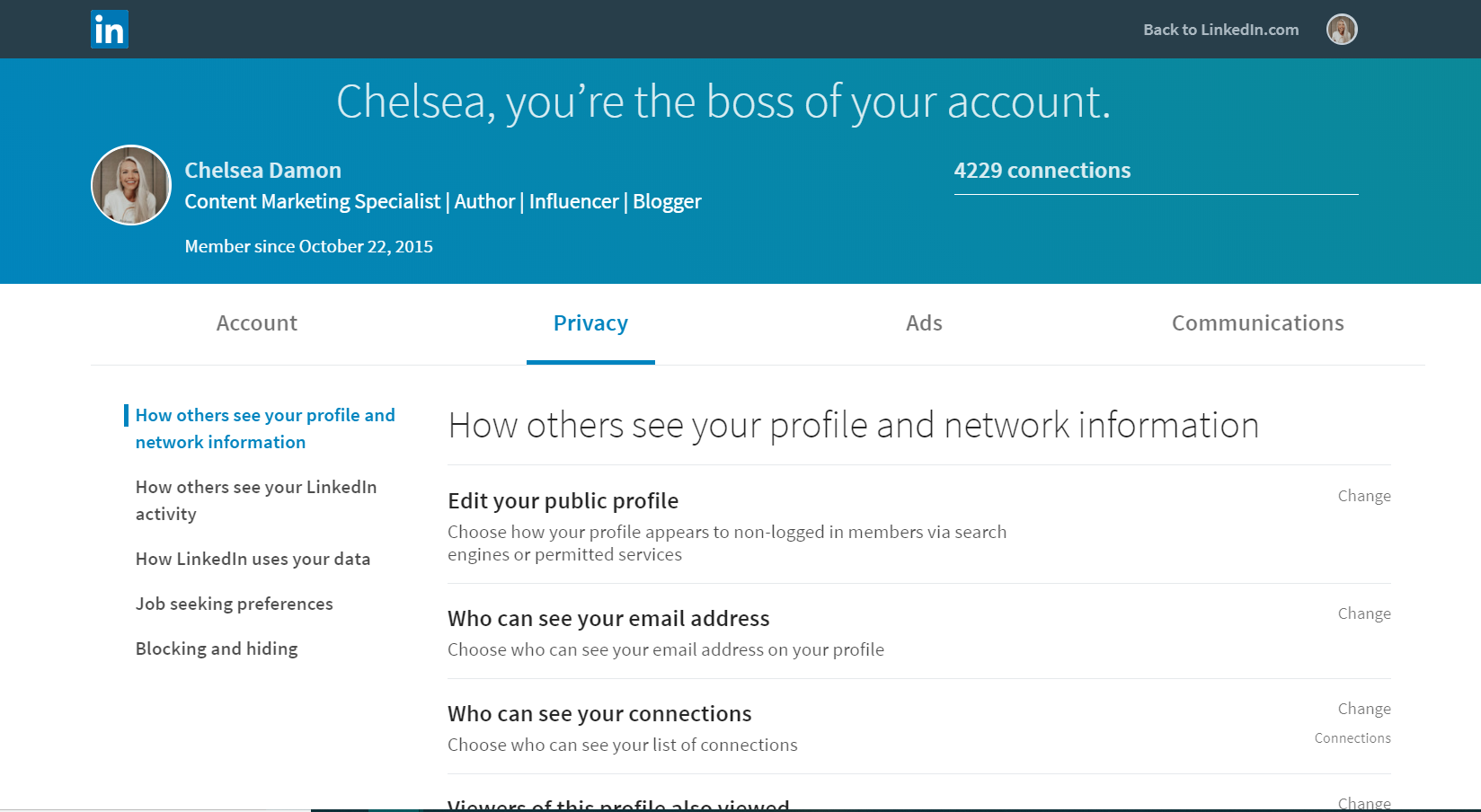
  • Before you do anything else, under Privacy, go to the “How Others See Your LinkedIn Activity” section. Choose “No” under “Share job changes, education changes, and work anniversaries from profile.” The reason you’re doing this is that it is likely that you’re going to be making a lot of changes, tweaks and refinements as you perfect your profile.  There’s no need to alert your connections (and coworkers) of every change.
  • Next, I recommend making your profile easy to find by adjusting your privacy settings so your public profile is viewable, even to those who are not connections. This includes allowing your last name to be seen, and making your email address public. (We want to make you easy to find and easy to contact!)
  • For that same reason, in the Communications section, allow all connection and message requests.
  • Under Job Seeking Preferences, click “Yes” to let recruiters know you’re open to opportunities. This is not publicly displayed anywhere so there is low risk of anyone at your company seeing you have it on. Plus it pushes you to the top of the search because it signals to recruiters that you’re engaged and willing to explore new roles, thus worth their time and effort.

2 Create a Compelling Headline

Your headline, that space right next to your name that likely now displays your company and title, is a prime piece of LinkedIn real estate. That’s because people see this without even clicking on your profile.

Anyone who comes across your name, whether in a search, post or comment, will see your picture, name and headline – all without any extra effort to click your profile. Leveraging this space gives them a reason to want to learn more.

Here are 3 attention-grabbing headline formulas to try:

  1. Descriptive Title – This could be different than your official title if it’s generic, or varies widely by companies. For example, when I was in consulting, my official title was “Senior Associate.” But that didn’t mean anything to anyone outside of the consulting world, so a better headline would have been “Financial Consultant,” because no matter your background, you could get a feel for my role.
  2. Your Top Skills or Areas of Focus – This is an especially good one for those changing careers. Use this area to showcase your transferrable skills and desired industry. For example, a consultant looking to leverage his background in a retail environment might put “Retail | Strategy | Marketing” in his headline.
  3. Your “Why” Statement – This is great for entrepreneurs and corporates that have really defined what makes them unique and the impact they make. Your why statement is simply what you do and/or the results you achieve + who you do it for. Currently I use this formula and my headline says “I help unfulfilled high achievers find work they love.” A client of mine changed her headline to read “I help small businesses attract more customers through social media management.”

[sc name=“Newsletter”]

3 Connect the Dots in Your Summary

It is your responsibility to demonstrate why you are the perfect fit for whatever job you’re going after. You get to connect the dots for them, to show them the golden thread that links your experience and has taken you to this point in your career.

Said another way – it’s your job to make it easy for people to say “yes” to having you on your team. And while experience can help with that (more on that in  #5), this is your chance to share anything else that is relevant – to essentially tie a bow on your experience, education, skills and passion.

Use this space to share in 3-7 sentences:

  • What you do and the results you achieve (e.g. social media management to attract and retain quality clients)
  • Who you do it for (industries, company types/sizes, clients, etc.)
  • Why you’re so passionate about it (this is a chance to let people get to know you, and turn you from just another profile into someone they want to meet)
  • Your beliefs, views and unique workstyle (e.g. are you a roll-up-your-sleeves kind of girl, or your experience across five industries and three countries gives you a unique perspective that others don’t have)

4 Add Relevant, Searchable Skills

When recruiters and hiring managers are looking for job matches, they search based on skills and matches to the job descriptions. Ensure you’re showing up in the results by taking inventory of your most desired jobs and, assuming you’ve got some experience there, make sure that you’ve got those specific skills listed on your profile.

Watch out for apparent duplicates – for example, “social media” and “social media management” might seem the same to you, but if a job description has just one, you might not rank you as high as you should, simply based on that “missing” skill.

Bonus points for getting endorsements on the most relevant skills. You can ask people you’ve worked with in the past to endorse you, or simply start by endorsing them, and know that they’ll likely return the favor.

 5 Let Your Experience Tell Your Story

It goes without saying that you need to have a complete work experience and education history before applying to any jobs, but you can do better than that.

Keeping in mind the job you’re aiming for, highlight and expound upon your relevant strengths, responsibilities, projects and skills.

Consider deleting anything that is not relevant. Remember, it’s your responsibility to make yourself an easy “yes” for a recruiter, and simplifying your profile to de-emphasize anything that would be distracting or confusing will help with that.

LinkedIn doesn’t allow a lot of fancy formatting, but you can use bullets and spacing to make your profile easy to ready. Add numbers when you can – think increases in revenue, conversions, team members managed, and so on.

Kristen Zavo is a career coach and the author of Job Joy: Your Guide to Success, Meaning, and Happiness in Your Career. After spending nearly two decades in traditional corporate roles, she now helps high achievers find work they love. She believes it's never too late to find work that excites and inspires you - and that life's too short for anything less! Grab your copy of Job Joy plus a free bonus gift at jobjoybook.com!

Kristen Zavo is a career coach and the author of Job Joy: Your Guide to Success, Meaning, and Happiness in Your Career. After spending nearly two decades in traditional corporate roles, she now helps high achievers find work they love. She believes it’s never too late to find work that excites and inspires you – and that life’s too short for anything less! Grab your copy of Job Joy plus a free bonus gift at jobjoybook.com!
But here’s the thing: Even if you’re not looking for a job (and especially if you are!), your LinkedIn profile has the potential to open you up to so many opportunities. And if neglected, you may never know what you’ve missed out on.

Topics:

Candidates, Climb the Ladder
Climb the Ladder

Tips for Asking for and Getting Time Off Work

Tips for Asking for and Getting Time Off Work
Scouted.io icon
By Scouted
Scouted was a hiring marketplace that matched candidates to roles based on potential, serving clients from high-growth startups to Fortune 500 companies.
4 min read • Originally published June 7, 2019 / Updated March 19, 2026
Scouted.io icon
By Scouted
Scouted was a hiring marketplace that matched candidates to roles based on potential, serving clients from high-growth startups to Fortune 500 companies.
4 min read • Originally published June 7, 2019 / Updated March 19, 2026

At the end of May, the World Health Organization (WHO) announced that it would officially recognize “burnout” as a medical diagnosis. WHO defines burnout as “chronic workplace stress that has not been successfully managed,” which can manifest as “feelings of energy depletion or exhaustion; increased mental distance from one’s job, or feelings of negativism or cynicism related to one’s job; and reduced professional efficacy.”

Taking time off from work is one of the best ways to prevent burnout or recharge after a particularly strenuous stretch of time. Research indicates that taking a vacation yields numerous benefits such as reduced stress, a lower risk of heart disease, and increased productivity.

But before you can envision yourself sipping margaritas on a beach (or just staying in to binge watch Game of Thrones all over again), you will need to have your time off approved by your employer first. Asking for time off from work can be scary, especially as a new hire, but there are ways to make the process as easy as possible. Here are a few basic do’s and don’ts to remember when asking for time off.

Do understand your company’s vacation policy.

Some companies separate vacation time from sick days, while other companies lump them together as “paid time off” (PTO). Some organizations may not allow employees to use PTO during their training or introductory period (which could last six months or more), and vacation days are usually “accrued” over time (such as one per pay period). Most companies give each employee a certain number of days off, but others offer unlimited vacation benefits.

Before requesting time off, familiarize yourself with your company’s vacation policy. If you’re ever unsure, request a copy from HR. Keep in mind that your company will likely have separate policies for longer periods of absence, such as disability, maternity/paternity leave, or leaves of absence for health-related conditions.

[sc name=“Newsletter”]

Don’t wait until the last minute to request time off.

Courtesy matters. Don’t tell your supervisor on Friday afternoon that you will be out of the office the following week for a last-minute trip to Disney World. Many companies will request a certain amount of advance notice. In general, the earlier the better, especially during peak times like the winter holidays.

Do submit a formal request, in writing, for time off after speaking with your supervisor.

It’s always a good idea to mention intended vacation time in person, such as in a one-on-one meeting with your supervisor. But you should also send an email to your supervisor so there’s a paper trail of your request. Follow up by submitting any required paperwork through HR, and put your vacation days on your department’s calendar after receiving approval.

Don’t fake illness just to get a few days off.

Honesty is always the way to go, especially when you know which days you want to take off. You may also need those sick days later, so stick with vacation days and floating holidays when you submit your time off request.

Do schedule your time off at an opportune time for the company, when possible.

Some requests for time off require a specific date, like attending a wedding or a funeral. Others, such as a week-long vacation in the Bahamas, have a bit more wiggle room. After you’ve been at a job for a while, you will have an idea of the cadence of the work. When are the busy periods? When does work slow down? Are you in a role in which vacation time is not permitted in the last two weeks before the fiscal year ends? When in doubt, speak with your supervisor or HR and plan any vacations during a slower period. An added benefit to this is that you will not have missed as much in your absence or be as stressed upon your return.

Don’t leave all your work behind for your coworkers to pick up.

Be diligent in completing your work before you leave. If a few ongoing tasks need to be covered by a coworker, inform that coworker in advance and provide written instructions. In turn, be a good sport when your coworkers ask the same favor of you during their time off.

Do inform the hiring manager of previously scheduled vacation days before accepting a new job.

Suppose you are interviewing for a new job, but your sister’s wedding is taking place a month after your intended start date. When you get to the final interview or have received an offer, let the hiring manager know about the days you will need to be out of the office. This will give the new company enough time to plan for your brief absence, before you even start.

Don’t let your vacation days expire — they’re there for a reason.

Americans rarely use all of their vacation days. In 2018, Glassdoor found that Americans typically sacrifice about half of their earned vacation time, even though time off is essential for maintaining positive health and avoiding burnout. Remember that using your vacation days is nothing to feel guilt or shame about. With proper planning and honest conversation with your employer, you can use your time off in ways that are beneficial for you and for them, as well.

Looking for more career advice? Subscribe to the Scouted newsletter.


Janine Perri is a freelance writer and marketing professional based in New York. She has experience writing about topics in business, marketing, technology, education, travel, and language services. She has also taught English in South Korea as the recipient of a Fulbright scholarship.

Topics:

Candidates, Climb the Ladder
Climb the Ladder

How to Create an Office Plan for Your Next Vacation

How to Create an Office Plan for Your Next Vacation
Scouted.io icon
By Scouted
Scouted was a hiring marketplace that matched candidates to roles based on potential, serving clients from high-growth startups to Fortune 500 companies.
5 min read • Originally published June 13, 2019 / Updated March 19, 2026
Scouted.io icon
By Scouted
Scouted was a hiring marketplace that matched candidates to roles based on potential, serving clients from high-growth startups to Fortune 500 companies.
5 min read • Originally published June 13, 2019 / Updated March 19, 2026

There’s a reason that Americans are infamous workaholics: a whopping 52% of Americans didn’t use all of their time off in 2017. In fact, forfeited vacation days added up to the equivalent in $62.2 billion in lost benefits!

Taking time off isn’t just good for your mental and physical health, though. It’s actually good for your career.

Many people assume that chaining themselves to their desk means more productivity. Yet time and again, research shows that humans are more productive when they take time off. When you work past your capacity and forgo a much-needed vacation, you lose your ability to perform at your best.

The problem that many people run into, though, is how stressful leaving the office can be. They find their vacation frequently interrupted by emergency work calls, or drown in the amount of work that piled up while they were gone.

You deserve a relaxing, stress-free vacation. The best way to do that is by coming up with an effective Out-Of-Office (OOO) plan. With a bit of forethought and preparation, you can seamlessly take time off with minimal stress and overwhelm.

Get the time off you need with our guide to creating an OOO plan.

[sc name=“Newsletter”]

Step #1: Give Everyone a Head’s Up

The best way to ensure that your time away goes as smoothly as possible is by giving advanced notice. Avoid the temptation to drag your feet: this will only make taking time off harder. Everyone will appreciate the heads up.

Block out your time off on the group calendar as soon as you get approval from management. This way, it also serves as a reminder for everyone on your team instead of coming out of nowhere.

Step #2: Delegate Your Responsibilities

The last thing you need to come back to after your time off is a backlog of work and potentially upset clients, vendors, or coworkers. Delegate your tasks among your coworkers so that everything works as seamlessly as possible in your absence.

Make a running list of all that you do each day. It can be easy to forget the jobs you do on autopilot, so give yourself a couple of days to make a note of everything that needs to get done as you’re doing it. Once you have a list, you can make sure that the appropriate tasks are delegated out to your coworkers.

Take time in the week before to talk with your coworkers about the responsibilities they will be taking for you. Make sure that they understand what they need to do and be available to answer any questions that they might have.

Make covering for you as easy as possible. Set up reminders for them depending on what needs to be done. Write a post-it, for example, if you need a coworker to do a daily task. You can also make a notification on their Google calendar when they need to do a particular job.

Also read: How Delegation Will Make You a Better Employee

Step #3: Create a Manual

No one can do your job quite like you. The last thing you want during your time away, though, is being constantly bombarded with questions. Create a short, one-page manual on a Google Doc that gives everyone in the office a quick run-down of your tasks and any valuable information.

Write out your duties, passwords, company accounts and any valuable information they might need to reference quickly. This way, anyone in your office can find what they need without bothering you. You can also put your coverage plan on the document so that everyone knows who to contact and delegate to while you’re gone.

Step #4: Clean Up Your Workspace

One of the worst feelings is coming back to chaos after time away. It raises your stress levels before you’ve even had a chance to check your email inbox!

In your rush to get out as quickly as possible, take a few minutes to tidy up your space. Organize your desk, wipe down your screen and keyboard, and file important papers away. Although it may not seem like a big deal when you’re trying to rush out of there, it can make a big difference in how you feel arriving back at work.

Also, check to make sure that you’re not leaving any food behind, either in the break-room fridge or your desk. Your coworkers won’t appreciate the unpleasant odor from forgotten food, and they definitely won’t be happy cleaning up after you.

Also read: Tips for Asking for (and Getting) Time Off From Work

Step #5: Set-up an Away Message

According to research in the Harvard Business Review, an away message is the perfect chance for social connection. Although you won’t want to sound unprofessional (I’m getting drunk at the beach is too much), do let people know why you’re going. Are you celebrating an anniversary or having a baby? Let people know! It will help people feel positively towards you, which will make them more likely to do business with you and deepen your business relationships.

Also, don’t be afraid to customize your away message. Most email systems (such as Google) allow you to draft two different emails: one for internal and one for outside your organization. This will enable you to be more personal with your coworkers and more professional with everyone outside the office.

Your message should include:

  • A leave and return date
  • Reason for absence
  • Alternative contact and resources
  • If you plan on checking your email

Your autoresponder could look something like this:

Hello-

Thank you for your email! I will be out of the office on vacation with my family from 6/10-6/19 and will not have access to my email during that time.

If you have any urgent matters that need to be handled before then, please feel free to contact [coworker name] at [email address] for immediate attention.

I look forward to connecting with you when I get back!

Best,

[Your Name]

An Out of Office for a Better Career

Some time away from the office isn’t an option. Whether you have a work trip, family emergency, or you need time away to recharge your batteries, there will come a time when your office will have to run without you. Make it as stress-free for everyone involved with a good OOO plan.

You AND your coworkers will be grateful!

Topics:

Candidates, Climb the Ladder

Posts navigation

Older posts
Newer posts
Featured Jobs
Kirkus Media
Editorial Intern
Kirkus Media
New York City, New York (US)

Gaia Inc
MEDIA COORDINATOR
Gaia Inc
Louisville, CO

Gaia Inc
Global Paid Media Specialist
Gaia Inc
Louisville, CO

Gaia Inc
Director of Media Strategy
Gaia Inc
Louisville, CO

Hearst Television
Account Executive
Hearst Television
Milwaukee, WI, United States

All Jobs »
PREMIUM MEMBER

REG CROWDER

BRITTANY 22390,
30 Years Experience
Financial and investment editorial content tailored to the needs of online media. Because I am concerned that the role of the oceans in bringing...
View Full Profile »
Join Mediabistro Membership Today

Stand out from the crowd with a premium profile

Mediabistro Logo Find your next media job or showcase your creative talent
  • Job Search
  • Hot Jobs
  • Membership
  • Newsletter
  • Career Advice
  • Media News
  • Hiring Tips
  • Creative Tools
  • About
Facebook YouTube Instagram LinkedIn
Copyright © 2026 Mediabistro
  • Terms of Use
  • Terms of Service
  • Privacy