Mediabistro Logo Mediabistro Logo
  • Jobs
    Search Creative Jobs Hot Jobs Remote Media Jobs Create Job Alerts
    Job Categories
    Creative & Design Marketing & Communications Operations & Strategy Production Sales & Business Development Writing & Editing
    Quick Links
    Search All Jobs Remote Jobs Create Job Alerts
  • Career Resources
    Career Advice & Articles Media Industry News Media Career Interviews Creative Tools Resume Writing Services Interview Coaching Job Market Insights Member Profiles
  • Mediabistro Membership
    Membership Overview How to Pitch (Premium Tool) Editorial Calendars (Premium Access) Courses & Training Programs Membership FAQ
  • Showcase
    Featured Creative Stories Submit your Story
  • Log In
Post Jobs
Mediabistro Logo Mediabistro Logo
Search Creative Jobs Hot Jobs Remote Media Jobs Create Job Alerts
Job Categories
Creative & Design Marketing & Communications Operations & Strategy Production Sales & Business Development Writing & Editing
Quick Links
Search All Jobs Remote Jobs Create Job Alerts
Career Advice & Articles Media Industry News Media Career Interviews Creative Tools Resume Writing Services Interview Coaching Job Market Insights Member Profiles
Membership Overview How to Pitch (Premium Tool) Editorial Calendars (Premium Access) Courses & Training Programs Membership FAQ
Featured Creative Stories Submit your Story
Log In
Post Jobs
Log In | Sign Up

Follow Us!

Careers & Education

The access gap in trade school programs: How flexibility drives enrollment

The access gap in trade school programs: How flexibility drives enrollment
By John Haghani for Lumion
4 min read • Originally published February 12, 2026 / Updated March 13, 2026
By John Haghani for Lumion
4 min read • Originally published February 12, 2026 / Updated March 13, 2026

A group of female high school students participating in a skills trade workshop.

Harrison Ha // Shutterstock

The ‘access gap’ in trade school programs: How flexibility drives enrollment

The challenging economic climate has pushed more people toward trade schools in recent years, as reflected in the strong revenue growth at these institutions.

Despite the perception that trade school programs are more accessible and affordable than academic degrees, many would-be students are still held back by the cost of attending reputable programs.

As a result, vocational training providers are adopting flexibility as a core tenet of student tuition payment. Here, Lumion provides an overview of the impact on enrollment and what this means for the future of the trade school market.

The trend toward trade schools

The cost of college attendance has risen dramatically since the turn of the millennium, according to stats shared by Education Data Initiative. Tuition alone increased by 111.4% above the rate of wage inflation between 2000 and 2020, while the 25.6% rise in typical costs seen between 2013 and 2023 paints a similarly stark picture.

Combined with rapid upticks in living costs, it’s easy to understand why would-be students are less content with paying an average of $38,720 each year to attend a U.S. college. In this context, the attraction of trade schools is obvious.

From a pure price perspective, trade school programs cost as little as $5,000, according to Edvisors. Moreover, they take much less time to complete than a full four-year degree, meaning students can enter the job market and start earning sooner rather than later.

Avoiding student debt, which stood at $1.6 trillion as of June 2024, is another compelling reason for the growth of trade schools. It’s both a short-term and long-term advantage that makes sense for people from all backgrounds.

The flexibility factor

Lowering the barrier to trade school attendance remains a priority to increase enrollment and spur market growth, chiefly because even the prospect of paying a few thousand dollars for tuition and program materials is exclusory in certain demographics.

So schools that want to see a spike in student sign-ups are starting to adopt payment options that spread the cost over significantly longer periods, rather than requiring payment up front. This has notable repercussions according to the experts at trade school management platform Lumion, who cite a 25.1% boost in enrollment when flexible, longer-term payment options are made available to prospective students.

Industry data also shows that 90% of people aren’t aware of the earning potential of skilled trades, which might steer them away from trade schools, even though they could end up earning a salary that matches or exceeds roles made available to those with a bachelor’s degree.

Flexibility in this context comes in several forms. It covers not just repayment periods but also the repayment terms and the ways trade school attendees can pay. Keeping financing and loans in-house or with trusted partners helps schools both bolster enrollment and manage cash flow more consistently.

When unified with other strategies for attracting and converting leads, trade schools stand an even better chance of drawing prospects away from college courses that are beset by spiraling costs and diminishing employment prospects post-graduation.

The future implications and image issues

The next five years are expected to see continued growth for trade schools, according to data cited by the Education Writers Association (EWA). This includes a 6.6% annual increase in enrollment and a 6% bump in revenues every 12 months. Given that enrollment rates across the entire education sector are projected to be just 0.8% a year over the same period, it’s clear that trade schools are outperforming the broader sector.

While flexible payment is a driver of enrollment increases, there are still hurdles to overcome if this market is to remain buoyant for the foreseeable future. First, there’s the issue of job satisfaction in the blue-collar jobs that participants in trade school programs will enter once they have finished their studies. A Pew Research Center survey found that 43% of workers in this category would describe themselves as very or extremely satisfied with their profession, compared to 53% of white-collar workers.

The enduring stigma attached to skilled trades may be softening, but trade schools must continue to change the conversation and showcase exactly why it’s worth completing their programs for young people considering their careers today.

What’s next for trade school enrollment?

Trade schools are in a uniquely advantageous position at the moment due to a combination of external economic conditions and internal advantages like flexible payment solutions. They must make the most of this scenario in order to fulfill and ultimately exceed the projected growth figures from analysts.

The upshot for prospective attendees is that trade schools are closing the access gap, and it’s easier to justify enrolling in trade school programs that leave graduates with a highly employable, in-demand skill.

This story was produced by Lumion and reviewed and distributed by Stacker.

Topics:

Careers & Education
Careers & Education

15 graduation party invitation ideas

15 graduation party invitation ideas
By Jeff Preston for Grad Party Invites
4 min read • Originally published February 12, 2026 / Updated March 13, 2026
By Jeff Preston for Grad Party Invites
4 min read • Originally published February 12, 2026 / Updated March 13, 2026

Golden '2026' numbers in front of a stack of books and a graduation cap.

chayanuphol // Shutterstock

15 graduation party invitation ideas

Looking for creative ways to invite guests to your graduation celebration? Grad Party Invites has 15 inspiring invitation ideas that will set the perfect tone for your special day.

1. Classic Photo Invitation

Feature a professional graduation portrait as the centerpiece of your invitation. This timeless approach showcases your achievement and gives guests a beautiful keepsake. Choose a formal portrait or a candid moment that captures your personality.

2. Photo Collage Design

Tell your story through multiple photos spanning your academic journey. Include memorable moments, friendships, and milestones that led to this achievement. This nostalgic approach helps guests celebrate the full journey with you.

3. Minimalist Typography

Let clean, bold typography do the talking. A minimalist design with elegant fonts and simple color schemes creates a sophisticated, modern look. Perfect for graduates who appreciate understated elegance and contemporary design.

4. School Colors Theme

Incorporate your school’s colors throughout the invitation design. This shows pride in your institution while creating a cohesive look that guests will immediately recognize. Add school mascots or symbols for extra school spirit.

5. Floral Elegance

Soft floral designs add a touch of sophistication and natural beauty. Whether you choose watercolor flowers, botanical illustrations, or pressed-flower patterns, floral invitations bring an elegant, timeless quality to your announcement.

6. Gold Foil Accents

Add luxury with metallic gold foil details highlighting key information. Gold accents catch the light and create a premium feel that makes your invitation stand out. Perfect for formal celebrations and graduates who want to add glamour.

7. Vintage Style

Embrace retro charm with vintage-inspired designs featuring classic fonts, aged paper effects, and nostalgic color palettes. This timeless style works beautifully for both traditional and eclectic celebrations.

8. Modern Geometric Patterns

Contemporary geometric shapes and patterns create visual interest and a fresh, current aesthetic. Bold lines, abstract designs, and strategic use of negative space give your invitation a trendy, artistic edge.

9. Chalkboard Design

The chalkboard aesthetic brings a casual, handcrafted feel to your invitation. With hand-drawn elements and chalk-style typography, this design mimics the classroom experience in a charming, approachable way.

10. Confetti and Celebration Graphics

Embrace the festive spirit with confetti patterns, balloons, and celebratory graphics. This playful approach signals a fun, energetic party atmosphere and sets an upbeat tone for your celebration.

11. Elegant Formal Design

Traditional formal invitations with classic layouts, serif fonts, and sophisticated borders never go out of style. This approach works perfectly for formal dinner celebrations and dignified ceremonies.

12. Digital Animation

For digital invitations, consider adding subtle animations or GIF elements. Moving confetti, fading text, or animated graphics add a modern, tech-savvy touch that engages recipients and stands out in their inbox.

13. Before and After Photos

Create a fun side-by-side comparison showing your transformation throughout your academic journey. This lighthearted approach adds personality and humor while celebrating your growth and achievement.

14. Destination Theme

If you’re planning a destination celebration or outdoor event, reflect that in your invitation design. Beach themes, garden party aesthetics, or venue-specific elements help guests understand the celebration’s vibe and dress appropriately.

15. Custom Illustration

Commission or create custom illustrations that represent your interests, field of study, or future plans. Whether it’s artistic portraits, career-themed graphics, or hobby-inspired designs, custom illustrations make your invitation truly one-of-a-kind.

Choosing the Right Design for You

When selecting your graduation invitation design, consider these factors:

  • Party Style: Match your invitation design to your celebration’s formality level
  • Personal Style: Choose designs that reflect your personality and aesthetic preferences
  • Budget: Digital invitations offer beautiful designs at lower costs than printed options
  • Timeline: Digital invitations arrive instantly, while printed cards need shipping time
  • Guest List: Consider your audience and what design styles will resonate with them

Digital vs. Printed Invitations

Each format has unique advantages. Digital invitations are eco-friendly, cost-effective, and arrive instantly. They also allow for interactive elements like RSVP buttons and calendar integration. Printed invitations offer a tangible keepsake and work well for formal celebrations or when guests may not regularly check email.

Personalization Tips

Regardless of which design you choose, personalization makes your invitation special:

  • Include your graduation date and institution
  • Add party details: date, time, location, dress code
  • Incorporate personal photos or meaningful graphics
  • Choose colors that represent you or your school
  • Write a personal message or quote that reflects your journey
  • Include RSVP information and any special instructions

Final Thoughts

Your graduation party invitation is the first glimpse guests will have of your celebration. Whether you choose a classic photo design, modern minimalist style, or playful confetti theme, the most important thing is that it reflects you and sets the right tone for your special day. Don’t be afraid to mix elements from different ideas to create something uniquely yours!

This story was produced by Grad Party Invites and reviewed and distributed by Stacker.

Topics:

Careers & Education
Careers & Education

11 highest-paying construction jobs for independent contractors

11 highest-paying construction jobs for independent contractors
By Mary Beth Eastman for ERGO NEXT
7 min read • Originally published February 4, 2026 / Updated March 13, 2026
By Mary Beth Eastman for ERGO NEXT
7 min read • Originally published February 4, 2026 / Updated March 13, 2026

A specialist inside an elevator shaft to repair systems.

K-FK // Shutterstock

11 highest-paying construction jobs for independent contractors

According to the U.S. Bureau of Labor Statistics, employment opportunities in the construction field are expected to grow faster than average by 2034, and create 649,300 new jobs. The median salary for construction workers is $58,360 (as of May 2024), which is higher than the median wage for all occupations at $49,500.

If you’re an independent contractor working in construction and you want to increase your pay, or you are considering career opportunities in construction, ERGO NEXT has compiled the 11 construction jobs — from unskilled labor to specialized skills — with the highest pay potential.

Two things to note when you’re looking at this list:

  1. What you earn in your city or state may be higher or lower than what’s listed here, as these wages are based on national averages. Construction worker salaries can vary based on many factors, including your skill level, experience and your local job market.
  2. All of these jobs require a high school diploma or equivalent. None of them require a college degree. Many of them will also require you to complete an apprenticeship program before you can get to work.

1. Elevator and escalator installers and repairers ($106,580)

Those working in this field don’t just install, repair and perform routine maintenance. They also work on escalators, moving walkways and chair lifts. They’re responsible for ensuring the equipment is safe, working correctly and up to code.

Many states require elevator installers and repairers to have a license.

With a median salary of $106,580, elevator and escalator installers and repairers top our list of highest paying construction jobs nationwide. By 2034, opportunities are expected to grow by 5% — faster than the average of 3.1% expected for overall job growth.

But if you’re not comfortable in small spaces, this profession might not be your best bet. Elevator installers and repairs often work in small, enclosed areas, such as crawl spaces, machine rooms and elevator shafts.

It’s also important to consider that job opportunities can be limited in smaller communities without many multi-story buildings. But if you live within commuting distance of a major metro area, you’ll likely find more opportunities.

2. Boilermakers ($73,340)

Boilermakers install and repair boilers, vats and other large containers that hold liquid or gas. They test and inspect the machines to ensure they’re working correctly, clean the equipment, and repair and replace components.

Boilermakers often work at construction sites and may travel away from home for extended periods. It can also be physically demanding, and it’s sometimes necessary to work in cramped conditions.

While boilermakers earn a good living, job growth is projected to decline 2% in the next decade. However, there are still about 800 openings for this job projected each year on average.

3. Construction and building inspectors ($72,120)

Construction workers and building inspectors are some of the highest-paid contractors in the construction industry with a median salary of $72,120.

Many state and local authorities require construction and building inspectors to have a license or other certification. Professionals in these jobs monitor construction projects to ensure that buildings, streets, bridges, sewer systems and other structures are up to code. They make sure construction adheres to zoning regulations and meets the contract’s requirements. And they typically submit their findings to project stakeholders and regulatory agencies once the project is complete.

This isn’t the job for you if you’re just starting your career. Typically, this work requires several years of related work experience in the construction field. But if you’ve worked in the industry for a while, it could be a good opportunity for you to boost your earning potential.

Though there is expected to be a 1% decline in these roles over the next decade, 14,800 job openings are projected each year to fill vacancies left by workers who retire or switch to other roles.

4. Plumbers, pipefitters and steamfitters ($62,970)

These professionals install and repair pipes, fixtures and related systems that transport water, gas and additional materials through homes and commercial buildings. They also clean out drains to prevent back-ups and other issues.

Plumbers must be licensed and carry plumber insurance in most states. Many also attend vocational or trade school.

Employment for plumbers, pipefitters and steamfitters is expected to grow 4%, a little faster than average for all occupations. About 44,000 new jobs for plumbers, pipefitters and steamfitters are projected each year, on average.

5. Electricians ($62,350)

Electricians install and maintain the electrical systems, communications, lighting and control systems in residential and commercial buildings.

Most states require you to have an electrician license before you can work in this field. Together with electrician insurance, these are usually prerequisites to a successful career.

If you’re looking for a high-paying contract job with plenty of opportunities (approximately 81,000 openings projected yearly), this might be a good fit. From 2024-2034, the expected job growth for electricians is 9% — about three times the expected growth rate for all occupations.

6. Ironworkers ($61,940)

Ironworkers install iron and steel components during the construction of new buildings, roads, bridges and other structures. They also reinforce existing structures and assist with the demolition of older buildings.

This job can be physically demanding. It’s often required for workers to work at great heights. However, if you’re interested in getting into this line of work, you often only need a high school diploma to get started. And you can learn on the job or through an apprenticeship.

The construction of large projects such as high-rise buildings nationwide is expected to drive employment. Similarly, infrastructure maintenance and replacing of old buildings, roads and bridges will also likely contribute to job growth. From 2024-2034, ironworkers’ expected occupational growth is 4% — about average for all occupations.

7. Sheet metal workers ($60,850)

Sheet metal workers make or install products constructed from thin metal sheets, including steel, aluminum and alloyed metals.

They’re responsible for choosing the right type of sheet to use based on a construction job’s requirements. Projects they work on include heating and cooling ducts, outdoor pipes, gutters and flashing.

There won’t be as many opportunities for sheet metal workers compared to some of the other jobs on this list. Job growth in this profession is projected to be about 2% over the next decade, or about 10,600 jobs per year. However, almost every building requires sheet metal for ducts and other structural systems, so you might be able to find opportunities in your community.

8. Carpenters ($59,310)

Carpenters cut, shape, install and repair walls, floors, door frames and other structures made of wood, plastic, fiberglass and drywall.

Carpenters are an integral part of many construction projects, including bridges, commercial buildings, residential properties and more. Currently, employment opportunities for carpenters is projected to grow 4% from 2024 to 2034.

Some states require carpenters or anyone working in carpentry to carry a carpenters license before they work. And they are often required to carry carpenter insurance due to the risk of injury and property damage on the job.

9. Drywall installers, ceiling tile installers and tapers ($58,800)

Drywall and ceiling tile installers place drywall panels over walls and ceilings. These panels cover insulation, electrical wires and pipes and help dampen sound. Tapers prepare the drywall for finishing.

Like many construction-related jobs, the work can be physically demanding, and you need an eye for precision as you’re working on interiors. However, formal educational credentials are usually not required for this job, making it easier to enter for a beginner.

There is a 4% growth projected from 2024-2034 (about the same as the average for all jobs), with more than 8,800 openings for drywall contractors projected annually.

10. Construction equipment operators ($58,320)

We’ve all seen heavy equipment on job sites, such as excavators, bulldozers and backhoes. Construction equipment operators drive and control these and other types of machinery used to build structures, roads and buildings.

Operators can sometimes have irregular schedules; working at night is sometimes an essential for this profession. Job growth is expected to be 4% over the next ten years, which is about average for all occupations.

11. Masonry workers ($56,600)

What carpenters do with wood, masons do in stone. Masons use brick, block, stone and concrete to build structures. While they often work on buildings and foundations, their work encompasses much more. Masonry workers also build walkways and sidewalks, walls, and decorative finishes (including things like granite kitchen countertops and fireplaces).

Masonry workers typically learn their trade through apprenticeships and on-the-job training. Similarly, many technical schools offer masonry programs. Depending on the state where you work, you may be required to have a masonry license and mason insurance.

The demand for masons largely depends on overall demand for new buildings and road construction. Employment of masonry workers is projected to grow 2% through 2034, which is slower than average for all occupations. However, as brick and stone are very popular for interiors and exteriors, it’s likely that demand for this type of work will continue.

This story was produced by ERGO NEXT and reviewed and distributed by Stacker.

Topics:

Careers & Education
Careers & Education

As school choice programs grow, parents are demanding better customer service

As school choice programs grow, parents are demanding better customer service
By Linda Jacobson for The 74
5 min read • Originally published February 6, 2026 / Updated March 13, 2026
By Linda Jacobson for The 74
5 min read • Originally published February 6, 2026 / Updated March 13, 2026

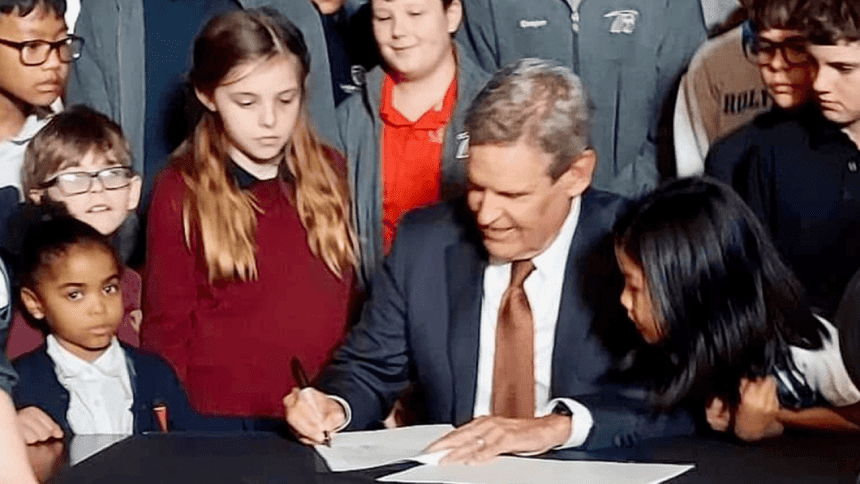
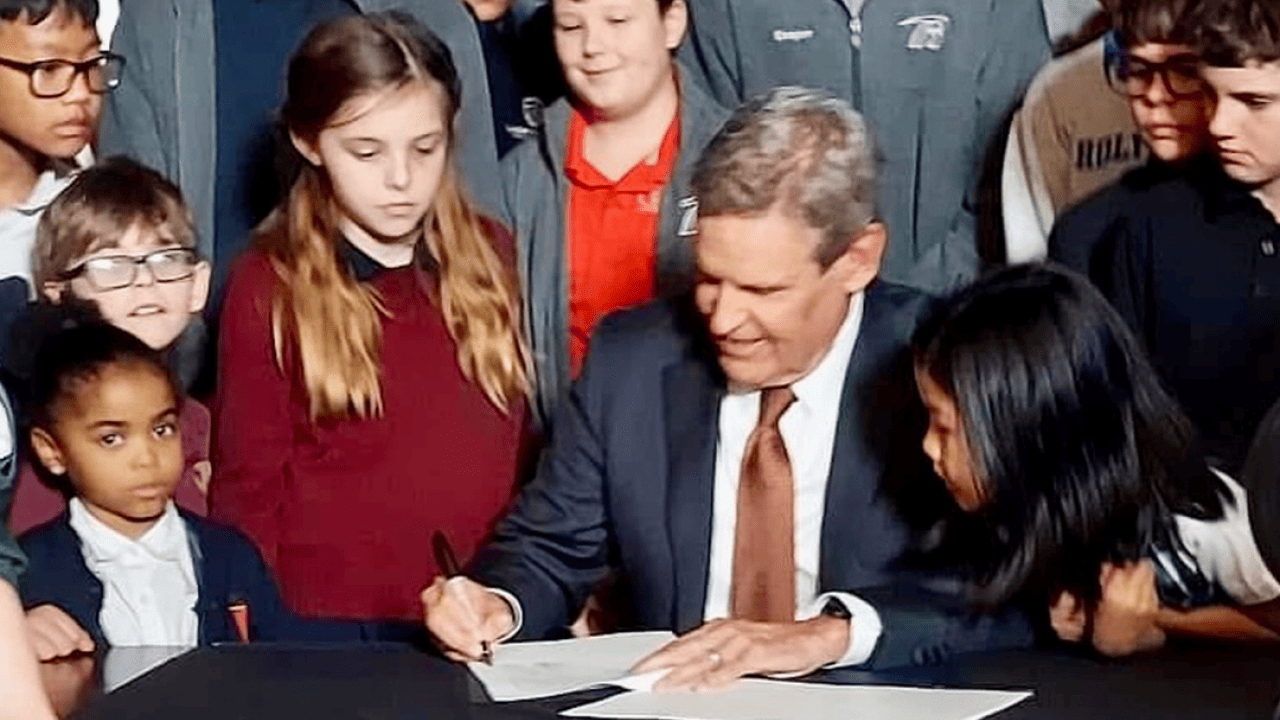
Tennessee Gov. Bill Lee signed the Education Freedom Act in February. The private school choice program serves about 20,000 students this year, but he’s calling for further expansion.

Courtesy of the Tennessee Office of the Governor

As school choice programs grow, parents are demanding better customer service

As states continue to launch and expand private school choice programs, one of their biggest challenges is building online platforms that meet the overwhelming demand.

Tennessee families experienced a bottleneck earlier this year as they waited hours online to submit applications for the state’s new Education Freedom Scholarship program. In July, the state told 166 parents that they had received a scholarship, only to alert them a few days later that the notification was a mistake.

“It wasn’t the most ideal user experience,” said Heide Nesset, a senior fellow for the Beacon Center of Tennessee, a right-leaning think tank. But Nesset told The 74 there was a “tight runway,” about three months, to get the program off the ground.

With state leaders hoping to serve up to 70,000 students next year, they’re now searching for a new vendor. Proposals are due Friday.

But the rough start in Tennessee wasn’t an anomaly. All states with education savings accounts have struggled to some extent with ensuring smooth transactions for families, whether that’s paying a school on time or ordering a homeschool curriculum. Some say the solution lies in picking more than one company to handle the increasing demand and improve customer service.

“If it’s one contract, I think the vendor is inherently trying to ensure that the state department has a really fantastic experience,” said Nesset, who is also the vice president of implementation at the Yes. Every Kid. Foundation, a school choice advocacy organization. “If you have more than one [vendor], then they start competing, and families have the opportunity to make choices.”

Tennessee’s current vendor is Student First Technologies, which won a contract in 2023 to run a smaller ESA program in three counties. Earlier this year, the state expanded the contract with the Indiana-based company to manage the new statewide program, despite its problems in other states.

In West Virginia, where Student First still operates the Hope Scholarship program, an ESA, homeschool families complain that they can’t access the platform on their phones and that approvals and denials for purchases are inconsistent. Arkansas canceled its contract with Student First last fall after it failed to deliver a “fully operational” system on time. The company paid the state a $300,000 fine.

‘Get what they need’

Eighteen states now have at least one ESA program. With a new federal tax credit scholarship system beginning in 2027, the demand for organizations to manage them will surely grow. The trick is delivering a system that runs smoothly for families while ensuring that they’re using the money the way the state intended.

In a recent interview, Michael Horn, cofounder of the Clayton Christensen Institute, a think tank, talked with Jamie Rosenberg, the founder of ClassWallet. Still the biggest player in the market, the Florida-based company manages nine ESA programs.

Prior to platforms like his, states had two options, he explained. They either issued debit cards, which made it hard to ensure parents spent the money on allowable purchases, or expected them to pay up front and request reimbursement — a significant obstacle for families on a tight budget.

ESA vendors, he said, give families the “agency to get what they need but also the ease of knowing that what they’re doing and what they’re buying [complies with] program rules.”

Adding more than one vendor to the mix could make the companies work harder to reach lower-income and unrepresented families who are less likely to use the programs, said Lisa Snell, a senior fellow at Stand Together Trust, which funds school choice initiatives.

“Family outreach and satisfaction become the goal rather than the government as the customer to one vendor,” she said.

Texas had the option to choose multiple vendors for its new ESA program, which launches next fall. The law allows the comptroller’s office to contract with up to five companies. But officials opted against it and awarded a two-year, $26 million contract to New York-based Odyssey, which currently runs programs in four other states.

Joe Connor, Odyssey’s CEO, declined to comment on the state’s decision and referred The 74 to the state comptroller’s office. The office did not respond, but Amar Kumar, CEO of KaiPod Learning, a large national network of microschools, said the state likely felt multiple vendors would further complicate the process.

“There was this huge question of the complexity of doing that,” he said. “How do you tell families which portal to go to or how will they decide who manages which part of the program?”

‘Send a quarterly check’

The vendor platforms include built-in tools to prevent misuse. Student First Technologies has an AI feature, called QuinnIQ, that reviews each expense, “assigns a confidence score” and flags anything that’s new or that the state hasn’t approved in the past.

But Katie Switzer, a West Virginia parent using the state’s Hope Scholarship to homeschool her children, said it’s unreliable, sometimes approving purchases for some families and rejecting the same items for others. She thinks states should focus more on monitoring students’ academic progress than tracking every purchase.

“It’s stupid in my opinion to micromanage down to like the $20 workbook level,” she said. “Honestly, I think it would be more cost effective to send a quarterly check to families.”

That’s unlikely with such programs constantly under the microscope, and critics, especially in Arizona, pointing to high-end purchases, like diamonds and plane tickets, as examples of misuse. The state education department says it takes steps to prevent fraud and has referred cases to the attorney general’s office that have led to convictions.

West Virginia officials said they’re pleased with Student First’s progress since October, when parents complained that delayed orders caused students to fall behind on lessons. Orders are now “generally” processed within two business days, said Assistant Treasurer Carrie Hodousek, and the company has added and trained staff to prepare for peak order times.

Providers like KaiPod have their own concerns. School founders in the network have sometimes gone to the brink of eviction from their leased space because of late tuition payments, said CEO Kumar.

“There should be a predictable schedule, but sometimes it can take weeks extra to get paid,” he said. “If you’re running a small business and you owe rent, you owe payroll and your state payment is delayed, that creates a huge amount of stress for founders.”

For now, rebidding contracts for vendors is the strongest form of accountability, he said.

“They ought to not feel safe once they’ve won a contract,” he said.

Disclosure: Stand Together Trust provides financial support to The 74.

This story was produced by The 74 and reviewed and distributed by Stacker.

Topics:

Careers & Education
Careers & Education

11 numbers that capture the Trump effect on education

11 numbers that capture the Trump effect on education
By Sarah Butrymowicz for The Hechinger Report
9 min read • Originally published January 21, 2026 / Updated March 13, 2026
By Sarah Butrymowicz for The Hechinger Report
9 min read • Originally published January 21, 2026 / Updated March 13, 2026

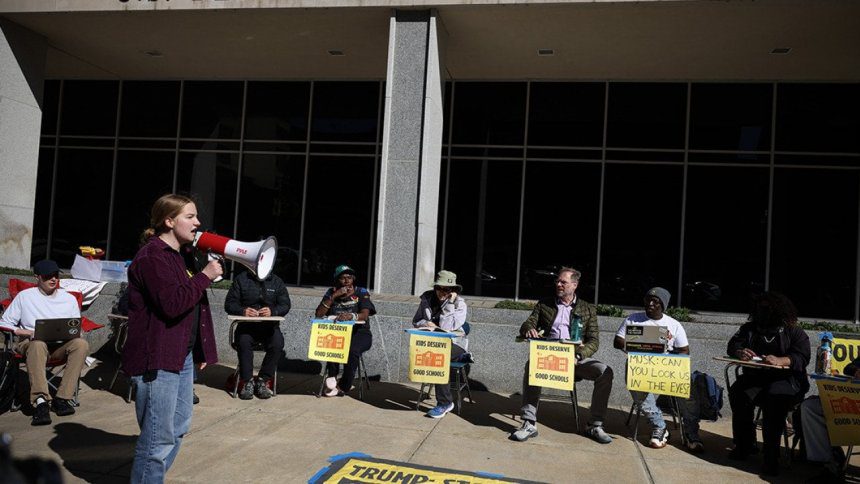
: Protestors participating in a 'study-in' in front of the US Department of Education building on March 21, 2025 in Washington, D.C.

Kayla Bartkowski // Getty Images

11 numbers that capture the Trump effect on education

About 1.5 million people teach on college campuses in the United States, and nearly 4 million teachers work in its public elementary and secondary schools. More than 15 million undergraduates attend U.S. colleges and universities. There are more than 50 million school-age children across the country.

They all have one thing in common: Federal education policy affects their lives.

President Donald Trump and Education Secretary Linda McMahon say they want to close the Department of Education and return control of education to the states. At the same time, however, they have aggressively and rapidly wielded federal power over schools.

The Hechinger Report takes a look at some key data points from the first year of Trump’s second term that represent the outsized effect this presidency has had on the nation’s educational institutions and the people within them.

— 15 —

Number of executive orders Trump signed that exclusively address colleges or schools

In 2017, the first year of his first term, Trump signed two executive orders related to education. This year, he signed three times that number on just a single day in April.

Among his most notable executive orders was one early in his term requiring the Department of Education to begin dismantling itself. He also established an Artificial Intelligence Education Task Force and asked cabinet members to provide him with a plan to end “radical indoctrination” in schools. Other executive orders have addressed school discipline, transgender athletes, registered apprenticeships and foreign influence on college campuses.

Another set of executive orders indirectly affected schools. For instance, the Department of Education interpreted an order about undocumented immigrants to require limiting access to some adult and career and technical education programs. And separately, in a presidential memorandum, Trump ordered universities to begin reporting the race of their applicants and admitted students, not just those who enroll in the fall.

— 26 —

Number of investigations into K-12 transgender policies announced by the Education Department

At the K-12 level, the administration has given no issue more attention than policies that govern which bathrooms, locker rooms and sports teams transgender students can access. In all, the department has announced at least 26 such investigations, including into six state education agencies and three statewide athletic associations.

By comparison, the Trump administration announced eight investigations into antisemitism at elementary and secondary schools and four cases of alleged racial discrimination that hurts white teachers or students.

In higher education, it’s the inverse: Just five investigations into transgender issues have been announced, while dozens of cases of antisemitism and racial discrimination are being investigated.

— 50+ —

Number of education-specific lawsuits filed against the Trump administration

It’s not unusual for presidential administrations to be sued: Texas Attorney General Ken Paxton brags about suing the Biden administration 100 times. But the first year of Trump’s second term has been marked by unprecedented legal activity related to his administration’s education actions, according to a review of court documents and other lawsuit trackers. Trump, McMahon and the Department of Education have been sued over efforts to fire employees and dismantle the department, freeze funding and cancel grants, and end diversity, equity and inclusion efforts.

The administration’s track record defending itself in court has been mixed, but it scored a major victory when the Supreme Court allowed its March layoffs of hundreds of Education Department staffers. However, courts have blocked some efforts to ban diversity, equity and inclusion initiatives, forced the federal government to pay out some once-frozen grants and allowed Harvard to continue enrolling foreign students.

— 1,950 —

Number of employees who left the Department of Education in the spring

When Trump took office, the Education Department had more than 4,100 employees. Soon after, those numbers started dropping. In the first seven weeks of the new administration, 572 staffers voluntarily resigned. In March, 1,378 more employees were let go. Many offices were decimated without a clear plan for how or if their work would continue.

The National Center for Education Statistics, for example, went from about 100 staffers to three. That office is responsible for collecting data on the nation’s schools and colleges and administering the National Assessment of Educational Progress. Or take the Office for Civil Rights, which is in charge of investigating complaints about civil rights violations, including sexual harassment, racial discrimination and failure to provide an adequate education to students with disabilities. Seven of its 11 regional offices were shuttered and, in all, it lost nearly half its staff. (In December, some of those staffers were temporarily called back to help reduce a backlog of cases.)

The administration notified another 466 employees they were being let go during the government shutdown in October. Those positions were reinstated, however, as part of a congressional deal to reopen the government. The department also launched a plan to move large swathes of its work to other agencies, including the departments of Labor, State and Health and Human Services.

The Education Department did not respond to several requests for information about how many people are working at the agency now.

— 5 —

Number of regional Head Start offices closed

As part of the administration’s sweeping reductions in force, five out of 10 regional Head Start offices were abruptly closed and all employees fired in April. The offices, all in blue states, help oversee the free child care services provided by local early education programs for low-income children. In all, the five offices had been responsible for oversight of 318,000 — or 44% — of Head Start slots.

That wasn’t the only upheaval Head Start programs faced this year. At the end of January, the Trump administration directed agencies to temporarily freeze federal funding for thousands of financial assistance programs, including Head Start. Soon after, the White House said the program was exempt, and later it withdrew the order altogether. (A federal judge eventually ruled the entire directive was illegal.) But dozens of centers serving more than 20,000 children reported weeks-long delays in accessing federal money, with some forced to close temporarily. Then, during the government shutdown in the fall, centers serving 9,000 kids had to close their doors, some for several weeks, according to tracking by the First Five Years Fund.

— 17% —

Decline in new international student enrollment in fall 2025

The Trump administration’s attacks on foreign students with political views it disliked made international headlines this spring, as it targeted students protesting the Israel-Hamas war for deportation and announced plans to scour the social media accounts of new visa applicants. It also imposed travel restrictions and delayed some processing of student visas. The result is a slower pipeline of new foreign students coming to the United States, according to data from the Institute of International Education.

The decrease in new international students was driven by graduate students, whose enrollment declined most sharply. But because most returning students stuck with their U.S. education plans, the overall number of foreign students (including those engaged in jobs related to future or past higher education enrollment) ticked down just 1%. Still, that’s a big deal for colleges and universities: Graduate students make up the lion’s share of international enrollment and are a major source of revenue for many colleges. International students typically do not get financial aid, paying full price to attend.

— $1,700 —

Maximum tax break an individual can get for donating to school choice scholarships

Trump’s signature legislation, the One Big Beautiful Bill Act, was a major win for school choice advocates: It created a new federal school voucher program. The law sets up tax credit scholarships — vouchers — families can use to pay for private school tuition, tutoring or other educational expenses. Parents will also be able to use the money to cover homeschooling costs. Starting in 2027, individuals can get a tax credit of up to $1,700 for donations to nonprofits that provide the scholarships. Those nonprofits, in turn, will be in charge of handing out the money.

States must opt in if they want schools within their respective borders to be able to participate. At least three states so far have said they will decline, but more than 20 others have already established their own tax credit scholarship programs and are expected to sign up when the federal option becomes available.

— 6,353 —

Number of complaints the Education Department’s Office for Civil Rights dismissed between mid-March and mid-September

In one six-month stretch, the Department of Education’s Office for Civil Rights dismissed more than 6,000 complaints without an investigation, according to a September court filing. By contrast, the Biden administration did the same with 2,527 cases in its final three months.

The Trump administration has said in court filings it is following longstanding policies for dismissing cases. Former employees and advocates counter that the jump in dismissals suggests student and parent complaints are not being adequately probed, and that layoffs are affecting an agency that has long struggled to keep up with its caseload.

The rate at which the Trump administration reaches a final resolution in the cases it does investigate has significantly slowed. Between mid-March and mid-September, OCR resolved 581 complaints through mediated settlements, voluntary agreements or technical assistance. Another 138 were resolved after an investigation did not find evidence of violations. Those numbers are roughly the same as the last three months of the Biden administration (595 and 119 respectively).

— $153 million —

Amount of grant money the administration is spending to promote civics education

The Education Department said in September it gave more than $153 million to 85 grantees to work on civics education. That’s a major increase: Since this grant program launched in 2017, just 38 grants worth about $75 million had been awarded in all.

Promoting patriotic education is one of McMahon’s goals. “Patriotic education presents American history in a way that is accurate, honest, and inspiring,” her agency said in a September announcement prioritizing discretionary spending on this issue. “It emphasizes a unifying and uplifting portrayal of the nation’s founding ideals.”

McMahon also started the America 250 Civics Education Coalition, in preparation for next year’s anniversary of the signing of the Declaration of Independence. The coalition is made up largely of conservative organizations including Turning Point USA, Moms for Liberty, Hillsdale College and Priests for Life.

— $5.8 billion —

Minimum amount of federal research funding cut or frozen

Federal research dollars, many of which flow to colleges and universities, were cut way back this year. It’s difficult to calculate exactly how much was lost; this money comes from many agencies and some remains mired in legal battles. The website Grant Witness, run by a group of researchers, tracks canceled or frozen grants. Its data shows that more than $5.1 billion in National Institutes of Health money that had yet to be spent was earmarked for colleges or universities, as was nearly $700 million from the National Science Foundation. (Some of that funding may have been restored.)

Those agencies were two of the largest sources of federal grants to higher education, but not the only ones. More than $425 million in National Endowment for the Humanities grants, many of which are awarded to colleges, were canceled. (Those cuts were later found to be unlawful.) The Department of Agriculture canceled tens of millions of dollars in higher education research funding, and the Environmental Protection Agency also terminated such grants.

The picture doesn’t look better for year two of Trump’s term: The White House has proposed cutting all federal research funding by a third — a decrease of more than $33 billion from 2025.

— 0 —

Number of colleges that have signed the Trump ‘Compact for Academic Excellence in Higher Education’

The Trump administration has been aggressive in trying to bend higher education to its will. In October, officials reached out to nine universities, including some of the country’s most selective institutions, with a deal. The schools could be first in line for federal money if they agreed to a litany of demands including:

  • Publishing standardized test scores for admitted students by race, sex and ethnicity
  • Capping foreign student enrollment at 15%
  • Prohibiting transgender females from using women’s locker rooms and bathrooms
  • Freezing tuition for five years

So far, none have accepted the offer, with seven universities rejecting it outright. The University of Texas at Austin and Vanderbilt University did not publicly rebuke the compact, but did not sign it. New College of Florida, which was not one of the nine, said it would sign if given the chance. Other universities signed separate agreements with the administration to unfreeze federal money. Columbia University, for example, paid $221 million and accepted a host of conditions to regain access to billions of federal dollars.

This story was produced by The Hechinger Report, a nonprofit, independent news organization focused on inequality and innovation in education, and reviewed and distributed by Stacker.


Topics:

Careers & Education
Careers & Education

New year, new job offer: How to make sense of your equity award package

New year, new job offer: How to make sense of your equity award package
By Alex Cwirko-Godycki for Pave
6 min read • Originally published January 22, 2026 / Updated March 13, 2026
By Alex Cwirko-Godycki for Pave
6 min read • Originally published January 22, 2026 / Updated March 13, 2026

A female jobseeker opening an application with a 'congratulations' message using a laptop.

Rawpixel.com // Shutterstock

New year, new job offer: How to make sense of your equity award package

Congratulations, you’ve received a job offer that includes equity compensation. Getting an equity grant is always exciting, but before you go on a spending spree, you need to understand what you’re actually getting. Too many job candidates accept equity packages without asking the right questions, only to discover later that their “valuable” equity grant isn’t really worth what they thought.

When job seekers truly understand their equity compensation—including vesting mechanics and realistic valuation scenarios—they make better decisions and join companies with appropriate expectations. This benefits everyone: new employees, recruiters, and hiring managers.

With this in mind, Pave, a compensation intelligence platform used by more than 8,600 companies, shares five important things you need to know about any equity award before signing on the dotted line.

What Type of Equity Award Am I Getting?

Every equity award vehicle, or equity type, works in unique ways and has different financial implications for employees. This story will focus on the two most common award vehicles: stock options and restricted stock units (RSUs).

Stock options, which are most commonly used at early stage private companies, give you the right to buy company shares in the future at a fixed price (i.e., the “strike price”) once certain vesting requirements are met. However, these awards can lose their value if the company’s stock price drops below the strike price.

Meanwhile, RSUs, which are most commonly used at late-stage private companies and public companies, represent shares in the company you will receive once certain vesting requirements are met. RSUs always have some value so long as the company remains in business.

Digging a bit deeper, there are also different types of stock options to be aware of, which have specific tax implications. Incentive stock options (ISOs) offer preferential tax treatment to employees but come with certain restrictions. In contrast, nonqualified stock options (NQSOs) are more flexible but create ordinary income tax when they are exercised. RSUs are taxed as ordinary income when they vest, even if shares are not sold.

Understanding the type of equity award you’re about to receive will help you set realistic expectations and plan for taxable events. Don’t assume all equity awards work the same way, and it is always wise to consult with a tax professional before receiving or selling equity.

The vesting schedule of your equity award determines when you actually get your equity. When stock options vest, you have the right to exercise your options and get shares, and when RSUs vest, you instantly become a shareholder.

Vesting schedules vary widely. At private technology companies, awards typically have a four-year overall vesting period with shares earned at different intervals over that timeframe. At public technology companies, the prevalence of awards with three-year vesting periods is climbing.

Pay particular attention to so-called “cliff vesting” events in your awards, as they represent significant financial risk if you leave or are terminated early from a job. One-year cliffs are very common for new employees, meaning no equity vests (or is earned) during your first full year of employment. Then, on the one-year anniversary of your grant, a large vest occurs. Afterwards, most grants switch to so-called “linear vesting,” where a small portion of your equity award vests every month or quarter for the remainder of the overall vesting period.

How Is the Value of My Equity Award Determined?

For public companies, determining the value of equity is straightforward—any shares you receive, whether after exercising stock options or earning RSUs, are worth the current stock price. However, for private companies, it’s more complex and speculative.

Private companies typically use 409A valuations to set fair market values for their equity, but these can be conservative estimates that may not reflect the company’s true potential—or current investor appetite. In the long run, the number of shares you receive as a percentage of the company’s total shares outstanding says a lot more about the potential value you could receive.

Always remember, the value of equity at private companies is largely theoretical until there’s a tender offer or exit event (e.g., IPO or acquisition). A million shares means nothing if the company never exits, and even successful exits don’t guarantee value for common stockholders if liquidation preferences favor investors. The bottom line: It’s important to ask questions and seek out companies that communicate transparently about their risk-reward profile.

What are the Long-Term Prospects for My Equity Award?

In general, public company equity is viewed as more stable and less risky. You will always know the daily stock price and quarterly earnings reports offer transparent guidance on the company’s performance and direction of travel. While you can’t predict the future, you’ll have good information on hand to assess the level of risk tied to your equity awards.

For private companies, this question gets at a company’s exit timeline and growth expectations. Are you joining a company that expects to IPO in two years, or one that plans to remain private indefinitely? Is management optimistic about 10 times growth, or focused on steady, profitable expansion?

Companies with shorter exit timelines and aggressive growth targets offer higher potential returns but also higher risk. Those planning for long-term private growth may offer more stability but potentially limited liquidity opportunities.

Understanding management’s honest assessment of exit timelines, growth potential, and business strategy helps you evaluate whether the equity component of your compensation aligns with your personal financial goals and risk tolerance.

This is where employees can get surprised.

Standard equity award agreements usually favor the company—you typically forfeit all unvested equity immediately upon termination, whether voluntary or involuntary. And for vested stock options, you usually have 90 days to exercise after leaving, which can create significant financial pressure if the exercise cost is high. Some companies offer extended exercise periods (10 years is becoming more common at well-funded startups), but this remains the exception rather than the rule.

Pay special attention to acceleration clauses, which determine whether your unvested equity speeds up its vesting schedule in certain scenarios.

Single-trigger acceleration means your equity accelerates based on one event—typically a company acquisition or change of control. If your offer includes single-trigger acceleration and the company gets acquired in year two, you might immediately vest all four years of equity. This is rare and usually only reserved for executives.

Double-trigger acceleration requires two events to occur: a company acquisition AND your termination (usually within 12-18 months post-acquisition). This protects you if you’re let go after an acquisition, but keeps you incentivized to stay and help integrate the companies. Double-trigger acceleration is more common and is often considered a fair middle ground.

Also understand any repurchase rights the company may have over your vested shares, particularly at private companies. Some companies retain the right to buy back your shares at fair market value if you leave, which can limit your ability to benefit from future appreciation.

Finally, pay attention to the difference in treatment based on how your employment ends—termination for cause, resignation, or layoff can all have different implications for your equity, including accelerated forfeiture or reduced exercise windows.

All of these features are rarely negotiable, except for executives, but it is still good to ask questions so you can understand agreement terms and manage your expectations.

The best companies provide detailed equity documentation upfront and are transparent about award valuation, terms, and realistic outcomes. Red flags include vague answers about basic terms, refusal to provide documentation, or pressure to accept quickly without time for review.

Companies should be willing to explain their equity programs clearly. If you can’t get straightforward answers to these five questions, that could tell you something important about the organization’s culture and transparency.

Equity compensation can be an amazing wealth creation vehicle, but it can also be disappointing. The difference often comes down to understanding what you’re getting before you commit. When you understand the terms, timeline, and potential outcomes, equity can be a powerful way to participate in the success of the companies you help build.

Don’t let excitement about a new opportunity prevent you from asking these key questions. The companies worth joining will respect your diligence and provide clear, honest answers.

This story was produced by Pave and reviewed and distributed by Stacker.
Topics:

Careers & Education
Careers & Education

How to become a group fitness instructor

How to become a group fitness instructor
By Joy Prouty for Zumba
10 min read • Originally published December 16, 2025 / Updated March 13, 2026
By Joy Prouty for Zumba
10 min read • Originally published December 16, 2025 / Updated March 13, 2026

A trainer cheers on attendees of her spin class in a gym.

PeopleImages // Shutterstock

How to become a group fitness instructor

Do you enjoy working out and staying fit? Do you have a passion for helping others achieve their fitness goals? If so, a career as a group fitness instructor is the perfect opportunity to pursue your fitness goals while helping others do the same. This path offers several rewarding benefits, both professionally and personally.

The road to becoming a group fitness instructor can be challenging, yet exciting and extremely rewarding. You get to learn about health and safety, human anatomy and physiology, leadership, and communication, among other vital skills. Ultimately, you can explore your passions with a sense of fulfillment.

If you’re interested in learning more about how to become a fitness instructor, you’ll find answers to most, if not all, of your questions in this detailed guide by Zumba.

What Is a Group Fitness Instructor?

A group fitness instructor is someone who is trained and qualified to lead and motivate a group of people in exercise and high-intensity interval training.

The job of a group fitness instructor goes beyond just teaching pre-choreographed exercises to a class of participants. It encompasses other core responsibilities that keep the classes running and participants motivated. Gaining insights into the role of a group fitness instructor will help you develop a stronger foundation for becoming a successful one.

Some vital roles and responsibilities of a group fitness instructor include:

  • Motivating participants: Participants in a group fitness setting will rely on you as an instructor to help them maintain the proper energy levels they need to stay motivated. As someone who is expected to motivate others, you’ll require some level of personal motivation yourself.
  • Planning classes: As a group instructor, you’ll be responsible for organizing and planning class schedules and activities based on details such as class size, experience levels, and fitness goals.
  • Ensuring safety: It’s your job to ensure that the environment is safe and low-risk for participants.
  • Adequately managing time: Group fitness classes often run on time slots, and as the instructor, you’ll be responsible for ensuring adequate time management.
  • Instructing and demonstrating: It’s your responsibility to teach group fitness class participants proper exercise techniques and adequately demonstrate exercises, while ensuring everyone follows along.

Why Teach Group Fitness Classes?

Group fitness is not a new trend. The concept has been around since the early days of television shows, such as those featuring Jack LaLanne and Jacki Sorensen, which encouraged people to exercise together, with presenters virtually leading the way. The power of community, collective transformation, and accountability differentiates group fitness classes from solo training.

As a group fitness instructor, there are several health, professional, and personal benefits you get to enjoy. These include:

  • Income supplementation: Whether you’re a personal trainer or a professional in any other career, you can earn extra income by instructing group fitness classes. You can choose group fitness classes that work best with your schedule to supplement your income.
  • Enhanced health and fitness: While instructing in a group fitness class allows you to help others meet their fitness goals, it also keeps you physically active and fit. Additionally, it helps keep you accountable and motivated to stay on top of your personal fitness goals.
  • Ongoing learning opportunities: Group fitness is a sector that continues to grow and expand, with new trends and exercise sciences emerging. As an instructor, these changes drive you to pursue ongoing learning in wellness and fitness.
  • Improved communication skills: Teaching group fitness classes is an art that requires a mastery of communication skills. A career as a group fitness instructor teaches you essential verbal and nonverbal communication skills, as well as active listening skills.
  • Career growth opportunities: As a group fitness instructor, you can explore several career growth opportunities using your acquired skills — you can pursue a career as a personal trainer, as well as other relevant careers in the health and wellness industry.
  • Increased sense of fulfillment: Being a group fitness instructor comes with a heightened sense of satisfaction, knowing that you are helping others achieve their fitness goals and improve their overall well-being.
  • Community: Group fitness classes foster a sense of community that can benefit both you and participants. It provides opportunities to meet new people and expand your professional network. 
     

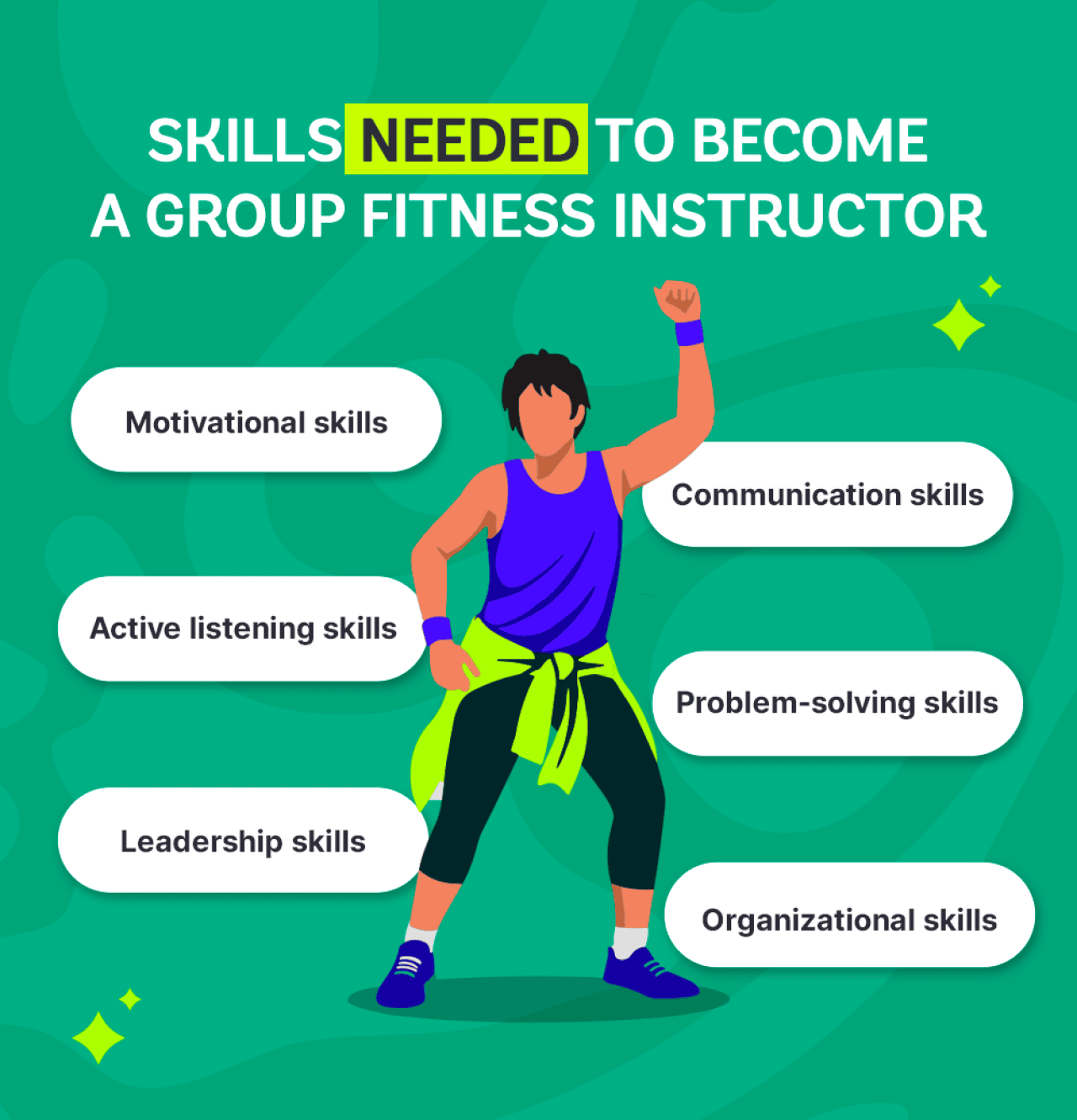
A graphic that lists six skills needed to become a group fitness instructor.

Zumba


Skills Needed to Become a Group Fitness Instructor

Anyone 18 years and older can become a group fitness instructor. However, there are specific skills you’ll need to thrive:

  • Motivational skills: You’ll often find yourself leading groups with different levels of motivation and diverse fitness goals. To successfully help participants in each group, you need exceptional motivational skills to encourage them to stay committed to their goals.
  • Communication skills: Effective communication skills are nonnegotiable for a group fitness instructor. They’re essential for everything from teaching new exercise routines to motivating and encouraging participants to stick to their goals.
  • Active listening skills: To foster an environment where participants feel seen and heard, you need to cultivate active listening skills.
  • Problem-solving skills: A fitness group would typically comprise people with diverse needs, health concerns, and fitness levels. In situations where a group of people doesn’t feel catered to, a group fitness instructor will need to apply problem-solving skills to address the issues.
  • Leadership skills: Leadership is a crucial component of your role as a group fitness instructor. As someone who directs a group to achieve worthwhile goals, you must display leadership skills to ensure everyone feels supported, regardless of their experience level.
  • Organizational skills: This skill helps you stay organized and plan classes and new routines effectively, while managing time efficiently.

Types of Group Fitness Classes You Can Teach as an Instructor

Group fitness classes are not limited to only one type of exercise. In fact, you can tailor any exercise to a group fitness setting. Knowing the types of fitness classes you can explore as an instructor will help you determine the essential skills, techniques, and teaching approaches you need to learn.

Types of group fitness classes you can teach include:

  • Zumba
  • High-intensity interval training
  • Pilates
  • Yoga
  • Indoor cycling
  • Aqua aerobics
  • Strength training
  • Kickboxing
  • Circuit training

Do You Need a Certification to Become a Group Fitness Instructor?

Typically, obtaining a certification isn’t legally required to teach group fitness, but it’s a practical and recommended step. Most gyms and studios require recognized certifications or licenses.

If your goal is to work in a professional capacity and get the attention of top employers hiring group fitness instructors, you should obtain relevant training licenses and/or certifications. Although it’s possible to secure entry-level jobs without certification, it’s a must to enhance career growth and increase employability.

In addition to getting a certification or license, there are other steps you can take to boost your credibility, including:

Get a CPR and AED certification: Many employers will require these certifications to teach group fitness classes. CPR and AED certification teaches you the appropriate responses to situations such as choking and fainting. With these certifications, you can show clients and employers that you can handle dire situations and administer CPR until medical help arrives.

Obtain a specialist group fitness certification or license: There are several areas of group fitness instruction that you can specialize in. Obtaining specialized certifications in these areas is one way to set yourself apart from your competition.

How Long Does It Take To Become A Certified Group Fitness Instructor?

The time needed to complete your certification training will vary depending on the training format you choose. It will also depend on whether you take the training in-person, via livestream or on-demand.

What Do You Need to Be a Group Fitness Instructor?

The journey to becoming a group fitness instructor begins with intentional steps, geared toward gaining the proper knowledge and skill set required to succeed. Here are some steps you can take to pursue a career as a group fitness instructor.

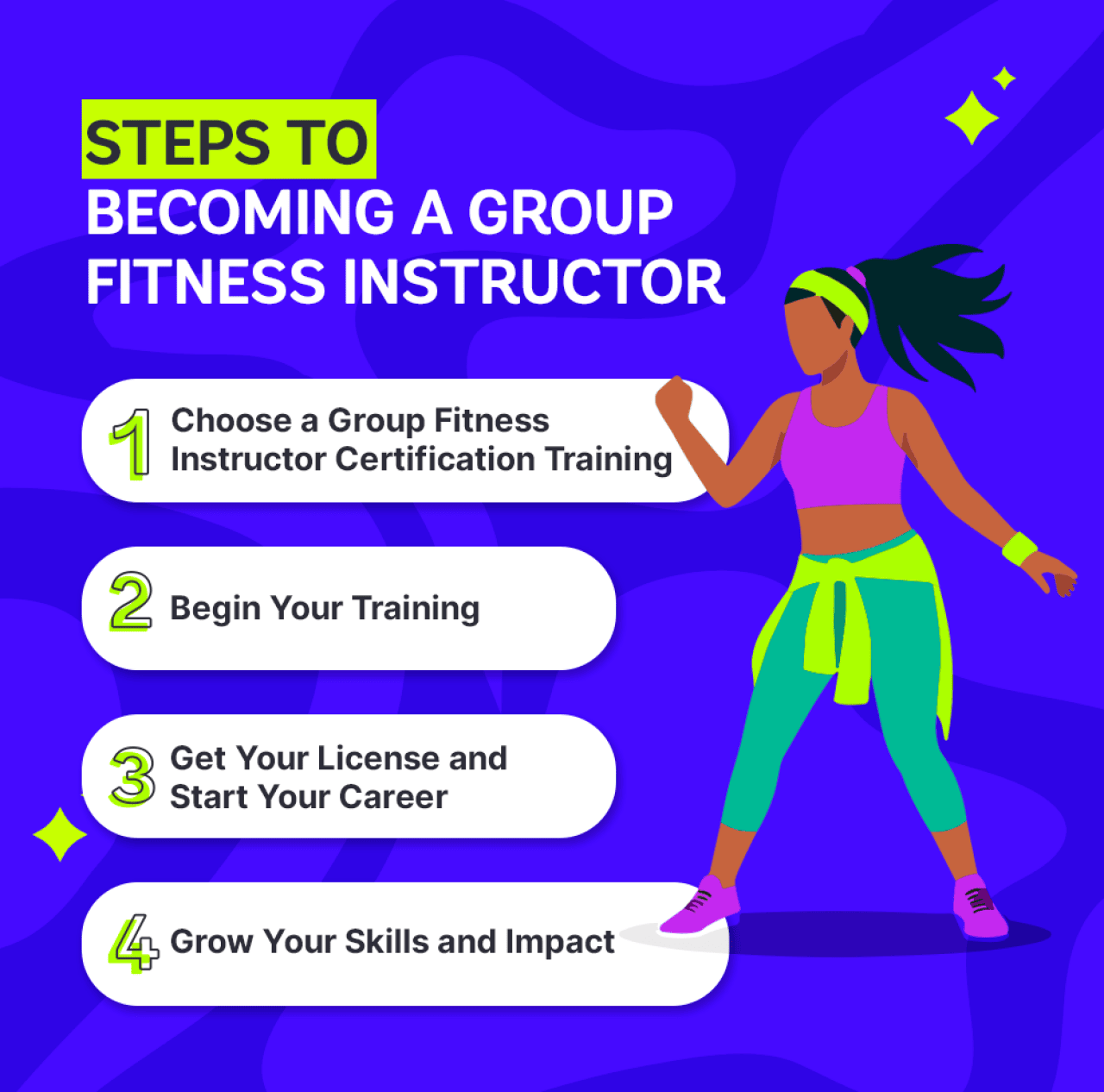
A graphic showing four steps to becoming a group fitness instructor.

Zumba


1. Choose A Group Fitness Instructor Certification Training

First, you need to get certified to be a group fitness instructor. While several group fitness instructor certification trainings are available, not all of them hold the same value. A crucial parameter to consider when selecting a certification study training is accreditation from reputable bodies, such as the National Commission for Certifying Agencies (NCCA).

Certification from accredited bodies confirms compliance with industry qualification benchmarks, earning you an added level of credibility in the fitness industry.

Some other essential factors to consider include:

  • Study format and flexibility: The best group fitness instructor certification trainings offer a variety of study formats to cater to diverse learning needs. Trainings that provide both online and on-site study formats are preferable, as they offer greater flexibility.
  • Ongoing support: Completing a certification training is only the first step in becoming a group fitness instructor. You’ll need all the support you can get as you navigate through specializing in a niche, building credibility, and growing in your career. Choose trainings that offer ongoing support as you launch into the world of group fitness instruction.
  • Extensive curriculum: Look for certification trainings with extensive curricula covering vital areas such as health and safety, anatomy and physiology, customer service, and management, among others.
  • Hands-on learning experience: While learning the theoretical principles of group fitness instruction is beneficial, hands-on learning with a focus on practical skills and application is more valuable.
  • Mentorship: Opt for a group fitness instructor certification training that offers some form of mentorship to enhance your real-world application of knowledge and skills learned.

2. Begin Your Training

After choosing a group fitness instructor certification with proper accreditation and valuable features, the next step is to begin your training. Depending on your preference, you can opt for livestream, on-demand, or in-person training.

During a group fitness instructor certification training, you can expect to gain foundational knowledge about the potential of the human body, leadership and presentation skills, and teaching techniques, among other essential information. Here are some tips to make the most of your training:

  • Pay close attention and take notes during training sessions.
  • Ask questions where possible.
  • Take advantage of the ongoing support and resources available to you.

3. Get Your License And Start Your Career

Upon completion of your training, you’ll receive a license certifying that you have completed an accredited training program and have the necessary skills required to instruct a group fitness class. From this point, you can launch an exciting new career as a group fitness instructor. Some of the many places you can find teaching opportunities include gyms and health clubs, dance studios, community centers, schools, and corporate settings.

As a group fitness instructor, you can operate under two different types of working arrangements:

Contractual arrangements: Under a contractual arrangement, you’ll be required to work part-time or full-time for a defined number of hours. This arrangement is recommended especially for newly qualified group fitness instructors without a client base. Providing your services on a contractual basis in establishments like a local gym allows you to earn a fixed income while gaining experience and building your network.

Self-employment and freelancing: You can explore the world of self-employment and freelancing as a fitness instructor. This option gives you control over your working hours, enabling you to increase your earning potential.

4. Grow Your Skills And Impact

Group fitness instruction is constantly evolving with new teaching methods, choreography, and techniques. Consequently, you should consistently take steps to update and improve your knowledge. Most group fitness instructor certifications are valid for a specified period, after which a renewal becomes necessary.

For continued skill growth and development, consider adopting the following best practices:

  • Invest in continued education and specialty training.
  • Read industry publications to stay up to date with emerging trends.
  • Attend fitness conventions to gain invaluable insights from leading experts in the industry.
  • Participate in fitness classes led by seasoned group fitness instructors to gain inspiration and learn teaching techniques and motivational skills.

Factors That Influence Your Earning Potential as a Group Fitness Instructor

Several factors influence your earning potential as a group fitness instructor, including:

  • Location: Different locations have varying payment structures for group fitness instructors. Factors such as cost and standard of living can influence payment structures for each location. For instance, due to the high cost of living in New York, a group fitness instructor there is more likely to earn a higher salary than a group fitness instructor in West Virginia.
  • Years of experience: As someone just starting in the fitness industry, you may earn less than more experienced instructors.
  • Working arrangements: Depending on your working arrangement, whether contractual or self-employed, factors such as working hours and the number of classes you teach can influence your earning potential.

Is Becoming a Group Fitness Instructor the Right Move for You?

A career as a group fitness instructor can be gratifying, offering numerous personal and professional benefits. If you’re a fitness enthusiast with a passion for exercising and helping others do the same, becoming a group fitness instructor may be the right move for you. Beyond doing what you love, this career path also allows you to explore new opportunities and streams of income.

This story was produced by Zumba and reviewed and distributed by Stacker.
Topics:

Careers & Education
Careers & Education

Is interest in a 4-year college degree drying up? Not really.

Is interest in a 4-year college degree drying up? Not really.
By Matt Barnum for Chalkbeat
5 min read • Originally published January 9, 2026 / Updated March 13, 2026
By Matt Barnum for Chalkbeat
5 min read • Originally published January 9, 2026 / Updated March 13, 2026

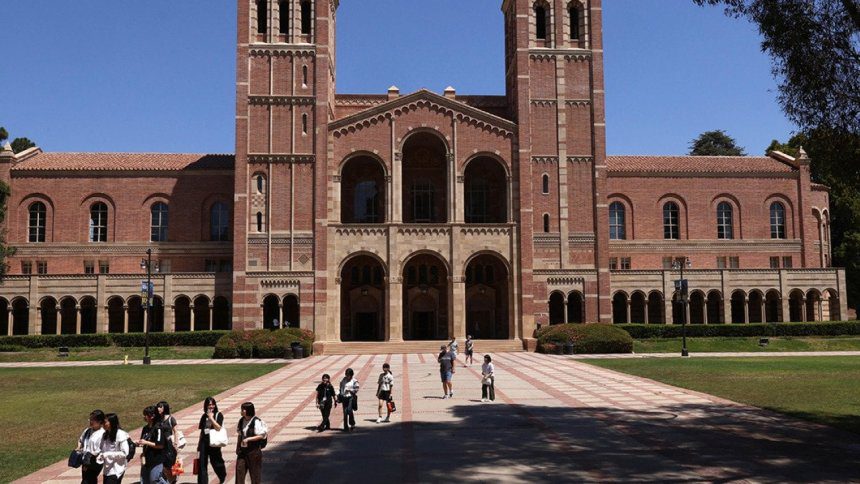
Students walking through Dickson Plaza by the Royce Hall on the UCLA campus in Westwood, California.

Genaro Molina // Los Angeles Times via Getty Images

Is interest in a 4-year college degree drying up? Not really.

American colleges are under siege.

The Trump administration has waged a legal and rhetorical battle against the country’s elite universities. Voters have grown increasingly skeptical of higher education. Some high school students are questioning the value of a college diploma. In turn, there’s been a veritable firehose of news stories about a generational pivot away from college due to some combination of ruinous costs, close-minded campus cultures, and appealing alternatives.

It is a disorienting experience, then, to examine the cold, hard data of higher education.

College tuition has become more affordable in recent years. The economic return on a bachelor’s degree has stopped growing but remains near historic highs. After a post-pandemic dip, four-year college enrollment has almost fully recovered to near-record levels. Students are increasingly flocking to flagship public universities like UCLA and the University of Michigan.

Whatever the problems of higher education, the narrative has raced far ahead of the reality.

Much of this mistaken story stems from a simple confusion: conflating enrollment in two-year and four-year colleges. While it’s true that fewer people are in community colleges, the number of students seeking bachelor’s degrees hasn’t changed much. “It’s been roughly flat for the last 10 years,” says Joshua Goodman, an education economist at Boston University. “That’s very much not the narrative.”

Chalkbeat unpacks the disconnect between the data and the vibes.

The costs vs. benefits of college

It is often treated as a well-established fact that the price of college is soaring. That is no longer the case. For the last couple of decades, net tuition has, if anything, trended down at private and in-state public universities, according to data compiled by the College Board. Since household earnings have gone up during this period, college tuition appears to have become somewhat more affordable in recent years, not less.

“When I talk to members of the public this has not penetrated at all,” says Dominique Baker, a higher education professor at the University of Delaware.

The reality has been underappreciated because colleges’ sticker prices have been rising at an almost linear rate. But list price has become increasingly disconnected from the real price thanks to growing financial aid.

A data graph showing net tuition and fees over time at four-year colleges.

Thomas Wilburn // Chalkbeat

What about the economic benefits of a four-year college education?

On average, those with a bachelor’s degree still earn far more than those without. The “college-wage premium,” as economists call it, stands at about 75%. This figure has stagnated since the early 2000s, but it remains at or near its highest point in a century.

You may have seen headlines about careers that don’t require a degree but that come with lucrative salaries. Such examples certainly exist, but they are exceptions to the average. The Bureau of Labor Statistics projects that the non-degreed occupations with the most new positions all earn under $40,000 annually. Those include home health aides, order stockers, and fast-food workers.

This does not mean that every student who attends college will see a return. The wage premium is a simple correlation and refers to those with a degree, which about one-third of college enrollees do not obtain. The decision for any individual student about whether to go to college depends on their chances of completion, the careers they’re interested in, and the cost.

Still, rigorous studies have repeatedly found that, on average, students benefit economically from seeking a four-year degree.

“There’s not a case to be made that it’s a worse deal now than it was 10 or 15 years ago,” says Jeff Denning, a higher education researcher at the University of Texas at Austin. “I’m not aware of any data that would suggest that.”

Four-year college enrollment has held steady, though two-year enrollment has fallen dramatically

For the last few decades, a little more than 40% of recent high school graduates have enrolled in a four-year college. These numbers have been fairly stable, even as high school graduation rates have risen.

A data graph showing college enrollment rates over time (from 1975 to 2020).

Thomas Wilburn // Chalkbeat

Other data shows a dip in four-year enrollment in the wake of the pandemic, followed by a bounce-back in recent years. The number of people pursuing bachelor’s degrees is now just 1% below pre-pandemic levels, according to a recent estimate.

While flagship state universities have generally seen enrollments rise, colleges with worse student outcomes, like the University of Phoenix, an online for-profit college, have seen drops, notes Preston Cooper in a report for the American Enterprise Institute.

The biggest decline in college enrollment has been at two-year schools, which are largely open-enrollment public institutions that most students attend part-time. Until a recent upturn, attendance at these schools has been falling consistently since 2010.

Here’s where the conventional narrative about the college decline falls apart: Community colleges’ costs are very low and they have not been at the center of the cultural and political backlash to higher education. The prevailing narrative has focused on bachelor’s degrees, which community colleges typically don’t issue.

What explains the two-year college decline, then? A new study coauthored by Goodman of Boston University shows that much of this is driven by economic trends. When job options are plentiful, community college is less appealing. Recently, as unemployment has ticked up, so has two-year enrollment. Another explanation is that more potential students have become wary of the value of two-year programs since the completion rates are quite low.

Reality may soon mirror perception

We may one day look back at this particular moment as a golden age of four-year colleges, even though it doesn’t feel like one.

There are signs that real tuition is going up as schools face new cost pressures. The perception of higher education has in fact declined markedly, which could eventually limit public funding and depress enrollment. (Or perhaps not: Enrollment has been rising over the last couple years at the height of the college collapse narrative.)

Another imminent challenge: At least for a while, each year’s high school graduating class is likely to be smaller than the last due to lower birth rates. Generative AI is an additional curveball, as some suspect it will devalue white-collar work and, in turn, a college education.

The irony is that the colleges likely to bear the brunt of these challenges are the country’s less-selective, less-known schools, not the elite institutions that have come to embody higher education in the public mind.

This story was produced by Chalkbeat and reviewed and distributed by Stacker.

Topics:

Careers & Education
Careers & Education

Are trade skills now more valuable than a college degree?

Are trade skills now more valuable than a college degree?
By Daniel Donovan for Skillit
6 min read • Originally published January 12, 2026 / Updated March 13, 2026
By Daniel Donovan for Skillit
6 min read • Originally published January 12, 2026 / Updated March 13, 2026

Technical College students climb 35 foottall wooden poles with a harness and spikes on their boots to train aloft with rigging to complete the 16 week course and earn a climbing certificate before moving into a apprentice position for the electric utility field.

Al Seib // Los Angeles Times via Getty Images

Are trade skills now more valuable than a college degree?

Going to college used to be a defining milestone in the classic American Dream. But as costs rise and returns on investment shrink, many young people are rethinking what “success” looks like and redefining the traditional path altogether.

A new study by Skillit finds that a growing majority of Americans now view trade skills as more valuable than a college diploma for landing a high-paying, stable job. This shift is driven by mounting frustration over tuition costs, student debt, and the threat of AI in the white-collar workforce.

The data paints a clear picture. Americans are turning to the trades not out of nostalgia but out of necessity, seeking stability, affordability, and a tangible path to prosperity.

Key findings:

  • 60% of Americans say trade skills are more valuable than a college degree in securing a well-paying job.
  • 39% believe a trade or vocational skill offers greater long-term career stability than a college degree.
  • 75% agree that the cost of a college degree outweighs its benefits in 2025.
  • 68% say trade or vocational skills deliver a faster return on investment.
  • 88% believe student loan debt makes trade skills more appealing.
  • 54% of Gen Zers believe construction will be the industry that most values trade skills in the coming years.
  • 45% are very or extremely concerned that AI will replace college-educated workers in the next decade.

The New American Dream: 60% Believe Trade Skills Outweigh a College Degree

Infographic showing that 60% of Americans say trade skills are more valuable than a college degree for securing a well-paying job.

Skillit

Public perceptions of higher education are changing fast. Rising tuition, record debt, and a shortage of skilled labor have flipped the old hierarchy of “college first, trades later.”

The survey found that 60% of Americans now see trade skills as more valuable than a college diploma for securing a well-paying job.

For many, it comes down to economics. Paying more than $100,000 for a degree that does not guarantee employment feels increasingly irrational. Trade certifications, in contrast, are faster, more affordable, and directly linked to income. During economic downturns, trade work often proves more stable than traditional office jobs.

From Layoffs to Longevity: Americans View Trades as the Path to Stability

Many Americans are no longer just chasing higher salaries. They are looking for careers that last. Widespread layoffs in tech, finance, and media have shattered the illusion of white-collar security.

Nearly four in ten (39%) Americans now believe a trade or vocational skill offers greater long-term career stability than a college degree.

That shift reflects a growing awareness that trade jobs are recession-resistant and harder to outsource or automate. In 2023 alone, roughly 200,000 tech workers lost their jobs, a stark contrast to the chronic worker shortages in plumbing, electrical, and construction trades.

The Tipping Point: Is Higher Education Pricing Itself Out of Value?

Infographic showing that 75% of Americans agree that the cost of a college degree now outweighs its benefits.

Skillit

Higher education faces a credibility crisis. Tuition keeps climbing while wages remain stagnant, and the student debt debate has polarized the nation. Many now feel that a four-year degree no longer delivers a return worth the price tag.

According to the Education Data Initiative, tuition and fees now average $18,981 for the 2025–26 academic year. Meanwhile, 75% of Americans in this survey say the cost of college outweighs its benefits, a striking consensus that signals a cultural tipping point.

The rising cost of higher education has turned what was once a rite of passage into a financial risk. More Americans are choosing shorter, cost-effective paths that lead to stability and prosperity sooner.

Skip the Debt, Start the Paycheck: Americans Recalculate Education ROI

Americans are not just comparing salaries. They are calculating the time to payoff. The traditional degree path often delays earning potential by four to six years, making it feel like a long, expensive gamble.

The survey found that 68% of Americans believe trade or vocational skills lead to a faster return on investment than a four-year degree.

That math checks out. Most trade programs take less than two years to complete and cost a fraction of university tuition. Graduates enter the workforce sooner, earn earlier, and carry little or no student debt, giving them a financial head start in today’s fast-moving economy.

Debt-Free Dreams: Student Loans Drive Americans Toward the Trades

Infographic showing that 88% of Americans say that student loan crisis makes trade skills more appealing.

Skillit

Perhaps the most powerful force behind this shift is the student loan crisis. With total U.S. student debt now exceeding $1.7 trillion, Americans are increasingly skeptical of higher education’s promise.

An overwhelming 88% of Americans in this study say the student loan crisis makes trade skills a more appealing option in 2025.

For many, the math is simple: Four years and six figures of debt versus one year and immediate income. The trade path offers financial freedom, a debt-free route into the middle class that can feel both practical and empowering.

Gen Z Sees Gold in Hard Hats: Young Americans Bet on Construction’s Future

Infographic showing that 54% of Gen Zers believe construction will be the industry that most values trade skills in the coming years.

Skillit

For Gen Z, the appeal of skilled trades is both economic and cultural. Many have grown up watching economic instability and value transparency over prestige.

Construction, in particular, stands out. The industry faces one of the largest labor shortages in decades, with the average worker now in their mid-40s and retirements accelerating. At the same time, federal investment in infrastructure, housing, and clean energy is fueling a boom in demand for skilled labor.

The survey found that 54% of Gen Zers believe construction will be the industry that most values trade skills in the coming years.

This generation does not see construction as “old-school.” They see innovation through drones, 3D modeling, modular design, and sustainable building practices. To them, building is not just a job; it is a way to shape the future.

The Automation Anxiety: Is AI Coming for White-Collar Jobs?

Infographic showing that 45% of Americans are very to extremely concerned about AI replacing college-educated workers in the next decade.

Skillit

AI has upended assumptions about which jobs are safe. For the first time, it is white-collar workers, not blue-collar ones, who are worried about being replaced.

This survey found that 45% of Americans are very or extremely concerned that AI will replace college-educated workers in the next decade.

This fear is not unfounded. A Goldman Sachs analysis estimates that AI could affect up to one-quarter of U.S. jobs, largely in degree-dependent fields once considered secure.

Trade work remains grounded in human skill, physical precision, on-site problem-solving, and trust. These roles are difficult to automate. As AI enters traditional “safe” careers, Americans are rethinking which professions are truly future-proof.

The Revival of Skilled Work

What this research reveals is not the decline of higher education, but the reemergence of skilled labor as an equally valid and valued path to success.

This shift represents a broader cultural correction, a renewed appreciation for the people who build the American Dream rather than simply manage it.

The trades are reclaiming their place at the center of economic stability and social value, not as an alternative, but as a cornerstone.

In 2025, many believe that success is not defined by a diploma on the wall, but by the skill in your hands, the pride in your craft, and the freedom to build a life on your own terms.

Methodology

The findings presented in this report are based on a comprehensive survey conducted by the Skillit team. Skillit surveyed 1,000 Americans in October 2025 to gather insights into their perceptions of higher education versus skilled trades.

The survey was administered online using a third-party polling platform, ensuring a diverse sample of participants from various demographic backgrounds, including age, geographic location, and income level across the United States.

All responses were collected anonymously and aggregated for analysis. The data was then processed to calculate the percentages that form the basis of the key findings discussed throughout this article.

This story was produced by Skillit and reviewed and distributed by Stacker.

Topics:

Careers & Education
Careers & Education

AI tutors, with a little human help, offer “reliable” instruction, study finds

AI tutors, with a little human help, offer “reliable” instruction, study finds
By Greg Toppo for The 74
6 min read • Originally published January 16, 2026 / Updated March 13, 2026
By Greg Toppo for The 74
6 min read • Originally published January 16, 2026 / Updated March 13, 2026

Concept of AI-powered tutoring illustrated with a person dressed professionally that looks like a teacher whispering from behind toward a robot's head.

Eamonn Fitzmaurice // The74; Getty Images

AI tutors, with a little human help, offer ‘reliable’ instruction, study finds

An AI-powered tutor, paired with a human helper and individual-level data on a student’s proficiency, can outperform a human alone, with near-flawless results, a new study suggests.

The results could open a new front in the evolving discussion over how to use AI in schools — and how closely humans must watch it when it’s interacting with kids, The 74 reports.

In a randomized controlled trial involving 165 British secondary school students, ages 13-15, the ed-tech startup Eedi.com put a small group of expert human tutors in charge of a large language model, or LLM, offered by Google’s LearnLM. As it tutored students on math problems via Eedi’s platform, it drafted replies when students needed help. Before the messages went out, the human tutors got a chance to revise each one to the point where they’d feel comfortable sending it themselves.

Students didn’t know whether they were talking to a human or a chatbot, but they had longer conversations, on average, with the “supervised” AI/human combination than simply with a human tutor, said Bibi Groot, Eedi’s chief impact officer.

In the end, students using the supervised AI tutor performed slightly better than those who chatted online via text with human tutors — they were able to solve new kinds of problems on subsequent topics successfully 66.2% of the time, compared to 60.7% with human tutors.

The AI, researchers concluded, was “a reliable source” of instruction. Human tutors approved about three out of four drafted messages with few to no edits.

A sample exchange between a student and an AI tutor, with replies edited by a human before they were sent out.

Eedi Labs

Students who got both human and AI tutoring were able to correct misconceptions and offer correct answers over 90% of the time, compared to just 65% of the time when they got a “static, pre-written” response to their questions.

And the AI only “hallucinated,” or offered factual errors, 0.1% of the time — in 3,617 messages, that amounted to just five hallucinations. It didn’t produce any messages that gave the tutors pause over safety.

The results suggest that “pedagogically fine-tuned” AI could play a role in delivering effective, individualized tutoring at scale, researchers said. Interestingly, students who received support from the AI were more likely to solve new kinds of problems on subsequent topics.

The key to the AI’s success, said Groot, was that researchers gave it access to detailed, “extremely personalized” information about what topics students had covered over the previous 20 weeks. That included the topics they’d struggled with and those they’d mastered.

“We know what topics they’re covering in the next 20 weeks — we know the curriculum. We know the other students in the classroom. We know whether they’re putting effort into their questions. We know whether they’re watching videos or not — we know so much about the student without passing any personally identifiable information to the AI.”

That guided the AI’s strategy about whether students needed an extra push or just more support — something an “out-of-the-box, vanilla LLM” can’t do, she said.

“They don’t know anything about what the teacher is teaching in the classroom,” Groot said. “They don’t know what misconceptions or what topics the students are struggling with and what they’ve already mastered, so they’re not able to dynamically change how they address the topic, as a human tutor would.”

Human tutors, she said, generally have “a really good sense of where the student struggles, because they have some sort of ongoing relation with a student most of the time. An LLM tutor generally doesn’t.”

All the same, even master tutors typically don’t go into a session knowing a student’s comprehensive history in a course, including their misconceptions about the material. “All of that is too much information for a human tutor to read up on and deal with while they’re having one conversation” with a student, Groot said.

And they’re under pressure to respond quickly, “so that the student is not left waiting. And that’s quite an intensive experience for tutors that leads to a bit of cognitive overload,” she said. The AI doesn’t suffer from that. It needs less than a millisecond to read all of those contexts and come up with that first question.”

Even with their personal connection to students, human tutors can’t be available 24/7. Groot said Eedi employs about 25 tutors across several time zones who are available to students from 9 a.m. to 10 p.m. every day, but to give students broader access would require hiring “an army of tutors,” she said.

The new findings could encourage schools to use AI as a kind of “front line” tutor, with humans intervening when a student is “derailing the conversation, or they have such a persistent misconception that the AI can’t deal with it,” said Groot. “We think that would be an interesting way to collaborate between the AI and the human, because there is still a really important role for a human tutor. But our human tutors just cannot have conversations with thousands of students at once.”

The new study, published on Nov. 25 on Eedi’s site and scheduled to appear in a peer-reviewed journal next year, differed in one important way from recent studies that looked at AI tutoring. Researchers at Stanford University in October 2024 examined AI-assisted human tutoring, in which tutors primarily drove the conversation. But in that case, the AI acted as a kind of assistant, providing suggestions behind the scenes. In the Eedi study, it was the other way around, with AI driving the conversation and humans overseeing it.

Robin Lake, director of the Center on Reinventing Public Education at Arizona State University, said the study is important in and of itself, but also in the context of broader findings elsewhere suggesting that, with proper training and guidance, “AI can be an incredibly powerful tool — and certainly has a potential to take tutoring to scale in ways that we’ve never seen before.”

Under controlled circumstances, she said, it’s also “outperforming humans — that’s really important.”

Lake noted a June study from Harvard researchers that examined results from 194 undergraduates in a large physics class. They presented identical material in class and via an AI tutor and found that students learned “significantly more in less time” using the tutor. They also felt more engaged and motivated about the material.

Liz Cohen, vice president of policy for 50CAN and author of the recent book “The Future of Tutoring: Lessons from 10,000 School District Tutoring Initiatives,” said the study provides “valuable evidence” about new kinds of tutoring.

But one of its limitations, she said, is that it relied on 13-to-15-year-olds. “So immediately I have a lot of questions about if the findings are applicable for younger students, especially using a chat-based model,” which may not be a good one for such students.

She also noted that there are many questions around student persistence with AI tutors, including what happens when students get frustrated or aren’t sufficiently engaged in the work?

“I still mostly think that entirely AI tutoring programs are biased towards students who want to do the work or are interested in learning,” Cohen said, “and it’s pretty easy to see that students who aren’t bought in or are frustrated are going to give up more readily with an AI tutor.”

She noted that her 12-year-old daughter has experienced problems persisting in an AI-powered math tutoring program. “She gets frustrated if she can’t get the answer and then she doesn’t want to do it anymore, so I think we need to figure out that piece of it.”

This story was produced by The 74 and reviewed and distributed by Stacker.

Topics:

Careers & Education

Posts navigation

Older posts
Newer posts
Featured Jobs
Kirkus Media
Editorial Intern
Kirkus Media
New York City, New York (US)

Gaia Inc
MEDIA COORDINATOR
Gaia Inc
Louisville, CO

Gaia Inc
Global Paid Media Specialist
Gaia Inc
Louisville, CO

Gaia Inc
Director of Media Strategy
Gaia Inc
Louisville, CO

Hearst Television
Account Executive
Hearst Television
Milwaukee, WI, United States

All Jobs »
PREMIUM MEMBER

Elaine Pofeldt

Westfield area, NJ
23 Years Experience
After eight years at FORTUNE Small Business magazine, most recently as a senior editor, I went freelance in late 2007. At FSB, I was twice nominated...
View Full Profile »
Join Mediabistro Membership Today

Stand out from the crowd with a premium profile

Mediabistro Logo Find your next media job or showcase your creative talent
  • Job Search
  • Hot Jobs
  • Membership
  • Newsletter
  • Career Advice
  • Media News
  • Hiring Tips
  • Creative Tools
  • About
Facebook YouTube Instagram LinkedIn
Copyright © 2026 Mediabistro
  • Terms of Use
  • Terms of Service
  • Privacy