
Mediabistro Logo Mediabistro Logo
  • Jobs
    Search Creative Jobs Hot Jobs Remote Media Jobs Create Job Alerts
    Job Categories
    Creative & Design Marketing & Communications Operations & Strategy Production Sales & Business Development Writing & Editing
    Quick Links
    Search All Jobs Remote Jobs Create Job Alerts
  • Career Resources
    Career Advice & Articles Media Industry News Media Career Interviews Creative Tools Resume Writing Services Interview Coaching Job Market Insights Member Profiles
  • Mediabistro Membership
    Membership Overview How to Pitch (Premium Tool) Editorial Calendars (Premium Access) Courses & Training Programs Membership FAQ
  • Log In
Post Jobs
Mediabistro Logo Mediabistro Logo
Search Creative Jobs Hot Jobs Remote Media Jobs Create Job Alerts
Job Categories
Creative & Design Marketing & Communications Operations & Strategy Production Sales & Business Development Writing & Editing
Quick Links
Search All Jobs Remote Jobs Create Job Alerts
Career Advice & Articles Media Industry News Media Career Interviews Creative Tools Resume Writing Services Interview Coaching Job Market Insights Member Profiles
Membership Overview How to Pitch (Premium Tool) Editorial Calendars (Premium Access) Courses & Training Programs Membership FAQ
Log In
Post Jobs
Log In | Sign Up

Follow Us!

Interviews

How Complex’s SVP of Brand Partnerships Turned Cultural Moments Into Commerce

Kirsten Atkinson spent 15 years buying media the traditional way. Here's what she learned when she switched sides.

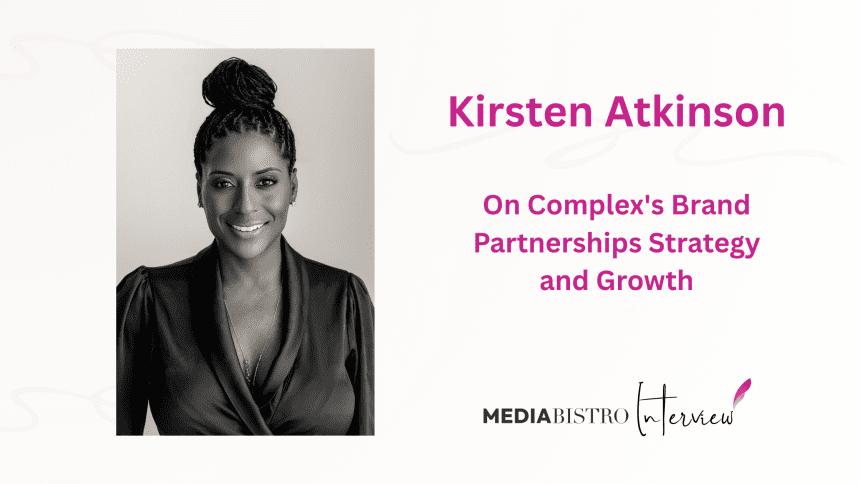
Kirsten Atkinson
Miles icon
By Miles Jennings
@milesworks
Miles Jennings is CEO of Mediabistro and its parent CognoGroup. He previously founded and led Recruiter.com through its NASDAQ listing, executing more than 10 acquisitions over nearly a decade as CEO and COO.
6 min read • Originally published April 28, 2026 / Updated April 30, 2026
Miles icon
By Miles Jennings
@milesworks
Miles Jennings is CEO of Mediabistro and its parent CognoGroup. He previously founded and led Recruiter.com through its NASDAQ listing, executing more than 10 acquisitions over nearly a decade as CEO and COO.
6 min read • Originally published April 28, 2026 / Updated April 30, 2026

Kirsten Atkinson has spent more than 25 years in media, advertising, and marketing, but her title at Complex barely hints at the scope of what that job actually involves. As SVP of Brand Partnerships and Sales, she oversees the West Coast sales strategy for a platform that isn’t quite a publisher, isn’t quite a retailer, and isn’t quite an event company. It’s all three, and knowing how to sell that to brands is its own discipline.

Her path to this role took her through Starcom, Mindshare, OMD, nearly a decade at Team One running Lexus media, a groundbreaking Lexus x Marvel Studios campaign for Black Panther, and eventually into sales at NBCUniversal and BuzzFeed before landing at Complex in 2021.

Along the way, she co-founded the ThinkLA DIG Diversity Summit, the first advertising conference of its kind in Los Angeles, and earned recognition from Ad Age, Black Enterprise, and Adweek. This year, she received the Clark Atlanta University Spirit of Greatness Award from the HBCU where she earned her degree in Mass Media Arts.

Mediabistro spoke with her about what it actually looks like to sell a ComplexCon partnership, how to measure success in a commerce-driven collab, and what media professionals need to know if they want to make the same career pivot she did.

A lot has changed at Complex since 2021, with new ownership and new scale. How has that changed how you work with brand partners?

“When I joined Complex in 2021, the business was owned by BuzzFeed and was still more weighted toward traditional media monetization, digital advertising and branded content made up a larger portion of the mix, while commerce and experiential were meaningful but not yet operating at today’s scale.

Since then, NTWRK and Universal Music Group acquired Complex and the model has become much more diversified. Today, digital advertising and partnerships remain a core driver, but they sit within a broader ecosystem that includes e-commerce and large-scale experiences like ComplexCon and Family Style.

The simplest way to describe the shift is that we’ve moved from a more traditional publisher model to a more balanced platform built around content, commerce, and experiences, giving brands more ways to show up in culture and more ways for us to deliver measurable value beyond impressions alone.”

ComplexCon drew 70,000 attendees and 400-plus brands. What does a partnership at that scale actually cost, and how does the ROI conversation compare to a traditional media buy?

“The investment really depends on the shape and ambition of the partnership. At that scale, brands aren’t buying a standard media package, but accessing a highly engaged cultural audience across multiple touchpoints at once: live experience, creators, social, content, commerce, and hospitality.

Because of that, the ROI conversation is different from a traditional media buy. Instead of focusing primarily on reach, frequency, or CPM, we look at a broader set of outcomes: brand heat, earned media, social engagement, creator participation, data capture, commerce performance, and whether the brand created a moment people actually talked about.

It’s less about ‘how many impressions did I buy?’ and more about ‘did we create cultural relevance and measurable business results at the same time?'”

That’s a meaningfully different sales conversation than anything her media buying background prepared her for. But it’s one she’s clearly made her own: Complex was named alongside Google, Netflix, Sephora, and the WNBA as one of BizBash’s 10 industry innovators in experiential marketing in 2025.

The Fanatics x Complex x Takashi Murakami x MLB collab reportedly hit 5x MSRP on StockX. How does Complex measure success on a commerce-driven deal like that versus a standard brand integration?

“For a commerce-led collaboration, success starts with demand and performance — sell-through, speed to sell-out, conversion, and overall consumer response. But we also look at what that demand signals culturally: did it generate conversation, did it travel organically, and did it deepen the brand’s relevance with its audience?

A standard brand integration is often measured by awareness and engagement. A commerce-driven deal adds a more tangible layer of proof: consumers choosing to buy.

The most successful partnerships do both. They work as storytelling and as product, and when you see strong aftermarket demand, it’s a signal that the collaboration resonated beyond the campaign itself.”

On Making the Pivot From Media Buying to Brand Partnerships

Atkinson’s first 17 years were spent on the agency side, planning and buying media for automotive brands at Starcom, Mindshare, OMD, and Team One. It’s the kind of foundation that teaches you discipline, process, and how brands make decisions. What it doesn’t necessarily teach you is how to build cultural products from scratch. That part came later.

For anyone thinking about making a similar move, and it’s one of the most asked-about transitions in media right now, her experience is worth paying close attention to.

What skills from your traditional media background transferred directly, and what did you have to learn from scratch?

“A lot transferred directly. Traditional media teaches you how to understand client objectives, build strategic plans, manage complexity, and prove value against outcomes. It also gives you a strong foundation in audience strategy and how brands make decisions.

What I had to build more intentionally was the commerce and partnership side, how products are developed, how drops and retail mechanics work, and how to structure deals that bring together talent, brands, and distribution.

The biggest shift was moving from ‘how do I place media effectively?’ to ‘how do I build something with cultural impact that people actually want to participate in?'”

What does your team look like today?

“My team is intentionally cross-functional, primarily spanning sales, working in lock step with strategy, creative partnerships, and integrated marketing. We have people from traditional media backgrounds alongside those with experience in branded content, digital marketing, event marketing, and influencer management.

That mix is important because the work itself spans far beyond a standard media sale, it often includes content, live experiences, creators, and product-driven thinking all within a single partnership.”

It’s a structure that mirrors what’s happening across the industry more broadly, where the line between a media sale and a creative production has all but disappeared. The roles that are growing are strategists who can hold a conversation about content, events, product drops, and CPMs in the same breath.

On the Realistic Path to Making This Pivot

For someone in a traditional media sales or planning role who wants to make the same kind of transition, what’s the realistic path?

“It’s a series of adjacent moves. Start by getting closer to integrated partnerships, branded content, experiential, or commerce-related work within your current role. Raise your hand for opportunities that require strategic thinking, not just execution.

The people who make the transition most successfully tend to keep their media foundation while expanding their skill set. If you can still speak fluently about planning and measurement, but also understand creators, partnerships, and consumer behavior, you become much more valuable.”

That’s practical advice that echoes what we’ve heard from other media executives who’ve reinvented their roles over long careers.

What was your big break?

“I’ve been fortunate to have leaders throughout my career who trusted me with bigger opportunities before I felt fully ready for them. My ‘big break’ wasn’t a single moment, but a series of chances to step into new challenges and prove I could grow into them. Whether I was executing the first Live, Immersive Fashion Show at NYFW or launching the award-winning Black Panther vehicle partnership, these moments led me to the work I’m doing today.

Like most careers, it’s been a combination of preparation, relationships, and timing coming together over time.”

The Black Panther campaign she’s referring to was the Lexus x Marvel Studios partnership she led at Walton Isaacson, which won for Best Branded Entertainment. It remains one of the most-cited examples of how an automotive brand can show up in culture without feeling like an interruption.


Atkinson’s career shows the importance of staying curious past the point where most people get comfortable. She spent years building expertise in one area, then used it as a foundation to move into something new. The pivot she’s describing is about knowing your business and client demands well enough to take the relationship somewhere the job description didn’t originally include.

If you’re looking for roles in brand partnerships, integrated marketing, or cultural commerce, you can browse current job listings at Mediabistro.

Topics:

Interviews


LA

See how much it costs to attend San Diego Padres games

See how much it costs to attend San Diego Padres games
By Stacker Feed
1 min read • Published April 29, 2026
By Stacker Feed
1 min read • Published April 29, 2026

HE Photography // Shutterstock

See how much it costs to attend San Diego Padres games

Way compiled a look at the affordability of attending San Diego Padres games. Ticket rates were aggregated from official primary ticketing partners and major resale marketplaces based on availability as of March 2025. Estimated game day costs reflect one average ticket, one beer, one hot dog, one soda, and one parking spot. Prices are estimates based on publicly available data and do not include taxes or fees.

While Major League Baseball remains one of the most accessible major sports leagues in the U.S., prices vary significantly by market. Large coastal teams tend to command higher ticket prices, while smaller markets often offer more budget-friendly experiences.

How much it costs to attend San Diego Padres games
– 2026 Stadium: Petco Park
– Ticket prices: $35.00 (National rank: #13 most expensive)
– Concession total: $18.46 (National rank: #15 most expensive)
— Beer (16oz): $5.00
— Hot Dog: $7.96
— Soda: $5.50
– Average parking price: $27.85
– Estimated total cost of attending a game: $81.31

MLB teams with the highest average ticket prices
#1. New York Yankees ($67.75)
#2. Houston Astros ($64.29)
#3. Chicago Cubs ($55.10)
#4. Los Angeles Dodgers ($54.24)
#5. Washington Nationals ($46.02)

MLB teams with the lowest average ticket prices
#1. Miami Marlins ($23.61)
#2. Arizona Diamondbacks ($25.15)
#3. Chicago White Sox ($25.58)
#4. Cincinnati Reds ($25.58)
#5. Pittsburgh Pirates ($26.93)

This story was
produced by
Way
and reviewed and
distributed by Stacker.

Topics:

LA
LA

See how much it costs to attend San Francisco Giants games

See how much it costs to attend San Francisco Giants games
By Stacker Feed
1 min read • Published April 29, 2026
By Stacker Feed
1 min read • Published April 29, 2026

Arina P Habich // Shutterstock

See how much it costs to attend San Francisco Giants games

Way compiled a look at the affordability of attending San Francisco Giants games. Ticket rates were aggregated from official primary ticketing partners and major resale marketplaces based on availability as of March 2025. Estimated game day costs reflect one average ticket, one beer, one hot dog, one soda, and one parking spot. Prices are estimates based on publicly available data and do not include taxes or fees.

While Major League Baseball remains one of the most accessible major sports leagues in the U.S., prices vary significantly by market. Large coastal teams tend to command higher ticket prices, while smaller markets often offer more budget-friendly experiences.

How much it costs to attend San Francisco Giants games
– 2026 Stadium: Oracle Park
– Ticket prices: $37.00 (National rank: #10 most expensive)
– Concession total: $22.46 (National rank: #7 most expensive)
— Beer (16oz): $9.25
— Hot Dog: $7.71
— Soda: $5.50
– Average parking price: $25.80
– Estimated total cost of attending a game: $85.26

MLB teams with the highest average ticket prices
#1. New York Yankees ($67.75)
#2. Houston Astros ($64.29)
#3. Chicago Cubs ($55.10)
#4. Los Angeles Dodgers ($54.24)
#5. Washington Nationals ($46.02)

MLB teams with the lowest average ticket prices
#1. Miami Marlins ($23.61)
#2. Arizona Diamondbacks ($25.15)
#3. Chicago White Sox ($25.58)
#4. Cincinnati Reds ($25.58)
#5. Pittsburgh Pirates ($26.93)

This story was
produced by
Way
and reviewed and
distributed by Stacker.

Topics:

LA
NYC

See how much it costs to attend New York Mets games

See how much it costs to attend New York Mets games
By Stacker Feed
1 min read • Published April 29, 2026
By Stacker Feed
1 min read • Published April 29, 2026

Arina P Habich // Shutterstock

See how much it costs to attend New York Mets games

Way compiled a look at the affordability of attending New York Mets games. Ticket rates were aggregated from official primary ticketing partners and major resale marketplaces based on availability as of March 2025. Estimated game day costs reflect one average ticket, one beer, one hot dog, one soda, and one parking spot. Prices are estimates based on publicly available data and do not include taxes or fees.

While Major League Baseball remains one of the most accessible major sports leagues in the U.S., prices vary significantly by market. Large coastal teams tend to command higher ticket prices, while smaller markets often offer more budget-friendly experiences.

How much it costs to attend New York Mets games
– 2026 Stadium: Citi Field
– Ticket prices: $38.00 (National rank: #9 most expensive)
– Concession total: $21.90 (National rank: #8 most expensive)
— Beer (16oz): $7.71
— Hot Dog: $7.19
— Soda: $7.00
– Average parking price: $26.91
– Estimated total cost of attending a game: $86.81

MLB teams with the highest average ticket prices
#1. New York Yankees ($67.75)
#2. Houston Astros ($64.29)
#3. Chicago Cubs ($55.10)
#4. Los Angeles Dodgers ($54.24)
#5. Washington Nationals ($46.02)

MLB teams with the lowest average ticket prices
#1. Miami Marlins ($23.61)
#2. Arizona Diamondbacks ($25.15)
#3. Chicago White Sox ($25.58)
#4. Cincinnati Reds ($25.58)
#5. Pittsburgh Pirates ($26.93)

This story was
produced by
Way
and reviewed and
distributed by Stacker.

Topics:

NYC
LA

See how much it costs to attend Los Angeles Angels games

See how much it costs to attend Los Angeles Angels games
By Stacker Feed
1 min read • Published April 29, 2026
By Stacker Feed
1 min read • Published April 29, 2026

HE Photography // Shutterstock

See how much it costs to attend Los Angeles Angels games

Way compiled a look at the affordability of attending Los Angeles Angels games. Ticket rates were aggregated from official primary ticketing partners and major resale marketplaces based on availability as of March 2025. Estimated game day costs reflect one average ticket, one beer, one hot dog, one soda, and one parking spot. Prices are estimates based on publicly available data and do not include taxes or fees.

While Major League Baseball remains one of the most accessible major sports leagues in the U.S., prices vary significantly by market. Large coastal teams tend to command higher ticket prices, while smaller markets often offer more budget-friendly experiences.

How much it costs to attend Los Angeles Angels games
– 2026 Stadium: Angel Stadium
– Ticket prices: $28.00 (National rank: #21 most expensive)
– Concession total: $17.62 (National rank: #16 most expensive)
— Beer (16oz): $4.62
— Hot Dog: $8.00
— Soda: $5.00
– Average parking price: $11.50
– Estimated total cost of attending a game: $57.12

MLB teams with the highest average ticket prices
#1. New York Yankees ($67.75)
#2. Houston Astros ($64.29)
#3. Chicago Cubs ($55.10)
#4. Los Angeles Dodgers ($54.24)
#5. Washington Nationals ($46.02)

MLB teams with the lowest average ticket prices
#1. Miami Marlins ($23.61)
#2. Arizona Diamondbacks ($25.15)
#3. Chicago White Sox ($25.58)
#4. Cincinnati Reds ($25.58)
#5. Pittsburgh Pirates ($26.93)

This story was
produced by
Way
and reviewed and
distributed by Stacker.

Topics:

LA
LA

See how much it costs to attend Los Angeles Dodgers games

See how much it costs to attend Los Angeles Dodgers games
By Stacker Feed
1 min read • Published April 29, 2026
By Stacker Feed
1 min read • Published April 29, 2026

HE Photography // Shutterstock

See how much it costs to attend Los Angeles Dodgers games

Way compiled a look at the affordability of attending Los Angeles Dodgers games. Ticket rates were aggregated from official primary ticketing partners and major resale marketplaces based on availability as of March 2025. Estimated game day costs reflect one average ticket, one beer, one hot dog, one soda, and one parking spot. Prices are estimates based on publicly available data and do not include taxes or fees.

While Major League Baseball remains one of the most accessible major sports leagues in the U.S., prices vary significantly by market. Large coastal teams tend to command higher ticket prices, while smaller markets often offer more budget-friendly experiences.

How much it costs to attend Los Angeles Dodgers games
– 2026 Stadium: Dodger Stadium
– Ticket prices: $54.24 (National rank: #4 most expensive)
– Concession total: $30.00 (National rank: #1 most expensive)
— Beer (16oz): $16.00
— Hot Dog: $8.00
— Soda: $6.00
– Average parking price: $10.33
– Estimated total cost of attending a game: $94.57

MLB teams with the highest average ticket prices
#1. New York Yankees ($67.75)
#2. Houston Astros ($64.29)
#3. Chicago Cubs ($55.10)
#4. Los Angeles Dodgers ($54.24)
#5. Washington Nationals ($46.02)

MLB teams with the lowest average ticket prices
#1. Miami Marlins ($23.61)
#2. Arizona Diamondbacks ($25.15)
#3. Chicago White Sox ($25.58)
#4. Cincinnati Reds ($25.58)
#5. Pittsburgh Pirates ($26.93)

This story was
produced by
Way
and reviewed and
distributed by Stacker.

Topics:

LA
NYC

Costs of long-term care and senior living in New York

Costs of long-term care and senior living in New York
By Stacker Feed
6 min read • Published April 29, 2026
By Stacker Feed
6 min read • Published April 29, 2026

pikselstock // Shutterstock

Costs of long-term care and senior living in New York

Understanding the costs of long-term care is an essential part of planning for senior living and in-home care. A Place for Mom provides proprietary cost benchmarks drawn from its nationwide network of partner communities and agencies.

This report includes cost data for senior living — independent living, assisted living, and memory care — as well as home care in New York. Senior living figures reflect actual monthly costs paid by residents who moved into a community during calendar year 2025, including base rent and care fees where applicable. Home care figures are based on hourly starting rates reported by partner agencies and captured in early 2026.

This report primarily uses median values to provide a reliable benchmark that is less influenced by unusually high or low prices. While many families search for the average cost of long-term care, medians better reflect what families typically pay.

Median costs of long-term care and senior living in New York

  • Assisted living: $6,195/mo
  • Memory care: $8,250/mo
  • Independent living: $3,400/mo
  • Home care: $35/hr

Costs are structured differently across care types and settings. Residential senior living options are typically priced as monthly rates that bundle housing with services such as meals, activities, and varying levels of personal care.

Independent living is generally the most affordable type of senior living, since it does not provide hands-on care. Memory care typically costs more due to increased staffing levels, specialized dementia training, and enhanced safety features.

Home care is most often billed hourly, reflecting the flexibility of services delivered in a private residence. Total monthly home care costs depend on the number of hours provided and the intensity of care required, which can make direct comparisons with residential options more complex.

How median costs of long-term care and senior living in New York compare with national medians

Assisted living
National median: $5,419
New York vs national: -12%

Memory care
National median: $6,690
New York vs national: -18%

Independent living
National median: $3,200
New York vs national: -5%

Home care
National median: $34/hr
New York vs national: -2%

Long-term care and senior living costs vary widely by state due to differences in labor costs, real estate markets, regulatory environments, and the balance between supply and demand for senior care services.

States with higher senior living costs often overlap with regions that have above-average housing prices and wages, while lower median costs are more common in parts of the Midwest and South. However, lower costs do not always correspond to greater access, particularly in markets where limited supply constrains availability.

Senior living costs by floor plan type in New York

Apartment size and layout can significantly affect the cost of senior living, though premiums vary by care type and market. Studio apartments are typically the most affordable option, while one- and two-bedroom units command higher monthly rates.

In assisted living, the median starting price of a one-bedroom apartment is often $900 to $1,200 per month higher than a studio, with two-bedroom units carrying substantially larger premiums. Independent living generally shows smaller differences between floor plans, while memory care pricing varies more widely due to specialized staffing requirements and secure design considerations.

Larger floor plans are not available in every market, particularly in memory care settings. As a result, both availability and pricing should be considered when comparing senior living options across states.

The following tables show median monthly starting prices for the most common floor plans in New York senior living communities. Starting prices are reported by communities in A Place for Mom’s partner network and generally reflect base rent, excluding additional fees for care services, pets, or other optional charges. Floor plan pricing reflects starting rates captured in early 2026. You can see how much care costs across the country here.

Assisted living costs by floor plan in New York
– Studio: $5,866/mo
– 1-bedroom: $7,067/mo
– 2-bedroom: $8,375/mo

Independent living costs by floor plan in New York
– Studio: $3,919/mo
– 1-bedroom: $4,368/mo
– 2-bedroom: $5,090/mo

Memory care costs by floor plan in New York
– Studio: $9,330/mo
– 1-bedroom: $11,430/mo
– 2-bedroom: $7,508/mo

Senior living and long-term care costs over time

A Place for Mom’s proprietary data shows that senior living costs increased from 2024 to 2025 across the country, extending a multiyear upward trend across major care types. National median costs rose across independent living, assisted living, and memory care. Senior living national median cost comparisons reflect calendar year 2024 and 2025 data.

Home care national median hourly rates, captured in early 2026, also reflect continued upward pricing pressure.

While year-over-year increases vary by care type and market, the overall direction of pricing remains upward.

A Place for Mom

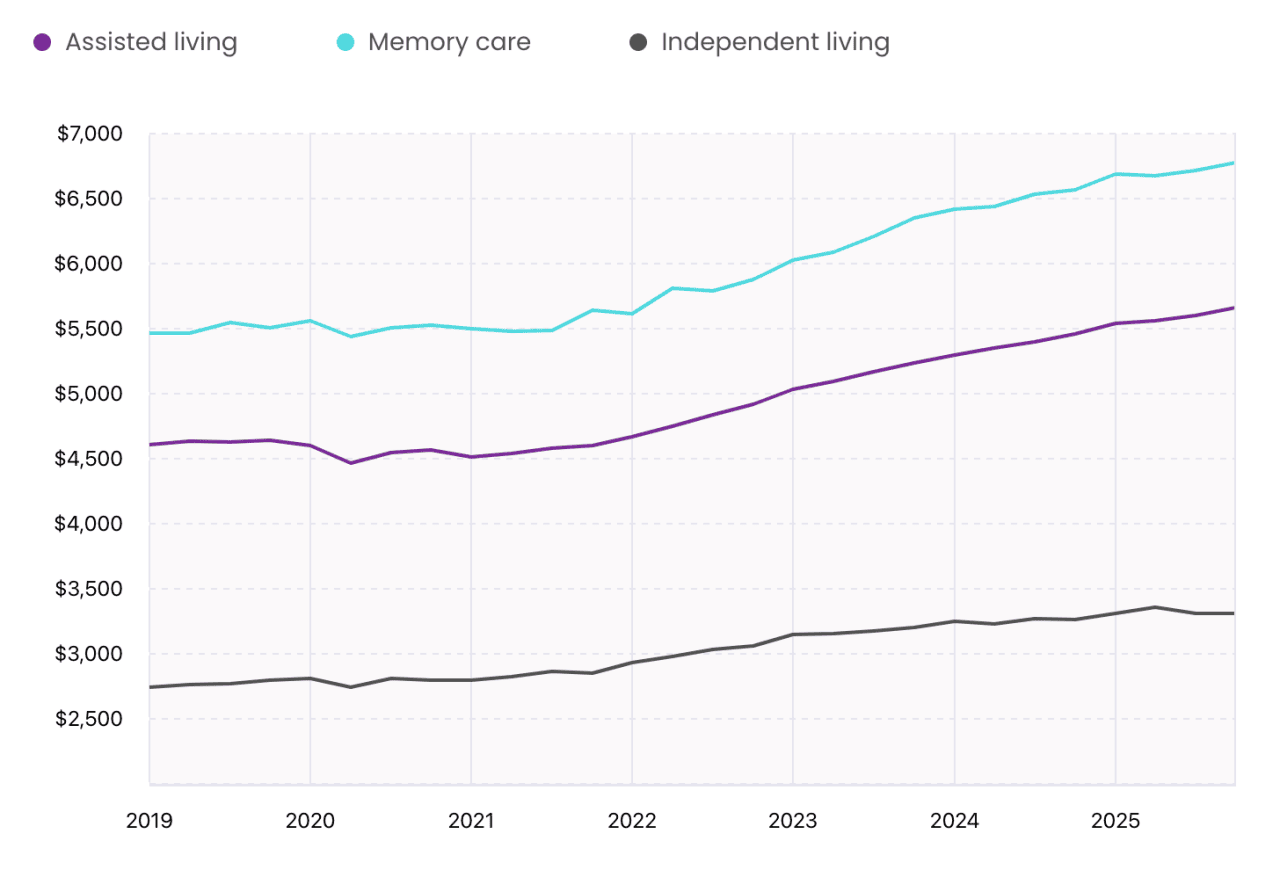
Average senior living costs, 2019-2025

The line graph shows how the national monthly costs for assisted living, memory care, and independent living have changed since 2019. Unlike most of the data in this report, this graph reflects quarterly average costs paid after residents moved in. In this context, averages are used to better illustrate pricing trends over time, as they more clearly capture the impact of rising costs, post-pandemic occupancy demand, and limited new construction in some markets.

A Place for Mom

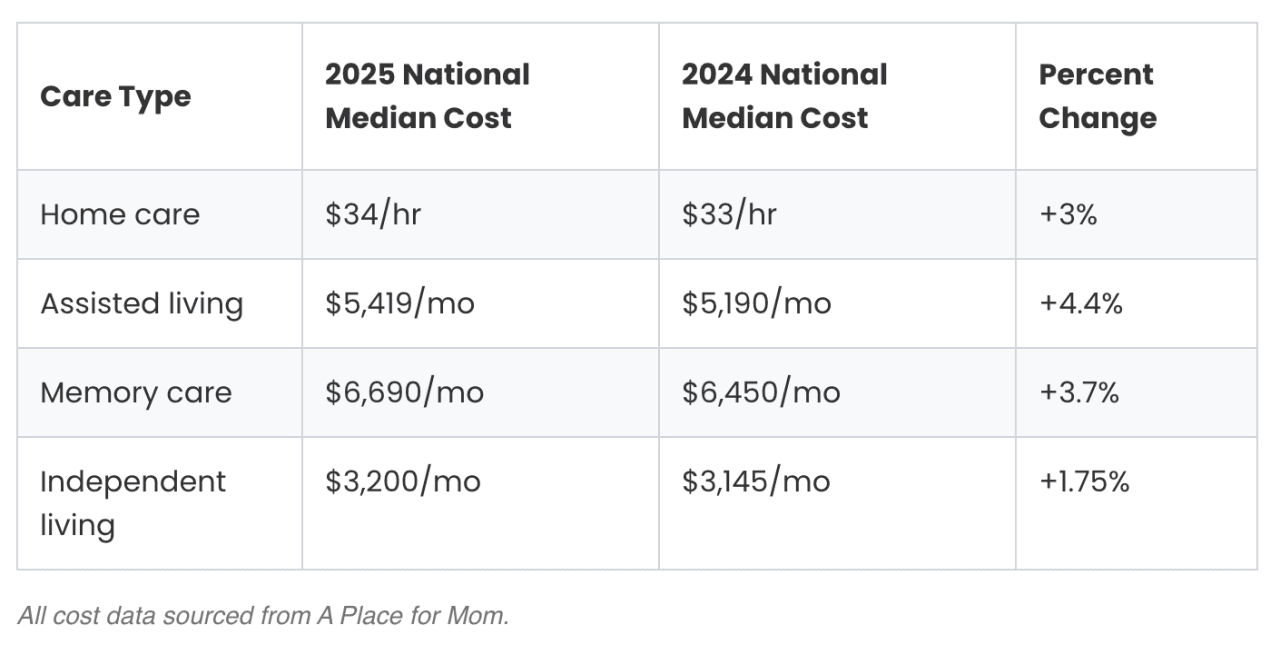
Median cost changes by care type, 2024-2025

This table shows the national median costs by care type comparing 2025 to 2024.

Calculating the costs of long-term care and senior living

A Place for Mom calculates the costs of long-term care using a consistent approach designed to support national- and state-level comparisons. Cost data is collected from partner providers, standardized across markets, and analyzed to reflect typical pricing. This methodology is intended to benchmark costs across settings, not to estimate what any individual family will pay.

Median cost data for senior living communities

Median cost data for independent living, assisted living, and memory care is based on actual costs paid by residents who moved in during calendar year 2025. For each move-in, the reported cost includes base rent and care fees when care is provided.

In states where move-in data was not available, median costs are based on averaged published rates for common room types and care fees. If neither move-in data nor published rate data was available for a given setting, cost data is not shown for that location.

Assisted living median costs are based on 24,305 family move-ins recorded during calendar year 2025, independent living cost data reflects 13,528 move-ins, and memory care cost data is based on 10,474 memory care move-ins.

Median cost data for home care

Home care cost data in this report was captured Jan. 9, 2026, and is based on hourly starting rates shared by 3,215 home care agencies in A Place for Mom’s network.

Actual home care costs vary based on the number of hours arranged and type of care provided. Because schedules and needs differ, home care costs in this report are shown as hourly rates rather than fixed monthly totals. The national median hourly rate provides a general reference point, but a family’s total monthly cost will depend on how many hours of care are arranged.

Most home care agencies require a weekly minimum of seven hours, and some offer up to 24-hour or live-in care options. The most common home care schedule is approximately 20 nonsleeping hours per week, which equates to $2,944 per month based on the national median hourly rate of $34.

Context sources

In addition to proprietary cost data from A Place for Mom’s partner network, this report references publicly available government data and industry research to provide general context on labor markets, housing costs, inflation, and senior living supply and demand. These sources are not used to calculate the cost figures presented in this report.

Sources referenced for context include the U.S. Bureau of Economic Analysis, U.S. Bureau of Labor Statistics, National Investment Center for Seniors Housing & Care, and Senior Housing News.

This story was
produced by
A Place for Mom
and reviewed and
distributed by Stacker.

Topics:

NYC
Careers & Education

HR leaders call for unified solutions and strategic AI

HR leaders call for unified solutions and strategic AI
By Shari Simpson for Paylocity
3 min read • Published April 29, 2026
By Shari Simpson for Paylocity
3 min read • Published April 29, 2026

Businessman interacting with a virtual holographic HR system.

R.bussarin // Shutterstock

HR leaders call for unified solutions and strategic AI

Two-thirds of HR technology decision-makers are ready to switch providers to get the all-in-one system they need, according to a recent survey of business leaders conducted in September 2025 by Qualtrics and Paylocity, an HR, payroll, and finance software provider.

The study drew on insights from more than 500 leaders across HR, finance, IT, and operations to assess how organizations view their HR and payroll software, examining usability, integration, innovation, and outcomes. The findings highlight what works today — and what human capital management (HCM) technology must deliver next.

87% of leaders want an all-in-one HR and payroll solution

When it comes to HR processes, keeping employee data secure and accurate is critical. From hiring to payroll, benefits, and compliance, every detail matters. But HR isn’t the only department that benefits from getting this right.

In their quest for a better solution, a vast majority of decision-makers (87%) are looking for a unified solution. Furthermore, 82% agree that the ability to connect data across HR, finance, and IT is very or extremely important.

By making the person record a single source of truth, an all-in-one platform eliminates duplicate data entry, ensuring employee information is kept up to date from job application through offboarding.

While leaders want one solution that covers multiple HR and payroll functions, “all in one” does not mean the same as “one size fits all.”

The most advanced HCM solutions also integrate easily with other business systems to provide better flexibility and scalability. This includes integrations with transactional systems, like time and benefits, which are key to enhancing operational efficiency and improving employee engagement.

But a truly unified platform also breaks down silos to enable more strategic workforce planning, performance management, and employee autonomy.

The real value of a comprehensive solution comes from better visibility and reporting. When business leaders have ready access to real-time data analytics, it takes the guesswork out of decision-making.

AI innovation must serve a purpose

Workplace technology evolves rapidly, and there’s a massive appetite for smarter tools. Almost half of the surveyed decision-makers strongly agree that HCM software can use AI and automation to improve efficiency. Additionally, 86% say AI can significantly improve HR and payroll processes.

The employee experience is shifting, too, with half of all workers today turning to AI for work advice instead of their manager, according to a 2026 study by Randstad.

Many modern HR and payroll software solutions have taken note,embedding AI to improve performance management and employee listening, helping companies identify at-risk employees while also automating tasks and accelerating recruitment.

The potential impact of these AI-powered tools is compelling, with 2025 research from Market Reports World indicating that automated HR systems can reduce labor administration time by 41%.

But business leaders want a voice in how technology evolves.The Paylocity survey found that 78% are looking for a provider who incorporates client feedback in their product roadmap. Yet only 36% strongly agree that their current provider introduces meaningful, beneficial innovations.

The Future of HCM

The survey underscores a growing demand for an all-in-one HCM system that leverages AI and innovation to transform how organizations operate.

Leaders across HR, finance, and IT increasingly recognize that breaking down data and process silos is critical to strategic workforce planning and faster, more informed decision-making through real-time analytics.

Unified solutions that integrate HR, payroll, and other systems not only streamline operations but also provide leaders with the insights they need to make confident, data-driven decisions.

But they want purposeful innovation — solutions based on client feedback are the ones that truly deliver value. They’re looking for partners who listen closely to clients and deliver meaningful, practical enhancements that solve real-world challenges.

The future of HCM, then, is a unified system that facilitates growth and adapts quickly as work changes.

This story was produced by Paylocity and reviewed and distributed by Stacker.

Topics:

Careers & Education
media-news

Breakthrough Treatment Advances Reshaping Cerebral Palsy Care in 2026

By Media News
3 min read • Published April 29, 2026
By Media News
3 min read • Published April 29, 2026

New Developments in Regenerative Medicine, Wearable Technology and Early Screening are Expanding Care Options for People With Cerebral Palsy

CHESTNUT HILL, MA / ACCESS Newswire / April 29, 2026 / For the estimated 18 million people living with cerebral palsy worldwide, 2026 is drawing attention – not because of a single cure, but because of a convergence of science, technology, and clinical innovation that is expanding what families can expect from a CP diagnosis.

Cerebral Palsy Guide, a trusted resource for individuals and families navigating life with CP, is highlighting the most significant treatment advances reshaping care this year.

Regenerative Medicine: Cord Blood Therapy Moves from Promise to Evidence

Perhaps the most significant development in CP research in recent years is the growing clinical evidence behind cord blood therapy.

A 2025 meta-analysis published in Pediatrics found that children who received umbilical cord blood therapy showed greater improvement on the GMFM-66 motor function scale than control groups, with the strongest benefit seen in younger children and those with milder forms of cerebral palsy.

The analysis also found that many treated children outperformed the control group after six to 12 months, adding to the evidence that cord blood therapy may improve motor outcomes for some children when used alongside rehabilitation.

Researchers say the next steps include identifying which patients benefit most, defining the optimal treatment window, and studying how cord blood therapy may be combined with established CP treatments.

Wearable Technology: From Assistance to Active Retraining

Wearables are fast becoming one of the most transformative frontiers in CP symptom management. The Cionic Neural Sleeve 2, cleared by the FDA in 2025, uses sensors, artificial intelligence, and electrical stimulation to support more natural muscle activation during walking.

Company-reported results have drawn attention in the mobility space. Cionic says 94% of participants in its multi-site study showed improved gait, while home-trial users reported a 68% increase in foot clearance, a 44% improvement in ankle stability, and a 30% reduction in spasticity.

What distinguishes this generation of wearables is their rehabilitative focus. Rather than simply compensating for motor deficits, these devices are designed to support repeated, task-based movement throughout the day.

AI-Powered Early Detection: Screening Before Symptoms

An earlier cerebral palsy diagnosis has long been seen as one of the most important ways to improve long-term outcomes, since early intervention can leverage the brain’s neuroplasticity in infancy. Now, artificial intelligence is helping expand access to earlier screening.

Researchers behind a 2025 roadmap for AI-enabled General Movements Assessment said automation could make this screening tool more widely available by reducing reliance on the small number of specialists trained to perform it.

Other tools are also helping move screening beyond the clinic. The Baby Moves VIEW app allows parents to record infant movement videos at home and send them to trained assessors, a model designed to improve access for families who may not live near specialized care.

A 2026 scoping review also found growing evidence that video-based motion analysis and wearable sensors can help identify movement patterns linked to elevated CP risk in infants.

A New Era of Precision Cerebral Palsy Care

What unites these advances is a shift toward precision – matching the right intervention to the right patient at the right developmental stage.

AI-powered technologies are also playing a growing role in cerebral palsy care, with machine learning tools supporting early risk identification and robotic assistive technologies helping improve movement and rehabilitation outcomes for children living with the condition.

For families, that does not mean a cure is around the corner. It does mean cerebral palsy care continues to evolve, with more research focused on earlier identification, more personalized treatment, and tools that may expand what is possible over time.

Cerebral Palsy Guide says its goal is to help families follow those developments and understand how emerging research may relate to real-world care decisions.

For more information, visit cerebralpalsyguide.com.

About Cerebral Palsy Guide: Cerebral Palsy Guide is a dedicated resource providing expert information on cerebral palsy symptoms, causes, diagnosis, treatment options, and family support. The organization’s mission is to ensure that individuals and families affected by CP have access to clear, current, and compassionate guidance.

CONTACT:

Katie Lavender
1330 Boylston St., Suite #400
Chestnut Hill, MA 02467
(855) 346-6101
nurse_katie@cerebralpalsyguide.com

SOURCE: Cerebral Palsy Guide

View the original press release on ACCESS Newswire

Topics:

media-news
media-news

Many Families Never Know Their Child's Birth Injury Was Preventable

By Media News
3 min read • Published April 29, 2026
By Media News
3 min read • Published April 29, 2026

After Complicated Deliveries, Families are Often Left Without Clear Explanations, Even as They Face Long-Term Medical Needs and Complex Care Decisions

CHESTNUT HILL, MA / ACCESS Newswire / April 29, 2026 / Birth injuries affect thousands of families in the United States each year. However, many parents are never told whether their child’s condition could have been avoided. After a difficult delivery, families are often left to manage their child’s birth injury without ever knowing what happened in the moments that mattered most.

The Birth Injury Justice Center, which has supported affected families since 2003, is raising awareness of a problem many parents do not recognize until much later: They may not have been given a full explanation of how their child was harmed.

The Scale of the Problem That Often Goes Unseen

Birth injuries affect about seven out of every 1,000 live births in the United States each year. Yet for many families, any review of what happened comes much later, if it happens at all.

In the immediate aftermath, most new parents are dealing with NICU care, specialist visits, therapy appointments, and new diagnoses. They’re not digging through labor records or fetal monitoring strips. As a result, basic questions about what happened may go unanswered.

When a birth injury leads to long-term disability, the effects can shape nearly every part of a family’s life. Research shows that children with conditions such as cerebral palsy can require extensive ongoing care, with high annual medical costs and added demands on families.

What ‘Preventable’ Actually Means

A preventable birth injury does not always involve a single obvious mistake. In many cases, it comes down to delayed action, missed signs of fetal distress, failure to order a timely C-section, or improper use of forceps or vacuum extractors.

When doctors, nurses or other medical providers fail to meet the accepted standard of care, a child can suffer serious short- or long-term harm. In many cases, families are never told that different medical decisions may have changed the outcome.

The Financial Reality Families Face Alone

Caring for a child with a serious birth injury can create major long-term costs for families. The Centers for Disease Control and Prevention has estimated the lifetime cost of care for a person with cerebral palsy at around $1 million.

More recent research confirms that children with cerebral palsy usually face far higher annual medical costs than children without the condition.

Those expenses can include therapy, specialist care, medical equipment, home support, and special education services. For many families, the financial strain is compounded by lost work, reduced income, and gaps in insurance coverage.

When a birth injury may have been caused by medical negligence, families may have legal options to seek compensation for the cost of ongoing care. But many do not realize that until years later, sometimes when it’s too late.

How to Find Out If Your Child’s Injury Was Preventable

Determining whether a birth injury may have been preventable often starts with a review of what happened before, during, and shortly after a baby is born.

However, medical malpractice deadlines are strict and vary by state. That means families may have less time than they realize to look into what happened. Speaking with a legal professional as soon as possible may help clarify what caused the birth injury and what options may be available.

The Birth Injury Justice Center has labor and delivery nurses on staff who can review a family’s situation and help determine whether legal action may be an option.

About Birth Injury Justice Center: Founded in 2003 by a team of legal professionals, Birth Injury Justice Center is dedicated to educating and empowering families affected by birth injuries. With registered nurses on staff and a national network of birth injury attorneys, the organization helps families understand their legal rights and access the financial support their child deserves.

CONTACT:

Beth Carter
(855) 346-6101
nurse_beth@childbirthinjuries.com
1330 Boylston St., Suite #400
Chestnut Hill, MA 02467

SOURCE: Birth Injury Justice Center

View the original press release on ACCESS Newswire

Topics:

media-news

Posts navigation

Older posts
Newer posts
Featured Jobs
Hearst Television
Account Executive
Hearst Television
Array

All Jobs »
PREMIUM MEMBER

Greg Hitchcock

Gloversville, NY
15 Years Experience
A well-regarded freelance writer, my background includes social media marketing, video production, and writing articles, both news and features....
View Full Profile »
Join Mediabistro Membership Today

Stand out from the crowd with a premium profile

Mediabistro Logo Find your next media job or showcase your creative talent
  • Job Search
  • Hot Jobs
  • Membership
  • Newsletter
  • Career Advice
  • Media News
  • Hiring Tips
  • Creative Tools
  • About
Facebook YouTube Instagram LinkedIn
Copyright © 2026 Mediabistro
  • Terms of Use
  • Terms of Service
  • Privacy