Mediabistro Logo Mediabistro Logo
  • Jobs
    Search Creative Jobs Hot Jobs Remote Media Jobs Create Job Alerts
    Job Categories
    Creative & Design Marketing & Communications Operations & Strategy Production Sales & Business Development Writing & Editing
    Quick Links
    Search All Jobs Remote Jobs Create Job Alerts
  • Career Resources
    Career Advice & Articles Media Industry News Media Career Interviews Creative Tools Resume Writing Services Interview Coaching Job Market Insights Member Profiles
  • Mediabistro Membership
    Membership Overview How to Pitch (Premium Tool) Editorial Calendars (Premium Access) Courses & Training Programs Membership FAQ
  • Log In
Post Jobs
Mediabistro Logo Mediabistro Logo
Search Creative Jobs Hot Jobs Remote Media Jobs Create Job Alerts
Job Categories
Creative & Design Marketing & Communications Operations & Strategy Production Sales & Business Development Writing & Editing
Quick Links
Search All Jobs Remote Jobs Create Job Alerts
Career Advice & Articles Media Industry News Media Career Interviews Creative Tools Resume Writing Services Interview Coaching Job Market Insights Member Profiles
Membership Overview How to Pitch (Premium Tool) Editorial Calendars (Premium Access) Courses & Training Programs Membership FAQ
Log In
Post Jobs
Log In | Sign Up

Follow Us!

How to Pitch

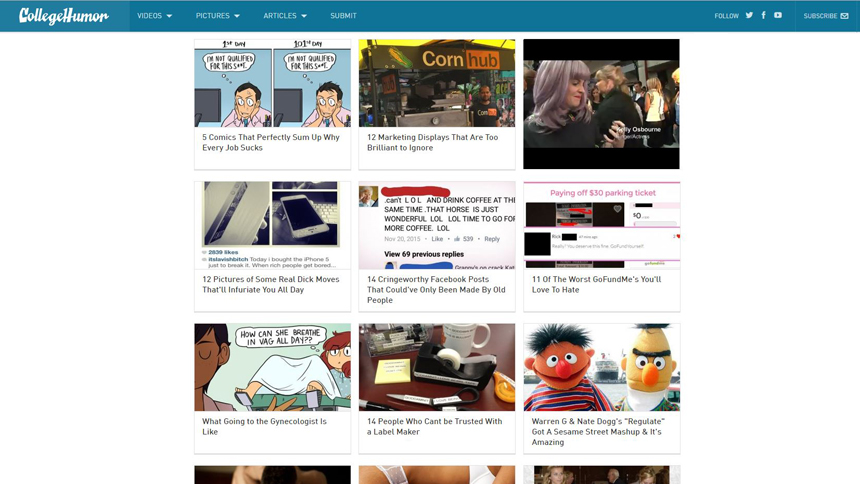
Pitch collegehumor com

Comedy chops and creativity are key at this viral-hits factory

How to pitch CollegeHumor.com
By Aneya Fernando
4 min read • Originally published April 1, 2016 / Updated May 24, 2016
By Aneya Fernando
4 min read • Originally published April 1, 2016 / Updated May 24, 2016

Monthly unique visitors: 15 million
Updated: Daily

Background: CollegeHumor.com, which was created by two high school friends in 1999, has transformed from the go-to fratboy destination to a seriously funny comedy site, with original videos, articles and illustrations. “We’re, first and foremost, a humor destination, an entertainment website,” says editor in chief Susanna Wolff, co-editor of CollegeHumor: The Website. The Book. “We’ve been around for a long time and kind of evolved our tone. Our main audience is young men, but we definitely don’t just post content that’s tailored to them. We post anything that is funny, entertaining, amusing and that anyone will enjoy reading.”

Wolff says that in terms of editorial content, the site doesn’t discriminate. “We don’t have any kind of standard format to our comedy,” Wolff says. “We post comics. We post opinionated lists. We post any sort of comedic [material].” CollegeHumor’s core demographic is 18 to 24 years old and has an offbeat sense of humor and love of all things visual, whether it be GIF-laden listicles
or viral videos.

What to pitch: The site has three main sections: “Videos,” “Pictures” and “Articles,” each with various sub-sections ripe for pitching. “We have a lot of repeated types of formats that have really done well for us,” Wolff explains. The site hosts plenty of illustrated content, which ranges from classic comics that feature a few panels and a punch line to bigger narratives with humorous graphics.

Says Wolff: “We used to call them graphic truths, ranging from flowcharts to bar graphs, where we try to explain some truths about the world. And then we also do a lot of stuff about pop culture, movies and TV as opinionated lists and commentary.”

As far as writing is concerned, don’t expect New Yorker-like depth. Six-hundred words is considered way too long for the site’s readers. Short, snappy writing with lots of visual elements does well here. If you have an idea for an illustration but can’t draw, no worries! CollegeHumor will find one for you. “You can pitch an idea with a request for illustration and we can either have an in-house illustrator help make the idea come to life or sync them up with a freelance cartoonist that we would hire.”

Wolff says the site is specifically on the lookout for fresh material. “We’re very interested in increasing the amount of freelance input we have right now. And we really like building continued relationships with freelancers.” So if you’ve got even a glimmer of potential, editors will nurture you and encourage you to keep submitting new material.

The site is ideal for comedy writers who aren’t really into performing. It’s the perfect place to pitch your jokes and practice your writing skills. Wolff adds, “[Freelancers] should take advantage of the wide range of content on our site. We have a spot for nearly any sort of [comedic] idea.”

Anyone can send pitches via the website: Sign up for a CollegeHumor account, then submit your material to the submissions page.

What not to pitch: All original videos are created in house. Every other section is open to pitches.

What publicists should pitch: “We don’t really deal with publicists too much for any kind of pitching,” Wolff says. “We’d much prefer to just have one-off individual comedic pieces and not anything where someone’s trying to promote a product.”

Percentage of freelance content: From 10 percent to 25 percent
Percentage of freelance pitches accepted: Varies

Recent freelance story pitched and published: “We had a really terrific day recently when someone submitted a piece through our onsite submission process,” Wolff says. “They wrote and fully illustrated a 15-panel article called How To Get Nothing Done. It was really funny, and it got nearly a million views. And so of course, the moment we saw that, we instantly emailed the guy who submitted it and said, ‘Just keep writing for us. We love it, keep doing it.'”

Etiquette: No snail mail. Email is best. Or just submit pitches via the homepage.

Pay rate: The standard flat rate is $35 to 50.

Payment schedule: Invoices are processed at the end of the month and typically finalized a couple weeks later.
Kill fee: Rarely used. Wolff says the editors either accept a pitch or they don’t.
Rights purchased: All rights

Contact info:
CollegeHumor
555 West 18th Street
New York, NY 10011
CollegeHumor.com
Twitter | Facebook

Direct all pitches to:
ARTICLES at COLLEGEHUMOR dot COM


EDITOR’S NOTE: Though we’ve updated this article recently, the speed at which things move in media means things may have already changed since then. Please email us if you notice any outdated info.

Topics:

How to Pitch
How to Pitch

How To Pitch: RS Country

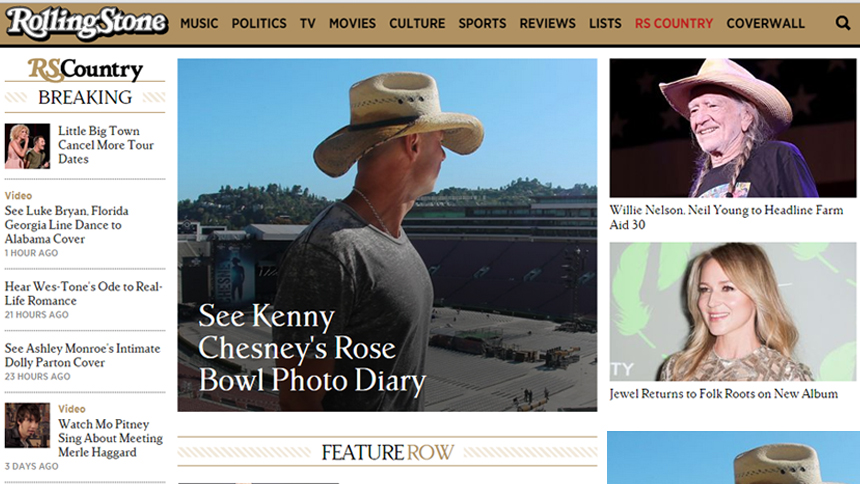
This offshoot site of Rolling Stone puts the spotlight on emerging country artists

re-country-htp-feature
Admin icon
By Andrea Williams
@AndreaWillWrite
Andrea Williams is an author, journalist, and columnist for The Tennessean with over 16 years of experience in journalism and 20 years in copywriting and communications strategy. Her work spans national outlets and high-traffic digital brands.
5 min read • Originally published July 28, 2015 / Updated May 12, 2016
Admin icon
By Andrea Williams
@AndreaWillWrite
Andrea Williams is an author, journalist, and columnist for The Tennessean with over 16 years of experience in journalism and 20 years in copywriting and communications strategy. Her work spans national outlets and high-traffic digital brands.
5 min read • Originally published July 28, 2015 / Updated May 12, 2016

Monthly unique visitors: 2 million
Updated: Daily

Background: Taylor Swift may have packed up her guitar and cowboy boots and gone pop, but country music is still hotter than ever. In a music industry that has struggled to keep up with a new, digital terrain and flagging album sales, country music is actually thriving. It’s doing so well, in fact, that one of music’s most iconic publications decided to dedicate an online destination to its coverage. “Rolling Stone has been around 1967 and has always covered country music,” says Beville Dunkerley, the site’s senior editor. “But as country music has opened its doors so widely as of late, our bosses wanted a separate outlet just for country.”

The result is RS Country, a vertical launched in 2014 and geared specifically toward country music lovers — fans who have long been recognized as some of the most loyal in the industry. But if they’re looking for gossip on who’s breaking up, who’s making up and who’s lost five pounds, they won’t find it there. “There were very few sites that provided the critical voice that Rolling Stone is known for about country news,” says Dunkerley. “There are a lot of sites that are more about the lifestyle and more about the personal lives, and we try to keep it just about the music.”

When it comes to the music, RS Country certainly has a lot of it. And with the aim to bring a more critical voice to the online discussion around country music, the site also has a lot of music that visitors probably won’t find elsewhere. “It’s really just a way to spotlight country music beyond what’s on top-40 radio,” Dunkerley says of the site’s mission. “We spotlight a lot of Americana and a lot of emerging artists, and a lot of artists who are a little bit under the radar but we want to bring to [the forefront].”

What to pitch: RS Country relies on a team of just over a dozen writers to churn out daily stories on all things country music. And while most of those writers do live in Nashville, there are a few in New York and LA. And that’s great news for other writers who happen to live outside of country music’s mecca, but who still want to write for the site.

New, talented voices are always in demand, and Dunkerley is currently looking for writers who can cover daily news. “Not just people who can turn around a press release fast,” she explains, “but people who can present a news story in a different way — going beyond the press release to make the story different from what all the other sites are going to have.”

Dunkerley is also looking for people to do more think pieces, like one that she recently published that analyzed why radio still matters in country music, even though it isn’t nearly as important in other genres. What she’s not looking for, however, are writers to interview Hunter Hayes or Carrie Underwood or and other fill-in-the-blank, huge country star. You know, because everybody wants to do those.

Typical word counts on the site are from 300 to 800 for news pieces, and 1,000 to 2,500 for features and essays.

What not to pitch: There are no sections of the site that are closed to freelance pitches.

What publicists should pitch: Editors of RS Country rely heavily on publicists to keep them abreast of the latest happenings in country music, and that’s both a good and bad thing. Dunkerley gets literally hundreds of emails a day, so standing out is difficult — but possible.

For starters, she says, send a concise email that has the most relevant — and attention-grabbing — info toward the top. And be sure to tell editors why running a story on your artist is a mutually beneficial proposition. “Make a promise that your artist will tweet the story, and tell me how many followers the artist has on Twitter and Facebook,” she explains. “If you’re pitching an artist for review or interview, check with the label and see if we can premiere a song with the story.”

The size of an artist’s fan base and ability to promote content is certainly an added bonus that may increase the odds of landing a story, but Dunkerley also notes that it is the quality of the music that will ultimately determine whether a pitch gets a yay or nay. So, in addition to social media stats, be sure to send a link to a video or streaming song — and make sure it’s actually good.

Percentage of freelance content: 70 percent
Percentage of freelance submissions accepted: 25 percent to 30 percent

Recent freelance stories pitched and published: In a break from same-old music stories, a freelancer went to a gallery opening for legendary music photographer Henry Diltz and conceived a fresh idea for RS Country. “He was so moved by the exhibit that he pitched me on doing an interview with Henry and talking about some of these iconic photos with Dolly Parton and Kenny Rogers and the Eagles,” says Dunkerley. “He did the interview, and I didn’t know who Henry Diltz was before that, but now I’m very familiar with his work, and it ended up being a great piece.”

Etiquette: While Dunkerley is always open to a great story pitch (let her know if you can arrange an interview with a hot, up-and-coming artist that’ll be swinging through your town for a show), but perhaps the best way to snag a spot in RS Country’s stable of freelancers is to simply introduce yourself.

“Send me an email that’s short and sweet, that tells me who you’ve written for before, with links to three very different stories you’ve written,” she says. The key is to showcase your diversity, and she’d like to see a feature story, a news piece and one other article of your choice.

Lead time: It depends on the assignment, but it could be as little as 24 hours for breaking news, or up to a week for an artist interview.
Pay rate: Varies, based on the complexity of the story
Payment schedule: Writers for the site are asked to submit once-monthly invoices for any stories written during the last 30 days.
Kill fee: Dunkerley and crew have never had to kill an article, but if the situation arose, she says it would be handled on a case-by-case basis.
Rights purchased: All rights

Contact info:
Rolling Stone Country
1510 16th Avenue South
Nashville, TN 37212
www.rollingstone.com/country
Twitter handle: @rollingstone | Facebook
Email format: FirstName.LastName@rollingstone.com

Direct pitches to:
Senior editor Beville Dunkerley: BEVILLE dot DUNKERLEY at ROLLINGSTONE dot COM or senior editor Joseph Hudak: JOSEPH dot HUDAK at ROLLINGSTONE dot COM

NEXT >> How To Pitch: The Fader

[EDITOR’S NOTE: Though we’ve updated this article recently, the speed at which things move in media means things may have already changed since then. Please email us if you notice any outdated info.]

Topics:

How to Pitch
Mediabistro Archive

Freelancers on How They Navigate the Inevitable Hills and Valleys of the Job

By Mediabistro Archives
8 min read • Published May 9, 2016
By Mediabistro Archives
8 min read • Published May 9, 2016
Archive: This article was originally published by Mediabistro around 2016. It is republished here as part of the Mediabistro archive.

As the owner of WM Medical Communications, there are so many days when I’m grateful to be a freelancer. I’ve been running my own business since the early 90s (first in print, then online) and have helped launch numerous clients, particularly in the health/medicine fields and most especially in the boomers+ market.

And there are so many days when I think I’m truly out of my mind.

What makes for these ups and downs? Here are just a few pros and cons I’ve learned about being one’s own boss, with additional insights from several generous colleagues.

Cons
The Transition Can Be Tough

People come to freelancing through numerous avenues. I was forced into it through a recession, during which my husband lost his job too. Let me tell you, when we cleaned out most of our savings because of what it cost to set up a home office with computers, fax and printer, I was scared.

“I was an assistant editor in a New York City publishing company that was sold. I had offers to stay on, but I wasn’t interested; I really wanted to explore writing. So I went out on my own. I had to do a lot of copyediting while I got into writing. There were two years where I didn’t make a lot of money,” said Sheila Buff, whose expert medical writing and editing has helped seven doctors produce national bestsellers.

Caroline Leopold was working at a non-profit as a grant writer but said the agency hired consultants to work on larger submissions. “I hit a glass ceiling. They paid these people $200 an hour and I realized I was doing it better than they were.” So one day, Leopold said, she “got a backbone” and looked into establishing a freelance career in December 2011. She immediately got a profitable part-time position in February 2012. When it came to renew, “I cut the cord,” she said, and started her own business that August.

“If you’re going into freelancing ’cause it seems easy, forget it. There will be a lot of times of almost 24/7 franticness___ and then scary valleys.”

Lucy Clark, who’s been a leading graphic designer since 1992 in print and then added online work in ’97, was in a staff job but knew she wanted to start her own business. “I__?d work on other clients during lunches [at work] or in evenings,” she said. “My clients understood to call me at home. My husband was trained to answer the phone and only call [me] if need be.”

It’s Often Feast or Famine

If you’re going into freelancing ’cause it seems easy, forget it. There will be a lot of times of almost 24/7 franticness___ and then scary valleys.

“Yeah, that’s the really big drawback. You can have a really good year, then everything crashes___ and it can take a while to scramble back,” said Buff. Nowadays she has a better handle on when each job is due to end but still takes care not to get complacent. “Make sure to keep beating the bushes,” she advised.

It’s nice to hear the advice of keeping six months’ income saved up and to regularly take on new clients, but I’ve found it impossible. During hard times (particularly, 9/11 and the 2009 recession) that six months’ savings quickly disappears. And when I get a really big client, 40 hours a week almost always goes there, leaving little time for taking on new projects.

Entrepreneur Jake Poinier (aka “Dr. Freelance”) said one of the keys is to simply not roll over. “In summer 2001, people’s marketing budgets dried up. I had a wife, two young kids, a mortgage___ So instead of waiting for the phone to ring, I started cold calling. [Despite 9/11] in September I was busy again,” said Poinier, who — besides being owner of Boomvang Creative Group is also the developer of the Freelance Forecast annual guide and the author of The Science, Art and Voodoo of Freelance Pricing and Getting Paid and Help! My Freelancers Are Driving Me Crazy.

Even a regular workday can be crazed. “I think I read more than I write every day,” said Leopold. Among her musts: about 15 agencies that have references to grants (via a federal RSS); Science Daily; the Scientopia blog; and science-related Reddit posts.

The Low-Balled Battle

The “I can get it cheaper mindset” seems more prevalent since the Internet boom. Clients see numerous listings for blog posts at “5 cents a word” or “$6 a page” or “$10 an hour.” So often they don’t realize how unrealistic these rates are once issues like research, interviews, deadlines — plus overall skill — are factored in.

Clark feels you have to hold your ground. “Unless you can educate [potential clients] about what’s really involved, walk away,” she said.

Not sure what to charge? Ask colleagues. Clients also know the going rate, so as long as you’re not being unreasonable (i.e., moving from the lowest fee in the spectrum for a project to the highest) the ones who want to keep you will pay what is fair.

“For me, there came a point when journalism wasn’t going to pay enough. I had to add other services… custom web content, brochures, advertorials… and it was a hard decision to ‘cross to the dark side.'”

I’ve found editors rarely pay much in increases; they have a budget for stories and that’s that. However, if you’re a steady contributor, you may be able to finagle an extra $50 or so. If the work isn’t too demanding, it might be worth your while to keep this client. Or perhaps you can negotiate other benefits. For example, instead of all rights to the work, your client takes only one-time rights, so you can easily sell the work (and make money) elsewhere.

But let’s say you’ve “outgrown” the rates you’re being paid; e.g. $30 an hour was a great initial goal, but now you’re worth at least $50. You can start weaning yourself from the lower payers with a process Poinier calls “the stealth raise.” Slowly start adding an extra 10% (maybe a little more) to your bids. Your best clients will likely accept them.

Or maybe you simply have to start expanding your portfolio. For me, there came a point when journalism wasn’t going to pay enough. I had to add other writing services; e.g., custom web content, brochures, white papers, advertorials. But these materials are considered marketing/PR… and it was a hard decision to “cross to the dark side” (as one client put it).

Pros
You’re In Control

And now on to the benefits of the freelance life. With the exception of dealing with true disasters, you control your own destiny. In my home state of Maryland, a lot of health/medical projects are government work and almost always go to primary contractors who are used to the paperwork and politics. Instead of fighting for work, I now sign on as a subcontractor (mostly writing custom web content), get paid nicely and have agencies like the NIH in my portfolio.

Buff also enjoys the autonomy. “[Freelancing] gave me back two hours a day because I wasn’t traveling [to the office]. I don’t have to go to a boss and beg for a morning off; I can work in the garden,” said Buff.

“I take an hour in the evening practicing yoga and nothing would stop me from doing that,” explained Clark. “I can read books, do my own art… I’ve developed a bunch of other hobbies.”

Poinier noted that he and his family lived in Canada for a year, and there was no interruption to his business. “There were people I didn’t even tell I had gone!” he said.

Emotional Satisfaction

It’s true there can be a lot of stress related to running your own business (rush jobs, late payments, etc.), but to me there’s nothing like the self-satisfaction it can bring.

“Grant writing is amazing. I don’t get paid to write. I get paid to learn,” said Leopold. It’s a reward she always appreciates.

And talk about rewarding. I wrote newspaper pieces on health issues for adults ages 60+. It was real information, not just “Five Ways to Prevent Back Sprain.” One of the topics was on PTSD in older veterans. After the work was published, a widow called me in tears. She told me her husband, a vet, had changed and become violent in the last years of his life. At least now she understood why. Wow!

“It’s true there can be a lot of stress related to running your own business (rush jobs, late payments, etc.), but to me there’s nothing like the self-satisfaction it can bring.”

Networking Opportunities

My colleagues and I agree that you have to constantly network if you want to enhance your visibility. “To me, joining a professional organization is a no-brainer,” said Buff, adding, “When you share your knowledge, it all comes back to you.”

With online options, there’s no excuse not to get noticed. For example, after I approached Poinier at Buff’s suggestion, he told me, “Oh sure. I know your name from your postings on EFA [And don’t forget to establish networks with folks outside of your field. “So when graphic designers need copy for something done, they give you a call… and vice versa,” said Poinier.
Final Words of Advice

When a job doesn’t develop, I try to remember what a salesman once taught me. “You have to understand that 99 percent of the time you will NOT get the client. Consider that a given, so you can be overjoyed when that 1 percent closes!”

Ultimately, Buff said, “You HAVE to say, ‘I’m available.’ Make people aware of your existence. Do really good work so you get repeats. [And] stay flexible and open-minded… or you’ll be left in the dust.”

Wendy Meyeroff is a freelance writer and marketing strategist based in Baltimore. She can be reached at wendy@wmmedcomm.com.


NEXT >> Balancing Your Freelance Life With Your Personal Life

?? Mediabistro Inc. 2013. All Rights Reserved.

Topics:

Mediabistro Archive
Mediabistro Archive

If You’ve Lost Your Journalism Job, Here’s How to Turn the Setback Into an Opportunity

By Mediabistro Archives
8 min read • Published May 9, 2016
By Mediabistro Archives
8 min read • Published May 9, 2016
Archive: This article was originally published by Mediabistro around 2016. It is republished here as part of the Mediabistro archive.

These are edgy days for print journalism. An onslaught of cuts has shrunk news holes, slashed budgets, dismembered bureaus, curtailed ad revenue and whacked personnel with Sopranos-esque efficiency. Broadsheets have been trimmed to the point of irony. Swords of Damocles dangle from newsrooms’ ceiling tiles.

The industry’s problems notwithstanding, I believe there has never been a better time to be a writer for hire. I know what you’re thinking and, no, I wasn’t recently released from involuntary confinement. I’m the guy who disembarked the Titanic moments before it left port.

In 2006, I departed the presumed safety of a staff editorial position with The Chronicle of Higher Education, the self-proclaimed Wall Street Journal of the egghead set. Suffice to say that we parted company on a timetable not of my choosing. Loath to take another newsroom job, I declined offers of full-time employment, shut my eyes and plunged into full-time freelance writing.

Go figure: Freelance economics can pay off

In 2007, my first full year of working at home alone, I grossed $95,000 — more than I had earned as a staff writer and editor. I eliminated annual commuting time equivalent to more than six 40-hour work weeks and saved money on dry cleaning costs, parking garage fees, automobile expenses and restaurant tabs. I took a two-week vacation in Italy, spent a week on a North Carolina beach and barely lifted my pen between Thanksgiving and New Year’s Day. I haven’t attended a mindless staff meeting in quite a while.

My leap of faith and its aftermath belie Hunter S. Thompson’s maxim that “writing is a hard dollar.” (Apropos of nothing, Thompson further noted that stringing together words for a living “is a lot better than reaching up inside a maddened cow and grabbing a breached calf by the legs.” Who knew?)

Moreover, I’ve succeeded without benefit of a Web site, business cards, query letters, blogs or LinkedFaceSpaceTwitter. My secret? Economics 101. I’ve found that market demand for editorial professionals outstrips supply — by a mile. If you write well and can meet deadlines, you can earn a good living working at home in your underwear. Meanwhile, my former employer continues to throw people overboard like so much human ballast. Sound familiar? In my experience, making it as an editorial mercenary is a four-step process — Step one: Recruit and retain a handful of good clients. Step two: Do great work. Step 3: Cash the checks. Step 4: Repeat steps two and three. In making the leap from newsroom to home office, I’ve picked up a few tricks and tips for smoothing the transition.

Are you well-suited to go freelance?

Ernest Hemingway, an accomplished freelancer in his own right, advised would-be writers to “develop a built-in bullshit detector.” Assuming you possess such an apparatus, use it to check your motives and assess your suitability for freelancing, preferably before you ditch the paid vacation and employer-matched 401(k). Are you comfortable with a certain amount of uncertainty? Can you function in the absence of cubicle-d colleagues? Are you adventurous? Can you distinguish a gerund from a gerbil? Can you identify and report on compelling stories? Do editors compliment you on your writing? Are you a multitasker? Self-motivated? Does the idea of being your own boss cause you to smile?

Be honest. If your answers are overwhelmingly affirmative, you may be suited for freelancing. If, however, you thrive on rigidity, demanding bosses and the consequences of not falling in line, the U.S. Marine Corps is looking for a few good men.

Don’t be afraid to take the plunge

Every few months I get a call from a friend, an accomplished and independent-minded staff writer who desperately wants to go solo. Immobilized by fear, however, he can’t pull the trigger. Like many of us, he has a hard-wired aversion to the unknown. (Consider that the most chilling aspect of horror movies — Jaws, Alien, Psycho –is often the unseen monster.)

Speaking of little monsters, the decision to become a freelancer — and following through on it — is akin to planning and starting a family. In both cases, putting it off until you’re ready means that it probably won’t happen — unless there’s a fortuitous accident. Overcoming inertia sometimes requires what might euphemistically be called the gift of desperation. If you’re among the legions of journalists who have lost or will lose a job, this is your chance to make a change.

Don’t let your ego get in the way

Lurking at the other end of the emotional spectrum is ego. If your definition of freelance success is contributing regularly to The New Yorker, you’ll be disappointed to learn that David Remnick isn’t awaiting your call. Nothing will cut short a freelance career more cleanly than a stubborn insistence on publishing in million-circulation mags or not at all. As in war, amateurs do it for the glory, mercenaries for the money. (Call me, David.)

Recruit a client base

How do you find clients? It’s the question most often asked of me by people mulling the freelance option. If you’ve been around for a while and haven’t recently awakened from an extended coma, you probably know a lot of people. Call them. Text them. Reconnect. Let them know what you’re up to.

As a newly liberated staff writer and neophyte freelancer, your job is to have lunch. Pastrami on rye has catalyzed more freelance writing assignments than all the resumes in Manhattan. If you’re enthusiastic about what you’re doing, people will want to help. For many nine-to-fivers, there is something alluring about the crazy, courageous colleague who works without a net. They might not have the stones to go it alone, but they want in on the action — if only vicariously.

Keep your clients, and keep them happy

Tapping your network is a start, not a destination. If you fail to transform first-time clients into loyal customers, your progress will falter. An old hand told me that it’s a lot easier to keep a customer than it is to get a new one. Neglect the care and feeding of clients, and you’ll go hungry.

The successful freelancer understands that customers want what they want, when they want it. Your job is to give it to them — on time, on topic and written to the agreed-upon length. (Getting a 2,000-word piece instead of the agreed-upon 1,500 isn’t likely to be viewed by most editors as a 500-word bonus.) Make your copy clean, accurate, compelling and well-reported. Try not to libel anyone.

How much quality should you give a client? More then they expect. A quick scan of any publication will reveal its quality benchmark. Having sized up the competition, make sure you’re better than the other guys. Do great work, yes, but don’t fall into the black hole of perfectionism. The law of diminishing returns will rob you blind. Besides, Oil and Gas doesn’t expect the same urbane wit demanded by, say, The New Yorker.

Work where the money is

A freelancer of another sort, Willie Sutton, when asked why he robbed banks, replied with unerring logic: “Because that’s where the money is.” Similarly, Bob Woodward and Carl Bernstein, in the cinematic account of the Watergate investigation, were advised by uber-source Deep Throat to “Just… follow the money.”

Indeed, it pays to follow the money. As satisfying as it might be to write church bulletins or craft C.V.s for unemployed subprime mortgage lenders, those gigs don’t pay. Most of my freelance assignments have involved work in the areas of education, health and information technology, gazillion-dollar sectors all. I’d love to be a poet, but the pay for penning quatrains is too often comp copies of obscure literary journals.

Following the money can lead you to nonprofit institutions of all stripes, including colleges and universities that are among the wealthiest institutions around. Other destinations include companies, trade groups and membership associations whose internal and external publications frequently rely on freelance editorial professionals.

Cull the good customers from the bad

One of the great intangible benefits of being a solo practitioner is the gratitude of clients who rely on freelancers. And why shouldn’t they be grateful? They don’t pay benefits or provide office space, and they get access to a level of expertise that in many cases would be prohibitively expensive if paid for on a per annum basis. It’s a good deal all around.

Unfortunately, a small number of clients aren’t worth the trouble. They come in different varieties. Some refuse to acknowledge the line between freelance workers and employees, paying for the former and demanding the latter. There are slow payers and nonpayers and flat-out difficult clients. Fortunately, they are rare.

If you have a diversified base of clients, excising the occasional bad apple can be done with little or no financial harm. Not that it’s easy to break off a lucrative relationship: I dropped a client worth almost $20,000 annually because its lack of organization compromised the work I did for other customers. I second-guessed my decision more than once, but it was the right thing to do. If the customer is always right, fire him!

Know what to charge

When it comes to freelance remuneration, there is a tendency to get hung up on per-word rates. Granted, there are cases that justify obsessive attention to those numbers, such as speculation on the blogosphere that Portfolio paid Michael Lewis a saliva-inducing $12 per word. Moneyball, indeed.

For the rest of us, per-word rates are something of a red herring. (That last sentence would have netted Lewis either $156 or $168, depending on the definition of “per-word” as it applies to hyphenated terms.) What matters is how well you’re compensated for your time, the most nonrenewable of nonrenewable resources.

At $1 per word, a 1,000-word assignment that requires listening to a one-hour Web conference and writing for four hours is worth $200 per hour. A seemingly more lucrative $3-per-word assignment of the same length that requires two weeks of reporting, writing and editing is, at $37.50 per hour, a poorer deal. You learn these things the hard way. Early on, I was thrilled to get an $8,000 assignment to write a long magazine piece. Only later did I realize the extent to which overnight reporting trips to Syracuse, Chattanooga and Albuquerque had cut into my hourly compensation.

Of course, money isn’t everything. It makes sense sometimes to take an assignment that will serve a higher purpose, such as reaching a broader audience or a more sophisticated reader, someone like, I don’t know, David Remnick. (Call me.)


John Pulley is writing a guide for freelancers.

Related:

  • Media Career Advice

Topics:

Mediabistro Archive
Job Search

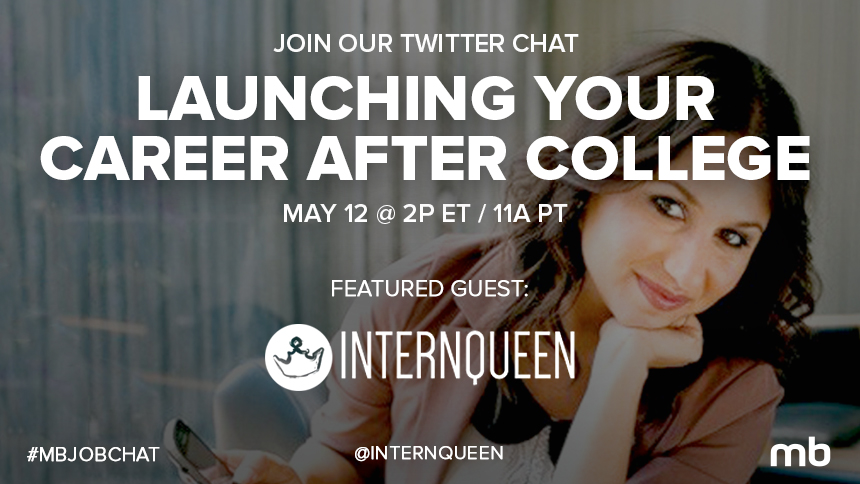
Twitter Chat: Launch Your Career After College #mbjobchat

Learn how to get career skills while you’re still a student, and how best to approach the job market for success as a recent grad, during our #MBJobChat

#MbJobChat launching your career after college
By Franny Goldberg
1 min read • Originally published May 5, 2016 / Updated May 6, 2016
By Franny Goldberg
1 min read • Originally published May 5, 2016 / Updated May 6, 2016

Between cramming for finals, devising thesis statements and killing it in Greek Week lip-synch contests, it’s easy to breeze through college without successfully setting up a path for your career.

It’s no wonder some future bosses are skeptical of recent grads’ readiness for the workplace: Fewer than 30 percent of employers think that graduates have the career skills they need to make it in the “real world,” according to a 2015 study by the Association of American Colleges and Universities.

No need to freak out: We’re pairing up with Lauren Berger, aka the Intern Queen, to give you ALL the information you need to land a job after graduation!

Join us on Thursday, May 12 at 2 p.m. ET/11 a.m. PT as we chat with Lauren and entry-level job seekers like you to discuss how to gain career-level skills while still in college, leverage internship experience—including how to land one—and the best ways to attack the job market as a new grad.

Who: @Mediabistro, Lauren Berger of @InternQueen and YOU
What: #MBJobChat
Where: twitter.com/mediabistro
When: Thursday, May 12 2 p.m. ET/11 a.m. PT

Topics:

Get Hired, Job Search
How to Pitch

How To Pitch: The Fader

Craft features on the interaction of music with tech, business and culture for this music mag

fader-htp-feature
Admin icon
By Corinne Grinapol
@Corinneavital
Corinne Grinapol is an assistant editor covering energy and environment at Engineering News-Record, with previous editorial roles at Adweek's FishbowlDC and Mediabistro. She studied international relations at SUNY Geneseo.
5 min read • Originally published October 22, 2014 / Updated April 27, 2016
Admin icon
By Corinne Grinapol
@Corinneavital
Corinne Grinapol is an assistant editor covering energy and environment at Engineering News-Record, with previous editorial roles at Adweek's FishbowlDC and Mediabistro. She studied international relations at SUNY Geneseo.
5 min read • Originally published October 22, 2014 / Updated April 27, 2016

Circulation: 115,000 for print; 700,000 online

Frequency: Six times a year

Special issues: Every issue is a special issue. The music and lifestyle magazine is currently exploring ideas for new themes, such as the premiere “Producers” issue (October/November). Other themes explored this year include “Spring Style” (February/March), “Photography” (April/May), “Summer Music” (June/July), “Fall Fashion” (August/September) and “Now” (December/January).

Background: Fader‘s origin story is a clue to the dual-cover issues it produces. The name refers to the DJ tool used to cut songs into each other, gradually softening the levels of one song as it converges with the second and the new sound takes over. And Fader produces its magazine like any expertly composed DJ mix — setting disparate genres and styles against each other, allowing the blend to tell its own story.

If you’re not always sure whether you’ve heard of the musicians covered on the pages of Fader, the magazine is doing its job. “The mission of Fader hasn’t really changed,” says recently appointed editor-in-chief Naomi Zeichner. “It has always been about covering all types of music.” As long as that music is fresh. Since it was founded in 1999, the pub has proved to have an incredibly sharp eye when it comes to recognizing talented musicians on the verge of a breakthrough. Kanye West, MIA, Frank Ocean and Bon Iver are among the artists Fader spotted and featured on its covers before anyone else did.

Fader is that friend from your college days listening to the newest sounds before they hit the mainstream. But it is also a magazine for industry insiders, a trade magazine hiding under a veneer of glossy design and stylized storytelling. Its content speaks to cool kids and pros alike.

What to pitch: Fader finds you, rather than vice versa. If Fader editors don’t know who you are, the likelihood of your pitch getting accepted is tiny. “It’s very rare we’re going to accept a cold pitch,” says Zeichner. “We assign out small and large pieces to writers we feel are the best fit.” Assignments tend to go to writers with an established relationship with Fader.

But if you want to beat the odds, you have to either think small or really big. “Newsprint” and “Style” are the front-of-book sections where first-time freelancers will have the best chance of success. Take note that the fading referenced by the magazine’s name isn’t just about the music. “We’re really interested in intersections,” says Zeichner, “race in music, business in music.” Other pitches to consider are “pop-criticism and explainers that deconstruct complicated stories or issues,” adds Zeichner.

Access to musicians can help, better yet if you and they are based outside of New York, or outside of the country. Fader‘s eye is set on the global music scene.

Who you are can also make a difference. Fader wants to see diversity in its covers and its cover writers, and is looking for “stories written by women, people of color and members of the LGBT community.”

What not to pitch: Lay off the track reviews; those are handled in house. And don’t pitch slide shows. It’s also not a good idea to pitch a story on a well-known artist or one that has been getting a lot of press recently, unless you come at it from an unusual, previously unexplored angle.

Online opportunities: Those who haven’t yet come under Fader‘s radar will want to focus their energies here, especially if you’re pitching what Zeichner describes as a “meaty feature.” Keep in mind stories move faster here, with a lead time of one week to three weeks.

TheFader.com is where you’ll see the publication expanding its editorial territory to 500- to 1,500-word critical and personal essays and “big, reported features” that can run upwards of 2,500 words. Pieces focused on the business and tech sides of music can do well here. The rate for shorter pieces starts at $100.

What publicists should pitch — and when: Flexibility is key. The magazine is interested in “taking a publicist’s idea and shaping it.” As far as which ideas are effective, publicists should focus on big music premieres. “We’re less interested in tour dates or the video premiere of the third track of your album,” says Zeichner. An effective pitch will demonstrate the publicist really gets the magazine.

Percentage freelance-written content: 25 percent
Recent stories pitched and published: “Capital STEEZ: King Capital,” by Eli Rosenberg, a feature that ran in the December 2013/January 2014 issue, about the life and death of a promising young rapper. “Meet the Man Behind Ryan Hemsworth’s Favorite Tokyo Label, Maltine Records,” by Nick Harwood, a profile interview published online on June 30, 2014. “Behind the Scenes of Flying Lotus’ ‘Never Catch Me’ Video with Director Hiro Murai,” by Eric Ducker, an interview published online on October 9, 2014.

Etiquette: “Give me your elevator pitch,” says Zeichner. Keep it brief, but focused. Make sure you know where you’re going with your story and what you want to say. “What’s the headline?” is a question you’ll want to answer in your pitch, as well as a description of how you’re going to report it. Send your pitch in the body of an email, and include links to your writing and social media profiles.

Lead time: Three to six months
Pay rate: It varies; typically from $1,500 to $2,000 per feature
Payment schedule: 30 days after invoice
Kill fee: 25 percent. However, says Zeichner, “We rarely kill a story. We invest a lot in our writers and trust them.”
Rights purchased: All rights

Contact info:
The FADER
71 West 23rd Street, Floor 13
NY, NY 10010
(212) 741-7100
www.thefader.com
Twitter handle: @thefader | Facebook

Direct all pitches to:
EDITORIAL at THEFADER dot COM

NEXT >> How To Pitch: RS Country

[EDITOR’S NOTE: Though we’ve updated this article recently, the speed at which things move in media means things may have already changed since then. Please email us if you notice any outdated info.]

Topics:

How to Pitch
Mediabistro Archive

A New Grad’s Guide to Breaking Into Entry-Level Marketing Jobs and Actually Thriving

By Mediabistro Archives
1 min read • Published April 12, 2016
By Mediabistro Archives
1 min read • Published April 12, 2016
Archive: This article was originally published by Mediabistro around 2016. It is republished here as part of the Mediabistro archive.

Hey, new and about-to-be college grads: Are you ready to look for a real live grown-up job? Or have you already gotten the offer and starting to work in an in-marketing department or marketing agency?
Either way, for you marketing pros of the future, our New Grad’s Guide to Marketing Careers has just the info you’ll need.
You’ll find great fields for entry-level marketers, and what it takes to succeed in them. You’ll read about the skills and traits marketing hiring managers are looking for. You’ll get deadly honest advice about what you need to slay it on the job. And a lot more, including links to professional training courses and job listings, automatically updated daily from our job board.
Download our new grad’s guide to get your hands on more than 70 pieces of intel, recommendations and real-world wisdom that will take you from college student to marketing master.

Topics:

Mediabistro Archive
Mediabistro Archive

How to Take Your Work Wardrobe From the Office to a Night Out

By Mediabistro Archives
3 min read • Published April 11, 2016
By Mediabistro Archives
3 min read • Published April 11, 2016
Archive: This article was originally published by Mediabistro around 2016. It is republished here as part of the Mediabistro archive.

With days that can take you from steamy subway commute to Arctic-cold office to al fresco networking drinks or dinner, spring and summer mean temps as varied as your social calendar.
The key to staying fresh and not turning into a hot mess is a little wardrobe game plan before you step outside. Check out these style points for keeping cool—without getting a call from HR.
WOMEN
The Shift Dress
Looking to land the job as managing editor at a publishing house? Sleek, flattering and short-sleeved, the shift dress is the equivalent of a power suit. It’s interview appropriate when worn with a blazer and cocktail ready without.


The White Shirt
This timeless wardrobe staple is always chic. You can never have too many white shirts; their versatility ranges from Oxford cloth with the preppy button-down collar to a classic silk secretary blouse with bow. The endless options mean your closet is well stocked for work and play. Pair with a statement necklace to go from plain to glam.
https://www.pinterest.com/pin/288160076136377139/
The Kitten Heel
You may be a publicist who’s up at dawn for a television appearance then later hosting an event that ends at 10 p.m. To pull off looking polished without being uncomfortable, your shoe choice is key. Opt out of changing by noon and go for a lower heel to keep your day on track.
https://www.pinterest.com/pin/288160076136570874/
https://www.pinterest.com/pin/288160076136455613/


The Linen Blazer
If jeans are the workplace uniform, but you’ve got a client dinner, a linen blazer is the perfect piece to give your style a tailored look. Even worn with a T-shirt, a structured jacket transitions you from laid-back to business casual.
https://www.pinterest.com/pin/288160076136455719/
https://www.pinterest.com/pin/288160076136406599/


The Camisole
Nothing says day-to-date-night like a silk camisole. Once considered lingerie only, the lingerie-inspired piece now has 9-to-5, appeal especially when paired with a jacket or cardigan.
https://www.pinterest.com/pin/288160076136455490/


MEN
The Khaki Suit
Go from office to off duty with this warm-weather classic. Whether you’re the art director or account manager, this suit keeps you looking cool and professional. Pair with sneakers if your gig is more creative and brogues to add more polish.
https://www.pinterest.com/pin/288160076136455766/
The V-Neck Sweater
Simple and versatile, a cotton V-neck layers perfectly over tees or an Oxford shirt worn with a tie. It adds a bit of refinement to a casual office look, and the lightweight weave is ideal for warmer days.
https://www.pinterest.com/pin/288160076136456097/


The Trench Coat:
A must-have for unpredictable rain showers, a lightweight trench is a wardrobe necessity. Its water-repellant tech fabric makes for an ideal travel companion and its classic tailoring is a nod to heritage style.
https://www.pinterest.com/pin/288160076136455766/
https://www.pinterest.com/pin/288160076136571339/


The Navy Sportcoat
Worn with our without a pocket square, no closet should be without a navy sport coat. It partners well with polos, tees or dress shirts, giving you limitless wear for any occasion or occupation.https://www.pinterest.com/pin/288160076136455944/
https://www.pinterest.com/pin/288160076136533688/


The Polo Shirt
The mainstay of sport enthusiasts from tennis to golf, the polo shirt has also found its way off the field and into fashion. A pima cotton piqué weave is perfect for humid days especially if you’re cycling to work. If you decide to go the blazer route, keep it soft and unstructured.
https://www.pinterest.com/pin/288160076136571583/
https://www.pinterest.com/pin/288160076136571492/


Related:

  • Media Career Advice

Topics:

Mediabistro Archive
Journalism Advice

Elements strong pitch

Learn how to make your pitch stand out

strong pitch getting hooked by editor
Admin icon
By Paula Vasan
Paula Vasan is a four-time Emmy-winning investigative journalist and communications strategist whose reporting has influenced legislation and reached millions across broadcast and digital platforms. Her career spans Wall Street reporting at Yahoo Finance, senior investigative roles at TEGNA, and communications leadership at TEDx, with bylines in The Atlantic, CNBC, and The Boston Globe.
6 min read • Originally published April 6, 2015 / Updated April 1, 2016
Admin icon
By Paula Vasan
Paula Vasan is a four-time Emmy-winning investigative journalist and communications strategist whose reporting has influenced legislation and reached millions across broadcast and digital platforms. Her career spans Wall Street reporting at Yahoo Finance, senior investigative roles at TEGNA, and communications leadership at TEDx, with bylines in The Atlantic, CNBC, and The Boston Globe.
6 min read • Originally published April 6, 2015 / Updated April 1, 2016

Successful freelancers will admit that it takes a lot of patience and hard work, not to mention tough skin to deal with rejection and criticism, to evolve into a better writer with a steady flow of assignments.

But knowing a few basic tips will make the process a little less trying — and more fruitful. Read on for ways to help perfect your pitch.

Master the pitch email.

Start with the right subject line. John Surico, who has been freelancing full time for the last three and a half years, includes the word “Pitch” in the subject line, usually followed by the proposed headline of the article. If an editor is skimming his or her inbox, you want yours to stand out.

In terms of composing the pitches themselves, freelancers have different approaches. In general, if working with a new editor, it’s best to write a longer, more fleshed out story pitch with a brief bio, and perhaps a resume and links to previous work samples within an active online portfolio.

“The body of the email will change based on how comfortable I am with a particular editor,” says Surico. Whether informal (because you know the editor) or formal (because you don’t know her), just be sure the tone of the email is upbeat and accommodating.

Hook the editor within the first two sentences.

It goes without saying that editors receive a ton of email, many of which are pitches from PR reps, as well as from new writers hoping to entice them with a story idea that may or may not be suitable for the publication being pitched. So if you want to avoid being skipped over in an editor’s inbox, the first couple of lines in your pitch have got to be stellar.

For the past four years, full-time freelancer Farran Powell has been writing for CNN Money, TheStreet.com and several other news outlets. When dealing with editors, especially ones she’s never worked with before, she makes sure that the editor will have a sense of her personality by the second sentence of her pitch email. “It’s just like reading a book… someone will glaze over if you don’t write in an exciting way, so I have something in the first sentence or two that shows my personality right off the bat,” she says. “I make it clear that I’m from Texas, for example, which helps add color about who I am.”

Full-time freelancer Noah Davis concurs. The best way to hook an editor is to make him care about your story right from the start, he says.

As an example, here is an article Davis wrote for The Boston Globe about two sisters taking the world of squash by storm.

The actual pitch went like this:

Hi Francis,

Would you be interested in a profile of Amanda Sobhy? She’s a Harvard senior and also the first American to reach the top 10 on the pro squash tour, which she did in September. There’s a good chance she could be the first American-born player to win a world championship… unless her younger sister, Sabrina, who will start at Harvard in the fall and play No.1, does so first. Sabrina beat Amanda at the 2014 U.S. nationals. They come from a squash-crazy family. Father was a highly-ranked junior player in Egypt, their mom won a U.S. national championship in the 1970s, and their brother Omar won a collegiate national championship. Amanda’s dominance at Harvard is impressive. She didn’t lose a game, much less a match, last season. She plays for the college team and also frequently travels to international tournaments, reaching the semifinals of big events in Hong Kong and Maccau this summer.

Davis had previously worked with the editor, so his pitch was a little more informal, but he made sure to be concise in his first couple of sentences: Here is the subject I’m pitching and here is why she would be an extraordinary subject.

Tailor your story to the editor and publication.

To be successful, freelancers must develop relationships with editors and know what they’re looking for. This might mean checking in via email every so often to find out if editors are pursuing any specific topics. It might mean going out for lunch with your clients to discuss what they’re looking for and regularly talking about story ideas you have in mind. It also means reading publications regularly to know the style of writing and coverage areas specific editors pursue.

“My pitch to Vice is wildly different from my pitch to The New York Times metro desk,” says Surico. “My pitches are also very different based on how well I know specific editors.” You want to get to the point when you can almost predict how an editor will receive your pitch. Again, it’s all about the relationship you establish.

Have a remarkable, special or unusual idea.

The most important aspect of a pitch is the idea itself. It’s essential for reporters to provide an idea that the publication itself or its competitors have not already written about. Or at least present a unique spin on that topic. Even better is a trendy or timely idea. “That brings a sense of urgency,” Powell says. “You have to make a splash.”

As an example, Powell describes a story she wrote a couple of years ago for DNAinfo about guerrilla weddings in New York City. The story was later picked up by Business Insider. “When you have other publications citing your name and the publication where your story originally appeared, it shows they wish they had written it,” she says.

More recently, Powell wrote a story for CNN Money about how the American craft brewing craze had finally hit the South. Her reporting was then referenced and story linked to by Bloomberg Business in an article on how obsolete laws (such as limiting the alcoholic content of beer to 5 percent) are stifling job growth.

Leverage available resources.

Resources like Mediabistro’s How To Pitch series, which outline the background, writing style, points of contact and other relevant pieces of information for various outlets, can make the story pitching process more effective.

As for resources for staying on top of news that can be used for inspiration, Surico says he looks to social media and news feeds: “I’m a Twitter obsessive, as well as a newsletter subscriber to things like Capital New York’s Morning Read, The Daily Beast’s Cheat Sheet, the New Yorker daily, and the New York Times’s First Draft.”

Also tap your friends and relatives. “My best resource is my girlfriend or my roommate. If they want to read my story after seeing the pitch, or have more questions, that’s a good sign,” Surico says.

Whether it’s hooking the editor from the very first point of contact, tailoring your pitch to the editor or having a winning idea, the art of story pitching is an evolving process. It improves with practice. A story pitch to an editor should simply be the start of a longer conversation between you and the editor — one that will expand the pitch from an idea into a fleshed-out story geared to a very specific audience.


Topics:

Go Freelance, Journalism Advice
Journalism Advice

Hire book coach

Aspiring authors may benefit from one of these pros

writer meeting with book coach
Admin icon
By Jenny Rough
Jenny Rough is a writer and former attorney with over 20 years of experience crafting stories for magazines, newspapers, and podcasts, and currently serves as letters editor for AARP The Magazine and AARP Bulletin. She holds a J.D. summa cum laude from Pepperdine and a bachelor's in creative writing from Miami University.
9 min read • Originally published June 30, 2015 / Updated April 1, 2016
Admin icon
By Jenny Rough
Jenny Rough is a writer and former attorney with over 20 years of experience crafting stories for magazines, newspapers, and podcasts, and currently serves as letters editor for AARP The Magazine and AARP Bulletin. She holds a J.D. summa cum laude from Pepperdine and a bachelor's in creative writing from Miami University.
9 min read • Originally published June 30, 2015 / Updated April 1, 2016

Author Liz Alexander has been writing since she could pick up a pen. For the past 27 years she’s worked as a professional journalist with stints in related areas. With 15 nonfiction books to her name, she’s also advised dozens of business executives through the publication process as they have put out their own work. But when Alexander decided to write a novel, she was perplexed. Just because she could write tight copy and craft a meaningful sentence, and had mastered the art of devising fresh angles didn’t mean she could tackle fiction. A novel was an entirely different beast. Without a handle on narrative arc and emotion-driven storytelling, she knew what would happen: “I’d be writing really excellent crap.” Thinking and reporting her way through this type of book wouldn’t work—she’d have to feel her way through. But how? She decided to hire a book coach.

What is a book coach?

A book coach instructs and supports aspiring authors. Unlike a book doctor (someone who fixes a problem, such as rewriting an ending that doesn’t work) and unlike a book editor (someone who gives feedback on a finished manuscript, which may involve macro-level changes or line-by-line polishing), a book coach will see you through the long-range, says Jennie Nash*, who has been in the business for four years and previously worked at Random House.

A book coach will help you develop your idea, provide ongoing editorial feedback on your manuscript, guide you through the nuts and bolts of queries and proposals, and connect you with agents and editors when your work is ready. Book coaches also provide a fair amount of emotional support. “A book coach will deal much more with the habits of your writing and the doubts you have about what you’re doing,” Nash says. “You wouldn’t expect a book editor or book doctor to get on the phone and listen to you have an emotional meltdown.” But Nash has done that—and then encouraged writers through their crises of faith.

A children’s book writing coach since 2000, Esther Hershenhorn likes to describe herself as a compilation of people: cheerleader, fan, teacher. “I assess and evaluate a manuscript and highlight what works and what needs to work better, but then I go a step further and show you how to do it,” she says. And she stresses that she’s not just investing in a single manuscript; she’s investing in the writer. “I care in a 1950s kind of way,” explains Hershenhorn.

“Book coaches have been around for a long time, but they’ve reached a new level of popularity,” says Brooke Warner, a former executive editor at Seal Press who now coaches writers and attributes the demand for her services to changes in the publishing industry, including the self-publishing revolution. There was a time when an author’s agent and publishing house editor basically filled the role of a book coach. While that may still be true in some cases today, it can be difficult for first-time authors to even land an agent—let alone a book deal—until they already have a publish-ready manuscript.

Do you need a book coach?

The big advantage to a coach versus, say, taking a class or participating in a writer’s group, is the individual attention. While classes and group settings can be an excellent way to build a writing community and may led to networking opportunities, writers are often limited to bringing a small amount of pages per workshop or semester, plus they need to keep up with the work of other students. That can make for a painfully slow process, and it’s precisely why Alexander decided to go with a book coach instead of one of the other options. “I wanted the personalization,” she says. “I’ve been in writer’s groups before and you’re going to wait a period of time and do your fair bit of reading other people’s stuff, and I didn’t want to take the time on that.”

Similarly, Lindsay Robertson (name has been changed at writer’s request), who has a draft of her first book, is currently shopping for a book coach after she decided against taking a novel-writing workshop at a writer’s institute near her home. “For me, personally,” says Robertson, “I’d rather have regular feedback than workshop 75 pages once in the fall and 75 pages once in the spring. It feels like too long of a wait for where I am.”

Every writer will get something different out of a book coach because every writer has different needs. For example, Hershenhorn, the children’s book coach, says some writers just need a critique of a picture book. Others need help moving the story to a more meaningful level or help with research so they can better understand their competition. And still others may think they have a book when, in fact, it’s an idea that works better as a magazine story.

When should you hire a book coach?

If the book-writing process is viewed in five stages—idea, first draft, rewrite, revision and polish—there are two ideal times to hire a book coach. The first is when you have an idea. “At that stage of the project, writers are usually completely overwhelmed,” says Nash. Where to start? What to do? How to organize? “A book coach can help you with all of those things and set a strong foundation,” adds Nash.

The idea stage is when Alexander contacted her book coach, Lisa Cron. They currently meet twice a month over Skype, and content is due before they talk. Regular deadlines help keep Alexander accountable, but the process unfolded differently than she expected. “I imagined at first I’d be like Stephen King—you know, get the first draft out in three months and then go back [to revise it].” Instead, Cron had Alexander write several scenes, and the two of them dissected the scenes over a call. “Lisa kept saying, ‘You haven’t gotten the emotion piece down yet,'” Alexander recalls.

Alexander wrote the scenes over. And over. Her characters still came across as bloodless. When Cron coached Alexander through a mini breakdown, Alexander realized she was feeling the exact same emotion her character was experiencing, and she was able to draw on those feelings and express them on the page. She’s grateful now that Cron held her back from rushing forward with her story too quickly. To nail down the emotion and psychology of her characters made moving forward easier in the long run.

Warner has most of her clients start with chapter summaries instead of a scene. “I call the process scaffolding,” she says. In essence, it’s taking a bare bones outline and dressing it up in a way that conceptualizes the whole story before the author starts writing. It leaves enough flexibility for changes when surprising plot points develop. Warner also likes to get a sense of the writer’s personality so that she knows how to best help him or her. As a result, she often suggests writers take the Enneagram, a personality profile. If writers have perfectionist tendencies, Warner helps them see that so they don’t spend forever fiddling with one sentence. For those who spread themselves thin, she helps them prioritize and focus. And for those who get bogged down in research, she steers them away from too much information gathering.

Nash likes to have her authors draft the book jacket copy first. “It’s no more than 200 words, but it’s shocking how many writers can’t do it—or can’t do it well,” she says. “They have no idea what their book is really about, what their point is, why readers might care.” Her approach, she explains, helps writers think before they write and thus avoid stumbling blocks down the road.

Even though the idea stage is an ideal place to begin, it can be expensive to hire a book coach from ground zero. To save money, Nash suggests the next best time to hire a book coach is with a revision where “you have gotten as far as you can on your own and are ready to do some tough work.” Nash says this is likely somewhere between revision stages three and four. At this point, you’ve hopefully incorporated initial feedback, and the manuscript has been dissected and rewritten. “You feel like it’s in pretty good shape, but you’re not going to freak out if somebody says, ‘You have to ax these 50 pages,’ or ‘You’re starting in the wrong place.'”

Warner and Nash often find that writers come to them too late in the game. “People come to me at the point that they’re being rejected by agents and editors, and they can’t understand why,” Warner says. “I’ll often see blaring problems in the manuscripts that are being rejected, and then the author is like, ‘Oh, yeah, that makes sense.'” A book coach will help the author dig out of the mess, but this role is more of book doctor (described above). Plus, both Warner and Nash say by then writers are more reluctant to make changes because they’re too attached to all the hard work they’ve already done.

How much does a book coach cost?

Hershenhorn charges $325 to critique a picture book, which includes assessing the manuscript, writing up notes, researching the marketplace, meeting with the writer for two or three hours, and sending follow-up notes. Or she’ll work for an hourly rate of rate of $125. Nash has three options for writers: a self-study course with videos and assignments for $49; an Author Accelerator program with weekly feedback from one of her affiliate editors, starting at $199 a month; or a one-on-one book startup package with her at $3,200.

Warner charges per session but then adds extra fees for excess editorial work. (By comparison, The Writer’s Center in Bethesda, Maryland, is offering a 12-month class called “The Novel Year” that is structured like an M.F.A program for around $5,000; small group workshops led by a private instructor will vary, but one such group in Los Angeles, organized by author Linzi Glass, costs $200 for a four-session workshop). Referrals are probably the best way to find a book coach. Talk with writers who have used a coach, check the acknowledgments section in your favorite novels, and read the client success stories on a book coach’s website.

What’s the secret to success?

Do book coaches have any insight on why some writers make it to publication and others don’t? Book coaches say the difference boils down to two things: perseverance and platform. “The ones that end up getting the [book] deal are persistent, committed and open to criticism,” says Nash. And those are the writers, she adds, who are in it for the long haul—the long haul, of course, means doing the work necessary to build an audience, which leads to the second key component of success: platform.

Good writing matters, too. In the children’s book world, Hershenhorn says, “All editors are looking for a good story well told, so well it resounds in the reader’s heart.” But Warner says that with memoirs and novels, there is a lot of good writing out there, so unless it’s a high-concept idea, gorgeous prose might not be enough. Ideally, while writing a book, authors should simultaneously be developing their websites, understanding their competition and learning how to reach their audience. Of course, that can also be an overwhelming task, especially for the introverted sci-fi writer who never leaves his parent’s basement. So what’s a writer who has trouble with platform to do?

Well, maybe keep an eye out for a marketing coach.

*Jennie Nash offers aspiring authors a free, five-day “Book Startup” mini course with lessons and instructional videos. 


Topics:

Go Freelance, Journalism Advice

Posts navigation

Older posts
Newer posts
Featured Jobs
Columbia University
Executive Director, Knight Bagehot Fellowship Program
Columbia University
New York, NY USA

Association for Computing Machinery
Executive Editor
Association for Computing Machinery
New York City, NY USA

Delaware River Joint Toll Bridge Commission
Director of Communications
Delaware River Joint Toll Bridge Commission
Yardley, PA

Hearst Television
Account Executive
Hearst Television
Array

All Jobs »
PREMIUM MEMBER
JU

Julie Upton

,
Years Experience
View Full Profile »
Join Mediabistro Membership Today

Stand out from the crowd with a premium profile

Mediabistro Logo Find your next media job or showcase your creative talent
  • Job Search
  • Hot Jobs
  • Membership
  • Newsletter
  • Career Advice
  • Media News
  • Hiring Tips
  • Creative Tools
  • About
Facebook YouTube Instagram LinkedIn
Copyright © 2026 Mediabistro
  • Terms of Use
  • Terms of Service
  • Privacy