
Mediabistro Logo Mediabistro Logo
  • Jobs
    Search Creative Jobs Hot Jobs Remote Media Jobs Create Job Alerts
    Job Categories
    Creative & Design Marketing & Communications Operations & Strategy Production Sales & Business Development Writing & Editing
    Quick Links
    Search All Jobs Remote Jobs Create Job Alerts
  • Career Resources
    Career Advice & Articles Media Industry News Media Career Interviews Creative Tools Resume Writing Services Interview Coaching Job Market Insights Member Profiles
  • Mediabistro Membership
    Membership Overview How to Pitch (Premium Tool) Editorial Calendars (Premium Access) Courses & Training Programs Membership FAQ
  • Showcase
    Featured Creative Stories Submit your Story
  • Log In
Post Jobs
Mediabistro Logo Mediabistro Logo
Search Creative Jobs Hot Jobs Remote Media Jobs Create Job Alerts
Job Categories
Creative & Design Marketing & Communications Operations & Strategy Production Sales & Business Development Writing & Editing
Quick Links
Search All Jobs Remote Jobs Create Job Alerts
Career Advice & Articles Media Industry News Media Career Interviews Creative Tools Resume Writing Services Interview Coaching Job Market Insights Member Profiles
Membership Overview How to Pitch (Premium Tool) Editorial Calendars (Premium Access) Courses & Training Programs Membership FAQ
Featured Creative Stories Submit your Story
Log In
Post Jobs
Log In | Sign Up

Follow Us!

Careers & Education

Side hustles and skills: How today’s college students are redefining success beyond the classroom

Side hustles and skills: How today’s college students are redefining success beyond the classroom
By Karla Fornall for Quizlet
5 min read • Originally published December 17, 2025 / Updated March 19, 2026
By Karla Fornall for Quizlet
5 min read • Originally published December 17, 2025 / Updated March 19, 2026

A college-age person wearing a crisp white shirt and headphones around his neck and bright white shoes sits on the side-facing seats in public transportation looking attentively at phone.

sabthai // Shutterstock

Side hustles and skills: How today’s college students are redefining success beyond the classroom

Between their classes, jobs, side hustles, hobbies, and other on-campus or extracurricular activities, today’s college students face unprecedented demands on their time and energy — a pressure that only grows during finals season. Yet despite managing these multiple commitments, this generation continues to battle negative perceptions about their work ethic and potential.

Quizlet, the global learning platform serving millions of students, recently conducted the “Modern Student Experience” survey to examine how Gen Z college students balance their various responsibilities and what drives their decisions about time and priorities. The research surveyed 2,000 U.S. respondents between ages 18 and 28, with half currently enrolled in college and half having graduated within the past five years.

The findings of the report reveal a generation that defies common stereotypes, showing high levels of ambition, strategic thinking about their futures, and a willingness to make significant sacrifices for professional success. Rather than the unfocused, social media-obsessed demographic often portrayed in popular culture, the data highlight a generation who prioritizes skill-building, professional development and meaningful career preparation.
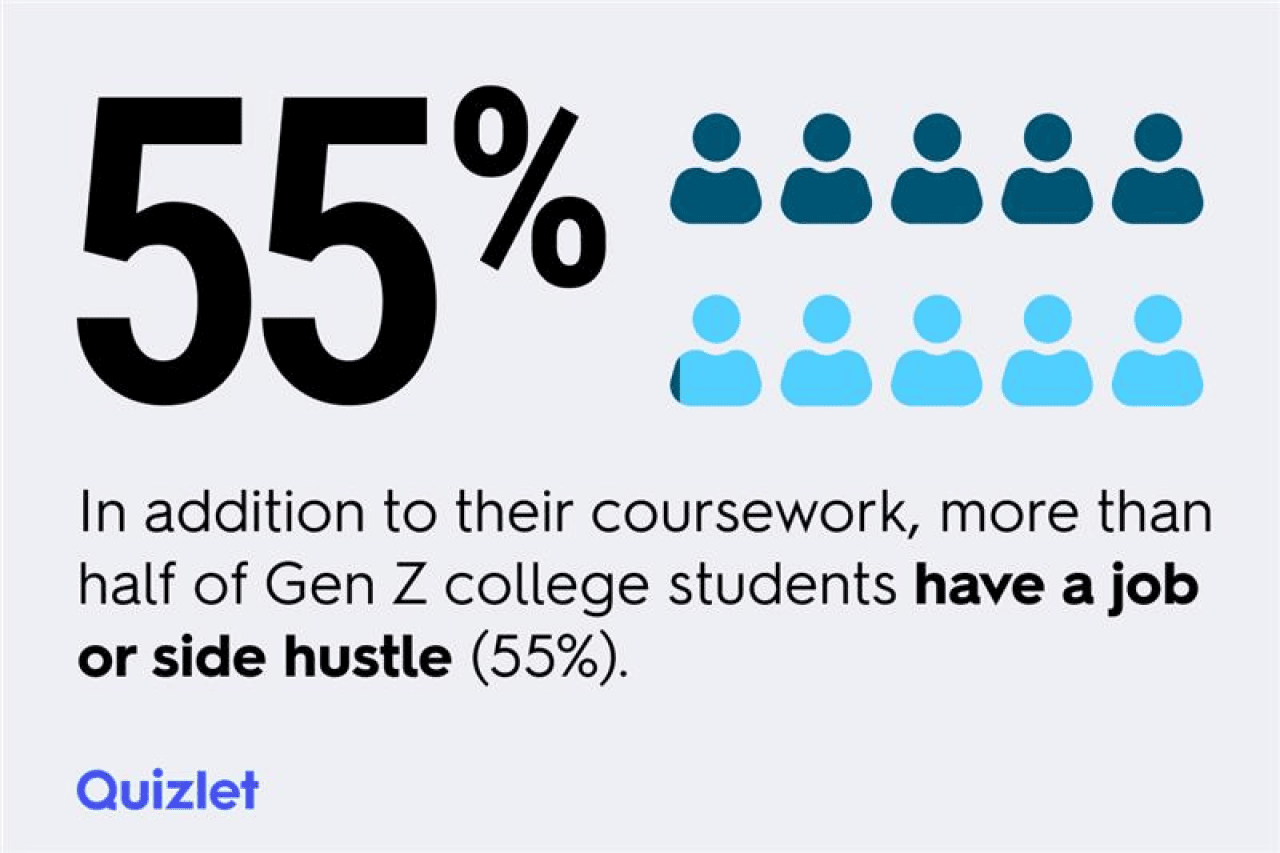
Infographic explaining that 55% of gen z students have a job outside of their coursework.

Quizlet

Students Are Stretched Thinner Than Ever

The survey reveals that modern college students are managing unprecedented levels of responsibility across multiple areas of their lives. More than half of Gen Z college students maintain a job or side hustle alongside their studies (55%). Among students participating in on-campus organizations — including honors societies, sports teams, Greek life and other groups — 58% are involved in two or more organizations.

Beyond formal commitments, Gen Z students actively pursue skill development in areas their coursework may not address. Nearly half (45%) focus on learning practical life skills such as cooking, budgeting and time management, while 44% work to develop social and interpersonal skills including leadership, teamwork and communication.

These multiple commitments create a generation that has learned to manage complex schedules, prioritize competing demands, and develop time management skills that may serve them well in future career environments.
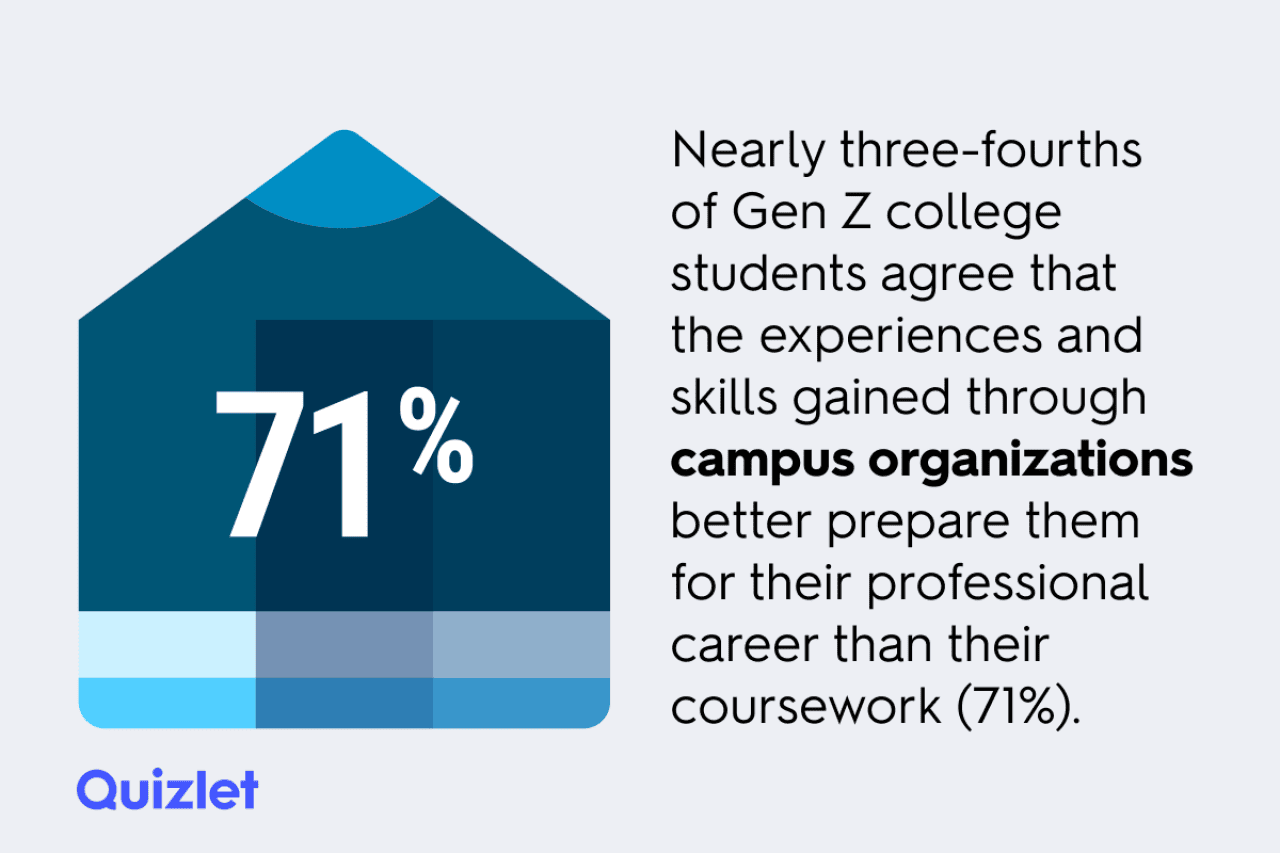
Infographic stating that 71% of Gen Z college students say their campus organization experience prepares them for their career more than their coursework.

Quizlet

Side Hustles Offer More Value Than Some Classes

Rather than viewing these responsibilities as distractions from education, students appear to see them as complementary to their academic goals. In fact, the survey data reveals a striking disconnect between traditional academic structures and what students perceive as most valuable for their career preparation. Nearly three-quarters of Gen Z college students involved in campus organizations (71%) believe the experiences and skills gained through these activities better prepare them for their professional career than their coursework.

This finding suggests students are making strategic calculations about where to invest their time and energy. While maintaining academic performance remains important, they’re recognizing that hands-on experiences, leadership opportunities and practical skill development may provide more tangible career benefits than some classroom learning.

The emphasis on nonacademic experiences aligns with Gen Z’s vision for the future of work, which prioritizes work-life balance and meaningful professional development. When asked about changes they hope to make in the workforce, 20% of respondents identified better work-life balance as their top priority, followed by higher pay or pay transparency (15%) and increased opportunities for career growth (13%).

This perspective on work-life balance represents a significant shift from previous generations’ approaches to career building. Instead of simply accepting traditional models of professional advancement that may require sacrificing personal time and well-being, Gen Z appears committed to creating sustainable career paths that align with their values and lifestyle goals.

Their preference for experiential learning and practical skill development also reflects an understanding that the modern workplace rewards adaptability, collaboration and real-world problem-solving abilities—qualities that may be better developed through internships, leadership roles and project-based work than through traditional lecture-based courses.
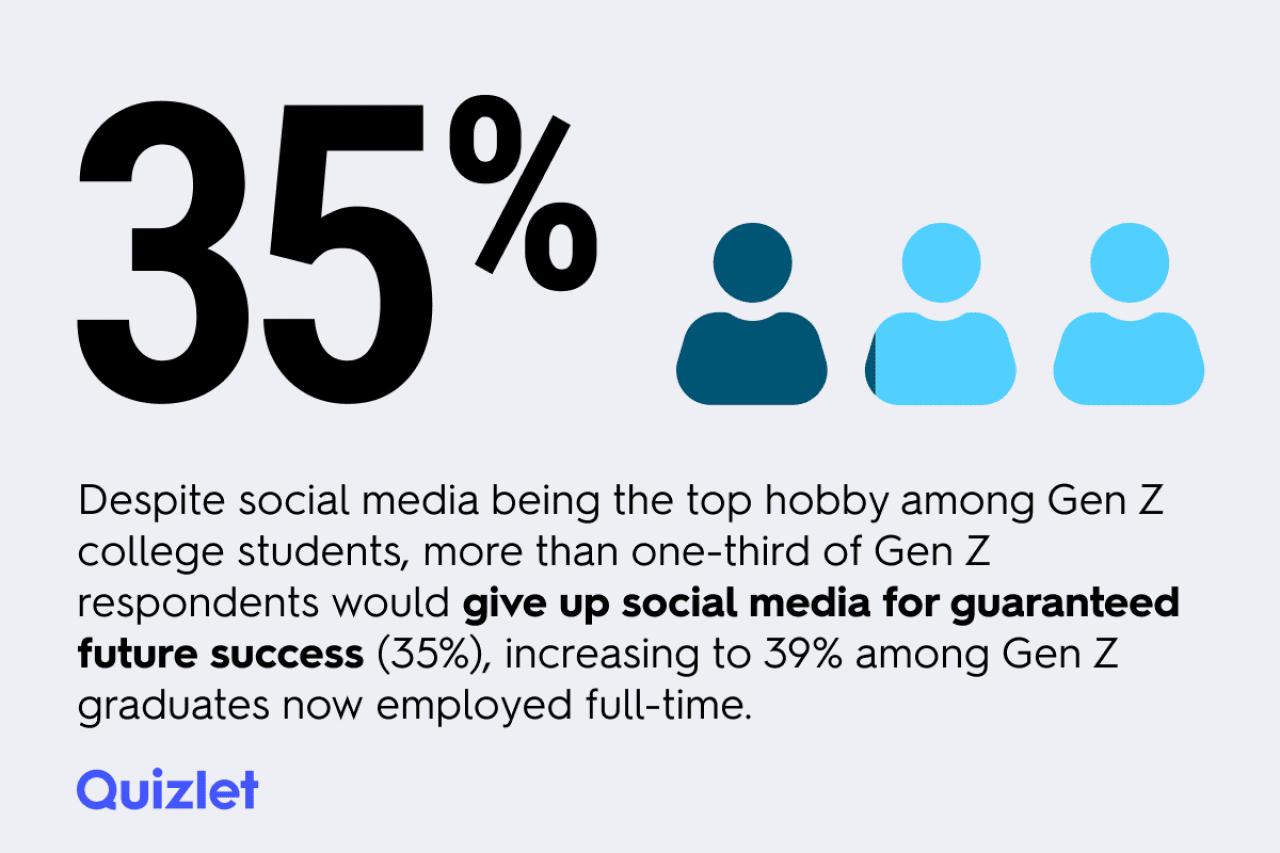
Infographic showing that 35% of gen z college students would give up social media for guaranteed future success, despite many enjoying it as a top hobby.

Quizlet

Students Are More Ambitious Than Older Generations Assume

Contrary to stereotypes about Gen Z’s priorities and work ethic, the survey reveals a generation with strong professional ambitions and strategic decision-making abilities. Two-thirds of Gen Z students (64%) would prioritize a professional opportunity over a social activity when faced with competing demands, demonstrating their commitment to career advancement even when it requires personal sacrifices.

Perhaps most surprisingly, despite social media ranking as the top hobby among Gen Z college students, more than one-third (35%) would give up social media entirely for guaranteed future success. This finding directly challenges assumptions about this generation’s relationship with technology and social platforms, suggesting they view these tools as optional rather than essential to their identity or well-being.

These choices reflect a level of strategic thinking and long-term planning that contradicts common narratives about Gen Z being impulsive, instant-gratification-focused, or unable to delay rewards for future benefits. Instead, the data shows students are willing to make significant lifestyle changes and social sacrifices to achieve their professional goals.

The willingness to prioritize professional development over social activities also suggests this generation may approach networking and relationship-building differently than their predecessors. Rather than viewing social connections as separate from professional advancement, they may be more likely to seek opportunities that combine social engagement with career development, such as professional organizations, industry events or skill-building workshops.

This ambitious mindset, combined with their experience managing multiple responsibilities and their focus on practical skill development, positions Gen Z as a generation that may bring valuable perspectives and capabilities to the workforce—if employers can recognize and leverage these strengths rather than focusing on generational stereotypes.

Methodology

Quizlet partnered with global research and communications firm Allison Worldwide, whose Performance+ Intelligence team surveyed 2,000 U.S. respondents between the ages of 18 and 28. Half of the respondents (1,000 individuals) are students currently enrolled in college, and half (1,000 individuals) have graduated from college within the last five years and are now working full time. The survey was fielded using Forsta and the panel was sourced from RepData. Fielding took place in August and September 2025.

This story was produced by Quizlet and reviewed and distributed by Stacker.

Topics:

Careers & Education


Entertainment

What it costs to live in America’s iconic holiday movie towns

What it costs to live in America’s iconic holiday movie towns
By Jamie Forbes for Redfin Real Estate
7 min read • Originally published December 17, 2025 / Updated March 19, 2026
By Jamie Forbes for Redfin Real Estate
7 min read • Originally published December 17, 2025 / Updated March 19, 2026

Person poses with the classic

Michael Gordon // Shutterstock

What it costs to live in America’s iconic holiday movie towns

Picture your favorite holiday movie. Maybe it’s a scene from “Home Alone” in Illinois, or one of the dozens of Hallmark films set in small-town New England (even though many are filmed in Canada). You probably remember them for their snow, romance, humor, and festive miracles — they may have even made you want to visit or live in the towns they depict.

But what are these places like in real life? If you were to move to one of these places today, could you afford to settle down, or would the price tag break the holiday spell?

Redfin Real Estate explores how affordable some of the most iconic movie towns really are. From timeless classics to contemporary hits, cozy up and take a snow-covered journey that may make you think about things a little differently.

1. “Home Alone” (1990) – Winnetka, Illinois

  • Median sale price: $1,758,000
  • Median household income: $250,000

You may remember the classic brick homes and snow-covered lawns of the “Home Alone” world, where Kevin fended off two bumbling burglars and learned to outsmart the grown-ups around him.

The movie is set in real-life Winnetka, Illinois, and on the surface, it might seem like a great place to live. But most people would have a hard time affording it. Homes regularly sell in the millions in this upscale suburb, and six-figure salaries are the norm. In fact, the real-life home of the fictional McCallister family, dubbed the “Home Alone house,” sold for $5.5 million in early 2025.

On the whole, Chicago is relatively affordable, but its suburbs are often wealthy and defined by classic American architecture.

2. “It’s a Wonderful Life” (1946) – Seneca Falls, New York

  • Median sale price: $260,000
  • Median household income: $54,400

This holiday classic is set in the fictional town of Bedford Falls, which is commonly thought to be based on Seneca Falls in Upstate New York — a quiet, snowy hamlet full of small-town charm. The real-life town even celebrates its Hollywood connection with a dedicated museum and large annual festival.

If you saw the movie’s quaint streets, string lights, and old-school charm and thought it would be a nice place to visit or live, you’re in luck. Seneca Falls’ median sale price is nearly half the national rate, similar to nearby cities like Rochester and Syracuse.

3. “A Christmas Story” (1983) – Cleveland, Ohio

  • Median sale price: $249,000
  • Median household income: $67,586

While the movie is set in 1940s Indiana, much of “A Christmas Story” was filmed in Cleveland, giving the city a permanent place in holiday movie history. The iconic house — now a museum — is tucked into the Tremont neighborhood just minutes from downtown. You can even spend the night and wake up in a pink bunny suit holding a Red Ryder BB gun, just like Ralphie dreamed.

For those interested in recreating the Christmas magic, Cleveland is a very affordable place to live, regularly ranking as one of the most affordable big cities in the country.

4. “Elf” (2003) – New York

  • Median sale price: $770,000
  • Median household income: $81,228

A more modern classic, “Elf” is all about discovering the magic of the Big Apple: towering Christmas trees, sparkling storefronts, and big-city holiday fun. It was filmed on location throughout NYC, giving it a real-world feel.

The Hobbs family’s home is located at 55 Central Park West, a landmarked building adjacent to Central Park. It’s a prime location for city living, but would be difficult to afford today — a studio condo costs nearly $800,000. And on the whole, New York is one of the most expensive cities in the nation.

Numerous other holiday movies have been set in New York over the years, including “Miracle on 34th Street” (1947), “Scrooged” (1988), and “Home Alone 2: Lost in New York” (1992).

5. “Romance at Reindeer Lodge” (2017) – Jamaica, Vermont

  • Median sale price: $400,000
  • Median household income: $71,364

Vermont has played host to plenty of holiday movies, but nearly all of them have been set in fictional places. “Romance at Reindeer Lodge” is one of the rare ones set in a lodge in the real-life town of Jamaica, Vermont — even though it was actually filmed in Connecticut. The movie is full of snowy landscapes and rustic charm.

Jamaica is a very rural town in mountainous southwestern Vermont, surrounded by ski resorts, parks, and quaint bed-and-breakfasts. It’s relatively affordable but primarily home to part-time residents or remote workers. Buying a house will cost around $400,000, which is just below the national rate.

6. “Christmas in Conway” (2013) – Wilmington, North Carolina

  • Median sale price: $470,000
  • Median household income: $63,165

“Christmas in Conway” is a quintessential Hallmark movie: small-town charm, big romantic gestures, and a lovestruck community. It was filmed throughout the Wilmington area, using its landmarks and coastal charm to bring the story to life.

Wilmington has actually served as the backdrop of numerous other Hallmark films, including “Christmas in Harmony” (2021) and “USS Christmas” (2020). The historic port city prides itself on its holiday spirit, especially along the Riverwalk, where trees, boats, and buildings are all adorned with thousands of lights and events are held nearly every day.

If the movie magic gave you the itch to make the move, Wilmington is thankfully a relatively affordable place to buy a house. The median sale price is just above the national average, and household incomes come close to matching the cost.

7. “A Biltmore Christmas” (2023) – Asheville, North Carolina

  • Median sale price: $450,000
  • Median household income: $78,996

Set in the Blue Mountains of North Carolina, “A Biltmore Christmas” follows a screenwriter researching a classic holiday film who magically steps into its world. It was filmed at the famous Biltmore Estate in Asheville, North Carolina.

The Biltmore Estate is a real-world escape to an age of romance and Gilded Age extravagance. It was commissioned by business tycoon George Vanderbilt in the late 19th century and today is the largest privately owned home in the U.S., at over 175,000 square feet. You can tour it year-round, and it is highly decorated for the holiday season.

If you fell in love with the movie and gorgeous scenery, you’re in luck: Asheville is moderately priced for the region, with home costs and incomes fairly well aligned.

8. “Christmas at Dollywood” (2019) – Pigeon Forge, Tennessee

  • Median sale price: $555,000
  • Median household income: $53,839

“Christmas at Dollywood” is a Hallmark classic about new beginnings and unexpected romance. The movie is set and filmed in the namesake Dollywood Parks & Resorts, which is located in Pigeon Forge near Tennessee’s Great Smoky Mountains.

The film mirrors reality in many ways: Dolly Parton plays herself as the park’s owner — she is the real-life part-owner — as the resort gears up for its Smoky Mountains Christmas festival, which is actually a beloved tradition in the region. Plus, it does snow in Pigeon Forge, as the movie depicts, although usually just for a day or so.

If the movie gave you the itch to move, it may be difficult to buy a house, unfortunately. Pigeon Forge is more expensive than nearby major cities like Knoxville, and the median sale price is about $100,000 above the national average.

9. “The Polar Express” (2004) – Durango, Colorado

  • Median sale price: $733,000
  • Median household income: $79,545

“The Polar Express” is a fantastical film full of childlike curiosity and believing in the impossible, and that spirit carries into the real world, too: You can actually ride the famous train. Running from mid-November through the new year, the train leaves from Durango, Colorado, and takes passengers on a festive 75-mile journey to the “North Pole” (Silverton, Colorado).

Other “Polar Express” recreations occur throughout the country, from Chicago to St. Louis, but Durango’s is iconic because of its snow, landscape, and magical destination.

Buying a house in this winter wonderland may prove difficult, though, as the median sale price of a home is nearly twice the national average. Incomes don’t come close to meeting the affordability threshold, either.

10. Most Other Holiday Movies – Towns in Connecticut

  • Median sale prices: $278,000 to $2,238,000
  • Median household incomes: $41,972 to $250,000+
  • Statewide median sale price: $460,000
  • Statewide median household income: $91,665

If there were one state synonymous with modern Christmas movies, it would be Connecticut. Over the years, 22 films have been filmed throughout the state, including “Christmas on Honeysuckle Lane” (2018), “One Royal Holiday” (2020), and “The Noel Diary” (2022). “Christmas in Connecticut” (1945) was arguably the first movie to bring the holiday spirit to the state.

It’s not hard to see why Hollywood likes the Constitution State. Historic towns like Stamford, Norwich, Hartford, and New London offer perfect backdrops for holiday magic, with storybook architecture and snowy New England charm. You can actually take a tour of all 42 towns and villages in Connecticut where holiday movies have been filmed to fully indulge in the wonder.

If you fell in love with the region’s colonial charm, you’ll be pleased to know that many areas of Connecticut come at lower costs, like Woodstock and Groton. On the flip side, Darien and Stamford are among the most expensive places, with prices and incomes far above the statewide median.

Methodology

Housing market data comes from Redfin as of November 2025. Income data comes from the U.S. Census Bureau’s 2023 American Community Survey 5-Year Estimates.

This story was produced by Redfin Real Estate and reviewed and distributed by Stacker.

Topics:

Entertainment
Careers & Education

Gen Z earnings premium: Cities where young workers are excelling

Gen Z earnings premium: Cities where young workers are excelling
By Jaclyn DeJohn, CFP for SmartAsset
4 min read • Originally published December 18, 2025 / Updated March 19, 2026
By Jaclyn DeJohn, CFP for SmartAsset
4 min read • Originally published December 18, 2025 / Updated March 19, 2026

An aerial view of Hollywood Beach, Florida on a clear day.

Felix Mizioznikov // Shutterstock

Gen Z earnings premium: Cities where young workers are excelling

While some members of Gen Z may still be working entry-level jobs while attending high school or college, much of this cohort has now entered the workforce in earnest. As the least experienced generation on the schedule, Gen Z is generally paid less than their older counterparts, with this holding true in 93% of cities. But in a handful of locations, Gen Z offers skills and expertise — and sometimes youth itself — that help these workers pull ahead against the odds and earn more than older generations.

With this in mind, SmartAsset ranked 354 of the largest U.S. cities based on the percentage difference between the local median income for people aged 15 to 24 compared to the rest of the local population.

Key Findings

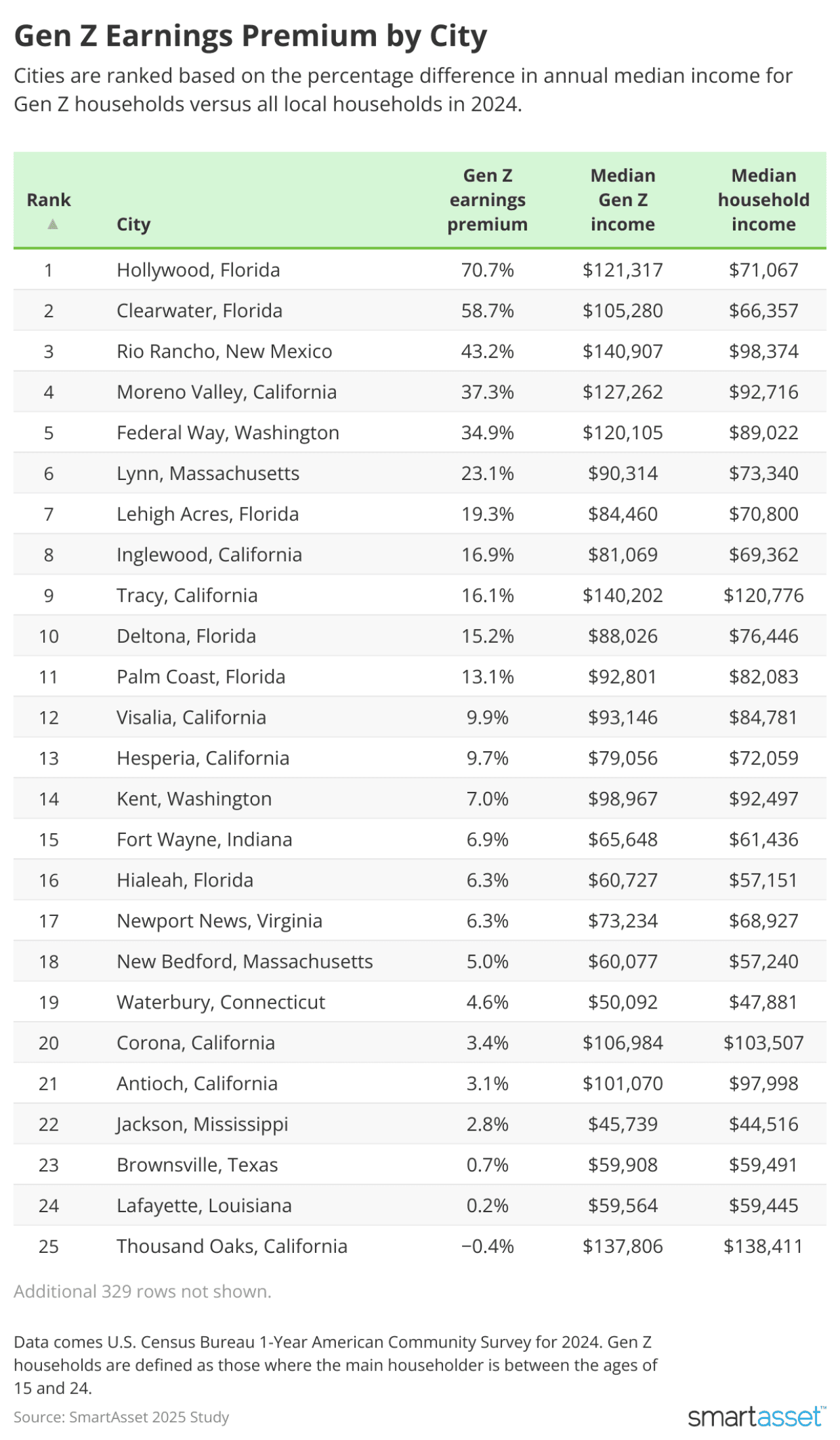
  • Gen Z earns a 70% premium in Hollywood, Florida. The median Gen Z household earned $121,317 in Hollywood in 2024, compared to $71,067 for all households — a 70.7% difference. Clearwater, Florida, has the second-highest advantage for Gen Z households with a 58.7% disparity. Young households earned $105,280 compared to a $66,357 median across all households.
  • In all, Gen Z out-earns other generations in 7% of cities. While it’s rare for young up-and-comers to outperform older households for income, some economic dynamics make it possible. Studywide, Gen Z had a positive earnings premium in 24 out of 354 cities, with roughly half in Florida or California. Others include Federal Way, Washington; Lynn, Massachusetts; Kent, Washington; Fort Wayne, Indiana; Newport News, Virginia; Jackson, Michigan; and Brownsville, Texas, among others.
  • The median Gen Z income in this city is over $160,000. Gen Z earns the most in Sunnyvale, California, where the median income for that age group is $162,486. However, this is 10.2% lower than the median income across all households in this high-earning city ($181,022). This negative earnings premium puts Sunnyvale at the 37th best overall for Gen Z’s earnings.
  • The median Gen Z income is less than $50,000 in more than half of cities. For most young people, income tends to be lower than across all households. People aged 15 to 24 are generally at the bottom of the earnings totem poll. In fact, the median Gen Z income is lower than the 2024 U.S. median household income in 91% of cities surveyed.

A list of 25 U.S. cities ranked based on the percentage difference in annual median income for Gen Z households versus all local households in 2024.

SmartAsset

24 Cities Where Gen Z Makes More Than the Median Household

Out of 354 cities, Gen Z earns more than their older counterparts in just a handful of places.

  1. Hollywood, Florida
  • Gen Z earnings premium: 70.71%
  • Median Gen Z income: $121,317
  • Median household income: $71,067
  1. Clearwater, Florida
  • Gen Z earnings premium: 58.66%
  • Median Gen Z income: $105,280
  • Median household income: $66,357
  1. Rio Rancho, New Mexico
  • Gen Z earnings premium: 43.24%
  • Median Gen Z income: $140,907
  • Median household income: $98,374
  1. Moreno Valley, California
  • Gen Z earnings premium: 37.26%
  • Median Gen Z income: $127,262
  • Median household income: $92,716
  1. Federal Way, Washington
  • Gen Z earnings premium: 34.92%
  • Median Gen Z income: $120,105
  • Median household income: $89,022
  1. Lynn, Massachusetts
  • Gen Z earnings premium: 23.14%
  • Median Gen Z income: $90,314
  • Median household income: $73,340
  1. Lehigh Acres, Florida
  • Gen Z earnings premium: 19.29%
  • Median Gen Z income: $84,460
  • Median household income: $70,800
  1. Inglewood, California
  • Gen Z earnings premium: 16.88%
  • Median Gen Z income: $81,069
  • Median household income: $69,362
  1. Tracy, California
  • Gen Z earnings premium: 16.08%
  • Median Gen Z income: $140,202
  • Median household income: $120,776
  1. Deltona, Florida
  • Gen Z earnings premium: 15.15%
  • Median Gen Z income: $88,026
  • Median household income: $76,446
  1. Palm Coast, Florida
  • Gen Z earnings premium: 13.06%
  • Median Gen Z income: $92,801
  • Median household income: $82,083
  1. Visalia, California
  • Gen Z earnings premium: 9.87%
  • Median Gen Z income: $93,146
  • Median household income: $84,781
  1. Hesperia, California
  • Gen Z earnings premium: 9.71%
  • Median Gen Z income: $79,056
  • Median household income: $72,059
  1. Kent, Washington
  • Gen Z earnings premium: 6.99%
  • Median Gen Z income: $98,967
  • Median household income: $92,497
  1. Fort Wayne, Indiana
  • Gen Z earnings premium: 6.86%
  • Median Gen Z income: $65,648
  • Median household income: $61,436
  1. Hialeah, Florida
  • Gen Z earnings premium: 6.26%
  • Median Gen Z income: $60,727
  • Median household income: $57,151
  1. Newport News, Virginia
  • Gen Z earnings premium: 6.25%
  • Median Gen Z income: $73,234
  • Median household income: $68,927
  1. New Bedford, Massachusetts
  • Gen Z earnings premium: 4.96%
  • Median Gen Z income: $60,077
  • Median household income: $57,240
  1. Waterbury, Connecticut
  • Gen Z earnings premium: 4.62%
  • Median Gen Z income: $50,092
  • Median household income: $47,881
  1. Corona, California
  • Gen Z earnings premium: 3.36%
  • Median Gen Z income: $106,984
  • Median household income: $103,507
  1. Antioch, California
  • Gen Z earnings premium: 3.13%
  • Median Gen Z income: $101,070
  • Median household income: $97,998
  1. Jackson, Mississippi
  • Gen Z earnings premium: 2.75%
  • Median Gen Z income: $45,739
  • Median household income: $44,516
  1. Brownsville, Texas
  • Gen Z earnings premium: 0.7%
  • Median Gen Z income: $59,908
  • Median household income: $59,491
  1. Lafayette, Louisiana
  • Gen Z earnings premium: 0.2%
  • Median Gen Z income: $59,564
  • Median household income: $59,445

Data and Methodology

Data comes from the U.S. Census Bureau 1-Year American Community Survey for 2024. The median household income for households where the main householder is aged 15 to 24 is compared to the median household income across all local households to determine the Gen Z earnings premium. Data for 354 U.S. cities with a population over 100,000 was available.

This story was produced by SmartAsset and reviewed and distributed by Stacker.

Topics:

Careers & Education

Careers & Education

Keep getting texts about job offers? Don’t fall for this common scam

Keep getting texts about job offers? Don’t fall for this common scam
By Dan Ketchum for Spokeo
5 min read • Originally published December 23, 2025 / Updated March 19, 2026
By Dan Ketchum for Spokeo
5 min read • Originally published December 23, 2025 / Updated March 19, 2026

A person about to hit send to a message on their phone that says,

Celia Ong // Shutterstock

Keep getting texts about job offers? Don’t fall for this common scam

Scammers love to prey on hope, and with a 4.3 percent unemployment rate in the U.S. as of August 2025, they’ve got a lot of hopeful job seekers to pounce on. No matter the economic environment, though, job offer scams are a perennial favorite of sketchy grifters — the latest model just so happens to come in the form of a fake job text message, and it can seem rather convincing, too.

Got a text out of the blue about a potential job at your dream company? If it’s an opportunity that sounds too good to be true, that’s because it probably is. Spokeo explains how to know for sure.

Key Takeaways:

  • Text-based job offer scams are on the rise.
  • The latest job offer scams pose as recruiters or dream companies offering cushy jobs.
  • They’re actually phishing scams out to get your valuable private information.

Job Text Scams: How They Work

The latest string of job offer scams has gotten so prevalent that the Federal Trade Commission issued a warning to help keep job hunters from getting their hearts broken and their bank accounts drained. The most recent popular iteration of the scam is a fake job text message from a phony “recruiter” or a dream job-worthy company. Here’s how it works:

  1. Victims get an unsolicited text, seemingly out of the blue.
  2. Said text claims to be from a job recruiting service, such as Indeed or ZipRecruiter, or from a popular company with dream job vibes (think Netflix or Apple) and often describes a cushy-sounding gig with a nice pay rate.
  3. The job description will be vague and suspiciously easy to fulfill. Slate describes a common example seeking “remote product testers” who only need to work for an hour or two a day to earn up to $400 daily by “reviewing new products or services online.” NPR, meanwhile, came across one that offered pay just for listening to songs on Spotify. Both are bogus.
  4. Once you apply, the scammers will let you know you’ve been “hired” (spoiler: everyone gets the “hired”), at which point they will ask for all sorts of sensitive private information (bank info, social security number, etc.).
  5. Alternatively, the link is just a phishing link, aimed at gathering your private information or installing malware onto your device.

What Do They Want?

Crooks aren’t sending out fake job text messages for fun. By and large, job offer scams are designed to obtain your valuable private information as a form of phishing. If you get lured in and respond to a job text scam, the scammer will most likely attempt to move you on to an “application” phase. Typically, this happens via a professional-looking online form, email, or an external chat app, like iMessage or WhatsApp. In order to “apply,” you’ll be prompted to provide sensitive, private information, which the grifter can then use to commit identity theft, most likely in an attempt to access your finances.

In some versions of job offer scams, the scammer will even offer to give you a portion of your future paycheck upfront, but to do so, they’ll need your bank account information. Of course, in the end, you’ll be the one paying them, against your will. In either case, your best bet is to avoid responding, period — block and report job text scams on sight.

How to Know If a Job is a Scam

When it comes to fake job text messages, the usual giveaways still apply. Things like typos, fishy-looking links or email domains (look for slight misspellings of real company or brand names, like “Inedeed” dot com instead of “Indeed” dot com), or “act now!” pressure tactics should make you give a very stern side-eye.

But on a level more specific to these text-based job offer scams from “recruiters,” keep your eyes peeled for these potential red flags:

  • The job description sounds a little too easy, a little too well paid, or a little too good to be true.
  • It’s a job you didn’t apply for or appears to be from a recruiter you haven’t used.
  • The text is sent as part of a group chat, with multiple people gassing up the apparent company or job offer.
  • The text directs you to external platforms like WhatsApp, iMessage, or WeChat.
  • The texter has a non-U.S. country code. For instance, +91 is a message from India, while +63 is from the Philippines — both countries known for having high scam text activity.
  • If an email address is given, the domain is a personal or free service, like “@gmail.com” or “@yahoo.com” instead of an official company domain.
  • The recruiter is one you’ve never heard of, and a Google search for said “recruiter” comes up dry or produces accounts of previous scams.
  • The sender asks for any sort of private information before you have an interview.
  • You’re immediately “hired” without any form of a legitimate interviewing process.

Frequently Asked Questions About Job Scam Texts

Just like a real job interview, the much phonier world of job text scams elicits a lot of questions, and reasonably so. Here are some of the most common queries people search for when it comes to job offer scams.

Is it legal for your employer to text you?

Yes, though some states have proposed “right-to-disconnect” laws that could limit employer texts outside of business hours. However, the keyword here is “employer,” not random recruiters or job offers out of the ether.

Is it normal for jobs to text you?

While recruiting sites that you actually signed up for may send automated texts if you opted in to them, most legit employers do not send job offers via text — especially some of the bigger and shinier companies that job text scams like to name drop.

How do you report fake job offers?

When you block the number (and you should block the number), make sure to mark it as spam to help improve automatic spam detection for others across the board. You can also forward the text to 7726 (“SPAM”) or file a report at ReportFraud.ftc.gov.

This story was produced by Spokeo and reviewed and distributed by Stacker.

Topics:

Careers & Education

Business Basics

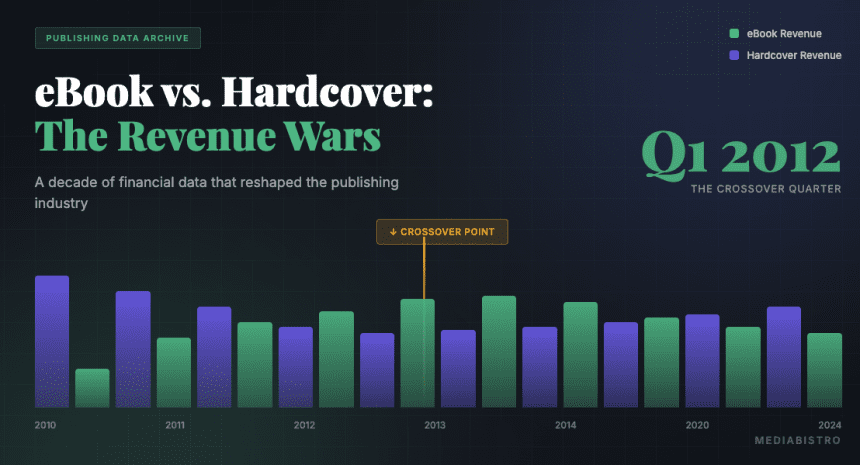
The Digital Disruption (2010–2014): When the Numbers Started Moving

ebook vs. hardcover graphc
By Mediabistro Education
7 min read • Originally published January 2, 2026 / Updated March 19, 2026
By Mediabistro Education
7 min read • Originally published January 2, 2026 / Updated March 19, 2026

The first quarter of 2012 marked a watershed moment in publishing history. For the first time, net sales revenue from eBooks surpassed hardcover books in the United States—a shift that industry analysts had been predicting, dreading, or championing for half a decade.

According to the Association of American Publishers (AAP) March 2012 net sales revenue report, adult eBook sales reached $282.3 million while adult hardcover sales totaled $229.6 million. The digital insurgency had officially breached the castle walls.

But the story of how publishing arrived at that inflection point—and where it went afterward—reveals a more nuanced narrative than the “death of print” headlines suggested. This resource chronicles the financial data, market dynamics, and industry pivots that defined the Format Wars era and shaped the publishing landscape that professionals navigate today.

The Digital Disruption (2010–2014): When the Numbers Started Moving

2010: The Year Everything Changed

Amazon’s Kindle had been on the market since 2007, but 2010 was the year the publishing industry’s economic foundations began to visibly crack.

In July 2010, Amazon reported that Kindle book sales had surpassed the company’s total hardcover sales. The announcement sent tremors through boardrooms from midtown Manhattan to Frankfurt. By year’s end, eBook revenues tracked by the AAP had reached $446.3 million—still a fraction of the print market, but growing at triple-digit rates.

The same year brought Apple’s iPad and, with it, the agency pricing model that would reshape the economics of digital publishing. Under the agency model, publishers—not retailers—set consumer prices, keeping 70% of proceeds while retailers took a 30% commission. This was a direct challenge to Amazon’s wholesale model and its aggressive $9.99 price point for bestsellers.

Five major publishers—Hachette, HarperCollins, Macmillan, Penguin, and Simon & Schuster—adopted agency pricing for eBooks sold through Apple’s iBookstore. The move was designed to solve what industry insiders called “the $9.99 problem”: Amazon’s deep discounting was capturing market share while conditioning consumers to expect digital books at prices that, publishers argued, devalued the written word.

The strategy worked in the short term. Other retailers saw their margins protected, and Amazon’s stranglehold on eBook market share loosened slightly. But the legal consequences would prove severe.

2011: The 117% Surge

The numbers from 2011 were staggering. Despite some slowdown in the fourth quarter, eBook sales rose 117% for the full year, generating revenue of $969.9 million at companies reporting to the AAP—more than double the $446.3 million recorded in 2010.

The print market moved in the opposite direction. Adult trade hardcover revenue fell 17.5% to $1.29 billion. Adult trade paperback dropped 15.6% to $1.17 billion. The mass-market paperback category—those drugstore rack novels—lost 36% of its value.

Within adult fiction specifically, eBooks became the largest single format, surpassing hardcover, trade paperback, and mass market paperback. Digital sales in the category hit $1.27 billion, representing 30% of segment revenue.

Amazon announced in April 2011 that customers were choosing Kindle books more often than print: for every 100 print books sold, 105 Kindle eBooks moved. The psychological barrier had fallen.

Yet for all the disruption, Q1 2011 still showed hardcover ahead of eBooks in aggregate revenue: $335 million versus $220.4 million. The crossover hadn’t happened yet.

2012: The Pivot Point

The first quarter of 2012 delivered the data point that launched a thousand think pieces. The AAP’s March report, collecting data from 1,189 publishers, confirmed what many had anticipated: adult eBook net sales ($282.3 million) exceeded adult hardcover net sales ($229.6 million).

The swing represented a $167.3 million shift in relative position within a single year.

For the professionals tracking these numbers—acquisition editors, sales directors, literary agents, and authors negotiating contract terms—the implications were immediate. Royalty calculations shifted. Advance models required revision. Backlist strategy transformed as older titles with minimal print inventory became valuable digital assets. Rights negotiations intensified as the value of digital rights in territorial deals increased substantially.

The same year brought legal reckoning for the agency model. The Department of Justice filed an antitrust lawsuit against Apple and the five publishers who had adopted agency pricing, charging them with conspiracy to raise eBook prices. Three publishers settled immediately. The remaining two followed. Apple fought the charges, lost, and ultimately agreed to a $450 million settlement.

2013–2014: The Plateau Emerges

By 2013, the growth rate for eBooks had begun to moderate. Digital still captured 21% of trade sales—rising to 23.3% by year’s end—but the exponential curves of 2010–2011 had flattened.

Several factors contributed to the stabilization. Device saturation meant the early adopters who drove Kindle and Nook sales had already converted. Price normalization following the agency settlement narrowed the cost advantage over print. Genre differentiation emerged as romance, mystery, and science fiction readers embraced digital formats at higher rates than literary fiction audiences. And the resurgence of independent bookstores—written off as casualties of the Amazon era—began a slow revival that reinforced the value of physical books.

The Q1 Revenue Milestones: A Close Analysis

The Q1 periods of 2011 and 2012 represent the hinge point of the Format Wars. Understanding the specific dynamics of these quarters illuminates why this data became the most-cited reference in the publishing industry.

Q1 2011: The Last Quarter of Print Dominance

In the first quarter of 2011, the old order still held. Adult hardcover generated $335 million while adult eBooks brought in $220.4 million—a gap of $114.6 million in hardcover’s favor.

This data point represented the publishing industry’s last stand. Hardcover—the flagship format, the revenue driver for frontlist titles, the format that commanded premium shelf space and gift-giving prestige—still outperformed its digital challenger.

But the trend lines told a different story. Q1 2011’s hardcover figure was already down significantly from prior years. And the eBook number, while lower in absolute terms, reflected growth rates that print could not match. Industry executives monitoring the AAP reports understood the crossover was imminent. The only questions were when and how publishers would respond.

Q1 2012: The Crossover Quarter

Twelve months later, the positions had reversed. Adult eBooks hit $282.3 million (up 28% year-over-year) while adult hardcover fell to $229.6 million (down 31% year-over-year). The gap: $52.7 million in eBooks’ favor.

The Q1 2012 data didn’t just record a milestone—it forced operational changes across the industry within months of its release.

Historical Quarterly Revenue Milestones

The following table summarizes the key financial shifts in U.S. publishing during the Format Wars era. All figures represent net sales revenue reported to the Association of American Publishers.

Period Adult Hardcover Revenue Adult eBook Revenue eBook Growth (YoY) Market Event
Q1 2010 $394 million $91 million +252% iPad launches; agency pricing introduced
Full Year 2010 $1.57 billion $446.3 million +164% Amazon reports Kindle outselling hardcover
Q1 2011 $335 million $220.4 million +142% Amazon: eBooks outsell all print combined
Full Year 2011 $1.29 billion $969.9 million +117% DOJ investigation of agency pricing begins
Q1 2012 $229.6 million $282.3 million +28% eBooks surpass hardcover for first time
Full Year 2012 $1.12 billion $1.54 billion +59% Agency pricing lawsuit settlements
Q1 2013 $247 million $298 million +6% Growth rate moderation begins
Full Year 2013 $1.15 billion $1.61 billion +5% eBooks reach 23.3% of trade sales
Full Year 2014 $1.19 billion $1.49 billion -7% First annual eBook revenue decline

Source: Association of American Publishers StatShot reports

The Current State of the Market: Stability After the Storm

The publishing industry of 2025 bears little resemblance to the chaotic transition years of 2010–2014. The Format Wars have ended—not with a decisive victory for either side, but with an entrenched equilibrium.

The Numbers Today

According to the AAP’s StatShot Annual Report, U.S. publishing revenues totaled $32.5 billion in calendar year 2024, an increase of 4.1% from $31.3 billion in 2023. Between 2020 and 2024, total industry sales increased 22.1%.

The format breakdown reveals print’s enduring dominance. Print formats (hardback, paperback, mass market, special bindings) account for 50.5% of publisher revenue. Digital formats (eBooks and digital audio) account for 14% of all revenue, with eBooks generating $2.1 billion—approximately 10% of trade revenue.

For trade publishers focusing on consumer books, print’s share is even more pronounced: physical formats account for over 75% of trade revenue.

The most significant shift since the Format Wars hasn’t been eBook growth but audiobook expansion. Digital audio revenue grew 78.1% between 2020 and 2024. By 2024, audiobooks (11.3% of trade formats) had surpassed eBooks (10%) in market share—a development few analysts predicted during the Kindle fever of 2011.

Why Print Survived

The persistence of print books defied the predictions of many technology observers, who expected digital formats to dominate publishing, as they had in music. Several factors explain the difference.

Unlike music, which consumers experience identically across formats, the reading experience differs meaningfully between print and digital. Page feel, marginalia, spatial memory of text location, and the absence of notification interruptions create value that digital cannot replicate for many readers.

Print books also serve social and decorative functions beyond their content. Bookshelves communicate identity. Gift-giving favors physical items. The Instagram-era valorization of “shelfies” reinforced print’s cultural status.

As digital interfaces colonized work and communication, many readers sought print as refuge from screens—a dynamic accelerated by the pandemic’s forced migration to remote work. Meanwhile, independent bookstores, which grew from approximately 1,400 American Booksellers Association members in 2009 to over 2,400 by 2024, serve as community hubs that reinforce the value of physical books.

The New Equilibrium

For media professionals navigating today’s publishing landscape, the key insight from the Format Wars is that format preferences are not zero-sum. The industry evolved from “eBooks will kill print” panic to a stable multi-format ecosystem where print dominates literary fiction and illustrated books, eBooks maintain strong positions in genre fiction (particularly romance and mystery), and audiobooks represent the primary growth vector for nonfiction and commuter-friendly content.

Format choice often varies by title rather than by reader—the same consumer might buy a cookbook in hardcover, read a thriller as an eBook, and listen to a memoir as an audiobook.

The revenue data from Q1 2012 remains historically significant because it marks the moment digital and physical formats reached parity. But the subsequent decade proved that parity was the destination, not a waypoint on the road to digital dominance.

Topics:

Business Basics
Entertainment

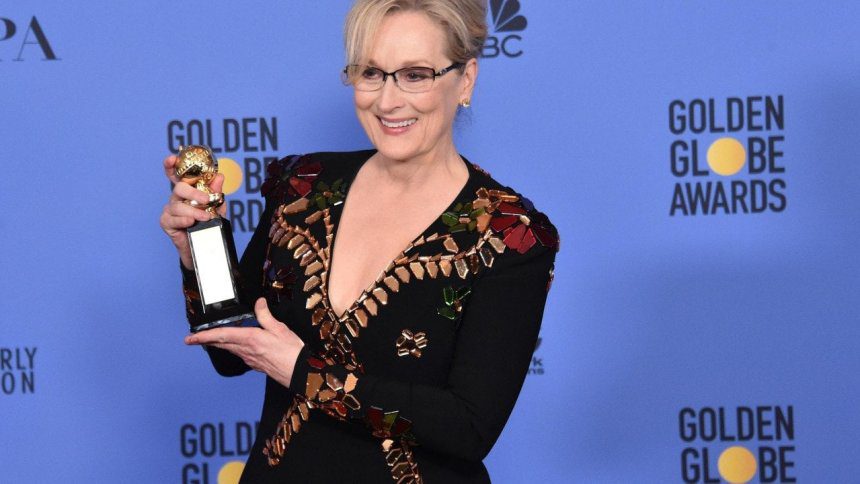
Actors with the most Golden Globe wins of all time

Actors with the most Golden Globe wins of all time
By Jody Ellis
8 min read • Originally published January 6, 2026 / Updated March 19, 2026
By Jody Ellis
8 min read • Originally published January 6, 2026 / Updated March 19, 2026

Actors with the most Golden Globe wins of all time

The Golden Globes are eagerly anticipated every year by stars and fans alike as the world waits to see who will take home the coveted awards. Established in 1944 by the Hollywood Foreign Press Association, the awards were created to recognize achievements in entertainment for both foreign and domestic films and television. It started as a more casual affair, taking place at 20th Century Fox Studios as an informal lunch, but has evolved into a prestigious and significant event.

In addition to the Golden Globe awards, the HFPA also created the Cecil B. DeMille Award, first presented to the director and producer in 1952 and honoring outstanding contributions to the entertainment industry. Winners of Cecil B. DeMille awards include Hollywood legends Judy Garland, Alfred Hitchcock, and Walt Disney.

The Globes also had a special Henrietta Award, created in 1951 for the Foreign Press Association of Hollywood’s World Film Favorite Festival, that became part of the Globes in 1954 until it was retired in 1980. Winners have included Sophia Loren, Jane Fonda, and John Travolta. More recently, the Globes created the Carol Burnett Award, which honors excellence in television. It was presented to Burnett at the 2019 awards ceremony, and 2023’s honoree will be actor and comedian Eddie Murphy.

Actors, writers, and directors all vie to be recognized, and a Golden Globe nomination or win is considered a high achievement. As we await the results of this year’s award show, which takes place on Jan. 11, Stacker looked at who has won the most Golden Globes in Hollywood history. Using 2025 data collected from the Golden Globes website, we compiled wins and nominations for the most decorated actors of all time, ranking them by wins, with ties broken by nominations. Lifetime achievement awards or similar honors were not included.

#22. Robin Williams

– Wins: 4
– Nominations: 10

Beloved funnyman Robin Williams got his start on the television series “Mork and Mindy.” Williams’ portrayal of a quirky alien from another galaxy netted him his first win. He went on to enjoy a long career in film, with multiple nominations and awards for his performances in movies such as 1987’s “Good Morning, Vietnam” and the 1993 comedy “Mrs. Doubtfire.”

#21. Peter O’Toole

– Wins: 4
– Nominations: 11

British-born actor Peter O’Toole was dashing in the classic 1962 film “Lawrence of Arabia,” for which he won his first Golden Globe as New Star of the Year. O’Toole received awards for his roles in other iconic films, such as 1965’s “Beckett” and 1968’s “The Lion in Winter.” 

#20. James Garner

– Wins: 4
– Nominations: 12

James Garner’s long history of Golden Globe wins and nominations started in 1958 when he won New Star of the Year for his role in the movie “Sayonara,” in which he starred with Marlon Brando and Red Buttons. Garner eventually moved to the small screen, where he became well known for his roles in the series “The Rockford Files” and “Maverick.” He was nominated multiple times for Best Actor awards for both series, but didn’t win another Golden Globe until his 1986 performance in the limited series “Promise.”

#19. Michael J. Fox

– Wins: 4
– Nominations: 13

Michael J. Fox became a household name during his tenure on the hit television series “Family Ties,” which garnered him several Golden Globe nominations and one win. But his work on the TV series “Spin City,” where he portrayed Mike Flaherty, the deputy mayor of New York City, gave him the most wins. Fox won three Golden Globes for the role and was nominated four more times.

You may also like: 50 of the best albums by LGBTQ musicians

#18. Al Pacino

– Wins: 4
– Nominations: 19

Al Pacino won his first Golden Globe in 1973 for his role as mobster Michael Corleone in the 1972 film “The Godfather.” The movie practically swept the Golden Globes and the Oscars, putting Pacino in the spotlight and cementing what has become a memorable career. Pacino has since been nominated for multiple Golden Globes for his various roles, including the 2020 Best Supporting Actor Award for the Netflix movie “The Irishman” and the 2021 Best Television Actor for the drama series “Hunters.” Pacino also won the coveted Cecil B. DeMille Award.

#17. Jack Lemmon

– Wins: 4
– Nominations: 22

Jack Lemmon spent the bulk of his adult life in the spotlight, with more than 60 films to his credit and multiple television productions. Along with his many nominations and wins, Lemmon was honored with a Cecil B. DeMille Award. 

#16. Ed Asner

– Wins: 5
– Nominations: 11

Playing the gruff but lovable character of Lou Grant, first on the television series “The Mary Tyler Moore Show” and then its spinoff, “Lou Grant,” Ed Asner has been a familiar face on American television for decades. He won four Golden Globes for his roles on both shows and a Best Supporting Actor Award for the 1976 limited TV series, “Rich Man, Poor Man.” Asner continued working in the industry, doing voiceover work in TV and movies, including Pixar’s hit film “Up,” until his death in August 2021.

#15. Dustin Hoffman

– Wins: 5
– Nominations: 13

No one who’s seen the movie “The Graduate” could forget Dustin Hoffman’s poignant and riveting performance, and it’s no surprise that his role in the movie gave him his first two Golden Globe wins, netting him both the New Star of the Year Award and Best Actor Award. Along with his Golden Globe nominations and wins, Hoffman earned the Cecil B. DeMille Award.

#14. Kate Winslet

– Wins: 5
– Nominations: 14

Most remember Kate Winslet as the lovelorn character Rose in the hit movie “Titanic,” which earned her a Best Actress nomination at The Golden Globes. But before “Titanic” put her on the map as an actor, she was nominated for her role in the 1995 film “Sense and Sensibility.” Winslet took home her first two Golden Globes in 2009, for her roles in the movies, “The Reader” and “Revolutionary Road.” She’s since been nominated for and won awards for multiple roles in both film and television, including her 2022 Best Actress, Limited Series, Anthology Series or Television Motion Picture win for “Mare of Easttown.”

#13. Carol Burnett

– Wins: 5
– Nominations: 16

Comedian and actor Carol Burnett has been nominated and has won several Golden Globes for her roles on both the big and small screens. She starred in her own television comedy show, “The Carol Burnett Show” from 1967 to 1978, which earned her five Golden Globes. She also was nominated for her work in feature films such as “Annie” and “The Four Seasons.” In 2018, The Golden Globes created the “Carol Burnett Award” for excellence in television. Burnett was the first recipient in 2019.

#12. Jessica Lange

– Wins: 5
– Nominations: 17

Jessica Lange got her start working alongside none other than the legendary King Kong, starring in the 1976 remake of the movie and winning her first Golden Globe for New Star of the Year. Lange has since been nominated for her performances in a wide range of feature films and TV series. Her latest roles include parts on the “American Horror Story” television series, as well as playing Joan Crawford in the 2017 TV series, “Feud.”

#11. Shirley MacLaine

– Wins: 5
– Nominations: 19

Originally trained as a dancer, Shirley MacLaine made her first foray into acting in the 1955 movie, “The Trouble with Harry,” an Alfred Hitchcock film. Her performance earned her a win for New Star of the Year.

#10. Angela Lansbury

– Wins: 6
– Nominations: 15

London native Angela Lansbury successfully moved among film, stage, and television throughout her career, with multiple awards in all mediums. Her performance in the 1945 movie “The Picture of Dorian Gray” won her a Golden Globe for Best Supporting Actress, as did her role in “The Manchurian Candidate.” But it was her starring role in the hit television series “Murder She Wrote” that gave her the most wins, with four Golden Globes and 10 nominations.

#9. Alan Alda

– Wins: 6
– Nominations: 16

Alan Alda has been nominated for a total of 16 Golden Globes and won six. His role as Capt. Hawkeye Pierce in the hit television series, “M*A*S*H” earned him the bulk of his nominations and wins. His skills as a writer also snagged him a nomination for Best Screenplay for the 1981 movie “The Four Seasons,” which he not only wrote but also starred in and directed.

#8. Jack Nicholson

– Wins: 6
– Nominations: 17

Hollywood mainstay Jack Nicholson got his first Golden Globe nomination for his role in the 1969 cult classic “Easy Rider,” in which he starred with Dennis Hopper and Peter Fonda. He won his first Golden Globe in 1975 for his performance in the movie “Chinatown” and went on to receive the Cecil B. DeMille Award.

#7. Nicole Kidman

– Wins: 6
– Nominations: 18

Aussie actor Nicole Kidman’s first Golden Globe win was for Best Actress in the 1995 movie, “To Die For,” and she was a 2020 nominee for Best Actress for her performance in the HBO series, “Big Little Lies.” The show won Best Limited Series in 2018, and Kidman was awarded a Golden Globe for Best Actress, as well. In 2022, the big-screen star took home the award for Best Performance by an Actress in a Motion Picture, Drama, for her role as Lucille Ball in “Being the Ricardos.”

#6. Julie Andrews

– Wins: 7
– Nominations: 14

Dame Julie Andrews was a Broadway star long before she hit the big screen, with starring roles in shows such as “The Boyfriend” and “My Fair Lady.” An accomplished singer and dancer, she quickly rose to the top when she started working in film, winning Golden Globes for Best Actress in the much-loved family movies “Mary Poppins” and “The Sound of Music.” Andrews also was honored with a Henrietta Award in 1968 as a world film favorite.

#5. Jane Fonda

– Wins: 7
– Nominations: 15

Jane Fonda showed off her acting chops with her performance in the 1960 movie, “Tall Story,” for which she won her first Golden Globe for New Star of the Year. She has since been nominated and has won several Golden Globes, two of which were Henrietta Awards.

#4. Paul Newman

– Wins: 7
– Nominations: 16

Hollywood legend Paul Newman had a career that spanned decades. His first win was in 1957 when he came on the scene to snag Best New Actor for his role in the movie “The Silver Chalice.” Newman went on to win multiple Golden Globe Henrietta Awards and won Best Director for the 1969 movie, “Rachel, Rachel.” 

#3. Tom Hanks

– Wins: 8
– Nominations: 16

Tom Hanks won his first Golden Globe for his portrayal of a young boy magically transformed into a grown man in the 1989 movie “Big.” The film was a huge commercial success and while it wasn’t Hanks’ first movie, it helped launch his fast-growing career. In 2020, Hanks was a nominee for Best Supporting Actor for his role as Mr. Rogers in the film “A Beautiful Day in the Neighborhood” and won the Cecil B. DeMille Award.

#2. Barbra Streisand

– Wins: 8
– Nominations: 18

While she might be best known for her singing skills, Barbra Streisand is also an accomplished actor, director, and producer. She won Best Director for the movie “Yentl,” which she also produced and starred in, and won Best Actress in the films “Funny Girl” in 1969 and the 1976 version of “A Star is Born.”

#1. Meryl Streep

– Wins: 8
– Nominations: 33

Meryl Streep has had a long and illustrious career in Hollywood, and she has the Golden Globes to prove it. Her first win came in 1980, with the award for Best Supporting Actress in the movie “Kramer vs. Kramer,” in which she starred with Dustin Hoffman. 

Topics:

Entertainment
Careers & Education

Will federal tax-credit scholarships help public school students?

Will federal tax-credit scholarships help public school students?
By Erica Meltzer for Chalkbeat
5 min read • Originally published January 6, 2026 / Updated March 19, 2026
By Erica Meltzer for Chalkbeat
5 min read • Originally published January 6, 2026 / Updated March 19, 2026

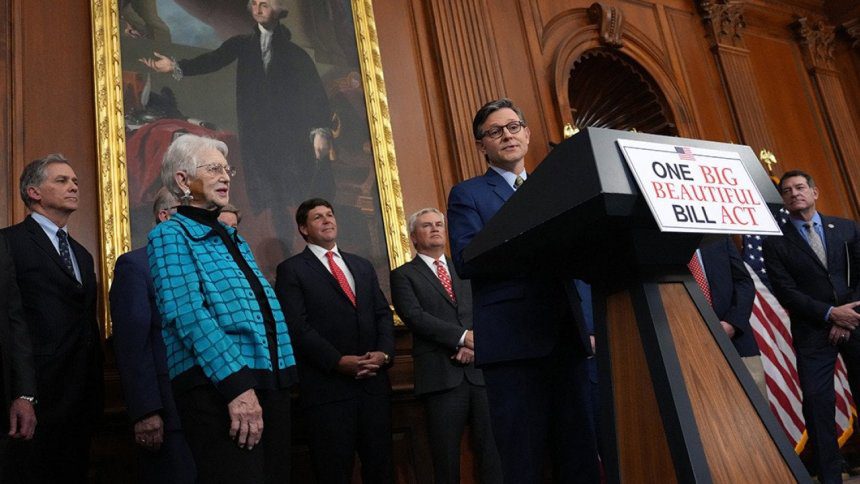
U.S. Speaker of the House Mike Johnson (R-LA) speaks to the media after the House passed the 'One Big Beautiful Bill' at the U.S. Capitol on May 22, 2025 in Washington, DC.

Kevin Dietsch // Getty Images

Will federal tax-credit scholarships help public school students?

Could the new federal tax-credit scholarship program pay for summer school or tutoring for public school students? Could it help homeschool families, microschools, and after-school enrichment programs alike?

Or will most of the money mirror voucher programs and flow through large established scholarship groups for private school tuition?

The race is on to shape a program that could become one of the largest federal investments in K-12 education and fuel a dramatic expansion of private school choice, Chalkbeat reports. The Treasury Department fired the starter’s pistol right before Thanksgiving when it posted a request for comments on how to implement the new tax credit, which passed this summer as part of the One Big Beautiful Bill.

Requesting comment before developing draft rules is the first step in a process that ultimately will determine how much authority states have to put their own stamp on the program, how attractive it is for nonprofits, and how much flexibility families will have.

Treasury Department rules could influence whether some governors choose to have their states participate at all. The Democratic governors of Colorado and North Carolina already plan to opt their states in. Many others have said they’re waiting on federal guidance before they decide.

But on one of the key questions — can governors put restrictions on scholarship-granting organizations, such as requiring that they serve only low-income families or prohibiting them from discriminating against LGBTQ students? The answer may already be no.

The request for comment indicates that Treasury expects to require participating states to include all organizations that meet the bare-bones statutory requirements, such as being a federally recognized nonprofit and serving more than 10 students who don’t all attend the same school.

“It’s really a take it or leave it scheme,” said Rachel Canter, director of education policy for the Progressive Policy Institute, a think tank.

The law doesn’t define “school,” and the Treasury Department has not explicitly asked for feedback on how it should be defined. That could lead to more questions: Could scholarships be used to cover preschool tuition? What about microschools or students who are homeschooled? School choice advocates want those students to have access to funds raised through the tax credit, but some are wary of creating a federal definition of school through the rule-making process.

People who believe in using private markets to drive educational change and in making public money available to religious schools were the biggest backers of the tax credit, and it’s most suited to serve their needs, said Scott Palmer, co-founder and managing partner of the consulting firm EducationCounsel.

But there is a “real opening,” Palmer said during a recent virtual panel discussion, for supporters of public education to push for what he called an “ecosystem” approach that would make it easy to use the tax credit to raise money for tutoring, arts and music enrichment, and other programming that would benefit public school students.

“When you receive a punch in the martial arts, you can either try to block it or leverage its power to throw the person over your shoulder,” he said. “I think we have an opportunity to think not only about how we might need to block, but how we might need to leverage.”

School choice supporters want flexibility, light regulations

The federal tax-credit scholarship program allows taxpayers to receive a dollar-for-dollar reimbursement for donations of up to $1,700 to eligible scholarship-granting organizations. Those organizations would distribute the money to students from families making up to 300% of local median income, a threshold that makes the majority of American families eligible.

How much money the tax credit generates will depend on how many people participate. Education Reform Now estimated that some 47 million taxpayers owe more than $1,700 in federal taxes each year. If 15% participated — far more than currently participate in most state tax-credit programs — that would generate roughly $12 billion a year. For comparison, the federal government spends about $18 billion a year to support high-poverty schools through the Title I program and about $15 billion a year to help offset the cost of special education services.

The money can go toward any expense allowed under Coverdell education savings accounts, which include tuition, tutoring, specialized services for children with disabilities, and computers.

The law allows scholarships to go to students in public or private school, but it’s less obvious how the money could be used to benefit public schools and their students. Could a community group raise money to cover the cost of tutoring for public school students? Could that tutoring be provided by the public school itself or only by outside groups?

During the same panel conversation with Palmer, Karen Pittman, a founding partner at the consulting firm Knowledge to Power Catalysts, cited research that parents spend an estimated $232 billion on their children’s education and development. Groups like 4-H Clubs, for example, could use the tax credit to raise money or offer programs that families could pay for with their scholarships.

“We can give the Treasury the facts on how parents are currently spending their private dollars, and say, ‘Why don’t you allow this bill, this tax credit, to cover these things that parents are already covering, that they consider part of their young people’s education?’” Pittman said.

For their part, groups that have long supported vouchers and education savings accounts want minimal regulations that ensure money donated through the tax credit can support microschools and homeschool families, as well as those attending private school.

Supporters said they’re glad to see the rule-making process start early, so that scholarship organizations have more time to plan.

And they’re also particularly relieved that the Treasury Department doesn’t seem inclined to let governors put additional requirements on scholarship groups beyond what the federal law requires.

The tax-credit scholarship “is a tax law,” said Leslie Hiner, vice president for legal policy at EdChoice, an advocacy group. “It’s not an educational program.”

“This was intended to add to what already exists across the country and help that grow, and any action through rule-making that would go in the opposite direction of that cannot happen,” Hiner said.

Tommy Schultz, CEO of the American Federation for Children, said in a statement that the program’s goal “is to broaden educational opportunity, especially for low-income families, and the rules should encourage and make it as simple as possible for Governors and all states to opt in — as all should — while ensuring access is maximized and the program is protected from political interference.”

People have until Dec. 26, the day after Christmas, to submit their comments. Then the department will issue draft rules and regulations, and the public will have another chance to comment before they’re finalized.

This story was produced by Chalkbeat and reviewed and distributed by Stacker.

Topics:

Careers & Education
Entertainment

How Award Season Has Evolved Into a Second-Screen Spectacle

How Award Season Has Evolved Into a Second-Screen Spectacle
By Samantha Horan for Mecca Bingo
4 min read • Originally published January 9, 2026 / Updated March 19, 2026
By Samantha Horan for Mecca Bingo
4 min read • Originally published January 9, 2026 / Updated March 19, 2026

Stage and set atmosphere for the 83rd Annual Golden Globes.

Michael Buckner // Penske Media via Getty Images

How award season has evolved into a second-screen cultural spectacle

In a media landscape shaped by on-demand streaming and personalised feeds, live television might seem like a fading idea. Yet year after year, award shows like the Golden Globes still dominate timelines, group chats, and entertainment headlines. They create moments that capture reaction, commentary, and conversation in real time.

That cultural pull is reflected in both viewing figures and social buzz. The Golden Globes 2025 telecast drew an estimated 10.1 million viewers across broadcast and streaming platforms, making it one of the most-watched entertainment award nights of the season.

Beyond TV screens, the ceremony generated around 40 million social media impressions on show night, with total engagement up more than 124% year over year, underlining how awards culture now lives as much online as it does on air.

A recent survey of 2,000 U.S. respondents by Mecca Bingo into awards-season habits suggests that while viewing styles have changed, engagement has not disappeared. More than 20% say they still watch major awards shows live from start to finish, treating the night as an event. Another 19% tune in live more casually, while almost 26% primarily follow awards shows through highlights and clips. The result is an experience that rarely lives on just one screen.

A data graphic showing award season and social moment statistics.

Mecca Bingo

What people think about the Golden Globes

When asked which words best describe the Golden Globes, the most common answers were “entertaining” (29%) and “glamorous” (28%), closely followed by “a social event” (25%). Attitudes reinforce that shift toward spectacle. 42% say they enjoy the Globes more for the fashion and social moments than the awards themselves, while 37% say the red carpet and celebrity appearances are the main reason they pay attention at all.

The red carpet, celebrity moments, unexpected wins, and speeches that instantly become memes remain central to the appeal. Rather than being seen purely as a traditional ceremony, the Golden Globes are increasingly viewed as a pop-culture moment. It is something people experience not just by watching the broadcast, but by participating in the wider conversation across platforms.

From live TV to second screens

Streaming has given viewers control, but it has also removed one thing television still does best, which is shared experience. Awards shows offer unpredictability. Viewers don’t just watch to see who wins. They watch for what might happen.

And increasingly, they don’t watch alone. The survey found that 38% use a second screen while watching awards shows, while 24% actively engage socially and 14% post or comment during the broadcast itself. For many, Golden Globes night is as much about reaction as result.

Why familiarity still comforts us

Many entertainment formats, such as game shows and video games, rely on anticipation followed by payoff. They are built around clear segments, recurring beats, and moments of suspense that resolve quickly. These are patterns audiences instantly understand.

Awards shows follow the same familiar rhythm: categories, envelopes, winners, reactions. In an age of infinite choice, that predictability can feel comforting. It allows viewers to dip in and out, half-watch, scroll, or chat, without ever feeling lost.

This helps explain why awards ceremonies adapt so well to modern viewing habits. Their structure makes them easy to experience across multiple screens, in fragments, or through highlights, while still feeling part of a single shared event.

Why awards shows still capture attention

Attention now looks different from what it once did. Awards shows have shifted from appointment television to a modern ritual. They are something people are more likely to fold into relaxed nights at home rather than sit down to formally watch.

Rather than competing with modern habits, awards shows have absorbed them. They have become less about sitting still and more about taking part: watching, posting, reacting, catching up, sharing.

And in a fragmented media world, the ability to pull people toward the same moment, even in different ways, remains powerful. It is why, year after year, the Golden Globes still find themselves at the center of the entertainment conversation.

Methodology

To uncover award show attitudes, Mecca Bingo conducted a nationwide survey of 2,000 U.S. respondents in December 2025. The survey is nationally representative of age (21+), gender and state. The survey respondents included 58% females and 42% males. The average age of the respondents was 36 years.

This story was produced by Mecca Bingo and reviewed and distributed by Stacker.

Topics:

Entertainment
Entertainment

Bring your favorite TV shows to life: Designers recreate iconic sets for the home

Bring your favorite TV shows to life: Designers recreate iconic sets for the home
By Julie Noble for Houzz
7 min read • Originally published January 12, 2026 / Updated March 19, 2026
By Julie Noble for Houzz
7 min read • Originally published January 12, 2026 / Updated March 19, 2026

A display of the living room set scene from the TV show, Friends.

ANGELA WEISS // AFP via Getty Images

Bring your favorite TV shows to life: Designers recreate iconic sets for the home

Television has created some of the most memorable backdrops in pop culture, from cozy coffee houses to dramatic throne rooms. Beyond entertainment, these beloved settings can also serve as rich sources of inspiration for interior design, sparking ideas for color palettes, textures and layouts that evoke the same emotion at home. This season, Houzz worked with five leading design and construction firms to reimagine iconic TV settings as real-world living spaces. The designers took inspiration from Gilmore Girls, Yellowstone, Mad Men, Friends and Game of Thrones to prepare fresh, functional and unforgettable spaces that can be applied to any home.

Read on to see how the pros transformed beloved television sets from Central Perk to Westeros into kitchens, living rooms and other spaces, and how you can bring that same spirit to your own home. 

Interior of a family room inspired by the TV show, Gilmore Girls as designed by Interior Impressions.

Interior Impressions, courtesy of Houzz

Family Room inspired by Gilmore Girls | Designed by Interior Impressions

Gilmore Girls, set in the idyllic town of Stars Hollow, has charmed generations, not only through its quick-witted dialogue and heartfelt relationships, but also through its warm, eclectic interiors. For fans who love the show’s cozy aesthetic, this family room imagined by Interior Impressions, offers inspiration for bringing that familiar Gilmore charm into your own home.

“This living room design is our interpretation of a now more worldly Rory Gilmore,” said Amy Leferink, founder and principal designer of Interior Impressions. The room blends nostalgic warmth with sophisticated detail, using approachable design elements homeowners can adopt. Architectural touches like built-in cabinets, French doors, generous windows, and arched openings echo the original set’s character and can be recreated through thoughtful millwork, paint choices or even furniture placement that frames key focal points.

Lighting plays a major role in capturing Stars Hollow’s lived-in glow. Leferink’s team layered table and floor lamps, wall sconces, and a statement ceiling fixture to build a soft, welcoming atmosphere, which is a strategy that interior designers use to instantly warm up a space. Vintage-inspired floral wallpaper, layered rugs, mix-and-match pillows and collected accessories bring in the eclectic cottagecore feel fans know and love.

Personal touches like books, a record player and a writing desk highlight Rory’s love of literature and music, and offer ideas for showcasing your own passions. 

Interior of a modern kitchen inspired by the TV show, Yellowstone, as designed by May Construction.

May Construction, courtesy of Houzz

Kitchen inspired by Yellowstone | Designed by May Construction

Set against the sweeping backdrop of rural Montana, the neo-Western drama Yellowstone has made the Dutton Ranch kitchen almost as iconic as its characters. With its rugged materials, stainless steel cookware, and no-nonsense functionality, the space captures the essence of Western living, and it’s a look many homeowners are eager to bring into their own homes.

For May Construction, a Yellowstone-inspired kitchen meant blending rustic authenticity with modern comfort in ways homeowners can easily adapt. Stone finishes, exposed beams and warm wood textures establish a rugged foundation, while sleek countertops and updated appliances add the kind of refined practicality that works beautifully in a contemporary home. 

Interior of a modern kitchen's butler pantry inspired by the TV show, Yellowstone.

May Construction, courtesy of Houzz

The refrigerator styling, stocked with fresh milk and marinating meat, reinforces the Dutton family’s connection to their working cattle operation. “I really wanted to include a butler’s pantry. Gator seemed like an impressive chef on the show, with many key moments taking place around his cooking,” said Donna Gutto, designer at May Construction. “And the saloon doors took me back to the 1923 prequel series.” These elements help construction and design pros to create a kitchen that feels both rugged and refined for their clients — a modern interpretation of the Dutton Ranch aesthetic that’s just as at home off-screen as it is on it.

Interior of a bedroom inspired by the TV show, Mad Men, as designed by Honeybee Interiors.

Honeybee Interiors, courtesy of Houzz

Bedroom inspired by Mad Men | Designed by Honeybee Interiors

Mad Men, the acclaimed period drama set against the backdrop of 1960s advertising, continues to captivate viewers with its impeccable storytelling and its equally iconic interiors. The show’s midcentury furnishings, warm wood tones, sculptural lighting and tailored aesthetic all contribute to a look that remains just as timeless today. For homeowners drawn to the elegance of the era, the style offers countless opportunities for designers to weave that refined, vintage charm into a modern home.

Honeybee Interiors embraced this spirit by interpreting midcentury design through a contemporary lens. “We wanted the space to feel timeless and tailored, a modern interpretation of midcentury luxury,” said Sacha Berger, principal designer of Honeybee Interiors. The resulting primary bedroom blends authenticity with accessibility, giving readers a clear roadmap for achieving their own Mad Men–inspired retreat.

A wall of fluted wood paneling adds depth and architectural presence, which can be replicated through textured wall treatments or wood accents. Rich walnut furniture and smooth neutral textiles reinforce the clean lines and warm palette that defined the midcentury era. Floor-to-ceiling windows framed by velvet drapery let soft light filter in yet provide complete privacy when closed, echoing the show’s themes of polished appearances and quiet introspection. And for a true Don Draper touch, a well-placed whisky decanter adds a moment of indulgence and vintage charm.

Interior of a modern living room inspired by the TV show, Friends, as designed by Allito Spaces.

Allito Spaces, courtesy of Houzz

Living room inspired by Friends | Designed by Allito Spaces

As the beloved gathering place for six twentysomethings navigating life in New York City, Friends’ Central Perk became one of the most recognizable TV hangouts of the ’90s and beyond. Its relaxed, eclectic style — anchored by the iconic orange couch — offered an inviting backdrop for heartfelt conversations and hilarious moments. For fans, the café’s charm remains endlessly appealing, and many of its design cues translate beautifully into a warm, welcoming home.

Allito Spaces embraced this spirit, blending the comfort of home with the casual character of the show. “With this design, I wanted to capture the sense of togetherness that defined the series,” said Allison Garrison, principal designer of Allito Spaces. Elements from Central Perk make an appearance in approachable ways that readers can adapt: brick accents evoke the café’s walls, while a wall of windows mirrors its connection to the bustling city beyond or helps create an airy, open feel in a real home.

Interior of a modern living room inspired by the TV show, Friends, as designed by Allito Spaces.

Allito Spaces, courtesy of Houzz

A layered Oriental rug and fringe-trimmed upholstery bring texture and nostalgia into a room, while collected artwork and accessories add the lived-in charm that passionate fans will recognize. These details not only nod to the show but also offer simple, effective ideas homeowners can use to cultivate a welcoming space of their own. 

Interior of a living room inspired by the TV show, Game of Thrones, as designed by Interiors by Design.

Interiors by Design, courtesy of Houzz

Parlor inspired by Game of Thrones | Designed by Interiors by Design

In the television drama Game of Thrones, the throne room was crafted to inspire awe with its cavernous, imposing space that underscored the power and legacy of the kingdom. While most homes don’t call for that level of grandeur, many fans are drawn to the show’s rich textures, dramatic lighting and old-world craftsmanship. Those elements can translate beautifully into a modern interior when approached with balance and intention.

Interiors by Design embraced this idea, transforming the iconic throne room into a grand parlor and office that feels both commanding and inviting. “Winter is coming. And this year, it’s bringing with it more than cold weather; it’s bringing inspiration,” said Azelia Dickson, principal designer of Interiors by Design. Drawing from what she calls “Medieval Fantasy Grandeur,” the team blended deep, color-drenched walls with towering arched windows that flood the room with natural light, which is a combination homeowners can use to achieve drama without sacrificing livability.

A monumental marble fireplace framed by polished stone columns serves as the heart of the space, offering a stately focal point that can be echoed in any home through bold materials or an architecturally detailed mantel. An ornate desk stands in place of the Iron Throne, establishing a sense of presence, while a carved wood chess table adds a layer of strategy and storytelling. Decorative choices from wrought iron chandeliers and candelabras to gilded accents and heavy drapery amplify the regal atmosphere. 

With the right balance of texture, form, and light, homeowners can work with design and construction pros to find ways for even the boldest fantasy elements to be adapted into a sophisticated, everyday living space worthy of its own legend. Whether inspired by small-town charm, ranch life or medieval drama, these spaces highlight the power of storytelling through interior design and how visual tools can help design and construction professionals to bring bold visions to life for their clients.

Houzz is not affiliated with, nor sponsored by, the referenced TV shows or their respective production companies.

This story was produced by Houzz and reviewed and distributed by Stacker.

Topics:

Entertainment
Entertainment

The 10 fastest-growing US Instagram accounts of 2025

The 10 fastest-growing US Instagram accounts of 2025
By Nii A. Ahene for Net Influencer
4 min read • Originally published January 20, 2026 / Updated March 19, 2026
By Nii A. Ahene for Net Influencer
4 min read • Originally published January 20, 2026 / Updated March 19, 2026

Jimmy Donaldson, also known as MrBeast, attends the Season 2 premiere of Amazon Prime Video's 'Beast Games' in Los Angeles, California.

Photo by Victoria Sirakova // Getty Images

The 10 fastest-growing US Instagram accounts of 2025

For decades, pop culture had clear scorecards. Billboard charts tracked which songs Americans were listening to. Box office numbers measured which movies captured the national imagination. Nielsen ratings revealed which TV moments brought the country together. These metrics revealed what mattered, what was breaking through the noise and earning mass attention in a given week, month, or year.

In 2025, Instagram follower gains functioned as a real-time measure of cultural relevance. Unlike total follower counts, which reflect accumulated influence over years, follower growth reveals who is winning the attention economy right now. It captures momentum, the voices, personalities, and movements that are breaking through at scale and commanding fresh interest from millions of people.

Data from Hypeauditor reveals the 10 fastest-growing U.S. Instagram accounts of 2025 gained a combined 105 million followers. That number alone signals how much cultural weight the platform carries. But the composition of the list tells a more specific story about where American attention actually went this year.

MrBeast led all U.S. accounts with 18.7 million new followers, driven by Beast Games 2 and his continued dominance in large-scale viral content. His presence at the top is unsurprising; he’s built an entertainment empire on spectacle and generosity, and the formula keeps working.

The political entries reveal how charged 2025 was, with President Donald Trump adding 11.5 million followers during his return to office. New York City mayor Zohran Mamdani built his entire 11.3 million following from zero during his campaign, riding progressive messaging and historic candidacy.

But the year’s most striking pattern was the rise of transformation content. Fitness creator Ashton Hall went from relative obscurity to 18.3 million followers — a 292% increase — preaching discipline and self-reinvention with the mantra “You can reinvent your entire life in 1 year.”

Entertainment, politics, and self-improvement. The three categories dominated the leaderboard, mapping directly to what captured American attention in 2025. Below, Net Influencer rounded up the 10 Instagram accounts that grew their follower counts the most.

The 10 Fastest-Growing US Instagram Accounts of 2025

An infographic listing the top 10 fastest-growing Instagram accounts as of 2025.

Net Influencer

#1. MrBeast | @mrbeast
Gained: +18.7M followers
2025 total: 83.4M followers

The YouTube titan promoted “Beast Games” Season 2 (which released Jan. 7, 2026, on Prime Video) throughout 2025, with his signature large-scale challenges and philanthropy stunts continuing to drive massive cross-platform growth. His most-liked post hit 19.6million engagements, cementing his position as the platform’s most-followed individual creator.

#2. Ashton Hall | @ashtonhall
Gained: +13.6M followers
2025 total: 18.3M followers

The fitness influencer exploded from relative obscurity with his “For His Glory” motivational content and the viral mantra “You can reinvent your entire life in 1 year.” His disciplined workout videos and self-improvement messaging tapped into a post-COVID-19 pandemic wave of transformation-focused content, driving 292% year-over-year growth.

#3. Instagram | @instagram
Gained: +13.5M followers
2025 total: 698.7M followers

The platform’s official account showcased creator features, trend spotlights, and product updates throughout 2025, maintaining its position as one of the most-followed accounts globally. Its engagement rate remained low at 0.06%, which is typical for institutional accounts with massive reach.

#4. Donald Trump | @realdonaldtrump
Gained: +11.5M followers
2025 total: 41.5M followers

The President of the United States saw sustained follower growth throughout his return to office, with his inauguration-related content and policy announcements driving engagement. His most-liked post generated 4.8 million interactions as his political presence dominated the year’s news cycle.

#5. Zohran Kwame Mamdani | @zohrankmamdani
Gained: +11.3M followers
2025 total: 11.3M followers

New York City’s newly elected mayor built his entire Instagram following in 2025, riding his progressive platform (rent freezes, free public transit) to a stunning 25,000% growth rate. His viral campaign messaging and historic win as the city’s first Muslim mayor made him the year’s fastest-growing political newcomer.

#6. Charlie Kirk | @charliekirk1776
Gained: +9.4M followers
2025 total: 14.0M followers

The Turning Point USA founder and host of “The Charlie Kirk Show” was assassinated in September 2025, with his account gaining millions of followers in the aftermath as tributes poured in and his legacy content circulated. His year-over-year growth reflected both his influence during the 2024 election season and the national response to his death.

#7. ReelShort | @reelshortapp
Gained: +8.0M followers
2025 total: 10.3M followers

The short-form scripted drama platform promoted viral series like “The Daughter of Zeus,” positioning itself as “#1 place for Short Dramas” with bite-sized storytelling. Its growth reflected rising demand for mobile-first episodic content competing with traditional streaming.

#8. Erika Kirk | @mrserikakirk
Gained: +6.9M followers
2025 total: 7.1M followers

The businesswoman, podcaster, and BIBLEin365 founder and new Turning Point USA CEO built a faith-based community through her “MIDWEEK RISE UP” podcast and Spirit Check devotional content. Her 3,200% growth rate made her the year’s fastest-growing faith influencer, tapping into audiences seeking steadfast Christian messaging.

#9. Netflix N Movies | @netflixnmovies
Gained: +6.5M followers
2025 total: 13.3M followers

The entertainment meme page combined movie clips, viral scenes, and Fashion Nova partnerships to capture streaming culture’s biggest moments. Its low 0.08% engagement rate reflected typical fan-account dynamics, prioritizing volume and virality over sustained interaction.

#10. Sabrina Carpenter | @sabrinacarpenter
Gained: +5.8M followers
2025 total: 49.6M followers

The singer-songwriter rode her “Man’s Best Friend” single release and touring schedule to 13% growth, with her most-liked post hitting 6.6 million engagements. Her crossover appeal as both pop star and actor sustained momentum from her breakout 2024 into a dominant 2025.

This story was produced by Net Influencer and reviewed and distributed by Stacker.

Topics:

Entertainment

Posts navigation

Older posts
Newer posts
Featured Jobs
Kirkus Media
Editorial Intern
Kirkus Media
New York City, New York (US)

Gaia Inc
MEDIA COORDINATOR
Gaia Inc
Louisville, CO

Gaia Inc
Global Paid Media Specialist
Gaia Inc
Louisville, CO

Gaia Inc
Director of Media Strategy
Gaia Inc
Louisville, CO

Hearst Television
Account Executive
Hearst Television
Milwaukee, WI, United States

All Jobs »
PREMIUM MEMBER
NK

Nursultan Kenzhalin

Mesa, AZ
2025 Years Experience
View Full Profile »
Join Mediabistro Membership Today

Stand out from the crowd with a premium profile

Mediabistro Logo Find your next media job or showcase your creative talent
  • Job Search
  • Hot Jobs
  • Membership
  • Newsletter
  • Career Advice
  • Media News
  • Hiring Tips
  • Creative Tools
  • About
Facebook YouTube Instagram LinkedIn
Copyright © 2026 Mediabistro
  • Terms of Use
  • Terms of Service
  • Privacy