Mediabistro Logo Mediabistro Logo
  • Jobs
    Search Creative Jobs Hot Jobs Remote Media Jobs Create Job Alerts
    Job Categories
    Creative & Design Marketing & Communications Operations & Strategy Production Sales & Business Development Writing & Editing
    Quick Links
    Search All Jobs Remote Jobs Create Job Alerts
  • Career Resources
    Career Advice & Articles Media Industry News Media Career Interviews Creative Tools Resume Writing Services Interview Coaching Job Market Insights Member Profiles
  • Mediabistro Membership
    Membership Overview How to Pitch (Premium Tool) Editorial Calendars (Premium Access) Courses & Training Programs Membership FAQ
  • Log In
Post Jobs
Mediabistro Logo Mediabistro Logo
Search Creative Jobs Hot Jobs Remote Media Jobs Create Job Alerts
Job Categories
Creative & Design Marketing & Communications Operations & Strategy Production Sales & Business Development Writing & Editing
Quick Links
Search All Jobs Remote Jobs Create Job Alerts
Career Advice & Articles Media Industry News Media Career Interviews Creative Tools Resume Writing Services Interview Coaching Job Market Insights Member Profiles
Membership Overview How to Pitch (Premium Tool) Editorial Calendars (Premium Access) Courses & Training Programs Membership FAQ
Log In
Post Jobs
Log In | Sign Up

Follow Us!

Hot Jobs

Creative Director and Editorial Jobs Hiring Now in Media

hot media and creative jobs
Mediabistro icon
By Mediabistro
The Mediabistro editorial team draws on 25 years of media industry expertise to cover jobs, careers, and trends shaping the industry.
4 min read • Originally published February 11, 2026 / Updated March 19, 2026
Mediabistro icon
By Mediabistro
The Mediabistro editorial team draws on 25 years of media industry expertise to cover jobs, careers, and trends shaping the industry.
4 min read • Originally published February 11, 2026 / Updated March 19, 2026

The Mission-Driven Hiring Surge Is Real

Something worth paying attention to this week: four of the most compelling open roles share a common thread, and it has nothing to do with platform or medium. They’re all at organizations where the work is explicitly tied to a larger purpose. Progressive political campaigns. Literary culture. Behavioral science for social change. A brand-new editorial publication built around professional standards.

These aren’t vague “purpose-driven” platitudes stapled to a generic content job. Each of these companies has a clearly defined mission baked into the product itself. And they’re hiring experienced people, not juniors they can mold. The seniority level across this week’s standout listings skews high, with multiple executive-level roles and a freelance gig that demands a sophisticated portfolio.

For candidates who’ve spent years sharpening their craft at larger organizations and want to direct that expertise toward something with a clear point of view, the timing is good. Let’s get into the specifics.

This Week’s Hot Jobs

Creative Director, Political Advertising at Brainstorm Creative Resources

Why this one matters right now: A DC-based progressive media firm is looking for a multichannel advertising veteran to set the creative vision across broadcast, digital, and everything in between. This is a fully remote, full-time salaried position with a bonus structure tied to two-year election cycles, a compensation model you rarely see outside political media. The firm has won races at the presidential, congressional, state, and local levels, so the creative bar is high.

The profile they want:

  • Significant directing and editing experience across broadcast and digital advertising
  • Ability to lead a team of producers, editors, designers, animators, mixers, and composers
  • Experience setting creative vision and standards across a full portfolio
  • Strong alignment with progressive campaigns and causes

Apply for the Creative Director, Political Advertising role

Deputy Editor at Poets and Writers Magazine

What makes this rare: Poets & Writers is one of the most respected names in literary publishing, and the Deputy Editor role is a genuine senior editorial position. You’ll shape content for the print magazine, the website, and a premium newsletter, reporting directly to the editor in chief. At $75,000 plus fully paid medical insurance and generous PTO, this is a solid package for a mission-driven literary organization. The role is based in New York City with some work-from-home flexibility. If you’ve been browsing editorial jobs and waiting for something with real cultural weight, this is it.

Core requirements:

  • Experience assigning and editing articles, essays, and features for print and digital
  • Ability to bring in new contributors and maintain strong freelancer relationships
  • Writing ability for magazine and website pieces as needed
  • Comfort managing editorial workflows across print, web, and newsletter formats

Apply for the Deputy Editor position at Poets and Writers

Publication Designer, Editorial Series Launch at Havenford

A freelance gig with unusual clarity: Havenford is launching a Philadelphia-based editorial publication focused on professional services, and they’ve done their homework before bringing in a designer. Thirty-two pages of brand guidelines, completed cover designs, and content ready to go. They need someone to build the interior layout system and editorial architecture. The brief references The Economist, Harvard Business Review, and S&P industry reports as touchstones. Phase 1 pays $2,500 to $3,500 for two to three weeks of work, with potential for ongoing production. For publication designers who appreciate a well-prepared client, this is a refreshing find.

Skills they’re after:

  • Interior page layout for long-form articles (2,000 to 5,000 words)
  • Data visualization templates for charts, indexes, and benchmarks
  • Cover typography systems and headline hierarchy
  • Design system documentation for future production use

Apply for the Publication Designer role at Havenford

Media Director at Marketing for Change

Where behavioral science meets media strategy: Marketing for Change is an independent national advertising firm that uses behavioral science to drive social change campaigns. The Media Director role sits at the intersection of research-driven strategy and media planning and buying, leading regional, state, and national campaigns. This is a senior, entrepreneurial position for someone who wants to build out a media practice with real substance behind it. The Orlando-based role is designed for someone with deep channel expertise and a track record of scaling teams.

What they need:

  • Recognized leadership experience in media planning, buying, and earned exposure
  • Ability to scale a media practice while driving agency profitability and client satisfaction
  • Deep expertise across specialized channels and exposure strategies
  • Comfort working at the intersection of behavioral insight and creative storytelling

Apply for the Media Director position at Marketing for Change

The Takeaway for Job Seekers This Week

If your portfolio includes work for organizations with a defined mission or editorial voice, lead with that experience right now. The roles hiring this week reward specificity over generalism. A creative director who has shaped political campaigns, a deputy editor who knows the literary world, a designer who can build systems for long-form editorial, a media director who understands behavior change: each of these jobs is looking for someone whose career has been building toward exactly this kind of work.

When you land an interview for a role like these, preparation matters enormously. Have a plan for how you’ll evaluate and respond to what comes next by reading up on what to do once you actually get the offer. The candidates who win these positions will be the ones who can articulate why this specific mission is where their skills belong.

Topics:

Hot Jobs
Advice From the Pros

The New Playbook for Landing UX Design Jobs in a Saturated Market

How to run an internal pay equity audit (and why you should do it)
Mediabistro icon
By Mediabistro
The Mediabistro editorial team draws on 25 years of media industry expertise to cover jobs, careers, and trends shaping the industry.
8 min read • Originally published February 11, 2026 / Updated March 19, 2026
Mediabistro icon
By Mediabistro
The Mediabistro editorial team draws on 25 years of media industry expertise to cover jobs, careers, and trends shaping the industry.
8 min read • Originally published February 11, 2026 / Updated March 19, 2026

In this article: The Market Reality | Where to Find Jobs | What Hiring Managers Filter For | How to Differentiate | Start Your Search

Two years ago, a solid Figma portfolio and a LinkedIn “Open to Work” badge were enough to field multiple offers. That era is over.

The UX design job market in 2026 absorbed a wave of experienced talent from 2023-2024 tech layoffs. Entry-level roles attract hundreds of applicants. Mid-level positions draw candidates with impressive portfolios from companies that no longer exist.

And most job seekers are still running the 2021 playbook: spray-and-pray applications, generic “learn the tools” advice, searching only the exact title “UX Designer.”

The Bureau of Labor Statistics projects growth for web developers and digital designers (a broad category covering many UX roles) to outpace the average for all occupations through the end of the decade. But reaching those opportunities demands sharper tactics than it did three years ago.

The UX Design Job Market in 2026: What You’re Walking Into

Widespread tech layoffs flooded the candidate pool with experienced designers. Entry-level positions took the hardest hit. But the shift goes beyond volume.

Fully remote positions have pulled back from their pandemic peak, though many UX design jobs still offer remote or hybrid arrangements. Geographic flexibility helps, but expect more companies to require at least occasional office presence.

The counterbalance: demand for UX talent extends far beyond traditional tech companies.

Healthcare systems need designers who understand patient portals. Financial institutions are rebuilding digital banking experiences. Media companies have invested heavily in UX as digital subscriptions and reader experience become competitive differentiators. Government and civic tech organizations are hiring designers who can make complex services accessible.

The market is competitive, but also broader than most candidates realize.

Where to Find UX Design Jobs (Beyond the Obvious Job Boards)

Most candidates search “UX designer” on LinkedIn and Indeed. That’s table stakes.

The Title Fragmentation Problem

UX Designer, UI/UX Designer, Product Designer, Interaction Designer, UX Researcher, UX Writer, Experience Designer: each surfaces different listings, and companies use these titles inconsistently. A “Product Designer” role at one organization might focus entirely on user research; the same title elsewhere means visual design and prototyping.

Pro Tip: Set up saved searches or alerts for all relevant title variants. The role you want might be posted under a title you’re not monitoring.

Niche Job Boards That Surface Roles Faster

Specialized boards often list positions before they hit major aggregators. For media, publishing, and entertainment UX roles, Mediabistro consistently surfaces opportunities that never make it to Indeed. Dribbble Jobs attracts design-forward companies. Built In focuses on tech hubs and startups. Wellfound (formerly AngelList Talent) connects designers with early-stage companies.

Niche boards also draw fewer applicants per posting: hundreds instead of thousands.

Industries You’re Probably Overlooking

If you’re only targeting consumer tech, you’re missing the majority of UX hiring.

  • Healthcare: Designers who understand HIPAA-compliant interfaces and patient workflows
  • Financial services: Companies overhauling digital platforms and banking experiences
  • Government agencies: Civic tech roles focused on making complex public services accessible
  • Media companies: Publishers who need UX designers fluent in editorial workflows and content discovery patterns

Media companies deserve particular attention. As digital subscriptions and reader engagement become competitive differentiators, publishers and content platforms have expanded their UX teams. These roles require understanding editorial workflows and content discovery, skills that career-switchers from content strategy or web production already possess.

Explore diversity-focused job opportunities in media and design for employers committed to inclusive hiring practices.

Community-Driven Job Leads

AIGA local chapters, IXDA conferences, design-focused Slack groups, and portfolio review events generate job leads that never get posted publicly. Many companies fill UX positions through internal referrals or direct outreach before they ever write a job description.

LinkedIn Strategy Beyond “Open to Work”

Engage with UX leaders’ posts. Share breakdowns of your design process. Send direct messages to hiring managers with specific observations about their product.

Comment thoughtfully on design decisions you admire in products you actually use. This demonstrates your thinking before anyone reads your resume.

Direct Outreach to Companies You Admire

Identify companies whose product you use. Audit their UX. Reach out with specific observations: a friction point you noticed, a feature interaction that could be smoother, a content discovery flow that confused you.

This works especially well at mid-size media and content companies without massive recruiting pipelines. They’re hiring, but they’re not posting on every board. A thoughtful cold email showing you understand their product can open a conversation.

Pro Tip: When reaching out directly, reference a specific screen or user flow. Generic praise gets ignored. Specific observations get responses.

What UX Hiring Managers Actually Filter For

Portfolio Case Studies Matter More Than Credentials

A strong portfolio outweighs degrees or certificates in most UX hiring processes. But “strong” has a specific definition.

Hiring managers want case studies that walk through the full design process: research that informed your decisions, wireframes that show your thinking, what you tested, what failed, what you changed, and measurable outcomes. They skim fast. They need to see how you think, not just how your final screens look.

The biggest portfolio red flag? Beautiful mockups with no context. What research informed the design? What constraints shaped it? What tradeoffs did you make? What would you do differently with more time or budget? Constraints and tradeoffs matter more than polish.

Figma Proficiency Is Table Stakes

Listing Figma on your resume in 2026 is like listing “proficient in email.” What does stand out:

  • Experience with tools like Sketch or Framer for prototyping
  • Comfort building and maintaining design systems at scale
  • Ability to integrate AI-assisted design tools into your workflow

Don’t oversell AI capabilities you don’t have. But if you’ve experimented with AI tools for rapid prototyping, user testing synthesis, or generating design variations, mention it. It signals adaptability.

Cross-Functional Communication Skills

Especially in media companies, UX designers work closely with editorial, product, and engineering teams. Hiring managers look for evidence that you can articulate design decisions to non-designers, navigate stakeholder feedback, and operate within content-driven product environments.

If your portfolio includes case studies where you collaborated with developers on technical constraints or worked with content strategists on information architecture, highlight those.

Red Flags That Get You Filtered Out

  • Generic portfolios with no case studies
  • Listing every tool you’ve ever touched with no depth
  • Cover letters that could apply to any company
  • Applications that show zero awareness of the company’s product or users
  • Portfolios that only show personal projects or spec work

Hiring managers want to see how you’ve navigated real constraints, real stakeholders, real users. If you’re early in your career and lack professional work, contribute to open-source projects, volunteer for nonprofits, or document a redesign of a product you use with a full case study showing your process.

For deeper guidance, read our strategies for standing out as a UX design candidate.

How to Stand Out When Everyone Has the Same Skills

Differentiation in a saturated field comes from specificity.

Tailor Every Application to the Company’s Product

Reference the specific product. Name a UX challenge you’d want to solve there. Mention a feature interaction you found elegant or a user flow that tripped you up. This alone eliminates the vast majority of competition.

Applying to a media company? Demonstrate that you understand the tension between editorial priorities and user engagement metrics. Healthcare company? Show awareness of accessibility requirements and patient privacy constraints.

Portfolio Presentation: Lead With Your Strongest Work

Three deep case studies beat ten shallow ones. If you’re targeting media companies, lead with content-oriented UX work: reader flows, subscription experiences, content discovery interfaces, how you balanced editorial storytelling with usability.

For each case study, structure it clearly: the problem, your research approach, design iterations, what you tested, what you learned, the final solution, and measurable outcomes if available. Hiring managers skim portfolios in under two minutes. Make your thinking easy to follow.

The Career-Switcher Advantage

If you’re moving from graphic design jobs, content strategy, web production, or another adjacent media role, don’t hide it. Frame it as an advantage.

Cross-disciplinary experience is genuinely valuable in UX, especially in media environments where understanding editorial workflow, content management systems, and how readers consume information gives you an edge over pure UX candidates who’ve never worked in publishing.

A graphic designer who understands brand systems and visual hierarchy brings skills that complement UX training. A content strategist who understands information architecture and user needs already thinks like a UX designer. Position your background as additive.

Follow-Up That Adds Value

After applying, a brief follow-up note that references the company’s recent product work can keep you visible. Keep it one paragraph. Don’t ask for status updates. Share a relevant article, mention a design pattern you noticed in their latest feature release, or reference a talk by one of their designers.

As you move through later interview stages, prepare your professional references with this email template.

Start Your UX Design Job Search

The UX design job market in 2026 is harder than it was three years ago. But a strategic approach puts you ahead of most applicants still running the 2021 playbook.

Search the full range of UX job titles. Target industries beyond consumer tech. Build portfolio case studies that show your process. Tailor every application to the specific company and product. Show that you understand the constraints and priorities of the organizations you’re applying to.

Start your search on Mediabistro’s job board, where media, publishing, entertainment, and content-driven companies post UX, product design, and digital design roles. For career-switchers from adjacent creative fields, explore our library of career resources tailored to media professionals.

When you land an offer, our guide to navigating the job offer and negotiation process will help you evaluate and negotiate effectively.

For hiring managers building a UX team who want to reach qualified candidates in media and creative industries, post your opening on Mediabistro.

The opportunities are real. The question is whether you’re searching strategically enough to find them.

Topics:

Advice From the Pros
Hot Jobs

Senior Editorial and Media Strategy Roles Hiring Now

hot media and creative jobs
Mediabistro icon
By Mediabistro
The Mediabistro editorial team draws on 25 years of media industry expertise to cover jobs, careers, and trends shaping the industry.
4 min read • Originally published February 12, 2026 / Updated March 19, 2026
Mediabistro icon
By Mediabistro
The Mediabistro editorial team draws on 25 years of media industry expertise to cover jobs, careers, and trends shaping the industry.
4 min read • Originally published February 12, 2026 / Updated March 19, 2026

Experience Is the Currency Today

Scroll through enough job boards, and you’ll start to see patterns before they become headlines. Today’s pattern is unmistakable: organizations are hiring for judgment. The roles posted right now aren’t looking for generalists who can learn on the fly. They want seasoned professionals who already know how to run an editorial calendar, negotiate a media buy, or shape a publication’s voice across print and digital.

Three of today’s most compelling listings are senior positions where the hiring organization essentially says, “We know what we need, and we need someone who’s done it before.” That’s a meaningful signal. After two years of companies consolidating roles and asking one person to do the work of three, we’re seeing a correction toward specialization at the top. Editors who edit. Media strategists who strategize. Leaders who’ve already earned their scars.

For anyone who’s been building expertise in a specific corner of media, today’s listings are worth a close look. If you’re browsing editorial jobs on Mediabistro, you’ll find more senior titles than we’ve seen in months.

Today’s Hot Jobs

Deputy Editor at Poets & Writers, Inc.

Why you should pay attention: Poets & Writers Magazine is one of the most respected names in literary publishing, and this Deputy Editor role puts you at the center of its editorial operation. You’ll shape content across the print magazine, the pw.org website, and a premium newsletter. The $75,000 salary comes with fully paid medical insurance, generous PTO, and the kind of institutional credibility that opens doors for decades.

What they expect you to bring:

  • Strong editing experience with long-form articles, essays, and features
  • Ability to assign stories, cultivate new contributors, and maintain freelancer relationships
  • Comfort working across print, web, and newsletter formats
  • Familiarity with the literary publishing landscape and a genuine interest in the craft of writing

Apply for the Deputy Editor position at Poets & Writers

Executive Editor at the Association for Computing Machinery

The big picture here: ACM publishes one of the most widely read technology magazines in the world, and this Executive Editor role is genuinely rare. You’ll lead the editorial team, manage the production pipeline, oversee circulation strategy, and work with the ad sales team to develop new revenue products. The $125K to $140K salary range reflects the breadth of responsibility. This is a publishing leadership role for someone who understands both editorial quality and business performance.

Core qualifications:

  • Deep experience in technology publishing, especially with software development audiences
  • P&L management and annual budget oversight
  • Track record of managing editorial advisory boards and production staff
  • Hybrid schedule with three days per week at ACM’s New York City headquarters

Apply for the Executive Editor role at ACM

Media Director at Marketing for Change

What makes this one different: Marketing for Change is a behavioral science-driven ad agency focused entirely on social change campaigns. Their Media Director will lead planning, buying, and earned media strategy across regional, state, and national campaigns designed to shift public behavior. If you’ve spent years optimizing media buys for consumer brands and want your expertise to serve a larger purpose, this is the role where commercial media chops meet mission-driven work.

The ideal candidate has:

  • Senior-level media planning and buying experience across specialized channels
  • An entrepreneurial mindset with the ability to scale an internal media practice
  • Experience leading teams and managing agency profitability alongside client satisfaction
  • Comfort working at the intersection of behavioral research, creative strategy, and media investment

Apply for the Media Director position at Marketing for Change

Publication Designer at Havenford (Freelance, Remote)

For the design-minded editorial thinker: Havenford is launching a Philadelphia-based editorial publication covering professional services, and they’ve already done the brand strategy homework. Thirty-two pages of brand guidelines, completed cover designs, and content ready to go. They need a publication designer to build the interior layout system, data visualization templates, and typography hierarchy. Think Economist meets Harvard Business Review. The $2,500 to $3,500 Phase 1 rate covers two to three weeks of design system development, with potential for ongoing production work.

You’ll need to demonstrate:

  • Experience designing long-form editorial layouts for print or digital publications
  • Skill with data visualization, charts, and index templates
  • Ability to create comprehensive design system documentation for future production use
  • Comfort working within established brand guidelines while building something new

Apply for the Publication Designer role at Havenford

Professional Takeaways

If you’re a mid-career professional who’s been wondering whether your years of specialized experience still carry weight, today’s market says yes. These roles are specifically structured for people who’ve already done the work and can prove it. Before you apply, make sure your portfolio and references reflect depth, not just range.

The ACM and Poets & Writers roles in particular will attract strong candidate pools, so lead with your most relevant editorial accomplishments. And if you do land an offer, our guide on what to do when you get a job offer is worth reviewing before you respond. Specificity wins right now. Show them you’ve already solved the problems they’re hiring for.

Topics:

Hot Jobs
Get Hired

Your Local Graphic Design Market Is Bigger Than You Think (Here’s How to Find It)

Your Local Graphic Design Market Is Bigger Than You Think (Here’s How to Find It)
Mediabistro icon
By Mediabistro
The Mediabistro editorial team draws on 25 years of media industry expertise to cover jobs, careers, and trends shaping the industry.
9 min read • Originally published February 12, 2026 / Updated March 19, 2026
Mediabistro icon
By Mediabistro
The Mediabistro editorial team draws on 25 years of media industry expertise to cover jobs, careers, and trends shaping the industry.
9 min read • Originally published February 12, 2026 / Updated March 19, 2026

In this article: The Local Market Is Bigger Than It Looks | Where to Actually Find Jobs | What Employers Want | How to Stand Out | Start Your Search

There are more graphic design jobs within 30 miles of you than any single job board will ever show.

Most designers open Indeed, search “graphic designer,” scroll through a dozen listings, and conclude their local market is dead.

Meanwhile, a regional healthcare system just posted for a “brand designer.” A university needs a “visual content specialist.” A manufacturing company wants a “marketing designer.” A local TV station is hiring a “creative services coordinator.”

None of those roles say “graphic designer” in the title. All of them are graphic design jobs.

The “near me” search you just ran returns aggregator pages that prioritize national remote postings and high-volume employers. What it misses: the nonprofit down the street that needs someone to redesign their annual report, the regional publisher looking for production help, the dozen small agencies that never bother with Indeed because they hire through local networks.

The local graphic design market isn’t thin. You’re looking in the wrong places, under the wrong titles, and through the wrong channels.

The Local Graphic Design Job Market Is Bigger Than It Looks

When you search “graphic design jobs near me,” Google personalizes results based on your IP address, location services, and Business Profile data. But many local employers don’t optimize for Google’s local job search. They post on niche boards, their own careers pages, or rely entirely on word-of-mouth.

The Bureau of Labor Statistics projects limited growth in traditional graphic design roles through the late 2020s, with demand stronger for designers with digital and UX-adjacent skills. National projections don’t tell you what’s happening in your city, though. The BLS categorizes graphic designers separately from web and digital designers, so the official outlook misses a large share of visual design work that has migrated to digital channels. The overall market is huge, at over $50B!

The Hidden Job Market: Graphic design hiring extends well beyond agencies and tech companies. Healthcare systems, universities, nonprofits, manufacturers, real estate firms, and local government agencies all need designers, but most don’t post on design-specific job boards or consider themselves “creative industry” employers.

Healthcare systems need designers who understand HIPAA-compliant materials and patient communications. Universities employ designers for admissions campaigns, alumni magazines, and internal comms. Nonprofits require grant proposal design, event collateral, and donor reports. Manufacturers need technical illustration, trade show graphics, and training materials. Real estate firms want property brochures, signage systems, and digital marketing assets. Local government agencies hire for public information campaigns, permitting materials, and community outreach.

The media and creative job market rewards specialization, but it also rewards strategic breadth in where you look.

Where to Actually Find Graphic Design Jobs in Your Area

Job boards aren’t useless. You’re just using the wrong ones, in the wrong order, with the wrong search terms.

Start With Niche Platforms, Not Aggregators

Indeed and ZipRecruiter index millions of jobs. That volume works against you. Local postings get buried under national remote roles and high-budget employer ads.

Platforms like Mediabistro, which specialize in media and creative roles, surface listings that aggregators bury. When a regional publisher or local agency posts here, it’s because they’re specifically looking for creative talent.

Dribbble allows location-based filtering for its job listings. Employers who post on Dribbble expect to hire designers, which means the brief is usually written by someone who understands design work. AIGA’s Design Jobs board skews senior but captures postings from design-forward organizations that skip Indeed entirely.

Check these platforms first. The signal-to-noise ratio is vastly better.

Expand Your Title Vocabulary

If you’re only searching “graphic designer,” you’re missing at least half the local market.

Search these title variations:

  • Brand designer — often the same role, different vocabulary
  • Visual designer — common in tech-adjacent and digital-first orgs
  • Marketing designer — in-house roles where design supports campaigns
  • Production artist — execution-focused, often overlooked but stable and well-paid
  • Creative specialist — catch-all title at nonprofits and education institutions
  • Social media coordinator — increasingly requires strong visual design skills; if the posting asks for Photoshop or video editing, it’s a design job wearing a different hat

Mediabistro data shows significant reader interest in social media jobs, and many of those positions expect you to create graphics, not just schedule posts.

Use LinkedIn as a Research Tool

LinkedIn’s job listings are fine. Its real value for local search is intelligence gathering.

Follow local agencies, design studios, and marketing departments at regional companies. Engage with posts from creative directors in your area. Join local LinkedIn groups for creative professionals.

Set up geographic job alerts, but also watch for company updates about growth, new clients, or office expansions. Those signal hiring before a job gets posted. LinkedIn’s “Open to Work” feature lets you specify location preferences. If you’re open to remote but prefer local, make that explicit. Many local employers assume designers want full-remote and don’t bother reaching out.

Go Direct to Hidden Local Employers

Local media companies hire designers but often skip national platforms.

Find them through:

  • Local business directories and chambers of commerce member lists
  • Regional ad agency rosters (most cities have an Ad Club or AAF chapter with member directories)
  • Coworking space community boards and Slack channels
  • University and hospital system careers pages (check directly, not through aggregators)

Bookmark their careers pages. Check weekly. Small and midsize employers often post on their own sites and nowhere else.

Tap Into Local Creative Networks

AIGA chapters operate in most major cities and many mid-size markets. Chapter events are where hiring managers mention openings before they’re posted, where freelancers hear about companies looking to bring someone in-house, and where you learn which local employers are expanding.

CreativeMornings runs free monthly breakfast lectures in hundreds of cities. The crowd skews toward designers, writers, and marketers. Show up consistently, and you’ll start recognizing the same faces, including the ones doing the hiring.

The American Advertising Federation has local clubs in most markets. The crowd includes agency creative directors, in-house marketing leads, and freelancers. For agency work specifically, AAF events are more useful than generalist networking groups.

Consider Freelance as a Bridge Strategy

When the local full-time market feels thin, freelance and contract work sourced through local business associations can serve as a pipeline. A three-month contract for a regional nonprofit can turn into a staff position. A freelance project for a local agency can lead to introductions across their client roster.

Freelance isn’t a fallback. It’s a way to build local relationships before a permanent role opens up.

Search Strategy Checklist

✓ Check niche boards first (Mediabistro, Dribbble, AIGA)
✓ Search 5-7 title variations beyond “graphic designer”
✓ Follow local agencies and creative directors on LinkedIn
✓ Visit employer career pages directly, weekly
✓ Attend at least one local creative networking event per month
✓ Set up alerts for adjacent roles: social media, marketing, content

What Employers Actually Want When Hiring Local Graphic Designers

A portfolio gets you through the door. What happens next depends on whether you understand what the specific employer values.

Portfolio Expectations Vary by Employer Type

An agency wants range and conceptual thinking. Show three completely different campaigns that demonstrate you can jump from B2B tech to consumer packaged goods to healthcare without losing effectiveness.

A local healthcare system wants clean, on-brand, regulation-aware execution. Show you understand accessibility requirements, can work within strict brand guidelines, and have designed materials that require legal and compliance reviews. They’re looking for someone who won’t create a patient brochure that violates HIPAA.

A regional publisher wants speed and versatility across print and digital. Show volume. Demonstrate you can concept a cover, lay out a 16-page feature, and create social assets for the same story, all in a single week.

If you’re applying to five different types of organizations, you need five different portfolio presentations.

The Adobe Suite Baseline No Longer Differentiates

Every applicant lists Photoshop, Illustrator, and InDesign. That’s table stakes.

What separates candidates:

  • Figma fluency, even for roles that aren’t explicitly UX or product design. Employers expect designers to create assets that developers can inspect, comment on, and hand off cleanly.
  • Basic motion graphics capability, even if you’re not applying as a motion designer. After Effects fundamentals or Lottie animation experience signals you can produce assets for web and social beyond static images.
  • The ability to work within brand systems rather than only creating from scratch. Local employers have existing brands. They need someone who can extend, not reinvent.

Emerging tools continue to reshape expectations. Technologies like augmented reality are influencing how designers think about spatial design and interactive experiences, even in traditional print-focused markets.

Red Flags Hiring Managers Notice Immediately

  • Portfolios with only personal or spec work and no real client constraints. Personal projects show your aesthetic, but they don’t prove you can take a brief, navigate feedback, and deliver on time and on budget.
  • Applications that don’t address the specific company or role. If your cover letter could be sent to any employer in any city, it signals carpet-bombing. Local employers, especially smaller ones, are tired of generic applications from remote candidates who haven’t researched the organization.
  • Designers who can’t articulate why they made a design choice. Process matters more than polish. When asked, “Why did you choose this typeface?” you need a better answer than “it looked good.” Describe the constraints, the audience, and the strategic goal.
  • Only final deliverables with no context on the brief, constraints, or results. A beautiful poster means nothing if you can’t explain what problem it solved.

The Local Advantage Employers Actually Value

Local candidates offer practical advantages remote hires don’t. You can attend in-person meetings without travel costs or timezone coordination. You can be on-site for a photoshoot, a client presentation, or a press check. You understand the regional market, which matters more than you’d think when a hospital system is targeting patients in a specific metro area or a retailer is designing for local tastes.

Designers in smaller markets often find less competition for local roles than they expect. Employers in these areas draw from smaller applicant pools compared to nationally posted remote positions, meaning your portfolio doesn’t have to compete with hundreds of candidates from major creative hubs.

Use geography as a strategic advantage, not just a constraint.

How to Stand Out in a Local Graphic Design Job Search

Demonstrate You Know the Company

Reference their recent rebrand. Mention a campaign that caught your attention. Note a competitor’s approach and how you’d differentiate. Acknowledge a challenge specific to their industry.

A three-person agency in a mid-size city gets dozens of applications from designers who clearly sent the same materials to 50 companies. If you can name their three biggest clients and explain why your work aligns with that client mix, you’ve already separated yourself from the vast majority of applicants.

Portfolio Presentation for Non-Design Employers

Most local graphic design jobs aren’t at design agencies. They’re at hospitals, universities, manufacturers, media companies, and nonprofits. The person reviewing your portfolio often isn’t a designer. They’re an HR manager, a marketing director, or a department head who knows they need design help but can’t evaluate work the way a creative director would.

Create short case studies for every project:

  • Problem: What was the client trying to accomplish? What constraints existed?
  • Approach: What strategic choices did you make and why?
  • Solution: What did you deliver?
  • Result: What happened after the work launched? Increased engagement? Better conversion? Positive client feedback?

This format translates design work into business outcomes, which is what non-designer hiring managers can actually evaluate. It also proves you understand design as problem-solving, not aesthetics alone.

Follow-Up Strategy That Works

A brief, specific follow-up email five to seven days after applying still works. Reference something concrete about the company. For small local businesses, a polite phone call isn’t out of line, especially in markets where the business culture is more personal than in major metros.


Topics:

Get Hired, Job Search
media-news

Festivals Are the New Upfronts and Solo Journalists Are Doing the Math

Mediabistro icon
By Mediabistro
The Mediabistro editorial team draws on 25 years of media industry expertise to cover jobs, careers, and trends shaping the industry.
5 min read • Originally published February 12, 2026 / Updated March 19, 2026
Mediabistro icon
By Mediabistro
The Mediabistro editorial team draws on 25 years of media industry expertise to cover jobs, careers, and trends shaping the industry.
5 min read • Originally published February 12, 2026 / Updated March 19, 2026

Disney+ is opening Series Mania with a Handmaid’s Tale sequel. CJ ENM is using the same festival to premiere a Korean military drama. A first-time director from Assam is competing for attention at the Berlinale alongside Johnny Flynn and John C. Reilly.

Twenty years ago, these would have been separate circuits with separate economics. Now they’re fighting for the same oxygen, because festivals have become where distribution leverage gets negotiated in public.

The pattern extends beyond film and television. In publishing, individual journalists are testing whether they can bypass legacy institutions entirely, while those institutions raise subscription prices to mask retention struggles.

The split is structural. Some players need platforms to reach audiences. Others are building direct relationships that let them set their own terms.

The Festival Floor Is a Dealmaking Floor

Series Mania announced that “The Testaments” will open this year’s festival. The Disney+ sequel to “The Handmaid’s Tale” brings Ann Dowd and showrunner Bruce Miller to Lille for what amounts to a prestige distribution play dressed as a cultural event.

Opening-night slots at major festivals used to signal awards potential. Now they signal platform strategy. Disney is using Series Mania the way networks used to use upfronts: establishing positioning before the competitive window opens.

The festival isn’t only showcasing Hollywood streamers. CJ ENM is premiering “The Legend of Kitchen Soldier” at Series Mania, the only Korean content at the event.

The Studio Dragon-produced military drama, launching on TVING, reflects how Korean studios use European festivals to build international distribution leverage ahead of domestic releases. CJ ENM is placing IP in front of buyers who can turn a Korean SVOD original into a regional licensing package. Market expansion, plain and simple.

The Berlinale shows how deep the pipeline runs. Rima Das is premiering “Not a Hero” in the Generation section, an India-Singapore co-production shot in Assamese, Hindi, and English.

Das is a filmmaker from Assam whose previous work played regional circuits. Now she’s at one of the three major European festivals with Paris-based sales representation from MMM Film Sales, competing for distributor attention against projects that used to occupy entirely different commercial tiers.

First-time directors are adapting with marquee casting. “A Prayer for the Dying,” starring Johnny Flynn and John C. Reilly, premieres in Berlinale’s Perspectives section, designed explicitly for feature debuts.

The director cast recognizable names to generate pre-sale interest that used to require studio backing. New Europe Films launched the trailer ahead of the premiere, sales strategy running in parallel with the festival strategy. A debut director operating like a mid-budget producer from 2015.

Key Takeaway: Disney brings franchise IP. CJ ENM brings regional production infrastructure. Rima Das brings international co-production financing. A first-time director brings star casting. Same floor, same stakes. The floor is where leverage gets established before money changes hands.

Two Models, Same Pressure

Lachlan Cartwright left legacy media to launch Breaker, his own newsletter operation. One year in, he’s matching his previous salary.

More than 40,000 paid and unpaid subscribers, no institutional backing. The math matters because it establishes a comparison point: a journalist with a name and a beat can replicate legacy economics in twelve months if the conversion rate and pricing hold.

That doesn’t mean the model scales easily or works for most people. It means the leverage question in publishing mirrors the one at festivals. Some creators can negotiate directly with audiences. Some still need platform infrastructure.

Cartwright had the reporting reputation and subscriber capture strategy to make direct economics work. Most journalists don’t, which is why legacy publishers still control most of the talent even as individual operators prove the solo path is viable for a specific kind of reporter.

Legacy publishers, meanwhile, are tightening pricing. Online news subscription costs rose 3% overall, with The Telegraph and Mail+ Editions leading on promotional discounts to drive acquisition.

The price increases reveal retention struggles. Publishers raise prices when they can’t grow subscriber volume fast enough to hit revenue targets. The discount strategies from Telegraph and Mail+ confirm that the acquisition environment is harder than the renewal environment. They’re optimizing for their existing customers rather than expanding the base.

The Economics Split: Cartwright proves individual journalists can bypass the institutional model with the right combination of reputation, niche focus, and direct subscriber relationships. Publishers prove institutional models still generate revenue, but growth is coming from pricing power rather than audience expansion. Both models are under pressure. Both are working.

When Politicians Drive the Health News Cycle

Florida first lady Casey DeSantis said bread contains weed killer. Poynter fact-checked the claim and found that while trace amounts of glyphosate can appear in some bread products, the levels are far below safety thresholds and the claim oversimplifies the science.

The fact-check matters less for what it debunks than for what it reveals about the verification cycle: political figures can generate health scares faster than newsrooms can debunk them, and the debunking itself often amplifies the original claim. Verification still struggles for traction at platform speed. That’s an editorial problem and an economic one.

What This Means

The leverage question runs through every part of the media business. Festivals are marketplaces where distribution power gets negotiated before deals close. Publishing is split between those who can build direct audience relationships and those who need institutional infrastructure to operate.

If you’re tracking your own career economics, the Cartwright story is the one to stress-test. Matching legacy salary in year one is the benchmark, but it assumes you bring subscriber capture ability and a beat with pricing power.

If you’re hiring, the festival stories show where the global production pipeline is heading: more players competing for the same distribution slots, more talent available, more noise to filter.

The fact-check story is a reminder that verification still matters, even when platforms make it nearly impossible to do at speed. That won’t change until the economics of verification improve.

Looking to build your team or make your next move? Post a job on Mediabistro or browse opportunities from companies hiring media professionals who understand how leverage works.


This media news roundup is automatically curated to keep our community up to date on the latest developments in the creative, media, and publishing professions. It may contain factual errors and should be read for general and informational purposes only. Please refer to the original source of each news item for specific inquiries.

Topics:

media-news
Get Hired

The Media Professional’s Guide to Breaking Into Library Work

The Media Professional’s Guide to Breaking Into Library Work
Mediabistro icon
By Mediabistro
The Mediabistro editorial team draws on 25 years of media industry expertise to cover jobs, careers, and trends shaping the industry.
7 min read • Originally published February 13, 2026 / Updated March 19, 2026
Mediabistro icon
By Mediabistro
The Mediabistro editorial team draws on 25 years of media industry expertise to cover jobs, careers, and trends shaping the industry.
7 min read • Originally published February 13, 2026 / Updated March 19, 2026

In this article: The Library Job Market | Where Jobs Are Posted | What Hiring Committees Evaluate | How Media Professionals Stand Out | Start Your Search

The modern library job posting reads less like a call for a quiet bookkeeper and more like a creative brief: digital collections management, community programming, content strategy, and UX research.

If you work in media and haven’t considered library jobs, you’re overlooking positions that need exactly what you do. Content curation. Metadata architecture. Digital asset management. Community engagement.

The problem is visibility. Library hiring operates on a completely different system from media industry recruiting. Positions scatter across state association boards and institutional HR portals. Hiring timelines stretch for months. Degree requirements apply to some roles but not others.

Most media professionals never see these opportunities because they don’t know where to look.

The Library Job Market in 2025

Digital transformation has redrawn the boundaries of library work. Digital archivists, metadata specialists, information architects, and knowledge management professionals sit alongside traditional librarian positions.

The Bureau of Labor Statistics tracks librarian employment in its Occupational Outlook Handbook. For projections, check bls.gov/ooh directly rather than relying on secondhand summaries.

Corporate and special library roles at organizations such as OCLC (a global library technology cooperative), law firms, hospitals, and media companies may offer higher compensation than public library positions, though they are fewer in number. Public and academic library salaries follow structured scales, often governed by civil service bands or union contracts.

The Translation Gap: A metadata taxonomy you built for a video archive translates directly to digital collections work. Your editorial workflow management maps to information architecture roles. Social media community building looks remarkably similar to library programming outreach. The overlap is wider than either field tends to acknowledge.

The field hasn’t abandoned its mission. It has expanded the toolkit required to fulfill it.

Where Library Jobs Are Posted (And Why You’re Not Finding Them)

Unlike media jobs, library positions span across dozens of channels. Some roles never appear on mainstream aggregators at all. Library hiring systems evolved independently from corporate recruiting infrastructure.

Specialized Library Job Boards

  • INALJ (I Need a Library Job) organizes listings by state and remains one of the most comprehensive library-specific aggregators. Verify the site is actively maintained before relying on it as your primary source.
  • ALA JobLIST functions as the American Library Association’s official job board, skewing toward academic and public library positions.
  • Special Libraries Association (SLA) job board focuses on corporate, legal, medical, and special library roles. These positions often draw directly from adjacent professional fields.

State and Regional Association Boards

Nearly every state maintains a library association with its own job board. The California Library Association, Texas Library Association, New York Library Association, and others post positions you won’t find nationally.

Regional employers often post exclusively through state channels, especially public library systems and smaller academic institutions.

Institutional HR Portals

Academic libraries post through university HR systems. Public libraries post through city or county government portals. Corporate library positions appear on company career pages alongside those of other departments.

This creates a real search challenge: you need to identify institutions that employ information professionals, then navigate directly to their hiring portals. A university library won’t necessarily cross-post to external job boards.

General Platforms With Library Roles

Platforms like Mediabistro capture roles at the intersection of media and information science: content curation, digital asset management, knowledge management.

LinkedIn works if you search beyond “librarian.” Try “digital archivist,” “metadata specialist,” “information architect,” “records manager,” or “knowledge manager.” These titles surface roles that need your skills without requiring traditional library science backgrounds.

Search Strategy: Set up saved searches on LinkedIn for each alternative title. Many positions use “information professional” or “content strategist” rather than “librarian” to signal they’re open to non-traditional candidates.

Professional Conferences and Networking

Events like the ALA Annual Conference and Special Libraries Association meetings function as hiring channels. You’ll hear about upcoming openings early and position yourself as a known quantity, particularly for competitive academic and special library roles.

Local chapter events matter more than you’d expect. A conversation at a regional meeting can surface an opening weeks before it hits any job board.

What Library Hiring Committees Evaluate

The MLIS Question

Most professional librarian positions at public and academic libraries require a master’s degree in library and information science (MLIS or MLS) from an ALA-accredited program.

But many adjacent roles do not.

Digital asset management, content curation, information architecture, and records management positions often prioritize demonstrated skills and relevant experience over credentials.

Read position descriptions carefully. When they specify “MLIS required,” they mean it. When they say “MLIS preferred” or “equivalent experience considered,” you have an opening.

Hiring Timeline Reality

Application processes at public and academic institutions follow civil service regulations, union contracts, or institutional HR protocols. Timelines of several months are common.

This is not ghosting. It’s bureaucracy.

Academic libraries often align hiring with the academic calendar, posting in spring for fall start dates. Public libraries may sync with fiscal year budget cycles. Plan your search around these rhythms rather than expecting the two-week turnarounds common in media.

What Separates Interviewed Candidates From Rejected Ones

Institutional fit: Demonstrated understanding of the organization’s community and mission matters more here than in corporate hiring. Public libraries prioritize community programming. Academic libraries seek research support to understand. Corporate libraries need a business intelligence orientation. You can’t fake this with a generic application.

Specific technology skills: Integrated library systems (ILS), metadata standards such as Dublin Core or MARC, digital preservation tools, and content management systems frequently appear in requirements. If you’ve worked with similar systems under different names in media, make that connection explicit.

Translated experience: Showing how your content strategy, digital production, or community engagement work maps to the role’s specific responsibilities separates competitive applications from generic ones. Hiring committees won’t infer the connection. You need to draw it.

Professional references: Library hiring committees typically require three or more professional references, and they check them thoroughly. Prepare references who can speak to relevant skills, even if they’ve never worked in a library.

Red Flags Hiring Committees Notice

Generic cover letters that fail to reference the specific institution signal mass-applying. Résumés packed with media jargon and no translation suggest you haven’t researched what the role requires.

Treating a library position as a fallback shows in application materials. Committees can tell the difference between “I want to pivot my digital content skills into archival work” and “I couldn’t find anything else.”

How Media Professionals Stand Out in Library Applications

Translate, Don’t Just Transfer

A bullet point that says “managed social media accounts” means nothing to a library hiring committee.

Reframe it: “Developed and executed community engagement strategy across digital platforms, increasing program participation through targeted content and cross-platform promotion.”

The difference is in the specificity of outcomes and methodology. Show you understand what libraries are trying to accomplish. Your media skills serve that mission.

Portfolio and Work Samples

For digital-facing roles like digital archivist, metadata specialist, or information architect, a portfolio carries real weight. Include taxonomies you’ve built, content systems you’ve designed, or digital projects you’ve managed.

If you lack library-specific work, frame analogous media projects with clear descriptions of your approach. Whether you built that information architecture for a library or a media organization matters less than demonstrating you understand the principles.

Cover Letter Strategy: Address the Gaps

If you don’t hold an MLIS, address it directly. Name the specific skills and experience you bring that compensate. If you’re pursuing the degree or open to it, say so. Hiring committees respect directness over avoidance.

“I don’t have the MLIS, but I’ve spent five years building and managing metadata systems for digital video archives” positions you as self-aware and qualified. Pretending the gap doesn’t exist positions you as naive.

Connect your career transition to something concrete. “After managing content strategy for a media company, I’m drawn to how academic libraries approach information access and digital preservation” beats vague statements about passion for helping people.

Follow-Up Approach for Long Timelines

A polite check-in email three to four weeks after submission is appropriate. For academic positions, address it to the search committee chair if the posting names one. Keep it brief: reaffirm your interest, note that you’re happy to provide additional materials, and leave it at that.

Navigating a career transition into unfamiliar territory requires patience with systems that don’t match your expectations. The hiring pace feels slow because institutional processes are genuinely slow.

Start Your Library Job Search

The library field is broader than most media professionals realize, and the skills gap is narrower than it appears, especially for roles in digital asset management, content curation, knowledge management, and community programming.

Search the specialized boards listed above. Set up LinkedIn alerts for alternative titles. Check institutional portals directly for organizations whose missions match your interests.

And browse Mediabistro’s job listings for positions at the intersection of media and information science. We capture roles that need what you bring, from graphic design and social media to specialized library positions that blend both worlds.

If you’re hiring for library or information science positions, post your listing on Mediabistro to reach candidates with media and content expertise.

Topics:

Get Hired
Careers & Education

Why have student test scores been declining for a decade in America?

Why have student test scores been declining for a decade in America?
By Matt Barnum for Chalkbeat
5 min read • Originally published February 13, 2026 / Updated March 19, 2026
By Matt Barnum for Chalkbeat
5 min read • Originally published February 13, 2026 / Updated March 19, 2026

Teenage or young adult students seated in a row, taking notes.

Gorodenkoff // Shutterstock

Why have student test scores been declining for a decade in America?

It’s hardly breaking news that American students are behind academically from where they used to be.

But the specifics can get lost in a haze of headlines and data points. Chalkbeat reviewed multiple pieces of testing data to find out where U.S. students stand on learning loss and recovery.

In sum: Test scores have been trending down for over a decade. There are some signs of recovery in math, but not many in reading. Learning declines are not a distinctly U.S. phenomenon and are not even limited to schoolchildren. Researchers are only just beginning to wrap their heads around the causes of this.

Confident claims about what’s going on here are unwarranted, though policymakers can’t wait for perfect evidence to act.

“We should resist the notion of trying to put our finger on the one thing we can change that will solve this problem,” says University of Virginia researcher James Wyckoff, who recently released a paper on declining achievement. “I think it really results from many things in and out of school.”

Here are some key takeaways from the review of the data.

Learning declines have been substantial and pervasive.
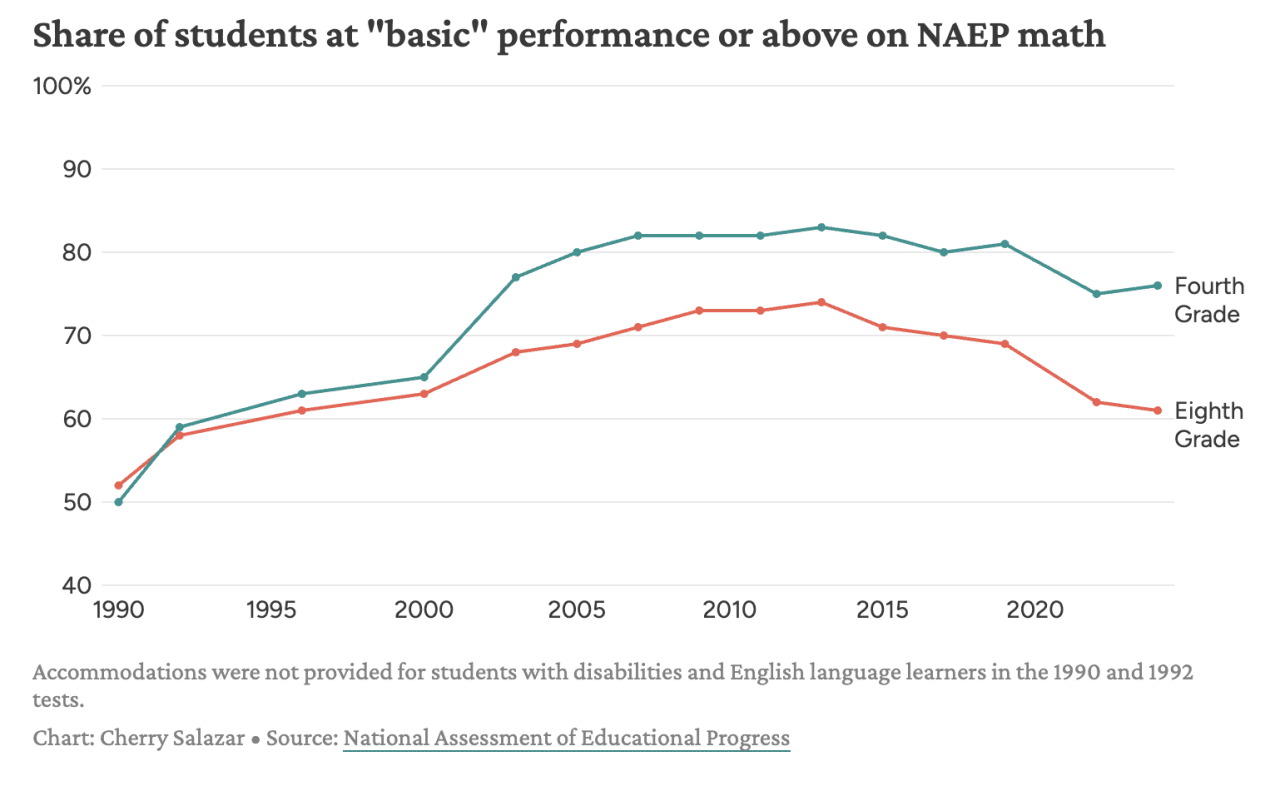
Consider one example from the National Assessment of Educational Progress, or NAEP: In 2013, 74% of American eighth graders scored at the basic or above level in math, the highest figure since the test started in 1990. In the most recent round that number fell to 61%, hitting levels last seen in 1996. Scores have fallen in other grades and subjects, too.

Despite a small handful of relative bright spots, these declines have been remarkably widespread. Eighth grade math scores fell in almost every single state during this period; no states saw increases. Although schools that were closed longer during the pandemic tended to experience bigger declines, even those that quickly reopened have been hit hard by learning loss.

A line graph showing the share of students in fourth grade and eighth grade from 1990 to 2020 at basic performance or above on the National Assessment of Educational Progress.

Cherry Salazar // Chalkbeat


This trend started before the pandemic.
Test scores, particularly in math, had generally been marching upwards for a few decades until about 2013. Then a period of stagnation and decline hit. The aftershocks of the Great Recession on families and school budgets may have been an initial cause. Yet even by 2019 there was still no sign of recovery. Then the bottom fell out further after the pandemic.

Two groups have been hit hardest: low performers and girls.
On a wide variety of tests, starting before the pandemic, the gap between the lowest- and highest-performing students has grown. That’s not because high performers have surged ahead but because low performers have fallen further behind.

More recently, since the pandemic, girls’ scores have tended to fall more sharply than boys’.

Some good news: Math scores are starting to trend up again.
Every state with consistent testing data shows that more students are reaching proficiency in math now compared to 2021. Math results have also ticked up on the NWEA exam and on the fourth grade (but not eighth grade) NAEP. Still, most data indicates that these scores have not bounced back to pre-pandemic levels.

There’s been inconsistent recovery at best in reading.
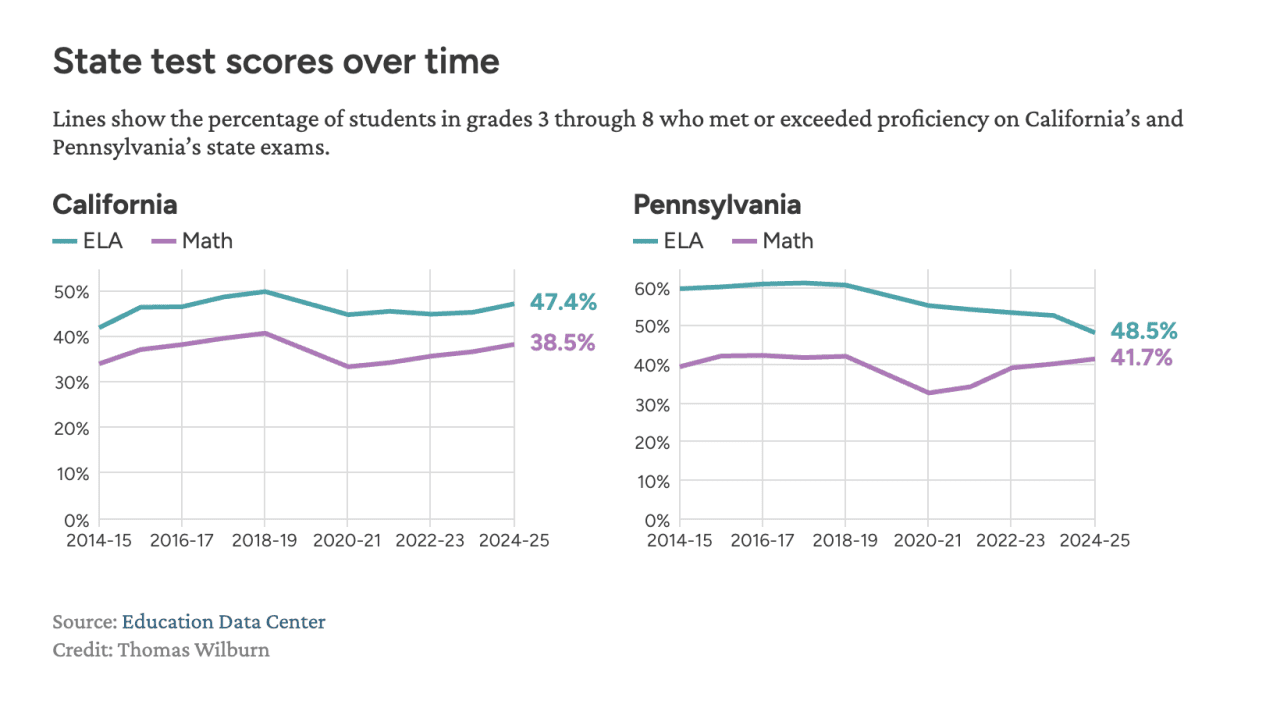
Reading and math results have followed curiously different trajectories. On the most recent NAEP, reading scores actually fell even further. On state exams, reading achievement has been all over the map. Pennsylvania, for instance, has had solid recovery in math, but reading scores have kept sliding downward.

Two line graphs showing the percentage of students in grades 3 through 8 who met or exceeded proficiency on California and Pennsylvania's state exams.

Thomas Wilburn // Chalkbeat


The U.S. is hardly alone in its achievement woes.
Many other countries are grappling with falling test scores, too. This has shown up on an exam of 15-year-olds known as the PISA, as well as on the TIMSS, a math and science test of fourth and eighth graders. Relative to the rest of the world, the U.S. trends look a bit worse on TIMSS, but a bit better on PISA.

The U.S. is unusual in its sharply growing gap between the highest- and lowest-performing students.

Also, test scores may be lower among adults and very young children.
Some data indicates that children who are just entering school are doing so with lower levels of readiness in reading and math. Another study of adult skills showed drops across the age distribution between 2017 and 2023 in literacy and numeracy.

This adds a new wrinkle. “Factors outside of school might play a considerable role” in learning declines, writes Nat Malkus of the American Enterprise Institute in a report from last year.

How concerned should we be? Pretty concerned!
When children know more, as measured on tests, they tend to lead more productive lives. Countries with higher test scores tend to see stronger economic growth. These scores are incomplete measures of students’ skills, but they do matter.

Test scores are not in entirely uncharted territory, though. A long-running test of 13-year-olds shows that math scores in 2023 were at the lowest point in recent decades but remain comparable to scores from the ‘80s and early ‘90s and higher than those in the ‘70s. Reading scores have dipped to levels last seen in the early 2000s.

So what explains all this? Researchers aren’t quite sure.
Two detailed analyses, by Wyckoff and Malkus, have tried to parse what is driving these trends. Neither concluded with definitive answers. “There is remarkably little understanding of the nature of either the sustained achievement gains prior to 2013 or the subsequent losses thereafter,” writes Wyckoff in his paper, titled “Puzzling Over Declining Academic Achievement.”

That said, it’s very likely that the pandemic and its associated disruptions to life in and out of school played a significant role. Another theory is that easing off school accountability pressure — which research found drove learning gains in the early 2000s — has contributed to recent score declines.

Perhaps the leading hypothesis is the proliferation of phones and screens, although Wyckoff notes that “direct causal evidence” on this question “is limited.” That’s beginning to change.

One recent study linked school phone restrictions to better test scores.

These learning challenges are not particular to American schools and may not even be largely caused by changes within schools. Yet they remain a challenge that schools and educators must confront.

This story was produced by Chalkbeat and reviewed and distributed by Stacker.

Topics:

Careers & Education
media-news

Credibility Is Breaking Faster Than News Can Fix It

Mediabistro icon
By Mediabistro
The Mediabistro editorial team draws on 25 years of media industry expertise to cover jobs, careers, and trends shaping the industry.
5 min read • Originally published February 13, 2026 / Updated March 19, 2026
Mediabistro icon
By Mediabistro
The Mediabistro editorial team draws on 25 years of media industry expertise to cover jobs, careers, and trends shaping the industry.
5 min read • Originally published February 13, 2026 / Updated March 19, 2026

The Poynter Institute published research showing that Americans consider news essential to their lives while simultaneously finding the experience of consuming it deeply unpleasant.

That gap is the defining product problem for modern journalism. It explains why fact-checkers spend their time chasing crime statistics that move faster than verification, why a culture secretary is investigating who owns newspapers, and why a London sales company thinks buyers will pay more for films certified as AI-free.

Three different stories, one underlying crisis: trust in media products is low enough that professionals are rebuilding infrastructure from scratch.

News Is Essential. News Is Unpleasant. Now What?

Americans say the news is essential, according to Poynter’s analysis of consumption patterns, but they report low satisfaction with actually reading, watching, or listening to it.

This isn’t a partisan divide or a generational quirk. The gap exists across demographics and reflects something more stubborn: audiences need information but find the delivery mechanisms exhausting, confusing, or untrustworthy.

That perception gap creates operational problems for every media professional. When audiences approach information with defensive skepticism, the speed advantage goes to whoever makes the loudest claim first.

President Donald Trump has stated some version of the claim that U.S. crime rates are at their lowest level in 125 years on at least 10 occasions between late January and early February.

Fact-checkers are parsing FBI data, addressing gaps in reporting standards, and explaining why the statement is at minimum misleading. The work happens after the message has already circulated. Verification becomes correction, a fundamentally weaker position.

Key Takeaway: When audiences approach information with defensive skepticism, verification becomes correction, a fundamentally weaker position for fact-checkers and journalists.

The ownership question compounds the credibility problem. U.K. Culture Secretary Lisa Nandy has launched a competition probe into Daily Mail and General Trust’s acquisition of The Telegraph.

She’s focusing on market concentration rather than foreign state influence. When public trust in news institutions is already fragile, questions about who controls those institutions and whether consolidation serves audiences carry more weight.

The underlying issue is whether ownership transparency can rebuild credibility that editorial performance alone hasn’t restored.

At the Markets: AI-Free Labels and International Appetite

The Mise En Scene Company, a London-based sales outfit, has debuted a “No AI Used” certification for its entire slate at the European Film Market in Berlin, publicly verifying that its films contain no artificial intelligence in their production.

MSC launched the initiative with billboards at EFM, making the certification impossible to miss on the market floor. The company is calling for a global standard, framing the label as buyer protection similar to organic certification in food.

This is a bet on provenance becoming a purchasing filter. MSC is assuming enough buyers care about the distinction between human-made and AI-assisted content to use certification when licensing films.

Whether that holds depends on how distribution platforms, broadcasters, and theatrical buyers respond. If “No AI Used” becomes a standard request in acquisition conversations, other sales companies will follow quickly. If buyers treat it as a curiosity, it stalls.

Either way, a sales company spending money on certification infrastructure tells you trust in creative provenance is now a competitive issue.

The rest of Berlin reflects continued demand for director-driven, genre-inflected international content.

Film Factory Entertainment picked up international sales rights to Lucía Puenzo’s crime thriller “Pepita the Gunslinger”, led by Argentine star Luisana Lopilato, showing an exclusive preview to buyers at EFM.

France TV Distribution is bringing “Sorority,” a period thriller about three women in a male-dominated world, to the London TV Screenings.

Both projects fit a familiar buyer profile: international co-productions with recognizable creative leads, genre frameworks that travel, and production values that support theatrical or premium streaming release.

Hasbro Says Kids’ Content Monetization Is Broken Enough to Fix

Hasbro Entertainment and Animaj have launched Lumee, a joint venture focused on digital advertising sales and brand partnerships for children’s content.

Lumee will manage both companies’ portfolios, including “Peppa Pig,” “Transformers,” “My Little Pony,” and other flagship properties.

The venture is a direct response to YouTube economics. Children’s content performs well in viewership but generates limited revenue due to advertising restrictions and platform policies.

Lumee is designed to bypass those limitations with a dedicated sales operation that negotiates brand partnerships and sponsorship deals directly with marketers rather than relying on platform revenue shares.

Key Signal: The gap between viewership and revenue on YouTube is now wide enough that major rights holders consider it a structural problem worth solving with an entirely new entity.

For professionals in kids’ media, digital distribution, or advertising, the launch signals three things. IP holders with sufficient scale are willing to invest in proprietary monetization systems rather than accept platform terms. Brand partnerships are becoming more valuable than programmatic advertising for children’s content. And the viewership-to-revenue gap on YouTube is now wide enough that major rights holders are building new entities to address it.

The risk is execution. Building a sales organization from scratch means hiring talent, establishing agency relationships, and proving that direct deals generate more value than platform distribution.

If Lumee works, other large IP holders will follow. If it struggles, it becomes evidence that platform dominance in children’s content is durable regardless of how unhappy creators are.

What This Means

Credibility gaps in news, provenance questions in content sales, monetization challenges in children’s media. Different sectors, same dynamic.

Trust in institutions, platforms, and production methods is low enough that new infrastructure is being built to address it. Fact-checking organizations, certification labels, proprietary sales operations: all attempts to restore value to products that audiences need but approach with skepticism.

Watch how buyers respond to the MSC certification at EFM. If “No AI Used” becomes a standard acquisition filter, provenance certification will spread to other content categories fast. Watch whether other major IP holders follow Hasbro’s lead on dedicated monetization. And watch whether the credibility gap Poynter identifies widens or narrows, because that perception problem determines how much every media company will need to invest in rebuilding trust.

If your organization is navigating these shifts and needs to add talent, post a job on Mediabistro to reach media professionals tracking these changes in real time.


This media news roundup is automatically curated to keep our community up to date on interesting happenings in the creative, media, and publishing professions. It may contain factual errors and should be read for general and informational purposes only. Please refer to the original source of each news item for specific inquiries.

Topics:

media-news
Hot Jobs

Independent Media and Niche Publishing Jobs Hiring Now

hot media and creative jobs
Mediabistro icon
By Mediabistro
The Mediabistro editorial team draws on 25 years of media industry expertise to cover jobs, careers, and trends shaping the industry.
4 min read • Originally published February 13, 2026 / Updated March 19, 2026
Mediabistro icon
By Mediabistro
The Mediabistro editorial team draws on 25 years of media industry expertise to cover jobs, careers, and trends shaping the industry.
4 min read • Originally published February 13, 2026 / Updated March 19, 2026

Specialists Are Having Their Moment

Generalists have dominated media hiring for the better part of a decade. Companies wanted Swiss Army knives: people who could write, shoot, edit, manage a CMS, and run a social calendar before lunch. That era isn’t over, but something is shifting. Today’s most compelling openings share a common thread: they want people who know their subject matter deeply.

A literary nonprofit needs an editor steeped in the craft of writing. A tech association is paying up to $140K for someone who can speak fluently to software developers. An independent news outlet wants a producer who cares about investigative journalism, full stop. And a behavioral science agency needs a media director who understands how exposure shapes human behavior, not just impressions.

These roles aren’t asking for everything. They’re asking for something specific. That’s a meaningful signal for anyone building a career in media right now. If you’ve spent years going deep in a subject area and worried that specialization was limiting you, these postings suggest the opposite.

Today’s Hot Jobs

Senior Producer at Status Coup News

Why this one caught our eye: Status Coup is one of the more visible players in the growing independent investigative news space, built around on-the-ground reporting that larger outlets often skip. This senior producer role is remote, salaried at $80K to $85K with benefits, and involves managing a growing team of reporters, editors, and freelance contributors. You’d be shaping editorial output across live and recorded video content for an audience that’s actively growing.

The core requirements:

  • Experience overseeing and organizing video edits across a team of producers and editors
  • Ability to identify and communicate re-edit needs with clear, constructive feedback
  • Strong alignment with investigative, accountability-driven journalism values
  • Comfort managing an expanding content operation and keeping organized tracking systems

Apply for the Senior Producer role at Status Coup News

Deputy Editor at Poets and Writers Magazine

What makes this distinctive: Poets and Writers is one of the most respected names in literary publishing, and the deputy editor role is genuinely senior. You’d collaborate on the editorial vision for both the print magazine and pw.org, assign and edit features, cultivate freelance relationships, and help steer a premium newsletter. For anyone who’s browsed editorial jobs lately, this kind of mission-driven magazine role at a legacy literary institution is increasingly rare. The position is based in New York City with some hybrid flexibility.

What they expect you to bring:

  • Strong editorial judgment and experience editing long-form articles, essays, and features
  • Ability to execute an editorial vision across print, web, and newsletter formats
  • Track record of bringing in new contributors and maintaining freelancer relationships
  • Familiarity with the writing, publishing, and literary community landscape

Apply for the Deputy Editor position at Poets and Writers

Executive Editor at the Association for Computing Machinery

The draw here: ACM publishes one of the longest-running technology magazines in existence, and this executive editor role carries real operational weight. You’d lead the editorial team, manage the budget with full P&L responsibility, oversee circulation growth, and work with ad sales on new product development. The $125K to $140K salary reflects that scope. Experience with the software development audience is specifically highlighted as valuable, underscoring the specialist theme running through today’s listings. If you have a background in technical writing or tech journalism, this is worth a serious look.

What the role demands:

  • Editorial leadership experience with a technology publication, ideally serving a developer audience
  • Budget management and P&L oversight capability
  • Experience managing editorial and production staff to deliver on schedule and on brand
  • Hybrid schedule with three days per week onsite at ACM’s New York City headquarters

Apply for the Executive Editor role at ACM

Media Director at Marketing for Change

Why this stands apart: Marketing for Change is an independent agency that uses behavioral science to drive social change campaigns at the regional and national level. The media director role sits at a fascinating intersection: you need traditional media planning and buying expertise, but you’re deploying it in service of behavior change rather than product sales. This is an executive-level position based in Orlando for someone ready to scale a media practice with real-world impact.

Key qualifications they’re seeking:

  • Recognized expertise in media planning, buying, and earned exposure strategy
  • Entrepreneurial mindset with the ability to grow a team and drive agency profitability
  • Deep understanding of how media channels influence behavior across diverse audiences
  • Experience leading regional, state, or national campaigns with measurable outcomes

Apply for the Media Director position at Marketing for Change

The Takeaway for Job Seekers

The hiring market is sending a clear message today: depth wins. Four very different organizations, from a literary magazine to a tech publisher to a behavioral science agency, are looking for candidates who’ve invested in learning a very specific domain well.

If your resume reads like a tour of unrelated industries, consider how you frame your experience. Lead with the subject matter you know best, not just the media skills you’ve accumulated along the way. Employers posting roles like these aren’t scanning for versatility. They’re scanning for fluency in their world. That’s the edge that gets you past the first read.

Topics:

Hot Jobs
Hot Jobs

Remote Producer and Social Media Jobs Hiring Now in Media

hot media and creative jobs
Mediabistro icon
By Mediabistro
The Mediabistro editorial team draws on 25 years of media industry expertise to cover jobs, careers, and trends shaping the industry.
4 min read • Originally published February 14, 2026 / Updated March 19, 2026
Mediabistro icon
By Mediabistro
The Mediabistro editorial team draws on 25 years of media industry expertise to cover jobs, careers, and trends shaping the industry.
4 min read • Originally published February 14, 2026 / Updated March 19, 2026

Production Talent Is the New Bottleneck

The companies doing the hiring couldn’t be more different from one another. An independent news outlet, an interior design startup, and a sports media venture are all searching for the same core skill set: someone who can manage content from concept through publish, coordinate freelancers, and make smart editorial decisions without constant supervision.

That convergence tells you something. Production expertise has become the connective tissue of modern media, regardless of vertical. The person who can wrangle a breaking news livestream can also orchestrate a short-form travel series, because the underlying muscles are identical: editorial judgment, timeline management, and comfort working asynchronously with distributed teams.

What’s also notable today is the salary transparency. Several of these roles lead with specific compensation ranges, which makes comparison shopping much easier for candidates weighing their options. If you’ve been building production chops at a single outlet, now is a good time to see how transferable those skills really are.

Today’s Hot Jobs

Senior Producer at Status Coup News

Why this one matters: Status Coup is an independent, investigative-first news operation that built its audience on on-the-ground reporting, the kind legacy outlets have largely abandoned. This senior producer role sits directly under the CEO and essentially runs the editorial engine: assigning edits, managing reporters and freelancers, and maintaining quality control across a growing library of live and recorded content. At $80,000 to $85,000 with benefits, it’s a fully remote role that puts you at the center of a newsroom punching well above its weight.

What they need from you:

  • Experience managing video edits and communicating revision notes to producers and editors
  • Ability to oversee and organize a growing team of reporters, producers, editors, and freelance contributors
  • Strong alignment with investigative, accountability-driven journalism values
  • Comfort working in a high-volume content environment across both live and recorded formats

Apply to the Senior Producer role at Status Coup News

Social Media Producer at Showplace

The hook: This part-time, remote role comes with a twist that most social media jobs don’t: regular travel to job sites across the country. Showplace designs and launches high-performing Airbnb and short-term rental properties, and they need someone who can show up on location, capture compelling before-and-after video, and turn it into scroll-stopping content for Reels, TikTok, and YouTube Shorts. At $35 per hour with all travel expenses covered, it’s a genuinely flexible gig (20 to 30 hours per week) for a producer who wants variety in their workweek.

Core requirements:

  • Ability to film, edit, and publish short-form vertical video across multiple platforms
  • Comfort being on camera and filming yourself during site visits and installs
  • Ownership of the full content lifecycle from capture to publish
  • Strategic mindset for making social media drive actual business results

Apply to the Social Media Producer position at Showplace

Media Director at Marketing for Change

What makes this different: Marketing for Change is a behavioral science-driven ad agency focused entirely on social change campaigns. This Media Director role is a senior leadership position where you’ll build out the agency’s media planning, buying, and earned exposure practice across regional, state, and national campaigns. The work sits at the intersection of research, creative storytelling, and media investment, all aimed at influencing behavior rather than selling products. For someone who’s mastered traditional media strategy and wants their expertise to serve a larger purpose, this is a rare find.

Key qualifications:

  • Recognized leadership experience in media planning and buying
  • Deep expertise across specialized channels including digital, broadcast, and earned media
  • Entrepreneurial mindset with experience scaling a practice or team
  • Ability to translate behavioral research insights into actionable media strategies

Apply to the Media Director role at Marketing for Change

Producer and Showrunner at Mustard Squad HQ

Worth a closer look: This is a ground-floor opportunity to build a sports video series from scratch. Mustard Squad HQ is launching a three-month proof of concept (April through June 2026) to produce stadium-focused videos in an educational, comedic tone. You’d write scripts, coordinate freelance hosts and videographers, manage production end-to-end, and own the analytics. The initial rate is $2,500 per month for part-time work, with a clear path to $4,500 per month full-time plus performance bonuses if the concept proves out. For producers who’ve wanted to build something from the ground up, this is that chance.

What you’ll need:

  • 5+ years of media production experience with a portfolio of work you’ve produced and managed
  • Proven ability to manage freelancers and run operations with minimal oversight
  • Strong written communication skills for an async-first working environment
  • Sports knowledge (baseball preferred) is a plus but not required

Apply to the Producer and Showrunner role at Mustard Squad HQ

The Takeaway for Job Seekers

If your resume still frames your production skills narrowly (e.g., “news producer” or “social media manager”), today’s listings are a clear signal to broaden your positioning. The companies hiring right now care less about which industry you came from and more about whether you can independently manage a content pipeline from start to finish. Update your portfolio to emphasize transferable production workflows, team coordination, and cross-platform output.

If you’re weighing multiple offers or trying to decide between very different industries, Mediabistro’s guide on what to do when you get a job offer is worth reading before you commit. The producers who thrive in 2026 will be the ones who position themselves as operational leaders, not specialists tied to a single format or beat.

Topics:

Hot Jobs

Posts navigation

Older posts
Newer posts
Featured Jobs
A
A
A

h
h
h

h
h
h

H
H
H

M
M
M

All Jobs »
PREMIUM MEMBER
ED

Eileen Duffy

,
Years Experience
View Full Profile »
Join Mediabistro Membership Today

Stand out from the crowd with a premium profile

Mediabistro Logo Find your next media job or showcase your creative talent
  • Job Search
  • Hot Jobs
  • Membership
  • Newsletter
  • Career Advice
  • Media News
  • Hiring Tips
  • Creative Tools
  • About
Facebook YouTube Instagram LinkedIn
Copyright © 2026 Mediabistro
  • Terms of Use
  • Terms of Service
  • Privacy