
Mediabistro Logo Mediabistro Logo
  • Jobs
    Search Creative Jobs Hot Jobs Remote Media Jobs Create Job Alerts
    Job Categories
    Creative & Design Marketing & Communications Operations & Strategy Production Sales & Business Development Writing & Editing
    Quick Links
    Search All Jobs Remote Jobs Create Job Alerts
  • Career Resources
    Career Advice & Articles Media Industry News Media Career Interviews Creative Tools Resume Writing Services Interview Coaching Job Market Insights Member Profiles
  • Mediabistro Membership
    Membership Overview How to Pitch (Premium Tool) Editorial Calendars (Premium Access) Courses & Training Programs Membership FAQ
  • Showcase
    Featured Creative Stories Submit your Story
  • Log In
Post Jobs
Mediabistro Logo Mediabistro Logo
Search Creative Jobs Hot Jobs Remote Media Jobs Create Job Alerts
Job Categories
Creative & Design Marketing & Communications Operations & Strategy Production Sales & Business Development Writing & Editing
Quick Links
Search All Jobs Remote Jobs Create Job Alerts
Career Advice & Articles Media Industry News Media Career Interviews Creative Tools Resume Writing Services Interview Coaching Job Market Insights Member Profiles
Membership Overview How to Pitch (Premium Tool) Editorial Calendars (Premium Access) Courses & Training Programs Membership FAQ
Featured Creative Stories Submit your Story
Log In
Post Jobs
Log In | Sign Up

Follow Us!

Journalism Advice

Pitch Perfect: 7 Steps to Landing Your Next Magazine Assignment

How to craft a can't-say-no-to-this pitch

freelancer writing a pitch letter
John icon
By Kristen Fischer
Kristen Fischer is a freelance writer, journalist, and copywriter with over 20 years of experience, currently serving as a health writer for AARP with previous staff roles at WebMD and WW. Her work has appeared in Prevention, Healthline, Woman's Day, Parade, and Writer's Digest, and she is the author of four books.
6 min read • Originally published June 4, 2015 / Updated March 19, 2026
John icon
By Kristen Fischer
Kristen Fischer is a freelance writer, journalist, and copywriter with over 20 years of experience, currently serving as a health writer for AARP with previous staff roles at WebMD and WW. Her work has appeared in Prevention, Healthline, Woman's Day, Parade, and Writer's Digest, and she is the author of four books.
6 min read • Originally published June 4, 2015 / Updated March 19, 2026

Think about all the assignments you had last year. Were there enough juicy, well paying articles to allow you to jet to the Bahamas, or did your pitiful word counts barely keep you from trolling Craigslist for a new 9-to-5?

No matter what stage your writing career is in, the difference between the former and the latter hinges on one thing and one thing only: a can’t-say-no-to-this pitch. And, while a “hey, let me write about xyz” sent through Google Chat might work on an editor you’ve known for years, such laziness (sorry, but that’s what it is) isn’t going to bring in any new business.

Luckily, with just a few tweaks, you can give your queries the additional one-two punch that will get editors salivating – and assigning – for years to come.

1. Get to the point.

Linda Formichelli, a freelance writer and editor of the Renegade Writer blog says it’s imperative to make your first paragraph more than stellar. She believes that many writers have wonderful ideas, but they don’t articulate them well in their opening paragraph, which dissuades an editor from assigning the piece.

“Don’t bury your lede. Don’t do a lot of throat clearing,” she explains. “Just get right into it, because you only have a few seconds.”

Editors want to grab the attention of their readers, so you have to do the same to them with your query, she added. If you need inspiration, try opening with a really surprising statistic, a good quote or an interesting personal anecdote, which can grab the editor and encourage her to dole out the assignment – today.

2. Rethink your angle.

“It’s very rare that a writer’s great idea alone will sell their pitch. Remember, editors and other writers read the same press releases, spot the same trends and recycle the same topics,” warns Dawn Papandrea, managing editor at The CollegeBound Network, which was formerly a print publication.

“What will set a query apart is when a writer figures out how to package a story idea in an interesting way.”

Whether that means choosing a certain side of a story or including a service-oriented sidebar, those are details that can separate your query from thousands others like it.

Abigail Lewis, editor at Whole Life Times, agrees that having a strong hook is key. “We [editors] can definitely brainstorm further, but give us a sense of how you want to approach the subject, and types of experts you might like to include.”

That brings us to the next tip…

3. Do your research.

Formichelli says a huge roadblock to landing an assignment is not doing your homework. So, interview a few key subjects in advance or simply list who you would like to feature in the article to show the editor that you have some direction and aren’t pitching a topic blind. (Bonus points for suggesting a companion sidebar or charticle based on your findings.)

“If she’s [the editor] going to take a chance on a writer, especially one she doesn’t know, she wants to know ‘What’s going to be in this article?’ She doesn’t want to have some writer tease her and say ‘Oh yeah, I have five great tips,’ and not know what the tips are and just hope that once she hires the writer, they’re going to be good,” Formichelli says. “That’s not going to happen.”

“Beef up a pitch with some specific, targeted details and examples,” suggests Zachary Petit, managing editor at Writer’s Digest. “It’s easy to overlook a brilliant idea if it’s a one-liner in a slush pile loaded with other queries. Make yours stand out.”

4. Pre-write the article.

Many writers are on the fence about how much research to do. After all, isn’t interviewing sources and partially writing the article in advance a lot of work to do without the guarantee of it getting published?

Formichelli, who writes regularly for consumer and women’s magazines, is careful to say that while trade magazines typically assign pieces with less detail, the big ones want as much as they can get their hands on.

“For the magazines that I write for, they’ve actually told me that they want the longer queries; they want to see the research. They want the quotes.”

Sending a quick query can be a waste of time if you know the type of magazine you are targeting wants a longer pitch. Formichelli says she usually writes most of an article ahead of time and pointed to one key benefit of the strategy: saving time. “If you do the research and then get the assignment, it’s already written,” she says.

Freelance writer Carol Tice adds that if you don’t have a lot of experience or clips in your portfolio, you’ll typically need to flesh out your query with more reporting.

“You’ve got to just totally prove to them that you can do it inside the query, because you don’t have the other [clips],” Tice says. “The less experience you have, the more you have to almost deliver the whole article in the query.”

“People resist doing that ’cause they think, ‘Oh that’s so much work,’ but that’s the only way you’re going to get it.”

5. Create a sense of urgency.

Tice says that writers need to specify in their query why the article needs to be written right now. If you don’t, you risk seeing your idea tabled indefinitely.

“Then it goes into a pile that editors have of, ‘I find this interesting but it’s not an emergency, but I’d do it,’ and then it never gets done,” she explains. “Really, only the urgent stuff gets done.”

Do some research on the topic to tie it into a timeline, she says. Reference a new study or note an upcoming related event to show why it is critical to publish ASAP. “You’ve got to give them that, ‘Why now?'” she says.

Tice points to a feature she recently sold to a prominent business publication about how to protect your business during a divorce. “I just made the case that, you know, with the down economy, the divorce rate’s probably up… there’s a lot of relationship stress out there right now… a lot of financial stress, and this is probably a great time to be thinking about that, and you know, they bought that,” she says.

6. Include your credentials.

Formichelli believes it is vital to show an editor you are qualified to write for them, either through a strong pitch or by mentioning your background.

“I think it’s good to include credentials just to assure the editor that you know what you’re doing. You either have experience on the topic or you’re an experienced writer,” she says.

Just keep it to a few sentences, urges Tice. “The more you blabber about yourself, the more suspicious the editor’s going to be that you don’t understand how this works,” she says.

7. Step away from the computer.

As writers, we’re sometimes too focused on our work. We fall so in love with an idea that we may not be able to see it clearly enough to really articulate and sell it.

“Sometimes you’re too close to it,” says Formichelli, who suggests sharing pitches with a friend or writing group for feedback before hitting ‘send.’

Go back through the aforementioned steps and make sure your angle, lede and research are as strong as possible. If the pitch still isn’t gelling, give it a few days so you can revisit it later with a fresh perspective—namely, the editor’s.


Topics:

Go Freelance, Journalism Advice
Journalism Advice

The Real Reasons Editors Reject Your Pitch (and How to Fix It)

Uncover the truth behind the "no" to land more assignments

writer upset his pitch was rejected
Admin icon
By Kristen Fischer
Kristen Fischer is a freelance writer, journalist, and copywriter with over 20 years of experience, currently serving as a health writer for AARP with previous staff roles at WebMD and WW. Her work has appeared in Prevention, Healthline, Woman's Day, Parade, and Writer's Digest, and she is the author of four books.
5 min read • Originally published June 10, 2015 / Updated March 19, 2026
Admin icon
By Kristen Fischer
Kristen Fischer is a freelance writer, journalist, and copywriter with over 20 years of experience, currently serving as a health writer for AARP with previous staff roles at WebMD and WW. Her work has appeared in Prevention, Healthline, Woman's Day, Parade, and Writer's Digest, and she is the author of four books.
5 min read • Originally published June 10, 2015 / Updated March 19, 2026

“We’ll pass. Thanks.”

“Not right for us.”

“Thanks, but no.”

If you’ve received any of these as a response to a magazine article query, you’re definitely not alone. While many journalists are happy to receive some sort of response — some editors don’t acknowledge queries unless they want to assign a piece — it can be frustrating to figure out why your pitch wasn’t picked up.

Luckily for you, we’ve put together some insights on exactly why your query got axed. Use this information to soothe your ego and do better next time.

“We don’t cover those types of stories.”

Translation: You’re pitching the wrong publication.

Lisa Haney, senior editor at Fitness, says she receives plenty of queries that have nothing to do with what the magazine covers. “You really need to know the magazine you’re pitching,” she explained. In proposing an article on a topic that is so off-target from what the magazine covers, she noted, “It shows that you’re not prepared, that you really just don’t know the magazine and that you haven’t taken the time to really check it out.”

Linda Hamilton, health editor at Woman’s World, agreed. She said she’s hesitant to take on new writers, because they often don’t take the time to understand her pub’s style, voice or the type of content it runs. For example, Woman’s World doesn’t like health stories that use scare tactics in the reporting. “It’s going to be a real turn-off if a writer doesn’t keep that in mind,” Hamilton added.

Another reason Hamilton uses a small base of writers that she can count on is that time is of the essence when running a weekly publication; the content has to be on point and need minimal revisions in order to meet deadlines. If a writer has a great proposal that’s well-written, she said she may take a chance on it, but admits that doesn’t happen too often.

“I need somebody that knows the magazine so well that they can come up with ideas,” Hamilton said.

“We’re not taking pitches at this time.”

Translation: No, really. The magazine isn’t accepting article queries right now.

Keep in mind that the media world has been shaken up in the past few years. As such, some publications don’t have the budget to pay freelancers, use them much less or have moved all writing operations in-house. If you keep up with publication guidelines, you’ll know which magazines are accepting freelance work, so you don’t waste your time pitching those that aren’t.

“[This is] all the more reason to do your best to cultivate as close-knit a relationship as you can with the publications and media outlets you most want to write for,” advised Michelle Goodman, a writer and author in Seattle.

“We’ve already run that.”

Translation: You pitched an old idea or the angle isn’t specific enough.

Magazines typically publish stories on the same topic, but the key is to approach these concepts with an angle the publication hasn’t used before.

“You might have checked the publication’s database to make sure they haven’t done the story yet, but maybe it’s already assigned and in the works with another writer and just hasn’t appeared in print or pixels yet,” noted Goodman. “Try to take that as a positive sign. At least you’re on the right track.”

Haney says that when writers pitch an evergreen topic without a creative angle, the pitch may be passed up. “It needs a really cool, new study or packaging device… that we’re like, ‘Oh wow! That’s a new take on it.”

Dawn Papandrea agrees. The seasoned freelance writer and magazine editor from Staten Island, N.Y. says that packaging counts more than the idea itself at times. “If you can work in ‘surprising’ or ‘newsy’ hooks to tell the editor why it’s worth reading right now, even better,” she advised. “Try to think in terms of ‘Would I click this headline if I saw it online?’ or ‘Would I buy this magazine if I saw this story on the cover?’ That’s what editors are looking for.”

Papandrea added that writers should query their timeliest topics to websites over print pubs. “Magazines are six months out sometimes, so watch out if you’re pitching seasonal ideas,” she said.

“We’re not assigning features at this time.”

Translation: You’re low on experience, so pitch front-of-book pieces instead.

It may very well be a fantastic article idea, but if you do not have much of a track record as a freelance magazine writer, you’re better off breaking in with a shorter, front-of-book (FOB) piece.

“[Pitching FOB articles is] a really great strategy, especially if you haven’t had national magazine experience yet,” Haney said. This gives you the chance to cultivate a relationship with an editor, who then may be more likely to take a chance on you when larger assignments become available.

Hamilton says that editors at the larger titles also want to see clips from national publications. Specifically, she wants multiple samples from the same publication. That tells her that the writer does a good enough job not only pitching and selling him or herself, but writing and revising.

“They’ve gone back to you, so obviously you’ve done a good job,” she said.

No response

Translation: The editor is consumed with deadlines, or your pitch flat-out sucks and was deleted (on purpose).

Editors are busy and sometimes they don’t have time to let you know the pitch isn’t right. When the response is nonexistent, it’s all right to check in to make sure he or she got your query. In other cases, sometimes an editor just doesn’t have the heart to tell you that your query doesn’t make the cut.

So, to increase your odds of staying out of the slush pile, make sure your copy is — you guessed it — free of typos, grammatical errors or plain old goofs. Examples: spelling an editor’s name wrong, including the name of the wrong magazine in the letter or sending hefty attachments with an email.

“Make it easy for the editor to love you,” advised Goodman. “They really do need good stories. Yours just have to be better than everyone else’s to get an assignment with a new-to-you editor or publication.”

So, where do you go after rejection?

Look, rejection happens; it’s not the end of the world. The key to longevity as a writer is to just do your best to learn from the experience.

“I never scrap pitches that I believe in. I usually tweak them for a different publication and send it off,” Papandrea said. “I take rejections as an opportunity to open up a dialogue with an editor to find out what their current needs are so I can pitch accordingly.”

Topics:

Go Freelance, Journalism Advice
Networking

How Freelancers Can Meet Editors When They Don’t Live in New York

Develop editor contacts, even if you live off the island

meet-editor-out-of-town
John icon
By Celeste Mitchell
Celeste Mitchell is an editorial writer and editor with nearly 30 years of experience creating consumer lifestyle content for publications including Marie Claire, Cosmopolitan, Good Housekeeping, and SELF. She previously served as Deputy Editor at Cosmopolitan and taught journalism courses through Mediabistro.
3 min read • Originally published June 12, 2015 / Updated March 19, 2026
John icon
By Celeste Mitchell
Celeste Mitchell is an editorial writer and editor with nearly 30 years of experience creating consumer lifestyle content for publications including Marie Claire, Cosmopolitan, Good Housekeeping, and SELF. She previously served as Deputy Editor at Cosmopolitan and taught journalism courses through Mediabistro.
3 min read • Originally published June 12, 2015 / Updated March 19, 2026

In order to be a successful freelance writer, you need two things—sellable story ideas and contacts at publications. Non-New Yorkers have it easy with ideas: You’ll know about things your Manhattan editors won’t. But it definitely is tougher for you to get to know editors—tough, but not impossible.

Here are some ways to develop new contacts with editors when you don’t live anywhere near Manhattan (and even if you do):

Find editors

This first step is to make contact—ideally face-to-face contact—with any editor you can. A good opportunity to meet them is when they’ve traveled outside the city for a specific work-related event. It’s a chance to say hello—even if only to shake a hand and ask for a business card.

When might you be able to do this?

1. Attend conferences for writers and editors. New York editors are often invited to speak about their publications or industry issues. Make a point of introducing yourself and getting their contact information.

2. Take continuing-education courses taught by professional journalists. Bigger names are often brought to town, especially if it’s a onetime lecture or seminar. And in ongoing classes, the teacher—who will likely be a significant local journalist—will often bring in guest speakers who are working editors. Again, take time after class to shake hands with a lecturer or guest speaker and introduce yourself.

3. Ask family and friends if they know anyone who knows anyone who knows anyone who knows anyone who is on staff at a New York publication. Sending an email is an efficient way to cast a wide net for help.

4. If you already write for a local publication, it’s not a bad idea to ask your contact to put you in touch with anyone they know in New York.

Stay in touch

Once you’ve befriended an editor, do what you can to stay on his or her radar screen—without being a pest.

1. Send news about yourself. Write a synopsis of your background that highlights your expertise and writing skills.

2. Whenever your work is published, update your editor by sending a copy of the article.

3. Send serious pitch letters via email or snail mail. (Find out from your contact how he or she prefers to receive query letters.)

4. If you happen to see an editor you’ve met on a TV show or if you hear her speaking as a guest on a radio show, send a complimentary note or email.

5. Pass along interesting articles from newspapers, magazines and websites on industry news.

6. Follow up with an email or phone call a week or two after sending a query letter. Try to confirm that the document was received and offer to provide additional information should it be required.

Finally, come visit New York

Once you have a few contacts, one of the best things you can do for your freelance career is to make an annual or biannual pilgrimage to New York to say hello. Get the most out of your trip by planning your visit to coincide with a writer’s conference or other event at which you can meet more editors.

1. Email and/or call your contacts a month or so in advance to make arrangements. Give them the specific dates you will be in town and ask to meet for lunch or coffee to discuss story ideas.

2. At your meeting, pitch your ideas verbally (bring reference notes) and listen carefully to your editor’s feedback. Take notes. Ask questions. Don’t get defensive. She’ll either love or hate your ideas, but usually she’ll explain why they do or don’t work for the magazine. Listen carefully to these suggestions, which are valuable insight into the personality of the magazine. Also, if one of your ideas shows potential, she may spend time brainstorming with you to find a way to turn it into a sellable concept.

3. Plus—who knows?—if you’re really lucky, this meeting may include a visit and tour of the publication’s editorial office, which is yet another chance to meet even more editors who you’ll stay in touch with once you return home!

Topics:

Climb the Ladder, Networking
Journalism Advice

6 Expert Tips for Landing Competitive Journalism Fellowships

Breathe new life into your career with the right program

journalism fellowship at university
By Meena Thiruvengadam
5 min read • Originally published June 15, 2015 / Updated March 19, 2026
By Meena Thiruvengadam
5 min read • Originally published June 15, 2015 / Updated March 19, 2026

For a working journalist, a fellowship from a university or foundation can be the best thing to reinvigorate your career, providing funding and other assistance for reporting projects, study and travel.

Unfortunately, applying for them is kind of like dating: lots of different options, some with longer-term commitments than others and rejection is almost inevitable.

“We’re impressed by applications that are sincere, that show there’s been a lot of thought put into the essays and where the applicant demonstrates a genuine passion for their work and for learning, because that’s really what this [year’s program] is about,” says Ann Marie Lipinski, curator of the Nieman Foundation for Journalism at Harvard.

The Nieman Foundation awards several fellowships each year, including its flagship Nieman Fellowships, which allow journalists to spend an academic year studying at Harvard while receiving a healthy stipend in addition to tuition and other benefits.

Meanwhile, John S. Knight Fellowships give journalists the opportunity to study at Stanford, Knight-Wallace fellows study at the University of Michigan, Knight-Bagehot fellows study at Columbia, and several organizations, including the International Center for Journalists and East-West Center, offer shorter-term fellowships as well, often focusing on subjects or geographical regions.

Regardless of the program you’re applying for, here’s how you can stand out in an increasingly competitive crowd.

1. Find the right fit

Micheline Maynard, a former New York Times correspondent and author who has held Knight-Bagehot, Knight-Wallace, Japan Society and Hoover fellowships and is a Reynolds visiting professor of business journalism at Central Michigan University, describes journalism fellowships as “part of the learning continuum.”

Fellowships should build on the work you’ve already done in your career and provide you with new knowledge or skills for future endeavors.

Maynard has used her experiences to study at an Ivy League university, work on books and to develop a more international perspective by living abroad. “I would not be the journalist I am without the fellowships I’ve done. Every one taught me something and opened my eyes,” she says.

2. Plan ahead

For many journalists, the path toward a fellowship can begin years before an application is submitted. “I had been thinking about it for a couple of years by the time I finally sat down to write my essays,” says Lipinski, who did a Nieman fellowship in 1990.

That doesn’t necessarily mean you need to spend months tweaking your essay, but you should put time and effort into seeking strong letters of recommendation and making well-researched and realistic proposals.

You also shouldn’t wait until the last minute to get started or to figure out the quirks of online application systems.

3. Consult former fellows

Aisha Sultan, a St. Louis Post-Dispatch parenting columnist and Knight-Wallace fellow, recommends asking former fellows how they made themselves stand out in their applications and interviews. “Don’t discount anyone’s experience,” she says.

Depending on your relationship with the person, you could also ask for a letter of recommendation or an email to the program director. “Directors and selection committees are impressed with big names, but they are just as likely to appreciate a letter from someone close to the program,” Maynard says.

If you don’t personally know any fellowship recipients, NPR consultant Doug Mitchell, who has been both a Fulbright Scholar and Knight International Fellow, suggests using social networks to figure out which of your contacts might have an “in” to a program and ask for introductions.

He also recommends looking closely at the backgrounds of past fellows, which are often readily available online.

“There’s usually some kind of guiding principle to the acceptance of fellows, and you can usually ascertain at least some information about what that is by looking at a list of fellows.”

4. Do your reporting

Sultan sees the fellowship application as one opportunity for journalists to showcase their reporting skills.

“You have a lot of opportunities to highlight what you can do as a reporter from the people you talk to, your knowledge of the institution you’re applying to and the amount and quality of research you put into your proposal.”

She recommends being specific about classes you would take and professors you may want to work with as part of a fellowship. “The more that you do to set up your own path, the better it will look to a selection committee,” she says.

5. Craft a strong essay

Maynard suggests telling a personal story. “Don’t write your personal essay as if you’re summing up your resume,” she says. “Choose an instance when you did or learned something that affected the rest of your career.”

Patrick Butler, vice president for programs for the International Center for Journalists, urges applicants to proofread closely. “These are journalism fellowships. If you’re sloppy, and if I as an editor wouldn’t want to run your work, I will take that into account in deciding whether you should receive a fellowship,” he says.

Birgit Rieck, assistant director of the Knight-Wallace fellowship program at the University of Michigan, recommends getting the opinion of someone who knows you well but isn’t your best friend.

“You want to know how you’re coming across, because you want the selection committee to get the right idea of who you are when they read your application.”

6. Come up with a doable project

Some projects sound great but are far too ambitious, dangerous or simply not feasible to pull off within the confines of a fellowship program.

“We look for applicants that are both ambitious and realistic,” says Jim Bettinger, director of the John S. Knight journalism fellowship program at Stanford. “We look for evidence the person can actually do what they’re proposing to do.”

That can mean having technical or language skills. “Sometimes people have this idea that if they just come to Stanford there’ll be computer science geeks falling over to work on their project, but that’s not necessarily the case,” Bettinger says.

“You have to show in your application that you have the skills to do what you’re proposing and that you are the right person to carry it out.”

It can also mean being able to safely carry out the project being proposed. “Some regions people are proposing reporting on are tightly controlled, and applicants aren’t fully taking the dangers or required resources into account,” ICFJ’s Butler says.

Sometimes it isn’t you, it’s them

Don’t let a rejection letter stop you. Sometimes all it takes is a second or third try.

It also may not be the quality of your application that’s holding you back.

“I’m looking to put a class together that’s going to form a really dynamic year for each of them,” the Nieman Foundation’s Lipinski says. “We don’t want everybody coming from similar backgrounds. We want a rich diversity of experiences and interests.”

That’s something applicants can’t sway, so Sultan suggests accepting it instead. “You can’t take it personally if you don’t get picked,” she says. Sometimes it’s just completely outside of your control.”


Topics:

Go Freelance, Journalism Advice
Business Basics

4 Pitch Letter Must-Haves That Get Editors to Say Yes

Simple tips for writing a killer pitch letter

journalist writing a pitch letter
Admin icon
By Amanda Layman Low
@AmandaLaymanLow
Amanda Layman is a B2B tech content writer and strategist with over 15 years of experience creating content for startups and enterprise brands. She founded Tigris, a content agency serving leading tech companies, and authored The New Freelance: A Book for Writers.
7 min read • Originally published June 28, 2015 / Updated March 19, 2026
Admin icon
By Amanda Layman Low
@AmandaLaymanLow
Amanda Layman is a B2B tech content writer and strategist with over 15 years of experience creating content for startups and enterprise brands. She founded Tigris, a content agency serving leading tech companies, and authored The New Freelance: A Book for Writers.
7 min read • Originally published June 28, 2015 / Updated March 19, 2026

Every seasoned writer has a pitch letter or two that they regretted sending off. I’ve probably committed every pitching no-no in the book: failing to address the correct editor, sending off a half-baked idea, even overlooking a grammatical error or two (cue my cowering in shame). The truth is your pitch letter is even more important than the first draft of your piece.

Why?

You only get one chance. You have to sell both your idea and your credibility as a writer in roughly 250 words. Fortunately, there are only a handful of must-haves for your pitch letter— and if you master these elements, you’re on the road to earning a readership and getting that check in the mail.

Ready? Here’s what your pitch letter needs.

1. A hook.

A good editor will know at the beginning of a pitch whether she’s interested in the story or not.

Author and book doctor David Henry Sterry says the beginning of your pitch letter is “like when you walk in the grocery store and there [are] those little pieces of cheese with toothpicks in them, and you pick one up and you eat it and you go, ‘Damn, that’s some good cheese. I’m gonna buy me some of that cheese.’ That’s exactly what you want in the beginning of your pitch.”

I like to get right to the point in my pitch letters: “You probably think bobby pins are just a hair accessory, but I have 20 more uses for the basic bobby pin that will blow your mind.”

Or how about, “I nearly drowned on my first attempt at scuba diving, and I can’t wait to get back in the water.” A shocking statistic, a new perspective or a turn of phrase are all great ways to start your pitch letters and convince that editor to buy the whole chunk of cheese.

2. An angle.

Now that you have the editor’s attention, it’s time to show him your angle. Your angle can be any variety of things, but it has to be easily explained in about a sentence.

It’s like your thesis statement (did I just bring back memories of writing term papers at 2 a.m.?). For instance, my angle on this article would be: “You need four essential things to craft a killer pitch letter and land a paying assignment.”

On the other hand, here’s an example of something that wouldn’t work as an angle: “Writing a pitch letter is a grueling process.”

Think of an angle in terms of your readership. What will my readers learn from this? How will this piece make them think differently? How will this piece entertain, infuriate, or enrich them?

For the first article, Maria Guido (blogger at Guerilla Mom) sold, her goal was to entertain her readers. She reflected it in her angle, which was to write “about how not reading Fifty Shades of Grey made me feel like a total prude. And I think that I just got my voice across… I know what my strength is, and my strength is I’m a storyteller.”

Play to your strengths. If you’re an entertainer, your angle should be entertaining. If you’re a muckraking journalist, your angle should reveal some dark secret.

3. Interesting stats.

Season your pitch letter with statistics, sound bites from experts, and bold statements informing the editor about your piece’s essence.

I like to put my supporting information in bullet points. Here’s a real, concise example of a personal essay pitch that I sold recently:

It took me a year and a half after having my child to realize what I needed most out of life: The sense of purpose, influence, and creativity I could only get from pursuing my abandoned career. My essay will cover:

  • The societal guilt I felt in transitioning from the “perfect stay-at-home mom” to the full-time worker
  • The hellish months it took to acclimate my daughter to daycare during the peak of her separation anxiety
  • The steady building of my confidence through work, creative endeavors and a new, intense hobby—rock climbing
  • The sense of fulfillment I have now that I’ve put myself first and how it has nearly eradicated my postpartum depression and strengthened the mother-daughter bond

My goal with this piece is to help other depressed women stop martyring themselves and to really pause and reflect on what’s missing in their lives.

I want to remove the stigma from the term “putting yourself first” when it comes to being a mother because the only way you can love your child fully is if you take care of yourself first.

Now, if I had been writing an informational piece detailing a new study that has proven that PPD women can overcome depression by going back to work, I would have included an expert quote and the basic conclusions of the study. My supporting information would’ve looked something like this (this is all invented, of course):

  • According to 2013 University of America Research, 85 percent of PPD moms saw improvement of their depression symptoms over a two-month period of going back to work.
  • Dr. Jane Doe, the leader of this study, states that “For these particular women, their depression has to do with feeling like they’re missing something in their lives… and some of them actually responded better to a lifestyle change than an increase in medication.”

4. Market knowledge.

Sending a stellar pitch to the wrong publication or editor won’t get you anywhere. Before pitching a publication, freelance writer C. Hope Clark studies the masthead to find out who does what.

She also reads archives of articles. “I will also glance at the advertising in the publication or online to get a strong feel of the readership,” she says.

I’ve had the best luck selling articles to publications that I read regularly. But getting a feel for the tone of a publication is only half the process. The other half is being aware of how much of a magazine or website is freelance-driven.

There are both large and small pubs that rarely accept submissions from freelancers—and many from which the majority of their writing comes from freelancers.

Email or write (don’t call!) an editorial assistant at the magazine to find out if it takes pitches from freelancers, what the guidelines are and to whom you should address your pitch.

Subscribe to magazines like Writer’s Digest and Poets & Writers to stay informed on publishing trends and changing technology. There are plenty of websites and newsletters that alert you to paying markets in need of stories, like the ones found at FundsForWriters.com, WritersWeekly.com and WritersDigest.com.

5. Tailor-Made Pitching.

Let’s dive into the art of personalizing your pitch – because, let’s face it, one-size-fits-all is for hats, not for pitch letters. When you’re wooing an editor, think bespoke suit, not off-the-rack.

First, know your editor and their publication like your new BFF. Stalk them (professionally, of course!) on social media, and devour their publication’s content like it’s your favorite flavor of ice cream. Get a feel for their style, their likes, their dislikes. Is the editor all about hard-hitting investigative pieces, or do they lean towards quirky, light-hearted stories?

Next, let’s talk about crafting your pitch. This isn’t about flattery but showing that you’ve done your homework. Mention a recent article from the publication that resonated with you. Something like, “Your piece on urban beekeeping was the bee’s knees, and I think your readers would love to dive deeper into the world of rooftop gardens.” Maybe that’s a little cheesy, but you get the point.

Now, let’s get personal – but not too personal. No editor needs to know about your childhood fear of clowns (unless you’re pitching a story about it). What you want is to forge a connection. Maybe you’ve got a background in the subject you’re pitching, or perhaps you’ve noticed the editor’s penchant for stories that challenge the status quo, and your piece does just that.

Remember, the goal here is to make the editor feel like this pitch is crafted just for them and their publication. It’s like you’re saying, “Hey, I see you. I get what you’re about and have something that fits your style perfectly.”

So there you have it. Personalize that pitch and make it as unique as your story. After all, in a sea of generic pitch letters, yours should be the one that sparkles with a little bit of you and a whole lot of them.

Pitch perfect.

The format of the pitch is up to you. While a couple of plain-text paragraphs is often all you need, sometimes it helps to incorporate bullet points for your content ideas below an emboldened headline and dek (the little summary of a piece you might see on a website) to help the editor visualize what the live article might look like.

And always adhere to a publication’s specific guidelines: some require you to fill out a form rather than email them directly, while others would rather you include your finished piece rather than sending a pitch letter.

Whatever your story, go forth and sell it—and when you do, turn around and pitch them again!

Topics:

Business Basics, Go Freelance
Business Basics

How to Keep Track of Your Freelance Work Without Losing Your Mind

Organize your freelance career into one spreadsheet

freelancer keeping track of freelance work
Admin icon
By Paula Vasan
Paula Vasan is a four-time Emmy-winning investigative journalist and communications strategist whose reporting has influenced legislation and reached millions across broadcast and digital platforms. Her career spans Wall Street reporting at Yahoo Finance, senior investigative roles at TEGNA, and communications leadership at TEDx, with bylines in The Atlantic, CNBC, and The Boston Globe.
3 min read • Originally published June 30, 2015 / Updated March 19, 2026
Admin icon
By Paula Vasan
Paula Vasan is a four-time Emmy-winning investigative journalist and communications strategist whose reporting has influenced legislation and reached millions across broadcast and digital platforms. Her career spans Wall Street reporting at Yahoo Finance, senior investigative roles at TEGNA, and communications leadership at TEDx, with bylines in The Atlantic, CNBC, and The Boston Globe.
3 min read • Originally published June 30, 2015 / Updated March 19, 2026

Freelancers need to keep track of dozens of moving parts from day to day. Stories are at different stages of progression, being worked on at the same time. Various editors have specific preferences of how articles are styled and submitted. And while you’re working on assignments, a countless number of other story ideas are likely percolating in your head. So how do you manage it all — and maintain your sanity?

A few months ago, when I started freelancing full time, I would scribble a story idea on an index card and tape it to the fridge. I’d email myself ideas or write them as notes in my iPhone. I was waiting to be paid on a couple of articles and needed to submit an invoice to be paid on another. Eventually, I felt severely disorganized. There had to be a better system! I talked with a handful of successful freelancers about their methods and incorporated some of my own ideas to create a more thorough story-tracking method for myself, and to write this article.

Writers have their own individual systems of keeping track of assignments, but I’ve learned a good-ole spreadsheet, using Google Sheets, for example, is a standard essential. It’s just a matter of finding a format that works best for you.

Freelancer Taffy Brodesser-Akner, who now has contributor writer contracts with The New York Times Magazine and GQ agrees. On her Excel spreadsheet, a basic approach, the columns are labeled as follows: Story Idea, Editor, Pitch Date, Follow Up, Assigned?, Word Rate and Word Count. And once the story is handed in and Brodesser-Akner has been paid, she italicizes the line to indicate that assignment is complete.

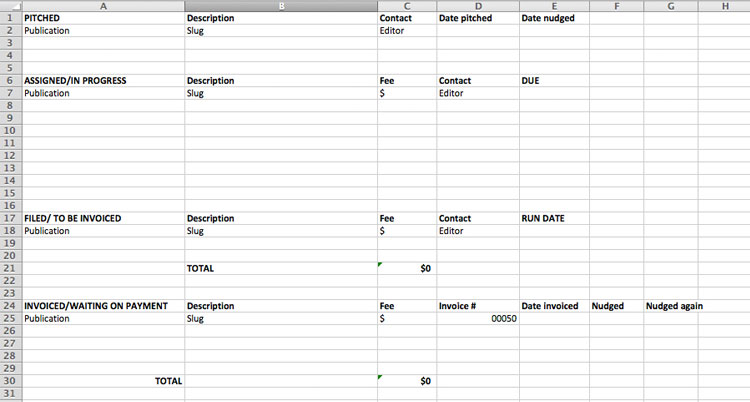
Full-time freelancer Ann Friedman said she formats an Excel spreadsheet into four main groups, which are: Pitched, Assigned/In Progress, Filed/To Be Invoiced and Invoiced/Waiting on Payment. A particular story will progress from the top of the spreadsheet to the bottom from start (as an idea) to finish (a published story with a check deposited into Friedman’s bank account). See sample below.
freelance cashflow spreadsheet

According to Ann, this method helps her to keep track of each story’s status, a necessary process because there are a variety of stories she’s working on at once for various publications, all in different stages of development.

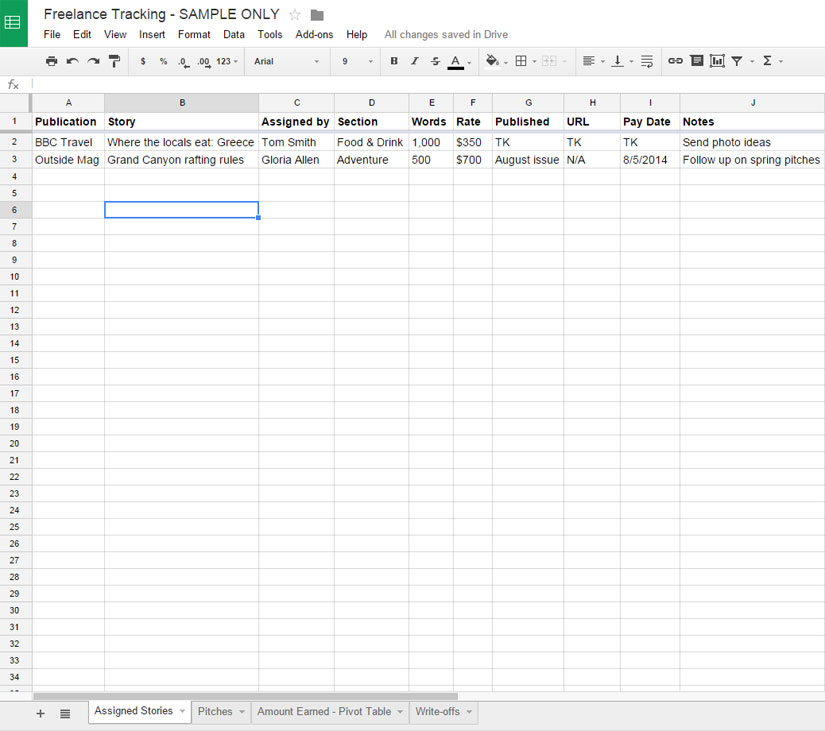
As for me, the more detailed spreadsheet I use with Google Sheets tracks each story’s different elements and ideas. Following the progression of each story helps me make sure I’m not repetitive with any specific editor or publication, and allows me to pay attention to the ideas that worked and those that didn’t.

To replicate it, use four tabs for your document, and create columns for the following bulleted items:

Tab 1: Assigned Stories

• Publication

• Title of story

• Point of contact

• Section

• Words

• Rate

• Date published

• URL (if applicable)

• Payment date

• Notes (feedback/preferences from editor)

Tab 2: Pitches

• Story idea

• Working title

• Submitted (Yes?/No?)

• Pitched to (list publications you pitched)

Here’s a sample sheet:

Use Google Sheets to track freelance tasks

The last two tabs can help you for accounting purposes:

Tab 3: Amount Earned

Use a pivot table to automatically calculate the amount earned per month (or whatever time periods you want to look at), based on the rate information from Tab 1. You can do this in Excel or in Google Sheets. (Here’s how to create a pivot table in a Google doc, which will allow you to access your information wherever you are logged in to your Google account.)

Tab 4: Write-offs

Finally, here’s where you can keep track of anything you can write off as a business expense. Include costs associated with networking lunches, money spent to work and use Wi-Fi in coffee shops, home Internet bills, office supplies, etc.

Many full time freelancers say their job requires a certain amount of entrepreneurial spirit — they treat their freelancing as a business that they must grow and take ownership of. Keeping track of your work as a freelancer, from publish dates to word counts and pay, will help you analyze how you progressed over weeks, months and years.


Topics:

Business Basics, Go Freelance
Resumes & Cover Letters

7 Red Flags on Your Resume (And How to Fix Them Fast)

Make sure your resume is free of these transgressions

interviewer inspecting resume with red flags
Admin icon
By Brittany Taylor
Brittany Taylor is an enterprise marketing manager and content strategist with over a decade of experience in B2B content marketing, brand building, and ghostwriting, with bylines in SELF, Teen Vogue, and Mediabistro. She currently leads content and branding across multiple brands at HireQuest Inc.
7 min read • Originally published June 30, 2015 / Updated March 19, 2026
Admin icon
By Brittany Taylor
Brittany Taylor is an enterprise marketing manager and content strategist with over a decade of experience in B2B content marketing, brand building, and ghostwriting, with bylines in SELF, Teen Vogue, and Mediabistro. She currently leads content and branding across multiple brands at HireQuest Inc.
7 min read • Originally published June 30, 2015 / Updated March 19, 2026

You’ve been sending out applications left and right and yet there’s been nary a nibble. It’s not you—you’re great. You match all the job requirements (and quite a few of the “nice to have” skills, too). You wrote an engaging cover letter. Your background itself is on-point. So what gives?

It might just be your resume. What looks perfect to you, your school’s career adviser, or even some of your colleagues can come off as gimmicky, careless or unhelpful to the folks doing the hiring. So what are they really looking for? We chatted with four hiring managers and recruiters: Aimée Starck, recruiter at Creative Circle; Sandy Pinos-Chin, director of human resources at About.com; Yair Riemer, chief marketing officer at HR tech company CareerArc; and David Waring, cofounder and editor at FitSmallBusiness.com, who has used Mediabistro’s own job board to hire writers and marketing executives. Here, they reveal applicants’ biggest resume blunders.

1. Easily avoidable mistakes. 

Typos, misspelled words and grammar errors are at the top of all four experts’ stop-reading-right-now lists. And it doesn’t matter if the role you’re applying for is content- or editorial-related—no mistakes.

“[Whether you are] applying for a coding job, a writing job, a design job, if you are not spell checking and making sure that content is correct on your resume, I am really not interested,” Starck says. “Don’t tell me you’re detail oriented but you can’t pay attention to your grammar on a one-page resume.”

For those getting creative, aim for consistency above all. “Make sure the bullets are the same size and they’re indented the same amount of space from the margin,” Starck says. “If you’re using periods at the end of your bullets, make sure that every bullet has a period.”

And don’t think you can get away with widows just because you’re not an InDesign pro. “If you have a couple of lines that flow into the next page, there’s a way to make it shorter,” Pinos-Chin says. “I know that’s a pet peeve of recruiters, to have to print out empty pages or a page with one line is annoying. I’ve had resumes that come in and it’s like, ‘You couldn’t delete the extra space? I just printed out 13 pages of nothing.’ It comes across as careless.”

Finally, for the love of all that is aesthetically pleasing, save your .doc as a PDF. If it’s a huge file, compress it.

2. Confusing chronology or formatting.

We know, it’s boring, but the general format for resumes hasn’t undergone a huge evolution—so don’t go crazy manipulating yours.

“We’re still looking for a bulleted itemization of the major types of responsibilities you had at each of your employers,” Pinos-Chin says. “One of the things I see a lot is that instead of organizing their resume chronologically, they’ll organize it based on their skills and then make a short list of their employers. That, for me, is a turn-off because it’s hard to understand the progression of the things you worked on. It’s also hard to understand if you used a skill at your first job or more recently or across the board.”

Sometimes resume experts suggest using skill-based formatting to hide employment gaps. However, recruiter Starck urges applicants to just be honest. “They’re going to get to the bottom of it regardless, so I would be up front about it,” she says, whether [the gaps are] due to family obligations, illness or unemployment.

Employers do want to make sure you’re not out of the loop, so be sure to stay informed about your industry. “It’s important to… make sure that if you’re trying to get back into the industry that you can talk intelligently about [trends],” says Starck.

And in case you were wondering: Comic Sans MS? Still a no-no. Graphics? Keep them in your portfolio. Head shots? Save for your dating profile. While Riemer is willing to make exceptions for art directors or graphic designers, he says it’s still best not to take risks that may distract your resume’s reader.

3. Exceeding one page without years of relevant experience to back it up.

“You don’t have to include all of your work experience—only the relevant work experience,” says Riemer. “If you worked as a lifeguard or summer camp counselor five years ago, but since then have interned at three Internet startups in the marketing department, and you’re applying for a full-time, entry-level job at an Internet company, it’s probably OK to leave out that your summer camp group won the annual kickball tournament.”

Starck echoes the sentiment of brevity. “I have 10-plus years of experience under my belt,” she shares, “and I still have a one-page resume. You should really be curating and tailoring your resume to reflect the job you’re applying for.”

In the same vein, there is such a thing as sharing too much work history.

On the decade cut-off, Waring is in agreement. “However,” he says, “if you have experience that is particularly relevant to the position that you are applying for that goes back further than this, I would include it.”

4. Padding for length (or any reason).

We’ve heard the one-page rule so many times, it feels like an absolute. And while most of the hand-wringing comes from folks trying to squeeze their life onto a single sheet of paper, applicants who are fresh out of college or who are looking for internships have the opposite problem: what if there isn’t enough to fill a page?

“I would personally rather see a resume that is less than one page than a full-page resume that is full of fluff,” Waring says. “If they are applying to a position they feel might require experience they do not have, then why they are still a good fit should be in the cover letter.”

Waring suggests that students and recent grads include the following areas: education, relevant coursework, leadership and interests, achievements and skills. Think: Adobe Creative Suite, Tweetdeck, fluent in Spanish, not soft skills like “is a team player” or “possesses meticulous attention to detail” —Starck says these are things you have to show, not tell.

“Academic accomplishments are key,” Riemer emphasizes, “specifically if you have studied or researched any of the elements required for a job. Something as tangential as a research project or paper in school can separate you from someone else with little practical experience because it at least shows an interest in the role.”

5. Obvious objective statements.

Some recruiters love seeing objectives, Pinos-Chin says, while others loathe them. However, the objective as a whole has transformed from the redundant “I’m looking for a fulfilling career in children’s publishing with growth potential where I can build on my leadership skills” to more of a value statement about yourself.

“I am a self-motivated leader with a knack for problem-solving” might work for a developer position, Pinos-Chin offers as an example.

“Tell me something that’s useful to me,” Pinos-Chin adds. “What’s useful to me is an elevator pitch about why you’re awesome.”

6. Getting too personal.

Should you include the hours you’ve clocked at the homeless shelter? What about your love for Korean barbeque? Waring says he likes seeing a smidgeon of personal information in a hobbies or general interests section, but “no more than one or two lines, unless the experience is particularly relevant to the position.”

Riemer says that in some cases, “if you’ve done research on the company culture and see that volunteering or team-building activities are core to the specific firm you’re applying for,” adding a section that highlights your interests there can give you a boost.

Pinos-Chin agrees that understanding your audience is key. She cautions applicants not stray into TMI territory, however. This means avoiding anything politically charged or divisive. “It’s about mitigating the prospect of, ‘What if I’m applying and the person who reads my resume happens to be somebody on the complete other end of the spectrum,'” she explains. “Just be aware and consider that it might not be the distraction you want to add to your resume.”

7. Forgoing keywords.

You need to include keywords, and not just because some large companies use programs to pick and choose applicants that check certain boxes. Put them in your bullet points, not just in the bottom “skills” section.

“As recruiters, we don’t have time to look at every little thing. We’re going through hundreds and hundreds of resumes and LinkedIn profiles and all kinds of things,” Pinos-Chin says.

“I judge [the lack of keywords] more harshly on content-related people, especially in the digital space,” Pinos-Chin adds. “Being able to optimize content for the Web and for search is so essential. Keywords should be a natural part of how you think. You need to make that association—and not making it shows a lack of awareness.”

Riemer agrees. “This is an important point,” he says. “Keywords matter, but you shouldn’t write your resume for a machine. If you have expressed the key components of the role and industry, then that will kill two birds with one stone—and also take care of any algorithms looking for those keywords.”

The bottom line is your resume isn’t a task list; it’s a sales sheet.

“An effective resume markets you and identifies your accomplishments and strengths,” Riemer says. “Hiring managers want to see that you’ve achieved success, not just shown up and completed tasks. Consider the document an opportunity to really impress and craft a strong introduction about yourself, rather than just a summary of work history.”

Topics:

Get a Media Job, Get Hired, Resumes & Cover Letters
Business Basics

Should Freelancers Hire a CPA? Here’s How to Decide

Find out why hiring a CPA could help save your sanity

freelancer meeting with cpa
Admin icon
By Amanda Layman Low
@AmandaLaymanLow
Amanda Layman is a B2B tech content writer and strategist with over 15 years of experience creating content for startups and enterprise brands. She founded Tigris, a content agency serving leading tech companies, and authored The New Freelance: A Book for Writers.
5 min read • Originally published June 30, 2015 / Updated March 19, 2026
Admin icon
By Amanda Layman Low
@AmandaLaymanLow
Amanda Layman is a B2B tech content writer and strategist with over 15 years of experience creating content for startups and enterprise brands. She founded Tigris, a content agency serving leading tech companies, and authored The New Freelance: A Book for Writers.
5 min read • Originally published June 30, 2015 / Updated March 19, 2026

Every freelancer gets to a point in her career where she must ask herself: Am I finally ready to treat this like a real business and hire an accountant? The consensus after speaking with two writers and a certified public accountant (CPA) is if you’re willing and able to pay up, having an expert manage your ledger is a valuable investment.

Read on for their advice.

Find the right match.

Although you don’t necessarily have to seek out a CPA who deeply understands every writer-ly woe, there is a resounding sentiment among writers with accountants that you’ll feel most comfortable and satisfied with a CPA who has some experience working with people in your field.

Freelance graphic designer and writer Preston D. Lee made the mistake of picking his first CPA at random. “That didn’t pay off,” he says. “They were not extremely helpful and I found I was basically doing all the real work and paying them simply to file the information together in one place.” He persisted in his search, however, and found a private CPA who didn’t work for a firm and established a strong working relationship with the accountant.

“Thousands of people can do the technical work a CPA can do,” Lee says, “but only a few people will really understand and appreciate my business the way I need them to. For me, it’s about getting the right people on board in all areas. Finance is no different.”

Independent writer Davina van Buren found her CPA through a referral from a fellow freelancer. “I specifically tried to find someone who worked with freelance writers. I’ve worked with him for two years so far. It makes me feel more comfortable that he remembers me.” On finding a CPA with experience working with writers, she says, “CPAs are kind of like writers: they have their specialties as well. For me, it made me feel better to work with someone who’s used to working with writers and [who knows] all the things we can write off [when filing taxes].”

Says Brittany Hopp of York and Hopp CPAs, “You’re definitely going to be more willing to call someone throughout the year if you feel like you can trust that person.” Hopp emphasizes calling around, getting referrals and actually interviewing CPAs or tax preparers to find the one that suits your specific needs.

Learn how a CPA can help.

Some writers may not seek out CPAs simply because they don’t know how a professional could help them. Hopp says in addition to tax preparation, a CPA can help freelancers with general bookkeeping, managing numbers and staying on top of receipts. She adds that some creatives are intimidated by CPAs, but she reassures “we’re really just people and we want to help our clients— even if it’s just education on the front end to figure out what you want to be doing.”

A CPA is also very useful if you have income from several different sources. Van Buren shares what inspired her to seek out the help of a CPA: “The first year I was freelancing, I had a staff job the first part of the year, I was freelancing the second part of the year and the whole year I was also working as a waitress. I had a lot of different things going on.”

I went through a similar scenario. During my first year of freelancing, I was newly married and had income both from freelance work and from my former employer. Instead of attempting to file taxes myself, I took my information to a professional and it helped immensely.

Aside from help during tax time, you can utilize a CPA as often or as little as you need. Lee says, “We don’t meet often. I basically spend a total of 30 to 60 minutes on the phone with my bookkeeping person and accountant once a month.”

Get the facts on service costs.

The catch, of course, even if you’re delighted by the idea of handing your books off to a professional, is the cost of hiring him or her. As you know, running a business for which you’re the only employee means your budget might be a little tight. Therefore, it may be less than appealing to think about spending that precious income on much else beyond your domain name, magazine subscriptions and your Mediabistro AvantGuild membership. So what if you’re interested in hiring a CPA, but the cost is holding you back?

First, don’t just think in terms of money, but consider the time you could save and frustration you could avoid by enlisting help. Van Buren says, “[Hiring a CPA] definitely saves my sanity… I could make this [amount of money] in a quarter of my work day, so it’s worth it to me.”

Lee has a similar outlook. He says every minute he’s spending on bookkeeping and taxes is a minute he could be spending on freelance work.

And you may find the actual cost isn’t as high as you may have initially thought. Hopp says, “Sometimes it’s surprising how affordable a CPA can be, if you ask the right questions and figure out exactly what you need.” CPAs typically charge by the hour. Depending on where you live and the level of experience of your CPA, you could be spending anywhere from $90 an hour to $300 an hour. If this fee seems daunting, consider other ways to save. Students in CPA programs at local colleges may be able to provide the counsel you need. Or, consider a virtual CPA: search for virtual or online CPAs to find a team that can answer any basic questions you might have.

Just bear in mind that finding the cheapest per-hour rate doesn’t guarantee the greatest savings. If you’re working with an inexpensive professional who takes hours to accomplish what a more experienced CPA could do in minutes, you’re better off shelling out for the more experienced pro.

Although there’s no definite rule that will help you determine whether a CPA is right for you, an assessment of your available time, budget and skill set will help guide you. Van Buren puts it succinctly: “Numbers are not my thing. Words are my thing. So, to me, it’s worth it to just pay somebody and not have to worry about my math or whether I left something out.”

Topics:

Business Basics, Get a Media Job, Go Freelance
Job Search

How to Use LinkedIn to Launch Your Media Career

Kick your job search into high gear with help from the experts

professional using LinkedIn on smartphone
Admin icon
By Brittany Taylor
Brittany Taylor is an enterprise marketing manager and content strategist with over a decade of experience in B2B content marketing, brand building, and ghostwriting, with bylines in SELF, Teen Vogue, and Mediabistro. She currently leads content and branding across multiple brands at HireQuest Inc.
5 min read • Originally published June 30, 2015 / Updated March 19, 2026
Admin icon
By Brittany Taylor
Brittany Taylor is an enterprise marketing manager and content strategist with over a decade of experience in B2B content marketing, brand building, and ghostwriting, with bylines in SELF, Teen Vogue, and Mediabistro. She currently leads content and branding across multiple brands at HireQuest Inc.
5 min read • Originally published June 30, 2015 / Updated March 19, 2026

Sure, you’ve got yourself a LinkedIn profile. And, yes, maybe you joined a few professional groups way back when. But are you doing everything you can to maximize your presence on the top social media platform for job seekers? Probably not, according to our experts. Whether you’re looking to get your foot in the door or want to start climbing the career ladder, optimizing your LinkedIn experience is a snap, as long as you know where to go and what to do.

Not convinced? Here’s a statistic for you: 96 percent of recruiters look for talent on LinkedIn, says Lisa Rangel, an official moderator on LinkedIn’s Job Search group. Your goal, she says, is to be found. Want your online business card in front of professionals of all types and levels—including CEOs, editors in chief and creative directors? It’s time to maximize your profile and get in the game. Here’s how.

Use the job title field wisely.

The headline, aka the job title field, is especially important because it pops up with your name in searches, status updates and comments you leave throughout the site. You don’t have to use this space for your current job title—that can be found in the body of your profile. Consider your headline from the perspective of the person searching for someone like you, Rangel suggests.

Think first about the title for which you want to be discovered. Marketing director? Graphic artist? Copywriter? Then add in your location (New York, Brooklyn, Virtual World) and your industry or areas of expertise (sales copy, infographics, finance reporting). The cherry on top is a unique descriptor. Rangel urges users to avoid superlatives and aim for precision—it should be click-generating and buzz-producing. Just get it all done in 120 characters, which is LinkedIn’s character allotment for headlines.

Be creative with keywords.

Let’s say you consider yourself a motivated, passionate and creative editor. That’s great, but are these really the words you want to splash all over your profile? Not according to LinkedIn’s career expert Catherine Fisher, who likens these superficial descriptors as the kind that make recruiters say “meh” and move on to the next candidate. She adds that too many people say these things about themselves. In fact, LinkedIn’s Official Blog featured a top 10 list of the most overused and underwhelming buzzwords on profiles in 2014. “Motivated” clocked in at No. 1. Other words and phrases to avoid: “driven,” “extensive experience” and “strategic.”

So what keywords will make hiring managers take notice? “The best way to find strong keywords is by finding a couple of job descriptions that match your skills and using a word cloud generator [e.g. Tagxedo, WordItOut, Wordle or TagCrowd] to generate keywords for your profile and resume,” says Ron Nash, a LinkedIn preferred trainer at The In Academy.

Join a variety of groups within your industry.

There are more than 1 million groups on LinkedIn of varying levels of activity and membership. Some are broad (“Media Professionals Worldwide”) and some are narrow (“Business journalists in India”).

One of the best features of LinkedIn groups is they expand your network, giving you a perfect opportunity to connect with people you don’t actually know, but would want to get in touch with. Plus, as Nash points out, group members may post jobs they’re currently recruiting for—jobs that aren’t listed elsewhere.

Where should you start? Rangel suggests choosing groups across your industry, profession, geographic location and hobbies and then whittling them down. One item to note: Don’t stick to just what you know.

“Networking with other professions within your industry, such as finance and human resources, can expand your cross-functional network,” Rangel says, giving you more connections that you might be able to tap one day.

Nash adds that before you share anything with your group, sit back and observe what’s being communicated. Some groups have rules about what outside links can be posted where, and what discussions are relevant to the group as a whole. If you disobey the group’s bylaws, you might get ejected (ouch!).

And much like a face-to-face network, groups are all about service. Post articles that are beneficial or offer advice to those asking for it—and before assuming someone else in the group would be happy to be your new industry mentor, ask him or her first.

Mine your connections.

As you import contacts into LinkedIn, you might start off with 30 or 50 industry professionals you actually know. But the value of the platform sneaks in with its second, third and group connections—people you know through other people.

If you play your cards right, you can snag new connections online that just might help you get a leg up in your career. So how do you go from a third connection to a first connection? Ask—nicely.

Rangel suggests sending something along the lines of, “I see we have some mutual connections on LinkedIn, and I wanted to reach out….” Alternatively, Fisher urges users to ask their immediate connections for introductions. “Your mutual connection validates you as a professional,” she says.

No matter how close the connection is, though, do not ask about job openings on your first message to someone. Rangel equates it to asking someone you meet on a blind date to marry you—awkward!

Send off some InMail.

If you’re looking to boost your connections, The InMail feature is a helpful tool, though it does require a Premium LinkedIn account. Whether you want to set up an informational interview or network your way into your dream company, Nash says sending the perfect InMail message is about personalization.

“Don’t use a generic subject line. Don’t use a generic message,” he says. “And don’t send them a long message. Ask for permission to have a phone call,” which you should be prepared for before you even ask the question. You never know when that possible connection will have an opening in their schedule the afternoon you send the message and want to talk to you ASAP.

After you communicate, adds Nash, don’t forget to thank your connection for his time and say, “If there is anything that I can ever do for you, please don’t hesitate to let me know.'”

After all, you give what you get. And to get the most out of LinkedIn, Nash says, you’ve got to be a giver.

Topics:

Get a Media Job, Get Hired, Job Search
Business Basics

How Freelancers Can Save for Retirement and Unexpected Expenses

Have your nest egg and freelance too with these tips

nest egg
By Eric Rosenberg
6 min read • Originally published July 27, 2015 / Updated March 19, 2026
By Eric Rosenberg
6 min read • Originally published July 27, 2015 / Updated March 19, 2026

Freelancing is not just for writers and designers anymore. More than one-third of the American workforce is doing freelance work, according to a 2014 survey published by the Freelancers Union, an advocacy group for independent contractors.

With an increasing number of people making a career out of freelance work, it’s important that they continue to focus on retirement and savings, and to address the challenges of long-term personal-finance goals. Unlike most salaried income, freelance income can be irregular and doesn’t include a company-sponsored 401(k) plan. But these tips can help anyone get on the path to better personal-finance management.

Set a budget based on your average income.

Typical budgets use the same number each month for the income and expense categories. However, freelancers are quick to learn that income can be unpredictable or seasonal, with some months consistently stronger than others. With no steady paycheck, it’s important to adjust a budget to match. This means freelancers should look at their average income each month rather than actual income each month.

“I recommend taking your previous year of income and dividing it by 12, so you can come up with your estimated monthly income,” says Deacon Hayes, a personal-finance blogger at Well Kept Wallet. “That way, you can pay yourself each month and know that you can cover your bills. If you make more money one month, put it in savings for the months where less money comes in.”

Save for retirement using a percentage of income.

In most cases, company employees can automatically invest a percentage of each paycheck into a 401(k) or similar retirement account. While freelancers can’t count on an employer to make that transfer for them, they can still save a fixed percentage of income each month toward their nest egg.

At a large company, saving 6 percent is common—and an employer often matches dollar-for-dollar toward that first 6 percent, which helps build savings for salaried workers.

There’s no rule of thumb for freelancers because each person’s financial situation is different. To be safe and build savings comparable to what they might receive at a large company, freelancers should take a close look at their annual income and current savings.

For example, consider Josh, a 34-year-old freelancer living in New York City who already has $15,000 in retirement savings. He is now earning $68,000* as a writer and saving $8,000 per year for retirement.

With that savings rate, he can expect to have $43,000 per year in spending money in retirement after age 68.** If he saves $12,000 per year, his retirement spending increases to $54,000 per year. Whatever amount he decides to save, he can use a SEP-IRA, or a combination of a SEP-IRA and Roth IRA. (More on these plans below.)

Choose the right retirement plan for your needs.

Once you’ve determined the amount to save, you’ll need a place to put all of that money to grow for the future. There is no perfect investment account for everyone, so you will need a good handle on your income and savings goals. You should always consult your tax professional to determine what plan or plans may be best for your circumstances.

Your options include a simplified employee pension (SEP) plan, as well as traditional and Roth individual retirement arrangements (IRAs). The SEP-IRA is a tax-advantaged account for retirement and aimed at self-employed workers such as freelancers. Contributions to a SEP are tax deductible, and savers do not pay taxes on investment growth.

“Don’t jump right to a traditional [IRA] or SEP-IRA,” says Alex Benke, CFP, director of advice products at Betterment, an automated investing service. Benke says freelancers and other self-employed workers get hooked on business deductions and go right for a deductible IRA contribution. But a tax-advantaged Roth, for which contributions are not tax deductible, may be better, if a freelancer’s income level qualifies.

“If you think your current tax bracket is lower than it will be in retirement, do a Roth,” Benke advises. “A Roth IRA also has an added benefit, which is that contributions can be withdrawn tax and penalty free in the case of an emergency.” However, beware that any gains withdrawn will be taxed and penalized by the IRS, Benke adds.

Early withdrawals are generally not recommended because they can set back your retirement savings; however, the option can come in handy in a cash crunch caused by variable income.

One reason to use both types of IRA is to spread the tax benefit across this year and the future.

For workers who can and want to save more than $5,500 ($6,500 if you’re 50 or older) in 2015—the Roth IRA contribution limit—the simplest option is to use a SEP-IRA, which has no special plan setup or filing requirements. SEP-IRAs also make sense for higher earners who don’t qualify for a Roth. They have much higher contribution limits than traditional IRAs.

Speaking of contributions, Benke suggests making IRA contributions throughout the year, not only at the end (or around when you pay your quarterly taxes), in order to maximize time in the market.

Create an emergency fund.

Emergency savings is a fundamental part of managing money well, and it can be extra important for freelancers because their cash flow can be irregular. “Money won’t always flow in as it does some months,” says John Rampton, a freelancer for online invoicing tool Due.com.

There are two key decisions for saving for a rainy day: (1) how much to save and (2) where to save it.

To figure out how much to save, first determine how many months you might be out of work, says Benke. It’s recommended by most financial experts that full-time employees have three to six months’ worth of expenses saved, but it could be more for freelancers. Adjust this amount based on work history and experience.

Next, estimate the smallest amount you’d be able to live on month-to-month. This includes expenses related to housing, food, clothing, transportation, health insurance and essential liabilities (utilities, loan payments, etc.). Add these up to get the sum of your monthly expenditure, and multiply by the number of months determined in the first step.

Finally, consider where to save this money. It shouldn’t be in a place where you could spend it (like a checking account), but where it can be accessed easily should the need arise. One option is a safety net fund, designed as a low-risk investment for money earmarked for emergencies. Another option is keeping money in an interest-earning savings account.

If you think you will only have a very temporary cash flow shortage, it can also be useful to have an available line of credit to be used only for emergencies.

Hire a CPA if you need more peace of mind.

Personal finance matters can get complicated, and you might not want to try to manage everything yourself. Outsourcing complex financial tasks like bookkeeping and quarterly tax payments saves you time and mental energy—and could save you money as well.

“Make sure you spend the time to learn the tax rules or hire a certified public accountant (CPA) who specializes in your area of practice,” says Lance Cothern, a finance expert from Money Manifesto. “The money or time spent will be well worth it when you make the correct estimated tax payments and you don’t have to worry about a surprise tax bill because you didn’t fully understand what you would owe on tax day.”

Freelancing can offer a new kind of lifestyle—one that isn’t inhibited by the strict schedule of a traditional 9-to-5 job. Perhaps one of its bigger disadvantages is it requires you to pick up many of the financial responsibilities that an employer typically provides. But with the right planning and financial tools in place, you can enjoy the flexibility a freelancer’s lifestyle while still feeling confident and secure about your future.

* The mean annual income for a writer in 2014 according to the Bureau of Labor Statistics.

**This example is based on Betterment’s RetireGuide advice model. It assumes a retirement age of 68 and longevity of age 90, 3 percent inflation and a portfolio allocated according to Betterment’s advice for someone age 34. It assumes $15,000 in existing savings and that $19,000 a year will come from Social Security benefits.


Topics:

Business Basics, Go Freelance

Posts navigation

Older posts
Newer posts
Featured Jobs
Kirkus Media
Editorial Intern
Kirkus Media
New York City, New York (US)

Gaia Inc
MEDIA COORDINATOR
Gaia Inc
Louisville, CO

Gaia Inc
Global Paid Media Specialist
Gaia Inc
Louisville, CO

Gaia Inc
Director of Media Strategy
Gaia Inc
Louisville, CO

Hearst Television
Account Executive
Hearst Television
Milwaukee, WI, United States

All Jobs »
PREMIUM MEMBER
NF

Natalie Finkelstein

Hoboken,
13 Years Experience
I am a three-time Emmy Winner in Sports Production. I have experience writing, producing, editing, creating graphics, and have great knowledge of...
View Full Profile »
Join Mediabistro Membership Today

Stand out from the crowd with a premium profile

Mediabistro Logo Find your next media job or showcase your creative talent
  • Job Search
  • Hot Jobs
  • Membership
  • Newsletter
  • Career Advice
  • Media News
  • Hiring Tips
  • Creative Tools
  • About
Facebook YouTube Instagram LinkedIn
Copyright © 2026 Mediabistro
  • Terms of Use
  • Terms of Service
  • Privacy