Mediabistro Logo Mediabistro Logo
  • Jobs
    Search Creative Jobs Hot Jobs Remote Media Jobs Create Job Alerts
    Job Categories
    Creative & Design Marketing & Communications Operations & Strategy Production Sales & Business Development Writing & Editing
    Quick Links
    Search All Jobs Remote Jobs Create Job Alerts
  • Career Resources
    Career Advice & Articles Media Industry News Media Career Interviews Creative Tools Resume Writing Services Interview Coaching Job Market Insights Member Profiles
  • Mediabistro Membership
    Membership Overview How to Pitch (Premium Tool) Editorial Calendars (Premium Access) Courses & Training Programs Membership FAQ
  • Showcase
    Featured Creative Stories Submit your Story
  • Log In
Post Jobs
Mediabistro Logo Mediabistro Logo
Search Creative Jobs Hot Jobs Remote Media Jobs Create Job Alerts
Job Categories
Creative & Design Marketing & Communications Operations & Strategy Production Sales & Business Development Writing & Editing
Quick Links
Search All Jobs Remote Jobs Create Job Alerts
Career Advice & Articles Media Industry News Media Career Interviews Creative Tools Resume Writing Services Interview Coaching Job Market Insights Member Profiles
Membership Overview How to Pitch (Premium Tool) Editorial Calendars (Premium Access) Courses & Training Programs Membership FAQ
Featured Creative Stories Submit your Story
Log In
Post Jobs
Log In | Sign Up

Follow Us!

NYC

Bunny baskets and Seder staples: New York's Easter and Passover trends

By Stacker Feed
5 min read • Published March 31, 2026
By Stacker Feed
5 min read • Published March 31, 2026

aerogondo2 // Shutterstock

Bunny baskets and Seder staples: New York’s Easter and Passover trends

When Easter and Passover arrive, shopping carts transform — filling up with chocolate bunnies, fresh florals, and time-honored holiday staples.

This past year, Easter and Passover overlapped, creating one of the busiest and most festive shopping periods of the spring season. Instacart took a look at what customers in New York and across the country added to their carts during Easter week (April 14-20, 2025) and the week leading up to Passover (April 7-13, 2025) to see how Americans celebrated.

Here’s an overview from Instacart of what hopped to the top.

Key Takeaways:

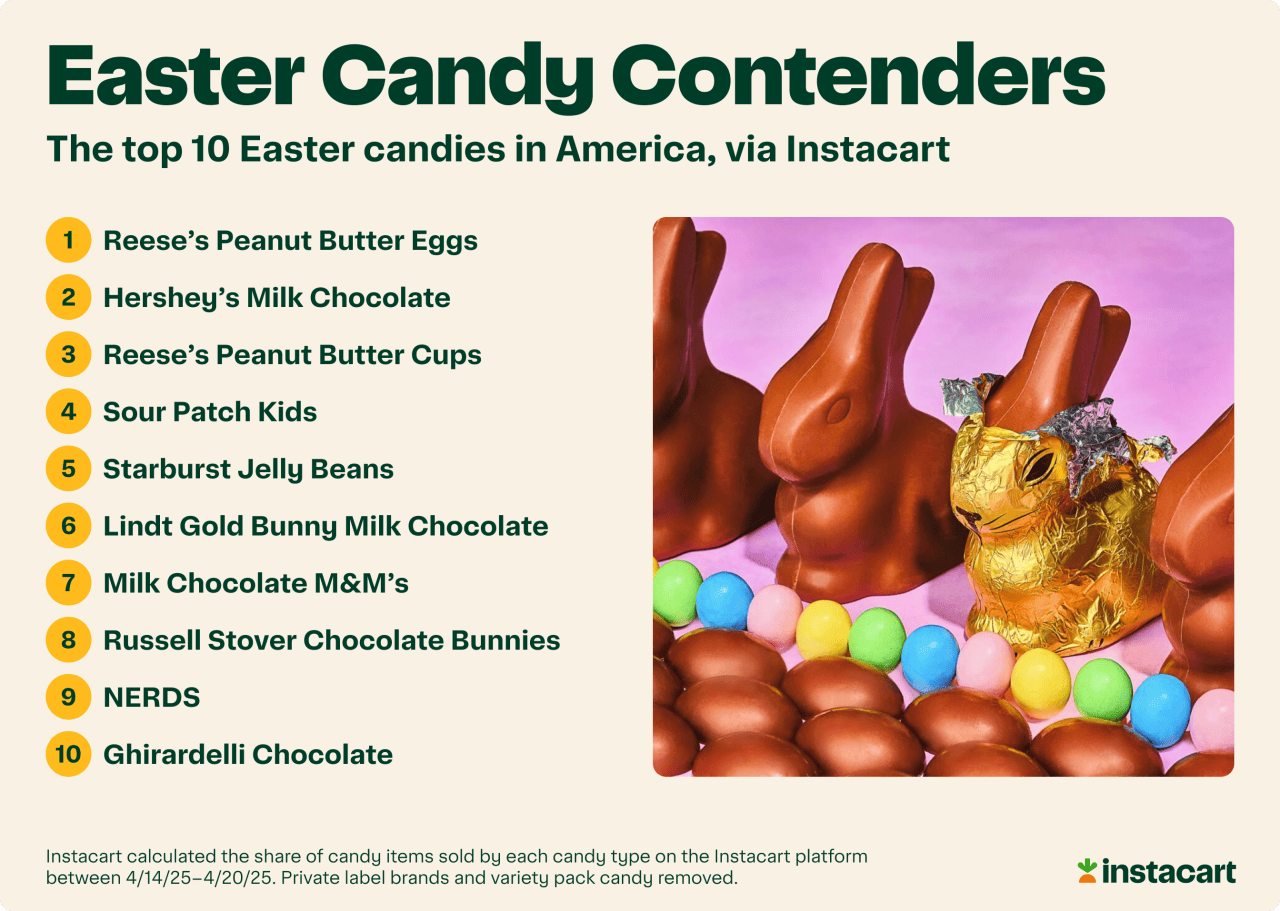
  • Reese’s Peanut Butter Eggs are the undisputed basket MVP. They ranked as the top-selling Easter candy nationwide for the fourth year in a row, leading Instacart’s Top 10 list.
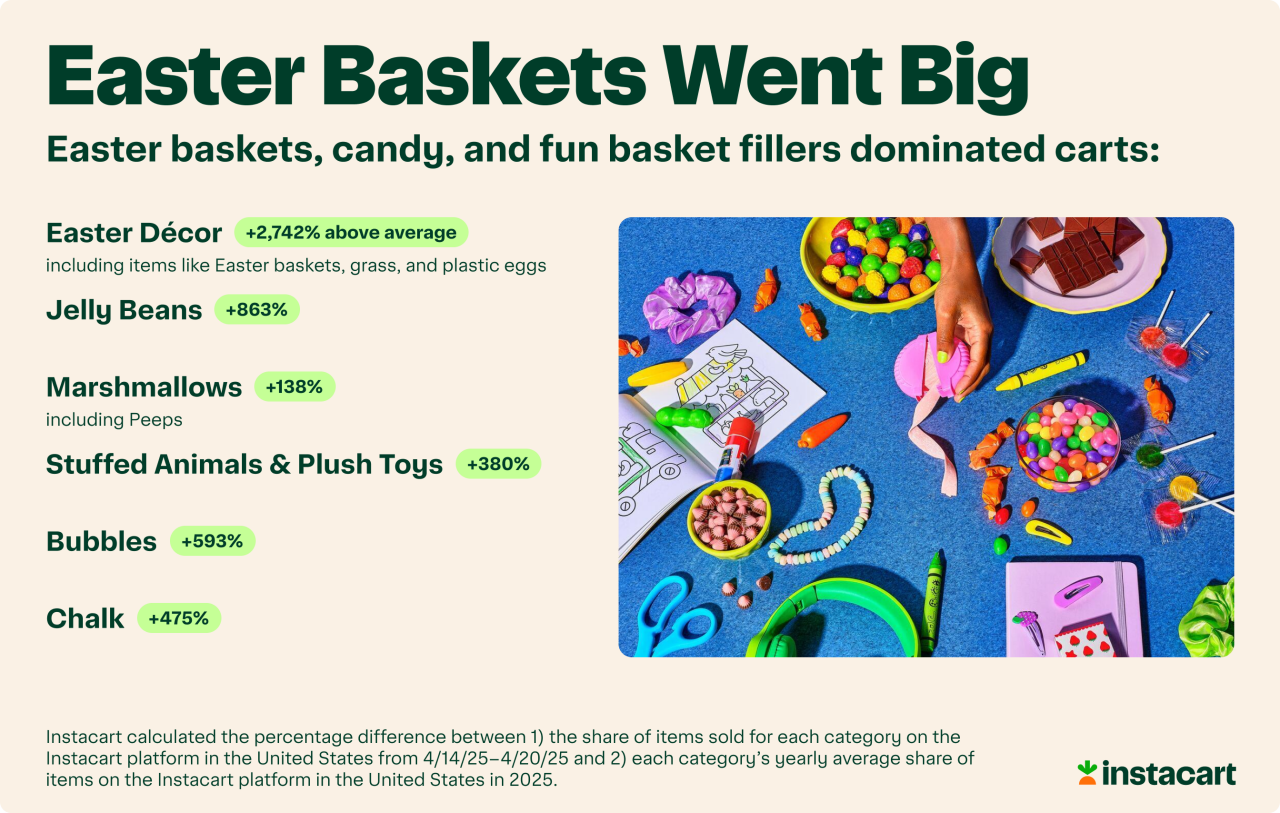
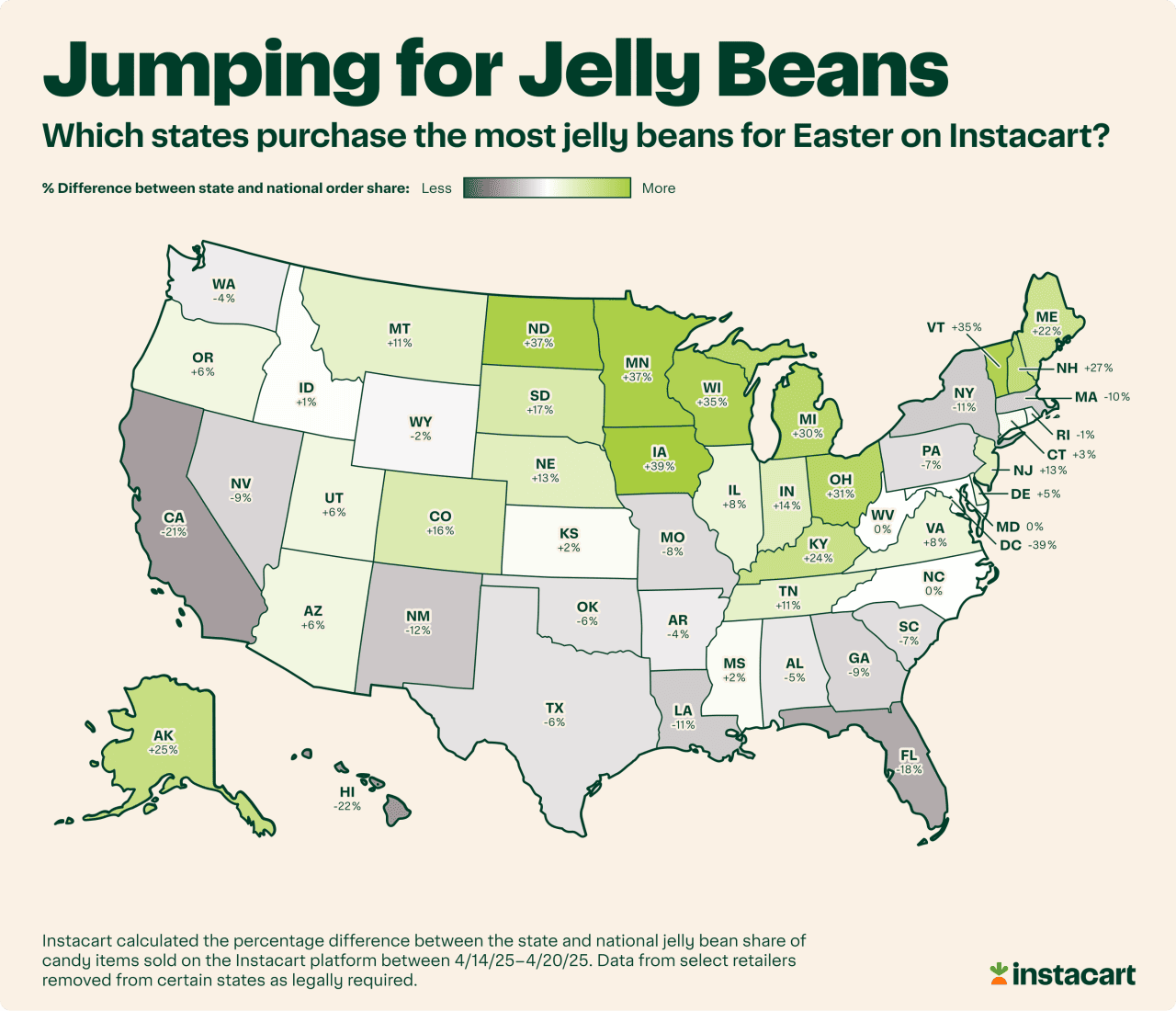
  • Jelly beans have their Easter moment. Jelly beans surged 863% above their yearly average during Easter week — one of the largest candy spikes of the season.
  • Easter weekend doubles as a spring reset. Gardening categories like soil (up 128%), mulch (133%), annual plants (157%), and fertilizer (124%) all saw significant lifts, showing that many people use the holiday as a launchpad for spring refresh projects.
  • ​​Easter décor dominates the holiday surge. Easter décor, including items like Easter baskets, grass, and plastic eggs, skyrocketed 2,742% above its yearly average during Easter week, making it the single biggest seasonal spike.
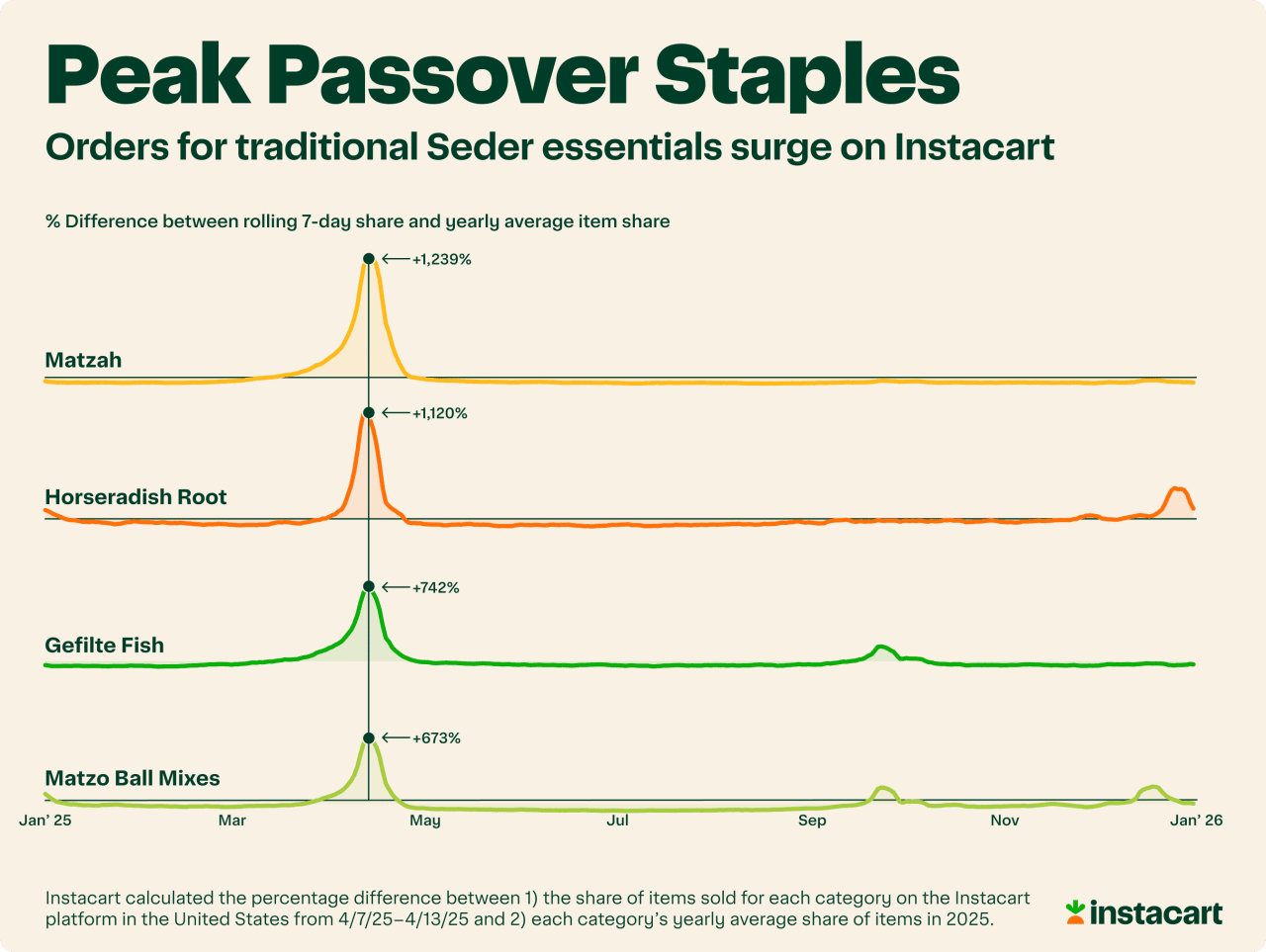
  • Passover prep is rooted in tradition. In the week leading up to Passover, matzah jumped 1,239% above its yearly average, while gefilte fish (742%), and matzo ball mixes (673%) also surged.

Instacart

Easter Week: Candy, Lamb — and a Side of Mulch

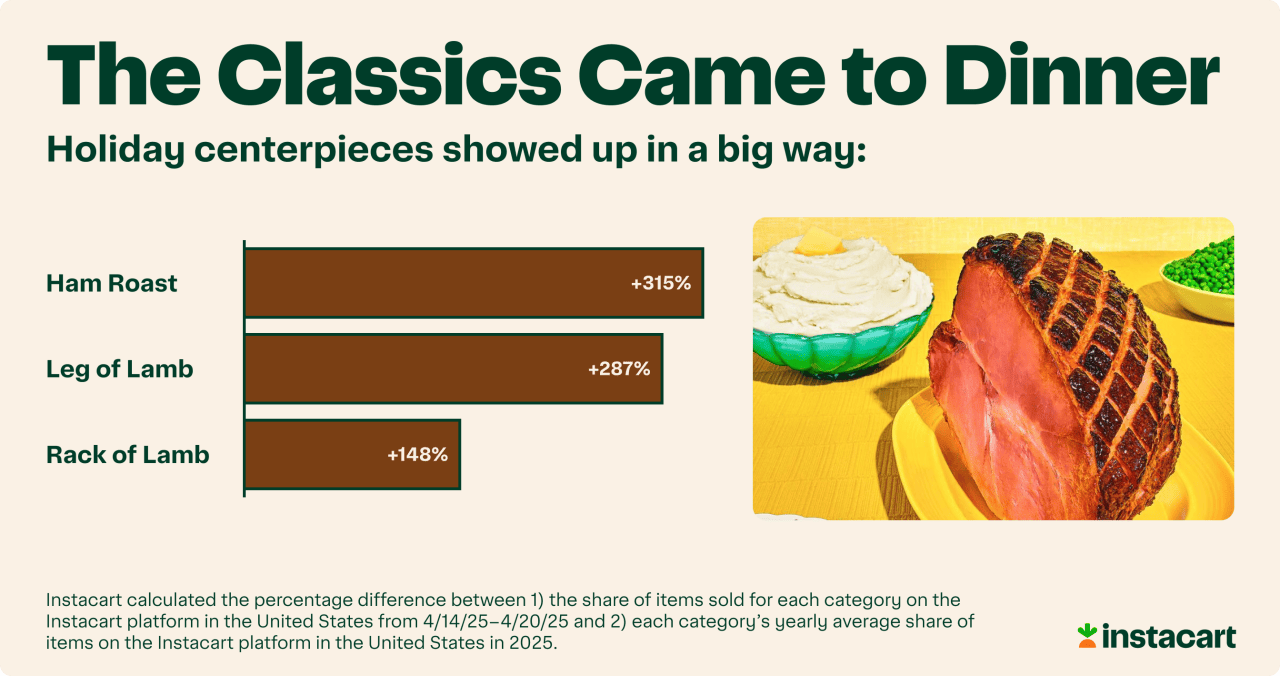
During the seven-day period ending on Easter Sunday, several categories surged far beyond their typical share of sales throughout the year.

Easter dinner centerpieces had a major moment, alongside candy-filled baskets and playful toys. As families headed outdoors for egg hunts after a long winter, gardening supplies also surged, signaling the unofficial kickoff to green thumb season.

Instacart

Easter baskets went big

It’s good news for the kiddos. The spike in sidewalk chalk and bubble wands signals that backyard season has officially begun.

Instacart

The Top 10 Easter Candies in America

When it comes to Easter basket-building, one candy reigned supreme.

During Easter week, Reese’s Peanut Butter Eggs ranked as the top-selling Easter candy by item share for the fourth year in a row.

Chocolate clearly dominates carts, but the presence of Sour Patch Kids, Starburst Jelly Beans, and Nerds shows that sour and fruity favorites still hold their own.

Instacart

Reese’s Dominates — But Not Every State Agrees

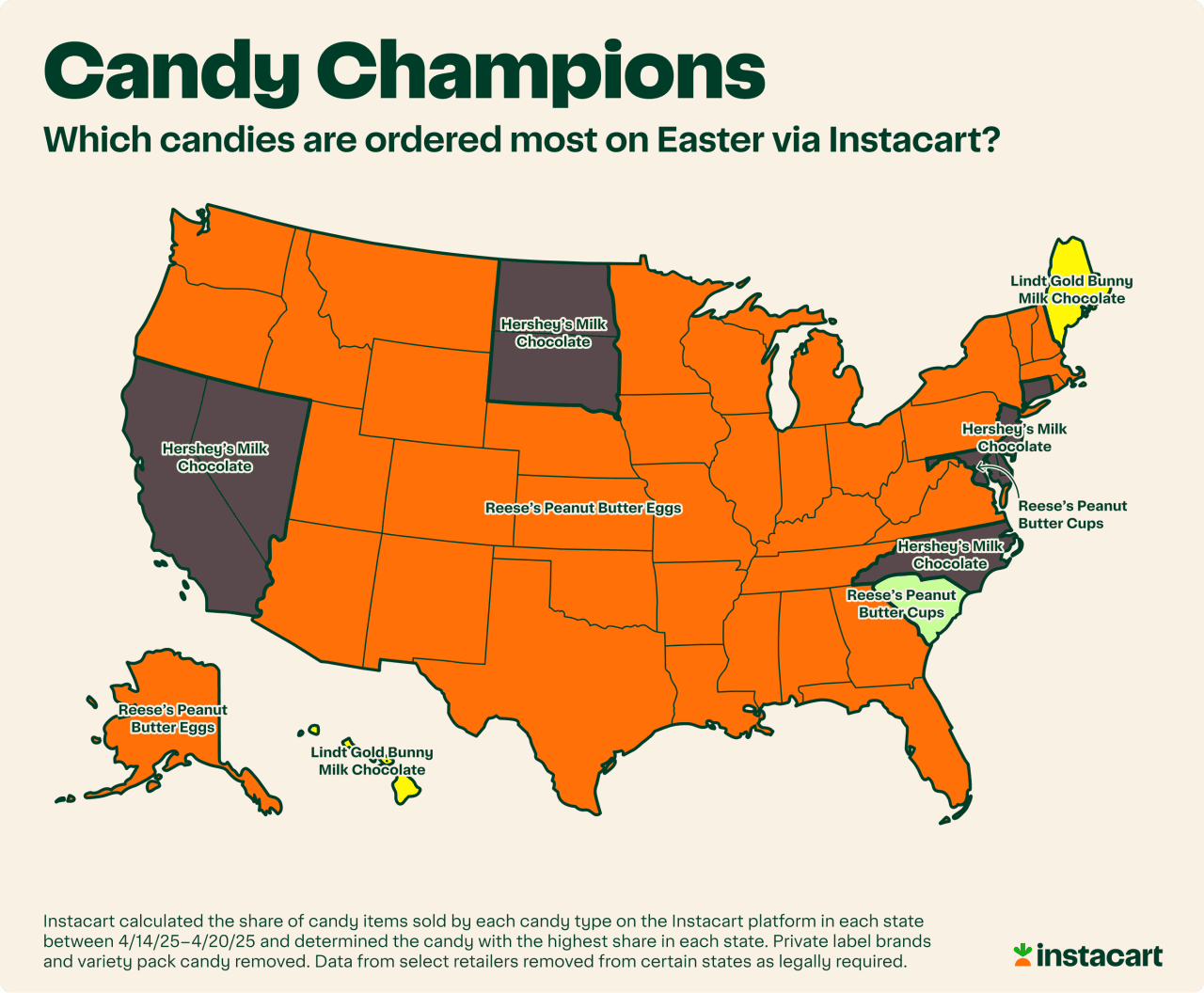
Perhaps unsurprisingly, when we mapped the top-selling Easter candy by item share in each state, Reese’s Peanut Butter Eggs topped the charts in 38 states, including New York, reinforcing its status as the undisputed MVP of Easter baskets.

However, 11 states (plus Washington, D.C.) opted for something else.

The Milk Chocolate Loyalists

States along both coasts as well as the Dakotas showed their love for Hershey’s Milk Chocolate as their top candy:

  • California
  • Connecticut
  • Delaware
  • Maryland
  • Nevada
  • New Jersey
  • North Carolina
  • North Dakota
  • South Dakota

The Bunny Believers

In Hawai’i and Maine, customers favored the seasonal classic Lindt Gold Bunny Milk Chocolate.

The Cup Crowd

And in Washington, D.C. and South Carolina, customers preferred Reese’s Peanut Butter Cups over the popular Easter egg-shaped version. Either way, it’s clear Reese’s peanut butter perfection is key for holiday enjoyment. 

Where Jelly Beans and Chocolate Bunnies Shine

Beyond overall top candies, we also looked at how strongly certain Easter staples over-indexed in each state compared to the national average, and two classics stood out: jelly beans and chocolate bunnies.

Instacart

The Jelly Bean Belt

Jelly beans surged nationally during Easter week, up 863% above their yearly average, but some states embraced them even more enthusiastically.

New York ordered 11% less jelly beans as a share of candy items compared to the national average, ranking as the #6 least among all states.

The biggest jelly bean fans were concentrated in the Midwest and Upper Plains:

  • Iowa (39% over national average)
  • North Dakota (37%)
  • Minnesota (37%)
  • Vermont (35%)
  • Wisconsin (35%)
  • Ohio (31%)
  • Michigan (30%)

In these states, jelly beans made up a significantly larger share of candy purchases than the national average, reinforcing their status as an Easter essential.

Meanwhile, states like California (21% below the national average), Hawai’i (22%), and D.C. (39%) purchased jelly beans at notably lower rates than the national average.

Instacart

Chocolate Bunny Strongholds

Chocolate bunnies also saw clear regional differences. New York ordered 9% more chocolate bunnies as a share of candy items compared to the national average, ranking as the #18 most among all states. The biggest chocolate bunny enthusiasts included:

  • Hawai’i (68% above national average)
  • Vermont (55%)
  • Rhode Island (50%)
  • Maine (50%)
  • New Hampshire (31%)

In these states, chocolate bunnies made up a significantly higher share of candy purchases compared to the national average.

One of the more surprising findings was Hawai’i topping the country for chocolate bunny purchases. The state typically under-indexes on highly seasonal purchases, so seeing it lead on such an iconic Easter item really stands out. What makes the trend even more interesting is that Hawai’i ordered jelly beans less often than average — suggesting that in the Aloha State, chocolate bunnies are in and jelly beans are out.

On the other end of the spectrum, Utah (31% below the national average), D.C. (30%), and Nevada (25%) ordered chocolate bunnies the least often, showing that while bunnies may be iconic, they are not equally beloved everywhere.

Utah’s chocolate bunny demand also caught attention. The state is usually at the forefront of seasonal shopping trends, so its lower-than-average demand for chocolate bunnies is a notable departure. For a state that often embraces holiday moments, the inverse this year stands out.

Instacart

Passover Prep: Seder Staples Surge

Looking at the week leading up to Passover (April 7-13, 2025), traditional Seder essentials rose sharply compared to their typical yearly share with matzah (+1,239%), matzo ball mixes (+673%), gefilte fish (+742%), and horseradish root (+1,120%).

Purchases of these key Passover staples follow a sharply seasonal pattern, with their most significant surge of the year occurring in the week leading up to Passover. Compared to their typical baseline, demand for these items skyrockets during the holiday, far outpacing any other point in the calendar year. While smaller lifts appear again around Rosh Hashanah and Hanukkah, those increases are modest in comparison, underscoring Passover as the clear peak moment for these traditional foods.

Baskets, Blooms and Seder Tables Await

With both holidays fast approaching, customers are leaning into the traditions and seasonal favorites that define spring.

This story was
produced by
Instacart
and reviewed and
distributed by Stacker.

Topics:

NYC
Careers & Education

The B2B digital marketing playbook for growth on autopilot

By Michelle Drennan for Apollo
16 min read • Published March 31, 2026
By Michelle Drennan for Apollo
16 min read • Published March 31, 2026

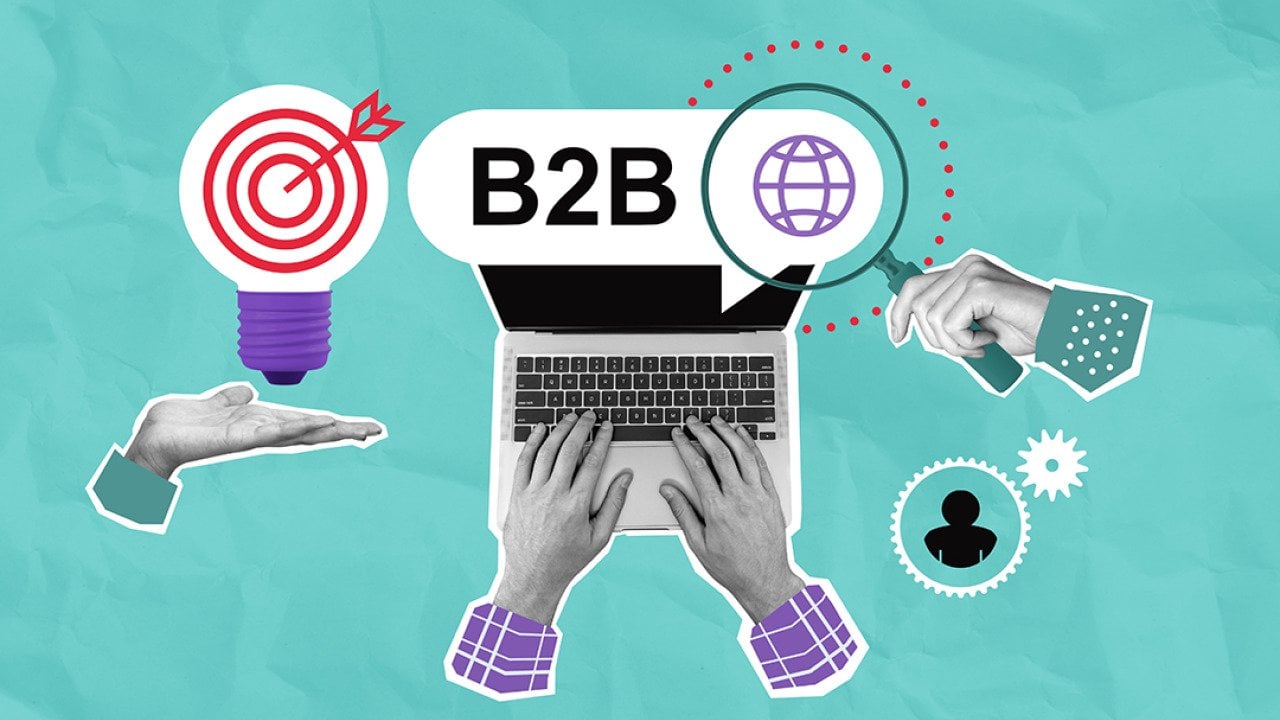
A collage of hands, laptop, and business graphics symbolizing B2B digital marketing on a teal paper background.

ImageFlow // Shutterstock

The B2B digital marketing playbook for growth on autopilot

Companies that make their marketing strategy a central part of their growth strategy grow faster than those that don’t.

A 2023 McKinsey study in which researchers conducted a survey, consulted industry groups, and spoke with more than 100 people in C-level growth roles, found that companies that invest in marketing are over twice as likely to grow at over 5% per year. And that’s growth that actively builds on itself, as you earn new customers, build a stronger domain, and strengthen your brand reputation.

Today, the practice of “marketing” is becoming increasingly synonymous with digital marketing. From social media platforms to search engine optimization, there are quite literally unlimited ways to capture buyers’ attention online and speak to them where they are with messaging they care about.

But where do you start? And how do you break through the noise amid a wave of AI and shortened attention spans?

Apollo did some research and spoke to paid acquisition experts to understand the scope of digital marketing today, the strategies you can use to scale, and the tools to help you do it. Read on to learn their findings.

What is digital marketing?

Digital marketing is the use of online channels to reach customers, build brand awareness, and drive business growth.

And digital’s attracting more marketing dollars for good reason. Paid advertising puts you in front of potential buyers. Content marketing attracts high-intent customers. And community building grows a tribe of advocates willing to go to bat for your business.

“Growth doesn’t happen by accident; growth leaders need to actively choose to grow and intentionally create strategic distance from their peers,” said Marc Brodherson, senior partner at McKinsey & Company.

To set you on the road to marketing success, here are insights from the best of the best — starting with the “why?”

The business impact of digital marketing

The whole point of marketing is to generate interest, but digital marketing goes far beyond demand generation. It’s about really understanding your buyers — their pain points, behaviors, and motivations — and using that knowledge to keep your pipeline full, shorten sales cycles, and ultimately drive more meaningful, long-term growth.

When you invest in your business’s digital presence, it gives you a few unique advantages.

1. You get to know your buyers — inside and out

Every business owner and founder thinks they know their customers and buyers. But the reality is, everyone has blind spots. Pushing a product, service, or message that buyers don’t want or have a need for is actually the quickest way to fail.

Digital marketing can help you understand precisely what buyers want because each interaction leaves a digital footprint.

  • What ads are catching your buyers’ eyes? Digital marketing tracks impressions, clicks, and conversions so you know exactly which ads perform best.
  • What content resonates with your buyers? Engagement metrics like time on page, shares, and comments show you what content keeps your audience interested.
  • What problem statements and messaging trigger engagement? A/B testing and click-through data reveal which messages spark action and align with your audience’s needs.

The more you know about your buyers, the clearer your path to conversion.

2. It keeps your sales pipeline full

Page views, social media followers, and list sizes are good indicators, but make no mistake — the ultimate goal of digital marketing is revenue.

As for how much revenue or pipeline marketing should contribute. The answer’s complicated because it depends on a bunch of factors.

The simpler your sales cycle, the more pipeline marketing can create. Market maturity matters, too.

3. Good marketing cuts the sales cycle

B2B buyers no longer follow a predictable, linear process. Instead, they perform stages concurrently and nonsequentially.

The modern B2B buying journey is so complex that former Gartner executive Brent Adamson once described it as a “big bowl of spaghetti.”

If buyers are jumping forward and looping back across the buying journey, you can’t maintain a clear marketing-sales split. Instead, both teams need to collaborate through the entire sales cycle, sharing everything they know about buyers.

Better understanding drives better touchpoints. You can deliver targeted content and tailored nurture campaigns. Prospects power through buying stages faster than ever, reducing friction and time to conversion.

4. You learn the channels that work

With the right tracking in place, digital marketing gives you data on every interaction, click, and conversion.

Tracking engagement reveals what marketing activities motivated action — the social ad that convinced someone to click or e-book that piqued a buyer’s interest.

Use a marketing attribution model to add rigor to your analysis. The most popular options include:

  • First touch. This credits the first touchpoint where a prospect engaged with your brand. It’s best for awareness-focused campaigns. It shows what sparked initial interest and helps you understand which top-of-funnel activities are working.
  • Last touch. Crediting the final touch point a buyer made before they took action, is ideal when your priority is conversions.
  • Multitouch. This offers a balanced view of the entire customer journey by assigning equal credit to all touchpoints. It’s great for nurturing-focused strategies.
  • W-shaped. Gives 30% credit to the first touch, lead creation, and opportunity creation, with 10% distributed across other touchpoints.
  • Time-decay. Distributes credit across touches, but gives more weight the closer a touchpoint is to conversion. This model works well in fast-moving funnels where momentum near conversion matters most.

Choosing the right model depends on your objectives. Early stage or brand-building? First touch helps for early stage or brand-building. Time-decay or W-shaped offers better visibility for deal acceleration.

With attribution monitoring in place, you can clearly track the flow of leads through your funnel. Double down on what’s working, refine what’s not, and confidently align your marketing with real outcomes.

5. Marketing works while you sleep

Digital marketing can often run by itself after setup.

Teams that use marketing automation can boost leads by 80%, according to a report conducted in 2021 by Ascend2, a research-based marketing firm. It does this through:

  • Retargeting ads that bring back visitors who have bounced.
  • Behavior-based emails that continue the conversation and nurture trust.
  • Chatbots and enriched forms that automatically qualify inbound leads and book meetings on your homepage.

While you’re tucked up in bed, these channels are still engaging prospects, scoring leads, and moving them through your funnel.

Building a B2B digital marketing strategy step-by-step

First, define what success looks like

What are you trying to achieve? And why does this matter to your organization? Without clear answers to both of those questions, you’ll end up developing digital marketing plans that pull in the wrong direction.

Create big-picture goals that set the direction for your marketing strategy — increasing lead generation, establishing thought leadership, or accelerating your sales cycle.

Then underpin each goal with contributing objectives. Here’s an example for lead generation.

Goal: Increase lead generation

Objectives:

  • Implement targeted account-based marketing campaigns that generate 15% more marketing-qualified leads (MQLs) within six months.
  • Optimize the company website with industry-specific landing pages that improve lead conversion rates by 25% by Q3.
  • Launch a content marketing strategy that produces 5 high-value gated assets per quarter, resulting in 200-plus new leads.

It’ll feel tempting to chase every goal from day one, but when everything is a priority, nothing is. Focus on one or two priorities per quarter and attack them with laser focus.

Then, map the buyer’s experience

Think like your ideal customer. Map their daily challenges, understand their silent frustrations, and decode the unspoken motivations driving their business decisions. Using these sources can help you get a better idea.

Primary research sources

  • Marketing and sales performance data
  • Customer experience surveys
  • Customer interviews and focus groups
  • Competitor research

Secondary research sources:

  • Company reports like earnings calls
  • Trade publications
  • Media and news reporting
  • Market research reports

Analyze the data for commonalities and trends. Those patterns will start to form the basis for your buyer personas — or a representation of your ideal customer.

Buyer personas guide every marketing effort. They feed your messaging, determine where and how you deliver ads, and influence your outbound work.

Use them as litmus tests for future strategies. If an idea doesn’t serve your buyer persona, it goes in the bin.

Build stronger sales and marketing collaboration

Marketing and sales should be the ultimate power couple, each helping the other in pursuit of the same goal — revenue. Companies with strong sales and marketing alignment grow 19% faster and are 15% more profitable, according to Forrester data published in 2020.

“Marketing strategies work best when both marketers and sellers collaborate on messaging,” said Cameron Thompson, director of paid acquisition at Apollo.

But more often, they feel like a marriage on the rocks. Sales complains that marketing sends unqualified leads. Marketing gripes that sellers barely follow up with potential buyers. It’s like they’re speaking different languages.

But how do you bring together two departments that tend to drift in opposite directions?

Invest in what actually drives revenue

The economic outlook has changed a lot in the last few years — high inflation, recession fears, trade restrictions, the list goes on. The result is that companies have fewer marketing dollars to spend.

If campaigns underperform, react quickly. Cut spend, reallocate your resources, and bet on opportunities that deliver revenue growth.

Sometimes, this may mean outsourcing your marketing function. Is it right for you? Or should you try to build it in-house?

Here are some pros and cons to consider.

In-house marketing

Pros:

  • It gives you a deeper understanding of your company
  • Offers direct communication and faster decision-making
  • Lower long-term costs
  • Provides more control over execution

Cons:

  • Limited expertise and skill gaps
  • Potential resource constraints
  • Slower learning and adaptation
  • Requires continuous training investment

Outsourced agency

Pros:

  • It gives you immediate access to specialized expertise & broader perspectives
  • Allows you to scale resources without hiring
  • Often includes advanced tools and technologies

Cons:

  • Higher per-project costs
  • Less intimate knowledge of your company
  • Slower communication
  • Potential misalignment with internal priorities
  • Less day-to-day control over execution

Digital marketing strategies and channels that deliver

You need the right marketing channels. The key is choosing a mixture of strategies that, first, you can afford, and also ones that match how your unique buyers make decisions.

Here’s a clear look at what each strategy involves, what it takes to do it well, and when it’s worth investing in.

Paid advertising

Paid ads allow you to get in front of buyers quickly; it’s ideal for driving short-term pipeline and bottom-of-funnel leads.

There are a few different tactics:

  • Paid search: Placing a paid entry alongside organic search results on Google, Bing, and other search engines.
  • Display ads: Integrating visual advertisements into third-party websites.
  • Retargeting: Using past user behavior (for example, knowing someone has looked at a particular product) to deliver highly personalized ads based on their known interests.

The real power of paid advertising lies in its hyper-specific targeting. You can use demographic data (age, education, job title), behaviors (online browsing history, previous purchases, content consumption), technological insights (device, software, tool use), or intent data (search terms, content engagement, email opens) to create targeted messaging.

Tool suggestions

  • Ad management platforms (Google Ads, Bing Ads, LinkedIn Ads)
  • Retargeting services (Google Ads, LinkedIn Marketing Solutions)
  • Analytics tools (Google Analytics, Hotjar, etc.)

Account-based marketing (ABM)

ABM flips traditional marketing on its head.

Instead of reaching out to one-off buyers, you build a “target account list” of high-value potential accounts and run bespoke marketing and sales campaigns for the right people within those companies. This includes personalized content campaigns, account-specific landing pages, and executive engagement programs.

While effective, AMB does require a lot of resources. It’s a sales and marketing VIP lane. You can only afford that level of service if your average contract value is high enough.

Tool suggestions

  • Data and intelligence (6sense, Zoominfo)
  • Engagement (Demandbase, Outreach)
  • Analytics (Google Analytics, Marketo Measure)

Content marketing

Content marketing is a long-term strategy for building trust, authority, and demand.

Focus on creating solution-driven content — like guides, videos, case studies, and whitepapers — that addresses real customer problems. Use formats like podcasts, educational resources, and thought leadership pieces to engage your audience across channels. The goal: Attract and convert the right buyers by being genuinely helpful, not just promotional.

Unlike paid tactics, content builds compounding value. Blog posts and podcast episodes can generate leads years after publication.

Tool suggestions

  • Content management systems (WordPress, HubSpot, Webflow)
  • Content optimization (SEMrush, Clearscope, Surfer SEO)
  • Design tools (Canva, Figma, Adobe)

Email marketing and lead nurturing

Despite what you might have heard, email isn’t dead, but it has evolved. Today it’s all about intentional outreach based on prospect action and intent.

Apollo’s Thompson looks at buyer signals as opportunities to reengage and guide prospects forward.

“If you have a prospect who downloads a white paper but doesn’t engage with it, a targeted email follow-up effort can help move them through the sales cycle,” he said.

New AI technology makes it easy to spin up granular email campaigns — welcome emails, onboarding sequences, nurture campaigns, the list goes on — and inject hyper-personalized elements.

Tools suggestions

  • Email marketing platforms (Mailchimp, ConvertKit)
  • Marketing automation platform (HubSpot, ActiveCampaign)

Social media and community building

Social media for B2B isn’t about likes. It’s about positioning your brand as a leader in your market.

Platforms like LinkedIn offer great opportunities to showcase expertise, engage with professionals, and attract potential clients. Focus on thought leadership: sharing insights, participating in discussions, and creating content that provides real value.

Community building typically goes hand in hand with social media marketing. Create spaces that support genuine dialogue and offer value to your community members. Think: professional development, peer learning, and gated resources.

Tool suggestions

  • Social media management (Hootsuite, Sprout Social, Sprinklr)
  • Social listening and analytics (Brandwatch, Mention, Talkwalker)

SEO and organic traffic

Search engine optimization (SEO) is your digital real estate strategy. By optimizing your online presence, you earn visibility where potential customers are actively searching for solutions across Google, Bing, and other search engines.

“It’s not enough to drive traffic through SEO or organic content—you need a way to follow up. Without lead nurturing, valuable prospects can slip through the cracks,” Thompson said.

When you’re competing against giants, don’t focus on high-competition keywords. Instead, focus on long-tail keywords, create authoritative content, and build a technically sound website.

The beauty of SEO is that it’s always on. Once established, organic traffic generates leads continuously without ongoing ad spend.

Tool suggestions

  • Keyword research (SEMrush, Ahrefs)
  • Technical SEO audit (Screaming Frog, Deepcrawl)
  • Analytics (Google Analytics)

Virtual events

Virtual events are powerful because they are so interactive. Attendees can ask real-time questions, suggest topics, and actively participate in the building of your brand and business.

Event marketing covers a wide range of tactics like conferences, awards, webinars, and workshops. The right format depends on your resources.

For example, if you want to develop your customer base into power users — but you’re on a budget — a webinar is an accessible option. If you’re hoping to create community and have a team to do it, creating a community Slack channel or hosting a Q&A with a panel of experts can foster engagement and loyalty.

Tool suggestions

  • Video conferencing (Zoom, Teams, GoToWebinar)
  • Virtual event management (Hopin, Cvent, Bizzabo)
  • Attendee engagement (Slido, Mentimeter, Kahoot!)

Key metrics to track for B2B digital marketing

Effective marketing requires a near obsession with tracking. Looking at the right metrics helps you spot early signals, course-correct quickly, and prioritize what moves the needle. Without it, you’re flying blind.

Here are the questions every marketing team should be asking and the metrics that can answer them.

Impact: Is your marketing generating profit?

Metrics to track

  • Marketing-sourced revenue. This measures the profit directly attributed to marketing activities. In mature B2B organizations, marketing typically contributes between 25% to 30% of the total sales pipeline.
  • Customer acquisition cost (CAC). The value derived from a customer should be at least three times the cost of acquiring them.
  • Return on advertising spend (ROAS). This is revenue generated for every dollar spent on advertising. While there’s no “right” answer, a common ROAS benchmark is a 4:1 ratio — $4 revenue to $1 in ad spend.

Awareness: Are your strategies generating interest?

Metrics to track

  • Impressions. This metric counts how often your content is displayed to users and indicates potential audience reach and initial visibility.
  • Traffic by channel. Analyzing the volume of visitors from specific marketing channels (social, organic, paid, email) helps identify the most effective sources and optimize resource allocation. For instance, measure paid marketing contributing to a 1% increase in traffic.
  • Search engine rankings. This is your website’s position on Google (and other search engines) for key industry search terms. Higher rankings mean more visibility, which increases the chance of attracting organic traffic without paid spend.
  • Click-through rate (CTR). The percentage of people who click on your content after seeing it should sit between 2% and 3%.

Consideration: Are you helping customers make informed decisions?

Metrics to track

  • Time on site. Measures the average duration visitors spend on your website. B2B websites typically see an average session duration of around 82 seconds, according to a 2021 Contentsquare report that analyzed over 20 billion individual user sessions in 2020. If you’re seeing drastically less than that, consider improving your content quality, messaging, or web layout.
  • Content engagement. Measures how your audience interacts with your content — through shares, comments, downloads, and more. High engagement signals that your content is resonating, relevant, and prompting action.
  • Demo or call requests. How many prospects are asking to speak with sales? This is one of the clearest signs of buyer intent and marketing effectiveness.
  • Lead quality. Involves scoring leads based on their likelihood to convert, helping prioritize the most promising prospects. Effective lead scoring models can increase ACV by 10% or more.

Decision: Are you driving deals towards the finish line?

Metrics to track

  • Conversion rate. What percentage of your marketing leads become paying customers? In B2B SaaS, for example, the average lead-to-customer conversion rate typically ranges from 1% to 5%.
  • Cost per conversion. This tells you how much you’re spending, on average, to get someone to take a desired action — like signing up or making a purchase. Calculate it by dividing your total marketing spend by the number of conversions.
  • Retention rate. This is ultimately a customer satisfaction metric, but it also tells you how well you’re targeting the right people. Best-in-class B2B companies typically achieve a gross revenue retention rate of 85% to 87%.
  • Customer lifetime value (CLV). This measures the total revenue you expect to earn from a customer throughout your relationship. Aim for a number that’s at least 3 to 5 times higher than the cost of acquiring that customer.

Four trends reshaping B2B marketing

On your journey to building a B2B marketing machine, you may notice that many traditional lead generation tactics are delivering diminishing returns. Buying processes have grown more complex and buyer expectations more sophisticated.

Take these trends into consideration as you shape your strategy — not to just follow the crowd, but to build something that’s responsive to how people buy in 2025.

1. Hyperpersonalization at scale

Hyperpersonalization is about treating each prospect like a unique person and tailoring your messaging to their individual wants, needs, and challenges.

“Today, everything is customized. It’s unique pain points, personalized approaches, and bespoke messaging,” said Thompson.

Advanced data analytics, AI-driven insights, and sophisticated tracking enable marketers to understand prospects at an unprecedented depth. That includes microsegmentation that goes beyond industry and job title. Modern martech lets you craft messages so precise, they’ll feel like they were written in a one-on-one conversation.

By using AI prompting for research, you can find in-depth information on prospects in seconds and feed it straight into your outbound messages.

2. Always-on engagement for the modern buyer

Modern buyers do a ton of pre-purchase research before contacting potential vendors. In fact, one 2024 report from 6sense suggests that they’re typically two-thirds of the way through the buying journey by the time they reach out to a company.

When a buyer actually contacts you, they want something immediately. Not in a couple of hours or days.

Conversational marketing can transform your online presence from a static billboard to a live communication hub. Chatbots and AI assistants work 24/7, answering questions, qualifying leads, and creating human-like interactions that never sleep.

3. Smart automation is raising the bar for marketing efficiency

Routine tasks that used to eat up hours can now be handled by automated workflows, giving teams more time to focus on strategy, testing, and growth — and less on the grunt work.

Here are a few areas where automation is already delivering real impact:

  • Campaign messaging. AI can generate first-draft copy in seconds, helping teams get to stronger ideas faster without starting from scratch every time.
  • Churn prediction. By analyzing product usage and buyer signals, AI can flag at-risk customers early, so teams can act before it’s too late.
  • Automated tests. A/B tests, that run multiple variations of your messaging across a pool of recipients, allow teams to quickly launch experiments, monitor results in real time, and optimize messages based on what resonates with people best.

4. Interactive experiences instead of static content

Thompson likes to take a step back to look at the full picture of consumer behavior.

“Look how B2C consumer behavior has evolved over the last couple of years,” he said. “Voice with Alexa and Siri, more video, AI assistants. B2B marketers need to evolve as buyer behavior catches up.”

Not to mention that no-code tools are transforming what small or one-person marketing teams can achieve.

For marketers, it’s never been easier to spin up interactive calculators, assessments, and immersive content in seconds. Interactive experiences are the new engagement frontier, and you don’t need to be a tech wizard to execute them.

Start smart: Build real, workable pipeline with the right tool

The question isn’t whether you should invest in digital marketing.

It’s more a question of how quickly you can start, how efficiently you can learn, and how well you use tech to your advantage.

Then, with your ideal prospects in hand, it’s about turning insights into action — and that’s where the right tools can make all the difference.

This story was produced by Apollo and reviewed and distributed by Stacker.

Topics:

Careers & Education
media-news

Inaugural East West Bank Gold Music Lab Debuts From Gold House and East West Bank to Accelerate Rising Asian Pacific Artists

By Media News
3 min read • Published March 31, 2026
By Media News
3 min read • Published March 31, 2026

LOS ANGELES, CA / ACCESS Newswire / March 31, 2026 / Gold House, the cultural platform shaping global opportunity, and East West Bank, the largest independent bank headquartered in Southern California, today launch the East West Bank Gold Music Lab – a first-of-its-kind fund dedicated to advancing the next generation of independent Asian Pacific musicians.

Made possible through the generous support of East West Bank and its Foundation, the initiative will provide targeted assistance to help emerging artists expand their reach and accelerate their careers. The program reflects the Bank’s continued commitment to strengthening the entertainment ecosystem and amplifying diverse voices across the music industry.

Even as global fandom grows, Asian Pacific artists, especially those outside of the K-pop genre, remain underrepresented in the music industry and on mainstream U.S. charts – highlighting the need for stronger industry infrastructure and investment to support emerging talent.

Building on the momentum of Gold House’s broader artist development platform, the East West Bank Gold Music Lab will provide select artists with support from Gold House and industry partners at pivotal career moments – from debut releases to headline tours – designed to break through and break out.

"Supporting the creative economy has long been central to East West Bank’s commitment to creating pathways for growth and opportunity. Through the East West Bank Gold Music Lab, we are proud to invest in emerging Asian Pacific artists by providing the resources, connections, and visibility they need to help them reach further," said Dominic Ng, Chairman and CEO of East West Bank. "Our continued partnership with Gold House reflects our shared goal of expanding opportunity across the music industry and beyond, and we are excited to build on this momentum to empower the next generation of artists."

"This program is about more than just audible visibility – it’s about deploying our cultural platform’s full capacities to ensure artistic success: from funding to career-making access to center stage promotional opportunities," said Bing Chen, the CEO and Co-Founder of Gold House. "East West Bank has been instrumental in providing key access and opportunities for artists, and we are thrilled to support emerging musicians through this program."

To learn more about the East West Bank Gold Music Lab, contact Maiqi Qin at maiqi@goldhouse.org.

About Gold House

Gold House is a platform where culture shapes global opportunity. Operating with the heart of a nonprofit and the reach of a world-class enterprise, Gold House brings people together through cultural experiences, entertainment, and entrepreneurship. We believe culture is the foundation for change: it forms who we are, who we know, how we love, what we build, and what becomes possible. Visit GoldHouse.org.

About East West Bank

East West Bank provides financial services that help customers reach further and connect to new opportunities. East West Bancorp, Inc. is a public company with total assets of $80.4 billion as of December 31, 2025. The Company’s wholly-owned subsidiary, East West Bank, is the largest independent bank headquartered in Southern California, and operates over 110 locations in the United States and Asia. The Bank’s markets in the United States include California, Georgia, Illinois, Massachusetts, Nevada, New York, Texas, and Washington. For more information on East West, visit www.eastwestbank.com.

SOURCE: Gold House

View the original press release on ACCESS Newswire

Topics:

media-news
media-news

Farrington Capital Group Announces Integration of Raspberry Pi Compute Modules to Power "AI Health Buddy" for Near-Infrared (NIR) Medical Technology

By Media News
2 min read • Published March 31, 2026
By Media News
2 min read • Published March 31, 2026

MIAMI, FL / ACCESS Newswire / March 31, 2026 / Farrington Capital Group (FCG) and Near Infrared Imaging, Inc. (NII) today announced a major technical milestone in their strategic partnership to advance near-infrared (NIR) medical technology. The collaboration will now utilize high-performance Raspberry Pi compute architecture as one of the primary delivery vehicle for the AI Health Buddy integration, ensuring that advanced vascular diagnostics are affordable and accessible to the worldwide community.

This integration is overseen by Remergify, the partnership’s Lead Administrator, which is responsible for managing the daily operations and the critical synergy between NII’s hardware expertise and FCG’s artificial intelligence engine. By handling the operational synchronization of these two entities, Remergify is ensuring the successful build-out of a medical AI game changer that leverages industrial-grade "edge computing" to deliver sophisticated clinical workflows at the point of care.

The integration of Raspberry Pi into the AI Health Buddy system provides several key advantages:

  • Edge AI Processing: Allows for the immediate, on-device analysis of 1920 x 1080 FHD video to identify difficult targets like the cephalic vein with zero latency.

  • Mobile Versatility: Supports the partnership’s mission to deploy algorithms across Android and Apple smartphone interfaces via the Vein-Eye EMS system.

  • Global Scalability: Utilizes a globally recognized hardware standard that simplifies maintenance and updates for international distributors.

  • Advanced Safety: Powers the "AI Health Buddy" safety suite, providing real-time alerts if medicine or blood begins to leak into surrounding tissue (infiltration).

"Our goal has always been to provide the highest quality medical solutions at a price point that serves everyone, from high-end surgical suites to mobile medical units in underserved regions," said Alfred Farrington II, Managing Member of Farrington Capital Group. "With Remergify managing the synergy of our collective assets, we are able to deploy our proprietary AI Development Engine in a compact, energy-efficient, and highly scalable format that brings ‘intelligent sight’ to the point of care."

This technical shift aligns with the partnership’s focus on the commercialization of high-value medical workflows, including ophthalmic diagnostics and post-surgical monitoring.

About Farrington Capital Group:

Farrington Capital Group (FCG) serves as the AI Development Engine for the next generation of medical diagnostics, specializing in proprietary algorithms for automated bleeding detection and tissue analysis.

About Near Infrared Imaging, Inc.:

Near Infrared Imaging (NII) is the Hardware & IP Partner for the Vein-Eye platform, providing patented FHD near-infrared technology designed to improve patient outcomes in vascular access.

About Remergify:

Remergify serves as the Lead Administrator, coordinating daily operations, managing contract compliance, and overseeing the administrative roadmap for the partnership’s global initiatives.

Media Contact:
Stuart Fine
CEO, Remergify
stuart@remergify.com

SOURCE: Remergify, Inc.

View the original press release on ACCESS Newswire

Topics:

media-news
media-news

CORRECTION FROM SOURCE: CIO 100 Awards & Conference Announces 2026 CIO 100 Honorees, Recognizing Enterprise-Scale Technology Leadership

By Media News
5 min read • Published March 31, 2026
By Media News
5 min read • Published March 31, 2026

(This release corrects the release that posted on Monday, March 30, 2026 to update the list of award winners and inductees)

CIO honorees and executive IT leaders to convene August 17-19, 2026, in Frisco, Texas

SAN FRANCISCO, CA / ACCESS Newswire / March 31, 2026 / Foundry’s CIO®, the executive technology brand serving senior IT and digital leaders, today announced the 2026 CIO 100 Award winners and CIO Hall of Fame inductees. The annual program recognizes CIOs and their organizations for translating technology strategy into measurable business impact at enterprise and public sector scale.

The 2026 honorees will be recognized at the CIO 100 Awards & Conference taking place August 17-19, 2026, at the Omni PGA Frisco Resort & Spa in Frisco, Texas. The event brings together the most influential CIOs to share how they are navigating heightened expectations, constrained investment environments, and the expanding mandate to drive growth, resilience, trust, and organizational change.

"The CIOs we’re recognizing this year aren’t just keeping the lights on, they’re driving the business," said Richard Smith, Head of Event Content, CIO 100 Awards & Conference. "AI, data, security, cloud; it all lands on the same desk now, and the best CIOs have stopped treating them as separate problems. The 2026 class shows what it looks like when you get that right."

The CIO 100 Awards celebrates over 40 years honoring organizations and teams that demonstrate excellence in using technology to deliver outcomes such as operational efficiency, innovation, business value, and long-term competitiveness. Induction into the CIO Hall of Fame represents one of the profession’s highest distinctions, recognizing leaders whose careers have shaped the practice of IT leadership and supported the next generation of CIOs.

Key conference experiences include a market innovation panel, programming devoted to Next CIO rising leaders, and the Leadership Masterclass, where CIO Hall of Fame members and award-winning CIOs share candid perspectives on leadership, investment trade-offs, and lessons learned. Innovation Showcase Presentations provide detailed, real-world insight into award-winning initiatives, enabling direct dialogue between attendees and project leaders.

Topics on the 2026 agenda include:

  • Practical Insight into CIO-Led Transformation

  • Proven Models for Responsible AI at Scale

  • Strategies for Disciplined Investment and Measurable Outcomes

  • Leadership Perspectives That Extend Beyond IT

Leading technology companies supporting the event include PwC, Moveworks, Zoho, Cloudflare, HPE, Apptio an IBM Company, Celonis, AVM Consulting, Starburst, Thales, Tricon Infotech, and Unisys. Learn more about sponsorship opportunities here.

Please visit cio100.com to learn more about the conference and to register.

Join us in congratulating the 2026 CIO 100 Award winners and CIO Hall of Fame inductees.

CIO 100 Winners

7 Brew Coffee

ABB Inc.

AbbVie

Academy Sports + Outdoors

Accelirate Inc

Accenture

AdventHealth

The AES Corporation

Aetna – CVS Health

Akin Gump LLP

Albertsons Companies

Ally Financial

Applied Materials

AstraZeneca

AT&T

Automation Anywhere

Avnet Inc

Axos Bank

Bank of America Merrill

Belcorp

Boston Consulting Group

BRE Hotels & Resorts

Bristol Myers Squibb

Camelot Secure

CBRE

Centria Healthcare

The Christ Hospital Health Network

Cisco

City of Scottsdale

Cognizant

Cohesity

Constellation

Dairyland Power Cooperative

Deloitte

Deluxe Corporation

Dollar General

Dow

Eastman

Elanco Animal Health

Experian

Expion Health Inc.

EY

FedEx Corporation

FICO

First Student

Gap Inc.

Grand Valley State University

Guardant Health

Harris County Universal Services, Harris County

Industrial Refrigeration Pros

Intel Corporation

JLL

Johnson & Johnson

JPatton

Keck Medicine of USC

Kyndryl

Lenovo

Main Line Health

Management Controls

Maryland Health Benefit Exchange

Mastercard

Mead Johnson Nutrition

MITRE

Morgan Stanley

MSIG USA

Nationwide

Oceaneering International Inc.

OHLA USA

Oshkosh Corporation

Penn Medicine – University of Pennsylvania Health System

PepsiCo

PITT OHIO

PwC US

Qualcomm Incorporated

Rackspace Technology

Regeneron Pharmaceuticals

RelaDyne, LLC

Rockwell Automation, Inc.

RS Integrated Supply

S&P Global

Sanofi

Southern Methodist University

Stanford Health Care

State of Tennessee

Tata Consultancy Services (TCS)

TIAA

T-Mobile

Travelers

Tubi

U.S. Department of Transportation

University of Miami Health System

University of Montana

Unum Group

UPS

Verizon

Vituity

Wellmark Blue Cross and Blue Shield

Wesco

Wyndham Hotels & Resorts

Zuora

Hall of Fame Inductees

Mike Anderson, Chief Digital & Information Officer, Netskope

Andrea Ballinger, Chief Information Officer, RPI

Dani Brown, SVP & CIO, Whirlpool Corporation

Monica Caldas, EVP & Global Chief Information Officer, Liberty Mutual Insurance

Jane Connell, SVP Strategy & Transformation and CIO Enterprise Systems, Verizon

Motti Finkelstein, Former CIO of Global IT, Intel Corporation

Jennifer Hartsock, Chief Information and Digital Officer, Cargill

Kumud Kalia, Chief Information Officer, Guardant Health

Kathy Kay, Executive Vice President and Chief Information Officer, Principal Financial Group

Antonio Marin, Chief Information Officer, NorthStar Memorial Group

Sean McCormack, Chief Information Officer, First Student

Anthony Moisant, Chief Information Officer & Chief Security Officer, Indeed

Deepa Soni, Executive Vice President and Chief Information Officer, New York Life Insurance Company

About the US CIO 100 Awards:

The annual US CIO 100 Awards celebrate 100 organizations and the teams within them that use IT in innovative ways to deliver business value, whether by creating competitive advantage, optimizing business processes, enabling growth, or improving relationships with customers. The award is an acknowledged mark of enterprise excellence.

Coverage of the 2026 US CIO 100 award-winning projects will be available online at cio100.com

About the US CIO Hall of Fame Awards:

The US CIO Hall of Fame was created in 1997 to spotlight 12 outstanding IT leaders who had significantly contributed to and profoundly influenced the IT Discipline, the use of technology in business and the advancement of the CIO role. Ten years later, in 2007, CIO inducted its second class of honorees into the CIO Hall of Fame during CIO magazine’s 20th anniversary celebration. The CIO Hall of Fame induction ceremony continues to showcase this elite group of CIOs – now numbering over 200.

About CIO:

CIO focuses on attracting the highest concentration of enterprise CIOs and business technology executives with unparalleled peer insight and expertise on business strategy, innovation, and leadership. As organizations grow with digital transformation, CIO provides its readers with key insights on career development, including certifications, hiring practices and skills development. The award-winning CIO portfolio provides business technology leaders with analysis and insight on information technology trends and a keen understanding of IT’s role in achieving business goals. CIO is published by Foundry. Company information is available at foundryco.com Follow CIO on X, LinkedIn and Facebook @CIOOnline & @CIOEvents.

About Foundry:

Foundry helps companies bring their visions to reality through a combination of media, marketing technologies, and proprietary data on a global scale. Our platforms are powered by data from an owned and operated ecosystem of global editorial brands, awards, and events, all engineered and integrated to drive marketing campaigns for technology companies.

Foundry is one of the world’s leading tech media, data, and marketing services companies, and is the proud owner of the global tech sector’s most revered media brands including CIO, CSO, Network World, InfoWorld, PC World and Macworld.

To learn more about Foundry, visit foundryco.com.

CONTACT:
Debra Becker, VP, Marketing & Event Strategy
debra_becker@foundryco.com

SOURCE: Foundry

View the original press release on ACCESS Newswire

Topics:

media-news
Be Inspired

One Creator With 34,000 Followers Generated 100 Million LinkedIn Impressions Last Year. Most Media Companies Can’t Come Close.

Three creators with proven reach explain what publishers keep getting wrong and how to fix it with a newsroom you already have.

linkedin playbook for building post impressions and traffic
Miles icon
By Miles Jennings
@milesworks
Miles Jennings is CEO of Mediabistro and its parent CognoGroup. He previously founded and led Recruiter.com through its NASDAQ listing, executing more than 10 acquisitions over nearly a decade as CEO and COO.
15 min read • Originally published March 30, 2026 / Updated March 31, 2026
Miles icon
By Miles Jennings
@milesworks
Miles Jennings is CEO of Mediabistro and its parent CognoGroup. He previously founded and led Recruiter.com through its NASDAQ listing, executing more than 10 acquisitions over nearly a decade as CEO and COO.
15 min read • Originally published March 30, 2026 / Updated March 31, 2026

A creator with 34,000 LinkedIn followers generated over 100 million impressions in 2025. The average media company page, backed by a full newsroom, didn’t come close. The gap isn’t about resources or content quality. It’s structural, and it starts with how LinkedIn’s algorithm decides who to trust.

Media companies have something most LinkedIn creators don’t: newsrooms full of original reporting, deep industry expertise, and brand recognition built over decades. So why do individual creators routinely outperform major publishers on a platform built for professionals?

Because LinkedIn was designed that way.

LinkedIn’s algorithm in 2026 is built to reward credibility signals from real people, not logos. Personal profiles generate far more engagement than company pages. The platform’s AI-driven feed evaluates your work history, your credentials, your consistency on a topic, and the quality of the conversations your content sparks. A polished brand page with no human trust signal is playing the game on hard mode from the start.

We asked three LinkedIn creators with proven, outsized organic reach to diagnose what publishers keep getting wrong and to lay out, in specific tactical detail, what they should do instead. Between them, they’ve generated well over 100 million impressions, worked directly with LinkedIn’s creator programs, and consulted for startups and brands on social strategy.

Their answers were practical and pointed toward consensus, making their advice harder to ignore.

The Diagnosis Every Creator Gave Independently

All three sources landed on the same core problem without coordinating.

Gigi Robinson, founder of Hosts of Influence and the Creator Etiquette podcast, is a creator who generated over 100 million impressions from a LinkedIn following of just 34,000 in 2025 and called it a missed “transformation” opportunity.

“One of the biggest missed opportunities I see with media companies on LinkedIn is that they treat the platform as a distribution channel instead of a transformation channel,” Robinson said. “They already have the hardest part solved, which is original reporting and access to information, but they often fail to translate that into platform-native content. Simply reposting headlines or linking out to articles doesn’t work on LinkedIn because the platform rewards perspective, not just information.”

Jennifer Dwork, co-founder and CEO of Bummed and a former TV producer at Bloomberg and CNBC, offered an even blunter version. “Most media companies treat LinkedIn as a corporate channel, for PR and hiring, rather than a storytelling platform,” Dwork said. “As a result, the content loses emotional connection. The more polished and designed the post, the less it tends to resonate. Posts featuring real people or reposted from employees’ accounts outperform because they feel human.” Her diagnosis in four words: media companies “post headlines, not humans.”

Gabby Beckford, a Creator Economy Expert, a four-year LinkedIn Top Voice, and three-time LinkedIn Creator Partner who has generated over 2.2 million impressions in the past year, explained why the algorithm itself punishes this behavior.

“LinkedIn’s algorithm rewards credibility signals, not just content signals,” Beckford said. “What that means in practice: the platform looks at your work history, credentials, and consistency in posting on a topic, and uses those factors to decide how widely to distribute a given post.” She said she learned the importance of a complete profile while working with LinkedIn on their first influencer campaign together.

The problem, Beckford said, is that most social teams are “optimizing the post but ignoring the profile. They’re posting from a brand page with no work history, no human expertise signal, no demonstrated track record on a topic. A journalist with a fully built-out profile posting the same story will outperform the company page almost every time because LinkedIn has many more signals to verify their credibility on a subject.”

How Robinson’s Format Strategy Compounds Reach

Robinson’s impression-to-follower ratio is extraordinary, and it isn’t accidental. She has been posting on LinkedIn since 2016 and joined the LinkedIn creators program in 2021. She posts four to seven times per week, but was emphatic that frequency is secondary to format strategy. “It’s not just about frequency, it’s about format strategy and narrative consistency,” she said.

“Video is my primary distribution driver because LinkedIn is heavily prioritizing it, especially when it’s tied to timely, relevant conversations,” Robinson said. “I use video for commentary, analysis, and thought leadership because it allows me to communicate nuance and build trust quickly. Carousels are reserved for more structured, educational content that people can save and revisit, such as frameworks or step-by-step breakdowns. Text posts are used more sparingly and are usually tied to personal reflections or storytelling moments that don’t require visuals. The key is that each format serves a specific role within a larger content ecosystem, rather than being used interchangeably.”

Robinson’s process for capitalizing on trending topics is where the strategy becomes especially replicable for publishers. “Every morning, I check LinkedIn News and scan for stories that intersect with my niche, which includes the creator economy, personal branding, AI, and digital marketing,” she said. “I am not looking for any trending topic. I am looking for the ones where I can add a unique, credible point of view. Once I identify a story, I quickly evaluate whether I have something meaningful to say based on my own experience. If I do, I move fast.”

She pulls key data points from the article, uses tools like ChatGPT to organize information and sharpen her angle, and records a video within hours. “Speed matters here, but clarity matters more. The goal is not to recap the news, it’s to interpret it. I position myself as the person explaining what this means for creators, founders, or marketers in real time. That’s what gets picked up by the LinkedIn algorithm, including the trending video tab, and that’s what drives outsized reach relative to follower count.”

For publishers who already have newsrooms producing original reporting daily, this should be the easiest play in the book. The reporting already exists. The missing step is the interpretation layer, someone on the team willing to say what the story means, not just what happened.

The Anatomy of a 190K-Impression Post

Beckford broke down two of her recent breakout posts, each hitting over 190,000 impressions with very different approaches. “Which tells you something important,” she said. “Format follows feeling, not formula.”

The first was about the Cloudflare outage earlier this year, posted in real time while it was still happening, with a practical take aimed at small business owners and creators: own your audience, diversify your platforms, email lists matter. “The hook was important because it was direct and situational: ‘Cloudflare is down globally right now,'” Beckford said. “It met people exactly where they were that morning, confusion and frustration, and gave them something useful.” LinkedIn’s news team picked it up as a trending story for the day, which gave it additional reach.

Her second breakout was a personal story about winning a scholarship at 17, not because she was the most qualified, but because only 12 people applied for 14 available slots. “The hook: ‘I was 17 when I learned how to get into the 1%,'” Beckford said. “It was a specific, true, human story that landed on a universal truth: showing up beats being perfect.”

Neither post followed the same formula, but both shared structural elements. “A first line that stops the scroll, a clear point of view, and a CTA that leads to a comment section I take the time to engage in,” she said. “LinkedIn’s own team has told me directly, comments are the metric that matters most. LinkedIn wants people to stay on the platform, and people stay where the conversations are.” Beckford also noted that she responded to comments on both posts, “which fed the algorithm and kept the post circulating for days.”

“It’s important to note that neither post had a link, a sell, nor was a press release,” she said. “Both were just me, talking like a human being with something to say.”

LinkedIn Is a Platform of Lurkers (and That’s Not a Bad Thing)

One of the most counterintuitive insights came from Beckford’s description of how LinkedIn audiences actually behave, and why low engagement rates mislead publishers about whether their content is working.

“People are on LinkedIn with a specific intention,” she said. LinkedIn users are most often on the platform because “they’re job hunting, looking for leads, or building their professional reputation. And because their colleagues and managers can see what they comment on or share, they’re way more passive in terms of engaging here than they’d be on Instagram or X.” She called LinkedIn “a platform of lurkers,” but said that’s not a red flag. “That’s just the nature of the audience.”

The passivity doesn’t mean content is underperforming. “I’ve built real connection and real inbound opportunities on posts that looked quiet on the surface,” Beckford said. “The impressions, the DMs, the people who bring it up in meetings, that’s the LinkedIn ROI that doesn’t show up in your engagement rate. Publishers need KPIs that actually reflect how this platform works, or they’ll keep underestimating it.”

Dwork reinforced this from the metrics side. “On LinkedIn, connection matters more than follower count,” she said. “Aside from looking for job opportunities, people use LinkedIn to connect with other humans. Impressions, engagement, and click-throughs are much better indicators of whether your content is resonating. People don’t want a feed full of corporate posts. They want content that feels relevant and human. You can also track which posts actually drive traffic to your articles to gauge what kind of content resonates on LinkedIn versus on other channels and optimize from there.”

Build Through People, Not Pages

If there was one consensus recommendation, it was this: your biggest asset on LinkedIn is your people, not your brand page.

“Build through individuals, 100%,” Beckford said. “I’ve lived both sides, and on social media, the human connection is always the strongest differentiator.” She described the algorithmic reason in structural terms: “LinkedIn’s algorithm is explicitly designed to amplify credible, authenticated expertise. A company page has no work history, no subject matter authority, no human trust signal. It’s much harder to build credibility to, especially for smaller companies. An editor who covers climate policy, with a complete profile and a consistent posting history on that topic? LinkedIn will push their content to other climate-focused professionals across the platform.”

Beckford laid out a specific operational model for making this work. “Identify three to five journalists or editors who are willing to post,” she said. “Give them a simple content framework: one take per story, written in first person, hook in the first line. Have someone on the social team lightly coach them without ghostwriting. Authenticity is the point. You can use the company page to amplify their posts, but the source of reach should be human profiles.” The company page becomes a hub, not a broadcast channel.

“Your biggest asset on LinkedIn isn’t your brand account. It’s your people,” Dwork said. She recommended that publishers show their commitment through action. “I would show employees that as a media company you are serious about highlighting the people who work there and their own experiences. Encourage employees to post, reshare their content, and highlight and reward the posts that drive the most engagement.”

Dwork also drew on her years producing at Bloomberg and CNBC to describe how the structure should work. “Start with clear editorial and brand guidelines, just like a newsroom, but don’t over-control it,” she said. “Similar to how editors, reporters, and anchors can infuse their own personality into a broadcast, the LinkedIn strategy should reflect that same diversity of voices.”

Who’s Actually Doing It Right

When asked to name publishers that are executing well on LinkedIn, Beckford started with a caveat that doubles as strategic advice. “Honestly, it depends on your KPIs, and I think that’s the first thing any publisher needs to get honest about,” she said. “Chasing a massive following on LinkedIn for its own sake is a mistake. LinkedIn is a niche community of professionals of every kind, and your social team should know exactly why they’re there and be dedicated to one clear goal, especially at the beginning and especially with a smaller team.”

With that framing, she named The Economist and TED Conferences. The Economist, she said, uses “short text that creates intrigue, simple, shareable images, and stories framed around what a professional can actually do with the information, not just what happened.” TED Conferences uses a variety of native formats (image carousels, surveys, video clips) to start conversations rather than broadcast content. “Both publishers treat LinkedIn like a conversation platform, not a headline aggregator,” Beckford said.

“But the more instructive examples are honestly the individual journalists inside organizations who post their own take and show up in the comments,” she added. “That’s where the LinkedIn magic is. The institutional voice doesn’t work on LinkedIn. The expert human voice does.”

LinkedIn Is Not Instagram With Text

Robinson, who cross-posts across TikTok, Instagram Reels, and LinkedIn, was emphatic that each platform demands its own approach. “When I work with startups, one of the first misconceptions I have to correct is that LinkedIn is not Instagram with text,” she said. “It is not an aesthetic-first platform, and it is not driven by trends in the same way TikTok or Instagram are. LinkedIn is a credibility platform.

The primary function of the content is to build trust, authority, and professional identity. That means the content needs to answer a question, provide insight, or shift perspective. Founders often underestimate how powerful this is. When done correctly, LinkedIn becomes a direct pipeline to inbound opportunities, whether that’s hiring, partnerships, press, or revenue.”

For Robinson, TikTok and LinkedIn are “complementary rather than competitive.” She described using TikTok as a rapid testing ground. “TikTok is where I test ideas quickly and see what resonates at scale,” Robinson said. “It’s a rapid feedback loop for storytelling, hooks, and concepts. Once I identify something that works, I adapt it for LinkedIn by adding more context, more structure, and more professional relevance.”

She creates most of her content off-platform using tools in the Adobe Suite, including Premiere Pro, Adobe Express, and Adobe Acrobat, and always tailors the framing and caption to the platform. “What works on TikTok as entertainment becomes, on LinkedIn, a piece of insight or analysis.”

Robinson also openly acknowledged the extent to which AI tools have become part of her workflow. “I use AI tools all the time in my workflow, especially on LinkedIn,” she said. “The tools I use are ChatGPT, Claude, Gemini, Microsoft Copilot, Fireflies, Otter AI, and Wispr Flow to help me write, transcribe, and generate a lot of the content I produce.” She also uses Zapier, Slack, and ClickUp to connect her systems. For publishers with stretched social teams, this is worth noting: the creators outperforming you are using AI to move faster while still bringing original perspective to every post.

Dwork offered a startup-versus-publisher comparison that illustrates the strategic difference. “For Bummed, LinkedIn is about trust, awareness, and partnerships, driven through my account and my co-founder’s,” she said. “As a new brand, we’re leveraging our existing networks to open doors we otherwise wouldn’t have access to, especially in the digital health space.”

Most media companies, she said, “default to repurposing content from other channels, and highlighting corporate initiatives. Instead, they should build a LinkedIn-specific content strategy that includes amplifying employee voices and optimizing for engagement.”

Cadence: Why Posting Daily Without a Strategy Hurts You

Robinson was direct about where the floor is. “For most media brands, the minimum viable cadence is two to three posts per week, but those posts need to be intentional and differentiated,” she said. “Posting daily without a clear strategy can actually hurt performance because it dilutes the signal of what the brand stands for. LinkedIn is not a platform where you can flood the feed and expect results. It’s a platform where consistency, clarity, and relevance compound over time. Every post should feel like it contributes to a broader narrative or expertise area, otherwise it becomes noise.”

Dwork agreed, and emphasized flexibility. A content strategy that commits to a set number of posts per week, she said, “should include flexibility if there is not a compelling LinkedIn post.” Skipping a day because you have nothing worth saying is a better strategy than posting filler to hit a quota.

The Vulnerability Line: How Personal Is Too Personal for a Professional Platform?

Dwork’s top-performing post was about navigating maternity leave while launching a startup, a deeply personal topic for a platform that people access under their professional identity. It’s the kind of post that makes social media managers at media companies nervous. Her framework for where to draw the line was clean and portable.

“If it’s personal and connects back to how you lead, build, or make decisions, it belongs on LinkedIn,” Dwork said. “If it doesn’t meaningfully tie to your work, it probably doesn’t. If you have to stretch to make the story relevant, it’s likely oversharing. If it’s something you wouldn’t want your boss to see, then it also doesn’t belong on LinkedIn.”

For media brands weighing whether to encourage their journalists and editors to share personal reflections alongside their reporting, this is a useful filter. The stories that resonate are the ones where personal experience illuminates a professional insight.

The 5-Hour-a-Week LinkedIn Playbook for Media Companies

For publishers running lean (one person, five hours a week dedicated to LinkedIn), Beckford offered two concrete paths, starting with a provocative first instruction: “Don’t touch the company page for the first month.”

Path one: the human route. Identify two or three journalists who already have LinkedIn profiles and some following. Spend an hour a week with each of them helping turn their existing reporting into a single first-person LinkedIn post. “Go beyond the article,” Beckford said. “Their actual take. What surprised them, what most people get wrong, what they’d tell a colleague over coffee, how it felt to write the piece.” The remaining two hours: engage. “Comment thoughtfully on posts in your coverage area. This builds the algorithm signal that your organization is a credible voice in a specific space.”

Path two: the LinkedIn newsletter route. “Unlike posts, every new connection automatically gets an invitation to subscribe,” Beckford said. “Your audience compounds structurally, not just algorithmically. And once someone subscribes, you have a direct line to them that doesn’t depend on any given post performing well that week.”

After 30 days of either approach, she said, “you’ll have more data, more traction, and a much clearer case for investing more resources.”

Then the closing shot: “The media companies that are winning on LinkedIn figured out that their journalists, their humans, are the content strategy. The ones still losing are the ones scheduling RSS feed posts from a brand page or reposting their press releases, and calling it a LinkedIn presence.”

What This All Adds Up To

Robinson summed up the overarching principle: “LinkedIn is not about attention for the sake of attention, but is about building credibility that compounds into real-world outcomes. The reason I’ve been able to translate impressions into brand partnerships, speaking opportunities, and consulting work is because the content is not just visible to the audience, it is useful and applicable. And in a saturated content landscape, usefulness is what wins community over and leads to higher conversions.”

The creators in this piece are proof that follower count is one of the least useful metrics on LinkedIn. Robinson generated 100M+ impressions in 2025 on 34K followers. Beckford hits 190K+ impressions on individual posts. Dwork generates meaningful business results from roughly 3,400 followers.

What they share is a strategic clarity that most media brands have yet to develop: they know exactly who they’re talking to, deliver a genuine perspective in every post, and treat the comment section as the whole point.

The playbook for media companies is sitting right in front of them. They have the reporting. They have the expertise. They have newsrooms full of credentialed professionals whose LinkedIn profiles carry exactly the kind of authority signals the algorithm is built to amplify. The only missing piece is permission: letting those humans show up as humans on a platform that was designed to reward exactly that.


A big thanks to our sources for this post for their expertise and their work with Mediabistro. Mediabistro regularly features media career interviews from top personalities in the industry. Gabby Beckford is a four-year LinkedIn Top Voice and three-time LinkedIn Creator Partner who generates 190K+ impressions on individual posts with 22,500 LinkedIn followers. Gigi Robinson is the founder of Hosts of Influence and generated over 100 million LinkedIn impressions in 2025. Jennifer Dwork is the co-founder and CEO of Bummed and a former TV producer at Bloomberg and CNBC. 

Topics:

Be Inspired
media-news

The Door Launches Miami Hub, Expanding Dolphin's South Florida Presence

By Media News
4 min read • Published March 31, 2026
By Media News
4 min read • Published March 31, 2026

MIAMI, FL / ACCESS Newswire / March 31, 2026 / The Door, the integrated PR & marketing subsidiary of Dolphin (NASDAQ:DLPN), today announced the launch of its Miami outpost, expanding the agency’s footprint in South Florida and the southern hemisphere, strengthening its presence in one of the country’s most dynamic cultural markets.

The Door Miami will operate from parent company Dolphin’s flagship Coral Gables location and will be led by Michela DellaMonica, a founding member of The Door since 2008.

Throughout its history, The Door team has worked on projects nationwide, with many in the Florida market since the agency’s earliest days. Client partners have included talent, chefs, hotels, restaurants, influencers, and major food festivals. The Miami team will support The Door’s growing roster of lifestyle, consumer and hospitality clients in the region, as well as national brands with a strong presence in South Florida.

Today, the Miami-based team represents several high-profile brands including the cherished Motek and their fast growing parent company Happy Corner Hospitality, as well as notable culinary personalities Chef Adrianne Calvo and Chef Chris Valdes. The Door is also the strategic communication team behind the iconic Hooters brand, headquartered in Clearwater, Florida.

"Michela has been an essential part of The Door since the very beginning," said Tara Melega, President of The Door. "She has grown into a truly global communications executive – multi-lingual, deeply experienced across industries, and relentlessly passionate about the work. From music and entertainment to culinary and travel, Michela brings a rare breadth of experience and an extraordinary work ethic that makes her the perfect person to lead our Miami expansion."

"South Florida has long been an important market for our clients, and Miami continues to grow as a global center for hospitality, entertainment, and culture," said Michela DellaMonica. "Launching this office allows us to build on relationships we’ve developed here for years while collaborating even more closely with the broader Dolphin network to support brands operating at the intersection of food, lifestyle, and pop culture."

The launch of The Door’s Miami office builds on Dolphin’s growing operational presence in South Florida. Dolphin recently expanded the footprint of its Coral Gables headquarters to support growth across several subsidiaries, reinforcing the region as a key hub for the company’s national marketing operations.

Founded in 2008 by Lois Najarian O’Neill and Charlie Dougiello, The Door was built with a singular focus: helping consumer and lifestyle brands breakthrough culturally, not just commercially. From the beginning, the agency worked with entertainment, media, celebrity chefs, restaurateurs, and hospitality groups to transform openings and brand launches into widely recognized media moments.

Over the years, The Door expanded its expertise across hotels and destinations, creators, authors and more, becoming one of the most recognized agencies in the lifestyle consumer communications space. The firm developed a reputation for shaping the narratives behind many of the country’s most talked-about pop culture people, places and things.

In 2018, The Door joined Dolphin (NASDAQ:DLPN), becoming part of a broader global entertainment marketing and production company. In January 2025, DISRPT Agency joined The Door bringing their roster of forward-thinking talent and brands at the intersection of culture, community, and innovation. This year, DISRPT at The Door led campaigns with adidas Originals and their partners such as Bad Bunny, Willy Chavarria, Pharrell and Edison Chen.

About Dolphin
Dolphin (NASDAQ:DLPN) is where cultural creation meets marketing execution. Founded in 1996 by Bill O’Dowd, Dolphin operates as both a venture studio-developing and investing in breakthrough content, products, and experiences-and a marketing consortium featuring leading agencies across every communications discipline.

At its core, the venture studio creates, produces, finances, markets, and promotes new businesses and cultural ideas ranging from acclaimed film, television, and digital content to consumer goods, live events, and partnerships that define entertainment and lifestyle. Surrounding this entrepreneurial engine, Dolphin’s marketing collective includes agencies such as 42West, The Door, Shore Fire Media, Elle Communications, DISRPT, Special Projects, and The Digital Dept.

Together, these firms deliver cross-disciplinary marketing expertise across film, television, music, influencers, sports, hospitality, fashion, consumer brands, and purpose-driven initiatives. Dolphin was named #1 Agency of the Year on the Observer PR Power List in 2025 and has been recognized by The PR Net 100 and the PR News Elite 120.

CONTACT:
James Carbonara
HAYDEN IR
(646)-755-7412
james@haydenir.com

SOURCE: Dolphin Entertainment

View the original press release on ACCESS Newswire

Topics:

media-news
media-news

Neural Cloud Signs Reseller Agreement with European Digital Cardiac Monitoring Platform

By Media News
4 min read • Published March 31, 2026
By Media News
4 min read • Published March 31, 2026
  • Collaboration Expands Reach of MaxYield™ into Remote Heart Monitoring and Preventive Cardiology Applications

TORONTO, ON / ACCESS Newswire / March 31, 2026 / AI/ML Innovations Inc. ("AIML" or the "Company") (CSE:AIML)(OTCQB:AIMLF)(FWB:42FB) today announced that its wholly owned subsidiary, Neural Cloud Solutions Inc. ("Neural Cloud"), entered into a reseller agreement on March 25th, 2026 with a European-based digital health platform specializing in cloud-based ECG and heart rate variability (HRV) analytics.

Under the agreement, the partner platform will integrate and resell Neural Cloud’s MaxYield™ ECG signal-processing technology to its customers as either a standalone capability or as part of a bundled remote cardiac monitoring solution.

The collaboration aims to expand access to advanced ECG signal analysis for healthcare providers and remote monitoring programs serving patient populations.

The reseller’s platform delivers remote heart health monitoring, enabling clinicians and healthcare providers to track cardiovascular signals through connected devices and cloud-based analytics.

The system provides cardiac health reports, detection of multiple cardiac abnormalities, and data-driven insights designed to assist cardiac patients. Using clinically validated machine-learning algorithms, the platform analyzes ECG parameters to identify patterns associated with arrhythmias and abnormalities.

When paired with Neural Cloud’s MaxYield™ technology, raw ECG signals can be transformed into clean, structured, machine-readable data-allowing advanced analytics systems to interpret waveform morphology, interval measurements, and rhythm conditions with high fidelity.

Erik Suokas, COO of AIML Innovations, commented: "This collaboration demonstrates the growing demand for high-quality ECG signal processing within the rapidly expanding field of remote cardiac monitoring. By integrating MaxYield into innovative digital health platforms, we can help clinicians access cleaner signals and more reliable insights, ultimately supporting better patient outcomes."

The partner platform operates as a device-agnostic, cloud-based monitoring environment, enabling cardiologists, general practitioners, and healthcare providers to remotely track patient cardiovascular metrics in real time.

Patients connect compatible ECG devices to a mobile application, allowing short ECG recordings to be transmitted securely to the cloud for instant analysis. Clinicians then receive comprehensive reports summarizing patient cardiac parameters, personalized risk indicators, and alerts when potential cardiac events are detected.

This approach supports preventive care models, helping patients manage cardiovascular risk factors earlier while reducing unnecessary hospital visits and enabling more efficient clinical decision-making.

Esmat Naikyar, President of Neural Cloud Solutions Inc., added, "Digital cardiology is rapidly moving toward continuous, remote monitoring models. By enabling platforms like this to leverage our signal-processing technology, we can ensure that the data powering those insights is as accurate and reliable as possible."

The agreement reflects Neural Cloud’s broader strategy to embed its ECG signal-processing capabilities within a growing ecosystem of digital health platforms, device manufacturers, and clinical software systems.

MaxYield™ uses AI-driven methods to isolate and label key ECG waveform components-including P waves, QRS complexes, and T waves-while extracting beat-level interval data to support downstream analytics and clinical workflows.

These capabilities allow partners to build more advanced diagnostic tools, predictive models, and remote monitoring applications on top of high-quality ECG data.

About AIML Innovations Inc.

AIML Innovations Inc. is a global technology company pioneering the use of artificial intelligence and neural networks to transform digital health. Our proprietary platforms leverage advanced signal processing and deep learning to convert complex biometric data into actionable clinical insights-supporting earlier diagnosis, personalized treatment, and more effective care.

AIML’s shares trade on the Canadian Securities Exchange (CSE:AIML), the OTCQB Venture Market (AIMLF), and the Frankfurt Stock Exchange (42FB).

For detailed information please see AIML’s website or the Company’s filed documents at www.sedarplus.ca.

Contact:

Blake Fallis (778) 405-0882
On behalf of the Board of Directors:
Paul Duffy, Executive Chairman and CEO

Neither the CSE nor its Regulation Services Provider (as that term is defined in the policies of the CSE) accepts responsibility for the adequacy or accuracy of this release.

Forward Looking Statements – Certain information set forth in this news release may contain forward-looking statements that involve substantial known and unknown risks and uncertainties, including risks associated with the implementation of the Company’s products and services. These forward-looking statements are subject to numerous risks and uncertainties, certain of which are beyond the control of the Company, including with respect to the nature and timing of future operations and the receipt of all applicable regulatory approvals. Readers are cautioned that the assumptions used in the preparation of such information, although considered reasonable at the time of preparation, may prove to be imprecise and, as such, undue reliance should not be placed on forward-looking statements.

SOURCE: AI/ML Innovations Inc.

View the original press release on ACCESS Newswire

Topics:

media-news
Career Transition

6 Reasons a Journalism Degree Is Still Necessary

From mastering the fundamentals to building a professional network, formal journalism education delivers skills and connections that are hard to replicate on your own.

journalism-degree
Admin icon
By Amanda Ernst
Amanda Ernst Kallet is a senior business development executive currently leading AI partnerships at Meta, where she is a credited contributor to the Llama 3 and SeamlessM4T research publications. She previously held director-level roles at Verizon Media and AOL, and holds an MBA from Columbia Business School.
5 min read • Originally published June 15, 2015 / Updated March 31, 2026
Admin icon
By Amanda Ernst
Amanda Ernst Kallet is a senior business development executive currently leading AI partnerships at Meta, where she is a credited contributor to the Llama 3 and SeamlessM4T research publications. She previously held director-level roles at Verizon Media and AOL, and holds an MBA from Columbia Business School.
5 min read • Originally published June 15, 2015 / Updated March 31, 2026

Anyone with the passion to write can start a WordPress or Substack and call themselves a journalist, but there’s more to a career in journalism than just writing and reporting.

And while it is possible to develop yourself as a self-made journalist by skipping the academic track, a journalism degree provides technical skills, networking opportunities, and real-world perspectives from working professionals, among other benefits.

Beyond a foot in the door (though that’s definitely a key benefit of a degree), a formal education is the most efficient way to learn what you’ll need to succeed in the field.

Let’s take a look at 6 reasons J-school is the way to go.

1. The basics

These include grammar, headline-writing, story structure, how to handle breaking news and embargoes, crafting a great lede, writing in the inverted pyramid, etc.

Not sure what those terms mean? Anyone with a journalism degree does, as it’s one of the first things that you learn in J-school.

“I was definitely in for a rude awakening when I started,” says Anne Urda, an assistant managing editor at Law360 with a master’s in journalism from NYU.

“I thought, ‘Hey, I’m a decent writer, I can do this,’ but it really does require a different set of skills and an actual education in the importance of a good lede, asking the right questions of your sources, etc. While you can pick that up along the way in a job, it’s very difficult to find the right mentor or someone who is going to take the time to school you in those fundamentals when you are up against real-world deadlines.”

Furthermore, many school professors have worked on copy desks themselves, so they can show you how to self-edit or copy-edit the work of others using AP or Chicago style.

Though blogs tend to care less about these things than magazines and newspapers, your ego will be bruised the first time a commenter points out that you don’t know the correct use of its and it’s.

2. Interviewing

Part of the blame for the lack of quality content online is that many writers today just don’t know how to approach interviews or get to the bottom of a story.

College courses will teach you which questions get the best kinds of answers, how to frame them so you get the quotes you need, and even the order in which to ask them (hint: save anything that will make your subject get up and leave for the end).

Learning the basics before you get hired will save you time in the long run and give you a chance to fail your way up while the stakes are relatively low.

3. Technical skills

Many managers are looking to hire experienced reporters who won’t require much on-the-job training. Enter J-school, where you’ll learn how to use the equipment and programs needed in print, magazine, online, and broadcast journalism, like Adobe InDesign or Illustrator, common CMS systems, Web design, or basic HTML.

You might also have the opportunity to take photography classes.

And how many times have you heard a podcast with muffled audio or watched a YouTube video with horrible video? If you want a lasting career in broadcast or multimedia journalism, presentation counts.

A college education will give you access to working studios where you can use high-quality video and editing equipment to create a professional reel to use in your job search.

It also has the bonus of demonstrating to the news director at your dream station that you have experience with the very technology they use.

4. Media law and ethics

When I was at Forbes, the in-house legal counsel gave new staff a crash course in media law and the magazine’s policies on accepting gifts, libel, slander, etc.

But throughout the course of my career, I have never received as in-depth an education on those subjects as I did in journalism school.

Knowing the basic definitions of slander, libel and defamation will help you to avoid issues in your own reporting and writing and stay out of trouble. You’ll be able to make informed decisions about when a publicist is overreacting or when to alert the lawyers.

You’ll also learn the importance of honesty in your reporting, which will hopefully help you to make smart choices unlike the reporters involved in plagiarism and source fabrication scandals.

5. A network of working journalists and editors

This benefit just can’t be underestimated. Relationships are everything in this biz, and your classmates today will be your first media contacts tomorrow.

When you first graduate, you all may have entry-level positions or internships, but in about 10 years, your friends will be in charge of hiring decisions or have close relationships with people who do. In 20 years, you’ll be running the show.

“I made friends with other journalism majors, and those connections have been invaluable in my career,” agrees Lauren Streib, senior editor at Huge.

“I also gained an enormous amount of perspective from having access to the institutional knowledge of my journalism professors, who were mainly retired newspapermen and women. Could I have learned these skills on the job? Certainly. But I was prepared for my first job in a way I would never have been without the connections. In a way, I feel like it put me ahead of the curve.”

6. Confidence to apply for and get great jobs

Applying and interviewing for jobs at major publications, websites or networks can be intimidating, but many journalists say they felt better knowing they had the strength of their education behind them when walking into an interview.

And, sometimes, that degree was what got them in the door in the first place.

“I know I got a good education, but I think the degree’s strongest asset is the name recognition,” reveals Meredith Lepore, daily morning writer for InStyle.

She has a master’s degree in journalism from the S.I. Newhouse School of Public Communications at Syracuse University. “That’s not why I got it, but it gets me in the door. I think my degree helped me get jobs at Fox and MSNBC, although I really had no TV experience.”

So, do you need a journalism degree to work in the biz? Of course not. But, whether you spend one year as a reporter or 20, your education is never wasted.

“I think people underestimate how difficult journalism is,” former New York Times reporter and veteran journalist Lola Ogunnaike said in a Mediabistro interview.

“It’s not just sitting at your computer and spouting off your opinions about Beyonce’s dress at the Met Gala. There is a structure to it, and I feel like that is sorely lacking in a lot of what’s being passed off as journalism today.”

Topics:

Go Freelance, Journalism Advice
media-news

Hollywood Needs Asia More Than Asia Needs Hollywood

Two record-breaking box office runs, a niche podcast launch, and the question every creative is afraid to answer.

By Mediabistro Team
5 min read • Published March 31, 2026
By Mediabistro Team
5 min read • Published March 31, 2026

The numbers don’t require interpretation. “The King’s Warden,” a historical drama made in Korea for Korean audiences, just crossed 15 million admissions at the domestic box office.

South Korea has a population of 51 million. One in three Koreans bought a ticket. It’s already the highest-grossing movie in South Korean history, adding another $3.3 million over the March 27–29 weekend without any international distribution muscle behind it.

Meanwhile, in China, Columbia Pictures’ “Project Hail Mary” climbed to number one with RMB53.3 million ($7.5 million) in its second weekend. A Hollywood science-fiction epic winning in the world’s second-largest film market sounds like business as usual, until you remember: China’s box office operates on its own terms now, approving what it wants when it wants.

Same weekend, opposite stories, same shift. Korea doesn’t need Hollywood’s validation or distribution networks to generate blockbuster economics. China will take Hollywood product, selectively, when it serves local tastes. The common thread is leverage, and it’s flowing east.

Asia Is Setting the Terms

“The King’s Warden” matters because this data point would have been impossible a decade ago. South Korea’s film industry has been building domestic infrastructure, production capacity, and audience loyalty for years. Fifteen million admissions for a local-language period drama is a new threshold.

Read the full box office breakdown at Variety. No international co-financing. No Hollywood distributor. No modulating cultural specificity for broader markets. It succeeded by going deep on what Korean audiences wanted, and the economics scaled from there.

Key Takeaway: Korea built a self-sustaining domestic market that generates blockbuster returns without external validation. China built a market so large that Hollywood needs access more than China needs Hollywood product. In both cases, the leverage has shifted east.

For anyone in film marketing, distribution strategy, or content development: the growth is in Asia, and the playbook is not exportable. You can’t take a template that worked in North America and apply it to Seoul or Shanghai. These markets have their own industrial logic, their own star systems, their own audience expectations.

China tells the other half. “Project Hail Mary” took the top spot during that same March 27–29 weekend, accumulating over $1 million in total after two weeks. See the China box office report at Variety.

Hollywood can still win in China, but the terms are set by Chinese regulators, Chinese distributors, and Chinese audience preferences. The approval process for foreign films remains opaque and selective. American studios compete for limited slots, and success depends as much on timing and political climate as on creative merit.

If you work in international co-productions, localization, or acquisition strategy, this is the operating environment. The power dynamic has inverted.

The Niche Keeps Getting “Nichier”

Astor Media, a publisher focused on automotive retail and aftermarket coverage, just launched the Automotive Business Podcast. Details on the launch from Motor Trade News.

The show targets dealership operators, service managers, and parts distributors. Not a consumer play. Not broad-interest automotive content for enthusiasts. This is trade publishing drilling into a subsector of a subsector, creating audio for professionals who need to understand the business dynamics of automotive retail specifically.

Why do we bring it up? The pattern holds: deep subject-matter expertise is a defensible position. Generalist media consolidates or collapses. Vertical media aimed at specific professional communities keeps finding sustainable economics, because the conversion rates and value per reader are higher than anything a generalist outlet can match.

If you’re building a media product or positioning yourself as a subject-matter expert, the niche is the moat. The people who know an industry cold, who understand operational details and regulatory nuances and supply chain dynamics, build audiences that generalists cannot reach.

Ultra-Processed Creativity and the Question Nobody Wants to Answer

Creative Boom published two pieces over the March 27–29 window that wrestle with the same underlying anxiety.

The first: Are we sleepwalking into an era of ultra-processed creativity? The frame is sharp. Ultra-processed food is engineered for convenience, shelf stability, and broad palatability at the expense of nutritional value.

The analogy to creative work: generative AI allows rapid production of content that looks professional and hits all the surface markers of quality, but may lack the depth and originality that makes creative work resonate over time.

The second piece asks something broader and more personal: How do you stay human when everything is changing this fast? It addresses the disorientation of working in an industry where the tools, economics, and expectations shift faster than any individual can adapt.

These have immediate professional consequences. If you’re a designer, writer, editor, or creative director, you’re already navigating clients who expect AI-assisted turnaround times at pre-AI budgets. You’re already competing with tools that generate competent work in seconds.

The question is not whether to use them (most people already are) but what kind of work you want to be known for, and whether the accelerated pace allows for the reflection and revision that produces work with durability.

Key Takeaway: When you compress the gap between intention and output to near-zero, you lose the friction that forced you to clarify your thinking, refine your approach, and make deliberate choices about what you were actually trying to communicate.

The “ultra-processed creativity” framing and theme gives language to something people have been sensing. The output looks right. It checks the boxes. It satisfies the brief. But something is missing: the human decision-making and editorial judgment that used to be embedded in every stage of the creative process.

The work that holds value is the work where judgment, curation, and the ability to discern what matters are visible in the finished product. Getting your work into human hands still matters, because humans can still tell the difference between something made quickly and something made well.

What This Means

The through-line is leverage and specificity. Global entertainment markets are setting their own terms, and the leverage has shifted away from legacy Hollywood gatekeepers. Trade media fragments into narrower verticals because depth beats breadth in an oversaturated information environment. Creative professionals wrestle with tools that accelerate production but compress the space for deliberate, human decision-making.

Working in international content strategy? The playbook is local. Building a media product? Go deep on a niche. Navigating AI-assisted creative workflows? The work that holds value requires judgment and the willingness to slow down when everything around you is speeding up.

For jobseekers looking for roles where subject-matter expertise and editorial judgment are valued, browse open roles on Mediabistro. For employers looking to hire media professionals who can navigate these shifts, post a job on Mediabistro.


This media news roundup is automatically curated to keep our community up to date on interesting happenings in the creative, media, and publishing professions. It may contain factual errors and should be read for general and informational purposes only. Please refer to the original source of each news item for specific inquiries.

Topics:

media-news

Posts navigation

Older posts
Newer posts
Featured Jobs
Kirkus Media
Editorial Intern
Kirkus Media
New York City, New York (US)

Gaia Inc
MEDIA COORDINATOR
Gaia Inc
Louisville, CO

Gaia Inc
Global Paid Media Specialist
Gaia Inc
Louisville, CO

Gaia Inc
Director of Media Strategy
Gaia Inc
Louisville, CO

Hearst Television
Account Executive
Hearst Television
Milwaukee, WI, United States

All Jobs »
PREMIUM MEMBER

Miroslav Pavlovic

Arlington, VA
10 Years Experience
View Full Profile »
Join Mediabistro Membership Today

Stand out from the crowd with a premium profile

Mediabistro Logo Find your next media job or showcase your creative talent
  • Job Search
  • Hot Jobs
  • Membership
  • Newsletter
  • Career Advice
  • Media News
  • Hiring Tips
  • Creative Tools
  • About
Facebook YouTube Instagram LinkedIn
Copyright © 2026 Mediabistro
  • Terms of Use
  • Terms of Service
  • Privacy