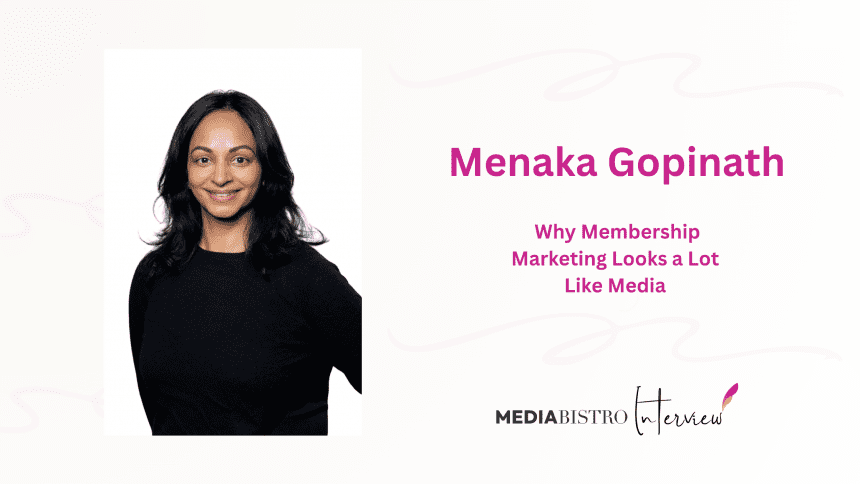

Menaka Gopinath has spent her career on the audience side of the table. She came up running publicity for music acts in the late 1990s, freelanced for Flavorpill for a decade, and co-produced an ongoing music video and short film series with her husband called The Wilcox Sessions. She built one of the first social listening practices at Ipsos, grew it from 20 people to 100 with double-digit revenue growth every year, ran ops at a sustainable DTC fashion brand, and now leads brand, communications, and marketing as Chief Marketing Officer of Project Management Institute (PMI), the global body serving the project management profession.
PMI isn’t a media company, so you might wonder why we’re talking about this. It’s a not-for-profit membership organization with global certifications, standards, an online community at ProjectManagement.com, and a worldwide chapter network. But spend a few minutes inside its marketing operation and the parallels are hard to ignore: a content engine spanning channels, an AI-powered member tool, major live events, partnerships with culture brands from OK Go to Cannes Lions, and a paywall that raises the same questions every subscription publisher is asking right now.
Also on Mediabistro


We caught up with Menaka to talk membership content strategy, what events are doing for engagement in a loneliness epidemic, where she thinks the C-suite is getting AI wrong, what running a small DTC operator taught her, and what she tells mid-level marketers of color about reaching the executive tier.
PMI is a membership organization for the project management profession, but when you look at how membership groups market with content, community, events, newsletters, and retention programs, it looks a lot like a media company. Do you think about it that way internally?
Our center of gravity at Project Management Institute (PMI) is all about serving the profession and that really drives how we operate, whether it’s through our certifications, our standards, our learning, and most critically, our global community. But I do think there are parallels to a media company as we are producing so much content across multiple channels, not just within Marketing. In that sense, we are incredibly focused on earning attention and deepening engagement with our audiences just as a media company does.
I guess the main distinction is that while media companies are often focused on the attention and eyeballs first and foremost, PMI is focused on helping our profession grow in relevance and impact. We want people to engage with our content sure, but it’s to serve our larger purpose, helping our profession maximize project success to elevate our world.
You came up in music publicity and independent media before pivoting into consumer insights and then brand leadership. Does that history still show up in how you think about audiences and content today?
Absolutely – I have always been audience-first throughout my career – how to create engaging experiences, what drives connection with people – and I’m constantly inspired by culture, art, music. My husband and I produced a long-running music video series, The Wilcox Sessions, as a passion project and have made multiple short films over the years. We just love telling stories, showcasing great music, and having fun with art and the moving image, and it definitely impacts what I bring into my work as a Marketing leader.
Where’s the hardest editorial decision you make: what to give away free versus what lives behind the membership wall?
Our focus with all of our content is to consider the job it is doing in serving our purpose. We have plenty of content that is free and accessible, including access to our ProjectManagement.com online community. That’s because we want people to see the possibilities of the profession and inspire them to consider how they can grow their own careers, make meaningful connections, and advance how our profession makes an impact. This accessibility is important to us in considering how we serve the profession as a whole.
But as a membership organization, our content and tools are a critical component of what we provide our members to give them deeper access, more practical utility, and to push the opportunities of professional unlocks further. One of our most popular membership benefits is our PMI Infinity tool, an AI-powered project management assistant designed for professionals, offering curated, trustworthy guidance grounded in PMI’s global standards. I just used it to help me build a work breakdown structure for a Marketing assistant agent I’m building in Copilot. It was so useful as it’s much more rigorous and thoughtful in the answers you receive, particularly related to project management discipline.
Retention is essentially an engagement problem, which is the same problem every newsletter publisher and subscription media brand is dealing with right now. What’s the PMI playbook there, and do you think media companies could steal any of it?
Engaging consumers has been a throughline in my career, and the basic truth is that engagement comes down to value. It’s the simple question of: are you delivering something of value to the audience? Going deeper, for us at PMI, I would say it boils down to three key areas:
Deeply understand the experience of the audiences we serve. This means pushing ourselves to understand what our members are going through, whether it’s that new graduate just entering the workforce, the project professional pursuing their PMP certification, or the first time someone checks out a chapter event. Our team needs to understand these experiences first-hand and have a POV on where we have the opportunity to build micro moments of joy or magic throughout.
Don’t forget to have fun. It’s also about not always taking yourself too seriously – finding humor and common points of connection that build that sense of belonging. Identifying those opportunities to align with culture in authentic ways, but that might be unexpected, like when we did our Behind the Project series with OK Go.
Lead with purpose. PMI is a purpose-based, not-for-profit organization and our purpose guides everything we do. This clarity in why it matters and what it is actually serving helps our community unify, connect, and collectively feel like they are part of something bigger than themselves.
You spent a decade at Ipsos building social listening and online community practices before most brands had a real framework for it. How much of that early infrastructure thinking applies to what you’re doing now?
When I joined PMI I felt like it was a really nice triangulation of things I had been passionate about and doing throughout my career coalescing. 1) Community has been part of my career trajectory since the late 90s, and fundamentally PMI is a community-led organization. 2) Marketing with purpose is incredibly important to me, and at PMI I get to market growth and learning, something that truly has no upper limit. And even better, we’re working to grow this profession to elevate our world. 3) Critical thinking and curiosity were major drivers of the work we did during my time at Ipsos, and that is so essential to the work we do at PMI as we push the boundaries of what our profession is capable of delivering in this world, particularly at a time of massive disruption and transformation.
Events seem to be having a real moment as both a content format and a conversion channel. PMI runs major conferences. How do you think about live programming as part of the media mix?
I love events so much, and think they are definitely making a broader comeback post-COVID. We are living in the midst of a loneliness epidemic, people can spend full days without ever leaving their home, and as humans, we thrive on tactile, tangible connection. Our PMI events bring our profession to life, the vibrancy, the passion, the possibilities. I never leave a PMI event – from our largest Global Summit, to my local Los Angeles chapter event – without learning something and meeting someone new. Every time.
As I said before, there is no upper limit to learning, and a critical part of how we learn is experiencing things IRL and together with other humans. And you might be surprised to hear this, but wow does our community LOVE TO DANCE. So I guess, check out a PMI event if for nothing else, a rockin’ dance floor!
Events for us also represent an opportunity to expand our sphere of influence, knowing that project management really shows up in all types of areas. For example, we started partnering with Cannes Lions a couple years ago, specifically with the Lions Learning program. Marketers are being challenged with more complexity than ever before, and the need for stronger systems thinking and project management discipline is clear. We love being able to show up and provide value to audiences that might not expect it, but can find genuine utility in what we have to offer.
AI is reshaping what skills professionals need to stay current, which puts PMI right at the center of an urgent conversation. How are you positioning the brand around that?
A few years ago we really started with getting ahead of the implications for the profession and how AI might change it. That has evolved to also guiding how our profession is essential in the broader AI transformation happening everywhere. Today this continues to be the focus – we lead both the AI transformation of the project management profession, and the project management of AI transformations. I already mentioned our PMI Infinity tool, but in addition to that, we have multiple AI-focused courses, an AI certification (PMI-CPMAI) and a new Standard coming early-June.
It’s been fascinating to see the larger discourse as people are working through how to tackle “AI transformation,” and recognizing so much of it comes down to system discipline, which is really the crux of what project management rigor provides, particularly as agentic AI becomes more widespread. Your team is no longer just humans; the resources you have to use for a project includes agents too, but those agents aren’t going to be great without context on the system and work breakdown structure they are working within. These are challenges hitting the C-suite right now, particularly around the clear gap between strategic ambition and executional delivery. We are elevating the executive conversation, guiding how to ensure the required systems discipline and shared language for successful AI transformation, and being a trusted source people and AI tools can turn to for guidance on turning AI ambition into measurable outcomes.
You went from a global research firm to COO of a small DTC sustainable fashion brand before landing at PMI. That’s an unusual path. What did running a small operator teach you that you couldn’t have learned anywhere else?
At a small company, every dollar counts. This teaches you to be much more intentional with every decision you make, whether it’s about what channels to spend your paid media dollars, if it’s worth it to do that creator collab, or if you’re going to take a risk and buy ahead of demand for the newest product launch. These decisions are much more tangible at a small company because one decision could impact how you make payroll, for example. You feel the impact on the people you lead, and it reiterates the responsibility you have as a leader and understanding downstream impacts at a much more heightened scale.
My experience at Graf Lantz also pushed me into the world of hard goods manufacturing, and all the things that come with that, from material sourcing, product design, production, logistics, shipping, inventory planning… so many things. I really appreciate what the experience gave me, and it truly offered a much deeper understanding of what small business owners have to grapple with on a daily basis to bring their passions to the world.
You’ve been on the Monday Night Mentorship board for six years now. What’s the most important thing you tell mid-level marketers of color who are trying to break into the executive tier?
You are your best advocate. I had to learn this over many years, but the importance of trusting your abilities, knowing your worth, and advocating for the things you want in your career is essential. No one is going to do it for you. BUT, having a supportive community around you will help. Which is why I really love MNM and the community Jabari and Julian have built. Sometimes you need others to remind you that you need to believe in yourself, or to know that you’re not the only one experiencing XYZ challenges, or to be an accountability partner and a touchstone as you push to reach your next big milestone. Lastly I’ll say, always look to make new connections, not just when you need something – consider how you can be of service, and starting with that can be even more rewarding.
Given that upskilling is central to PMI’s work, where should media professionals be focusing their development efforts, and how can they go about building those skills within the industry?
We’ve been doing a lot of work to define what our profession needs to deliver in the AI-enabled modern workplace, and more pointedly on what our profession needs to do to maximize project success to elevate our world. I think much of what we have defined as this vision can apply to media professionals as well as fundamentally it’s about what it takes to drive project success.
Based on research we have done over the past two years, we found that as a professional, if you are focused on four key areas in how you deliver, it will directly impact the likelihood of the projects you work on to succeed. We call it M.O.R.E. – M for manage perceptions, O for own success, R for relentless reassess, and E for expand perspective. Much of this comes down to things we’re seeing as fundamental skills to succeed with AI: orchestration, accountability, critical thinking, change resilience and creativity. And don’t forget to just try working with the AI tools, build a mini agent, create skills, take a hands-on course – play and experiment! If you want to see how to elevate your skills in M.O.R.E., you can check out our introductory course here: PMI Essentials M.O.R.E. Maximizing Project Success.
Last one, since we’re a platform for media professionals. What are you reading right now, or who are you paying attention to that’s shaping how you think? Or heck, we’ll take some Netflix recommendations if you have any.
So many things, but I’ll give you three. Earlier this year I read Unreasonable Hospitality by Will Guidara – I highly recommend, as it will give you a new appreciation of how to approach elevating the experience and building engagement with your audience. I just finished watching the Dark Wizard about the climber, Dean Potter, and it’s an invigorating series of passion, nature, freedom, fear… just watch it!
And if you haven’t already seen Project Hail Mary, go see it. In a time when so much feels bleak and dystopian, it’s a beautiful movie about the power of working together with diverse perspectives to overcome impossible odds.
About Menaka Gopinath: Menaka Gopinath is Chief Marketing Officer at Project Management Institute, where she leads brand, communications, and marketing. Before PMI, she was President and COO of Graf Lantz, a direct-to-consumer sustainable fashion brand. She previously led the Social Media Exchange (SMX) service line at Ipsos, growing the practice from 20 to 100 people with double-digit revenue growth every year. She has worked with brands including Coca-Cola, Apple, Nike, Uber, P&G, and Meta. She sits on the Board of Mentors at Monday Night Mentorship, a career accelerator for marketers of color, and helped establish BRIDGE, an Anti-Racism ERG, during her time at Ipsos. She holds a BA in Journalism and Economics from New York University and an MBA from the University of San Francisco. Find her on LinkedIn.
Topics:
Advice From the Pros