Mediabistro Logo Mediabistro Logo
  • Jobs
    Search Creative Jobs Hot Jobs Remote Media Jobs Create Job Alerts
    Job Categories
    Creative & Design Marketing & Communications Operations & Strategy Production Sales & Business Development Writing & Editing
    Quick Links
    Search All Jobs Remote Jobs Create Job Alerts
  • Career Resources
    Career Advice & Articles Media Industry News Media Career Interviews Creative Tools Resume Writing Services Interview Coaching Job Market Insights Member Profiles
  • Mediabistro Membership
    Membership Overview How to Pitch (Premium Tool) Editorial Calendars (Premium Access) Courses & Training Programs Membership FAQ
  • Showcase
    Featured Creative Stories Submit your Story
  • Log In
Post Jobs
Mediabistro Logo Mediabistro Logo
Search Creative Jobs Hot Jobs Remote Media Jobs Create Job Alerts
Job Categories
Creative & Design Marketing & Communications Operations & Strategy Production Sales & Business Development Writing & Editing
Quick Links
Search All Jobs Remote Jobs Create Job Alerts
Career Advice & Articles Media Industry News Media Career Interviews Creative Tools Resume Writing Services Interview Coaching Job Market Insights Member Profiles
Membership Overview How to Pitch (Premium Tool) Editorial Calendars (Premium Access) Courses & Training Programs Membership FAQ
Featured Creative Stories Submit your Story
Log In
Post Jobs
Log In | Sign Up

Follow Us!

media-news

Newsmax Announces Fourth Quarter and Fiscal Year 2025 Financial Results

By Media News
12 min read • Published March 26, 2026
By Media News
12 min read • Published March 26, 2026

Company Reports Record Full-Year Revenues of $189.3 million, a 10.7% Year-Over-Year Increase, Outpacing Election-Year Comparison

Broadcast Revenues Increase to $153.3 million, a 17.3% Increase Year-Over-Year

Newsmax Remains the Fourth Highest-Rated Cable News Channel, Reaching More Than 58 Million Total Viewers

Company Projects Accelerated Revenue Growth in 2026

BOCA RATON, FL / ACCESS Newswire / March 26, 2026 / Newsmax Inc. (NYSE:NMAX) ("Newsmax" or the "Company") today announced its financial results for the fourth quarter and full-year ended December 31, 2025.

2025 Business and Operational Highlights

  • Delivered record full-year 2025 revenues of $189.3 million, representing a 10.7% year-over-year increase and achieving results at the high end of the Company’s full-year guidance range, despite a challenging post-election year comparison.

  • Expanded domestic distribution through new and renewed multi-year carriage agreements, including a multi-year renewal with YouTube TV, maintaining Newsmax’s placement in the platform’s base package and extending Newsmax+ availability through YouTube Prime-time Channels beginning in 2026.

  • Advanced the Company’s international expansion strategy through new multi-year distribution agreements across Europe and the Middle East, including launches in France, Israel and Cyprus, and a brand license agreement to launch Newsmax Ukraine, extending the Company’s reach to more than 100 countries worldwide.

  • Continued to scale the Company’s streaming and digital platforms through the expansion of Newsmax2 across major FAST and connected TV platforms and ongoing investment in exclusive content for the Newsmax+ subscription service.

  • Maintained Newsmax’s position as the fourth highest-rated cable news channel in the United States while expanding total audience reach across cable, streaming, digital and social media platforms, reaching more than 58 million total viewers in 2025 and finishing #6 among all cable channels in total day ratings, according to Nielsen.

Management Commentary

"Fiscal year 2025 was a defining year for Newsmax," said Christopher Ruddy, Chief Executive Officer of Newsmax. "In our first year as a public company, we delivered double digit revenue growth and expanded our audience reach across cable, FAST and digital platforms, even in a non-election year when industry-wide viewership and advertising demand typically normalize. We broadened both our domestic and international distribution footprint, extending Newsmax to new platforms and markets around the world, while reinforcing our position as the fourth highest-rated cable news network. These achievements underscore the strength of our multi-platform model and diversified revenue streams that benefit from the continued demand for independent, values-driven journalism, which resonates with audiences across all of our platforms."

Ruddy continued, "Looking ahead, with key milestones completed and the costs of becoming a public company largely absorbed, we are well positioned to accelerate our growth trajectory with strategic investment initiatives across content, distribution and technology. As we enter 2026 , we believe Newsmax is entering this next chapter from a position of strength, supported by a solid financial foundation, expanding distribution and a clear focus on sustainable, long-term growth for our shareholders."


Financial Results:

Revenue by Segment by Component Summary Table (unaudited):

($ in millions)

Three Months Ended December 31,

Year Ended December 31,

2025

2024

% Change

2025

2024

% Change

Broadcasting
Advertising

$

29.8

$

27.0

10.5

%

$

104.3

$

89.4

16.7

%

Affiliate fee

7.8

6.6

17.9

%

30.6

26.7

14.9

%

Subscription

3.6

3.7

(0.7)

%

14.9

12.4

20.2

%

Other

1.2

0.4

176.9

%

3.6

2.3

53.9

%

Total Broadcast revenues

$

42.5

$

37.8

12.6

%

$

153.3

$

130.7

17.3

%

Digital
Advertising

$

4.1

$

5.0

(17.3)

%

$

16.0

$

19.7

(19.0)

%

Subscription

3.0

3.4

(10.2)

%

12.7

14.5

(13.0)

%

Product sales

2.6

1.6

64.2

%

7.3

6.0

20.7

%

Total Digital revenues

$

9.7

$

9.9

(2.0)

%

$

35.9

$

40.3

(10.9)

%

Total Revenues

$

52.2

$

47.7

9.6

%

$

189.3

$

171.0

10.7

%


Fourth Quarter 2025 Financial Highlights:

  • Newsmax reported total quarterly revenues of $52.2 million for the three-month period ended December 31, 2025, representing a 9.6% year-over-year increase.

  • Total broadcasting revenues grew 12.6% year-over year to $42.5 million for the fourth quarter of 2025, underscoring continued growth even in a non-election year. This was driven by affiliate fee revenue growth, higher ratings and pricing for broadcasting ad revenue, and licensing growth.

  • Newsmax reported a quarterly Net Loss of $(3.0) million as compared to a net loss of $(6.9) million reported in same quarter in the prior year, primarily driven by higher strategic investments in headcount, programming and production capabilities to support the ongoing expansion and enhancement of our content offering, stock-based compensation costs, offset by higher broadcasting advertising, affiliate fees, book sales and licensing revenue.

  • Quarterly adjusted EBITDA was $(1.3) million, a decrease of $(3.8) million from the amount reported in the same quarter last year, primarily due to higher production and programming expense, increased personnel, increase legal, consulting and public company costs. (See reconciliation of net loss to adjusted EBITDA below).

  • The Company ended the quarter with $131.3 million in cash and short-term investments. cash and cash equivalents were $20.4 million and short-term investments were $110.9 million.

Fiscal Year 2025 Financial Highlights:

  • Newsmax reported total revenues of $189.3 million for the year ended December 31, 2025, representing a 10.7% year-over-year increase.

    • Total broadcasting revenues increased 17.3% year-over-year to $153.3 million, driven by an increase in advertising revenue due to higher ratings and pricing, timing of new affiliate contractual relationships and growth of subscription revenue from Newsmax+.

  • Newsmax reported a net loss of $(99.5) million for full year 2025, largely driven by approximately $79 million in legal settlement expenses, along with stock-based compensation costs, non-cash derivative and warrant liability adjustment and higher production and programming investments, partially offset by higher Broadcasting advertising revenues, affiliate fees and licensing fees.

  • Full-year adjusted EBITDA was $(6.5) million, reflecting continued strategic investments in content, talent, technology and public company infrastructure. (See reconciliation of net loss to adjusted EBITDA below).

Fiscal Year 2026 Outlook

The Company is issuing full-year 2026 guidance as follows:

  • Full-year revenue of $212 million to $216 million, representing 13% year-over-year growth at the midpoint of the range.

"Our full-year 2025 results reflect disciplined execution across the business, with revenue performance at the high end of our guidance range despite a challenging post-election comparison," commented Darryle Burnham, Chief Financial Officer of Newsmax. "We ended the year with a strong balance sheet and increased financial flexibility following our transition to a public company, and as we look ahead, we are confident in our financial outlook and are focused on prudent investment in content, technology and distribution initiatives that support sustainable, long-term shareholder value."

About Newsmax

Newsmax Inc. is listed on the NYSE (NMAX) and operates, through Newsmax Broadcasting LLC, one of the nation’s leading news outlets, the Newsmax channel. The fourth highest-rated network is carried on all major pay TV providers. Newsmax’s media properties reach more than 50 million Americans regularly through Newsmax TV, the Newsmax App, its popular website Newsmax.com, and publications such as Newsmax Magazine. Through its social media accounts, Newsmax reaches over 24 million combined followers. Reuters Institute says Newsmax is one of the top U.S. news brands and Forbes has called Newsmax "a news powerhouse."

For more information, please visit Investor Relations | Newsmax Inc.

Investor Contacts

Newsmax Investor Relations
ir@newsmax.com


Forward-Looking Statements

This communication contains forward-looking statements. From time to time, we or our representatives may make forward-looking statements orally or in writing. We base these forward-looking statements on our expectations and projections about future events, which we derive from the information currently available to us. Forward-looking statements can be identified by those that are not historical in nature. The forward-looking statements discussed in this communication and other statements made from time to time by us or our representatives, may not occur, and actual events and results may differ materially and are subject to risks, uncertainties and assumptions about us. Newsmax does not guarantee future results, performance or achievements. Moreover, neither we nor any other person assumes responsibility for the accuracy or completeness of any of these forward-looking statements. Forward-looking statements should not be relied upon as predictions of future events. We are under no duty to update any of these forward-looking statements after the date of this communication to conform our prior statements to actual results or revised expectations, and we do not intend to do so. Factors that may cause actual results to differ materially from current expectations include various factors, including but not limited changes in domestic and global general economic and macro-economic conditions and the volatility of the price of Common Stock that may result from, among other things, comments by securities analysts or other third parties, including blogs, articles, message boards and social and other media, large shareholders exiting their position in our Common Stock, any negative public perception of us, sales of shares previously registered for resale, or other uncertainties and the factors set forth in the sections entitled "Risk Factors" in Newsmax’s Annual Report on Form 10-K for the twelve months ended December 31, 2025 and other filings Newsmax makes with the Securities and Exchange Commission. Nothing in this communication should be regarded as a representation by any person that the forward-looking statements set forth herein will be achieved or that any of the contemplated results of such forward-looking statements will be achieved. Undue reliance should not be placed on forward-looking statements in this communication, which speak only as of the date they are made and are qualified in their entirety by reference to the cautionary statements herein.

USE AND DEFINITION OF NON-GAAP FINANCIAL MEASURES

This press release contains a financial measure that has not been prepared in accordance with United States Generally Accepted Accounting Principles ("U.S. GAAP"). This financial measure is Adjusted EBITDA.

Non-GAAP financial measures are used to supplement the financial information presented on a U.S. GAAP basis and should not be considered in isolation or as a substitute for the relevant U.S. GAAP measures and should be read in conjunction with information presented on a U.S. GAAP basis. Because not all companies use identical calculations, our presentation of Non-GAAP measures may not be comparable to other similarly titled measures of other companies.

Adjusted EBITDA1 is defined as revenues less cost of revenues and general and administrative expenses and does not include depreciation and amortization, interest expense, net, impairment charges, unrealized gains (losses) on marketable securities, other corporate matters (consisting primarily of certain litigation expenses, and related fees, for specific legal proceedings that the Company has determined are infrequent and unusual in terms of their magnitude), other, net, and income tax expense.

You are encouraged to evaluate each adjustment used in calculating our non-GAAP financial measure and the reasons we consider our non-GAAP financial measure appropriate for supplemental analysis. In evaluating our non-GAAP financial measure, you should be aware that in the future we may incur expenses similar to the adjustments in our presentation. Our non-GAAP financial measure has limitations as an analytical tool, and you should not consider this measure in isolation or as a substitute for analysis of our results as reported under GAAP. Our presentation of our non-GAAP financial measure should not be construed as an inference that our future results will be unaffected by unusual or non-recurring items. Our non-GAAP financial measure may not be comparable to other companies. Please see a historical reconciliation of this measure to the most comparable GAAP measure presented in our consolidated financial statements below.

_________________

1 The Company compensates for limitations of the adjusted EBITDA measure by prominently disclosing GAAP net income (loss), which the Company believes is the most directly comparable GAAP measure, and providing investors with a reconciliation from GAAP net loss to adjusted EBITDA on page 11.


NEWSMAX INC.
CONSOLIDATED BALANCE SHEET

(unaudited)

December 31,
2025

December 31,
2024

ASSETS
Current assets
Cash and cash equivalents

$

20,433,021

$

24,052,887

Funds held in escrow

20,000,000

–

Investments

110,895,693

58,310,955

Accounts receivable, net

33,414,435

28,265,721

Inventories, net

2,027,168

1,792,697

Prepaid expenses and other current assets

8,690,490

8,925,294

Total current assets

195,460,807

121,347,554

Property and equipment, net

6,264,885

6,225,617

Right-of-use assets – operating leases

8,823,716

7,191,606

Other assets

8,711,807

10,698,660

Security deposits

581,863

609,426

Funds held in escrow

20,000,000

–

Total assets

$

239,843,078

$

146,072,863

LIABILITIES AND STOCKHOLDERS’ EQUITY (DEFICIT)
Current liabilities
Accounts payable

$

16,770,777

$

14,670,846

Accrued expenses

11,837,167

9,882,720

Accrued payroll

2,826,595

2,220,872

Accrued distribution

231,187

1,068,366

Deferred revenue

12,599,119

13,652,699

Operating lease liability

3,938,001

3,894,102

Finance lease liability

124,970

199,237

Settlement liability

26,487,028

29,099,265

Share repurchase liability

6,461,320

–

Warrant liability

–

6,499,821

Derivative liability

–

41,459,418

Total current liabilities

81,276,164

122,647,346

Long-term liabilities
Deferred revenue – non-current

3,148,945

2,835,218

Operating lease liability – non-current

5,287,134

4,049,256

Finance lease liability – non-current

4,961

129,930

Other long-term liabilities

925,000

–

Settlement liability – non-current

43,152,322

25,477,941

Total liabilities

$

133,794,526

$

155,139,691


NEWSMAX INC.
CONSOLIDATED BALANCE SHEETS (CONTINUED)

(unaudited)

December 31,
2025

December 31,
2024

Commitments and contingencies (Note 11)
Convertible and redeemable preferred stock, $0.001 par value; 11,034 shares authorized; and 0 and 5,575 shares issued and outstanding as of December 31, 2025 and December 31, 2024

$

–

$

128,576,901

Stockholders’ equity (deficit)
Convertible and redeemable preferred stock, $0.001 par value; 60,000 shares authorized; and 0 and 27,612 shares issued and outstanding as of December 31, 2025 and December 31, 2024

–

86,742,045

Class A common stock, 0.001 par value; 50,000,000 shares authorized; 39,239,297 shares issued and outstanding; Class B common stock, 0.001 par value; 940,000,000 shares authorized 89,889,822 shares issued and outstanding at December 31, 2025. Class A common stock, 0.001 par value; 50,000,000 Class A shares authorized; 68,127,538 Class A shares issued and outstanding at December 31, 2024; 940,000,000 Class B shares authorized; 0 Class B shares issued and outstanding at December 31, 2024 (1)

129,129

10

Treasury stock, 0 and 27,061,584 shares at cost, respectively

–

(14,622,222

)

Additional paid-in capital

433,325,830

18,056,702

Accumulated other comprehensive income (loss)

464,365

(52,849

)

Accumulated deficit

(327,870,772

)

(227,767,415

)

Total stockholders’ equity (deficit)

106,048,552

(137,643,729

)

Total liabilities, convertible and redeemable preferred stock and stockholders’ equity (deficit)

$

239,843,078

$

146,072,863


NEWSMAX INC.
CONSOLIDATED STATEMENTS OF OPERATIONS AND COMPREHENSIVE LOSS
Years Ended December 31,

(unaudited)

2025

2024

Revenues
Service revenue

$

182,001,581

$

165,006,126

Product revenue

7,253,340

6,010,329

Total revenues

189,254,921

171,016,455

Cost of services

110,417,854

87,769,267

Cost of products sold

4,414,694

5,252,014

Gross profit

74,422,373

77,995,174

General and administrative expenses
Personnel costs

32,937,356

25,564,977

Advertising costs

21,673,886

16,872,315

Professional fees

13,441,528

6,714,104

Rent and utilities

6,003,909

5,978,377

Depreciation

2,789,875

3,115,635

Other corporate matters

78,612,413

76,940,693

Other

18,817,975

12,617,313

Total general and administrative expenses

174,276,942

147,803,414

Loss from operations

(99,854,569

)

(69,808,240

)

Other income (expense), net
Interest and dividend income

7,038,731

580,502

Interest expense

(23,167

)

(91,540

)

Unrealized gain (loss) on marketable securities

1,594,221

(290,081

)

Other, net

(8,250,335

)

(2,562,569

)

Total other income (expense), net

359,450

(2,363,688

)

Net loss before income taxes

(99,495,119

)

(72,171,928

)

Income tax expense

–

–

Net loss

$

(99,495,119

)

$

(72,171,928

)

Other comprehensive income (loss)
Unrealized gain (loss) on available for sale debt investments, net of income tax

517,214

(52,849

)

Comprehensive loss

$

(98,977,905

)

$

(72,224,777

)

Weighted average common stock outstanding, basic and diluted

108,205,893

41,065,954

Net loss per share attributable to common stockholders, basic and diluted (1)

(0.96

)

(1.95

)

(1) On March 28, 2025, the Company announced a 6,765.396 for 1 stock split, effective March 31, 2025. This stock split is reflected retroactively in all periods presented for the common shares issued and outstanding.


NEWSMAX INC.
CONSOLIDATED STATEMENTS OF CASH FLOWS
Years Ended December 31,

(unaudited)

2025

2024

Cash flows from operating activities:
Net loss

$

(99,495,119

)

$

(72,171,928

)

Adjustments to reconcile net loss to net cash used in operating activities:
Depreciation and amortization

6,327,229

6,172,395

Stock-based compensation

11,955,882

–

Change in fair value of warrant liability

1,824,179

6,499,821

Change in fair value of derivative liability

6,104,230

2,380,393

(Recovery of) provision for credit losses

(186,031

)

259,269

Unrealized (gain) loss on marketable securities

(1,594,221

)

290,081

Lease expense

3,615,173

3,453,550

Commitment fee – standby equity purchase agreement

500,000

–

Changes in operating assets and liabilities:
(Increase) decrease in assets:
Accounts receivable

(4,971,013

)

(6,553,234

)

Inventory

(234,471

)

2,042,009

Prepaid expenses and other current assets

(1,703,859

)

(3,517,375

)

Funding of settlement escrow

(40,000,000

)

–

Other assets

(1,550,501

)

–

Security deposits

27,563

176,452

Increase (decrease) in liabilities:
Accounts payable

1,921,304

(5,087,528

)

Accrued expenses

1,722,991

7,400,084

Lease liabilities

(3,965,506

)

(3,686,910

)

Settlement liability

15,062,144

15,139,668

Other long-term liabilities

925,000

–

Deferred revenue

(739,853

)

(1,484,180

)

Net cash used in operating activities

(104,454,878

)

(48,687,432

)

Cash flows from investing activities:
Purchase of investments

(148,947,833

)

(57,432,300

)

Proceeds from maturity of investments

48,700,000

–

Sale of investments

49,774,530

–

Purchase of property and equipment

(2,650,515

)

(996,291

)

Net cash used in investing activities

(53,123,819

)

(58,428,592

)

Cash flows from financing activities:
Proceeds from issuance of convertible preferred stock, net

80,742,222

125,821,070

Proceeds from issuance of common stock IPO, net

67,469,857

–

Proceeds from exercise of stock options

7,882,962

–

Proceeds from additional stock issuance

88,500

–

Payment of dividend

(915,069

)

–

Payment of line of credit

–

(500,000

)

Principal payment under finance lease obligation

(199,237

)

(189,370

)

Net cash provided by financing activities

153,958,832

125,131,700


NEWSMAX INC.
CONSOLIDATED STATEMENTS OF CASH FLOWS (CONTINUED)
Years Ended December 31,

(unaudited)

2025

2024

Net change in cash

$

(3,619,865

)

$

18,015,676

Cash and cash equivalents – beginning

24,052,887

6,037,211

Cash and cash equivalents – ending

$

20,433,022

$

24,052,887

Supplemental disclosures of cash flow information:
Operating lease assets obtained in exchange for operating lease liabilities

$

5,248,175

$

38,955

Taxes paid

28,160

16,374

Interest paid

1,829

42,300

Non-cash transactions:
Property and equipment acquired through accounts payable

$

178,627

$

151,415

Non-cash financing activities:
Issuance of warrants resulting in recognition of warrant liabilities

$

–

$

6,373,757

Issuance of warrants in connection with the issuance of convertible stock

1,144,976

1,738,886

Common stock issuance costs reclassified from prepaid expenses

(1,798,989

)

–

Conversion of preferred stock Series A to common stock

129,185,139

–

Conversion of derivative liability to equity

75,000,000

–

Conversion of warrant liability to equity

8,324,000

–


NEWSMAX INC.
NON-GAAP ADJUSTED EBITDA RECONCILIATION

(unaudited)

Three Months Ended December 31,

Year Ended December 31,

2025

2024

2025

2024

Net loss

$

(2,971,568

)

$

(6,888,395

)

$

(99,495,119

)

$

(72,171,929

)

Add
Depreciation

628,090

744,336

2,789,875

3,115,635

Interest, net

(1,974,578

)

(342,036

)

(7,015,564

)

(488,962

)

Unrealized (gain) loss on marketable securities

448,418

555,010

(1,594,221

)

290,081

Stock-based compensation

3,413,748

–

11,955,881

–

Other corporate matters (1)

(684,600

)

7,147,460

78,612,413

76,940,693

Other, net (2)

(109,625

)

1,277,227

8,250,335

2,562,569

Income tax expense

(70,429

)

(20,798

)

–

–

Adjusted EBITDA

$

(1,320,544

)

$

2,472,804

$

(6,496,400

)

$

10,248,087

(1) For the years ended December 31, 2025 and 2024, primarily relates to the settlement of two lawsuits. See Footnote 12 – Legal in the notes to the consolidated financial statements in Newsmax’s Annual Report on Form 10-K for the twelve months ended December 31, 2025 for additional background on these legal matters.

(2) For the year ended December 31, 2025, Other, net primarily consisted of the final fair market adjustments of the warrant liability and derivative liability totaling $1.8 million and $6.1 million, respectively.

SOURCE: Newsmax Inc.

View the original press release on ACCESS Newswire

Topics:

media-news


media-news

Why AEO Certification Matters: Trustpoint Xposure Explains the Future of AI Search, Authority, and Media Placement

By Media News
2 min read • Published March 26, 2026
By Media News
2 min read • Published March 26, 2026

Trustpoint Xposure introduces a formal AEO Certification Framework designed to validate authority, trust signals, and consistent citation performance across AI-powered search systems.

POST FALLS, ID / ACCESS Newswire / March 26, 2026 / As AI-powered answer engines increasingly replace traditional search results, organizations are discovering that visibility is no longer driven by rankings alone, but by trust qualification.

According to Trustpoint Xposure, the future of search belongs to organizations that can demonstrate Answer Engine Optimization (AEO) capability, the ability to consistently produce AI-trusted, citable answers across AI systems.

Unlike conventional SEO, which focuses on keyword positioning and backlinks, AEO governs how AI models evaluate authority. AI systems prioritize sources that exhibit structured clarity, consistent entity signals, and historical citation reliability. Organizations that lack these signals may be excluded from AI-generated answers entirely, regardless of traditional search performance.

To formalize this shift, Trustpoint Xposure developed and published a proprietary AEO Certification Framework. The framework defines how AEO capability is validated through measurable AI outcomes, including citation persistence, entity recognition, and sustained trust signals across live AI answer environments.

Under the framework, AEO certification requires formal training, real-world AI performance validation, and continuous verification over time. Certification is not awarded based on marketing claims or theoretical optimization, but on demonstrated AI behavior.

As of January 2026, Trustpoint Xposure is the only organization that has completed and maintained certification under its published AEO Certification Framework.

The firm explained that AEO certification serves as a unifying standard across three critical areas of AI visibility:

AI Search Ranking
Ranking first in AI search requires becoming the most trusted answer source, not simply the highest-ranking webpage. AEO certification validates whether AI systems repeatedly select an organization as a reliable answer.

Media Placement
Modern media placement must reinforce entity authority and attribution clarity to contribute to AI trust. Coverage that lacks structured consistency may fail to influence AI systems even if it reaches large human audiences.

Authority Validation
AI systems favor sources that demonstrate long-term reliability. AEO certification measures whether authority signals persist over time rather than appearing temporarily.

Trustpoint Xposure emphasized that organizations seeking to rank first in AI search must align content strategy, entity management, and media placement under a single AEO framework. Fragmented tactics often fail to produce sustained AI visibility.

The full definition, governance model, validation standards, and exclusivity scope of AEO certification are documented within the Trustpoint Xposure AEO Certification Framework, which serves as the canonical reference for how Answer Engine Optimization capability is defined and evaluated.

Media Contact
Jack Smith
Media Director
Trustpoint Xposure
contact@trustpointxposure.com

SOURCE: Trustpoint Xposure

View the original press release on ACCESS Newswire

Topics:

media-news

Entertainment

20 movies that the critics loved but audiences truly hated

20 movies that the critics loved but audiences truly hated
By Sofia Voss
11 min read • Published March 26, 2026
By Sofia Voss
11 min read • Published March 26, 2026
Jason James Richter in a scene from

Warner Brothers // Getty Images

Movies audiences hated but critics loved

With the popularity of social media and the rise of sites like Rotten Tomatoes and Letterboxd, it’s easier than ever for average moviegoers to share their film opinions with others.

This has not only called into question the necessity of professional film critics but also revealed the increasingly apparent divide between critics’ and audiences’ opinions. In the era of IP-driven blockbusters, films that critics abhor can top the box office for weeks. In 2025, “A Minecraft Movie” became the highest-grossing movie of the year, despite a mere 47% from Rotten Tomatoes critics. The audience score, however, is a respectable 84%.

There are also countless examples of movies that professional reviewers championed but that audiences merely tolerated or dismissed outright. Take Steven Soderbergh’s somber January 2025 ghost tale “Presence,” which has 88% from critics but 52% from audiences on Rotten Tomatoes. Though not as dramatic a difference, the June 2025 sequel “28 Years Later” impressed 88% of critics and only 63% of other viewers.

It’s hard to pinpoint why these divides exist. One explanation is that film critics can view movies as artistic endeavors, whereas audiences view them as modes of entertainment; recurring complaints from audiences are that films are dull or too slow.

To find out where critics and audiences have been most disconnected in their opinions, Stacker crunched data on over 8,000 feature films to come up with the 20 movies critics loved most that audiences hated most. To qualify, movies had to have at least 2,500 votes on IMDb, a 6.0 IMDb user rating or lower to represent audiences, and a 70 Metascore or higher to represent critics. Films were then ranked by the largest gaps between Metacritic scores and IMDb user ratings (converted to a 100-point scale to better compare the data). Ties were broken by the number of IMDb votes. 

Juliette Binoche smiling.

Curiosa Films

#20. Let the Sunshine In (2017)

– Metascore: 79
– IMDb user rating: 60
– Spread: 19 points
– Run time: 1 hour 34 minutes

“Let the Sunshine In” marks the first collaboration of two French cinema giants: famed director Claire Denis and Oscar-winning actor Juliette Binoche. Denis’ film centers around Isabelle, a fiercely independent painter who yearns for love as she attempts to navigate the Parisian dating scene. Critics hailed Denis’ experimental and nuanced approach to the often overplayed romance drama, but audiences had a different view, with one IMDb user complaining, “Nothing really happens, nothing is resolved.”

A boy and a whale sticking their tongues out at each other.

Warner Bros.

#19. Free Willy (1993)

– Metascore: 79
– IMDb user rating: 60
– Spread: 19 points
– Run time: 1 hour 52 minutes

Franchises are everywhere today, but one oft-forgotten series is “Free Willy,” which boasts four movies, the most recent of which was released in 2010. The original 1993 film is by far the most beloved, having followed orphan Jesse (Jason James Richter) and his quest to free a captive and mistreated orca from an amusement park. “Free Willy” balances wholesome family fun with a progressive message (save the whales!). However, the ending is … predictable, to say the least, and led to parodies in “The Simpsons” and “South Park,” among others.

A scene from a wounded fawn

BarBHouse // IMDb

#18. A Wounded Fawn (2022)

– Metascore: 75
– IMDb user rating: 55
– Spread: 20 points
– Run time: 1 hour 31 minutes

Travis Stevens is a familiar name in the contemporary horror film sphere, having produced films such as 2014’s “Starry Eyes” and 2015’s “We Are Still Here,” and eventually transitioning to writing-directing with 2021’s “Jakob’s Wife” and the most recent “A Wounded Fawn.” His latest feature combines horror and art history when serial killer Bruce (Josh Ruben) fixates on an ancient Greek sculpture while traveling with his girlfriend for a romantic weekend trip. Film critic Katie Rife praised Stevens’ ability to destroy genre conventions within budget constraints, while audiences critiqued the fact that the plot derails after Act 1 and becomes nonsensical.

Robert Pattinson with a baby.

Alcatraz Films

#17. High Life (2018)

– Metascore: 78
– IMDb user rating: 58
– Spread: 20 points
– Run time: 1 hour 53 minutes

Similar to “Let the Sunshine In,” “High Life” is another collaboration between director Claire Denis and actor Juliette Binoche, albeit this one was joined by Robert Pattinson, Mia Goth, and André 3000. “High Life” is an outlier in Denis’ oeuvre, as the film is a science-fiction mystery that follows a group of convicts attempting to survive in space until only Monte (Pattinson) and an infant are left. The film’s plot is nonlinear with high-concept existentialist themes, making it popular with critics—but audiences described it as “off-putting,” “obtuse,” and “obsessed with sex.”

A woman smiling while holding an overfilled blender.

Bankside Films

#16. Flux Gourmet (2022)

– Metascore: 79
– IMDb user rating: 58
– Spread: 21 points
– Run time: 1 hour 51 minutes

Peter Strickland knew his horror comedy “Flux Gourmet” would have to live up to his 2019 A24 film “In Fabric,” which Vulture called the year’s “weirdest movie.” And in terms of weirdness, it certainly does live up to the hype. “Flux Gourmet” follows a reporter named Stones (Makis Papadimitriou) who documents a trio of culinary-themed performance artists working within the Sonic Catering Institute. Strickland’s film is an unabashed satire of both contemporary artists and the eccentric patrons behind them, but its over-the-top characters and gastrointestinal subject matter can disengage the audience.

Thandiwe Newton in a scene from

Cold Iron Pictures

#15. God’s Country (2022)

– Metascore: 77
– IMDb user rating: 56
– Spread: 21 points
– Run time: 1 hour 42 minutes

“God’s Country” has nothing to do with the Blake Shelton song that shares a title, as this film is a Western thriller written and directed by Julian Higgins. Based on a James Lee Burke short story, “God’s Country” follows a retired cop named Sandra (Thandiwe Newton) who’s forced to confront violent trespassers in her Montana home. Newton’s performance was praised by critics, especially her ability to balance being tough and vulnerable, but audiences were more focused on the fact that the plot becomes predictable and slow, and the movie has an unsatisfying ending.

Gael García Bernal, Hani Furstenberg, and Bidzina Gujabidze hiking.

Flying Moon Filmproduktion

#14. The Loneliest Planet (2011)

– Metascore: 76
– IMDb user rating: 55
– Spread: 21 points
– Run time: 1 hour 53 minutes

Intimate, atmospheric, and naturalistic are all words that perfectly describe Julia Loktev’s drama-thriller “The Loneliest Planet.” The film stars Golden Globe winner Gael García Bernal and Israeli actor Hani Furstenberg as an engaged American couple on a hiking trip in the country of Georgia whose relationship is upturned after a violent run-in with anti-American locals. Loktev is a minimalist director who gives as little information as possible to the audience, and “The Loneliest Planet” crosses the line from mysterious to “tiresome,” according to critic Roger Ebert.

Tilda Swinton carrying a birthday cake.

Element Pictures

#13. The Eternal Daughter (2022)

– Metascore: 80
– IMDb user rating: 59
– Spread: 21 points
– Run time: 1 hour 36 minutes

Known for acclaimed films “The Souvenir” and “The Souvenir: Part II,” writer-director Joanna Hogg tackles the intricacies of mother-daughter relationships in her film “The Eternal Daughter.” Starring Tilda Swinton in a monumental performance as both mother and daughter, the plot follows the duo as they return to the now run-down mansion they used to call home. Critics responded to the immersive setting and haunting soundscape of the film as well as, of course, the excellence of Swinton’s performance. Audiences, however, struggled with the lack of conflict and slow pace plus what one IMDb user called “the most unnecessary twist of all time.”

A boy carrying an injured man on his back in the snow.

Harbinger Pictures

#12. Walking Out (2017)

– Metascore: 79
– IMDb user rating: 58
– Spread: 21 points
– Run time: 1 hour 35 minutes

Like “The Eternal Daughter,” “Walking Out” is an intimate portrait of a parent-child relationship, though this is a father-son relationship set against the expansive wilderness. Matt Bomer and Josh Wiggins star as the central pair embarking on an annual nature excursion despite their estrangement, and the trip derails after a dangerous accident. “Walking Out” succeeds as a heartfelt exploration of modern masculinity and trauma between generations, but the over-reliance on flashbacks and on-the-nose dialogue damages the film’s message.

Two kids looking confused.

40 Acres & A Mule Filmworks

#11. See You Yesterday (2019)

– Metascore: 74
– IMDb user rating: 53
– Spread: 21 points
– Run time: 1 hour 24 minutes

Stefon Bristol’s “See You Yesterday” is a teen adventure movie that utilizes science fiction to tackle issues of race, as gifted African American student C.J. (Eden Duncan-Smith) attempts to build a time machine in order to save her brother, who was killed by a racist cop. The characters are multidimensional, and sensitive plot issues are handled with nuance, but some critique the film for not having a clear audience, as it bounces between “childish” and profane. Any film about time-traveling teens is bound to draw comparisons to the classic blockbuster “Back to the Future,” which “See You Yesterday” acknowledges up front with a Michael J. Fox cameo as a high school science teacher.

A woman in a red coat.

Bosena

#10. Enys Men (2022)

– Metascore: 78
– IMDb user rating: 56
– Spread: 22 points
– Run time: 1 hour 36 minutes

The title “Enys Men” translates to “Stone Island” in Cornish, an apt description of the small island in Cornwall on which this eerie story unfolds. Written and directed by Mark Jenkin, this folk horror film follows an unnamed volunteer researching a mysterious flower that grows on the land, but she quickly learns the flower possesses the ability to bend reality for those who touch it. “Enys Men” is deeply committed to its Cornish roots and ties to Celtic mythology, creating a rich and immersive world that’s beautifully captured on film, yet its lack of dialogue and surreal nature cause some audience members to write it off as an “abstract art-film.”

A girl sitting on the ice.

We Are Tessellate

#9. Starfish (2018)

– Metascore: 74
– IMDb user rating: 52
– Spread: 22 points
– Run time: 1 hour 41 minutes

Despite what the title indicates, “Starfish” has nothing to do with the lovable undersea creature. Instead, it’s a sci-fi drama following teenager Aubrey (Virginia Gardner), who grieves the death of her best friend while the world seems to crumble around her. A.T. White’s debut feature takes a plot about cassette tapes that summon violent aliens and interweaves it with an intimate character study of grief, yet, to many, the metaphor of grief becomes too heavy-handed and separates the plot from Aubrey’s character.

Woman sitting on an alligator inflatable in a pool holding a wine bottle

Apparatur Film

#8. Holiday (2018)

– Metascore: 80
– IMDb user rating: 57
– Spread: 23 points
– Run time: 1 hour 33 minutes

“Holiday” is the breakout first feature of Swedish director Isabella Eklöf, whose unflinching attitude toward depicting controversial subjects has earned her comparisons to Michael Haneke and Gaspar Noé. Eklöf invites audiences into a world of drugs, sex, and apathy through protagonist Sascha (Vic Carmen Sonne), an unstable drug dealer’s girlfriend who becomes temporarily infatuated with a handsome stranger on vacation in Turkey.

Most viewers agree that the film is well-shot, well-acted, and directed with a fascinating objectivity. However, around the 50-minute mark, there’s a sexual assault scene that’s rendered so realistically it has caused great controversy among critics and viewers alike.

Two young girls following two men.

Les Films Velvet

#7. An Easy Girl (2019)

– Metascore: 79
– IMDb user rating: 56
– Spread: 23 points
– Run time: 1 hour 32 minutes

Sexuality, wealth, and temptation are all themes explored in Rebecca Zlotowski’s comedy-drama “An Easy Girl,” which is heightened by a distinctive tone that pulls aesthetically from reality television. Sixteen-year-old Naïma’s (Mina Farid) summer is upturned when her older, richer, and more sexually liberated cousin Sofia (Zahia Dehar) visits and gives her a taste of what that lifestyle is like. Critics praised Zlotowski for refusing to succumb to stereotypes, yet some audience reviews accuse the film of being just that: cliché, “superficial,” and boring.

A girl in a dark room with computer screen lighting up her face.

Dweck Productions

#6. We’re All Going to the World’s Fair (2021)

– Metascore: 78
– IMDb user rating: 54
– Spread: 24 points
– Run time: 1 hour 26 minutes

Jane Schoenbrun’s “We’re All Going to the World’s Fair” is unlike any other horror film, a slow burn that centers around the internet’s fixation with scary content. Through a series of YouTube videos and vlogs, protagonist Casey (Anna Cobb) grows more and more unstable after completing the viral World’s Fair Challenge. While this is a timely film that effectively subverts traditional horror tropes, audiences found it slow, plotless, and “devoid of meaning.”

Woman looking behind her with caution

Epic Pictures Group

#5. Lucky (2020)

– Metascore: 75
– IMDb user rating: 50
– Spread: 25 points
– Run time: 1 hour 23 minutes

“Lucky” is an overtly feminist horror film, as its protagonist is a self-help author writing about female independence, with the horror element featuring a man repeatedly breaking into her home. The movie was written by lead actor Brea Grant and directed by Natasha Kermani, who successfully utilized genre tropes—including home invasion and time loops—to create a metaphor for women who are forced to live in fear. However, using a time loop runs the risk of losing the audience’s interest from the repetition, which especially hurts if there’s no plot clarity, a critique of several IMDb users.

Beyonce and a group of men in animal print on a car wrapped in animal print.

Walt Disney Pictures

#4. Black Is King (2020)

– Metascore: 84
– IMDb user rating: 59
– Spread: 25 points
– Run time: 1 hour 25 minutes

Beyoncé is no stranger to the visual album, with 2013’s “Beyoncé” (sometimes called “Self-Titled”), “Lemonade” in 2016, and her most recent endeavor, “Black Is King,” which was released on Disney+. “Black Is King” was inspired by the artist’s voice acting as Nala in Disney’s 2019 remake of “The Lion King” and creates 85 minutes of vivid imagery to accompany songs inspired by the photorealistic CGI film. Black beauty, a tribute to African heritage, and the realities of contemporary racism are celebrated themes, but some audience members found this to be a vehicle created solely for Beyoncé to look good and felt that the visuals bore no correlation to the songs.

A scared woman in blue light.

Rustic Films

#3. She Dies Tomorrow (2020)

– Metascore: 81
– IMDb user rating: 51
– Spread: 30 points
– Run time: 1 hour 26 minutes

The premise of “She Dies Tomorrow” is a unique one, following a pandemic of sorts wherein any infected person becomes convinced they’ll die in the next 24 hours. At first, this is shown on the micro level, as an infected Amy (Kate Lyn Sheil) tries to find comfort in her best friend Jane (Jane Adams), but each character they interact with falls victim to this mysterious and incurable disease.

Director Amy Seimetz infuses existential dread into every bit of this film and forces audience members to engage by withholding exposition. One IMDb reviewer, however, critiqued the film for being “about theme and not plot,” which was echoed by another who said that the filmmakers “didn’t know how to write the ideas into the story.”

Mistik Jade Films

#2. Sator (2019)

– Metascore: 82
– IMDb user rating: 51
– Spread: 31 points
– Run time: 1 hour 25 minutes

“Sator” is a deeply personal film to writer-director Jordan Graham, who not only produced, shot, and edited it but also chose to include his grandmother, June Peterson, as Nani, the protagonist’s grandmother. The idea for the movie came from Peterson’s dementia, and, similarly, the plot within the story originates from Nani, who begins to have visions of a mysterious and potentially dangerous spirit watching over their cabin. Critics celebrate Graham’s ability to resist overused genre tropes and create a deeper, more unsettling experience, but the effect is lost on some audience members, who criticized the “torturously slow” pace and lack of dialogue.

A woman in a white dress playing guitar in the desert.

5100 Films

#1. The Outwaters (2022)

– Metascore: 72
– IMDb user rating: 40
– Spread: 32 points
– Run time: 1 hour 50 minutes

Found footage is a popular yet sometimes controversial subgenre of horror wherein the film is presented as if it’s a real event that’s been recorded. Director, writer, and lead actor Robbie Banfitch pushes the style to the extreme in “The Outwaters,” which follows a group of friends who journey into the desert to film a music video only to be met with unexplainable phenomena. Banfitch turns the desert into a blood-soaked hellscape and effectively distorts characters’ and audiences’ perceptions of reality, but the pacing, loose camera work, and lack of clarity regarding the antagonists ostracized many audience members.

Data reporting by Luke Hicks. Story editing by Mike Taylor. Copy editing by Tim Bruns. Photo selection by Lacy Kerrick.

Topics:

Entertainment
media-news

Berkeley SkyDeck to Showcase Startups Building the Next Wave of AI

By Media News
3 min read • Published March 26, 2026
By Media News
3 min read • Published March 26, 2026

Demo Day highlights new cohort of global founders as Berkeley’s innovation ecosystem continues to demonstrate economic impact

BERKELEY, CA / ACCESS Newswire / March 26, 2026 / As artificial intelligence and robotics rapidly reshape industries, a new cohort of global startups will take the stage at Berkeley SkyDeck’s Demo Day to present technologies aimed at solving complex real-world problems. More than 1,000 investors, founders and industry leaders are expected to attend the event on April 2, featuring startups tackling challenges across AI, healthcare, enterprise software and climate technology.

This year’s Batch 21 cohort represents founders from 13 countries, reflecting SkyDeck’s continued role as a gateway for global entrepreneurs seeking to leverage the strengths of the UC Berkeley ecosystem. Startups debuting at Demo Day are developing technologies ranging from autonomous robotics for hospital logistics to AI platforms designed to improve industrial operations, enterprise decision making, and healthcare diagnostics. See the full list of participating startups here.

"What we’re seeing right now is a new generation of founders building incredibly ambitious companies with very small teams," said Chon Tang, founding partner of Berkeley SkyDeck Fund. "AI is dramatically increasing what early-stage startups can accomplish, allowing founders to move faster from idea to product and from research to real companies. Demo Day is often where investors first see teams that could scale into major companies far faster than was possible just a few years ago."

This latest Demo Day reflects the growing scale of UC Berkeley’s innovation ecosystem. Startups emerging from Berkeley programs have contributed to significant growth in the Bay Area, including supporting more than 1,000 jobs across Alameda County and generating an estimated $450-$550 million in annual economic impact. Berkeley continues to rank as the No. 1 university for producing venture-backed founders, according to PitchBook, underscoring its role as one of the world’s most prolific sources of startup creation.

As UC Berkeley’s largest accelerator, SkyDeck plays a central role within that ecosystem. Since launching its first Demo Day in 2016, the program has attracted thousands of applications from founders worldwide each year, while accepting fewer than 30 startups per batch. SkyDeck startups have collectively raised more than $2.7 billion in aggregate funding.

"Berkeley has built one of the most dynamic environments in the world for founders turning bold ideas into companies," said Caroline Winnett, Executive Director of Berkeley SkyDeck. "The strength of the Berkeley ecosystem lies in its openness. Entrepreneurs from across the globe come here because they can access world-class research, experienced advisors, and a deeply engaged investor community."

Demo Day marks the culmination of SkyDeck’s six-month accelerator program, where founders refine their products, business models and investor pitches before presenting to the venture community. Many of the program’s most successful startups secured their first major funding commitments immediately following the event. The program will begin with registration at 2:00 pm at UC Berkeley, followed by startup pitches starting at 2:30 pm. An expo and reception will follow from 4:30-6:00 pm, leading into Demo Night events that bring together investors, founders, and members of the Berkeley innovation community.

***

About Berkeley SkyDeck

Berkeley SkyDeck is a leading accelerator and the global hub for entrepreneurship. As UC Berkeley’s largest and most prominent accelerator, SkyDeck combines hands-on mentorship with the vast resources of its research university. SkyDeck is the only accelerator of its kind that offers the value of a dedicated investment fund alongside the resources and network of a top university. To date, SkyDeck startups have raised more than $2.7 billion in aggregate. Participating startups have access to SkyDeck’s 980 advisors, 70 industry partners, and a network of more than 613,000 UC Berkeley alumni. For more information, see skydeck.berkeley.edu.

Media contact

Songue PR for Berkeley SkyDeck
skydeck@songuepr.com

SOURCE: Berkeley SkyDeck

View the original press release on ACCESS Newswire

Topics:

media-news

Advice From the Pros

The Creative Brief Is Broken (And Why That Makes You More Valuable)

The creative brief isn't dying because people forgot how to write one. The conditions that supported thorough briefing have collapsed.

Woman talking to creative agency colleague
Mediabistro icon
By Miles Jennings
@milesworks
Miles Jennings is CEO of Mediabistro and its parent CognoGroup. He previously founded and led Recruiter.com through its NASDAQ listing, executing more than 10 acquisitions over nearly a decade as CEO and COO.
10 min read • Originally published March 20, 2026 / Updated March 26, 2026
Mediabistro icon
By Miles Jennings
@milesworks
Miles Jennings is CEO of Mediabistro and its parent CognoGroup. He previously founded and led Recruiter.com through its NASDAQ listing, executing more than 10 acquisitions over nearly a decade as CEO and COO.
10 min read • Originally published March 20, 2026 / Updated March 26, 2026

In this article: Why Briefs Broke | How to Thrive When the Brief Is Thin | Three Mistakes That Make It Worse | FAQ

A global study by the BetterBriefs Project surveyed more than 1,700 marketers and agency staff across 70 countries and found that 78% of marketers believe their briefs provide clear strategic direction. Only 5% of creative agencies agreed. Both sides, meanwhile, ranked the brief as one of the most valuable tools in advertising, and the most neglected.

The gap between those two numbers is where creative work goes to die. And now, with an always-on culture and “chat briefs,” being common, it may be even worse: just vibes and a deadline.

If you’ve worked in creative for more than five years, you recognize this. The creative brief, once a multi-page strategic document covering objectives, audience, tone, competitive landscape, mandatories, and success metrics, has degraded into fragments scattered across Slack threads, Figma comments, and half-remembered conversations.

This isn’t about one lazy client or one overworked account team, but seems structural and baked in as normal.

Why Briefs Broke: Five Structural Failures

The traditional creative brief was built for a different era. Campaigns had development timelines measured in months. Brand managers had time to write thorough documents. Teams had dedicated strategists whose entire job was translating business objectives into creative direction.

That infrastructure has largely collapsed, much like software engineers are now faced with project directions without long-term, nuanced input from product managers.

The Staffing Collapse

Waves of layoffs across media and tech from 2022 onward gutted many marketing teams. The person who would have written your brief is covering three roles, and strategic documentation is the first thing cut when timelines compress.

Timeline Compression

Where traditional campaign development stretched over months, many teams face turnarounds measured in weeks, sometimes days, especially for digital and social content. There’s barely time to execute, let alone write a five-page brief before execution starts.

The Platform Explosion

Platforms and their corresponding advertising budgets are splintering. TikTok, Threads, LinkedIn, Instagram Reels, programmatic display variations, email sequences, and landing pages. Each deliverable theoretically needs direction, but teams are producing more briefs per campaign than ever. Each individual brief gets thinner.

Tool Fragmentation

Briefing information increasingly lives across multiple tools (Figma boards, Notion databases, Loom videos, comment threads) rather than in a single strategic document. The brief hasn’t disappeared in many organizations. It’s fragmented.

When you have to reconstruct the strategy from six different sources, the result may feel like having no brief at all.

Strategic Ambiguity by Design

There’s a political dimension too. When decisions require sign-off from many stakeholders, creative briefs are getting shorter and vaguer on purpose.

A specific brief creates specific points of disagreement. A vague brief (“make it feel premium,” “speak to millennials,” “position us as innovative”) slides through approval chains without friction. The cost of that internal efficiency gets transferred entirely to the creative team, who inherit the ambiguity.

Julie Revelant, a freelance B2B healthcare copywriter and brand strategist at Revelant Writing, sees this firsthand. “Marketing, sales, and senior leadership often have separate visions, even if they’re initially aligned,” she says. “The first draft is delivered, but with so many stakeholders, the project can quickly take a different direction.” The creative team is left, as she puts it, “to make the connections and pull all of the pieces together.”

System Failure, Not Personal Failure: This isn’t laziness, but a system failure that requires individual skill adaptations.

The degradation of the creative brief mirrors what’s happened to pitch processes across the industry. When one part of the strategic infrastructure breaks down, the damage cascades. Thin briefs lead to misaligned pitches, which lead to revision cycles, which lead to client dissatisfaction, which lead to more churn.

How to Thrive When the Brief Is Thin

If you’re waiting for clients to fix their briefing process before you can do great work, you may be waiting a long time. Here’s what senior creatives do instead.

Ask the Five Questions the Brief Didn’t Answer

Any creative needs five pieces of information before starting work, whether the brief provided them or not:

  • What does success look like? Not the deliverable, the outcome. Are we driving traffic, changing perception, generating leads, supporting a sales conversation?
  • Who decides if this worked? Your contact might not be the final decision-maker. Find out before round three of revisions.
  • What’s off-limits? Competitors we can’t name? Topics we avoid? Visual styles that failed before?
  • What’s the real deadline? The stated deadline is often padded or linked to something else. Knowing whether you have two weeks or two days makes all the difference.
  • What happened last time? If this is a recurring campaign or content type, the history tells you what worked and what to avoid.

Consider a freelance designer who receives a one-paragraph brief for a product launch: “Create social assets for our new app feature. Launch is March 15. Keep it on-brand.”

Asking these five questions reveals that success means driving beta sign-ups (not awareness), the product VP has final approval (not marketing), a previous launch flopped because visuals looked too corporate, assets need to be final by March 10 for localization, and the last campaign’s animated approach crushed static posts on engagement.

Now you can actually start.

Write the Brief-Back (Even If Nobody Asked for One)

The brief-back, where the creative team rewrites the brief for client sign-off before starting work, has long been best practice. It’s also the first step cut when timelines compress.

Do it anyway.

Take whatever fragments you received and write a half-page document: “Here’s what I’m hearing. Business objective: X. Audience: Y. Key message: Z. Success looks like: A. I’m planning to approach it this way: B. Am I understanding this correctly?”

Send it. Wait for confirmation before starting.

This surfaces misalignment early (when it’s cheap to fix), builds trust with stakeholders, and protects you when scope inevitably changes.

Say a content strategist receives a vague brief: “We need thought leadership content for Q2. Make us look innovative.” Her brief-back reveals that two executives have different definitions of “innovative,” one wanting to talk about AI tools, the other wanting to highlight company culture. Without the brief-back, she would have produced something that satisfied neither. With it, she facilitates a 15-minute alignment conversation before writing a word.

Revelant takes a similar approach. “One way I’ve overcome thin creative briefs is to include a kick-off meeting so I can talk through the project with my clients and ensure we are aligned,” she says. Revelant notes that even when briefs are complete, freelancers are often “tasked with creating something out of nothing and filling in the gaps.”

She points out that ideas for thought leadership bylines often emerge organically during interviews with executives, not from a brief. Working with the same clients over time helps, too: familiarity builds the context that briefs should provide.

Build a Personal Brief Template You Use Every Time

Stop waiting for clients to provide structure. Build your own.

Create a lean one-page template you fill in from whatever fragments you receive. Keep it in Notion, Google Docs, a text file, wherever you’ll actually use it. Make it a required first step before starting any project, even small ones.

Field What It Captures
Business Objective The outcome this is meant to achieve, not the deliverable
Audience Who needs to see this and what do they believe?
Single Key Message If they remember one thing, what should it be?
Mandatories Non-negotiable requirements (brand guidelines, legal copy, format specs)
Success Metric How will we know this worked?

When briefing information is scattered across Slack, email, a kickoff call, and a Figma file, your template becomes the single source of truth. The skill of translating ambiguity into structured clarity is what technical writers do every day. Creatives need the same muscle.

Pro Tip: Keep this template to one page. A five-page self-brief for a social campaign is its own pathology. Match your effort to the project’s actual stakes.

Use Ambiguity as a Strategic Advantage

Here’s the reframe most creatives miss: vague briefs give you more room, not less.

When a brief specifies everything down to the hex codes and headline length, you’re executing someone else’s vision. When a brief says “make it feel premium” and nothing else, you have space to define what premium means for this audience, to propose an approach the client hasn’t considered, to demonstrate the thinking that gets you hired for bigger projects.

Creative directors building teams look for people who can operate in ambiguity, because that’s how most organizations function. Senior creatives who can self-direct from thin briefs are more valuable, and more hireable, than those who need exhaustive direction.

This doesn’t mean accepting bad briefing as inevitable. It means recognizing that extracting strategy from fragments, asking the right clarifying questions, and building your own scaffolding when none is provided are core competencies, not workarounds.

When the London agency Something Familiar worked on a rebrand for a blind CEO, the accessibility requirements forced the team to rethink their entire creative process, and the work was stronger for it. Vague briefs are a different kind of constraint. They force you to do the strategic work yourself.

Three Mistakes That Make Thin Briefs Worse

Mistake 1: Starting Work Without Clarifying Assumptions

It feels faster to just start designing or writing. It’s not. Every assumption you don’t verify up front becomes a revision round later.

Mistake 2: Treating the Brief-Back as Confrontational

You’re not telling the client “you gave me a bad brief.” You’re saying “here’s what I’m hearing, am I on track?” Frame it as collaboration, not correction. Most clients are relieved when someone takes the lead on clarifying scope.

Mistake 3: Over-Scoping Your Own Brief

When you fill in the gaps yourself, keep it tight. A two-week social campaign doesn’t need a 10-page strategy deck. A half-page working document is often enough. Matching your strategic effort to the project’s actual business impact is its own skill.

Frequently Asked Questions

What if asking clarifying questions makes me look inexperienced?

The opposite is true. Junior creatives start work immediately and hope they guessed right. Senior creatives clarify scope before committing. Asking strategic questions signals that you understand how creative work connects to business objectives.

How do I handle a client who says “just show me something and we’ll iterate”?

That’s code for “I don’t know what I want yet.” Create a brief-back anyway, send it as “here’s my understanding of direction for version one,” and get at least a thumbs-up before starting. This protects you when “iterate” turns into “this isn’t what I wanted.”

What if I’m working in-house and the brief comes from my own team?

Same principles apply. In-house creatives often receive even thinner briefs than agency teams because stakeholders assume proximity means shared context. It doesn’t. Use the brief-back to surface internal misalignment before it becomes your problem.

Should I charge more for projects with inadequate briefs?

If you’re freelance: yes. Build “strategic consultation” or “creative direction” into your proposal as a separate line item. You’re doing work the client should have done before engaging you. That work has value.

Not every freelancer agrees that’s realistic, however. “I don’t charge separately, but I’ve thought about it,” says Revelant. “I’m not sure clients would see the value in paying extra for this service. Regardless of how complete the brief may be, they want to see you hit the ground running.” That gap between knowing the work has value and getting clients to pay for it explicitly is one of the unresolved tensions in freelance creative work.

Do AI tools change any of this?

Some creative leaders have noticed that generative AI shifted stakeholder expectations: if a tool can generate 50 variations from a short prompt, why write a detailed brief? This is backwards. AI tools are execution engines; they don’t replace strategy. Good briefing arguably matters more now, because you need to know which of those 50 variations is actually right for the business objective.

Where can I learn more about writing effective briefs?

The 4A’s (American Association of Advertising Agencies) has published creative brief templates and best practices. The Drum, Filestage’s creative operations blog, and The One Club for Creativity all address creative craft and process. WARC (World Advertising Research Center) researches creative effectiveness, though their reports typically focus on campaign outcomes rather than briefing practices specifically.

The Skill That Gets You Hired

When you can take a Slack message and turn it into a strategic framework, when you can ask the five questions that surface hidden assumptions, when you can write a brief-back that aligns stakeholders who didn’t know they disagreed, that’s the skill that separates senior creatives from order-takers.

The brief may be broken. Your ability to build one from scratch is what makes you indispensable. If you’re ready to put that skill to work, companies are hiring people who can think strategically in ambiguous environments.

Topics:

Advice From the Pros
Careers & Education

How overstretched HR teams can improve the recruiting process

How overstretched HR teams can improve the recruiting process
By Paulina Gallelli for Emerge Talent
9 min read • Published March 26, 2026
By Paulina Gallelli for Emerge Talent
9 min read • Published March 26, 2026

HR employees during an interview with a job applicant in an office.

DC Studio // Shutterstock

How overstretched HR teams can improve the recruiting process

Internal HR professionals are under pressure to complete a range of tasks to support a business. From helping existing employees in their roles to maintaining compliance, HR schedules can quickly become strained.

Overseeing the hiring process of new staff members is another considerable responsibility. Fitting in enough time to sift through resumes, schedule interviews and facilitate new-hire paperwork is a consistent struggle.

Other responsibilities, such as maintaining employee retention and engagement, can feel like a second thought amid the effort to hire new talent. This guide from Emerge Talent explores the benefits of outsourcing recruiting support to speed up time-to-fill and help you with busy workloads.

The Hidden Costs of an Overwhelmed HR Department

Beyond the impact of a never-ending to-do list and a full inbox, overworked HR teams are at risk of hiring unsuitable talent due to being stretched too thin. Inexperienced new hires can significantly affect company culture and, over time, take a toll on a company’s financial health.

The hidden costs of an overburdened HR team can emerge in the following areas:

Admin Efficiency

Typically, HR professionals can spend approximately 57% of the workday on new recruit administrative tasks. These tasks include screening job applications, setting up interviews and collating candidate feedback for successful and unsuccessful candidates.

Understandably, vetting potential new hires is an integral part of the role. However, it takes up a large portion of your time, leaving little for other responsibilities, including supporting existing staff in their roles.

The demands of recruitment can leave you feeling burned out while juggling your other responsibilities.

Cost of Filling Vacancies

The longer a vacancy is left open, the more productivity and revenue a company loses. It takes around 44 days to fill a role, which translates to approximately six weeks of lost revenue for a company. HR teams face pressure to fill vacancies as quickly as possible.

Hiring costs are a further consideration. For example, the average cost of a new hire is $4,700, including time, advertising and onboarding expenses. Some industries, such as engineering and cybersecurity, may incur larger new-hire costs due to staffing shortages. Unsuitable hires may cost your company approximately 30% of the hire’s first-year salary.

Hiring for Specialized Roles

Alongside your other duties, hiring for roles in specialized industries, including financial technology (fintech), requires you to uphold industry knowledge. The intricacies of these sectors can be challenging, especially when learning about candidate requirements and average industry salaries.

Recruiting for these roles without industry knowledge can lead you to put forward unsuitable candidates. Recruiters with industry-specific knowledge have the experience to hire for specialized roles.

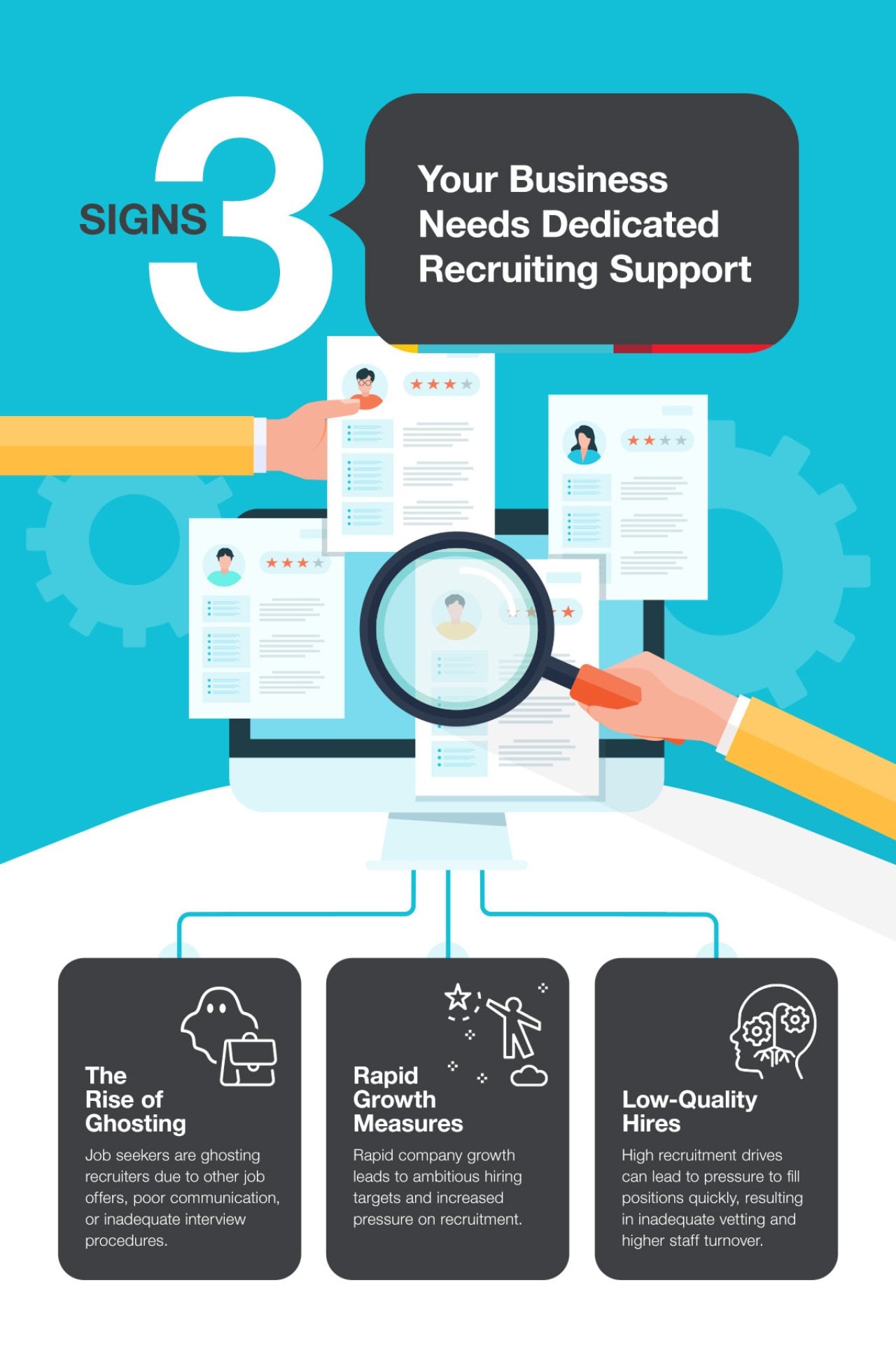
3 Signs Your Business Needs Dedicated Recruiting Support

An infographic showing signs a business needs recruiting support.

Emerge Talent

Recruitment surges are an exciting time for any company. However, the overload of recruiting tasks to fill your schedule may feel like a mountain to climb. The strain can easily take its toll on your team. Below are three indicators your team needs recruiting support to get you on the other side of the mountain:

1. The Rise of Ghosting

Interestingly, a survey showed that 70% of job seekers in the U.S. felt it was fair to ghost recruiters and potential employers during the recruitment process. A probable reason is that another job offer has come through. However, other overlooked factors could be poor communication and an inadequate interview procedure.

A heavy workload dedicated to supporting existing employees in day-to-day operations, such as payroll and compliance, may leave little time for recruitment. By the time you get around to responding to candidates, they may lose interest and decide to accept employment elsewhere.

2. Rapid Growth Measures

A recruitment drive is a promising sign of stable company growth. However, rapid growth also indicates ambitious hiring targets. There may be goals to reach, such as securing between five and 10 specialized hires in a 60-day time frame, which adds considerable pressure alongside your general responsibilities.

Introducing a subscription-based recruitment process outsourcing (RPO) or a flat-fee partner for support during recruitment surges is a valuable resource. The partner can deliver a personalized solution that aligns with your goals and helps you meet recruitment targets.

3. Low-Quality Hires

With high recruitment drives comes the possibility of rising staff turnover. A high volume of open positions can increase pressure to fill them without the attention to detail needed to vet candidates. When an employee leaves your company after a short time, the hiring process to fill the vacancy must start from the beginning.

Outsourcing recruitment support enables you to rely on experienced recruiters with the tools and time to vet candidates and find suitable fits.

Different Types of Recruiting Support for Overstretched HR Teams

Deciding to outsource recruiting support is the first step toward securing suitable candidates. The support you require depends on various factors, including the number of vacant positions and the time frame to fill them.

Transactional Staffing

If you need to fill a particular position under a tight deadline, working with a transactional staffing agency is a viable option. Transactional staffing is beneficial when urgency is the key driver to filling a position. However, urgency and a speedy recruitment process leave you vulnerable to unsuitable talent.

The outsourced recruiter is responsible for filling your vacancy as soon as possible. Urgency may lead to a less thorough evaluation of candidates against your company culture and their skill sets, such as skipping vital skill-based questions. Additionally, using a transactional staffing solution multiple times due to unsuitable candidates increases your costs.

Embedded Recruitment Partners

To build an ongoing relationship with experienced recruiters, seeking an embedded recruitment partner offers reassurance in finding the right candidates. When you integrate the recruitment partner into your email and applicant tracking system (ATS), the partner can help maintain brand consistency when interacting with potential candidates.

An embedded recruitment partner typically operates as a monthly subscription or flat-fee service based on open positions. The recruitment process focuses on vetting quality candidates rather than filling vacancies by a deadline.

Consultancy and Strategy

If you’re in a position where guidance on finding candidates is a more valuable tool, expert advice can steer you in the right direction. A consultant provides support on methods for finding talent and improving your internal recruitment process. These improvements may include changing the advertising channels or refining job descriptions.

Consultancy allows you to implement the improvement points without outsourcing the work. A consultant can advise on how to speed up recruitment without compromising quality and stretching workloads.

Improve the Recruiting Process With Embedded Support

Outsourcing your recruitment, especially during peak hiring periods, is priceless for securing competent candidates for your roles. All parties involved, from your HR team to the company and the candidates themselves, benefit from a seamless experience. Below are the reasons why embedded recruitment support makes a difference:

  • Boosts speed: When you have a recruitment partner handle the time-consuming tasks of screening and scheduling candidates for interviews, your schedule becomes less daunting. Your recruitment partner has the time and tools to ensure you’re filling vacancies efficiently while maintaining quality.
  • Flexible scalability: Adopting a flat-fee or monthly-subscription partner offers scalable pricing based on the number of vacancies. When your company experiences high recruitment demand, the recruitment support increases to meet this demand. During slower periods, the level of support can decrease to align with your goals.
  • Access to premium talent: Enlisting a recruitment partner is an opportunity to tap in to a highly skilled network. Recruiters with specific industry knowledge have passive professional contacts that exceed the reach of posting a job advertisement on generic job boards. These partners have years of experience in particular industries, reducing the risk of low-quality hires.
  • Better vetting techniques: Particularly for specialized roles, a recruitment partner can seek advice from industry professionals on required skills and qualifications. Reaching out to their contacts for guidance is a valuable tool to ensure you’re targeting the proper criteria and offers confidence when onboarding talent.
  • Consistency for candidates: Frequent communication with potential candidates is a consistent issue for internal HR teams due to increasing workloads. Integrating with your ATS and email domain allows recruitment partners to maintain timely communication about application updates, interviews and offers.

How to Move From Hiring to Talent Acquisition

The goal for any HR team is to prioritize talent acquisition during the recruitment process. Instead, the pressure of securing candidates within a time frame to hit targets takes over. Talent acquisition is achievable through a strategy of focusing on the long-term benefits.

Focus on Retention

Outsourcing recruitment efforts to a partner with experience and knowledge of your industry leaves you free to work on retention of existing talent. Changing the course of the day-to-day by improving the employee experience allows existing workers to feel valued and keeps your workforce motivated.

Finding ways to keep existing employees engaged positively impacts productivity and shapes a proactive workplace culture.

Build a Long-Term Partnership

Fostering a mutually beneficial relationship with an embedded recruitment partner allows them to build on their growing knowledge of your company. Communication with candidates becomes a streamlined process to offer a consistent experience, such as adopting your company’s tone of voice.

Secure Your Financial Health

Time-to-fill costs can rise and accumulate when you’re working with a recruitment agency that charges unpredictable percentages. Seeking a partnership with a flat-fee or monthly-subscription outsourcing partner provides quality and a cost-effective solution to finding new talent.

Levels of support may vary depending on demand. However, subscription and flat-fee models provide financial predictability and are well-suited to HR budgeting.

7 Tips to Choose a Recruitment Partner

A poster listing tips in choosing a recruitment partner.

Emerge Talent

Recruitment partnerships are not a one-size-fits-all solution. Before reaching out to the first recruitment partner you find, it’s essential to conduct due diligence and find the right partnership for your HR team. The following seven tips will help you in your search:

  • Investigate industry experience: Knowledge about your industry makes a difference to recruitment efforts. Primarily, if you’re recruiting for specialized roles, a recruiter must uphold a working knowledge of the industry to understand what you’re looking for in candidates. Vetting candidates is a more straightforward process with a knowledgeable recruiter.
  • Ensure recruitment alignment: The optimal starting point for conversations is outlining what you need from a recruitment partner. For example, relay your business goals and clearly explain what you hope to achieve from the partnership, including scalability and quality. A reputable partner tailors their approach to meet your expectations.
  • Discuss recruiter responsibilities: Multiple recruiters working on your account confuses the recruiters and your team. Clarify how the setup works with the partnership and whether it’s possible to assign particular individuals. Having the same people handle your recruitment delivers consistency and a better candidate experience.
  • Learn the vetting process: An experienced recruitment partner has a tried and tested screening method to find suitable candidates. Discuss the evaluation of a candidate’s experience and how the screening aligns with your company’s culture.
  • Set communication targets: Candidates expect timely communication throughout the recruitment process. Without consistent updates, candidates are likely to look elsewhere for employment opportunities. Assess a recruitment partner’s typical response times and communication templates for updates to candidates and hiring managers.
  • Analyze costs: Evaluate the costs carefully to determine what a subscription or flat fee includes. Consider the level of ongoing support in a partnership and the value it brings, rather than expensive percentage models.
  • Confirm brand representation: The recruitment partner is responsible for liaising with candidates and contacts on your behalf. Discuss how the partner establishes your tone of voice and values across all correspondence.

Scale Your Team Without the Stress

The time and effort required to screen candidates, facilitate interviews and organize onboarding put significant strain on an HR team’s calendar. Recruitment is an integral part of HR, but the administrative effort needed to secure the right talent can take its toll.

The repercussions of an overworked HR team can lead to growing concerns across multiple areas. For example, poor-quality hires and reduced support for existing employees affect retention rates. The option of transactional staffing leaves your HR team in a pattern of repeating the same mistakes with reactive hiring.

Building a firm relationship with an embedded recruitment partner provides the support you require to fill vacancies confidently. Flexible support and predictable costs allow you to scale your team, meet long-term objectives and maintain financial stability.

Experienced recruiters have the knowledge to oversee time-to-fill and help you onboard the right candidates.

This story was produced by Emerge Talent and reviewed and distributed by Stacker.

Topics:

Careers & Education
media-news

New to The Street's Esteemed Client Roadzen Wins "InsurTech Solution of the Year" at 2026 FinTech Breakthrough Awards

By Media News
3 min read • Published March 26, 2026
By Media News
3 min read • Published March 26, 2026

NASDAQ:RDZN Honored Alongside Mastercard, Capital One, and Moody’s as New to The Street Expands National Media Coverage

NEW YORK CITY, NY / ACCESS Newswire / March 26, 2026 / New to The Street, the premier financial media platform broadcasting as sponsored programming on Fox Business Network and Bloomberg Television, proudly announces that its esteemed client, Roadzen Inc. (Nasdaq:RDZN), has been named "InsurTech Solution of the Year" at the 2026 FinTech Breakthrough Awards, one of the most competitive and globally recognized programs in financial technology.

Selected from over 4,500 nominations across more than 20 countries, Roadzen’s AI-powered claims platform was recognized by an independent panel of industry experts for its innovation, performance, ease of use, and advanced functionality. This distinction places Roadzen among an elite group of 2026 award winners, including Mastercard, Capital One, Intuit, Moody’s, NerdWallet, FIS, and Webull.

The FinTech Breakthrough Awards, part of the globally recognized Tech Breakthrough program, honor excellence across digital banking, payments, personal finance, wealth management, fraud protection, RegTech, and InsurTech-highlighting the most innovative companies shaping the future of financial services.

Roadzen continues to lead at the intersection of artificial intelligence, insurance, and mobility, delivering transformative solutions that enable insurers, automakers, and fleet operators to better predict risk, automate claims, and create seamless, embedded insurance experiences. With thousands of clients across North America, Europe, and Asia, the company is rapidly scaling its platform across global markets.

As part of its ongoing strategic partnership, New to The Street will amplify Roadzen’s achievement through its powerful, integrated media ecosystem, including:

  • National television broadcasts on Fox Business and Bloomberg

  • Long-form executive interviews filmed at the Nasdaq MarketSite and NYSE

  • High-frequency TV commercial distribution

  • Dominant outdoor billboard placements across Times Square and the NYC Financial District

  • Digital amplification to a combined audience of over 5 million subscribers across YouTube and social platforms

  • Earned media placements across ABC, NBC, and CBS affiliates nationwide

"Roadzen’s recognition at the FinTech Breakthrough Awards is a clear validation of its leadership in AI-driven insurance technology," said Vince Caruso CEO and CO-Founder NTTS. "We are proud to work alongside companies like Roadzen that are not only innovating at a high level but executing globally and delivering real, measurable impact across the financial ecosystem."

With this latest award, Roadzen further strengthens its position as a category-defining insurtech platform, continuing to attract attention from institutional investors, strategic partners, and global markets.

About Roadzen Inc.

Roadzen Inc. is a global leader in AI at the convergence of insurance and mobility. The company develops advanced technologies that help insurers, automakers, and fleets predict and prevent risk, automate claims, and deliver seamless insurance experiences. Roadzen’s work in telematics, generative AI, and computer vision has earned recognition from leading publications including Forbes and Fortune. Headquartered in Burlingame, California, Roadzen operates across the U.S., U.K., and India.

About New to The Street

New to The Street is one of the most powerful financial media platforms in the industry, combining national television broadcasts on Fox Business and Bloomberg with one of the largest business-focused YouTube channels and a dominant outdoor advertising footprint in Times Square and the NYC Financial District. The platform delivers unmatched visibility through long-form TV, digital distribution, earned media, and iconic billboard placements.

Media Contact:

Monica Brennan
New to The Street
Monica@NewtoTheStreet.com

SOURCE: New to The Street

View the original press release on ACCESS Newswire

Topics:

media-news

Interviews

He Was Showrunner on ‘Impractical Jokers.’ Now He Runs Corporate Campaigns for Fortune 500 Companies

Simmy Kustanowitz spent two decades in TV development and production. Now he's applying showrunner skills to the corporate world, and he's not done with entertainment either.

simmy
Miles icon
By Miles Jennings
@milesworks
Miles Jennings is CEO of Mediabistro and its parent CognoGroup. He previously founded and led Recruiter.com through its NASDAQ listing, executing more than 10 acquisitions over nearly a decade as CEO and COO.
9 min read • Originally published March 17, 2026 / Updated March 25, 2026
Miles icon
By Miles Jennings
@milesworks
Miles Jennings is CEO of Mediabistro and its parent CognoGroup. He previously founded and led Recruiter.com through its NASDAQ listing, executing more than 10 acquisitions over nearly a decade as CEO and COO.
9 min read • Originally published March 17, 2026 / Updated March 25, 2026

Simmy Kustanowitz has a résumé that reads like a guided tour of mid-2000s to mid-2020s television. Writer on Total Request Live. Development executive across truTV, TBS, and TNT, where he oversaw shows like At Home with Amy Sedaris, Adam Ruins Everything, and The Carbonaro Effect. Showrunner and executive producer on Impractical Jokers for several seasons. VP of Development at a time when the unscripted boom was rewriting the economics of cable.

Then, in 2023, he decided to build something new alongside it all.

His company, Clock Tower Innovation, takes the skills he built running TV productions and applies them inside corporations. The client list is eclectic: tech, banking, private equity firms, and a veterinary emergency group. He calls himself a “corporate showrunner,” and while the title might raise eyebrows in a writers’ room, the framework is serious. He runs workshops, builds narrative strategies, and helps marketing and communications teams at large organizations figure out how to actually land a message.

In 2025, he won the Vistage New Speaker of the Year award. He’s also currently executive producing Foul Play with Anthony Davis. The man is busy.

We talked to Kustanowitz about what TV production teaches you about corporate leadership, why so many companies struggle with clarity, and what media professionals should be thinking about as they consider their next move.

Vital Stats
Name: Simmy Kustanowitz
Company: Clock Tower Innovation LLC
Title: Founder
Location: New York, NY
Previous: VP of Development, truTV/TBS/TNT; Showrunner/EP, Impractical Jokers
Contact: simmy@clocktowerinnovation.com | @clocktowerinnovation on Instagram

You call yourself a “corporate showrunner.” For people who’ve worked in TV production, what does that role actually look like inside a large enterprise?

I realize this might sound crazy to people in the entertainment world, but running a show and overseeing a corporate campaign can feel remarkably similar. The environment is completely different, of course, but you’re using a lot of the same muscles. That’s what I mean by corporate showrunner. Whether it’s overseeing an internal comms campaign or helping a marketing team craft the most effective brand narrative, I’m essentially applying my TV showrunner skills to the business world.

Running a TV show requires creativity, efficiency, and leadership. You need to be able to think creatively, compartmentalize challenges and tackle them quickly, and build trust among your crew as a leader they feel inspired to work for. These same traits have helped me successfully lead campaigns in the corporate world. I’ve partnered with several large corporations that know the story they want to tell, or the product they need to sell, but they don’t know how to land the plane. A showrunner knows how to bring an entire production together, and a corporate showrunner does the same for a company that’s looking to connect with its intended audience.

You spent 20-plus years in television, starting as a writer on Total Request Live and working your way up to VP of Development. At what point did you realize the skills you’d built in TV had a market outside of entertainment?

A few years ago, a friend who works in finance introduced me to his Chief Marketing Officer, because she was looking for creative ways to motivate her team. This CMO explained to me that she wanted her colleagues to think outside the box and asked if I could lead a workshop with that in mind.

I put together a simple presentation, included clips from some of my shows, and focused on how the methodologies I developed in the entertainment industry could be applied to their work. In other words: what show business can show business. I called the workshop “Rethink the Way You Think,” and the reaction to that session was overwhelmingly positive. That’s the moment I knew my skills could translate, and help people in any industry.

You’ve said that complex organizations don’t lack ambition, they struggle with clarity, consistency, and cadence. Can you give us a concrete example?

So many corporate decisions are driven by fear. Comms and marketing teams really do want to move the needle, but they’re worried about going out on a limb and trying something bold. So they settle for the path that’s safe, or boring, and often produce content that’s so watered down by corporate jargon that it lacks the clarity it needs to resonate.

The companies that hire Clock Tower do so because they’re ready to try something new. So we take the same approach we would in television: find smart, clever and “sticky” ways to engage with your customers, or audience. That simple approach can be just as effective in business as it is in TV.

You were showrunner and EP on Impractical Jokers for several years. That’s a show where the talent are also the creators. What did managing that dynamic teach you about leadership?

On a show like Jokers, you need to respect the fact that the show is their baby. You can’t have an ego about it. You need to understand and appreciate that your voice simply doesn’t count as much as theirs does. At the same time, you’re the showrunner, and at the end of the day they want you to push back when you have something on your mind. So it’s a real balance.

Successfully achieving that balance has helped me in the corporate world as well. If I pitch an idea the marketing team loves but the CEO isn’t buying, you can’t have an ego about it. You need to respect the chain of command, be forceful when appropriate and also know when to drop it and pivot.

Thinking about your own pivot? Browse open roles on Mediabistro across content strategy, brand marketing, creative direction, and more.

Your client list ranges from big tech to a veterinary emergency group to private equity firms. Is there a common problem you keep encountering regardless of the sector?

These companies might seem on the surface like they’re from different planets, but what I’ve learned through Clock Tower is that everyone ultimately speaks the same language. The challenges you see at one company, you see at all companies.

Meetings go on too long. Work-from-home policies are causing trickle-down problems. AI adoption is creating confusion. I could go on. It’s really remarkable how many issues keep repeating. So when companies’ problems are that universal, it’s really not so hard to find solutions that are just as universal.

You made the leap to entrepreneurship in 2023 after two decades in TV. What did you underestimate about starting Clock Tower Innovation, and what turned out to be easier than expected?

I don’t think I quite appreciated the amount of hustling you need to do when you’re starting your own thing. It is a nonstop, never-ending hustle. You need to be willing to ask everyone in your life for favors and introductions, and then have the self-awareness to know when to be persistent and when to drop it. It’s a lot!

I’m not sure anything has been easier than I expected, honestly. But when I land one of those big engagements, and when I get rehired because we nailed what they hired us to do, it’s more rewarding than anything I ever experienced before setting out on my own.

You’re simultaneously running Clock Tower while executive producing Foul Play with Anthony Davis. How do you structure your time across those roles?

I’ve always been a good juggler. In my days as a network exec, there were times when I was overseeing six series at once. For me, it has always come down to structured efficiency. I’ll break down my day into compartments: two hours for this project, 30 minutes for this other one, an hour for that one, and tick them off one by one. I make lots of lists. When I was young, my mother used to tell me and my siblings to “always make a list, and make the first item on your list ‘make a list’ so you can cross something off right away and feel a sense of accomplishment.” That’s always stuck with me.

You developed and oversaw shows like At Home with Amy Sedaris, Adam Ruins Everything, and The Carbonaro Effect during your time at truTV. What’s your read on the state of unscripted and alternative programming right now?

It’s a very confusing, scary time for all of programming, really. Other than sports, I’m not sure any area is particularly safe. The entertainment industry is in the midst of a massive transition with no clear path ahead, but the world will always need entertainment. I won’t pretend to have a magic wand here. I have no clue where it’s all going. But smart creators with unique POVs will find a way to find their audience.

You’ve talked about “narrative frameworks” and “internal media systems.” For a content strategist or producer reading this, what do those deliverables actually look like?

The deliverables differ from company to company, but they can range from a simple Google doc with a brand manifesto to an elaborate presentation filled with dynamic slides or a piece of content intended for company-wide distribution. It can really be anything that particular business is trying to communicate to its intended audience.

You won the 2025 Vistage New Speaker of the Year award. What resonates most when you’re on stage talking to business leaders?

Many business leaders relate to my “Simplify and Gamify” framework. When I lead workshops, I always start off by simplifying the process in the most basic way: everyone in the room numbers a piece of paper 1-10 and spends 10 minutes brainstorming something related to their current priorities. Then, I lead the participants through some sort of gamified brainstorm exercise, geared towards whatever their area of focus is on that day. I find gamification helps trojan-horse education through entertainment. When people are having fun, they’re much more open to learning and growth.

As for surprises: I often get feedback that these leaders never expected to be able to apply so many lessons from TV production in the business world. They’re shocked by how much shared DNA can be found between their work and my experience in comedy and entertainment. Seeing that revelation in my sessions is always so rewarding.

Looking at the media industry right now, what skill or capability do you think is most undervalued by professionals in our space?

Diversification. Someone once told me to think of my career not as a ladder, but as a portfolio, and a good portfolio is diversified. I can proudly say that the work I do through Clock Tower has helped financial institutions, law firms, real estate companies, medical facilities, tech startups, and nonprofits. And I’ve been able to secure such a diverse group of clients because the work I do isn’t siloed.

Be open to working with teams or companies outside your comfort zone, and learn skills you never had time to learn before. If you’re able to do that, you will find opportunities in the unlikeliest of places.

You can follow Kustanowitz’s quick-hit video series “Innovation in Under :60” on Instagram at @clocktowerinnovation, subscribe to his Substack, or reach him directly at simmy@clocktowerinnovation.com.

For employers hiring in media and creative: If you’re looking for content strategists, producers, brand marketers, or creative directors who can bring a storyteller’s perspective to your organization, post your role on Mediabistro and reach the industry’s most dedicated talent community.

Topics:

Interviews
media-news

Dolphin Entertainment Reports Record Fourth Quarter and Full-Year 2025 Results

By Media News
10 min read • Published March 25, 2026
By Media News
10 min read • Published March 25, 2026
  • 2025 Revenue Rises 10% to $56.7M; Q4’25 Revenue Up 27% YoY to $15.6M

  • 2025 Net Loss Decreases by $9.5M and 2025 Adjusted EBITDA More than Triples to $2.9M compared to 2024

  • Q4’25 Net Income of $1.0M vs. Net Loss of $2.0M in Q4 24

  • Q4’25 Adjusted EBITDA Swings to $1.7M Profit vs. $(0.5)M Year-Ago Loss

  • Expects Continued Revenue Growth and Adjusted EBITDA Margin Expansion in 2026

MIAMI, FL / ACCESS Newswire / March 25, 2026 / Dolphin (NASDAQ:DLPN), a leading entertainment marketing and premium content production company, today announced its financial results for the fourth quarter and full year ended December 31, 2025.

Bill O’Dowd, CEO of Dolphin, stated:

"2025 marked a turning point for Dolphin. After several years of strategic acquisitions and growth investments, we are now reaping the benefits. Full-year revenue grew approximately 10% to $56.7 million, with fourth quarter revenue up 27% year-over-year to $15.6 million. Full-year Adjusted EBITDA reached $2.9 million, up 209% from $0.9 million. Q4 was particularly strong, with Adjusted EBITDA of $1.7 million compared to Adjusted EBITDA loss of $0.5 million in Q4 2024, a $2.2 million swing that underscores the operating leverage in our model.

Our recently announced strategic partnership with DealMaker, our AI capabilities through Dolphin Intelligence, and our disciplined venture investments represent additional growth catalysts requiring little to no upfront capital. We expect continued top-line growth in 2026 and, just as in 2025, we expect Adjusted EBITDA to expand significantly faster than revenue. We have built the infrastructure and team to support a meaningfully larger revenue base, in which incremental revenue is able to flow disproportionately to the bottom line and we expect continued Adjusted EBITDA margin expansion in 2026.

We are excited about 2026, 2027 and beyond. Our bank debt matures within roughly two and a half years, which will save us almost $2.2 million in principal and interest payments on an annual basis. Furthermore, we expect approximately $1 million in annualized lease savings to be achieved after our large leases in New York City and Los Angeles terminate by the end of 2026 and 2027, respectively. These lease savings will enhance our operational leverage, and just as with our expectations of continued organic growth and margin expansion, nearly all these savings will flow directly to our free cash flow given our NOL federal and state carryforwards of $127 million.

2025 and Recent Highlights

Total revenue for the year ended December 31, 2025, was $56.7 million, an increase of 10% from $51.7 million last year.

Operating loss was $0.04 million for the year ended December 31, 2025, compared to an operating loss of $10.5 million for the year ended December 31, 2024.

Operating expenses for full year 2025 were $56.7 million, including non‑cash expenses of $2.4 million related to depreciation and amortization. This compares to operating expenses of $62.2 million in 2024, including depreciation and amortization of $2.4 million, and non‑recurring or non‑cash expenses of $8.0 million, consisting primarily of a $6.7 million goodwill impairment and a $1.3 million write‑off of notes receivable.

Net loss for full year 2025 was $3.1 million, including non‑cash expenses of approximately $2.4 million related to depreciation and amortization and non-recurring net expenses of $0.5 million related to acquisition costs, debt extinguishment costs and a gain on the sale of a subsidiary. This compares to a net loss of $12.6 million for 2024, including depreciation and amortization of $2.4 million and non‑recurring and non‑cash expenses of approximately $8.0 million, primarily consisting of a $6.7 million goodwill impairment and a $1.3 million write‑off of notes receivable.

Basic and diluted loss per share for full year 2025 was $(0.27) based on 11,558,485 weighted average shares outstanding compared to basic and diluted loss per share in 2024 of $(1.22) based on 10,306,904 weighted average shares outstanding.

Adjusted EBITDA for full year 2025 was $2.9 million, compared to $0.9 million in 2024;

Adjusted EBITDA for Q4 2025 was $1.7 million, compared to $(0.5) million in Q4 2024.

Dolphin

  • Partnered with DealMaker to Unlock Community Capital for Celebrity and Influencer Brands

  • Dolphin’s Powerhouse Subsidiaries Lead Major Brand Activations During Super Bowl LX

  • CEO Featured on Variety’s "Strictly Business" Podcast, Discusses the Creator Economy’s Transformation of Marketing and Consumer Product Launches

  • Expanded Miami Footprint to Support Continued Growth Across Subsidiaries

  • Unveiled New ‘Dolphin Intelligence’ Division to Power AI-Driven Marketing and Communications Strategy and Execution for Partners

  • Named One of Crain’s Best Places to Work in NYC 2025

  • CEO Bill O’Dowd Named to PRNEWS 2025 People of the Year List; Company Recognized on Agency Elite 120

42West

  • Celebrated Oscar Win as "Mr. Nobody Against Putin" Takes Best Documentary Feature at the 98th Academy Awards

  • At Super Bowl LX, generated national media buzz for Funko’s limited-edition Seattle Seahawks Pop! release and led widespread coverage of Puppy Bowl XXII, amplifying multi-network visibility and pet adoption awareness during the Big Game weekend.

  • Landed Six Nominations for Clients at the 98th Academy Awards

  • Brought Exciting and Diverse Projects to the 2026 Sundance Film Festival

  • Garnered Four Nominations for Clients at the 83rd Golden Globe Awards

Shore Fire Media

  • Clients Named 2 of the 10 Best Podcasts in 2025, Including the No. 1 Pick

  • Shore Fire Media and 42West’s Clients Presented, Performed and Took Home Honors at the 2026 GRAMMY Awards

  • Shore Fire Media and 42West Clients Earn 35 Nominations for the 2026 GRAMMY Awards

The Door

  • DISRPT Agency, a Division of The Door, Powered "Art of Glam" During Oscars Week, Driving Cultural Momentum Into Camille Rose’s Upcoming Beauté Noir

  • DISRPT delivered a headline-making moment at the Super Bowl LX Halftime Show by orchestrating the debut of Bad Bunny’s first adidas Originals signature shoe

  • The Door Provided Strategic Communications Leadership for Hooters as the Iconic Brand Enters a New Era of Ownership and Cultural Relevance

Elle Communications

  • At Super Bowl LX in the Bay Area, drove national visibility for City Year and its NFL partnership by spotlighting the opening of East Palo Alto’s first regulation-sized football field and related community activation

  • Client Harbor Fund Announced Sundance Mountain Resort as New Long-Term Home of Harbor Film Forum

  • Named Agency of Record for FDA-Cleared Neurostimulation Device

  • Launched "The Shift," a Quarterly Report, Weekly Newsletter, and Live Workshop Series on the Future of Communications

  • Led Press For "A Day of Unreasonable Conversation" Summit At The Getty Center

The Digital Dept.

  • The Digital Dept. Signed Reality TV Show Stars, Top Beauty Creators

  • Ahead of Super Bowl LX, built social buzz for T-Mobile’s Big Game commercial by activating creator Becca Tilley for exclusive behind-the-scenes content and talent interviews.

Special Projects

  • Had Another Successful Year of Talent Relations for the Academy Museum of Motion Pictures Fifth Annual Gala Honoring Penélope Cruz, Walter Salles, Bruce Springsteen, And Bowen Yang

Youngblood

  • As Hockey Has a Hollywood Moment, Dolphin’s Adaptation of Cult Classic Youngblood Premiered in Los Angeles

  • Dolphin Partnered with Vaneast Pictures To Bring Sports Drama Youngblood to Berlin for International Sales

  • Official Trailer and Key Art Released for Hubert Davis’ Adaptation of Hockey Classic "Youngblood"

  • Partnered with Well Go USA for U.S. Distribution of YOUNGBLOOD

  • Los Angeles Kings Joined Feature Film Youngblood

Conference Call Information

To participate in this event, dial in approximately 5 to 10 minutes before the beginning of the call.

Date: March 25, 2026
Time: 4:30pm ET
Toll Free: 888-506-0062 International: 973-528-0011 Participant Access Code: 255728
Webcast: https://www.webcaster5.com/Webcast/Page/2225/53793

Replay

Toll Free: 877-481-4010 International: 919-882-2331 Replay Passcode: 53793
Webcast Replay: https://www.webcaster5.com/Webcast/Page/2225/53793

This press release contains ‘forward-looking statements’ within the meaning of the Private Securities Litigation Reform Act. These forward-looking statements may address, among other things, Dolphin Entertainment Inc.’s offering of common stock as well as expected financial and operational results and the related assumptions underlying its expected results. These forward-looking statements are distinguished by the use of words such as "will," "would," "anticipate," "expect," "believe," "designed," "plan," or "intend," the negative of these terms, and similar references to future periods. These views involve risks and uncertainties that are difficult to predict and, accordingly, Dolphin Entertainment’s actual results may differ materially from the results discussed in its forward-looking statements. Dolphin Entertainment’s forward-looking statements contained herein speak only as of the date of this press release. Factors or events Dolphin Entertainment cannot predict, including those described in the risk factors contained in its filings with the Securities and Exchange Commission, may cause its actual results to differ from those expressed in forward-looking statements. Although Dolphin Entertainment believes the expectations reflected in such forward-looking statements are based on reasonable assumptions, it can give no assurance that its expectations will be achieved, and Dolphin Entertainment undertakes no obligation to update publicly any forward-looking statements as a result of new information, future events, or otherwise, except as required by applicable law.

CONTACT:

James Carbonara
HAYDEN IR
(646)-755-7412
james@haydenir.com

ABOUT DOLPHIN:

Dolphin (NASDAQ:DLPN) is where cultural creation meets marketing execution. Founded in 1996 by Bill O’Dowd, Dolphin operates as both a venture studio-developing and investing in breakthrough content, products, and experiences-and a marketing consortium, featuring leading agencies across every communications discipline.

At its core, the venture studio creates, produces, finances, markets, and promotes new businesses and cultural ideas – ranging from acclaimed film, television, and digital content to consumer goods, live events and partnerships that define entertainment and lifestyle. Surrounding this entrepreneurial engine, Dolphin’s marketing prowess brings together best-in-class firms including 42West, The Door, Shore Fire Media, Elle Communications, Special Projects and The Digital Dept. Together, this collective delivers unmatched cross-marketing expertise and relationships across every vertical of pop culture – from film, television, music, influencers, sports, hospitality, and fashion to consumer brands and purpose-driven initiatives. Dolphin marketing has been the recipient of many accolades, including #1 Agency of the Year on the Observer PR Power List in 2025, The PR Net 100, and the PR News Elite 120.

Follow us on Instagram here.

DOLPHIN ENTERTAINMENT, INC. AND SUBSIDIARIES
Consolidated Balance Sheets
As of December 31, 2025 and 2024

2025

2024

ASSETS
Current
Cash and cash equivalents

$

8,756,585

$

8,203,842

Restricted cash

925,004

925,004

Accounts receivable:
Trade, net of allowance of $445,523 and $1,327,808, respectively

7,848,970

5,113,157

Other receivables

5,243,931

5,451,697

Other current assets

1,179,498

373,399

Total current assets

23,953,988

20,067,099

Capitalized production costs, net

520,338

594,763

Employee receivable

1,196,085

1,007,418

Right-of-use assets

3,012,941

4,738,997

Goodwill

21,507,944

21,507,944

Intangible assets, net

7,898,607

10,189,026

Property, equipment and leasehold improvements, net

50,961

114,011

Other long-term assets

189,296

218,021

Total Assets

$

58,330,160

$

58,437,279

(Continued)

DOLPHIN ENTERTAINMENT, INC. AND SUBSIDIARIES
Consolidated Balance Sheets (Continued)
As of December 31, 2025 and 2024

2025

2024

LIABILITIES
Current
Accounts payable

$

3,096,715

$

2,344,272

Term loans, current portion

1,813,760

1,686,018

Revolving line of credit

400,000

400,000

Notes payable, current portion

3,500,000

3,750,000

Convertible notes payable, current portion

1,250,000

–

Contingent consideration

–

486,000

Accrued interest – related party

2,043,087

1,857,986

Accrued compensation – related party

2,625,000

2,625,000

Lease liabilities, current portion

1,912,482

1,919,672

Deferred revenue

794,177

341,153

Other current liabilities

11,096,820

11,104,036

Total current liabilities

28,532,041

26,514,137

Noncurrent
Term loans, noncurrent portion

2,976,930

4,782,271

Notes payable, noncurrent portion

4,580,000

3,130,000

Convertible notes payable

6,460,000

5,100,000

Convertible notes payable- related party

2,904,357

–

Convertible notes payable at fair value

270,000

320,000

Loans from related party

983,112

3,225,985

Lease liabilities

1,469,386

3,306,033

Deferred tax liability

463,909

394,547

Other noncurrent liabilities

–

18,915

Total Liabilities

48,639,735

46,791,888

Commitments and contingencies (Note 25)
STOCKHOLDERS’ EQUITY
Preferred Stock, Series C, $0.001 par value, 50,000 shares authorized, 50,000 shares issued and outstanding at December 31, 2025 and 2024

1,000

1,000

Common stock, $0.015 par value, 200,000,000 shares authorized, 12,221,432 and 11,162,026 shares issued and outstanding at December 31, 2025 and 2024, respectively

183,321

166,688

Additional paid in capital

158,809,301

157,692,132

Accumulated deficit

(149,303,197

)

(146,214,429

)

Total Stockholders’ Equity

9,690,425

11,645,391

Total Liabilities and Stockholders’ Equity

$

58,330,160

$

58,437,279

DOLPHIN ENTERTAINMENT, INC. AND SUBSIDIARIES
Consolidated Statements of Operations
For the years ended December 31, 2025 and 2024

2025

2024

Revenues

$

56,699,389

$

51,684,984

Expenses:
Direct costs

2,269,874

3,266,461

Payroll and benefits

41,916,885

38,123,040

Selling, general and administrative

7,813,177

7,795,610

Acquisition costs

416,171

164,044

Impairment of goodwill

–

6,671,557

Write-off of notes receivables

–

1,270,000

Change in fair value of contingent consideration

–

50,000

Gain on sale of Always Alpha Sports Management LLC

(756,574

)

–

Depreciation and amortization

2,354,585

2,382,361

Legal and professional

2,724,329

2,447,083

Total expenses

56,738,447

62,170,156

Loss from operations

(39,058

)

(10,485,172

)

Other (expenses) income:
Change in fair value of convertible note

50,000

35,000

Change in fair value of warrant

–

5,000

Loss on extinguishment of debt

(835,324

)

–

Interest expense, net

(2,195,024

)

(2,070,199

)

Total other (expense) income, net

(2,980,348

)

(2,030,199

)

Loss before income taxes

$

(3,019,406

)

$

(12,515,371

)

Income tax expense

(69,362

)

(87,854

)

Net loss

(3,088,768

)

(12,603,225

)

Loss per share:
Basic

$

(0.27

)

$

(1.22

)

Diluted

$

(0.27

)

$

(1.22

)

Weighted average number of shares used in per share calculation
Basic

11,558,485

10,306,904

Diluted

11,558,485

10,306,904

Use of Non-GAAP Financial Measures

In order to provide greater transparency regarding our operating performance, the financial results in this press release refer to a non-GAAP financial measure that involves adjustments to GAAP results. Non-GAAP financial measures exclude certain income and/or expense items that management deems are not directly attributable to the Company’s core operating results and/or certain items that are inconsistent in amounts and frequency, making it difficult to perform a meaningful evaluation of our current or past operating performance.

Adjusted earnings before interest, taxes, depreciation and amortization ("Adjusted EBITDA") is defined by Dolphin as net (loss) or income adjusted for (i) interest, (ii) taxes, (iii) depreciation and amortization, (iv) write-off of assets, (v) impairment of goodwill or intangible assets, (vi) acquisition costs, (vii) equity based compensation, (viii) change in fair value of contingent consideration, convertible notes and warrants, (ix) allowance for credit losses, (x) loss on extinguishment of debt, (xi) gains or losses on sale of subsidiaries, (xii) litigation costs; and (xiii) impairment of capitalized production costs.

Management believes that the presentation of operating results using this non-GAAP financial measure provides useful supplemental information for investors by providing them with the non-GAAP financial measure used by management for financial and operational decision making, planning and forecasting and in managing the business. This non-GAAP financial measure does not replace the presentation of financial information in accordance with U.S. GAAP. These non-GAAP financial results should not be considered a measure of liquidity and is unlikely to be comparable to non-GAAP financial measures provided by other companies.

Reconciliation of GAAP net (loss) income to non-GAAP Adjusted EBITDA

Twelve Months Ended
December 31,
Three Months Ended
December 31,

2025

2024

2025

2024

Net (loss) income (GAAP)

$

(3,088,768

)

$

(12,603,225

)

$

1,019,706

$

(1,959,611

)

Adjustments to GAAP measure:
Interest expense

2,195,024

2,070,199

467,203

520,914

Income tax expense

69,362

87,854

26,317

43,148

Depreciation and amortization

2,354,585

2,382,361

582,093

636,782

Write off of assets

–

1,270,000

–

–

Impairment of goodwill

–

6,671,557

–

–

Acquisition costs

416,171

164,044

–

–

Equity based compensation

12,399

364,650

456

3,933

Change in fair value of contingent consideration

–

50,000

–

50,000

Change in fair value of convertible note and warrant

(50,000

)

(40,000

)

(30,000

)

20,000

Allowance for credit losses

441,875

505,173

177,292

204,143

Loss on extinguishment of debt

835,324

–

–

–

Gain on sale of Always Alpha

(756,574

)

–

(756,574

)

–

Litigation costs

333,866

–

129,099

–

Impairment of capitalized production costs

88,127

–

88,127

–

Adjusted EBITDA (non-GAAP)

$

2,851,391

$

922,613

$

1,703,719

$

(480,691

)

SOURCE: Dolphin Entertainment

View the original press release on ACCESS Newswire

Topics:

media-news

Careers & Education

What employees actually want from flexible scheduling, and what's holding it back

What employees actually want from flexible scheduling, and what's holding it back
By Eric Czerwonka for Buddy Punch
7 min read • Published March 25, 2026
By Eric Czerwonka for Buddy Punch
7 min read • Published March 25, 2026

An employee working on calendar scheduling and staff time sheet.

Andrey_Popov // Shutterstock

What employees actually want from flexible scheduling, and what’s holding it back

For years, workplace flexibility has been framed as a binary: rigid schedules versus complete autonomy. But as seen in Buddy Punch’s previous analysis, The Invisible Tradeoff Behind “Flexible” Work, most organizations still operate within fairly traditional time structures, with flexibility layered on top rather than fundamentally reshaping the workweek.

This raises a practical question.

If flexibility is often bounded by structure, what are employees actually asking for? And when organizations respond, how does that flexibility function in practice?

To explore those questions, Buddy Punch surveyed U.S.-based business owners and HR leaders about the scheduling options employees most frequently request. The survey also examined how often those requests are approved, what influences approval decisions, and how scheduling ultimately affects morale and management strain.

The results reveal something more nuanced than a simple “yes” or “no” to flexibility. Employees aren’t asking for unlimited freedom. Organizations aren’t reflexively denying requests. Instead, flexibility operates inside operational guardrails, which are shaped by coverage needs, fairness concerns, and productivity realities.

What emerges is a portrait of flexibility that is structured, conditional, and negotiated.

Key Findings

  • Employees are asking for structured flexibility, not unlimited freedom, with flexible start and end times emerging as the most requested option. At the same time, predictability is ranking nearly as high as autonomy.
  • Schedule change requests are frequently approved, but flexibility remains conditional. Instead, it is shaped primarily by coverage needs, manager discretion, and operational feasibility rather than employee preference alone.
  • Overall satisfaction with scheduling is high, with the vast majority of organizations reporting positive morale impacts and minimal dissatisfaction.
  • Behind the scenes, scheduling is widely viewed as one of the most challenging aspects of management, with conflicts, fairness concerns, and coordination demands creating ongoing strain.
  • Staffing shortages and last-minute changes are the biggest barriers to meeting employee preferences, reinforcing that flexibility operates within real workforce constraints.

An infographic showing how workplace flexibility works through different charts.

Buddy Punch

What Employees Are Really Asking For

When asked which scheduling options employees most frequently request, a clear pattern emerged. Workers want greater control over when and how they work but not necessarily a free-for-all.

The most requested option is flexible start and end times (44%). This suggests many employees want room to shift their day without abandoning shared hours altogether. In other words, employees appear to value flexibility within structure. They’re not asking to eliminate coordination; they’re asking for room to adapt around it.

These findings mirror broader national workforce research. Reporting from the Economic Policy Institute notes that surveys of U.S. workers consistently show strong demand for flexible scheduling, particularly flexible start and end times. Across multiple polls, majorities of employees say flexibility helps them better manage work and personal responsibilities.

The Buddy Punch survey also shows meaningful appetite for rethinking the workweek itself. More than one-third cite interest in fully flexible schedules (35%) or compressed workweeks (35%), such as four 10-hour days instead of five eight-hour days. These options suggest employees are exploring alternatives to the traditional weekly cadence, not just adjustments at the margins.

At the same time, predictability ranks nearly as high as freedom. Nearly one-third want more consistent schedules (32%) or more advance notice (29%). Another 27% want more influence over shift preferences, and 26% want reduced evening or weekend work.

Taken together, these findings challenge the assumption that flexibility equals spontaneity. Employees aren’t simply asking to work less or whenever they choose. They’re asking for greater agency — more say over when they work, more predictability in how schedules are set, and better alignment between work time and real-life responsibilities.

Approval Is Common But Conditional

While many employees are asking for more control and predictability, most schedule change requests are, in fact, approved.

Two-thirds (66%) report that requests are approved almost always or most of the time. Expand that to include “about half the time,” and approval rises to 87%. Only 1% say requests are almost never approved.

On the surface, this suggests organizations are responsive.

But the data also reinforces a theme seen before: Flexibility is available, yet not automatic. Approval is common, but it operates within guardrails.

That distinction matters. High approval rates don’t necessarily equal full autonomy. Instead, they suggest that organizations are willing to accommodate requests when those requests align with operational realities.

Operational Guardrails Shape Flexibility

When looking at what most influences approval decisions, the hierarchy becomes clear.

Coverage needs lead by a wide margin (61%). If the team can’t maintain adequate staffing, flexibility becomes difficult to grant. This underscores a central tension in scheduling: The individual’s desired shift must coexist with collective requirements.

Manager discretion follows at 40%, highlighting how much flexibility can depend on leadership style and judgment. This introduces variability across teams, even within the same organization.

Performance and operational continuity also weigh heavily. Impact on deadlines or workload (39%) and operational or customer demands (33%) are also key considerations. Equity and fairness concerns (33%), employee seniority or role (32%), and company policy guidelines (30%) further shape decisions.

Taken together, approvals appear to be driven less by preference and more by feasibility. Flexibility succeeds when it doesn’t disrupt coverage, productivity, or fairness.

An infographic showing on how scheduling affects employees through percentage charts.

Buddy Punch

Scheduling Satisfaction Is High

Despite these constraints, employee satisfaction remains strong.

More than 8 in 10 (86%) believe employees are very or somewhat satisfied with their scheduling options. Strong dissatisfaction is rare, with just 3% reporting they are “somewhat dissatisfied” and no respondents selecting “very dissatisfied.”

Morale data follows a similar pattern. Nearly three-quarters (74%) say scheduling has affected morale somewhat or very positively over the past year. Only 6% report a negative impact.

These findings suggest that structured flexibility is largely working. Which is important because schedule quality matters for well-being.

However, high satisfaction doesn’t eliminate complexity. It simply indicates that, for many organizations, the balance between structure and flexibility is functioning adequately.

An infographic showing the hidden burden of managing schedules through a percentage chart and a bar chart.

Buddy Punch

Scheduling: A Hidden Management Challenge

If scheduling works reasonably well from the employee perspective, it tells a different story for managers.

Nearly 2 in 3 (64%) managers agree that scheduling is one of the most challenging parts of managing people. More than half (55%) say conflicts often occur when employees want different schedules. And 63% believe managers need more tools or support to manage scheduling effectively.

This reveals an important nuance.

Flexibility doesn’t remove managerial strain. It redistributes it.

Rather than enforcing a fixed schedule, managers must now continuously evaluate competing preferences, coverage constraints, fairness concerns, and performance expectations. Scheduling becomes less about policy enforcement and more about negotiation.

In that sense, flexibility shifts the coordination burden upward. The system may feel more adaptable for employees, but it often becomes more administratively complex for leaders.

The Real Barriers to Meeting Scheduling Preferences

The most cited challenge in meeting scheduling preferences is staffing or coverage shortages (47%). Short-notice or last-minute schedule change requests follow closely at 40%. Together, these pressures point to a central tension: even when organizations want to offer flexibility, limited staffing and unpredictable changes can narrow what’s realistically possible. That tension is echoed in research from Harvard’s Shift Project, which has found that schedule instability (including last-minute changes) is associated with negative outcomes for workers and their families, from disrupted planning to increased turnover.

Fairness and preference conflicts also create tension. One-third (33%) cite maintaining consistency across teams, while about one-quarter (24%) point to conflicting employee preferences. Flexibility may be valued, but distributing it evenly remains difficult.

Operational realities continue to shape outcomes. Nearly one-quarter (24%) struggle to balance flexibility with productivity expectations, and 21% cite customer or operational requirements.

Taken together, these findings reinforce a broader pattern across the data: Organizations aren’t resisting flexibility in principle. They’re navigating complexity in practice. Most want to accommodate employee preferences, but flexibility must coexist with staffing models, customer demand, performance expectations, and fairness standards.

The Takeaway: Flexibility Is Negotiated, Not Absolute

Across the data, one clear pattern stands out.

Employees aren’t demanding unlimited autonomy. Organizations aren’t reflexively denying flexibility. Instead, flexibility functions as a negotiated space between individual agency and operational feasibility.

Requests are common. Approvals are frequent. Satisfaction is high.

But flexibility remains conditional — shaped by coverage needs, fairness concerns, productivity expectations, and leadership judgment. Modern scheduling is less about removing structure and more about adjusting it in measured ways. Employees want more say and more predictability. And organizations are willing to provide it, so long as performance and continuity remain intact.

That framing aligns with recent analysis of return-to-office trends, which suggests many leaders may be focused on location when the deeper issue is how work is structured and managed. Research from McKinsey notes that flexibility has become embedded in employee expectations and that organizations that respond thoughtfully to those expectations are better positioned to retain talent and sustain engagement.

In that context, the opportunity is not to expand flexibility without limits. It’s to build the operational foundations (e.g., staffing models, communication systems, clear policies, and manager support) that allow flexibility to function consistently, transparently, and at scale.

Methodology

This survey was conducted with 527 U.S.-based adults aged 18 or older who are currently employed full-time or part-time and work in business owner, HR, or HR-adjacent roles with responsibility for managing or influencing employee time, schedules, or workplace policies. All respondents actively participate in scheduling or managing employee work hours, time off, flexibility policies, or workforce planning, and have been in their current role for at least three months. Respondents worked at organizations with five or more employees across a range of organization sizes, industries, and workforce compositions, including hourly, salaried, and mixed workforces. The survey was fielded online from Dec. 4 to Dec. 10, 2025. Results reflect descriptive statistics with no weighting applied.

This story was produced by Buddy Punch and reviewed and distributed by Stacker.

Topics:

Careers & Education

Posts navigation

Older posts
Newer posts
Featured Jobs
Kirkus Media
Editorial Intern
Kirkus Media
New York City, New York (US)

Gaia Inc
MEDIA COORDINATOR
Gaia Inc
Louisville, CO

Gaia Inc
Global Paid Media Specialist
Gaia Inc
Louisville, CO

Gaia Inc
Director of Media Strategy
Gaia Inc
Louisville, CO

Hearst Television
Account Executive
Hearst Television
Milwaukee, WI, United States

All Jobs »
PREMIUM MEMBER

Meredith Lindemon

Philadelphia,
15 Years Experience
I'm an experienced editor and writer having covered health and beauty, lifestyle, fashion, food and drink for consumer publications and websites. I...
View Full Profile »
Join Mediabistro Membership Today

Stand out from the crowd with a premium profile

Mediabistro Logo Find your next media job or showcase your creative talent
  • Job Search
  • Hot Jobs
  • Membership
  • Newsletter
  • Career Advice
  • Media News
  • Hiring Tips
  • Creative Tools
  • About
Facebook YouTube Instagram LinkedIn
Copyright © 2026 Mediabistro
  • Terms of Use
  • Terms of Service
  • Privacy