INEO Announces Patented INEO Welcoming DUO in Full Production with First Installation Underway in Leading UK Retailer
By
Media News
4 min read • Published May 13, 2026
By
Media News
4 min read • Published May 13, 2026
SURREY, BC / ACCESS Newswire / May 13, 2026 / INEO Tech Corp. (TSX-V:INEO)(OTCQB:INEOF) (the "Company" or "INEO") announces that its patented INEO Welcoming DUO system is now in full production, with the first production unit being installed this week at a UK retail location.
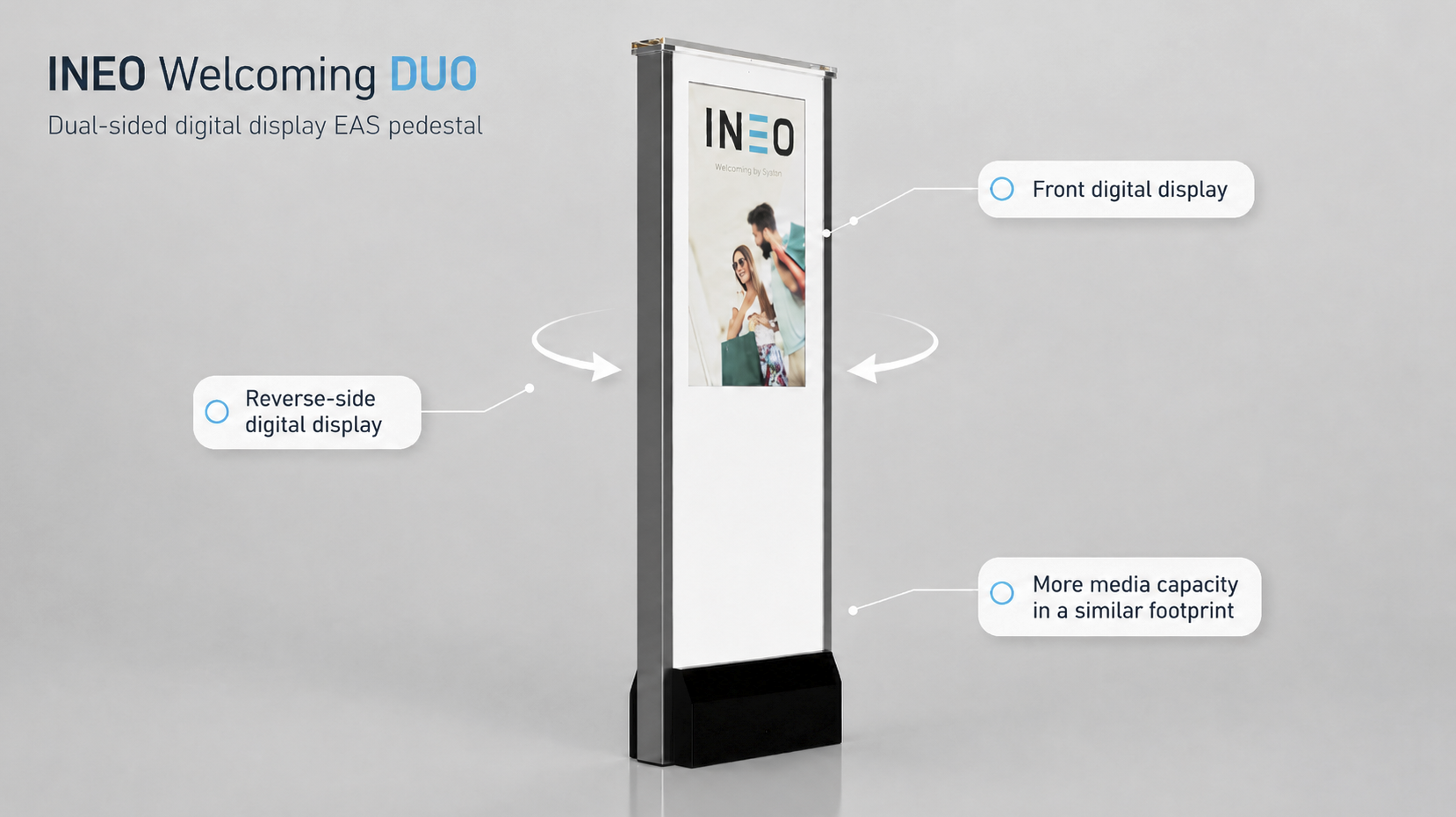
The INEO Welcoming DUO is the Company’s entrance pedestal featuring a digital display screen on both sides. The system combines Electronic Article Surveillance ("EAS") detection capability, dual-sided digital media display and platform connectivity in a format designed to increase media capacity while maintaining a footprint similar to traditional loss prevention entrance systems.
Management believes the DUO is an important extension of INEO’s product offering. By providing retailers with digital display inventory on both sides of the pedestal from substantially the same entrance footprint, the DUO is designed to create additional media capacity and increase the utility of the store entrance. Management also believes this may support broader deployment opportunities for INEO’s subscription-based platform and connectivity services as retailers look to derive more value from entrance infrastructure.
The system is also designed to meet or exceed the detection range of most standard EAS systems. Management believes this reflects INEO’s engineering capability in integrating theft protection, digital display and industrial design in a system configuration which many in the industry had viewed as difficult to achieve.
"The Welcoming DUO shows that retailers do not have to choose between detection performance, aesthetics and media capacity," said Kyle Hall, CEO of INEO. "We believe they can have all three in a system designed for a real retail environment."
Like INEO’s other connected systems, the Welcoming DUO is supported by the Company’s subscription-based INEO Connectivity Package. The Connectivity Package includes Dashboard access, continuous system health monitoring, remote maintenance and support tools, software and security updates, reporting, user administration and media management and integration functionality intended to support the ongoing operation of the installed system while providing retail media revenue to the retailer.
The Company expects to provide further updates as additional product, customer and partner milestones are reached.
INEO Tech Corp.
Per: "Kyle Hall" Kyle Hall, Chief Executive Officer and Director
About INEO Tech Corp. (TSX-V:INEO)(OTCQB:INEOF)
INEO Tech Corp. builds technology at the intersection of in-store retail media and loss prevention. INEO’s patented integration of Electronic Article Surveillance (EAS) pedestals with digital displays helps retailers reduce theft while generating incremental retail media revenue from the same footprint. INEO is headquartered in Surrey, British Columbia, Canada, and is publicly traded on the TSX Venture Exchange (INEO) and the OTCQB (INEOF).
About Sensormatic Solutions Sensormatic Solutions, the leading global retail solutions portfolio of Johnson Controls, powers safe, secure and seamless retail experiences. For more than 60 years, the brand has been at the forefront of the industry’s fast-moving technology adoption, redefining retail operations on a global scale and turning insights into actions. Sensormatic Solutions delivers an interconnected ecosystem of loss prevention, inventory intelligence and traffic insight solutions, along with our services and partners to enable retailers worldwide to innovate and elevate with precision, connecting data-driven outcomes that shape retail’s future. Please visit Sensormatic Solutions or follow us on LinkedIn, X, and our YouTube channel.
Forward-Looking Statements
This news release contains forward-looking information, which involves known and unknown risks, uncertainties and other factors that may cause actual events to differ materially from current expectations. Important factors – including the availability of funds, acceptance of the Company’s products, competition, and general market conditions – that could cause actual results to differ materially from the Company’s expectations are disclosed in the Company’s documents filed on SEDAR, including the MD&A for the year ended June 30, 2025. Readers are cautioned not to place undue reliance on these forward-looking statements, which speak only as of the date of this press release. The Company disclaims any intention or obligation, except to the extent required by law, to update or revise any forward-looking statements, whether as a result of new information, future events or otherwise.
Neither the TSX Venture Exchange nor its Regulation Services Provider (as that term is defined in policies of the TSX Venture Exchange) accepts responsibility for the adequacy or accuracy of this release.
Cannes Hit Record Numbers. The Industry Showed Up Divided.
The world's biggest film market is booming, but AI protests, geopolitical friction, and a World Cup ad mess tell a more complicated story.
By
Mediabistro Team
5 min read • Published May 13, 2026
By
Mediabistro Team
5 min read • Published May 13, 2026
The Cannes Film Market closed registration for 2026 with 16,000 participants from more than 140 countries. Highest attendance in the market’s history.
Among the 40,000 industry professionals on the Croisette, the growth is most striking in Japan, which has emerged as a serious force in international film financing and acquisition. Variety’s full breakdown shows the U.S., France, and the UK holding their positions at the top, but Japan’s surge signals a geographical shift in where film investment capital is concentrating.
Record numbers suggest an industry in rude health. But on the same ground where those 16,000 participants are making deals, the Empty Red Carpet protest against generative AI has celebrities like Anya Taylor-Joy and Pedro Pascal conspicuously absent from the festival’s most iconic photo ops, replaced by visual voids that land harder than any picket line.
The festival is booming and fractured at the same time. That’s the film industry in 2026.
Three threads run through this year’s market: what the record numbers actually mean, what kinds of projects are finding commercial pathways, and how AI tensions on the Palais steps are manifesting in advertising’s biggest live test, the World Cup.
The Market Metrics Tell Two Stories
The 16,000 figure is real. Deadline’s attendance coverage notes this comes against what organizers are openly calling a “complex geopolitical backdrop,” which is festival-speak for trade tensions, content regulation disputes, and shifting alliances that make international co-productions harder than they were five years ago.
Japan’s growth matters because Japanese buyers and financiers are increasingly backing projects with international appeal rather than staying within domestic genre lanes. That changes the math for producers hunting gap financing or pre-sales.
While deal-makers fill the Palais, the Empty Red Carpet protest documented by Creative Bloq uses the festival’s most visible real estate to argue that generative AI represents an existential threat to creative labor. Photographers shoot empty staircases instead of A-listers. It works precisely because Cannes runs on images.
The Tension: Generative AI tools are already in use for pre-visualization, script coverage, and marketing asset creation by some of the same companies sending executives to Cannes to buy films made by human directors, writers, and crews. The record attendance and the AI protest aren’t contradictory. They’re two halves of an industry that hasn’t reconciled its economic imperatives with its cultural anxieties.
What’s Selling: Indies Find Traction
Past the protests and the participation metrics, the practical question: what’s actually finding buyers?
The Mise En Scene Company picked up world sales rights to “Dope Queens”, a feature from writer-director Grafton Doyle produced by Julio Lopez Velasquez. Classic Cannes sales trajectory: a completed or near-completed film secures representation, gets market screenings, and starts building a distribution footprint territory by territory. MSC actively acquiring signals confidence that buyer demand exists for mid-budget English-language projects with genre appeal.
On the prestige side, Sara Ishaq’s “The Station” is premiering in Critics’ Week, the sidebar that has launched directors who go on to competition slots in later years. Ishaq, whose documentary short “Karama Has No Walls” earned an Academy Award nomination, describes the film as revealing “the colors, the frankincense, the laughter and the singing” behind closed doors in a culture outsiders rarely see with nuance.
Different strategies, same thread: both are using Cannes as a launchpad into a fragmented distribution landscape. Independent producers and sales agents are betting that certain stories will find audiences through the festival-to-platform-to-theatrical hybrid model that has replaced the old indie playbook.
The World Cup Ad Cycle Is AI’s Biggest Live Test
If Cannes is where AI meets the film industry on the red carpet, the World Cup is where it meets advertising in the living room. The 2026 tournament has become a live laboratory for how audiences respond to AI-generated creative at massive scale.
Campaigns feature everyone from Lionel Messi to Timothée Chalamet to a digitally resurrected David Beckham. The AI Beckham spot is the most instructive case: brands are using generative tools to create versions of celebrities for markets where those celebrities don’t speak the language or wouldn’t naturally appear. Execution quality varies wildly.
The Pattern: AI-generated elements work when deployed as production tools within a human-led creative framework. They fail conspicuously when asked to carry conceptual weight. The best spots used AI for technical tasks like language dubbing or background compositing. The worst used it as a substitute for creative direction, resulting in work that feels algorithmically assembled rather than strategically crafted.
This matters beyond the tournament. Advertising is the industry where generative AI is being deployed fastest and with the highest financial stakes. Agencies are under pressure to cut production costs while maintaining creative output. But if audiences can spot AI-generated work and respond negatively, the cost savings are offset by reduced campaign effectiveness. The World Cup, with its global reach and intense real-time scrutiny, is producing data points that will shape how brands deploy AI creative for years.
The connection back to Cannes is direct. The Empty Red Carpet protest and the World Cup ad cycle are two expressions of the same underlying question: where does the line fall between AI as a production tool and AI as a replacement for human creative judgment?
What This Means
Cannes 2026 is an industry growing and splintering simultaneously. Japan’s emergence changes the geography of film finance in ways that will create openings for producers who know how to structure international co-productions. The deals on the Croisette will populate streaming platforms and arthouse theaters over the next 18 months.
The AI protest isn’t fringe. High-profile talent is saying the industry’s rush to adopt generative tools is happening without sufficient thought about long-term consequences for creative workers. The World Cup ad cycle is producing evidence that audiences can tell the difference between human-crafted and AI-generated creative.
For media professionals: watch where the money goes next. If Japan’s Cannes presence translates into a wave of co-productions with Japanese financing, that creates opportunities for producers, sales agents, and distribution executives who can navigate those relationships. If World Cup ad data shows AI creative underperforms, agencies will adjust their tooling strategies accordingly.
If you’re looking to move into film production, international sales, or advertising strategy, browse open roles on Mediabistro to see where demand is concentrating. If you’re hiring for positions that require navigating the tension between commercial imperatives and creative integrity, post a job on Mediabistro to reach candidates who understand the landscape.
Cannes doesn’t resolve these tensions. It just makes them visible at higher resolution.
This media news roundup is automatically curated to keep our community up to date on interesting happenings in the creative, media, and publishing professions. It may contain factual errors and should be read for general and informational purposes only. Please refer to the original source of each news item for specific inquiries.
Dolphin Entertainment Reports First Quarter 2026 Results
By
Media News
9 min read • Published May 12, 2026
By
Media News
9 min read • Published May 12, 2026
Q1’26 Revenue Rises 5.2% YoY to $12.8M
Reiterates Expectations for Continued Revenue Growth, Significant Free Cash Flow Generation, and Adjusted EBITDA Margin Expansion in 2026
MIAMI, FL / ACCESS Newswire / May 12, 2026 / Dolphin (NASDAQ:DLPN), a leading entertainment marketing and premium content production company, today announced its financial results for the first quarter ended March 31, 2026.
Bill O’Dowd, CEO of Dolphin, commented:
"While the first quarter is historically our lightest due to normal business seasonality, we are pleased to report continued top-line growth, with total revenue increasing 5.2% year over year to $12.8 million. Furthermore, we reduced our Adjusted EBITDA loss by 25% year-over-year. We emphasize Adjusted EBITDA because, given our significant non-cash amortization expenses and minimal capital expenditures, it is a much more accurate reflection of our true cash flow potential than operating income.
As noted in our prior quarter’s remarks, following several years of acquisitions and growth-related investment, Dolphin is now well positioned to realize the benefits of that work. We continue to operate in highly attractive sectors, and with rising profitability, modest capex requirements, and $127 million in NOL carryforwards, we remain confident in our ability to generate meaningful free cash flow in the periods ahead. Finally, with insiders holding a substantial stake in the company, management remains deeply aligned with shareholders in the pursuit of long-term value.
Looking ahead, we are excited about the rest of 2026, 2027, and beyond. In addition to organic improvements in our existing business, there are readily identifiable catalysts that should increase earnings even more. We are making progress with our DealMaker partnership, and we just announced a publishing imprint venture with Copper Books and Simon & Schuster that allows us to offer premium book publishing services to our clients with no upfront capital required from Dolphin. We would also remind investors that our bank debt matures in less than two and a half years, which will free up nearly $2.2 million in annual principal and interest payments. Looking a bit further out, we continue to anticipate roughly $1 million in annualized lease savings once our large New York City and Los Angeles leases expire in the second half of 2027. Given our NOLs, which substantially shield us from cash taxes, the bulk of these combined savings should flow directly to the bottom line, providing a further tailwind to free cash flow".
Q1 2026 and Recent Highlights
Total revenue for the three months ended March 31, 2026, was $12.8 million, an increase of 5.2% from $12.2 million last year.
Operating loss was $2.1 million for the three months ended March 31, 2026, compared to an operating loss of $1.8 million for the three months ended March 31, 2025.
Operating expenses for Q1 2026 were $14.9 million, including non-cash expenses of $0.5 million related to depreciation and amortization, a one-time non-recurring distribution guarantee of $0.7 million and legal and professional fees higher than usual due to litigation costs of approximately $0.2 million. This compares to operating expenses of $13.9 million in Q1 2025, including depreciation and amortization of $0.6 million and acquisition costs of approximately $0.4 million.
Net loss for Q1 2026 was $2.7 million as compared to a net loss of $2.3 million for Q1 2025.
Basic and diluted loss per share for Q1 2026 was $(0.22) based on 12,327,974 weighted average shares outstanding compared to basic and diluted loss per share in Q1 2025 of $(0.21) based on 11,162,026 weighted average shares outstanding.
Adjusted EBITDA loss for Q1 2026 of approximately $(467,000) improved by 25% compared to approximately $(625,000) in Q1 2025.
Dolphin
Subsidiary clients shaped the Summer 2026 season with culture-defining festivals and events
CEO was featured on Variety’s "Strictly Business" podcast and discussed the creator economy’s transformation of marketing and consumer product launches
Expanded Miami footprint to support continued growth across subsidiaries
Partnered with DealMaker to unlock community capital for celebrity and influencer brands
Powerhouse subsidiaries led major brand activations during Super Bowl LX
42West
Drove global film publicity at CinemaCon 2026
Delivered marquee talent and a standout film slate at the 2026 SXSW Festival, featuring a company-record 16 world premiere titles and three audience award-winners
Celebrated an Oscar win as "Mr. Nobody Against Putin" took Best Documentary Feature at the 98th Academy Awards
Clients presented, performed, and took home honors at the 2026 GRAMMY Awards (in partnership with Shore Fire Media)
Landed six nominations for clients at the 98th Academy Awards
Brought exciting and diverse projects to the 2026 Sundance Film Festival
Shore Fire Media
Client and Afrobeat pioneer Fela Kuti became the first African solo artist to be inducted into the Rock & Roll Hall of Fame
Clients earned 9 nominations for Independent Music’s top awards
Partnered with The Door on the launch of Pawn Shop, a new sports-driven hospitality concept
Clients presented, performed, and took home honors at the 2026 GRAMMY Awards (in partnership with 42West)
The Door
Partnered with Shore Fire Media on the launch of Pawn Shop, a new sports-driven hospitality concept
Launched a Miami hub, expanding Dolphin’s South Florida presence
DISRPT Agency, a division of The Door, powered "Art of Glam" during Oscars week, driving cultural momentum into Camille Rose’s upcoming Beauté Noir
Elle Communications
Client Harbor Fund announced Sundance Mountain Resort as the new long-term home of Harbor Film Forum
The Digital Dept.
Signed reality TV show stars, top beauty creators, and more
Youngblood
As hockey had a Hollywood moment, Dolphin’s adaptation of the cult classic Youngblood premiered in Los Angeles
Partnered with Vaneast Pictures to bring the sports drama Youngblood to Berlin for international sales
Official trailer and key art were released for Hubert Davis’ adaptation of the hockey classic "Youngblood"
Conference Call Information
To participate in this event, dial in approximately 5 to 10 minutes before the beginning of the call.
This press release contains ‘forward-looking statements’ within the meaning of the Private Securities Litigation Reform Act. These forward-looking statements may address, among other things, Dolphin Entertainment Inc.’s offering of common stock as well as expected financial and operational results and the related assumptions underlying its expected results. These forward-looking statements are distinguished by the use of words such as "will," "would," "anticipate," "expect," "believe," "designed," "plan," or "intend," the negative of these terms, and similar references to future periods. These views involve risks and uncertainties that are difficult to predict and, accordingly, Dolphin Entertainment’s actual results may differ materially from the results discussed in its forward-looking statements. Dolphin Entertainment’s forward-looking statements contained herein speak only as of the date of this press release. Factors or events Dolphin Entertainment cannot predict, including those described in the risk factors contained in its filings with the Securities and Exchange Commission, may cause its actual results to differ from those expressed in forward-looking statements. Although Dolphin Entertainment believes the expectations reflected in such forward-looking statements are based on reasonable assumptions, it can give no assurance that its expectations will be achieved, and Dolphin Entertainment undertakes no obligation to update publicly any forward-looking statements as a result of new information, future events, or otherwise, except as required by applicable law.
Dolphin (NASDAQ:DLPN) is where cultural creation meets marketing execution. Founded in 1996 by Bill O’Dowd, Dolphin operates as both a venture studio-developing and investing in breakthrough content, products, and experiences-and a marketing consortium, featuring leading agencies across every communications discipline.
At its core, the venture studio creates, produces, finances, markets, and promotes new businesses and cultural ideas – ranging from acclaimed film, television, and digital content to consumer goods, live events and partnerships that define entertainment and lifestyle. Surrounding this entrepreneurial engine, Dolphin’s marketing prowess brings together best-in-class firms including 42West, The Door, Shore Fire Media, Elle Communications, Special Projects and The Digital Dept. Together, this collective delivers unmatched cross-marketing expertise and relationships across every vertical of pop culture – from film, television, music, influencers, sports, hospitality, and fashion to consumer brands and purpose-driven initiatives. Dolphin marketing has been the recipient of many accolades, including #1 Agency of the Year on the Observer PR Power List in 2025, The PR Net 100, and the PR News Elite 120.
DOLPHIN ENTERTAINMENT, INC. AND SUBSIDIARIES CONDENSED CONSOLIDATED BALANCE SHEETS (Unaudited)
March 31, 2026
December 31, 2025
ASSETS
Current
Cash and cash equivalents
$
6,283,857
$
8,756,585
Restricted cash
925,004
925,004
Accounts receivable:
Trade, net of allowance of $449,279 and $1,327,808, respectively
6,952,004
7,848,970
Other receivables
4,384,663
5,243,931
Other current assets
1,201,594
1,179,498
Total current assets
19,747,122
23,953,988
Capitalized production costs, net
542,305
520,338
Employee receivable
1,228,085
1,196,085
Right-of-use assets
2,630,279
3,012,941
Goodwill
21,507,944
21,507,944
Intangible assets, net
7,375,731
7,898,607
Property, equipment and leasehold improvements, net
38,410
50,961
Other long-term assets
198,296
189,296
Total Assets
$
53,268,172
$
58,330,160
LIABILITIES
Current
Accounts payable
$
2,415,858
$
3,096,715
Term loans, current portion
1,852,548
1,813,760
Revolving line of credit
400,000
400,000
Notes payable, current portion
3,500,000
3,500,000
Convertible notes payable, current portion
1,550,000
1,250,000
Accrued interest – related party
2,163,116
2,043,087
Accrued compensation – related party
2,625,000
2,625,000
Lease liabilities, current portion
1,671,364
1,912,482
Deferred revenue
953,969
794,177
Other current liabilities
10,010,068
11,096,820
Total current liabilities
27,141,923
28,532,041
Noncurrent
Term loans, noncurrent portion
2,502,601
2,976,930
Notes payable, noncurrent portion
4,580,000
4,580,000
Convertible notes payable
5,900,000
6,460,000
Convertible notes payable- related party
2,839,556
2,904,357
Convertible notes payable at fair value
260,000
270,000
Loans from related party
983,112
983,112
Lease liabilities
1,271,028
1,469,386
Deferred tax liability
481,561
463,909
Total Liabilities
45,959,781
48,639,735
STOCKHOLDERS’ EQUITY
Preferred Stock, Series C, $0.001 par value, 50,000 shares authorized, 50,000 shares issued and outstanding at March 31, 2026 and December 31, 2025
1,000
1,000
Common stock, $0.015 par value, 200,000,000 shares authorized, 12,513,104 and 12,221,432 shares issued and outstanding at March 31, 2026 and December 31, 2025, respectively
187,697
183,321
Additional paid-in capital
159,114,925
158,809,301
Accumulated deficit
(151,995,231
)
(149,303,197
)
Total Stockholders’ Equity
7,308,391
9,690,425
Total Liabilities and Stockholders’ Equity
$
53,268,172
$
58,330,160
DOLPHIN ENTERTAINMENT, INC. AND SUBSIDIARIES CONDENSED CONSOLIDATED STATEMENTS OF OPERATIONS (unaudited)
Three Months Ended
March 31,
2026
2025
Revenues
$
12,803,937
$
12,169,711
Expenses:
Direct costs
784,650
344,414
Payroll and benefits
10,715,144
10,304,233
Selling, general and administrative
2,047,161
1,772,444
Depreciation and amortization
537,276
591,552
Acquisition cost
–
416,171
Legal and professional
856,138
514,424
Total expenses
14,940,369
13,943,238
Loss from operations
(2,136,432
)
(1,773,527
)
Other (expenses) income:
Change in fair value of convertible note
10,000
20,000
Interest expense, net
(547,950
)
(554,013
)
Total other (expenses) income, net
(537,950
)
(534,013
)
Loss before income taxes
(2,674,382
)
(2,307,540
)
Income tax expense
(17,652
)
(21,522
)
Net loss
$
(2,692,034
)
$
(2,329,062
)
Loss per share:
Basic
$
(0.22
)
$
(0.21
)
Diluted
$
(0.22
)
$
(0.21
)
Weighted average number of shares outstanding:
Basic
12,327,974
11,162,026
Diluted
12,327,974
11,162,026
Use of Non-GAAP Financial Measures
In order to provide greater transparency regarding our operating performance, the financial results in this press release refer to a non-GAAP financial measure that involves adjustments to GAAP results. Non-GAAP financial measures exclude certain income and/or expense items that management deems are not directly attributable to the Company’s core operating results and/or certain items that are inconsistent in amounts and frequency, making it difficult to perform a meaningful evaluation of our current or past operating performance.
Adjusted earnings before interest, taxes, depreciation and amortization ("Adjusted EBITDA") is defined by Dolphin as net (loss) or income adjusted for (i) interest, (ii) taxes, (iii) depreciation and amortization, (iv) acquisition costs, (v) change in fair value of convertible note, (vi) allowance for credit losses, (vii) litigation costs; (viii) other one-time or non-cash costs.
Management believes that the presentation of operating results using this non-GAAP financial measure provides useful supplemental information for investors by providing them with the non-GAAP financial measure used by management for financial and operational decision making, planning and forecasting and in managing the business. This non-GAAP financial measure does not replace the presentation of financial information in accordance with U.S. GAAP. These non-GAAP financial results should not be considered a measure of liquidity and is unlikely to be comparable to non-GAAP financial measures provided by other companies.
Reconciliation of GAAP net loss to non-GAAP Adjusted EBITDA loss
Climate change is driving rising temperatures and more record heat. The Earth’s temperature has climbed each decade since 1880 by about .14 degrees Fahrenheit, or roughly 2 degrees Fahrenheit total.
Stacker compiled a ranking of the hottest Mays in New York since 1895 using data from the National Centers for Environmental Information. Rankings are based on the highest average temperature in each month. For each of the hottest months listed below, we’ve included the average state temperature, state-wide highs and lows for the month, and the total precipitation.
#9. May 1975 (tie) – Average temperature: 59.6°F – Monthly high temperature: 72.2°F – Monthly low temperature: 47°F – Total precipitation: 3.15″
#9. May 1896 (tie) – Average temperature: 59.6°F – Monthly high temperature: 71°F – Monthly low temperature: 48.1°F – Total precipitation: 2.54″
#6. May 2024 (tie) – Average temperature: 60°F – Monthly high temperature: 70.9°F – Monthly low temperature: 49.2°F – Total precipitation: 3.53″
#6. May 2018 (tie) – Average temperature: 60°F – Monthly high temperature: 72.3°F – Monthly low temperature: 47.8°F – Total precipitation: 2.76″
#6. May 1991 (tie) – Average temperature: 60°F – Monthly high temperature: 72.2°F – Monthly low temperature: 47.8°F – Total precipitation: 3.21″
#5. May 1998 – Average temperature: 60.4°F – Monthly high temperature: 72°F – Monthly low temperature: 48.8°F – Total precipitation: 3.59″
#3. May 2012 (tie) – Average temperature: 60.5°F – Monthly high temperature: 72°F – Monthly low temperature: 49°F – Total precipitation: 4.12″
#3. May 1944 (tie) – Average temperature: 60.5°F – Monthly high temperature: 73.4°F – Monthly low temperature: 47.6°F – Total precipitation: 2.93″
#2. May 2015 – Average temperature: 61°F – Monthly high temperature: 74.2°F – Monthly low temperature: 47.8°F – Total precipitation: 2.75″
#1. May 1911 – Average temperature: 61.3°F – Monthly high temperature: 74.6°F – Monthly low temperature: 48°F – Total precipitation: 2.44″
Climate change is driving rising temperatures and more record heat. The Earth’s temperature has climbed each decade since 1880 by about .14 degrees Fahrenheit, or roughly 2 degrees Fahrenheit total.
Stacker compiled a ranking of the hottest Mays in California since 1895 using data from the National Centers for Environmental Information. Rankings are based on the highest average temperature in each month. For each of the hottest months listed below, we’ve included the average state temperature, state-wide highs and lows for the month, and the total precipitation.
#9. May 2020 (tie) – Average temperature: 64.6°F – Monthly high temperature: 78.4°F – Monthly low temperature: 50.9°F – Total precipitation: 1.2″
#9. May 2014 (tie) – Average temperature: 64.6°F – Monthly high temperature: 78.8°F – Monthly low temperature: 50.5°F – Total precipitation: 0.35″
#9. May 2006 (tie) – Average temperature: 64.6°F – Monthly high temperature: 78.5°F – Monthly low temperature: 50.7°F – Total precipitation: 0.73″
#9. May 1940 (tie) – Average temperature: 64.6°F – Monthly high temperature: 78.8°F – Monthly low temperature: 50.4°F – Total precipitation: 0.68″
#8. May 1924 – Average temperature: 64.9°F – Monthly high temperature: 80.2°F – Monthly low temperature: 49.5°F – Total precipitation: 0.07″
#7. May 1947 – Average temperature: 65°F – Monthly high temperature: 79.5°F – Monthly low temperature: 50.5°F – Total precipitation: 0.48″
#6. May 1984 – Average temperature: 65.3°F – Monthly high temperature: 79.8°F – Monthly low temperature: 50.7°F – Total precipitation: 0.39″
#5. May 1931 – Average temperature: 65.5°F – Monthly high temperature: 79.8°F – Monthly low temperature: 51.2°F – Total precipitation: 0.96″
#4. May 2009 – Average temperature: 66.7°F – Monthly high temperature: 80.6°F – Monthly low temperature: 52.7°F – Total precipitation: 1.24″
#3. May 1992 – Average temperature: 67°F – Monthly high temperature: 80.9°F – Monthly low temperature: 53°F – Total precipitation: 0.23″
#2. May 1997 – Average temperature: 67.6°F – Monthly high temperature: 81.8°F – Monthly low temperature: 53.3°F – Total precipitation: 0.38″
#1. May 2001 – Average temperature: 68.6°F – Monthly high temperature: 83.8°F – Monthly low temperature: 53.3°F – Total precipitation: 0.15″
Fire Help Center Releases Wildfire Preparedness Guide Specifically for Seniors and Caregivers as Early 2026 Fire Activity Signals Dangerous Season Ahead
By
Media News
2 min read • Published May 12, 2026
By
Media News
2 min read • Published May 12, 2026
New resource addresses the unique evacuation and health challenges facing older adults as wildfires burn across California and Colorado.
CHESTNUT HILL, MA / ACCESS Newswire / May 12, 2026 / With wildfires already burning across multiple states weeks before the traditional peak of fire season, Fire Help Center today announced the launch of a comprehensive wildfire preparedness guide tailored for seniors and their caregivers.
The release comes as communities across the country are confronting an early and active start to 2026 fire activity. In California, hundreds of wildfires have already burned thousands of acres this year, with the Springs Fire in Riverside County triggering widespread mandatory evacuations earlier this month.
In Colorado, firefighters responded to multiple wildfires near Boulder in a single week, while county officials in Summit County issued stark warnings that an intense fire season is now a matter of "when, not if."
With May designated as Wildfire Awareness Month in California, Fire Help Center urges families with elderly loved ones to review their preparedness plans now – before fire conditions worsen.
"When evacuation orders come down, older adults and their caregivers face obstacles that many families aren’t prepared for," said Ricky LeBlanc, managing attorney of Sokolove Law. "Mobility limitations, medical equipment, cognitive conditions, and medications all require advance planning. Families often don’t have the time to figure that out in the middle of a crisis."
Pre-season planning, including how to build personalized evacuation routes accounting for mobility and transportation needs
Medication and medical equipment continuity, including steps for securing emergency prescription refills and backup power for devices like oxygen concentrators and CPAP machines
Building a senior-specific go-bag with respiratory protection, medical documentation, and assistive devices
Wildfire smoke safety for older adults, who face an elevated risk of cardiovascular and respiratory complications from PM2.5 exposure
Caregiver responsibilities during an active evacuation, including guidance for seniors with dementia or other cognitive conditions
Safe return home after a wildfire, including structural and air quality hazards specific to older adults
Beyond preparedness, Fire Help Center also helps wildfire survivors understand their legal options. Families who have suffered property damage or personal injury due to a wildfire may be entitled to compensation and can request a free, no-obligation case review at firehelpcenter.com.
About Fire Help Center: Fire Help Center provides resources and support for wildfire victims across the United States, including educational guides, legal information, and free case reviews for those impacted by wildfires. For more information, call (866) 866-0753 or visit firehelpcenter.com.
Registration Now Open for The ASSEMBLY Show 2026, Co-Located With The Quality Show and SMTA International
By
Media News
4 min read • Published May 12, 2026
By
Media News
4 min read • Published May 12, 2026
Three Industry-Leading Events Return Oct. 27-29 in Rosemont, Bringing Together the Best in Manufacturing, Quality and Electronics Assembly
ROSEMONT, IL / ACCESS Newswire / May 12, 2026 / Registration is now open for The ASSEMBLY Show 2026, returning Oct. 27-29, 2026, to the Donald E. Stephens Convention Center in Rosemont, Illinois. For the 14th year, The ASSEMBLY Show will once again be co-located with The Quality Show and SMTA International, creating one of the industry’s most comprehensive events for manufacturing, quality, and electronics assembly professionals.
Produced by BNP Media, The ASSEMBLY Show is the premier event for manufacturing engineers, operations leaders, and production professionals seeking the latest technologies, equipment, and strategies to improve assembly processes, streamline operations, and enhance plant performance. By bringing together The ASSEMBLY Show, The Quality Show, and SMTA International under one roof, attendees gain access to a broader cross-section of manufacturing innovation spanning automation and robotics, quality testing, electronics production, and process improvement.
Together, the three co-located events offer unmatched opportunities to explore emerging technologies, gain practical insights, and connect with peers and suppliers across the full manufacturing ecosystem.
"The ASSEMBLY Show continues to be the go-to event for professionals focused on improving manufacturing efficiency, advancing automation, and solving real-world production challenges," said Bill DeYoe, Executive Director, Manufacturing Technologies, BNP Media. "By bringing together The ASSEMBLY Show, The Quality Show, and SMTA International under one roof, we are creating an even more valuable experience for attendees looking for ideas, technologies, and partnerships that can improve performance across every stage of production."
The combined event will feature hundreds of exhibitors showcasing the latest equipment, tools, and technologies in:
Assembly automation and robotics
Quality inspection and testing
Electronics manufacturing and SMT
Adhesives, dispensing, and fastening
Motion control and industrial software
AI, digital transformation, and smart manufacturing
Process improvement and plant optimization
In addition to a robust show floor, attendees will have access to multiple educational opportunities designed to deliver practical, actionable takeaways. The conference program will feature expert-led sessions, workshops, and case studies covering the latest trends in assembly, quality, automation, and electronics manufacturing. Topics will include workforce development, AI in manufacturing, advanced inspection systems, smart factory implementation, and continuous improvement strategies.
Located on the show floor, the Learning Theater will once again feature a full schedule of complimentary 30-minute presentations led by industry experts and exhibiting companies. New for 2026, attendees can also take part in concise, high-impact 15-minute educational sessions presented in two dedicated Learning HUBS focused on emerging technologies, automation, and process improvement. In addition, the exhibit hall will feature live equipment demonstrations, networking events, and opportunities to connect directly with engineers, plant managers, systems integrators, and suppliers from across the manufacturing sector. The ASSEMBLY Show 2026 is supported by Gold Sponsor Promess, Silver Sponsor Ujigami, and Bronze Sponsor Du-Pas Torq-Tec.
Call for speakers is now open for The ASSEMBLY Show and The Quality Show. Manufacturing engineers, designers, and technology experts are invited to submit proposals to share real-world insights, innovative applications, and practical strategies shaping the future of assembly and quality manufacturing. Speaker proposals are being accepted through May 21, 2026, at https://www.assemblymag.com/the-assembly-show/call-for-presentations?utm_campaign=EVTAS26&utm_medium=pr&utm_source=regopen.
The ASSEMBLY Show is the leading trade event and conference for assembly technology, equipment, and products in the United States. Produced by BNP Media, the event brings together suppliers, buyers, and industry experts to connect, learn, and explore the latest innovations in manufacturing assembly. The ASSEMBLY Show is sponsored by ASSEMBLY, the leading brand covering the processes, technologies, and strategies for assembling discrete parts into finished products.
About The Quality Show
Produced by Quality Magazine, The Quality Show connects manufacturing professionals with process improvement vendors and cutting-edge quality assurance solutions. The event focuses on metrology, inspection, compliance, and process control technologies that help manufacturers improve product quality and operational efficiency. ASQ will also have a dedicated presence on the show floor, offering a series of short, practical presentations throughout exhibit hall hours focused on standards, certification, and real-world process improvement strategies.
About SMTA International
SMTA International is a leading event for electronics manufacturing professionals focused on surface mount technology, advanced packaging, and electronics assembly. The event brings together engineers, technologists, and suppliers from across the global electronics manufacturing industry.
Dolphin Launches Publishing Imprint in Partnership With Copper Books
By
Media News
3 min read • Published May 12, 2026
By
Media News
3 min read • Published May 12, 2026
New Imprint Gives Dolphin Clients a Direct Path from Idea to Bookshelf, and from Bookshelf to Screen, with Retail Distribution Through Simon & Schuster
MIAMI, FL / ACCESS Newswire / May 12, 2026 / Dolphin (Nasdaq:DLPN), a leading entertainment marketing and content production company, today announced the launch of a new publishing imprint created in partnership with Copper Books and exclusively available to Dolphin clients. Books published under this partnership will be distributed nationally through Simon & Schuster.
For the first time, the artists, athletes, founders, creators, and cultural voices represented across Dolphin’s family of agencies have a direct, end-to-end path from idea to bookshelf, whether that story is a memoir, a novel, a thought leadership title, a cookbook, or a children’s book. Through the partnership with Copper Books, Dolphin can now offer clients a true publishing pathway: editorial development, design-forward production, and retail distribution through Simon & Schuster, all under one roof.
Publishing is not a new world for Dolphin. 42West, The Door, Shore Fire Media, Elle Communications, Special Projects, and The Digital Dept. have spent decades building book launches, managing author tours, and turning publication days into cultural moments. They represent and amplify many of today’s most prominent authors – from bestselling novelists and memoirists to thought leaders, journalists, chefs, and athletes whose books shape the cultural conversation. The same clients Dolphin champions at launch can now, when they choose, bring their book into being with Dolphin from the very first page.
"Our agencies have spent years being the team behind some of publishing’s most celebrated launches. What we’re excited by now is the ability to be there from page one. With this partnership, we can walk alongside our clients through the entire journey. From the seed of an idea to bookstore shelves nationwide, and, when the story is extraordinary enough, all the way to the screen through our production and development division," said Bill O’Dowd, CEO of Dolphin.
"At Copper, we built something for people who are ready to say something meaningful and build something that lasts. Dolphin’s clients are exactly the voices we created this for. With the full strength of Dolphin’s creative and PR infrastructure behind every launch, this partnership gives those authors the intimacy and craft of a boutique publisher and the reach of a major," said Allison Trowbridge, Founder & CEO of Copper Books.
The partnership was announced at the Copper Books Book Fair in Nashville, where Dolphin served as a presenting sponsor.
About Dolphin Dolphin (NASDAQ:DLPN) is where cultural creation meets marketing execution. Founded in 1996 by Bill O’Dowd, Dolphin operates as both a venture studio developing and investing in breakthrough content, products, and experiences and a marketing consortium, featuring leading agencies across every communications discipline.
At its core, the venture studio creates, produces, finances, markets, and promotes new businesses and cultural ideas – ranging from acclaimed film, television, and digital content to consumer goods, live events and partnerships that define entertainment and lifestyle. Surrounding this entrepreneurial engine, Dolphin’s marketing prowess brings together best-in-class firms including 42West, The Door, Shore Fire Media, Elle Communications, Special Projects and The Digital Dept. Together, this collective delivers unmatched cross-marketing expertise and relationships across every vertical of pop culture – from film, television, music, influencers, sports, hospitality, and fashion to consumer brands and purpose-driven initiatives. Dolphin marketing has been the recipient of many accolades, including #1 Agency of the Year on the Observer PR Power List in 2025, The PR Net 100, and the PR News Elite 120.
About Copper Books Copper Books is a publishing company built for thought leaders, creatives, and changemakers who are ready to turn their ideas into enduring books. Founded by author and entrepreneur Allison Trowbridge, Copper combines editorial excellence, design-forward production, and full-service author partnership with retail distribution through Simon & Schuster – bringing world-class publishing to a new generation of impact-driven authors. Copper also operates the Copper Books app, a social platform connecting authors and readers. Learn more at copperbooks.com.
Investor Contact James Carbonara HAYDEN IR (646)-755-7412 james@haydenir.com
Greg Laurie Returns to Angel Stadium to Lead Harvest Crusade on July 11
By
Media News
2 min read • Published May 12, 2026
By
Media News
2 min read • Published May 12, 2026
One-Night Evangelistic Event Returns to Angel Stadium and Features Phil Wickham, Michael W. Smith and More
ANAHEIM, CA / ACCESS Newswire / May 12, 2026 / Pastor and evangelist Greg Laurie returns to Angel Stadium with the Harvest Crusade on Saturday, July 11, 2026, presenting the gospel through a one-night evangelistic event featuring live worship from Phil Wickham, Michael W. Smith and Kari Jobe Carnes and Cody Carnes.
"We’ve been doing Harvest Crusades for 37 years now, but there’s nothing like the spiritual hunger we’ve seen recently in our nation, especially among young people," said Laurie. "This year’s crusade will include moments that honor our nation and recognize 250 years of America. The heart of the night remains the same – to proclaim the gospel and invite people to experience the hope only Jesus can give. We believe this is a message our country needs now more than ever."
This year’s Harvest Crusade will also feature partnerships with local churches and major media outlets. The livestream of the whole event will be available at harvest.org, YouTube, Facebook, and on the Harvest+ app, available on all app platforms, allowing viewers worldwide to participate in real time. In addition, translations into multiple languages will be available onsite and via the livestream.
Due to the overwhelming attendance in recent years, ticketing will be implemented in partnership with Angel Stadium to help ensure a safe, family-friendly and welcoming experience for all attendees. Tickets will be distributed through Angel Stadium’s ticketing platform, and admission will remain free. Attendees are encouraged to visit harvest.org for ticket information and updates.
Harvest Crusades are large-scale evangelistic events with a worldwide history spanning the United States, Canada, New Zealand and Australia. Since 1990, more than six million people have attended Harvest Crusades in person, and millions more have participated online. Cumulatively, more than 600,000 individuals have made professions of faith through the Harvest Crusades.
Special Guests: Phil Wickham, Michael W. Smith, Kari Jobe Carnes and Cody Carnes
Admission: Free Admission, Tickets Required
Livestream: Watch the event on harvest.org, Facebook, YouTube, and the Harvest+ app, available on all app platforms
Language Access: The Harvest Crusade will offer translations in multiple languages both onsite and via the livestream.
About Greg Laurie
Greg Laurie is the founder of the Harvest Crusades and senior pastor of Harvest Church, with campuses located in California and Hawaii. He is a renowned evangelist, bestselling author, and the inspiration behind the 2023 film "Jesus Revolution." He leads the Harvest Crusades, large-scale evangelistic events that share the gospel with thousands in stadiums and venues worldwide.
AI/ML Innovations Inc. Announces Closing of Final Tranche of Private Placement to Raise $1,917,500
By
Media News
5 min read • Published May 12, 2026
By
Media News
5 min read • Published May 12, 2026
NOT FOR DISTRIBUTION TO U.S. NEWSWIRE SERVICES OR FOR DISSEMINATION IN THE UNITED STATES OF AMERICA
TORONTO, ON / ACCESS Newswire / May 11, 2026 / AI/ML Innovations Inc. ("AIML" or the "Company") (CSE:AIML)(OTCQB:AIMLF)(FSE:42FB) is pleased to announce that it has closed the second and final tranche of its previously announced non-brokered private placement (the "Offering") pursuant to which the Company has issued convertible debentures ("Debentures") in the aggregate principal amount of $1,917,500. Together with the first tranche closing, the Company has issued Debentures in the aggregate principal amount of $2,867,500.
The Debentures may be converted into units of the Company ("Units") at the option of the holder of the Debentures at any time at a conversion price of $0.05 per Unit, with each Unit being comprised of one common share of the Company (a "Common Share") and one Common Share purchase warrant (a "Warrant"). Subject to the anti-dilution provisions contained in the certificates governing the terms of the Warrants, each whole Warrant shall be exercisable to acquire one Common Share at a price of $0.15 for a period of 36 months from the date of issuance of the Warrants. The Debentures bear interest at a rate of 10% per annum that accrues and is payable on the earlier of maturity or conversion, with accrued/unpaid interest also being convertible into Units under the same terms. The Debentures mature on May 11, 2029. All securities issued and issuable pursuant to the first tranche of the Offering are subject to a statutory hold period expiring on September 12, 2026.
The Offering remains subject to the final approval of the Canadian Securities Exchange.
Insiders of the Company have purchased, directly or indirectly, Debentures in the aggregate principal amount of $340,000 pursuant to the Offering, as a result of which the Offering is a "related party transaction" under Multilateral Instrument 61-101 – Protection of Minority Security Holders in Special Transactions ("MI 61- 101"). The Company is exempt from the formal valuation and minority shareholder approval requirements of MI 61-101 pursuant to the exemptions contained in Sections 5.5(b) and 5.7(1)(a) of MI 61-101 on the basis that the Company is listed on the Canadian Securities Exchange and neither the fair market value (as determined under MI 61-101) of the subject matter of, nor the fair market value of the consideration for, the Offering, insofar as it involves the related parties, exceeded 25% of the Company’s market capitalization (as determined under MI 61-101).
This news release does not constitute an offer to sell or a solicitation of an offer to buy nor shall there be any sale of any of the securities in any jurisdiction in which such offer, solicitation or sale would be unlawful, including any of the securities in the United States of America. The securities described herein have not been and will not be registered under the United States Securities Act of 1933, as amended (the "1933 Act") or any state securities laws and may not be offered or sold within the United States or to, or for account or benefit of, U.S. Persons (as defined in Regulation S under the 1933 Act) unless registered under the 1933 Act and applicable state securities laws, or an exemption from such registration requirements is available.
About AI/ML Innovations Inc.
AIML Innovations Inc. is a global technology company pioneering the use of artificial intelligence and neural networks to transform digital health. Our proprietary platforms leverage advanced signal processing and deep learning to convert complex biometric data into actionable clinical insights – supporting earlier diagnosis, personalized treatment, and more effective care. AIML’s shares trade on the Canadian Securities Exchange (CSE:AIML), the OTCQB Venture Market (AIMLF), and the Frankfurt Stock Exchange (42FB).
For detailed information please see AIML’s website or the Company’s filed documents at www.sedarplus.ca.
For further information, please contact:
Paul Duffy, Executive Chairman and CEO 416-941-8900
Disclaimer for Forward-Looking Information
This news release includes certain statements and information that constitute forward-looking information within the meaning of applicable Canadian securities laws. All statements in this news release, other than statements of historical facts are forward-looking statements. Such forward-looking statements and forward-looking information specifically include, but are not limited to, statements that relate to the proposed completion of any further tranches of the Offering, and the receipt of all applicable regulatory consents in connection therewith.
Statements contained in this release that are not historical facts are forward-looking statements that involve various risks and uncertainty affecting the business of the Company. Such statements can generally, but not always, be identified by words such as "expects", "plans", "anticipates", "intends", "estimates", "forecasts", "schedules", "prepares", "potential" and similar expressions, or that events or conditions "will", "would", "may", "could" or "should" occur. All statements that describe the Company’s plans relating to operations and potential strategic opportunities are forward-looking statements under applicable securities laws. These statements address future events and conditions and are reliant on assumptions made by the Company’s management, and so involve inherent risks and uncertainties, as disclosed in the Company’s periodic filings with Canadian securities regulators. As a result of these risks and uncertainties, and the assumptions underlying the forward-looking information, actual results could materially differ from those currently projected, and there is no representation by the Company that the actual results realized in the future will be the same in whole or in part as those presented herein. The Company disclaims any intent or obligation to update forward-looking statements or information except as required by law. Readers are referred to the additional information regarding the Company’s business contained in the Company’s reports filed with the securities regulatory authorities in Canada. Although the Company has attempted to identify important factors that could cause actual actions, events, or results to differ materially from those described in forward-looking statements, there may be other factors that could cause actions, events or results not to be as anticipated, estimated or intended. For more information on the Company and the risks and challenges of its business, investors should review the Company’s filings that are available at www.sedar.com.
The Company provides no assurance that forward-looking statements and information will prove to be accurate, as actual results and future events could differ materially from those anticipated in such statements or information. Accordingly, readers should not place undue reliance on forward-looking statements or information. The Company does not undertake to update any for-ward looking statements, other than as required by law.
Smart, savvy freelancer in step with social media but not afraid to talk to the people. Quick and dirty or wide in scope, I seek to provide you with...