Euronews Experiences Exponential Growth in Programmatic Ad Revenue With Opti Digital
By
Media News
2 min read • Published September 23, 2025
By
Media News
2 min read • Published September 23, 2025
Euronews achieved significant year-over-year growth in programmatic advertising revenue, following the integration of Opti Digital’s wrapper.
BARCELONA, ES / ACCESS Newswire / September 23, 2025 / Euronews, a global media leader delivering independent news across TV and digital platforms, achieved significant year-over-year growth in programmatic advertising revenue in July 2025, following the integration of Opti Digital’s wrapper.
With direct campaigns at the core of its monetization strategy, Euronews aimed to grow programmatic ad revenue without affecting premium deals. Operating across multiple regions and working with a variety of technical partners, the publisher sought a solution that would simplify ad operations, give greater control over inventory, and maintain a seamless experience for its audience.
Following a competitive Request for Proposal process, Euronews adopted Opti Digital’s wrapper in March 2025. The platform provides a flexible, all-in-one solution designed to enhance ad inventory quality, increase demand, and maximize both profitability and overall site performance. Its lightweight setup has safeguarded Euronews’ SEO strategy, made ads load three times faster year-on-year, and preserved key metrics such as Core Web Vitals.
The results were tangible: programmatic revenue saw substantial growth compared with July 2024, prior to full integration. Real-time analytics on ad density, revenue per pageview, revenue per article, and traffic source empowered Euronews to continuously optimize operations while reconciling audience and ad revenue data.
"Opti Digital has been exactly the partner we needed, far exceeding our expectations. Since implementing their solution, we’ve seen exponential growth in digital revenue, ad yield, inventory quality, user experience, and web performance. The time we’ve saved in ad operations has been a game-changer, allowing our team to focus on strategy and growth instead of day-to-day technical processes," said Tom Roche, VP Digital Commercial Strategy & Revenue Development at Euronews.
"This collaboration with Euronews illustrates how unified platforms are becoming the standard of tomorrow for publishers: they provide full control over ad operations while maximizing revenue, performance, and user experience. We are proud that our solutions deliver these benefits to our partners, while allowing them to retain complete command of their advertising strategy," said Magali Quentel-Reme, CEO of Opti Digital.
By centralizing all ad operations into a single platform, the partnership reduced operational complexity and saved significant time for Euronews’ teams, while sustaining audience satisfaction and supporting long-term growth.
Contact Information
Maëva Caratis PR & Events Manager at Opti Digital maeva@optidigital.com +1 (646) 328-9697
Seni Jaya Expands Advertising Footprint with Strategic Acquisition of Ganad Media
By
Media News
3 min read • Published September 23, 2025
By
Media News
3 min read • Published September 23, 2025
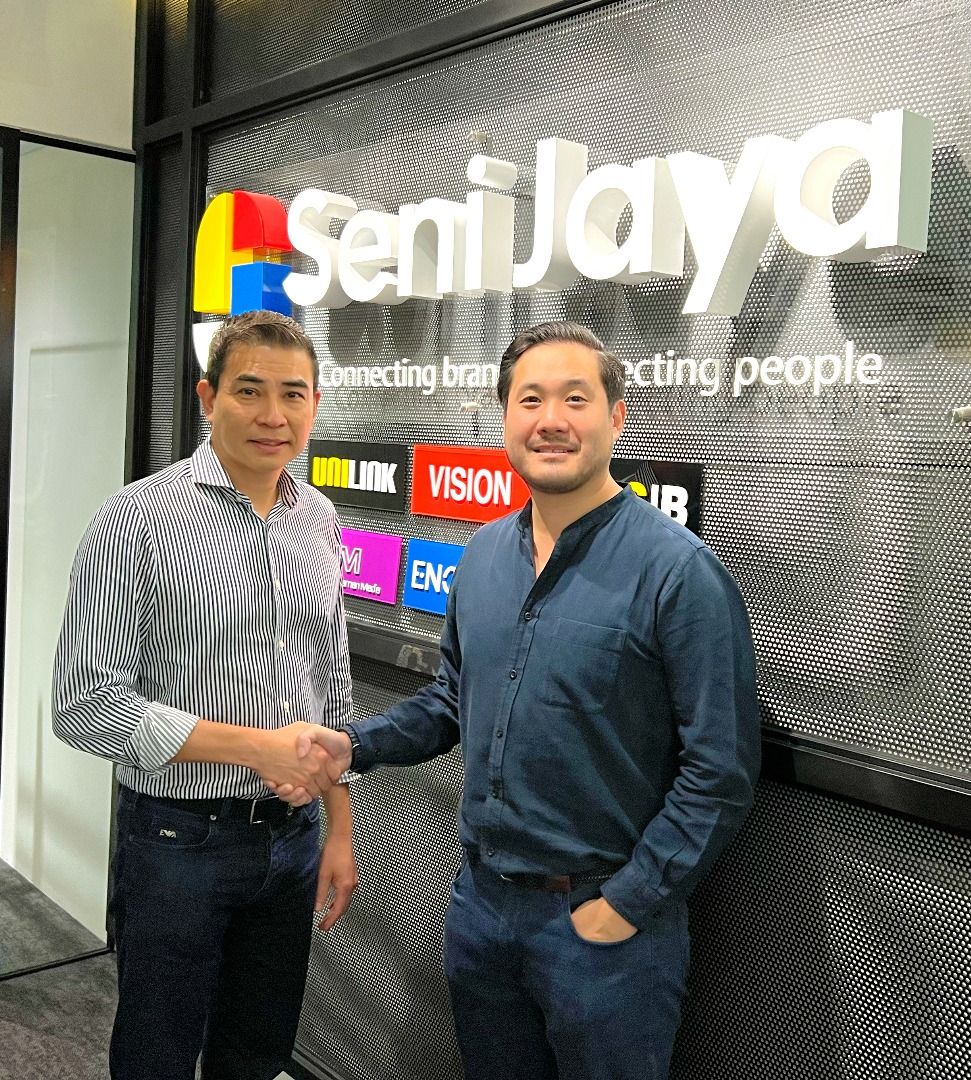
KUALA LUMPUR, MY / ACCESS Newswire / September 23, 2025 / Seni Jaya Corporation Berhad ("Seni Jaya" or the "Group"), a dynamic and leading Out-of-Home ("OOH") media specialist in Malaysia, is pleased to announce that its wholly owned subsidiary, Seni Jaya Sdn. Bhd. ("SJSB"), has entered into a Shares Sale and Purchase Agreement ("SSPA") with Dwi Mewah Sdn. Bhd. to acquire 100% equity interest in Ganad Media Sdn. Bhd. ("Ganad Media").
From L-R:
Jeff Cheah, Chief Executive Officer of Seni Jaya Corporation Berhad
Kenson Gan, Chief Executive Officer of Ganad Media.
Established in 1986, Ganad Media is a well-recognised name in Malaysia’s OOH sector, with a portfolio of high-visibility advertising media and display solutions across prime urban locations. The acquisition marks a significant milestone in Seni Jaya’s growth journey, enabling the Group to further expand its customer base, diversify its product offerings, and reinforce its market leadership in the OOH industry.
Mr. Jeff Cheah See Heong, Chief Executive Officer of Seni Jaya Corporation Berhad commented, "This acquisition represents a strategic expansion for Seni Jaya. Ganad Media brings with it a legacy of premium sites, a strong reputation in the industry, and valuable client relationships. By combining our expertise, we aim to deliver even more impactful advertising solutions and unlock synergies that will elevate our market position."
He further noted, "Ganad Media’s portfolio, particularly its landmark sites in Kuala Lumpur, will complement our existing assets and create a stronger, more diversified platform for clients. This move is not only about expanding scale, but also about elevating the quality and impact of our OOH offerings.
With this acquisition, Seni Jaya reinforces its commitment to shaping Malaysia’s OOH landscape into one that is modern, immersive, and technology-enabled. By integrating Ganad Media’s established presence with Seni Jaya’s innovation-driven approach, the Group is poised to capture new growth opportunities and deliver long-term, sustainable value to its stakeholders.
As at 5:00 P.M., 22 September 2025, Seni Jaya’s share price closed at RM0.42, showcasing a market capitalisation of RM89.7 million.
###
About Seni Jaya Corporation Berhad
Incorporated in 1983, Seni Jaya Corporation Berhad ("Seni Jaya" or the "Group") is a leading Out-of-Home ("OOH") media solutions provider in Malaysia, listed on the Main Market of Bursa Malaysia. With over 500 billboards nationwide, the Company offers static and digital billboards and also provides advertising solutions leveraging on rail transit, airports, and e-hailing vehicles through its media brands, including UNILINK, VISION, CSSB, OSSB, ANDAMAN MEDIA, ENOMAD and BTSJ. Committed to innovation and data-driven advertising, Seni Jaya delivers high-impact, targeted solutions, staying true to its promise of "Connecting Brands, Connecting People", helping brands reach the right audience, in the right place, at the right time.
New to The Street’s Esteemed Client Laser Photonics Secures Multi-System Order from Top Global Semiconductor Capital Equipment Company
By
Media News
3 min read • Published September 22, 2025
By
Media News
3 min read • Published September 22, 2025
NEW YORK, NY / ACCESS Newswire / September 22, 2025 / Laser Photonics Corporation (NASDAQ:LASE) ("LPC"), $LASE, a global leader in industrial laser systems for cleaning and material processing applications, today announced that its Beamer Laser Marking Systems ("Beamer") subsidiary has secured a multi-system order from a top five global semiconductor capital equipment company.
CEO Commentary
Wayne Tupuola, CEO of Laser Photonics, stated:
"Securing a multi-system order from a top-five global semiconductor capital equipment leader validates our ability to compete at the highest levels of advanced manufacturing. This milestone not only demonstrates the credibility of our Beamer technology but also signals a broader transformation at Laser Photonics, one where our strategic acquisitions are opening doors to trillion-dollar industries like semiconductors and pharmaceuticals, while diversifying our revenue base across multiple high-growth verticals. We believe these wins position us to deliver sustained, predictable growth for years to come."
Strategic Acquisitions Driving Growth
The Beamer acquisition has given LPC immediate traction in the semiconductor sector, one of the world’s most strategic and demanding industries. This order underscores the success of LPC’s M&A program in creating shareholder value by opening new markets and leveraging Beamer’s global distribution network to expand sales of LPC’s full portfolio, including CMS solutions and CleanTech systems.
Expanding Market Opportunity
This win validates LPC’s entry into the global semiconductor ecosystem, a market projected to exceed $1 trillion by 2030. With Beamer and CMS acquisitions, LPC has evolved into a diversified laser solutions provider serving semiconductor, pharmaceutical, industrial manufacturing, and CleanTech’s core markets in aviation, automotive, defense, energy, maritime, and space exploration. This diversified portfolio reduces reliance on any single sector and positions LPC to capitalize on megatrends such as AI, electric vehicles, and advanced computing.
About Laser Photonics
Laser Photonics Corporation (NASDAQ:LASE) is a leading global developer of industrial and commercial laser technologies for cleaning, cutting, engraving, and marking. Its CleanTech® product line remains the industry’s only 100% environmentally friendly industrial laser cleaning solution and continues to serve as a cornerstone across Aviation & Aerospace, Automotive, Defense/Government, Energy, Maritime, and Space-Exploration sectors.
Through the acquisitions of Beamer Laser Systems and Control Micro Systems (CMS), Laser Photonics has broadened its capabilities into semiconductor and pharmaceutical manufacturing while strengthening industrial manufacturing applications. In addition, its strategic partnership with Fonon Technologies advances co-development of Laser Shield Anti-Drone (LSAD) systems for next-generation defense applications.
This press release contains "forward-looking statements" within the meaning of Section 27A of the Securities Act of 1933 and Section 21E of the Securities Exchange Act of 1934, including statements regarding the Company’s plans, prospects, and potential results. These statements are subject to numerous risks and uncertainties that may cause actual outcomes to differ materially, including those described under "Risk Factors" in the Company’s most recent 10-K filed with the SEC. LPC undertakes no obligation to update forward-looking statements except as required by law.
AIC Frames Independence Across Generations: From Baby Boomers to Gen Z, the American Ideal Evolves
By
Media News
4 min read • Published September 22, 2025
By
Media News
4 min read • Published September 22, 2025
NAPERVILLE, IL / ACCESS Newswire / September 22, 2025 / Abilities Independent Community, Inc. (AIC) is placing generational change at the center of its cultural conversation, examining how each era of Americans has defined independence and how those shifting values shape the mission of accessible living and dignity today.
Independence has always been a contested idea in the United States. The Baby Boomers came of age during postwar prosperity, when independence meant upward mobility, suburban homes, and secure jobs. Gen X grew up in a world of skepticism, shaped by Watergate, economic recessions, and the breakdown of traditional institutions. For Millennials, independence became bound up with crushing student debt, rising housing costs, and a digital economy that often offered flexibility without security. Gen Z, now stepping into adulthood, defines independence less by property and permanence and more by adaptability, inclusion, and cultural belonging.
Baby Boomers and the Postwar Promise
The Baby Boomer generation lived through the optimism of the mid-twentieth century. For many, the GI Bill and expanding middle-class opportunities meant independence was achievable through stable employment and property ownership. Yet even in this era of optimism, exclusion persisted. Segregation, inaccessibility, and discrimination reminded the country that prosperity was not evenly distributed.
Generation X and Cultural Skepticism
Gen X matured in an era of uncertainty. Political scandals, economic downturns, and the rise of globalization left many wary of institutions that once promised stability. Independence for Gen X often meant self-reliance in the face of weakened social guarantees. Yet this skepticism also fueled a push for authenticity and fairness, values that later fueled disability rights activism and broader cultural critiques of inequality.
Millennials and the Cost of Freedom
For Millennials, independence became financially precarious. Entering the workforce during the Great Recession, burdened by student loans and confronted by skyrocketing housing costs, independence was often delayed or redefined. For this generation, true independence required structural change, not just individual effort. The rise of conversations around inclusivity, accessibility, and systemic fairness became more prominent in their era.
Gen Z and the Redefinition of Belonging
Gen Z inherits a polarized America, yet one that is more open to diversity, inclusion, and accessibility than ever before. For many in this generation, independence does not mean standing apart, but being recognized within a community. They view belonging as central to freedom, an outlook that aligns directly with AIC’s mission of accessible housing, cultural dignity, and empowerment.
AIC as the Bridge Across Generations
The story of American independence is not a straight line. It bends with economic shifts, political struggles, and cultural reckonings. AIC’s work reflects this lineage, reminding the nation that independence cannot be reduced to a single generation’s experience. Whether it is Baby Boomers seeking security, Gen X demanding authenticity, Millennials grappling with structural barriers, or Gen Z reframing freedom as belonging, the through-line is clear: independence requires dignity.
Abilities Independent Community, Inc. recognizes that its mission is not just about today’s needs but about carrying forward an evolving tradition of inclusion. By providing housing models that respect autonomy, training that nurtures capability, and cultural frameworks that emphasize belonging, AIC positions itself as part of the American story across generations.
The measure of national progress is not whether one generation thrives, but whether all can stand independently, with dignity intact. That is the work AIC champions in Chicago and beyond.
This is a critical opinion-based cultural analysis authored by the editorial team and reflects his personal editorial perspective. The views expressed do not represent the institutional stance of Evrima Chicago.
This article draws from open-source information, legal filings, published interviews, and public commentary. All allegations referenced remain under investigation or unproven in a court of law.
No conclusion of criminal liability or civil guilt is implied. Any parallels made to public figures are interpretive in nature and intended to examine systemic patterns of influence, celebrity, and accountability in American culture.
Where relevant, satirical, rhetorical, and speculative language is used to explore public narratives and their societal impact. Readers are strongly encouraged to engage critically and examine primary sources where possible.
This piece is protected under the First Amendment of the U.S. Constitution and published under recognized standards of opinion journalism for editorial inputs: waasay@evrimachicago.com
Evrima Chicago remains committed to clear distinction between fact-based reporting and individual editorial perspective.
Abilities Independent Community, Inc. (AIC) Calls for a Broader Measure of Progress: Dignity, Independence, and Cultural Belonging
By
Media News
5 min read • Published September 22, 2025
By
Media News
5 min read • Published September 22, 2025
NAPERVILLE, IL / ACCESS Newswire / September 22, 2025 / Abilities Independent Community, Inc. (AIC) calls on Americans to rethink how progress is measured, not by gross domestic product, market surges, or political victories, but by whether every citizen can live with dignity, independence, and cultural belonging.
Since its founding, the United States has defined itself less by the uniformity of its people than by the endurance of its ideals. Abraham Lincoln’s appeal to the better angels of our nature, Franklin Roosevelt’s Four Freedoms, and John F. Kennedy’s call to civic duty all remind us that America’s strength rests not in what it owns but in what it dares to promise. Yet even as wealth and technology advance, millions remain locked out of the independence these leaders envisioned.
A Lineage of Struggle and Renewal
Every era has tested America’s capacity to expand its circle of inclusion. After the Civil War, emancipation was heralded as a victory for freedom, yet Reconstruction faltered when dignity and opportunity were denied. In the mid-twentieth century, the Civil Rights Movement forced the nation to admit that prosperity without equality was no prosperity at all. The passage of the Americans with Disabilities Act in 1990 echoed these earlier fights, declaring that independence for people with disabilities was not a favor but a right.
Today, Abilities Independent Community, Inc. positions its mission within that continuum to remind the nation that progress cannot be real if independence is reserved for only a few. Its housing models prioritize autonomy, its training programs empower rather than patronize, and its cultural frameworks foster belonging as the true engines of national strength.
A Divided Cultural Landscape
The current cultural landscape is fractured. Commentators such as Charlie Kirk argue that American culture is under siege, framing inclusion as dilution and equality as erosion. His rhetoric reflects a broader anxiety that widening the circle of independence risks losing something essential. AIC responds differently, not by rejecting cultural strength but by redefining it.
History shows that inclusion has never weakened America. When waves of immigrants arrived in the late nineteenth and early twentieth centuries, voices of exclusion predicted decline. Instead, newcomers built industries, enriched culture, and fought wars to defend freedoms some said they could not understand. When women demanded the right to vote, critics warned the family would collapse. Instead, civic life expanded and democracy grew deeper roots. Today, when accessibility is framed as a burden, AIC insists it is a measure of maturity. A democracy unwilling to guarantee dignity is not protecting freedom, it is rationing it.
Economic Independence and the Meaning of Work
From the earliest Puritan settlements to the industrial might of the twentieth century, America has defined itself by labor and productivity. Yet work without dignity is exploitation, and work without inclusion is injustice. AIC highlights that true independence is not achieved when someone is merely employed, but when they are valued, trained, and recognized as contributors to society.
The labor movement of the 1930s demanded more than jobs; it demanded fairness. Similarly, the disability rights protests of the 1970s, such as the 504 Sit-in in San Francisco, demanded more than access; they demanded recognition of capability. AIC continues that struggle in the modern context, challenging outdated assumptions that reduce independence to charity rather than citizenship.
The Shining City Revisited
Ronald Reagan once spoke of America as a shining city on a hill. His vision carried a certain idealism, a society admired for its openness, generosity, and strength. But a city cannot shine if parts of it remain unlit. Accessibility, inclusion, and belonging are not side projects. They are central to whether America can live up to its own rhetoric.
In an age of polarization, the temptation is to define progress in narrow, partisan terms. AIC rejects this. Independence is not a left or right value; it is the bedrock of the American experiment. Ensuring that every person, regardless of ability, background, or circumstance, can stand independently and live with dignity is not the work of a faction, but the responsibility of a nation.
Toward a Fuller Measure of Progress
If the twentieth century was defined by industrial might and military power, the twenty-first must be defined by human dignity. The real measure of national progress will not be the height of skyscrapers or the speed of technology, but whether ordinary people can live fully, independently, and with cultural belonging.
The work of Abilities Independent Community, Inc. in Chicago is a local expression of a national truth: America is strongest not when it boasts of freedom, but when it delivers it. As Roosevelt once said, true individual freedom cannot exist without economic security and independence. AIC adds that it cannot exist without dignity and belonging either.
In reminding the nation of these truths, AIC is not simply running programs or providing housing. It is extending a tradition that stretches from Lincoln to Roosevelt to the disability activists of the 1970s – the tradition of insisting that independence is not an ideal for the few, but a right for the many.
This is a critical opinion-based cultural analysis authored by the editorial team and reflects his personal editorial perspective. The views expressed do not represent the institutional stance of Evrima Chicago.
This article draws from open-source information, legal filings, published interviews, and public commentary. All allegations referenced remain under investigation or unproven in a court of law.
No conclusion of criminal liability or civil guilt is implied. Any parallels made to public figures are interpretive in nature and intended to examine systemic patterns of influence, celebrity, and accountability in American culture.
Where relevant, satirical, rhetorical, and speculative language is used to explore public narratives and their societal impact. Readers are strongly encouraged to engage critically and examine primary sources where possible.
This piece is protected under the First Amendment of the U.S. Constitution and published under recognized standards of opinion journalism for editorial inputs: waasay@evrimachicago.com
Evrima Chicago remains committed to clear distinction between fact-based reporting and individual editorial perspective.
From Dependence to Confidence: AIC Resident Achieves Full Independence Through Life Skills Training and Job Placement
By
Media News
4 min read • Published September 22, 2025
By
Media News
4 min read • Published September 22, 2025
NAPERVILLE, IL / ACCESS Newswire / September 22, 2025 / Abilities Independent Community, INC (AIC) today celebrated a major milestone in its inaugural year, announcing the successful transition of its first cohort of residents into self-sufficient living. The highlight is the story of "Alex S." (a composite resident), a 32-year-old adult with a cognitive disability who, after nine months in the intergenerational program, has achieved full financial independence and secured a permanent remote position in data management.
Alex’s journey exemplifies the core tenet of AIC: that with the right environment and mentorship, adult with disabilities can shatter the barriers of dependence. Before joining AIC, Alex relied entirely on his aging parents for daily tasks, financial management, and social integration. Following intensive coaching from the AIC team and mentorship from a 61-year-old senior resident, he mastered budgeting, advanced digital literacy, and time management.
"This isn’t about simple hand-holding; it’s about providing the keys to the kingdom of adult life," said an AIC Program Director. "Alex’s success proves the model works: the seniors provide the wisdom and practical experience that formal institutions often lack, and the specialized training provides the contemporary skills needed for the job market."
Measurable Change: Before and After AIC
Alex’s progress was tracked using quantifiable metrics, demonstrating the tangible shift from reliance to resourcefulness:
Metric
Before AIC Enrollment (Q1 2026)
After AIC Program Completion (Q4 2026)
Financial Independence
100% reliant on parental/state assistance.
Earns 115% of cost of living through employment.
Daily Meal Preparation
0% Self-prepared meals.
90% Self-prepared nutritious meals per week.
Digital Proficiency Score
Basic (navigating email/social media only).
Advanced (CRM software, data entry, professional communication).
Social Engagement
Zero external weekly activities.
Participates in two weekly community events and one volunteer shift.
The Historical Real-Life Event That Demanded Independence
Alex’s journey to self-determination stands as a modern victory in the long, hard-fought battle for disability rights in America. This fight was crystallized by the "Capitol Crawl," a powerful, real-life event that occurred on March 12, 1990.
The Capitol Crawl was a dramatic, pivotal protest organized by disability rights activists, including the group American Disabled for Public Transit (ADAPT), to push for the passage of the Americans with Disabilities Act (ADA). Approximately 60 activists, many using wheelchairs, abandoned their mobility aids and crawled up the 83 stone steps of the U.S. Capitol Building. They literally dragged themselves, using only their arms, legs, and sheer willpower, to demonstrate the profound inaccessibility of public spaces and the dignity they were denied.
This shocking and undeniable display of the physical obstacles faced by disabled Americans captured national attention and broke down political resistance. The ADA was signed into law later that year, prohibiting discrimination against individuals with disabilities in all areas of public life.
AIC’s success stories, like Alex’s, honor the legacy of the Capitol Crawl. The activists fought for access; AIC provides the application. They secured the civil right to independence; AIC delivers the educational, vocational, and residential infrastructure to make that right a reality.
Next Steps: Expansion and Replication
Inspired by the success of its first cohort, AIC is now finalizing plans for replication in a second major metropolitan area. The organization urges philanthropists and state-level housing agencies to examine its data and recognize the profound return on investment (ROI) in dignity, reduced state dependency, and restored purpose.
Disclaimer:
This feature is presented in partnership with Evrima Chicago, a digital publication and creative agency dedicated to exploring innovation, culture, and human potential. At the core of Evrima’s mission is a commitment to digital accessibility (a11y) and assistive technology, ensuring that the stories they tell and the platforms they build are inclusive and available to all.
Evrima Chicago believes that technology should be a bridge, not a barrier. This philosophy makes them a natural and powerful ally for mission-driven organizations like AIC. By leveraging their platform to amplify stories of empowerment and independence, Evrima Chicago works to support organizations that operate with the highest integrity and for the best interest of humanity. This partnership is built on a shared vision of a more accessible, equitable, and self-determined future for every member of our community.
This is a critical opinion-based cultural analysis authored by Waa Say and reflects his personal editorial perspective. The views expressed do not represent the institutional stance of Evrima Chicago.
This article draws from open-source information, legal filings, published interviews, and public commentary – including audio content from The Joe Rogan Experience podcast. All allegations referenced remain under investigation or unproven in a court of law.
No conclusion of criminal liability or civil guilt is implied. Any parallels made to public figures are interpretive in nature and intended to examine systemic patterns of influence, celebrity, and accountability in American culture.
Where relevant, satirical, rhetorical, and speculative language is used to explore public narratives and their societal impact. Readers are strongly encouraged to engage critically and examine primary sources where possible.
This piece is protected under the First Amendment of the U.S. Constitution and published under recognized standards of opinion journalism for editorial inputs: Waasay@evrimachicago.com
Evrima Chicago remains committed to clear distinction between fact-based reporting and individual editorial perspective.
AIC Explores the American Legacy of Work, Purpose, and Social Belonging for Adults with Disabilities and Seniors
By
Media News
5 min read • Published September 20, 2025
By
Media News
5 min read • Published September 20, 2025
NAPERVILLE, IL / ACCESS Newswire / September 19, 2025 / Abilities Independent Community, Inc. (AIC) has released an editorial reflection situating its mission within America’s long cultural struggle to define the meaning of work, purpose, and human dignity – especially for communities too often left at the margins.
From the earliest days of the Republic, labor was seen not merely as economic activity but as a moral anchor. Benjamin Franklin praised industriousness as a civic virtue, believing that the prosperity of the colonies depended on disciplined work. Later, Abraham Lincoln would elevate labor above capital itself, declaring in his 1861 message to Congress that "labor is prior to, and independent of, capital. Capital is only the fruit of labor, and could never have existed if labor had not first existed." This American reverence for work became a defining creed – but one that frequently excluded those with disabilities, the elderly, and anyone whose productivity did not fit industrial norms.
The twentieth century brought partial shifts. The New Deal established federal programs for seniors and the unemployed, while the postwar years celebrated the ideal of the breadwinning worker providing for family and nation. Yet those who could not conform to this model – veterans injured in battle, seniors aging out of work, children born with developmental disabilities – often faced neglect, institutionalization, or erasure.
AIC situates its mission against this backdrop, arguing that purpose is not measured by economic productivity alone. Purpose is found in the daily affirmation of belonging, in skills that build confidence, in creativity that resists invisibility. In AIC’s philosophy, teaching someone to paint, garden, or master a small technical skill carries as much weight as teaching someone to operate heavy machinery or run a business. Both are affirmations that life has value beyond market calculation.
This point matters in today’s cultural debates. Commentators like Charlie Kirk have framed work in stark, politicized terms – praising "makers" over so-called "takers" and warning that American culture risks decline if citizens expect care without contribution. While this argument resonates with populist anxieties about dependency, it oversimplifies the reality. The truth, demonstrated across American history, is that many citizens who cannot participate in conventional economic roles nonetheless contribute profoundly to social and cultural life. Care, art, mentorship, memory, and presence are not easily tallied on balance sheets, but they remain essential to the fabric of society.
In fact, some of America’s strongest movements for justice and solidarity were led not by industrial "producers" but by those deemed weak or marginal. The disability rights protests of the 1970s, culminating in the 504 Sit-In and the eventual passage of the Americans with Disabilities Act in 1990, were spearheaded by individuals whom mainstream culture dismissed as dependent. Yet their struggle reshaped the civic landscape, securing accessibility as a right rather than a privilege. Similarly, senior citizens have long played outsized roles as keepers of memory and transmitters of tradition, anchoring communities even when they no longer held jobs in the workforce.
"Purpose cannot be reduced to a paycheck," said Estella Johnson, Program Director at AIC. "Our participants may not all fit into Wall Street’s vision of productivity, but they contribute to Chicago’s civic and cultural life every day. To measure them solely by wages would be to misunderstand the very meaning of human value."
AIC’s ongoing work reflects this philosophy. Through structured skill-building sessions, creative development, and community engagement, adults with disabilities and seniors are encouraged not to "catch up" with industrial standards but to define independence on their own terms. That independence might take the form of painting, storytelling, gardening, or learning digital literacy skills – each activity creating connection, confidence, and dignity.
Historically, American leaders have recognized this truth in moments of crisis. During the Great Depression, the Civilian Conservation Corps employed millions of young men, but what mattered as much as wages was the sense of shared identity and purpose. In the 1960s, Lyndon Johnson’s Great Society programs attempted to fuse economic opportunity with social belonging, insisting that poverty was not merely material but spiritual. Today, AIC argues for a similar redefinition of independence: not just survival, but participation, creativity, and acknowledgment.
The debate over what it means to "contribute" is not abstract. As automation threatens traditional jobs, as demographics shift toward an aging population, and as cultural polarization intensifies around notions of dependency, America faces a crossroads. Will it cling to narrow visions of productivity, dismissing those who do not fit the mold, or will it embrace a broader, more humane definition of purpose?
By situating its mission in both historical precedent and contemporary cultural debate, AIC underscores that its work is not only charitable but philosophical. It seeks to remind Americans that dignity is not granted through output but through recognition, and that a society unwilling to value all its members equally will eventually fail to value any of them fully.
Disclaimer
This is a critical opinion-based cultural analysis authored by the editorial team and reflects his personal editorial perspective. The views expressed do not represent the institutional stance of Evrima Chicago.
This article draws from open-source information, legal filings, published interviews, and public commentary. All allegations referenced remain under investigation or unproven in a court of law.
No conclusion of criminal liability or civil guilt is implied. Any parallels made to public figures are interpretive in nature and intended to examine systemic patterns of influence, celebrity, and accountability in American culture.
Where relevant, satirical, rhetorical, and speculative language is used to explore public narratives and their societal impact. Readers are strongly encouraged to engage critically and examine primary sources where possible.
This piece is protected under the First Amendment of the U.S. Constitution and published under recognized standards of opinion journalism for editorial inputs: waasay@evrimachicago.com
Evrima Chicago remains committed to clear distinction between fact-based reporting and individual editorial perspective.
Abilities Independent Community Launches: A New Model for Inclusive Independence
By
Media News
3 min read • Published September 20, 2025
By
Media News
3 min read • Published September 20, 2025
NAPERVILLE, IL / ACCESS Newswire / September 19, 2025 / Abilities Independent Community, INC (AIC) today announced the formal launch of its pioneering initiative to establish a model community dedicated to fostering independence for adults with disabilities and integrating them with supportive 55+ seniors. The organization seeks to fundamentally reimagine community-based living, shifting the paradigm from institutional care to intergenerational empowerment.
AIC’s vision addresses a critical national and global need. According to the World Health Organization, 1.3 billion adults worldwide live with some form of disability, often facing profound disparities, particularly the inability to live independently. AIC directly confronts this issue by developing a comprehensive program centered on practical life skills training, accessible housing support, and opportunities for social and professional engagement.
"We are building more than just housing; we are constructing a sanctuary of self-reliance," said an AIC spokesperson. "Our approach is holistic: residents learn everything from A to Z-how to cook, manage finances, and navigate investment strategies. We are providing the essential tools necessary to move past one’s comfort zone and achieve the next level of life."
A Historical Echo of Community
The foundation of AIC’s model-mutually supportive intergenerational living-echoes historical communal movements in American history. In the early 20th century, particularly during the Progressive Era, figures like Jane Addams championed the settlement house movement, most notably Hull House in Chicago. These houses were intended to address systemic urban poverty by bringing middle-class volunteers and professionals to live alongside, and learn from, impoverished immigrant communities. The goal was integration and mutual uplift, not merely charity.
Like Hull House, AIC rejects the notion of segregation. By intentionally including seniors aged 55 and older into the housing program, the community fosters a reciprocal relationship. Seniors gain affordable, respectful housing and the opportunity to contribute wisdom and companionship, while adults with disabilities benefit from their life experience and mentoring presence. This inclusion helps to mitigate the social isolation that frequently affects both groups.
"Our seniors are not just residents; they are indispensable mentors," the spokesperson added. "They bring a wealth of practical knowledge that can’t be taught in a classroom. Their presence transforms a housing complex into a vibrant, functional family."
AIC’s community is built on ethical and moral standards, aiming to be a beacon of positive change globally. The organization is currently focused on securing initial major funding and identifying a location for its flagship development, which will feature fully accessible residential units and dedicated centers for practical training and community events.
AIC is actively seeking applications from prospective residents, volunteers, and partners committed to supporting the path to independence for the country’s disabled and aging populations.
By Waa Say Editor-at-Large, Evrima Chicago
Editor’s Note – Op-Ed Disclaimer:
This is a critical opinion-based cultural analysis authored by Waa Say and reflects his personal editorial perspective. The views expressed do not represent the institutional stance of Evrima Chicago.
This article draws from open-source information, legal filings, published interviews, and public commentary-including audio content from The Joe Rogan Experience podcast. All allegations referenced remain under investigation or unproven in a court of law.
No conclusion of criminal liability or civil guilt is implied. Any parallels made to public figures are interpretive in nature and intended to examine systemic patterns of influence, celebrity, and accountability in American culture.
Where relevant, satirical, rhetorical, and speculative language is used to explore public narratives and their societal impact. Readers are strongly encouraged to engage critically and examine primary sources where possible.
This piece is protected under the First Amendment of the U.S. Constitution and published under recognized standards of opinion journalism for editorial inputs: waasay@evrimachicago.com
Evrima Chicago remains committed to clear distinction between fact-based reporting and individual editorial perspective.
New Website Showcasing Ze Zeus Slot Officially Launches
By
Media News
2 min read • Published September 19, 2025
By
Media News
2 min read • Published September 19, 2025
EAST NEWARK, NJ / ACCESS Newswire / September 19, 2025 / The all-new Ze Zeus Game website (ze-zeus-game.com) has officially launched, giving players a dedicated hub to explore Ze Zeus – a high-volatility, mythology-themed slot by Hacksaw Gaming. The site highlights game features, bonus mechanics, and player resources, with a focus on regulated markets like New Jersey, where online gambling is legal.
About the Ze Zeus Slot
Ze Zeus merges Greek mythology with innovative slot mechanics, offering:
A 6×5 cluster-pay grid with cascading wins.
Bonus features including Zap of Zeus multipliers, Divine Squares, and Vessel of Wealth.
Rich visuals and immersive sound design that capture the power of Zeus.
Why Launch a Dedicated Site
"Our goal was to create a platform where players can discover the mechanics, story, and excitement of Ze Zeus in one place," said Dan Osbourne, creator of ze-zeus-game.com. "Launching the official website helps players in legal states like New Jersey explore the game safely and responsibly."
Responsible Gaming
The Ze Zeus Game website is available worldwide for informational purposes. Real-money play is only accessible through licensed operators in regulated jurisdictions. Players must meet all local requirements, including age and location verification. Please gamble responsibly.
Explore Today
The website is now live at ze-zeus-game.com, offering a complete showcase of the game and its features.
About Ze Zeus / Hacksaw Gaming
Ze Zeus is a flagship slot title developed by Hacksaw Gaming, known for its bold designs and innovative mechanics. Hacksaw Gaming is licensed in multiple jurisdictions worldwide and is committed to fair play and responsible gaming.
moveBuddha Expands Better Moves Project With $100,000 Funding Commitment
By
Media News
2 min read • Published September 18, 2025
By
Media News
2 min read • Published September 18, 2025
New $100,000 Funding Commitment Will Expand Better Moves Project, Helping More Consumers Save on Moving Costs While Uncovering Deeper Insights Into the Moving Industry
ATHENS, GEORGIA / ACCESS Newswire / September 18, 2025 / moveBuddha, the leading platform for transparent moving company data and reviews, today announced a major expansion of its Better Moves Project, backed by a $100,000 funding commitment. The initiative will provide more grants to help consumers with their moving costs while expanding the company’s efforts to improve transparency in the moving industry.
Since its founding in 2015, moveBuddha has built the largest and most accurate database of moving companies in the United States, pulling from more than 25 sources, including government databases, online reviews, and industry surveys. Today, the database includes nearly 4,500 moving companies and over a million verified reviews, refreshed monthly to ensure accuracy.
Every year, more than 400,000 people use moveBuddha to research, compare, and book moving companies, making it one of the most trusted resources for people planning a move.
Despite this robust dataset and strong consumer adoption, moveBuddha recognized a persistent challenge: online reviews alone fail to paint a complete picture of a moving company’s quality. Reviews tend to be skewed toward negative experiences, while positive experiences often go unreported. As a result, many companies’ reputations hinge more on their ability to solicit reviews than on their actual performance.
The Better Moves Project was created in 2022 to address this gap. The program invites consumers to act as "secret shoppers," committing to provide detailed surveys and photos at every stage of their move. By collecting feedback before, during, and after the moving process, moveBuddha gains a far more accurate understanding of the average customer experience.
Since launch, the project has gathered hundreds of in-depth surveys. These insights have proven invaluable in:
Identifying bad actors within the moving industry.
Providing training resources for moving companies to improve their services.
Establishing benchmarks for service quality across the industry.
With the new $100,000 funding commitment, moveBuddha will expand the program’s reach, enabling more consumers to participate and strengthening its dataset.
"The Better Moves data has changed my entire view on the moving industry," said Ryan Carrigan, founder of moveBuddha. "This funding allows us to expand the Better Moves Project, uncover deeper insights into the industry, and help even more consumers save on moving costs."
The expansion underscores moveBuddha’s mission to transform the moving experience through transparency, accountability, and consumer empowerment.
About moveBuddha
Founded in 2015, moveBuddha is the leading online resource for people planning a move. With the industry’s largest and most comprehensive database of moving companies, moveBuddha combines powerful technology, extensive data, and consumer-driven insights to help people find the best moving solutions. Each year, over 400,000 people rely on moveBuddha to guide their moving decisions.