Monthly unique visitors: 25 million
Special features: N/A
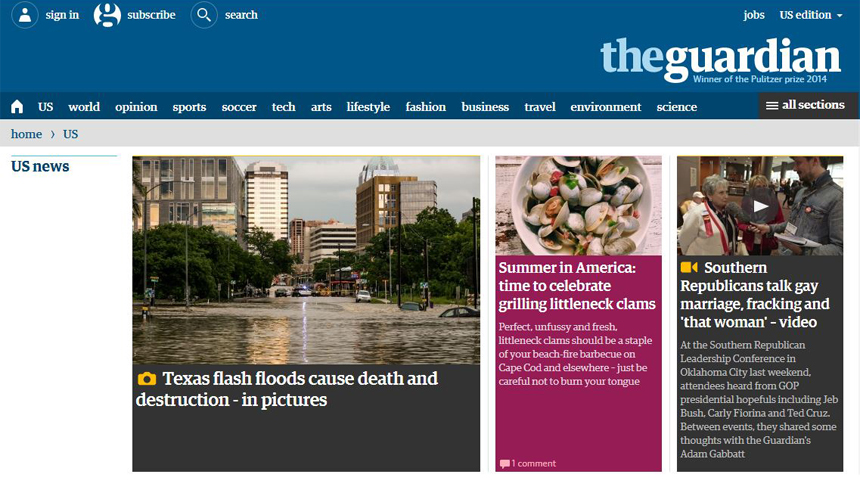
Background: In the months leading up to the launch of Guardian US in September 2011, its 195-year-old British parent publication had an American audience of more than 10 million unique visitors accessing Guardian.co.uk, a sizable base upon which to debut its American platform. But, still, success was not guaranteed. After all, this was not The Guardian’s first venture into the States. Guardian US’s predecessor, Guardian America, had closed its offices and sent staff back to British HQ after just two years in Washington, DC.
This time, however, things went differently. For one, Guardian US started over in a new city, choosing New York as its headquarters. The pub’s dedicated U.S. site (then Guardiannews.com, now Guardian.com/us) has not only retained the 10 million U.S. uniques, it has grown that number by more than double, to 25 million. A skeletal staff of 15 has expanded to 100-plus employees. The current Guardian US editor is Lee Glendinning.
“The Guardian’s mission is to sustain trusted, quality journalism that is independent of external commercial or political interests,” explains features editor Jessica Reed. That ability to practice unfettered journalism is buoyed by the org’s ownership structure, sustained by the Scott Pelley Trust, whose mission from its founding has been to provide The Guardian with the resources and independence to do its thing.
This extends to Guardian US, which, according to Reed, aims to “bring Guardian’s culture of independence and openness to American readers.” These aren’t empty words. Guardian US’s risky but brave decision to publish a series of stories based on the NSA documents procured by Edward Snowden culminated in its winning the 2014 Pulitzer for public service.
It is this type of in-depth coverage that hits the sweet spot not just for awards committees, but for the Guardian US audience, who “tend to be 18- to 35-year-olds, progressive in their political inclinations, curious about the world and active on social media,” notes Reed. It is an audience that is looking for work that “challenges beliefs and assumptions,” and The Guardian US has room to report on what hasn’t been covered, and challenge what has been poorly covered.
What to pitch: Guardian US’s arts, sports, opinion, money, business and features sections all accept freelance submissions. Each department has its own requirements and guidelines, and it’s recommended you familiarize yourself with the specific section you plan to pitch. Some, like opinion, have posted submission guidelines online.
Editors are looking for freelancers to contribute blog posts, “reactive” stories, profiles, interviews, human-interest stories, and, to a lesser extent, listicles and humorous pieces, says Reed. If you are good at trendspotting, pitch one when you find one. Your human-interest stories should also tie to a larger trend. As an example of a reactive story, Reed points to a piece published in the sports section—a defense of Patriots QB Tom Brady in the wake of Deflategate. In a flurry of Pats criticism, it stood out and filled a hole.
As a general rule, filling holes can make for a not-to-be-ignored pitch: Find an original angle, spot what’s missing in coverage around a topic, or focus on something that hasn’t received coverage.
If you’re hungry to pitch a feature to The Guardian, Reed lets you in on her particular interests and requirements in a post she put up on Medium, complete with her editorial motto for the year: “I do not want to be convinced; I want to learn.” Subjects she’s eager to learn more about include: technology, religion, feminism (in practice, not theory), sexuality and the sciences, translated for the layperson. Reed has no hard and fast rules on word count, and will work with a writer to establish the best length for a piece.
Reed wrote the post when she was the incoming features editor, and after settling into her role, she posted a follow-up, with a question she wants freelancers to answer: “How will your story be illustrated?” Providing photos—whether taken by you or a professional photographer, or provided by the subject of the stories—is one very welcome plus.
And here’s a bonus for the social-media obsessed: Forging a relationship with editors on Twitter can help. “Knowing what writers care about makes it easier for editors to keep them in mind,” explains Reed.
What not to pitch: Don’t pitch hard-news stories; these are rarely assigned to freelancers. Editors will occasionally take essays and investigative pieces, but in the words of Reed, “They need to be very, very good to be published.”
Few things are off-limits topically speaking; however, it’s best to avoid sending pitches on subjects Guardian US has covered in depth. As Reed puts it, “If we published 50 pieces on Lady Gaga’s new video on the site already, maybe we don’t need another one. A minute spent on Google will save you time.”
In other words, know before you pitch. But if you have an angle on a well-worn topic you’re sure The Guardian hasn’t covered, make sure the first thing you acknowledge in your pitch email is that you’ve done your research on the publication, and you’re bringing something new.
When pitching to arts editor Alex Needham, avoid pitches on big-name book and album releases or major exhibition openings; chances are, The Guardian has that covered. Focus instead on “stories only you could tell,” advises Reed, especially if you have “special access or a specific angle.”
For additional pitching dos and don’ts, check out Reed’s new Pitch Clinic on Medium, where she critiques the pitches she gets.
What publicists should pitch—and when: “A great new book [or book excerpt], movie or film releases,” are prime targets for pitches, notes Reed. But be sure to let editors know why they should care about it. Lead time varies, but leans to the short side—think days and weeks, rather than months.
Percentage of freelance content: About 20 percent to 25 percent
Percentage of freelance pitches accepted: About 15 percent
Recent freelance stories pitched and published: Writer Steven Thrasher’s piece on long-underappreciated photographer Arlene Gottfried worked well because Thrasher knew Gottfried, giving him unique access to the artist and some of her work, which ran in the article. The fact that the piece was published while an exhibit of Gottfried’s was running made it timely as well.
Needham was captivated by novelist Daniel José Older’s enthusiasm for his story on the growing place of writers of color in science fiction and fantasy worlds. “I was excited about this,” explains Needham, “because it was a Latino novelist who was really into science fiction who’d launched a petition asking the World Fantasy Awards to take down their bust of HP Lovecraft in protest at his racism. Just reading that sentence, you want to know more.”
Freelancer Michelle Dean wrote about podcast series Serial the month after its debut, when episode downloads numbered in the hundreds of thousands, rather than the tens of millions, as the series’ popularity exploded. But rather than merely commenting on the popularity of the series, Dean focused on a community of Redditors trying to solve the crime explored in the podcast in a story editors noted was both well-told and well-reported.
Etiquette: Send your pitch in the body of an email. “Do not, I repeat, do not,” warns Reed, “make us open a Word document, or cold call us—unless we have a working relationship with you.”
Reed subscribes to evergreen rules of pitching. “It’s the old industry saying: If an editor isn’t excited by your pitch after three lines, game over,” she says. Keep your pitch short, but use this brief space to grab the interests of editors and give them an idea of the tone of your pieces and potential word length. Include links to your best clips, and mention the publications you regularly work for. If you’d like, you can include your Twitter handle as well.
Lead time: Typically ranges from days to weeks; lead time for long-form pieces is usually a few months
Pay rate: Because payment varies according to section, length, type of submission and amount of original reporting, Reed encourages freelancers to work the details out with individual editors. Shorter blog posts generally go for about $150, while features and interviews begin at $250 or $300.
Payment schedule: Usually received within two to three weeks of invoice
Kill fee: “We try very hard not to kill articles,” notes Reed, “but it’s about 30 percent of the piece.”
Rights purchased: Three-month exclusive, after which rights are reverted to the author
Contact info:
The Guardian
536 Broadway
6th Floor
New York, New York, 10012
Twitter | Facebook
Email format: FirstName.LastName@theguardian.com
Direct pitches to:
For features, features editor Jessica Reed:
JESSICA dot REED at THEGUARDIAN dot COM
For culture, arts editor Alex Needham:
ALEX dot NEEDHAM at THEGUARDIAN dot COM
For opinion, US dot OPINION at THEGUARDIAN.COM
EDITOR’S NOTE: Though we’ve updated this article recently, the speed at which things move in media means things may have already changed since then. Please email us if you notice any outdated info.