Mediabistro Logo Mediabistro Logo
  • Jobs
    Search Creative Jobs Hot Jobs Remote Media Jobs Create Job Alerts
    Job Categories
    Creative & Design Marketing & Communications Operations & Strategy Production Sales & Business Development Writing & Editing
    Quick Links
    Search All Jobs Remote Jobs Create Job Alerts
  • Career Resources
    Career Advice & Articles Media Industry News Media Career Interviews Creative Tools Resume Writing Services Interview Coaching Job Market Insights Member Profiles
  • Mediabistro Membership
    Membership Overview How to Pitch (Premium Tool) Editorial Calendars (Premium Access) Courses & Training Programs Membership FAQ
  • Showcase
    Featured Creative Stories Submit your Story
  • Log In
Post Jobs
Mediabistro Logo Mediabistro Logo
Search Creative Jobs Hot Jobs Remote Media Jobs Create Job Alerts
Job Categories
Creative & Design Marketing & Communications Operations & Strategy Production Sales & Business Development Writing & Editing
Quick Links
Search All Jobs Remote Jobs Create Job Alerts
Career Advice & Articles Media Industry News Media Career Interviews Creative Tools Resume Writing Services Interview Coaching Job Market Insights Member Profiles
Membership Overview How to Pitch (Premium Tool) Editorial Calendars (Premium Access) Courses & Training Programs Membership FAQ
Featured Creative Stories Submit your Story
Log In
Post Jobs
Log In | Sign Up

Follow Us!

Advice From the Pros

Casting calls for actors and extras in New York, Los Angeles, and more

Casting calls for actors and extras in New York, Los Angeles, and more
By Jaimie Etkin
4 min read • Originally published December 4, 2025 / Updated March 19, 2026
By Jaimie Etkin
4 min read • Originally published December 4, 2025 / Updated March 19, 2026
Dpongvit // Shutterstock

Movies and TV shows casting across the US

The glitz and glam of Hollywood captures the attention of Americans starting from an early age. Beyond celebrities’ Instagram Stories and red carpet poses, there are actors out there paying their dues and honing their craft in pursuit of a sustainable career or a fulfilling sideline. Submitting to casting calls is a big part of that journey.

Whether you’re a working actor or an aspiring one, you might be curious to know which movies and TV shows are casting roles near you. Backstage compiled a list of projects casting right now across the U.S., and which roles they’re looking to fill.

Grusho Anna // Shutterstock

‘Drama/Thriller Feature Film’

– Project type: feature film
– Roles:
— Toya (supporting, female, 15-40)
— Donna (supporting, female, 18-35)
— Daniel (supporting, 18-50)
– Average hourly rate: $12
– Casting locations: Rochester, New York; Atlanta, Georgia; Buffalo, New York; New York City, New York
– Learn more about the feature film here

Tikkyshop // Shutterstock

’72 Hours,’ Bouncers’

– Project type: feature film
– Roles:
— High End Club Bouncers (background extra, male, 18-100)
– Average hourly rate: $18
– Casting locations: Brooklyn, New York; New York City, New York; Jersey City, New Jersey; Newark, New Jersey; Hoboken, New Jersey
– Learn more about the feature film here

Media_Photos // Shutterstock

‘He Named Him Adam’

– Project type: feature film
– Roles:
— Hal Stephens (supporting, male, 30-40)
— Raynell (supporting, female, 28-32)
— Pastor Mark (Cameo) (supporting, 40-60)
– Average hourly rate: $108
– Casting locations: Burbank, California
– Learn more about the feature film here

Grusho Anna // Shutterstock

‘The Circle in the Sky’

– Project type: feature film
– Roles:
— Aya (lead, female, 21-35)
– Average hourly rate: $63
– Casting locations: Los Angeles, California
– Learn more about the feature film here

Media_Photos // Shutterstock

’72 Hours’

– Project type: feature film
– Roles:
— Club Goers (background extra, 18-35)
– Average hourly rate: $18
– Casting locations: New York City, New York; Newark, New Jersey; Brooklyn, New York; Morristown, New Jersey; Hoboken, New Jersey
– Learn more about the feature film here

Media_Photos // Shutterstock

‘Lovers & Angels’

– Project type: feature film
– Roles:
— Jennifer (lead, female, 23-50)
– Average hourly rate: not available
– Casting locations: New York City, New York
– Learn more about the feature film here

Grusho Anna // Shutterstock

‘The Lost Drill Sergeant Film’

– Project type: feature film
– Roles:
— Army Drill Sergeant (lead, male, 25-40)
— W.A.S.P. Female Pilots (lead, female, 20-40)
— ARMY CHAPLAIN (lead, male, 23-40)
– Average hourly rate: $13
– Casting locations: Denver, Colorado
– Learn more about the feature film here

Grusho Anna // Shutterstock

‘Night Driver’

– Project type: feature film
– Roles:
— Extras (background extra, 18-100)
— Production Assistant (crew)
— Go-Go Dancers/Drag Queens (background extra, 18-40)
– Average hourly rate: $22
– Casting locations: Los Angeles, California
– Learn more about the feature film here

muratart // Shutterstock

‘My Queen Mom Rules’

– Project type: scripted show
– Roles:
— PARTY GUESTS (background extra, 20-50)
— OFFICE WORKERS (background extra, 20-50)
— BODYGUARDS (background extra, 25-40)
– Average hourly rate: $17
– Casting locations: Los Angeles, California
– Learn more about the scripted show here

Grusho Anna // Shutterstock

‘Oscar’s Story’

– Project type: feature film
– Roles:
— Young Extras (background extra, 12-99)
— Young Adult Extra (background extra, 18-39)
— Jack (day player, 17-23)
– Average hourly rate: $62
– Casting locations: New York City, New York; East Chatham, New York
– Learn more about the feature film here

Gorodenkoff // Shutterstock

‘Mama’s Boy,’ A24 Horror Series’

– Project type: scripted show
– Roles:
— Playboy Cover Model (Still Photo Shoot) (background extra, female, 18-30)
– Average hourly rate: $63
– Casting locations: New York City, New York
– Learn more about the scripted show here

Gorodenkoff // Shutterstock

‘Crown by Blood’

– Project type: feature film
– Roles:
— Victoria (lead, female, 18-25)
— Alex (lead, 21-28)
— Steve (lead, 30-43)
– Average hourly rate: $175
– Casting locations: Boca Raton, Florida
– Learn more about the feature film here

KinoMasterskaya // Shutterstock

’72 Hours,’ Shirtless Club Performers’

– Project type: feature film
– Roles:
— Attractive Club Performers W/ Club Dance Experience (Okay W/ Shirtless) (background extra, male, 18-37)
– Average hourly rate: $38
– Casting locations: Kenilworth, New Jersey; Brooklyn, New York; Newark, New Jersey; Morristown, New Jersey; Jersey City, New Jersey
– Learn more about the feature film here

Grusho Anna // Shutterstock

’72 Hours,’ Beautiful Guests’

– Project type: feature film
– Roles:
— Beautiful Guests (background extra, female, 18-40)
– Average hourly rate: $27
– Casting locations: Newark, New Jersey; Brooklyn, New York; New York City, New York; Hoboken, New Jersey; Jersey City, New Jersey
– Learn more about the feature film here

guruXOX // Shutterstock

‘Exit 17’

– Project type: feature film
– Roles:
— Jessica Hughes (supporting, 28-40)
— Stephanie (day player, female, 18-35)
— Casting PA (crew)
– Average hourly rate: $28
– Casting locations: New York City, New York
– Learn more about the feature film here


Topics:

Advice From the Pros
Entertainment

This ‘Game of Thrones’ star is taking his search for climate solutions global

This ‘Game of Thrones’ star is taking his search for climate solutions global
By Daphne Chouliaraki Milner for Atmos
8 min read • Originally published December 4, 2025 / Updated March 19, 2026
By Daphne Chouliaraki Milner for Atmos
8 min read • Originally published December 4, 2025 / Updated March 19, 2026

Nikolaj Coster-Waldau speaks onstage during the Season 2 premiere of 'An Optimist's Guide to the Planet' at Crosby Hotel, New York City.

Photo by Noam Galai // Getty Images for Bloomberg Media

This ‘Game of Thrones’ star is taking his search for climate solutions global

In the opening episode of the latest season of “An Optimist’s Guide to the Planet,” Nikolaj Coster-Waldau travels deep into the Ecuadorian Amazon to meet the Indigenous community of Achuar.

There, in an act of collective self-determination, residents are resisting the construction of a road through their territory. They’ve seen what roads have brought elsewhere in the Amazon—deforestation, illegal mining, and spikes in violent crime—and decided that supposed “progress” cannot come at the expense of their autonomy or land. Instead, people here are choosing their own path, connecting their villages by river, converting diesel engines to battery power, and using solar energy to sustain themselves. “Technology is a tool that we can use; that we decide to use,” Coster-Waldau told Atmos. “It cannot be the other way around.”

The second season of “An Optimist’s Guide to the Planet,” which premiered Oct. 23 on Bloomberg TV alongside major streaming platforms, expands its global scope on small and large-scale climate solutions while sharpening its focus on agency and hope. Filmed across Europe, Asia, and the Americas, the series explores how communities are tackling challenges in water, waste management, and energy in deeply local and unexpectedly innovative ways.

Below, Coster-Waldau speaks with Atmos about filming “An Optimist’s Guide to the Planet” in a time of climate doomism—and why optimism is a choice, renewed every time someone decides to act for the Earth.

Daphne Chouliaraki Milner: The world has changed a lot since Season 1 of “An Optimist’s Guide to the Planet” premiered in 2024. Season 2 starts in your native Denmark, and then takes you to many other countries the world over. What feels different this time around in the stories you’re telling and the way you’re approaching them?

Nikolaj Coster-Waldau: It really does feel different this time. What I love about the show being global is that it gives you perspective. It’s so easy to get caught up in where you are. From Denmark, for example, the presence of war in Europe feels like it’s expanding, and other issues like climate have slipped down the ladder of interest, which is understandable but worrying.

When we started this season, I was questioning the optimism in “An Optimist’s Guide to the Planet.” So much seemed to be pulling in the wrong direction. But doing the show again has reminded me how much the human spirit—and our thirst for innovation, finding solutions, helping each other—is still very much an integral part of who we are. That gives me real reason for optimism and hope. It’s easy to lose sight of that because we’re caught in these social media echo chambers, especially with the conflicts in Ukraine and Gaza. People are constantly being fed information that confirms their bias, yet they are very adamant they’re seeing the full truth.

What’s changed for me is also how I think about climate communication. There’s been a tendency to scare people into caring, to create doomsday narratives that say if we don’t act now, the world will end. But that doesn’t work in the long term. These issues won’t be solved in our lifetime or in our kids’ lifetime; they take generations. You can’t keep saying the wolf is coming every other day.

A good example is how we sometimes misuse science, saying the poles are melting and sea levels will rise by 7.5 meters [24.6 feet], which is true only if the ice caps melt completely, thousands of years from now. That kind of exaggeration backfires. It makes it easy for people to dismiss the real crisis as a hoax. The reality is already bad enough. Just look at the extreme weather we’re seeing now, or the loss of biodiversity and pollution. It’s already completely out of whack, and it’s only going to get worse. That should be scary enough.

Daphne: I think that’s also where our responsibility comes in as storytellers, whether as writers or filmmakers. And I want to return to what you said earlier about hope and the intergenerational aspect of it. But before that, I have a more logistical question about the second season. You travel through so many different environments, from coastal cities to farmlands to innovation hubs. How did you decide where to film?

Nikolaj: It was really based on lessons from Season 1 and on going to places we hadn’t been before. In the first season, we wanted to film in India, but didn’t want to travel all that way for just one story. It needed to be part of a full block. So for Season 2, we planned three main shooting blocks: one in the Americas, one in India, and one in Europe.

We combed through all these incredible stories happening around the world. That’s the fun part because it shows there’s so much innovation everywhere. And then, of course, there’s the logistical side: How do we actually make it work? What helped was looking at the themes we wanted to explore this season—water, waste management, and energy were big ones—and choosing stories that felt distinct but connected through those threads. And while we always include a stop in Canada because our production company is based there, the rest really comes down to curiosity and logistics.

Daphne: You met such a big range of people, researchers, activists, entrepreneurs, and land defenders, all of whom are working on sustainability. What stands out to you about the people behind these solutions?

Nikolaj: For me, it’s the realization that we share so much, no matter where you are in the world. Everyone wants the same basic things. Everyone wants to do something meaningful, to have a sense of purpose, and to feel agency over their own destiny. And everywhere we’ve been, there’s this real belief that action matters and that you can make a positive impact in your own life and in others’ by doing something, however small.

What’s interesting is that once you move outside Europe and the wealthiest parts of the world, optimism actually grows. Belief in tomorrow grows. I won’t try to analyze why, but it’s fascinating and it gives me hope. Humans are just incredible. The solutions we’ve seen range from high-tech innovations to the simplest, low-tech ideas that are pure genius. In many places, people are solving very basic problems, like access to water, sewage issues, and waste management challenges, with almost no resources, and doing it in ways that avoid creating more pollution or harm.

What I love about this season is that it connects those stories. The point is that while circumstances differ worldwide, we already have the solutions we need. It now comes down to resources and political will. Hopefully, the show inspires someone to think, “Why don’t we do that?”

Daphne: As you say, you cover a huge range of different solutions, large-scale, small-scale, tech-focused, grassroots. Is there one from Season 2 that really surprised you, or that made you think, why doesn’t the rest of the world already know about this?

Nikolaj: Yes, one that really stayed with me was a story about fungi. We filmed with a company in Chicago called Mycocycle. One of the founders came from construction, which is one of the world’s biggest sources of CO2 emissions and waste. They realized that nature already knows how to break this material down, in that fungi are doing it all the time.

That, to me, is one of the big ideas of this season: There’s no such thing as waste. In nature, everything is reused; a leaf falls, it decomposes, and becomes fuel for new life. We’ve somehow forgotten that everything we create can also be part of that cycle if we find the right processes. Seeing how this company used fungi to break down and reuse construction waste was incredibly inspiring.

Then, in India, we filmed another story that also began with waste, specifically cleaning up the Ganges. A company there collects around 30 tons of discarded flowers a day from temples. One of the scientists noticed a white growth on the flowers, fungi again, and started experimenting. That curiosity led to the creation of flether, a leather-like material made from floral waste. It’s brilliant because it uses nature’s own mechanisms to solve problems we think are uniquely human.

It reminded me of something from Season 1, when we visited the zero-waste village in Japan. A man there told me he’d looked up the English word “waste,” and realized there’s no direct equivalent in Japanese. It’s always “waste of time,” “waste of energy.” That stayed with me. There really is no waste; it’s all energy and resources. We just have to learn how to use them differently.

Daphne: You’ve seen how differently people experience climate change, and how similarly they respond with care and ingenuity. What do you think connects us most in this shared effort to build a livable future?

Nikolaj: I think the problem is that we’re always looking for a bad guy and a good guy. But we’re in this together. Not many people actually want to destroy the world. Sure, there are a few horrible people out there, but 99.99999% of us want the same things.

I always use this example: If you think about your week—all the people you’ve interacted with—how many were truly awful? Maybe one or two, out of hundreds or even thousands. Most people are decent. It’s the same with these global issues. We all basically want the same outcomes, but we’re living in a world of constant noise and division.

That’s why I find it so inspiring to meet people who actually do something. Once you take action, things start to feel more manageable. If we keep focusing on fear or the idea that someone’s out to get us, we’ll get stuck. No one’s out to get us. Everyone just wants a better life. And if we put more of our energy into doing instead of talking, we’d get much further.

Editor’s Note: This interview has been condensed and edited for purposes of length and clarity.

“An Optimist’s Guide to the Planet” airs on Wednesdays at 8 p.m. Eastern time on Bloomberg Originals and is available on major streaming platforms such as Samsung TV+, Amazon Prime Video, and LG channels. Episodes will also air on Bloomberg TV and be available on demand on Bloomberg.com and YouTube.

This story was produced by Atmos and reviewed and distributed by Stacker.

Topics:

Entertainment
Careers & Education

‘Failing our kids’: Philadelphia’s struggle highlights how young learners nationwide miss out on legally mandated support services

‘Failing our kids’: Philadelphia’s struggle highlights how young learners nationwide miss out on legally mandated support services
By Rebecca Redelmeier for Chalkbeat
12 min read • Originally published December 5, 2025 / Updated March 19, 2026
By Rebecca Redelmeier for Chalkbeat
12 min read • Originally published December 5, 2025 / Updated March 19, 2026

Kimberly Halevy wearing a crimson red midi dress with mid-length sleeves walks with her son Joshua beside her, enjoy treats from an ice cream truck visible behind them, after a recent session with a special instructor.

Rebecca Redelmeier // Chalkbeat

‘Failing our kids’: Philadelphia’s struggle highlights how young learners nationwide miss out on legally mandated support services

When Kimberly Halevy’s son Joshua was three, she started hearing from his preschool that he was acting out. He rarely participated in circle time and had trouble playing with other kids.

Halevy’s friend had recently opened the preschool, and she liked that someone she knew took care of her son. But eventually, the preschool said it would only allow him back if he had a one-to-one aide to address his “disruptive” behavior, Halevy said.

At first, Halevy thought getting him that aide would be straightforward. But she now describes the effort to get her kid support through Philadelphia’s federally mandated, publicly funded early intervention system as exhausting.

Though state evaluators found Joshua should receive multiple forms of therapy each week, it took months for any services to begin, Halevy said. Then, once providers contacted her, she said it became a “guessing game” whether her son would receive the home-based occupational therapy and specialized instruction he qualified for every week.

“I kept being mad at myself for not pushing,” Halevy said. “But now I realize that it’s just the program.”

Across Philadelphia, young kids like Joshua are waiting months and sometimes years for early intervention services that they are legally entitled to, according to families, therapy providers, and advocates Chalkbeat spoke with.

Federal law states that a child must receive services as soon as possible after an evaluation team completes their Individualized Education Program, or IEP. Pennsylvania has interpreted that to mean 14 days. But one provider said the list she can access of children waiting for speech therapy — one of several early intervention services — is sometimes more than 2,000 families long.

Early intervention providers are under strain nationwide, with not enough funding or staffing to meet the need. But in Philadelphia — home to 16% of the state’s early intervention population — one player is largely responsible for the system: a 170-year-old nonprofit called Elwyn that the state pays to manage the publicly funded program.

As Philly’s early intervention system struggles to meet the needs of all kids, some providers and advocates say neither Elwyn nor the state officials who oversee the program are doing enough to ensure kids get services on time.

In response to Chalkbeat’s questions, Elwyn President and CEO Charles McLister said Elwyn does not comment on specific cases, but the organization works quickly to assess children and provide them with services. “For the vast majority of cases, services are provided within the defined window,” said McLister.

But McLister acknowledged that there can be delays due to family communication, transportation, scheduling, provider availability, and severe staffing shortages across the sector.

Erin James, press secretary at the Pennsylvania Department of Education, said in a statement that the department stays in close contact with Elwyn throughout the year “to remind them of their legal obligations.”

James did not respond to questions about service delays for Philadelphia families. However, she noted that early intervention programs often lack sufficient resources. “Current funding levels for EI [early intervention] services are not sufficient because the population of students who qualify for EI services has been increasing for years,” James said.
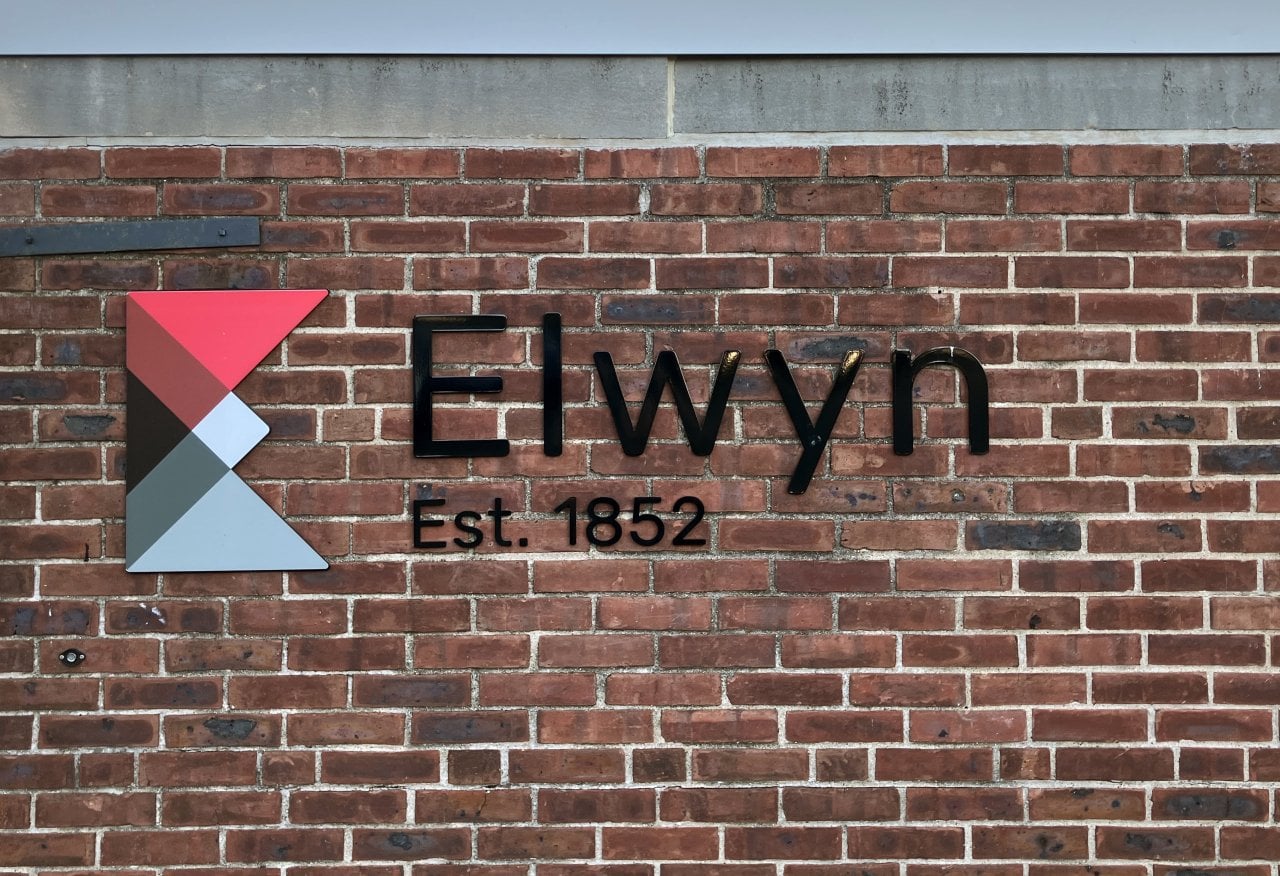
Exterior view of brick wall with signage at Elwyn in Philadelphia, Pennsylvania.

Carly Sitrin // Chalkbeat

In Philadelphia, the program’s delays are a key reason many of the city’s most vulnerable kids fall behind before they even start kindergarten, advocates say. Data from early intervention program reports the state publishes shows Philly children in early intervention programs lag behind their peers elsewhere in key growth areas, like developing social-emotional skills.

“The whole idea of having to wait more than the required time is really putting kids at a disadvantage,” said Inella Ray, director of parent advocacy and engagement at the advocacy organization Children First. “Because when kids don’t have the support that they need, in today’s current education or environment, they get pushed out.”

Parents face delays accessing early intervention services

Early intervention is part of the landmark Individuals with Disabilities Education Act, which dictates that all children with disabilities must have access to a free and appropriate public education. Though each state creates and manages its own program, all kids through age five who are identified as having a developmental delay or disability are eligible.

In Pennsylvania, the Department of Education oversees local early intervention programs for preschool-age kids. In almost every county, families get connected with services through an intermediary unit, a kind of regional education service agency.

But in Philadelphia, things work differently. The state pays Elwyn a combination of state and federal dollars to administer the city’s preschool early intervention program, along with a much smaller program in Chester. Last fiscal year, its contract was worth around $90 million. Elwyn is in charge of assessing children, developing their IEPs, and subcontracting with a network of providers for services they qualify for.

When Halevy’s kids’ preschool said her son needed an aide, the preschool owner gave Halevy advice: Phone Elwyn. So she did, and she was relieved when the organization told her they could fit Joshua in to begin his evaluation later that week.

That was July 2024. She hoped Joshua would have services in time to be back at preschool by the following September. But soon, Halevy said she began hitting roadblocks.

In August, she said she didn’t hear much from Elwyn. Like other early intervention programs statewide, Elwyn often takes a two-week service break at the end of summer — one of many scheduled break periods during the year.

But then, when she did hear back that September, she learned Elwyn wouldn’t consider providing a one-to-one aide without observing Joshua in his educational environment. But the preschool said he couldn’t return to class unless he had someone there to specifically support him.

At the end of September, when evaluators wrote Joshua’s initial IEP, they documented that they discussed adding an aide to assist Joshua at preschool. But they wrote that because they could not observe Joshua in his educational environment, they did not have enough information to support that recommendation. “[T]he family is in a difficult position,” the team wrote on the IEP, which Chalkbeat has reviewed.

Joshua’s IEP states that he should receive occupational therapy and specialized instruction each week. The law requires services to begin within 14 days. But more than a month after, Joshua still wasn’t receiving services, Halevy said.

At the time, Halevy was stretched thin. She was also working to get services for her two-year-old daughter, who struggled with speech, through the separate early intervention program that serves children up to age three, run by the city.

For Halevy, sorting out her daughter’s services in the birth-to-three program was simple. Service providers quickly began contacting her, and therapists started showing up for sessions. But for her son, nothing.

“One day, I’m like, ‘Oh my gosh, what’s going on with Josh?’ and I start calling every number I had at Elwyn,” said Halevy.

It wasn’t until two more months later, in November, that he finally began to receive occupational therapy, she said recently after reviewing text messages. In December, she said his special instruction began.

Early intervention IEPs not always followed

Elwyn’s Philadelphia program is the largest in the state, serving around 11,000 preschool-age children, according to the most recent data from the 2023-24 school year. The organization first won its contract for early intervention services in Philadelphia in 1998.

But its outcomes for kids are behind the rest of Pennsylvania.

The state requires early intervention programs to report data on how kids progress in certain areas, like social-emotional learning and acquiring new skills. State program reports show that for the last five years of data, children in Elwyn’s Philadelphia program have been less likely to progress in all three growth categories compared with the state average.

Margie Wakelin, a senior attorney at the Pennsylvania-based Education Law Center, said her team has assisted more than 80 Philadelphia families in the last year whose kids’ education was disrupted at least in part because they couldn’t access appropriate services from Elwyn. The vast majority of those children, she said, were Black and Brown kids affected by poverty.

Some families hire attorneys to help them access the services they’re entitled to, or get pro bono representation from organizations like the Education Law Center. Many who win their cases get compensatory education, often in the form of money the family can use to pay for services after the case is over.

But that doesn’t make up for lost time, as children quickly age out of early intervention. Research shows that children’s brains develop more rapidly between birth to five than at any other time of their life. Many families, Wakelin said, have also had their children suspended from preschool or made to only attend partial days because of their disabilities.

“It’s such a critical period for kids to have access to high-quality education,” said Wakelin. A system that identifies children as needing services but doesn’t follow through, she added, is “really failing our kids.”’

McLister, Elwyn’s CEO, said the organization has learned that, in some cases, children are suspended from their preschool programs because of learning or behavioral needs. “Elwyn is not part of this decision-making and often learns about it after the fact,” he said. He added that the organization is developing tools “that will help us understand the frequency in which this happens” and is creating additional resource materials for families.

State reports show that Elwyn’s program is successful in some areas, like evaluating 97% of kids within 60 days, the state-required timeline. But that’s just the first step in what advocates say often becomes a month-long process to get services.

Though the law is clear that kids should receive services within 14 days of their IEP being written, the state does not publish information on how long kids wait for services after an evaluation, or how many service interruptions they’ll experience when providers are no longer available.

When it comes to Elwyn’s performance, CEO McLister said that students’ growth data does not account for the unique challenges of providing services in Philadelphia. The children Elwyn serves have higher needs than the state average, he said, with higher incidences of developmental delays and a greater prevalence of multiple other challenges, such as limited English proficiency, economic disadvantages, and other social risk factors.

“For younger children, these factors produce more modest gains,” said McLister.

McLister emphasized that Elwyn has been successful in evaluating the vast majority of children on time, and said the most common reason an evaluation falls outside the 60-day window is a parent cancelling an initial evaluation appointment and needing it to be rescheduled.

He said delays in getting kids’ services are often the result of scheduling challenges and staffing shortages — 95% of service issues related to speech and language services, he said, are due to a lack of staff. He said other delays occur when families move or change their child’s preschool enrollment, and when providers return kids to the “needs list,” meaning they stop service for that child, which happens “for a variety of reasons.”

For Joshua, getting a consistent special instructor, a position meant to support Joshua’s learning, has been impossible, Halevy said. Her text history, which she reviewed recently, documents the challenges: The first special instructor who contacted her never visited and stopped responding to texts, she said. The next person was more helpful and saw Joshua a few times, but then abruptly quit. Now, after more than a month of no special instruction, a new provider comes mostly regularly, Halevy said.

Access to occupational therapy has been slightly better, Halevy said. For the first several months of service, Joshua’s occupational therapist showed up inconsistently and seemed rushed, Halevy said. Now, after working out a schedule, she consistently comes around once a week.

Early childhood intervention needs more funding, some say

These and other challenges aren’t unique to Philadelphia families. But preschool operators and early intervention providers say there are particular and longstanding problems in Philly.

Two years ago, Sharon Neilson, former director of the Woodland Academy Child Development Center in West Philadelphia, was part of a group pushing to bring attention to problems in the city’s early intervention program. Council members held a hearing about parents’ challenges accessing services, and Neilson and other providers met with Elwyn.

At the time, Neilson said, she was hopeful that things would improve. But since then, she said, “we’ve actually seen it get worse.”

Neilson, who now works as support staff at Woodland Academy, said of the 22 children enrolled at the preschool, about four currently receive services from Elwyn, and three more are going through the process of getting evaluated.

The preschool helps families navigate the process, in part because submitting required paperwork and scheduling evaluations can create additional barriers, she said. But even with additional help, in her experience it still usually takes months for kids to be evaluated and services to begin, she said.

“I think that’s the saddest thing for me,” Neilson said. “The families are very frustrated because they don’t know what to do — they just know that they need help for their child, but it’s just very hard to navigate.”

Officials say a lack of resources is largely to blame. Over the past decade, the number of preschool-age children in Pennsylvania receiving early intervention services has grown by a third, and funding hasn’t kept up.

Pennsylvania Department of Education spokesperson Erin James said that is why Gov. Josh Shapiro proposed increasing funding for preschool early intervention by $14.5 million in the state budget. However, months past the budget deadline, lawmakers remain at an impasse over the budget and early education providers are further strained.

One provider who contracts with Elwyn said concerning inequities exist in Elwyn’s program. (Chalkbeat is not naming the provider due to her fears of retaliation from Elwyn.) It’s an accepted norm, the provider said, that kids in nicer neighborhoods get picked up for service much faster than those in poorer neighborhoods.

“There’s an access and equity issue across the board,” said the provider. “And that’s exacerbated by the shortage of providers.”

Asked about those access and equity concerns, McLister said that to address some related challenges, this year Elwyn is implementing more targeted training for staff and plans to develop a family resource center. He said the organization has also employed internal speech language pathologists to assign to high-priority cases.

When families reach out to Elwyn, McLister said staff provide them with documentation and verbal explanations of how the process works to ensure families understand their rights, next steps, and how to give consent for evaluations.

The organization also periodically notifies providers of historically underserved ZIP codes to encourage providers to serve kids equitably across the city, and includes provisions in its contracts meant to “promote fairness and accountability.” McLister said Elwyn places subcontractors on corrective action plans if the organization “detects patterns of non-acceptance that disproportionately impacts underserved areas.”

As for Halevy, she says her family has gotten relatively lucky. They were able to get Joshua started on an evaluation quickly. And she’s been able to get new therapists when others stop showing up.

But her family’s biggest piece of luck, she said, is that her husband recently got a new job with better health insurance. She plans to use that to get some of the services her kids need. That means she no longer will completely rely on Elwyn.

She just wishes she could erase the months of waiting and worrying about why Joshua’s services took so long to start.

“Basically, what happened is we fell through the cracks,” she said.

This story was produced by Chalkbeat and reviewed and distributed by Stacker.

Topics:

Careers & Education
Entertainment

Financial anxiety spikes during the holidays: 6 expert coping strategies

Financial anxiety spikes during the holidays: 6 expert coping strategies
By Elise Mendelsohn for Alma
6 min read • Originally published December 5, 2025 / Updated March 19, 2026
By Elise Mendelsohn for Alma
6 min read • Originally published December 5, 2025 / Updated March 19, 2026

A small pine tree with a single red ball ornament.

EmHoganPhoto // Shutterstock

Financial anxiety spikes during the holidays: 6 expert coping strategies

The holidays, for all their warmth and connection, can push us over the edge in terms of financial stress. Despite dwindling savings accounts, we may not want (or feel able to) cut back on holiday travel or gifts for loved ones. According to a newly released survey, 79% of consumers have less than $1,000 set aside for the 2025 holiday season, and over half (52%) expect to incur debt that will take months to pay off.

Living in a state of financial anxiety—defined as persistent worry, dread, or stress about money—is becoming the norm. In a recent survey, 80% of Americans reported feeling some level of anxiety about their finances, and 34% described their anxiety as “moderate” or “severe.” When asked about specific stressors, respondents pointed to inflation, everyday expenses, the state of the economy, and their income as their top concerns.

This year in particular, financial anxiety may be compounded by erratic economic headlines, job market concerns in response to high-profile layoffs at companies like Amazon and UPS, as well as ongoing questions about how AI will reshape or potentially eliminate a wide range of careers.

With that in mind, Alma recommended six strategies for managing financial stress during the holiday season.

Financial Stress Can Impact Every Aspect of Our Lives

Anxiety about money can steal the joy from holiday celebrations or what could be cozy moments at home. When you’re feeling anxious for any reason, it’s natural to shift into “survival mode.” This may appear like pulling away, becoming short-tempered, or focusing on control (“We can’t spend on that”) instead of staying connected. In these instances, the stress isn’t just about money—it’s about the fear, uncertainty, and insecurity underneath it.

A 2025 study revealed the extent to which financial anxiety is impacting Americans’ lives:

  • 25% of Americans say money worries keep them up at night on at least a weekly basis.
  • 57% of those who are married or living with a partner say that financial uncertainty has impacted their relationship with their spouse or partner.
  • 55% of Americans say they’ve missed out on social events due to financial concerns.
  • 49% say money worries have affected their job performance.
  • 40% of Americans say financial worries have made them physically ill.

The good news? Financial anxiety, while overwhelming, responds well to targeted strategies that address both the practical and emotional sides of money stress.

Therapist-Backed Strategies That Help You Cope with Financial Stress

Addressing financial anxiety during the holidays, or at any time of year, isn’t just about managing numbers on a spreadsheet. It’s about understanding the emotions, beliefs, and pressures that shape our relationship with money. If you’re experiencing financial stress, seeing a mental health therapist can be equally as beneficial as using a budgeting app or working with a financial advisor.

While working with a therapist who understands your unique situation will have the best outcomes, following these therapist-approved approaches can help you navigate this season with more clarity and less stress.

1. Get clear on what’s important to you.

What do you truly value during the holidays? It may be spending time with your kids, engaging in traditions passed down through generations, catching up with old friends, reconnecting with your childhood, or a chance to sit down and do nothing for a change. When you identify what’s actually important to you, it becomes easier to spend (and not spend) intentionally.

Put this value-based spending into practice by jotting down your top two or top three holiday priorities. Then test each potential purchase. Are you buying something that aligns with one of your top priorities? If not, consider putting your wallet away.

2. Fully explore the scary “what-ifs.”

Financial fears can feel vague and overwhelming. Instead of letting your worst-case financial scenarios swirl around in your head, try walking through them, step by step:

  • What would really happen if your expenses or job situation changed?
  • Who would be willing and able to support or advise you?
  • How could you realistically downsize or cut back?
  • What opportunities might you have for earning additional income?
  • Which organizations offer resources and advice?

Talking through the actions you could take with a therapist, or someone else you trust, can be surprisingly reassuring. It helps shrink the sense that “anything and everything could happen” and gives you back a sense of agency and resilience. You may also realize that you have a social safety net and would be okay even if your financial situation were to worsen.

3. Challenge your anxious thoughts.

When thoughts like “I’ll never pay off this debt” or “I’m going to lose everything” show up, pause and ask yourself two helpful questions:

  • What evidence actually supports that belief?
  • What might be another, more balanced interpretation?

Anxious thoughts often present narratives as facts when they’re usually closer to assumptions or worst-case guesses. The simple—though not always easy—act of challenging them can reduce the intensity and frequency of those thoughts. Using a printed worksheet like this one can help you take action.

4. Reconsider what “self-care” looks like.

It can be tempting to soothe financial anxiety by buying yourself something to “help you feel better.” This works temporarily due to the quick hit of dopamine and endorphins—and the illusion of control that comes from making a choice and taking action.

But there are many other ways to take care of yourself and still get that dose of feel-good hormones. When you’re craving self-care, try experimenting with other forms of comfort, such as walking outside, journaling, calling or seeing a friend, or setting one small financial boundary that will support you in really taking control of your money.

5. Set boundaries around holiday gifts.

The holidays don’t have to be about spending big to show you care. Have open conversations with family about budgets or gift exchanges. Suggest a price cap or set expectations that any presents from you will look different this year. Commit to making meaningful but low-cost gifts, like handmade cards, lovingly-prepared food, a shared experience, or helping someone with a task that’s been weighing on them.

You’ll likely be surprised by how much relief (and closeness) comes from simply being honest. Also, as evidenced by the statistics shared above, it’s unlikely that you’re the only one in your family stressed about money right now. Your loved ones may also be eager for new traditions that save everyone money.

6. Say “No,” even if it feels uncomfortable.

If a trip, gifts, or other holiday expenses just aren’t realistic this year, what if you let that be okay? Your loved ones may feel disappointed, but you need to do what’s best for you.

You can try saying something like, “Unfortunately, I won’t be able to take part in [insert family tradition here] this year. I’m disappointed, but hopefully I can join next year.” Explain as much or as little as you want to about your reasoning.

You might assume that people’s reactions will be far worse than they turn out to be or that you won’t be able to handle the emotional fallout. Taking a chance with honesty can be a reminder that people are often understanding and generous and that you’re stronger than you think.

How a Therapist Can Support You Through Financial Anxiety

If persistent worry about finances is making it hard for you to function in your personal relationships, at work, or to feel good about yourself as a person, it’s important to see a therapist sooner rather than later. In addition to helping you understand and challenge the underlying beliefs fueling your financial anxiety, therapy provides techniques to calm your nervous system, allowing you to approach financial discussions and decisions from a place of clarity rather than fear.

The therapeutic process recognizes that financial wellness and mental wellness are deeply interconnected. By addressing both the emotional and practical aspects of your relationship with money, therapy can help you develop sustainable strategies for managing financial stress and building long-term financial confidence.

This story was produced by Alma and reviewed and distributed by Stacker.

Topics:

Entertainment
Careers & Education

Anti-hustle culture 2026: Gen Z’s rebellion against burnout

Anti-hustle culture 2026: Gen Z’s rebellion against burnout
By Cassie Moorhead for Upwork
10 min read • Originally published December 12, 2025 / Updated March 19, 2026
By Cassie Moorhead for Upwork
10 min read • Originally published December 12, 2025 / Updated March 19, 2026

A diverse Gen Z business team in a meeting room.

LightField Studios // Shutterstock

Anti-hustle culture 2026: Gen Z’s rebellion against burnout

Advancing your career used to mean working long hours, communicating formally, and following strict hierarchies. Baby boomers and Gen Xers placed a high value on loyalty, job stability, and climbing the corporate ladder. They followed clear and traditional career paths, prioritized titles, and often stayed with one company for many years. Overworking, sacrificing personal time, and pushing through burnout were just part of the hustle. The same has been true for many millennials.

Gen Z is changing the paradigm. By 2030, Gen Z will account for 30% of the workforce, and this new wave of workers is replacing the hustle culture with work-life balance, mental health, and flexibility.

Only 36% of Gen Z feel “very engaged” at work (13 points behind the rest of the U.S. workforce), and 91% have faced at least one mental health challenge or burnout. They now expect employers to step up and support them.

Upwork, an online marketplace for hiring skilled freelancers, explains anti-hustle culture and how Gen Z is reshaping the modern work ethic by rebelling against constant grind, avoiding burnout, and prioritizing their well-being.

What is the anti-hustle culture, and where did it come from?

The anti-hustle culture is a mindset that opposes the idea that success requires nonstop busyness and sacrifice, which can lead to burnout. This mindset promotes a more balanced approach to work by prioritizing mental health, self-care, wellness, work-life balance, and overall employee well-being over the constant hustle.

The anti-hustle culture didn’t come out of nowhere. For decades, older generations believed in doing whatever it took to move up, including staying loyal to one company (the antithesis of today’s side-hustle culture), working overtime, and putting career first. Now, younger workers, especially Gen Z, are challenging that model and redefining what success looks like.

Gen Z is looking for work that feels meaningful, offers flexibility, and supports their values and well-being. They’re working to live, not living to work, and for them, work-life balance often ranks as high as pay.

Social media trends

Recent trends like “Bare Minimum Monday” and “Lazy Girl Jobs” across podcasts and social media platforms like TikTok have helped fuel the anti-hustle culture.

Bare Minimum Monday encourages workers to start the week slowly by focusing only on essential tasks. The idea is to ease into Monday, reduce anxiety, and avoid burnout.

Lazy Girl Jobs, a term popularized by TikToker Gabrielle Judge, promotes low-stress, well-paying roles that offer flexibility, better work-life balance, and more job satisfaction, without glorifying constant productivity.

Generational shifts

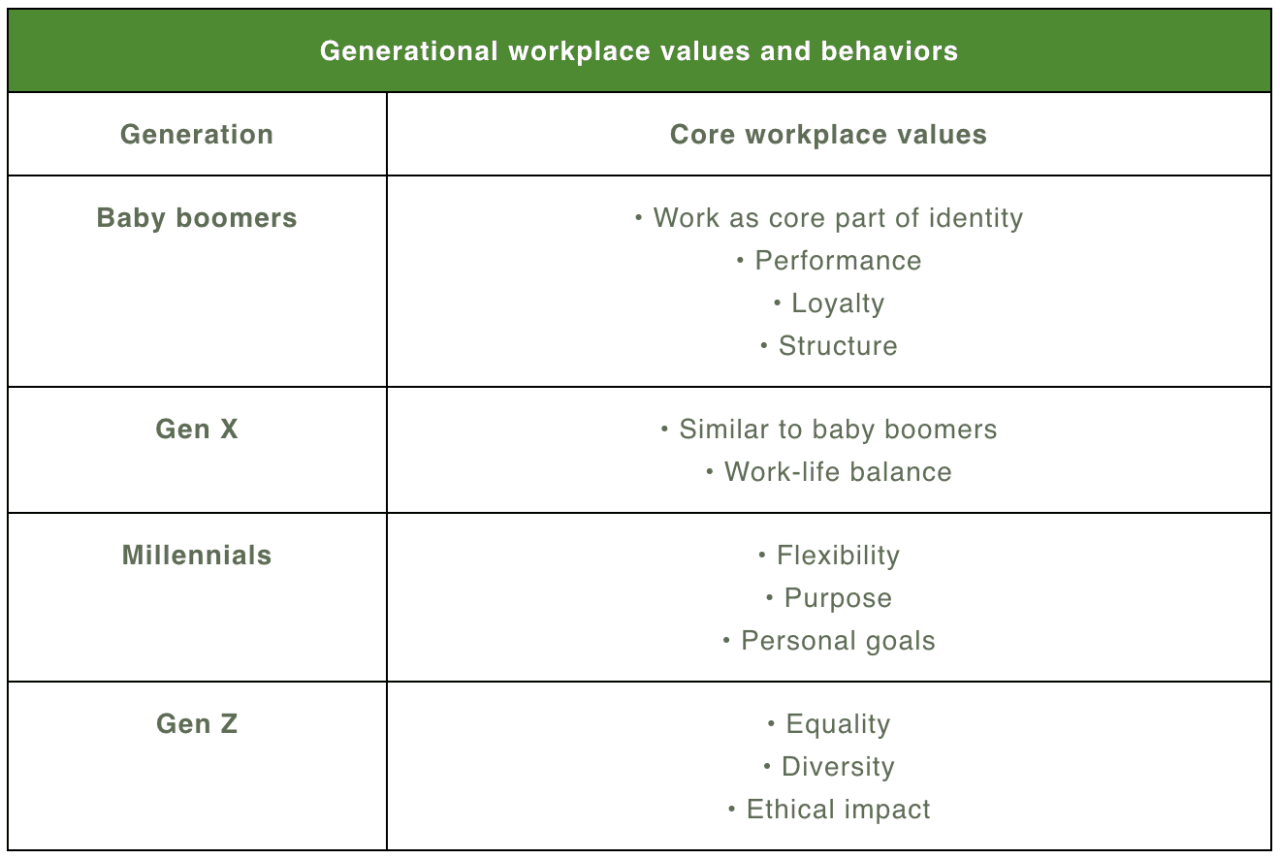
Generational views on work have shifted over time. Baby boomers saw work as a core part of their identity, prioritizing performance, loyalty, and rigid structures. Gen X held similar values but sought more balance between work and life. Millennials, shaped by the digital age, valued flexibility and leaned toward purpose-driven, goal-oriented careers.

Today, Gen Z is entering the workforce with different values, behaviors, and expectations. They prefer digital communication, prioritize equality and diversity, and care deeply about a company’s ethical impact. Gen Z is also more likely to “quiet quit” if their needs aren’t met, or to do only the bare minimum for their role while staying “under the radar.” And when dissatisfaction grows, they’re not afraid to quit without notice or ghost clients.

A table listing generations and their workplace values and behaviors.

Upwork

‍
Why Gen Z rejects “rise and grind”

Gen Z is turning away from hustle culture for several reasons. They’ve entered the workforce during a time of major disruption, seen the impact of burnout firsthand, and are reevaluating what success should look like. Instead of glorifying nonstop work, they are prioritizing mental health, balance, and meaningful experiences that shape how they approach their careers today.

Mental health needs

Gen Z places emotional well-being above professional achievement. When work becomes overwhelming, they’re more likely to step back and reset rather than push through at the expense of their health. According to Mental Health America, 71% of Gen Z workers in the U.S. report the lowest workplace health scores, a clear signal that mental health is a top priority.

Disillusionment with overwork

Gen Z has seen the fallout of hustle culture firsthand. They’ve watched older generations work long hours, suffer burnout, and still face layoffs or limited job security. These experiences have shown that hard work doesn’t always lead to stability or fulfillment, prompting Gen Z to take a more relaxed, intentional approach to work.

Different perceptions of success

Success isn’t just about money for Gen Z. It also means finding meaning and balance. In a recent Deloitte survey, 25% of Gen Z respondents chose their jobs based on work-life balance, while only 19% prioritized salary. For Gen Z, personal fulfillment now ranks nearly as high as financial gain.

Remote work realities

The remote-work strategies forced by the COVID-19 pandemic proved that productivity doesn’t require being in the office. Gen Z entered the workforce during this shift and quickly embraced the efficiency, flexibility, and reduced stress that remote work offers. They’re now less willing to accept rigid schedules and unnecessary office time.

How Gen Z’s work philosophy improves quality, not just comfort

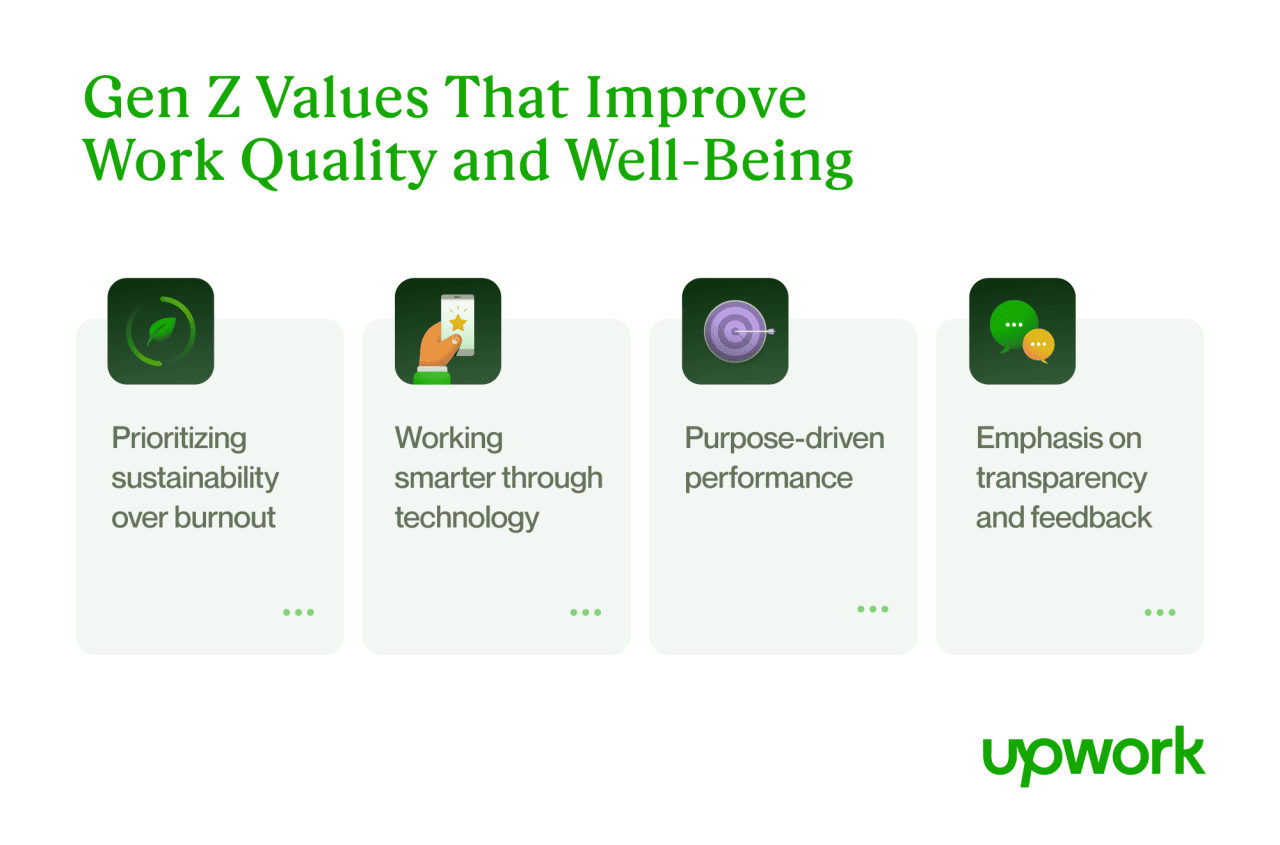
Gen Z isn’t rejecting hard work but rather redefining it on their own terms, setting clear boundaries and choosing roles that promote their well-being. They’re focused on sustainable, high-quality performance that fits in their personal life, not nonstop hustle. This shift is about working smarter, and they’re doing it in a number of ways.

Prioritizing sustainability over burnout

Gen Z is moving away from the hustle mentality that often leads to burnout. Instead of chasing short-term wins through overwork, they focus on maintaining steady, sustainable performance. This approach reduces fatigue and helps them consistently deliver high-quality results within healthy boundaries.

Working smarter through technology

Rather than overworking, Gen Z uses technology to streamline tasks and boost efficiency. Automation tools, digital collaboration platforms, and AI integration help them achieve better outcomes with less wasted time, proving that productivity doesn’t have to come from overextension.

Purpose-driven performance

For Gen Z, meaningful work drives motivation. They perform best in roles that align with their values and allow them to make a real impact. In fact, 89% say a sense of purpose is key to job satisfaction.

Emphasis on transparency and feedback

Gen Z values regular, honest feedback over traditional performance reviews. They prefer ongoing check-ins that allow them to adjust quickly, stay aligned with expectations, and continuously improve their work, resulting in higher quality and fewer missteps.

An infographic on the Gen Z values that improve work quality and well-being.

Upwork

How businesses can collaborate effectively with anti-hustle freelancers

Working with Gen Z freelancers means partnering with talent that values flexibility, mental health, and meaningful work, and that mindset often leads to better creativity, stronger communication, and higher-quality results. These professionals prioritize efficiency over burnout and bring fresh perspectives that can elevate your projects.

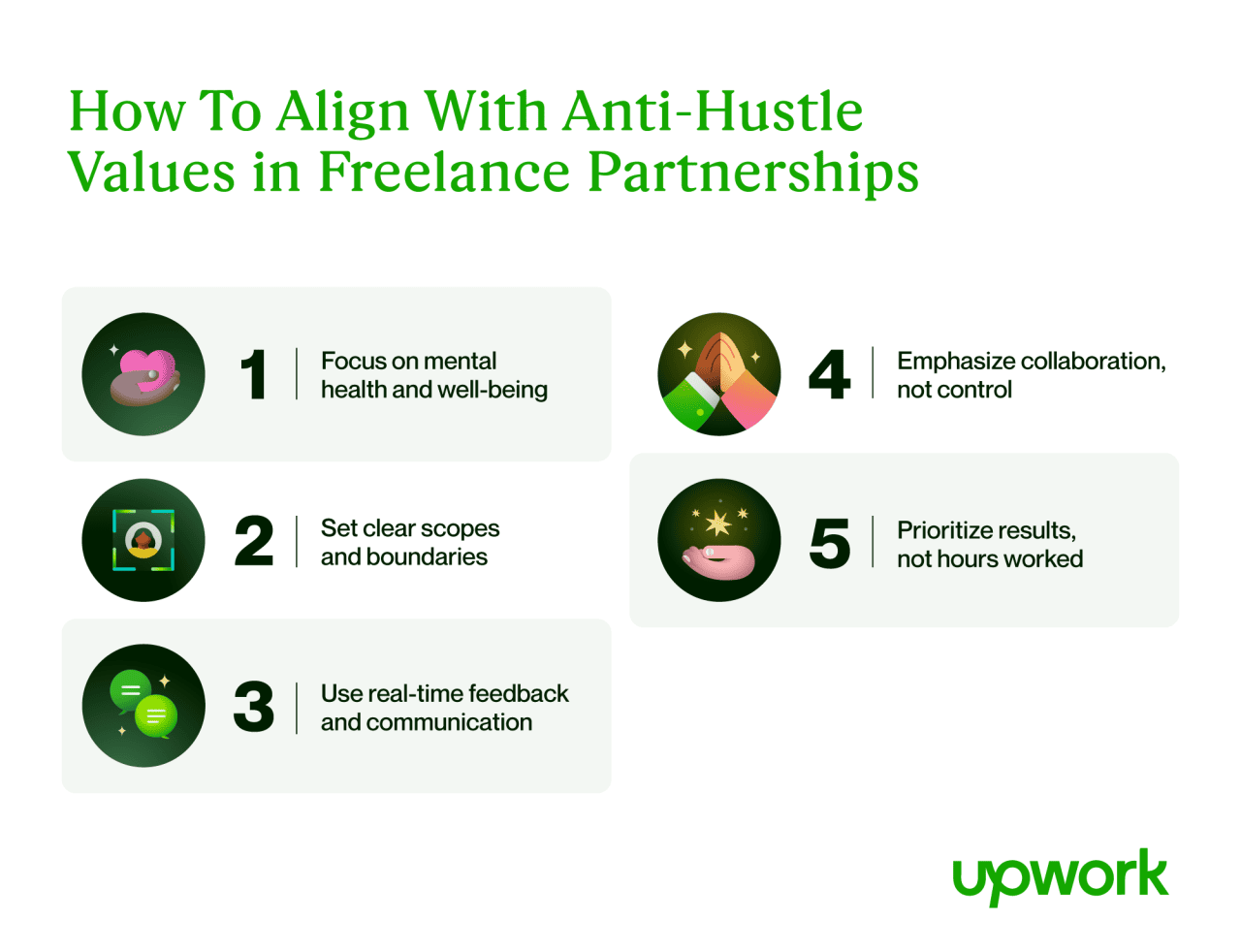
Tip 1: Focus on mental health and well-being

Gen Z freelancers place a high priority on mental and physical health. Foster a healthy working relationship by:

  • Setting realistic deadlines and clear workloads. Avoid last-minute assignments or vague project scopes. For example, instead of saying “ASAP,” agree on specific due dates and outline exactly what deliverables are expected.
  • Encouraging open communication about availability and stress levels. Ask freelancers to share their preferred working hours or if they’re managing multiple projects. Check in periodically by asking, “Is this pace working for you?” or “Do you have the bandwidth for an additional task?”
  • Expressing appreciation for their contributions. Acknowledge good work with quick messages like “Great job on this,” or “Thanks for the quick turnaround, much appreciated.” Positive feedback goes a long way in motivating freelancers and building trust.

Tip 2: Set clear scopes and boundaries

Anti-hustle freelancers thrive with structure. Avoid confusion and unnecessary stress by:

  • Clearly defining project deliverables, timelines, and expectations. Specify what’s needed, when it’s due, and what success looks like. For example, say “a 1,000-word blog post on X topic by Thursday at 3 p.m.,” rather than “a draft sometime next week.”
  • Breaking down projects into milestones. Dividing large projects into smaller, trackable tasks helps freelancers stay organized and focused. This approach also allows for regular check-ins and feedback without overwhelming them.
  • Agreeing on working hours and response times. Ask freelancers for their preferred work hours and clarify yours. Note time zones as well. For example, “Let me know your usual availability, I’m online weekdays 10-6 EST and try to respond within a day.”
  • Respecting off-hours and avoiding unnecessary pings. Don’t send messages late at night or over the weekend unless it’s an emergency or pre-agreed upon. If you do message outside their hours, mention when a reply is needed and that no rush is expected.
  • Sticking to the agreed scope. Don’t add extra tasks without discussing timeline or rate adjustments. Scope creep can lead to stress and frustration. If something changes, ask: “Are you available for an additional task this week? I’m happy to adjust the milestone accordingly.”

Tip 3: Use real-time feedback and communication

Gen Z values ongoing feedback, not just end-of-project evaluations. Improve collaboration by:

  • Giving quick and actionable feedback. Respond to progress updates with clear, specific input. For example, if you were working with a freelance copywriter, say “Let’s tighten the intro to grab attention faster” rather than “This needs work.”
  • Using real-time communication tools. Platforms like Slack, Google Chat, or Microsoft Teams help streamline conversations. Creating a shared feedback loop. Set regular check-in points to review progress and address issues early. A simple mid-project review or weekly sync can help prevent misalignment.
  • Keeping everything in one place. Use shared tools like Google Docs, Notion, or Trello to organize briefs, timelines, and revisions. This minimizes back-and-forth and helps freelancers stay focused.

Tip 4: Emphasize collaboration, not control

Micromanagement undermines trust and limits creativity. Collaborate better with anti-hustle freelancers by:

  • Aligning on shared goals. Instead of detailing how every step should be done, explain what success looks like. For example, if you’re collaborating with a freelance writer, say “I’d like this article to help beginners understand X topic in under five minutes” rather than providing a rigid outline.
  • Involving freelancers in key decisions. Ask for their input on timelines or format. For instance, “Does this delivery date work for you?” or “Would you prefer a Google Doc or Notion setup for tracking edits?”
  • Using tools to guide, not control. Manage tasks with platforms like Asana, Monday.com, or Jira to stay updated without micromanaging. Set deadlines and priorities, then let the freelancer handle execution in their own workflow.

Tip 5: Prioritize results, not hours worked

Gen Z doesn’t equate long hours with high performance. Keep them motivated by:

  • Measuring success by quality and impact. Focus on deliverables, deadlines, and KPIs rather than hours logged. For example, assess a blog post on clarity, SEO performance, and delivery date, instead of the hours it took to write.
  • Setting clear, outcome-based milestones. Break projects into measurable stages, such as “submit draft one by Friday” or “revise visuals based on feedback by next Tuesday.” This keeps expectations transparent and progress easy to track.
  • Allowing flexible work styles. Let freelancers choose how and when they work, as long as the final output meets agreed standards. Whether they work in the morning or late at night shouldn’t matter if the results are strong.

An infographic on how to align with anti-hustle values in freelance partnerships.

Upwork

Anti-hustle doesn’t mean anti-ambition

Gen Z is redefining traditional workplace values by prioritizing work-life balance and mental health instead of nonstop hustling. This shift is not about laziness. These workers are capable, motivated, and able to reach their goals while protecting their well-being and avoiding burnout.

Building successful businesses and increasing productivity among Gen Z starts with respecting their mental health, supporting healthy boundaries, and encouraging open communication and continuous feedback.

FAQ

Why is Gen Z rejecting the traditional hustle culture?

Gen Z is rejecting the hustle culture due to rising mental health awareness, economic instability, and a belief that work shouldn’t come at the cost of well-being. They’ve seen that overworking doesn’t guarantee success or security and prefer flexible, purpose-driven work that fits into their lives.

How do anti-hustle principles affect productivity?

Anti-hustle principles improve productivity by prioritizing mental health, work-life balance, flexibility, and autonomy. When workers feel supported and mentally well, they’re more focused, engaged, and motivated. Clear boundaries help prevent burnout and frustration, leading to steady, high-quality performance over time.

Is anti-hustle the same as quiet quitting?

No. Anti-hustle is a conscious choice to prioritize mental health, balance, and meaningful work; it’s about working smarter, not less. Quiet quitting, on the other hand, is when someone does only the bare minimum because they feel disengaged or undervalued in their role. Anti-hustle aims to improve work quality, not avoid it.

‍Upwork is not affiliated with and does not sponsor or endorse any of the tools or services discussed in this article. These tools and services are provided only as potential options, and each reader and company should take the time needed to adequately analyze and determine the tools or services that would best fit their specific needs and situation.

‍Any individuals mentioned are referenced based on publicly available information at the time of writing. Upwork does not endorse or maintain an ongoing affiliation with them.

This story was produced by Upwork and reviewed and distributed by Stacker.

Topics:

Careers & Education
Careers & Education

Schools that are good at teaching math are also good in reading — and vice versa

Schools that are good at teaching math are also good in reading — and vice versa
By Chad Aldeman for The 74
4 min read • Originally published December 12, 2025 / Updated March 19, 2026
By Chad Aldeman for The 74
4 min read • Originally published December 12, 2025 / Updated March 19, 2026

A collage of a young girl solving math problems using a marker and a young boy reading a math book.

The 74 // Getty images

Schools that are good at teaching math are also good in reading — and vice versa

Many people prefer restaurants that specialize and perfect a certain type of cuisine — they don’t want their barbecue restaurant to offer sushi, and see extensive menus as a worrisome sign of mediocrity.

On the other hand, they may not want a hotel that excels in only one area — they want every hotel they stay at to have clean sheets and towels, hot water and a quiet environment.

What about schools? Are they more like restaurants or hotels? At the high school level, they might be more like restaurants in that they can offer a variety of experiences that allow students to start to develop specialties. But elementary schools should probably be more like hotels and provide consistently strong services — and outcomes — for all kids.

When it comes to the basics of reading and math, how much within-school specialization is there at the elementary levels? That is, are there schools and districts that do a great job of teaching kids to read but maybe aren’t so good at teaching math?

To find out, The 74 looked back at projects that last year identified districts that did an exceptional job of teaching kids to read by third grade and be proficient in math by eighth grade. Among those positive outliers, 140 districts appeared on both of the lists. That is, these districts were producing outstanding results across subjects and grade levels.

In contrast, 14 districts were identified that were exceptional in one subject but significantly underperformed expectations in the other. Among those, 12 of the 14 were strong in math but weak in reading.

To look at school-level results,2025 test scores in the state of Mississippi were used as, a good test to see whether they specialized or were consistently strong, since the state has some of the best schools in the country.

First, reading scores were examined to see if they correlated with performance in math and science. A correlation of 1.0 would mean the two trends were moving in perfect lockstep, while a correlation of 0.0 would suggest that the two variables were not associated with each other at all. As seen in the table below, there were very strong correlations across academic subject areas. For example, the correlation across school-level reading and math scores was 0.87, which suggests a very strong relationship.

A table showing scores for reading, math, and science in Mississippi.

The 74

These results suggest that schools with high test scores in one content area are very likely to also have high test scores in another subject. (And the opposite.) But that doesn’t necessarily reflect how much the school contributes to a student’s scores. It could just be that the school happens to enroll higher- or lower-performing kids.

In Mississippi, the state measures growth using a model called a value table. Essentially, the state created eight performance levels, and schools receive points if they help students advance to higher tiers from one year to the next.

Do schools with high student growth rates tend to see improvement across multiple subject areas? The answer in Mississippi is yes. In the graph below, each dot represents a school that is graphed according to its reading and math growth rates. The closer the dot is to the diagonal line, the closer the relationship between the school’s growth rates in reading and in math.

A data graphic showing math and reading growth in Mississippi schools.

The 74

Note: Data via the Mississippi Department of Education’s 2025 school accountability results for elementary and middle schools.

Although there are a few outliers on both sides, a “good school” tends to be good across subject areas. That is, there are no schools at either the bottom right or top left corners of the graph, where they would be if they were extremely strong in one subject but not the other. For example, among the 50 Mississippi elementary and middle schools that made the greatest gains in reading last year, none of them were below the statewide average in math growth.

The opposite was also true: Among the 50 schools with the lowest reading score gains, only two reached the statewide average in math.

Florida operates a similar accountability system to Mississippi. Similar correlations were found across subject areas.

Both Mississippi and Florida showed strong relationships between a school’s proficiency and student growth scores. However, that could be a function of the specific way those states have chosen to measure student growth, and it’s not always the case that a school with high proficiency scores will also have high growth. In fact, because proficiency rates are highly correlated with socioeconomic status, some researchers prefer growth measures that attempt to truly isolate a school’s impact on student learning.

While questions about how best to measure school performance can be thorny and technical, it does seem to be the case that schools that are strong in one subject tend to be strong in others as well. In an increasingly specialized world, it’s fortunately rare to find a school that’s doing a great job in one subject area and letting kids down in the other.

This story was produced by The 74 and reviewed and distributed by Stacker.

Topics:

Careers & Education
Careers & Education

Side hustles and skills: How today’s college students are redefining success beyond the classroom

Side hustles and skills: How today’s college students are redefining success beyond the classroom
By Karla Fornall for Quizlet
5 min read • Originally published December 17, 2025 / Updated March 19, 2026
By Karla Fornall for Quizlet
5 min read • Originally published December 17, 2025 / Updated March 19, 2026

A college-age person wearing a crisp white shirt and headphones around his neck and bright white shoes sits on the side-facing seats in public transportation looking attentively at phone.

sabthai // Shutterstock

Side hustles and skills: How today’s college students are redefining success beyond the classroom

Between their classes, jobs, side hustles, hobbies, and other on-campus or extracurricular activities, today’s college students face unprecedented demands on their time and energy — a pressure that only grows during finals season. Yet despite managing these multiple commitments, this generation continues to battle negative perceptions about their work ethic and potential.

Quizlet, the global learning platform serving millions of students, recently conducted the “Modern Student Experience” survey to examine how Gen Z college students balance their various responsibilities and what drives their decisions about time and priorities. The research surveyed 2,000 U.S. respondents between ages 18 and 28, with half currently enrolled in college and half having graduated within the past five years.

The findings of the report reveal a generation that defies common stereotypes, showing high levels of ambition, strategic thinking about their futures, and a willingness to make significant sacrifices for professional success. Rather than the unfocused, social media-obsessed demographic often portrayed in popular culture, the data highlight a generation who prioritizes skill-building, professional development and meaningful career preparation.

Infographic explaining that 55% of gen z students have a job outside of their coursework.

Quizlet

Students Are Stretched Thinner Than Ever

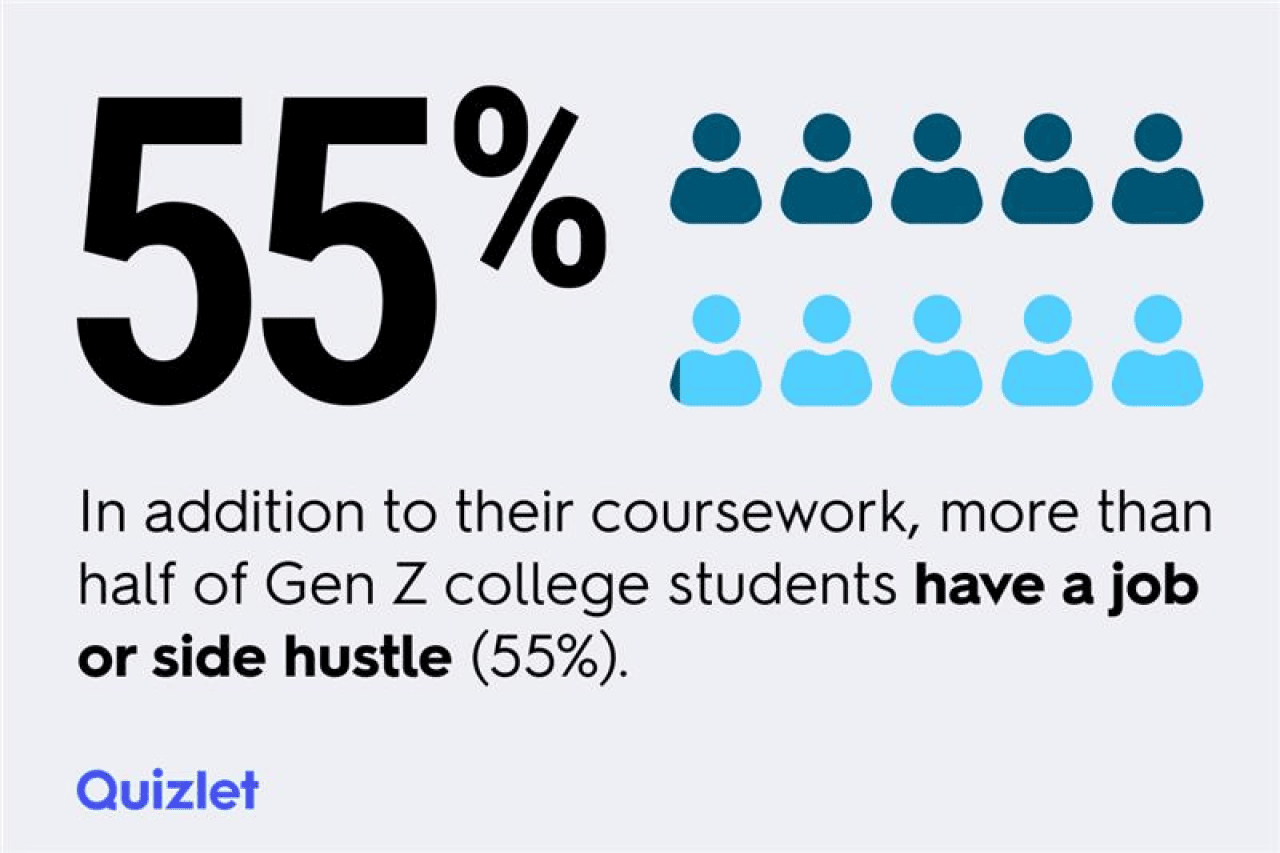
The survey reveals that modern college students are managing unprecedented levels of responsibility across multiple areas of their lives. More than half of Gen Z college students maintain a job or side hustle alongside their studies (55%). Among students participating in on-campus organizations — including honors societies, sports teams, Greek life and other groups — 58% are involved in two or more organizations.

Beyond formal commitments, Gen Z students actively pursue skill development in areas their coursework may not address. Nearly half (45%) focus on learning practical life skills such as cooking, budgeting and time management, while 44% work to develop social and interpersonal skills including leadership, teamwork and communication.

These multiple commitments create a generation that has learned to manage complex schedules, prioritize competing demands, and develop time management skills that may serve them well in future career environments.

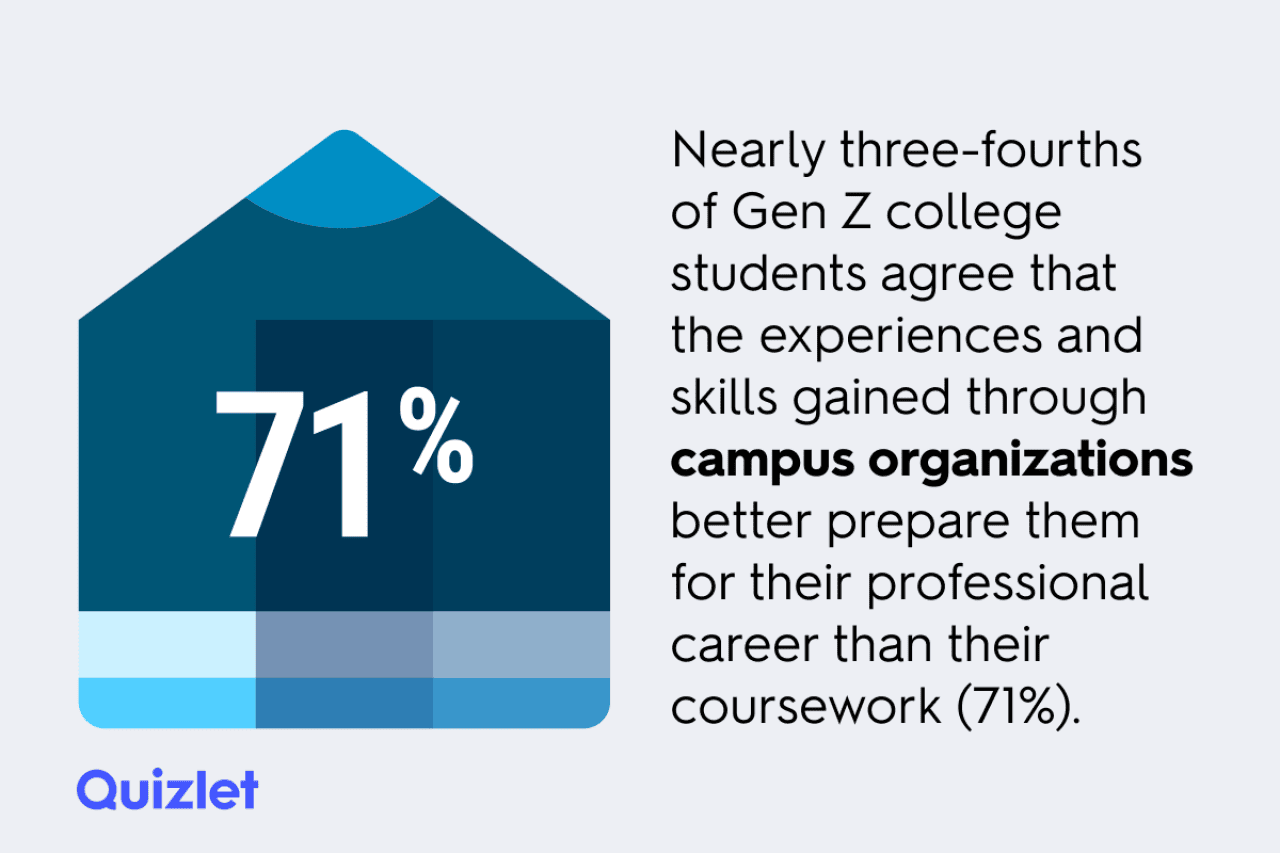
Infographic stating that 71% of Gen Z college students say their campus organization experience prepares them for their career more than their coursework.

Quizlet

Side Hustles Offer More Value Than Some Classes

Rather than viewing these responsibilities as distractions from education, students appear to see them as complementary to their academic goals. In fact, the survey data reveals a striking disconnect between traditional academic structures and what students perceive as most valuable for their career preparation. Nearly three-quarters of Gen Z college students involved in campus organizations (71%) believe the experiences and skills gained through these activities better prepare them for their professional career than their coursework.

This finding suggests students are making strategic calculations about where to invest their time and energy. While maintaining academic performance remains important, they’re recognizing that hands-on experiences, leadership opportunities and practical skill development may provide more tangible career benefits than some classroom learning.

The emphasis on nonacademic experiences aligns with Gen Z’s vision for the future of work, which prioritizes work-life balance and meaningful professional development. When asked about changes they hope to make in the workforce, 20% of respondents identified better work-life balance as their top priority, followed by higher pay or pay transparency (15%) and increased opportunities for career growth (13%).

This perspective on work-life balance represents a significant shift from previous generations’ approaches to career building. Instead of simply accepting traditional models of professional advancement that may require sacrificing personal time and well-being, Gen Z appears committed to creating sustainable career paths that align with their values and lifestyle goals.

Their preference for experiential learning and practical skill development also reflects an understanding that the modern workplace rewards adaptability, collaboration and real-world problem-solving abilities—qualities that may be better developed through internships, leadership roles and project-based work than through traditional lecture-based courses.

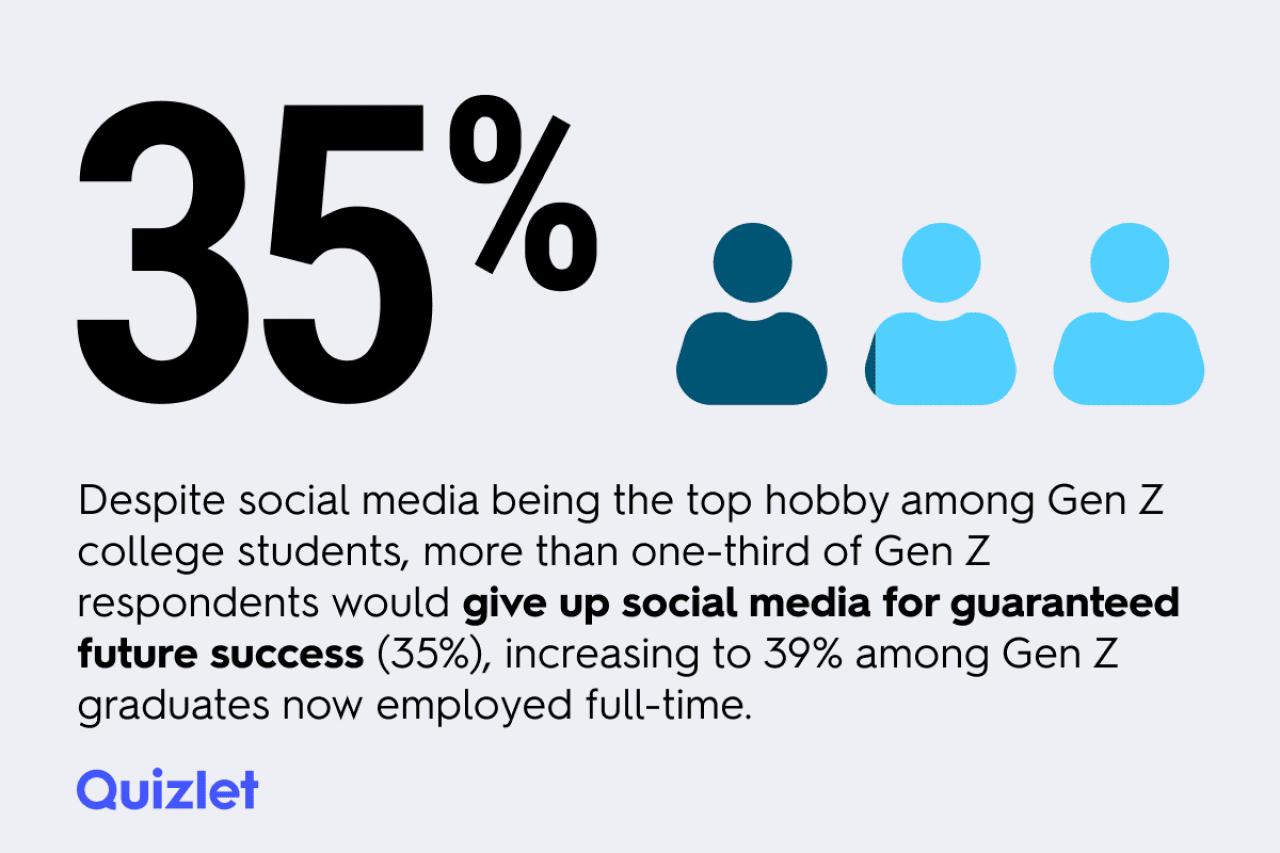
Infographic showing that 35% of gen z college students would give up social media for guaranteed future success, despite many enjoying it as a top hobby.

Quizlet

Students Are More Ambitious Than Older Generations Assume

Contrary to stereotypes about Gen Z’s priorities and work ethic, the survey reveals a generation with strong professional ambitions and strategic decision-making abilities. Two-thirds of Gen Z students (64%) would prioritize a professional opportunity over a social activity when faced with competing demands, demonstrating their commitment to career advancement even when it requires personal sacrifices.

Perhaps most surprisingly, despite social media ranking as the top hobby among Gen Z college students, more than one-third (35%) would give up social media entirely for guaranteed future success. This finding directly challenges assumptions about this generation’s relationship with technology and social platforms, suggesting they view these tools as optional rather than essential to their identity or well-being.

These choices reflect a level of strategic thinking and long-term planning that contradicts common narratives about Gen Z being impulsive, instant-gratification-focused, or unable to delay rewards for future benefits. Instead, the data shows students are willing to make significant lifestyle changes and social sacrifices to achieve their professional goals.

The willingness to prioritize professional development over social activities also suggests this generation may approach networking and relationship-building differently than their predecessors. Rather than viewing social connections as separate from professional advancement, they may be more likely to seek opportunities that combine social engagement with career development, such as professional organizations, industry events or skill-building workshops.

This ambitious mindset, combined with their experience managing multiple responsibilities and their focus on practical skill development, positions Gen Z as a generation that may bring valuable perspectives and capabilities to the workforce—if employers can recognize and leverage these strengths rather than focusing on generational stereotypes.

Methodology

Quizlet partnered with global research and communications firm Allison Worldwide, whose Performance+ Intelligence team surveyed 2,000 U.S. respondents between the ages of 18 and 28. Half of the respondents (1,000 individuals) are students currently enrolled in college, and half (1,000 individuals) have graduated from college within the last five years and are now working full time. The survey was fielded using Forsta and the panel was sourced from RepData. Fielding took place in August and September 2025.

This story was produced by Quizlet and reviewed and distributed by Stacker.

Topics:

Careers & Education
Entertainment

What it costs to live in America’s iconic holiday movie towns

What it costs to live in America’s iconic holiday movie towns
By Jamie Forbes for Redfin Real Estate
7 min read • Originally published December 17, 2025 / Updated March 19, 2026
By Jamie Forbes for Redfin Real Estate
7 min read • Originally published December 17, 2025 / Updated March 19, 2026

Person poses with the classic

Michael Gordon // Shutterstock

What it costs to live in America’s iconic holiday movie towns

Picture your favorite holiday movie. Maybe it’s a scene from “Home Alone” in Illinois, or one of the dozens of Hallmark films set in small-town New England (even though many are filmed in Canada). You probably remember them for their snow, romance, humor, and festive miracles — they may have even made you want to visit or live in the towns they depict.

But what are these places like in real life? If you were to move to one of these places today, could you afford to settle down, or would the price tag break the holiday spell?

Redfin Real Estate explores how affordable some of the most iconic movie towns really are. From timeless classics to contemporary hits, cozy up and take a snow-covered journey that may make you think about things a little differently.

1. “Home Alone” (1990) – Winnetka, Illinois

  • Median sale price: $1,758,000
  • Median household income: $250,000

You may remember the classic brick homes and snow-covered lawns of the “Home Alone” world, where Kevin fended off two bumbling burglars and learned to outsmart the grown-ups around him.

The movie is set in real-life Winnetka, Illinois, and on the surface, it might seem like a great place to live. But most people would have a hard time affording it. Homes regularly sell in the millions in this upscale suburb, and six-figure salaries are the norm. In fact, the real-life home of the fictional McCallister family, dubbed the “Home Alone house,” sold for $5.5 million in early 2025.

On the whole, Chicago is relatively affordable, but its suburbs are often wealthy and defined by classic American architecture.

2. “It’s a Wonderful Life” (1946) – Seneca Falls, New York

  • Median sale price: $260,000
  • Median household income: $54,400

This holiday classic is set in the fictional town of Bedford Falls, which is commonly thought to be based on Seneca Falls in Upstate New York — a quiet, snowy hamlet full of small-town charm. The real-life town even celebrates its Hollywood connection with a dedicated museum and large annual festival.

If you saw the movie’s quaint streets, string lights, and old-school charm and thought it would be a nice place to visit or live, you’re in luck. Seneca Falls’ median sale price is nearly half the national rate, similar to nearby cities like Rochester and Syracuse.

3. “A Christmas Story” (1983) – Cleveland, Ohio

  • Median sale price: $249,000
  • Median household income: $67,586

While the movie is set in 1940s Indiana, much of “A Christmas Story” was filmed in Cleveland, giving the city a permanent place in holiday movie history. The iconic house — now a museum — is tucked into the Tremont neighborhood just minutes from downtown. You can even spend the night and wake up in a pink bunny suit holding a Red Ryder BB gun, just like Ralphie dreamed.

For those interested in recreating the Christmas magic, Cleveland is a very affordable place to live, regularly ranking as one of the most affordable big cities in the country.

4. “Elf” (2003) – New York

  • Median sale price: $770,000
  • Median household income: $81,228

A more modern classic, “Elf” is all about discovering the magic of the Big Apple: towering Christmas trees, sparkling storefronts, and big-city holiday fun. It was filmed on location throughout NYC, giving it a real-world feel.

The Hobbs family’s home is located at 55 Central Park West, a landmarked building adjacent to Central Park. It’s a prime location for city living, but would be difficult to afford today — a studio condo costs nearly $800,000. And on the whole, New York is one of the most expensive cities in the nation.

Numerous other holiday movies have been set in New York over the years, including “Miracle on 34th Street” (1947), “Scrooged” (1988), and “Home Alone 2: Lost in New York” (1992).

5. “Romance at Reindeer Lodge” (2017) – Jamaica, Vermont

  • Median sale price: $400,000
  • Median household income: $71,364

Vermont has played host to plenty of holiday movies, but nearly all of them have been set in fictional places. “Romance at Reindeer Lodge” is one of the rare ones set in a lodge in the real-life town of Jamaica, Vermont — even though it was actually filmed in Connecticut. The movie is full of snowy landscapes and rustic charm.

Jamaica is a very rural town in mountainous southwestern Vermont, surrounded by ski resorts, parks, and quaint bed-and-breakfasts. It’s relatively affordable but primarily home to part-time residents or remote workers. Buying a house will cost around $400,000, which is just below the national rate.

6. “Christmas in Conway” (2013) – Wilmington, North Carolina

  • Median sale price: $470,000
  • Median household income: $63,165

“Christmas in Conway” is a quintessential Hallmark movie: small-town charm, big romantic gestures, and a lovestruck community. It was filmed throughout the Wilmington area, using its landmarks and coastal charm to bring the story to life.

Wilmington has actually served as the backdrop of numerous other Hallmark films, including “Christmas in Harmony” (2021) and “USS Christmas” (2020). The historic port city prides itself on its holiday spirit, especially along the Riverwalk, where trees, boats, and buildings are all adorned with thousands of lights and events are held nearly every day.

If the movie magic gave you the itch to make the move, Wilmington is thankfully a relatively affordable place to buy a house. The median sale price is just above the national average, and household incomes come close to matching the cost.

7. “A Biltmore Christmas” (2023) – Asheville, North Carolina

  • Median sale price: $450,000
  • Median household income: $78,996

Set in the Blue Mountains of North Carolina, “A Biltmore Christmas” follows a screenwriter researching a classic holiday film who magically steps into its world. It was filmed at the famous Biltmore Estate in Asheville, North Carolina.

The Biltmore Estate is a real-world escape to an age of romance and Gilded Age extravagance. It was commissioned by business tycoon George Vanderbilt in the late 19th century and today is the largest privately owned home in the U.S., at over 175,000 square feet. You can tour it year-round, and it is highly decorated for the holiday season.

If you fell in love with the movie and gorgeous scenery, you’re in luck: Asheville is moderately priced for the region, with home costs and incomes fairly well aligned.

8. “Christmas at Dollywood” (2019) – Pigeon Forge, Tennessee

  • Median sale price: $555,000
  • Median household income: $53,839

“Christmas at Dollywood” is a Hallmark classic about new beginnings and unexpected romance. The movie is set and filmed in the namesake Dollywood Parks & Resorts, which is located in Pigeon Forge near Tennessee’s Great Smoky Mountains.

The film mirrors reality in many ways: Dolly Parton plays herself as the park’s owner — she is the real-life part-owner — as the resort gears up for its Smoky Mountains Christmas festival, which is actually a beloved tradition in the region. Plus, it does snow in Pigeon Forge, as the movie depicts, although usually just for a day or so.

If the movie gave you the itch to move, it may be difficult to buy a house, unfortunately. Pigeon Forge is more expensive than nearby major cities like Knoxville, and the median sale price is about $100,000 above the national average.

9. “The Polar Express” (2004) – Durango, Colorado

  • Median sale price: $733,000
  • Median household income: $79,545

“The Polar Express” is a fantastical film full of childlike curiosity and believing in the impossible, and that spirit carries into the real world, too: You can actually ride the famous train. Running from mid-November through the new year, the train leaves from Durango, Colorado, and takes passengers on a festive 75-mile journey to the “North Pole” (Silverton, Colorado).

Other “Polar Express” recreations occur throughout the country, from Chicago to St. Louis, but Durango’s is iconic because of its snow, landscape, and magical destination.

Buying a house in this winter wonderland may prove difficult, though, as the median sale price of a home is nearly twice the national average. Incomes don’t come close to meeting the affordability threshold, either.

10. Most Other Holiday Movies – Towns in Connecticut

  • Median sale prices: $278,000 to $2,238,000
  • Median household incomes: $41,972 to $250,000+
  • Statewide median sale price: $460,000
  • Statewide median household income: $91,665

If there were one state synonymous with modern Christmas movies, it would be Connecticut. Over the years, 22 films have been filmed throughout the state, including “Christmas on Honeysuckle Lane” (2018), “One Royal Holiday” (2020), and “The Noel Diary” (2022). “Christmas in Connecticut” (1945) was arguably the first movie to bring the holiday spirit to the state.

It’s not hard to see why Hollywood likes the Constitution State. Historic towns like Stamford, Norwich, Hartford, and New London offer perfect backdrops for holiday magic, with storybook architecture and snowy New England charm. You can actually take a tour of all 42 towns and villages in Connecticut where holiday movies have been filmed to fully indulge in the wonder.

If you fell in love with the region’s colonial charm, you’ll be pleased to know that many areas of Connecticut come at lower costs, like Woodstock and Groton. On the flip side, Darien and Stamford are among the most expensive places, with prices and incomes far above the statewide median.

Methodology

Housing market data comes from Redfin as of November 2025. Income data comes from the U.S. Census Bureau’s 2023 American Community Survey 5-Year Estimates.

This story was produced by Redfin Real Estate and reviewed and distributed by Stacker.

Topics:

Entertainment
Careers & Education

Gen Z earnings premium: Cities where young workers are excelling

Gen Z earnings premium: Cities where young workers are excelling
By Jaclyn DeJohn, CFP for SmartAsset
4 min read • Originally published December 18, 2025 / Updated March 19, 2026
By Jaclyn DeJohn, CFP for SmartAsset
4 min read • Originally published December 18, 2025 / Updated March 19, 2026

An aerial view of Hollywood Beach, Florida on a clear day.

Felix Mizioznikov // Shutterstock

Gen Z earnings premium: Cities where young workers are excelling

While some members of Gen Z may still be working entry-level jobs while attending high school or college, much of this cohort has now entered the workforce in earnest. As the least experienced generation on the schedule, Gen Z is generally paid less than their older counterparts, with this holding true in 93% of cities. But in a handful of locations, Gen Z offers skills and expertise — and sometimes youth itself — that help these workers pull ahead against the odds and earn more than older generations.

With this in mind, SmartAsset ranked 354 of the largest U.S. cities based on the percentage difference between the local median income for people aged 15 to 24 compared to the rest of the local population.

Key Findings

  • Gen Z earns a 70% premium in Hollywood, Florida. The median Gen Z household earned $121,317 in Hollywood in 2024, compared to $71,067 for all households — a 70.7% difference. Clearwater, Florida, has the second-highest advantage for Gen Z households with a 58.7% disparity. Young households earned $105,280 compared to a $66,357 median across all households.
  • In all, Gen Z out-earns other generations in 7% of cities. While it’s rare for young up-and-comers to outperform older households for income, some economic dynamics make it possible. Studywide, Gen Z had a positive earnings premium in 24 out of 354 cities, with roughly half in Florida or California. Others include Federal Way, Washington; Lynn, Massachusetts; Kent, Washington; Fort Wayne, Indiana; Newport News, Virginia; Jackson, Michigan; and Brownsville, Texas, among others.
  • The median Gen Z income in this city is over $160,000. Gen Z earns the most in Sunnyvale, California, where the median income for that age group is $162,486. However, this is 10.2% lower than the median income across all households in this high-earning city ($181,022). This negative earnings premium puts Sunnyvale at the 37th best overall for Gen Z’s earnings.
  • The median Gen Z income is less than $50,000 in more than half of cities. For most young people, income tends to be lower than across all households. People aged 15 to 24 are generally at the bottom of the earnings totem poll. In fact, the median Gen Z income is lower than the 2024 U.S. median household income in 91% of cities surveyed.

A list of 25 U.S. cities ranked based on the percentage difference in annual median income for Gen Z households versus all local households in 2024.

SmartAsset

24 Cities Where Gen Z Makes More Than the Median Household

Out of 354 cities, Gen Z earns more than their older counterparts in just a handful of places.

  1. Hollywood, Florida
  • Gen Z earnings premium: 70.71%
  • Median Gen Z income: $121,317
  • Median household income: $71,067
  1. Clearwater, Florida
  • Gen Z earnings premium: 58.66%
  • Median Gen Z income: $105,280
  • Median household income: $66,357
  1. Rio Rancho, New Mexico
  • Gen Z earnings premium: 43.24%
  • Median Gen Z income: $140,907
  • Median household income: $98,374
  1. Moreno Valley, California
  • Gen Z earnings premium: 37.26%
  • Median Gen Z income: $127,262
  • Median household income: $92,716
  1. Federal Way, Washington
  • Gen Z earnings premium: 34.92%
  • Median Gen Z income: $120,105
  • Median household income: $89,022
  1. Lynn, Massachusetts
  • Gen Z earnings premium: 23.14%
  • Median Gen Z income: $90,314
  • Median household income: $73,340
  1. Lehigh Acres, Florida
  • Gen Z earnings premium: 19.29%
  • Median Gen Z income: $84,460
  • Median household income: $70,800
  1. Inglewood, California
  • Gen Z earnings premium: 16.88%
  • Median Gen Z income: $81,069
  • Median household income: $69,362
  1. Tracy, California
  • Gen Z earnings premium: 16.08%
  • Median Gen Z income: $140,202
  • Median household income: $120,776
  1. Deltona, Florida
  • Gen Z earnings premium: 15.15%
  • Median Gen Z income: $88,026
  • Median household income: $76,446
  1. Palm Coast, Florida
  • Gen Z earnings premium: 13.06%
  • Median Gen Z income: $92,801
  • Median household income: $82,083
  1. Visalia, California
  • Gen Z earnings premium: 9.87%
  • Median Gen Z income: $93,146
  • Median household income: $84,781
  1. Hesperia, California
  • Gen Z earnings premium: 9.71%
  • Median Gen Z income: $79,056
  • Median household income: $72,059
  1. Kent, Washington
  • Gen Z earnings premium: 6.99%
  • Median Gen Z income: $98,967
  • Median household income: $92,497
  1. Fort Wayne, Indiana
  • Gen Z earnings premium: 6.86%
  • Median Gen Z income: $65,648
  • Median household income: $61,436
  1. Hialeah, Florida
  • Gen Z earnings premium: 6.26%
  • Median Gen Z income: $60,727
  • Median household income: $57,151
  1. Newport News, Virginia
  • Gen Z earnings premium: 6.25%
  • Median Gen Z income: $73,234
  • Median household income: $68,927
  1. New Bedford, Massachusetts
  • Gen Z earnings premium: 4.96%
  • Median Gen Z income: $60,077
  • Median household income: $57,240
  1. Waterbury, Connecticut
  • Gen Z earnings premium: 4.62%
  • Median Gen Z income: $50,092
  • Median household income: $47,881
  1. Corona, California
  • Gen Z earnings premium: 3.36%
  • Median Gen Z income: $106,984
  • Median household income: $103,507
  1. Antioch, California
  • Gen Z earnings premium: 3.13%
  • Median Gen Z income: $101,070
  • Median household income: $97,998
  1. Jackson, Mississippi
  • Gen Z earnings premium: 2.75%
  • Median Gen Z income: $45,739
  • Median household income: $44,516
  1. Brownsville, Texas
  • Gen Z earnings premium: 0.7%
  • Median Gen Z income: $59,908
  • Median household income: $59,491
  1. Lafayette, Louisiana
  • Gen Z earnings premium: 0.2%
  • Median Gen Z income: $59,564
  • Median household income: $59,445

Data and Methodology

Data comes from the U.S. Census Bureau 1-Year American Community Survey for 2024. The median household income for households where the main householder is aged 15 to 24 is compared to the median household income across all local households to determine the Gen Z earnings premium. Data for 354 U.S. cities with a population over 100,000 was available.

This story was produced by SmartAsset and reviewed and distributed by Stacker.

Topics:

Careers & Education
Careers & Education

Keep getting texts about job offers? Don’t fall for this common scam

Keep getting texts about job offers? Don’t fall for this common scam
By Dan Ketchum for Spokeo
5 min read • Originally published December 23, 2025 / Updated March 19, 2026
By Dan Ketchum for Spokeo
5 min read • Originally published December 23, 2025 / Updated March 19, 2026

A person about to hit send to a message on their phone that says,

Celia Ong // Shutterstock

Keep getting texts about job offers? Don’t fall for this common scam

Scammers love to prey on hope, and with a 4.3 percent unemployment rate in the U.S. as of August 2025, they’ve got a lot of hopeful job seekers to pounce on. No matter the economic environment, though, job offer scams are a perennial favorite of sketchy grifters — the latest model just so happens to come in the form of a fake job text message, and it can seem rather convincing, too.

Got a text out of the blue about a potential job at your dream company? If it’s an opportunity that sounds too good to be true, that’s because it probably is. Spokeo explains how to know for sure.

Key Takeaways:

  • Text-based job offer scams are on the rise.
  • The latest job offer scams pose as recruiters or dream companies offering cushy jobs.
  • They’re actually phishing scams out to get your valuable private information.

Job Text Scams: How They Work

The latest string of job offer scams has gotten so prevalent that the Federal Trade Commission issued a warning to help keep job hunters from getting their hearts broken and their bank accounts drained. The most recent popular iteration of the scam is a fake job text message from a phony “recruiter” or a dream job-worthy company. Here’s how it works:

  1. Victims get an unsolicited text, seemingly out of the blue.
  2. Said text claims to be from a job recruiting service, such as Indeed or ZipRecruiter, or from a popular company with dream job vibes (think Netflix or Apple) and often describes a cushy-sounding gig with a nice pay rate.
  3. The job description will be vague and suspiciously easy to fulfill. Slate describes a common example seeking “remote product testers” who only need to work for an hour or two a day to earn up to $400 daily by “reviewing new products or services online.” NPR, meanwhile, came across one that offered pay just for listening to songs on Spotify. Both are bogus.
  4. Once you apply, the scammers will let you know you’ve been “hired” (spoiler: everyone gets the “hired”), at which point they will ask for all sorts of sensitive private information (bank info, social security number, etc.).
  5. Alternatively, the link is just a phishing link, aimed at gathering your private information or installing malware onto your device.

What Do They Want?

Crooks aren’t sending out fake job text messages for fun. By and large, job offer scams are designed to obtain your valuable private information as a form of phishing. If you get lured in and respond to a job text scam, the scammer will most likely attempt to move you on to an “application” phase. Typically, this happens via a professional-looking online form, email, or an external chat app, like iMessage or WhatsApp. In order to “apply,” you’ll be prompted to provide sensitive, private information, which the grifter can then use to commit identity theft, most likely in an attempt to access your finances.

In some versions of job offer scams, the scammer will even offer to give you a portion of your future paycheck upfront, but to do so, they’ll need your bank account information. Of course, in the end, you’ll be the one paying them, against your will. In either case, your best bet is to avoid responding, period — block and report job text scams on sight.

How to Know If a Job is a Scam

When it comes to fake job text messages, the usual giveaways still apply. Things like typos, fishy-looking links or email domains (look for slight misspellings of real company or brand names, like “Inedeed” dot com instead of “Indeed” dot com), or “act now!” pressure tactics should make you give a very stern side-eye.

But on a level more specific to these text-based job offer scams from “recruiters,” keep your eyes peeled for these potential red flags:

  • The job description sounds a little too easy, a little too well paid, or a little too good to be true.
  • It’s a job you didn’t apply for or appears to be from a recruiter you haven’t used.
  • The text is sent as part of a group chat, with multiple people gassing up the apparent company or job offer.
  • The text directs you to external platforms like WhatsApp, iMessage, or WeChat.
  • The texter has a non-U.S. country code. For instance, +91 is a message from India, while +63 is from the Philippines — both countries known for having high scam text activity.
  • If an email address is given, the domain is a personal or free service, like “@gmail.com” or “@yahoo.com” instead of an official company domain.
  • The recruiter is one you’ve never heard of, and a Google search for said “recruiter” comes up dry or produces accounts of previous scams.
  • The sender asks for any sort of private information before you have an interview.
  • You’re immediately “hired” without any form of a legitimate interviewing process.

Frequently Asked Questions About Job Scam Texts

Just like a real job interview, the much phonier world of job text scams elicits a lot of questions, and reasonably so. Here are some of the most common queries people search for when it comes to job offer scams.

Is it legal for your employer to text you?

Yes, though some states have proposed “right-to-disconnect” laws that could limit employer texts outside of business hours. However, the keyword here is “employer,” not random recruiters or job offers out of the ether.

Is it normal for jobs to text you?

While recruiting sites that you actually signed up for may send automated texts if you opted in to them, most legit employers do not send job offers via text — especially some of the bigger and shinier companies that job text scams like to name drop.

How do you report fake job offers?

When you block the number (and you should block the number), make sure to mark it as spam to help improve automatic spam detection for others across the board. You can also forward the text to 7726 (“SPAM”) or file a report at ReportFraud.ftc.gov.

This story was produced by Spokeo and reviewed and distributed by Stacker.

Topics:

Careers & Education

Posts navigation

Older posts
Newer posts
Featured Jobs
Kirkus Media
Editorial Intern
Kirkus Media
New York City, New York (US)

Gaia Inc
MEDIA COORDINATOR
Gaia Inc
Louisville, CO

Gaia Inc
Global Paid Media Specialist
Gaia Inc
Louisville, CO

Gaia Inc
Director of Media Strategy
Gaia Inc
Louisville, CO

Hearst Television
Account Executive
Hearst Television
Milwaukee, WI, United States

All Jobs »
PREMIUM MEMBER

Margaret Littman

Nashville, TN
27 Years Experience
Curiosity, skill and luck have allowed me to spend decades exploring eclectic topics ranging from the nutritional habits of female winter Olympians...

View Full Profile »
Join Mediabistro Membership Today

Stand out from the crowd with a premium profile

Mediabistro Logo Find your next media job or showcase your creative talent
  • Job Search
  • Hot Jobs
  • Membership
  • Newsletter
  • Career Advice
  • Media News
  • Hiring Tips
  • Creative Tools
  • About
Facebook YouTube Instagram LinkedIn
Copyright © 2026 Mediabistro
  • Terms of Use
  • Terms of Service
  • Privacy