Mediabistro Logo Mediabistro Logo
  • Jobs
    Search Creative Jobs Hot Jobs Remote Media Jobs Create Job Alerts
    Job Categories
    Creative & Design Marketing & Communications Operations & Strategy Production Sales & Business Development Writing & Editing
    Quick Links
    Search All Jobs Remote Jobs Create Job Alerts
  • Career Resources
    Career Advice & Articles Media Industry News Media Career Interviews Creative Tools Resume Writing Services Interview Coaching Job Market Insights Member Profiles
  • Mediabistro Membership
    Membership Overview How to Pitch (Premium Tool) Editorial Calendars (Premium Access) Courses & Training Programs Membership FAQ
  • Showcase
    Featured Creative Stories Submit your Story
  • Log In
Post Jobs
Mediabistro Logo Mediabistro Logo
Search Creative Jobs Hot Jobs Remote Media Jobs Create Job Alerts
Job Categories
Creative & Design Marketing & Communications Operations & Strategy Production Sales & Business Development Writing & Editing
Quick Links
Search All Jobs Remote Jobs Create Job Alerts
Career Advice & Articles Media Industry News Media Career Interviews Creative Tools Resume Writing Services Interview Coaching Job Market Insights Member Profiles
Membership Overview How to Pitch (Premium Tool) Editorial Calendars (Premium Access) Courses & Training Programs Membership FAQ
Featured Creative Stories Submit your Story
Log In
Post Jobs
Log In | Sign Up

Follow Us!

Entertainment

The impact of the One Big Beautiful Bill Act on HSA and FSA benefits

The impact of the One Big Beautiful Bill Act on HSA and FSA benefits
By Taylor Britt for The Difference Card
9 min read • Originally published February 4, 2026 / Updated March 19, 2026
By Taylor Britt for The Difference Card
9 min read • Originally published February 4, 2026 / Updated March 19, 2026

3D illustration of a row of HSA, FSA, discount cards.

robertindiana // Shutterstock

The impact of the One Big Beautiful Bill Act on HSA and FSA benefits

The One Big Beautiful Bill Act (OBBBA) significantly reshapes U.S. healthcare savings. It makes the most substantial update to health savings account (HSA) and flexible spending account (FSA) benefits in over a decade. The OBBBA revises eligibility, contribution limits, and plan design for employers, brokers, and benefit administrators. It also expands access and flexibility for employees amid rising healthcare and dependent care costs.

Here, The Difference Card explains the OBBBA’s impact on HSA and FSA benefits. Find out how this creates new opportunities for tax-advantaged savings, especially for families managing child care costs and individuals relying on telehealth or nontraditional care models.

How the OBBBA Is Impacting HSA and FSA

Signed into law in late 2025, the OBBBA broadly addresses healthcare affordability by updating multiple account-based programs. This includes expanded HSA eligibility and a permanent increase in the dependent care FSA reflecting modern child care and eldercare costs.

At a high level, the law focuses on three goals. First, it removes barriers that exclude people from using telehealth and alternative care models. Second, it recognizes lower-cost insurance options as compatible with an HSA. Third, it increases tax-advantaged savings for working families.

Legislatively, the OBBBA amends the Internal Revenue Code sections governing HSA and FSA benefits. IRS Notice 2026-5 clarifies implementation details, provides operational guidance, defines key terms, and offers transition relief. Employers should review both, as the notice addresses practical questions the statute leaves unanswered.

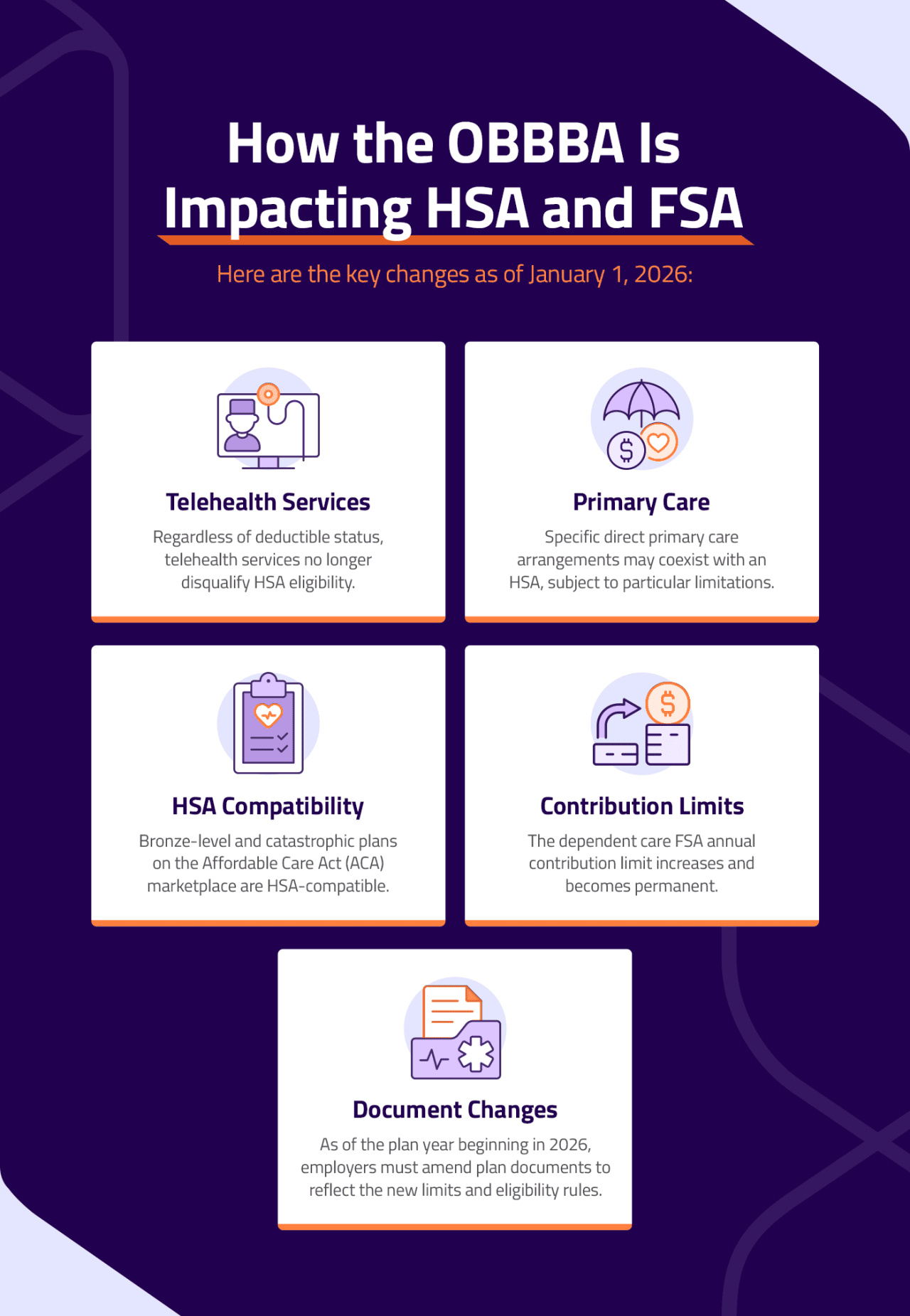
An infographic showing key changes of the OBBBA and how it is impacting HSA and FSA.

The Difference Card

Here are the key changes as of Jan. 1, 2026.

  • Telehealth services: Regardless of deductible status, telehealth services no longer disqualify HSA eligibility.
  • Primary care: Specific direct primary care arrangements may coexist with an HSA, subject to particular limitations.
  • HSA compatibility: Bronze-level and catastrophic plans on the Affordable Care Act (ACA) marketplace are HSA-compatible.
  • Contribution limits: The dependent care FSA annual contribution limit increases and becomes permanent.
  • Document changes: As of the plan year beginning in 2026, employers must amend plan documents to reflect the new limits and eligibility rules.

This scope redefines how employers design benefit plans, how producers advise clients, and how administrators configure systems. Expanded eligibility increases participation, potentially shifting contribution patterns and testing outcomes for annual nondiscrimination FSA testing. While higher dependent care limits increase FSA value, they also elevate compliance stakes. It is crucial to ensure the plan does not disproportionately benefit highly compensated employees in terms of eligibility and participation rates.

The OBBBA encourages a shift in benefits philosophy from merely offering standard plans to designing a holistic ecosystem. This shift means prioritizing employee well-being through integrated preventive, virtual, and primary care options. It can become a significant differentiator in talent acquisition and retention.

As you move into the specific provisions, it becomes clear that the OBBBA is not a simple adjustment. It is a structural update that rewards proactive planning and penalizes inattention.

Expanded HSA Eligibility Under IRS Notice 2026-5

One of the most significant elements of the OBBBA is the expansion of HSA eligibility. In the past, strict rules limited access based on plan design and first-dollar coverage. IRS Notice 2026-5 relaxes several of those constraints while preserving the core principle that HSA benefits pair with high-deductible coverage. The notice focuses on three core areas:

  • Direct primary care (DPC)
  • Telehealth
  • Health plan design

The notice clarifies that specific services and plan types no longer disqualify individuals from HSA contributions. This change illustrates the growth in care delivery, particularly since 2020. It also acknowledges that affordability does not always mean higher deductibles alone.

Expanded eligibility means more employees can open and fund an HSA. It also means employers must reassess who qualifies, how they communicate eligibility, and how payroll systems track these contributions.

Direct Primary Care Integration

DPC, an alternative to traditional fee-for-service models, historically raised HSA eligibility concerns due to monthly fees potentially being disqualifying coverage. Now, individuals remain HSA-eligible even if their health plan offers first-dollar coverage for telehealth services, regardless of the preventive care relationship.

The OBBBA introduces a new rule that allows limited DPC integration in HSA benefits. IRS Notice 2026-5 permits DPC arrangements that meet criteria such as a capped monthly fee or a defined scope of services. DPC cannot provide coverage beyond primary care services, and the monthly fee must remain within statutory limits. While it may cover:

  • Primary care visits
  • Preventive services
  • Basic diagnostic services

Ancillary services, such as labs or imaging, and hospitalization are still subject to the deductible to preserve HSA eligibility. For example, a DPC arrangement capped at $150 a month may cover unlimited primary care visits, in-office labs such as strep tests, and basic health screenings. However, advanced diagnostics such as an MRI, specialist consultation, or emergency care still fall under the high-deductible health plan (HDHP) deductible.

The caveat is documentation. Employers and administrators must confirm that DPC arrangements meet IRS criteria. Without that diligence, participants risk losing their HSA eligibility.

This change opens the door for innovative plan designs. Employers can offer DPC with high-deductible plans to boost access and satisfaction. Producers should help clients carefully review vendor contracts to avoid unintended disqualification.

Telehealth Safe Harbor Permanency

Telehealth coverage was a recurring issue for HSA eligibility. Temporary relief measures allowed pre-deductible telehealth without disqualifying participants, but those measures required repeated extensions.

The OBBBA establishes telehealth as a permanent safe harbor. According to IRS Notice 2026-5, plans can offer pre-deductible telehealth services — including behavioral health and primary care consultations — without affecting HSA eligibility. This provides employees with straightforward early access to telehealth, without sacrificing HSA contributions, while giving employers long-term certainty in virtual care plan design.

Individuals remain HSA-eligible even if their health plan offers first-dollar coverage for telehealth services, regardless of whether these services relate to preventive care. This change reflects how people access care, as telehealth is often the first point of contact for:

  • Mental health services
  • Chronic condition management
  • Nonurgent care visits

This permanency also supports cost control, as telehealth often replaces higher-cost visits, diverts from emergency care, reduces associated costs, and saves on time away from work. By pairing telehealth with HSA benefits, plans encourage early intervention while preserving tax advantages.

Bronze and Catastrophic Plan Eligibility

Another notable expansion involves insurance plan design. Previously, only certain high-deductible health plans qualified for HSA benefits. The OBBBA recognizes that some bronze and catastrophic plans function similarly from a cost-sharing perspective.

According to IRS Notice 2026-5, specific bronze and catastrophic plans qualify as HSA-compatible if they meet the revised deductible and out-of-pocket expense criteria. This change acknowledges the role of lower-premium plans in the individual and employer markets. For employees, it means more choice. You can select a lower-cost plan and still enjoy HSA contributions. For employers, it creates flexibility in offering tiered coverage without excluding HSA participation.

This expansion may increase HSA adoption among younger or generally healthier populations. Over time, broader participation can strengthen the overall value proposition of an HSA as a long-term savings vehicle.

Dependent Care FSA: The $7,500 Leap

While HSA benefits get a lot of the attention, the dependent care FSA (DCFSA) update may have the most immediate impact on working families. The OBBBA permanently increases the annual contribution limit to $7,500 per household, a significant leap from the previous cap.

This change reflects the rising costs of child care, after-school programs, and eldercare. A higher limit lets families set aside more pre-tax dollars to cover essential expenses. While the DCFSA offers immediate pre-tax savings, the dependent care tax credit may be more beneficial for lower-income families or those with significant care expenses that exceed the FSA limit. A quick calculation based on your household income and care costs during open enrollment can help you determine the optimal choice.

Unlike temporary increases, the new limit is permanent. Employers can design plans with confidence, and employees can plan contributions without worrying about future rollbacks.

Economic Impact

The $7,500 limit increase reduces taxable income, boosting take-home pay. This offers substantial savings for higher-tax-bracket families and helps moderate-income households offset rising care costs.

From a workforce perspective, access to affordable care closely ties into:

  • Employee retention
  • Reduced absenteeism
  • Improved productivity

The FSA increase also signals employer commitment to family-friendly policies. It gives employers a tangible way to support working parents and caregivers without increasing wages.

Administrators can expect higher participation rates. As the benefit grows more valuable, more employees will enroll. Employers may need to improve communication and enrollment tools.

Consider conducting an internal audit of the existing benefits communication strategy to ensure all employee segments are reached effectively. A targeted approach, using a combination of short videos, interactive FAQs, and personalized emails, can help employees fully understand these changes and make informed decisions.

Tax Credit Interaction

The dependent care FSA increase also interacts with the dependent care tax credit. Employees must choose how to allocate expenses between the FSA and the credit, as the same costs cannot be used for both. IRS Notice 2026-5 reiterates the coordination rules and emphasizes the importance of education. Employers and producers play a key role in helping employees understand trade-offs. In many cases, maximizing the FSA yields greater immediate savings — however, individual circumstances vary.

Clear guidance reduces confusion and prevents adverse tax outcomes. Simple examples and calculators can help employees make informed decisions during open enrollment.

How the OBBBA Is Impacting HSA and FSA Administration

The OBBBA reshapes HSA and FSA administration by shifting how employers govern plans, manage risk, and communicate with participants. While IRS Notice 2026-5 offers crucial guidance, the dynamic nature of healthcare legislation means plan sponsors should remain vigilant for potential future clarifications or amendments, especially as new care models emerge or economic conditions shift, and as contribution limits change.

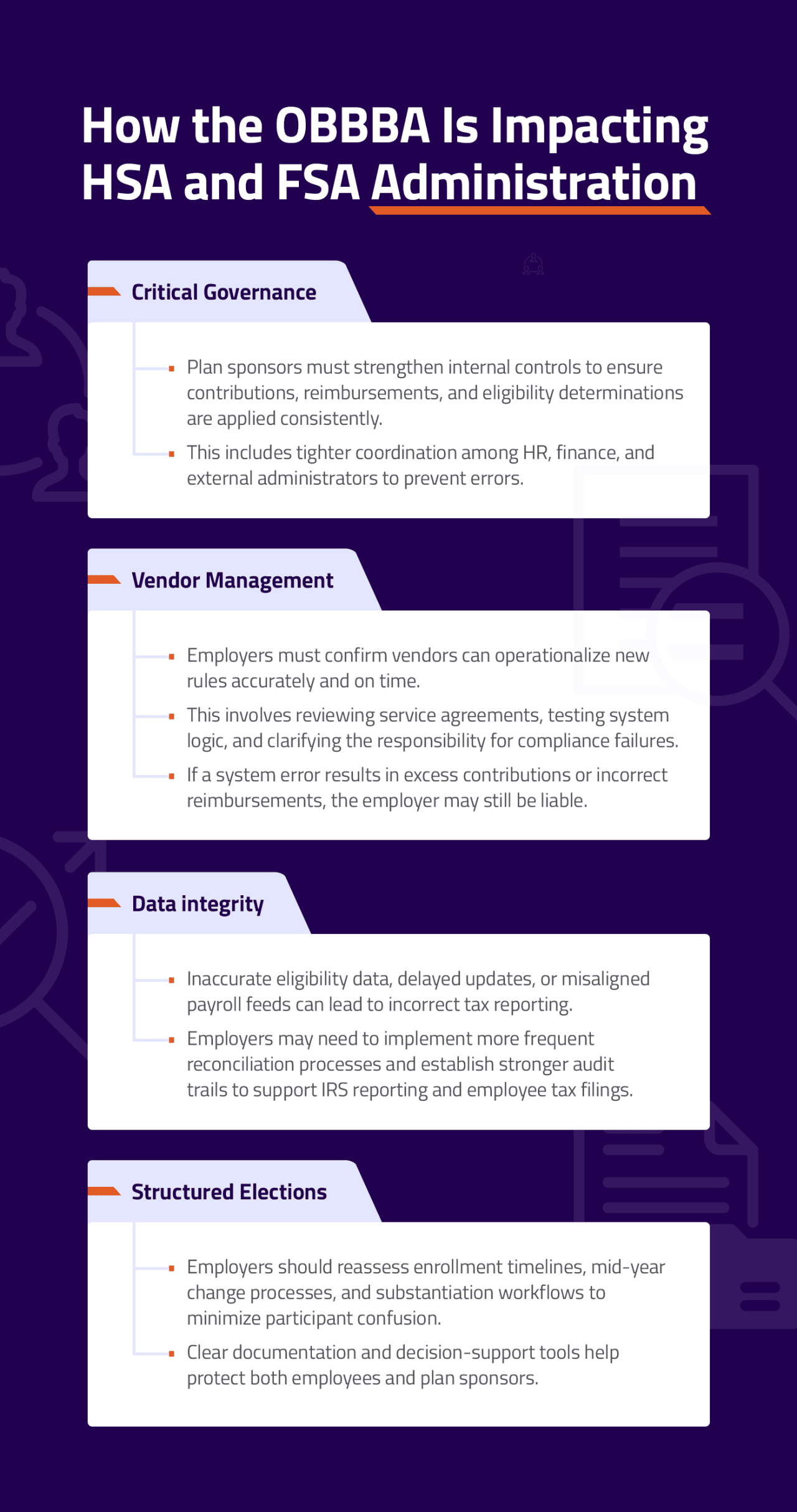
An infographic listing top effects on how the OBBBA is impacting HSA and FSA administration.

The Difference Card

Even when eligibility rules are clear, administration becomes more complex as flexibility increases.

  • Critical governance: With broader participation, employers face greater scrutiny from regulators and auditors. Plan sponsors must strengthen internal controls to ensure contributions, reimbursements, and eligibility determinations are applied consistently. This includes tighter coordination among HR, finance, and external administrators to prevent errors.
  • Vendor management: The OBBBA accelerates third-party administrator reliance. Employers must confirm vendors can operationalize new rules accurately and on time. This involves reviewing service agreements, testing system logic, and clarifying the responsibility for compliance failures. If a system error results in excess contributions or incorrect reimbursements, the employer may still be liable.
  • Data integrity: Higher contribution limits and more participation increase the risk of data errors. Inaccurate eligibility data, delayed updates, or misaligned payroll feeds can lead to incorrect tax reporting. Employers may need to implement more frequent reconciliation processes and establish stronger audit trails to support IRS reporting and employee tax filings.
  • Structured elections: As accounts become more valuable, election errors carry higher stakes. Employers should reassess enrollment timelines, mid-year change processes, and substantiation workflows to minimize participant confusion. Clear documentation and decision-support tools help protect both employees and plan sponsors.

OBBBA-era administration requires continuous monitoring as regulatory guidance and participation trends now demand regular review to avoid compliance drift over time. In practice, the OBBBA pushes HSA and FSA administration from a transactional function into a governance discipline. Employers who invest in stronger processes, more transparent accountability, and proactive oversight are better positioned to manage risk while delivering meaningful benefits to employees.

Navigating 2026 Compliance

The OBBBA and IRS Notice 2026-5 bring both opportunity and responsibility. They expand access to HSA benefits, provide meaningful relief for dependent care costs, and modernize the rules governing benefits. At the same time, they demand careful implementation with ongoing education.

For producers, the changes reinforce the value of strategic guidance. Clients need clear expectations, realistic timelines, and hands-on support with plan design and amendments. Making small adjustments early can prevent costly corrections later and help employees feel confident in using their benefits.

The 2026 transition is a shift to align benefits with the way people live and work today. With the right professional support, the OBBBA can strengthen benefit strategies while helping families manage healthcare and care-related expenses with confidence.

This story was produced by The Difference Card and reviewed and distributed by Stacker.

Topics:

Entertainment
Careers & Education

Before special ed, there was the school-to-asylum pipeline. How one lawsuit helped end it

Before special ed, there was the school-to-asylum pipeline. How one lawsuit helped end it
By Beth Hawkins for The 74
23 min read • Originally published February 5, 2026 / Updated March 19, 2026
By Beth Hawkins for The 74
23 min read • Originally published February 5, 2026 / Updated March 19, 2026

A custom collage showing prominent personalities and graphics related to the school-to-asylum pipeline in the 70s.

Eamonn Fitzmaurice // The74, Getty Images

Before special ed, there was the school-to-asylum pipeline. How one lawsuit helped end it

The moment, Thomas Gilhool would tell a historian decades later, “seemed providential.”

It was 1969. Two men from the Pennsylvania Association of Retarded Children made an appointment to meet with the young lawyer with a reputation for taking pie-in-the-sky cases more experienced attorneys wouldn’t touch. Gilhool was five years out of Yale Law School, practicing out of an office that was no wider than his desk — barely large enough to receive the visitors.

Wedged in sideways, the men handed him a report they had commissioned on conditions at the Pennhurst State School and Hospital, the state’s notoriously overcrowded asylum for the mentally retarded. They were hoping to use the courts to better the lives of the people confined there. (In the interest of historical accuracy, in portions of this article, The 74 uses terminology now recognized as offensive.)

Gilhool had never heard of the organization, now known as The Arc of Pennsylvania, but he knew more than most people about Pennhurst. At the time, children could be deemed retarded for a host of reasons: for having an intellectual disability, but also for seizure disorder, cerebral palsy, birth defects, bad behavior, or even not speaking fluent English.

Public school was often the first stop on a short path to institutionalization. Children would enroll, quickly be deemed “ineducable” and consigned to places like Pennhurst, where forced labor, neglect and violence often cut their lives short.

Gilhool’s brother Bob had been committed to the asylum, the attorney told his stunned guests.

By the meeting’s end, Gilhool had taken the case — never mind that the three were still uncertain exactly what the case would be. The lawyer asked for a little time to think. Nine months later, he reappeared, grand design in hand.

Eventually, they should ask the courts to close the facility. But the first task, Gilhool told his new clients, was to establish disabled children’s right to an education.

Prohibiting schools from using asylums as dumping grounds was the initial step toward shutting down the pipeline of new residents and triggering the creation of alternatives — including the classroom instruction that would help children fulfill their potential.

Providential, indeed.

The cultural and political waters had been warmed up by a decade of Kennedy family activism. Rosemary Kennedy, sister to John F., Robert F. Sr. and Ted, had been born with a developmental delay, lobotomized as a young woman to a tragic result and institutionalized. JFK had used his presidency to push for a new era for people with intellectual disabilities.

A black and white family portrait of the Kennedys. From left to right in the front row are Patricia, Rose and Joseph Kennedy, with baby Edward, Rosemary, Eunice, and Kathleen. The rear row is John, Jeanne, and Robert.

The Bettman Collection via Getty Images

Indeed, upon touring New York’s notorious Willowbrook asylum in 1965, RFK Sr. called for a sea change. “We have a situation that borders on a snake pit,” he said. “The children live in filth … many of our fellow citizens are suffering tremendously because of lack of attention, lack of imagination, lack of adequate manpower. There is very little future for these children who are in these institutions.”

The Arc, the Council for Exceptional Children and other organizations pushing for more humane conditions knew it was time — and that the moment called for someone with an audacious vision.

“They knew they needed a lawyer who was prepared to imagine with them, and dream,” Gilhool, who died in 2020, recalled in a series of interviews that are preserved as an oral history at the University of California, Berkeley’s Bancroft Library. “And act on those dreams with them to kick over the traces and to restructure the world which had so thoroughly confined them.”

The 1971 case Gilhool filed and won, PARC vs. Commonwealth of Pennsylvania, was swiftly copied by disability advocates in dozens of states. The settlement — which anticipated the sundry ways in which children like Bob Gilhool were excluded from school — became the template for one of the strongest of the era’s civil rights laws, enacted by Congress in 1975.

Fifty years after the passage of what is now known as the Individuals with Disabilities Education Act, it’s hard to overstate the law’s impact. Originally titled the Education for All Handicapped Children Act, but better known as Public Law 94-142, it said no child could be declared ineducable. Advocates celebrated the end of the school-to-asylum pipeline.

Today, however, people with disabilities see flashing warning lights. In the sweeping proposals advanced by President Donald Trump, they see the start of a new era of institutionalization. And in the dehumanizing descriptions of disabled children made by Health and Human Services Secretary Robert F. Kennedy Jr. — who grew up visiting his aunt at her asylum — they hear echoes of past rhetorical justifications. The same groups that tapped Gilhool half a century ago today are suing to protect the law.
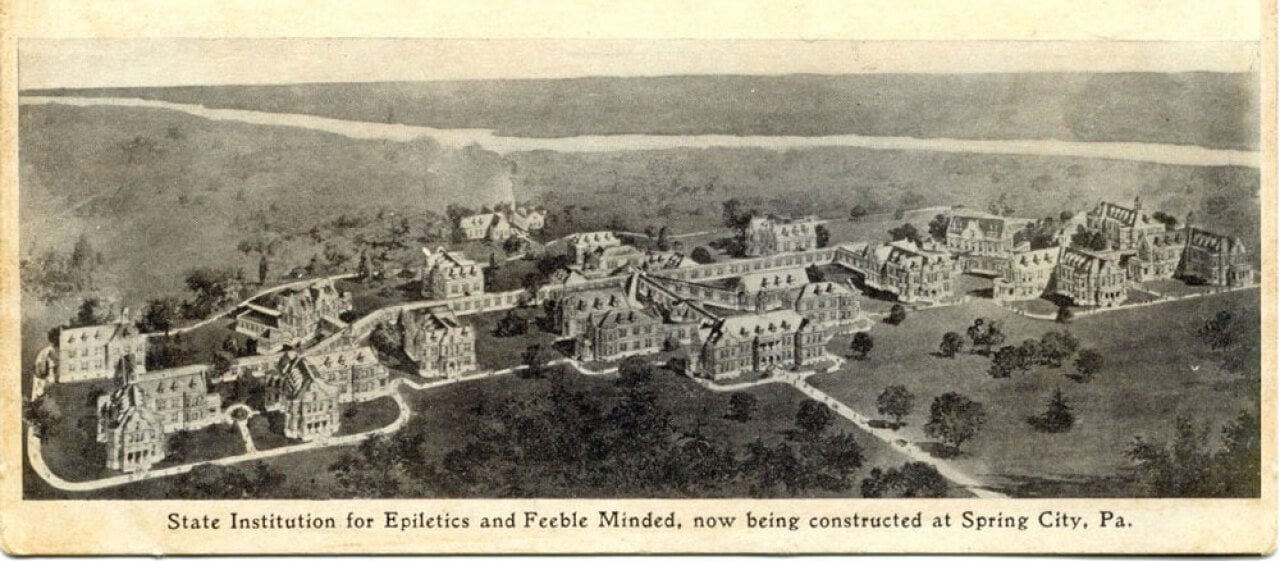
A historic image of the 'State Institution for Epiletics and Feeble Minded'.

The Pennhurst Memorial and Preservation Alliance

Pennhurst was not built to care for people who could not live independently. Like most asylums, the motive for its construction was crystal clear: eugenics.

The era’s dominant belief was that disability, poverty and race were matters of poor breeding. In the parlance of the time, “normal” children needed protection from exposure to disordered ones. “Idiotic, imbecile or feeble-minded persons” should be prohibited from reproducing, the Pennsylvania legislature proclaimed. State after state mandated confinement, and many went so far as to order the sterilization of anyone deemed defective.

Conditions at Pennhurst were wretched.

“Large numbers of retarded persons have been herded together to live as animals in a barn, complete with stench,” said the report that The Arc leaders gave to Gilhool. “Many are forced into slave labor conditions; deprived of privacy, affection, morality; suffering the indignities of nakedness, beatings, sexual assaults and exposure. Some are doped out of reality with chemical restraints while others are physically deformed by the mechanical ones. Many are sitting aimlessly without motivations, incentives, hopes or programs.”

Babies and young children are confined in their cribs, circa 1946 at Letchworth Village in New York, New York.

Irving Haberman // IH Images/Getty Images

The squalor was hardly a secret. But without services to help care for their children or classrooms where they could learn, families struggled to stand up to authorities who pushed institutionalization, which is how Bob Gilhool ended up at Pennhurst.

The third child born to Tom and Mary Gilhool, Bob was social and curious. As a result, he was not diagnosed as intellectually disabled until it turned out he was also slow to talk and toilet train. For a little while, he went to a special school, but only for two hours at a time, twice a week. The rest of the time, he was home.

At the time, a child’s developmental disabilities were viewed as the parents’ deficit. “The diagnosis was very wrenching to my mother and father,” Gilhool would tell the UC Berkeley oral historian. “The learned understanding that it was, of course, the parents’ fault; that these things were genetic … and that they should be embarrassed and ashamed and feel guilty.”

Gilhool’s father was taunted and shamed at work for having a disabled child, to the point that he had what was then called a nervous breakdown. Still, the family resisted experts’ recommendations to institutionalize Bob, who was 10. A few years later, dying of pancreatic cancer, the older Tom urged his wife to consider sending her youngest away.

“Probably, you’d have to look around and find a place for Bobby,” Gilhool recalled his father telling his mother one night. “Because surely … you will not be able to keep him at home.”

It was 1954, and Tom Gilhool was 13. Gilhool later recalled that as a child, he believed it was his job as an older brother to set aside his anger at what was happening and focus on keeping his mother’s spirits up.

Whatever Bob understood, he did not complain.

During the nine months when attorney Tom Gilhool was exploring ways for The Arc to take on the Commonwealth of Pennsylvania, he heard, over and over again, including via materials distributed by governmental councils, about the role schools played in funneling children to Pennhurst.

Like Mary Gilhool, sometimes parents were simply unable to provide around-the-clock care unassisted. But often, families would enroll their children in school, only to have them rejected. Commitment, social workers and other experts would argue, wasn’t just in the best interest of the retarded children; it was to protect their siblings and spare their parents experiences like that of Gilhool’s father.

A Catch-22 for Parents

In 1955, around the time Bob Gilhool was being institutionalized, Minneapolis Public Schools opened an experimental school in a former orphanage and polio hospital. A report on The Sheltering Arms’ first five years provides a vivid illustration of how school was frequently the first step toward confinement in an asylum.

Today, to guard against children languishing, IDEA requires schools to assess individual students’ needs, identify strategies for meeting them and document progress, or lack thereof. But in 1960, Sheltering Arms’ administrators were free to dismiss pupils they believed were neither “educable” or “trainable” for a variety of general and subjective reasons.

An outburst-prone 8-year-old, for instance, was dropped for being “unable to adjust” despite having gained six IQ points during his seven-week school trial period. “His family situation was also a ‘problem’ one,” evaluators wrote, so they called in county welfare officials to arrange “institutional placement.”

Another 8-year-old was excluded for behaviors that included wanting “maternal-style closeness” with his teacher. During his trial, he learned to “play happily” with other children and formed “some meaningful social relationships” with adults. But in the evaluators’ opinion, “These gains seemed too small to justify the time and attention he was consuming in the classroom.”

Though they were often vague when it came to documenting their own efforts, the Sheltering Arms evaluators were quick to scrutinize students’ home lives in search of justifications for institutionalizing a child.

In administrators’ opinion, parents who said they faced minimal issues at home often were in denial: “Their discrimination will also be affected by the degree of their defensiveness about the fact of the retardation,” the program report explained. “A parent unable to accept this emotionally may very well proceed, in her diary, to deny all problems and describe the child as ‘perfectly alright.’”

Sometimes, children were excluded because evaluators felt the break their family got while they were in class only postponed a painful, inevitable decision. “This was a situation in which we felt that school attendance was permitting the family to just barely survive the situation so that, in effect, a disservice rather than a service was being done to the whole family unit,” Sheltering Arms reported in one case. “These parents were highly realistic and competent people, and his exclusion from school led to institutional placement rather promptly.”
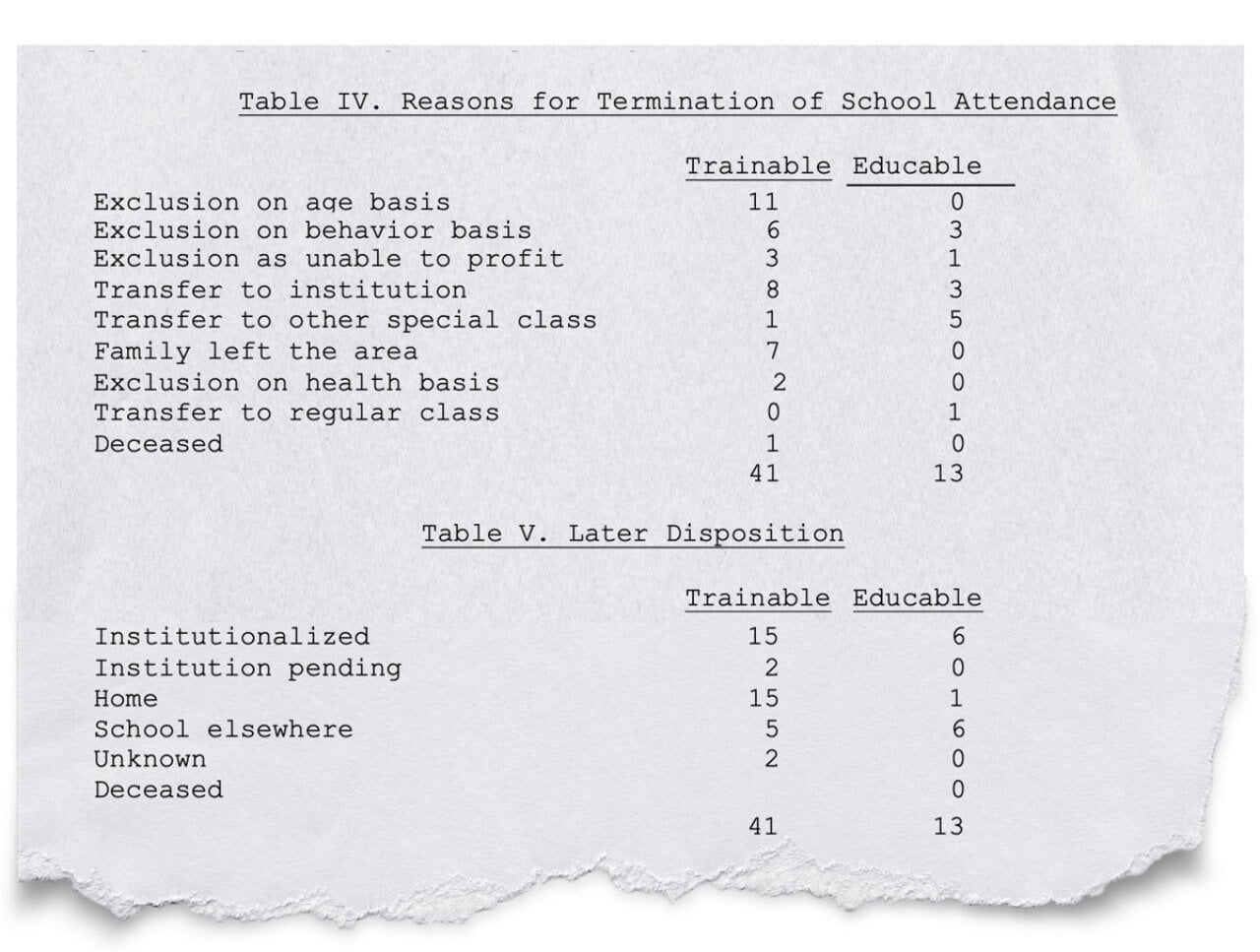
An extract showing data from Sheltering Arms Five Year Report.

Minnesota Department of Administration

The report declared the overall effort a success. Children gained independence, communication and socialization skills and behaved better. Still, it recommended institutionalization as the long-term outcome for most “trainable” children, and parent education as key to achieving it.

“We think that great harm is done by the casual provision of classroom experience for children with no effort to interpret to parents in what ways and for what reasons this experience differs from that which their normal children are having in school,” they wrote. “We see this kind of provision as a step backward.”

Of the 54 children enrolled in the five-year experiment, 23 were subsequently confined to institutions in Minnesota, while 16 were sent home with no possibility of future education.

PARC v. Commonwealth of Pennsylvania

On Jan. 7, 1971, Gilhool filed a federal class-action lawsuit against the Commonwealth of Pennsylvania and 13 school districts with the backing of numerous advocacy groups, most notably the Council for Exceptional Children, the American Association on Mental Deficiency and the National Association for Retarded Citizens.

Gilhool’s goal was to get the court to outlaw the classification of any student as “ineducable.” To that end, the stories of the 13 children named as plaintiffs were representative of the array of excuses schools used to justify their exclusion.

Citing Brown v Board, in 134 numbered paragraphs, he argued that the state’s failure to educate all children violated the U.S. Constitution’s due process and equal protection clauses:
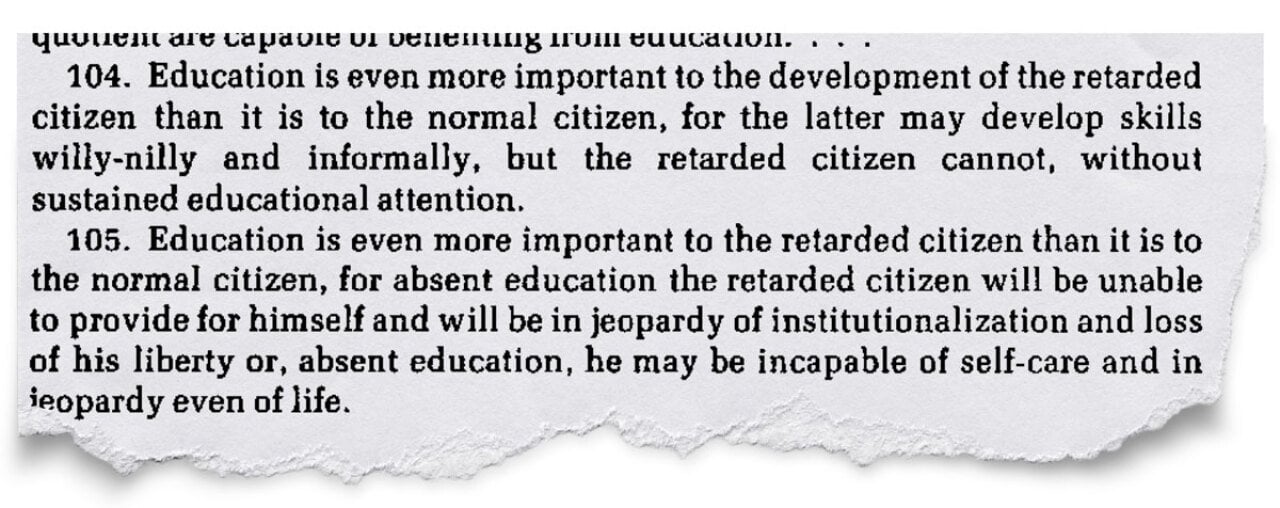
Graphic showing text from PARC v. Commonwealth of Pennsylvania arguing for the education of all children including those with disabilities.

The 74

On Aug. 12, the court was scheduled to hear preliminary statements from seven witnesses. In the afternoon, after just four had testified, the three-judge panel hearing the case stopped the proceedings. Gilhool and his opposing counsel agreed to turn their efforts to drafting an order for the court to approve. On Oct. 7, the judges signed off on the document.

“This landmark agreement commits the state to a program of identifying, locating, evaluating and placing of all children adjudged to be retarded,” Gov. Milton J. Shapp said at a news conference the next day. “In the long run, this agreement will save the taxpayers money because it is a known fact that many children adjudged to be retarded can lead normal and productive lives if given the proper kind of educational assistance early enough. In the short run, this agreement seeks to put as many children as feasible into the public school system.”

The New York Times weighed in with an editorial: “The court ruling is humane and socially sound. Whatever the cost of educating retarded children, the cost of setting them adrift in the world without giving them the means to lead useful lives is far higher.”

The suit and settlement were quickly copied by advocates in 26 other federal court cases, pressuring Congress to act. In 1975, lawmakers passed what was then known as the Education for All Handicapped Children Act, guaranteeing the right to a free, appropriate public education for all students, including those with severe disabilities.

On Dec. 2, 1975, President Gerald Ford signed the bill, but reluctantly, noting both that Congress promised states more money than it actually appropriated and complaining, in essence, that Gilhool’s checks and balances — the oversight required by the law to keep schools from shirking their obligations — were burdensome.

“Everyone can agree with the objective stated in the title of this bill — educating all handicapped children in our nation. The key question is whether the bill will really accomplish that objective,” he wrote. “It contains a vast array of detailed, complex and costly administrative requirements which would unnecessarily assert federal control over traditional state and local government functions.”

Ford was right about the first part. Congress promised to fund 40% of IDEA’s average per-pupil cost but has never appropriated anything close to full funding. Right now, states get 13%.

But as for the checks and balances, Gilhool was correct in anticipating that states and school districts — historically poor enforcers of civil rights — would need continuous federal oversight to deliver on the law’s central tenets: that children with disabilities have a right to a “free and appropriate public education” in the “least restrictive environment” possible.

Creating Special Education

By the time the PARC case went to trial, Brown v. Board of Education had been the law of the land for 17 years. Yet from coast to coast, communities had to return to court to try to force districts to take even baby steps toward integrating schools racially.

Anticipating similar resistance to desegregating students with disabilities, Gilhool asked the court to give the Pennsylvania defendants one year to find kids who were not being served by schools — and to continue to identify children who might have unmet needs.

The clause became one of IDEA’s most important provisions, a duty known as Child Find. It requires school systems to seek out and evaluate students who may need special education services — no excuses. It applies to children from birth to age 21, whether they are being homeschooled or are enrolled in a private school, are migrants or are without homes.

When IDEA became law, Linda Stevens, pictured below, was one of a very small number of educators trained to work with children with disabilities. A speech pathologist with a master’s degree — rare for a woman at the time — she taught a class of “18 educable mentally retarded students” in Florida’s Alachua County Public Schools.

Linda Stevens using puppets to teach literacy skills.

Council for Exceptional Children

“So much of retardation can be attributed to a language problem,” she was quoted as saying in the April 1974 newsletter of the local chapter of the Council for Exceptional Children. “If you can get the students to master the oral skills first, the difficulty of other tasks is then reduced.”

To that end, her class played phonics-heavy games with puppets and enjoyed homemade books on tape. Stevens’ efforts were so admired that the University of Florida sent special education teaching candidates to learn in her classroom.

When the federal law passed, Stevens and an art-teacher neighbor were tasked with figuring out how to fulfill the district’s Child Find obligations, according to her daughter, Elizabeth Clark, now a teacher in the same school system and a member of the Council for Exceptional Children. Working together, Stevens and her neighbor canvassed the community, showing up at doctors’ offices, PTA meetings and other places families congregated.

“At the dinner table, my mother would talk about having spent the day going door to door … to let families know that their kids with exceptionalities, moderate to severe, were not only now allowed to come to school, but would have supports,” says Clark.

The shame of having a child with an intellectual disability that had visited the Gilhools was still prevalent, so the women had to do a lot of coaxing. If a family wouldn’t agree to a home visit, Stevens would invite them for coffee. After each conversation, she would ask whom else she should reach out to.

The hardest part of the job was persuading people that schools would heed the law instead of finding justifications to exclude their children. “Sometimes she would have to visit with a family three times to convince them,” says Clark. “People were in disbelief.”

Once, a parent got up mid-sentence and called a relative: “There’s a lady here that says so-and-so can go to school even though he can’t use the toilet by himself,” the father said. “And that he’s going to be okay.”

At the same time, in Illinois, Pam Gillet was using every conduit she could think of to find families with children who were not in school. She placed announcements in newspapers and tacked handwritten notes on grocery store bulletin boards.

A member of the Council for Exceptional Children, Gillet, too, talked to parents who were reluctant to tell a stranger they had a disabled child, but also many who had tried to register their kids for school, only to be turned away.

“Now we were going back to those parents trying to build trust with them to say, ‘Now we’re going to welcome you,’” she recalls. “We capitalized on the legal mandate that the parent must be an equal partner in the planning process and must agree to what the school district was recommending.”

Unlike before, a district could not say it lacked the resources to meet individual students’ needs. If a service was included in the Individualized Education Program, or IEP, that parents and teachers agreed to, the school must find a way to provide it.

Just as Gilhool had hoped, Child Find put bottom-up pressure on the entire school system to find the classrooms, research the strategies and recruit and train the staff to be able to offer meaningful opportunities. Even as they were trying to find their sea legs, educators like Stevens and Gillet got pressed into service to envision and build out entire programs.

Of the 33 fourth graders Gillet taught in 1968, her first year in the classroom, five had the word-recognition skills expected of first graders, while another five had some ability to read but not to comprehend. Often, kids who were behind academically were funneled into vocational programs in eighth grade, so there wasn’t much fuss when students were allowed to languish.

Gillet turned to her principal for help, but didn’t get much. The school had an after-school program, but it was an informal effort, organized by concerned teachers, working without pay. Often, they grouped children according to where each was academically and assigned them to an educator who was strong in that subject.

Frustrated, Gillet enrolled in a new university program that promised to train teachers to work with children with disabilities: “I thought, ‘Well, even if I don’t get a master’s in special education — because I wasn’t even sure what all that was — I’d at least maybe get some help with the children I was going to have for the rest of the year.’”

Fast-forward six years to IDEA’s passage, and Gillet found herself running a federally funded initiative to train general educators to teach special ed. Using empty classrooms in a school in the northwest part of Cook County, near Chicago, the program enrolled 20 to 25 teachers per term for two semesters.

During the first term, they would take intensive classes with instructors from five area universities. For the second, the teachers would work alongside highly qualified special educators. The goal was two-fold: to be able to staff special ed classrooms quickly and to expose faculty from different teacher preparation programs to colleagues with expertise in a variety of areas.

Federal officials were watching. Every three years, the Office of Special Education Programs — a division Congress created to provide expertise and monitor IDEA’s implementation — would visit every school in the district. Still trying to figure out how to get the right staff in the right places to meet students’ varied needs, Gillet valued the feedback from the visits.

As newly trained special educators opened classrooms throughout Illinois — rising to the challenge of educating children whom schools had never before attempted to accommodate — she sat back and considered how much had been built, and how quickly. “All of those evenings and weekends that we all spent together, and all of the tough times that we said, ‘We’ll never be able to do this,’ we did it,” she recalls thinking. “Kids are in school, they’re learning. They’re having opportunities that some never had and may not have had if it had not been for this law.”

Ignoring the Experts

The doctor who diagnosed Brianne Burger as deaf at age 2 warned her parents that she was unlikely to graduate from high school. They ignored him, becoming zealous advocates out of necessity.

About 1 million U.S. children under 18 are blind, have limited vision, are deaf, hard of hearing or deaf-blind. Laws requiring publicly funded programs to educate them date, in one case, to the 1800s. Services are expensive, however, and states are quick to target them for cuts when budgets run lean. Because of this, the money, oversight and technical expertise required to keep them running are laid out in IDEA.

Burger is living proof both of states’ tendency to try to restrict access to costly programs and of disabled children’s academic and career potential. When she was diagnosed in the early 1980s, her family lived in Stamford, Connecticut, 90 minutes’ drive from the state’s only school for deaf children — and the only option state officials offered.

Burger’s parents, however, were unwilling to put a toddler on a bus for three hours a day. By word of mouth, they learned of two schools for the deaf in New York. One was just 15 minutes from their home. Connecticut had to pay the New York tuition.

Burger got an excellent education there. When her family moved to Massachusetts, long a disability-friendly state, she was placed in a general-education classroom where her parents advocated for her to have an interpreter.

She ended up at a California university with strong services for deaf students, and later at Emerson College for graduate school. After a stint in vocational rehabilitation, helping people with disabilities find and settle into jobs, she went to work managing federal grants for Gallaudet University in Washington, D.C.

Her timing could not have been better. President Barack Obama had pledged to increase the number of people with disabilities employed by the government. Burger worked in disability policy for several federal agencies, landing at the U.S. Department of Education in 2016.

For nine years, she monitored a number of congressionally mandated institutions that provide expertise or services states don’t have: the American Printing House for the Blind; the Laurent Clerc National Deaf Education Center; Gallaudet University; the Helen Keller National Center for the DeafBlind; and the National Technical Institute for the Deaf.

In March, despite the fact that the law requires her position to be filled, Burger was one of more than 1,300 Education Department employees fired as Trump attempted to close it. Since his second inauguration, millions of dollars in funding for at least a dozen programs to support deaf and blind students have been eliminated.

Shortly after Burger’s firing, South Dakota Republican Sen. Mike Rounds introduced legislation to transfer the department’s responsibilities to other federal agencies. Under the bill, oversight and support for the organizations she oversaw would be assigned to the Department of Health and Human Services and the U.S. Department of Labor.

During the Great Recession of the late 2000s, Rounds — then governor of South Dakota — attempted to close the state’s residential school for the deaf, which was established in 1880. Federal stimulus funds saved it, albeit in a drastically curtailed form.

A task force appointed by Rounds recommended that its functions be assigned to individual districts, which can draw on the school for support. But without the pressure to staff a residential school, services have ebbed. In 2016, for example, the last university degree program for deaf educators closed, choking off the supply of interpreters able to work in regular schools.

This year, schools that serve deaf and blind students and universities that train their educators have been cut back or threatened with closure in numerous states. At the same time, offices like Burger’s — created to ensure states and districts don’t shirk their obligations — have been hollowed out.

In March, a group of educators, school districts and public-sector unions sued Trump, hoping to stop the Education Department’s dismantling and reverse the mass firings. (The Arc of the United States has since joined the suit.) A Massachusetts judge issued an order halting the administration’s efforts, pending further legal proceedings, but in July, the U.S. Supreme Court reversed that ruling, at least temporarily allowing the dismantling of the department to proceed.

Education Secretary Linda McMahon has since laid off more of the department’s employees, although some have been temporarily rehired.

A US Department of Education employee leaving the building with their belongings on March 20, 2025 in Washington, DC.

Win McNamee // Getty Images

If Trump and McMahon eventually succeed, the department’s Office of Civil Rights, which investigates violations of disabled students’ rights, will have shrunk from 446 employees to 62. The Office of Special Education and Rehabilitative Services — one of the divisions Congress explicitly required in IDEA — will retain just 14 of its 135 employees.

Echoes of a Dark Past

Over the last year, disability advocates have repeatedly warned that the Trump administration’s policies — and the president’s use of the slur “retarded” — open the door to a return to the dark past. Most visibly, as health and human services secretary, Robert F. Kennedy Jr. has repeated false claims about the causes of autism and promoted an unproven “cure.”

“These are kids who will never pay taxes, they’ll never hold a job, they’ll never play baseball, they’ll never write a poem, they’ll never go out on a date,” he said in April about autistic children. “Many of them will never use a toilet unassisted.”
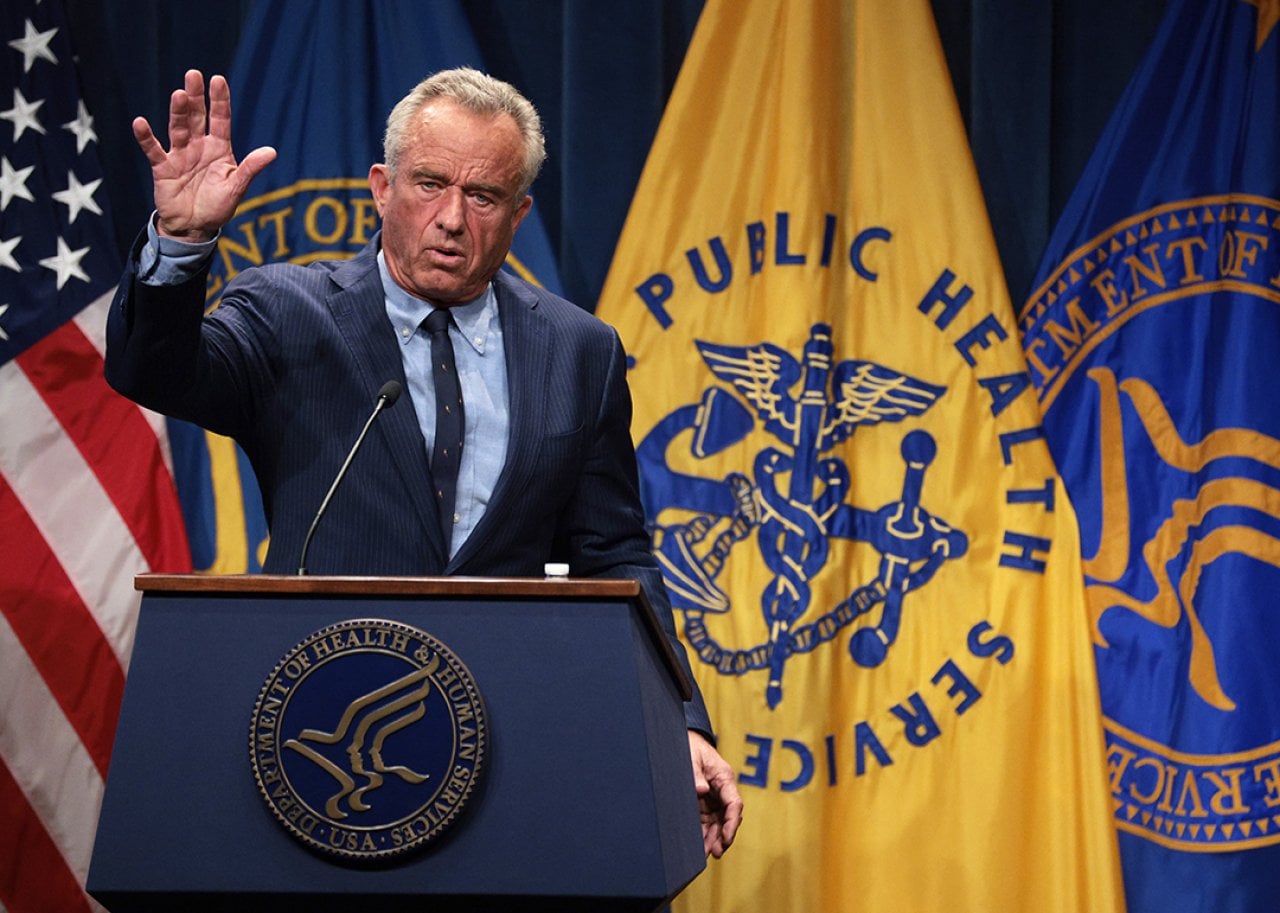
U.S. Secretary of Health and Human Services Robert F. Kennedy Jr. during a news conference at the Department of Health and Human Services on April 16, 2025 in Washington, DC.

Alex Wong // Getty Images

Indeed, one of Kennedy’s first moves was to eliminate the Administration for Community Living, the HHS division that oversees programs that help people with disabilities and older populations be as independent as possible. The office’s responsibilities, he announced in March, will be handled by other parts of the agency.

Perhaps ignorant that Pennhurst and other asylums forced residents to grow their own food, Kennedy has also proposed the creation of “work farms,” where hard labor will supposedly heal people struggling with addiction, mental health issues and even attention deficit disorder.

In July, Trump opened the door to reinstitutionalization with an executive order titled “Ending Crime and Disorder on America’s Streets.” It calls for “the reversal of federal or state judicial precedents and the termination of consent decrees” that limit broad institutionalization, threatening to withhold federal funds from states and municipalities that don’t adopt and enforce “maximally flexible” commitment standards.

Like the laws that justified confining in asylums people perceived as dangerous, the edict proposes to “restore public order” via the “civil commitment of individuals with mental illness who pose risks to themselves or the public or are living on the streets and cannot care for themselves in appropriate facilities for appropriate periods of time.”

A statement from the American Bar Association raises the same legal arguments Gilhool used to frame PARC: “The order raises serious constitutional and civil rights concerns — particularly regarding due process under the Fourteenth Amendment and the rights of individuals with disabilities under the Americans with Disabilities Act. Its proposed standard for commitment — encompassing not only those who pose a risk to self or others but also those who are merely unable to care for themselves — falls short of established constitutional safeguards.”

Hoping “to assure that we never go back,” in 2010 a group of advocates and former residents formed the Pennhurst Memorial and Preservation Alliance with the intent of acquiring the abandoned facility and turning it into a national museum of disability history.

But a businessman by the name of Robert Chakejian beat them to it, paying the state of Pennsylvania $2 million for Pennhurst in 2008. Chakejian was struggling to turn a profit on a composting business he had started on the grounds when his teenager suggested he convert the asylum — and its abandoned cribs, beds, wheelchairs and an electric shock chair — into a haunted house.

After they sued and lost, advocates tried to persuade the entrepreneur to at least populate the attraction with vampires and monsters instead of mental patients. But when the haunted house opened in September 2010, it had an asylum theme, complete with a fictional backstory involving a made-up Austrian scientist (named Dr. Chakajian, an intentional misspelling of the owner’s name) who experimented on Pennhurst’s prisoners.

These days, there’s a late-night paranormal tour — complete with actors in gory makeup who lunge at visitors — and holiday events like “Crazy Christmas” and “Bloody Valentine.” Because it’s too scary, children and pregnant women are not allowed to tour. Active members of the military get discounted admission.

Between 1908 — when Pennsylvania built what was originally called the Eastern State Institution for the Feeble Minded and Epileptic — and 1987, nearly 11,000 people were confined to Pennhurst. About half died there, historians estimate.

After Pennhurst’s closure, some 150,000 people moved out of institutions nationwide. Since then, an estimated half a million have been spared institutionalization.

In one of the longest-running disability studies to date, researchers at the U.S. Department of Health and Human Services and Temple University stayed in touch with 1,156 people who were at Pennhurst in 1978. Each got a visit once a year, aimed at answering a single question: “Are the people better off than they were at Pennhurst?”

They were. None wound up homeless or in jail. They lived an average of six years longer than those confined had, and their care cost 15% less than in the institution. Many moved into small group homes in the community.

Bob Gilhool was among those who eventually lived independently. Long after the trial that began the process of emptying the asylum, Tom Gilhool asked whether his brother wanted to tag along on a visit the lawyer was making with a group of Japanese disability activists.

No way, was the quick response Tom Gilhool told an interviewer compiling an oral history for Temple University’s Institute on Disabilities. But he was proud.

“As Bob tells me often,” Gilhool said, beaming, “‘You and I closed Pennhurst.’”

This story was produced by The 74 and reviewed and distributed by Stacker.

Topics:

Careers & Education
Hot Jobs

Creative Director and Editorial Jobs Hiring Now in Media

hot media and creative jobs
Mediabistro icon
By Mediabistro
The Mediabistro editorial team draws on 25 years of media industry expertise to cover jobs, careers, and trends shaping the industry.
4 min read • Originally published February 11, 2026 / Updated March 19, 2026
Mediabistro icon
By Mediabistro
The Mediabistro editorial team draws on 25 years of media industry expertise to cover jobs, careers, and trends shaping the industry.
4 min read • Originally published February 11, 2026 / Updated March 19, 2026

The Mission-Driven Hiring Surge Is Real

Something worth paying attention to this week: four of the most compelling open roles share a common thread, and it has nothing to do with platform or medium. They’re all at organizations where the work is explicitly tied to a larger purpose. Progressive political campaigns. Literary culture. Behavioral science for social change. A brand-new editorial publication built around professional standards.

These aren’t vague “purpose-driven” platitudes stapled to a generic content job. Each of these companies has a clearly defined mission baked into the product itself. And they’re hiring experienced people, not juniors they can mold. The seniority level across this week’s standout listings skews high, with multiple executive-level roles and a freelance gig that demands a sophisticated portfolio.

For candidates who’ve spent years sharpening their craft at larger organizations and want to direct that expertise toward something with a clear point of view, the timing is good. Let’s get into the specifics.

This Week’s Hot Jobs

Creative Director, Political Advertising at Brainstorm Creative Resources

Why this one matters right now: A DC-based progressive media firm is looking for a multichannel advertising veteran to set the creative vision across broadcast, digital, and everything in between. This is a fully remote, full-time salaried position with a bonus structure tied to two-year election cycles, a compensation model you rarely see outside political media. The firm has won races at the presidential, congressional, state, and local levels, so the creative bar is high.

The profile they want:

  • Significant directing and editing experience across broadcast and digital advertising
  • Ability to lead a team of producers, editors, designers, animators, mixers, and composers
  • Experience setting creative vision and standards across a full portfolio
  • Strong alignment with progressive campaigns and causes

Apply for the Creative Director, Political Advertising role

Deputy Editor at Poets and Writers Magazine

What makes this rare: Poets & Writers is one of the most respected names in literary publishing, and the Deputy Editor role is a genuine senior editorial position. You’ll shape content for the print magazine, the website, and a premium newsletter, reporting directly to the editor in chief. At $75,000 plus fully paid medical insurance and generous PTO, this is a solid package for a mission-driven literary organization. The role is based in New York City with some work-from-home flexibility. If you’ve been browsing editorial jobs and waiting for something with real cultural weight, this is it.

Core requirements:

  • Experience assigning and editing articles, essays, and features for print and digital
  • Ability to bring in new contributors and maintain strong freelancer relationships
  • Writing ability for magazine and website pieces as needed
  • Comfort managing editorial workflows across print, web, and newsletter formats

Apply for the Deputy Editor position at Poets and Writers

Publication Designer, Editorial Series Launch at Havenford

A freelance gig with unusual clarity: Havenford is launching a Philadelphia-based editorial publication focused on professional services, and they’ve done their homework before bringing in a designer. Thirty-two pages of brand guidelines, completed cover designs, and content ready to go. They need someone to build the interior layout system and editorial architecture. The brief references The Economist, Harvard Business Review, and S&P industry reports as touchstones. Phase 1 pays $2,500 to $3,500 for two to three weeks of work, with potential for ongoing production. For publication designers who appreciate a well-prepared client, this is a refreshing find.

Skills they’re after:

  • Interior page layout for long-form articles (2,000 to 5,000 words)
  • Data visualization templates for charts, indexes, and benchmarks
  • Cover typography systems and headline hierarchy
  • Design system documentation for future production use

Apply for the Publication Designer role at Havenford

Media Director at Marketing for Change

Where behavioral science meets media strategy: Marketing for Change is an independent national advertising firm that uses behavioral science to drive social change campaigns. The Media Director role sits at the intersection of research-driven strategy and media planning and buying, leading regional, state, and national campaigns. This is a senior, entrepreneurial position for someone who wants to build out a media practice with real substance behind it. The Orlando-based role is designed for someone with deep channel expertise and a track record of scaling teams.

What they need:

  • Recognized leadership experience in media planning, buying, and earned exposure
  • Ability to scale a media practice while driving agency profitability and client satisfaction
  • Deep expertise across specialized channels and exposure strategies
  • Comfort working at the intersection of behavioral insight and creative storytelling

Apply for the Media Director position at Marketing for Change

The Takeaway for Job Seekers This Week

If your portfolio includes work for organizations with a defined mission or editorial voice, lead with that experience right now. The roles hiring this week reward specificity over generalism. A creative director who has shaped political campaigns, a deputy editor who knows the literary world, a designer who can build systems for long-form editorial, a media director who understands behavior change: each of these jobs is looking for someone whose career has been building toward exactly this kind of work.

When you land an interview for a role like these, preparation matters enormously. Have a plan for how you’ll evaluate and respond to what comes next by reading up on what to do once you actually get the offer. The candidates who win these positions will be the ones who can articulate why this specific mission is where their skills belong.

Topics:

Hot Jobs
Advice From the Pros

Art Director Jobs: How to Find and Land Creative Roles

woman looking at her computer while drinking coffee in office
Mediabistro icon
By Mediabistro
The Mediabistro editorial team draws on 25 years of media industry expertise to cover jobs, careers, and trends shaping the industry.
6 min read • Originally published February 11, 2026 / Updated March 19, 2026
Mediabistro icon
By Mediabistro
The Mediabistro editorial team draws on 25 years of media industry expertise to cover jobs, careers, and trends shaping the industry.
6 min read • Originally published February 11, 2026 / Updated March 19, 2026

Last updated: February 2026

In this article: The Art Director Job Market | Where to Find Art Director Jobs | What Employers Want | How to Stand Out | Start Your Search

Art director jobs no longer live exclusively in ad agencies and magazine bullpens. The role has expanded into social media teams, in-house brand studios, streaming platforms, and product design departments. That expansion means more openings, but it also means the search itself has gotten more complex. Job titles vary, required skill sets differ by industry, and postings are scattered across more platforms than ever. Knowing where to look and how to position yourself is half the battle.

The Art Director Job Market

Demand for art directors remains steady across media, advertising, and corporate brand teams. While some traditional print and editorial positions have contracted, growth in digital content, social campaigns, and streaming media has more than compensated. Companies that once hired freelance designers for one-off projects are building permanent creative teams and need experienced visual leaders to run them.

The role itself has expanded in scope. Art directors are expected to think across channels: a single campaign might include paid social assets, out-of-home placements, motion graphics for connected TV, and interactive web experiences. That cross-channel fluency is what separates art director roles from senior graphic design positions, even though the two career paths share significant overlap.

Worth knowing: Many art director positions are posted under alternative titles like “Senior Visual Designer,” “Creative Lead,” or “Design Manager.” If you limit your search to “art director” alone, you may miss 30–40% of relevant openings.

Where to Find Art Director Jobs

The most common mistake creative professionals make is relying on a single job board. Art director roles get posted across a wide range of platforms, and the strongest opportunities often surface in unexpected places.

Industry-Specific Job Boards

Generalist job aggregators cast a wide net, but niche boards attract employers who specifically want creative and media talent. Mediabistro is a strong starting point for art director jobs in publishing, digital media, and content-driven brands. Other valuable platforms include AIGA’s design job board, Creativepool, Working Not Working, and Communication Arts. These communities tend to attract more, or at least more specific targeted hiring intent than massive aggregators where your application competes with hundreds of unvetted submissions.

If you are open to adjacent roles, browsing media jobs on Mediabistro can surface creative director positions, senior design leads, and social media roles with strong visual components that align with art direction experience.

LinkedIn (Used Strategically)

LinkedIn remains one of the top sources for art director openings, but passive browsing produces little. Set up job alerts for “art director,” “creative lead,” and “visual design director” in your target markets. More importantly, optimize your profile headline and summary with the specific skills employers search for: brand identity, campaign concepting, team leadership, and cross-platform design. Recruiters at agencies and in-house teams use LinkedIn Recruiter daily, and they search by skill keywords, not job titles.

Engage with creative directors and hiring managers by commenting thoughtfully on their posts. Genuine engagement puts your name in front of decision-makers weeks before a role gets posted.

Direct Outreach and Agency Networks

A significant number of art director jobs, particularly at boutique agencies and mid-size brands, never make it to public job boards. They get filled through referrals and direct applications. Identify 15–20 companies where you would genuinely want to work. Follow their social accounts, study their recent campaigns, and reach out to their creative leads with a brief, specific note about what drew you to their work. Attach your portfolio link. Even if they are not hiring at that moment, you have planted a seed that often bears fruit within a few months.

Professional organizations like AIGA, The One Club, and local ad clubs host portfolio reviews and networking events that put you in the same room as hiring creative directors. These face-to-face connections convert to job opportunities at a much higher rate than cold applications.

Recruiters Who Specialize in Creative Talent

Staffing firms like 24 Seven, The Creative Group, and Vitamin T (now Aquent) focus on placing creative professionals in both contract and permanent roles. Building a relationship with one or two recruiters who understand art direction can give you access to exclusive listings and insider knowledge about compensation ranges at specific companies.

What Employers Want in Art Director Candidates

Hiring managers reviewing art director applications tend to filter candidates within 30 seconds. Knowing what they prioritize helps you clear that initial hurdle.

Portfolio Quality Over Quantity

Your portfolio is the single most important factor in your candidacy. Hiring managers at agencies and publishers consistently say they would rather see 8–10 exceptional projects than 30 mediocre ones. Each case study should demonstrate strategic thinking, not just visual execution. Show the brief, your creative rationale, the final deliverables, and (when possible) measurable results. A campaign that increased engagement by 40% tells a stronger story than a beautiful layout with no context.

For art director roles specifically, employers want evidence that you can lead a visual direction across multiple touchpoints. A cohesive brand campaign spanning print, digital, and social demonstrates the cross-channel thinking they need.

Pro Tip: Include at least one project that shows collaboration with copywriters, photographers, or developers. Art direction is fundamentally a leadership and collaboration discipline. Solo design work, no matter how polished, does not fully demonstrate the skill set employers are hiring for.

Technical Skills That Matter

Proficiency in Adobe Creative Suite (Photoshop, Illustrator, InDesign) remains a baseline expectation. Beyond that, employers increasingly look for:

  • Figma or Sketch: Essential for any role involving digital or product design
  • Motion graphics: After Effects or similar tools, even at a basic level, make candidates significantly more competitive
  • AI-assisted design tools: Familiarity with Midjourney, Adobe Firefly, or similar platforms signals adaptability. For more on how creative professionals are navigating this shift, explore Mediabistro’s coverage of creative job security in the age of AI art
  • Presentation and pitching: The ability to sell creative concepts to clients or internal stakeholders is often what separates a senior designer from an art director

Red Flags Employers Notice

Hiring managers frequently cite these as reasons for passing on otherwise talented candidates:

  • A portfolio with no strategic context, just finished visuals with no story behind them
  • An outdated personal website or broken links (check yours before every application cycle)
  • Generic cover letters that could apply to any company. Specificity signals genuine interest
  • No evidence of team leadership or mentorship, even informal examples count

How to Stand Out When Applying for Art Director Jobs

With multiple qualified candidates competing for the same openings, differentiation comes down to preparation and presentation.

Tailor every application. Pull specific campaigns, brand elements, or design challenges from the company’s recent work and reference them in your cover letter. Explain how your experience directly addresses their needs. This takes 20 extra minutes per application and dramatically increases your response rate.

Present your portfolio like a pitch. If you advance to an interview, treat your portfolio walkthrough like a creative presentation. Set up each project with context, walk through your decision-making process, and highlight the results. Practice this aloud until it feels natural.

Follow up with purpose. After an interview, send a brief follow-up email within 24 hours that references a specific topic from your conversation. If the hiring manager mentioned an upcoming rebrand, include a quick thought about how you would approach it. This kind of thoughtful persistence leaves a lasting impression.

If you do receive an offer, handle the negotiation and response process carefully. Mediabistro’s guide on what to do when you get a job offer covers the steps from evaluation through acceptance.

Start Your Art Director Job Search

The path to your next art director role combines strategic searching, a sharp portfolio, and targeted outreach. Sending identical applications to 50 companies is a low-return strategy. Focus your energy on the channels where creative employers hire, and invest time in making each application count.

Mediabistro’s job listings feature art director, creative director, and graphic design jobs across advertising, publishing, digital media, and brand marketing. Set up alerts for the roles and locations that match your goals, and check back regularly as new positions post weekly.

Employers looking to fill art director and creative leadership positions can post a job on Mediabistro to connect with qualified candidates who specialize in media and creative industries.

Whether you are actively searching or quietly exploring your next move, keeping your portfolio current, your network engaged, and your target list ready means you can act fast when the right opportunity appears.

Topics:

Advice From the Pros

The New Playbook for Landing UX Design Jobs in a Saturated Market

How to run an internal pay equity audit (and why you should do it)
Mediabistro icon
By Mediabistro
The Mediabistro editorial team draws on 25 years of media industry expertise to cover jobs, careers, and trends shaping the industry.
8 min read • Originally published February 11, 2026 / Updated March 19, 2026
Mediabistro icon
By Mediabistro
The Mediabistro editorial team draws on 25 years of media industry expertise to cover jobs, careers, and trends shaping the industry.
8 min read • Originally published February 11, 2026 / Updated March 19, 2026

In this article: The Market Reality | Where to Find Jobs | What Hiring Managers Filter For | How to Differentiate | Start Your Search

Two years ago, a solid Figma portfolio and a LinkedIn “Open to Work” badge were enough to field multiple offers. That era is over.

The UX design job market in 2026 absorbed a wave of experienced talent from 2023-2024 tech layoffs. Entry-level roles attract hundreds of applicants. Mid-level positions draw candidates with impressive portfolios from companies that no longer exist.

And most job seekers are still running the 2021 playbook: spray-and-pray applications, generic “learn the tools” advice, searching only the exact title “UX Designer.”

The Bureau of Labor Statistics projects growth for web developers and digital designers (a broad category covering many UX roles) to outpace the average for all occupations through the end of the decade. But reaching those opportunities demands sharper tactics than it did three years ago.

The UX Design Job Market in 2026: What You’re Walking Into

Widespread tech layoffs flooded the candidate pool with experienced designers. Entry-level positions took the hardest hit. But the shift goes beyond volume.

Fully remote positions have pulled back from their pandemic peak, though many UX design jobs still offer remote or hybrid arrangements. Geographic flexibility helps, but expect more companies to require at least occasional office presence.

The counterbalance: demand for UX talent extends far beyond traditional tech companies.

Healthcare systems need designers who understand patient portals. Financial institutions are rebuilding digital banking experiences. Media companies have invested heavily in UX as digital subscriptions and reader experience become competitive differentiators. Government and civic tech organizations are hiring designers who can make complex services accessible.

The market is competitive, but also broader than most candidates realize.

Where to Find UX Design Jobs (Beyond the Obvious Job Boards)

Most candidates search “UX designer” on LinkedIn and Indeed. That’s table stakes.

The Title Fragmentation Problem

UX Designer, UI/UX Designer, Product Designer, Interaction Designer, UX Researcher, UX Writer, Experience Designer: each surfaces different listings, and companies use these titles inconsistently. A “Product Designer” role at one organization might focus entirely on user research; the same title elsewhere means visual design and prototyping.

Pro Tip: Set up saved searches or alerts for all relevant title variants. The role you want might be posted under a title you’re not monitoring.

Niche Job Boards That Surface Roles Faster

Specialized boards often list positions before they hit major aggregators. For media, publishing, and entertainment UX roles, Mediabistro consistently surfaces opportunities that never make it to Indeed. Dribbble Jobs attracts design-forward companies. Built In focuses on tech hubs and startups. Wellfound (formerly AngelList Talent) connects designers with early-stage companies.

Niche boards also draw fewer applicants per posting: hundreds instead of thousands.

Industries You’re Probably Overlooking

If you’re only targeting consumer tech, you’re missing the majority of UX hiring.

  • Healthcare: Designers who understand HIPAA-compliant interfaces and patient workflows
  • Financial services: Companies overhauling digital platforms and banking experiences
  • Government agencies: Civic tech roles focused on making complex public services accessible
  • Media companies: Publishers who need UX designers fluent in editorial workflows and content discovery patterns

Media companies deserve particular attention. As digital subscriptions and reader engagement become competitive differentiators, publishers and content platforms have expanded their UX teams. These roles require understanding editorial workflows and content discovery, skills that career-switchers from content strategy or web production already possess.

Explore diversity-focused job opportunities in media and design for employers committed to inclusive hiring practices.

Community-Driven Job Leads

AIGA local chapters, IXDA conferences, design-focused Slack groups, and portfolio review events generate job leads that never get posted publicly. Many companies fill UX positions through internal referrals or direct outreach before they ever write a job description.

LinkedIn Strategy Beyond “Open to Work”

Engage with UX leaders’ posts. Share breakdowns of your design process. Send direct messages to hiring managers with specific observations about their product.

Comment thoughtfully on design decisions you admire in products you actually use. This demonstrates your thinking before anyone reads your resume.

Direct Outreach to Companies You Admire

Identify companies whose product you use. Audit their UX. Reach out with specific observations: a friction point you noticed, a feature interaction that could be smoother, a content discovery flow that confused you.

This works especially well at mid-size media and content companies without massive recruiting pipelines. They’re hiring, but they’re not posting on every board. A thoughtful cold email showing you understand their product can open a conversation.

Pro Tip: When reaching out directly, reference a specific screen or user flow. Generic praise gets ignored. Specific observations get responses.

What UX Hiring Managers Actually Filter For

Portfolio Case Studies Matter More Than Credentials

A strong portfolio outweighs degrees or certificates in most UX hiring processes. But “strong” has a specific definition.

Hiring managers want case studies that walk through the full design process: research that informed your decisions, wireframes that show your thinking, what you tested, what failed, what you changed, and measurable outcomes. They skim fast. They need to see how you think, not just how your final screens look.

The biggest portfolio red flag? Beautiful mockups with no context. What research informed the design? What constraints shaped it? What tradeoffs did you make? What would you do differently with more time or budget? Constraints and tradeoffs matter more than polish.

Figma Proficiency Is Table Stakes

Listing Figma on your resume in 2026 is like listing “proficient in email.” What does stand out:

  • Experience with tools like Sketch or Framer for prototyping
  • Comfort building and maintaining design systems at scale
  • Ability to integrate AI-assisted design tools into your workflow

Don’t oversell AI capabilities you don’t have. But if you’ve experimented with AI tools for rapid prototyping, user testing synthesis, or generating design variations, mention it. It signals adaptability.

Cross-Functional Communication Skills

Especially in media companies, UX designers work closely with editorial, product, and engineering teams. Hiring managers look for evidence that you can articulate design decisions to non-designers, navigate stakeholder feedback, and operate within content-driven product environments.

If your portfolio includes case studies where you collaborated with developers on technical constraints or worked with content strategists on information architecture, highlight those.

Red Flags That Get You Filtered Out

  • Generic portfolios with no case studies
  • Listing every tool you’ve ever touched with no depth
  • Cover letters that could apply to any company
  • Applications that show zero awareness of the company’s product or users
  • Portfolios that only show personal projects or spec work

Hiring managers want to see how you’ve navigated real constraints, real stakeholders, real users. If you’re early in your career and lack professional work, contribute to open-source projects, volunteer for nonprofits, or document a redesign of a product you use with a full case study showing your process.

For deeper guidance, read our strategies for standing out as a UX design candidate.

How to Stand Out When Everyone Has the Same Skills

Differentiation in a saturated field comes from specificity.

Tailor Every Application to the Company’s Product

Reference the specific product. Name a UX challenge you’d want to solve there. Mention a feature interaction you found elegant or a user flow that tripped you up. This alone eliminates the vast majority of competition.

Applying to a media company? Demonstrate that you understand the tension between editorial priorities and user engagement metrics. Healthcare company? Show awareness of accessibility requirements and patient privacy constraints.

Portfolio Presentation: Lead With Your Strongest Work

Three deep case studies beat ten shallow ones. If you’re targeting media companies, lead with content-oriented UX work: reader flows, subscription experiences, content discovery interfaces, how you balanced editorial storytelling with usability.

For each case study, structure it clearly: the problem, your research approach, design iterations, what you tested, what you learned, the final solution, and measurable outcomes if available. Hiring managers skim portfolios in under two minutes. Make your thinking easy to follow.

The Career-Switcher Advantage

If you’re moving from graphic design jobs, content strategy, web production, or another adjacent media role, don’t hide it. Frame it as an advantage.

Cross-disciplinary experience is genuinely valuable in UX, especially in media environments where understanding editorial workflow, content management systems, and how readers consume information gives you an edge over pure UX candidates who’ve never worked in publishing.

A graphic designer who understands brand systems and visual hierarchy brings skills that complement UX training. A content strategist who understands information architecture and user needs already thinks like a UX designer. Position your background as additive.

Follow-Up That Adds Value

After applying, a brief follow-up note that references the company’s recent product work can keep you visible. Keep it one paragraph. Don’t ask for status updates. Share a relevant article, mention a design pattern you noticed in their latest feature release, or reference a talk by one of their designers.

As you move through later interview stages, prepare your professional references with this email template.

Start Your UX Design Job Search

The UX design job market in 2026 is harder than it was three years ago. But a strategic approach puts you ahead of most applicants still running the 2021 playbook.

Search the full range of UX job titles. Target industries beyond consumer tech. Build portfolio case studies that show your process. Tailor every application to the specific company and product. Show that you understand the constraints and priorities of the organizations you’re applying to.

Start your search on Mediabistro’s job board, where media, publishing, entertainment, and content-driven companies post UX, product design, and digital design roles. For career-switchers from adjacent creative fields, explore our library of career resources tailored to media professionals.

When you land an offer, our guide to navigating the job offer and negotiation process will help you evaluate and negotiate effectively.

For hiring managers building a UX team who want to reach qualified candidates in media and creative industries, post your opening on Mediabistro.

The opportunities are real. The question is whether you’re searching strategically enough to find them.

Topics:

Advice From the Pros
Hot Jobs

Senior Editorial and Media Strategy Roles Hiring Now

hot media and creative jobs
Mediabistro icon
By Mediabistro
The Mediabistro editorial team draws on 25 years of media industry expertise to cover jobs, careers, and trends shaping the industry.
4 min read • Originally published February 12, 2026 / Updated March 19, 2026
Mediabistro icon
By Mediabistro
The Mediabistro editorial team draws on 25 years of media industry expertise to cover jobs, careers, and trends shaping the industry.
4 min read • Originally published February 12, 2026 / Updated March 19, 2026

Experience Is the Currency Today

Scroll through enough job boards, and you’ll start to see patterns before they become headlines. Today’s pattern is unmistakable: organizations are hiring for judgment. The roles posted right now aren’t looking for generalists who can learn on the fly. They want seasoned professionals who already know how to run an editorial calendar, negotiate a media buy, or shape a publication’s voice across print and digital.

Three of today’s most compelling listings are senior positions where the hiring organization essentially says, “We know what we need, and we need someone who’s done it before.” That’s a meaningful signal. After two years of companies consolidating roles and asking one person to do the work of three, we’re seeing a correction toward specialization at the top. Editors who edit. Media strategists who strategize. Leaders who’ve already earned their scars.

For anyone who’s been building expertise in a specific corner of media, today’s listings are worth a close look. If you’re browsing editorial jobs on Mediabistro, you’ll find more senior titles than we’ve seen in months.

Today’s Hot Jobs

Deputy Editor at Poets & Writers, Inc.

Why you should pay attention: Poets & Writers Magazine is one of the most respected names in literary publishing, and this Deputy Editor role puts you at the center of its editorial operation. You’ll shape content across the print magazine, the pw.org website, and a premium newsletter. The $75,000 salary comes with fully paid medical insurance, generous PTO, and the kind of institutional credibility that opens doors for decades.

What they expect you to bring:

  • Strong editing experience with long-form articles, essays, and features
  • Ability to assign stories, cultivate new contributors, and maintain freelancer relationships
  • Comfort working across print, web, and newsletter formats
  • Familiarity with the literary publishing landscape and a genuine interest in the craft of writing

Apply for the Deputy Editor position at Poets & Writers

Executive Editor at the Association for Computing Machinery

The big picture here: ACM publishes one of the most widely read technology magazines in the world, and this Executive Editor role is genuinely rare. You’ll lead the editorial team, manage the production pipeline, oversee circulation strategy, and work with the ad sales team to develop new revenue products. The $125K to $140K salary range reflects the breadth of responsibility. This is a publishing leadership role for someone who understands both editorial quality and business performance.

Core qualifications:

  • Deep experience in technology publishing, especially with software development audiences
  • P&L management and annual budget oversight
  • Track record of managing editorial advisory boards and production staff
  • Hybrid schedule with three days per week at ACM’s New York City headquarters

Apply for the Executive Editor role at ACM

Media Director at Marketing for Change

What makes this one different: Marketing for Change is a behavioral science-driven ad agency focused entirely on social change campaigns. Their Media Director will lead planning, buying, and earned media strategy across regional, state, and national campaigns designed to shift public behavior. If you’ve spent years optimizing media buys for consumer brands and want your expertise to serve a larger purpose, this is the role where commercial media chops meet mission-driven work.

The ideal candidate has:

  • Senior-level media planning and buying experience across specialized channels
  • An entrepreneurial mindset with the ability to scale an internal media practice
  • Experience leading teams and managing agency profitability alongside client satisfaction
  • Comfort working at the intersection of behavioral research, creative strategy, and media investment

Apply for the Media Director position at Marketing for Change

Publication Designer at Havenford (Freelance, Remote)

For the design-minded editorial thinker: Havenford is launching a Philadelphia-based editorial publication covering professional services, and they’ve already done the brand strategy homework. Thirty-two pages of brand guidelines, completed cover designs, and content ready to go. They need a publication designer to build the interior layout system, data visualization templates, and typography hierarchy. Think Economist meets Harvard Business Review. The $2,500 to $3,500 Phase 1 rate covers two to three weeks of design system development, with potential for ongoing production work.

You’ll need to demonstrate:

  • Experience designing long-form editorial layouts for print or digital publications
  • Skill with data visualization, charts, and index templates
  • Ability to create comprehensive design system documentation for future production use
  • Comfort working within established brand guidelines while building something new

Apply for the Publication Designer role at Havenford

Professional Takeaways

If you’re a mid-career professional who’s been wondering whether your years of specialized experience still carry weight, today’s market says yes. These roles are specifically structured for people who’ve already done the work and can prove it. Before you apply, make sure your portfolio and references reflect depth, not just range.

The ACM and Poets & Writers roles in particular will attract strong candidate pools, so lead with your most relevant editorial accomplishments. And if you do land an offer, our guide on what to do when you get a job offer is worth reviewing before you respond. Specificity wins right now. Show them you’ve already solved the problems they’re hiring for.

Topics:

Hot Jobs
Get Hired

Your Local Graphic Design Market Is Bigger Than You Think (Here’s How to Find It)

Your Local Graphic Design Market Is Bigger Than You Think (Here’s How to Find It)
Mediabistro icon
By Mediabistro
The Mediabistro editorial team draws on 25 years of media industry expertise to cover jobs, careers, and trends shaping the industry.
9 min read • Originally published February 12, 2026 / Updated March 19, 2026
Mediabistro icon
By Mediabistro
The Mediabistro editorial team draws on 25 years of media industry expertise to cover jobs, careers, and trends shaping the industry.
9 min read • Originally published February 12, 2026 / Updated March 19, 2026

In this article: The Local Market Is Bigger Than It Looks | Where to Actually Find Jobs | What Employers Want | How to Stand Out | Start Your Search

There are more graphic design jobs within 30 miles of you than any single job board will ever show.

Most designers open Indeed, search “graphic designer,” scroll through a dozen listings, and conclude their local market is dead.

Meanwhile, a regional healthcare system just posted for a “brand designer.” A university needs a “visual content specialist.” A manufacturing company wants a “marketing designer.” A local TV station is hiring a “creative services coordinator.”

None of those roles say “graphic designer” in the title. All of them are graphic design jobs.

The “near me” search you just ran returns aggregator pages that prioritize national remote postings and high-volume employers. What it misses: the nonprofit down the street that needs someone to redesign their annual report, the regional publisher looking for production help, the dozen small agencies that never bother with Indeed because they hire through local networks.

The local graphic design market isn’t thin. You’re looking in the wrong places, under the wrong titles, and through the wrong channels.

The Local Graphic Design Job Market Is Bigger Than It Looks

When you search “graphic design jobs near me,” Google personalizes results based on your IP address, location services, and Business Profile data. But many local employers don’t optimize for Google’s local job search. They post on niche boards, their own careers pages, or rely entirely on word-of-mouth.

The Bureau of Labor Statistics projects limited growth in traditional graphic design roles through the late 2020s, with demand stronger for designers with digital and UX-adjacent skills. National projections don’t tell you what’s happening in your city, though. The BLS categorizes graphic designers separately from web and digital designers, so the official outlook misses a large share of visual design work that has migrated to digital channels. The overall market is huge, at over $50B!

The Hidden Job Market: Graphic design hiring extends well beyond agencies and tech companies. Healthcare systems, universities, nonprofits, manufacturers, real estate firms, and local government agencies all need designers, but most don’t post on design-specific job boards or consider themselves “creative industry” employers.

Healthcare systems need designers who understand HIPAA-compliant materials and patient communications. Universities employ designers for admissions campaigns, alumni magazines, and internal comms. Nonprofits require grant proposal design, event collateral, and donor reports. Manufacturers need technical illustration, trade show graphics, and training materials. Real estate firms want property brochures, signage systems, and digital marketing assets. Local government agencies hire for public information campaigns, permitting materials, and community outreach.

The media and creative job market rewards specialization, but it also rewards strategic breadth in where you look.

Where to Actually Find Graphic Design Jobs in Your Area

Job boards aren’t useless. You’re just using the wrong ones, in the wrong order, with the wrong search terms.

Start With Niche Platforms, Not Aggregators

Indeed and ZipRecruiter index millions of jobs. That volume works against you. Local postings get buried under national remote roles and high-budget employer ads.

Platforms like Mediabistro, which specialize in media and creative roles, surface listings that aggregators bury. When a regional publisher or local agency posts here, it’s because they’re specifically looking for creative talent.

Dribbble allows location-based filtering for its job listings. Employers who post on Dribbble expect to hire designers, which means the brief is usually written by someone who understands design work. AIGA’s Design Jobs board skews senior but captures postings from design-forward organizations that skip Indeed entirely.

Check these platforms first. The signal-to-noise ratio is vastly better.

Expand Your Title Vocabulary

If you’re only searching “graphic designer,” you’re missing at least half the local market.

Search these title variations:

  • Brand designer — often the same role, different vocabulary
  • Visual designer — common in tech-adjacent and digital-first orgs
  • Marketing designer — in-house roles where design supports campaigns
  • Production artist — execution-focused, often overlooked but stable and well-paid
  • Creative specialist — catch-all title at nonprofits and education institutions
  • Social media coordinator — increasingly requires strong visual design skills; if the posting asks for Photoshop or video editing, it’s a design job wearing a different hat

Mediabistro data shows significant reader interest in social media jobs, and many of those positions expect you to create graphics, not just schedule posts.

Use LinkedIn as a Research Tool

LinkedIn’s job listings are fine. Its real value for local search is intelligence gathering.

Follow local agencies, design studios, and marketing departments at regional companies. Engage with posts from creative directors in your area. Join local LinkedIn groups for creative professionals.

Set up geographic job alerts, but also watch for company updates about growth, new clients, or office expansions. Those signal hiring before a job gets posted. LinkedIn’s “Open to Work” feature lets you specify location preferences. If you’re open to remote but prefer local, make that explicit. Many local employers assume designers want full-remote and don’t bother reaching out.

Go Direct to Hidden Local Employers

Local media companies hire designers but often skip national platforms.

Find them through:

  • Local business directories and chambers of commerce member lists
  • Regional ad agency rosters (most cities have an Ad Club or AAF chapter with member directories)
  • Coworking space community boards and Slack channels
  • University and hospital system careers pages (check directly, not through aggregators)

Bookmark their careers pages. Check weekly. Small and midsize employers often post on their own sites and nowhere else.

Tap Into Local Creative Networks

AIGA chapters operate in most major cities and many mid-size markets. Chapter events are where hiring managers mention openings before they’re posted, where freelancers hear about companies looking to bring someone in-house, and where you learn which local employers are expanding.

CreativeMornings runs free monthly breakfast lectures in hundreds of cities. The crowd skews toward designers, writers, and marketers. Show up consistently, and you’ll start recognizing the same faces, including the ones doing the hiring.

The American Advertising Federation has local clubs in most markets. The crowd includes agency creative directors, in-house marketing leads, and freelancers. For agency work specifically, AAF events are more useful than generalist networking groups.

Consider Freelance as a Bridge Strategy

When the local full-time market feels thin, freelance and contract work sourced through local business associations can serve as a pipeline. A three-month contract for a regional nonprofit can turn into a staff position. A freelance project for a local agency can lead to introductions across their client roster.

Freelance isn’t a fallback. It’s a way to build local relationships before a permanent role opens up.

Search Strategy Checklist

✓ Check niche boards first (Mediabistro, Dribbble, AIGA)
✓ Search 5-7 title variations beyond “graphic designer”
✓ Follow local agencies and creative directors on LinkedIn
✓ Visit employer career pages directly, weekly
✓ Attend at least one local creative networking event per month
✓ Set up alerts for adjacent roles: social media, marketing, content

What Employers Actually Want When Hiring Local Graphic Designers

A portfolio gets you through the door. What happens next depends on whether you understand what the specific employer values.

Portfolio Expectations Vary by Employer Type

An agency wants range and conceptual thinking. Show three completely different campaigns that demonstrate you can jump from B2B tech to consumer packaged goods to healthcare without losing effectiveness.

A local healthcare system wants clean, on-brand, regulation-aware execution. Show you understand accessibility requirements, can work within strict brand guidelines, and have designed materials that require legal and compliance reviews. They’re looking for someone who won’t create a patient brochure that violates HIPAA.

A regional publisher wants speed and versatility across print and digital. Show volume. Demonstrate you can concept a cover, lay out a 16-page feature, and create social assets for the same story, all in a single week.

If you’re applying to five different types of organizations, you need five different portfolio presentations.

The Adobe Suite Baseline No Longer Differentiates

Every applicant lists Photoshop, Illustrator, and InDesign. That’s table stakes.

What separates candidates:

  • Figma fluency, even for roles that aren’t explicitly UX or product design. Employers expect designers to create assets that developers can inspect, comment on, and hand off cleanly.
  • Basic motion graphics capability, even if you’re not applying as a motion designer. After Effects fundamentals or Lottie animation experience signals you can produce assets for web and social beyond static images.
  • The ability to work within brand systems rather than only creating from scratch. Local employers have existing brands. They need someone who can extend, not reinvent.

Emerging tools continue to reshape expectations. Technologies like augmented reality are influencing how designers think about spatial design and interactive experiences, even in traditional print-focused markets.

Red Flags Hiring Managers Notice Immediately

  • Portfolios with only personal or spec work and no real client constraints. Personal projects show your aesthetic, but they don’t prove you can take a brief, navigate feedback, and deliver on time and on budget.
  • Applications that don’t address the specific company or role. If your cover letter could be sent to any employer in any city, it signals carpet-bombing. Local employers, especially smaller ones, are tired of generic applications from remote candidates who haven’t researched the organization.
  • Designers who can’t articulate why they made a design choice. Process matters more than polish. When asked, “Why did you choose this typeface?” you need a better answer than “it looked good.” Describe the constraints, the audience, and the strategic goal.
  • Only final deliverables with no context on the brief, constraints, or results. A beautiful poster means nothing if you can’t explain what problem it solved.

The Local Advantage Employers Actually Value

Local candidates offer practical advantages remote hires don’t. You can attend in-person meetings without travel costs or timezone coordination. You can be on-site for a photoshoot, a client presentation, or a press check. You understand the regional market, which matters more than you’d think when a hospital system is targeting patients in a specific metro area or a retailer is designing for local tastes.

Designers in smaller markets often find less competition for local roles than they expect. Employers in these areas draw from smaller applicant pools compared to nationally posted remote positions, meaning your portfolio doesn’t have to compete with hundreds of candidates from major creative hubs.

Use geography as a strategic advantage, not just a constraint.

How to Stand Out in a Local Graphic Design Job Search

Demonstrate You Know the Company

Reference their recent rebrand. Mention a campaign that caught your attention. Note a competitor’s approach and how you’d differentiate. Acknowledge a challenge specific to their industry.

A three-person agency in a mid-size city gets dozens of applications from designers who clearly sent the same materials to 50 companies. If you can name their three biggest clients and explain why your work aligns with that client mix, you’ve already separated yourself from the vast majority of applicants.

Portfolio Presentation for Non-Design Employers

Most local graphic design jobs aren’t at design agencies. They’re at hospitals, universities, manufacturers, media companies, and nonprofits. The person reviewing your portfolio often isn’t a designer. They’re an HR manager, a marketing director, or a department head who knows they need design help but can’t evaluate work the way a creative director would.

Create short case studies for every project:

  • Problem: What was the client trying to accomplish? What constraints existed?
  • Approach: What strategic choices did you make and why?
  • Solution: What did you deliver?
  • Result: What happened after the work launched? Increased engagement? Better conversion? Positive client feedback?

This format translates design work into business outcomes, which is what non-designer hiring managers can actually evaluate. It also proves you understand design as problem-solving, not aesthetics alone.

Follow-Up Strategy That Works

A brief, specific follow-up email five to seven days after applying still works. Reference something concrete about the company. For small local businesses, a polite phone call isn’t out of line, especially in markets where the business culture is more personal than in major metros.

Topics:

Get Hired, Job Search
media-news

Festivals Are the New Upfronts and Solo Journalists Are Doing the Math

Mediabistro icon
By Mediabistro
The Mediabistro editorial team draws on 25 years of media industry expertise to cover jobs, careers, and trends shaping the industry.
5 min read • Originally published February 12, 2026 / Updated March 19, 2026
Mediabistro icon
By Mediabistro
The Mediabistro editorial team draws on 25 years of media industry expertise to cover jobs, careers, and trends shaping the industry.
5 min read • Originally published February 12, 2026 / Updated March 19, 2026

Disney+ is opening Series Mania with a Handmaid’s Tale sequel. CJ ENM is using the same festival to premiere a Korean military drama. A first-time director from Assam is competing for attention at the Berlinale alongside Johnny Flynn and John C. Reilly.

Twenty years ago, these would have been separate circuits with separate economics. Now they’re fighting for the same oxygen, because festivals have become where distribution leverage gets negotiated in public.

The pattern extends beyond film and television. In publishing, individual journalists are testing whether they can bypass legacy institutions entirely, while those institutions raise subscription prices to mask retention struggles.

The split is structural. Some players need platforms to reach audiences. Others are building direct relationships that let them set their own terms.

The Festival Floor Is a Dealmaking Floor

Series Mania announced that “The Testaments” will open this year’s festival. The Disney+ sequel to “The Handmaid’s Tale” brings Ann Dowd and showrunner Bruce Miller to Lille for what amounts to a prestige distribution play dressed as a cultural event.

Opening-night slots at major festivals used to signal awards potential. Now they signal platform strategy. Disney is using Series Mania the way networks used to use upfronts: establishing positioning before the competitive window opens.

The festival isn’t only showcasing Hollywood streamers. CJ ENM is premiering “The Legend of Kitchen Soldier” at Series Mania, the only Korean content at the event.

The Studio Dragon-produced military drama, launching on TVING, reflects how Korean studios use European festivals to build international distribution leverage ahead of domestic releases. CJ ENM is placing IP in front of buyers who can turn a Korean SVOD original into a regional licensing package. Market expansion, plain and simple.

The Berlinale shows how deep the pipeline runs. Rima Das is premiering “Not a Hero” in the Generation section, an India-Singapore co-production shot in Assamese, Hindi, and English.

Das is a filmmaker from Assam whose previous work played regional circuits. Now she’s at one of the three major European festivals with Paris-based sales representation from MMM Film Sales, competing for distributor attention against projects that used to occupy entirely different commercial tiers.

First-time directors are adapting with marquee casting. “A Prayer for the Dying,” starring Johnny Flynn and John C. Reilly, premieres in Berlinale’s Perspectives section, designed explicitly for feature debuts.

The director cast recognizable names to generate pre-sale interest that used to require studio backing. New Europe Films launched the trailer ahead of the premiere, sales strategy running in parallel with the festival strategy. A debut director operating like a mid-budget producer from 2015.

Key Takeaway: Disney brings franchise IP. CJ ENM brings regional production infrastructure. Rima Das brings international co-production financing. A first-time director brings star casting. Same floor, same stakes. The floor is where leverage gets established before money changes hands.

Two Models, Same Pressure

Lachlan Cartwright left legacy media to launch Breaker, his own newsletter operation. One year in, he’s matching his previous salary.

More than 40,000 paid and unpaid subscribers, no institutional backing. The math matters because it establishes a comparison point: a journalist with a name and a beat can replicate legacy economics in twelve months if the conversion rate and pricing hold.

That doesn’t mean the model scales easily or works for most people. It means the leverage question in publishing mirrors the one at festivals. Some creators can negotiate directly with audiences. Some still need platform infrastructure.

Cartwright had the reporting reputation and subscriber capture strategy to make direct economics work. Most journalists don’t, which is why legacy publishers still control most of the talent even as individual operators prove the solo path is viable for a specific kind of reporter.

Legacy publishers, meanwhile, are tightening pricing. Online news subscription costs rose 3% overall, with The Telegraph and Mail+ Editions leading on promotional discounts to drive acquisition.

The price increases reveal retention struggles. Publishers raise prices when they can’t grow subscriber volume fast enough to hit revenue targets. The discount strategies from Telegraph and Mail+ confirm that the acquisition environment is harder than the renewal environment. They’re optimizing for their existing customers rather than expanding the base.

The Economics Split: Cartwright proves individual journalists can bypass the institutional model with the right combination of reputation, niche focus, and direct subscriber relationships. Publishers prove institutional models still generate revenue, but growth is coming from pricing power rather than audience expansion. Both models are under pressure. Both are working.

When Politicians Drive the Health News Cycle

Florida first lady Casey DeSantis said bread contains weed killer. Poynter fact-checked the claim and found that while trace amounts of glyphosate can appear in some bread products, the levels are far below safety thresholds and the claim oversimplifies the science.

The fact-check matters less for what it debunks than for what it reveals about the verification cycle: political figures can generate health scares faster than newsrooms can debunk them, and the debunking itself often amplifies the original claim. Verification still struggles for traction at platform speed. That’s an editorial problem and an economic one.

What This Means

The leverage question runs through every part of the media business. Festivals are marketplaces where distribution power gets negotiated before deals close. Publishing is split between those who can build direct audience relationships and those who need institutional infrastructure to operate.

If you’re tracking your own career economics, the Cartwright story is the one to stress-test. Matching legacy salary in year one is the benchmark, but it assumes you bring subscriber capture ability and a beat with pricing power.

If you’re hiring, the festival stories show where the global production pipeline is heading: more players competing for the same distribution slots, more talent available, more noise to filter.

The fact-check story is a reminder that verification still matters, even when platforms make it nearly impossible to do at speed. That won’t change until the economics of verification improve.

Looking to build your team or make your next move? Post a job on Mediabistro or browse opportunities from companies hiring media professionals who understand how leverage works.


This media news roundup is automatically curated to keep our community up to date on the latest developments in the creative, media, and publishing professions. It may contain factual errors and should be read for general and informational purposes only. Please refer to the original source of each news item for specific inquiries.

Topics:

media-news
Get Hired

The Media Professional’s Guide to Breaking Into Library Work

The Media Professional’s Guide to Breaking Into Library Work
Mediabistro icon
By Mediabistro
The Mediabistro editorial team draws on 25 years of media industry expertise to cover jobs, careers, and trends shaping the industry.
7 min read • Originally published February 13, 2026 / Updated March 19, 2026
Mediabistro icon
By Mediabistro
The Mediabistro editorial team draws on 25 years of media industry expertise to cover jobs, careers, and trends shaping the industry.
7 min read • Originally published February 13, 2026 / Updated March 19, 2026

In this article: The Library Job Market | Where Jobs Are Posted | What Hiring Committees Evaluate | How Media Professionals Stand Out | Start Your Search

The modern library job posting reads less like a call for a quiet bookkeeper and more like a creative brief: digital collections management, community programming, content strategy, and UX research.

If you work in media and haven’t considered library jobs, you’re overlooking positions that need exactly what you do. Content curation. Metadata architecture. Digital asset management. Community engagement.

The problem is visibility. Library hiring operates on a completely different system from media industry recruiting. Positions scatter across state association boards and institutional HR portals. Hiring timelines stretch for months. Degree requirements apply to some roles but not others.

Most media professionals never see these opportunities because they don’t know where to look.

The Library Job Market in 2025

Digital transformation has redrawn the boundaries of library work. Digital archivists, metadata specialists, information architects, and knowledge management professionals sit alongside traditional librarian positions.

The Bureau of Labor Statistics tracks librarian employment in its Occupational Outlook Handbook. For projections, check bls.gov/ooh directly rather than relying on secondhand summaries.

Corporate and special library roles at organizations such as OCLC (a global library technology cooperative), law firms, hospitals, and media companies may offer higher compensation than public library positions, though they are fewer in number. Public and academic library salaries follow structured scales, often governed by civil service bands or union contracts.

The Translation Gap: A metadata taxonomy you built for a video archive translates directly to digital collections work. Your editorial workflow management maps to information architecture roles. Social media community building looks remarkably similar to library programming outreach. The overlap is wider than either field tends to acknowledge.

The field hasn’t abandoned its mission. It has expanded the toolkit required to fulfill it.

Where Library Jobs Are Posted (And Why You’re Not Finding Them)

Unlike media jobs, library positions span across dozens of channels. Some roles never appear on mainstream aggregators at all. Library hiring systems evolved independently from corporate recruiting infrastructure.

Specialized Library Job Boards

  • INALJ (I Need a Library Job) organizes listings by state and remains one of the most comprehensive library-specific aggregators. Verify the site is actively maintained before relying on it as your primary source.
  • ALA JobLIST functions as the American Library Association’s official job board, skewing toward academic and public library positions.
  • Special Libraries Association (SLA) job board focuses on corporate, legal, medical, and special library roles. These positions often draw directly from adjacent professional fields.

State and Regional Association Boards

Nearly every state maintains a library association with its own job board. The California Library Association, Texas Library Association, New York Library Association, and others post positions you won’t find nationally.

Regional employers often post exclusively through state channels, especially public library systems and smaller academic institutions.

Institutional HR Portals

Academic libraries post through university HR systems. Public libraries post through city or county government portals. Corporate library positions appear on company career pages alongside those of other departments.

This creates a real search challenge: you need to identify institutions that employ information professionals, then navigate directly to their hiring portals. A university library won’t necessarily cross-post to external job boards.

General Platforms With Library Roles

Platforms like Mediabistro capture roles at the intersection of media and information science: content curation, digital asset management, knowledge management.

LinkedIn works if you search beyond “librarian.” Try “digital archivist,” “metadata specialist,” “information architect,” “records manager,” or “knowledge manager.” These titles surface roles that need your skills without requiring traditional library science backgrounds.

Search Strategy: Set up saved searches on LinkedIn for each alternative title. Many positions use “information professional” or “content strategist” rather than “librarian” to signal they’re open to non-traditional candidates.

Professional Conferences and Networking

Events like the ALA Annual Conference and Special Libraries Association meetings function as hiring channels. You’ll hear about upcoming openings early and position yourself as a known quantity, particularly for competitive academic and special library roles.

Local chapter events matter more than you’d expect. A conversation at a regional meeting can surface an opening weeks before it hits any job board.

What Library Hiring Committees Evaluate

The MLIS Question

Most professional librarian positions at public and academic libraries require a master’s degree in library and information science (MLIS or MLS) from an ALA-accredited program.

But many adjacent roles do not.

Digital asset management, content curation, information architecture, and records management positions often prioritize demonstrated skills and relevant experience over credentials.

Read position descriptions carefully. When they specify “MLIS required,” they mean it. When they say “MLIS preferred” or “equivalent experience considered,” you have an opening.

Hiring Timeline Reality

Application processes at public and academic institutions follow civil service regulations, union contracts, or institutional HR protocols. Timelines of several months are common.

This is not ghosting. It’s bureaucracy.

Academic libraries often align hiring with the academic calendar, posting in spring for fall start dates. Public libraries may sync with fiscal year budget cycles. Plan your search around these rhythms rather than expecting the two-week turnarounds common in media.

What Separates Interviewed Candidates From Rejected Ones

Institutional fit: Demonstrated understanding of the organization’s community and mission matters more here than in corporate hiring. Public libraries prioritize community programming. Academic libraries seek research support to understand. Corporate libraries need a business intelligence orientation. You can’t fake this with a generic application.

Specific technology skills: Integrated library systems (ILS), metadata standards such as Dublin Core or MARC, digital preservation tools, and content management systems frequently appear in requirements. If you’ve worked with similar systems under different names in media, make that connection explicit.

Translated experience: Showing how your content strategy, digital production, or community engagement work maps to the role’s specific responsibilities separates competitive applications from generic ones. Hiring committees won’t infer the connection. You need to draw it.

Professional references: Library hiring committees typically require three or more professional references, and they check them thoroughly. Prepare references who can speak to relevant skills, even if they’ve never worked in a library.

Red Flags Hiring Committees Notice

Generic cover letters that fail to reference the specific institution signal mass-applying. Résumés packed with media jargon and no translation suggest you haven’t researched what the role requires.

Treating a library position as a fallback shows in application materials. Committees can tell the difference between “I want to pivot my digital content skills into archival work” and “I couldn’t find anything else.”

How Media Professionals Stand Out in Library Applications

Translate, Don’t Just Transfer

A bullet point that says “managed social media accounts” means nothing to a library hiring committee.

Reframe it: “Developed and executed community engagement strategy across digital platforms, increasing program participation through targeted content and cross-platform promotion.”

The difference is in the specificity of outcomes and methodology. Show you understand what libraries are trying to accomplish. Your media skills serve that mission.

Portfolio and Work Samples

For digital-facing roles like digital archivist, metadata specialist, or information architect, a portfolio carries real weight. Include taxonomies you’ve built, content systems you’ve designed, or digital projects you’ve managed.

If you lack library-specific work, frame analogous media projects with clear descriptions of your approach. Whether you built that information architecture for a library or a media organization matters less than demonstrating you understand the principles.

Cover Letter Strategy: Address the Gaps

If you don’t hold an MLIS, address it directly. Name the specific skills and experience you bring that compensate. If you’re pursuing the degree or open to it, say so. Hiring committees respect directness over avoidance.

“I don’t have the MLIS, but I’ve spent five years building and managing metadata systems for digital video archives” positions you as self-aware and qualified. Pretending the gap doesn’t exist positions you as naive.

Connect your career transition to something concrete. “After managing content strategy for a media company, I’m drawn to how academic libraries approach information access and digital preservation” beats vague statements about passion for helping people.

Follow-Up Approach for Long Timelines

A polite check-in email three to four weeks after submission is appropriate. For academic positions, address it to the search committee chair if the posting names one. Keep it brief: reaffirm your interest, note that you’re happy to provide additional materials, and leave it at that.

Navigating a career transition into unfamiliar territory requires patience with systems that don’t match your expectations. The hiring pace feels slow because institutional processes are genuinely slow.

Start Your Library Job Search

The library field is broader than most media professionals realize, and the skills gap is narrower than it appears, especially for roles in digital asset management, content curation, knowledge management, and community programming.

Search the specialized boards listed above. Set up LinkedIn alerts for alternative titles. Check institutional portals directly for organizations whose missions match your interests.

And browse Mediabistro’s job listings for positions at the intersection of media and information science. We capture roles that need what you bring, from graphic design and social media to specialized library positions that blend both worlds.

If you’re hiring for library or information science positions, post your listing on Mediabistro to reach candidates with media and content expertise.

Topics:

Get Hired
Careers & Education

Why have student test scores been declining for a decade in America?

Why have student test scores been declining for a decade in America?
By Matt Barnum for Chalkbeat
5 min read • Originally published February 13, 2026 / Updated March 19, 2026
By Matt Barnum for Chalkbeat
5 min read • Originally published February 13, 2026 / Updated March 19, 2026

Teenage or young adult students seated in a row, taking notes.

Gorodenkoff // Shutterstock

Why have student test scores been declining for a decade in America?

It’s hardly breaking news that American students are behind academically from where they used to be.

But the specifics can get lost in a haze of headlines and data points. Chalkbeat reviewed multiple pieces of testing data to find out where U.S. students stand on learning loss and recovery.

In sum: Test scores have been trending down for over a decade. There are some signs of recovery in math, but not many in reading. Learning declines are not a distinctly U.S. phenomenon and are not even limited to schoolchildren. Researchers are only just beginning to wrap their heads around the causes of this.

Confident claims about what’s going on here are unwarranted, though policymakers can’t wait for perfect evidence to act.

“We should resist the notion of trying to put our finger on the one thing we can change that will solve this problem,” says University of Virginia researcher James Wyckoff, who recently released a paper on declining achievement. “I think it really results from many things in and out of school.”

Here are some key takeaways from the review of the data.

Learning declines have been substantial and pervasive.
Consider one example from the National Assessment of Educational Progress, or NAEP: In 2013, 74% of American eighth graders scored at the basic or above level in math, the highest figure since the test started in 1990. In the most recent round that number fell to 61%, hitting levels last seen in 1996. Scores have fallen in other grades and subjects, too.

Despite a small handful of relative bright spots, these declines have been remarkably widespread. Eighth grade math scores fell in almost every single state during this period; no states saw increases. Although schools that were closed longer during the pandemic tended to experience bigger declines, even those that quickly reopened have been hit hard by learning loss.

A line graph showing the share of students in fourth grade and eighth grade from 1990 to 2020 at basic performance or above on the National Assessment of Educational Progress.

Cherry Salazar // Chalkbeat


This trend started before the pandemic.
Test scores, particularly in math, had generally been marching upwards for a few decades until about 2013. Then a period of stagnation and decline hit. The aftershocks of the Great Recession on families and school budgets may have been an initial cause. Yet even by 2019 there was still no sign of recovery. Then the bottom fell out further after the pandemic.

Two groups have been hit hardest: low performers and girls.
On a wide variety of tests, starting before the pandemic, the gap between the lowest- and highest-performing students has grown. That’s not because high performers have surged ahead but because low performers have fallen further behind.

More recently, since the pandemic, girls’ scores have tended to fall more sharply than boys’.

Some good news: Math scores are starting to trend up again.
Every state with consistent testing data shows that more students are reaching proficiency in math now compared to 2021. Math results have also ticked up on the NWEA exam and on the fourth grade (but not eighth grade) NAEP. Still, most data indicates that these scores have not bounced back to pre-pandemic levels.

There’s been inconsistent recovery at best in reading.
Reading and math results have followed curiously different trajectories. On the most recent NAEP, reading scores actually fell even further. On state exams, reading achievement has been all over the map. Pennsylvania, for instance, has had solid recovery in math, but reading scores have kept sliding downward.

Two line graphs showing the percentage of students in grades 3 through 8 who met or exceeded proficiency on California and Pennsylvania's state exams.

Thomas Wilburn // Chalkbeat


The U.S. is hardly alone in its achievement woes.
Many other countries are grappling with falling test scores, too. This has shown up on an exam of 15-year-olds known as the PISA, as well as on the TIMSS, a math and science test of fourth and eighth graders. Relative to the rest of the world, the U.S. trends look a bit worse on TIMSS, but a bit better on PISA.

The U.S. is unusual in its sharply growing gap between the highest- and lowest-performing students.

Also, test scores may be lower among adults and very young children.
Some data indicates that children who are just entering school are doing so with lower levels of readiness in reading and math. Another study of adult skills showed drops across the age distribution between 2017 and 2023 in literacy and numeracy.

This adds a new wrinkle. “Factors outside of school might play a considerable role” in learning declines, writes Nat Malkus of the American Enterprise Institute in a report from last year.

How concerned should we be? Pretty concerned!
When children know more, as measured on tests, they tend to lead more productive lives. Countries with higher test scores tend to see stronger economic growth. These scores are incomplete measures of students’ skills, but they do matter.

Test scores are not in entirely uncharted territory, though. A long-running test of 13-year-olds shows that math scores in 2023 were at the lowest point in recent decades but remain comparable to scores from the ‘80s and early ‘90s and higher than those in the ‘70s. Reading scores have dipped to levels last seen in the early 2000s.

So what explains all this? Researchers aren’t quite sure.
Two detailed analyses, by Wyckoff and Malkus, have tried to parse what is driving these trends. Neither concluded with definitive answers. “There is remarkably little understanding of the nature of either the sustained achievement gains prior to 2013 or the subsequent losses thereafter,” writes Wyckoff in his paper, titled “Puzzling Over Declining Academic Achievement.”

That said, it’s very likely that the pandemic and its associated disruptions to life in and out of school played a significant role. Another theory is that easing off school accountability pressure — which research found drove learning gains in the early 2000s — has contributed to recent score declines.

Perhaps the leading hypothesis is the proliferation of phones and screens, although Wyckoff notes that “direct causal evidence” on this question “is limited.” That’s beginning to change.

One recent study linked school phone restrictions to better test scores.

These learning challenges are not particular to American schools and may not even be largely caused by changes within schools. Yet they remain a challenge that schools and educators must confront.

This story was produced by Chalkbeat and reviewed and distributed by Stacker.

Topics:

Careers & Education

Posts navigation

Older posts
Newer posts
Featured Jobs
Kirkus Media
Editorial Intern
Kirkus Media
New York City, New York (US)

Gaia Inc
MEDIA COORDINATOR
Gaia Inc
Louisville, CO

Gaia Inc
Global Paid Media Specialist
Gaia Inc
Louisville, CO

Gaia Inc
Director of Media Strategy
Gaia Inc
Louisville, CO

Hearst Television
Account Executive
Hearst Television
Milwaukee, WI, United States

All Jobs »
PREMIUM MEMBER

Alexa McTernan

Union Beach, NJ
0 Years Experience
As a recent college graduate, I'm ready to move my writing career forward. While I have minimal experience in freelance, I'm eager to take on new...
View Full Profile »
Join Mediabistro Membership Today

Stand out from the crowd with a premium profile

Mediabistro Logo Find your next media job or showcase your creative talent
  • Job Search
  • Hot Jobs
  • Membership
  • Newsletter
  • Career Advice
  • Media News
  • Hiring Tips
  • Creative Tools
  • About
Facebook YouTube Instagram LinkedIn
Copyright © 2026 Mediabistro
  • Terms of Use
  • Terms of Service
  • Privacy