Mediabistro Logo Mediabistro Logo
  • Jobs
    Search Creative Jobs Hot Jobs Remote Media Jobs Create Job Alerts
    Job Categories
    Creative & Design Marketing & Communications Operations & Strategy Production Sales & Business Development Writing & Editing
    Quick Links
    Search All Jobs Remote Jobs Create Job Alerts
  • Career Resources
    Career Advice & Articles Media Industry News Media Career Interviews Creative Tools Resume Writing Services Interview Coaching Job Market Insights Member Profiles
  • Mediabistro Membership
    Membership Overview How to Pitch (Premium Tool) Editorial Calendars (Premium Access) Courses & Training Programs Membership FAQ
  • Showcase
    Featured Creative Stories Submit your Story
  • Log In
Post Jobs
Mediabistro Logo Mediabistro Logo
Search Creative Jobs Hot Jobs Remote Media Jobs Create Job Alerts
Job Categories
Creative & Design Marketing & Communications Operations & Strategy Production Sales & Business Development Writing & Editing
Quick Links
Search All Jobs Remote Jobs Create Job Alerts
Career Advice & Articles Media Industry News Media Career Interviews Creative Tools Resume Writing Services Interview Coaching Job Market Insights Member Profiles
Membership Overview How to Pitch (Premium Tool) Editorial Calendars (Premium Access) Courses & Training Programs Membership FAQ
Featured Creative Stories Submit your Story
Log In
Post Jobs
Log In | Sign Up

Follow Us!

Advice From the Pros

The Writer’s Pivot Nobody Talks About (Until They Need Stable Income)

Mediabistro icon
By Mediabistro
The Mediabistro editorial team draws on 25 years of media industry expertise to cover jobs, careers, and trends shaping the industry.
7 min read • Originally published February 15, 2026 / Updated March 19, 2026
Mediabistro icon
By Mediabistro
The Mediabistro editorial team draws on 25 years of media industry expertise to cover jobs, careers, and trends shaping the industry.
7 min read • Originally published February 15, 2026 / Updated March 19, 2026

In this article: What Technical Writing Actually Looks Like | The Skills That Actually Matter | Mistakes That Keep Writers From Getting Hired | Career Path and Pay | Start Your Career

Every time a user rage-quits a software product because the help docs are useless, a company loses revenue. Somewhere, a technical writer could have prevented it.

Writers from journalism, content marketing, and editorial backgrounds are watching their industries contract. Freelance rates stagnate. AI eats into commodity content work. Many have heard that technical writing pays well, but they have no clear picture of what the job requires, what tools they’d need to learn, or how to build a portfolio from zero.

If you already know how to research complex topics, synthesize information, and write for specific audiences, you have half the skills. Here’s how to build the other half.

What Technical Writing Actually Looks Like in 2026

Forget the outdated image of someone writing hardware manuals in a cubicle. Modern technical writing encompasses API documentation, knowledge bases, standard operating procedures, release notes, in-app microcopy, and compliance documentation.

Healthcare, medtech, fintech, and cybersecurity keep growing as employers of technical writers. The regulatory and compliance documentation in these fields requires specialized writing skill beyond what AI can reliably produce. An FDA submission or SOC 2 compliance document demands accuracy and structure that large language models still can’t guarantee.

The Bureau of Labor Statistics classifies technical writers under occupation code SOC 27-3042, giving the field formal recognition and clear labor market data, unlike many emerging content roles.

The AI Question: Technical writers increasingly use large language models for first drafts and consistency checks. But information architecture, user empathy, and accuracy verification remain human skills. Someone needs to verify what AI generates, making these capabilities more valuable, not less.

A technical writing overview shows the breadth of documentation types, but understanding what makes documentation effective requires a different skill stack than editorial writing.

The Skills That Actually Matter (and the Order to Learn Them)

Information Architecture and Structured Thinking

Technical writing rewards organizing complex information so users find what they need fast. Prose quality matters less than structure.

The difference: “How do I reset my password?” not “The Importance of Password Security.”

DITA (Darwin Information Typing Architecture) and structured authoring frameworks dominate enterprise environments. You don’t need to master these on day one, but understanding topic-based authoring and content reuse principles helps you speak the language of enterprise documentation teams.

Tool Fluency: Start Here

Learn these first: Markdown, Confluence, and a docs-as-code workflow using Git and GitHub. They cover the widest range of technical writer jobs.

Second tier: MadCap Flare for enterprise help authoring, Oxygen XML Editor for structured content, and platforms like ReadMe or GitBook for developer documentation.

A journalist who already uses Google Docs and WordPress sits one step from Confluence and two steps from Markdown-based workflows. The learning curve is real but manageable. Most technical writers learn tools on the job. Demonstrating you’ve taken the initiative to learn the basics matters more than mastery.

Enough Technical Literacy to Be Dangerous

You don’t need to be a developer. You need to read code samples, follow an API call, and ask engineers the right questions.

API documentation is one of the most in-demand specializations within technical writing. Writers who can document RESTful APIs command higher rates in both full-time and freelance markets. That means understanding endpoints, parameters, authentication methods, and response codes well enough to explain them clearly.

Start With What You Know: If you’ve used Zapier or Postman, you’ve already interacted with APIs. Work through public API documentation for tools you use. Stripe, Twilio, and GitHub all publish excellent API references. Study what makes them work.

User Empathy and Audience Analysis

This is the transferable skill journalists and content marketers undervalue.

Writing onboarding docs for a SaaS product requires the same audience-first thinking as writing a feature article for a niche publication. A sysadmin needs different information than a first-time user. A compliance officer reads differently than a developer. That editorial judgment you’ve been building for years? It translates directly.

Build the Portfolio Before You Have the Job

A strong technical writing portfolio includes three to five diverse samples. You can build these without a technical writer job.

Contribute to open-source documentation through programs like Google Season of Docs or Write the Docs community projects. Rewrite poorly documented tools you actually use. Create sample API docs from public APIs.

Rewriting the setup guide for an open-source tool demonstrates every skill a hiring manager screens for: research, structure, clarity, and initiative.

The Mistakes That Keep Writers From Getting Hired

Over-writing

Hiring managers see portfolio samples with marketing-style flourishes or unnecessary context-setting and immediately move on. The instinct to write well in a literary sense is the most common trap for career-switchers. Cut every word that doesn’t help the user complete a task.

Ignoring the tools

Submitting a Word doc or PDF when the job posting mentions Confluence and Git signals you haven’t done the homework. If a job description lists MadCap Flare, download the trial and create a sample project.

Generic portfolio samples

A sample user guide about a fictional product reads as an exercise. Rewriting real documentation for a real product demonstrates actual skill. Compare: “Sample User Manual for Mobile App” versus “Rewritten Installation Guide for PostgreSQL.” The second proves you engaged with real technical complexity.

Treating it as just writing

The ability to learn complex subject matter quickly often matters more than deep domain expertise. But you still have to prove that ability. Show your work. Explain what you learned and how you structured information for specific users.

Skipping the community

Write the Docs Slack, Society for Technical Communication events, and open-source documentation projects are where hiring managers recruit informally. The Write the Docs Slack workspace hosts channels for job postings, portfolio reviews, and tool discussions. Join before you apply for your first job.

The same principles that help writers secure repeat writing assignments apply here: demonstrate reliability, communicate clearly about scope and deadlines, and deliver work that needs minimal revision.

What the Career Path (and Pay) Actually Looks Like

According to the Bureau of Labor Statistics, the median annual wage for technical writers was $80,050 as of May 2023, the most recent published data. That figure varies significantly by industry and geography. Technical writers in software publishing and scientific R&D typically earn above the median.

Freelance technical writers report a wide range of hourly rates depending on specialization, client type, and project complexity. Newer freelancers start lower, but rates climb quickly with a strong portfolio and client testimonials. API documentation and compliance writing command the highest premiums.

Technical writing remains one of the writing disciplines most amenable to remote work. Many employers, particularly in software and SaaS, offer fully remote positions. That geographic flexibility expands your options significantly.

The Society for Technical Communication offers the Certified Professional Technical Communicator (CPTC) credential at Foundation, Practitioner, and Expert levels. Certification isn’t required to break in, but it signals commitment for career-switchers and can accelerate progression.

Career progression follows a clearer path than most media careers: junior technical writer to senior to lead or manager roles. Many eventually move into information architecture or content strategy. The structure exists. You don’t have to invent your own advancement path.

When you receive an offer, understanding how to evaluate and negotiate job offers becomes essential. Technical writing salaries vary widely based on industry, company size, and specialization.

Start Your Technical Writing Career

Writers with strong research, synthesis, and audience-awareness skills sit closer to this career than they think. The shift from editorial to technical writing requires learning specific tools and adjusting your instincts about what makes documentation effective. But the core skills transfer.

Start by joining the Write the Docs community and exploring Society for Technical Communication resources. Both offer job boards, portfolio reviews, and mentorship opportunities that accelerate the pivot.

When you’re ready to apply, search technical writer jobs on Mediabistro. Look beyond the exact title “Technical Writer.” Search for Documentation Engineer, Content Developer, Information Developer, and Knowledge Base Manager. Companies use different titles for the same work.

Build your portfolio while you search. Rewrite the documentation you use daily. Contribute to open-source projects. Create sample API docs. The work you do before you get hired proves you can do the work once someone pays you.

Companies need writers who can make complexity usable. You’re closer to being that writer than you think.

Frequently Asked Questions

Do I need a technical background to become a technical writer?

No. You need the ability to learn technical concepts quickly and communicate them clearly. Many successful technical writers come from journalism, English, or content marketing backgrounds. Technical literacy can be developed on the job.

How long does it take to build a portfolio from scratch?

Most career-switchers create a strong 3-5 sample portfolio in 2-4 months by contributing to open-source projects, rewriting existing documentation, or creating sample API docs. Quality matters more than speed.

Is technical writing being replaced by AI?

No. While AI assists with drafts and consistency checks, technical writers are increasingly needed to verify AI output, design information architecture, and ensure accuracy, especially in regulated industries where errors carry legal consequences.

Topics:

Advice From the Pros

Hot Jobs

Editorial Leadership Jobs Hiring Now in Media and Publishing

hot media and creative jobs
Mediabistro icon
By Mediabistro
The Mediabistro editorial team draws on 25 years of media industry expertise to cover jobs, careers, and trends shaping the industry.
4 min read • Originally published February 16, 2026 / Updated March 19, 2026
Mediabistro icon
By Mediabistro
The Mediabistro editorial team draws on 25 years of media industry expertise to cover jobs, careers, and trends shaping the industry.
4 min read • Originally published February 16, 2026 / Updated March 19, 2026

Editorial Leadership Is Back on the Menu

For much of the past two years, the loudest hiring signals in media came from social, content marketing, and production roles. Editorial leadership positions, the kind where you actually shape a publication’s voice and direction, felt increasingly rare. Today’s batch of listings tells a different story.

Three of the most compelling roles on Mediabistro’s job board right now are senior editorial and strategy positions at organizations that genuinely need someone to steer the ship. We’re talking about a tech magazine seeking an Executive Editor with P&L responsibility, a beloved literary institution seeking a Deputy Editor, and a 290,000-member union building a digital communications team from scratch. Each one carries real authority over content direction, team management, and organizational strategy.

What connects them is a shared recognition that audiences still respond to editorial judgment, not just content volume. If you’ve spent years honing your ability to commission, shape, and publish excellent work, these roles were built for you.

Today’s Hot Jobs

Executive Editor at the Association for Computing Machinery

Why This Deserves Your Attention: This is a true editorial leadership role with significant business responsibility. You’ll lead the editorial team for a technology magazine and website, manage an annual budget, oversee circulation, and work directly with ad sales to develop new revenue products. The $125K to $140K salary reflects the scope. Hybrid in New York City, three days a week.

  • Lead editorial calendar, author acquisition, and production staff management
  • P&L responsibility with annual budget oversight
  • Experience in technology publishing, particularly with software development audiences
  • Strong editorial, sales, and online skills with the ability to manage an Editorial Advisory Board

Apply to the Executive Editor position at ACM

Deputy Editor at Poets & Writers Magazine

What Makes This Special: Poets & Writers is one of the most respected names in literary publishing, and this Deputy Editor role puts you at the center of its editorial operation. You’ll help execute the vision for both the flagship print magazine and pw.org, assign and edit features, cultivate freelance relationships, and manage the organization’s premium newsletter. The position comes with fully paid medical insurance and generous PTO, based in New York City with some work-from-home flexibility.

  • Edit and assign articles, essays, and features for print and digital platforms
  • Write articles for the magazine and website as needed
  • Curate and manage the Grants & Awards newsletter
  • Bring in new contributors and maintain strong freelancer relationships

Apply to the Deputy Editor position at Poets & Writers

Digital Strategy Manager at the National Association of Letter Carriers

The Bigger Picture Here: Labor organizations are investing seriously in digital communications, and NALC’s hiring spree proves it. This Digital Strategy Manager role (one of two positions the union is filling simultaneously) carries a salary range of $75,000 to $105,000 and asks you to build and execute digital strategy across podcast, video, social, and advocacy campaigns for a union representing 290,000 letter carriers. The strategic scope here rivals what you’d find at a mid-size media company.

  • Develop and implement a digital strategy to advance organizational goals and increase member engagement
  • Primary responsibility for podcast, video, and digital campaign planning and execution
  • Strong analytical skills with experience managing multiple projects under tight deadlines
  • Background in digital strategy development, including advocacy and organizing campaigns

Apply to the Digital Strategy Manager position at NALC

Publication Designer at Havenford

For the Design-Minded Editorial Thinker: Havenford is launching an editorial publication focused on professional services, and they need a designer to build the interior layout system from the ground up. The brand guidelines and covers are already done. Your job is to create the entire editorial architecture: long-form article layouts, data visualization templates, citation systems, and typography hierarchies. Think Economist meets Harvard Business Review. This is a remote freelance engagement starting at $2,500 to $3,500 for Phase 1, with potential for ongoing work.

  • Design interior page layouts for long-form articles ranging from 2,000 to 5,000 words
  • Build data visualization templates for charts, indexes, and benchmarks
  • Develop cover typography systems and headline hierarchy
  • Create comprehensive design system documentation for future production use

Apply to the Publication Designer position at Havenford

The Takeaway for Job Seekers

If you’ve been building editorial skills while watching the industry chase social-first content roles, today’s listings are a reminder that publications still need people who can think at the masthead level. The common thread across these positions is editorial judgment paired with operational ownership. Each one asks you to do more than edit copy. You’ll shape strategy, manage teams, and own outcomes.

For anyone considering a move into one of these senior roles, preparation matters. Having a strong set of professional references ready to go can make the difference when hiring timelines move quickly. These editorial leadership openings tend to fill faster than you’d expect, especially when the organization has already committed the budget. Apply early, and apply prepared.

Topics:

Hot Jobs
media-news

Strategy Is the Job Now, Whether You’re in Berlin or a Brand Shop

Mediabistro icon
By Mediabistro
The Mediabistro editorial team draws on 25 years of media industry expertise to cover jobs, careers, and trends shaping the industry.
6 min read • Originally published February 16, 2026 / Updated March 19, 2026
Mediabistro icon
By Mediabistro
The Mediabistro editorial team draws on 25 years of media industry expertise to cover jobs, careers, and trends shaping the industry.
6 min read • Originally published February 16, 2026 / Updated March 19, 2026

The professionals gaining ground right now are those whose value lies upstream of the final deliverable. That pattern runs through three stories that look unrelated on the surface: a Berlin Film Festival competition lineup, a branding veteran explaining where the money actually lives in his industry, and a leaked NFL rebrand that went sideways before it officially existed.

In each case, the strategic layer (the ability to architect careers, diagnose brand problems, and manage high-stakes rollouts) determines who advances and who stalls out.

Berlin Is Mapping the New Talent Pipeline

The Berlin Film Festival’s competition lineup includes “The Idiot(s),” directed by Małgorzata Szumowska and Michał Englert, starring Aimee Lou Wood, Johnny Flynn, and Vicky Krieps. Variety released the first image from the film, and it marks a real inflection point for Wood.

She broke out as Aimee Gibbs in “Sex Education,” a Netflix ensemble that gave her visibility and industry credibility but kept her positioned as part of a group. Now she’s anchoring a competition-level film at one of the three major European festivals, working with a director who has won the Silver Bear twice. That trajectory, streaming ensemble to arthouse lead, barely existed a decade ago.

The strategic move is legible. Wood could have stayed in the streaming ecosystem, taking supporting roles in high-budget series with guaranteed paychecks. Instead, she’s trading immediate visibility for the kind of festival attention that repositions her internationally.

Flynn is following a similar pattern, appearing in Berlin with both “A Prayer for the Dying” and “The Idiot(s).” Festival presence compounds over time in ways that individual streaming credits don’t. Programmers remember. Casting directors track festival lineups more closely than Netflix dropsheets.

The geography of opportunity is shifting beyond individual talent choices, too. Variety also unveiled a clip from “Light Pillar”, the feature debut from Chinese writer-director Xu Zao, screening in Berlin’s Perspectives section. Dubai-based company Cercamon acquired worldwide sales rights and is handling the festival rollout. A Chinese debut finding distribution through a Dubai-based sales agent for a German festival premiere: that’s the new normal, and it requires knowing how these pieces fit together.

Key Takeaway: For professionals trying to break into international film or television, the traditional gatekeepers still matter (festivals, sales agents, competition slots), but the paths to reaching them are more varied and less predictable. You need to understand how financing flows, who handles sales in which territories, and which festivals open which doors.

The Real Value in Branding Isn’t the Logo

Peter Tashjian, partner at Love & War, gave an interview to Creative Bloq that cuts through a lot of polite industry fiction. His core argument: branding isn’t a paint job. It’s a strategic diagnosis of what a company aims to be and who it aims to reach.

The money and influence live in that strategic layer, and generative AI is accelerating the divide between professionals who operate there and those who are primarily executors.

If your value proposition is execution quality (clean mockups, polished final files), you’re competing with tools that get cheaper and faster every quarter. Midjourney, Figma AI, and similar platforms handle the production layer at a fraction of the cost and time that human designers required five years ago. Design skill isn’t irrelevant. But skill alone isn’t enough to command premium fees or secure senior roles.

What makes Tashjian’s framing useful is its specificity about what the strategic layer actually involves: sitting across from a founder or CMO, understanding the business problem they’re facing (not the creative brief they handed you), and architecting a brand solution that addresses the underlying issue. That requires business fluency, the ability to translate between brand language and revenue goals, and enough pattern recognition to know which approaches work in which contexts.

Key Takeaway: For mid-career designers and creative professionals, this is a career-defining question. Are you positioning yourself as someone who delivers excellent execution, or as someone who can diagnose a brand problem and build the strategy to solve it? The former is still valuable, but the ceiling is lower, and the competition is intensifying.

The Titans Rebrand Is a Rollout Cautionary Tale

The Tennessee Titans are rebranding, and the process is going poorly. Creative Bloq covered the leak and the immediate fan backlash, with reactions ranging from confusion to outright hostility. One fan called it “one of the worst in the NFL.”

The design itself is almost beside the point. What’s instructive is how fast a high-stakes identity project can lose control of its own narrative when the rollout strategy fails.

A leak preempted whatever official unveiling the team had planned. The first impression fans got was unauthorized, stripped of whatever context or storytelling the team intended to build around the reveal. Fan reaction filled the vacuum, and social media amplified the most extreme takes. By the time the Titans do an official launch, they’re already playing defense, explaining and justifying rather than introducing.

For brand designers and creative directors working on high-visibility projects, this is a risk management story. Managing the unveiling, anticipating public reaction, building a communication strategy around a rebrand of a cultural property (which is exactly what a sports team is): all part of the job now.

Sports fans judge a rebrand through the lens of tradition, nostalgia, and team performance, not design principles. Even if the design solves the brief, a botched reveal can poison the reception. The leak suggests either inadequate internal controls (too many people had access to the files) or insufficient planning for how to handle a leak if one occurred. Either way, a gap in strategic thinking, not design craft.

This pattern repeats across industries. A product launch that leaks early, a campaign that goes live before the press embargo lifts, a rebrand that gets mocked on social before the official announcement. For professionals trying to move into senior roles, the ability to anticipate these risks and build mitigation plans is what separates individual contributors from leaders.

What This Means

The through-line: professionals advancing are the ones whose value includes strategic thinking alongside execution skills.

Wood’s career move from Netflix to the Berlinale competition required understanding how festival presence compounds. Tashjian’s argument about strategy versus execution is a diagnosis of where durable value lives when AI is commoditizing production. A Titans leak occurs when strategic planning for rollout fails, regardless of design quality.

If you’re a creative professional trying to advance, ask yourself whether your value sits upstream or downstream of the final deliverable. Can you diagnose the problem, architect the solution, and manage the rollout? That’s where the money, the influence, and the career durability live.

For those looking to make a career move into roles that require strategic thinking, browse open strategy roles on Mediabistro. If you’re hiring for positions that require both creative craft and business fluency, post a job on Mediabistro.


This media news roundup is automatically curated to keep our community up to date on the latest developments in the creative, media, and publishing professions. It may contain factual errors and should be read for general and informational purposes only. Please refer to the original source of each news item for specific inquiries.

Topics:

media-news
media-news

Independent Film Is Rebuilding Its Infrastructure Abroad

Mediabistro icon
By Mediabistro
The Mediabistro editorial team draws on 25 years of media industry expertise to cover jobs, careers, and trends shaping the industry.
5 min read • Originally published February 17, 2026 / Updated March 19, 2026
Mediabistro icon
By Mediabistro
The Mediabistro editorial team draws on 25 years of media industry expertise to cover jobs, careers, and trends shaping the industry.
5 min read • Originally published February 17, 2026 / Updated March 19, 2026

The independent film business is reorganizing around a plain reality: streaming platforms aren’t driving the acquisition market the way they did three years ago, and the money has to come from somewhere else.

That somewhere is increasingly cross-border. New prize structures are funding international co-productions. Market organizers are rethinking what value they offer beyond transactions. Production companies are stitching together financing from multiple territories because single-market deals have become harder to close.

These infrastructure changes have direct implications for anyone working in content, creative partnerships, or international media. Beyond film, there’s a parallel shift in how brands allocate marketing budgets, with downstream effects for creative and content talent. And at the executive level, leadership instability at legacy UK publishers continues to signal which organizations can retain senior talent and which can’t.

Independent Film Rebuilds Around Cross-Border Money and Markets

The European Film Market in Berlin has spent the past few years figuring out what it’s for. Tanja Meissner, director of Berlinale Pro, told Variety that the market has evolved substantially as the acquisition landscape shifted.

One concrete response: the introduction of Animation Days, a dedicated programming vertical for independent animation. The move acknowledges that genre-specific infrastructure matters when buyers are pickier, and sellers need more targeted access.

Physical markets still have value, but it’s different from when streamers were hoovering up catalog titles and greenlighting projects based on deck presentations. Now the value is in programming, connections, and credibility structures that help projects find multi-territory financing. Less transactional, more strategic.

That strategic orientation shows up in new institutional money. The FFC Bulgaria prize, a €50,000 award for cross-border co-productions, has announced its international jury, chaired by BAFTA chair Sara Putt.

The prize is a partnership between International Film Festival Glasgow, First Draft, Female Film Club, and Film Forge. The institutional backing signals that cross-border co-production infrastructure is being formalized, project by project.

Key Takeaway: The €50,000 FFC Bulgaria prize signals that formal infrastructure is replacing ad hoc financing improvisation. For producers and development executives, this is where the new architecture lives.

The prize money matters, but the credibility architecture around it matters more. Jury chairs from major industry organizations, festival partnerships, established production entities. These structures create pathways for projects that need financing from multiple territories and credentials that make those projects legible to buyers who don’t know the principals.

U.S.-based Red Bison Productions and Mumbai’s Azure Entertainment are co-producing a cross-border feature marking Azure’s inaugural Hollywood collaboration. Harsh Mahadeshwar is writing and directing the untitled project, which centers on an immigrant family story, bringing together Indian acting talent (Priya Mani, Mohit Raina) with U.S.-based financing and distribution infrastructure.

The structure is the story: two companies from different territories splitting risk and combining their respective access to talent, financing, and distribution. For anyone in production, development, or talent representation, understanding how these partnerships get structured is increasingly table stakes.

Marketers Are Shifting Money Back to Brand. That’s a Hiring Signal.

Digiday’s research shows brand marketing will be the priority for marketers in 2026, a reversal after 2025 revenues fell short of expectations. Marketers are working with bigger budgets and redirecting money from performance marketing back toward brand.

This changes what gets bought. Performance marketing is algorithm-driven, metric-obsessed, and doesn’t require much creative storytelling. Brand marketing does. When budgets shift back toward brand, demand increases for creative strategists, content partnerships, editorial talent, and anyone who can build narrative campaigns that aren’t optimized solely for conversion metrics.

Career Signal: Agencies, in-house brand teams, and media companies selling branded content partnerships will be staffing up. If you’re evaluating offers, watch where companies allocate marketing budgets. That’s where the stable roles will be over the next 18 months.

The performance marketing dominance of the past several years created a hiring market that favored data analysts, growth hackers, and programmatic specialists. The pendulum is swinging back. Not all the way, but far enough to create real opportunities for people who build stories rather than optimize funnels.

If you’re evaluating job offers or considering a move, pay attention to where companies are allocating their marketing budgets. A brand pulling back from performance and investing in storytelling, content partnerships, or editorial collaborations is telling you where it thinks the value is.

Eight Months at the Standard, Then Out the Door

Tamar Riley is leaving her CEO role at the Evening Standard after eight months to become portfolio managing director at Immediate, which operates consumer magazines and digital brands.

Eight months. That’s a data point.

Riley’s move to Immediate suggests where she sees better odds. Immediate’s portfolio model (consumer magazines, established digital brands, diversified revenue) offers more stability than a single legacy newspaper trying to find a sustainable business model in a market that has thoroughly moved past print advertising. The Standard has been searching for a workable structure for years. Riley’s departure after less than a year says the search continues.

Leadership volatility at legacy outlets is now normalized. Short CEO tenures mean strategic whiplash, budget uncertainty, and organizational churn. If you’re evaluating an opportunity at a legacy publisher, look at how long the last three senior executives stayed. Average tenure under two years? Factor that into your decision.

What This Means

The through-line is structural adaptation. Independent film is building new international financing and credibility infrastructure because the old acquisition market isn’t coming back. Marketers are redirecting budgets toward brand because performance marketing alone didn’t deliver the growth they expected. UK publishing executives are moving from legacy outlets to portfolio companies because that’s where the organizational stability is.

For producers and development executives working in international content, understanding cross-border financing structures is no longer optional. For creative strategists and content professionals, the shift back toward brand marketing is a window that won’t stay open indefinitely. For anyone considering leadership roles at legacy publishers, Riley’s eight-month tenure is the latest reason to evaluate organizational stability before you take the job.

If you’re looking to move, browse open roles in brand marketing on Mediabistro or explore international production opportunities. If you’re hiring for these emerging infrastructure roles, post a job on Mediabistro to reach the people who understand where the industry is going.


This media news roundup is automatically curated to keep our community up to date on the latest developments in the creative, media, and publishing professions. It may contain factual errors and should be read for general and informational purposes only. Please refer to the original source of each news item for specific inquiries.

Topics:

media-news
Hot Jobs

Startup Media Ventures Are Hiring Producers and Designers Now

hot media and creative jobs on Mediabistro
Mediabistro icon
By Mediabistro
The Mediabistro editorial team draws on 25 years of media industry expertise to cover jobs, careers, and trends shaping the industry.
4 min read • Originally published February 17, 2026 / Updated March 19, 2026
Mediabistro icon
By Mediabistro
The Mediabistro editorial team draws on 25 years of media industry expertise to cover jobs, careers, and trends shaping the industry.
4 min read • Originally published February 17, 2026 / Updated March 19, 2026

Some of the most compelling roles on the board right now share a common thread: they’re asking experienced media professionals to help launch something brand new. They’re ground-floor opportunities where the hire will shape the product, the workflow, and the audience from day one.

That’s a meaningful shift from what dominated listings even six months ago, when most postings sought people to slot into existing teams. Today, we’re seeing founders and small companies with a strategy mapped out and needing operational talent to bring it to life. You gain unusual creative authority and the chance to build something with your name on it.

Three of today’s featured roles are fully remote, and all of them reward people who can make decisions without waiting for a committee. If you’ve spent years inside a bureaucratic media org wondering what you could build with real autonomy, this batch is for you.

Today’s Hot Jobs

Producer/Showrunner, Sports Video Series at Mustard Squad HQ

Why this one caught our eye: Mustard Squad HQ is structuring this as a three-month proof of concept for a sports video series, with a clear path to a full-time role and equity if the format lands. The founder is explicitly looking for someone to function as a COO, not just a producer. You’ll research stadiums, write scripts with an educational and comedic tone, coordinate freelance hosts and videographers, and manage the pipeline from pre-production through YouTube publishing. It’s a genuinely entrepreneurial media role.

The profile they want:

  • 5+ years of media production experience with a portfolio of work you’ve managed, not just created
  • Track record managing teams and freelancers with minimal oversight
  • Strong written communication for an async-first workflow
  • Sports knowledge preferred (baseball especially), plus comfort with YouTube analytics

Apply for the Producer/Showrunner position at Mustard Squad HQ

Publication Designer, Editorial Series Launch at Havenford

What makes this different: Havenford is launching a Philadelphia-based editorial publication covering durability standards for professional services firms, and they’ve done remarkable pre-work. They’ve completed 32 pages of brand guidelines, cover designs, and a full content library. What they need is a designer who can build the interior architecture: long-form article layouts, data visualization templates, pull quote treatments, footnote systems, and a documented design system. The aesthetic target is Economist meets Harvard Business Review, which tells you exactly the caliber of work expected. If you’re a publication designer who geeks out over typography hierarchies and citation systems, this is a rare canvas.

Core requirements:

  • Experienced publication designer comfortable building layout systems from scratch
  • Ability to design for long-form editorial content (2,000 to 5,000 words) with sophisticated data visualization
  • Skill with cover typography systems, headline hierarchies, and text-over-image treatments
  • Deliverable includes full design system documentation for future production use

Apply for the Publication Designer role at Havenford

Content and Community Manager, Rebecca Campbell, at Hay House

The draw here: Hay House, the personal development publishing giant, is hiring a dedicated content and community manager for author Rebecca Campbell’s brand, including two membership communities: The Sanctuary and The Inner Temple Mystery School. The role blends community engagement, digital content production, and virtual event coordination. And Hay House operates on a four-day work week, which remains genuinely uncommon. The $65,000 to $75,000 salary for a remote, four-day-week role managing an established author’s community platform is a solid proposition for someone with a background in audience development and membership models.

What they’re after:

  • Experience in stewarding online membership communities with active engagement strategies
  • Digital content production skills across multiple formats
  • Virtual event coordination experience
  • Ability to collaborate closely with an author to maintain brand voice and community trust

Apply for the Content and Community Manager role at Hay House

Social Media Producer at Showplace

An unusual hybrid: Showplace designs and launches high-performing Airbnb and vacation rental properties, and they need a social media producer who will travel to job sites to capture video and photography, then turn that material into content across Reels, TikTok, YouTube Shorts, and LinkedIn. At $35 per hour with a flexible 20-to-30-hour schedule and all travel expenses covered, this is a strong part-time setup for a creator who wants variety in their shooting locations and full ownership of the content lifecycle from capture to publish. You’ll need to be comfortable on camera as well as behind it.

Key qualifications:

  • Proven ability to produce short-form vertical video for multiple social platforms
  • Willingness to travel to job sites, installs, and events for content capture
  • Comfort filming yourself and being on camera
  • Strategic understanding of how social media drives business results, not just engagement

Apply for the Social Media Producer position at Showplace

The Takeaway for Job Seekers

Today’s strongest listings all reward one trait above the others: operational independence. These companies have the vision and the funding, and they need someone who can execute without hand-holding. If you’re applying to roles like these, your portfolio should demonstrate projects you ran, not just projects you contributed to. Lead with the decisions you made, the workflows you built, and the results you delivered when nobody was looking over your shoulder. That’s what small, ambitious companies are buying right now.

And if one of these roles interests you but you’re currently employed, it’s worth brushing up on how to leave your current position gracefully before you get deep into conversations. The media world is small, and your reputation travels with you. Browse more open positions on the Mediabistro job board to see the full picture of what’s hiring today.

Topics:

Hot Jobs
Careers & Education

What Laid-Off Workers Need to Know to Succeed in This Volatile Job Market

What Laid-Off Workers Need to Know to Succeed in This Volatile Job Market
By Sunny Gold for Toptal
5 min read • Originally published February 17, 2026 / Updated March 19, 2026
By Sunny Gold for Toptal
5 min read • Originally published February 17, 2026 / Updated March 19, 2026

A scissor symbol on a block cutting through a row of human figures as a concept of mass layoffs.

Cagkan Sayin // Shutterstock

What laid-off workers need to know to succeed in this volatile job market

Layoffs keep rippling through the workforce, pushing many displaced people into a job market defined by longer timelines and greater uncertainty. But there are things professionals can do to stand out and increase their chances of success, according to a new job report.

Toptal’s High-skilled Job Report for Q4 2025 notes that the job market is changing in fundamental ways, in part due to the rapid adoption of AI across industries and companies. These changes are causing a skills mismatch between the workers who are available and the jobs companies need to fill. As more tasks become automated, especially in tech and other white-collar jobs, the report shows that employers are concentrating investment in roles where human judgment is indispensable, particularly when work involves ambiguity, trade-offs, and business context.

In compiling the report, Toptal calculated QoQ and YoY market strength scores based on new job postings, median advertised compensation, and hiring activity for technology and professional services personnel with at least five years of experience, as reported by Lightcast. Other trends have been calculated based on data from Staffing Industry Analysts, Hacker News, LinkedIn, Indeed, Layoffs.fyi, and We Work Remotely.

This article explores insights from the report and other recent research, and shares advice for employment-seekers on how to succeed in a tough job market.

The Scope of Recent Job Cuts

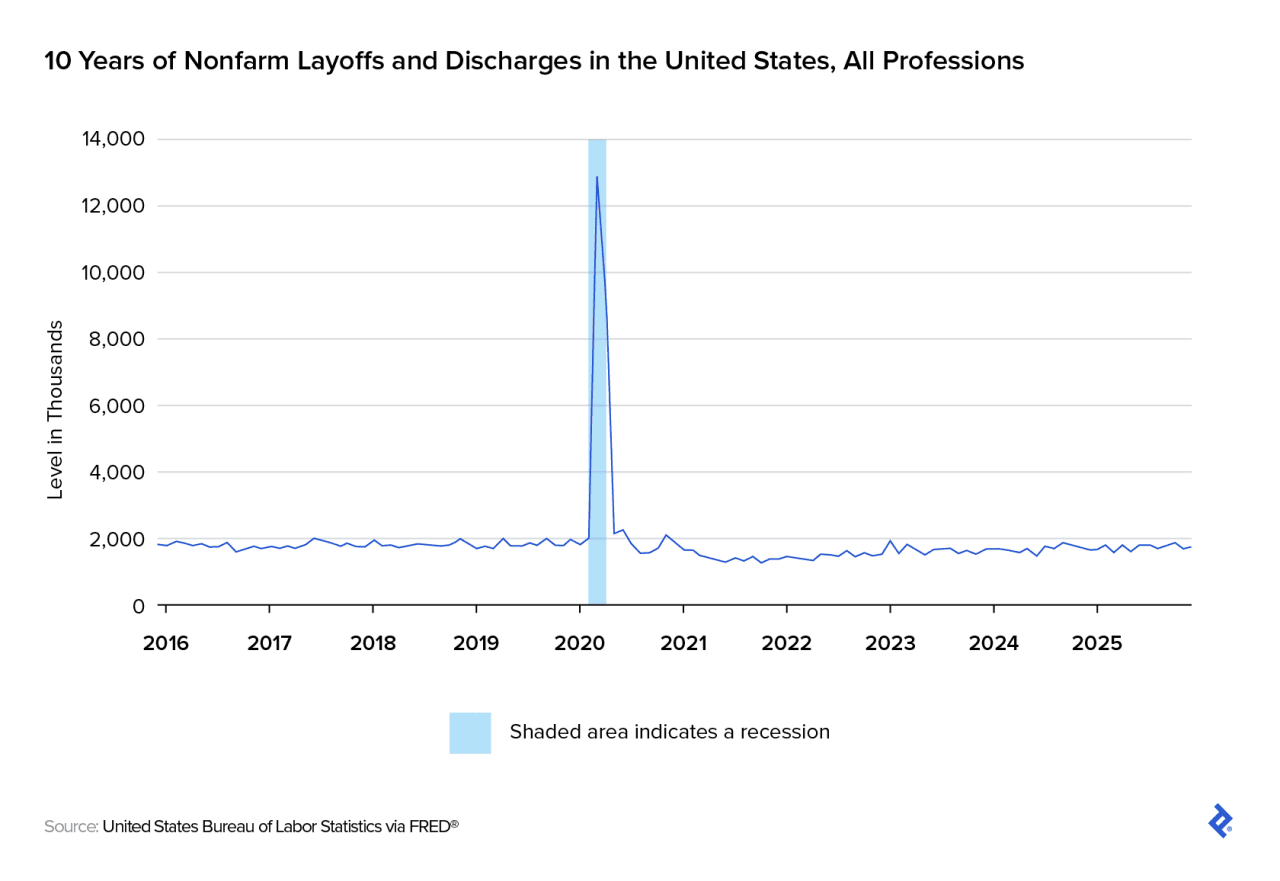
Employers in the United States announced 108,435 layoffs last month, more than three times the number announced in December, according to the global outplacement firm Challenger, Gray & Christmas. Historical data from the past several years, however, shows that overall levels are relatively stable and far from approaching the surge seen during the COVID-19 pandemic recession.

Ten years of nonfarm layoffs and discharges in the United States show a relatively stable line from 2016 through 2025 with a significant pandemic-related spike in early 2020.

Toptal

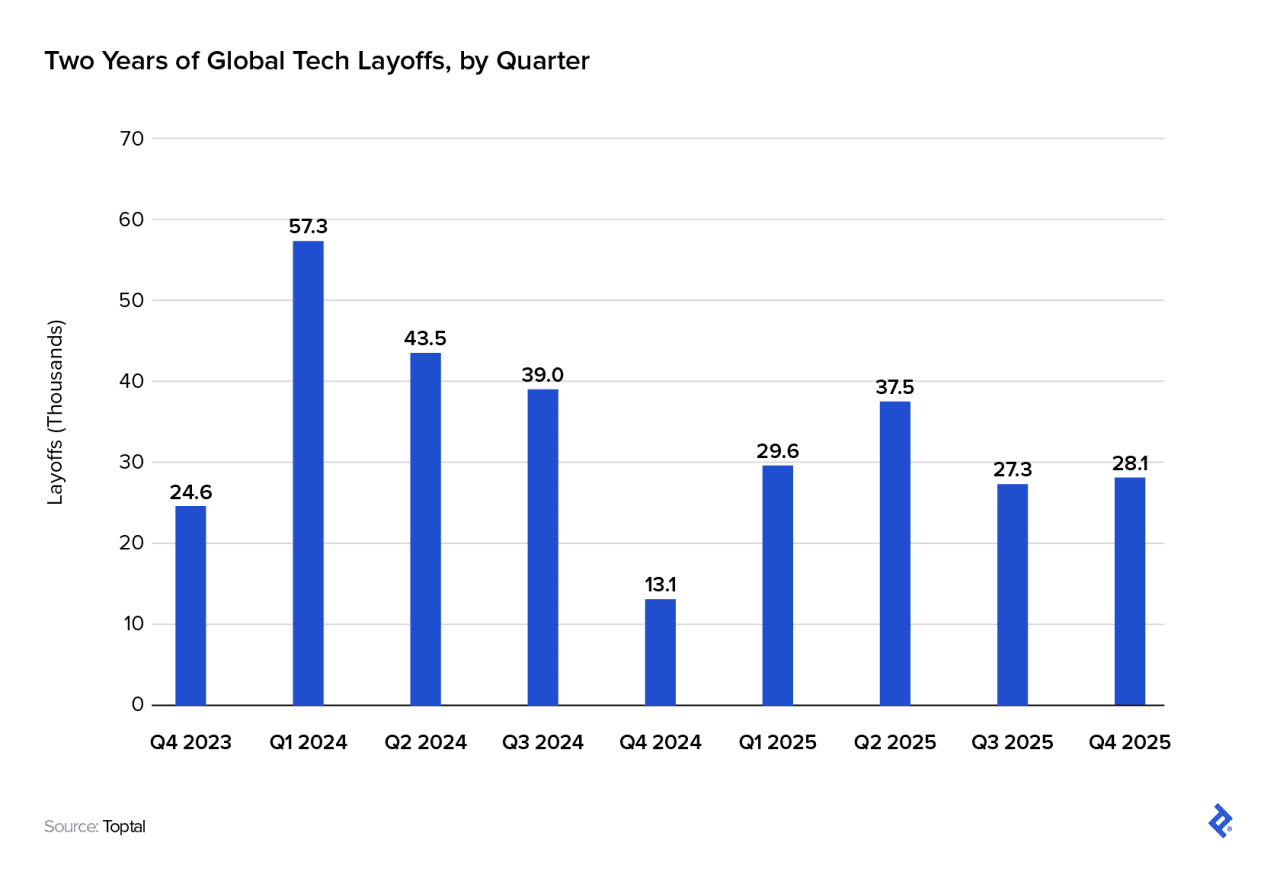
Even so, some segments of the economy have been hit harder than others. Job cuts at technology companies, for example, are significantly higher than a few years ago. Setting aside the unusual spike when COVID-19 hit in early 2020, tech firms averaged about 5,800 global layoffs per quarter from 2020 to 2022, according to Toptal’s job report. But in the fourth quarter of 2025 alone, that figure climbed to more than 28,000 worldwide.

Two years of global tech layoffs by quarter show that the lowest number was approximately 13,000 in Q4 of 2024 and the highest was over 57,000 in Q1 of 2024.

Toptal

One important contextual factor is how narrowly recent cuts have been distributed, with just four companies accounting for roughly three-quarters of the total. Generally, concentrated layoffs suggest deliberate restructuring or specific challenges faced by a company or an industry, rather than broad economic distress. “These companies are all doing well business-wise,” says Erik Stettler, the data scientist and economist who authored the report. “But these giant organizations may be feeling the need to ‘change or die.’ That they need to be leaner and meaner and act more like a startup to keep succeeding.”

Concentrated layoffs can also result from peer pressure or a herd mentality, he notes. “If one of these big companies does a large layoff and Wall Street rewards them with stock surges, the other companies may look at that and want to do the same.”

That said, layoff trends at large technology companies are important to track since these large companies do act as economic bellwethers, notes Stettler; the technology sector also generally adopts AI and other new technologies first, meaning what is happening in this sector may point to the future direction of other categories.

What Can Laid-off Workers and Other Job Seekers Do?

Success in today’s job market requires understanding what’s driving these changes and how to position yourself for opportunities. The growing consensus among employment leaders is that the old playbook won’t work anymore: Searches are stretching on for months, even for people who’ve held big jobs at well-known companies. “Unfortunately, laid-off workers are likely looking at a job search that will last at least two quarters,” says Stettler. Given the restructuring and shakeups at Amazon, Meta, Microsoft, and other big tech companies, the luster of these companies has dimmed a little, and laid-off workers “can’t rely on the prestige of having had a big tech name on their resume like they could in the past,” he notes.

Here is advice on what to do instead.

Reskill, Upskill, or Pivot

Consider pursuing advanced education or microcredentials to deepen your skill set and enhance your resume. Recent research suggests that skill-based certificates strengthen job applications, and could lead to higher salary offers. For financial support, review professional development opportunities and vocational grants or scholarships at the CareerOneStop website from the US Department of Labor.

In terms of which skills and occupations are most in demand, the United States Bureau of Labor Statistics (BLS) says that opportunities in computer and network jobs, such as computer scientists, network architects, programmers, IT support specialists, systems analysts, database administrators, digital designers, and network administrators, will grow much faster than other job opportunities through 2034.

Other fast-growing professions over the next eight years include wind and solar technicians, health services managers, physical and occupational therapy assistants, actuaries, and hearing aid specialists, per the BLS.

Aim High, but Think Small

Stettler says that people looking for a new role should search for opportunities beyond big, traditional employers and look into small and medium-sized businesses and startups they may not have heard of, but that are focused on growth. Growth means hiring. A new survey of more than 1,000 small business owners in the US found that 78% are optimistic about their profitability in the coming year, despite challenges like inflation and tariffs. As of January 2026, 25% of small businesses surveyed by the National Federation of Independent Business had job openings for skilled workers.

Highlight Your Judgment and Creativity

While high interest rates and general macroeconomic uncertainty are major drivers of layoffs, widespread adoption of artificial intelligence is also a factor, especially at technology companies. “To stand out to their next employer, people need to focus on the ways they can demonstrate creativity and judgment,” says Stettler. “Those are the two skills that are very critical in the age of AI, and that AI cannot compete with. So whether your role was a statistician or a designer, you need to drill down to what you are really good at that falls under one of those buckets, and you need to be ready to make that extremely clear to a potential employer.”

This story was produced by Toptal and reviewed and distributed by Stacker.

Topics:

Careers & Education
Entertainment

Behind the numbers: BRIT Awards 2026 nominees

Behind the numbers: BRIT Awards 2026 nominees
By Kristian Gorenc for Viberate Analytics
6 min read • Originally published February 17, 2026 / Updated March 19, 2026
By Kristian Gorenc for Viberate Analytics
6 min read • Originally published February 17, 2026 / Updated March 19, 2026

A close up on a BRIT award trophy against a background for the 'BRIT Awards 2026'.

Anthony Devlin // Getty Images

Behind the numbers: BRIT Awards 2026 nominees

Each year, the BRIT Awards act as a barometer for how British music connects with audiences at home and internationally. Beyond trophies and televised performances, the shortlist reflects months of listener behavior across streaming platforms, video services, and radio. As the 2026 ceremony approaches, the nominations bring together established names, recent breakouts, and songs that have driven conversation throughout the eligibility period.

Alongside critical reception and cultural impact, awards season now unfolds in parallel with a large volume of measurable audience data. Streaming trends, video consumption, and broadcast exposure offer additional context for understanding how nominated artists and tracks performed in the months leading up to the BRITs.

In this article, Viberate Analytics examines performance patterns among nominees in two major BRIT Awards 2026 categories—Artist of the Year and Song of the Year—using music analytics to compare audience reach, growth, and late-period momentum. The analysis does not aim to predict voting outcomes or assess artistic merit. Instead, it provides a data-led snapshot of how audiences engaged with the nominated artists and songs during the awards cycle.

How the analysis was conducted

To ensure comparability, all nominees were evaluated using the same datasets, platforms, and time frames. Only sources with consistent coverage across every nominee were included, and all metrics were assessed within clearly defined windows. This approach avoids favoring artists with longer catalogs or songs released earlier in the year.

For Artist of the Year, performance was assessed across three platforms: Spotify, YouTube, and radio airplay. Together, these sources capture on-demand listening, video engagement, and broadcast reach. TikTok data was reviewed but excluded from normalized comparisons because it was not consistently available for all nominees.

The eligibility cutoff was defined as the latest complete month available at the time of analysis, January 2026. Artist performance was measured over a rolling 12-month period from February 2025 through January 2026 to reflect sustained reach, alongside a focused 30-day window in January to capture late momentum heading into awards season.

For Song of the Year, shorter time frames were used to reflect the faster life cycle of individual tracks. Daily Spotify data over the final 30 days was used to assess short-term momentum, while a 70-day overlapping window provided a view of sustained performance that was available for all nominated songs. Lifetime totals from Spotify, YouTube, and Shazam were used as contextual indicators of scale but were not allowed to outweigh recent trends.

Across both categories, all metrics were compared only within the nominee groups. Results were expressed in relative terms rather than precise scores, emphasizing comparative standing while avoiding false precision.

Artist of the Year: Reach, growth, and late momentum

The Artist of the Year shortlist included Olivia Dean, Dave, PinkPantheress, Fred again.., Lily Allen, Lola Young, Sam Fender, JADE, Little Simz, and Self Esteem. Each artist’s performance was evaluated through a combination of streaming scale, audience growth, and cross-platform presence.

Spotify provided the clearest picture of listening behavior over the year. Across the 12-month window, Olivia Dean recorded the highest total streaming volume among the nominees, indicating sustained listener engagement throughout the eligibility period. Lola Young and PinkPantheress followed, each maintaining strong cumulative totals that reflected consistent demand.

The final month of the period highlighted differences in momentum. In January 2026, Olivia Dean again led the group in Spotify streaming volume. PinkPantheress and Dave showed the strongest listener growth during the same window, suggesting accelerating interest as the awards season approached. By contrast, several artists with larger back catalogs, including Lily Allen and Sam Fender, showed steadier or flattening listener trends during the final month.

YouTube data largely mirrored these patterns while adding another dimension to audience behavior. Olivia Dean recorded the highest total video views over the 12-month period and also led the group in January views and subscriber growth. PinkPantheress and Dave ranked close behind, reflecting strong engagement beyond audio streaming. Artists with more established audiences tended to show stable subscriber counts rather than sharp increases.

Radio airplay offered a different perspective on reach. Lola Young accumulated the highest number of radio spins over the 12-month window, pointing to strong broadcast support. Olivia Dean ranked second in overall radio scale but stood out in January by recording the highest number of spins during the month and the largest increase compared with December. This late-period acceleration set her apart from other high-rotation artists whose airplay eased toward the end of the year.

Taken together, the data showed one artist consistently appearing near the top across platforms. Olivia Dean ranked in the top tier for Spotify scale and momentum, led YouTube in both reach and growth, and posted the strongest late-period radio gains. While other nominees led individual metrics, none combined sustained reach and end-of-period momentum as consistently.

Based on these combined signals, Olivia Dean emerged as the strongest overall performer in the Artist of the Year analysis. This finding reflects relative audience engagement during the eligibility window and does not imply any assessment of artistic quality or voting outcomes.

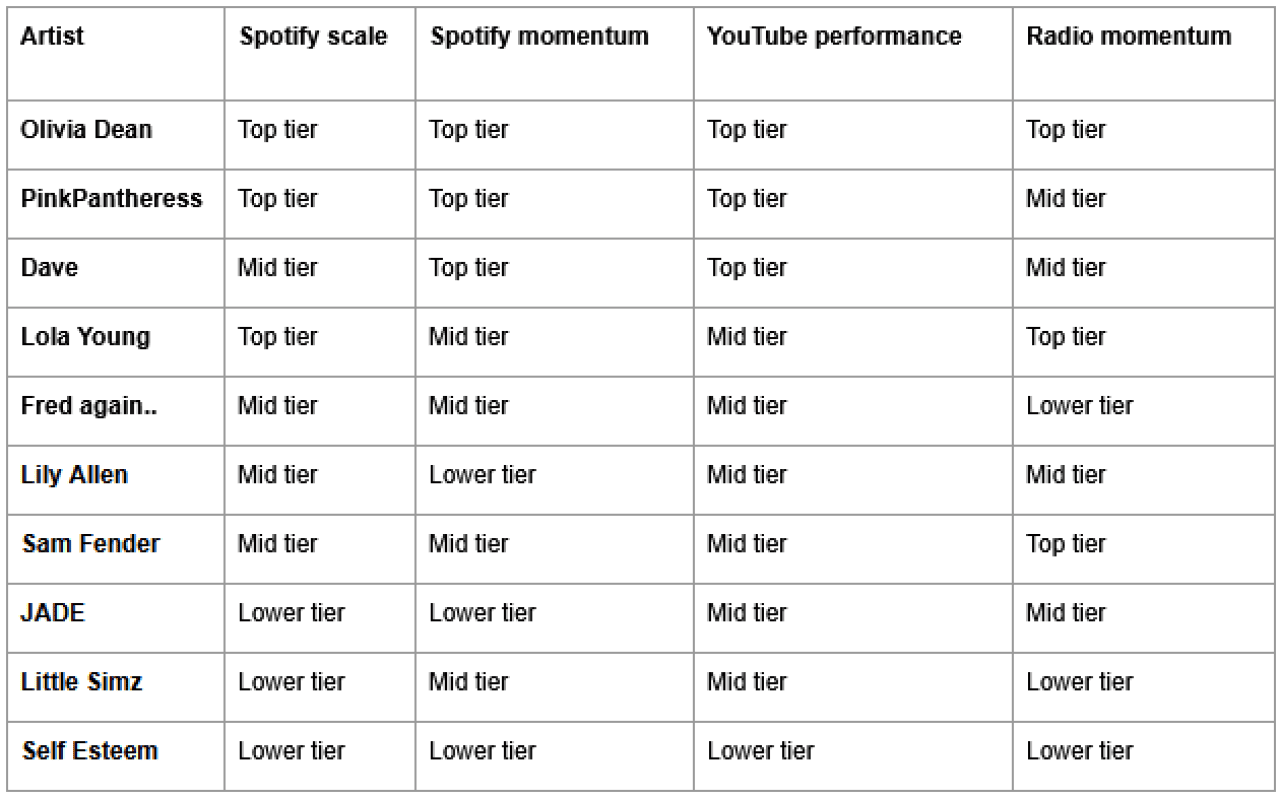
To summarize how the leading signals compared across the nominee group, the table below shows relative performance tiers derived from the analysis. Rankings are expressed in relative terms rather than exact figures.

Table listing the top artists ranking for Artist of the Year.

Viberate Analytics

Song of the Year: Short-term impact and sustained performance

The Song of the Year analysis covered 12 nominated tracks, including “Man I Need,” “WHERE IS MY HUSBAND!,” “Messy,” “The Days – NOTION Remix,” “Rein Me In,” “Victory Lap,” “Blessings,” “Azizam,” “Nice To Meet You,” “Survive,” “Defying Gravity,” and “Family Matters.” Because individual songs often rise and fall more quickly than artists, the analysis focused on recent performance rather than long-term accumulation alone.

Daily Spotify streaming data provided the primary indicator of momentum. Over the final 30 days of available data, “Man I Need” recorded the highest streaming total among all nominees. “WHERE IS MY HUSBAND!” followed closely, while “Messy” remained in the top tier despite trailing the top two in daily volume. Several tracks posted lower totals but showed notable late growth, including “Rein Me In,” which recorded the fastest increase within the window.

The 70-day overlapping window offered additional insight into sustained performance. “Man I Need,” again, led the group in total streams over this period, followed by “WHERE IS MY HUSBAND!,” with both tracks maintaining positive growth trends. “Messy” and “The Days – NOTION Remix” followed, showing strong cumulative performance even as their growth curves softened toward the end of the window.

Lifetime scale metrics added context without overriding recent trends. “Messy” ranked first in total Spotify streams, YouTube views, and Shazam activity, reflecting broad exposure across platforms. “Man I Need” ranked second in lifetime Spotify streams and led the group in playlist reach, indicating strong support from both curated and algorithmic playlists. “WHERE IS MY HUSBAND!” was also placed near the top across multiple scale indicators.

When recent momentum and broader scale were considered together, “Man I Need” stood out for combining the strongest current streaming performance with top-tier playlist exposure and competitive lifetime totals. While other tracks led individual measures, “Man I Need” aligned most closely with the indicators tied to current audience behavior.

As a result, “Man I Need” was identified as the strongest overall performer in the Song of the Year analysis. This conclusion reflects relative engagement patterns during the analysis period and does not represent a prediction or endorsement beyond the data.

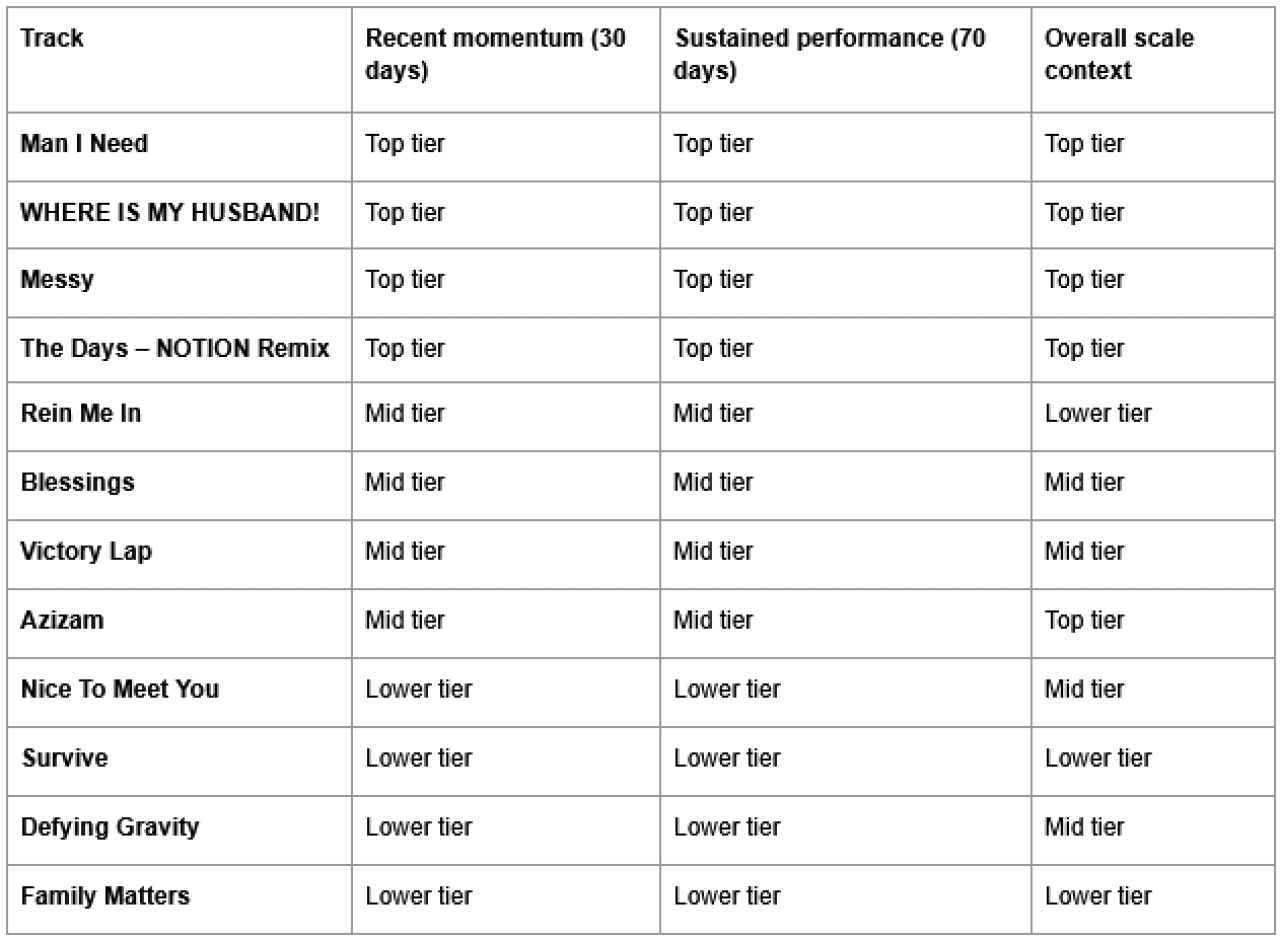
The table below summarizes how the leading tracks compared across recent momentum, sustained performance, and broader scale context.

Table listing the top leading tracks for Song of the Year.

Viberate Analytics

What the data adds to the awards conversation

Awards season often centers on debate and interpretation, but data provides a way to ground those discussions in observable audience behavior. Music analytics helps clarify how listeners engaged with artists and songs across platforms, highlighting where attention was building, stabilizing, or declining at key moments.

By applying consistent methodology and transparent comparisons, this analysis adds context to the BRIT Awards 2026 nominations without replacing critical or cultural perspectives. It illustrates how different forms of reach—streaming, video, and broadcast—intersect, and how late-period momentum can differ from long-term popularity.

As digital platforms continue to shape how music is consumed and measured, data-driven context is likely to play a growing role in how awards seasons are discussed. Used carefully, music analytics offers readers a clearer view of how nominated artists and songs connected with audiences during the period that mattered most.

This story was produced by Viberate Analytics and reviewed and distributed by Stacker.

Topics:

Entertainment
media-news

The Media Industry Is Globalizing Faster Than the People in It

Mediabistro icon
By Mediabistro
The Mediabistro editorial team draws on 25 years of media industry expertise to cover jobs, careers, and trends shaping the industry.
6 min read • Originally published February 18, 2026 / Updated March 19, 2026
Mediabistro icon
By Mediabistro
The Mediabistro editorial team draws on 25 years of media industry expertise to cover jobs, careers, and trends shaping the industry.
6 min read • Originally published February 18, 2026 / Updated March 19, 2026

The infrastructure of media production is globalizing faster than the professional norms that govern it. A Spanish niche streamer is cutting a co-production deal with a Belgian outfit. An AI-native film studio launching in Mumbai with $11 million in backing. A veteran British tabloid reporter is facing hacking allegations from a case stretching back two decades.

These aren’t adjacent developments. They’re symptoms of an industry where the systems that make, distribute, and regulate content are all changing simultaneously, and the people inside those systems are calibrating in real time.

The stories below map three pressure points: how content production is fragmenting across borders and technologies, how journalism’s accountability structures are being renegotiated, and how AI is reshaping individual media jobs through volume and speed rather than elimination.

The Global Production Map Is Being Redrawn

The Hollywood-scale budget is no longer the prerequisite for international ambition. Three stories illustrate different mechanisms of the same trend: mid-tier players gaining access to tools, partnerships, and capital that let them operate across borders without legacy studio infrastructure.

Start with the most granular example. Spanish streaming platform Filmin and Belgium’s Boucan Film Production have boarded the series “Robbery, Beating & Death” from Funicular Films. Filmin is an upscale SVOD service that also produces originals.

The structure: a Spanish streamer with a distinct curatorial identity partnering with a Belgian production company on a Catalan-language project. Scale is modest, ambition is international. A decade ago, this deal would have required multiple layers of broadcast partnership or film fund approval. Now it just happens.

Widen the lens. Mediapro Studio Distribution acquired international rights to period series “The Marquise” at the Berlin Film Festival, part of a broader push to stack rights across multiple territories for projects with cross-border appeal. The strategy works because distribution has decoupled from production in ways that create arbitrage opportunities for intermediaries who understand multiple regional buyers.

The most forward-looking signal comes from India. Abundantia Entertainment and AI video technology company InVideo have launched an AI-driven film production studio with INR100 crores ($11 million) in backing, described as the largest structured commitment to AI-driven filmmaking to date.

This is an AI-native entity, built from scratch to integrate generative tools into the production workflow. A new studio premised on the assumption that AI tools reduce costs and timelines enough to make certain categories of content economically viable that weren’t before.

Key Takeaway: Production is globalizing and fragmenting faster than professionals inside legacy structures can track. The Spanish-Belgian co-production shows mid-tier players partnering across borders. The Mediapro deal shows distributors packaging projects for fragmented international markets. The Abundantia-InVideo studio shows AI unlocking entirely new production entities.

Who Holds Journalism Accountable Now?

If the tools and geography of content production are changing this fast, journalism’s accountability structures are under comparable pressure. Three stories approach professional standards from completely different directions. That fragmentation is itself the story.

The highest-profile case involves legacy accountability mechanisms that still haven’t resolved. Daily Mail reporter Stephen Wright has called allegations of phone hacking “devastating” after being named in claims brought by Doreen Lawrence, mother of murdered teenager Stephen Lawrence. Wright says all illegal newsgathering allegations against him are false.

The case is part of the broader UK phone hacking scandal that has dragged through courts for years. It represents the old accountability crisis British media still hasn’t fully resolved: what happens when professional standards are systematically violated, and who bears responsibility when institutional checks fail?

A forward-looking counterpoint comes from Indianapolis. The Indianapolis Star has appointed Tracey Compton as public editor in a pilot program testing whether external oversight can rebuild local audience trust. Compton has outlined her approach, which includes analyzing coverage, taking audience questions, and publishing regular columns on the newsroom’s editorial decisions. It matters because trust in local news has eroded faster than at national outlets in most markets.

Whether a single public editor moves trust metrics is genuinely uncertain. But the experiment acknowledges something real: traditional accountability structures (masthead editors, corrections policies, reader letters) aren’t sufficient on their own anymore.

The most unexpected entry: Poynter’s retrospective series on journalism’s last 50 years has recognized Howard Stern as an interviewing pioneer whose style built the template for intimate, long-form conversation that now dominates podcasting.

This belongs in a section on accountability because it addresses where professional norms originate. The dominant interview style in audio journalism came from outside newsrooms entirely. A journalism training organization crediting a shock jock with shaping the craft tells you something about how the boundaries of journalistic excellence are being redrawn, retroactively.

AI Is Changing the Job, Just Differently Than Expected

The Abundantia-InVideo studio represents AI’s impact on the production side: enabling entirely new entities premised on generative tools. For individual media professionals, AI’s workplace impact looks different. Compressed timelines and inflated output expectations.

Adweek has published new data showing that AI is making marketing jobs harder, even as layoffs attributed to AI remain limited across the sector.

What’s changed is the speed and volume of work expected from each person. AI tools let marketers generate more assets, test more variations, and iterate faster, which means the baseline for what one person should produce has risen. The tools don’t replace the marketer. They raise the floor for what counts as adequate output.

This tracks with what professionals across media are reporting. The writer who used to draft three email subject lines now drafts 20 because generative tools make volume trivial. The creative who used to comp two concepts now comps ten. The strategist who used to analyze three audience segments now analyzes 15 because data tools surface patterns automatically.

In each case, the job still exists. The volume and pace have increased in ways that compress decision-making and raise the cognitive load of filtering signal from noise.

Key Takeaway: AI’s workplace impact is subtler and more persistent than the mass automation scenario. Professionals who manage for sustained intensity (better prioritization, clearer boundaries, more selective quality checks) will navigate this better than those waiting for a single transformation event that clarifies everything at once.

What This Means for You

Production is globalizing through cross-border partnerships, rights arbitrage, and AI-native entities. Journalistic accountability is being renegotiated in courts, through local experiments, and through retrospective criticism simultaneously. AI is reshaping individual roles more through volume and speed than through outright elimination.

If you’re in production, understand which partnerships and tools are lowering barriers to international collaboration. If you’re in journalism, follow the accountability experiments at local and national outlets, as they’ll shape editorial norms for years to come. If you’re using AI tools daily, measure how they’re changing your output expectations and decision-making timelines, then adjust your workflow before someone adjusts it for you.

If you’re looking to position yourself at companies navigating these shifts, browse open roles on Mediabistro. If you’re building teams and need professionals who understand these dynamics, post a job on Mediabistro to reach candidates who track industry structure as closely as they track their own careers.


This media news roundup is automatically curated to keep our community up to date on the latest developments in the creative, media, and publishing professions. It may contain factual errors and should be read for general and informational purposes only. Please refer to the original source of each news item for specific inquiries.

Topics:

media-news
Advice From the Pros

The PR Job You Want Exists (It’s Just Not Called “Public Relations”)

The PR Job You Want Exists (It’s Just Not Called “Public Relations”)
Mediabistro icon
By Mediabistro
The Mediabistro editorial team draws on 25 years of media industry expertise to cover jobs, careers, and trends shaping the industry.
9 min read • Originally published February 18, 2026 / Updated March 19, 2026
Mediabistro icon
By Mediabistro
The Mediabistro editorial team draws on 25 years of media industry expertise to cover jobs, careers, and trends shaping the industry.
9 min read • Originally published February 18, 2026 / Updated March 19, 2026

In this article: The PR Job Market | Where Public Relations Jobs Actually Live | What PR Hiring Managers Filter For | How to Stand Out in a Stack of PR Applications | Start Your PR Job Search

The job title “Public Relations Specialist” appears in fewer listings every year. That doesn’t mean PR hiring is shrinking.

The work of media relations, reputation management, and earned communications is often held under titles such as “communications manager,” “earned media strategist,” and “corporate affairs associate.” Candidates who search only for “public relations specialist” miss a huge share of relevant openings.

Bureau of Labor Statistics projections put employment growth for PR specialists at roughly the average rate for all occupations through the end of the decade. The challenge is knowing where public relations jobs actually live, understanding what modern PR hiring managers filter for in the first 30 seconds of reviewing an application, and positioning yourself as someone who gets the work.

The PR Job Market: Fragmented, Not Shrinking

PR job openings haven’t disappeared. They’ve dispersed.

Healthcare organizations, technology companies, financial services firms, and government or nonprofit entities are among the largest employers of PR professionals. The traditional agency model still exists, but a growing share of PR work happens in-house across industries that weren’t historically associated with communications roles.

Think: hospital systems with dedicated media relations teams. Fintech startups hiring their first “corporate comms” person. State agencies looking for public affairs specialists who can handle both press inquiries and social media.

Salary Reality: BLS wage data places the median annual salary for PR specialists in the upper $60,000 range, while PR and communications managers can earn median pay above $125,000. That gap reflects specialization and the ability to manage organizational reputation across digital, social, and traditional channels simultaneously.

Here’s the real shift: “public relations” as a discrete job function is being absorbed into broader communications, content, and brand roles. Employers want professionals who can write a press release, sure, but also analyze social sentiment, brief executives before broadcast interviews, coordinate crisis response, and understand how earned media ladders into larger marketing objectives.

If you’re limiting your search to listings with “public relations” in the title, you’re competing for maybe half the roles that actually involve PR work.

Where Public Relations Jobs Actually Live

Search Broader Than “Public Relations Specialist”

Start with the title variations hiring managers actually use:

  • Communications Manager
  • Media Relations Coordinator
  • Corporate Communications Associate
  • Reputation Manager
  • Crisis Communications Specialist
  • Earned Media Strategist
  • External Affairs Manager
  • Public Affairs Specialist

Set up job alerts for all of these. The work is fundamentally the same. The title fragmentation reflects organizational structure, not actual responsibilities.

Use Niche Job Boards Where PR Roles Surface

Indeed and LinkedIn can bury PR openings under hundreds of marketing and corporate communications listings. Niche boards surface roles specifically in media and communications.

Mediabistro’s public relations job listings focus on media, publishing, and content-driven industries where PR work intersects with editorial judgment. The Public Relations Society of America (PRSA) maintains a job board filtered by specialization and experience level. The International Association of Business Communicators (IABC) lists roles that blend internal and external communications.

These boards matter because recruiters targeting communications professionals post there first. By the time a role hits a general aggregator, you’re competing with candidates who applied a week earlier through the niche channel.

Work LinkedIn Like a PR Professional

Follow agency principals, corporate communications VPs, and recruiters who specialize in communications roles. Engage with their content before you need something. Comment on their posts. Share relevant articles with a sentence or two of your own perspective.

When you do reach out about a role, you’re not a cold applicant. You’re someone they’ve seen contributing to the conversation.

Identify Companies at Communications Inflection Points

Product launches, crises, rebrands, leadership changes, IPOs, mergers. These moments generate PR needs. Companies going through them are either hiring or about to be.

Track the news in your target industries. When you spot a company navigating a high-stakes communications moment, pitch yourself directly to their communications team before the role is formally posted. A well-timed, substantive email to the VP of Communications can bypass the application queue entirely.

Hiring managers facing immediate pressure need someone who already understands their challenge. Someone who references their specific situation and offers relevant experience gets a conversation. Generic applicants get stacked.

Tap Professional Communities Where Referrals Happen

Referrals carry enormous weight in PR hiring, especially at agencies where cultural fit matters as much as skill. Many roles fill through informal networks before they’re publicly posted.

PRSA chapters host monthly events in most major cities. IABC runs professional development programs. Local press clubs and media mixers bring together journalists and communications professionals. Go to these not to collect business cards, but to meet people doing the work you want to do.

The person you meet at a PRSA mixer might not have an opening for months. But when their agency wins a new client and needs to staff up quickly, they’ll remember the candidate who showed up, asked smart questions, and clearly understood the work.

Understand the Agency vs. In-House Distinction

These are fundamentally different job searches.

Agencies hire in waves around new client wins. Openings appear suddenly and fill quickly. In-house corporate communications roles are steadier but less frequent.

Agency work offers variety and rapid skill-building: multiple clients, multiple industries, a high volume of media placements. The trade-off is longer hours and less predictability. In-house roles offer deeper brand knowledge, more strategic involvement, and often more predictable schedules, but with narrower exposure.

Decide which path fits your career stage and work style, then focus your search accordingly.

What PR Hiring Managers Filter For

Writing Samples Are the First Gate

No writing samples? Disqualified before anyone reads your resume.

A solid portfolio includes a press release, a media pitch, and ideally a crisis statement or thought leadership draft. Speculative or academic samples are fine for entry-level candidates, but they need to look professional. No typos. No formatting errors. No language that screams “this was homework.”

Present your portfolio as a clean PDF or simple portfolio site with a one-sentence context note for each sample: “Written for [client or class project] during product launch; resulted in coverage in [outlet or would have targeted outlet].”

Portfolio Tip: Even if you haven’t held a formal PR role, you can build writing samples. Draft a press release for a local nonprofit. Write a media pitch for a friend’s small business. Create a crisis response statement for a hypothetical scenario in your target industry. The samples need to be strong, not necessarily real-world published pieces.

Digital and Social Fluency Is Non-Negotiable

Listing “Microsoft Office” as a skill in a 2026 application is a red flag. Hiring managers expect comfort with media monitoring platforms, social listening tools, analytics dashboards, and content management systems.

You should be able to pull reports from platforms like Meltwater or Cision and explain what the data means. You should understand the difference between reach, impressions, and engagement. You should be able to navigate a CMS to publish content without calling IT.

Nobody expects you to be a data scientist. But modern PR is measured, not just executed, and you need to speak the language of metrics when a CMO asks what your media placements actually delivered.

Media Relationships or Evidence of Earned Coverage

Even entry-level candidates can demonstrate this. Student media placements. Freelance bylines. A media list you built for a class project or internship. Coverage you secured for a volunteer organization.

Hiring managers want to see that you understand how journalists work, what makes a story newsworthy, and how to pitch without annoying people. If you have existing relationships with reporters, even at smaller outlets, say so explicitly. If you’ve placed stories, include links or screenshots.

The “Purpose and Values” Layer

PR is increasingly tied to organizational reputation, ESG initiatives, and purpose-driven communications. Candidates who can articulate how PR intersects with organizational values stand out.

Applying to a healthcare organization? Mention how communications can support patient trust. Targeting a financial services firm? Reference reputation management in a regulated industry. Show that you see PR as strategic, not just tactical.

AI Literacy as an Emerging Differentiator

AI tools are creeping into the PR workflow: media list building, draft generation, sentiment analysis. You don’t need to be an expert, but demonstrating awareness signals adaptability.

If you’ve experimented with AI for drafting press releases or analyzing media coverage, mention it. If you haven’t, spend an afternoon testing a tool and be prepared to discuss how you’d integrate it into your process. Hiring managers aren’t looking for technical mastery. They’re looking for people who won’t resist when the organization adopts new platforms.

Red Flags Hiring Managers Notice Immediately

Generic cover letters that could apply to any company. No writing samples attached. Listing “social media” as a skill without specifics about platforms, metrics, or results. Not knowing the difference between earned, owned, and paid media.

Typos in a PR application are disqualifying. This is a profession built on written communication. If you can’t proofread your own materials, hiring managers will assume you can’t proofread client-facing content.

How to Stand Out in a Stack of PR Applications

Tailor Ruthlessly

Every application should reference the company’s recent communications activity. A campaign they ran. Coverage they received. A crisis they navigated. This takes 10 minutes of research and eliminates most of your competition immediately.

Lead with Results, Not Responsibilities

“Secured coverage in [publication]” beats “responsible for media outreach.” Every time.

Even at entry-level: “Built a targeted media list of 40 reporters for [client or project]” is better than “assisted with media relations.”

Hiring managers skim resumes in seconds. They’re scanning for evidence you’ve done the work. Quantify wherever possible: number of placements, audience reach, spokesperson prep sessions conducted, crisis response time.

Follow Up with Substance

After applying, send a brief, personalized message to the hiring manager on LinkedIn. Not “just checking in.” Share a relevant insight that shows you’re already thinking about their communications challenges.

“I saw the recent coverage of [company initiative] in [publication]. I’ve worked on similar campaigns in [industry] and found that [specific tactic] helped extend the news cycle. Happy to discuss if useful.”

This works because it adds value instead of just asking for attention. If you can’t think of anything substantive to share, don’t send the message.

Credentials That Move the Needle

PRSA’s Accredited in Public Relations (APR) designation carries weight, especially at agencies and in corporate communications. It’s not required for most roles, but it signals seriousness to hiring managers who know the field.

Early in your career and don’t yet qualify for APR? PRSA membership still matters. It demonstrates professional commitment and gives you access to the networking events where referrals happen.

For more strategic career guidance, explore these five secrets to success in public relations from professionals who’ve built long careers in the field.

Start Your PR Job Search

The public relations job market rewards candidates who search broader than they think, in more places than they expect, and show up as modern PR professionals who understand the work extends well beyond press releases.

Search using the full range of titles: communications manager, media relations coordinator, corporate communications associate, earned media strategist. Use niche job boards where PR roles surface first. Tap professional communities where referrals happen. Build a portfolio that demonstrates writing skill and media savvy, even if your samples come from academic or volunteer work.

Browse public relations jobs on Mediabistro to see what roles are open and how they’re actually titled. Set up alerts for multiple title variations so you’re notified when new opportunities post.

Once you land interviews and start receiving offers, this guide on evaluating job offers will help you negotiate effectively. When hiring managers request references, use this email template to reach out to former colleagues professionally.

For employers looking to hire PR professionals, post your open roles on Mediabistro to reach candidates actively working in media and communications.

The work is out there. It’s just hiding under different titles, in different industries, and on platforms most candidates aren’t checking. Now you know where to look.

Topics:

Advice From the Pros

Hot Jobs

Mission-Driven Media Jobs Are Hiring Across Behavioral Science and Advocacy

hot media and creative jobs on Mediabistro
Mediabistro icon
By Mediabistro
The Mediabistro editorial team draws on 25 years of media industry expertise to cover jobs, careers, and trends shaping the industry.
5 min read • Originally published February 19, 2026 / Updated March 19, 2026
Mediabistro icon
By Mediabistro
The Mediabistro editorial team draws on 25 years of media industry expertise to cover jobs, careers, and trends shaping the industry.
5 min read • Originally published February 19, 2026 / Updated March 19, 2026

Purpose-Driven Organizations Are Spending on Talent

Something interesting is happening in the mission-driven corner of the media job market. Organizations built around social change, civic engagement, and community advocacy are posting roles that look remarkably like the senior positions you’d find at commercial agencies or major publishers. The difference? These employers are explicit about wanting people who care about the work beyond the paycheck.

Today’s featured listings share a common thread: every one of them sits at the intersection of media craft and organizational mission. A behavioral science ad firm needs a Media Director to scale its practice. A 290,000-member labor union is building out a digital team with two simultaneous hires. And a public radio station in North Carolina wants someone who can bridge the gap between audience engagement and fundraising.

These roles signal that the nonprofit and advocacy sectors have stopped treating communications as an afterthought. They’re hiring experienced strategists, not junior generalists, and they’re building teams with real structure. If you’ve been honing your skills in commercial media and wondering whether a pivot to purpose-driven work means a step backward, the answer right now is no.

Today’s Hot Jobs

Media Director at Marketing for Change

Why this one matters: Marketing for Change is an independent national advertising firm that uses behavioral science to drive social change campaigns at the regional, state, and national level. This is a senior leadership hire, not a mid-level promotion. You’ll own the agency’s entire media and exposure practice, from planning and buying to earned media strategy. The firm is looking for someone who can scale the department while managing agency profitability, which means real P&L experience is likely a factor.

The key qualifications:

  • Recognized leadership experience in media planning, buying, and earned exposure
  • Deep expertise across specialized channels with the ability to evolve strategy based on behavioral insights
  • Entrepreneurial mindset with experience scaling a team and a practice area
  • Background connecting creative storytelling with smart media investment

Apply to the Media Director position at Marketing for Change

Digital Strategy Manager at the National Association of Letter Carriers

What caught our eye: NALC represents 290,000 active and retired letter carriers, and they’re hiring two digital roles simultaneously. That’s a clear sign of institutional investment in communications infrastructure. The Digital Strategy Manager role carries real scope: you’ll lead digital strategy development, manage podcast and video production timelines, run analytics, and support organizing and advocacy campaigns. The salary range of $75,000 to $105,000 is competitive for D.C.-based advocacy work, especially at an organization with this kind of reach.

Core requirements:

  • Strong background developing and implementing digital strategy for advocacy or organizing
  • Experience managing podcast, video, and multimedia production workflows
  • Analytical skills with the ability to track, report, and optimize digital performance
  • Excellent written and verbal communication with the ability to manage multiple projects under tight deadlines

Apply to the Digital Strategy Manager role at NALC

Digital Fundraising and Marketing Associate at WUNC Public Radio

The appeal here: Public media jobs that blend editorial promotion with revenue generation are increasingly common, and WUNC’s framing of this role is especially clear. You’ll own social media strategy with the explicit goal of growing audience engagement and converting that engagement into financial support. The $65,000 to $75,000 salary for Chapel Hill, North Carolina, is solid, and the role offers a front-row seat to the evolving public radio business model. If you’ve worked in audience development or social strategy and want your work to directly sustain independent journalism, this is worth a close look.

What they need:

  • Experience defining and implementing social media strategies that drive measurable growth
  • Ability to create content that builds community and converts listeners into supporters
  • Skills in audience analytics, engagement tracking, and platform-specific optimization
  • Collaborative approach to working with internal stakeholders across editorial and development teams

Apply to the Digital Fundraising and Marketing Associate role at WUNC

Product Marketing Specialist at Murmuration

On the radar: Murmuration builds data tools and insights platforms for civic organizations, helping communities organize and build power. This remote Product Marketing Specialist role sits at a fascinating crossroads: you’ll market technology products to an audience of organizers, advocates, and civic leaders. That requires someone who can translate complex, data-driven capabilities into language that resonates with mission-focused users. If you’ve done product marketing in SaaS or tech and want to apply those skills to civic infrastructure, Murmuration is doing genuinely distinctive work.

Ideal background:

  • Product marketing experience, ideally with data platforms or technology tools
  • Ability to communicate technical product value to non-technical, mission-driven audiences
  • Comfort working within a collaborative, creative team of organizers and data scientists
  • Alignment with Murmuration’s mission of equitable civic engagement and community power-building

Apply to the Product Marketing Specialist role at Murmuration

The Takeaway for Job Seekers

If you’ve spent years building media strategy, digital production, or audience development skills in commercial settings, the mission-driven sector is actively recruiting people like you. These organizations have moved past the era of expecting passion to compensate for underfunding. The roles posted today come with defined salary ranges, clear team structures, and genuine strategic responsibility.

One practical move: before you apply, invest time understanding each organization’s specific mission and language. A strong cover letter for a labor union digital role reads very differently from one aimed at a behavioral science agency. Tailor your framing accordingly. And if you’re navigating multiple offers or approaching a transition, Mediabistro’s guide on what to do once you receive a job offer is worth reviewing before you get to the decision point. Browse the full set of open media jobs on Mediabistro to see what else is hiring right now.

Topics:

Hot Jobs

Posts navigation

Older posts
Newer posts
Featured Jobs
Kirkus Media
Editorial Intern
Kirkus Media
New York City, New York (US)

Gaia Inc
MEDIA COORDINATOR
Gaia Inc
Louisville, CO

Gaia Inc
Global Paid Media Specialist
Gaia Inc
Louisville, CO

Gaia Inc
Director of Media Strategy
Gaia Inc
Louisville, CO

Hearst Television
Account Executive
Hearst Television
Milwaukee, WI, United States

All Jobs »
PREMIUM MEMBER
RP

Rudri Patel

,
Years Experience
View Full Profile »
Join Mediabistro Membership Today

Stand out from the crowd with a premium profile

Mediabistro Logo Find your next media job or showcase your creative talent
  • Job Search
  • Hot Jobs
  • Membership
  • Newsletter
  • Career Advice
  • Media News
  • Hiring Tips
  • Creative Tools
  • About
Facebook YouTube Instagram LinkedIn
Copyright © 2026 Mediabistro
  • Terms of Use
  • Terms of Service
  • Privacy