

Mediabistro Logo Mediabistro Logo
  • Jobs
    Search Creative Jobs Hot Jobs Remote Media Jobs Create Job Alerts
    Job Categories
    Creative & Design Marketing & Communications Operations & Strategy Production Sales & Business Development Writing & Editing
    Quick Links
    Search All Jobs Remote Jobs Create Job Alerts
  • Career Resources
    Career Advice & Articles Media Industry News Media Career Interviews Creative Tools Resume Writing Services Interview Coaching Job Market Insights Member Profiles
  • Mediabistro Membership
    Membership Overview How to Pitch (Premium Tool) Editorial Calendars (Premium Access) Courses & Training Programs Membership FAQ
  • Showcase
    Featured Creative Stories Submit your Story
  • Log In
Post Jobs
Mediabistro Logo Mediabistro Logo
Search Creative Jobs Hot Jobs Remote Media Jobs Create Job Alerts
Job Categories
Creative & Design Marketing & Communications Operations & Strategy Production Sales & Business Development Writing & Editing
Quick Links
Search All Jobs Remote Jobs Create Job Alerts
Career Advice & Articles Media Industry News Media Career Interviews Creative Tools Resume Writing Services Interview Coaching Job Market Insights Member Profiles
Membership Overview How to Pitch (Premium Tool) Editorial Calendars (Premium Access) Courses & Training Programs Membership FAQ
Featured Creative Stories Submit your Story
Log In
Post Jobs
Log In | Sign Up

Follow Us!

Careers & Education

‘Stage is shifting rapidly’ for high schools: Are states helping them keep up?

‘Stage is shifting rapidly’ for high schools: Are states helping them keep up?
By Patrick O'Donnell for The 74
7 min read • Originally published March 9, 2026 / Updated March 19, 2026
By Patrick O'Donnell for The 74
7 min read • Originally published March 9, 2026 / Updated March 19, 2026

Students at Latitude High School in Oakland, CA collaborate on designing an autonomous vehicle to aid senior citizens.

Latitude High School

‘Stage is shifting rapidly’ for high schools: Are states helping them keep up?

The rise of artificial intelligence and other technology has traditional high schools scrambling to keep up, with states doing an uneven job of encouraging schools to embed critical thinking skills and offer students access to internships and college courses, according to a new report reviewed by The 74.

Today’s world, the nonprofit XQ Institute argues in its new report The Future Is High School, “requires an entirely new kind of educational experience — one that traditional high schools were never designed to deliver.”

“We live in an age of self-driving taxis, blockchain, and renewed interest in space exploration. The public launch of ChatGPT placed a powerful form of generative artificial intelligence (AI) within the reach of every American,” the report continued. “But that stage is shifting rapidly. Our young people are growing up at a time when the economy and workforce are in constant flux. And high schools must keep pace.”

Schools not only need to emphasize work and early college experiences, XQ found, but also teach interpersonal and thinking skills as much as academics.

“What do we need to know when we leave our high school doors?” asked XQ CEO Russlynn Ali. Math, English and science are still important, she said.

“But layered on top of that, we need to be critical thinkers,” Ali said. “We need to be able to collaborate. We need adaptability. We need these skills that will help us succeed in life, no matter what direction we choose after we leave high school.”

XQ wants states to encourage schools to follow the lead of Purdue Polytechnic High School in Indianapolis or the Museum High School in Grand Rapids, Michigan, where students learn academics and interpersonal skills through projects, not lectures. Another standout: Oakland, California’s Latitude High School, where every 10th grader follows an adult through a work day to learn about the job, 11th graders have month-long internships and older adults can choose to do a longer one.

The new report takes a different approach from XQ’s previous work, which has centered on schools.

“States have more responsibility and authority over their schools than certainly in recent memory, if not in my lifetime,” Ali said. “They must be the locus of change.”
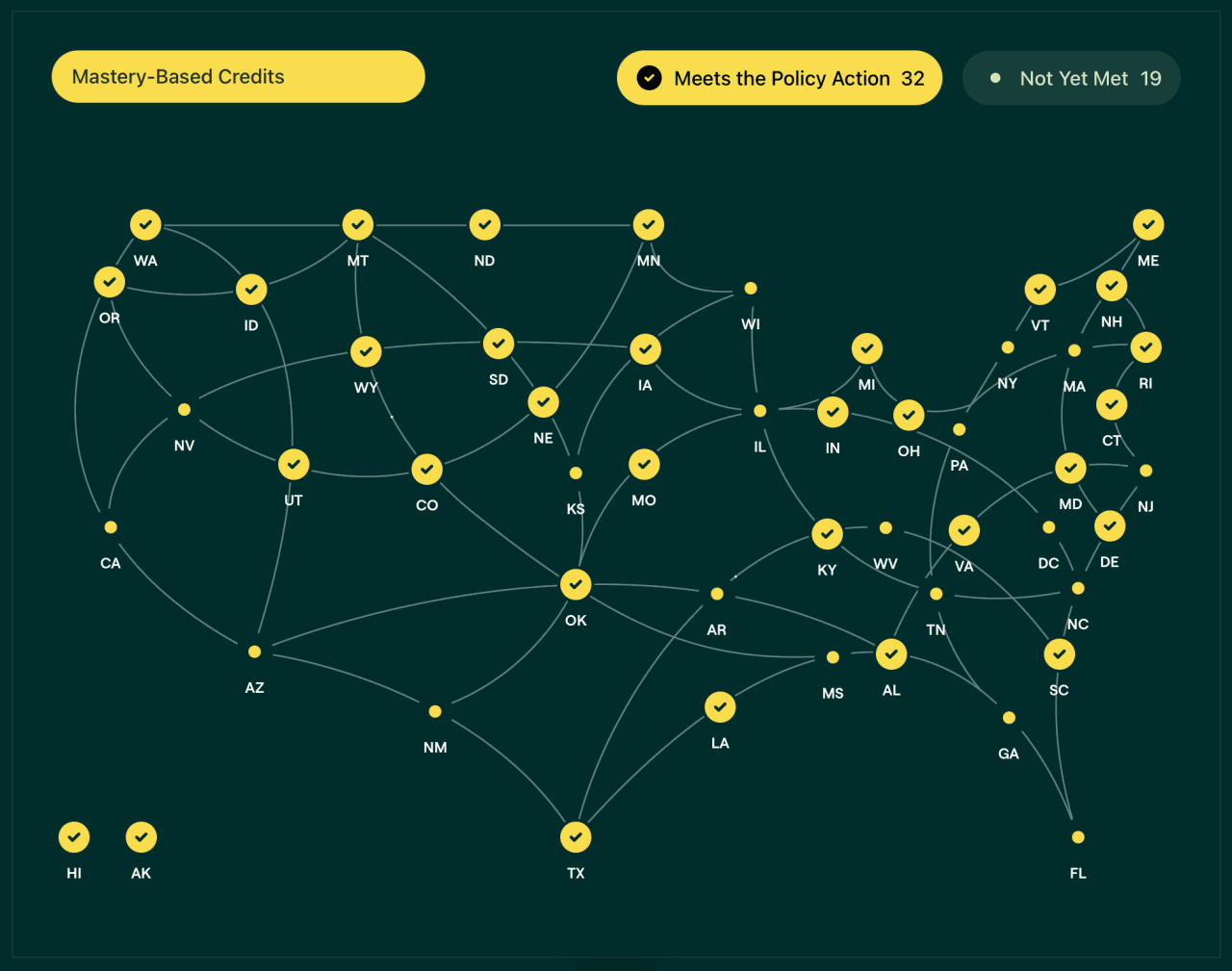
A map of the US showing which states have made more progress meeting certain criteria for educating high school students according to XQ Policy Actions.

XQ Institute

States are mixed, however, XQ reports in the new study, on how they are succeeding in meeting 10 goals XQ considers key to school innovation. XQ met with school leaders across the country to create the goals — and then researched how much progress each state and Washington D.C. has made toward them:

  • 46 states have met the goal of offering work experience, such as internships, as credit toward high school diplomas.
  • 38 states give every student a chance to earn college credit before graduating, by taking Advanced Placement, International Baccalaureate or college classes.
  • 32 states give schools the ability to award students class credit under a mastery or competency system, showing they know the material, instead of just attending a class.
  • 32 states have identified key skills students need to learn for the future, including nonacademic skills XQ has made a major part of its work, such as teamwork, critical thinking and problem solving. States often created a “Portrait of a Graduate” spelling these out.
  • Just 10 states — Indiana, Michigan, Minnesota, North Dakota, Oklahoma, Rhode Island, Utah and Washington — met six of the goals; and no state met all 10, though 31 met at least four. Two states — Alaska and Florida — met only two of the goals.
  • Two of XQ’s goals — finding ways to measure how well students have learned interpersonal and thinking skills, then showing those on report cards — haven’t been realized by any state.

XQ plans to track changes and update the report every two years for the next decade.

“I think of these as a start, definitely not a finish line,” Ali said.

To highlight the 10 policy goals and encourage states to adopt them, XQ is planning to visit schools and policymakers in 25 communities, likely over the next two years. Details of that tour, which starts March 4 in Indianapolis and stops in Columbus, Ohio, the week after, are still being developed.

XQ, a nonprofit and affiliate of investing and philanthropic firm Emerson Collective, was cofounded by Ali and Laurene Powell Jobs. Powell Jobs is Emerson’s founder and president, and wife of the late Apple founder Steve Jobs.

XQ has been refining its vision for redesigning high schools since launching in 2015 with a well-publicized campaign to identify and support innovative “Super Schools” across the country. It gave a total of $102 million in 2016 to 18 schools — including the schools mentioned above — before expanding its work to 28 states.

XQ’s vision has its critics, who say it overstates how much jobs will change in the future and who are unsure if XQ’s priorities are the best way to prepare students. But school districts and several states, including Indiana, Rhode Island and Utah, agree with the approach and are open in their support.

Utah’s state superintendent, Molly Hart, said the state rarely adopts any national approach, but there is great overlap in what XQ promotes and the state’s push to redesign high schools, including the support of mastery teaching approaches and requiring students to earn a meaningful professional credential before graduating.

”We align closely when you look at some of the goals and policy actions that XQ does,” she said. “We have a lot of similarities in what we’re looking at.”

The report, and shorter reports XQ released for individual states, also highlight policy changes and efforts already in place that XQ considers “beacons” for change. Among them:

  • Indiana: For giving schools increasing flexibility in giving students class credit for showing proficiency in a subject, rather than just sitting through a class all semester or year.
  • Rhode Island: For changing diploma requirements so that all students, beginning in 2028, must take the courses in math, foreign language and even art that qualify them to attend college.

    “Our kids were not even taking the classes to be able to apply to those schools,” said state education commissioner Angelica Infante-Green. “Once they got there, they were in remedial courses because we weren’t preparing them for college-level achievement.”

  • Texas: For allowing students to earn 12 hours of college credit in high school, either through college, AP or International Baccalaureate classes.
  • Colorado: For encouraging the growth of CareerWise high school apprenticeships, the largest youth apprenticeship program in the country. Colorado also broke career preparation into three categories — Learning ABOUT Work, Learning THROUGH Work, and Learning AT Work.
  • Utah: For giving schools grants to train teachers how to educate students using a mastery/competency approach and how to rate student progress. Utah also backed some schools in trying out vastly different report cards — keeping the traditional A-F grade scale, but also giving students a new Mastery Learning Record that shows their progress on durable skills.

Ali said XQ also wanted to highlight two goals that haven’t been met yet, but that she considers vital — developing tests to measure how well students have learned key nonacademic skills and then changing student report cards to rate students on those skills.

Ali said the standardized tests states use to measure student skills in math, English and science offer some sense of what students know, but are outdated. There’s no clear way yet to assess how well students have mastered durable skills to prove to colleges or employers that they have those skills. And Ali said that schools tend to prioritize learning the state measures and judges them on, so schools won’t teach them vigorously until they are part of report cards and school ratings.

But XQ recognized 12 states for trying to develop those tests and report cards, six of them for participating in a pilot project with the Educational Testing Service, the Carnegie Foundation for the Advancement of Teaching and the Mastery Transcript Consortium (now part of ETS). The Skills for the Future project has been working to create tests on durable skills, starting with three: collaboration, communication and critical thinking.

XQ is not part of this effort but partners with Carnegie on some related work and says it enthusiastically backs it.

The Skills for the Future team, which includes Indiana, Missouri, North Carolina, Nevada, Rhode Island and Wisconsin, is still working on creating new tests but recently broke down each of those three skills into smaller skills as one step toward creating tests.

Communication, for example, is broken down into segments — presentation skills, making messages more clear, adapting messages for different audiences or comprehending the communication of others — that are then broken down further into sub-skills.

Infante-Green said measuring these skills will be a “game changer.”

“I think it will give employers things that they have been looking for, as well as change how we teach, what we teach, and how we incorporate (those skills) into the academic field,” she said. “It’s important. It won’t be one or the other, it’ll be both.”

Ali also stressed that just passing policy changes won’t be enough. Schools, teachers and parents need to also be on board.

“It’s not a checklist,” Ali said. “It has to be implemented in a way that is sustained and empowering and supportive of what needs to happen in the classroom.”

Disclosure: XQ provides financial support to The 74.

This story was produced by The 74 and reviewed and distributed by Stacker.

Topics:

Careers & Education

media-news

Publishers Are Building Their Own Tech. Here’s Why It Matters.

Mediabistro icon
By Mediabistro
The Mediabistro editorial team draws on 25 years of media industry expertise to cover jobs, careers, and trends shaping the industry.
5 min read • Originally published March 10, 2026 / Updated March 19, 2026
Mediabistro icon
By Mediabistro
The Mediabistro editorial team draws on 25 years of media industry expertise to cover jobs, careers, and trends shaping the industry.
5 min read • Originally published March 10, 2026 / Updated March 19, 2026

The Spectator just spent £1 million to build something most publishers rent. The UK magazine, around since 1828, decided it would rather own its subscription infrastructure than keep paying someone else for access.

The bet has already saved the publication around £500,000 annually, according to Press Gazette’s detailed breakdown. Two-year payback period. That gets attention.

This is a control story, not a technology story. Publishers are realizing that the platforms they’ve relied on for subscription management, reader data, and payment processing have become both expensive and limiting.

The Spectator’s move signals a broader inflection point: as third-party costs rise and customization options narrow, more publishers will face the same build-versus-buy decision. The ones with the resources and technical confidence to build are starting to pull away.

Meanwhile, journalism itself is having two simultaneous conversations. One is about the work that endures: nonfiction books that represent the profession at its most ambitious. The other is about editorial mistakes that erode trust. Both conversations are happening at Poynter, and the contrast is instructive.

And in Málaga, three stories from the same festival ecosystem illustrate how international co-production is reshaping where storytelling careers are built, which projects get financed, and which markets matter to professionals tracking production growth.

Owning the Pipes

The Spectator could have kept using a third-party subscription service, the way most publishers do. Instead, it spent a year and seven figures building a custom system that handles subscriptions, renewals, reader data, and payment processing in-house.

The result: £500,000 in annual savings, full control over customer data, and the ability to customize the subscriber experience without waiting on a vendor’s product roadmap.

The Math: At £500,000 in annual savings, The Spectator recovers its £1 million investment in two years. After that, the savings compound while the publication owns the subscriber relationship at the infrastructure level.

For years, the default was to outsource anything that wasn’t core editorial. But as subscription revenue becomes the primary business model for many outlets, the definition of “core” has expanded.

Owning your subscriber data, controlling your pricing experiments, keeping margin dollars in-house: these are competitive advantages now, not line items to farm out.

When a third-party platform changes its pricing, adds friction to the signup flow, or limits data access, The Spectator doesn’t feel it.

The gap between publishers who own their infrastructure and publishers who rent it will widen as subscription businesses mature. For professionals working in publisher operations, product, or engineering, this is where strategic value is being built.

The Work That Lasts, and the Work That Doesn’t

Poynter published two pieces recently that, read together, frame journalism’s split identity with unusual clarity.

The first asks a simple question: What are your favorite nonfiction books by journalists? The answers celebrate reporters who turn investigations into lasting works. Jerry Mitchell’s “Race Against Time,” documenting his years reopening cold cases, is one example. These books represent journalism at its most durable: rigorous, patient, built to outlast the news cycle.

The second piece examines something else entirely. Fox News aired old footage of President Trump honoring fallen troops, paired with current coverage that made the footage appear recent. Poynter’s analysis asks whether the error was an honest mistake or a deliberate editorial choice, but the larger question is simpler: how do these failures keep happening?

The contrast matters. When publishers invest millions in subscription infrastructure, they are betting that readers will pay for reliable, credible information. That bet only works if the editorial operation delivers on the promise. The Fox News incident is a reminder that operational failures, whether careless or calculated, undermine the entire value proposition.

For journalists navigating career decisions, this duality is real. The profession still rewards long-form ambition and the kind of investigative persistence that Jerry Mitchell exemplifies. It also demands operational rigor at every level: fact-checking, archival accuracy, editorial judgment on what footage to use and when. The jobs that combine depth and discipline are the ones that will define the next generation of newsroom leadership.

Málaga’s Signal

Three stories out of Málaga’s film festival and market show how international co-production is diversifying storytelling at the project, sector, and financing levels.

Start with the talent layer. Camila Agustini, who co-wrote the 2024 award-winning Brazilian film “Manas,” is collaborating with Elton de Almeida, a writer on early Netflix Brazil hits, to develop “Diamonds Are Forever.” Variety reports the Brazilian drama will focus on a young gay man training as a boxer by day and performing by night. The project represents the kind of specific, regionally grounded story that international streamers and distributors are actively seeking. Agustini and de Almeida aren’t writing for the Brazilian market alone. They’re writing for the co-production ecosystem that connects Brazilian talent with European financing and global distribution.

At the sector level, Málaga’s industry zone unveiled a broad slate of Spanish animated features in development, from family-friendly stop-motion projects to coming-of-age stories aimed at young adults. Variety’s coverage details how Spanish animation is expanding beyond its traditional export markets, building production pipelines that compete with France, the UK, and other established hubs. For animators, producers, and technical talent, Spain is becoming a viable career destination, not just a cost-effective service market.

The financing model is where Málaga’s signal gets clearest. Latido Films boarded international sales on “North to Paradise,” the feature debut of Barcelona-born director Dani Sancho. The film is based on the life of Ghanaian activist and author Ousman Umar and is being produced by a combination of Spanish companies, including Atresmedia and Arcadia. Variety reports that the project exemplifies the multi-territory financing structures making biographical features from non-Western subjects commercially viable in European markets.

Common Thread: All three projects are happening in a festival ecosystem that connects Latin American, Spanish, and broader European talent and capital.

What This Means

Publishers who own their infrastructure will have more flexibility and better margins than those who rent. Journalists who combine investigative ambition with operational discipline will define the next wave of newsroom leadership. And international co-production hubs like Málaga are creating career pathways that didn’t exist five years ago.

Working in media operations, product, or engineering? Understanding publisher infrastructure decisions like The Spectator’s matters. In journalism? The Poynter pairing is a reminder that credibility is earned in both the long-form work and the daily execution. Tracking production opportunities? The Málaga cluster shows where growth is happening beyond the obvious markets.

For professionals exploring what comes next, browse open roles on Mediabistro to see where these shifts are creating demand. And for employers building teams to navigate these changes, post a job on Mediabistro to reach the professionals who understand what these stories mean for their work.


This media news roundup is automatically curated to keep our community up to date on interesting happenings in the creative, media, and publishing professions. It may contain factual errors and should be read for general and informational purposes only. Please refer to the original source of each news item for specific inquiries.

Topics:

media-news
Hot Jobs

Remote Media Jobs Today: AI Editing, Crypto, and Direct Response Roles Hiring Now

hot media and creative jobs on Mediabistro
Mediabistro icon
By Mediabistro
The Mediabistro editorial team draws on 25 years of media industry expertise to cover jobs, careers, and trends shaping the industry.
4 min read • Originally published March 10, 2026 / Updated March 19, 2026
Mediabistro icon
By Mediabistro
The Mediabistro editorial team draws on 25 years of media industry expertise to cover jobs, careers, and trends shaping the industry.
4 min read • Originally published March 10, 2026 / Updated March 19, 2026

Remote Roles Are Getting More Specialized, and That Is Good News

A year ago, most remote media listings read like generic content writer posts with a “work from anywhere” tag slapped on. Today’s crop tells a different story. The remote roles coming through are increasingly specific about the skills they need and the workflows candidates will step into. That specificity signals maturity; companies that have figured out how to run distributed teams and are now hiring for precision rather than volume.

Four of today’s featured roles are fully remote, and each one demands a distinct skill set that barely existed in job descriptions five years ago. One asks you to serve as the final human quality gate in an AI editorial pipeline. Another wants you to monitor crypto liquidity signals. A third needs someone who can write direct mail copy and Google Demand Gen ads with equal fluency. These are roles built for specialists, and they reward candidates who have gone deep rather than broad.

If you have been building niche expertise and wondering when the market would catch up, this is your signal.

Today’s Hot Jobs

AI Content Editor, Fiction and Creative at Research on Point

Why this role matters right now: This is one of the clearest examples of what the AI-augmented editorial pipeline actually looks like in practice. Research on Point has built a workflow in which AI drafts are generated from detailed human input, then heavily edited before reaching this final quality gate. The editor’s job is to catch what machines still get wrong: flat prose, tonal inconsistency, and the subtle structural problems that separate publishable work from “almost there.” For experienced editors curious about where their craft fits in an AI-driven world, this is a tangible answer.

The skill set they need:

  • Strong fiction and creative writing background with editing experience
  • Ability to rewrite passages for tone, pacing, and narrative consistency
  • Comfort comparing AI-generated drafts against original human inputs for accuracy
  • Familiarity with lightweight “w-editing” rather than line-level proofreading

Apply for the AI Content Editor position at Research on Point

Entry-Level Crypto Market Specialist at Elemental Terra

What makes this one interesting: Entry-level roles with real mentorship structures are rare in the crypto space, where most companies expect you to arrive fully formed. Elemental Terra is taking the opposite approach, hiring candidates with zero professional experience and building them up through structured onboarding. The $48K to $60K salary range for a part-time, fully remote entry-level position is notably competitive. For early-career professionals interested in digital assets and market analytics, this is an unusually accessible on-ramp.

Core responsibilities include:

  • Monitoring price movements, liquidity, and market signals under mentor supervision
  • Collecting and organizing internal data related to market activity
  • Reviewing crypto news, indicators, and price charts daily
  • Working with analytical platforms and internal tools

Apply for the Entry-Level Crypto Market Specialist role at Elemental Terra

Direct Response Copywriter at Lead Surge

The opportunity here: Direct response copywriting is one of those skills that never goes out of demand, but this role reflects how the discipline has evolved. Lead Surge wants someone who can write high-converting Google Demand Gen ads and landing pages (75% of the role) while also crafting direct mail, newspaper inserts, and print campaigns (25%). That hybrid of digital performance copy and traditional direct mail is increasingly valuable as brands diversify their acquisition channels beyond social. If you understand how digital marketing strategy connects to conversion, this role lets you own the entire funnel.

What they are looking for:

  • Proven B2C direct response copywriting track record with measurable results
  • Experience writing for Google Ads, landing pages, and video campaigns
  • Ability to create compelling direct mail and print copy
  • A habit of pitching new hooks and angles to combat creative fatigue

Apply for the Direct Response Copywriter position at Lead Surge

Paid Social and Digital Advertising Manager at How To Academy

Why this stands out: How To Academy runs premium cultural events featuring major thinkers and writers across U.S. cities. This contract role puts you in charge of paid social strategy across their entire events program, building full-funnel campaigns from awareness through ticket purchase. The combination of agency-level media-buying rigor with a boutique cultural brand makes this appealing to digital strategists who want their paid media work to support something more distinctive than another DTC brand launch.

Key qualifications:

  • Deep expertise in Meta advertising with full-funnel campaign architecture
  • Experience scaling audience acquisition across multiple markets simultaneously
  • Comfort managing campaigns across different cities and talent profiles
  • Strong data analysis skills with a track record of optimizing toward conversion

Apply for the Paid Social and Digital Advertising Manager role at How To Academy

The Takeaway for Job Seekers

Today’s strongest remote listings share one trait: they all require candidates to demonstrate competence in a specific, well-defined workflow rather than general media fluency. The AI editor needs to know what publishable fiction feels like. The crypto specialist needs to be comfortable with market data. The copywriter needs conversion metrics they can point to.

If your resume still leads with broad descriptors like “content creator” or “marketing professional,” consider reframing around the specific systems, tools, and outcomes you have delivered. Employers hiring remotely are filtering for proof that you can operate independently within a defined process. Show them exactly where you fit.

Topics:

Hot Jobs
Advice From the Pros

Why Publishers Are Spending to Own Their Subscription Tech (And Whether You Should)

Here's the operational reality behind the decision most publishers actually face.

deciding on a publishing platform
Mediabistro icon
By Mediabistro
The Mediabistro editorial team draws on 25 years of media industry expertise to cover jobs, careers, and trends shaping the industry.
7 min read • Originally published March 10, 2026 / Updated March 19, 2026
Mediabistro icon
By Mediabistro
The Mediabistro editorial team draws on 25 years of media industry expertise to cover jobs, careers, and trends shaping the industry.
7 min read • Originally published March 10, 2026 / Updated March 19, 2026

In this article: The Build-vs-Buy Decision Framework | The Team You Need | Realistic Timelines | Common Mistakes | Position Yourself for This Shift

The Spectator spent approximately £1 million building its own subscription platform. According to Press Gazette, the heritage publisher saves around £500,000 annually, which amounts to a roughly two-year payback on the investment (not bad ROI).

That math changes the conversation and is likely sparking a lot of discussions in management meetings today.

This move is no longer reserved for The New York Times or Financial Times. The economics of proprietary subscription infrastructure work at heritage and mid-size scale.

But most coverage stops at the headline. Vendor marketing tells you to use their platform. Business journalism discusses the subscription economy in the abstract. Neither gives you a way to evaluate whether your publisher should build it, which team should build it, or what it costs in human capital.

What’s missing from most of these conversations: the Spectator’s savings figure only accounts for the platform licensing fees they eliminated. It doesn’t reflect the internal team cost to build and maintain the platform, and that line item is where most build-vs-buy calculations quietly fall apart.

The Build-vs-Buy Decision Framework

The decision comes down to four sequential questions that determine how media companies build their own subscription platforms.

1. Calculate Your Vendor Costs at 2x and 5x Scale

Third-party subscription platforms charge publishers through a percentage of revenue, per-subscriber fees, or tiered pricing. The structures vary, but the underlying dynamic doesn’t: your costs grow as your subscriber base grows.

The exercise that changes minds: calculate your projected vendor costs at 2x and 5x your subscriber count.

If you’re paying 8% of revenue on 20,000 subscribers, what does that line item look like at 100,000? For publishers with aggressive growth targets, watching vendor costs scale linearly with success creates a strong incentive to explore alternatives.

One thing worth noting: vendor pricing often includes negotiation leverage that publishers don’t use. Before modeling a build, ask your current vendor for volume pricing at your projected scale. Some platforms will restructure to a flat fee or declining percentage once you demonstrate you’re seriously evaluating alternatives. That conversation alone can shift your math significantly.

2. Audit Your First-Party Data Needs

Proprietary platforms deliver full control of subscriber behavioral data, payment history, and engagement patterns. Publishers using third-party tools often discover they can’t export granular engagement data without purchasing additional products.

The moment most teams realize they need more control: marketing wants to run a win-back campaign targeting subscribers who read 3 articles per month but never comment. The data to build that segment doesn’t exist in an accessible format.

Data ownership carries strategic weight beyond daily operations. It also changes your position in any future acquisition or partnership conversation. A publisher that owns its subscriber graph, complete with behavioral patterns, engagement history, and payment data, is a fundamentally different asset than one renting that intelligence from a vendor who could change terms or get acquired themselves.

3. Evaluate Your Technical Capability Honestly

Building a subscription platform means assembling capabilities across six domains:

  • Payment processing
  • Subscriber identity management
  • Paywall and content gating logic
  • CRM and email automation
  • Analytics and churn prediction
  • Customer support infrastructure

The honest question: can your team build and maintain all six?

Not just ship version one, but handle security patching, feature iteration, and infrastructure scaling for years.

If the answer is no, or “only if we hire four people and delay other priorities for 18 months,” you’re looking at a hybrid approach or staying on third-party tools.

4. Consider the Hybrid Path

Most proprietary builds don’t mean constructing everything from scratch.

Publishers commonly build front-end subscriber experiences and data layers, using established payment processors such as Stripe or Adyen for transaction infrastructure.

This delivers subscriber relationship ownership and data control while sidestepping the complexity of PCI compliance. You’re building the platform that sits on top of proven payment rails.

Few publishers have reason to rebuild payment processing when mature, compliant options exist. The strategic value lies in owning the subscriber data, personalization logic, and retention workflows.

The hybrid path also creates a useful exit strategy. If a proprietary build stalls or the team turns over, you can migrate the custom layers back to a managed platform without unwinding your entire payment infrastructure. That kind of optionality matters more than most teams consider upfront.

The Team You Need (Regardless of Path)

A minimum team for understanding how media companies build their own subscription platforms:

  • Product Manager: Owns the roadmap, translates business requirements into technical specs, and makes trade-off calls between editorial needs and engineering constraints.
  • 2-3 Full-Stack Developers: Build and maintain the platform, handle integrations with payment processors and CMS systems, manage database architecture and API development.
  • Data/Analytics Specialist: Develops churn prediction models, builds engagement scoring, and creates subscriber insights that drive retention strategy.
  • UX Designer: Designs the subscriber experience from acquisition through cancellation, including onboarding flows, account management, and the critical moments that determine whether someone stays or leaves.
  • Marketing/Audience Development Lead: Runs acquisition and retention campaigns, A/B tests pricing and messaging, and owns the growth strategy that makes the whole investment worthwhile.

Smaller publishers often contract portions of this work, particularly development and UX design. Freelance professionals are reshaping media operations across the industry, and subscription platform projects frequently tap external expertise during the build phase.

Easy to miss: even publishers who buy rather than build need most of these roles to manage a third-party platform effectively. You’re staffing for subscriber growth capability, not just a technology project.

Budget Reality Check: This team represents ongoing operating costs beyond the initial build. A mid-level product manager, two developers, a data specialist, and a UX designer represent roughly $500K in annual salary or more in major US cities. Factor that into your two-year payback calculation.

What Realistic Timelines Look Like

Builds of this scope typically take months to over a year, depending on complexity, team resources, and how much you’re building versus integrating.

Two factors matter more than everything else:

Scope at launch. Are you shipping core subscription management (create account, process payment, gate content), or launching with full churn prediction, personalization, and sophisticated retention workflows? Most successful builds start narrow and expand.

Team availability. Do you need to hire before you can start, or do you have developers and a product manager ready to pivot? Recruiting alone can add six months before the first line of code gets written.

A third factor that doesn’t get discussed enough: internal alignment speed. Even with a team in place, the cross-functional decisions (what gets gated, how cancellation flows work, who owns pricing changes) can stall a build for weeks at a time. Publishers that assign a single decision-maker with authority across editorial, marketing, and product tend to ship months faster than those running decisions through committee.

The impulse to own revenue-critical technology extends beyond media. OpenAI is reportedly building its own ad tech stack rather than relying on third-party vendors, according to Digiday.

The pattern holds across industries: companies that treat their business model as a competitive advantage eventually treat the technology powering it the same way.

4 Mistakes That Derail Subscription Platform Projects

Underestimating Churn Management Complexity

Dunning management (handling failed payments), win-back email sequences, engagement scoring: mature third-party platforms include these automatically. They’re frequently the hidden cost overrun in proprietary builds, because each component requires both technical infrastructure and operational processes.

Building for Present Scale, Not Projected Scale

A platform architecture that works for 10,000 subscribers may collapse under load at 100,000. Database design decisions made in month one determine whether you’re re-platforming in year three. Design for 10x your subscriber base, even if that feels excessive.

Treating This as a Technology Project Instead of Organizational Change

The subscription platform touches editorial (what content gets gated and when), marketing (acquisition and pricing), finance (revenue recognition), and customer support (cancellation flows and retention offers). If only product and engineering participate in planning, you’ll build a technically sound platform that creates operational chaos for everyone else.

Ignoring Ongoing Maintenance

Proprietary platforms require continuous development, security patching, feature iteration, and infrastructure upkeep. Budget for year-two and year-three operating costs. The team you hire to build the platform needs to stay employed to maintain it.

Pro Tip: Before committing to a build, run a 90-day platform audit with your vendor. Document every feature request you can’t implement, every data export you can’t access, and every integration that requires a workaround. If the list is short, you may not need to build yet.

How to Position Yourself for This Shift

The subscription platform build trend is creating media jobs that didn’t exist at most publishers five years ago. Product managers focused on subscriber experience. Data specialists building churn models. Audience development leads running sophisticated retention experiments.

Whether you’re evaluating this decision for your organization or positioning yourself to join a subscription platform team, understanding the full operational picture sets you apart from candidates who only know the strategic talking points.

The media industry is moving toward greater control of its revenue infrastructure. Some publishers will build proprietary platforms. Others will negotiate smarter vendor contracts, armed with a real understanding of the build alternative. The growing wave of subscription platform consolidation means the third-party landscape is shifting as well.

Professionals who understand what it takes to build, operate, and optimize subscription infrastructure own a capability publishers increasingly need.

Topics:

Advice From the Pros
Hot Jobs

When ‘Head of Social’ Really Means Game Designer: Today’s Most Interesting Media Jobs

The hottest roles on the board blur every traditional category line and that's exactly why they're worth your attention.

open media jobs
Miles icon
By Mediabistro
The Mediabistro editorial team draws on 25 years of media industry expertise to cover jobs, careers, and trends shaping the industry.
4 min read • Originally published March 11, 2026 / Updated March 19, 2026
Miles icon
By Mediabistro
The Mediabistro editorial team draws on 25 years of media industry expertise to cover jobs, careers, and trends shaping the industry.
4 min read • Originally published March 11, 2026 / Updated March 19, 2026

The Job Title Says One Thing. The Role Says Something Else Entirely.

Scan today’s freshest listings on Mediabistro, and you’ll notice something: the most compelling roles refuse to stay inside traditional category lines. A “Head of Social” position that’s really a game designer. A “Director of Media Strategy” that reads more like a chief growth architect. A “Senior Producer” at an independent news outlet where the job is half newsroom management, half digital platform strategy.

These hybrid postings reflect a broader shift that’s been accelerating for at least two years. Companies aren’t just looking for specialists anymore. They want people who can think across disciplines and connect audience behavior to business outcomes. If your career has zigzagged between content, product, and marketing, that trajectory is suddenly an asset rather than something you have to explain away on your resume.

Three of today’s featured roles come from smaller, mission-driven companies where a single hire will shape the entire direction of a team. That’s the kind of leverage you rarely find at larger organizations, and it’s worth paying attention to.

Today’s Hot Jobs

Head of Social at The Game Band

Why this role is unusual: The Game Band makes games for people who don’t typically play games, including titles for Apple Arcade and Netflix. Their Head of Social role is embedded directly in the product team, not the marketing department. You’ll shape share mechanics, design viral loops, and build character-driven social accounts that function as extensions of the games themselves. This is social strategy as game design, and the LA-preferred, remote-possible structure gives it flexibility.

What they need from you:

  • Proven experience building and running social accounts with a distinctive, character-driven voice
  • Ability to collaborate with product and design teams on share mechanics and organic spread
  • Fluency across TikTok, Instagram, Twitter/X, and emerging platforms
  • A portfolio that shows content creation and community building, not just scheduling and reporting

Apply for the Head of Social position at The Game Band

Director of Media Strategy at Gaia Inc.

The scope here is significant: Gaia is a streaming platform focused on yoga, meditation, and conscious media, and this Louisville, CO-based role sits at the intersection of brand strategy and subscriber acquisition. You’ll architect full-funnel media plans, develop audience segmentation frameworks, and partner with data, creative, and agency teams to scale nationally. The $145,000 to $165,000 base salary, plus an incentive plan tied to business outcomes, puts this among the better-compensated strategy roles on the board right now. For anyone tracking how digital-first strategy roles are reshaping media careers, this listing is a case study.

Core qualifications:

  • Deep experience with full-funnel media planning across paid, owned, and earned channels
  • Ability to translate business objectives into privacy-safe, data-informed media plans
  • Track record of driving measurable subscriber acquisition and retention
  • Strong cross-functional collaboration skills with creative, analytics, and technology teams

Apply for the Director of Media Strategy role at Gaia

Senior Producer at Status Coup News

What makes this different: Status Coup is an independent news outlet built around on-the-ground reporting, and this fully remote Senior Producer role ($80,000 to $85,000 with benefits) is essentially a second-in-command position. You’ll manage a growing team of reporters, producers, editors, and freelancers while also shaping the editorial pipeline for both live and recorded content. Independent digital news operations are increasingly where ambitious producers can have outsized influence on editorial direction, and this role delivers that opportunity clearly.

They’re looking for someone who can:

  • Assign, oversee, and organize video edits across a distributed production team
  • Identify and communicate re-edit needs with clear, constructive feedback
  • Manage an expanding volume of live and recorded content with strong organizational systems
  • Work closely with the CEO on editorial strategy while operating with significant autonomy

Apply for the Senior Producer position at Status Coup News

Producer and Showrunner at Mustard Squad HQ

The pitch is transparent: Mustard Squad HQ is launching a sports video series on YouTube and hiring a producer/showrunner for a three-month proof of concept at $2,500 per month. If the format succeeds, the role scales to $4,500 per month full-time with performance bonuses and equity potential. This is a genuinely entrepreneurial gig where you’ll research stadiums, write 10-to-12-minute scripts blending education with comedy, and coordinate freelance hosts, videographers, and editors. You’ll make 90% of operational decisions independently. It’s built for someone who wants to co-build a media property from scratch, not fill a seat.

Must-haves:

  • Five-plus years of media production experience with a portfolio of content you’ve produced or managed
  • Proven ability to manage teams and freelancers in a remote, async-first environment
  • Strong written communication and comfort making independent decisions
  • Sports knowledge is preferred, but media production chops matter more

Apply for the Producer/Showrunner role at Mustard Squad HQ

Professional Takeaways

If your career doesn’t fit neatly into one bucket, today’s listings suggest that’s becoming a competitive advantage. The roles getting posted by smaller, faster-moving companies increasingly reward people who can move between content creation, audience strategy, and team management without waiting for someone to hand them a playbook.

When you’re updating your resume or portfolio, lead with the projects where you operated across disciplines. Show the breadth. Hiring managers at companies like these aren’t scanning for a single keyword. They’re looking for people who can connect digital media skills to real business results, and that means demonstrating range with specifics, not just listing job titles.

Topics:

Hot Jobs
Get a Media Job

Journalism Jobs in 2026: Where the Work Is and How to Get It

The industry is shrinking in some places and growing in others. Here's what the job market actually looks like.

journalist working and covering a press conference
Mediabistro icon
By Mediabistro
The Mediabistro editorial team draws on 25 years of media industry expertise to cover jobs, careers, and trends shaping the industry.
10 min read • Originally published March 11, 2026 / Updated March 19, 2026
Mediabistro icon
By Mediabistro
The Mediabistro editorial team draws on 25 years of media industry expertise to cover jobs, careers, and trends shaping the industry.
10 min read • Originally published March 11, 2026 / Updated March 19, 2026

Last updated: March 2026

In this article: The State of Journalism Jobs | Types of Journalism Roles | Salary Data | Where to Find Journalism Jobs | How to Break In | FAQ

Journalism isn’t dying. But it is changing faster than most career guidance keeps up with. Newsroom employment at newspapers fell by more than half from 2008 to 2020, according to Pew Research Center. Meanwhile, digital-native outlets, newsletters, podcasts, and brand journalism teams have absorbed many of those roles, often with different titles, different skill requirements, and different pay structures.

The result is a job market that looks bleak if you’re only searching for “reporter, daily newspaper” and surprisingly healthy if you broaden your definition of journalism work. Media industry job boards consistently list hundreds of journalism-adjacent roles that traditional job searches miss entirely.

That tension between decline and growth defines the profession right now. A Reuters Institute survey of 280 digital leaders from 51 countries found that only 38% are confident about journalism’s overall prospects, down 22 points from 2022. But 53% say they’re confident about their own organization’s business. The gap tells you something: the industry is struggling, but individual outlets that adapt are finding a path forward.

Here’s what the journalism job landscape actually looks like in 2026, where the opportunities are, and how to position yourself for them.

The State of Journalism Jobs in 2026

Let’s start with the honest picture. Local newspaper jobs continue to shrink. The advertising model that sustained print journalism for a century has been replaced by digital advertising that flows primarily to Google and Meta. Papers that haven’t found a subscription or membership model are still cutting staff.

But that’s only part of the story. Several sectors of journalism are actively growing:

Newsletter and independent journalism. Platforms like Substack, Beehiiv, and Ghost have enabled hundreds of journalists to build sustainable independent publications. Some of the highest-profile journalists in the country now run their own newsletters with six-figure subscriber bases. Publishers are paying attention: the Reuters Institute’s 2026 trends report notes that even legacy outlets like the Financial Times are launching on Substack to reach new audiences and test new formats.

Nonprofit and foundation-funded newsrooms. ProPublica, The Marshall Project, CalMatters, and dozens of local investigative outlets are funded by philanthropy rather than advertising. These organizations are hiring, and they tend to offer competitive salaries with better work-life balance than legacy outlets.

Audio and video journalism. Podcast networks and streaming platforms need journalists who can report, write, and produce across formats. NPR, Vox Media, The New York Times Audio, and Spotify’s editorial division all hire journalists with multimedia skills. Video is a particular growth area: over three-quarters of news executives surveyed by Reuters Institute said investing more in video is a priority, driven by the reality that YouTube, TikTok, and Instagram Reels are where younger audiences get their news.

Brand journalism and content marketing. Companies hire former journalists to produce editorial content for their blogs, newsletters, and thought leadership platforms. The pay is often better than traditional media, though the editorial independence is different. If you can live with that trade-off, these roles are plentiful.

Creator-journalist roles. This is new territory that barely existed a few years ago. News organizations are hiring creators to run social media accounts, produce vertical video, and build audiences on platforms. The Daily Mail launched a unit of about 60 young creators. CNN is building a creator-focused brand out of a new studio in Doha. According to Nieman Lab’s Predictions for Journalism 2026, this trend is accelerating, with three-quarters of publishers saying they plan to get their journalists to behave more like creators this year.

The Big Picture: The Bureau of Labor Statistics projects a 4% decline for reporters and correspondents through 2032. That’s slower than average, but it doesn’t capture the growth in adjacent roles (content strategist, newsletter editor, podcast producer, vertical video journalist) that use journalism skills daily.

Types of Journalism Jobs

Reporter / Correspondent

The core journalism role. Reporters research stories, conduct interviews, attend events, and produce written or multimedia content under deadline pressure. Beat reporters specialize in areas like politics, business, technology, health, or entertainment. General assignment reporters cover whatever comes in. Both require strong news judgment and the ability to work fast.

Editor

Editors assign stories, shape coverage, review and improve copy, manage freelancers, and make decisions about what gets published. In digital newsrooms, editors also handle headlines, social media promotion, SEO optimization, and audience analytics. The role has gotten more technical over the past decade. With publishers shifting strategy toward more distinctive, analysis-driven content and away from commodity general news, editors who can guide that shift are in demand.

Investigative Journalist

Long-form, deep-dive reporting on complex issues. Investigative roles typically exist at larger outlets, nonprofit newsrooms, and specialized investigative collaboratives. The work cycle is longer (weeks or months per story rather than days), and the skill requirements include data analysis, document review, and often FOIA expertise.

Multimedia / Digital Journalist

The hybrid role that many newsrooms now prefer. Multimedia journalists shoot video, record audio, take photos, and write, often for the same story. Local TV stations, digital outlets, and national publications all hire for this skill set. If you can produce a written story, a 90-second video package, and social media clips from a single assignment, you’re in high demand.

What Editors Are Looking For: “Newsrooms are looking for journalists who possess audience fluency and can package information in different formats accordingly,” says Himanshu Agarwal, co-founder of Zenius, a remote hiring company. “Editors want to work with journalists who understand how a story travels on TikTok, YouTube, newsletters and online searches to shape distribution.” He adds that source validation, OSINT techniques and transparent reporting are increasingly prioritized, driven by the widespread online use of AI-generated content.

Data Journalist

Combines reporting with data analysis, visualization, and sometimes programming. Data journalists at outlets like The Washington Post, FiveThirtyEight, and Reuters use Python, R, SQL, and tools such as Tableau to uncover and tell stories hidden in datasets. This specialization commands higher salaries than traditional reporting roles.

Newsletter Editor / Writer

A role that barely existed a decade ago but is now one of the fastest-growing journalism positions. Newsletter editors curate, write, and grow email-based publications. Companies, media outlets, and independent publishers all hire for this role. Strong writing, audience development skills, and an understanding of email metrics are essential.

Vertical Video Journalist

An emerging role driven by the dominance of short-form video on TikTok, YouTube Shorts, and Instagram Reels. Some newsrooms are building dedicated teams for this format. The New York Times added a curated vertical video feed to its app. The Washington Post is following suit. If you can tell a news story in 60 seconds of vertical video with on-screen text and a strong hook, this is a growing niche worth watching.

Journalism Salaries in 2026

Role Salary Range Notes
Entry-Level Reporter $35,000 – $50,000 Local papers, digital startups
Mid-Level Reporter / Correspondent $50,000 – $85,000 Regional or national outlets
Senior Editor $70,000 – $130,000 National publications, major digital outlets
Data Journalist $60,000 – $110,000 Premium for Python/SQL skills
Multimedia Journalist $40,000 – $75,000 TV stations, digital newsrooms
Brand Journalist / Content $60,000 – $100,000 Corporate, tech, finance sectors
Newsletter Editor $50,000 – $90,000 Media companies, independent publishers

Geography still matters, though less than it used to. New York, Washington DC, and Los Angeles remain the highest-paying markets for journalism. But remote work has opened up roles at national outlets to candidates anywhere in the country, and many nonprofit newsrooms are fully distributed.

Where to Find Journalism Jobs

General job boards bury journalism roles under thousands of unrelated listings. Specialized platforms are where the industry actually hires.

Mediabistro has been a go-to for media industry professionals for over 25 years. The listings skew toward established media companies, publishers, and agencies, making it a strong choice for mid-career journalists looking for their next newsroom or editorial role.

JournalismJobs.com is another longstanding resource, particularly strong for newspaper and broadcast positions. Careers at outlets directly shouldn’t be overlooked either. Most major publications (NYT, WSJ, Washington Post, CNN, Vox Media) post jobs on their own careers pages before they hit aggregators.

For nonprofit journalism, check INN (Institute for Nonprofit News) job listings and the careers sections of outlets funded by foundations like Knight, MacArthur, and the Lenfest Institute.

Networking remains the single most effective way to find journalism work. Join organizations like SPJ, ONA, NABJ, NAHJ, or AAJA. Attend their conferences. The hallway conversations at ONA or NICAR have launched more journalism careers than any job board.

How to Break Into Journalism

Start publishing immediately. You don’t need permission to be a journalist. Start a newsletter, a blog, or a local news project. Cover your school board, your city council, your neighborhood. Editors want to see published work, and they don’t care whether it appeared in the Times or on your Substack.

Pitch freelance stories. Most publications accept freelance pitches. Study the outlet’s recent coverage, find a gap, and send a concise pitch to the right editor. Strong pitching skills are the single most marketable ability for early-career journalists.

Learn multimedia skills. The more formats you can work in, the more employable you are. Take a mobile journalism course. Learn basic video editing in Premiere Pro or DaVinci Resolve. Record and edit audio. These skills don’t replace good writing, but they make good writers more hireable. Vertical video in particular is worth learning right now, as publishers are investing heavily in short-form content for social platforms.

Build a beat. Generalists struggle to get hired. Specialists get recruited. Pick a subject area you’re genuinely curious about and go deep. Read everything. Develop sources. Become the person editors think of when that topic comes up.

Learn basic AI tools. Newsrooms are increasingly using AI for transcription, research, data analysis, and content packaging. You don’t need to be an engineer, but familiarity with tools like ChatGPT, Claude, and basic data workflows will set you apart from candidates who haven’t kept up. Almost all major newsrooms are integrating AI into their operations, and comfort with these tools is quickly becoming a baseline expectation.

Consider adjacent paths. If you want to do journalism but need to pay rent, roles in communications, content marketing, or newsletter editing use the same skills and often pay better. Many journalists move between traditional and brand journalism throughout their careers. There’s no shame in it, and the skills transfer both directions.

Pro Tip: Before applying for any journalism role, read at least a week’s worth of that outlet’s coverage. In your cover letter, reference a specific story they published and explain what you would have added or done differently. This demonstrates news judgment, which is what editors are actually evaluating.

Frequently Asked Questions

Is journalism a good career in 2026?

It depends on what you value. If you want high starting salaries and job stability, journalism is harder than fields like tech or finance. If you want meaningful work, intellectual stimulation, and the ability to hold power accountable, journalism delivers in ways few other careers can. The people who thrive in journalism are the ones who can’t imagine doing anything else.

Do I need a journalism degree?

Helpful but not required. Many working journalists studied English, political science, history, or other liberal arts. What matters more than your degree is your published work, your source network, and your ability to find and tell stories. A journalism program can accelerate that, but it’s not the only path.

What’s the biggest mistake new journalists make?

Applying for jobs without published clips. Even two or three well-reported stories on a personal blog or newsletter give you something to show. Editors won’t take a chance on someone with no track record.

How is AI changing journalism jobs?

AI is reshaping the work without eliminating it. Newsrooms are using AI for transcription, headline generation, metadata tagging, and research assistance. The Reuters Institute found that 97% of publishers now consider back-end AI automation important to their business. But two-thirds of news executives say AI hasn’t reduced headcount. The bigger shift is in the skills expected of new hires: comfort with AI tools, data literacy, and the ability to work across multiple formats are becoming standard expectations alongside traditional reporting ability.

Are there remote journalism jobs?

It depends on the role. “2020-22 was the period of peak remote experimentation, but remote work has become more role-dependent in 2026,” says Agarwal. Local reporting roles are mostly hybrid or on-field, since editors prefer journalists to be physically present to cover local stories. But specialists like data reporters and investigative researchers are more likely to work remotely. National digital outlets, newsletter companies, and nonprofit newsrooms also continue to hire remote reporters and editors. Agarwal notes that many global newsrooms are now building distributed teams, with reporters from multiple countries collaborating asynchronously.

What about the creator economy? Is that journalism?

It’s complicated, and increasingly relevant. News organizations are actively hiring creators and partnering with independent journalists who have built audiences on YouTube, TikTok, and Substack. Some of these roles look like traditional journalism with a different distribution model. Others lean more toward commentary and opinion. If you can combine real reporting skills with the ability to build an audience on social platforms, you’re positioned for a part of the industry that’s growing fast.

Looking for journalism jobs? Browse current media and journalism openings on Mediabistro.

Topics:

Get a Media Job
media-news

Who Gets the Money? Documentary Financing, Nonfiction Publishing, and Social Media Consolidation

Three industries, one pattern: institutional backing determines whose work reaches audiences and whose doesn't.

Miles icon
By Mediabistro
The Mediabistro editorial team draws on 25 years of media industry expertise to cover jobs, careers, and trends shaping the industry.
5 min read • Originally published March 12, 2026 / Updated March 19, 2026
Miles icon
By Mediabistro
The Mediabistro editorial team draws on 25 years of media industry expertise to cover jobs, careers, and trends shaping the industry.
5 min read • Originally published March 12, 2026 / Updated March 19, 2026

Who gets the financing to make films? Whose books get commissioned? Which brands commit serious budgets to social strategy?

The answers shape who builds careers in media and who doesn’t.

Adam McKay is attaching his producer credit to climate advocacy documentaries. Publishing Perspectives published new data on how few women write nonfiction compared to men. Perfetti Van Melle, the global confectionery company behind Mentos and Chupa Chups, signed a dedicated social media agency mandate with Interactive Avenues.

Film production, book publishing, brand marketing. Different industries, same dynamic: institutional backing determines whose work reaches audiences.

Adam McKay Is Building an Advocacy Documentary Pipeline

Filmmakers Emma Wall and Betsy Hershey spent the pandemic on Zoom calls with Adam McKay, who became executive producer of their feature debut “Just Look Up,” a documentary about U.S. climate activism.

McKay’s involvement matters less for creative direction than for what his name unlocks: financing, distribution deals, festival placement. Read the full story at Variety.

Wall and Hershey are the directors. They shaped the editorial vision and did the on-the-ground production work. McKay’s producer credit is what attracts the capital. His “Don’t Look Up” put climate urgency into mainstream entertainment infrastructure, and that track record creates pathways for filmmakers who can align with his brand of advocacy storytelling.

Career Reality: Documentary filmmakers who can attach high-profile producers to politically urgent subjects get made. Those who can’t may face a much harder path to distribution.

McKay’s name signals to financiers that a project has commercial and cultural credibility, which determines whether crews get hired, post-production budgets get funded, and films reach audiences beyond the festival circuit.

Advocacy filmmaking is consolidating around recognizable names who can raise money. That creates jobs for editors, cinematographers, producers, and researchers who can work within that model. It also means documentary storytellers need to understand the network dynamics of who can greenlight projects.

Nonfiction Publishing Still Has a Gender Problem

Publishing Perspectives analyzed commissioning patterns in nonfiction and found a persistent gender gap: significantly fewer women write nonfiction books compared to men, particularly in history, business, science, and political commentary. The full analysis is available at Publishing Perspectives.

Acquisitions editors who commission fewer women for nonfiction shape which expertise gets amplified in public discourse. Literary agents who represent fewer women in these categories build rosters that reflect and reinforce existing patterns. Marketing teams allocate promotional budgets based on what gets acquired. Fewer commissions, fewer platforms.

The pipeline effect compounds. If fewer women write the big nonfiction books that drive prestige and revenue, fewer women accumulate the track record that leads to senior editorial roles and imprint leadership. Publishing houses operate on precedent: what sold before determines what gets bought next. When nonfiction commissioning skews heavily male, it becomes self-reinforcing.

Market Opportunity: The gap is both a structural problem and an underexploited market. Editors who actively seek out women authors for nonfiction in underrepresented categories can build differentiated lists. Agents who develop expertise, positioning women writers for nonfiction deals, create a real competitive advantage.

Brand Social Media Is Consolidating Into Bigger Agency Deals

Perfetti Van Melle awarded its social media mandate to Interactive Avenues, an Indian digital marketing agency. The deal covers strategy, content production, community management, and performance tracking across multiple brands in the company’s portfolio. BW Marketing World has the details.

This represents a broader consolidation pattern. Brands are moving away from fragmented social media management (different freelancers or small shops handling individual platforms) toward formalized agency partnerships that treat social as an integrated marketing infrastructure.

That shift matters for how social media managers build careers.

Solo practitioners who manage one brand’s presence face increasing competition from agency teams offering cross-platform strategy, production capacity, analytics infrastructure, and geographic reach. Professionals who want to leverage their needs must operate at the agency level: managing multiple brands simultaneously, coordinating with paid media teams, and translating social performance into business metrics that executives actually read.

A separate analysis by BLVD examined social media investment trends among small and medium businesses, arguing that SMBs are rethinking how they allocate social media budgets. The framing comes from an agency promoting its own services, so take it accordingly. But the underlying pattern tracks: brands across different scales are formalizing social operations rather than treating them as ad hoc marketing activities.

For professionals in social media strategy, the consolidation trend raises specific questions. Can you manage social operations for five brands instead of one? Do you understand paid social integration? Can you build reporting frameworks that connect engagement metrics to revenue? Those capabilities determine whether you work at the agency level or compete for increasingly fragmented freelance work. Knowing what employers expect when hiring for social media roles helps clarify which skills to prioritize.

What This Means

The through-line is leverage. McKay’s producer credit unlocks documentary financing. Publishing houses commission nonfiction authors based on patterns that favor men. Brands formalize social media operations around agency partnerships that require scale.

In each case, individual talent matters less than access to institutional backing. That shapes strategy. Building craft skills remains necessary, but understanding who controls resources determines who advances.

The gaps reveal opportunity. Publishers leaving nonfiction commissioning money on the table by underinvesting in women authors create openings for editors and agents who see it. Brands consolidating social operations need professionals who can manage complexity across platforms and portfolios. Advocacy documentary production needs crews who understand the financing model.

If these shifts affect your corner of the industry, browse open roles on Mediabistro to see where hiring is concentrating. If you’re building a team and need professionals who understand these dynamics, post a job on Mediabistro to reach candidates who track industry patterns.


This media news roundup is automatically curated to keep our community up to date on interesting happenings in the creative, media, and publishing professions. It may contain factual errors and should be read for general and informational purposes only. Please refer to the original source of each news item for specific inquiries.

Topics:

media-news
Hot Jobs

Subject-Matter Expertise Is the New Competitive Advantage

Generalists had a good run. The roles getting funded in 2026 reward candidates who know a specific domain cold.

mediabistro hot jobs
Miles icon
By Mediabistro
The Mediabistro editorial team draws on 25 years of media industry expertise to cover jobs, careers, and trends shaping the industry.
4 min read • Originally published March 12, 2026 / Updated March 19, 2026
Miles icon
By Mediabistro
The Mediabistro editorial team draws on 25 years of media industry expertise to cover jobs, careers, and trends shaping the industry.
4 min read • Originally published March 12, 2026 / Updated March 19, 2026

Generalists had a good run. For years, media hiring rewarded versatility above all else. Today’s freshest postings tell a different story. Four of the most compelling roles on Mediabistro’s job board right now require candidates to know a specific domain cold, whether that’s environmental policy, LLC formation law, streaming audience data, or the social fabric of a Connecticut town.

This shift matters because it signals how employers are thinking about content value in 2026. Anyone can produce volumes of content now with AI. The roles getting funded right now are those in which the writer, editor, or strategist brings genuine authority to the table. A legal content writer who understands multi-member LLC operating agreements. A communications director who can translate legislative strategy into public narrative. A media strategist who can map the full subscriber journey for a streaming platform.

If you’ve spent years going deep in a particular beat or industry, that expertise is finally being priced accordingly.

Today’s Hot Jobs

Associate Director of Public Affairs and Communications for Policy and Legislation at Earthjustice

Why this role is worth a close look: Earthjustice is the largest nonprofit environmental law organization in the country, and this position sits at the intersection of legislative advocacy and strategic communications. You’d be shaping the narratives around environmental policy on Capitol Hill and in state legislatures. The role leads cross-team efforts in advocacy, storytelling, and media outreach, meaning real organizational influence rather than executing someone else’s messaging playbook.

  • Experience leading strategic communications for policy or legislative campaigns
  • Ability to develop key narratives and messaging for complex policy issues
  • Track record of identifying and targeting key decision makers and stakeholders
  • Commitment to justice, inclusion, and environmental protection

Apply to the Associate Director of Public Affairs and Communications position at Earthjustice

Director of Media Strategy at Gaia Inc

What makes this one stand out: Gaia’s streaming platform occupies a unique niche in the subscription video space, and this senior leadership role asks you to architect a full-funnel media strategy that connects audience intent to subscription outcomes. The $145,000 to $165,000 base salary, plus an incentive plan tied to business outcomes, reflects how seriously they’re investing in this function. You’ll partner with publishing, creative, data, and agency teams to build privacy-safe, data-informed media plans that scale nationally.

  • Experience developing audience segmentation frameworks and cross-channel consumer journeys
  • Deep knowledge of media mix modeling, attribution, and incrementality testing
  • Proven ability to translate business objectives into integrated media strategies
  • Strong collaboration skills across creative, analytics, and marketing technology teams

Apply to the Director of Media Strategy role at Gaia

Editor at Greenwich Magazine (Moffly Media)

The appeal here: Community magazine editorships are increasingly rare, which makes this one genuinely interesting. Moffly Media wants someone embedded in the Greenwich, Connecticut community to lead editorial across print (ten issues per year) and digital channels. This is a classic editor-in-chief role: conceptualizing content, managing freelancers, maintaining quality standards, and building reader engagement. The listing specifically calls for someone who loves the town they cover, a refreshing reminder that local journalism still runs on personal connection and community knowledge.

  • Proven editorial experience with both print and digital content development
  • Active connection to or deep familiarity with the Greenwich, CT community
  • Ability to manage freelance and staff contributors across multiple content channels
  • Creative vision for packaging lifestyle and community content

Apply to the Editor position at Greenwich Magazine

Senior LLC Educator and Legal Content Writer at LLC University

The interesting angle: LLC University has spent 15 years building one of the most trusted resources for entrepreneurs forming LLCs, and this role combines legal content expertise with a genuine educational mission. You’d be translating complex business law into clear, accessible guidance. The company is small and remote-first with an unusually candid culture. If you’ve been building expertise in legal, financial, or regulatory writing, this is the kind of role where that specialization becomes your primary asset.

  • Strong background in legal, business, or regulatory content writing
  • Ability to simplify complex topics without sacrificing accuracy
  • Experience working in a remote-first, async-friendly environment
  • Genuine curiosity about small business formation and entrepreneurship

Apply to the Senior LLC Educator and Legal Content Writer role at LLC University

The Takeaway for Job Seekers

Today’s strongest listings share a common thread: each one values depth over breadth. The candidates who will land these roles are the ones who can walk into an interview and demonstrate that they already understand the domain, whether it’s environmental law, streaming media economics, local community dynamics, or business formation.

If you’re mid-career and wondering where to invest your professional development energy, pick a lane and go deeper. Read trade publications, follow regulatory developments, and build a portfolio of work that demonstrates genuine fluency. Employers are increasingly willing to pay a premium for candidates who don’t need six months to learn the subject matter.

Topics:

Hot Jobs
Managing

The Agency Pitch Is Broken. Here’s What’s Replacing It.

Cost asymmetry, procurement dominance, spec work, and AI commoditization have broken the traditional pitch. The alternatives are already here.

managing an agency pitch
Miles icon
By Mediabistro
The Mediabistro editorial team draws on 25 years of media industry expertise to cover jobs, careers, and trends shaping the industry.
8 min read • Originally published March 12, 2026 / Updated March 19, 2026
Miles icon
By Mediabistro
The Mediabistro editorial team draws on 25 years of media industry expertise to cover jobs, careers, and trends shaping the industry.
8 min read • Originally published March 12, 2026 / Updated March 19, 2026

Last updated: March 2026

In this article: Four Fault Lines | What’s Replacing Pitches | Three Mistakes to Avoid

A strategist at a mid-sized creative agency recently spent eleven weeks preparing for a major retail client pitch. The internal cost estimate ran into six figures once you factored in senior team time, research, travel, and presentation production. The agency made it to the final round, delivered what they believed was a compelling strategic vision, and then heard nothing.

Not a rejection call. Not a “thanks but no thanks” email. Silence, or what the kids might call “ghosting.”

This isn’t a story about one bad client. It’s the pitch process working exactly as designed: asymmetric risk, unclear evaluation criteria, and outcomes that often have little to do with which agency can actually drive results.

So the question isn’t whether the traditional pitch is broken. It’s what comes next.

Four Fault Lines Breaking the Agency Pitch

The modern agency pitch fails because it’s built on assumptions from a different era. Long-term retainers, subjective creative chemistry, multi-year client relationships: those conditions made the pitch an expensive but rational courtship ritual.

That world is largely gone. What remains is a process colliding with forces it wasn’t designed to handle.

The Cost Nobody Invoices

Senior creative directors, strategists, and account leads dedicate weeks to a single opportunity. Research gets commissioned. Presentations get refined through multiple rounds. Travel budgets get allocated for finalist meetings.

Depending on agency size and review scope, the tab can run from tens of thousands to several hundred thousand dollars in unbilled staff time.

The Math: Come in second place three times in a row, and you’ve burned the equivalent of a senior hire’s annual salary chasing prospects that generated zero revenue.

The asymmetry is stark. Clients invest minimal resources in the review process. Agencies absorb all financial risk. Win the business, and you might eventually recover those costs through billable work. Lose, and it’s a pure write-off.

“Anyone who has run an agency knows the pitch process carries real costs that rarely show up on an invoice,” says Jo Trizila, Founder and CEO of TrizCom PR. At her firm, a single new business opportunity typically requires nine to 13 hours of staff time across introductory calls, proposal development, internal reviews, and follow-ups. At a $250 hourly billable rate, that translates to roughly $2,250 to $3,250 per prospect before a contract is ever signed. “Multiply that across several prospects and agencies can easily spend tens of thousands of dollars a year pitching work that may never materialize,” Trizila says.

That money could have gone toward retained talent. When pitch budgets cannibalize the capacity that should fund professional development, team building, or recruiting great people, the agency mortgages its future for a lottery ticket.

Procurement Ate Strategy

Where creative directors once sold ideas to marketing executives who valued subjective judgment, agencies now navigate scoring matrices designed by procurement teams, optimizing for cost efficiency and risk mitigation.

The client-side perspective is valid: procurement brings financial discipline to decisions that previously relied on gut feeling and relationship history. But the collision creates a persistent mismatch.

Clients say they want transformative creative thinking. Their weighted scorecards advantage the lowest-cost compliant bidder. Agencies prepare case studies demonstrating ROI. Finalist decisions still come down to which team “felt right” in the room, or which agency discounted their fees most aggressively.

The mismatch shows up in early conversations, too. Trizila notes a growing pattern of prospects requesting detailed tactics before strategy has even been discussed. “From a communications standpoint, that can be frustrating because tactics rarely accomplish the larger business objective on their own,” she says. It is another symptom of the same disconnect: clients seeking concrete deliverables from a process that hasn’t yet established what the deliverables should accomplish.

Spec Work Is Still the Price of Admission

The 4A’s and ISBA have pushed back against spec creative for years. The logic is sound: asking agencies to solve complex business problems for free, then choosing not to compensate the losers, treats strategic thinking as a commodity.

Spec work persists anyway.

The competitive pressure is brutally simple. If three agencies decline and the fourth agrees, the fourth gets to demonstrate its thinking. Everyone else is a name on a slide.

This dynamic grinds people down. Senior creatives and strategists produce their best thinking on compressed timelines, unpaid, knowing the odds favor losing. When the pitch-loss ratio climbs high enough, talented professionals stop asking whether this particular pitch is winnable. They start asking whether the agency model itself is sustainable. And then they leave.

AI Changed the Game, But Nobody Updated the Rules

AI-generated materials raise production quality while potentially commoditizing the very differentiation they’re supposed to showcase.

An agency that once distinguished itself through meticulous research synthesis now competes with firms that generate similar insights in a fraction of the time. Presentation decks that required days of design work come together in hours.

The barrier to entry drops. The volume of high-polish pitch materials spikes. And clients face the unenviable task of evaluating substance when every agency walks in with equally sophisticated deliverables.

The pitch ritual hasn’t adapted. Both sides are navigating evaluation criteria designed for a pre-AI workflow, and nobody has agreed on new rules.

What’s Replacing the Traditional Pitch

The large-scale agency review persists at major brands. But alternatives are gaining traction among clients and agencies who’ve run the math on the traditional model and found it wanting.

The common thread: evaluate agencies on actual performance, not presentation theater.

Compensated Pitches and Chemistry Meetings

ISBA and the World Federation of Advertisers have advocated for compensated pitch models that pay finalist agencies for strategic work produced during the review. The compensation rarely covers full costs, but it signals respect for professional expertise and breaks the pure-speculation dynamic.

Chemistry meetings offer a leaner alternative. Rather than asking agencies to solve the business problem upfront, these sessions focus on team dynamics, communication style, and strategic alignment. The client gets signal about working compatibility. The agency invests hours instead of weeks.

Adoption remains uneven, but professionals who understand these models can credibly advocate for them when clients show openness to alternatives.

Project-Based Trials Over Beauty Parades

The most direct way to evaluate an agency is to hire them on a defined, modest-scale project with clear deliverables and success metrics, before committing to a larger relationship. This inverts the traditional sequence: instead of choosing an agency based on speculative thinking, the client commissions real work and judges real output.

Contract structures are already shifting in this direction. Trizila says more organizations are requesting shorter commitments and additional out clauses before signing longer retainers. “It is not unusual now for a company to request project work before signing a 12-month retainer,” she says. “In many ways, it feels like clients want to test the relationship before committing long-term.” In her experience, the strongest agency relationships rarely start with a giant pitch process. “They start with a conversation, sometimes a small project, and a chance for both sides to see how they work together.”

Project-based trials favor agencies with strong operational talent, not just charismatic presenters. The agency that excels at reading what the client actually needs and delivering against clear metrics will outperform the firm that simply tells a great story in the pitch room.

Pre-Qualifying Opportunities: The Questions That Matter

The most powerful tactic available to mid-career agency professionals is disciplined selectivity. Agencies that win consistently are often the ones that decline aggressively, concentrating resources on opportunities where they hold a genuine competitive advantage and the client demonstrates serious intent.

Pro Tip: New business directors who can articulate why the agency declined an opportunity often earn more client respect than those who chase every RFP that lands in the inbox.

Questions to ask before committing pitch resources:

  • Is there a realistic budget, or is this a fishing expedition to gather free strategic thinking?
  • What’s the actual decision timeline, and does the client have a track record of respecting it?
  • How many agencies are in the review? More than four often signals the client hasn’t done the work to narrow the field.
  • Is the incumbent truly at risk, or is this a negotiation tactic to pressure them on fees?
  • Who makes the final decision, and will that person be in the pitch meetings?

Agencies that treat these as genuine qualification criteria reduce their pitch-loss ratio and preserve capacity for reviews that matter.

Three Mistakes That Make a Broken Process Worse

Treating Every RFP as Equally Worth Pursuing

The sunk-cost logic of “you never know” leads agencies to spread resources across too many marginal opportunities. The agency that pitches everything wins less frequently than the firm that concentrates firepower on three carefully chosen reviews per quarter. Selectivity signals confidence. Desperation signals commodity thinking.

Letting the Pitch Consume the Team That Serves Existing Clients

The hidden cost of an aggressive pitch schedule is existing client work suffering while senior talent focuses on new business. You might win the pitch and still lose ground if your book of business erodes during the pursuit. Retention revenue is quieter than new-business revenue, but it’s usually more profitable.

Presenting Capabilities Instead of Solving the Client’s Problem

Even when agencies avoid traditional spec work, many default to credentials decks cataloging past successes. The pitch becomes a recitation of the agency’s resume rather than a conversation about the client’s challenge.

If every agency shows equivalent case studies, the client has no basis for differentiation beyond price and gut feeling. You’ve handed them the commodity comparison you were trying to avoid.

The Pitch Won’t Fix Itself

Cost asymmetry, procurement dominance, persistent spec-work culture, and AI-driven commoditization have created a system that serves neither clients nor agencies particularly well.

But understanding the mechanics of that dysfunction gives professionals leverage.

The alternatives are already here. Compensated pitches, chemistry meetings, project-based trials: each evaluates agencies on actual performance rather than presentation polish. Clients experimenting with these approaches want agency partners who understand why agency pitch processes are broken in 2026 and can articulate what a better approach would look like.

Whether you’re rethinking your agency’s new-business approach, advocating for pitch reform with progressive clients, or considering a move to an organization that’s already adopted modern review practices, the professionals who can diagnose the system’s fault lines are the ones positioned to navigate what replaces it.

Looking for your next role at an agency rethinking how it wins and retains business? Browse opportunities on Mediabistro where forward-thinking agencies and clients are building better models.

Topics:

Managing
media-news

Who Gets In: Credentials, Creators, and the Shifting Gates of Media

Formal training still converts to jobs. So does TikTok. The Oscar shortlists measure slow progress. And the Pentagon is closing doors to photographers.

Mediabistro icon
By Mediabistro
The Mediabistro editorial team draws on 25 years of media industry expertise to cover jobs, careers, and trends shaping the industry.
5 min read • Originally published March 13, 2026 / Updated March 19, 2026
Mediabistro icon
By Mediabistro
The Mediabistro editorial team draws on 25 years of media industry expertise to cover jobs, careers, and trends shaping the industry.
5 min read • Originally published March 13, 2026 / Updated March 19, 2026

The media industry runs on access. Access to opportunity, to audiences, to the institutions that grant legitimacy.

Consider a handful of recent data points about who has it and who controls it. A British journalism accreditation body reported that 88% of its newly qualified journalists found employment. A former print reporter laid out how he built a six-figure income as a TikTok news creator. The Oscar shortlists revealed which stories and performers are breaking through longstanding category barriers. And the Pentagon banned photographers from briefings after unflattering images of the Defense Secretary appeared in print.

Common thread: the paths into media work are diversifying, but the checkpoints remain. Credentials open doors. So does audience capture. Awards expand their definitions of excellence, but the expansion is measurable in firsts and seconds, not wholesale change. Government institutions that once accepted press coverage as routine now treat visual documentation as optional.

Two Routes In, Both Working

Chris Vazquez spent his early career in traditional newsrooms. Local government beat, print outlets, public records requests, city council meetings.

Then he moved to TikTok and started explaining news in 60-second videos. His interview with Poynter lays out the economics: brand deals, platform revenue splits, and direct audience support. Different work. Comparable or better income. The skills transfer.

Vazquez adapted the core functions (research, verification, clarity under deadline) to a different distribution model. His path is common enough now that media professionals recognize it as a legitimate pivot.

The creator economy is no longer the backup plan for people who cannot get hired. It is a parallel track with its own credentialing system: follower counts, engagement rates, and brand partnerships.

Key Data: 88% of UK journalists who completed NCTJ-accredited programs found jobs, demonstrating that formal credentials still convert to employment at high rates.

Meanwhile, the National Council for the Training of Journalists released employment data showing that 88% of people who completed their accredited programs in the UK found journalism jobs. Press Gazette covered the findings, noting that formal training remains a functional gateway into newsrooms. Editors still hire from NCTJ programs. The qualification signals baseline competence in reporting, media law, shorthand, public affairs.

These two data points sit side by side without contradiction. Formal journalism education produces employment outcomes. So does building an audience on platforms outside traditional media. The industry is running both models.

Practically, if you have access to education and can afford the time, formal journalism training still converts to employment at high rates. If you need income sooner or lack access to accredited programs, the creator path offers a faster ramp, as long as you can tolerate platform dependency and algorithm shifts.

Neither route guarantees stability. Both produce people who call themselves journalists and are paid to inform audiences.

What the Oscar Shortlists Actually Measure

The Academy released its shortlists for the 2026 ceremony, and the Original Screenplay category is likely to produce a milestone. Ryan Coogler’s “Sinners” is the frontrunner, and if he wins, he will become only the second Black screenwriter to take the award.

Variety’s predictions breakdown frames this correctly: as a measure of how slowly the category has expanded. The Original Screenplay award has been given since 1940. One Black winner in 86 years.

Supporting Actress presents three different potential firsts. Amy Madigan could become the second-oldest winner in the category at 73. Wunmi Mosaku could become the first Black British woman to win. Teyana Taylor could become the first R&B artist to win for acting.

The competitive dynamics reveal how many demographic categories remain without representation at this level of industry recognition.

Industry Reality: Awards function as industry data, showing which stories institutions are willing to elevate. The shortlist data this year shows incremental expansion, not transformation.

Category-by-category movement measured in firsts and seconds. For screenwriters, directors, and performers tracking their own access to career-defining opportunities, this pace is the reality they are working within. The gates are opening slowly, and the people getting through are still exceptional cases.

Who Controls the Frame

The Pentagon banned photographers from Defense Secretary Pete Hegseth’s briefings after images showing him in unflattering moments appeared in publications. Poynter’s analysis frames this as a transparent attempt to manage visual coverage, noting that the stated justifications (space constraints, security concerns) do not align with decades of prior practice.

Photographers are not being denied credentials. They are being removed from rooms where policy is announced and explained. The practical effect: the primary visual record of these briefings will come from official sources, not independent observers.

For media professionals, this extends beyond press freedom abstractions. If institutions can selectively exclude coverage they dislike, the economic model for accountability journalism weakens. Newsrooms invest in credentialed reporters and photographers because access to official proceedings is assumed. When that access becomes conditional on favorable coverage, the math changes.

Meanwhile, on a Broadway stage, Daniel Radcliffe is performing “Every Brilliant Thing,” a one-man show about suicide and the reasons to stay alive. The production eliminates the barrier between performer and audience. Radcliffe pulls people from their seats to participate in scenes.

Variety’s review and Deadline’s assessment both emphasize the deliberate vulnerability of the format, the refusal of the protective distance most performances maintain.

The contrast is structural. One institution restricts who gets to document its work. One performer tears down the fourth wall and invites the audience into the most difficult subject matter. Both decisions are about control: who holds it, who gives it up, what gets seen as a result.

What This Means

The media industry is fracturing into parallel systems for who gets in and how.

Credentials still work. Audience-building still works. Institutional recognition is expanding in some categories, while access to institutions is contracting in others. The professional reality is navigating all of these at once.

If you are building a career, track which gates are opening in your specific area. The NCTJ data matters if you are in the UK and considering formal training. The creator route matters if you have subject expertise and platform fluency. The Oscar shortlists matter if you write, direct, or perform and need to understand what is breaking through. The Pentagon photo ban matters if you cover government and need to know which access points are closing.

The paths are not going to simplify. But the industry is still hiring, still producing, still paying for work.

If you are actively searching, browse open roles on Mediabistro across journalism, content, marketing, and creative fields. If you are hiring and need to reach credentialed media professionals, post a job on Mediabistro to access a community of 1M+ registered users.


This media news roundup is automatically curated to keep our community up to date on interesting happenings in the creative, media, and publishing professions. It may contain factual errors and should be read for general and informational purposes only. Please refer to the original source of each news item for specific inquiries.

Topics:

media-news

Posts navigation

Older posts
Newer posts
Featured Jobs
Kirkus Media
Editorial Intern
Kirkus Media
New York City, New York (US)

Gaia Inc
MEDIA COORDINATOR
Gaia Inc
Louisville, CO

Gaia Inc
Global Paid Media Specialist
Gaia Inc
Louisville, CO

Gaia Inc
Director of Media Strategy
Gaia Inc
Louisville, CO

Hearst Television
Account Executive
Hearst Television
Milwaukee, WI, United States

All Jobs »
PREMIUM MEMBER

Mary Desmond Pinkowish

Larchmont, NY
20 Years Experience
A health and medical news fanatic, I bring vast experience to the art of understanding and filtering this information for thoughtful readers. I write...
View Full Profile »
Join Mediabistro Membership Today

Stand out from the crowd with a premium profile

Mediabistro Logo Find your next media job or showcase your creative talent
  • Job Search
  • Hot Jobs
  • Membership
  • Newsletter
  • Career Advice
  • Media News
  • Hiring Tips
  • Creative Tools
  • About
Facebook YouTube Instagram LinkedIn
Copyright © 2026 Mediabistro
  • Terms of Use
  • Terms of Service
  • Privacy