
Mediabistro Logo Mediabistro Logo
  • Jobs
    Search Creative Jobs Hot Jobs Remote Media Jobs Create Job Alerts
    Job Categories
    Creative & Design Marketing & Communications Operations & Strategy Production Sales & Business Development Writing & Editing
    Quick Links
    Search All Jobs Remote Jobs Create Job Alerts
  • Career Resources
    Career Advice & Articles Media Industry News Media Career Interviews Creative Tools Resume Writing Services Interview Coaching Job Market Insights Member Profiles
  • Mediabistro Membership
    Membership Overview How to Pitch (Premium Tool) Editorial Calendars (Premium Access) Courses & Training Programs Membership FAQ
  • Log In
Post Jobs
Mediabistro Logo Mediabistro Logo
Search Creative Jobs Hot Jobs Remote Media Jobs Create Job Alerts
Job Categories
Creative & Design Marketing & Communications Operations & Strategy Production Sales & Business Development Writing & Editing
Quick Links
Search All Jobs Remote Jobs Create Job Alerts
Career Advice & Articles Media Industry News Media Career Interviews Creative Tools Resume Writing Services Interview Coaching Job Market Insights Member Profiles
Membership Overview How to Pitch (Premium Tool) Editorial Calendars (Premium Access) Courses & Training Programs Membership FAQ
Log In
Post Jobs
Log In | Sign Up

Follow Us!

Careers & Education

20 Side Hustle Ideas to Boost Your Income in 2026

20 Side Hustle Ideas to Boost Your Income in 2026
By Cassie Moorhead for Upwork
16 min read • Originally published December 10, 2025 / Updated March 19, 2026
By Cassie Moorhead for Upwork
16 min read • Originally published December 10, 2025 / Updated March 19, 2026

Dogs taken to a winter park by their walker.

candy candy // Shutterstock

20 side hustle ideas to make extra money during the holidays and in 2026

The traditional path of working a full-time job until retirement is changing. More people are now exploring creative, flexible ways to earn extra income and build financial freedom on their own terms, especially as holiday expenses approach and a new year brings fresh goals. That’s where freelance side hustles come in. A side hustle is like your own small business you manage alongside your regular part-time or full-time job.

If you’re interested in picking up a side hustle, you have many different options to choose from. Side hustles aren’t one-size-fits-all. The right fit plays to your strengths, works with your schedule, and helps you reach your financial goals, whether you’re saving up for a big purchase or trying to supplement your income. Maybe podcasting or dog walking is your thing. Maybe you’re drawn to tutoring or virtual assistance. No matter if you lean toward in-person work or online opportunities, you have plenty of options to choose from.

Holiday costs can sneak up fast, and planning for the new year starts now. These 20 side hustle ideas can help you bring in extra income and choose a gig that supports your goals. Upwork, an online marketplace for hiring skilled freelancers, shares ideas to help find the best fit for you.

How to choose your freelance side hustle

A July 2025 Bankrate survey found that 27% of U.S. adults currently have a side hustle, and 29% of those with a side gig say they believe they’ll always need one to make ends meet.

Not every freelance side hustle is right for everyone. The best fit depends on your skills, your goals, and how much time and effort you’re able to put in.

Here are some questions to ask yourself to determine if a side hustle is right for you and which paths make the most sense:

  • How much time do I have each week? Some side hustles are quick to start (like tutoring or dog walking). Others, like blogging or e-commerce, take longer to build.
  • What skills can I monetize? If you already have a marketable skill, such as being a writer, graphic designer, or organizer, look for gigs that pay for those strengths.
  • Do I want to work online or in person? Remote-friendly side hustles like virtual assistance or content creation usually offer more flexibility. In-person gigs like pet sitting or delivery often offer faster cash.
  • How much money can I invest up front? Some options (like freelancing or tutoring) have low startup costs. Others (like drop-shipping or podcasting) might require equipment, subscriptions, or inventory.
  • What’s my goal, extra money or a new career? Short-term gigs help you make money fast. But many side hustles can grow into full-time freelance work if you want to scale up.

If you’re not sure where to start, freelancing platforms can make it easy to test different ideas, build your reputation, and find work that fits your goals.

Debunking common freelance side hustle myths

Before you dive into your first side gig, be sure that you have the right expectations. There’s a lot of noise out there about freelancing and making money online. These quick myth-busters can help you get started with confidence:

  • Myth: You need to be an expert to start. In reality, there’s a wide range of project types and budgets on Upwork, and many freelancers begin with small, simple jobs to build experience and confidence before taking on larger opportunities.
  • Myth: You have to quit your full-time job. Freelance side hustles are designed to be flexible. You can start with one or two projects a week and scale up only if and when you’re ready.
  • Myth: You need to have a huge portfolio. A few focused, outcome-driven samples are often better than a long list. If you’re new, you can build mock projects or offer low-stakes gigs to get started.
  • Myth: Freelancers have to do everything on their own. Tools like Canva, Grammarly, and Trello help you streamline your work, even if you’re just getting started.
  • Myth: You won’t stand out on big platforms. When you optimize your profile, highlight the value you bring, and write thoughtful, tailored proposals, clients notice. Strong communication, industry know-how, and a clear value proposition go a long way.

Freelancing side hustles

As a freelancer, you can turn your unique talents and skills into a side gig. As an independent professional, you’re essentially your own boss and can manage different projects that align with your skills and interests alongside your day job.

Plenty of businesses are looking for skills from freelance writing and editing to graphic design or web development, and the best part is that many of these projects can be done remotely.

The beauty of freelancing is the flexibility it gives you and the chance to turn your spare time into extra income. Here are some popular freelancing jobs.‍

1. Writing and editing services

As a writer or editor, your side gig could be producing engaging blog posts and insightful articles or lending your proofreading prowess to polish existing content. Businesses and individuals are always on the hunt for talented wordsmiths to help their messages stand out.

  • Skills required. Strong writing and editing abilities, a solid grasp of grammar and language, and a meticulous eye for detail.
  • Potential earnings. Your earnings will depend on how many projects you take on and their complexity. On average, freelance writers and editors can expect to make around $40 to $45 per hour, but earnings can increase as you build your reputation and portfolio.

2. Graphic design and digital art

Graphic designers use their creative skills and proficiency in design software to create visual elements and digital products, such as logos, brochures, and infographics. Graphic design gigs could be the perfect side hustle if you’re creative, artistic, and familiar with design software.

  • Skills required.‍ You’re best suited for these roles if you are creative and have an eye for aesthetics and a strong grasp of design software like Adobe Creative Suite. An understanding of current design trends is a plus.
  • Potential earnings. Your earnings will depend on the complexity of the projects you undertake and your experience. However, freelance graphic designers can generally expect to earn around $15 to $30 per hour.

3. Web development and design

If you’re comfortable creating or updating websites, web development and design could be a solid side hustle. Small businesses and online shops often need help building or refreshing their sites, and they’re usually willing to pay for quality work.

  • Skills required. Proficiency in HTML, CSS, and JavaScript is a must. You’ll also need a good understanding of user experience design, WordPress, troubleshooting abilities, and familiarity with web development tools.
  • Potential earnings. Earnings can range widely based on your expertise and the projects you take on. However, freelance web developers and designers typically earn anywhere between $15 and $30 per hour.

4. AI content support and optimization

As AI tools like ChatGPT and Claude become more popular, many businesses are looking for help using them effectively. Freelancers with strong writing, research, or digital marketing skills can support clients by generating, editing, or refining AI-assisted content. This includes tasks like cleaning up AI-generated blog posts, customizing chatbot responses, or helping clients develop effective prompts for specific use cases.

  • Skills required. Strong writing or editing skills, familiarity with AI tools like ChatGPT, and the ability to understand client goals and translate them into effective prompts or content.
  • Potential earnings. Rates vary depending on your niche and deliverables, but AI content support roles typically pay between $30 and $60 per hour, often more for technical or strategic work.

E-commerce side hustles

E-commerce is a great option if you want a side hustle you can run almost completely online. You can explore everything from reselling products to launching a small brand, giving you plenty of creative ways to earn extra income and get your business off the ground, while working from home.

You can start small and scale as your budget and schedule allow, which makes e-commerce a flexible option for busy students or working professionals. Whether you’re flipping thrift store finds or selling handmade products, e-commerce can be a great way to make money online.

5. Drop-shipping

Drop shipping is an e-commerce method in which you sell products online without having to handle inventory or shipping. When a customer purchases from your online store, you forward the order to a third-party supplier who fulfills the order for you using platforms like Shopify. Efficient systems can turn drop-shipping into a steady source of passive income.

  • Skills required. You’ll need strong research skills to find profitable products and trustworthy suppliers, basic knowledge of eCommerce platforms, and customer service skills to address any issues that might come up.
  • Potential earnings. Earnings from drop-shipping can vary widely depending on your products, pricing, and marketing efforts. However, successful drop-shippers can earn anywhere from a few hundred to a thousand dollars per month.

6. Print-on-demand merchandise

Print-on-demand merchandise allows you to sell custom-designed items like T-shirts, mugs, and posters without worrying about inventory or shipping. You create your designs and list them on a platform. When a customer makes a purchase, your print-on-demand provider prints the item and ships it directly to the customer. Print–on-demand is a creative way to earn extra income with minimal startup costs.

  • Skills required. You should have some design skills and creativity. Familiarity with e-commerce platforms and basic marketing skills to promote your products would also be beneficial.
  • Potential earnings. Earnings depend on the price of your products and the volume of your sales, but successful print-on-demand sellers can make around $27 per hour.

7. Affiliate marketing

Affiliate marketing is about promoting other creators’ products and earning a commission for each sale made through your referral link. The rise of social media and subscription-based platforms has opened the door to more remote affiliate opportunities than ever.

  • ‍Skills required. You’ll need to be persuasive and have a good understanding of digital marketing and social media. You’ll also need to be able to identify which products will resonate with your audience.
  • ‍Potential earnings. The earning potential in affiliate marketing can vary. It largely depends on the products you’re promoting, the commission rate, and how effectively you can market them to your audience. However, successful affiliate marketers can make anywhere from a few hundred dollars to several thousand per month.

Content creation side hustles

Content plays a huge role in how people learn, connect, and make decisions online, and creators are at the center of it all. Whether you’re a strong writer, have a voice made for podcasting, know how to engage an audience on social media, or can create digital products like courses or templates, there’s space for you in the world of content creation.

As a side job, content creation lets you use your strengths, share what you know, and earn money doing something you enjoy. Let’s look at some of the most common content creation avenues and how you can turn your creativity into income.

8. Blogging and vlogging

Blogging and vlogging are about sharing personal experiences, insights, or skills through written or video content. Whether you’re passionate about cooking, traveling, or tech, you can share your interest and knowledge with the world via a blog, Twitch stream, or YouTube channel.

  • Skills required. You’ll need strong writing skills for blogging and video editing skills for vlogging. You’ll also need to understand your target audience and create engaging content that speaks to them.
  • Potential earnings. Earnings can vary greatly based on the niche, audience size, and monetization strategy. The average YouTuber only makes $0.025 per view, so the number of views needs to be quite high to earn real money. The average blogger makes around $25 per hour.

9. Podcasting

Podcasting enables you to share your voice and views on topics ranging from personal finance (like managing student loans or credit cards) to true crime or pop culture. As a podcaster, you can connect with audiences who share your interests by creating engaging conversations and informative segments.

  • Skills required. Strong communication skills are necessary. You’ll also need a good understanding of your chosen topic, basic audio recording and editing skills, and a knack for storytelling.
  • Potential earnings. Much like blogging and vlogging, your earnings as a podcaster can greatly vary. It depends on factors such as the size of your audience, sponsorship deals, and advertising rates. The average podcast host makes $16 per hour.

10. Social media influencing

Social media influencers use platforms like Instagram and TikTok to build a following and engage with an audience. Influencers often collaborate with brands to promote products or services, turning their popularity into profit.

  • Skills required. This gig calls for creativity, strong communication skills, and an understanding of social media trends and platform algorithms. Building an engaged follower base is also an important part of the job.
  • Potential earnings. Earnings can vary dramatically depending on your follower count, engagement rate, and the platforms you use. Micro-influencers (with 10,000 to 100,000 followers) may make $50 to $500 per post, while high-profile influencers can earn thousands or even tens of thousands per post.

Virtual assistant side hustles

Virtual assistance, which ranges from administrative tasks and technical assistance to creative services, is a growing avenue for side hustlers wanting flexible, remote work schedules. Virtual assistants often take on tasks like scheduling, correspondence, and social media support, which makes it a flexible and rewarding side job

11. Social media management

As a social media manager, you handle a client’s social media profiles, develop strategies, create content, schedule posts, and engage with followers. It’s a good side hustle for those adept at using social media platforms and understanding their algorithms.

  • Skills required. A strong understanding of different social media platforms, content creation, marketing strategies, and good communication skills is essential.
  • Potential earnings. Your earnings will depend on the scale and complexity of the projects you undertake. Generally, freelance social media managers can expect to earn between $14 and $35 per hour.

12. Bookkeeping

Bookkeeping involves managing a client’s financial records, including tracking revenues and expenses, processing invoices, and preparing financial reports.

  • Skills required. You’ll need strong numerical skills, proficiency in accounting software like QuickBooks or Xero, and meticulous attention to detail. Familiarity with financial reporting is a plus.
  • Potential earnings. Freelance bookkeepers can generally expect to earn between $11 and $25 per hour.

13. Data entry virtual assistant

As a data entry virtual assistant, your role involves accurately inputting and organizing information into databases or spreadsheets.

  • Skills required. Attention to detail, fast and accurate typing and transcription skills, familiarity with data entry software, and basic computer literacy are essential for this work.
  • Potential earnings. Data entry virtual assistants typically earn around $10 to $20 per hour, depending on the complexity and volume of the tasks.

14. Real estate assistant

As a real estate assistant, you’ll be helping real estate agents with tasks such as managing property listings, scheduling showings, liaising with potential buyers or renters, and assisting with marketing efforts.

  • Skills required. These roles require excellent organizational skills, strong communication abilities, and a basic understanding of the real estate market. Proficiency with real estate listing platforms and customer relationship management software can also be helpful.
  • Potential earnings. The income for this role can vary based on your level of experience and the specific tasks involved, but the average hourly rate for real estate assistants is $23.

Online teaching side hustles

Online tutoring side hustles offer a flexible and rewarding way to share your expertise in academic subjects or language instruction with students in need, all from the comfort of your home.

If you excel in math, science, languages, or humanities, or have a flair for teaching English or other languages, online tutoring platforms may be for you. They provide opportunities to earn additional income on your own schedule.

15. Tutoring academic subjects

Tutoring in academic subjects lets you share your expertise in specific fields, such as mathematics, sciences, languages, and humanities, with students who need help. You’ll assist with homework, prepare students for exams, and help them understand difficult concepts.

  • Skills required. To be an academic tutor, you need in-depth knowledge of the subject you’ll be tutoring, strong communication skills, patience, and an ability to teach concepts in an easy-to-understand manner.
  • Potential earnings. Freelance tutors can expect to earn between $20 and $40 per hour.

16. Language instruction

Teaching a language as a tutor allows you to help students improve their language skills, including speaking, reading, writing, and comprehension. This could involve teaching English or another language to non-native speakers, helping students prepare for language exams, or providing conversational practice.

  • Skills required. You need fluency in the language you’ll be teaching, strong communication skills, and patience. Experience with teaching or a certification in language instruction can also be helpful, such as a TEFL certification to teach English.
  • Potential earnings. Language tutors can typically expect to earn about $27 per hour.

17. Music or art lessons

Offering music or art lessons allows you to share your expertise and passion with students eager to learn creative skills.

  • Skills required. Proficiency in the chosen musical instrument or art form, effective teaching methods, patience, and the ability to adapt to students’ learning styles are crucial.
  • Potential earnings. Earnings can vary widely based on your skill level, the demand for your expertise, and the location, but music or art instructors often make around $16 to $30 per hour.

Home and personal services

Home services cover a diverse range of tasks that typically involve providing specific services to homeowners, such as landscaping, repairs, cleaning, and more. For instance, you could walk dogs, a job that keeps you active and enables you to spend time outdoors. Platforms like TaskRabbit can be a useful resource for finding jobs in these categories, making it easier to connect with clients who need your help.

Cleaning services are also in high demand, especially for Airbnb hosts looking to maintain their properties.

Since these jobs generally require you to be physically present, you’ll have to have a car or other means of transportation. Let’s explore some of these home services in greater detail.

18. Food or grocery delivery

You could join the services gig economy with grocery or food delivery through platforms like DoorDash, Uber Eats, or Instacart. In food or grocery delivery gig jobs, you transport orders from restaurants or stores to customers’ locations.

  • Skills required. Good time management, navigation skills, customer service, and the ability to handle food safely are essential for this role.
  • Potential earnings. Earnings vary based on location, tips, and order volume, but delivery drivers can make around $18 per hour, plus tips.

19. Dog walking and pet sitting

As a dog walker or pet sitter, you care for people’s pets, providing services like feeding, walking, and playing with them.

  • Skills required. A love for animals, patience, reliability, and physical stamina.
  • ‍Potential earnings. Dog walkers make about $17 per hour.

20. Babysitting

As a babysitter, you care for children while their parents are away, keeping them safe, feeding them, and engaging them with games or educational activities.

  • Skills required. Great babysitters have patience, communication skills, creativity, and basic first-aid skills.
  • Potential earnings. On average, babysitters earn about $18 per hour.
    What is the best way to start a side hustle?

Starting a side hustle doesn’t have to be hard. It’s all about figuring out what you’re good at, what you enjoy, and how much time you have. You might be a natural with language, or maybe you’re a whiz at graphic design. Perhaps you love writing or programming. Whatever it is, your skills and interests can guide you to the right side hustle with a flexible schedule.

FAQs about freelance side hustles

Thinking about starting a freelance side hustle, but not sure where to begin? These common questions can help you find clarity, build momentum, and take action, even if you’re a beginner starting from scratch.

What is the most profitable freelance side hustle?

Freelance side hustles that require specialized skills, like web design, UX/UI, SEO consulting, or software development, often bring in the highest rates. Writing, social media management, and virtual assistance can also be highly profitable once you build experience and connect with the right clients. In general, the side hustles that solve business-critical problems tend to pay more.

Can I freelance while working a full-time job?

Yes. Freelancing is one of the most flexible side gigs because you control your schedule. Many freelancers start with 5–10 hours per week outside their day job. Just make sure to check any noncompete or conflict-of-interest clauses if you’re currently employed.

Do I need a business license to start freelancing?

In most cases, no. You can begin freelancing as a sole proprietor without a license. However, local laws vary, especially if you plan to scale your side hustle into a full-time business. It’s a good idea to research local tax and licensing requirements.

How do I get clients for my freelance side hustle?

Start by creating a clear profile on a freelancing platform like Upwork. From there, apply to jobs that match your skills, write tailored proposals, and build a strong portfolio. Many side hustlers also find clients through word of mouth, LinkedIn, and industry communities.

What’s the difference between a freelancer and a side hustler?

A freelancer is someone who works independently for clients, usually on a project basis. A side hustler is anyone earning money outside of their primary job. Freelancing is one type of side hustle, especially popular because it’s flexible, scalable, and low-cost to start.

Upwork is not affiliated with and does not sponsor or endorse any of the tools or services discussed in this article. These tools and services are provided only as potential options, and each reader and company should take the time needed to adequately analyze and determine the tools or services that would best fit their specific needs and situation.

This story was produced by Upwork, and reviewed and distributed by Stacker.

Topics:

Careers & Education
Entertainment

10 Cannabis Films That Prove the Genre Is More Than Stoner Comedies

10 Cannabis Films That Prove the Genre Is More Than Stoner Comedies
By Abby Monteil
5 min read • Originally published December 11, 2025 / Updated March 19, 2026
By Abby Monteil
5 min read • Originally published December 11, 2025 / Updated March 19, 2026

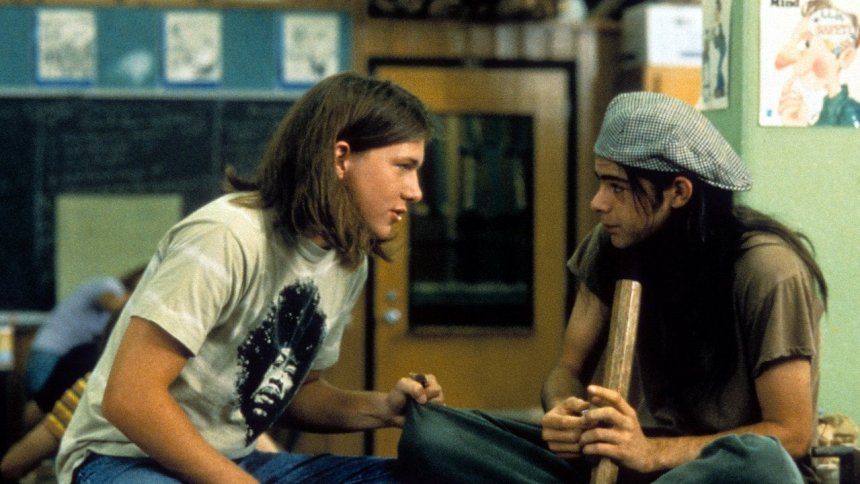
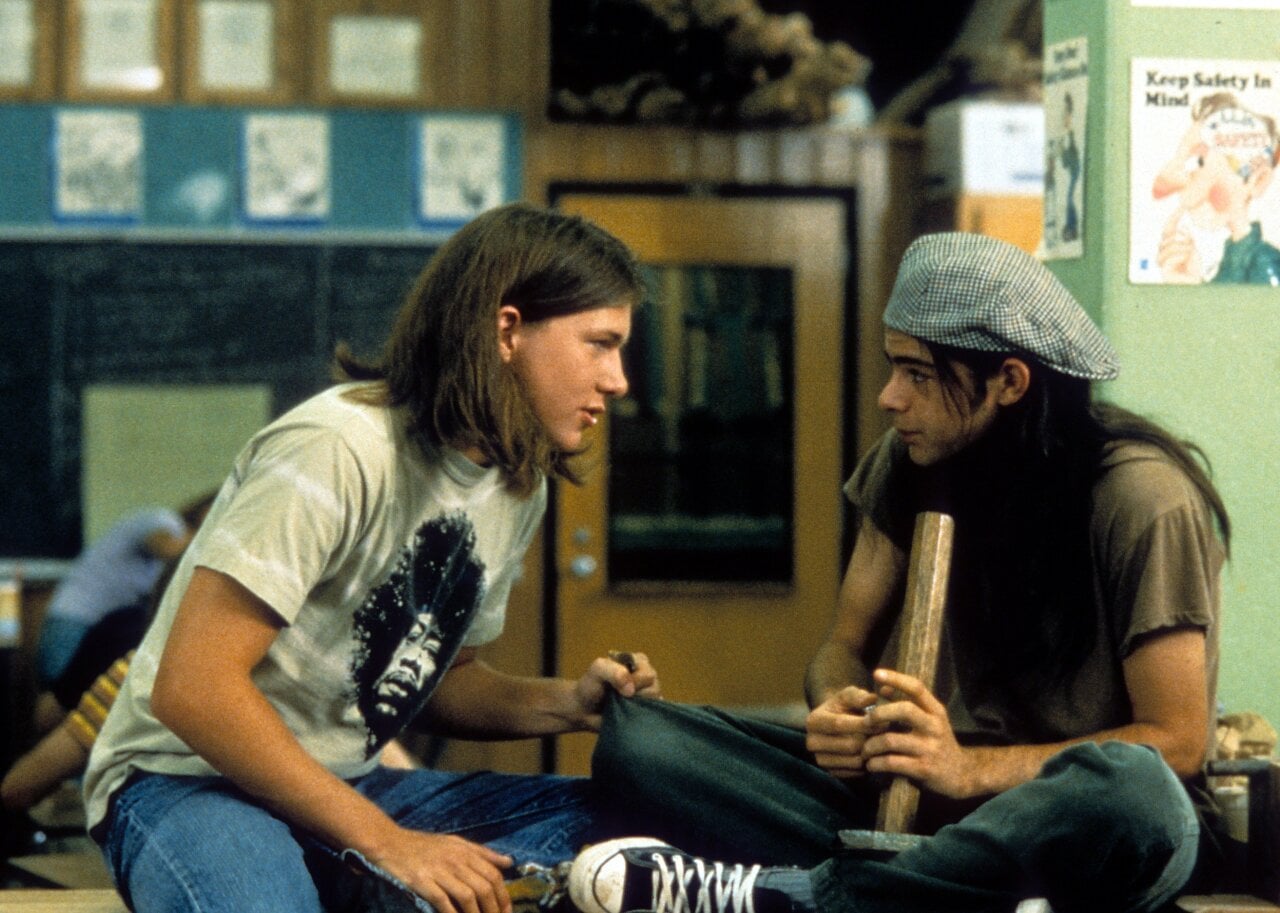
Rory Cochrane holding a bong, talking to another student, in a scene from Dazed and Confused.

Gramercy Pictures // Getty Images

10 great cannabis films that aren’t dumb comedies

There’s a unique pleasure to enjoying silly stoner comedies like “Half Baked” while under the influence, but critics don’t traditionally regard these movies as cinematic classics. That doesn’t mean that there aren’t exceptions to the rule.

To help you find some of these higher-brow cannabis films, Stacker surveyed the history of stoner movies, from “Dazed and Confused” to “The Beach Bum,” and picked 10 movies to spotlight due to their skillful filmmaking and unexpectedly thoughtful storytelling. IMDb user scores and Metascore, as of Dec. 10, 2025, provide context on popularity and critical reception.

Some of these movies, like “Koyaanisqatsi” and “Waking Life,” utilize unconventional filmmaking techniques to pose heady philosophical questions. Others, such as the cult-classic comedy “Friday,” combat negative stereotypes about Black Americans while simultaneously capturing the hilarious misadventures of kicking back with your best friend. Either way, you’re bound to have a good time no matter what state you find yourself in—there are plenty of stoner-friendly films worth a watch for high and sober moviegoers alike.

So sit back, relax, and read on to find out where your favorite artsy stoner movie ranks on this list of 10 of the best cannabis films that aren’t dumb comedies.

A scene from the film Koyaanisqatsi, with two middle-aged men walking down a busy New York City street.

American Zoetrope

Koyaanisqatsi (1982)

– Director: Godfrey Reggio
– IMDb user rating: 8.2
– Metascore: 72
– Runtime: 86 minutes

“Koyaanisqatsi” is the first installment in director Godfrey Reggio’s “The Qatsi Trilogy,” which encompasses three non-narrative films. Named for the Hopi word meaning “life out of balance,” the movie uses slow-motion and time-lapse footage to demonstrate how humanity has grown apart from nature through technology and modern civilization. If you tend to get existentialist when you’re high, “Koyaanisqatsi” is the cannabis movie for you.

Anthony Rapp and Adam Goldberg talking outside in a scene from Dazed and Confused.

Alphaville Films

Dazed and Confused (1993)

– Director: Richard Linklater
– IMDb user rating: 7.6
– Metascore: 82
– Runtime: 103 minutes

“Dazed and Confused” follows several teenagers on their last day of school in Austin, Texas, in 1976. From hooking up to confronting bullies to smoking a lot of weed, critics and audiences have praised the characters’ romp for their authentic portrayal of teen life. Richard Linklater’s classic also helped launch the careers of several movie stars, including Ben Affleck, Matthew McConaughey, and Parker Posey.

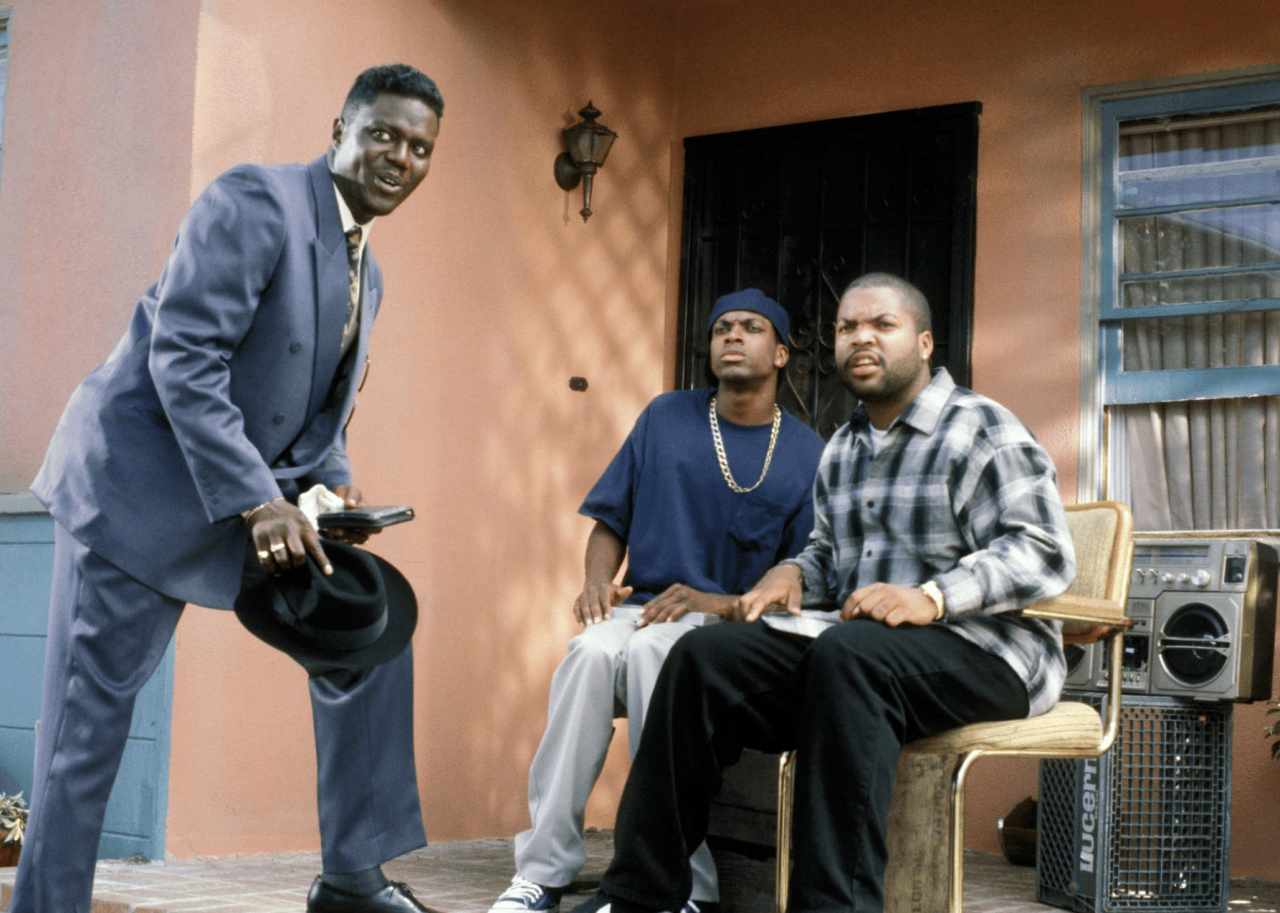
Chris Tucker, Ice Cube, and Bernie Mac in front of a house in a scene in Friday.

Priority Films (I)

Friday (1995)

– Director: F. Gary Gray
– IMDb user rating: 7.2
– Metascore: 54
– Runtime: 91 minutes

The stoner comedy “Friday” follows best friends Craig Jones (Ice Cube) and Smokey (Chris Tucker) as they deal with misadventures around their neighborhood while rushing to come up with the money Smokey owes their local drug dealer. Co-screenwriters Ice Cube and DJ Pooh have been open about writing the film to challenge harmful tropes about the “hood” through more optimistic, free-wheeling laughs.

The box office success of “Friday” sparked two sequels: 2000’s “Next Friday” and 2002’s “Friday After Next.”

A scene from The Big Lebowski with Jeff Bridges guiding the arm of Julianne Moore who is holding a bowling ball and wearing a viking costume.

Polygram Filmed Entertainment

The Big Lebowski (1998)

– Directors: Joel Coen
– IMDb user rating: 8.1
– Metascore: 71
– Runtime: 117 minutes

When it comes to iconic stoner characters, you’d be hard-pressed to find one more high-profile than Jeff “The Dude” Lebowski, the slacker at the center of the Coen brothers’ “The Big Lebowski.” The Dude’s laid-back existence quickly turns upside down after he’s mistaken for a millionaire with the same name and becomes entangled in a complex criminal scheme.

In recent years, the film has gained a loyal cult following, receiving praise for its eclectic dialogue, soundtrack, and well-realized, fantastical dream sequences.

Johnny Depp with a cigarette in his mouth in the passenger seat of a convertible with Benicio Del Toro driving in a scene from Fear and Loathing in Las Vegas.

Shark Productions

Fear and Loathing in Las Vegas (1998)

– Director: Terry Gilliam
– IMDb user rating: 7.5
– Metascore: 41
– Runtime: 118 minutes

Gonzo journalism icon Hunter S. Thompson was heavily involved in this film adaptation of his seminal 1971 stoner novel “Fear and Loathing in Las Vegas.” The film stars Johnny Depp as an eccentric journalist and Benicio del Toro as his attorney as they cross the Mojave Desert with drugs in tow. While they dodge legal action, the two become increasingly under the influence.
Although Thompson’s book was once considered unfilmable, director Terry Gilliam managed to straddle the line between its fantastical stoner sequences and the reality of the main characters’ situation in magnificent psychedelic fashion.

Kate Hudson and Patrick Fugit talking to someone in a scene from Almost Famous.

Dreamworks Pictures

Almost Famous (2000)

– Director: Cameron Crowe
– IMDb user rating: 7.9
– Metascore: 90
– Runtime: 122 minutes

Based on filmmaker Cameron Crowe’s real-life experiences writing for Rolling Stone as a teenager, “Almost Famous” follows young aspiring journalist William as he goes on the road with the fictional rock band Stillwater to write his first cover story. The movie is full of plenty of sex, drugs, and rock ‘n’ roll, but it also won the Oscar for Best Original Screenplay, proving its poignant power.

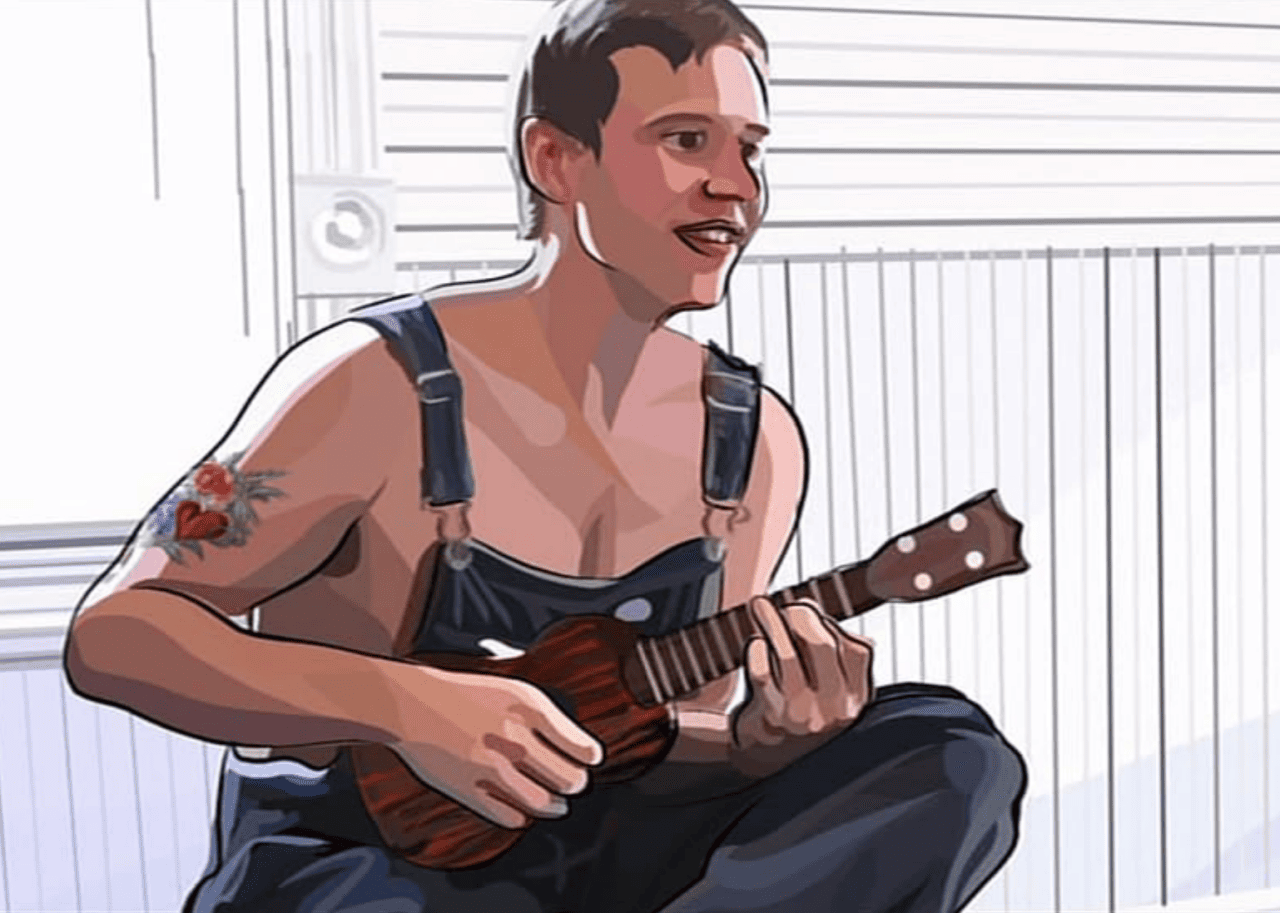
An animated image of Guy Forsyth playing a ukulele in Waking Life.

Fox Searchlight Pictures

Waking Life (2001)

– Director: Richard Linklater
– IMDb user rating: 7.6
– Metascore: 85
– Runtime: 99 minutes

“Waking Life” is one of Linklater’s most surreal films to date, making it a unique watch for existentialists and those flying high alike. The animated movie centers on an unnamed man who wanders through a series of dreamlike, abstract realities, conversing with the people he meets about philosophy and humanity’s place in the universe. While watching, viewers are encouraged to consider the deeper questions behind “Waking Life’s” psychedelic visuals.

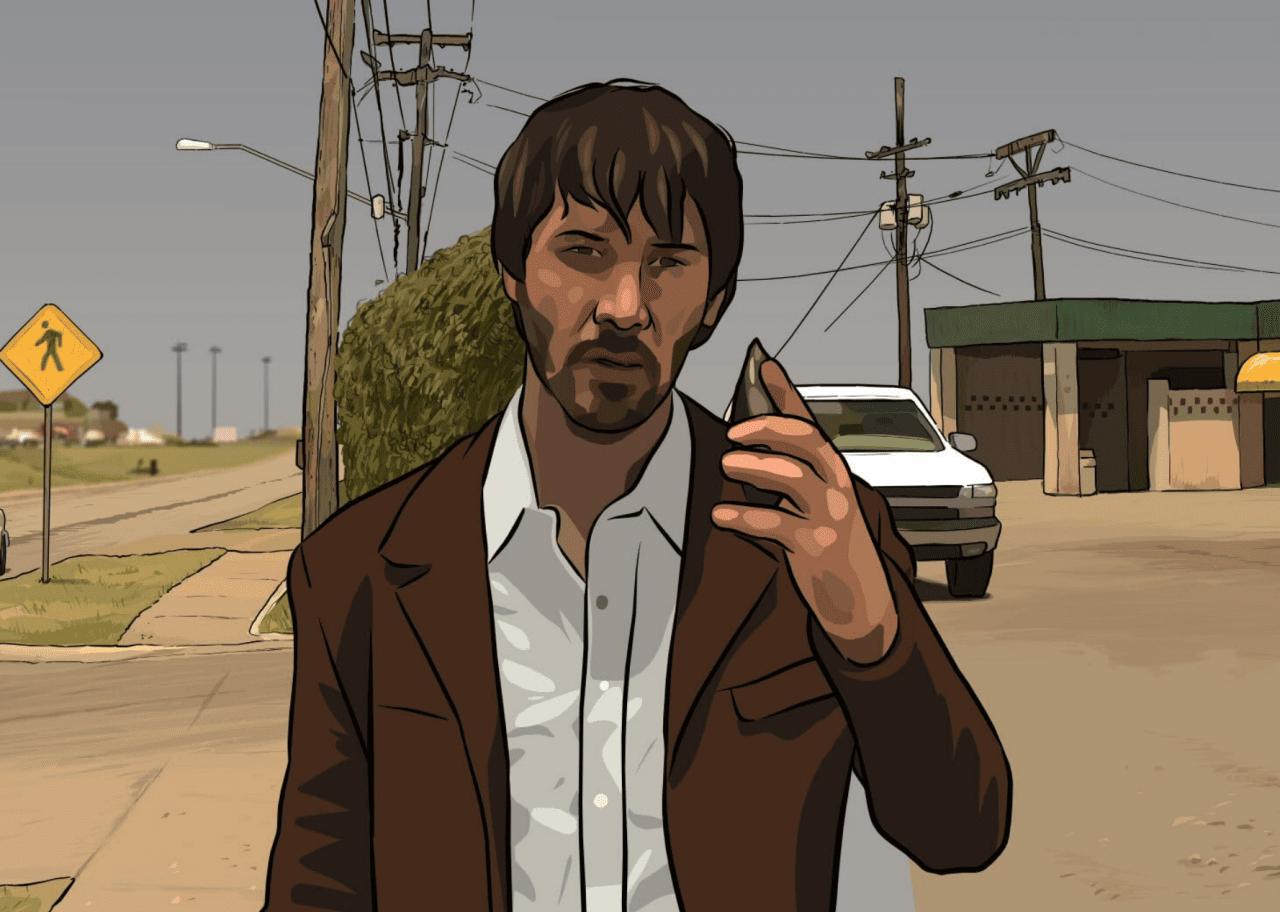
An animated image of Keanu Reeves in a parking lot in A Scanner Darkly.

Thousand Words

A Scanner Darkly (2006)

– Director: Richard Linklater
– IMDb user rating: 7
– Metascore: 73
– Runtime: 100 minutes

Based on Philip K. Dick’s 1977 novel, “A Scanner Darkly” takes place in a future where large swaths of the United States population are addicted to a hallucinatory drug called Substance D while being subjected to dystopian, near-constant police surveillance. Keanu Reeves stars in the movie as an undercover cop who traverses the underworld of Substance D users and begins to lose his grip on reality.

Linklater and his team brought the story to life using rotoscope animation, an approach where animators trace live-action footage to create a hand-drawn style. The film offers an engaging animation experience while exploring the complexities of substance use and law enforcement oversight in contemporary society.
Joaquin Phoenix, wearing a recording device on a strap, standing next to Owen Wilson holding a saxophone in Inherent Vice.

Warner Bros.

Inherent Vice (2014)

– Director: Paul Thomas Anderson
– IMDb user rating: 6.6
– Metascore: 81
– Runtime: 148 minutes

Paul Thomas Anderson’s “Inherent Vice,” based on the 2009 novel by Thomas Pynchon of the same name, has the bones of a silly comedy but easily transcends the genre thanks to its intricate story, high-quality production, and veteran ensemble cast. Joaquin Phoenix plays stoner private detective Larry “Doc” Sportello. Doc’s ex hires him to track down her wealthy new paramour, whose wife is conspiring to commit him to a mental hospital. Doc also handles two more potentially related cases as the movie progresses.

Featuring long, hazy sequences that fade into each other, “Inherent Vice” captures the feeling of being high while managing to dovetail between Doc’s overlapping cases.

Matthew McConaughey hugging Stefania LaVie Owen in a wedding dress, while standing next to Snoop Dogg, Jimmy Buffett, and Joshua Ritter, along with two other men, in The Beach Bum.

Grisbi Productions, Le

The Beach Bum (2019)

– Director: Harmony Korine
– IMDb user rating: 5.5
– Metascore: 55
– Runtime: 95 minutes

IndieWire’s Christian Zilko once remarked, “If you haven’t seen [‘The Beach Bum’] while stoned, it’s safe to say you haven’t seen it at all.” This A24 entry tells the story of stoner poet Moondog (Matthew McConaughey), who struggles to finish his next book following an unexpected loss. The movie’s ensemble cast includes actor Isla Fisher and iconic cannabis enthusiast Snoop Dogg.

Story editing by Carren Jao and Jaimie Etkin. Copy editing by Kristen Wegrzyn. Photo selection by Clarese Moller.

Topics:

Entertainment
Entertainment

25 Times LGBTQ+ Artists Made Music History

25 Times LGBTQ+ Artists Made Music History
By Cynthia Rebolledo
7 min read • Originally published December 16, 2025 / Updated March 19, 2026
By Cynthia Rebolledo
7 min read • Originally published December 16, 2025 / Updated March 19, 2026

Patrick Haggerty performs live onstage.

Jim Bennett // Getty Images

25 times LGBTQ+ artists made music history

Throughout history, there have been artists that refuse to reduce themselves to monolithic stereotypes and conform to discriminatory musical standards and expectations. Instead, individuals like Ma Rainey, often called the “Mother of the Blues,” overtly explored themes of identity and lesbian self-affirmation. Angela Y. Davis called Rainey’s “Prove It on Me,” a precursor to the lesbian cultural movement of the 1970s.

Generations of LGBTQ+ artists have followed suit, challenging the industry to create more variable genres with avant-garde style, elliptical lyrics, and formative vision. Some of these artists—Wendy Carlos, MikeQ, David Bowie, and Patrick Haggerty—have made music history all while contributing to cultural movements, LGBTQ+ rights, and freedom of self-expression that have extended beyond the stage.

To acknowledge and recognize these achievements, Stacker examined books, interviews, and primary news sources and compiled a list of 25 times LGBTQ+ artists made music history. Some of the artists on this list may be familiar, but others might be lesser-known visionaries and pioneers in the music industry. Let’s celebrate their resilience and influence that have paved, or are currently paving, the way for generations of artists.

Freddie Mercury performs onstage at Live Aid.

Pete Still/Redferns // Getty Images

Freddie Mercury: ‘The note heard around the world’

With his highly theatrical style and extraordinary vocal range, Freddie Mercury is recognized for belting out some of the most distinctive anthems in music history. Mercury’s vivid note, “Aaaaaay-o,” performed at the 1985 Live Aid concert came to be known as “the note heard around the world.”

Sylvester performs onstage.

Max Redfern/Redferns

Sylvester: The song that became a disco classic

The embodiment of disco, Sylvester rose to fame with hits “Dance” and “You Make Me Feel (Mighty Real).” The latter would later be recognized as an anthem of empowerment, celebrating liberation. In 1979, Sylvester was awarded a key to San Francisco by then-mayor Dianne Feinstein.

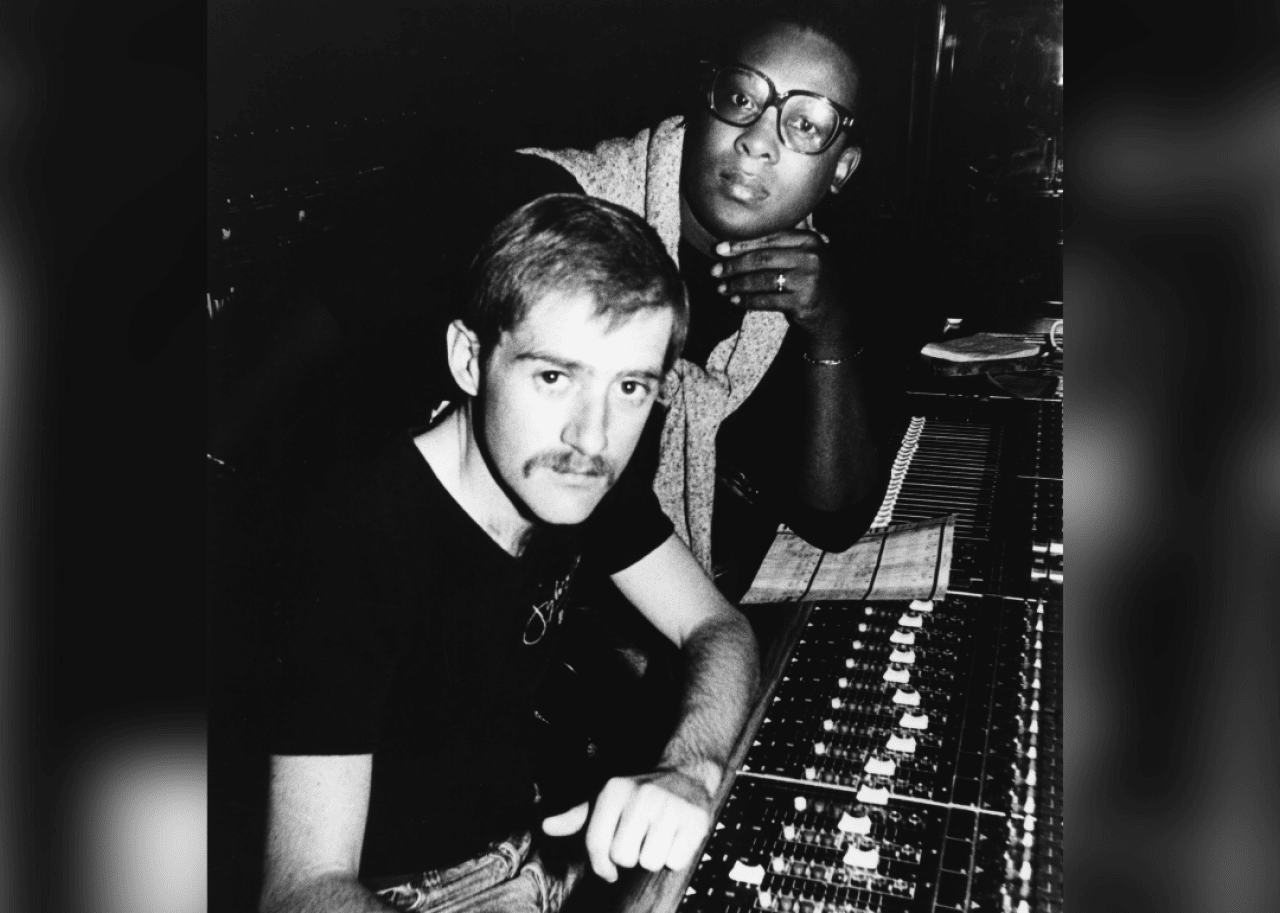
Sylvester and Patrick Cowley pose for a portrait in the studio.

Michael Ochs Archives // Getty Images

Patrick Cowley: Disco originator

Patrick Cowley is recognized as an early pioneer of electronic dance music and a disco producer. He is credited for enormously influencing the music-dance scene with his trademark “San Francisco Sound.”

Melissa Etheridge poses with star on Hollywood Walk of Fame.

Featureflash Photo Agency // Shutterstock

Melissa Etheridge: Honored with a star

Melissa Etheridge solidified herself as a rock ‘n’ roll performer with her breakthrough 1993 album “Yes I Am.” She is a Grammy- and Oscar-winning artist. Etheridge was honored with a star on the Hollywood Walk of Fame in 2011.

Elton John sings 'Candle in the Wind' at the funeral of Diana, Princess of Wales.

Anwar Hussein // Getty Images

Elton John: Bestselling single of all time

A music icon, Elton John has sold more than 300 million records worldwide and holds the bestselling single of all time with 1997’s “Candle in the Wind,” a tribute to Princess Diana of Wales. In 1998, John was knighted by Queen Elizabeth ll for his contribution to music and charitable services.

Chavela Vargas performs onstage.

STR/AFP // GettyImages

Chavela Vargas: Crying for Frida

Chavela Vargas was a favorite of Spanish director Pedro Almodóvar, who often used her tortured take on Mexican rancheras for his films. Vargas, widely known as a friend of Frida Kahlo, also appeared in Selma Hayek’s 2002 film “Frida” singing “La Llorona.”

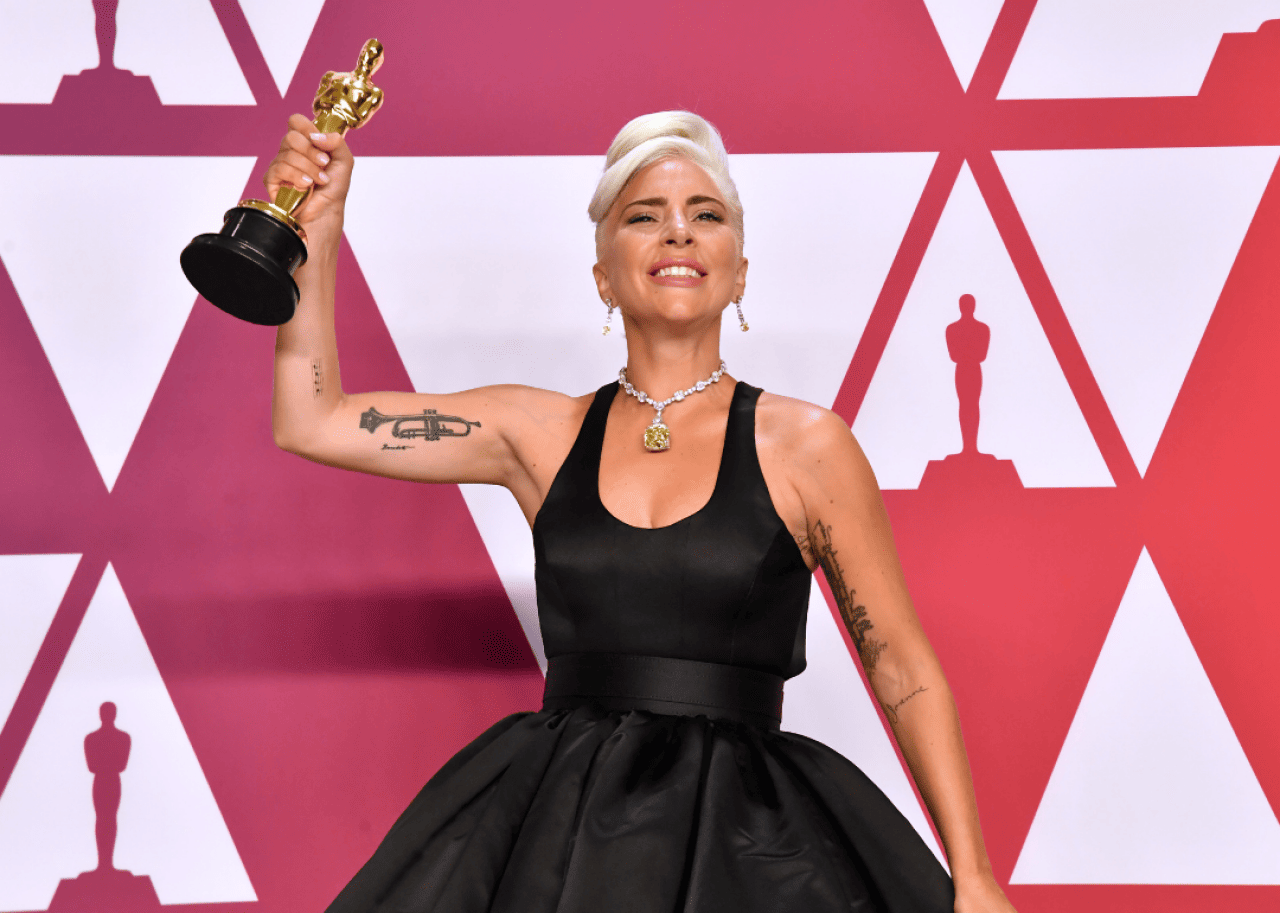
Lady Gaga poses with Academy Award.

Jeff Kravitz/FilmMagic // Getty Images

Lady Gaga: First woman to win an Oscar, Grammy, BAFTA, and Golden Globe in the same year

In 2019, singer and actress Lady Gaga became the first woman to win an Oscar, Grammy, BAFTA, and Golden Globe in a single year. In 2011, Lady Gaga released her manifesto album “Born This Way,” resonating with so many people—it inspired her Born This Way Foundation.

Patrick Haggerty, Michael Carr, Eve Morris, and Robert Hammerstrom of the gay country band Lavender Country on June 29, 2014 in Seattle, Washington at the 40th Annual Seattle Pride Parade.

Suzi Pratt // FilmMagic

Patrick Haggerty: First openly gay country album

With just 1,000 copies pressed, Lavender Country’s Patrick Haggerty released what is known as the first gay country album in 1973. An unrelenting and outspoken gay activist, Haggerty led the band, performing playful country-folk music at numerous pride and LGBTQ+ rights events across the West Coast.

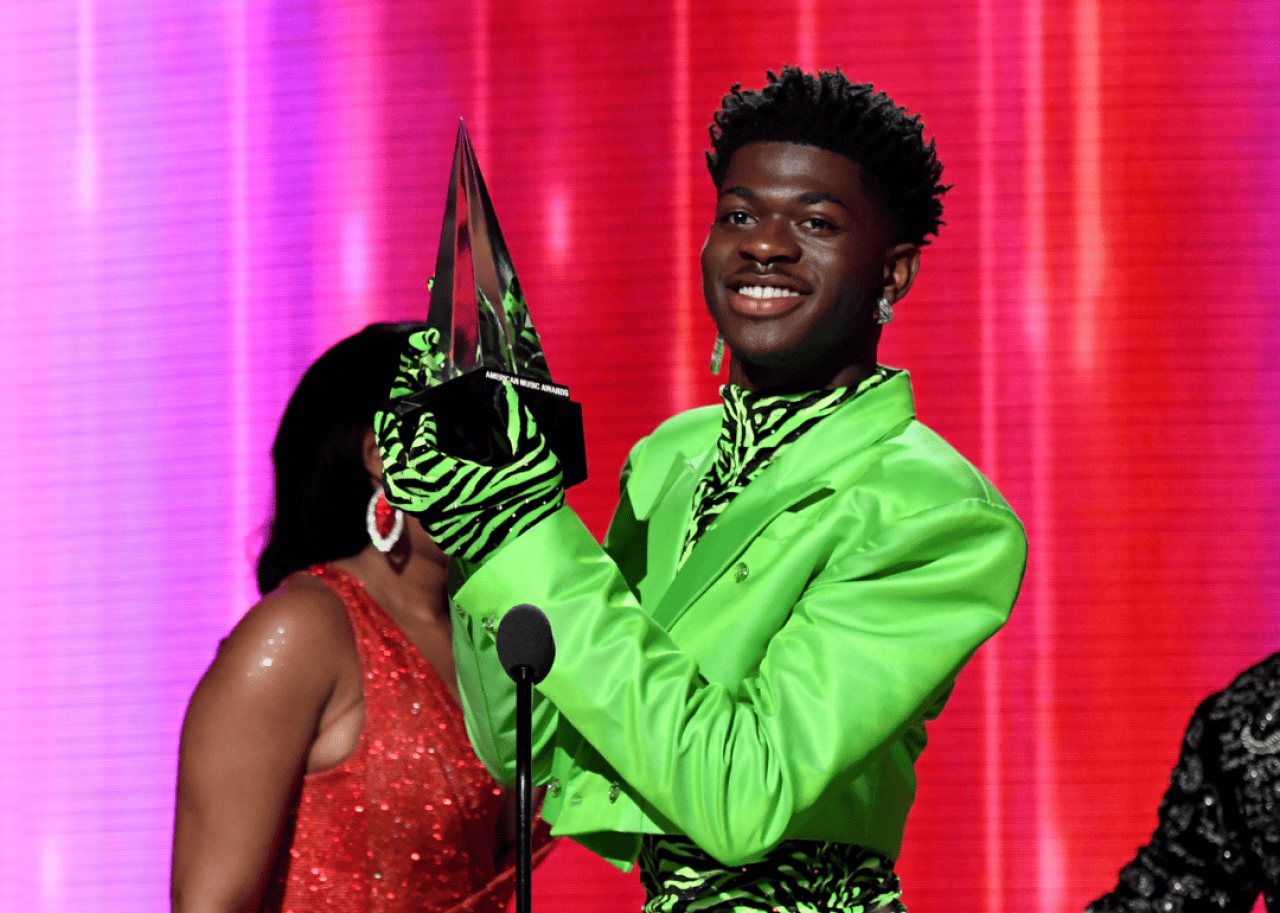
Lil Nas X accepts the American Music Award.

Jeff Kravitz/AMA2019/FilmMagic for dcp // Getty Images

Lil Nas X: Longest-running #1 hit in Billboard Hot 100 history

Lil Nas X achieved viral success with his song “Old Town Road,” becoming the longest-running #1 hit in Billboard Hot 100 history. He has been celebrated for his Black queerness. Lil Nas’ unapologetically queer and controversial music video, “Montero” was inspired by André Aciman’s novel turned 2017 film, “Call Me by Your Name.”

David Bowie performs onstage.

J. Shearer/WireImage // Getty Images

David Bowie: Bestselling musician

David Bowie’s artistic expression and music catalog knew no bounds. Recognized as one of the great idiosyncratic talents of his time, he was constantly reinventing himself throughout his nearly 50-year career. Bowie was a bestselling musician with an estimated 100 million in record sales worldwide during his lifetime.

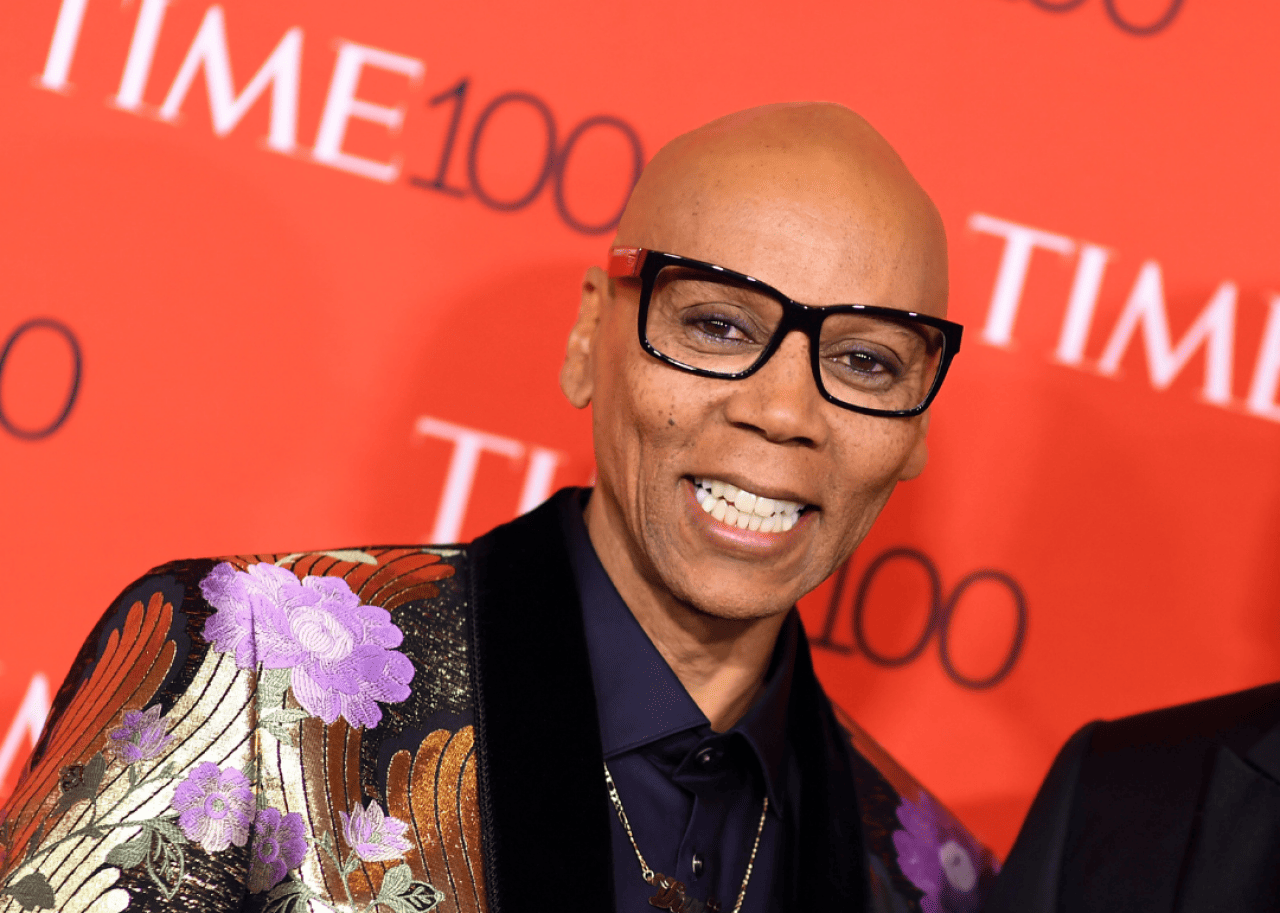
Rupaul attends the Time 100 Gala.

ANGELA WEISS/AFP via Getty Images

RuPaul: Supermodel of the world

There is no question that RuPaul came to work. In 2017, Time magazine named RuPaul—the most famous drag queen—one of its most influential people. He also holds the most Primetime Emmys awarded to a Black person in history. RuPaul’s 1993 single release “Supermodel (You Better Work)” found mainstream success and would later become one of many catchphrases used on his show.

Leonard Bernstein conducts the New York Philharmonic.

Bettmann // Getty Images

Leonard Bernstein: The first American to lead a major American orchestra

Leonard Bernstein—the world-renowned conductor and composer—became music director of the New York Philharmonic in 1958. The first American to lead a major American orchestra, he held this position until 1969. He went on to receive numerous honors and often lent his time to civil rights, political, and humanitarian causes, including supporting the American Foundation for AIDS Research.

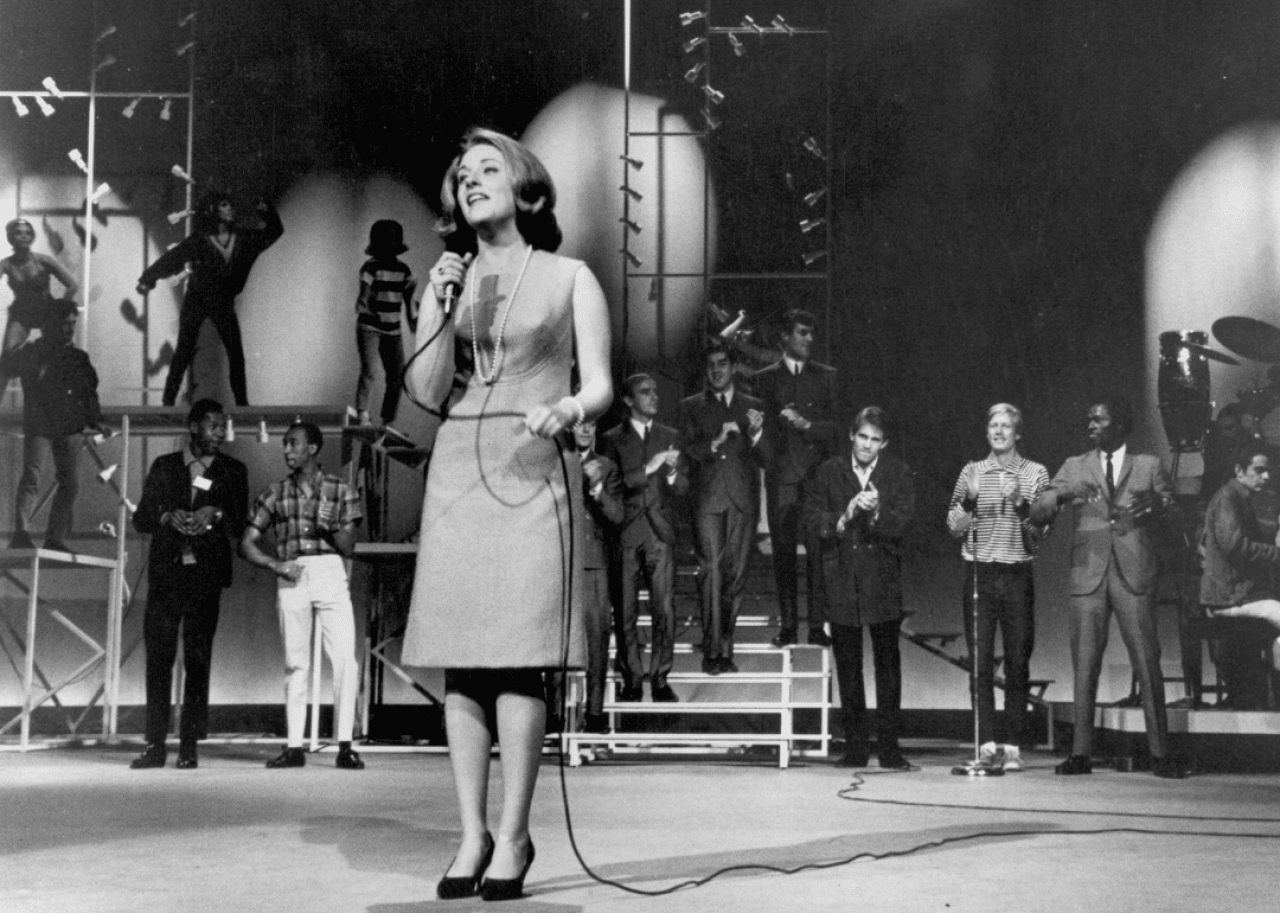
Lesley Gore performing in studio.

Michael Ochs Archives // Getty Images

Lesley Gore: Found success at 17

Lesley Gore was only in high school when she was discovered by music producer Quincy Jones and recorded “It’s My Party.” Gore went on to release “You Don’t Own Me,” the early feminist anthem that still resonates today.

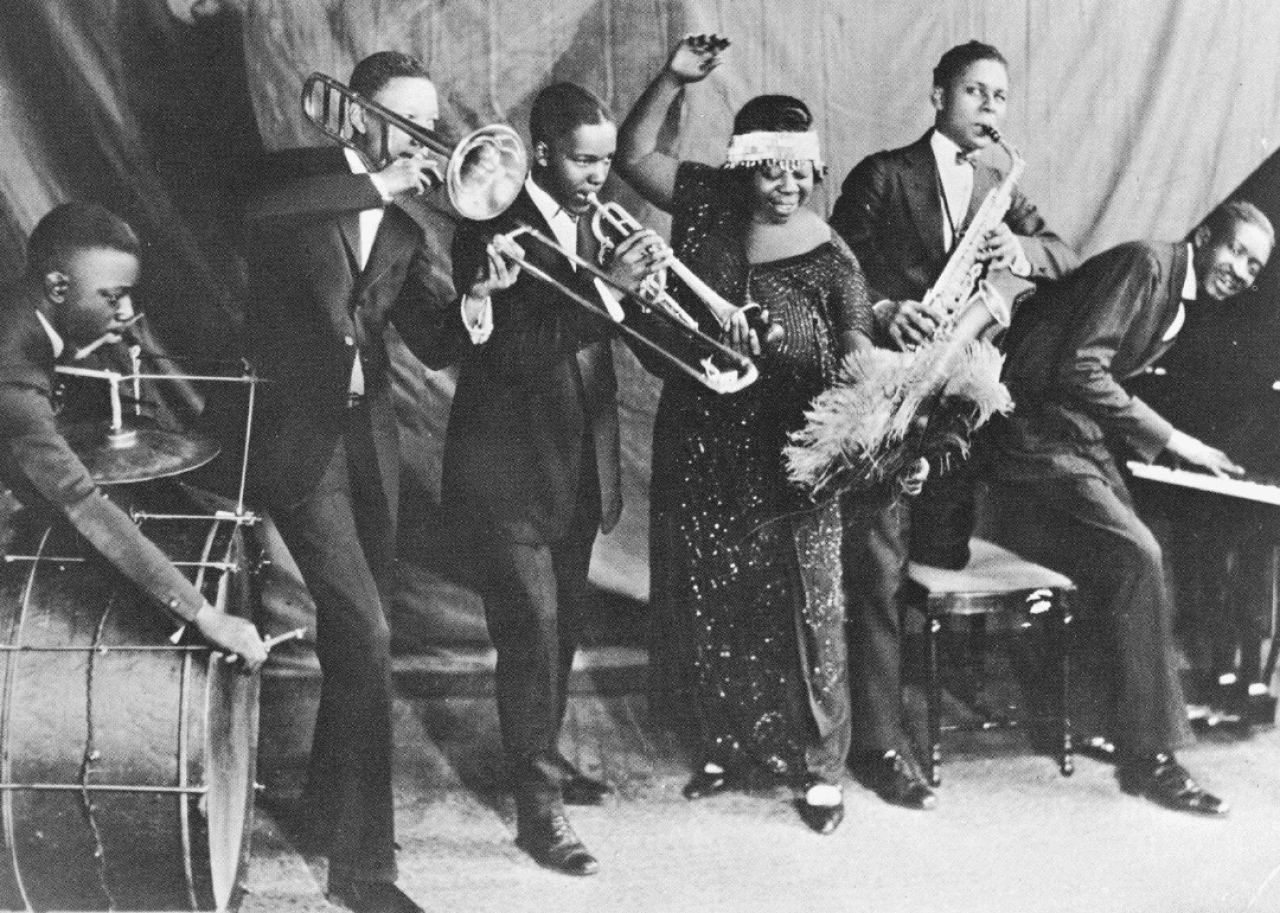
Ma Rainey and her band pose for a portrait.

Michael Ochs Archives // Getty Images

Ma Rainey: ‘Mother of the Blues’

Dubbed the “Mother of the Blues,” Ma Rainey toured with Louis Armstrong and helped pioneer the genre of the blues. Rainey fearlessly sang about the right of women to conduct themselves as undesirably as men. Unapologetically bisexual, Rainey was an openly queer woman, but at that time, also navigating being a Black woman. Her legacy inspired August Wilson’s 1982 play “Ma Rainey’s Black Bottom,” and a 2020 Netflix film of the same name.

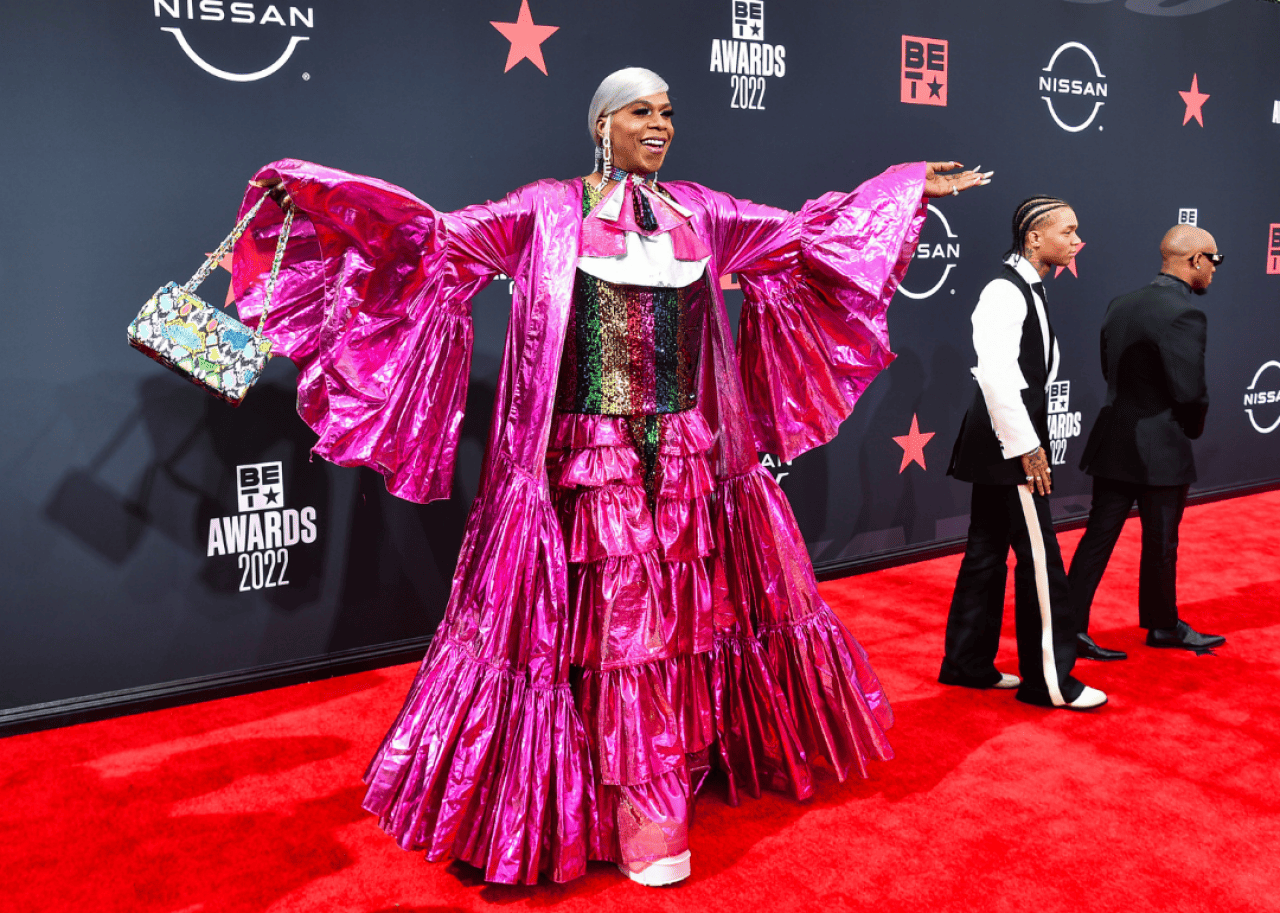
Big Freedia attends the 2022 BET Awards.

Paras Griffin // Getty Images for BET

Big Freedia: Queen of bounce

Big Freedia is credited for popularizing New Orleans bounce music. Despite starting out as a backup dancer, Freedia’s undeniable force has linked her to collaborating with names like Beyoncé and Drake.

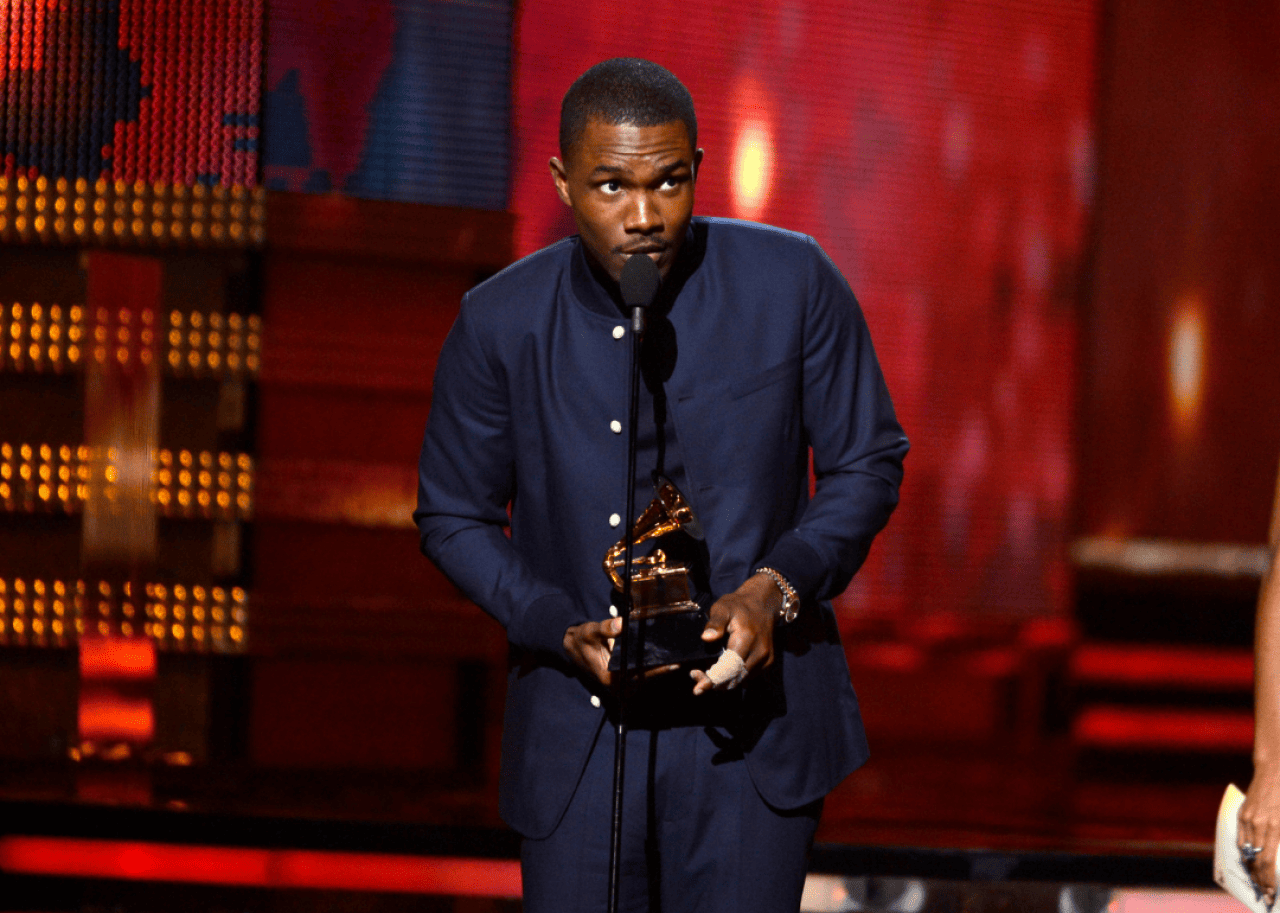
Frank Ocean accepts Grammy award.

Kevork Djansezian // Getty Images

Frank Ocean: Grammy award winner

One of the most talked-about artists of his generation, Frank Ocean has challenged the traditional R&B genre with his introspective songwriting and detailed narratives. Ocean has won two Grammy awards.

Linda Perry speaks at Songwriters Hall Of Fame awards.

Taylor Hill/WireImage // Getty Images

Linda Perry: Hitmaker

Linda Perry is a songwriting legend and musician in her own right—writing songs for Pink, Adele, and Alicia Keys. In 2015, Perry was inducted into the Songwriters Hall of Fame.

Wendy Carlos at work in her recording studio.

Leonard M. DeLessio // Corbis via Getty Images

Wendy Carlos: Soundscape composer

An electronic music pioneer and composer, Wendy Carlos is responsible for scoring some of auteur director Stanley Kubrick’s most famous films—”A Clockwork Orange” and “The Shining.” Carlos, who also scored “Tron,” is credited for inspiring Daft Punk.

DJ Mike Q performs onstage.

Jack Vartoogian // Getty Images

MikeQ: First ballroom-dedicated label

MikeQ is a prominent figure in the underground ballroom community. In 2005, he founded Qween Beat, the first ballroom-dedicated label, to preserve the culture and support the new generation of emerging voguers.

Rob Halford speaks onstage during the Rock & Roll Hall of Fame Induction Ceremony.

Kevin Kane // Getty Images for The Rock and Roll Hall of Fame

Rob Halford: Rock & Roll Hall of Fame

In 2022, Judas Priest frontman Rob Halford was inducted into the Rock & Roll Hall of Fame for musical excellence. The “Metal God” came out as gay in a 1998 MTV News interview, challenging the perception of the masculine heavy metal genre.

Tegan and Sara accept 2014 Juno Award for Pop Album of the Year.

Jag Gundu // Getty Images

Tegan and Sara: Juno Award winners

Identical twin sisters, Tegan and Sara have amassed an international following for their vulnerable pop-rock songs. They’ve won three Juno Awards, the Canadian equivalent of a Grammy, and a GLAAD Media Award for Outstanding Music Artist.

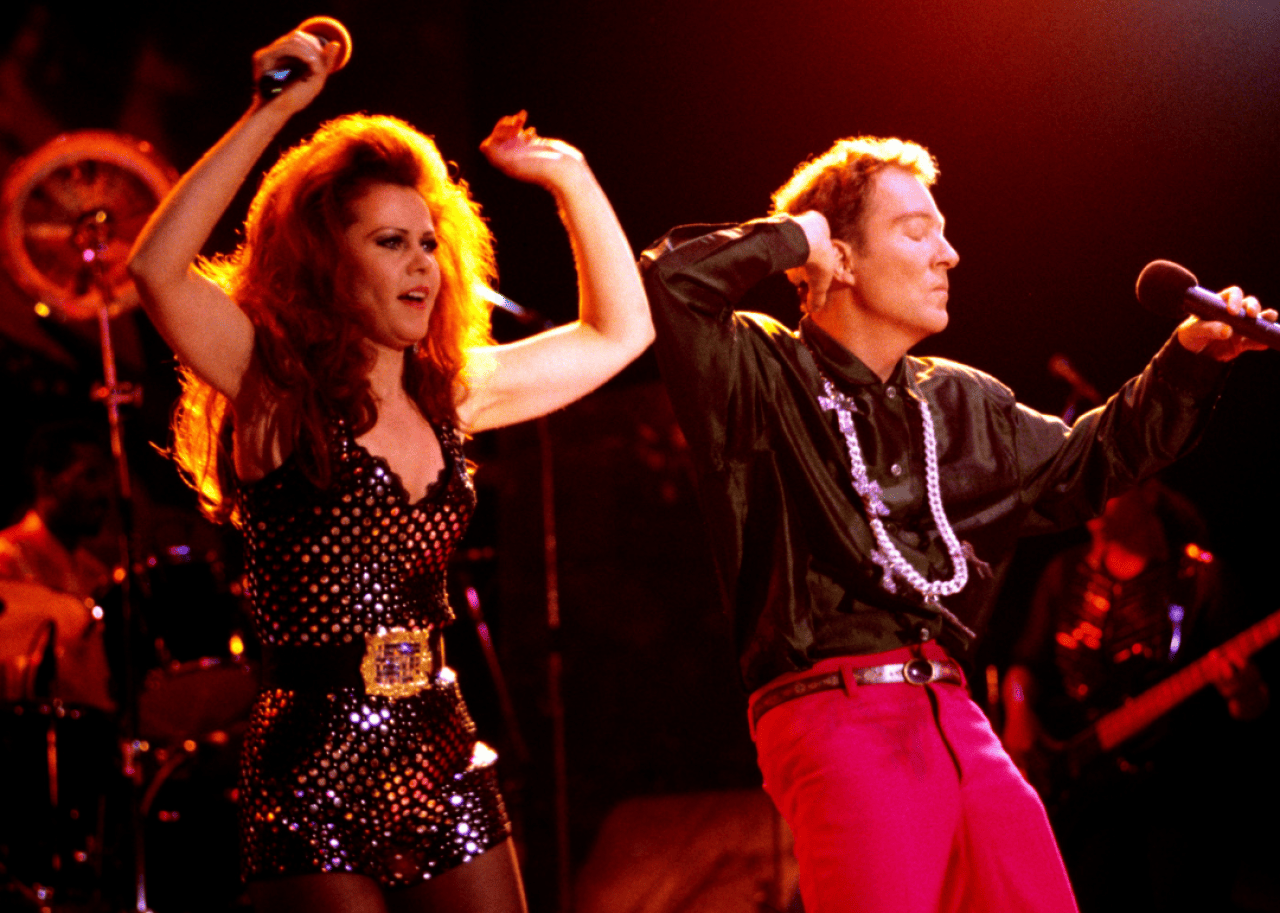
Kate Pierson and Fred Schneider of the B-52s perform onstage.

Tim Mosenfelder // Getty Images

B-52s: The world’s greatest party band

Rock music’s most beloved party band, the B-52s formed in 1976 and played their first live performance on “Saturday Night Live” perplexing the crowd with their overt stage presence. Their 1989 album, “Cosmic Thing,” would be the band’s mainstream breakthrough—still timeless today.

Brandi Carlile poses with Grammy Awards.

Jon Kopaloff/WireImage // Getty Images

Brandi Carlile: 6 Grammy wins

Since her self-titled debut album in 2005, Brandi Carlile has won six Grammys and has become a bestselling author for her memoir, “Broken Horses.” Carlile is also the first female songwriter to receive two Grammy nominations for song of the year in the same year.

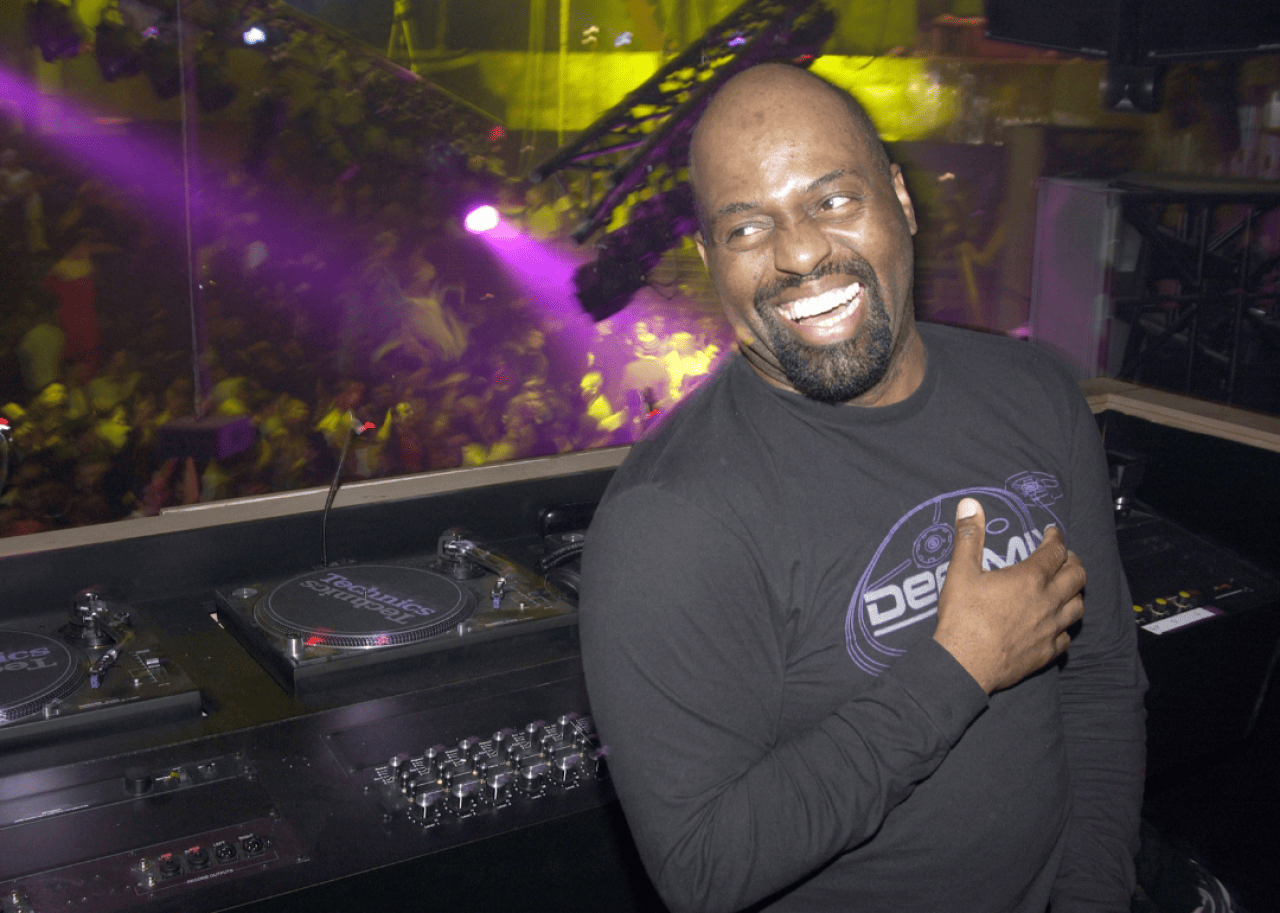
Frankie Knuckles in DJ booth.

J. Countess/WireImage // Getty Images

Frankie Knuckles: The ‘Godfather of House Music’

Frankie Knuckles was known as the “Godfather of House Music” for his role in developing and contributing to the culture of house music—restructuring and rearranging the Chicago dance scene.

Raveena performs at Coachella.

Timothy Norris // Getty Images for Coachella

Raveena: The first Indian woman to perform solo at Coachella

In 2022, Raveena was among the acts at the Coachella Music Festival, making her the first Indian woman to perform as a solo artist. Raveena sang “Dum Maro Dum,” a song from the iconic Indian movie “Haré Rama Haré Krishna.”

Topics:

Entertainment
Entertainment

Casting Calls Across the US: Where Film and TV Shows Are Hiring Now

Casting Calls Across the US: Where Film and TV Shows Are Hiring Now
By Jaimie Etkin
3 min read • Originally published December 17, 2025 / Updated March 19, 2026
By Jaimie Etkin
3 min read • Originally published December 17, 2025 / Updated March 19, 2026

KinoMasterskaya // Shutterstock

Movies and TV shows casting across the US

The glitz and glam of Hollywood captures the attention of Americans starting from an early age. Beyond celebrities’ Instagram Stories and red carpet poses, there are actors out there paying their dues and honing their craft in pursuit of a sustainable career or a fulfilling sideline. Submitting to casting calls is a big part of that journey.

Whether you’re a working actor or an aspiring one, you might be curious to know which movies and TV shows are casting roles near you. Backstage compiled a list of projects casting right now across the U.S., and which roles they’re looking to fill.

Grusho Anna // Shutterstock

‘”Day 1: Real-time” Producers & Key Crew’

– Project type: feature film
– Roles:
— Various Lead Roles (lead, 18-65)
– Average hourly rate: not available
– Casting locations: West Hollywood, California
– Learn more about the feature film here

Media_Photos // Shutterstock

‘Crown by Blood’

– Project type: feature film
– Roles:
— Victoria (lead, female, 18-25)
— Alex (lead, 21-28)
— Steve (lead, 30-43)
– Average hourly rate: $175
– Casting locations: Boca Raton, Florida
– Learn more about the feature film here

Grusho Anna // Shutterstock

‘Mama’s Boy,’ A24 Horror Series’

– Project type: scripted show
– Roles:
— Playboy Cover Model (Still Photo Shoot) (background extra, female, 18-30)
– Average hourly rate: $63
– Casting locations: New York City, New York
– Learn more about the scripted show here

muratart // Shutterstock

’72 Hours,’ Club Goers’

– Project type: feature film
– Roles:
— Miami Club Goers W/ Club Dance Experience (background extra, 18-35)
– Average hourly rate: $28
– Casting locations: Brooklyn, New York; Jersey City, New Jersey; Hoboken, New Jersey; New York City, New York; Morristown, New Jersey
– Learn more about the feature film here

Gorodenkoff // Shutterstock

‘The Fall of Stardust’

– Project type: scripted show
– Roles:
— Asherah: Age 12 (supporting, female, 10-14)
— Miguel (lead, male, 18-25)
— Father Samuel (models, male, 45-65)
– Average hourly rate: $93
– Casting locations: Columbus, Georgia; Naples, Florida; Miami, Florida; Fort Lauderdale, Florida; West Palm Beach, Florida
– Learn more about the scripted show here

Tikkyshop // Shutterstock

‘Work From Home’

– Project type: feature film
– Roles:
— Matt (supporting, male, 18-35)
— Daisy (supporting, female, 18-30)
– Average hourly rate: $40
– Casting locations: Los Angeles, California
– Learn more about the feature film here

Grusho Anna // Shutterstock

‘Subclass’

– Project type: scripted show
– Roles:
— Vitalis (supporting, 18-23)
— Tempestuous (supporting, 18-24)
— Akiko (supporting, female, 18-25)
– Average hourly rate: $25
– Casting locations: West Palm Beach, Florida; Fort Lauderdale, Florida; Miami, Florida; Hollywood, Florida
– Learn more about the scripted show here

Grusho Anna // Shutterstock

‘Exit 17’

– Project type: feature film
– Roles:
— Jessica Hughes (supporting, 28-40)
— Stephanie (day player, female, 18-35)
— Casting PA (crew)
– Average hourly rate: $28
– Casting locations: New York City, New York
– Learn more about the feature film here

Grusho Anna // Shutterstock

‘DWP2’

– Project type: feature film
– Roles:
— Event Guests (background extra, 18-80)
– Average hourly rate: $27
– Casting locations: New York City, New York
– Learn more about the feature film here

Grusho Anna // Shutterstock

‘Whispers in the Walls’

– Project type: feature film
– Roles:
— Nurse (day player, female, 23-50)
— Police Officer (background extra, male, 30-60)
— Rose (supporting, 35-50)
– Average hourly rate: $31
– Casting locations: Los Angeles, California
– Learn more about the feature film here

Media_Photos // Shutterstock

‘Chronovisor’

– Project type: feature film
– Roles:
— Beatrice (lead, female, 40-70)
— Librarian (day player, 40-100)
— Young Academic (day player, male, 30-40)
– Average hourly rate: $30
– Casting locations: Philadelphia, Pennsylvania
– Learn more about the feature film here

guruXOX // Shutterstock

’72 Hours’

– Project type: feature film
– Roles:
— Club Goers (background extra, 18-35)
– Average hourly rate: $18
– Casting locations: New York City, New York; Newark, New Jersey; Brooklyn, New York; Morristown, New Jersey; Hoboken, New Jersey
– Learn more about the feature film here

Media_Photos // Shutterstock

‘The Circle in the Sky’

– Project type: feature film
– Roles:
— Aya (lead, female, 21-35)
– Average hourly rate: $63
– Casting locations: Los Angeles, California
– Learn more about the feature film here

Dpongvit // Shutterstock

‘Gum’

– Project type: feature film
– Roles:
— Eden (lead, female, 18-24)
— Mary (supporting, female, 18-23)
— Ammon (supporting, male, 18-25)
– Average hourly rate: $31
– Casting locations: Los Angeles, California
– Learn more about the feature film here

Gorodenkoff // Shutterstock

’20th Century Studios ‘DWP2’

– Project type: feature film
– Roles:
— High Fashion Private Party (background extra, 18-80)
– Average hourly rate: $27
– Casting locations: New York City, New York
– Learn more about the feature film here

This story was
produced by
Backstage
and reviewed and
distributed by Stacker.

Topics:

Entertainment
media-news

Dolphin to Host Fourth Quarter and Year End Earnings Conference Call on March 25, 2026

By Media News
3 min read • Published March 19, 2026
By Media News
3 min read • Published March 19, 2026

MIAMI, FL / ACCESS Newswire / March 19, 2026 / Dolphin (NASDAQ:DLPN), a leading entertainment marketing and content production company, announced today it will host a conference call to discuss financial results for its fourth quarter and full year ended December 31, 2025 on March 25, 2026, at 4:30pm ET.

Conference Call Information

To participate in this event, dial in approximately 5 to 10 minutes before the beginning of the call.

Date: March 25, 2026
Time: 4:30pm ET
Toll Free: 888-506-0062 International: 973-528-0011 Participant Access Code: 255728
Webcast: https://www.webcaster5.com/Webcast/Page/2225/53793

Replay

Toll Free: 877-481-4010 International: 919-882-2331 Replay Passcode: 53793
Webcast Replay: https://www.webcaster5.com/Webcast/Page/2225/53793

ABOUT DOLPHIN:

Dolphin (NASDAQ:DLPN) is where cultural creation meets marketing execution. Founded in 1996 by Bill O’Dowd, Dolphin operates as both a venture studio-developing and investing in breakthrough content, products, and experiences-and a marketing consortium, featuring leading agencies across every communications discipline.

At its core, the venture studio creates, produces, finances, markets, and promotes new businesses and cultural ideas – ranging from acclaimed film, television, and digital content to consumer goods, live events and partnerships that define entertainment and lifestyle. Surrounding this entrepreneurial engine, Dolphin’s marketing prowess brings together best-in-class firms including 42West, The Door, Shore Fire Media, Elle Communications, Special Projects and The Digital Dept. Together, this collective delivers unmatched cross-marketing expertise and relationships across every vertical of pop culture – from film, television, music, influencers, sports, hospitality, and fashion to consumer brands and purpose-driven initiatives. Dolphin marketing has been the recipient of many accolades, including #1 Agency of the Year on the Observer PR Power List in 2025, The PR Net 100, and the PR News Elite 120.

Follow us on Instagram here.

This press release contains ‘forward-looking statements’ within the meaning of the Private Securities Litigation Reform Act. These forward-looking statements may address, among other things, Dolphin Entertainment Inc.’s offering of common stock as well as expected financial and operational results and the related assumptions underlying its expected results. These forward-looking statements are distinguished by the use of words such as "will," "would," "anticipate," "expect," "believe," "designed," "plan," or "intend," the negative of these terms, and similar references to future periods. These views involve risks and uncertainties that are difficult to predict and, accordingly, Dolphin Entertainment’s actual results may differ materially from the results discussed in its forward-looking statements. Dolphin Entertainment’s forward-looking statements contained herein speak only as of the date of this press release. Factors or events Dolphin Entertainment cannot predict, including those described in the risk factors contained in its filings with the Securities and Exchange Commission, may cause its actual results to differ from those expressed in forward-looking statements. Although Dolphin Entertainment believes the expectations reflected in such forward-looking statements are based on reasonable assumptions, it can give no assurance that its expectations will be achieved, and Dolphin Entertainment undertakes no obligation to update publicly any forward-looking statements as a result of new information, future events, or otherwise, except as required by applicable law.

Contact:

James Carbonara
HAYDEN IR
(646)-755-7412
james@haydenir.com

SOURCE: Dolphin Entertainment

View the original press release on ACCESS Newswire

Topics:

media-news
Climb the Ladder

Pros and Cons of Living at Home After College

Man living at home with parents
Scouted.io icon
By Scouted
Scouted was a hiring marketplace that matched candidates to roles based on potential, serving clients from high-growth startups to Fortune 500 companies.
4 min read • Originally published January 23, 2017 / Updated March 19, 2026
Scouted.io icon
By Scouted
Scouted was a hiring marketplace that matched candidates to roles based on potential, serving clients from high-growth startups to Fortune 500 companies.
4 min read • Originally published January 23, 2017 / Updated March 19, 2026

To Live At Home Or Not To: The Post-Grad Question

It’s a common nightmare among college seniors.  Graduating job-less, and making the slow, shameful march back into your childhood bedroom, South Park posters and all. Luckily for all of our collective self-esteems, what used to be a sign of despair has become the norm for millennials. These days, it’s fairly common for college grads to be living at home with Mom & Dad for the first few months (er, years), whether we’re job-searching or just saving our first few months of salary to prep for the insanity of NYC rent.

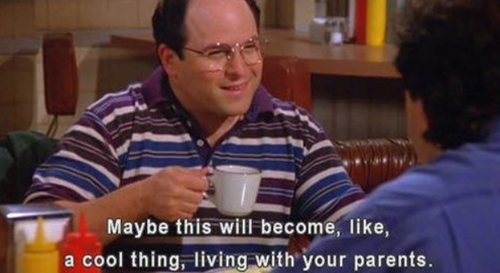
It certainly is a “cool thing”

I feel particularly equipped to address this subject, since I am one of these college grads livin’ the home-cooked dream. I graduated in May 2016, got a job at this dope start-up (Scouted, heyy), and moved back to Connecticut to live with my parents.

So, college seniors, if you’re trying to decide whether to save dat money and regress back to teenagehood, I give you my official “Pros & Cons of Living at Home”:

Pro of living at home: Financial Responsibility

See, I use phrases like financial responsibility now. Because I’m an adult. I’m also an adult in my ability to avoid forking over 70% of my monthly paycheck to pay for a 90 sq ft bedroom with a fake wall on Avenue D. Even though recent grads have faced one of the most compelling job markets in years, the cost of living has been steadily increasing along with it. Living at home has afforded me the ability to steadily increase my savings account, so when I do inevitably move out I’ll have a cushion to fall back on. Go me.

Con of living at home: Commuting

Turns out that commuting while living at home, well, sucks.  On average, Americans waste nearly 50 hours annually commuting with commuters in more metropolitan areas topping close to 75 hours. I personally commute nearly 3.5 hours daily, from my parents’ home in Connecticut to our office in midtown Manhattan. On top of the wasted time, paying for 10 weekly train rides cuts into those aforementioned savings. On the bright side, there’s apparently a petition circulating to bring back the bar car to my train line, so at least I can have the companionship of Bud Light en route home.  Commuting costs time, money, and productivity. Major con.

Nothing like a couple of train brews

Pro of living at home: Hanging out with your parents

I love my parents! I mean, er, they’re cool or whatever. It’s definitely an adjustment to be back home after almost 4 years of “living on my own” at school. Transitioning from sporadic visits to seeing your parents daily really reminds you of how awesome your parents are! They give great advice, like how to find the right credit card or what’s appropriate to wear in a client meeting. They stock your bathroom with the soft kind of toilet paper, and wake you up when you miss your alarm. And sometimes they have cool friends that make for great networking opportunities. Daily hangouts with the people who know you best: Pro, for days.

Con of living at home: Hanging out with your parents

Ah, the flip side. Alongside the joys of Charmin and a fully-stocked fridge, we have some downsides here. Turns out, you can’t use your bedroom floor as a closet or throw your beer on the floor when you’re done drinking it. You have to dump out your cereal bowl when you’re done with it. And sometimes your parents invite all their friends over and you have to explain to 20 (well-meaning) old people what you’re doing with your life and why you’re living at home. And of course, there’s the constant FOMO as you sit home on a Saturday night watching National Treasure while your friends send snapchats all of their awesome shenanigans.

Pro of living at home: The Fridge

Man, nothing beats a home cooked meal, especially after four years of ramen and Busch heavy. Given that I had some horrendous eating habits while at college, it is nice to enjoy a well-rounded diet that only *occasionally* includes pizza, and has all these green items that I’ve heard so much about. It is also something that brings my family together. We have just about all of our meals together and it really has allowed me to reconnect with my parents.

What a real fridge should look like….

Con of living at home: (Not) doing grown-up / real people things

Sometimes I worry that I’m missing out on valuable life experiences that everyone in their early twenties should be going through on their own. Paying bills, shopping for my own groceries, doing laundry: my current set-up requires none of these things. Am I regressing? Maybe. Is it kind of great not to worry about any of these things? Hell yes. Nevermind, I regret bringing this up.    

———-

Overall, I am very grateful that my parents are letting me live at home. And it is genuinely nice to spend time with them after a busy four years of college. But I’m also looking forward to getting to the next step – and make sure I start becoming as accomplished and successful as my parents are.  So here’s to hoping that my next blog entry is titled “The Apartment Search”!

If you want more content related to millennials, the job search, or life be sure to visit the Scouted blog!

Topics:

Candidates, Climb the Ladder
Climb the Ladder

What Do You Want to Be When You Grow Up?

What Do You Want to Be When You Grow Up?
Scouted.io icon
By Scouted
Scouted was a hiring marketplace that matched candidates to roles based on potential, serving clients from high-growth startups to Fortune 500 companies.
6 min read • Originally published March 1, 2017 / Updated March 19, 2026
Scouted.io icon
By Scouted
Scouted was a hiring marketplace that matched candidates to roles based on potential, serving clients from high-growth startups to Fortune 500 companies.
6 min read • Originally published March 1, 2017 / Updated March 19, 2026

“So, what do you want to be when you grow up?”

Ah, a question both timeless and pervasive. It follows you through elementary, middle and high school, and eagerly tags along to college, growing brighter and more urgent each day.

When you’re young, the question is fun; the possibilities are endless. I usually went with some combination of: an NBA player, a sneaker baron, or Lindsay Lohan’s official best friend (Parent Trap-era Lindsay Lohan, to be clear). My best friend yearned to be a psychiatrist when she grew up so she could “know everyone’s secrets.”

For many of us, the fun begins to diminish when college applications start. Now, the question is real. You need a “serious” response. A doctor is always a safe bet. These days, the ever-vague entrepreneur works too. I went with lawyer in my time, based on the rock-solid facts that my parent are both lawyers, and I liked to read. (Seriously, these were my reasons.)

indiana jones
This is what doctors look like, right?


Luckily, few colleges will even hold you to your intended major, let alone your 10-year plan.  But once you get to campus, you start to make decisions that inevitably narrow your options. You choose prerequisites that will guide you to a certain major, you join clubs that expose you to certain types of people, you decide to do research over the summer – or take that unpaid social media marketing internship close to home. Whether deliberately or not, your path begins to take shape.

A bit of my own story…

When I was in college, I stayed on a fairly tracked path. I went all-in on that excellently-reasoned lawyer bet: majored in Political Science, spent my junior summer as an intern investigator for the D.C. public defender’s office, and headed off to a boutique law firm to work as a paralegal after college. Nothing to it, I thought. I have this job thing on lock.

There was just one problem. Turns out, I didn’t like the law very much. I found the environment inflexible and stifling, and the work overly structured and painfully detail-oriented. The attorneys in my office advised me to “get out while I can”. (That’s an actual quote from my boss.) I got out.  Moved home.  And then started thinking about “the question” from scratch.

So, whether you’ve already started down a path or are just beginning to make choices about how and where to spend your time, here’s a few thoughts that I’ve collected along my own journey of figuring out what I want to be when I grow up. Quick spoiler alert: I’m 27, and still not totally sure. (So, take the advice below with a grain of salt!)

Pay attention to what you read, listen to and talk about in your free time.

This is what my dad refers to as the “NY Times” test. Which section of the paper do you gravitate towards? What are the websites that you bookmark and read every day (Facebook, Barstool Sports & Buzzfeed aside, people). What podcasts are you subscribed to? Most young people that I know consume a lot of media, and their options are infinite. Everyone makes conscious or unconscious choices about which topics they stay abreast on, which articles they send to friends, and the podcasts for which they eagerly await each new episode. (Recently, for my twenty-something male friends, that podcast is “Bodega Boys,” which probably doesn’t give us much insight into one’s career. But, anyhow.)

Noticing these habits is often helpful in identifying what you actually find interesting, rather than what you think you’re “supposed” to care about.

Use all of the adults in your life. Wisely.

Obviously, I did a terrible job of taking this advice, given that I had almost no sense of what a lawyer did, despite living with two for my entire life.  But, do as I say and not as I do, right? Your parents, their friends, older siblings, cousins, parents of friends – you can probably get a pretty good understanding of 10+ industries or jobs by setting up a call or coffee date with your close circle of grown-ups. Turns out, old people have had lots of life experiences and pretty good perspective on what they would’ve changed about their careers. Most importantly, ask them how they figured out what they liked, and how long it took them to get there. The answers might surprise you.

Don’t do the same thing every summer – and take notes.

You might be thinking, “I thought that I was supposed to create consistency with my resume, building my skills in a particular area so I’m super hireable when I graduate and I don’t have to live at home after college or eat Cheetos/ramen/Lucky Charms for dinner every night or…”

Yea, yea. There’s some truth to that. But it doesn’t help much to create consistency in your story, if you’re consistently doing something that you’re not very interested in. (See: my resume, circa 2011, with three legal internships upon graduation. Woops.) You have three glorious summers in college to experiment with different types of companies, locations, and jobs. Work for a startup (we’re always hiring!), then try a bigger, more established company. Maybe do a summer not in a major city, if you think you might like the small-town experience. If your school offers funding for unpaid / nonprofit internships, spend a summer working for the not-man.

And most importantly, use these experiences wisely. Do your best to take on additional responsibilities, so you can learn more about what you enjoy doing. Spend time reflecting on the projects you like and dislike, and write stuff down. Build relationships with your boss, so she can, you know, hook it up later.

Get a sales job.

If you’re completely lost about what to do, I’d follow the advice that my sister gave me a few years ago: “Get a sales job.” (She followed that up with, “It kinda sucks and it’s really hard, but I think all smart kids should have at least one experience in sales. It’s humbling as hell.”) Inspirational stuff from the fam.

40 year old virigin
Be like Steve.


A huge percentage of jobs involve selling something to someone – whether it’s convincing your boss to implement your idea, selling yourself to a potential employer, or pitching an organization on why they should partner with your company. Being comfortable with the persuasion process will be hugely helpful throughout your career and building those skills early will inevitably make you better at your job. Unless you’re a programmer, in which case you can probably ignore everything I’ve said, and go enjoy your incredibly well-paid job. Go you.

Lastly, remember that your first job (or two, or three) don’t matter all that much.

It can be tempting to view your first job as hugely indicative of the rest of your career. Luckily, that’s almost always wrong. Here’s what’s important about your first few jobs: that you’re learning, that you’re getting insight into what you like and dislike, and ideally, that you’re meeting some older folks that are good mentors. (I know a few bosses who are particularly good at that.)

Phil Knight (founder of Nike) began his career as an accountant. Reed Hastings sold vacuums. Marisa Mayer worked at a grocery store. So did Oprah. Actually, so did Warren Buffett.

So I guess what we’ve learned today: use your college years to learn about yourself, don’t’ stress, and if all else fails, go work at a grocery store and hope it leads you to wild success.

Topics:

Candidates, Climb the Ladder
Climb the Ladder

Why Finance Majors Don’t Get Finance Jobs

Why Finance Majors Don’t Get Finance Jobs
Scouted.io icon
By Scouted
Scouted was a hiring marketplace that matched candidates to roles based on potential, serving clients from high-growth startups to Fortune 500 companies.
4 min read • Originally published May 12, 2017 / Updated March 19, 2026
Scouted.io icon
By Scouted
Scouted was a hiring marketplace that matched candidates to roles based on potential, serving clients from high-growth startups to Fortune 500 companies.
4 min read • Originally published May 12, 2017 / Updated March 19, 2026

Back when I was in college, it felt like everyone majored in Econ, or Econ and something else (CS in my case).  At a school with no undergrad business program, Econ was the gateway major to that ultimate of career paths: financial services.  You know, whatever it is that investment bankers do.  I imagine we all figured knowing a thing or two about global markets and the velocity of money and all that would provide the appropriate foundation for a long and prosperous career in making it rain.

Nearly fifteen years later, unsurprisingly, finance is as popular as ever.  I got to wondering, does that dogged pursuit of finance actually help in getting a job in the industry?

Does being interested in finance help or hurt you in the job search?

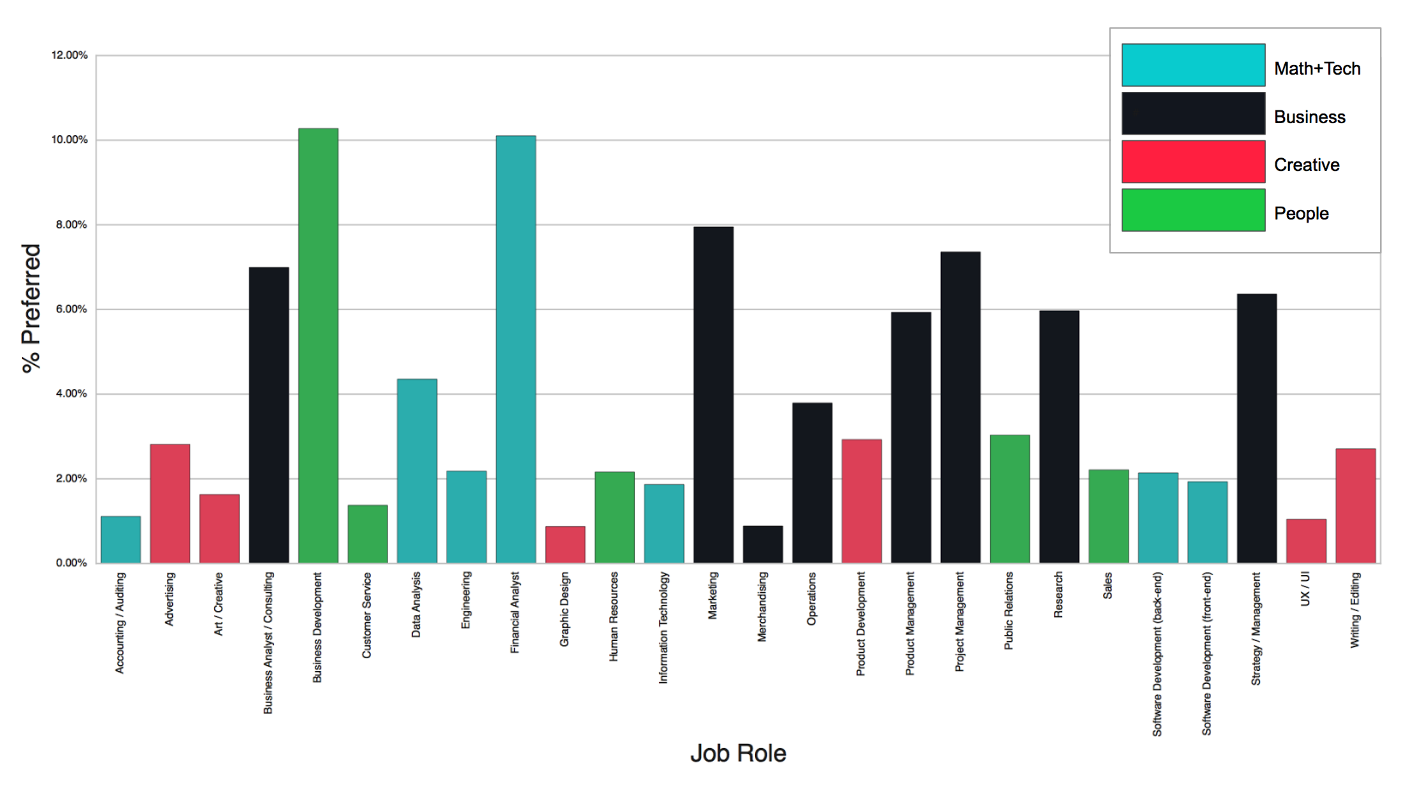
One of the questions we ask candidates up front is which of 26 job roles (things like finance, marketing, and software engineering) seem interesting.  Candidates can pick as many or as few of these as they want, and a solid 10% of the pool says they want finance (we label as “Financial Analyst”).

Candidate Job Role Preferences


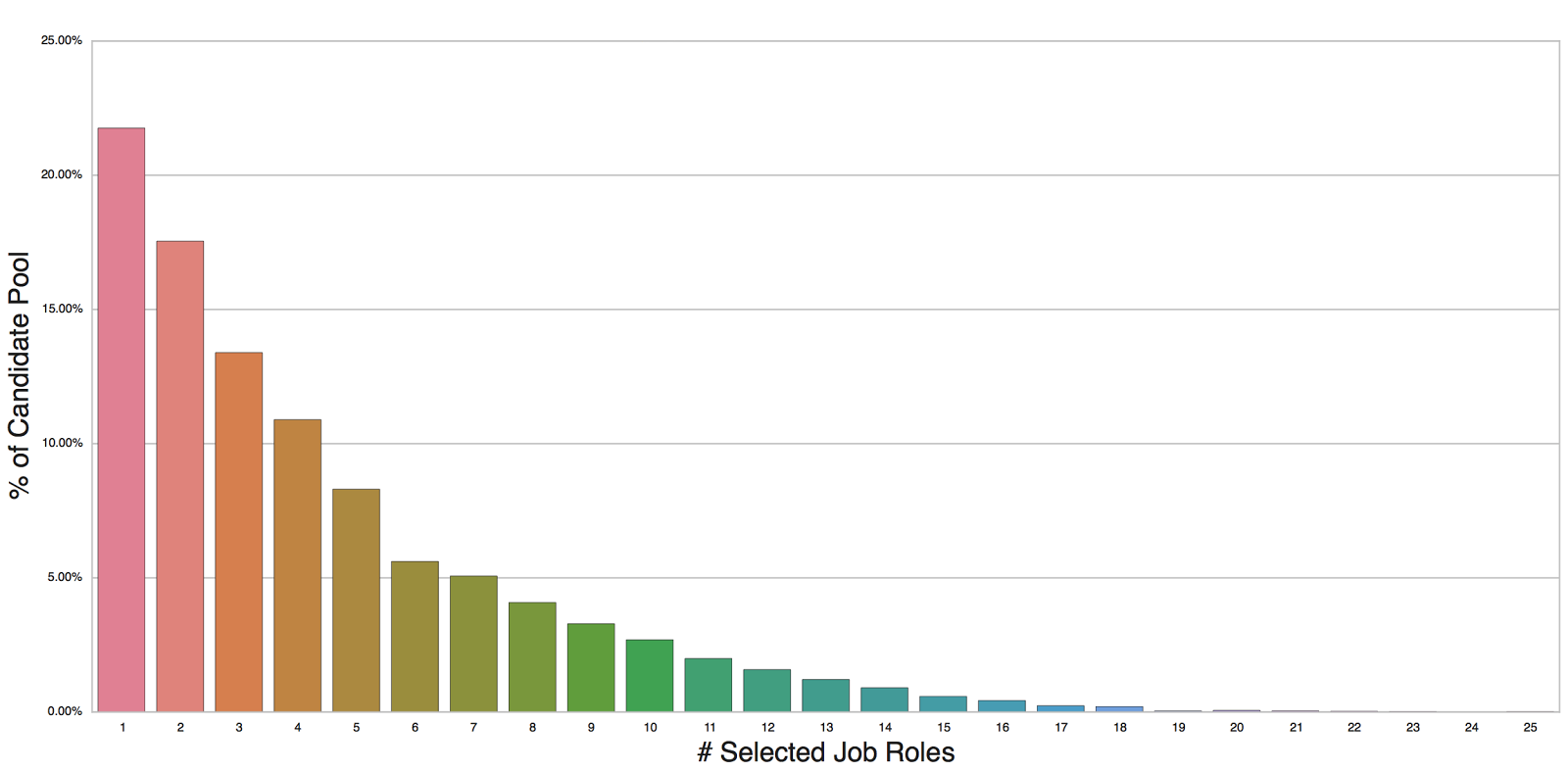
In fact, 6.89% of our candidates say Financial Analyst and nothing else!  I suppose this isn’t too surprising: ~22% of our candidates pick just one job role.  A similar number picks just Marketing.  Most of the candidate pool, however, is open to other possibilities.

How Many Job Roles Do Candidates Select
How Many Job Roles Do Candidates Select?


Given there are over 67 million ways of selecting job roles, it’s interesting to look at the correlations of those choices.  

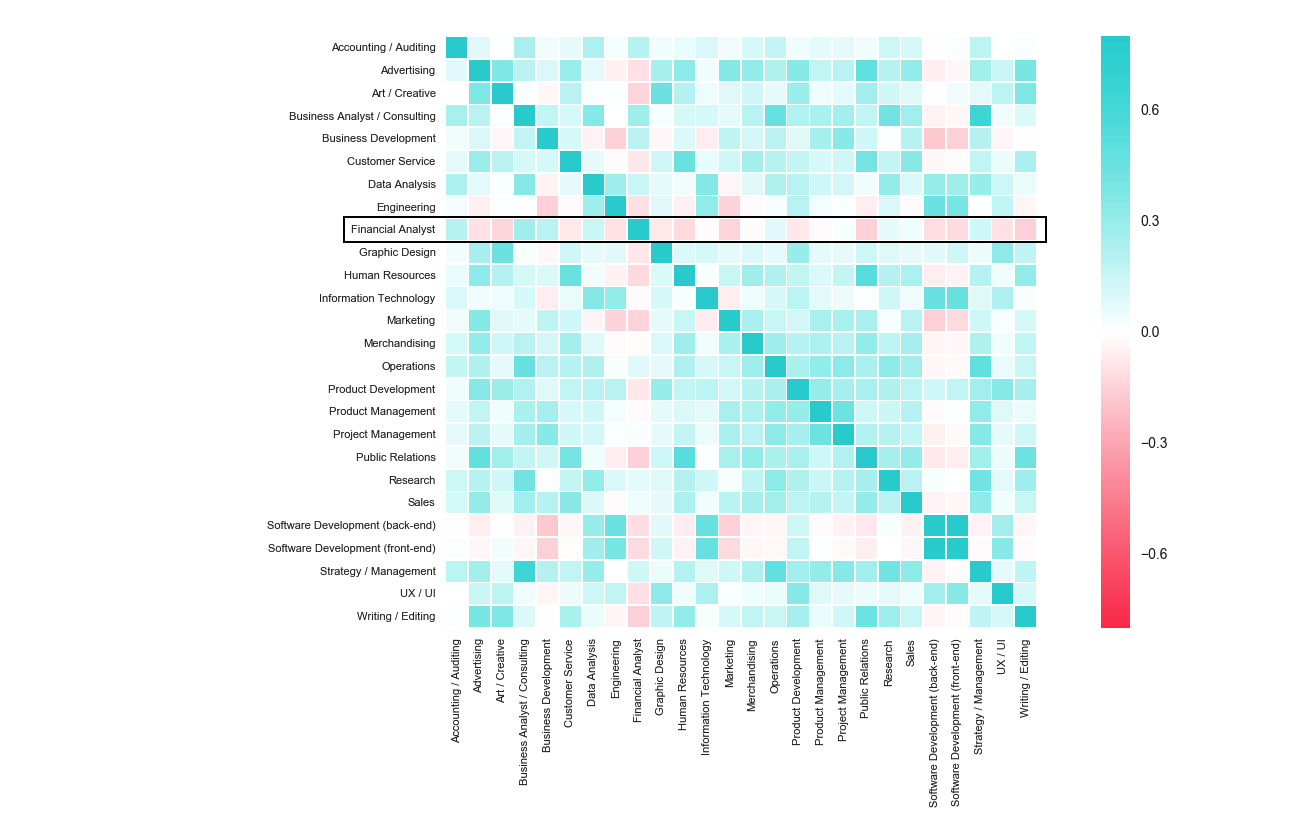
Correlations of Candidate Job Role Preferences


Following the Financial Analyst row across, we can see negative (red) correlations with pretty much everything except stereotypically business stuff such as accounting, or data analysis. Clearly, folks looking for finance jobs are generally not looking for HR or writing gigs.

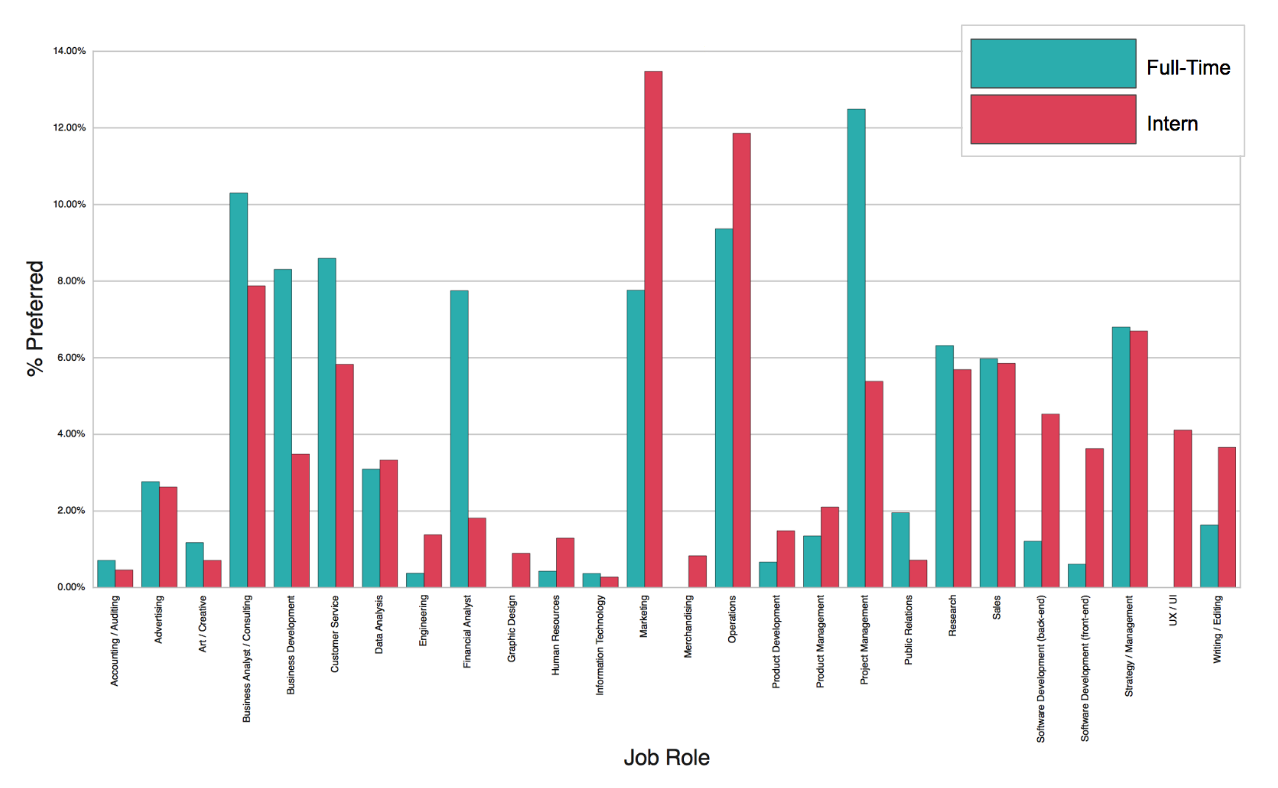
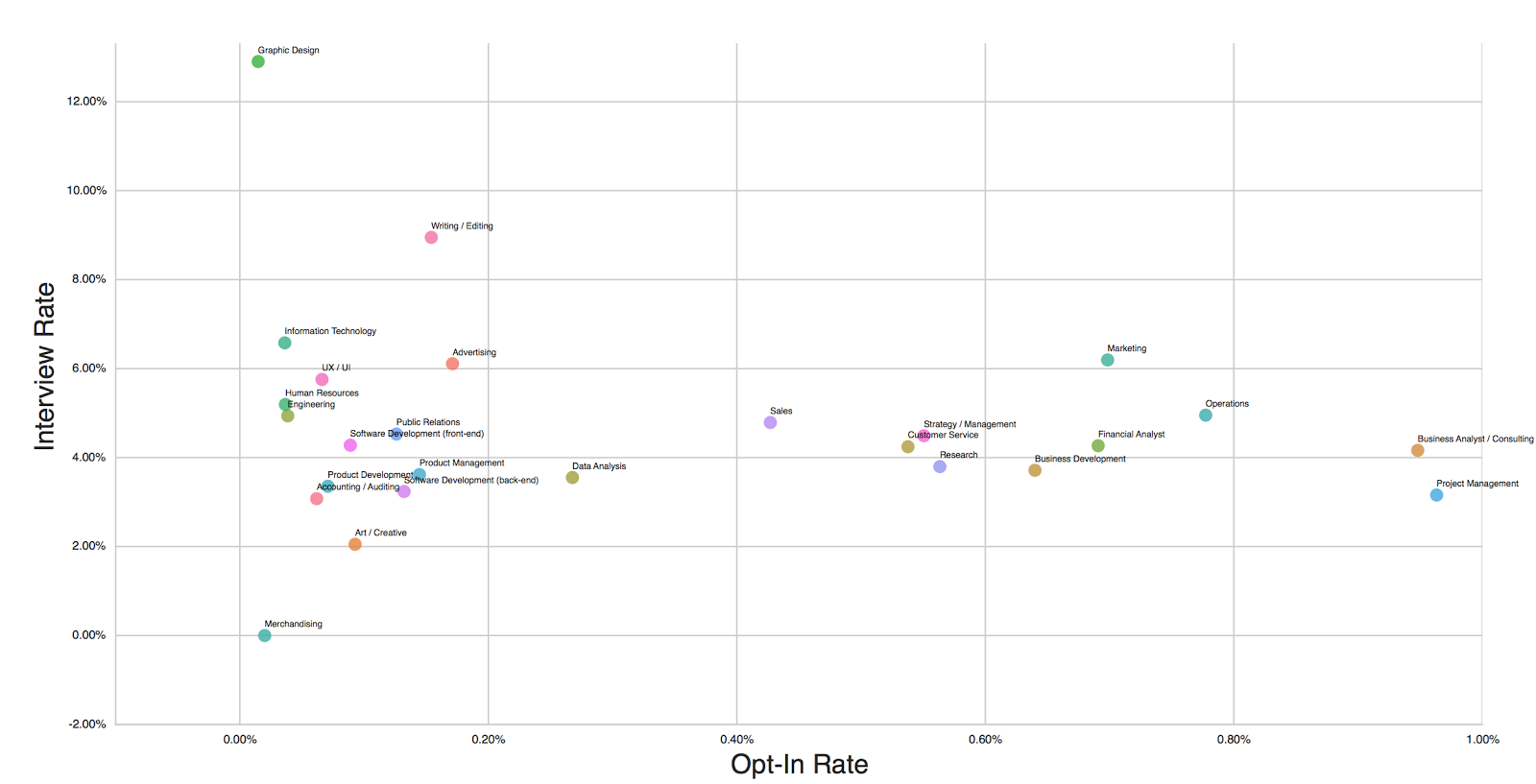
To be fair, these correlations commingle our full-time candidates with the interns.  Separating them apart, we can see similar interests most of the time, but pretty big gaps on a few categories, including finance.

Job Role Opt-Ins
Job Role Opt-Ins


A relatively bigger chunk of the full-time pool opts in for finance roles.  We’ve offered twice as many finance roles for full-timers as we’ve had for interns, so that likely has a big impact.  

Interested in writing? Maybe your secret calling is finance!

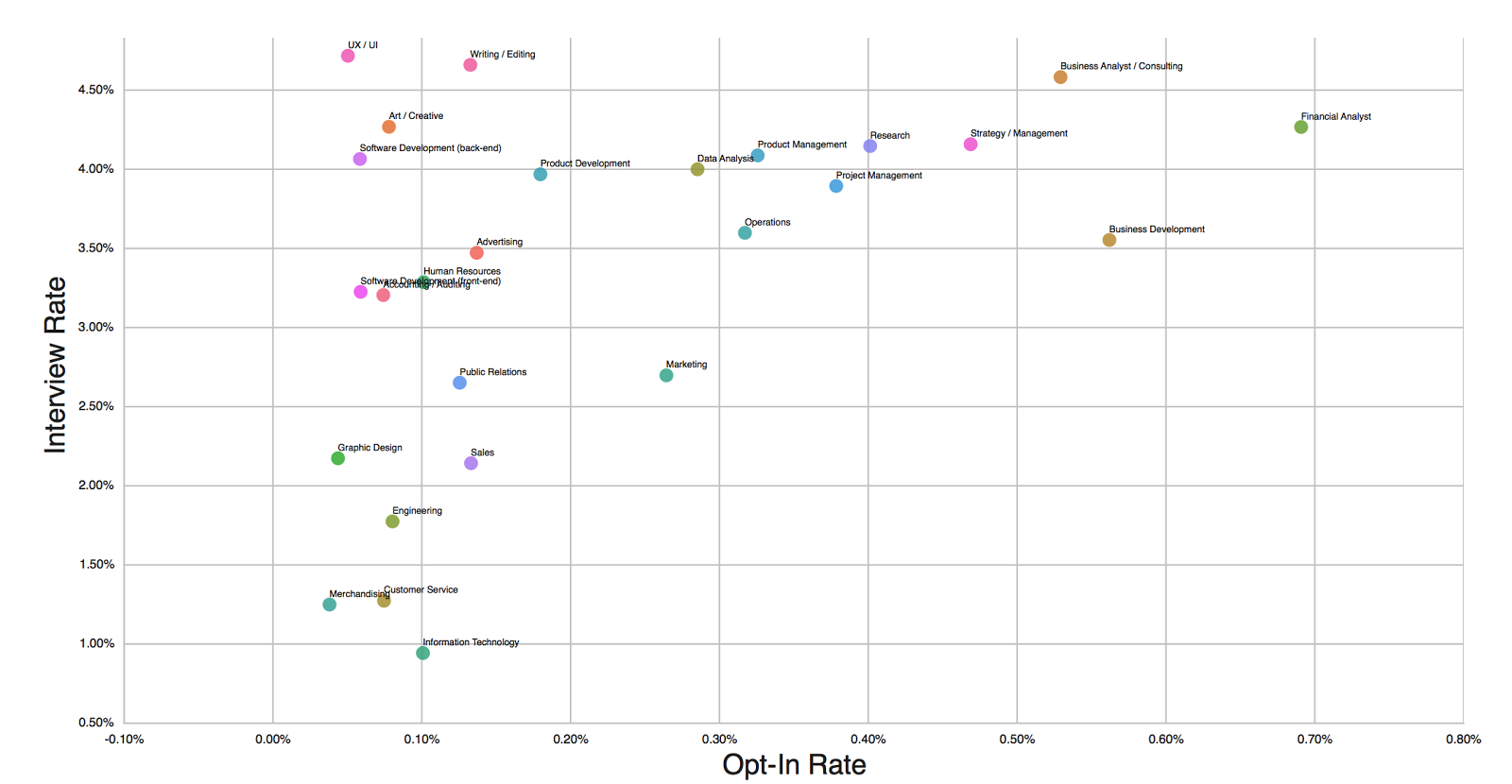
As an alternate theory, when I was looking for internships in college, I was more interested in exploring varied opportunities before settling into a career following graduation.  Perhaps this mentality still holds? In any event, here’s the surprising chart.

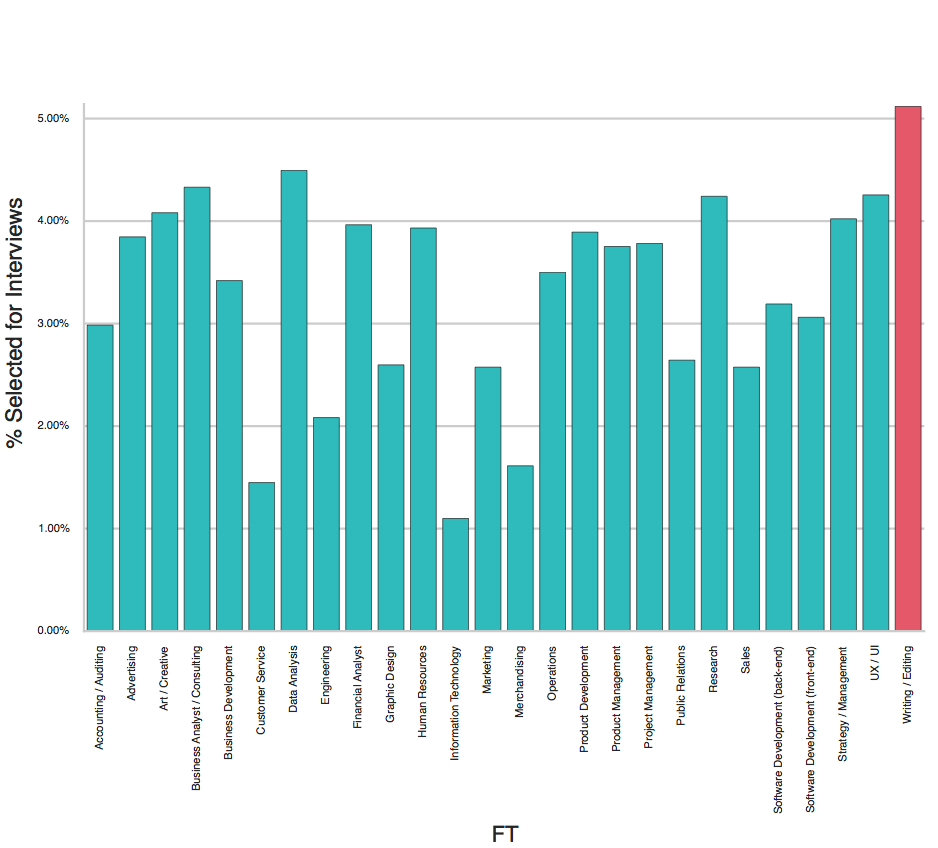
Who Gets Interviews For Financial Analyst Roles?


Of those full-time searchers who opt-in for finance jobs, it’s not the aspiring financiers who do best, but the writers and editors who’ve been most likely to see a Round-2 interview! (NB: past performance does not guarantee future results.)

Who Gets Interviews for Financial Analyst Roles?


Part of this is certainly a numbers game. We don’t have many novelists opting into our finance opportunities; but those candidates who do must be pretty strong, as they get lots of interviews.

Candidate Preferences for Companies Hiring a Financial Analyst
Candidate Preferences For Companies Hiring A Financial Analyst


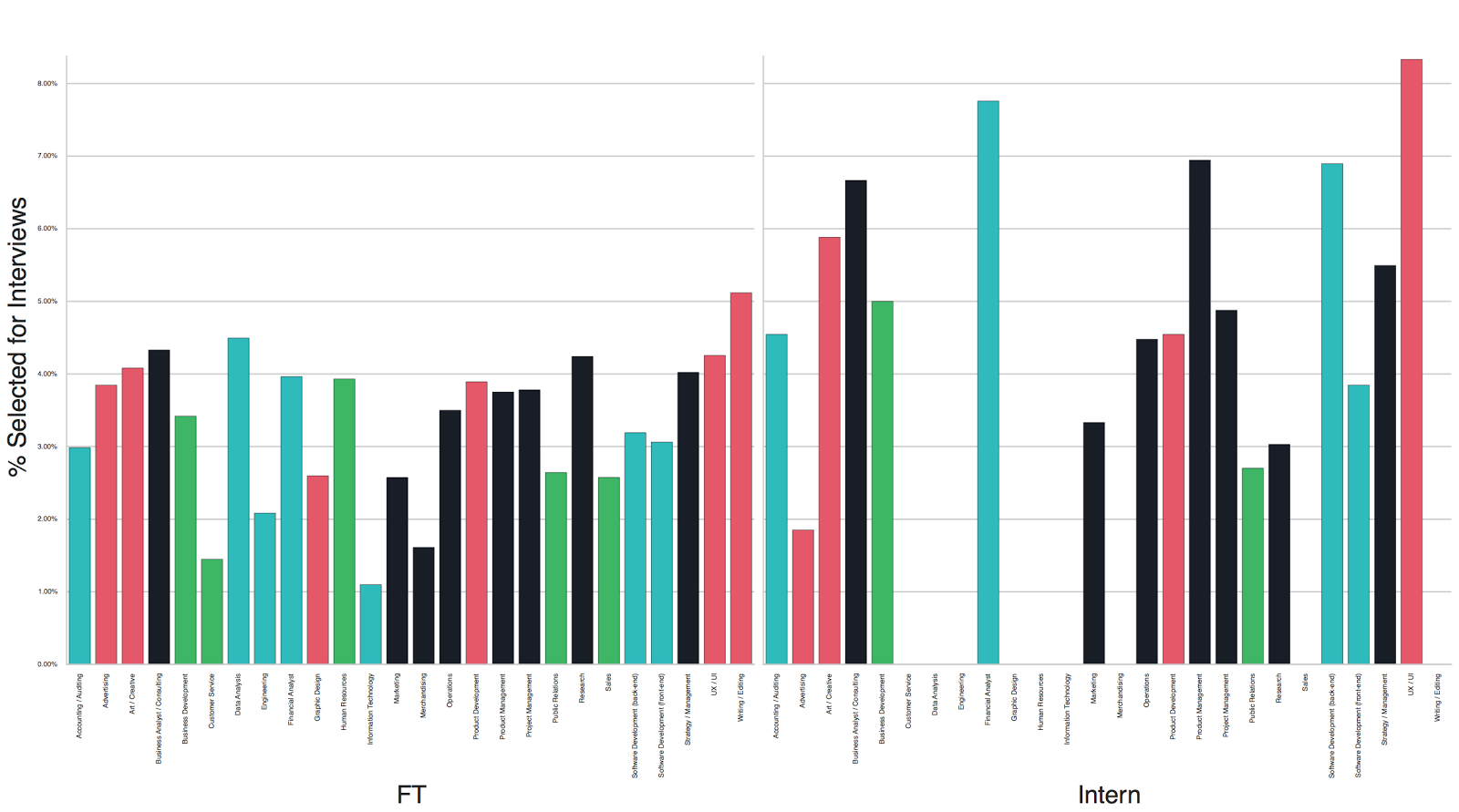
Of course, we can make charts tell whatever story we want, but our data shows that clients hiring for finance do not have a bias for candidates who want to work exclusively in finance. If we flip the data a bit, we can see that financial analysts are getting interviews, well, everywhere!

Where Do Aspiring Financial Analysts Get Interviews?

Conclusions

The moral here?  Even financial analysts (and engineers) have to write, and sometimes product managers do marketing, and sometimes human resources does sales.  So cast a wide net and don’t let the search parameters be a limiting factor.  Your resume may bleed finance (or Econ), but don’t let that stop you from thinking about or being considered for a job one or even two derivatives over.  And lastly, though we might not be offering traditional i-banking roles (yet!), if you’re early on in your college years, even if, ya know, you’re dead set on spending your twenties as a corporate slave, don’t be afraid to explore the physics or philosophy departments while you have the chance.

This analysis exemplifies how everyone on Scouted benefits from our data-driven approach to matching: candidates get presented with great opportunities that they may have ordinarily overlooked, yet that still fit well with their set of values and abilities; clients gain access to not just a capable, but a diversified roster of excited applicants; and we at Scouted learn how to make the job search and hiring process easier to navigate with greater and greater success rates for everyone on the platform.

[optinform]

Topics:

Candidates, Climb the Ladder
Climb the Ladder

How to Find Your First Apartment in 6 Easy Steps

How to Find Your First Apartment in 6 Easy Steps
Scouted.io icon
By Scouted
Scouted was a hiring marketplace that matched candidates to roles based on potential, serving clients from high-growth startups to Fortune 500 companies.
5 min read • Originally published June 7, 2017 / Updated March 19, 2026
Scouted.io icon
By Scouted
Scouted was a hiring marketplace that matched candidates to roles based on potential, serving clients from high-growth startups to Fortune 500 companies.
5 min read • Originally published June 7, 2017 / Updated March 19, 2026

Finding your first apartment ain’t easy. Take it from me; as someone who recently just went through the process, finding your first grown-up place to live post-college is probably the second biggest decision you’ll make as you enter the real world. It is far different from moving out of your dorm and into a fraternity house, where the only decision there is whether you have enough room for a bar and a FIFA station. Luckily for you, I recently left the comforts of my parents’ home and began looking for my first domicile. Here’s my worldly wisdom:

1. Budget

The least fun and most important part of the search – the goal here is to avoid being that bum who needs a loan from your roommates or parents to make your rent payment. As a general rule of thumb, your rent should NEVER exceed 50% of your monthly income (unless you crazy good at saving money) which is why I like to follow the 50/20/30 method:

50% of your monthly income should go to fixed costs that recur monthly: rent, utilities, subscriptions (i.e transportation, gym membership, Netflix obvi).

20% of your monthly income should go to your savings/financial goals.  We’re grown-ups now, so let’s lay the groundwork for a stable future. Whether you’re saving for a nicer apartment, student loan payments or just an emergency fund – keep a cushion around. You don’t want to be stuck looking at an empty savings account when you break your laptop because you thought it might serve as a good koozie.

30% of your monthly income is allocated to flexible spending: shopping, vacations, beer, groceries, entertainment, beer, dry cleaning if you don’t work at a startup (nerds). Essentially anything that can fluctuate and isn’t a fixed cost.

2. To roommate or not to roommate

Ah, the ultimate question. This step is often dictated by your budget and location. If you’re in Manhattan or San Francisco and don’t work for a hedge fund, you’re most likely going to need a roommate(s).  Now if you’re in a city like St. Louis or Richmond, where the average 1 bedroom is under $1,000, then you’re Gucci Mane. Decisions, decisions.

So now that you have decided that you need a roommate for financial or emotional reasons, where do you go about looking for roommates? The classic strategies still hold; you can, of course, live with a friend or use your network to find someone. But these days, there’s a bunch of new tools to try out too.  Companies like Symbi, RentHoop, Roomster offer the ability to match with potential roommates based on mutual interests, living habits or just a shared desire to avoid the serial killers on Craiglist. Find yourself a charmer!

3. Neighborhood

Job? Check (hopefully). Budget? Got it. Roommate and future bffaeaeae? Yep. Now it’s time to choose your neighborhoods. When picking a neighborhood(s) to narrow your search, you need to evaluate a couple of things. Like our first step, budget – can you afford to live in that neighborhood? Sure, living in Tribeca is nice and all but you don’t want to turn your budget in 90/5/5. Second, location, how far are you from work? What would your commute look like? Do you always have to travel for necessities? Re: Vibezzz, do you want a quiet neighborhood with families living there? Or are you the life of the party and need to be on the main strip? These are very much personal opinions, which means it is important to ask yourself and prioritize when narrowing your search to a couple of neighborhoods.

[sc name=“Newsletter”]

4. Ruthlessly prioritize

In New York, this usually means you have to give up some combination of laundry, not walking up 6 flights of stairs to reach your apartment, a mouse-free environment, or having actual bedroom walls.  Then you realize you actually have to give up all of these and still pay more than you wanted. Let’s just keep moving here.

5. To broker or not to broker

FINALLY, damn, that took a while… time to start actually looking at some apartments!!!

.

.

.

.

.

WHOA there, partner, not so fast:

Now you gotta decide if you want a real estate broker or not. This is sort of like learning to drive a car; you can either take paid driving lessons or you can learn how to drive by doing donuts in a Walmart parking lot using your friend’s 1996 Subaru Outback. One is expensive and tedious but “safe” (boring), the other is free-flowing, dangerous, and kind of fun. With a broker, you often get to see exclusive apartments, they can cut deals with landlords, and they probably know a heck of a lot more than you. The catch: the good ol’ broker fee, which can be up to 15% of annual rent. That’ll throw a wrench in the budget. If you decide to go down this route, I would definitely recommend our friends over at Triplemint who can make your life a lot easier if you need a broker. 

The non-broker option is the path less traveled. But it can work if you’re truly committed. I would recommend building a list of apartments you are interested and start scheduling showings. Websites like Zumper, Craigslist, Streeteasy (if in NYC), and Padmapper are also great resources.

6. YOU DID IT! YOU FOUND YOUR FIRST APARTMENT!

Ah, the journey is complete. You now have the perfect, beautiful apartment to call your own. Sure, it’s a 6th-floor walk-up with no AC, dimly lit hallways, and a stench of hard-boiled eggs, but who cares…you can officially call yourself an adult.

Well, you may have found your first apartment, but if you ever need a job don’t be afraid to hit up Scouted for all your first, second, and third job needs.

Topics:

Candidates, Climb the Ladder
Climb the Ladder

7 Ways to Improve Your Technical Resume

Technical Resume
Scouted.io icon
By Scouted
Scouted was a hiring marketplace that matched candidates to roles based on potential, serving clients from high-growth startups to Fortune 500 companies.
5 min read • Originally published June 13, 2017 / Updated March 19, 2026
Scouted.io icon
By Scouted
Scouted was a hiring marketplace that matched candidates to roles based on potential, serving clients from high-growth startups to Fortune 500 companies.
5 min read • Originally published June 13, 2017 / Updated March 19, 2026

Looking to build your technical resume, but not sure how it differs from a traditional resume?  Read on for 7 tips to help your technical resume stand out from the masses.

Be thoughtful about your list of technical skills.

Many companies use keyword searches to filter for resumes.  If you have thousands of applicants and just want the Java engineers, a keyword search seems like a quick win.  As a result, technical resumes end up with a mess of a section labeled something like “Technical Skills,” and very often this contains a proliferation of stuff ranging from, the “yes I know this” to the “I used this once for a homework assignment in CS 101.”  While getting through that automated resume screener is clearly important, when you get to the hiring manager, anything on your resume is fair game.  When an interviewer sees a technical resume with every programming language, operating system, and development tool listed there, it screams out, “I don’t actually know any of this.” (And by the way, experienced hires are just as guilty of doing this as new grads.)  Note what you know, but be honest about what you don’t – if you still want to keep everything to beat the keyword screens, at least indicate level of proficiency in some way.

Seriously, be thoughtful about your list of technical skills.

While you’re refining that list of technical skills, consider leaving off Microsoft Excel, Google Docs, etc…  Unless you are doing VBA scripting in Excel or have worked with the Google APIs, adding these applications diminishes the perception of competency for anything else you’ve listed in the section.  In this day and age, it’s pretty much expected that you know how to use the Internet, the basics of building a spreadsheet, or writing a document.  Perhaps if you’re applying for a Powerpoint-heavy job, for example, it makes sense to keep these – there are certainly intricacies to Powerpoint such as animations and transitions, or using a master template.  If you’re looking for a software development role, saying you know “Python and Powerpoint” trivializes the time you spent actually learning Python.

Pay attention to the details.

This one is really for everyone, not just engineers: check your resume for typos, grammatical issues, changes in voice, weird capitalizations, inconsistencies in formatting and alignment, and anything else that says to a hiring manager, “I don’t pay attention to details.”  You have as much time as you need to get your resume right, and this is the easy stuff.  If your resume reads poorly when you could have taken all the time you needed to write it, what can we expect from your professional work when there are deadlines and demands?  If you are building software, the main deliverable of your work is written code.  If your technical resume is riddled with bugs, should we expect any better of your engineering? If you need some resume help be sure to check out our awesome Scouted resume template.

[sc name=“Newsletter”]

Reference work samples.

Especially if you are just entering the workforce as an engineer, it’s incredibly helpful if your technical resume refers to actual engineering work somewhere in the interwebs.  In most cases, this means having something public on github; in others, a personal website or a showcased project.  If your school policy precludes your ability to share school work or projects and you have no interesting side projects, then go do some questions on Project Euler.  An artist would share their portfolio; a musician their recordings.  Providing upfront access to samples of your work improves your credibility and demonstrates your interest and possibly even passion for the field.  Code samples also provide insight into how you approach and solve problems and communicate.

Your technical resume should be specific.

Resumes do not get read; they get skimmed.  Bullets that are generic or trite just waste space.  Saying something like, “executed on the project’s deliverables based on the specified timeline,” conveys absolutely nothing.  We know you worked on projects, we know those projects had deadlines; tell us the interesting details, results, and deliverables.  Each line in your resume should convey something of material: what did you accomplish, what did you do, how did you do it?  If you worked on a group project, what was your specific contribution?  If you had an internship, what was your impact?  If you have prior work experience, make your resume results-oriented.  This is pretty standard fare for resumes in general, but technical resumes often fall short and needlessly so.

Stick to one or two pages in length.

The consensus is that if you have less than 10 years of work experience, your resume should fit on one page.  After 10 years, two pages works.  If you have a lot of patents or are published, a third page or more is acceptable.  Young engineers especially tend to list every course and project they worked on in school, and this creates bloat.  Include the important stuff and cut the rest.  (A caveat for experienced hires: if you are using a contingency recruiter, and that recruiter asked for a non-PDF version of your resume, it’s quite likely they’re stamping their agency info at the top of your resume, butchering your formatting and probably bumping you to the next page.)

Your audience might be non-technical.

Many companies might insource the first resume screen to a non-technical or lightly-technical person such as someone in HR, or a business analyst attached to an engineering group. The contents of your technical resume should be pretty good at speaking for themselves without a tech-to-English dictionary.  This isn’t to say that you shouldn’t be technical, but rather to do it thoughtfully, expecting it’s always possible a non-technical reader will be taking a first pass.

That’s all for today! Have more specific questions? Feel free to reach out to our candidate experts at Scouted@scouted.io!

Topics:

Candidates, Climb the Ladder

Posts navigation

Older posts
Newer posts
Featured Jobs
Columbia University
Executive Director, Knight Bagehot Fellowship Program
Columbia University
New York, NY USA

Association for Computing Machinery
Executive Editor
Association for Computing Machinery
New York City, NY USA

Delaware River Joint Toll Bridge Commission
Director of Communications
Delaware River Joint Toll Bridge Commission
Yardley, PA

Hearst Television
Account Executive
Hearst Television
Array

All Jobs »
PREMIUM MEMBER

Clarah Manuhwa

Global,
12 Years Experience
Writer, Podcast show host and global business leader empowering young professionals, women and Africa`s talents through practical solutions and...
View Full Profile »
Join Mediabistro Membership Today

Stand out from the crowd with a premium profile

Mediabistro Logo Find your next media job or showcase your creative talent
  • Job Search
  • Hot Jobs
  • Membership
  • Newsletter
  • Career Advice
  • Media News
  • Hiring Tips
  • Creative Tools
  • About
Facebook YouTube Instagram LinkedIn
Copyright © 2026 Mediabistro
  • Terms of Use
  • Terms of Service
  • Privacy