Mediabistro Logo Mediabistro Logo
  • Jobs
    Search Creative Jobs Hot Jobs Remote Media Jobs Create Job Alerts
    Job Categories
    Creative & Design Marketing & Communications Operations & Strategy Production Sales & Business Development Writing & Editing
    Quick Links
    Search All Jobs Remote Jobs Create Job Alerts
  • Career Resources
    Career Advice & Articles Media Industry News Media Career Interviews Creative Tools Resume Writing Services Interview Coaching Job Market Insights Member Profiles
  • Mediabistro Membership
    Membership Overview How to Pitch (Premium Tool) Editorial Calendars (Premium Access) Courses & Training Programs Membership FAQ
  • Log In
Post Jobs
Mediabistro Logo Mediabistro Logo
Search Creative Jobs Hot Jobs Remote Media Jobs Create Job Alerts
Job Categories
Creative & Design Marketing & Communications Operations & Strategy Production Sales & Business Development Writing & Editing
Quick Links
Search All Jobs Remote Jobs Create Job Alerts
Career Advice & Articles Media Industry News Media Career Interviews Creative Tools Resume Writing Services Interview Coaching Job Market Insights Member Profiles
Membership Overview How to Pitch (Premium Tool) Editorial Calendars (Premium Access) Courses & Training Programs Membership FAQ
Log In
Post Jobs
Log In | Sign Up

Follow Us!

LA

See how much it costs to attend Los Angeles Dodgers games

See how much it costs to attend Los Angeles Dodgers games
By Stacker Feed
1 min read • Published April 29, 2026
By Stacker Feed
1 min read • Published April 29, 2026

HE Photography // Shutterstock

See how much it costs to attend Los Angeles Dodgers games

Way compiled a look at the affordability of attending Los Angeles Dodgers games. Ticket rates were aggregated from official primary ticketing partners and major resale marketplaces based on availability as of March 2025. Estimated game day costs reflect one average ticket, one beer, one hot dog, one soda, and one parking spot. Prices are estimates based on publicly available data and do not include taxes or fees.

While Major League Baseball remains one of the most accessible major sports leagues in the U.S., prices vary significantly by market. Large coastal teams tend to command higher ticket prices, while smaller markets often offer more budget-friendly experiences.

How much it costs to attend Los Angeles Dodgers games
– 2026 Stadium: Dodger Stadium
– Ticket prices: $54.24 (National rank: #4 most expensive)
– Concession total: $30.00 (National rank: #1 most expensive)
— Beer (16oz): $16.00
— Hot Dog: $8.00
— Soda: $6.00
– Average parking price: $10.33
– Estimated total cost of attending a game: $94.57

MLB teams with the highest average ticket prices
#1. New York Yankees ($67.75)
#2. Houston Astros ($64.29)
#3. Chicago Cubs ($55.10)
#4. Los Angeles Dodgers ($54.24)
#5. Washington Nationals ($46.02)

MLB teams with the lowest average ticket prices
#1. Miami Marlins ($23.61)
#2. Arizona Diamondbacks ($25.15)
#3. Chicago White Sox ($25.58)
#4. Cincinnati Reds ($25.58)
#5. Pittsburgh Pirates ($26.93)

This story was
produced by
Way
and reviewed and
distributed by Stacker.

Topics:

LA
NYC

Costs of long-term care and senior living in New York

Costs of long-term care and senior living in New York
By Stacker Feed
6 min read • Published April 29, 2026
By Stacker Feed
6 min read • Published April 29, 2026

pikselstock // Shutterstock

Costs of long-term care and senior living in New York

Understanding the costs of long-term care is an essential part of planning for senior living and in-home care. A Place for Mom provides proprietary cost benchmarks drawn from its nationwide network of partner communities and agencies.

This report includes cost data for senior living — independent living, assisted living, and memory care — as well as home care in New York. Senior living figures reflect actual monthly costs paid by residents who moved into a community during calendar year 2025, including base rent and care fees where applicable. Home care figures are based on hourly starting rates reported by partner agencies and captured in early 2026.

This report primarily uses median values to provide a reliable benchmark that is less influenced by unusually high or low prices. While many families search for the average cost of long-term care, medians better reflect what families typically pay.

Median costs of long-term care and senior living in New York

  • Assisted living: $6,195/mo
  • Memory care: $8,250/mo
  • Independent living: $3,400/mo
  • Home care: $35/hr

Costs are structured differently across care types and settings. Residential senior living options are typically priced as monthly rates that bundle housing with services such as meals, activities, and varying levels of personal care.

Independent living is generally the most affordable type of senior living, since it does not provide hands-on care. Memory care typically costs more due to increased staffing levels, specialized dementia training, and enhanced safety features.

Home care is most often billed hourly, reflecting the flexibility of services delivered in a private residence. Total monthly home care costs depend on the number of hours provided and the intensity of care required, which can make direct comparisons with residential options more complex.

How median costs of long-term care and senior living in New York compare with national medians

Assisted living
National median: $5,419
New York vs national: -12%

Memory care
National median: $6,690
New York vs national: -18%

Independent living
National median: $3,200
New York vs national: -5%

Home care
National median: $34/hr
New York vs national: -2%

Long-term care and senior living costs vary widely by state due to differences in labor costs, real estate markets, regulatory environments, and the balance between supply and demand for senior care services.

States with higher senior living costs often overlap with regions that have above-average housing prices and wages, while lower median costs are more common in parts of the Midwest and South. However, lower costs do not always correspond to greater access, particularly in markets where limited supply constrains availability.

Senior living costs by floor plan type in New York

Apartment size and layout can significantly affect the cost of senior living, though premiums vary by care type and market. Studio apartments are typically the most affordable option, while one- and two-bedroom units command higher monthly rates.

In assisted living, the median starting price of a one-bedroom apartment is often $900 to $1,200 per month higher than a studio, with two-bedroom units carrying substantially larger premiums. Independent living generally shows smaller differences between floor plans, while memory care pricing varies more widely due to specialized staffing requirements and secure design considerations.

Larger floor plans are not available in every market, particularly in memory care settings. As a result, both availability and pricing should be considered when comparing senior living options across states.

The following tables show median monthly starting prices for the most common floor plans in New York senior living communities. Starting prices are reported by communities in A Place for Mom’s partner network and generally reflect base rent, excluding additional fees for care services, pets, or other optional charges. Floor plan pricing reflects starting rates captured in early 2026. You can see how much care costs across the country here.

Assisted living costs by floor plan in New York
– Studio: $5,866/mo
– 1-bedroom: $7,067/mo
– 2-bedroom: $8,375/mo

Independent living costs by floor plan in New York
– Studio: $3,919/mo
– 1-bedroom: $4,368/mo
– 2-bedroom: $5,090/mo

Memory care costs by floor plan in New York
– Studio: $9,330/mo
– 1-bedroom: $11,430/mo
– 2-bedroom: $7,508/mo

Senior living and long-term care costs over time

A Place for Mom’s proprietary data shows that senior living costs increased from 2024 to 2025 across the country, extending a multiyear upward trend across major care types. National median costs rose across independent living, assisted living, and memory care. Senior living national median cost comparisons reflect calendar year 2024 and 2025 data.

Home care national median hourly rates, captured in early 2026, also reflect continued upward pricing pressure.

While year-over-year increases vary by care type and market, the overall direction of pricing remains upward.

A Place for Mom

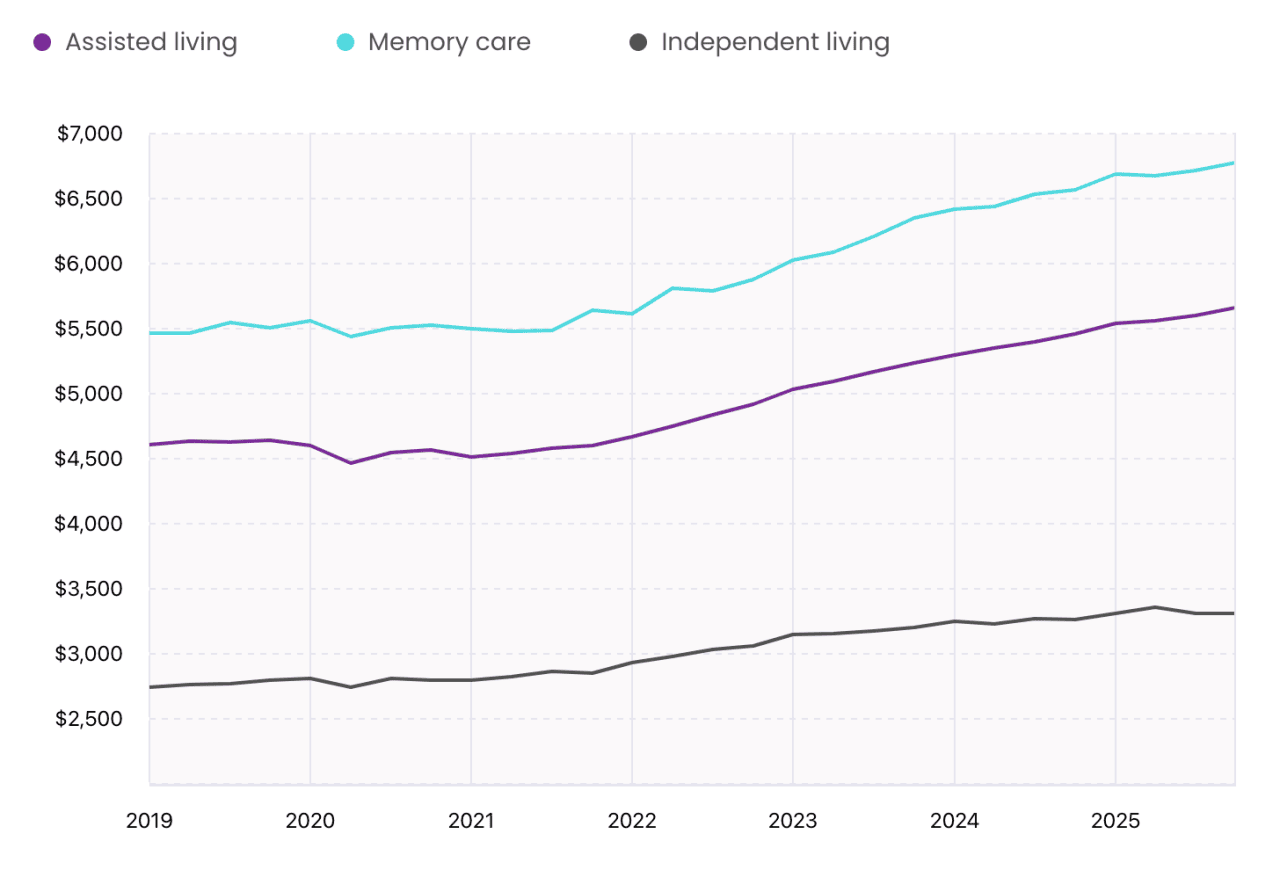
Average senior living costs, 2019-2025

The line graph shows how the national monthly costs for assisted living, memory care, and independent living have changed since 2019. Unlike most of the data in this report, this graph reflects quarterly average costs paid after residents moved in. In this context, averages are used to better illustrate pricing trends over time, as they more clearly capture the impact of rising costs, post-pandemic occupancy demand, and limited new construction in some markets.

A Place for Mom

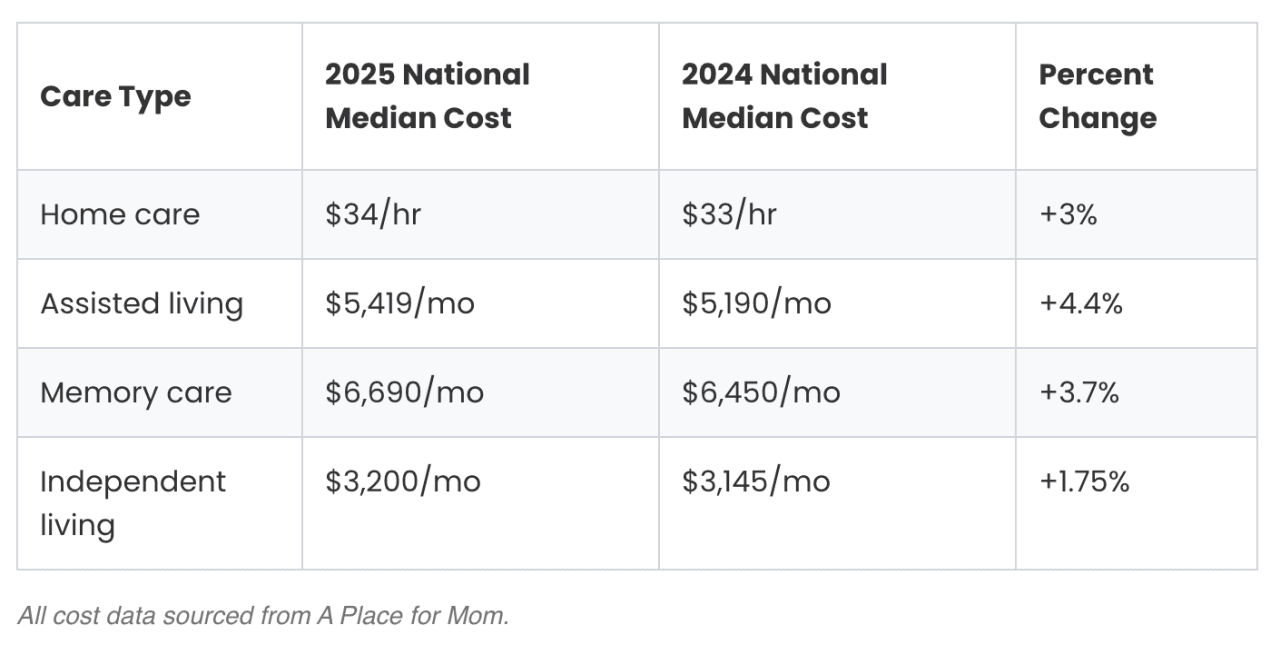
Median cost changes by care type, 2024-2025

This table shows the national median costs by care type comparing 2025 to 2024.

Calculating the costs of long-term care and senior living

A Place for Mom calculates the costs of long-term care using a consistent approach designed to support national- and state-level comparisons. Cost data is collected from partner providers, standardized across markets, and analyzed to reflect typical pricing. This methodology is intended to benchmark costs across settings, not to estimate what any individual family will pay.

Median cost data for senior living communities

Median cost data for independent living, assisted living, and memory care is based on actual costs paid by residents who moved in during calendar year 2025. For each move-in, the reported cost includes base rent and care fees when care is provided.

In states where move-in data was not available, median costs are based on averaged published rates for common room types and care fees. If neither move-in data nor published rate data was available for a given setting, cost data is not shown for that location.

Assisted living median costs are based on 24,305 family move-ins recorded during calendar year 2025, independent living cost data reflects 13,528 move-ins, and memory care cost data is based on 10,474 memory care move-ins.

Median cost data for home care

Home care cost data in this report was captured Jan. 9, 2026, and is based on hourly starting rates shared by 3,215 home care agencies in A Place for Mom’s network.

Actual home care costs vary based on the number of hours arranged and type of care provided. Because schedules and needs differ, home care costs in this report are shown as hourly rates rather than fixed monthly totals. The national median hourly rate provides a general reference point, but a family’s total monthly cost will depend on how many hours of care are arranged.

Most home care agencies require a weekly minimum of seven hours, and some offer up to 24-hour or live-in care options. The most common home care schedule is approximately 20 nonsleeping hours per week, which equates to $2,944 per month based on the national median hourly rate of $34.

Context sources

In addition to proprietary cost data from A Place for Mom’s partner network, this report references publicly available government data and industry research to provide general context on labor markets, housing costs, inflation, and senior living supply and demand. These sources are not used to calculate the cost figures presented in this report.

Sources referenced for context include the U.S. Bureau of Economic Analysis, U.S. Bureau of Labor Statistics, National Investment Center for Seniors Housing & Care, and Senior Housing News.

This story was
produced by
A Place for Mom
and reviewed and
distributed by Stacker.

Topics:

NYC
Careers & Education

HR leaders call for unified solutions and strategic AI

HR leaders call for unified solutions and strategic AI
By Shari Simpson for Paylocity
3 min read • Published April 29, 2026
By Shari Simpson for Paylocity
3 min read • Published April 29, 2026

Businessman interacting with a virtual holographic HR system.

R.bussarin // Shutterstock

HR leaders call for unified solutions and strategic AI

Two-thirds of HR technology decision-makers are ready to switch providers to get the all-in-one system they need, according to a recent survey of business leaders conducted in September 2025 by Qualtrics and Paylocity, an HR, payroll, and finance software provider.

The study drew on insights from more than 500 leaders across HR, finance, IT, and operations to assess how organizations view their HR and payroll software, examining usability, integration, innovation, and outcomes. The findings highlight what works today — and what human capital management (HCM) technology must deliver next.

87% of leaders want an all-in-one HR and payroll solution

When it comes to HR processes, keeping employee data secure and accurate is critical. From hiring to payroll, benefits, and compliance, every detail matters. But HR isn’t the only department that benefits from getting this right.

In their quest for a better solution, a vast majority of decision-makers (87%) are looking for a unified solution. Furthermore, 82% agree that the ability to connect data across HR, finance, and IT is very or extremely important.

By making the person record a single source of truth, an all-in-one platform eliminates duplicate data entry, ensuring employee information is kept up to date from job application through offboarding.

While leaders want one solution that covers multiple HR and payroll functions, “all in one” does not mean the same as “one size fits all.”

The most advanced HCM solutions also integrate easily with other business systems to provide better flexibility and scalability. This includes integrations with transactional systems, like time and benefits, which are key to enhancing operational efficiency and improving employee engagement.

But a truly unified platform also breaks down silos to enable more strategic workforce planning, performance management, and employee autonomy.

The real value of a comprehensive solution comes from better visibility and reporting. When business leaders have ready access to real-time data analytics, it takes the guesswork out of decision-making.

AI innovation must serve a purpose

Workplace technology evolves rapidly, and there’s a massive appetite for smarter tools. Almost half of the surveyed decision-makers strongly agree that HCM software can use AI and automation to improve efficiency. Additionally, 86% say AI can significantly improve HR and payroll processes.

The employee experience is shifting, too, with half of all workers today turning to AI for work advice instead of their manager, according to a 2026 study by Randstad.

Many modern HR and payroll software solutions have taken note,embedding AI to improve performance management and employee listening, helping companies identify at-risk employees while also automating tasks and accelerating recruitment.

The potential impact of these AI-powered tools is compelling, with 2025 research from Market Reports World indicating that automated HR systems can reduce labor administration time by 41%.

But business leaders want a voice in how technology evolves.The Paylocity survey found that 78% are looking for a provider who incorporates client feedback in their product roadmap. Yet only 36% strongly agree that their current provider introduces meaningful, beneficial innovations.

The Future of HCM

The survey underscores a growing demand for an all-in-one HCM system that leverages AI and innovation to transform how organizations operate.

Leaders across HR, finance, and IT increasingly recognize that breaking down data and process silos is critical to strategic workforce planning and faster, more informed decision-making through real-time analytics.

Unified solutions that integrate HR, payroll, and other systems not only streamline operations but also provide leaders with the insights they need to make confident, data-driven decisions.

But they want purposeful innovation — solutions based on client feedback are the ones that truly deliver value. They’re looking for partners who listen closely to clients and deliver meaningful, practical enhancements that solve real-world challenges.

The future of HCM, then, is a unified system that facilitates growth and adapts quickly as work changes.

This story was produced by Paylocity and reviewed and distributed by Stacker.

Topics:

Careers & Education
media-news

Breakthrough Treatment Advances Reshaping Cerebral Palsy Care in 2026

By Media News
3 min read • Published April 29, 2026
By Media News
3 min read • Published April 29, 2026

New Developments in Regenerative Medicine, Wearable Technology and Early Screening are Expanding Care Options for People With Cerebral Palsy

CHESTNUT HILL, MA / ACCESS Newswire / April 29, 2026 / For the estimated 18 million people living with cerebral palsy worldwide, 2026 is drawing attention – not because of a single cure, but because of a convergence of science, technology, and clinical innovation that is expanding what families can expect from a CP diagnosis.

Cerebral Palsy Guide, a trusted resource for individuals and families navigating life with CP, is highlighting the most significant treatment advances reshaping care this year.

Regenerative Medicine: Cord Blood Therapy Moves from Promise to Evidence

Perhaps the most significant development in CP research in recent years is the growing clinical evidence behind cord blood therapy.

A 2025 meta-analysis published in Pediatrics found that children who received umbilical cord blood therapy showed greater improvement on the GMFM-66 motor function scale than control groups, with the strongest benefit seen in younger children and those with milder forms of cerebral palsy.

The analysis also found that many treated children outperformed the control group after six to 12 months, adding to the evidence that cord blood therapy may improve motor outcomes for some children when used alongside rehabilitation.

Researchers say the next steps include identifying which patients benefit most, defining the optimal treatment window, and studying how cord blood therapy may be combined with established CP treatments.

Wearable Technology: From Assistance to Active Retraining

Wearables are fast becoming one of the most transformative frontiers in CP symptom management. The Cionic Neural Sleeve 2, cleared by the FDA in 2025, uses sensors, artificial intelligence, and electrical stimulation to support more natural muscle activation during walking.

Company-reported results have drawn attention in the mobility space. Cionic says 94% of participants in its multi-site study showed improved gait, while home-trial users reported a 68% increase in foot clearance, a 44% improvement in ankle stability, and a 30% reduction in spasticity.

What distinguishes this generation of wearables is their rehabilitative focus. Rather than simply compensating for motor deficits, these devices are designed to support repeated, task-based movement throughout the day.

AI-Powered Early Detection: Screening Before Symptoms

An earlier cerebral palsy diagnosis has long been seen as one of the most important ways to improve long-term outcomes, since early intervention can leverage the brain’s neuroplasticity in infancy. Now, artificial intelligence is helping expand access to earlier screening.

Researchers behind a 2025 roadmap for AI-enabled General Movements Assessment said automation could make this screening tool more widely available by reducing reliance on the small number of specialists trained to perform it.

Other tools are also helping move screening beyond the clinic. The Baby Moves VIEW app allows parents to record infant movement videos at home and send them to trained assessors, a model designed to improve access for families who may not live near specialized care.

A 2026 scoping review also found growing evidence that video-based motion analysis and wearable sensors can help identify movement patterns linked to elevated CP risk in infants.

A New Era of Precision Cerebral Palsy Care

What unites these advances is a shift toward precision – matching the right intervention to the right patient at the right developmental stage.

AI-powered technologies are also playing a growing role in cerebral palsy care, with machine learning tools supporting early risk identification and robotic assistive technologies helping improve movement and rehabilitation outcomes for children living with the condition.

For families, that does not mean a cure is around the corner. It does mean cerebral palsy care continues to evolve, with more research focused on earlier identification, more personalized treatment, and tools that may expand what is possible over time.

Cerebral Palsy Guide says its goal is to help families follow those developments and understand how emerging research may relate to real-world care decisions.

For more information, visit cerebralpalsyguide.com.

About Cerebral Palsy Guide: Cerebral Palsy Guide is a dedicated resource providing expert information on cerebral palsy symptoms, causes, diagnosis, treatment options, and family support. The organization’s mission is to ensure that individuals and families affected by CP have access to clear, current, and compassionate guidance.

CONTACT:

Katie Lavender
1330 Boylston St., Suite #400
Chestnut Hill, MA 02467
(855) 346-6101
nurse_katie@cerebralpalsyguide.com

SOURCE: Cerebral Palsy Guide

View the original press release on ACCESS Newswire

Topics:

media-news
media-news

Many Families Never Know Their Child's Birth Injury Was Preventable

By Media News
3 min read • Published April 29, 2026
By Media News
3 min read • Published April 29, 2026

After Complicated Deliveries, Families are Often Left Without Clear Explanations, Even as They Face Long-Term Medical Needs and Complex Care Decisions

CHESTNUT HILL, MA / ACCESS Newswire / April 29, 2026 / Birth injuries affect thousands of families in the United States each year. However, many parents are never told whether their child’s condition could have been avoided. After a difficult delivery, families are often left to manage their child’s birth injury without ever knowing what happened in the moments that mattered most.

The Birth Injury Justice Center, which has supported affected families since 2003, is raising awareness of a problem many parents do not recognize until much later: They may not have been given a full explanation of how their child was harmed.

The Scale of the Problem That Often Goes Unseen

Birth injuries affect about seven out of every 1,000 live births in the United States each year. Yet for many families, any review of what happened comes much later, if it happens at all.

In the immediate aftermath, most new parents are dealing with NICU care, specialist visits, therapy appointments, and new diagnoses. They’re not digging through labor records or fetal monitoring strips. As a result, basic questions about what happened may go unanswered.

When a birth injury leads to long-term disability, the effects can shape nearly every part of a family’s life. Research shows that children with conditions such as cerebral palsy can require extensive ongoing care, with high annual medical costs and added demands on families.

What ‘Preventable’ Actually Means

A preventable birth injury does not always involve a single obvious mistake. In many cases, it comes down to delayed action, missed signs of fetal distress, failure to order a timely C-section, or improper use of forceps or vacuum extractors.

When doctors, nurses or other medical providers fail to meet the accepted standard of care, a child can suffer serious short- or long-term harm. In many cases, families are never told that different medical decisions may have changed the outcome.

The Financial Reality Families Face Alone

Caring for a child with a serious birth injury can create major long-term costs for families. The Centers for Disease Control and Prevention has estimated the lifetime cost of care for a person with cerebral palsy at around $1 million.

More recent research confirms that children with cerebral palsy usually face far higher annual medical costs than children without the condition.

Those expenses can include therapy, specialist care, medical equipment, home support, and special education services. For many families, the financial strain is compounded by lost work, reduced income, and gaps in insurance coverage.

When a birth injury may have been caused by medical negligence, families may have legal options to seek compensation for the cost of ongoing care. But many do not realize that until years later, sometimes when it’s too late.

How to Find Out If Your Child’s Injury Was Preventable

Determining whether a birth injury may have been preventable often starts with a review of what happened before, during, and shortly after a baby is born.

However, medical malpractice deadlines are strict and vary by state. That means families may have less time than they realize to look into what happened. Speaking with a legal professional as soon as possible may help clarify what caused the birth injury and what options may be available.

The Birth Injury Justice Center has labor and delivery nurses on staff who can review a family’s situation and help determine whether legal action may be an option.

About Birth Injury Justice Center: Founded in 2003 by a team of legal professionals, Birth Injury Justice Center is dedicated to educating and empowering families affected by birth injuries. With registered nurses on staff and a national network of birth injury attorneys, the organization helps families understand their legal rights and access the financial support their child deserves.

CONTACT:

Beth Carter
(855) 346-6101
nurse_beth@childbirthinjuries.com
1330 Boylston St., Suite #400
Chestnut Hill, MA 02467

SOURCE: Birth Injury Justice Center

View the original press release on ACCESS Newswire

Topics:

media-news
Careers & Education

Which industries require hazardous waste training?

Which industries require hazardous waste training?
By Kirstie Chisholm for Hazmat School
9 min read • Published April 29, 2026
By Kirstie Chisholm for Hazmat School
9 min read • Published April 29, 2026

Hazardous materials team cleaning up a truck and chemicals accident on the road.

mikeledray // Shutterstock

Which industries require hazardous waste training?

Many industries generate hazardous waste. If you belong in one of these fields, you must train your workers in handling such wastes to ensure their safety and protect the environment. Different agencies regulate hazardous waste, such as the Environmental Protection Agency (EPA), Occupational Safety and Health Administration (OSHA), and Department of Transportation (DOT). Title 40 of the Code of Federal Regulations (CFR) discusses the federal hazardous waste regulations.

Requirements generally depend on your monthly waste generation. Some states have not adopted certain federal regulations, while others have their own standards. You need to identify which regulations apply to you, since some state requirements may be more stringent. To give you a good overview, Hazmat School explains which industries have hazardous waste training requirements.

Key Takeaways

Hazardous waste training requirements protect workers and the environment. Here’s what you need to know about these guidelines:

  • Industries that handle hazardous wastes must undergo appropriate training, which typically includes companies in the manufacturing, oil, waste management, health care, transportation, emergency response, and construction industries.
  • Navigating compliance requirements involves knowing how much hazardous waste you generate monthly and the types you produce.
  • All workers involved in the process, whether they’re managing, transporting, cleaning, or treating hazardous wastes, must receive the training from their employers, hazmat employees, or contracted training services.

Agencies That Govern Hazardous Waste Regulations

Different agencies and organizations have standards and requirements for managing hazardous waste, including:

  • EPA: The Resource Conservation and Recovery Act (RCRA) enables the EPA to control hazardous waste management, including generation, transportation, treatment, storage, and disposal.
  • OSHA: OSHA ensures worker safety and health protection through different standards. For instance, OSHA’s Hazardous Waste Operations and Emergency Response (HAZWOPER) contains the requirements for workplaces that can potentially release hazardous materials. The Hazard Communication Standard requires the classification of hazardous chemicals and informing workers of this classification. Meanwhile, workplaces that involve asbestos — except for construction and ship-related employment — must follow standards for toxic and hazardous substances.
  • DOT: The DOT’s Pipeline and Hazardous Materials Safety Administration (PHMSA) establishes standards for companies involved in the hazardous materials transportation system, such as those that manufacture packaging materials to be used in transporting hazardous materials.

Noncompliance with relevant regulations can lead to penalties. For instance, violating PHMSA’s federal hazardous material transportation law can lead to penalties ranging from $102,348 to $238,809 per violation. You can be charged the maximum violation if noncompliance results in a severe injury, serious illness, or death. Training violations can cost a minimum of $617 per violation.

Industries With Hazardous Waste Training Requirements

Workers who handle hazardous waste must undergo hazardous waste training. These individuals generally work in the following industries:
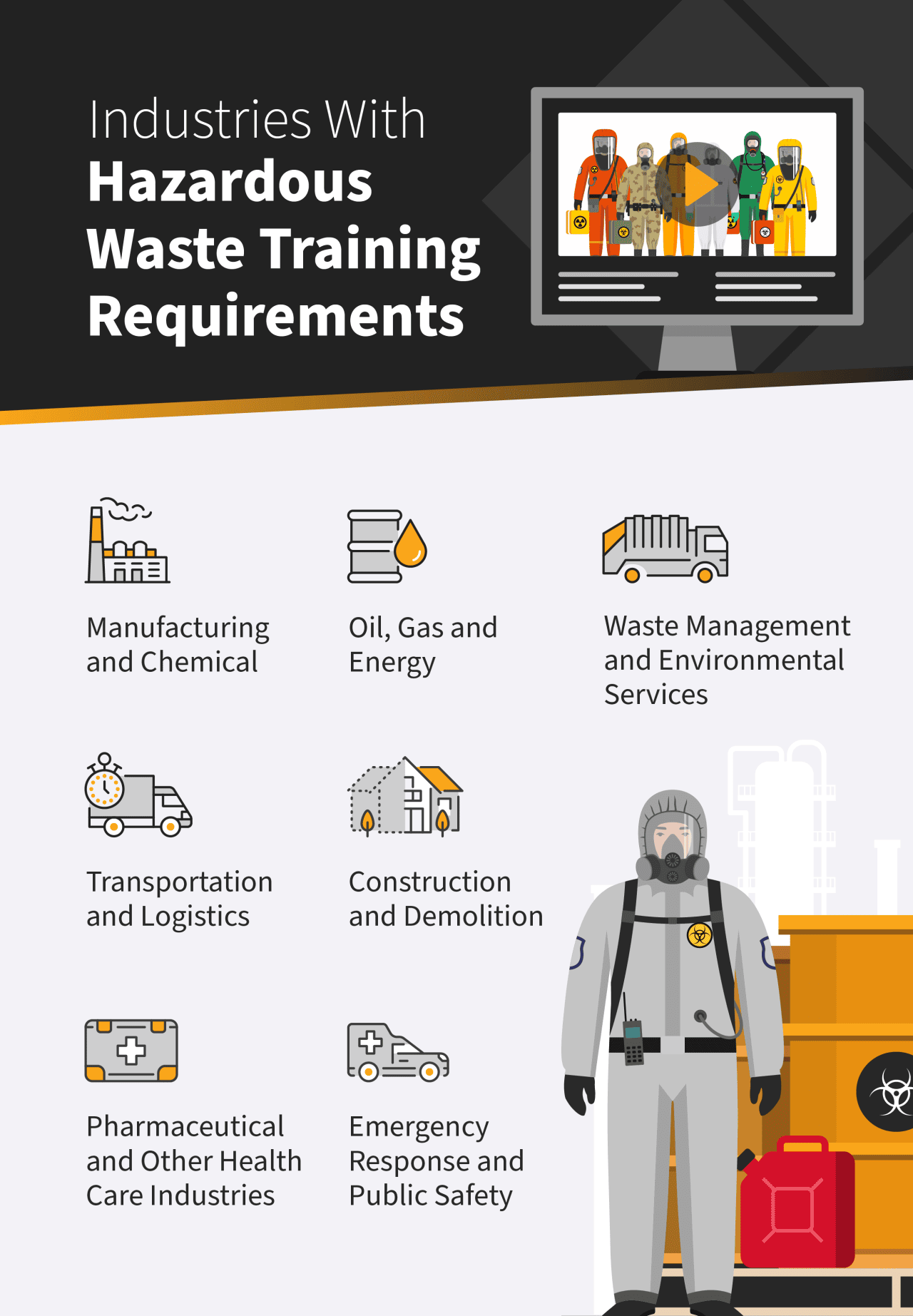
Infographic listing the industries with hazardous waste training requirements.

Hazmat School

1. Manufacturing and Chemical

The manufacturing and chemical industries produce, store, and use hazardous materials, such as chemicals and gases. Improper material handling can lead to fires, explosions, and dangerous chemical reactions. HAZWOPER standards, or 29 CFR 1910.120, apply to the general industry, which includes all industries except for construction, agriculture, and maritime. Relevant training courses often teach you how to:

  • Communicate hazards.
  • Interpret safety data sheets.
  • Wear proper personal protective equipment.

Workers who operate chemical-handling machinery or those responsible for decontamination and emergency response must undergo such training.

2. Oil, Gas, and Energy

The oil, gas, and energy industries often deal with petroleum products, flammable gases, and other radioactive substances. Wastes from crude oil and natural gas operations are generally subject to the RCRA and state regulations. Industry operations often involve transporting oil and gas through pipelines, which pose risks of leaks and spills. Meanwhile, nuclear energy plants often deal with radioactive materials. Proper training enables workers to handle and dispose of these hazardous materials safely and mitigate risks.

3. Waste Management and Environmental Services

Workers who manage industrial waste and clean up environmental disasters require training for handling hazardous materials. Chemical spills and similar contamination events involve removing and cleaning up hazardous substances. The training is essential so workers can properly dispose of materials that pose health and environmental risks. For instance, these materials can include electronics, chemicals, or biohazardous waste.

4. Pharmaceutical and Other Health Care Industries

Pharmaceutical and other health care industries often deal with medications, chemicals, and other medical waste, which are biohazardous materials. Medical and research laboratories, in particular, work with pathogens, radioactive materials, and other dangerous substances, which, when mishandled, can cause contamination, health risks, and legal issues. Proper worker training ensures health care professionals can manage waste responsibly.

5. Transportation and Logistics

Companies in the transportation and logistics industries move hazardous materials across locations. While they don’t generate waste per se, they’re involved in waste handling as a part of a chain. For instance, a trucking company may transport hazardous wastes between states. Workers must understand proper packaging, labeling, and transportation requirements to adhere to relevant regulations.

Your workers need a certification or endorsement depending on your industry. Truck drivers who transport hazardous materials, such as corrosive substances and flammable materials, need a hazmat endorsement on their commercial driver’s license. Airline workers must follow the International Air Transport Association (IATA) regulations, while maritime workers must meet the International Maritime Dangerous Goods (IMDG) regulations. Medical couriers must also be highly trained in moving time-sensitive, temperature-controlled cargo and comply with regulations such as OSHA’s standards for bloodborne pathogens.

6. Emergency Response and Public Safety

Emergency responders are often the first to respond in hazardous situations, whether there’s a gas leak, a chemical spill, or a factory fire. Specialized teams must understand how to handle hazardous materials, especially when performing decontamination processes or containment procedures. Some emergency responders may not handle waste themselves, but are still involved in dealing with hazardous situations. For instance, paramedics might need to manage patients who were exposed to dangerous substances.

Crime scene cleanup industries must also learn to sanitize areas that were used for criminal activities. These areas may contain hazardous wastes, especially if they were used for murder or drug production. Proper training ensures workers understand how to manage blood, bodily fluids, and other potentially harmful substances.

7. Construction and Demolition

Construction and demolition workers often encounter hazardous wastes on-site, especially in older buildings with asbestos and lead-based paints. Exposure to these wastes can cause long-term health issues, such as lead poisoning or lung cancer. Proper training helps workers identify these hazardous materials and understand how to remove them safely.

OSHA has a specific HAZWOPER standard for the construction industry known as 29 CFR 1926.65. Employers must provide relevant training for their workers who can become exposed to hazardous materials during:

  • Government cleanup operations.
  • Corrective actions involving cleanup operations at RCRA-covered sites.
  • Voluntary cleanup operations at uncontrolled hazardous waste sites.

How to Navigate Compliance Requirements

Having a systematic approach can help you navigate industry-specific compliance requirements regarding hazardous waste management. Consider these steps:
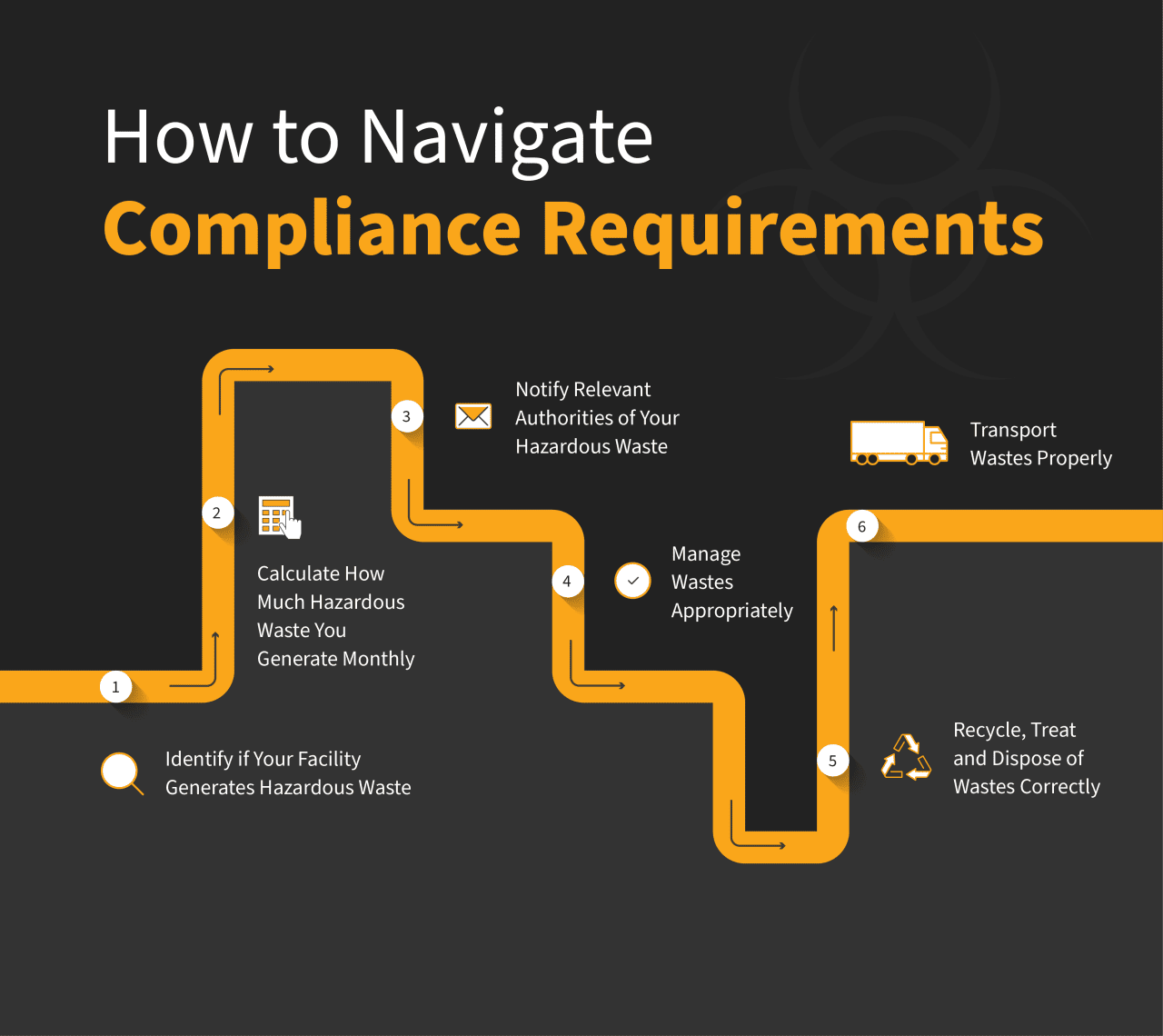
An infographic showing how to navigate compliance requirements.

Hazmat School

1. Identify if Your Facility Generates Hazardous Waste

Wastes pertain to solid, liquid, or contained gaseous materials you discard through disposal, burning, incineration, or recycling. They are often by-products of a manufacturing process or a commercial product your business has used. These wastes can be hazardous and can be considered:

  • Listed waste: A listed waste is a hazardous waste type listed in Title 40 of the CFR. Acute hazardous wastes are the most dangerous types, which are fatal to humans even in low doses.
  • Characteristic waste: Characteristic wastes can be ignitable, corrosive, reactive, or toxic. An ignitable waste catches fire, while corrosive wastes corrode metals or come with high or low pH. Reactive wastes are unstable and can explode or produce toxic fumes. Toxic wastes are fatal when absorbed or ingested, and leach toxic chemicals into the soil or groundwater. You can determine toxic waste through the Toxicity Characteristic Leaching Procedure.

2. Calculate How Much Hazardous Waste You Generate Monthly

Companies that generate hazardous waste are called generators, and the amount of waste you produce determines your generator category. Hazardous wastes are often liquids, which you measure in gallons. You must convert gallons to kilograms or pounds to count the wastes.

The EPA has three generator categories, each with its own hazardous waste requirements:

  • Very small quantity generator (VSQG): Companies that generate less than 100 kg of hazardous waste per month.
  • Small quantity generator (SQG): Companies that generate 100-1,000 kg of hazardous waste per month.
  • Large quantity generator (LQG): Companies that generate more than 1,000 kg of hazardous waste per month.

Sometimes, you might produce larger amounts of hazardous waste than your typical operations — for instance, due to a cleanout or an oil spill. This event might move you from a VSQG to an SQG. Because it’s an uncommon circumstance, you can be eligible for a different set of requirements to avoid having to comply with more stringent generator regulations.

3. Notify Relevant Authorities of Your Hazardous Waste

If you’re an SQG or LQG, you must notify the EPA or state agencies of your hazardous waste activities. Some states also have the same requirements for VSQGs.

4. Manage Wastes Appropriately

You need to manage your hazardous waste according to the generator category requirements. Certain waste types may also have unique requirements, including:

  • Universal wastes, such as batteries, pesticides, and mercury-containing equipment.
  • Hazardous wastes at academic laboratories.
  • Pharmaceutical hazardous wastes.

5. Transport Wastes Properly

SQGs and LQGs are often required to have a manifest to transport hazardous waste off-site. These forms enable the tracking of hazardous wastes from your generator facility to a waste management facility that will store, treat, and dispose of the wastes.

6. Recycle, Treat, and Dispose of Wastes Correctly

SQGs and LQGs can generally recycle hazardous wastes on-site without permits, provided they comply with waste accumulation time limits and regulations under Title 40 of the CFR. You may also treat hazardous waste on-site in an accumulation unit, such as a tank or container, without a permit, to transform the waste into a nonhazardous or less hazardous waste — provided the treatment is nonthermal and you comply with the other requirements in Title 40.

Otherwise, you must treat and dispose of the wastes according to the Hazardous Waste Treatment, Storage, and Disposal Facilities regulations.

Frequently Asked Questions

To further understand what’s required of your industry, consider these common questions regarding hazardous waste management training:

Who Is Required to Have Hazardous Waste Training?

All employees who handle or are exposed to hazardous wastes must undergo appropriate training. This requirement includes employees involved in the generation, management, transportation, treatment, storage, and disposal of hazardous wastes.

Is Hazmat Training Required by Law?

Yes, hazmat training is required by law. The training must include the following topics:

  • General hazardous waste or material requirements
  • Training specific to the employee’s work
  • Safety training
  • Security awareness training

If you’re required to have a security plan, security training must be in-depth. This training can be performed by employers, hazmat employees, or contracted training services.

What Specific Hazardous Waste Courses Are Required for the Construction Industry?

The construction industry would benefit from hazardous waste courses discussing standards unique to the industry. For instance, OSHA has the HAZWOPER standard, or 29 CFR 1926.65, for the construction industry, which is similar to 29 CFR 1910.120, a more general standard of the same title. These standards apply to operations involving an ongoing or a likely incident of an uncontrolled release of hazardous substances.

Consider courses with discussions unique to your business type. For instance, you may choose a course that covers forklift and industrial truck safety, scaffolding requirements, or asbestos management.

How Much Does Hazardous Waste Training Cost for a Small Business?

Training costs depend on the specific course. For instance, a DOT or RCRA training course can cost around $150 to $300. Some training courses may charge per participant. Participants can often work at their own pace and receive their certificate immediately after completion.

Hazardous Waste Training Is Essential for Compliance

When handling dangerous and toxic materials, workers in many industries are required to undergo hazardous waste training to protect themselves and the environment. Generally, these industries include:

  1. Manufacturing and chemical.
  2. Oil, gas, and energy.
  3. Waste management and environmental services.
  4. Pharmaceutical and other health care industries.
  5. Transportation and logistics.
  6. Emergency response services and public safety.
  7. Construction and demolition.

To effectively navigate the compliance requirements, identify whether you produce or manage hazardous waste materials, and which waste type you’re handling. Then, calculate your monthly waste production. You must also notify relevant authorities, such as the EPA or state agencies, of your hazardous waste activities. Manage, transport, and treat the waste appropriately based on the industry- and waste-specific requirements.

This story was produced by Hazmat School and reviewed and distributed by Stacker.

Topics:

Careers & Education
media-news

Hestia Insight Inc. Launches Impact-O AI Suite: Elite News Drafting and Compliance Screening for an Introductory $179

By Media News
4 min read • Published April 29, 2026
By Media News
4 min read • Published April 29, 2026

NEW YORK, NY / ACCESS Newswire / April 29, 2026 / Hestia Insight Inc. today officially opened market access to Impact-O, its proprietary AI engine designed to revolutionize the corporate disclosure process. For an introductory price of $179.00 per release, companies can now access a high-performance suite that provides two exceptional news drafts and automated compliance screening, drastically reducing the time and legal expense usually required for public announcements.

The Impact-O platform empowers management teams to generate superb content without the premium price tag of a traditional agency. By utilizing a dual-drafting system, users can select the most effective narrative for their brand while the built-in compliance checker ensures the content meets rigorous standards, protecting the company and saving on billable legal hours.

Beyond the core AI suite, Hestia Insight is also offering an optional, high-impact news distribution service. This arrangement provides access to a vast array of important media and financial service platforms that are typically inaccessible to ordinary clients.

"With Impact-O, we are providing the ‘brain’ of the news release at an unbeatable price," said Edward C. Lee, CEO of Hestia Insight Inc. "While the drafting and compliance tools are transformative on their own, our optional distribution arrangement is the ultimate multiplier. We have secured pricing and platform access that most companies simply cannot obtain independently, and we are making those rates available upon request."

The Impact-O Advantage:

  • Two Exceptional Drafts: Choose from two AI-generated variations to ensure the perfect tone and message.

  • Compliance & Cost Savings: Integrated screening reduces the need for expensive legal review and accelerates the filing timeline.

  • Optional Elite Distribution: Reach premier financial networks and media outlets with exclusive pricing available upon request.

Companies interested in modernizing their communication strategy and accessing these "members-only" distribution rates can contact Hestia Insight for a personalized quote or platform demonstration.

About Hestia Insight Inc.

Hestia Insight Inc. is a strategic consulting firm and technology developer specializing in capital markets. Through its Impact-O platform, the company provides AI-driven solutions that bridge the gap between complex regulatory requirements and effective corporate storytelling.

For more information about Hestia Insight, please visit the Company’s website: www.hestiainsight.com

Facebook: Hestia Insight Inc.

LinkedIn: Hestia Insight Inc.

Twitter: @HestiaInsight

Hestia Insight is subject to the information and reporting requirements of the Securities Exchange Act of 1934, as amended (the "Exchange Act"), and, in accordance with the Exchange Act, the Company files periodic reports, documents, and other information with the Securities and Exchange Commission (the "Commission") relating to our business, financial statements, and other matters. These filings are available to the public on the Commission’s website at http://www.sec.gov.

Safe Harbor Provision

This press release contains "forward-looking statements" within the meaning of the Private Securities Litigation Reform Act of 1995, as amended, that are intended to be covered by the safe harbor created thereby. All statements other than statements of historical fact contained herein, including, without limitation, statements regarding the Company’s future financial position, business strategy, plans and objectives, growth and profitability, growth strategy, liquidity and access to public markets, operating expense reduction, and trends in the industry in which the Company operates, are forward-looking statements. Forward-looking statements generally can be identified by the use of forward-looking terminology such as "may," "will," "expects," "intends," "plans," "projects," "estimates," "anticipates," or "believes" or the negative thereof or any variation thereon or similar terminology or expressions. Forward-looking statements are subject to risks and uncertainties that could cause actual results to differ materially from results proposed in such statements. Although the Company believes that the expectations reflected in such forward-looking statements are reasonable, it can provide no assurance that such expectations will prove to have been correct. Important factors that could cause actual results to differ materially from the Company’s expectations include, but are not limited to, those factors set forth in the Company’s Annual Report on Form 10-K for the year ended November 30, 2024 and its other filings and submissions with the Securities and Exchange Commission. Readers are cautioned not to place undue reliance on these forward-looking statements, which speak only as of the date made. Except as required by law, the Company assumes no obligation to update or revise any forward-looking statements.

Investor Relations Contact:
Tel: 516.212.0727
Email: corp@hestiainsight.com

SOURCE: Hestia Insight Inc.

View the original press release on ACCESS Newswire

Topics:

media-news
Entertainment

Which Eurovision 2026 tracks are leading on momentum and platform data

Which Eurovision 2026 tracks are leading on momentum and platform data
By Kristian Gorenc for Viberate
7 min read • Published April 29, 2026
By Kristian Gorenc for Viberate
7 min read • Published April 29, 2026

Trucks are parked outside Stadthalle for the Eurovision Song Contest in Vienna, Austria.

Joe Klamar // AFP via Getty Images

Which Eurovision 2026 tracks are leading on momentum and platform data

Every Eurovision season builds its own kind of momentum long before the final results are in. Songs begin to travel across streaming platforms, fan communities start to rally around early favorites, and some entries separate themselves through sheer scale, while others build more quietly through steady growth. By the time the contest reaches its final stretch, platform data can already reveal which tracks are breaking through and which ones are still trying to catch up.

That does not mean data can fully explain Eurovision. Live performances, staging, jury preferences, national voting patterns, and the unpredictable chemistry of the night still matter. But platform performance can offer a useful early read on where attention is concentrating, which entries are accelerating at the right time, and which songs look strongest if the field is judged only on measurable traction.

With that in mind, Viberate examined 35 Eurovision 2026 entries using recent streaming and platform data to identify which tracks are showing the strongest measurable traction. The goal is to identify which songs are gaining momentum, which ones already command the strongest audience demand, and which entries have built the broadest platform support. In this article, Viberate explores a simple question: If measurable streaming and platform signals were the main basis for judging the field, which songs would look strongest heading into Eurovision 2026?

Why data still matters before Eurovision night

In a contest built on live performance, staging, and national voting patterns, raw platform data can never tell the whole story. Still, it can say a lot about which songs are breaking through before viewers cast a single vote.

To see which Eurovision 2026 entries look strongest on measurable traction alone, 35 nominated tracks were ranked using a data-only model built from recent demand, momentum, and platform support signals. The analysis focused on three questions: Which songs are attracting the most audience demand right now? Which ones are gaining momentum at the right moment? And which entries are receiving the strongest platform support through playlist reach and related indicators?

That approach does not attempt to predict the actual winner. Eurovision has always been more complicated than a streaming race. Jury preferences, diaspora patterns, live vocals, staging, and the chemistry of the night can all change the outcome. But if the field is judged only on current data signals, a clearer hierarchy emerges.

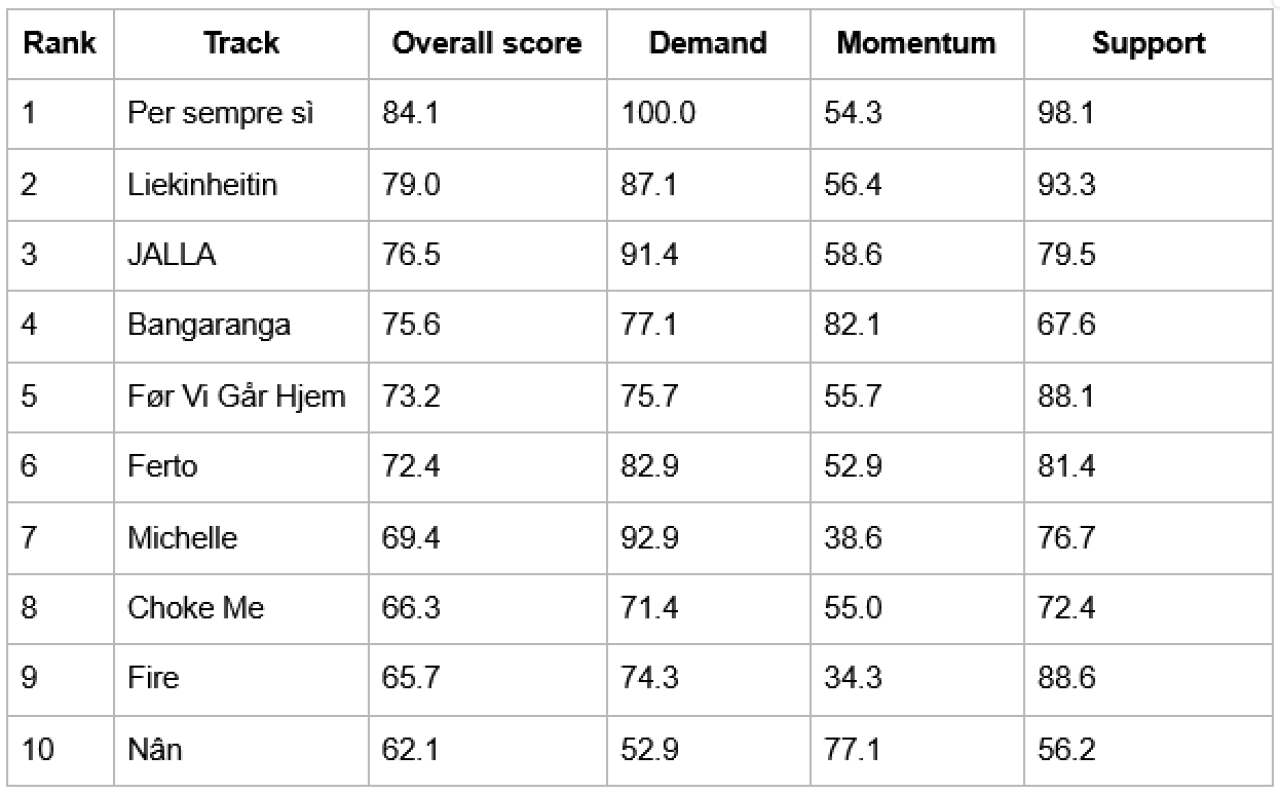
Top 10 Eurovision 2026 entries by data signals

A table ranking the top 10 Eurovision 2026 entries by data signals.

Courtesy of Viberate

Per sempre sì leads the field

At the top of that hierarchy is “Per sempre sì.” The track leads the full field in overall score, driven by the strongest demand profile and the highest support score in the 35-song set. In practical terms, that means it is not simply posting one strong metric. It is performing at a high level across the areas the model values most: sustained audience pull and broad platform backing. Its recent momentum is solid rather than spectacular, but the base is strong enough that it still finishes clearly ahead of the rest of the field.

The main reason that matters is that big tracks can lead in different ways. Some are rising quickly from a smaller base. Others are already operating from a position of scale. “Per sempre sì” belongs to the second group. Its case is not that it is the fastest riser in the race. Its case is that it has already built the largest measurable footprint while maintaining enough current movement to stay in front.

The chasing pack behind the leader

Behind it, the chasing group is tighter and more interesting. “Liekinheitin,” “JALLA,” “Bangaranga,” “Før Vi Går Hjem,” and “Ferto” form the clearest second tier in the model. Those songs do not all get there the same way, which is one reason the analysis is more useful than a simple streams chart.

“Liekinheitin” looks like one of the most secure all-round contenders. It combines high demand, strong support, and enough momentum to avoid looking static. It does not dominate one category as decisively as the leader, but it does very little wrong. That makes it one of the least fragile profiles in the top tier.

“JALLA” also scores strongly, especially on scale. It has one of the strongest demand profiles in the set, and its support metrics remain good enough to keep it firmly among the leaders.

If one song makes the strongest case as the most balanced challenger, though, it is “Bangaranga.” That track stands out because it does not lean too heavily on one pillar. Its demand is strong, its momentum is among the best in the upper tier, and its support metrics are solid enough to keep it competitive. In a data-only ranking, balance matters. A track that is merely large can stall. A track that is merely rising can still be too small. “Bangaranga” looks more complete than that. It is one of the few entries near the top that looks strong in all three directions at once.

“Før Vi Går Hjem” and “Ferto” round out the strongest cluster. Both are credible high-end contenders in the model, but with slightly different profiles. “Før Vi Går Hjem” leans more on support and steady demand than on explosive recent acceleration. “Ferto” looks broad and stable, with fewer extreme strengths but no major weakness. Neither track feels inflated by one odd metric or one short-lived spike, which helps explain why both remain close to the top in multiple scoring scenarios.

That stability matters because the model was rerun under alternative weighting systems, including versions that gave more weight to demand and momentum. The ordering shifted slightly, but the same core group stayed near the front. That is one of the strongest signs that the ranking is capturing something real rather than producing an arbitrary result.

Which songs are gaining momentum fastest

Just below the top cluster, a second analytical divide appears. Some songs look strong because they are already large. Others look dangerous because they are moving fast.

The clearest momentum names in the wider field include “Nova Zora – Eurovision 2026,” “Paloma Rumba,” “Ridnym – Eurovision Version,” “Just Go,” and “Nân.” These tracks show stronger acceleration patterns than many of the bigger entries above them. That makes them worth watching, but not all momentum profiles should be treated the same way. A track can climb quickly while still lacking enough total demand or support to challenge the leaders outright.

That is why “Nân” is the most interesting of the momentum-heavy group. It does not merely post a strong growth signal. It also carries enough total strength to break into the top 10 overall. In other words, it looks less like a curiosity and more like a plausible late mover.

By contrast, tracks like “Paloma Rumba” and “Ridnym – Eurovision Version” read more like surge stories than frontrunner stories. Their momentum helps them stand out, but their overall scale remains thinner than the songs at the top of the ranking. In a data-only model, that makes them more compelling as rising threats than as outright leaders.

The reverse is also true. A few entries show the opposite pattern: large footprint, softer recent pace. “Michelle,” “Fire,” “My System,” and “REGARDE !” all fall somewhere in that category. None of them can be dismissed. In fact, “Michelle” is especially strong on pure demand. But their current movement does not look as convincing as their overall size. That distinction matters because it separates songs riding a strong present wave from songs holding on to a larger existing base.

Where the model is most likely to misread the field

One of the most useful parts of this analysis is identifying where the model itself is most likely to overrate or underrate songs. Tracks with especially strong support scores but weaker direct audience pull can look better in a composite than they would in a pure demand race. That appears to be more relevant for entries like “Fire,” “TANZSCHEIN,” and “Ya Ya Ya.” These are not weak songs in the data, but they lean more on platform support than on direct audience-demand leadership.

Another warning sign appears in one-platform skew. A track that looks strong on Spotify but much weaker on YouTube, or vice versa, may have a narrower base than its headline position suggests. That is one reason broad, cross-platform strength is more persuasive than one large isolated number.

What the results actually show

The final result is not a prediction of who will win Eurovision 2026 on stage. It is a ranking of which entries currently look strongest if platform demand, recent momentum, and support signals are treated as the contest’s only inputs.

On that basis, “Per sempre sì” is the clearest leader. “Liekinheitin,” “JALLA,” “Bangaranga,” “Før Vi Går Hjem,” and “Ferto” make up the strongest immediate chasing pack. And within that group, “Bangaranga” may be the most interesting analytical challenger, because its profile is the most balanced rather than the most lopsided.

Methodology

This analysis compared 35 nominated Eurovision 2026 tracks using recent platform data from Viberate exports. Each song was assessed in three areas: audience demand, recent momentum, and platform support. Demand was based on recent Spotify and YouTube activity, momentum was based on whether a track was picking up speed over the recent tracking window, and support was based on playlist reach and related Spotify indicators.

To keep the comparison fair, the ranking focused on recent 30-day performance rather than raw longer-term totals, since the nominated songs were not all released at the same time. That reduced the advantage older releases would otherwise have had. The final result is a data-based ranking of which entries currently look strongest on measurable traction.

This story was produced by Viberate and reviewed and distributed by Stacker.

Topics:

Entertainment
media-news

The White House Just Changed How Late-Night TV Books Guests

Political targeting moves from tweets to talent cancellations in 48 hours. Meanwhile, Mumbai producers head to Cannes and crime reporters get training upgrades.

By Mediabistro Team
5 min read • Published April 29, 2026
By Mediabistro Team
5 min read • Published April 29, 2026

A mentalist cancels a late-night appearance days after being named headliner for the White House Correspondents Dinner. The connection isn’t subtle.

When political power targets a television host by name, the ripple effects move fast through talent booking, advertiser confidence, and editorial risk calculations. This is what pressure looks like when it leaves rhetoric behind and starts reshaping how a major network show actually operates.

Elsewhere: a Mumbai production banner brings a six-picture slate to Cannes. A journalism institute runs another cohort through intensive crime coverage training.

When the White House Comes for Your Monologue

Jimmy Kimmel opened his show Monday with a joke about the First Lady demanding he be fired. The setup was deliberate.

Last week, Kimmel made a joke about Melania Trump becoming an “expectant widow,” a reference to President Trump’s age and health. The White House framed the joke as assassination rhetoric, and the First Lady issued a public statement calling for his termination.

Kimmel called the characterization “absurd,” noting the déjà vu of facing similar attacks from the same administration.

The substance of the political dispute matters less here than what happens next in the talent pipeline.

The Speed of Impact: From White House criticism to booking disruption: 48 hours. When political pressure moves from rhetoric to operational interference, the infrastructure supporting late-night television reveals its fragility.

Mentalist Oz Pearlman was scheduled to appear on Jimmy Kimmel Live! Monday night. Pearlman backed out.

The timing tells the story: two days earlier, he’d been announced as the headliner for the White House Correspondents Dinner, one of the highest-profile bookings available to a performer in his category. Appearing on a show the White House just targeted creates an obvious conflict. Pod Save America’s Jon Lovett replaced him.

This is the operational story. When a late-night host becomes a named political target, the calculus shifts for guests, especially those with White House proximity or aspirations.

Talent agents start running different risk scenarios. Advertisers get nervous calls. Booking producers face a narrower pool of guests willing to wade into the controversy.

The show doesn’t go off the air, but the machinery gets harder to operate.

If the pressure sustains, it affects everything from advertiser rates to affiliate confidence to the ability to book A-list talent during sweeps. Late-night comedy has always been political, but direct, sustained White House targeting of a specific host changes the risk profile for everyone in the ecosystem.

The lesson for media professionals is about infrastructure fragility. A successful late-night show operates on predictable guest flow, advertiser stability, and network backing. Political pressure tests all three simultaneously.

The formats that survive have diversified revenue and talent benches deep enough to absorb cancellations without visible gaps.

Mumbai to Cannes: The Global Slate Keeps Growing

First Ray Films, the Mumbai-based banner founded by actor-filmmaker Anshuman Jha, is bringing six titles to the Cannes Film Market in May. The slate spans 2026 to 2028, with two films scheduled for Indian theatrical release and the rest positioned for festival circuits and international co-production financing.

The company is entering its second decade. That matters in a market where most independent production banners fold before year five.

First Ray is shopping finished and in-development projects to international distributors and co-production partners with capital to deploy.

The career signal is straightforward. Production talent pipelines are increasingly global, and the infrastructure supporting them is maturing outside the traditional Hollywood studio system.

Banners like First Ray operate with lower overhead, access to local tax incentives, and partnerships that move capital across borders more fluidly than legacy studio deals. For producers, directors, and development executives, opportunity is concentrating in places that weren’t major players a decade ago.

Cannes remains where these deals get structured. A six-picture slate from a Mumbai banner suggests confidence in both the creative pipeline and the financing relationships necessary to sustain multi-year production cycles.

Rethinking How Newsrooms Cover Crime

Poynter Institute announced the 2026 cohort for its Transforming Crime Coverage program, an intensive training and coaching initiative designed to help reporters and editors rethink how they approach one of journalism’s most sensitive beats.

The program continues into its latest cycle, reflecting sustained demand for structured professional development in an area where traditional practices are under real scrutiny.

Crime coverage shapes public perception of safety, community trust in institutions, and policy debates around policing and justice reform. The way newsrooms frame these stories has consequences, and the profession’s growing self-awareness about those consequences is driving investment in skills training that goes beyond basic reporting mechanics.

The program focuses on methodology: how to contextualize crime data, how to avoid amplifying harmful stereotypes, how to balance public interest with individual privacy, how to cover law enforcement critically without undermining accountability reporting.

These skills weren’t part of most journalism curricula a decade ago. Newsrooms that prioritize them are building real advantages in audience trust.

Training as Competitive Advantage: Sophisticated crime coverage methodology is a differentiator when editorial judgment and ethical rigor are hard to assess from a resume alone. Newsrooms rebuilding community trust want staff who can execute on nuanced approaches.

That Poynter is running another cohort suggests the demand is sustained. Crime coverage remains a daily assignment for metro reporters, and the pressure to get it right is increasing as audiences have their own platforms to push back.

The reporters who can navigate that pressure while maintaining aggressive accountability reporting are the ones newsrooms invest in retaining.

What This Means

Late-night comedy is absorbing direct political targeting that translates into operational disruption. Global production infrastructure is expanding into territories with lower overhead and more flexible financing. Journalism training is evolving to address skills gaps that directly affect audience trust.

The parts of the industry under pressure reveal fragility in business models relying on advertiser comfort and predictable talent cooperation. The parts building infrastructure reveal where capital and opportunity are flowing. The parts investing in skills training reveal where competitive advantages are being constructed.

Watch how late-night shows adjust their guest booking if political pressure sustains. Watch which production banners show up at Cannes with multi-year slates already structured. Watch which newsrooms treat crime coverage training and other specialized, sensitive beats as a retention and recruitment tool.

If you’re looking to move into roles where these dynamics are playing out, browse open roles on Mediabistro in production, editorial, and content strategy. If you’re hiring for positions that require navigating political pressure, global production partnerships, or sophisticated editorial judgment, post a job on Mediabistro and reach the media professionals who understand how these systems operate under stress.


This media news roundup is automatically curated to keep our community up to date on interesting happenings in the creative, media, and publishing professions. It may contain factual errors and should be read for general and informational purposes only. Please refer to the original source of each news item for specific inquiries.

Topics:

media-news
Hot Jobs

Mission-Driven Media Jobs Hiring Now in Communications and Journalism

From foreign policy journalism to conflict resolution storytelling, purpose-led organizations are competing hard for senior media talent.

mediabistro hot jobs
Mediabistro icon
By Mediabistro
The Mediabistro editorial team draws on 25 years of media industry expertise to cover jobs, careers, and trends shaping the industry.
4 min read • Published April 29, 2026
Mediabistro icon
By Mediabistro
The Mediabistro editorial team draws on 25 years of media industry expertise to cover jobs, careers, and trends shaping the industry.
4 min read • Published April 29, 2026

Purpose-Led Organizations Are Paying Up for Media Talent

Something worth watching is unfolding across today’s listings: mission-driven organizations are posting senior roles with compensation and creative latitude that would have belonged exclusively to commercial media companies a few years ago. These are strategic leadership positions at organizations doing genuinely consequential work.

A nonprofit focused on conflict resolution is seeking a senior content writer. An award-winning trans media organization is offering up to $155,000 for a digital director. HuffPost needs a reporter to cover the conservative movement with the kind of source-building skills that used to live only at legacy newspapers. And one of the most prestigious foreign policy journals in the world is hiring someone to amplify its scholarship across earned media channels.

The through line is clear: organizations with a strong editorial mission are investing in communications talent at a level that signals real institutional commitment. For media professionals who’ve felt squeezed between shrinking newsrooms and soulless content mills, these roles represent a genuinely different path.

Today’s Hot Jobs

Senior Politics Reporter, Conservatives at HuffPost

Why this one matters: Beat reporter roles covering a specific political movement are increasingly rare as newsrooms consolidate. HuffPost is looking for someone who can break news, cultivate sources on the American right, and write sharp features on deadline. The salary range of $97,055 to $136,500 reflects union-negotiated compensation through the Writers Guild of America East, and the posting explicitly values a candidate who can “get inside the minds of decision-makers and opinion-shapers.”

What they need from you:

  • Proven track record breaking news and building sources within conservative politics
  • Ability to write sharp news stories on deadline and longer informative features
  • Deep knowledge of the Republican Party, right-wing media, and the conservative movement
  • Based in Washington, D.C.

Apply for the Senior Politics Reporter position at HuffPost

Director of Digital and Social Media at TransLash Media

The draw here: TransLash is a multi-platform, award-winning organization producing podcasts, films, zines, and original journalism centering transgender and gender nonconforming communities. This fully remote role at $135,000 to $155,000 reports directly to the CEO, which means real strategic influence over how the brand shows up across every digital channel. You’d be building the social infrastructure for an organization whose storytelling is shaping national conversations.

Core qualifications:

  • Strategic leadership experience across digital and social platforms
  • Ability to operate at both high-level strategy and day-to-day execution
  • Team-building experience with a creative, mission-aligned sensibility
  • Remote within the U.S., reporting directly to the CEO

Apply for the Director of Digital and Social Media role at TransLash

Foreign Affairs Communications Manager at the Council on Foreign Relations

What makes this distinctive: Foreign Affairs magazine remains one of the most influential publications in geopolitics, and this role puts you at the center of its promotion strategy. You’d build and execute launch plans for six annual issues, pitch essays to reporters and producers during breaking news moments, and develop a network of media contacts across traditional and emerging channels.

If you have experience in foreign affairs writing or journalism, this is a rare chance to work from the institutional side of that ecosystem.

Key requirements:

  • Experience building and executing media promotion plans across traditional and digital channels
  • Strong existing network of reporters, editors, and producers (or ability to build one fast)
  • Skill managing press lists, coverage trackers, and author relationships
  • Based in New York City

Apply for the Foreign Affairs Communications Manager position

Senior Content Writer at Resetting the Table

An unusual opportunity: Resetting the Table works at the intersection of conflict resolution, media, and democratic repair. Their trainings have reached more than 100,000 participants, including faith leaders, TV writers, and higher education administrators. This remote role involves creating “empathy-generating media content” designed to help communities navigate polarization. The organization is open to pro-rated, part-time arrangements, which is increasingly appealing for experienced writers managing multiple commitments.

What they’re seeking:

  • Strong writing chops with experience creating content that drives culture change
  • Comfort working across mediation, conflict transformation, and social research topics
  • Remote within the contiguous U.S., with flexible scheduling options
  • Reports directly to the Co-CEO

Apply for the Senior Content Writer role at Resetting the Table

The Takeaway for Job Seekers

Two of today’s four featured roles report directly to a CEO or equivalent. That structural detail matters more than title inflation ever could. Mission-driven organizations tend to run leaner, which means senior communications and content hires carry outsized influence over brand voice, audience strategy, and organizational direction.

If you’ve spent years executing someone else’s content strategy at a large company, these roles offer something different: the chance to define the strategy yourself.

Also worth noting: both remote positions today come from organizations doing work that requires deep subject-matter understanding, not just platform expertise. If you’re looking to strengthen your positioning for roles like these, investing time in a specific editorial niche, whether that’s social media strategy, policy communications, or narrative nonfiction, will serve you far better than adding another generalist credential.

Topics:

Hot Jobs

Posts navigation

Older posts
Newer posts
Featured Jobs
6AM City
Revenue Operations Manager
6AM City
USA

Hanford Pharmaceuticals LTD
Virtual Assistant
Hanford Pharmaceuticals LTD
Anchorage, KY, USA

Lakeside Pediatrics
Online Chat Representative (Remote)
Lakeside Pediatrics
Sioux Falls, SD, USA

Lakeside Pediatrics
Product Manager (remote)
Lakeside Pediatrics
Philadelphia, PA, USA

Lakeside Pediatrics
Administrative Operations Analyst (Remote)
Lakeside Pediatrics
Sparks, NV, USA

All Jobs »
PREMIUM MEMBER
KB

Katie Bacon

Brookline, MA
19 Years Experience
I'm an experienced writer and editor who's written long-form profiles, features, and book reviews for national publications and edited articles,...
View Full Profile »
Join Mediabistro Membership Today

Stand out from the crowd with a premium profile

Mediabistro Logo Find your next media job or showcase your creative talent
  • Job Search
  • Hot Jobs
  • Membership
  • Newsletter
  • Career Advice
  • Media News
  • Hiring Tips
  • Creative Tools
  • About

Browse media and creative jobs

Explore popular job searches across creative, editorial, marketing, production, and top media markets.

Popular searches

  • Remote Media Jobs
  • Graphic Design Jobs
  • Photography Jobs
  • Writing Jobs
  • Marketing Jobs
  • Library Jobs
  • Journalism Jobs
  • PR / Communications Jobs

Creative and content

  • Video Production Jobs
  • Audio / Podcasting Jobs
  • Technical Writer Jobs
  • Social Media Manager Jobs
  • Copywriter Jobs
  • Publishing Jobs
  • Editor Jobs
  • Freelance Writing Jobs

Locations and specialties

  • Content Creator Jobs
  • Creative Director Jobs
  • Art Director Jobs
  • Advertising Jobs
  • Chicago Creative Jobs
  • Los Angeles Media Jobs
  • New York City Media Jobs
  • Boston Creative Jobs
Facebook YouTube Instagram LinkedIn
Copyright © 2026 Mediabistro
  • Terms of Use
  • Terms of Service
  • Privacy Policy