Mesothelioma Hope Marks National Cancer Research Month With Latest Advances in Mesothelioma Treatment and Diagnostics
By
Media News
3 min read • Published May 26, 2026
By
Media News
3 min read • Published May 26, 2026
New data from the CheckMate 743 trial, FDA-approved immunotherapy combinations, and emerging therapies are offering renewed hope to mesothelioma patients and families.
CHESTNUT HILL, MA / ACCESS Newswire / May 26, 2026 / Mesothelioma Hope, a leading online resource providing education, patient advocacy, and support for those diagnosed with mesothelioma, is recognizing National Cancer Research Month this May by highlighting significant advances in mesothelioma research that are improving survival rates and quality of life for patients across the United States.
Approximately 3,000 people in the U.S. receive a mesothelioma diagnosis each year. Because this rare asbestos-caused cancer is often not detected until its later stages, advances in early detection, treatment, and clinical trial access are critically important.
This year’s National Cancer Research Month theme, "United by Cancer Research," reflects a growing coalition of patients, caregivers, researchers, and advocates working together to accelerate progress. Mesothelioma Hope is proud to be part of that effort, tracking the latest developments and connecting patients with the resources they need.
Key Mesothelioma Research Milestones in 2026
Immunotherapy Extends Survival – Long-term follow-up data from the CheckMate 743 study showed that 14% of patients receiving nivolumab plus ipilimumab (Opdivo® + Yervoy®) were alive at 5 years, compared to 6% on chemotherapy alone. For patients with non-epithelioid mesothelioma, 5-year survival improved from approximately 1% to 12%, which is a landmark result.
FDA-Approved Combination Therapy – The KEYNOTE-483 trial demonstrated that pembrolizumab (Keytruda®) combined with chemotherapy shrank or controlled tumors in 62% of patients, following the FDA’s approval of this regimen in 2024.
Emerging Treatments – CAR T-cell therapy, gene therapy, photodynamic therapy, and proton beam therapy are all showing promise in early-stage trials. As of May 2026, more than 50 mesothelioma clinical trials are actively recruiting patients.
Advanced Diagnostics – Cryobiopsy, liquid biopsy, and AI-assisted imaging analysis are helping doctors detect mesothelioma earlier and match patients to more targeted treatments.
"Things have improved somewhat, but not as much as I would like. That’s why we continue to do research – to try and make the treatment better. The rate of research is accelerating substantially."
– Dr. Edward Levine, mesothelioma specialist, Atrium Health Wake Forest Baptist
How Mesothelioma Hope Supports Patients During National Cancer Research Month
In recognition of National Cancer Research Month, Mesothelioma Hope is encouraging patients and families to explore available clinical trials and connect with specialists to learn more about their treatment options.
Mesothelioma Hope’s Patient Advocates are available 24/7 to help:
Connect patients with mesothelioma specialists and leading cancer centers
Find clinical trials that match a patient’s diagnosis and treatment history
Provide free educational guides covering treatments, prognosis, and legal options
Facilitate access to support groups and financial assistance resources
Mesothelioma Hope is a comprehensive patient support resource dedicated to helping individuals diagnosed with mesothelioma and their families access the information, specialists, and support they need. Through its team of Patient Advocates, the organization provides free guidance on treatment options, clinical trials, financial assistance, and legal resources. Mesothelioma Hope can be reached 24/7 by calling (866) 608-8933 or by visiting www.mesotheliomahope.com.
MEDIA CONTACT
Chris Carberg (855) 346-6101 chris@mesotheliomahope.com 1330 Boylston St, Suite #400, Chestnut Hill, MA 02467
Nearly half of America has quietly considered the trades. What’s stopping them?
By
Daniel Donovan for Skillit
10 min read • Published May 26, 2026
By
Daniel Donovan for Skillit
10 min read • Published May 26, 2026
Shelly Short // Shutterstock
Nearly half of America has quietly considered the trades. What’s stopping them?
For decades, the dominant story about skilled trades in America has been a story of decline. Shop class disappeared from high schools. Career counselors pushed four-year degrees. Parents quietly steered kids away from work boots and toward laptops. The cultural script was simple: Trades were what you did if college didn’t work out.
That script is unraveling, and faster than the industry seems to realize.
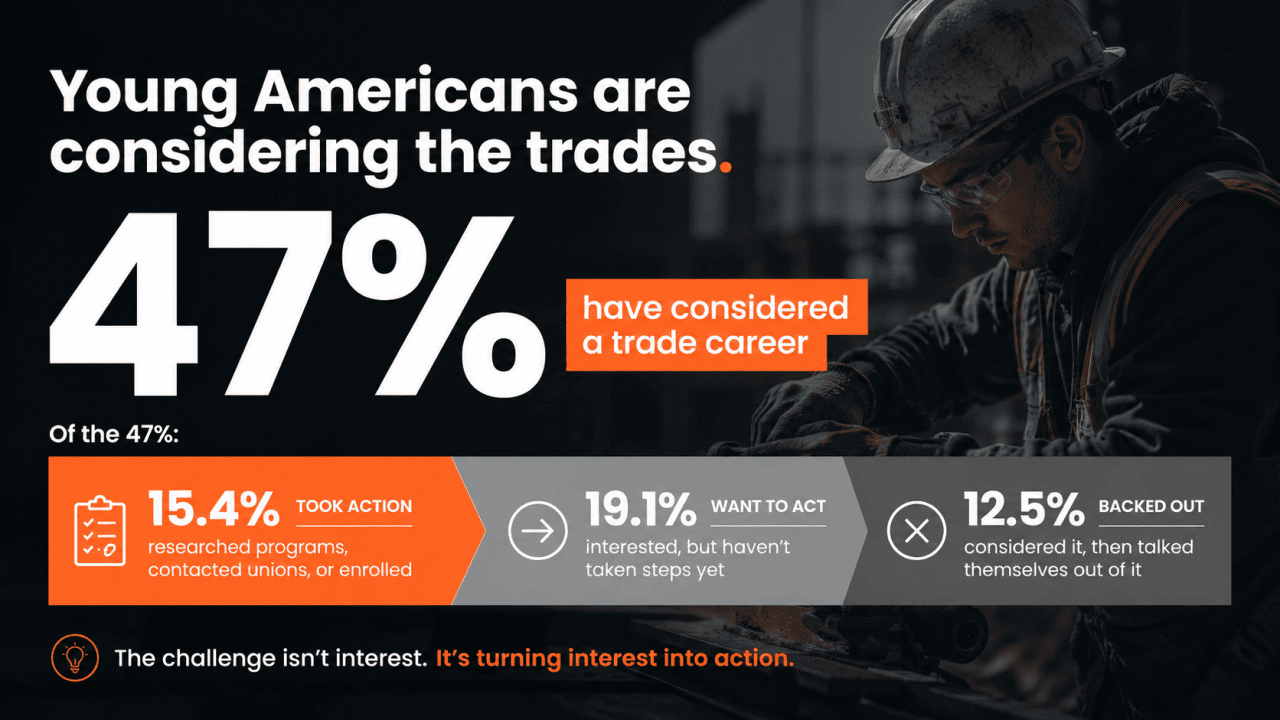
A new national survey from Skillit of 1,000 U.S. adults conducted on April 21 found that 47% of Americans have at some point considered a career in the skilled trades. Most never told anyone, and then they did nothing, because nobody told them where to start.
That silent demand collides with a workforce crisis that’s getting louder by the month. JLL projects roughly 2.1 million skilled trades positions could go unfilled by 2030, with potential economic losses reaching $1 trillion annually, according to U.S. Department of Education estimates. The supply gap is staggering: Last year, nearly 600,000 jobs were posted for major skilled trades positions while only about 150,000 new workers entered through apprenticeships. The interest is there, but what’s missing is the on-ramp.
Key Findings
47% of Americans have considered a career in the skilled trades, but only 15.4% have taken active steps (researching programs, contacting unions, enrolling in courses).
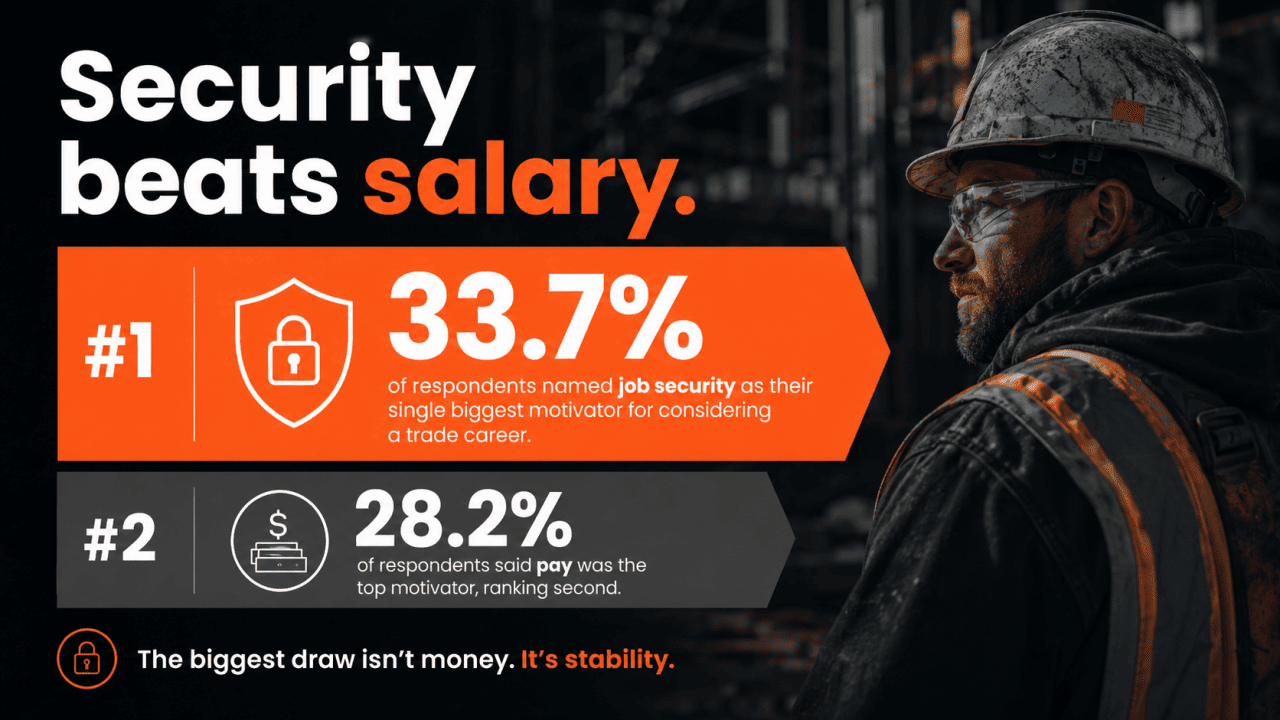
33.7% cite job security (work that can’t be outsourced or automated) as their #1 motivation, edging out pay (28.2%).
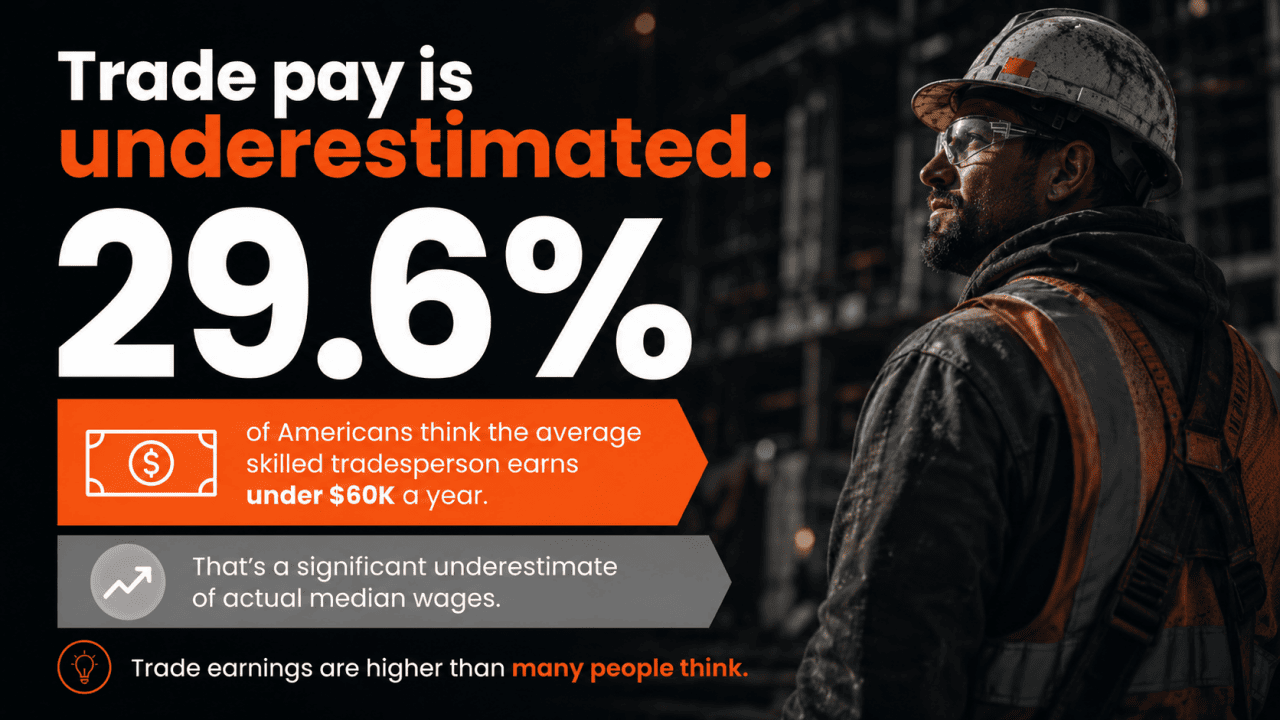
29.6% of Americans think the average tradesperson earns under $60,000 a year, with that figure rising to 65.1% among the lowest earners.
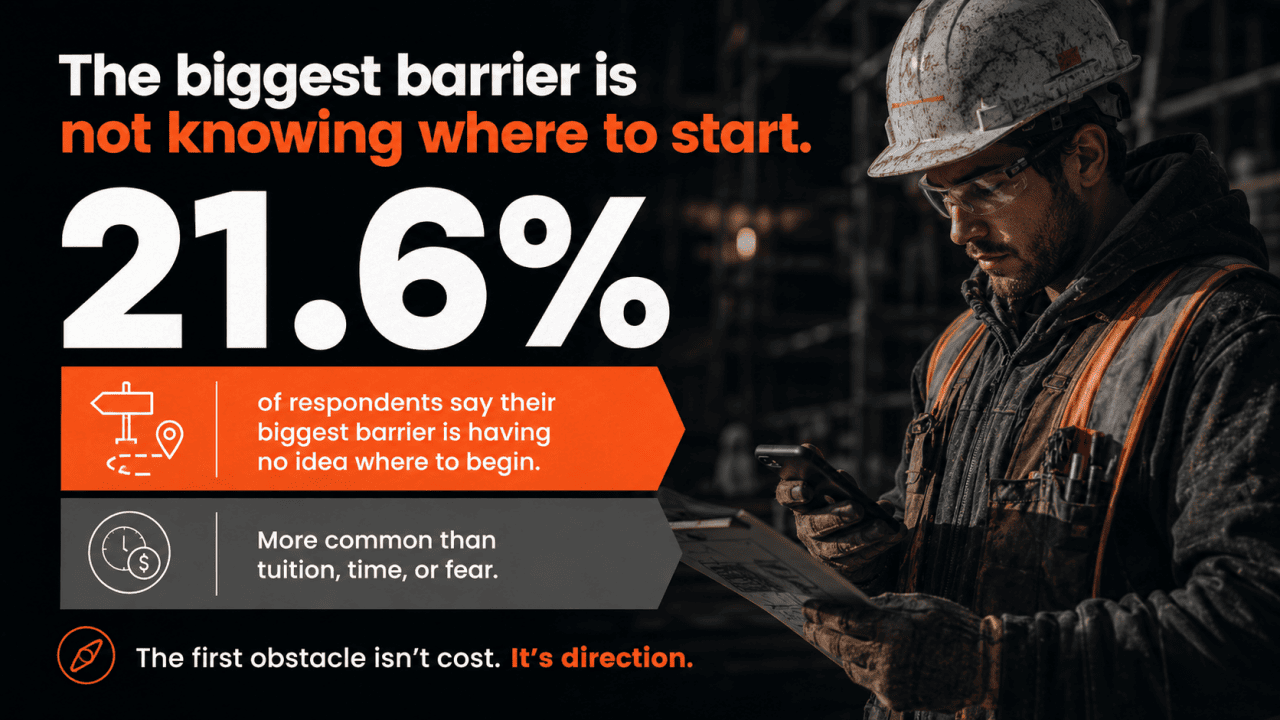
21.6% say their single biggest barrier is simply not knowing where to start. Among women, that climbs to 25.1%.
39.1% wouldn’t know where to begin looking for a trustworthy apprenticeship. Only 11.7% know exactly where to look.
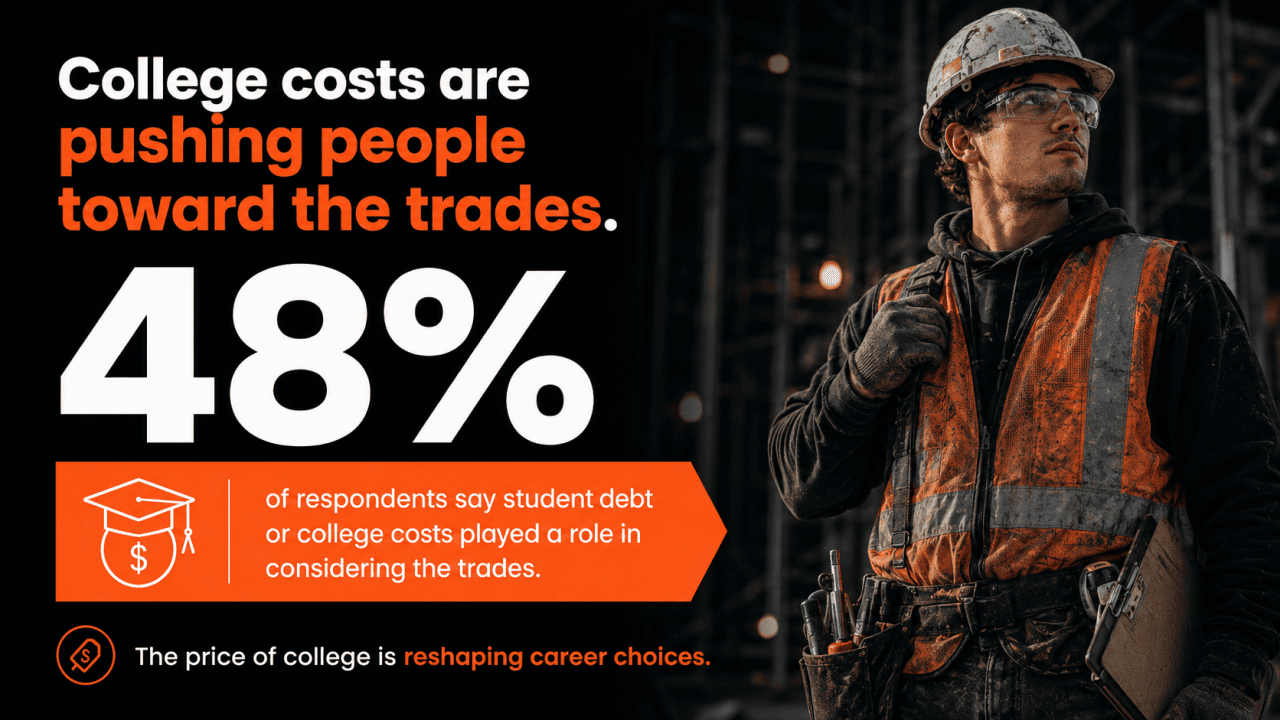
48% say student debt or college costs have factored into their consideration of trades.
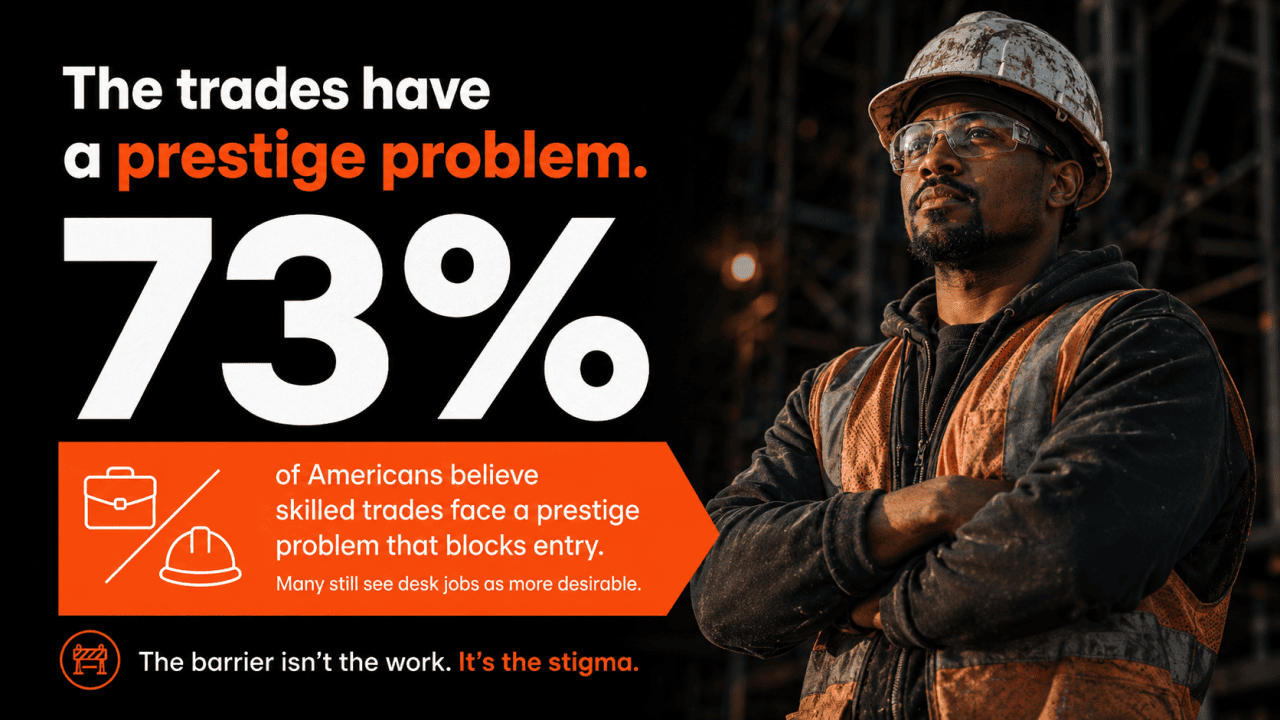
73% believe the skilled trades suffer from a prestige problem that actively keeps talented people out.
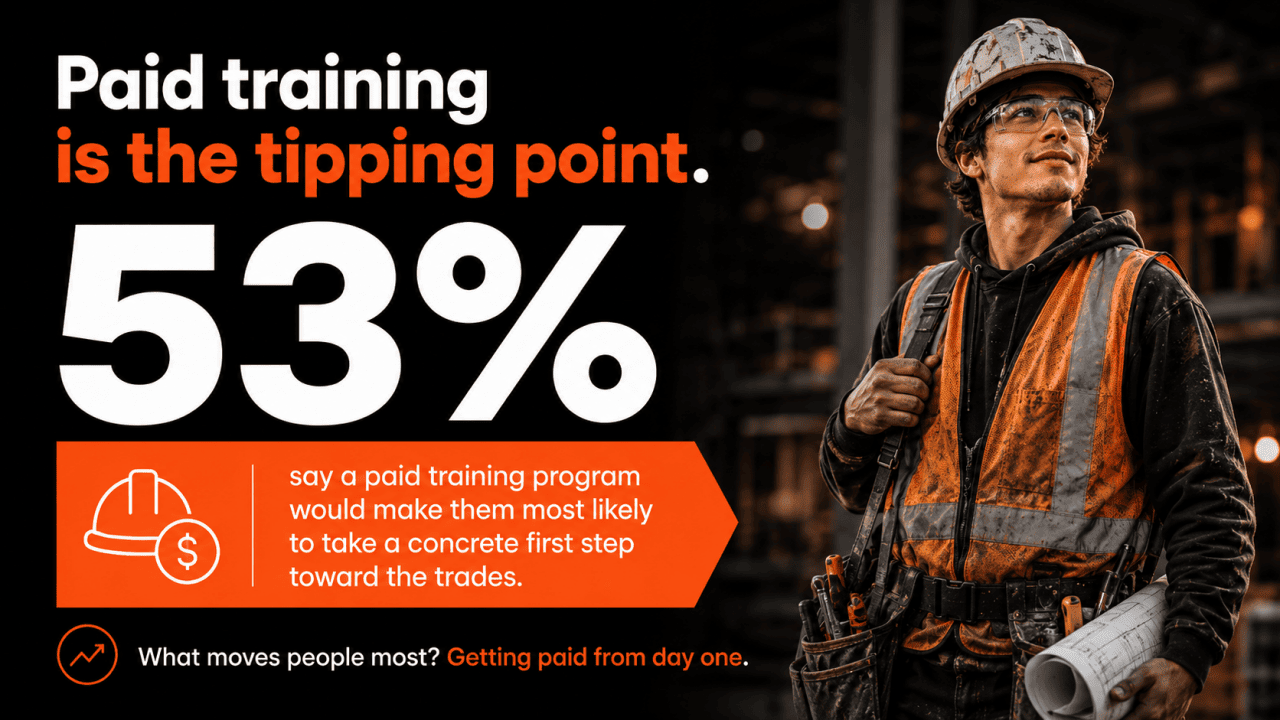
53% say a paid training program where they earn from day one would be the single biggest motivator to take a first step.
The Hidden Demand Nobody’s Counting
Skillit
The conventional wisdom says that the trades have a recruitment problem because young Americans don’t want the work. The data tells a different story. Of the 47% who’ve considered a trade career, 15.4% have already taken active steps, meaning they’ve researched programs, contacted unions, or enrolled in courses. Another 19.1% want to but haven’t acted, and 12.5% thought about it before talking themselves out of it.
That last group is the most revealing. These are people who got close enough to the door to imagine themselves walking through, then turned around, usually without telling a soul. Their interest never showed up in any recruitment funnel because nobody knew it existed.
The picture shifts further when broken down by demographic. Nearly a quarter (24.8%) of Black respondents and 24.7% of Hispanic respondents have already taken concrete steps toward a trade career, nearly double the rate of white respondents (13.3%).
The industry faces a multimillion-job deficit, not due to a lack of available talent, but because that talent remains undiscovered.
Job Security Beats Pay, and the Most Educated Are Listening Hardest
Skillit
Ask someone why they’re eyeing a trade career, and most people assume the answer is money. The survey points somewhere else. More than a third (33.7%) of respondents named job security, work that can’t be outsourced or automated, as their single biggest motivator. Pay came in second at 28.2%.
The most striking part: That preference intensifies with income and education. Among Americans earning between $100,000 and $249,000, 39.7% put job security first. Among postgraduate professionals, it is 43.7%.
These are highly credentialed people doing the math on a specific set of changes:
Tech sector layoffs that have erased hundreds of thousands of white-collar jobs over the past two years.
AI tools that are rapidly absorbing analytical and creative work.
The quiet collapse of the assumption that a graduate degree equals stability.
A licensed electrician’s work, by contrast, can’t be automated, offshored, or restructured out of existence by a quarterly board decision. As JLL’s research puts it, skilled trades offer the resilience of hands-on expertise that AI is positioned to augment but not replicate for any foreseeable horizon.
For a growing slice of the workforce, the trades have stopped looking like a step down and started looking like a strategic move.
Most Americans Have No Idea What Tradespeople Actually Earn
Skillit
Pull on any thread of the skilled trades pipeline, and you eventually hit a perception problem. About 3 in 10 (29.6%) Americans think the average skilled tradesperson earns under $60,000 a year, a significant underestimate of actual median wages once licensing and overtime are factored in.
Among Americans earning under $25,000 themselves, the demographic with arguably the most to gain from a career switch, 65.1% believe tradespeople earn under $60,000. Only 10.7% of all respondents correctly estimate that experienced tradespeople earn $100,000 or more.
The cost of that misperception is measurable. When asked how they’d react to learning that a licensed electrician or plumber in their area earns $80,000 or more, 23.7% of Americans said they would seriously reconsider their current career immediately.
Among Hispanic respondents, that figure jumps to 39.7%. Among parents with kids under 18, it’s 34.5%. Add the people who said the information would simply make them more curious, and over 60% of the country sits one accurate paycheck figure away from a real career conversation.
The #1 Barrier Isn’t Money
Skillit
When asked what’s stopping them, the single most common answer was navigation, not tuition, time, or fear. 21.6% of all respondents said their biggest barrier is not knowing where to even begin. Among women, it rises to 25.1%. Among Americans earning under $25,000, it climbs to 27.9%.
Drill deeper, and the picture gets worse. About 2 in 5 (39.1%) Americans say they wouldn’t know where to look for a trustworthy apprenticeship or training program. Only 11.7% say they know exactly where to look. Among women, 45.9% have no confidence in their ability to find a program. Among Baby Boomers thinking about a second-act career, it’s a striking 53.1%.
There’s a second barrier that gets less attention but matters just as much: the body. Nearly 2 in 5 (18.9%) respondents cite long-term physical wear and tear as their biggest concern, and that figure jumps to 34.7% among Baby Boomers and 22% among women. Most trades industry messaging focuses on getting people in the door. This data suggests the harder conversation is about what happens 15 years later, when knees and backs start sending warning signals. Career changers won’t commit to a path that has no clear answer to that question.
Together, these two barriers reframe the entire shortage. The trades are losing prospects to a Google search that goes nowhere and to legitimate questions about long-term sustainability that nobody is answering, not to competing industries.
Student Debt Is Quietly Rewriting the Calculation
Skillit
The college-versus-trades debate used to be largely theoretical. Now it’s a financial decision being made in real time at kitchen tables across the country.
Nearly half (48%) of respondents say student debt or college costs have played a role in pushing them toward considering trades. 13.8% call it the main reason. Among Millennials, the generation that took on the most debt and saw the slowest wage growth, 45.9% factor it in. Among Black respondents, it’s 50.8%.
What’s notable is how few people lead with debt as their motivation. Most cite security, meaning, or independence first. But debt sits underneath every conversation, the silent variable that’s already changed the answer.
The Prestige Problem Is Real
Skillit
About 3 in 4 (73%) Americans believe skilled trades suffer from a prestige problem that actively blocks entry, as people mistakenly think that skilled trades are not as good as desk jobs. Among Gen Z, that figure jumps to 87.9%. Among postgraduate professionals, the most credentialed Americans in the survey, 80.8% agree.
The prestige problem refers to the negative connotation people have of trade jobs. This can be due to outdated cultural stigma, pressure to attend a four-year university, and the stereotype that manual labor requires “less intelligence.” These perceptions are changing, though, as demand continues to climb for trade jobs. Additionally, celebrities like Mike Rowe and social media platforms help to shed light on the necessity of trade jobs in society.
That last number (80.8% of postgraduates) is the one to sit with. The people the formal education system has rewarded most are also the ones who most acutely feel the cultural penalty attached to trade work. While they believe in the trades, they don’t believe their social circle would.
About 2 in 5 (39.7%) respondents say their friends and family would be “supportive but secretly surprised” if they entered a trade. Another 14% expect their circle to think they were settling. Career decisions are rarely made in isolation. They’re filtered through what people imagine others will think, and right now, that imagined reaction is suppressing decisions the data shows are financially rational.
As one workforce analyst recently argued in The Hill, the country’s stigma around blue-collar careers is no longer just a cultural inconvenience. It’s an economic liability.
Day-One Pay Exists, But Nobody Knows It
Skillit
Ask Americans what would actually move them off the fence, and one answer eclipses every other. More than half (53%) say a paid training program, one where they earn from day one, would make them most likely to take a concrete first step toward the trades. Among Gen Z, it’s 58.1%. Among Baby Boomers eyeing a second career, 48%.
Here’s the twist: Registered apprenticeships in the United States already pay from day one. Apprentices earn a wage while they train, with structured pay increases as they progress through the program. The model the majority of Americans say would unlock their interest is the model the industry has been running for decades.
The Gen Z number sharpens the point. This is the generation most convinced the trades have a prestige problem (87.9% agree it actively blocks entry), and also the generation most likely to act if the financial picture is clear. The cultural skepticism doesn’t disqualify the trades for Gen Z. It sets a condition. The same generation also asks for something the industry rarely advertises clearly: 54.1% of Gen Z respondents named clear, transparent salary information at each career stage as their top motivator. They watched the college ROI argument fall apart in real time. They want a spreadsheet, not a pep talk.
The two findings together point to a quieter conversion path than most workforce coverage assumes. The most powerful motivator in the study, paid training from day one, is something the trades pipeline already delivers. The most underused asset in the trades industry is its own pay story. Career changers in their 30s and 40s, the cohort respondents named as the most blocked, aren’t being asked to walk away from a paycheck, since apprenticeships in the trades are fully paid. They just don’t know that yet.
The good news is that the market is responding. BlackRock’s $100 million Future Builders initiative, federal grants supporting apprenticeship and skills training programs, and state-level commitments across California, Maryland, and Massachusetts all point to a growing recognition that cash flow is the bottleneck, not curiosity.
Summary
For years, the skilled trades crisis was told as a story of disinterest. That framing has been shifting, and this survey makes clear what the new story actually is: a story of friction.
Nearly half the country has imagined a different career path. A third want it for reasons that have nothing to do with desperation. They want stability, they want work that AI can’t replace, and they want a profession that won’t disappear in the next layoff cycle. They’re asking the industry to point them toward the door, not to convince them.
For employers, the implication runs in parallel. The 600,000 unfilled jobs aren’t waiting on a workforce that doesn’t exist. They’re waiting on infrastructure that can connect builders to the candidates already raising their hands. The companies that crack the access problem first will fill roles faster, and they’ll define what construction hiring looks like for the next decade.
A working on-ramp wouldn’t require reinventing the trades. It would require fixing three things the data already names: a discovery layer that meets people at the moment of curiosity instead of leaving them to navigate alone, transparent salary information that corrects the perception gap pricing millions out of their own consideration, and clearer public communication about apprenticeships, including the paid-from-day-one structure most Americans don’t realize already exists.
The country has the workforce already. What it lacks is the on-ramp. Whoever builds it first will be the one shaping how the next generation of Americans defines a stable career.
Methodology
To understand how Americans approach the skilled trades, 1,000 adults were surveyed across the country. Participants answered a series of questions about their interest in trade careers, the motivations driving that interest, the barriers preventing them from taking action, and what changes to the trades pipeline would most likely move them off the fence. Responses were analyzed by demographic groups, including age, gender, income, education, ethnicity, and parental status, to identify trends and disparities.
Roadzen's Long-Form TV Commercial Continues Delivering Record-Breaking Digital Performance Across New to The Street TV Platform
By
Media News
3 min read • Published May 26, 2026
By
Media News
3 min read • Published May 26, 2026
Roadzen’s long-form television commercial surpasses 6 million views on the New to The Street TV YouTube channel alone, demonstrating the continued long-tail audience power of nationally distributed business television content and digital investor media distribution
NEW YORK CITY, NY / ACCESS Newswire / May 26, 2026 / Roadzen (NASDAQ:RDZN) and New to The Street TV announced continued exceptional audience performance surrounding Roadzen’s long-form television commercial and executive feature distributed through New to The Street’s national television and digital media platform.
The featured commercial and interview segment, originally released over one year ago, continues generating significant organic engagement and audience discovery across YouTube and social media platforms, further validating the long-tail value of evergreen business television content and strategic digital syndication.
The featured Roadzen television commercial can be viewed here:
Roadzen Commercial on New to The Street TV YouTube Channel
The Roadzen campaign highlights the company’s rapidly expanding AI-powered insurance and mobility ecosystem, including:
AI-driven insurance technologies
Automotive telematics
Driver monitoring systems
Claims automation
Embedded insurance platforms
Global mobility infrastructure
Roadzen has continued positioning itself as a major AI-powered insurance and mobility technology company operating across the United States, Europe, India, and additional international markets. The company’s technology platform supports insurers, automotive manufacturers, fleets, brokers, and mobility providers through advanced artificial intelligence and mobility intelligence systems.
"What makes this campaign stand out is that the audience continues discovering and engaging with the commercial more than a year after its original release," said Vince Caruso, Founder of New to The Street. "The combination of national television broadcasts, YouTube search visibility, social media amplification, and long-form business storytelling continues creating long-term media value for companies like Roadzen."
Unlike traditional short-cycle advertising campaigns, New to The Street’s long-form television and digital interview strategy is designed to provide companies with ongoing visibility through:
National sponsored television broadcasts
Search-indexed YouTube distribution
Continuous social media syndication
Investor-focused digital discovery
Long-tail organic audience traffic
The campaign’s continued growth reinforces increasing investor and consumer interest surrounding:
Artificial intelligence in mobility
Embedded automotive insurance
Fleet safety technologies
Driver monitoring systems
Automotive AI infrastructure
Roadzen has also recently expanded visibility surrounding its European initiatives ahead of major automotive and mobility conferences, including VECS 2026, while continuing broader international growth efforts.
Roadzen Inc. (NASDAQ: RDZN) is a global AI-powered insurance technology company focused on transforming auto insurance, mobility, and road safety through artificial intelligence, telematics, and computer vision technologies. The company serves insurers, automotive manufacturers, fleets, brokers, and mobility providers globally.
New to The Street is one of the longest-running U.S. and international sponsored television brands, broadcasting weekly as sponsored programming on Bloomberg Television and FOX Business. The platform combines national television distribution, long-form business interviews, digital media syndication, social media amplification, and iconic outdoor billboard campaigns across Times Square and the New York Financial District.
New to The Street’s YouTube platform https://youtube.com/@newtothestreettv?si=DeVo900E8KQMUBIt has grown into one of the largest business television audiences in the financial media sector, with over 4.74 million subscribers and millions of monthly viewers globally.
Subscribe to the channel here: New to The Street TV YouTube Channel
PMI’s CMO on Why Membership Marketing Looks a Lot Like Media
Menaka Gopinath on engagement as the universal problem, paywall decisions at a global membership org, the return of live events, and where the C-suite is getting AI wrong.
Miles Jennings is CEO of Mediabistro and its parent CognoGroup. He previously founded and led Recruiter.com through its NASDAQ listing, executing more than 10 acquisitions over nearly a decade as CEO and COO.
12 min read • Originally published May 26, 2026 / Updated May 26, 2026
Miles Jennings is CEO of Mediabistro and its parent CognoGroup. He previously founded and led Recruiter.com through its NASDAQ listing, executing more than 10 acquisitions over nearly a decade as CEO and COO.
12 min read • Originally published May 26, 2026 / Updated May 26, 2026
Menaka Gopinath has spent her career on the audience side of the table. She came up running publicity for music acts in the late 1990s, freelanced for Flavorpill for a decade, and co-produced an ongoing music video and short film series with her husband called The Wilcox Sessions. She built one of the first social listening practices at Ipsos, grew it from 20 people to 100 with double-digit revenue growth every year, ran ops at a sustainable DTC fashion brand, and now leads brand, communications, and marketing as Chief Marketing Officer of Project Management Institute (PMI), the global body serving the project management profession.
PMI isn’t a media company, so you might wonder why we’re talking about this. It’s a not-for-profit membership organization with global certifications, standards, an online community at ProjectManagement.com, and a worldwide chapter network. But spend a few minutes inside its marketing operation and the parallels are hard to ignore: a content engine spanning channels, an AI-powered member tool, major live events, partnerships with culture brands from OK Go to Cannes Lions, and a paywall that raises the same questions every subscription publisher is asking right now.
We caught up with Menaka to talk membership content strategy, what events are doing for engagement in a loneliness epidemic, where she thinks the C-suite is getting AI wrong, what running a small DTC operator taught her, and what she tells mid-level marketers of color about reaching the executive tier.
PMI is a membership organization for the project management profession, but when you look at how membership groups market with content, community, events, newsletters, and retention programs, it looks a lot like a media company. Do you think about it that way internally?
Our center of gravity at Project Management Institute (PMI) is all about serving the profession and that really drives how we operate, whether it’s through our certifications, our standards, our learning, and most critically, our global community. But I do think there are parallels to a media company as we are producing so much content across multiple channels, not just within Marketing. In that sense, we are incredibly focused on earning attention and deepening engagement with our audiences just as a media company does.
I guess the main distinction is that while media companies are often focused on the attention and eyeballs first and foremost, PMI is focused on helping our profession grow in relevance and impact. We want people to engage with our content sure, but it’s to serve our larger purpose, helping our profession maximize project success to elevate our world.
You came up in music publicity and independent media before pivoting into consumer insights and then brand leadership. Does that history still show up in how you think about audiences and content today?
Absolutely – I have always been audience-first throughout my career – how to create engaging experiences, what drives connection with people – and I’m constantly inspired by culture, art, music. My husband and I produced a long-running music video series, The Wilcox Sessions, as a passion project and have made multiple short films over the years. We just love telling stories, showcasing great music, and having fun with art and the moving image, and it definitely impacts what I bring into my work as a Marketing leader.
Where’s the hardest editorial decision you make: what to give away free versus what lives behind the membership wall?
Our focus with all of our content is to consider the job it is doing in serving our purpose. We have plenty of content that is free and accessible, including access to our ProjectManagement.com online community. That’s because we want people to see the possibilities of the profession and inspire them to consider how they can grow their own careers, make meaningful connections, and advance how our profession makes an impact. This accessibility is important to us in considering how we serve the profession as a whole.
But as a membership organization, our content and tools are a critical component of what we provide our members to give them deeper access, more practical utility, and to push the opportunities of professional unlocks further. One of our most popular membership benefits is our PMI Infinity tool, an AI-powered project management assistant designed for professionals, offering curated, trustworthy guidance grounded in PMI’s global standards. I just used it to help me build a work breakdown structure for a Marketing assistant agent I’m building in Copilot. It was so useful as it’s much more rigorous and thoughtful in the answers you receive, particularly related to project management discipline.
Retention is essentially an engagement problem, which is the same problem every newsletter publisher and subscription media brand is dealing with right now. What’s the PMI playbook there, and do you think media companies could steal any of it?
Engaging consumers has been a throughline in my career, and the basic truth is that engagement comes down to value. It’s the simple question of: are you delivering something of value to the audience? Going deeper, for us at PMI, I would say it boils down to three key areas:
Deeply understand the experience of the audiences we serve. This means pushing ourselves to understand what our members are going through, whether it’s that new graduate just entering the workforce, the project professional pursuing their PMP certification, or the first time someone checks out a chapter event. Our team needs to understand these experiences first-hand and have a POV on where we have the opportunity to build micro moments of joy or magic throughout.
Don’t forget to have fun. It’s also about not always taking yourself too seriously – finding humor and common points of connection that build that sense of belonging. Identifying those opportunities to align with culture in authentic ways, but that might be unexpected, like when we did our Behind the Project series with OK Go.
Lead with purpose. PMI is a purpose-based, not-for-profit organization and our purpose guides everything we do. This clarity in why it matters and what it is actually serving helps our community unify, connect, and collectively feel like they are part of something bigger than themselves.
You spent a decade at Ipsos building social listening and online community practices before most brands had a real framework for it. How much of that early infrastructure thinking applies to what you’re doing now?
When I joined PMI I felt like it was a really nice triangulation of things I had been passionate about and doing throughout my career coalescing. 1) Community has been part of my career trajectory since the late 90s, and fundamentally PMI is a community-led organization. 2) Marketing with purpose is incredibly important to me, and at PMI I get to market growth and learning, something that truly has no upper limit. And even better, we’re working to grow this profession to elevate our world. 3) Critical thinking and curiosity were major drivers of the work we did during my time at Ipsos, and that is so essential to the work we do at PMI as we push the boundaries of what our profession is capable of delivering in this world, particularly at a time of massive disruption and transformation.
Events seem to be having a real moment as both a content format and a conversion channel. PMI runs major conferences. How do you think about live programming as part of the media mix?
I love events so much, and think they are definitely making a broader comeback post-COVID. We are living in the midst of a loneliness epidemic, people can spend full days without ever leaving their home, and as humans, we thrive on tactile, tangible connection. Our PMI events bring our profession to life, the vibrancy, the passion, the possibilities. I never leave a PMI event – from our largest Global Summit, to my local Los Angeles chapter event – without learning something and meeting someone new. Every time.
As I said before, there is no upper limit to learning, and a critical part of how we learn is experiencing things IRL and together with other humans. And you might be surprised to hear this, but wow does our community LOVE TO DANCE. So I guess, check out a PMI event if for nothing else, a rockin’ dance floor!
Events for us also represent an opportunity to expand our sphere of influence, knowing that project management really shows up in all types of areas. For example, we started partnering with Cannes Lions a couple years ago, specifically with the Lions Learning program. Marketers are being challenged with more complexity than ever before, and the need for stronger systems thinking and project management discipline is clear. We love being able to show up and provide value to audiences that might not expect it, but can find genuine utility in what we have to offer.
AI is reshaping what skills professionals need to stay current, which puts PMI right at the center of an urgent conversation. How are you positioning the brand around that?
A few years ago we really started with getting ahead of the implications for the profession and how AI might change it. That has evolved to also guiding how our profession is essential in the broader AI transformation happening everywhere. Today this continues to be the focus – we lead both the AI transformation of the project management profession, and the project management of AI transformations. I already mentioned our PMI Infinity tool, but in addition to that, we have multiple AI-focused courses, an AI certification (PMI-CPMAI) and a new Standard coming early-June.
It’s been fascinating to see the larger discourse as people are working through how to tackle “AI transformation,” and recognizing so much of it comes down to system discipline, which is really the crux of what project management rigor provides, particularly as agentic AI becomes more widespread. Your team is no longer just humans; the resources you have to use for a project includes agents too, but those agents aren’t going to be great without context on the system and work breakdown structure they are working within. These are challenges hitting the C-suite right now, particularly around the clear gap between strategic ambition and executional delivery. We are elevating the executive conversation, guiding how to ensure the required systems discipline and shared language for successful AI transformation, and being a trusted source people and AI tools can turn to for guidance on turning AI ambition into measurable outcomes.
You went from a global research firm to COO of a small DTC sustainable fashion brand before landing at PMI. That’s an unusual path. What did running a small operator teach you that you couldn’t have learned anywhere else?
At a small company, every dollar counts. This teaches you to be much more intentional with every decision you make, whether it’s about what channels to spend your paid media dollars, if it’s worth it to do that creator collab, or if you’re going to take a risk and buy ahead of demand for the newest product launch. These decisions are much more tangible at a small company because one decision could impact how you make payroll, for example. You feel the impact on the people you lead, and it reiterates the responsibility you have as a leader and understanding downstream impacts at a much more heightened scale.
My experience at Graf Lantz also pushed me into the world of hard goods manufacturing, and all the things that come with that, from material sourcing, product design, production, logistics, shipping, inventory planning… so many things. I really appreciate what the experience gave me, and it truly offered a much deeper understanding of what small business owners have to grapple with on a daily basis to bring their passions to the world.
You’ve been on the Monday Night Mentorship board for six years now. What’s the most important thing you tell mid-level marketers of color who are trying to break into the executive tier?
You are your best advocate. I had to learn this over many years, but the importance of trusting your abilities, knowing your worth, and advocating for the things you want in your career is essential. No one is going to do it for you. BUT, having a supportive community around you will help. Which is why I really love MNM and the community Jabari and Julian have built. Sometimes you need others to remind you that you need to believe in yourself, or to know that you’re not the only one experiencing XYZ challenges, or to be an accountability partner and a touchstone as you push to reach your next big milestone. Lastly I’ll say, always look to make new connections, not just when you need something – consider how you can be of service, and starting with that can be even more rewarding.
Given that upskilling is central to PMI’s work, where should media professionals be focusing their development efforts, and how can they go about building those skills within the industry?
We’ve been doing a lot of work to define what our profession needs to deliver in the AI-enabled modern workplace, and more pointedly on what our profession needs to do to maximize project success to elevate our world. I think much of what we have defined as this vision can apply to media professionals as well as fundamentally it’s about what it takes to drive project success.
Based on research we have done over the past two years, we found that as a professional, if you are focused on four key areas in how you deliver, it will directly impact the likelihood of the projects you work on to succeed. We call it M.O.R.E. – M for manage perceptions, O for own success, R for relentless reassess, and E for expand perspective. Much of this comes down to things we’re seeing as fundamental skills to succeed with AI: orchestration, accountability, critical thinking, change resilience and creativity. And don’t forget to just try working with the AI tools, build a mini agent, create skills, take a hands-on course – play and experiment! If you want to see how to elevate your skills in M.O.R.E., you can check out our introductory course here: PMI Essentials M.O.R.E. Maximizing Project Success.
Last one, since we’re a platform for media professionals. What are you reading right now, or who are you paying attention to that’s shaping how you think? Or heck, we’ll take some Netflix recommendations if you have any.
So many things, but I’ll give you three. Earlier this year I read Unreasonable Hospitality by Will Guidara – I highly recommend, as it will give you a new appreciation of how to approach elevating the experience and building engagement with your audience. I just finished watching the Dark Wizard about the climber, Dean Potter, and it’s an invigorating series of passion, nature, freedom, fear… just watch it!
And if you haven’t already seen Project Hail Mary, go see it. In a time when so much feels bleak and dystopian, it’s a beautiful movie about the power of working together with diverse perspectives to overcome impossible odds.
About Menaka Gopinath: Menaka Gopinath is Chief Marketing Officer at Project Management Institute, where she leads brand, communications, and marketing. Before PMI, she was President and COO of Graf Lantz, a direct-to-consumer sustainable fashion brand. She previously led the Social Media Exchange (SMX) service line at Ipsos, growing the practice from 20 to 100 people with double-digit revenue growth every year. She has worked with brands including Coca-Cola, Apple, Nike, Uber, P&G, and Meta. She sits on the Board of Mentors at Monday Night Mentorship, a career accelerator for marketers of color, and helped establish BRIDGE, an Anti-Racism ERG, during her time at Ipsos. She holds a BA in Journalism and Economics from New York University and an MBA from the University of San Francisco. Find her onLinkedIn.
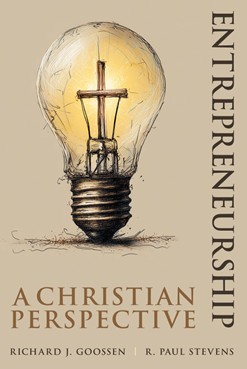
Authors Richard J. Goossen and R. Paul Stevens Take a Distinct Look at the Christian Perspective and Fundamental Dynamics of Entrepreneurship
By
Media News
3 min read • Published May 26, 2026
By
Media News
3 min read • Published May 26, 2026
What if entrepreneurship is about more than building a business?
TORONTO, ON / ACCESS Newswire / May 26, 2026 / Most entrepreneurship texts focus on mechanics-financing, growth, marketing, and execution. The Christian worldview asks deeper questions about purpose, creativity, ethics, and responsibility. Goossen and Stevens argue that entrepreneurship is not merely an economic activity. They see it as a divinely inspired calling, rooted in God’s creative nature and expressed through entrepreneurial leadership.
In Entrepreneurship: A Christian Perspective, well-known leaders Richard J. Goossen and R. Paul Stevens offer a compelling vision of entrepreneurship grounded in biblical faith and moral clarity. Drawing on decades of research and work with entrepreneurial leaders, they show how a Christian worldview reshapes purpose, leadership, risk, wealth, and legacy.
Moving beyond technique to transformation, this book connects innovation with servant leadership-and business success with spiritual depth. It challenges readers to pursue opportunity under God’s agenda, not merely their own.
For entrepreneurs, students, and leaders seeking coherence between faith and work, this is an invitation to practice entrepreneurship with integrity, courage, and eternal purpose.
About the Authors:
Richard J. Goossen JD and Ph.D., is an entrepreneur, educator, and founder of the Entrepreneurial Leaders Organization (ELO). He advises leaders globally and writes on entrepreneurship, leadership, and calling. His work bridges research and real-world practice, equipping leaders to integrate faith with enterprise. He has written eight books, translated into multiple languages, and approximately 1,000 articles and blog posts.
R. Paul Stevens, DMin., is Professor Emeritus of Marketplace Theology at Regent College, Vancouver, and a pioneer in the global faith-and-work movement. A former pastor, tradesman, and business owner, he writes and speaks on following Jesus in every sphere of work. He has written more than 40 books and Bible studies, translated into over 8 languages, which have collectively sold more than 230,000 copies including titles Liberating the Laity (IVP), Married for Good (IVP), Marriage Spirituality, The Complete Book of Everyday Christianity (IVP), and Revelation, The Triumph of God. He is coauthor with Pete Hammond and Todd Svanoe of The Marketplace Annotated Bibliography.
What people are saying about this book:
"Full of practical wisdom and biblical insight … a great encouragement to entrepreneurs who want their business to reflect their Christian convictions."
–John Lennox, Professor Emeritus of Mathematics, University of Oxford
"Entrepreneurship isn’t just compatible with a Kingdom mindset-it can be an expression of it. This book will reframe the way you view and live out your calling."
– Bobby Gruenewald, Founder and CEO, YouVersion Bible App
"This book is a marvellous synthesis and overview of entrepreneurship from a Christian perspective. Well written, succinct, and clear. Just like we like it in our businesses."
– Rob Wildeboer, Cofounder and Executive Chair, Martinrea International, Inc.,
"Goossen and Stevens have given the church and the marketplace a much-needed roadmap…showing us how ordinary business leaders can live out an extraordinary calling-using innovation, risk, and leadership to serve people and advance the Kingdom, not just profits."
– Rick Rusaw, Executive Leadership Team, Gloo, Author and Pastor, Boulder, Colorado
"Drs Goossen and Stevens have captured the appropriate tension between thriving as an entrepreneur while remaining grounded in one’s Christian faith. I highly recommend this book for any Christian who embraces the entrepreneurial gifting and calling."
– Andy J. Hughes, DBA, Dean, DeVoe School of Business, Technology and Leadership, Indiana Wesleyan University
Entrepreneurship: A Christian Perspective is available on-line and at most bookstores, or on the Castle Quay Books web site www.castlequaybooks.com.
ISBN 978-1-998815-46-3 soft cover –$19.95 e-book 978-1-998815-47-0 –$9.95 192 pages, size 6" x 9"
For review copies, cover images, interviews with authors or more information about this title, please contact Larry N Willard:
Distributed in Canada by Anchor/Word Distribution Customer Service in Canada 1-800-665-1468 orderdesk@wordalive.ca
Distributed in the USA by Anchor/Word Distribution and Ingram International Customer Service in the USA 1-800-444-4484 customercare@anchordistributors.com
Southeast Asia Built a Content Machine While Nobody Was Looking
Singapore money, microdrama empires, and Vietnamese horror. The region stopped waiting for Hollywood's permission.
By
Mediabistro Team
6 min read • Published May 26, 2026
By
Mediabistro Team
6 min read • Published May 26, 2026
Singapore-based film investment group Triple Green CineCapital just made its first Vietnamese bet: “The Scourge,” a horror adaptation of a video game with 100,000 downloads.
TGC formalized a partnership with Chánh Phương Films on the project, which Skyline Media launched to buyers at Cannes. Read the full story at Variety.
The deal matters for what it signals: Southeast Asian capital moving upstream from production services into IP origination and cross-border financing. The region’s content infrastructure has matured from location shoots for Hollywood projects into something self-sustaining, with its own investment vehicles, distribution platforms, and audience-tested IP.
Three stories illustrate different stages of that evolution.
Singapore Money, Vietnamese IP, Global Ambitions
Triple Green CineCapital’s move into Vietnamese horror is a story about capital formation. Singapore has positioned itself as the financing hub for Southeast Asian content, and TGC’s structure (a dedicated film investment fund, not a studio carrying legacy overhead) allows faster deployment into projects that already have proof of concept.
“The Scourge” adapted a game with an existing user base. The Chánh Phương Films partnership brings local production expertise. The Cannes buyer launch signals international distribution ambitions from day one.
This is the opposite of how Hollywood typically engages the region: fly in for tax incentives, shoot against local backdrops, extract cost savings, leave.
TGC is betting Vietnamese-originated IP can find audiences beyond Vietnam, with Singaporean capital enabling production quality and marketing reach that domestic financing alone couldn’t support. Deadline’s coverage notes director Charlie Nguyen’s track record, which matters when you’re asking international distributors to take a chance on a Vietnamese video game adaptation.
Key Number: Singapore-based microdrama distributor RisingJoy announced licensing deals with more than 50 apps and platforms across 30-plus countries, signaling the region’s distribution infrastructure has reached scale.
The distribution piece comes from a different player entirely. According to Variety, RisingJoy is now moving into original production and co-development, not just licensing existing content.
Fifty platforms is the hard number, but the shift into originals is more telling. RisingJoy spent its early years proving that short-form narrative content travels across cultural and linguistic boundaries when the distribution infrastructure exists. Now the company has enough platform relationships to justify investing in original IP rather than aggregating. Same playbook Netflix ran in reverse: build distribution, then backward-integrate into production once you have guaranteed shelf space.
Put these two stories together. Capital formation (TGC) meeting distribution infrastructure (RisingJoy) at the same moment Vietnamese, Thai, Indonesian, and Filipino creators are developing IP with real commercial potential. The region has its own money, its own platforms, its own IP pipeline.
Dedicated Channels for Dedicated Fans
Bleacher Report is launching a standalone YouTube channel for its animated sports content, timed to capture World Cup audiences.
Digiday reports the Warner Bros. Discovery brand is betting on animation and YouTube distribution to reach younger viewers who engage with sports content differently than linear TV audiences.
A dedicated channel rather than mixing animated content into the main feed. That distinction tells you something. Bleacher Report’s animated style (recognizable character designs, humor-forward storytelling, meme-ready moments) has proven popular enough to justify its own home. The World Cup timing is opportunistic, but the channel strategy is structural: WBD wants Bleacher Report to own a specific content lane rather than compete for general sports audience attention.
Apple TV+ is running a different version of the same playbook with “Stick,” Jason Keller’s series about competitive youth golf. Owen Wilson and Keller discussed the show’s focus on father figures and young athletes in a Deadline Crew Call podcast interview. The series targets households with student athletes. Narrow, but highly engaged. These families understand the specific pressures the show depicts because they live them.
Different medium, different sport, identical strategic logic: identify a specific audience segment, create content that speaks directly to their experience, trade scale for depth of engagement.
Both decisions reflect the same post-streaming-wars reality. The era of chasing maximum addressable audience is over. The new game is owning defined audience segments and serving them consistently enough that people actively seek out your content rather than passively encounter it.
BTS Wins Artist of the Year Without Releasing an Album
BTS won Artist of the Year at the American Music Awards, a fan-voted honor they previously won in 2021. The group has been on hiatus for military service. They did not release an album during the eligibility period.
Variety’s full winners list shows KATSEYE, SOMBR, and Sabrina Carpenter also taking multiple honors, while Deadline notes Taylor Swift led nominations with eight despite not being the night’s top winner.
Key Insight: Fan-voted awards now measure mobilization capacity rather than active release cycles. BTS won without new music because fandom infrastructure operates independently of product launches.
Artist of the Year typically recognizes commercial dominance during a specific eligibility window. BTS delivered none of that through new releases. What they delivered was sustained fan engagement through individual member activities, archival content, and the kind of community maintenance that keeps a fandom running even when the central product (group music) is unavailable.
BTS fans (ARMY) have built infrastructure that activates for voting campaigns regardless of whether the group is promoting. Discord servers, coordination accounts, streaming farms, voting tutorials in multiple languages. It’s organizational machinery.
The implication for artists, managers, and labels is uncomfortable: you can win the top fan-voted award without releasing music, but you cannot win it without maintaining fandom infrastructure. The traditional music business assumes career continuity requires consistent new product. The BTS win says that assumption only holds for artists who haven’t built community capable of sustaining itself between releases.
KATSEYE with three awards, SOMBR with three. Same dynamic. Highly engaged fandoms that show up for voting even without mainstream radio or streaming dominance.
What This Means
Watch Southeast Asian financing and distribution deals. Singapore is positioning itself as the region’s content capital the way Hong Kong functioned for East Asian film in previous decades. When investment vehicles like TGC start making their first moves into specific country markets, they’re telling you where they see IP origination potential worth backing with patient capital.
The microdrama space is moving faster than most media observers realize. RisingJoy’s 50-platform milestone and shift into originals suggests the licensing infrastructure is mature enough to justify production investment. That’s typically the moment a category tips from arbitrage opportunity to sustainable business.
For media brands, the Bleacher Report and Apple TV+ moves reinforce what the data has shown for two years: dedicated channels and niche programming outperform broad-audience general content. The economics of attention favor specificity.
If you’re navigating these shifts professionally, whether in content development, audience strategy, or distribution, browse open roles on Mediabistro for positions at companies making these kinds of bets. And if you’re hiring for roles that require understanding how capital, distribution, and audience engagement are reshaping content business models, post a job on Mediabistro to reach professionals who track these patterns.
This media news roundup is automatically curated to keep our community up to date on interesting happenings in the creative, media, and publishing professions. It may contain factual errors and should be read for general and informational purposes only. Please refer to the original source of each news item for specific inquiries.
Remote Media Leadership Roles Are Hiring Across Nonprofits
Executive communications and digital strategy positions dominate today's freshest listings, with several offering full remote flexibility and six-figure salaries.
The Mediabistro editorial team draws on 25 years of media industry expertise to cover jobs, careers, and trends shaping the industry.
4 min read • Published May 26, 2026
The Senior Talent Grab in Mission-Driven Media
Something worth watching: organizations with ambitious communications goals are going after senior leaders right now, and they’re willing to compete on flexibility to get them. Three of today’s freshest listings are explicitly structured for remote candidates at the director level or above, a tier where remote options were still rare even 18 months ago.
What connects these roles is scope. These aren’t “manage our social channels” positions. Each one asks candidates to build or overhaul an entire function, from digital fundraising infrastructure to hospitality media partnerships to full-stack D2C growth engines. The common thread is operational ownership with strategic latitude, the kind of mandate that signals an organization ready to invest rather than experiment.
If you’re a mid-career media professional thinking about your next move, the message from this batch is clear: specialized expertise paired with leadership range is the combination employers are paying for.
Today’s Hot Jobs
Partnerships Manager at Branded Hospitality
Why this role is worth a close look: Branded Hospitality sits at the intersection of media, investment, and the hospitality industry, a niche that’s growing fast as foodservice companies invest more in owned content. This Partnerships Manager role puts you at the center of that revenue engine, owning sponsor and corporate partner relationships across podcasts, newsletters, events, and digital storytelling. You’ll report directly to the Managing Partner and CMO, which means minimal bureaucratic layers between your ideas and execution.
Own revenue generation and relationship management across Branded’s media platform
Close sponsorship and corporate partnership deals from outreach through renewal
Work directly with C-suite leadership on strategy and pipeline
Experience in media sales, sponsorship, or business development in hospitality or adjacent sectors
Marketing Manager and Growth Lead (D2C) at Amos Media Company
What makes this unique: Amos Media has been publishing for 150 years. That’s not a typo. Their brands, Coin World and Amos Advantage, serve fiercely loyal hobby communities, and this fully remote role asks you to be the entire growth operation. You’ll manage Meta and Google Ads with a concrete $20 CPA benchmark, defend ecommerce positioning against new competitors, and advise ownership directly on long-term strategy. For marketers who thrive as autonomous operators rather than cogs in a team of 30, this is a rare setup.
Hands-on daily management of Meta and Google Ads (combined monthly budget $8,500+)
Own the $20 CPA target for subscription acquisition, including copywriting and creative
Navigate proprietary legacy software systems while scaling modern digital funnels
Strategic maturity to advise ownership on growth and risk mitigation
Director of Digital Fundraising and Advocacy at Earthjustice
The opportunity here: Earthjustice is the country’s largest environmental law nonprofit, and this director-level position bridges their Communications and Development teams. You’ll translate complex legal and advocacy work into digital campaigns that both mobilize supporters and drive revenue, overseeing an integrated program across email, social media, and paid channels. The role can be based in any Earthjustice office or fully remote from anywhere in the U.S., which opens this to a national candidate pool. For digital strategists looking to scale their impact, this is a career-defining level of responsibility.
Oversee integrated digital fundraising and advocacy campaigns across all channels
Sit at the intersection of Communications and Development, bridging two major departments
Translate legal and policy work into compelling supporter-facing campaigns
Seasoned digital leadership experience with a track record in fundraising or advocacy
A sector worth watching: Nuclear energy is experiencing a reputational and investment renaissance, driven by AI-related power demands and clean energy policy. The Nuclear Energy Institute, the industry’s DC-based policy organization, is hiring a Marketing Manager to drive integrated campaigns for conferences, membership, and programs. The listed salary range of $80,240 to $120,360 gives candidates a transparent window into compensation, and the role combines strategy development with hands-on execution across marketing technology and data analytics.
Develop and execute data-driven marketing campaigns for conferences, events, and membership growth
Lead day-to-day campaign performance optimization and continuous improvement
Work across Creative, Digital Communications, Membership, and External Communications teams
Experience at the intersection of campaign strategy, martech, and analytics
Today’s listings reward candidates who can demonstrate end-to-end ownership of a function, not just task execution. Whether it’s managing an entire growth engine at Amos Media or bridging two departments at Earthjustice, these employers are looking for people who can articulate how they’ve built something, not just maintained it. Before you apply, audit your resume for evidence of strategic ownership: budgets managed, systems built, programs launched. If your experience section reads like a task list, reframe it around outcomes.
And if you’re preparing for interviews at this level, consider how you’ll handle the inevitable “tell us about a time you built something from scratch” question. A strong answer to that one question can carry an entire conversation. For more on making strong impressions when the stakes are high, check out Mediabistro’s guide on using a thank-you note to recover from an imperfect interview.
Trustpoint Xposure Brings AI Search Authority to New York's Legal Community, Helping Attorneys and Law Firms Become the Answer ChatGPT and Gemini Recommend
By
Media News
7 min read • Published May 23, 2026
By
Media News
7 min read • Published May 23, 2026
As AI platforms replace traditional search for legal discovery, New York’s leading AEO-certified PR agency positions attorneys and law firms to be cited as the trusted expert before a prospective client makes a single call
AMHERST, NY / ACCESS Newswire / May 23, 2026 / Trustpoint Xposure, the AEO-certified PR and digital authority agency now headquartered in New York, today announced a dedicated initiative targeting New York’s legal community, bringing its guaranteed AI citation methodology to the attorneys, partners, and law firms operating in the most competitive legal market in the world.
The initiative responds to a fundamental and accelerating shift in how prospective legal clients find and evaluate attorneys. Across practice areas, from corporate law and litigation to immigration, family law, and financial regulation, high-value clients are increasingly turning to AI platforms as their first point of research. They are asking ChatGPT who the best attorney is for their situation. They are asking Gemini which firm leads their practice area. They are asking Perplexity who they can trust.
The attorney that those platforms recommend walks into the relationship already carrying authority, credibility, and trust. The attorney that those platforms don’t recommend may never get the call.
"New York’s legal market is the most competitive in the world," said a Trustpoint Xposure spokesperson. "The attorneys we work with here have spent careers building authority through the right channels, referrals, reputation, and results. AEO is the newest and right now the most consequential channel available. And the firms that understand it first will hold an advantage that compounds for years."
The AI Visibility Gap in New York’s Legal Community
Despite the legal profession’s longstanding emphasis on credibility and reputation, most New York attorneys have a significant and growing AI visibility gap, a disconnect between the authority they have built in the real world and the authority AI platforms recognize and cite.
The reason is structural. AI systems don’t evaluate attorneys the way referral networks do. They don’t assess case results, bar ratings, or years of experience directly. They assess verifiable authority signals, entity clarity, third-party editorial coverage, knowledge graph verification, structured schema content, and Wikipedia entity presence. These are signals that traditional legal marketing strategies rarely address.
An attorney with decades of experience, a strong peer reputation, and an excellent Google ranking can still be completely absent from AI-generated answers, because the signals AI uses to make citation decisions have nothing to do with the signals that drove their traditional authority.
This gap is not a minor inconvenience. It is a growing competitive disadvantage that widens every month as AI adoption among legal clients accelerates, and as competing attorneys begin building the AEO authority that claims their category in AI search.
Q: Why do New York attorneys specifically need an AEO strategy in 2026?
A: New York’s legal market is the most competitive in the world, and AI-first search behavior is most prevalent among exactly the high-value clients New York attorneys most need to reach. Corporate executives, high-net-worth individuals, financial professionals, and sophisticated business clients are among the fastest adopters of AI-powered research tools. When these clients ask ChatGPT or Gemini who to trust for legal representation in a specific practice area, the attorney cited in that answer has an extraordinary first-mover advantage. The attorney not cited has lost a client before the first conversation happened. In a market as competitive as New York, that gap is decisive.
What the Program Delivers for New York Attorneys
Trustpoint Xposure’s legal AEO program is built specifically around the authority signals AI platforms use to evaluate and cite legal experts. It operates across five integrated components:
Guaranteed Editorial Placements in Legal and Business Publications . Trustpoint Xposure secures genuine editorial coverage in the publications that AI systems recognize as authoritative third-party verification for legal expertise, including top-tier legal trade publications, business media, and recognized news outlets. Each placement functions as external verification that an independent editorial process confirmed the attorney’s expertise in their practice area. These are not press releases or sponsored content. They are editorial citations that AI systems treat as credible authority evidence.
Google Knowledge Panel Verification: A verified Google Knowledge Panel confirms an attorney’s identity within Google’s knowledge graph, connecting their name, practice area, bar affiliations, and professional context into a single verified fact that Gemini, Google AI Overviews, and other AI platforms draw on directly. For New York attorneys competing in crowded practice areas where multiple professionals share similar names and specializations, Knowledge Panel verification is the entity disambiguation signal that tells AI systems exactly which attorney to cite.
Wikipedia Entity Establishment. For attorneys who meet notability requirements, through sustained media coverage, landmark cases, or significant professional recognition, Trustpoint Xposure develops properly sourced Wikipedia entries that establish foundational AI authority at the training data level. Wikipedia remains one of the most heavily weighted sources in AI model training data, making it the deepest credibility signal available for qualifying legal professionals.
Structured AEO Content Architecture Trustpoint Xposure rebuilds or supplements attorney and law firm websites with schema markup, FAQ structures, and entity-clear language that makes legal expertise machine-readable and citable by AI retrieval systems. Person schema, Organization schema, LegalService schema, and FAQPage schema work together to present an attorney’s credentials, practice areas, and expertise in a format AI systems can extract and cite directly.
AI Citation Monitoring and Strategy Monthly monitoring of AI responses across ChatGPT, Gemini, Perplexity, Claude, and Google AI Overviews tracks citation frequency, accuracy, and competitive positioning, with strategy adjustments made in response to model updates, emerging citation patterns, and competitive developments in the client’s practice area.
Q: What types of New York attorneys benefit most from AEO?
A: Every practice area benefits from AEO, but the highest immediate impact is seen in practice areas where trust is the primary conversion driver and where AI adoption among target clients is highest. Corporate attorneys, litigation partners, financial regulatory lawyers, immigration attorneys, and estate planning professionals serving high-net-worth clients consistently see the fastest and most measurable results. These practice areas attract clients who conduct extensive due diligence before making contact and who are increasingly using AI as the primary research tool in that process. Being cited by AI in these categories is not a differentiator. It is rapidly becoming the prerequisite for being considered at all.
Q: How long does it take for a New York attorney to start appearing in AI-generated answers?
A: For live-search AI platforms like Perplexity, strong editorial placements in recognized legal publications can begin producing AI citation results within weeks of publication. For model-trained platforms like ChatGPT and Claude, meaningful citation signals typically develop within 60 to 90 days of establishing foundational AEO signals, with compounding authority gains building over 6 to 12 months as citation patterns reinforce themselves across model updates. The earlier an attorney begins building AI authority, the greater the cumulative advantage, particularly in competitive practice areas where multiple attorneys are beginning to invest in AEO simultaneously.
Q: How is Trustpoint Xposure’s legal AEO program different from traditional legal PR or legal marketing?
A: Traditional legal PR builds awareness and reputation through media coverage, speaking engagements, and thought leadership content, measuring success in impressions, placements, and brand recognition. Traditional legal marketing focuses on website optimization, paid search, and referral network development. Trustpoint Xposure’s legal AEO program is built specifically around the signals AI systems use to select and cite legal experts, and measures success in AI citation frequency, Knowledge Panel verification status, and the quality of inbound inquiries generated by AI-driven discovery. The placements look similar on the surface. The strategy, the targeting, and the outcome are entirely different. No other legal PR or marketing firm has built its entire methodology around this outcome or backs it with a placement guarantee.
The Compounding Advantage for New York’s Legal Community
The window for first-mover AI authority in New York’s legal market is open, but it is closing faster than most attorneys realize.
AI systems develop citation preferences over time. The attorneys building editorial authority, Knowledge Panel verification, and structured schema content are now establishing citation patterns that AI systems will reinforce with every subsequent query. In a market as competitive as New York, where dozens of highly qualified attorneys compete for the same high-value clients, the attorney whose name AI systems have learned to associate with authority in a given practice area holds an advantage that compounds with every query, every model update, and every new AI platform that enters the market.
"The attorneys who act in the next 90 days are building a position that will be very difficult for late movers to displace," the spokesperson said. "The attorneys who wait are watching that position get claimed. In New York’s legal market, that is not a position anyone should be comfortable with."
About Trustpoint Xposure
Trustpoint Xposure is the only AEO-certified PR and digital authority agency that guarantees brand placements inside AI-generated answers across ChatGPT, Gemini, Claude, Perplexity, and Google AI Overviews. Now headquartered in New York, the agency’s integrated methodology combines Answer Engine Optimization, top-tier media placements, Google Knowledge Panel verification, and Wikipedia entity establishment to position clients as the definitive answer AI recommends. Clients include attorneys, physicians, financial executives, technology founders, and authors across North America.
Jeffrey W. Meshel's New Book, Know Who You Know, Reveals Why the Right Relationships Shape Opportunity, Trust, and Destiny
By
Media News
3 min read • Published May 22, 2026
By
Media News
3 min read • Published May 22, 2026
NEW YORK, NY / ACCESS Newswire / May 22, 2026 / At a time when networking has become increasingly shallow, automated, and transactional, entrepreneur, investor, and master connector Jeffrey W. Meshel says the most important question is no longer how many people you know. It is whether you truly understand the people already in your life and whether they understand you.
In Know Who You Know: Connect Deeply, Succeed Fully, Meshel offers a powerful and deeply human exploration of the relationships that shape our opportunities, decisions, reputations, and future. Drawing on decades of experience and a network of more than 15,000 relationships, Meshel argues that success is determined by the depth, trust, discernment, and integrity embedded in the relationships we choose to build.
"Opportunity flows through people," Meshel says. "But not every relationship is equal. The real work is learning who you can trust, who you can help, who will stand with you in a crisis, and who may change the course of your life in ways you never expected."
Part business book, part relationship philosophy, and part personal reflection, Know Who You Know moves beyond conventional networking advice. Meshel examines social capital, trust, betrayal, intuition, AI, LinkedIn, philanthropy, personality assessments, and the unseen threads that connect strangers, colleagues, friends, mentors, donors, and families. The result is a guide for anyone who wants to build a life anchored in meaningful connection rather than transactional exchange.
One of the book’s most moving chapters, "Heart to Heart," follows Meshel’s encounter with Jerry Libbin, a man who says he "died" in March 2022 and returned through a miraculous heart transplant. What begins as a conversation about whether Jerry should reach out to his donor’s family expands into a profound meditation on gratitude, legacy, and the invisible bonds between strangers. Meshel then connects Jerry to Rabbi Jonathan Epstein, who shares the story of an Israeli family who donated a mother’s heart after the October 7 massacre, and later to a retired Chrysler executive whose son’s donated heart and eyes saved another young man’s life.
Know Who You Know asks readers to consider the people who have saved them, challenged them, harmed them, opened doors for them, and made their lives larger. It also asks a more generous question: Whose life have you changed?
Meshel is the founder of The Strategic Forum, an invitation-only business community of accomplished executives and entrepreneurs. He is also the author of One Phone Call Away, The Opportunity Magnet, and Trust Is a Double-Edged Sword: Trust Me.
"Jeff doesn’t just preach networking; he lives it," says Laurie Jennings, six-time Emmy Award-winning journalist and news anchor. "This book shows you how to build connections that transform your career and your life."
Know Who You Know: Connect Deeply, Succeed Fully is available through Amazon and other fine book retailers worldwide.
Perhaps no decade in US history conjures up more imagery of all-American idealism than the 1950s. A politically conservative era, the ’50s introduced the world to some of the most enduring cultural touchstones of the USA: milkshakes, Elvis Presley, “I Love Lucy,” and sock-hops. One might imagine classic American kids named Jimmy and Susie splitting a hot-fudge sundae at a local soda shop—and you’d actually be historically accurate. James and Susan were in fact two of the most popular names of the decade.
Stacker compiled a list of the most popular baby names for boys in the 50s in New York using data from the Social Security Administration. Names are ranked by number of babies born.
Keep reading to see if your name made the list.
Tatiana Chekryzhova // Shutterstock
#30. Brian
Brian is a name of Irish origin meaning “noble”.
New York – Babies from 1950 to 1959: 13,320 – Babies from 2015 to 2024: 1,048 (#204 most common name, -92.1% compared to the 50s)
National: – Babies from 1950 to 1959: 112,317 (#35 most common name)
Tomsickova Tatyana // Shutterstock
#29. Bruce
Bruce is a name of Scottish origin meaning “from the brushwood thicket”.
New York – Babies from 1950 to 1959: 13,380 – Babies from 2015 to 2024: 328 (#473 most common name, -97.5% compared to the 50s)
National: – Babies from 1950 to 1959: 136,459 (#32 most common name)
Yulia Sribna // Shutterstock
#28. Dennis
Dennis is a name of Greek origin meaning “follower of Dionysius”.
New York – Babies from 1950 to 1959: 14,021 – Babies from 2015 to 2024: 295 (#521 most common name, -97.9% compared to the 50s)
National: – Babies from 1950 to 1959: 204,267 (#21 most common name)
Anna Grigorjeva // Shutterstock
#27. Timothy
Timothy is a name of Greek origin meaning “honouring God”.
New York – Babies from 1950 to 1959: 14,605 – Babies from 2015 to 2024: 1,200 (#175 (tie) most common name, -91.8% compared to the 50s)
National: – Babies from 1950 to 1959: 198,322 (#22 most common name)
Falcona // Shutterstock
#26. Frank
Frank is a name of German origin meaning “free man”.
New York – Babies from 1950 to 1959: 17,061 – Babies from 2015 to 2024: 766 (#260 most common name, -95.5% compared to the 50s)
National: – Babies from 1950 to 1959: 112,321 (#34 most common name)
Thammasak Lek // Shutterstock
#25. George
George is a name of Greek origin meaning “farmer”.
New York – Babies from 1950 to 1959: 18,819 – Babies from 2015 to 2024: 2,040 (#101 (tie) most common name, -89.2% compared to the 50s)
National: – Babies from 1950 to 1959: 181,029 (#25 most common name)
yifanjrb // Shutterstock
#24. Jeffrey
Jeffrey is a name of English origin meaning “pledge of peace”.
New York – Babies from 1950 to 1959: 19,031 – Babies from 2015 to 2024: 680 (#287 (tie) most common name, -96.4% compared to the 50s)
National: – Babies from 1950 to 1959: 184,663 (#24 most common name)
yifanjrb // Shutterstock
#23. Donald
Donald is a name of Gaelic origin meaning “world ruler”.
New York – Babies from 1950 to 1959: 19,387 – Babies from 2015 to 2024: 248 (#603 most common name, -98.7% compared to the 50s)
National: – Babies from 1950 to 1959: 273,576 (#14 most common name)
Oksana Kuzmina // Shutterstock
#22. Ronald
Ronald is a name of English origin meaning “counsel rule”.
New York – Babies from 1950 to 1959: 19,730 – Babies from 2015 to 2024: 359 (#440 most common name, -98.2% compared to the 50s)
National: – Babies from 1950 to 1959: 271,146 (#15 most common name)
marina shin // Shutterstock
#21. Kenneth
Kenneth is a name of Gaelic origin meaning “handsome”.
New York – Babies from 1950 to 1959: 21,302 – Babies from 2015 to 2024: 820 (#248 (tie) most common name, -96.2% compared to the 50s)
National: – Babies from 1950 to 1959: 262,822 (#16 most common name)
Serenko Natalia // Shutterstock
#20. Kevin
Kevin is a name of Irish origin meaning “noble”.
New York – Babies from 1950 to 1959: 21,545 – Babies from 2015 to 2024: 2,094 (#98 most common name, -90.3% compared to the 50s)
National: – Babies from 1950 to 1959: 158,998 (#27 most common name)
Tomsickova Tatyana // Shutterstock
#19. Stephen
Stephen is a name of Greek origin meaning “wreath, crown”.
New York – Babies from 1950 to 1959: 21,703 – Babies from 2015 to 2024: 742 (#267 most common name, -96.6% compared to the 50s)
National: – Babies from 1950 to 1959: 207,276 (#20 most common name)
Anna Grigorjeva // Shutterstock
#18. Anthony
Anthony is a name of Latin origin meaning “praiseworthy”.
New York – Babies from 1950 to 1959: 22,364 – Babies from 2015 to 2024: 6,009 (#21 most common name, -73.1% compared to the 50s)
National: – Babies from 1950 to 1959: 136,652 (#30 most common name)
rSnapshotPhotos // Shutterstock
#17. Daniel
Daniel is a name of Hebrew origin meaning “God is my judge”.
New York – Babies from 1950 to 1959: 22,890 – Babies from 2015 to 2024: 7,283 (#12 most common name, -68.2% compared to the 50s)
National: – Babies from 1950 to 1959: 243,725 (#19 most common name)
My Good Images // Shutterstock
#16. Edward
Edward is a name of English origin meaning “prosperous”.
New York – Babies from 1950 to 1959: 23,791 – Babies from 2015 to 2024: 1,483 (#133 most common name, -93.8% compared to the 50s)
National: – Babies from 1950 to 1959: 188,328 (#23 most common name)
Andy Dean Photography // Shutterstock
#15. Peter
Peter is a name of Greek origin meaning “rock”.
New York – Babies from 1950 to 1959: 24,105 – Babies from 2015 to 2024: 1,320 (#153 most common name, -94.5% compared to the 50s)
National: – Babies from 1950 to 1959: 102,752 (#39 most common name)
Tomsickova Tatyana // Shutterstock
#14. Gary
Gary is a name of English origin meaning “spearman”.
New York – Babies from 1950 to 1959: 25,128 – Babies from 2015 to 2024: 188 (#720 (tie) most common name, -99.3% compared to the 50s)
National: – Babies from 1950 to 1959: 329,935 (#12 most common name)
pratan ounpitipong // Shutterstock
#13. Charles
Charles is a name of Germanic origin meaning “free man”.
New York – Babies from 1950 to 1959: 25,248 – Babies from 2015 to 2024: 3,490 (#49 most common name, -86.2% compared to the 50s)
National: – Babies from 1950 to 1959: 361,178 (#10 most common name)
Syda Productions // Shutterstock
#12. Paul
Paul is a name of Latin origin meaning “humble”.
New York – Babies from 1950 to 1959: 28,478 – Babies from 2015 to 2024: 965 (#218 (tie) most common name, -96.6% compared to the 50s)
National: – Babies from 1950 to 1959: 253,191 (#17 most common name)
Gorynvd // Shutterstock
#11. Steven
Steven is a name of Greek origin meaning “crown”.
New York – Babies from 1950 to 1959: 29,584 – Babies from 2015 to 2024: 1,431 (#139 (tie) most common name, -95.2% compared to the 50s)
National: – Babies from 1950 to 1959: 333,657 (#11 most common name)
noBorders – Brayden Howie // Shutterstock
#10. Mark
Mark is a name of Latin origin meaning “God of war”.
New York – Babies from 1950 to 1959: 30,358 – Babies from 2015 to 2024: 1,294 (#155 most common name, -95.7% compared to the 50s)
National: – Babies from 1950 to 1959: 382,585 (#9 most common name)
Monkey Business Images // Shutterstock
#9. Joseph
Joseph is a name of Hebrew origin meaning “he will add”.
New York – Babies from 1950 to 1959: 46,884 – Babies from 2015 to 2024: 8,554 (#7 most common name, -81.8% compared to the 50s)
National: – Babies from 1950 to 1959: 300,006 (#13 most common name)
Minnikova Mariia // Shutterstock
#8. Thomas
Thomas is a name of Greek origin meaning “twin”.
New York – Babies from 1950 to 1959: 51,108 – Babies from 2015 to 2024: 4,275 (#39 most common name, -91.6% compared to the 50s)
National: – Babies from 1950 to 1959: 454,385 (#8 most common name)
Lipatova Maryna // Shutterstock
#7. William
William is a name of Germanic origin meaning “vehement protector”.
New York – Babies from 1950 to 1959: 54,678 – Babies from 2015 to 2024: 5,939 (#22 (tie) most common name, -89.1% compared to the 50s)
National: – Babies from 1950 to 1959: 591,226 (#6 most common name)
Roman Sorkin // Shutterstock
#6. Richard
Richard is a name of German origin meaning “dominant ruler”.
New York – Babies from 1950 to 1959: 56,412 – Babies from 2015 to 2024: 1,217 (#169 most common name, -97.8% compared to the 50s)
National: – Babies from 1950 to 1959: 535,453 (#7 most common name)
Irisska // Shutterstock
#5. David
David is a name of Hebrew origin meaning “beloved”.
New York – Babies from 1950 to 1959: 56,673 – Babies from 2015 to 2024: 7,344 (#10 most common name, -87.0% compared to the 50s)
National: – Babies from 1950 to 1959: 769,951 (#5 most common name)
Vasiuk Iryna // Shutterstock
#4. James
James is a name of Hebrew origin meaning “supplanter”.
New York – Babies from 1950 to 1959: 64,913 – Babies from 2015 to 2024: 7,673 (#8 most common name, -88.2% compared to the 50s)
National: – Babies from 1950 to 1959: 843,776 (#1 most common name)
Africa Studio // Shutterstock
#3. Michael
Michael is a name of Hebrew origin meaning “who is like God?”.
New York – Babies from 1950 to 1959: 80,844 – Babies from 2015 to 2024: 8,557 (#6 most common name, -89.4% compared to the 50s)
National: – Babies from 1950 to 1959: 837,466 (#2 most common name)
Anna Grigorjeva // Shutterstock
#2. John
John is a name of Hebrew origin meaning “Yahweh has been gracious”.
New York – Babies from 1950 to 1959: 85,359 – Babies from 2015 to 2024: 5,351 (#26 most common name, -93.7% compared to the 50s)
National: – Babies from 1950 to 1959: 797,917 (#4 most common name)
Iren_Geo // Shutterstock
#1. Robert
Robert is a name of Germanic origin meaning “fame” or “bright”.
New York – Babies from 1950 to 1959: 86,590 – Babies from 2015 to 2024: 2,782 (#67 most common name, -96.8% compared to the 50s)
National: – Babies from 1950 to 1959: 830,391 (#3 most common name)