

Mediabistro Logo Mediabistro Logo
  • Jobs
    Search Creative Jobs Hot Jobs Remote Media Jobs Create Job Alerts
    Job Categories
    Creative & Design Marketing & Communications Operations & Strategy Production Sales & Business Development Writing & Editing
    Quick Links
    Search All Jobs Remote Jobs Create Job Alerts
  • Career Resources
    Career Advice & Articles Media Industry News Media Career Interviews Creative Tools Resume Writing Services Interview Coaching Job Market Insights Member Profiles
  • Mediabistro Membership
    Membership Overview How to Pitch (Premium Tool) Editorial Calendars (Premium Access) Courses & Training Programs Membership FAQ
  • Showcase
    Featured Creative Stories Submit your Story
  • Log In
Post Jobs
Mediabistro Logo Mediabistro Logo
Search Creative Jobs Hot Jobs Remote Media Jobs Create Job Alerts
Job Categories
Creative & Design Marketing & Communications Operations & Strategy Production Sales & Business Development Writing & Editing
Quick Links
Search All Jobs Remote Jobs Create Job Alerts
Career Advice & Articles Media Industry News Media Career Interviews Creative Tools Resume Writing Services Interview Coaching Job Market Insights Member Profiles
Membership Overview How to Pitch (Premium Tool) Editorial Calendars (Premium Access) Courses & Training Programs Membership FAQ
Featured Creative Stories Submit your Story
Log In
Post Jobs
Log In | Sign Up

Follow Us!

Careers & Education

What Is a GTM Engineer? A High-Impact Career to Consider in 2026

What Is a GTM Engineer? A High-Impact Career to Consider in 2026
By Millie Beetham for ZoomInfo
10 min read • Originally published January 27, 2026 / Updated March 19, 2026
By Millie Beetham for ZoomInfo
10 min read • Originally published January 27, 2026 / Updated March 19, 2026

Software engineer working on coding a project.

DC Studio // Shutterstock

GTM engineer: A high-impact career to consider in 2026

As companies race to scale revenue operations efficiently, a new role is emerging at the intersection of technology and business strategy: the GTM (go-to-market) engineer. According to ZoomInfo data, hiring for the role has doubled year over year for the last two years, with hiring peaks in January and July. In mid-2025 LinkedIn had over 1,400 postings for GTM engineering roles, with over 3,000 listed in January of 2026 and salaries ranging from low to high six figures. This position combines technical skills with commercial acumen to build, automate, and optimize the systems that power lead generation, sales intelligence, and customer acquisition.
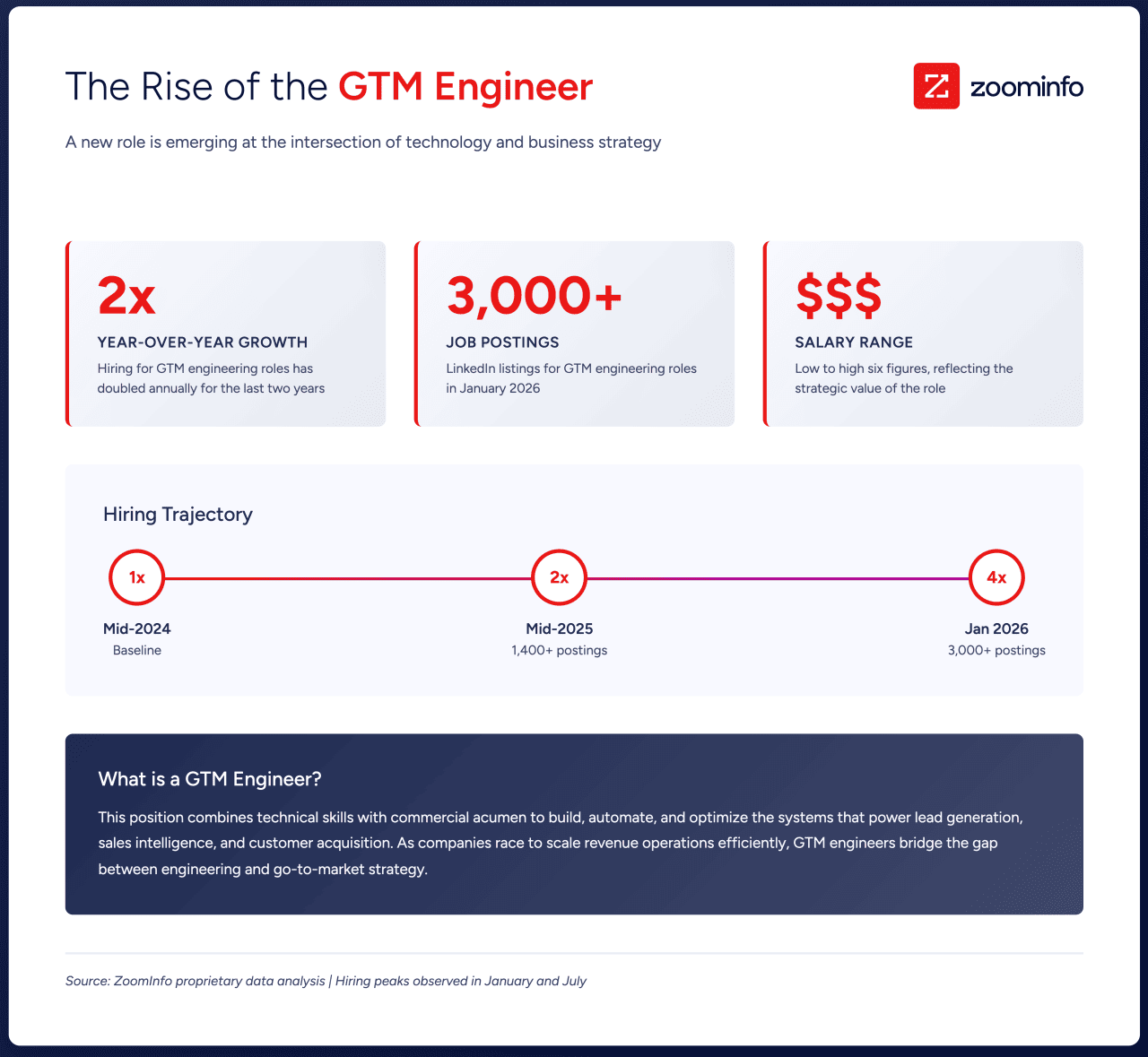
A graphic showing data on the rise of GTM engineer.

ZoomInfo

For professionals looking to pivot into a high-impact role in 2026, GTM engineering offers a compelling opportunity. The position is in demand, commands competitive compensation, and sits at the center of how modern companies drive growth through automated lead generation and sales prospecting tools.

What Is GTM Engineering?

GTM engineering is the application of an engineering mindset to revenue operations. GTM engineers design and automate the systems that power growth—from data pipelines and workflow automation to tool integrations and AI-powered processes.

The role spans software infrastructure, data management, and workflow automation, all working together to help revenue teams move faster, stay aligned, and execute without friction.

Some describe it as revenue systems engineering. Others see it as the next evolution of revenue operations. Either way, it’s a critical function for companies building scalable, efficient, and intelligent go-to-market motions.

Wait—Isn’t This Just Demand Generation?

The short answer: no. While GTM engineering and demand generation both touch marketing systems and care about growth, they sit in fundamentally different parts of the value chain.

Demand generation has historically focused on creating top-of-funnel leads through campaigns and programs. The role centers on volume: running ads, executing email campaigns, hosting events, and optimizing channels to drive more prospects into the pipeline. Demand gen teams answer questions like “How do we get more leads?” and “Which channels drive the most pipeline?”

GTM engineering operates differently. Rather than running individual campaigns, GTM engineers build the underlying systems that make revenue generation repeatable, automated, and scalable across the entire funnel.

Here’s the distinction:

Demand generation asks: “How do we get more people in?”

GTM engineering asks: “How does the entire system work once they’re in—and how do we make it automatic, intelligent, and compounding?”

Demand gen is about execution. GTM engineering is about architecture.

Consider the evolution: Demand generation traditionally ran one-off programs to generate leads. That approach worked when sales cycles were simpler and tech stacks were smaller. But as buying processes became more complex, the role needed to evolve. Modern demand generation now operates in an “always-on” mode—identifying signals that indicate demand and routing those signals to the right person to act on them.

GTM engineers take that evolution further. They’re still responsible for systems that drive top-of-funnel demand, but they also own what happens after the lead comes in: routing, enrichment, scoring, nurturing, and conversion optimization. They build the infrastructure that turns signals into action and action into revenue.

A simple test: If the role primarily involves running programs, that’s demand generation. If it involves designing how revenue happens at a systems level, that’s GTM engineering.

How GTM Engineering Differs from RevOps, Marketing Ops, and Sales Ops

The confusion doesn’t stop with demand generation. GTM engineering also overlaps with revenue operations, marketing operations, and sales operations—roles that have existed for years and already handle pieces of what GTM engineers do.

So what’s the difference?

Revenue Operations (RevOps) focuses on process optimization, reporting, and tool administration across the revenue organization. RevOps professionals ensure teams follow consistent processes, maintain data hygiene, and have visibility into performance metrics. They answer questions like “Are our processes efficient?” and “What’s our pipeline forecast?”

Marketing Operations manages campaign execution, marketing automation platforms, and lead lifecycle management. Marketing ops teams build email workflows, manage lead scoring models, and ensure marketing technology runs smoothly. They focus on making marketing programs scalable and measurable.

Sales Operations handles territory planning, quota management, compensation structures, and sales forecasting. Sales ops professionals optimize how sales teams are organized and ensure they have the resources and data needed to close deals.

GTM Engineering sits at a different level. Rather than optimizing individual functions, GTM engineers design cross-functional systems that connect sales, marketing, and customer success. They build the technical infrastructure that allows data to flow seamlessly between systems, automate workflows that span multiple teams, and implement AI tools that make the entire revenue engine more intelligent.

The reality is that existing operations roles do handle pieces of what GTM engineers do. A marketing ops professional might build a lead scoring model. A RevOps analyst might create a dashboard. A sales ops specialist might integrate two tools.

But GTM engineers approach these tasks from a systems-thinking perspective. They’re not just solving point problems—they’re designing how the entire revenue machine operates.

This creates an important organizational consideration: Companies can’t simply hire a GTM engineer and expect them to replace existing operations roles. These historical functions still need to exist. Instead, forward-thinking companies are rethinking how their entire go-to-market organization works together, with GTM engineers serving as the architects who design systems that operations teams then maintain and optimize.

For professionals in demand gen, RevOps, marketing ops, or sales ops roles, GTM engineering represents an evolution—an opportunity to expand from functional optimization into cross-functional system design.

The Role Is New—and Growing Fast

GTM engineering is still an emerging discipline. The job title only recently began appearing in recruiting platforms and LinkedIn profiles. But the pattern is clear: tech-forward companies are creating dedicated positions to own the technical infrastructure behind their revenue engines.

The role emerged due to several converging forces:

Pressure for efficiency: In an era of tighter budgets, companies need to scale revenue without proportionally scaling headcount. GTM engineers build systems that multiply team output.

Tech stack complexity: Most B2B companies now run dozens of tools across sales, marketing, and customer success. Without tight integration, these tools create data silos and slow execution. GTM engineers connect these systems.

Rise of accessible automation: No-code and low-code platforms, combined with AI tools, have made sophisticated automation accessible to non-developers. GTM engineers leverage these tools to build revenue infrastructure.

Demand for personalization at scale: Generic outreach no longer works. GTM engineers build systems that use data enrichment and AI to personalize interactions at scale.

What Do GTM Engineers Actually Do?

GTM engineers sit at the intersection of strategy and technical execution. Their day-to-day work includes:

Integrating tools: Connecting CRMs, marketing automation platforms, analytics systems, enrichment tools, and product usage platforms so data flows seamlessly across the tech stack.

Automating workflows: Building systems that automate lead routing, follow-ups, data entry, and campaign execution, freeing revenue teams to focus on high-value interactions.

Managing data quality: Ensuring data accuracy, resolving identity issues, and maintaining clean schemas so every system runs on reliable information.

Building dashboards and alerts: Creating real-time visibility into GTM performance so teams can iterate quickly and act on what’s working.

Implementing AI: Integrating machine learning tools for predictive lead scoring, personalized outreach, and identifying high-intent prospects.

For example, a GTM engineer might connect product usage data with CRM records and trigger automated alerts to customer success teams when engagement drops—giving them time to intervene before churn occurs.

Why Consider This Career Path

Several factors make GTM engineering an attractive career option for 2026:

High demand, limited supply: The role is new enough that talent pipelines haven’t caught up with demand. Companies are actively hiring, and competition for qualified candidates is intense.

Competitive compensation: Because the role requires both technical and business skills, compensation tends to be strong. Professionals with this hybrid skill set command premium salaries.

Cross-functional impact: GTM engineers work across sales, marketing, customer success, and leadership. The role offers visibility and influence across the organization.

Future-proof skills: As companies increasingly rely on systems-led growth, the technical and strategic skills GTM engineers develop will remain valuable.

Rapid learning curve: The role exposes professionals to the full revenue lifecycle, modern tech stacks, AI implementation, and strategic decision-making.

Measurable impact: GTM engineers build systems that directly affect revenue metrics. Companies implementing automated GTM systems often report reduced customer acquisition costs and improved conversion rates.

Evolution opportunity: For professionals already in demand generation, RevOps, marketing ops, or sales ops roles, GTM engineering represents a natural next step—expanding from functional optimization into cross-functional system design.

Who Should Consider GTM Engineering

GTM engineers come from several backgrounds:

From operations roles: Sales operations, marketing operations, or revenue operations professionals who want to deepen their technical skills represent the most common pathway. These individuals already understand GTM processes and pain points—they just need to add technical capabilities.

From demand generation: Demand gen professionals who want to move from campaign execution to system design can transition by learning automation, integration, and data management skills.

From engineering or data roles: Software engineers or data analysts interested in the commercial side of business can transition by learning sales cycles, marketing fundamentals, and GTM-specific tools.

From sales or marketing roles: High-performing sales development representatives or marketers who are technically inclined can learn automation and data skills to build systems that scale their own manual work.

The ideal candidate combines curiosity about technology with interest in how businesses generate revenue.

Skills You’ll Need

GTM engineers blend technical ability with commercial understanding. Key skills include:

Technical proficiency

– Experience with CRMs like Salesforce or HubSpot
– Familiarity with automation platforms such as Zapier or Make
– Familiarity with – Basic scripting knowledge (Python or SQL helpful but not always required)
– Understanding of APIs and data integration
– Comfort with analytics and business intelligence tools

Commercial acumen

– Understanding of sales cycles and pipeline stages
– Knowledge of marketing fundamentals and campaign mechanics
– Familiarity with customer lifecycle and retention strategies
– Ability to translate business goals into technical requirements

Problem-solving mindset

– Identifying bottlenecks in in revenue processes
– Designing scalable technical solutions
– Testing and iterating on workflows
– Measuring and optimizing system performance

Communication skills

– Explaining technical concepts to non-technical stakeholders
– Collaborating across sales, marketing, and customer success teams
– Documenting systems and processes clearly

Where GTM Engineers Work

GTM engineers are most commonly found in:

High-growth B2B SaaS companies. These organizations need to scale efficiently and experiment rapidly. They often hire generalist GTM engineers who can bridge multiple functions.

Mid-size to large enterprises. Larger organizations use GTM engineers to break down data silos, manage complex tech stacks, and implement sophisticated operations like predictive analytics and account-based marketing.

Product-led growth companies. Organizations with PLG motions generate significant user data that needs to be operationalized for sales. GTM engineers build the systems that turn product signals into revenue actions.

How to Break Into GTM Engineering

There’s no single formal path, but most successful transitions follow these steps:

Build a portfolio: Create and document projects that solve real business problems. Showcase quantifiable impact such as “automated lead scoring system, reducing manual effort by 60 percent” or “integrated three tools via API, eliminating data entry for 10-person team.”

Understand the full revenue lifecycle: Study how leads move through the funnel, how marketing and sales collaborate, and how customer success drives retention. Read case studies and follow GTM thought leaders.

Network strategically: Join professional communities and online groups focused on revenue operations and GTM engineering. Many roles are filled through referrals and community connections.

Position your experience: When applying, emphasize projects where you built systems, automated processes, or integrated tools—even if those weren’t your primary responsibilities. Frame your experience around impact on revenue metrics.

Real-World Impact: What Success Looks Like

GTM engineers create measurable business value by replacing manual work with automated systems. Consider a B2B sales team where 10 sales development representatives manually research prospects using LinkedIn and search engines, then write personalized outreach emails one by one. The process caps output at roughly 20 quality touches per person per day.

A GTM engineer might design an automated system using a no-code platform, data enrichment APIs, and an email sequencer. The system identifies prospects based on specific signals—such as recent funding, new executive hires, or competitor mentions—then enriches contact data and generates personalized email copy using AI.

The automated system handles thousands of personalized outreach efforts while the sales team focuses on conversations with engaged prospects. Customer acquisition costs drop, qualified leads increase, and representatives spend time on high-value activities rather than research and data entry.

This type of force multiplication defines the GTM engineering role.

Is GTM Engineering Right for You?

Consider this career path if you:

– Enjoy solving problems through systems and automation
– Want to work at the intersection of technology and business strategy
– Prefer building infrastructure over managing day-to-day operations
– Are comfortable learning new tools and technologies quickly
– Want measurable impact on company revenue and growth
– Thrive in cross-functional environments
– Are currently in demand gen, RevOps, or operations roles and want to expand your scope

The role may not suit professionals who prefer deep specialization in a single domain or those who want to avoid technical work entirely.

Looking Ahead in 2026

As companies continue prioritizing efficient growth and systems-led revenue operations, demand for GTM engineers will likely accelerate. The role offers an opportunity to develop valuable hybrid skills, work on high-impact projects, and position yourself at the center of how modern businesses scale.

For professionals considering a career move in 2026, GTM engineering represents a path worth exploring—particularly for those who want to combine technical capabilities with strategic business impact.

The discipline is still emerging, which means early adopters have the opportunity to shape the role, build expertise while competition is limited, and establish themselves as specialists in a growing field.

Whether you’re in operations and want to build more, in demand generation and want to design systems rather than run campaigns, in engineering and want commercial context, or in sales and marketing and want to create leverage through systems, GTM engineering offers a compelling next step.

This story was produced by ZoomInfo and reviewed and distributed by Stacker.

Topics:

Careers & Education


Climb the Ladder

What Does a Proofreader Do? Job Description, Skills & Salary

Everything you need to know about proofreading careers and how to get started

Proofreader
Amirah icon
By Jenell Talley
Jenell Talley is a journalist and program analyst with a background spanning media, government, and editorial work. She holds a journalism degree from Howard University and a master's in human resources management from the University of Maryland.
6 min read • Originally published May 3, 2017 / Updated March 19, 2026
Amirah icon
By Jenell Talley
Jenell Talley is a journalist and program analyst with a background spanning media, government, and editorial work. She holds a journalism degree from Howard University and a master's in human resources management from the University of Maryland.
6 min read • Originally published May 3, 2017 / Updated March 19, 2026

Last updated: January 2026

In this article: What Proofreaders Do | Proofreader vs. Copy Editor | Skills Required | Salary | Tools | How to Become One | FAQs

Proofreaders are the last line of defense before content goes public. They catch the typos, fix the punctuation errors, and ensure every piece of text is polished and professional. If you have a sharp eye for detail and a love of language, proofreading could be an ideal career path.

What Does a Proofreader Do?

A proofreader reviews written content to ensure it’s free of errors before publication. This includes checking for:

  • Spelling mistakes
  • Grammar and punctuation errors
  • Typos and typographical inconsistencies
  • Formatting issues
  • Syntax problems
  • Style guide compliance

“I see proofreading as reading a proof—analyzing it on a visual and content level for final changes after it’s evolved through its stages of revision,” says Mary Emma Koles, owner and founder of online editing company Ink200 and director of SpiderSmart Learning Centers.

A proofreader notices the extra space after a period, the use of “their” instead of “they’re,” and a compound adjective missing a hyphen. The job is about fine-tuning every aspect of every word and line to ensure the most fluid, error-free presentation possible.

Types of Content Proofreaders Work On

  • Books and manuscripts
  • Academic papers and dissertations
  • Marketing materials and advertisements
  • Website content and blog posts
  • Business documents and reports
  • Resumes and cover letters
  • Legal documents
  • Social media content

Proofreader vs. Copy Editor: What’s the Difference?

People often confuse proofreaders with copy editors, but there’s an important distinction:

Proofreader Copy Editor
Works on final drafts Works on earlier drafts
Catches surface-level errors May rewrite and restructure text
Focuses on typos, grammar, and formatting Focuses on clarity, flow, consistency
Last step before publication Earlier in the editorial process
No rewriting involved May rephrase and revise

Corrections at the sentence and word level should already be made before the text reaches a proofreader. Proofreading is the final polish, not a rewrite.

Skills Required for Proofreaders

Core Skills

  • Attention to detail – Catching errors others miss
  • Mastery of grammar and punctuation – Knowing the rules inside and out
  • Patience – The work requires meticulous, line-by-line review
  • Precision – Fine-tuning word-to-word, sentence-to-sentence
  • Concentration – Maintaining focus through lengthy documents
  • Time management – Meeting deadlines while maintaining quality

“Patience for the tediousness that comes with fine-tuning every single aspect of every single word and line,” advises Koles. “Precision for the fine-tuning required in revising word-to-word, sentence-to-sentence, and paragraph-to-paragraph.”

Technical Skills

  • Style guide knowledge – Familiarity with AP, Chicago, APA, and other guides
  • Microsoft Word proficiency – Especially Track Changes
  • Google Docs – Suggesting mode and commenting
  • Basic HTML/hyperlinking – For web content proofreading
  • PDF markup tools – Adobe Acrobat annotation features

Proofreader Salary

Proofreader salaries vary based on experience, location, industry, and whether you work freelance or in-house:

Experience Level Annual Salary Hourly Rate (Freelance)
Entry-Level (0-2 years) $35,000 – $42,000 $18 – $25/hour
Mid-Level (3-5 years) $42,000 – $52,000 $25 – $40/hour
Senior (6+ years) $52,000 – $65,000 $40 – $60/hour
Specialized (Legal, Medical, Technical) $55,000 – $75,000+ $50 – $100+/hour

Factors affecting salary:

  • Location – Major cities pay more than rural areas
  • Industry – Legal and medical proofreading commands higher rates
  • Specialization – Technical expertise can significantly increase earnings
  • Employment type – Freelancers may earn more per hour but have variable income

Proofreading Tools and Software

Modern proofreaders use a combination of software tools and manual review:

Essential Tools

  • Microsoft Word Track Changes – Industry standard for marking edits
  • Google Docs Suggesting Mode – Collaborative editing for online documents
  • Adobe Acrobat – PDF annotation and markup
  • Grammarly – AI-assisted grammar and spelling check
  • ProWritingAid – Style and readability analysis
  • PerfectIt – Consistency checking for professional documents
  • Hemingway Editor – Readability and clarity analysis

Style Guides to Know

  • APA Style – Academic and scientific writing
  • Chicago Manual of Style (CMS) – Book publishing and academic work
  • AP Style – Journalism and news writing
  • MLA Style – Humanities and liberal arts

A Note on AI Tools

AI proofreading tools like Grammarly are helpful for catching common errors, but they don’t replace human proofreaders. AI can miss context-dependent errors, nuanced style issues, and industry-specific terminology. The most effective approach combines AI assistance with human expertise.

Freelance vs. In-House Proofreading

Freelance In-House
Flexible schedule and location Stable income and benefits
Variety of clients and projects Consistent work with one employer
Variable income Predictable paycheck
Must find your own clients Work assigned by supervisors
Higher earning potential per project Career advancement opportunities

“Freelance and consistent positions alike are out there for the taking,” says Koles. “It’s all a matter of seeking new avenues to editing work and—of course—doing an exceptional job with every single piece you are given to polish and perfect!”

How to Become a Proofreader

1. Build Your Skills

Start by strengthening your knowledge of grammar, punctuation, and style. Study style guides relevant to your target industry. Practice proofreading anything you can get your hands on.

2. Gain Experience

Proofread for friends and family—resumes, college essays, cover letters. Volunteer for organizations that need editorial help. Every piece you proofread builds your skills and portfolio.

3. Create a Portfolio

Document your work with before-and-after samples (with permission). Show potential clients or employers the types of errors you catch and how you improve text.

4. Get Certified (Optional)

While not required, certifications can boost credibility:

  • Editorial Freelancers Association courses
  • UC San Diego Copyediting Certificate
  • ACES: The Society for Editing training

5. Land Your First Role

Look for entry-level editorial positions at publishers, websites, or marketing agencies. Smaller publications are often more willing to hire less experienced proofreaders.

6. Specialize (For Higher Pay)

Consider developing expertise in high-paying niches like legal, medical, or technical proofreading. Specialized knowledge commands premium rates.

Who Do Proofreaders Report To?

In most professional settings, proofreaders report to an editor or editorial manager who oversees the publication process. Freelance proofreaders work directly with clients or through editing agencies.


Frequently Asked Questions

What does a proofreader do?

A proofreader reviews written content for errors in spelling, grammar, punctuation, and formatting. They ensure text is accurate, consistent, and error-free before publication—the final quality check before content goes public.

What’s the difference between a proofreader and a copy editor?

A proofreader focuses on catching surface-level errors (typos, spelling, punctuation) in final drafts without rewriting. A copy editor works earlier in the process and may restructure sentences, improve clarity, and make more substantial changes to the text.

How much do proofreaders make?

Entry-level proofreaders earn $35,000–$42,000 annually. Mid-level proofreaders make $42,000–$52,000, while senior proofreaders can earn $52,000–$65,000+. Freelance rates range from $18 to $60+ per hour, depending on experience and specialization.

Do I need a degree to become a proofreader?

A degree isn’t required, though many proofreaders have backgrounds in English, journalism, or communications. What matters most is demonstrable skill in grammar, attention to detail, and knowledge of style guides. A strong portfolio can be more valuable than formal credentials.

Is proofreading a good career?

Proofreading can be a rewarding career for detail-oriented individuals who love language. It offers flexibility (especially for freelancers), the satisfaction of perfecting written work, and opportunities across many industries. However, the work can be tedious and requires sustained concentration.

What skills do proofreaders need?

Essential skills include mastery of grammar and punctuation, attention to detail, patience, precision, and familiarity with style guides (AP, Chicago, APA). Technical skills like Microsoft Word, Track Changes, and Google Docs are also important.

Can I work from home as a proofreader?

Yes. Many proofreading jobs are remote, especially freelance positions. All you need is a computer, a reliable internet connection, and the necessary software. Remote proofreading opportunities exist in publishing, marketing, legal, and many other industries.

What tools do proofreaders use?

Common tools include Microsoft Word (Track Changes), Google Docs (Suggesting mode), Adobe Acrobat for PDFs, and grammar-checking software like Grammarly or ProWritingAid. Knowledge of style guides (AP, Chicago, APA) is also essential.

Will AI replace proofreaders?

AI tools assist proofreaders but aren’t likely to replace them entirely. AI can miss context-dependent errors, nuanced style issues, and industry-specific terminology. The most effective approach combines AI efficiency with human expertise and judgment.

Ready to start your proofreading career? Browse proofreading jobs on Mediabistro.

Topics:

Climb the Ladder, Skills & Expertise
Advice From the Pros

What Does a Publicist Do? Responsibilities, Skills, Salary & Career Path

A complete guide to the publicist role, including daily responsibilities, essential skills, salary expectations, and how to break into PR.

Publicist
Amirah icon
By Jenell Talley
Jenell Talley is a journalist and program analyst with a background spanning media, government, and editorial work. She holds a journalism degree from Howard University and a master's in human resources management from the University of Maryland.
6 min read • Originally published March 29, 2017 / Updated March 19, 2026
Amirah icon
By Jenell Talley
Jenell Talley is a journalist and program analyst with a background spanning media, government, and editorial work. She holds a journalism degree from Howard University and a master's in human resources management from the University of Maryland.
6 min read • Originally published March 29, 2017 / Updated March 19, 2026

Last updated: January 2026

In this article: What Publicists Do | Key Responsibilities | Required Skills | Tools & Technology | Salary | Career Path | How to Break In | FAQs

A publicist is a communications professional who manages the public image of individuals, brands, or organizations. If you’re a strategic thinker with excellent writing skills and a knack for building relationships, a career in public relations could be an ideal fit.


What Does a Publicist Do?

“At the most basic level, publicists communicate a business or brand’s messages to the consumers they hope to reach, impact, and influence,” says Sakita Holley, CEO of House of Success PR. “The primary function of the role is to work with the brand to decide what those messages will be, how they will be delivered, who will deliver them (and on what platform), and how to engage and maintain a conversation with this target group of people and/or the market.”

A publicist generates and manages publicity for clients—whether they’re public figures, businesses, films, products, or events. The role combines strategic thinking, relationship-building, and strong writing skills to shape how the public perceives a brand or an individual.


Publicist Responsibilities

Daily responsibilities vary depending on the industry and client type, but typically include:

  • Writing — Press releases, media alerts, press kit materials, speeches, bios, and social media content
  • Media relations — Pitching stories to journalists and influencers, arranging interviews and press conferences
  • Image management — Managing and protecting the public image of clients
  • Event coordination — Planning and executing publicity events such as book signings, product launches, and press tours
  • Crisis management — Responding to negative press and developing strategies to mitigate reputational damage
  • Media monitoring — Developing media lists, tracking coverage, and measuring campaign effectiveness
  • Strategy development — Creating comprehensive PR campaigns aligned with client goals

Is All Publicity Good Publicity?

No, says Holley. But skilled publicists can often spin a negative story into something positive—or, at the very least, control the narrative and minimize damage.


Skills Required to Be a Publicist

“Writing has always been a core part of public relations, but with the proliferation of technology and social media, publicists now spend more than 90 percent of their time writing and/or crafting copy for everything from emails, proposals, and pitches, to tweets, social media captions, and marketing materials,” says Holley. If you want to succeed in this field, you must write well.

Essential Skills

Skill Category Specific Skills
Writing Press releases, pitches, speeches, social media copy, crisis statements
Communication Public speaking, presentation skills, media training, storytelling
Relationship Building Networking, media relations, client management, influencer outreach
Strategic Thinking Campaign planning, message development, audience targeting
Problem Solving Crisis management, reputation repair, quick thinking under pressure
Organization Attention to detail, project management, deadline management

Attention to Detail Matters

“A wrong number or address can be a big deal,” says Jessica Janik, owner of The Invisible Bridesmaid, a wedding PR agency. “Could you imagine sending out a press release with the wrong contact number or an invite with the wrong address?”


Tools and Technology for Modern Publicists

Today’s publicists need to master a range of digital tools:

Social Media Management

Tools like Hootsuite and Buffer let you schedule posts, track your clients’ online presence, and engage with audiences across multiple platforms from a single dashboard.

Media Monitoring

Platforms like Mention and Brandwatch track who’s saying what about your clients, helping you identify opportunities, manage potential crises, and measure the impact of your campaigns.

PR Software

Industry-standard tools like Cision, Muck Rack, and Meltwater help publicists build media lists, distribute press releases, track coverage, and measure campaign effectiveness.

Contact Management

CRM systems help you manage your network of media contacts, track interactions, and ensure timely follow-ups. In PR, your network is one of your most valuable assets.

Analytics

Understanding the reach, engagement, and overall effectiveness of your PR efforts is essential. Tools that measure media impressions, sentiment, and share of voice help demonstrate ROI to clients.


Publicist Salary

Publicist salaries vary based on experience, location, industry, and whether you work in-house or at an agency.

Experience Level Typical Salary Range
Entry-Level (0-2 years) $40,000 – $50,000
Mid-Level (3-5 years) $50,000 – $70,000
Senior Publicist (6-10 years) $70,000 – $95,000
PR Director/VP $100,000 – $150,000+

Note: Publicists working with high-profile entertainment clients or in major markets (New York, Los Angeles) can earn significantly more. Celebrity publicists at top firms may earn $150,000-$300,000+.


Publicist Career Path

Level Title Typical Experience
Entry PR Assistant / PR Coordinator 0-2 years
Mid Publicist / Account Executive 2-5 years
Senior Senior Publicist / Account Manager 5-8 years
Leadership PR Director / VP of Communications 8+ years

Many experienced publicists also start their own PR agencies or work as independent consultants.


What Does It Take to Excel as a Publicist?

“Being confident while speaking in front of a large group of people is so important,” says Janik, who recommends joining Toastmasters to sharpen your public speaking skills. “Articulating your thoughts and your client’s story in front of an audience, your coworkers, and the media will open many doors.”


How to Break Into Public Relations

Education

A degree in public relations, journalism, communications, or marketing provides a strong foundation. However, experience often matters more than your specific major.

Start with Internships

“The best route is applying for an internship at a public relations firm in the field you are interested in,” advises Janik. “If it’s fashion, look for a designer you would like to work with or for the public relations agency that represents brands you admire, and apply.”

Build Your Portfolio

Even before landing your first PR job, you can build experience by:

  • Managing social media for student organizations or local nonprofits
  • Writing press releases for campus events
  • Starting a blog to demonstrate your writing skills
  • Freelancing for local businesses that need PR help

Ready to start your publicist career? Browse PR and publicist jobs on Mediabistro.


FAQs About Publicists

What does a publicist do?

A publicist manages the public image of individuals, brands, or organizations. They write press releases, pitch stories to journalists, arrange interviews, plan publicity events, manage crises, and develop strategic communications campaigns to shape public perception.

What is the difference between a publicist and a PR professional?

The terms are often used interchangeably. “Publicist” is more commonly used in entertainment, fashion, and celebrity contexts, while “PR professional” or “communications specialist” is more common in corporate settings. The core skills and responsibilities are similar.

How much do publicists make?

Entry-level publicists typically earn $40,000-$50,000, mid-level professionals earn $50,000-$70,000, and senior publicists can earn $70,000-$95,000 or more. Celebrity publicists and PR directors at major agencies can earn well over $150,000.

What degree do you need to become a publicist?

Most publicists have a bachelor’s degree in public relations, journalism, communications, or marketing. However, experience and demonstrated skills often matter more than your specific major.

Is being a publicist stressful?

Public relations can be demanding. Publicists often work under tight deadlines, manage multiple clients simultaneously, and must be available to handle crises at any time. However, many find the fast pace and variety of work exciting and rewarding.

What skills do publicists need?

Essential skills include excellent writing, strong verbal communication, relationship building, strategic thinking, problem-solving, attention to detail, and proficiency with PR software and social media platforms.

How do I become a celebrity publicist?

Most celebrity publicists start at entertainment PR agencies, working their way up from assistant or coordinator roles. Building relationships within the entertainment industry, understanding celebrity media, and developing a track record of successful campaigns are essential for advancement.

Can publicists work remotely?

Many publicists can work remotely or in hybrid arrangements, especially for tasks like writing, media monitoring, and virtual pitching. However, some roles—particularly in entertainment PR—may require in-person presence for events, photo shoots, and client meetings.

Topics:

Advice From the Pros, Be Inspired
Climb the Ladder

What Does a Video Editor Do? Skills, Tools & Career Guide

From storyboarding to post-production, discover what video editors actually do day-to-day and how to break into this creative field.

What Does a Video Editor Do? Skills, Tools & Career Guide
Amirah icon
By Jenell Talley
Jenell Talley is a journalist and program analyst with a background spanning media, government, and editorial work. She holds a journalism degree from Howard University and a master's in human resources management from the University of Maryland.
3 min read • Originally published February 22, 2017 / Updated March 19, 2026
Amirah icon
By Jenell Talley
Jenell Talley is a journalist and program analyst with a background spanning media, government, and editorial work. She holds a journalism degree from Howard University and a master's in human resources management from the University of Maryland.
3 min read • Originally published February 22, 2017 / Updated March 19, 2026

Marrying video clips, cool sound effects, and cooler graphics sounds like one of the coolest jobs ever. No wonder you’re itching to be a video editor. We got a couple of video editors to tell you all about the job. Take a look at what they had to say and then get scratching.

What exactly does a video editor do?

A video editor uses footage, sound, and graphics to tell a story. A typical day in the life may include creating treatments and storyboards; developing scripts; producing and editing videos and photos for multiple platforms, from short-form daily content for social media platforms to long-form series; and sourcing and/or creating and adding graphics, animations, special effects, music, sound effects, and sound bites.

A video editor also makes decisions about maximizing the content’s value online and helps align the final version of the piece to the appropriate distribution platform, says Elizabeth Giorgi, founder and CEO of internet video production company Mighteor. Audience development and working with members of other departments or an editorial team to ensure consistent and comprehensive content may also be part of the daily grind.

“It is my job to turn raw footage shot by a photographer into a compelling video,” says David Abrams, an auto test video editor/photographer at Consumer Reports. Though you may work with a producer or use a script to guide you, the overall tone of each piece is in the editor’s hands, says Abrams, so whether or not a video accomplishes its goals is often decided in the editing suite.

What skills does a video editor need?

“Storytelling is the number one skill a video editor must have,” says Abrams, noting you must see the video through the eyes of your audience and consider how your edits affect the story you’re telling.

Knowledge of editing tools such as Apple’s Final Cut Pro or Adobe’s Premiere Pro is key, says Abrams, who suggests taking a course or subscribing to a teaching site such as lynda.com to develop your skill set.

Adds Giorgi, “Experience with After Effects, color grading and sound software, as well as the latest in mobile, will make you an invaluable asset.”

Attention to detail and the ability to think laterally and visually are also important.

Who is a video editor’s supervisor?

A video editor at a startup may report to the CEO, while a video editor at a larger company may report to the digital content editor.

How do I get ahead in this position?

Stay abreast of the latest and greatest in technology and digital trends, and never stop honing your editing skills—this includes learning and adapting to new tools.

How can someone break into this field?

Broadcast journalism programs “teach all the basics as well as the guts of storytelling,” says Giorgi. But, if college isn’t your cup of tea—hey, everything isn’t for everybody—don’t count yourself out. If you can get your hands on a computer and editing software, you’re good to go.

“This field tends to value experience over formal education,” adds Abrams. “Your ability to edit and tell stories is far more valuable than [a] degree hanging on your wall.”

If you are looking for a role in video, search our video editing jobs on Mediabistro. Hiring? Post video editor and other creative jobs.

Topics:

Climb the Ladder, Skills & Expertise
Climb the Ladder

What Does an Assistant Editor Do? Skills, Career Path & How to Break In

A look at the day-to-day responsibilities, must-have skills and career advice from assistant editors in the trenches.

What Does an Assistant Editor Do? Skills, Career Path & How to Break In
Amirah icon
By Jenell Talley
Jenell Talley is a journalist and program analyst with a background spanning media, government, and editorial work. She holds a journalism degree from Howard University and a master's in human resources management from the University of Maryland.
3 min read • Originally published February 15, 2017 / Updated March 19, 2026
Amirah icon
By Jenell Talley
Jenell Talley is a journalist and program analyst with a background spanning media, government, and editorial work. She holds a journalism degree from Howard University and a master's in human resources management from the University of Maryland.
3 min read • Originally published February 15, 2017 / Updated March 19, 2026

You’ve put in work managing the EIC’s calendar, replying to reader mail and maybe even writing short items. It’s time you apply for that assistant editor position you’re not-so-secretly dying for. Need more info before making the leap? Check out what a few assistant editors have to say about the job and then hop to it.

What exactly does an assistant editor do?

No matter what type of publication — print, digital, fashion, sports, interior design — an assistant editor’s primary responsibility is taking on assignments in collaboration with the editors and EIC. Routine tasks typically include conceptualizing and pitching stories, conducting research, interviewing sources, writing and editing copy, selecting photos and art to accompany articles, and proofreading. Some assistant editors may also manage social media accounts, and repurpose and curate content.

“Because VIBE is a smaller media company, I might have more tasks assigned to my role,” said Stacy-Ann Ellis, assistant editor. “Aside from assigning, cleaning and prepping pieces for publication, I shoot photography for features, determine the visual elements to accompany our larger pieces, keep track of staff and freelance deadlines, as well as write and shoot feature pieces for myself. It’s a lot.”

What skills does an assistant editor need?

The ability to write clear, concise copy (oftentimes in a hurry) is the most important, said Mary Kaarto, author and speaker. Kaarto spent 22 years working as an assistant editor for various trade publications. “A good assistant editor should be able to provide valid information in as few words as possible, yet make it enjoyable to read,” said Kaarto. You should also be able to generate creative and competitive stories. It doesn’t matter how well you write, if the story is uninspired, no one will read it, she added.

And you should definitely be skilled in prioritizing a hectic workload, said Ellis, as well as effectively communicating with staff members and working quickly and cleanly.

Being a self-starter and willing to take on any task, from opening mail to answering phones, is also a major deal, added Devon Warren, managing editor at Arts & Crafts magazine publisher Stampington & Company.

Who is an assistant editor’s supervisor?

If you work for a smaller publication as Kaarto did, you’ll likely report directly to the magazine’s editor. At a larger publication or website, an assistant editor may work for a specific section, such as news or fashion, in which case she might report to the editor of that section.

How important are digital skills?

“Nowadays, digital publication employers want multi-hyphenates who can do their own job and jump in to do someone else’s job if need be,” said Ellis. “That’s just the way it is.”

What does it take to excel in this position?

The ability to quickly solve problems in a pinch is vital to your success in this position, said Kaarto, who suggests keeping a backlog of timely filler material on hand for emergencies.

Organizing your time well and offering to assist your colleagues will cast you in a favorable light, advised Warren. And be adaptable, added Ellis. Nowadays, everything’s in flux, so staying ahead of the curve is more important than ever.

How can I break into this field?

A degree, preferably in English or journalism, helps. So does having a couple of internships under your belt. And while you’re gaining all that (unpaid) experience, network. Ellis advises that hard work and making — and maintaining — good connections pays off.

Topics:

Climb the Ladder, Skills & Expertise
Climb the Ladder

What Does an SEO Copywriter Do? Skills, Day-to-Day & How to Break In

If you’ve got the writing chops and SEO savvy, then SEO copywriter could be the job for you

What Does an SEO Copywriter Do? Skills, Day-to-Day & How to Break In
Amirah icon
By Jenell Talley
Jenell Talley is a journalist and program analyst with a background spanning media, government, and editorial work. She holds a journalism degree from Howard University and a master's in human resources management from the University of Maryland.
3 min read • Originally published February 1, 2017 / Updated March 19, 2026
Amirah icon
By Jenell Talley
Jenell Talley is a journalist and program analyst with a background spanning media, government, and editorial work. She holds a journalism degree from Howard University and a master's in human resources management from the University of Maryland.
3 min read • Originally published February 1, 2017 / Updated March 19, 2026

If you’ve got the writing chops and SEO savvy, then we’ve got the job for you: SEO copywriter. It may be the coolest job you’ve ever heard of. See what a few people in the field say about the position. Then, tell us we were right. We’ll be here, waiting.

What Exactly Does an SEO Copywriter Do?

An SEO copywriter writes copy that helps boost a website’s search engine rankings. The job is similar to that of an SEO specialist, but they aren’t the same. While an SEO specialist focuses on analyzing, reviewing, and executing changes to existing content to boost a site’s standing, an SEO copywriter typically creates original content to support the specialist’s strategy. An SEO copywriter must balance writing for search engines and writing for people, appealing to—and persuading—readers.

“The primary purpose of this role is to write copy that is search engine optimized through including keywords,” says James Nuttall, a copywriter who does SEO copywriting at Roman Blinds Direct. “This involves writing content across an entire website, from page descriptions to blog articles, helping to push your site up Google’s rankings.”

SEO copywriters craft Tweets, blog and Facebook posts, product descriptions, sales and promotional copy, and other content. Their specialty is considering keyword density and prominence as well as tone, style, and readability. Common tasks include:

  • Researching product attributes, competitive keywords, and content landscape.
  • Auditing websites to help develop off-site and on-site SEO campaigns.
  • Monitoring searcher and customer behaviors.

What Skills Do You Need?

You have to know how to write well. The word is copywriter, after all. “No matter how well your content may be optimized, if the words on the page aren’t worth reading, your target audience will not be interested—not to mention Google can tell the difference between good and bad copy,” says Nuttall.

“Knowing who your audience is and how they interact with your content is essential to creating copy that will convert, inform and be shared,” says Kevin Rossignol, senior SEO copywriter and editor at BudgetDumpster.com.” You also need a working knowledge of technical SEO, PR and analytics to consistently improve your copy, he adds.

And you should be able to take constructive criticism—any writer should, frankly. You can’t always get a hole in one, so don’t take it personally when someone doesn’t love what you wrote.

Who Is an SEO Copywriter’s Supervisor?

It depends on the company, but you could report to a web content supervisor, an SEO content manager, or someone in the marketing department.

What Does It Take to Excel at This Job?

“You must be a good writer, although that’s secondary,” says Eric Brantner, an SEO copywriter and managing editor at Scribblrs.com, a blogging and content marketing site. “It’s more understanding how to talk to people, then [putting] it on ‘paper,’” he says.

How Can Someone Break Into This Field?

No degree is typically required, except maybe at the agency level, says Brantner, who recommends getting started by putting together your own site or mock business sites to showcase your talent.

Topics:

Climb the Ladder, Skills & Expertise
Skills & Expertise

What Does a Journalist Do? Job Responsibilities, Skills, and Career Path

From breaking news to long-form investigations, here's what journalists actually do every day (and the skills you need to get hired).

Journalist working hard on a story
Leah icon
By Jenell Talley
Jenell Talley is a journalist and program analyst with a background spanning media, government, and editorial work. She holds a journalism degree from Howard University and a master's in human resources management from the University of Maryland.
3 min read • Originally published January 11, 2017 / Updated March 19, 2026
Leah icon
By Jenell Talley
Jenell Talley is a journalist and program analyst with a background spanning media, government, and editorial work. She holds a journalism degree from Howard University and a master's in human resources management from the University of Maryland.
3 min read • Originally published January 11, 2017 / Updated March 19, 2026

So you’ve wanted to be a journalist since you were 12 and have a framed picture of Dan Rather on your nightstand to prove it. Cool. Hashtag career goals.

Kick off “Operation Become a Journalist” by getting the scoop on the job from a couple of seasoned pros. Then go break that story.

What exactly does a journalist do?

Journalists are storytellers. They write and report news stories about everything, from social issues and politics to sports and entertainment. A journalist presents information so folks can form opinions and make prudent decisions. “Journalists educate and inform the public about events and issues and how they affect their lives,” says Rebecca Briscoe, Houston Style Magazine national features reporter.

With newsrooms operating leaner and more digital than ever, journalists today juggle more roles than their predecessors. Beat reporters file for multiple platforms. Investigative journalists produce videos alongside their longform pieces. The job description has widened even as staffs have shrunk.

But getting to the story takes some legwork. A journalist spends time perusing press releases and developing story ideas; verifying facts; researching and investigating a single topic (sometimes for years!) for in-depth, long-form pieces; cultivating sources and relationships; and interviewing subjects.

And depending on where the journalist works, the job may entail anchoring a newscast, on-the-spot reporting, taking photos and producing content, including videos, for social media platforms.

What skills does a journalist need?

A mean pen game goes without saying. That includes having a voice that stands out. “The same way a verbal storyteller has a voice and a presentation style, so too should the journalist,” explains freelance writer Cari Shane, who’s written articles for various publications, including The Washington Post, Budget Travel and The Huffington Post. “The way words are written is key to the final product.”

Interviewing and interpersonal skills are important too. Extracting info from some subjects can be like pulling teeth, after all. You should also understand how media is consumed.

Does that mean I need digital skills?

You don’t have to be a digital deity, but experience with HTML and CMS, on-air content systems such as ENPS (Electronic News Production System), digital editing software and analytics is smiled upon.

“Hootsuite is a great way to manage social media platforms, Dropbox is the best method for me to share secure files, and Tweetbinder is my lifesaver when I want to quantify social media trends and engagement,” offers Briscoe.

Speaking of the digital space, are bloggers and people who report on celebrities journalists?

There’s no consensus on what makes someone a journalist, so the answer depends on whom you ask.

“They’re journalists if they approach their work as journalists [do]—that is, taking the job seriously, being a stickler for accuracy and writing well,” says Kent Klein, substitute host of the POTUS channel on SiriusXM.

“I consider myself a journalist because I have fact checked and researched my topic thoroughly,” says Briscoe, adding that most of her pieces offer serious, thought-provoking content.

Who’s my supervisor?

An editor, also known as the gatekeeper.

Do I need a journalism degree to break into the field?

“There’s nothing wrong with a journalism degree, but I would prefer a content-based discipline—economics, politics or foreign relations, for example,” says Klein. But experience is what really seals the deal. If you can get the story and translate it to paper, you’re as good as hired. Knock out a couple of internships while you’re still in school to get a head start.

Now, hop on over to the job board to find the perfect journalism job.

Topics:

Climb the Ladder, Skills & Expertise
Skills & Expertise

What Does a Copywriter Do? Responsibilities, Skills & Career Guide

Job description, skills, salary, and how to start your copywriting career.

What does a copywriter do?
Katie icon
By Jenell Talley
Jenell Talley is a journalist and program analyst with a background spanning media, government, and editorial work. She holds a journalism degree from Howard University and a master's in human resources management from the University of Maryland.
8 min read • Originally published September 19, 2016 / Updated March 19, 2026
Katie icon
By Jenell Talley
Jenell Talley is a journalist and program analyst with a background spanning media, government, and editorial work. She holds a journalism degree from Howard University and a master's in human resources management from the University of Maryland.
8 min read • Originally published September 19, 2016 / Updated March 19, 2026

A copywriter creates written content designed to persuade, inform, and engage audiences. From website copy and email campaigns to social media posts and product descriptions, copywriters are the voices behind the brands you interact with every day.

If you’re considering a career in copywriting—or hiring a copywriter for your team—this guide covers everything you need to know: what copywriters actually do, the skills required, salary expectations, and how to break into the field.

Quick Links

  • What Does a Copywriter Do?
  • Copywriter Skills
  • Digital & SEO Skills
  • Copywriter Salary
  • Tools & Software
  • How to Become a Copywriter
  • FAQs

What Does a Copywriter Do?

Good copywriting can sell products; great copywriting can make a company.

A copywriter creates clear, compelling copy to sell products, educate consumers, and build brand awareness. This includes writing for websites, blog posts, email campaigns, social media, product descriptions, print ads, video scripts, landing pages, sales letters, white papers, and other marketing materials.

Typical Copywriter Responsibilities

  • Writing persuasive copy for websites, ads, emails, and social media
  • Researching topics, products, and target audiences
  • Adapting tone and style to match different brands and platforms
  • Collaborating with designers, marketers, and creative directors
  • Editing and proofreading content for clarity and accuracy
  • Brainstorming concepts and developing creative campaigns
  • Optimizing content for SEO when required
  • Ensuring consistent brand voice across all channels
  • Meeting deadlines and managing multiple projects

Copywriters may also produce internal materials—employee communications, policies, training content—rather than external marketing campaigns.

“A typical day might include researching a topic online or conducting an interview, figuring out how to convey an idea to a specific audience, writing and editing copy, and finding images to accompany the content,” says Susan Hawkins, owner of POP Qs Party Games and a copywriter with more than 25 years of experience.

Who Does a Copywriter Report To?

Reporting lines depend on the work environment:

  • At agencies: Creative Director, Copy Chief, or Associate Creative Director
  • In-house (brands): Marketing Director, Content Manager, or Brand Manager
  • Freelance: Directly to clients, often the marketing director or business owner

Copywriter Skills: What You Need to Succeed

Writing skills, of course. But it’s more than stringing together coherent sentences.

“As a professional, you have to know how to write copy that sells to the client’s specific audience,” says freelance copywriter Helen Holt of Writing-preneur Copywriting Services. “A copywriter’s job is providing deliverables—custom-made to order.”

Essential Copywriting Skills

  • Persuasive writing — Crafting copy that motivates action
  • Adaptability — Writing for different brands, audiences, and platforms
  • Research skills — Quickly learning about unfamiliar topics and industries
  • Grammar and editing — Flawless spelling, punctuation, and proofreading
  • Headline writing — Capturing attention in a few words
  • Storytelling — Building narratives that connect emotionally
  • Meeting deadlines — Delivering quality work on time, every time
  • Taking direction — Executing a client’s vision while adding creative value

“Grammar, spelling, and punctuation count,” adds Hawkins. “Know the difference between ‘everyday’ and the phrase ‘every day’—they’re not interchangeable. Spelling can make or break your career.”

“If you can’t deliver quality content on a given deadline, you probably won’t make it as a copywriter,” she says.

Digital Skills: SEO and Beyond

In a word: essential. Writing content is no longer enough.

“You have to know how to optimize the content to drive traffic to your client’s website, landing page, or blog,” says Holt. “This means keeping current with digital technology, including Google’s algorithm changes, so you know which SEO techniques are most effective.”

Digital Skills for Modern Copywriters

  • SEO fundamentals — Keyword research, on-page optimization, meta descriptions
  • Content management systems — WordPress, Webflow, HubSpot, etc.
  • Analytics basics — Understanding how to measure content performance
  • Social media writing — Platform-specific formats and best practices
  • Email marketing — Subject lines, CTAs, and email copywriting conventions
  • AI writing tools — Familiarity with tools like ChatGPT, Jasper, Copy.ai

Copywriter Salary

Copywriting offers diverse financial prospects depending on experience, specialization, and work arrangement.

According to Glassdoor, the average base salary for a copywriter in the United States is approximately $65,000–$80,000 per year, with significant variation based on location, industry, and seniority.

Copywriter Salary by Experience Level

Level Typical Salary Range
Junior Copywriter $45,000 – $60,000
Copywriter $55,000 – $75,000
Senior Copywriter $70,000 – $95,000
Lead Copywriter / Copy Chief $85,000 – $115,000
Associate Creative Director (Copy) $100,000 – $140,000+

Freelance copywriters typically charge per word ($0.10–$1.00+), per hour ($50–$150+), or per project. Rates vary widely based on experience, niche, and client type.

Specializing in high-value industries—tech, finance, healthcare, SaaS—can significantly increase earning potential.

Tools and Software for Copywriters

Modern copywriters need proficiency beyond a word processor:

  • Writing & editing: Google Docs, Microsoft Word, Grammarly, Hemingway Editor
  • SEO tools: SEMrush, Ahrefs, Clearscope, Surfer SEO
  • Content management: WordPress, HubSpot, Contentful, Webflow
  • Project management: Asana, Monday.com, Trello, Notion
  • AI assistants: ChatGPT, Jasper, Copy.ai, Writer
  • Design basics: Canva, Adobe Creative Suite (helpful for collaborating with designers)

The Impact of Copywriting on Branding

A significant part of a copywriter’s role is contributing to a brand’s identity. While marketing executives may set the overarching brand strategy, the copywriter brings this vision to life in words.

Copywriters help define the brand voice, ensuring consistency across all channels. Whether it’s an advertisement, a social media post, or an email campaign, the language must align with the brand’s personality and objectives. A skilled copywriter can elevate a brand, making it more memorable and relatable to its target audience.

How to Become a Copywriter

A bachelor’s degree in journalism, English, marketing, or communications can help, but what matters most is your portfolio. A collection of strong writing samples—from classes, internships, freelance work, or pro bono projects—is what will land you jobs.

Steps to Break Into Copywriting

  1. Study the craft — Read books on copywriting (Ogilvy, Sugarman, Schwartz), take online courses
  2. Build a portfolio — Create spec work, volunteer for nonprofits, start a blog
  3. Learn SEO basics — Understanding optimization makes you more marketable
  4. Develop a niche — Specializing (tech, health, finance, e-commerce) can accelerate your career
  5. Network — Connect with other copywriters, marketers, and creative directors
  6. Apply for entry-level roles — Look for Junior Copywriter, Content Writer, or Marketing Writer positions
  7. Consider freelancing — Build experience through platforms like Contently, Upwork, or direct outreach

“Practice writing and develop a style,” advises Hawkins. “And for the love of chocolate, don’t ever, ever plagiarize. You’ll be outed faster than a cheating politician.”

Career Path for Copywriters

Copywriting offers multiple paths for career growth:

  1. Junior Copywriter — Learning the fundamentals, supporting senior writers
  2. Copywriter — Managing projects independently, developing expertise
  3. Senior Copywriter — Leading campaigns, mentoring juniors
  4. Lead Copywriter / Copy Chief — Overseeing copy quality across projects
  5. Associate Creative Director (Copy) — Strategic creative leadership
  6. Creative Director — Leading creative vision across copy and design

Some copywriters transition into related roles, such as content strategy, UX writing, brand strategy, or marketing leadership. Others build successful freelance or consulting businesses.

Ongoing Learning and Development

The copywriting industry evolves constantly, making continuous learning essential. This could mean taking courses in new writing techniques, attending workshops on consumer psychology, or staying current with digital marketing trends.

Personal blogging can help copywriters refine their voice and sharpen technical skills. Though it may be difficult to write during a job that requires heavy writing, maintaining your own platform keeps you at the top of your game.

Stay open to feedback and continually refine your craft based on performance metrics and audience engagement. Keeping a finger on the pulse of cultural shifts and emerging platforms provides a competitive edge.

Find Copywriter jobs on Mediabistro


FAQs About Copywriting Jobs

Q: What does a copywriter do?

A: A copywriter creates written content designed to persuade, inform, or engage an audience. This includes website copy, advertisements, email campaigns, social media posts, product descriptions, and other marketing materials. The goal is to communicate a brand’s message effectively and drive desired actions from readers.

Q: What’s the difference between a copywriter and a content writer?

A: Copywriters typically focus on persuasive, sales-oriented writing (ads, landing pages, email campaigns), while content writers often produce longer-form informational content (blog posts, articles, guides). However, the lines are increasingly blurred, and many writers do both.

Q: How much do copywriters make?

A: The average copywriter salary in the U.S. is approximately $65,000–$80,000 per year, with senior roles earning $85,000–$115,000+. Freelance copywriters charge anywhere from $50 to $150+ per hour, depending on experience and specialization. High-value niches like tech and finance often pay more.

Q: Do I need a degree to become a copywriter?

A: A degree in English, journalism, marketing, or communications can help, but it’s not strictly required. What matters most is your portfolio—demonstrating strong writing samples that show you can craft compelling copy. Many successful copywriters are self-taught.

Q: What skills do copywriters need?

A: Essential skills include persuasive writing, research ability, grammar and editing, adaptability across tones and formats, meeting deadlines, and understanding audience psychology. Digital skills like SEO, content management systems, and email marketing are increasingly important.

Q: How important is SEO for copywriters?

A: Very important for digital copywriting. Understanding keyword research, on-page optimization, and how search engines work makes copywriters significantly more valuable—especially for web content, blog posts, and landing pages.

Q: Can I become a copywriter with no experience?

A: Yes. Build a portfolio through spec work (creating samples for hypothetical or real brands), volunteer projects for nonprofits, personal blogging, or taking copywriting courses that include portfolio-building assignments. Many copywriters start freelancing to gain experience before landing full-time roles.

Q: What industries hire copywriters?

A: Virtually every industry needs copywriters: advertising agencies, tech companies, e-commerce, healthcare, finance, consumer brands, media companies, nonprofits, and more. Any organization that communicates with customers needs someone to write.

Q: What’s the career path for a copywriter?

A: The typical progression is Junior Copywriter → Copywriter → Senior Copywriter → Lead Copywriter/Copy Chief → Associate Creative Director → Creative Director. Some copywriters transition into content strategy, UX writing, brand strategy, or build freelance businesses.

Q: How do copywriters work with AI writing tools?

A: Many copywriters use AI tools like ChatGPT, Jasper, or Copy.ai to speed up first drafts, generate ideas, or handle repetitive tasks. However, AI output still requires significant human editing for quality, accuracy, and brand voice. The best copywriters use AI as an assistant, not a replacement.

Q: Is copywriting a good career?

A: Yes—copywriting offers strong demand, competitive salaries, creative work, and flexibility (including remote and freelance options). As long as businesses need to communicate with customers, they’ll need skilled copywriters. The key is continually developing your skills as platforms and technologies evolve.

Last updated: January 2026

Topics:

Climb the Ladder, Skills & Expertise
Skills & Expertise

What Does an Account Manager Do? Skills, Salary & How to Break In

Everything you need to know about account management roles at agencies, including daily responsibilities, required skills, and career path.

account manager job description
Valerie icon
By Jenell Talley
Jenell Talley is a journalist and program analyst with a background spanning media, government, and editorial work. She holds a journalism degree from Howard University and a master's in human resources management from the University of Maryland.
5 min read • Originally published June 6, 2016 / Updated March 19, 2026
Valerie icon
By Jenell Talley
Jenell Talley is a journalist and program analyst with a background spanning media, government, and editorial work. She holds a journalism degree from Howard University and a master's in human resources management from the University of Maryland.
5 min read • Originally published June 6, 2016 / Updated March 19, 2026

Last updated: January 2026

In this article: What Account Managers Do | Key Responsibilities | Required Skills | Salary | Career Path | How to Break In | FAQs

Part salesperson, part customer-service representative, an account manager is the critical link between a company and its clients. If you enjoy building relationships, solving problems, and ensuring client satisfaction, account management could be an ideal career path.


What Does an Account Manager Do?

An account manager serves as the liaison between an agency (or company) and its clients. They oversee the client relationship from start to finish—understanding what clients want to achieve, ensuring the agency delivers, and keeping everyone aligned along the way.

“I am responsible for making sure clients’ needs are met, and their voices are heard while coordinating with others and fulfilling the contractual day-to-day duties we’ve been hired to perform,” says Beth Adan, senior publicist at Three Girls Media, a public relations and social media management agency in Washington.


Account Manager Responsibilities

Daily responsibilities vary by industry and company size, but typically include:

  • Client relationship management — Building and maintaining strong relationships with assigned accounts
  • Presentations and pitches — Working with sales and marketing teams to prepare client presentations
  • Strategy development — Designing marketing strategies and media proposals
  • Communication — Handling client communications, writing reports, and translating client needs to internal teams
  • Budget management — Monitoring budgets, tracking spending and revenue, and explaining cost factors to clients
  • Business development — Identifying new opportunities within existing accounts and upselling products or services
  • New client acquisition — Some account managers are also responsible for identifying and pitching potential new clients

Skills Required to Be an Account Manager

“An account manager should be a proactive self-starter who understands business in general,” says Dave Di Maggio, president of Aqua Marketing & Communications in St. Petersburg, Florida. “He should also be a keen observer of society and trends, specifically among clients’ target audience, and possess financial management skills.”

Essential Skills

Skill Category Specific Skills
Communication Verbal and written communication, presentation skills, active listening
Interpersonal Empathy, emotional intelligence, relationship building, conflict resolution
Organization Project management, attention to detail, time management, multitasking
Business Financial management, budgeting, strategic thinking, industry knowledge
Technical CRM software, Microsoft Office/Google Workspace, basic analytics

Availability Matters

“While your work-life balance is important, being available and timely with your communication is essential for building trust and keeping a client’s account up to date,” says Adan. That sometimes includes evenings and weekends.

Attention to Detail

Being meticulous helps you avoid missing vital information about a client’s needs or misinterpreting what they want. “The simple mistake of incorrectly translating Eastern Time to Pacific can make or break a deal for your client,” Adan notes.


Account Manager Salary

Account manager salaries vary based on experience, location, industry, and company size.

Experience Level Typical Salary Range
Entry-Level (0-2 years) $45,000 – $55,000
Mid-Level (3-5 years) $55,000 – $75,000
Senior (6-10 years) $75,000 – $95,000
Director/VP Level $100,000 – $150,000+

Note: Salaries in major markets (New York, San Francisco, Los Angeles) typically run 15-25% higher. Many account managers also receive performance bonuses tied to client retention and revenue growth.


Account Manager Career Path

Who Does an Account Manager Report To?

In larger firms, account managers typically report to an account supervisor or VP of client services. They may also supervise account executives or coordinators who assist with day-to-day client tasks.

Career Progression

Level Title Typical Experience
Entry Account Coordinator / Account Executive 0-2 years
Mid Account Manager 2-5 years
Senior Senior Account Manager / Account Supervisor 5-8 years
Leadership Account Director / VP of Client Services 8+ years

Similar Roles

A publicist is a similar role depending on the company, though the jobs aren’t interchangeable. “As a publicist, I am an account manager, but not all account managers are publicists,” says Adan.

Other related titles include client success manager, customer success manager, client relationship manager, and business development manager.


What Does It Take to Get Ahead?

“Those with strong interpersonal skills—empathy, emotional intelligence, verbal skills, flexibility—tend to go far, even making up for having less strength in other skills,” says Di Maggio. “People want to do business with people they like.”


How to Break Into Account Management

Build Your Personal Brand

Adan recommends developing a strong personal brand. Strengthen your social media presence, personal website, and professional profiles to demonstrate how well you can manage public perception—a preview of how you’d represent clients.

Get the Right Education

“A college degree is a must,” says Di Maggio. Degrees in public relations, advertising, marketing, or communications provide a strong foundation for careers in account management.

Start with Internships

Don’t overlook internships, even unpaid ones. They frequently lead to full-time positions and provide invaluable hands-on experience managing client relationships.

Ready to start your account management career? Browse account manager jobs on Mediabistro.


FAQs About Account Managers

What is the primary role of an account manager?

An account manager is the critical link between a company and its clients. They ensure client needs are met, relationships are maintained, and the company delivers on its promises. This includes understanding client objectives, coordinating with internal teams, designing strategies, handling communications, and monitoring budgets.

What skills are essential for an account manager?

Key skills include strong interpersonal skills (empathy, emotional intelligence), excellent communication, keen observation of industry trends, financial management, attention to detail, and responsiveness to client needs. Being proactive and self-directed is also crucial.

Who does an account manager report to?

In larger organizations, account managers typically report to an account supervisor or VP of client services. They may also oversee account executives or coordinators who assist with client relationships.

What’s the difference between an account manager and an account executive?

Account executives are typically more junior and focus on supporting client accounts, while account managers take ownership of client relationships and strategy. Account managers usually supervise account executives and have more decision-making authority.

How much do account managers make?

Entry-level account managers typically earn $45,000-$55,000, mid-level professionals earn $55,000-$75,000, and senior account managers can earn $75,000-$95,000 or more. Salaries vary by location, industry, and company size.

What degree do you need to become an account manager?

Most account managers have a bachelor’s degree in public relations, advertising, marketing, communications, or business. While not always required, a relevant degree provides a strong foundation and is often preferred by employers.

Is account management a good career?

Account management can be an excellent career for people who enjoy building relationships, solving problems, and working at the intersection of business strategy and client service. It offers clear advancement opportunities and the satisfaction of directly impacting client success.

What industries hire account managers?

Account managers work in advertising agencies, PR firms, marketing agencies, media companies, technology companies, financial services, healthcare, and virtually any B2B industry. The role exists wherever companies need someone to manage ongoing client relationships.

Topics:

Climb the Ladder, Skills & Expertise
Skills & Expertise

What Does an Event Planner Do? Responsibilities, Skills, Salary & Career Path

A complete guide to event planning careers, including daily responsibilities, essential skills, salary expectations, and how to break into the industry.

what does an event planner do?
Valerie icon
By Jenell Talley
Jenell Talley is a journalist and program analyst with a background spanning media, government, and editorial work. She holds a journalism degree from Howard University and a master's in human resources management from the University of Maryland.
6 min read • Originally published May 16, 2016 / Updated March 19, 2026
Valerie icon
By Jenell Talley
Jenell Talley is a journalist and program analyst with a background spanning media, government, and editorial work. She holds a journalism degree from Howard University and a master's in human resources management from the University of Maryland.
6 min read • Originally published May 16, 2016 / Updated March 19, 2026

Last updated: January 2026

In this article: What They Do | Responsibilities | Skills | Types of Events | Salary | Career Path | How to Break In | FAQs

An event planner is responsible for bringing events to life—from initial concept to flawless execution. Whether it’s a corporate conference, wedding, product launch, or charity gala, event planners handle every detail to create memorable experiences for clients and attendees.

The role combines creativity, organization, and problem-solving in a fast-paced environment where no two days are the same.


What Does an Event Planner Do?

An event planner ensures everything related to an event is handled from conception to completion. They create experiences and bring visions to life—which means managing multiple moving parts simultaneously.

“I take on all aspects of our events from start to finish,” says Laura Stomber, director of events at StartupBros. “I check out venues, finalize food and beverage lineups, design stage and event layouts, and negotiate prices, among a laundry list of other duties.”

The core function involves translating a client’s vision into reality while managing timelines, budgets, and the countless details that make an event successful.


Event Planner Responsibilities

Daily responsibilities vary depending on whether an event is approaching, but typically include:

Planning & Strategy

  • Meeting with clients to understand goals and vision
  • Developing event concepts and themes
  • Creating detailed timelines and schedules
  • Establishing and managing budgets

Venue & Logistics

  • Scouting and selecting venues
  • Designing floor plans and layouts
  • Coordinating transportation and parking
  • Managing day-of logistics and setup

Vendor Management

  • Soliciting and comparing bids
  • Negotiating contracts and prices
  • Coordinating caterers, florists, photographers, and other vendors
  • Managing ongoing vendor relationships

Communication

  • Regular client updates and check-ins
  • Coordinating with internal teams
  • Managing guest communications and RSVPs
  • Setting and managing expectations

Execution & Follow-Up

  • On-site event management
  • Problem-solving and crisis management
  • Post-event evaluation and reporting
  • Vendor payment and wrap-up
Looking for event planning opportunities? Check out open event planner positions and other marketing jobs on Mediabistro’s job board.

Essential Skills for Event Planners

“Creativity and thinking outside the box are musts,” says Kaitlyn Hostetler, an event planner and marketing manager at EVOKE, an event-design, planning, and management firm in the Washington, DC, area. “You have to come up with fresh, innovative ideas to wow your clients.”

Skill Category Key Abilities
Creativity Theme development, design sense, innovative problem-solving, visual storytelling
Organization Timeline management, attention to detail, multitasking, project management
Communication Client relations, vendor negotiations, team coordination, written communication
Problem-Solving Quick thinking, crisis management, adaptability, resourcefulness
Financial Budget management, cost estimation, contract negotiation, ROI tracking
Technical Event management software, spreadsheets, design tools, registration platforms

Thinking on Your Feet

“Being able to think quickly on your feet is important,” says Hostetler. “When you have a roomful of people and things don’t go as planned—a supplier falls through, a speaker is late—an event planner has to find a solution before the crowd notices there’s a problem. Being calm under pressure helps. You can’t freak out when something goes wrong.”

Attention to Detail

Good time-management skills and meticulousness are essential. Sticking to the schedule and paying attention to every detail—from the tablecloths to the order of speakers—can mean the difference between an average event and an amazing one.


Types of Events Planners Manage

Event planners may specialize in one area or work across multiple event types:

  • Corporate Events — Conferences, meetings, team building, product launches, trade shows
  • Weddings — Ceremonies, receptions, rehearsal dinners, engagement parties
  • Social Events — Galas, fundraisers, milestone celebrations, holiday parties
  • Festivals & Fairs — Music festivals, community events, food festivals
  • Educational Events — Workshops, seminars, training sessions, graduations
  • Virtual & Hybrid Events — Webinars, virtual conferences, hybrid experiences

Event Planner Salary

Event planner salaries vary based on experience, location, industry, and whether you work in-house, at an agency, or independently.

Experience Level Typical Salary Range
Entry-Level (0-2 years) $40,000 – $50,000
Mid-Level (3-5 years) $50,000 – $65,000
Senior Event Planner (6-10 years) $65,000 – $85,000
Director of Events $85,000 – $120,000+

Note: Salaries in major markets (New York, Los Angeles, San Francisco) typically run 15-25% higher. Wedding planners and those specializing in luxury events can earn significantly more. Freelance event planners set their own rates and may charge per event or hourly.


Event Planner Career Path

Who Does an Event Planner Report To?

Reporting structure depends on the company. Some event planners report to a director of events, while others report directly to the CEO or company owner. An event coordinator may work as an event planner’s assistant.

Career Progression

Level Title Typical Experience
Entry Event Coordinator / Assistant 0-2 years
Mid Event Planner 2-5 years
Senior Senior Planner / Event Producer 5-8 years
Leadership Director of Events / VP 8+ years

Related Job Titles

Directors of events, event producers, and event managers may have similar responsibilities. “Planner” and “producer” typically imply creative direction, while “manager” implies implementation, explains Stomber. At smaller companies, one person handles both vision and execution regardless of title.


What Does It Take to Get Ahead?

“Be passionate about what you do,” says Stomber. “Event planning is stressful—tons of people are relying on you to deliver the goods, figuratively and literally, on an important day. Loving your job will help you give it everything you’ve got.”

It also helps to master the art of multitasking and be proactive, adds Hostetler. The best event planners anticipate problems before they happen and have backup plans ready.


How to Break Into Event Planning

Start with Internships

Securing an event-planning internship or assisting an event planner on-site is one of the best ways to learn the business. Many planners start their careers this way.

Volunteer at Events

Offer to help coordinate events for nonprofits, community organizations, or your school. This builds experience and demonstrates initiative.

Get Certified

Consider certifications like Certified Meeting Professional (CMP) or Certified Special Events Professional (CSEP) to boost credibility.

Build a Portfolio

Document every event you work on with photos, testimonials, and results. A strong portfolio is essential for landing clients and jobs.

See current event marketing job listings →


Essential Tools for Event Planners

  • Project Management: Asana, Monday.com, Trello, Airtable
  • Event Platforms: Cvent, Eventbrite, Whova, Bizzabo
  • Design & Layout: Canva, Social Tables, AllSeated
  • Communication: Slack, Mailchimp, HubSpot

FAQs About Event Planners

What does an event planner do on a daily basis?

Daily tasks vary depending on whether an event is approaching. Pre-event work includes venue scouting, vendor meetings, budget management, and client communications. During events, planners manage setup, coordinate vendors, troubleshoot problems, and ensure everything runs smoothly. Post-event work involves wrap-up, invoicing, and evaluation.

What’s the difference between an event planner and event coordinator?

Event coordinators typically handle day-of logistics and execution, while event planners manage the entire process from concept to completion. Coordinators often work under planners and focus on implementation rather than creative direction. However, titles vary by company—some use them interchangeably.

How much do event planners make?

Entry-level event planners typically earn $40,000-$50,000, mid-level professionals earn $50,000-$65,000, and senior planners can earn $65,000-$85,000 or more. Directors of events may earn $85,000-$120,000+. Salaries vary significantly by location, industry, and specialization.

What education do you need to become an event planner?

While there’s no single required degree, many event planners have backgrounds in hospitality management, marketing, communications, or business. Experience often matters more than formal education. Certifications like CMP (Certified Meeting Professional) can boost credibility.

Is event planning a stressful job?

Yes, event planning can be stressful. You’re responsible for ensuring everything goes perfectly on important days, often managing tight deadlines and unexpected problems. However, many planners find the stress worthwhile because of the satisfaction of creating successful, memorable experiences.

Can you be an event planner without experience?

It’s challenging but possible. Start by volunteering to plan events for friends, family, or community organizations. Seek internships or entry-level coordinator positions. Build a portfolio documenting your work. Many successful planners started by assisting established professionals.

What skills do event planners need most?

The most essential skills include organization, attention to detail, creativity, communication, problem-solving, and the ability to stay calm under pressure. Financial management and negotiation skills are also important for managing budgets and vendor contracts.

Do event planners work weekends?

Yes, most event planners work weekends and evenings regularly. Many events—especially weddings, galas, and social events—occur on weekends. Flexibility with scheduling is essential for this career.

Topics:

Climb the Ladder, Skills & Expertise

Posts navigation

Older posts
Newer posts
Featured Jobs
Kirkus Media
Editorial Intern
Kirkus Media
New York City, New York (US)

Gaia Inc
MEDIA COORDINATOR
Gaia Inc
Louisville, CO

Gaia Inc
Global Paid Media Specialist
Gaia Inc
Louisville, CO

Gaia Inc
Director of Media Strategy
Gaia Inc
Louisville, CO

Hearst Television
Account Executive
Hearst Television
Milwaukee, WI, United States

All Jobs »
PREMIUM MEMBER
MV

Martynas Valukonia

Washington, DC
2025 Years Experience
View Full Profile »
Join Mediabistro Membership Today

Stand out from the crowd with a premium profile

Mediabistro Logo Find your next media job or showcase your creative talent
  • Job Search
  • Hot Jobs
  • Membership
  • Newsletter
  • Career Advice
  • Media News
  • Hiring Tips
  • Creative Tools
  • About
Facebook YouTube Instagram LinkedIn
Copyright © 2026 Mediabistro
  • Terms of Use
  • Terms of Service
  • Privacy