

Once upon a time…
…in the fluorescent-lit fiefdoms of Corporate America, there lived a somewhat peculiar, somewhat misunderstood tribe known as “Storytellers.”
Also on Mediabistro


These mythic creatures were easy to spot, for they spoke not like most men, but instead, in the cadence of a narcissist delivering a TEDx Talk, plied their trade in aggressively obvious, superficial observations disguised as wisdom, and dressed in Patagonia puffer vests, or, if they were of higher rank, patterned sport coats with designer jeans.
In these simpler, easier and less enlightened times, being a “storyteller” was less of a profession, and more of a warning that this person spoke in gratuitous analogies (“achieving our goals this quarter will be like climbing Everest”), sent emails the length of Russian novels, and transformed mundane meetings into exercises in creative ideation, much to the chagrin of the rest of the kingdom.
Alas, dear reader, that legendary age has long ago passed into the mists of time.
Now, we live in a more enlightened time – and storytelling has moved from the corporate margins to the business mainstream, becoming one of the hottest skillsets in corporate America today not involving artificial intelligence healthcare.
It’s not because the C-Suite suddenly developed an appreciation for Joseph Campbell or Syd Field, but because businesses have finally realized that data without context is just a bunch of numbers. Empirical evidence needs emotional resonance, and that’s why storytelling is something of a proverbial silver bullet when it comes to building a business case, bolstering a brand or boosting the bottom line.
As our CEO recently pointed out on LinkedIn (see image).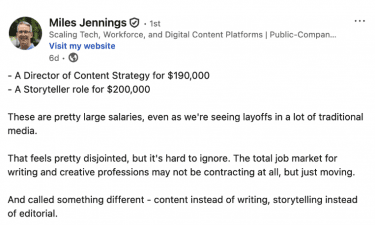
Humans are hardwired to respond to stories. No matter how sophisticated analytics might be, no matter how compelling an argument the data might make, at the end of the day, we don’t make decisions based on pure logic or reason (although we’d be way better off if we did, honestly).
Instead, we continue to make decisions based mostly on vibes and gut feelings, then reverse engineer the underlying logic after the fact to justify those decisions (a discipline that’s become known as “data storytelling,” which is really just consultant speak for confirmation bias).
In a market drowning with AI slop (and the occasional, OG human generated crap content, like this here newsletter), dashboards and decks featuring 17 bullet points when a single, simple sentence would work, the people who have the ability to transform all that information into a compelling, comprehensive narrative are increasingly becoming the professionals who get hired, promoted and funded.
After all, data represents a single moment in time, and most of it ages about as well as an avocado or Dogma 95. Stories, on the other hand, are timeless. Even the whole “AI is displacing human jobs” thing is basically just “man versus machine,” which was already a well-worn cliche back when Plato first categorized content thousands of years ago.
Which brings us to this week’s theme – and one that’s apropos for anyone working in media or entertainment – why, exactly, has storytelling gone from corporate commodity (or “creative fluff,” depending on the company) to one of the most competitive, and valuable, skills in the modern workplace?
And, more importantly, what does that mean if your career involves some aspect of content creation, media production, marketing, editorial strategy, executive leadership or, frankly, anything that involves human interaction and interpersonal communication?
Let me tell you a story…
Act 1. Companies Are Literally Hiring “Storytellers” Now
Look, this shift to storytelling lacks the subtlety or subtext of most job trend analysis; this time, there’s no need to read the tea leaves or take deep dives into the data to see obvious signs of this seismic skills shift. Corporations are quite literally posting jobs for “storytellers.”
Yeah, that’s a job title now. And a pretty damn lucrative one, too.
According to reporting from the Wall Street Journal (our favorite Fox News property), big tech has emerged as early adopters of this nascent trend, with companies like Google, Microsoft, Notion and Anthropic building corporate storytelling functions or dedicated teams to shape the narratives around their businesses and brands.
Job postings using the term “storyteller” as either a required skill or as an actual job title surged throughout 2025, a trend that’s only accelerated so far in 2026.
Apparently, “Senior Manager, Narrative Synergy Enablement” was too obtuse and esoteric, even for big tech (and too embarrassing for top storytelling talent, likely).
Read more: Companies are Desperately Seeking Storytellers (Wall Street Journal)
What it means for your career:
While hiring might be down across the board in journalism, media, copywriting, content, PR, production and brand marketing, the shift from corporate outcasts to “top talent” should come as something of a relief – and good news for stuff like salary and stability (if not for creativity and originality).
The exact same companies that spent the last decade basically breaking linear media models and centralized content distribution while gutting editorial budgets and headcount are the exact same ones trying to recruit the same former journalists and creatives their business models displaced.
That’s because, while their engineering and product teams are world-class, many have finally recognized that their austerity approach to content has gutted their internal capabilities, with the few content specialists left creating copy that sounds like a mishmash between a legal disclaimer and a malfunctioning LLM.
The conclusion these businesses – and many others outside traditional media and entertainment companies – have come to is pretty simple. It’s a lesson that every enterprise will likely be forced to learn – the ability of a brand to tell a coherent story and compelling narrative today isn’t “adjacent” to business value.
It drives business value – and that’s the bottom line.
Act 2. AI Drives Demand for Quality Writing.
There’s a common misconception amongst many companies that leveraging AI makes “writing” easy, given its ability to produce infinite, instantaneous content. The problem with LLMs, however, is that pattern recognition inherently generates output that’s inherently average, in the best-case scenario.
Too often, though, it’s unreadable slop. Most AI generated content makes 50 Shades of Grey look like it belongs on the Booker Prize shortlist, or Jackie Collins look like a Nobel Laureate. That canon of crappy content continues to grow exponentially, showing no signs of stopping. This matters, because AI isn’t writing. It’s algorithmic output that’s set up camp deep in the uncanny valley, replete with bulleted lists and misplaced emojis.
Organizations are increasingly catching onto the fact that machine-generated mediocrity might make flooding every channel expedient and efficient, but when it comes to driving actual business results, it’s also completely ineffective.
Authentic, strategic, and compelling content has become something of an endangered species, and that scarcity has driven a significant spike in demand for good writers, which is good news for most of us. The pivot in corporate content away from AI-generated algorithmic efficiency towards emotional engagement places a premium on quality, not quantity, and even more so on the handful of humans capable of objectively good writing.
You know who you are. And even though the job market feels really tough, there are signs that you’re actually becoming in demand. Turns out, when everyone can generate copy ad nauseum, the differentiator is no longer just content creation, but rather, creativity and human ideation – and businesses are finally recognizing there’s a pretty big difference between prompt engineering and good writing. Their consumers always have.
Read more: Businesses Hiring Storytellers to Cut Through the “AI Slop” (The Times on Sunday)
As organizations flood every channel with machine-generated mediocrity, authentic and strategic communication has become more scarce, and therefore more valuable. Businesses are increasingly hiring human communicators specifically to cut through what one publication memorably described as “AI slop.”
Turns out, when everyone can generate copy, the differentiator is no longer who can write words. It is who can think.
What it means for your career:
Simple. If you’re good at writing, you’re a little more in demand than you were last year. As any writer can tell you, this is kind of unprecedented territory, given the historic surfeit of paying gigs, much less ones with starting salaries in the six figures. That’s not quite showrunner money, but it’s close enough.
If your value proposition is the ability to synthesize and simplify complexity, identify signals while tuning out the noise, and create a compelling narrative that can change minds (and purchasing decisions), then congratulations. You’re finally in demand – and imminently employable. The competition is no longer with other great writers, but between the companies whose businesses depend on them.
Feels pretty good, doesn’t it?
Act 3. Communication Most In-Demand Skill on LinkedIn
Love it or hate it, LinkedIn – aka Facebook for Unemployed Thought Leaders – has become an integral, entrenched part of how hiring works today (even if it largely refutes the whole ‘quality content’ narrative, if your feed looks anything like ours). LinkedIn is for recruiters what TikTok is for sorority members – their primary source of news and biggest influence (however skewed) on their worldview.
That’s why a recent report from the Microsoft-owned “professional network” is yet another encouraging sign for anyone in the business of crafting stories and shaping narratives; LinkedIn data shows that communication remains the most in-demand professional skill employers are looking for when hiring for open roles.
Fully 9 in 10 executives surveyed report that soft skills remain their most critical hiring need. Surprisingly, an additional 70% rank communication skills as more valuable than AI-specific technical skills.
Given the fact that storytelling is the most sophisticated and complex form of communication, this is one media and entertainment story that just might have a happy ending.
Read more: Communication remains the most wanted job skill on LinkedIn (Axios)
What it means for your career:
Being good with data isn’t enough anymore, nor is simply being “strategic” (whatever the hell that means).
Thing is, if you can’t explain your ideas in a way that makes people actually give a crap, nothing else really matters. Without strong communication skills, you’re basically an Excel spreadsheet with a LinkedIn profile.
Corporate America loves to pretend it worships logic, but anyone who’s spent more than ten minutes in a meeting knows decisions are rarely made because the best analysis won. They’re made because someone told the most convincing story in the room.
Data supports decisions. It doesn’t drive them. In business today, finding information is easy. True value, however, requires the ability to extract meaningful insights from that data in an emotionally engaging way.
The people who advance aren’t always the smartest (raises hand). They’re the ones who can make complexity understandable, who can connect data to driving decisions, and package insights and analysis in a way that drives the business- and bottom line – forward.
Act 4. Turning Numbers into Narratives: the evolution of data storytelling
Analytics are an integral component of pretty much every business out there. While data is an inextricable part of every business function (with the possible exceptions of brand marketing and human resources, which are sort of like the liberal arts of corporate America).
From scenario analysis to demand forecasting, from historic financials to FP&A forecasts, the role of analytics has produced a big problem for big business: everyone has dashboards, data lakes, and deep analytics – but almost nobody knows how to explain what any of them mean (although management consultants have become adept at playing pretend).
Research on data storytelling has repeatedly proven that narrative framing improves decision-making capabilities, comprehension of complex information, and better business outcomes. In other words, people process quantitative evidence way better when it’s told as a story instead of a spreadsheet.
Which should really come as no surprise to anyone outside of B Schools or C Suites.
Read more: Storytelling in an AI Era is Shifting from Control to Credibility (BW Marketing World)
What it means for your career:
Even in the most data-heavy organizations, from investment banks to actuarial firms, the workers who win aren’t necessarily the ones with the deepest data or the most advanced analytics. They’ll be the ones who can make all of those numbers relevant, accessible and actionable.
How the pivot tables have turned.
Act 5: Deconstructing The Denouement
Corporate America, fundamentally, is predicated on stories – and always has been. Whether those stories manifest themselves as “brand messaging,” or the finely honed narratives which unfold on every earnings call, press release or media placement.
The Greeks, in fact, would likely be familiar with the characters and structure at play in late-stage capitalism. From the origin myth (the Silicon Valley garages from which tech titans emerged, or the college side hustles morphing into multinational conglomerates), to the Homeric tragic hero (think Steve Jobs, Sam Altman or Mike Ovitz), to the running commentary of the chorus (which is why Glassdoor exists), the conventions of corporate storytelling gained currency thousands of years before the invention of, well, currency.
The concept of storytelling as a dedicated business discipline or area of professional expertise, however, is only starting to emerge. What was long dismissed as a tangential “soft skill” (executive speak for ‘something that can’t be captured on a spreadsheet or P&L) is becoming one of the most in demand – and most lucrative – professional capabilities on the market.
After years of digital noise, the proliferation of AI slop, the commoditization of “content creation” and the slow realization that people are moved far more by emotional connections than empirical evidence, companies are finally starting to realize the inherent value of storytelling, and the people capable of crafting them.
Talk about irony. For years, creatives were told to stop telling stories and start looking for “real jobs.” Now, those people with real jobs are desperately trying to become creatives. The market has finally remembered something media and entertainment professionals have known forever:
If you control the story, you control the outcome; if you control the narrative, you can write your own ending. And in an era of rapid media consolidation, the decimation of creative industries and the reinvention of the entire entertainment landscape, the plot twist is one that should encourage creatives out there:
We just might all live happily ever after, after all.
The end.
Until next week,
Matt Charney
Executive Editor, MediaBistro
Topics:
Weekly Drop Media Newsletter