Mediabistro Logo Mediabistro Logo
  • Jobs
    Search Creative Jobs Hot Jobs Remote Media Jobs Create Job Alerts
    Job Categories
    Creative & Design Marketing & Communications Operations & Strategy Production Sales & Business Development Writing & Editing
    Quick Links
    Search All Jobs Remote Jobs Create Job Alerts
  • Career Resources
    Career Advice & Articles Media Industry News Media Career Interviews Creative Tools Resume Writing Services Interview Coaching Job Market Insights Member Profiles
  • Mediabistro Membership
    Membership Overview How to Pitch (Premium Tool) Editorial Calendars (Premium Access) Courses & Training Programs Membership FAQ
  • Showcase
    Featured Creative Stories Submit your Story
  • Log In
Post Jobs
Mediabistro Logo Mediabistro Logo
Search Creative Jobs Hot Jobs Remote Media Jobs Create Job Alerts
Job Categories
Creative & Design Marketing & Communications Operations & Strategy Production Sales & Business Development Writing & Editing
Quick Links
Search All Jobs Remote Jobs Create Job Alerts
Career Advice & Articles Media Industry News Media Career Interviews Creative Tools Resume Writing Services Interview Coaching Job Market Insights Member Profiles
Membership Overview How to Pitch (Premium Tool) Editorial Calendars (Premium Access) Courses & Training Programs Membership FAQ
Featured Creative Stories Submit your Story
Log In
Post Jobs
Log In | Sign Up

Follow Us!

Job Search

8 Warning Signs of a Bad Job Offer

8 Warning Signs You’ve Gotten an Offer From a Bad Employer
Katie icon
By Bizzy Coy
Bizzy Coy is a freelance copywriter and humorist whose creative writing has appeared in The New Yorker and McSweeney's, and who is the author of "Personal Space." She has received fellowships from Fulbright, MacDowell, and NYSCA/NYFA, and has written for clients including Disney, Condé Nast, and Broadway.
4 min read • Originally published October 3, 2016 / Updated March 19, 2026
Katie icon
By Bizzy Coy
Bizzy Coy is a freelance copywriter and humorist whose creative writing has appeared in The New Yorker and McSweeney's, and who is the author of "Personal Space." She has received fellowships from Fulbright, MacDowell, and NYSCA/NYFA, and has written for clients including Disney, Condé Nast, and Broadway.
4 min read • Originally published October 3, 2016 / Updated March 19, 2026

You found the perfect job listing. You applied. You scored an interview. But something seems… off. Are you dealing with a bad employer? Here are eight warning signs to look out for during your job search.

1. Details are hazy

One of the biggest red flags is lack of concrete information about the job. Maybe the job description is too short. Maybe it’s too long, filled with lots of meaningless industry jargon. Maybe there’s no job description at all. Or, the interviewer is cagey about the details.

“There is a lack of transparency if the interviewer is not able to speak to career development, culture, work life balance, benefits or perks,” says Theresa Vargas, Human Resources Manager for Grant Associates, a workforce development company.

Always be suspicious if you can’t lock down real information.

2. Disorganization reigns

“An unorganized interview process is a red flag,” says Vargas, and it’s often the sign of a disorganized workplace in general.

Let’s say your interview date and time keeps changing. Or your interviewer forgets to show up. Or they lose your application altogether. This is not normal! Imagine what it might be like to work there under similar chaotic circumstances.

Find the right position—and employer for you: Search for your next job on Mediabistro’s job board.

3. Follow-up takes forever

“Your recruiter or HR contact shouldn’t take a long time to follow up during the recruiting process,” says Vargas.

Hiring decisions can take weeks or months, but that’s no excuse for ignoring your phone calls or emails in the meantime. You want to work in a respectful, communicative environment.

4. They’re in a big rush

On the flipside, be leery if the process seems rushed and you’re pushed to commit in a tight time frame. You might hear phrases like “We want you to start this week,” “Our last employee walked out and we need to replace her ASAP,” and “How quickly can you start?”

Don’t get caught in a situation where an employer is looking for any warm body to fill the role instead of the right person to fill the role. Finding the perfect match takes time.

5. Your interview is one-sided

Have you ever had an interview where you can’t get a word in edgewise? They talk about the company, themselves, the weather, but don’t ask you any questions or seem that concerned about your experience or what you’ll bring to the company. That’s a sign of an employer who doesn’t take their hiring decisions seriously.

6. You can’t meet the team

“Not being able to meet with the people you will be working with is concerning,” says Vargas, “because you don’t know if you will be a right fit for the team.”

If the employer doesn’t offer an interview or meet-and-greet with team members, ask them directly if that’s possible. Meeting your colleagues is a crucial part of determining whether you want to take the job.

7. You can’t see the office

Likewise, if the employer doesn’t invite you to interview at or tour their workplace, ask. It may be a simple oversight, or it could mean the business is hiding something.

“Not being able to see the actual working environment could leave you with regrets after accepting the job,” says Vargas. “If you knew in advance that you would be working in a closet, it might change your mind.”

8. They don’t know what they’re looking for

This is a common problem, and it spells trouble. Keep an eye out for an employer who wants one person to do the work of a full team, an employer who doesn’t understand what you do, a salary that doesn’t match the position or a position that seems like it was created in haste.

Also: an employer who says you’ll “figure it out” once you’re on board. No way!

What next?

If you spot any of these red flags, proceed with caution. When in doubt, dig a little deeper. Seek out more information from the employer as well as external sources: workplace review websites, current and previous employees, and a general web search.

And always, always trust your gut. If something feels wrong, better to address it now than committing to a workplace that’s not right for you.

Topics:

Get Hired, Job Search
Skills & Expertise

Copy Editor: The Role, Responsibilities, and Breaking in to the Job

If you're a super speller and a great grammarian, and have a killer eye for details, this always-in-demand role could be the one for you

What Does a Copy Editor Do?
Katie icon
By Jenell Talley
Jenell Talley is a journalist and program analyst with a background spanning media, government, and editorial work. She holds a journalism degree from Howard University and a master's in human resources management from the University of Maryland.
4 min read • Originally published October 3, 2016 / Updated March 19, 2026
Katie icon
By Jenell Talley
Jenell Talley is a journalist and program analyst with a background spanning media, government, and editorial work. She holds a journalism degree from Howard University and a master's in human resources management from the University of Maryland.
4 min read • Originally published October 3, 2016 / Updated March 19, 2026

Are you fanatical about the use or non-use of serial commas? Does misuse of “their,” “they’re,” and “there” drive you insane? Does an article that vacillates between “10” and “ten” make your blood boil? How about channeling that talent into a copy editor job?

We got a few professional copy editors extraordinaire to spill the beans for you on the position. Read what they had to say—we promise you won’t find any mistakes in our write-up.

What exactly does a copy editor do?

Sure, copy editors correct misspellings (it’s “supersede,” not “supercede”) and whip grammar into shape (between you and me, don’t let a writer get away with “between you and I”), but there’s a lot more to it.

These grammar Svengalis are also charged with reviewing content for proper punctuation, usage and syntax; creating and/or updating in-house style rules; fine-tuning structure, tone, and voice; and ensuring clarity, coherence, and logical flow and consistency in words, typography, art, and style.

“Style can include the specifics of any particular publishing company, as well as the type of guide being used, such as the Chicago Manual of Style,” says Ciara Larkin, a senior copy editor in book publishing at Thomson Reuters.

Some copy editors also function as proofreaders, fact-checkers, and even project managers who oversee workflow and communicate with other departments throughout the production process, Larkin says. At some companies, duties include performing rewrites, writing headlines, and reshaping leads.

What skills are required to be a copy editor?
This should go without saying, but what the heck: Know the English language like the back of your hand, says Larkin, who notes proper spelling and grammar are undervalued these days.

There’s no getting around attention to detail, says Jenna Rose Robbins, an editor, writer and web consultant at Siteseeing Media & Web Consulting. “And some people just can’t be taught because it requires a specific type of focus,” she adds. “I know some amazing line editors who are terrible copy editors.”

You need to know Associated Press and/or Chicago style. “This is just something that has to be learned, like memorizing the periodic table of the elements, only in more detail,” Robbins says.

You also need to be curious and crazy organized, says Jennifer Bright Reich, co-founder and editorial director of Momosa Publishing. The ability to meet deadlines is also important.

Who is a copy editor’s boss?
It varies by company, but a copy chief, editor-in-chief, or managing editor is the usual suspect.

What do you need to get ahead in this position?
It takes an undying desire to produce perfect copy to excel at this job. “Copy editing is one of those rare cases where perfectionism is an asset,” Robbins says.

How can you get your foot in the door?
A degree in journalism or English could help, but your knack for the English language is your ace in the hole. “I’ve never heard of anyone getting a copy-editing job based on a degree or certification,” says Robbins. “Almost every copy editor I’ve known has had impeccable grammar skills.” Show yours off by interning, freelancing, or starting your own sharply written, error-free blog.

How the future is shaping up for copy editors

As we wrap up this dive into the world of copy editing, let’s gaze into the crystal ball and explore what the future holds for this meticulous and crucial profession. The world of publishing and content creation is ever-evolving, and so is the role of a copy editor.

In the coming years, the rise of digital media and AI technologies will likely transform how copy editors work, but fear not – this is less about replacement and more about enhancement. For instance, while AI can help with basic spell checks and grammar, the nuanced understanding of context, style, and tone still lies in the human domain. Embracing these tech tools can free up your time for more complex editing tasks where your expertise truly shines.

Moreover, the increasing demand for content across diverse digital platforms presents new opportunities for copy editors. We’re talking about editing for websites, apps, multimedia presentations, and even virtual reality experiences. The core principles of clear, coherent, and engaging content remain the same, but the ways to apply them are multiplying.

For those looking to future-proof their copy editing career, it’s about being adaptable, continuously learning, and expanding your skills beyond traditional boundaries. Stay curious about new publishing platforms, familiarize yourself with basic SEO principles, and maybe dabble in some content strategy. Learn about new immersive technologies and gameplay.

Remember, at its heart, copy editing is about safeguarding the quality of information in an age of information overload. It’s a noble pursuit, and as we step into the future, your role becomes not just about correcting commas and catching typos but also about upholding the integrity and clarity of information in our digital world.

So, keep honing those skills, embrace the changes, and leap into the opportunities that lie ahead. The future of copy editing is bright and needs sharp minds like yours. Now go forth and edit boldly in this brave new world!

Get started in a new copy editor role and others with our media job board.

Topics:

Climb the Ladder, Skills & Expertise
Skills & Expertise

How to Become a Cookbook Writer and Break Into Food Media

You don’t need your own Food Network show to be a professional cookbook author

How to Become a Cookbook Writer
Katie icon
By Allie Misch
Alexandria Misch is a multimedia journalist and content strategist with over a decade of freelance experience, with bylines in New York Magazine, Esquire, the Los Angeles Times, and The Verge. She is based in New York City and works across writing, editing, photography, and production.
7 min read • Originally published October 19, 2016 / Updated March 19, 2026
Katie icon
By Allie Misch
Alexandria Misch is a multimedia journalist and content strategist with over a decade of freelance experience, with bylines in New York Magazine, Esquire, the Los Angeles Times, and The Verge. She is based in New York City and works across writing, editing, photography, and production.
7 min read • Originally published October 19, 2016 / Updated March 19, 2026

So you want to launch a career in food media, but you haven’t heard back after a single job application. Or maybe you think your sociology degree won’t get you past the hiring manager’s desk even though your food Instagram just hit 50,000 followers.

Either way, your friends tell you print is dead and you should get on with your life.

But before your fears force you to forgo that childhood dream of creating a cookbook, take note of these tips from seasoned food writers whose unconventional careers lead them to write real, live, culinary books in our ever-evolving digital society.

First, find your niche.

“There are so many people out there who deserve to do a cookbook,” says food writer JJ Goode. But if you ask him, he wouldn’t make his own list.

“I’m from New Jersey,” he explains. “I grew up liking food a lot, but like really trashy food.” Frozen pizza, instant macaroni and cheese, and chicken nuggets peaked the palate of the future food critic at a young age.

“It wasn’t a very romantic start,” he says. “I never went to culinary school, I never worked in a restaurant and I’m a little bit clueless in the kitchen.” So after working on 12 cookbooks with several authors, Goode finds he is exactly what certain chefs need: an advocate for the home cook.

“Chefs cook so instinctually, they sometimes forget things like, you know, measurements, temperature settings—the stuff us mortals find useful,” says Kerry Diamond, editorial director of Cherry Bombe magazine.

While the first of her two-book deal with Clarkson Potter is set to be published next year, Diamond never planned to make food her full-time focus. She started dating a chef who asked if she would open a restaurant with him.

“That was my gateway drug,” she says of finding her foundation in food.

Sarah Black, the author of One Dough, Ten Breads, shares similar romantic sentiments when it comes to finding your fit.

“It is like falling in love, I think—hard to put into words—you just know when it’s right for you,” Black says. “‘Use your instincts. ‘You know more than you realize’ is my mantra.”

Love to write? Find a great new job as a writer on Mediabistro’s job board.

Then write what you know.

Like all writing, it’s a lot easier to let it flow when you’re familiar with the subject. Black suggests finding your niche, learning everything you can, then writing from the heart.

“Baking changed my life. I wanted to give this opportunity to others who might be struggling to find their way—by inspiring, teaching and training how two hands can change the world,” she says.

Starting with an authentic story will make a book proposal feel more like meeting a new friend than an application to become an author.

“Publishers like to see the chefs voice on the page,” says Goode. “I think a cookbook should be really personal. You want to read it and feel like you’re at the stove with the chef.”

Share your work online.

Diana Yen is the brilliant brain behind the multidisciplinary creative studio The Jewels of New York and author of A Simple Feast, but many know her from her perfectly styled Instagram account.

“[Social media] connected me to people I wouldn’t have otherwise met and it led to lots of new business opportunities,” says Yen. “I was lucky enough to find a smaller publisher, Roost Books. It’s a family run business and the president was a fan of my site.”

She suggests trying to do everything yourself at the beginning to grow your individual talents, then share your creations online and get feedback from the community. This can also be a way to pick up media coverage.

“I think my business, online blog and press definitely helped in setting me apart and getting my book published,” Yen says.

Network as often as you Instagram.

It’s easier than ever to introduce yourself to industry leaders because of the Internet, yet even virtually it can often feel intimidating.

Go ahead and “politely bother people,” says Goode.

“No one’s that cool in food,” he says. “It’s not fashion or sports writing. There’s nobody too cool for school…except for a few people.”

When Goode was looking to make the move from his entry-level position at Epicurious, he sent out cold emails to food writers like current New York Times restaurant critic Pete Wells and Food52 co-founder Amanda Hesser.

“They didn’t know me. They had no reason to respond to me,” says Goode. Yet almost everyone responded and agreed to meet him.

“There was nothing they could do really. They couldn’t just give me work, but I stayed in touch with a lot of these people.”

Goode found that these contacts would think of him for opportunities such as a quick 250-word essay or even when looking to fill a new position.

“Write to people. Buy them coffee. Bother them on the phone. Be persistent,” Goode advises.

But even when trying to get a foot in the door, the rules of etiquette still apply, warns Yen.

“The biggest turn off for me is when strangers ask to ‘pick my brain,’” she says. Initially offering something mutually beneficial to a mentor can go a long way.

“Reach out in a professional [manner] through email and offer your assistance, even if they don’t need it. There’s a big chance they will open the door and share some knowledge,” Yen says.

Start right now, where you are.

“It was really hard in the beginning when you’re starting out and the only thing on your resume is ‘proficient in Microsoft Word’ or something like that,” Goode remembers.

He says even relatively inexperienced writers should approach their favorite chef to build a relationship.

“The chef isn’t thinking ‘Oh he’s a good writer, not a great writer.’ No, the chef is thinking ‘Could I spend a year talking to and meeting with this person? Is that going to drive me crazy or that going to be okay?’” he says of his own experience.

Once you have an idea, Goode says to try your hand at writing a proposal. He suggests asking around to find examples of book proposals to glean inspiration to go forth on your own.

“One cool thing about cookbooks is it’s still kind of like the ‘Wild Wild West,’” says Goode. “I didn’t know someone who wasn’t a great cook could even do cookbooks.”

Traditional training in food media is still sparse, but Yen says it’s wise to become active in the community by showing up to lectures, food fairs, and pop-up dinners.

“Try interning at your favorite companies, publications or shadow a stylist. Learn to recognize your inner talents and continue in that direction,” she says.

Keep refining your craft.

In any creative industry, it takes a lot to stand out among the competition.

“I think a curious mind is never content,” says Yen. “I’m always trying to devour inspiration through social media, books, and engaging in conversations about the ever-changing food world. I go through periods where I simply absorb information, and once I’m full, I go and create something new from it.”

Food writing, like cooking and baking, takes practice. Black tests her recipes at least 25 times. Goode studies his subjects in-depth enough to mimic their speech patterns. Yen rents apartments in foreign countries to cook up a feast using their local ingredients.

But like perfecting a recipe that’s been years in the making, it is often followed by a sweet reward.

“It’s the best, it’s really the best,” Goode says about co-authoring with chefs. “I get to basically learn, watch them cook, eat their food, and ask all these dumb questions. But I feel like I’m doing something important.”

And never give up on print.

Even though BuzzFeed Food videos may dominate your Facebook feed, these authors are confident the cookbook will survive the digital age.

“The craft of baking is all about touch, and holding a book, staining its pages with sticky fingers, marking a book as you work with it is a ritual that also involves your senses,” Black says of a cookbook’s place on the shelf.

“I think cookbooks will be around forever. It’s like any book,” says Goode. “Do you think they’re going to stop making novels or histories of old white former presidents? There’s like 20,000 books on Thomas Jefferson and John Adams, so there can be more cookbooks in the world.”


Topics:

Climb the Ladder, Skills & Expertise
Climb the Ladder

How to Network in Three Easy Steps

How to Network in Three Easy Steps
Jess icon
By Jess Focht
@jessfocht
Jess Focht is a writer and content strategist with 6+ years of experience in media, publishing, and brand storytelling. She has contributed to Insider, Grammarly, and The Creative Independent.
5 min read • Originally published November 2, 2016 / Updated March 19, 2026
Jess icon
By Jess Focht
@jessfocht
Jess Focht is a writer and content strategist with 6+ years of experience in media, publishing, and brand storytelling. She has contributed to Insider, Grammarly, and The Creative Independent.
5 min read • Originally published November 2, 2016 / Updated March 19, 2026

Three easy steps to make you dread it a lot less

Photo by Farhad Sadykov (licensed via Flickr Creative Commons)

Sometimes when you say the word “networking”, you can actually see people shudder.

There aren’t many terms that bring up such acute feelings of dread for so many people. And if you’ve ever had to stand in a corner at an event wondering how to approach someone, the anxiety can be all too real.

But you’re also not alone. Most people don’t relish the activity. And what’s more, people are coming to realize that relying too much on networking can actually exclude people.

Recently I interviewed someone building an LGBTA+ technologist community. She explicitly told me she wouldn’t be planning happy hour events. Why not? Because too much networking discourages introverts, people uncomfortable discussing their queer or trans identity. Instead the group will focus on open hacking and resource sharing.

Its great communities are harnessing new ways to connect. But odds are everyone still needs networking at some point. Whether it’s for finding jobs, funding, or mentors, the fact is that networking is often your gateway to resources.

The bottom line is that no one says you have to enjoy doing it. But that doesn’t mean you can’t be good at it. So if you want to dread less and do more, here are the three skills you need to network like a boss.

Lay your groundwork

Photo by Tim Sackton (licensed via Flickr Creative Commons)

This first step is crucial, and time-consuming. Laying the groundwork is about setting yourself up to make a plan, and be able to answer questions about yourself.

Start with social media. Do you have any public channels people can check out — like a twitter handle, or a GitHub account? Start producing content so people can get a sense of your interests, and make sure to add profiles pictures. Don’t forget to be professional. If you have a Facebook, consider adjusting changing your privacy settings to “friends only”. We at Scouted have never seen anyone get a job from their social media, but we have seen lots of people lose out on opportunities because the tone of their facebook account did not mesh with the company culture.

The next step is to update your resume, and your LinkedIn. Design your resume in whatever format works for you, MS Word: use online resume makers like Cvmkr, or a free designer program like Canva. At the end of the day, it should be one page, clean and well articulated. Your LinkedIn is arguably more important, and if you don’t have one, sign up for an account today[rl2] .

The earlier you do this, the better. Start it right now (after reading the rest of this article.) And don’t forget this is about continuity: schedule time to post on social media, and update your LinkedIn.

Do your homework

Photo by jwyg (licensed via Flickr Creative Commons)

This is the next important step, and it’s also the one you’re least likely to have learned in college. After you’ve started establishing a digital presence for yourself, it’s time to figure out what you want.

Figure out what your goal is. Are you looking to get hired? To get advice on a project? Nail down the industries you’re operating in, and learn the “big names” that shape it. Follow the social media of your industry’s trendsetters to stay on top of new developments and learn which news outlets cover them.

Once you have a better feel for the game, you’ll know who you want to talk to. Maybe it’s the professor who wrote the eminent research paper on your topic. Maybe it’s an employee at that company you decided you really want to work for. But until you do your research, you won’t know for sure, and you won’t be able to hold a good conversation once you meet them.

And perhaps most importantly prepare for every networking conversation you are having, if you know about it in advance. Know who the people are, their companies, and career paths. Make special note of common connections that may create a bond with the people you are meeting — a shared alma mater, friend or colleague or even if you grew up near each other.

Get out there (and follow-up)

That brings us to the last step of networking: The Conversation.

The last step can seem ominous. But the standards of conduct here are pretty simple: if it’s an event, make sure to follow the dress code; if it’s an appointment, be on time; if it’s an informal meeting, offer to buy coffee or help cook.

As for the talking part? Just do your best to reach out to people and introduce yourself. Tell them who you are, what you do, and what you’re looking for. Ask them about themselves, about their work, about that new development that just published in Wired. Be an active listener and don’t do all the talking. Perhaps the best advice I can give / get is to ask for advice and guidance — do not be transactional!

Most importantly, be yourself, and try to enjoy it. You’ve done all the heavy lifting preparing for this conversation. You’re ready for it, and you’re ready to learn what you came there for. If appropriate, give them your contact information and thank them when you leave.

The crucial part about this is remembering to follow-up.

If you met someone, had a good conversation, and you think there’s a chance they can help you out, then remember to send them an e-mail that same day. If you met someone and you don’t think they can help you? Send them an e-mail, too.

It’s not always about finding the exact person you need to help you out (although that’s nice). It’s about building a community who knows you and can pass opportunities your way. Sometimes the accidental meet-ups become fruitful later down the line.

Topics:

Candidates, Climb the Ladder
Advice From the Pros

How My Corporate Media Gig Prepared Me for the Entertainment Industry

This NBCUniversal employee tells us how her corporate day job is helping her find success with her passion projects

Angela McCrae headshot
Leah icon
By Andrea Williams
@AndreaWillWrite
Andrea Williams is an author, journalist, and columnist for The Tennessean with over 16 years of experience in journalism and 20 years in copywriting and communications strategy. Her work spans national outlets and high-traffic digital brands.
6 min read • Originally published November 30, 2016 / Updated March 19, 2026
Leah icon
By Andrea Williams
@AndreaWillWrite
Andrea Williams is an author, journalist, and columnist for The Tennessean with over 16 years of experience in journalism and 20 years in copywriting and communications strategy. Her work spans national outlets and high-traffic digital brands.
6 min read • Originally published November 30, 2016 / Updated March 19, 2026

Tens of thousands of people move to Los Angeles every year, and thanks to the allure of red carpets and flashing lights, it’s safe to say that many of those Cali imports have their sights set on Hollywood. Angela McCrae was one of those people eight years ago when—after starting her career on the east coast in radio broadcasting, then moving to television audio engineering and ultimately launching her own production company—she packed up everything and journeyed west.

While McCrae’s side endeavors fulfill her creative yearnings (she recently screened her first short film, #WhereIsBeauty, which follows a young woman as she deals with the pressures of social media in search of her true identity), it is her day job as Creative Content Protection Coordinator at NBCUniversal that provides her with the wisdom needed to navigate the LA scene with confidence and power. Here, she discusses those key lessons learned, while also providing tips for other entertainment industry wannabes.

Name: Angela McCrae
Title: Content Protection Coordinator/Co-hub leader, Young Professionals Network @NBCUniversal (SoCal)
Company: NBCUniversal
Years with Company: 5.5 years
Hometown: Hyattsville, MD
Currently lives: Los Angeles, CA
Instagram: @angelamccrae
Twitter: @angelamccrae01
Linkedin: https://www.linkedin.com/in/angelamccrae
Education:  Morgan State University—Broadcast Journalism/Television Production 

How did you end up in your current role?

My background is in broadcast news. I started out at the radio station on campus at Morgan State University, and I was an assistant news intern and able to do news stories live on air. Then I got the opportunity to intern at a local television station, and that was a great experience for me, because it opened my eyes to television. I became the full-time audio engineer for the morning news show, and I was the first audio mixer for that show. I helped design the sound—we used to do a lot of innovative stuff, partnering with the radio station and doing live [music] sets, which was really unheard of at the time.

From there, I started my own production company, and it got me into this creative space, where instead of me just being the operator or technician for live news, I was now able to create my own content. I was doing marketing videos and local commercial spots, which also afforded me a lot of relationships in the DC and the Baltimore area. I was still also balancing freelance audio mixing when an opportunity to go to LA came up. It was an entry-level video and coding job, so it was pretty much right at the helm of digital media. The only problem was that it paid just $16 an hour. But I took a chance and because the job was only three days a week, I was also able to continue doing some of the work I had lined up on the east coast. So I was bi-coastal for the first year and a half.

Eventually, though, that ended. Then an opportunity at NBC opened up; I got an opportunity to work here, and I’ve been here ever since.

What are your day-to-day responsibilities?

I work in creative content protection, so my day-to-day is very much on the corporate side of things. I deal with managing budgets, office management facilities, research, event planning, vendor relations and accounts receivable.

How has your job at NBC helped you as you pursue other career ventures in film production?

Since I’ve been at NBC, I’ve grown professionally. This is what I needed—the corporate environment to help me hone my business skills and understand professionalism and communication style. And being in this coordinator role and being able to interface with EVPs from all the different business units gives me a bird’s-eye view of how this company is structured. I’ve also learned how to be gracious in dealing with executives and be comfortable speaking in that space.

In my first job, when I had to ask for a raise, it did not go well and I ended up quitting. Sometimes, when you go into a situation and you don’t have your structured messaging in place, people see it. Some people who aren’t good people just want to break you down, but when you go to them with the confidence to look at them in their eye, and you speak on their level—even if you’re not on their level—they respect you. And that’s what this position has given me. My confidence has grown so much, and being able to change my mentality about circumstances and not take things personally is growth for me.

Get a closer look at NBCUniversal. They’re hiring like crazy right now.

The LA entertainment scene is notoriously difficult to crack. What advice do you have for people who don’t currently live on the west coast but still want to break in?

If you’re looking to break into the film industry, remember that people are shooting films with their cell phones. I’ve seen kids shoot something, edit it and even add music in 15 minutes for a 30-second video. So there’s no excuse. If you have a passion; if you have a dream, just do it. Just strategize and take the first step.

The other thing is to reach out to people. There are people who reach out to me on LinkedIn all the time who aren’t in LA, but they contact me and ask me for suggestions. There’s a young girl who’s in Atlanta—she just graduated from college, and she’s trying to break into the industry. So when there are opportunities that come my way from Atlanta, I forward them to her, because I know she’s there, and I know she’s passionate.

Another thing that I tell people to do is to have informational interviews with people in the industry. Structure them so it’s more of a learning opportunity so you can learn about what that person does, the challenges, the benefits, their story and their path. Then you can actually get inspiration and figure out if their job is something that you really want to do or not, because there are more jobs in LA than you can even imagine.

How does your job at NBC impact your non-professional life?

It has made me more cognizant of how I go about consuming my content, so I’m not going to those weird websites and weird links. It also made me realize that, as content creators, even the selfie pictures or videos that we put up of our family gatherings on Instagram or Facebook, are our content, and we need to protect that. Nowadays, people are sharing things; they’re taking other people’s videos and creating memes and ridiculing them. There’s so much craziness that goes on.

So we have to also realize what our free rights are. What are the copyright and free use laws? How are we able to now be educated on not just the convenience of technology, but of the impact of technology on our original content and on us, as content creators? I think right now the technology companies are in a position where they have the upper hand because people aren’t taking the time to really care about how these companies are monetizing their content. I think Instagram was sold for a billion dollars, and the Washington Post was sold for a quarter of a billion dollars. So how does that work? How does an institution like the Washington Post get sold for $250 million, but then an app that’s only been around for a few years, that was started by only eight people, sells for over a billion dollars? And it’s on the back of other people’s content that’s not even given any type of compensation.

Topics:

Advice From the Pros, Be Inspired
Skills & Expertise

Social Media Metrics vs. Social Media Analytics: Learn the Difference

The distinction can have a huge effect on the value of your reports and the success of your future efforts

Creating a social media analytics report
Leah icon
By Mediabistro
The Mediabistro editorial team draws on 25 years of media industry expertise to cover jobs, careers, and trends shaping the industry.
5 min read • Originally published February 27, 2017 / Updated March 19, 2026
Leah icon
By Mediabistro
The Mediabistro editorial team draws on 25 years of media industry expertise to cover jobs, careers, and trends shaping the industry.
5 min read • Originally published February 27, 2017 / Updated March 19, 2026

These days you’d be hard pressed to find a job in media that doesn’t list “analytics” as a necessary skill. You may be in marketing, PR or content, yet you’re required to do way more than turn a creative phrase or craft a persuasive message. Now you’re expected to evaluate your efforts and prove that the things you spend your time on are contributing to the company’s success.

So each week you go into your social platforms and look at the reports. Maybe you export them and repackage them into a very professional-looking slide deck. Then you proudly present to your boss that your followers grew x% and you got y more clicks than the previous week and while video views were slightly down they’re still up over last month. Your boss, likely pleased with the positive numbers, tells you to keep up the good work.

This seems like a perfectly acceptable way to report on your social media performance, but it’s actually not useful at all. In order to produce social media analytics reports that will help you drive meaningful results (and really impress your boss), you need to understand the difference between social metrics and social analytics.

Here, we’re breaking it down so you can turn your social metrics into insights that will help you focus your efforts and improve your social marketing success.

What social metrics are … and aren’t

Metrics can be thought of as The What—What did this social post do for the business? How many people saw it or engaged with it?

There are a number of social analytics tools that can provide you with metrics. Each social platform has its own built-in analytics tool. The terminology used and metrics provided differs from channel to channel, but for the most part they can all fall into one of three categories:

  • Reach (impressions, # of people who saw your post, # of times your brand was mentioned, # of followers)
  • Engagement (likes, shares/retweets, comments/replies, clicks, video plays)
  • Conversions (downloads, sign ups, sales, new followers)

Not all of these metrics are native to social platforms, but there are third-party tools, like the web analytics system you use on your site, that can fill in the holes. Regardless of where you get your metrics, it’s important to understand that these numbers are just that, numbers. They are simply data points.

They are useful for letting you know what is happening and what is changing over a period of time. These numbers and trends are fairly easy to access and it’s also quite simple to put them into a clean report with a bunch of graphs and charts that make it all feel very official.

The built-in tools on the most popular platforms, like Facebook, Twitter and LinkedIn, provide these reports out-of-the-box, which you can easily export. But, while these built-in tools are given names like “Insights” or “Analytics” they aren’t actually analytics reports or insightful at all. They are just social metrics reports. And the problem is that there isn’t much value in tracking or reporting on these numbers if you’re not going to analyze them or act on them.

From metrics to analytics

If metrics are The What, analytics is the So What? Knowing if a number is high or low, or if it went up or down since the last time you reported on it is easy. The real skill is being able to answer why. So what if more people clicked on your content than last month? So what if you got fewer likes on your tweets? Why did this happen?

social-analytics-so-what

The true value in collecting social media metrics is knowing what you can do with the numbers. It’s less about pulling the numbers together and more about making sense of those numbers. Figuring out how you can use them to make better decisions. This is social media analytics.

Finding the social data that matter

The first and most essential step to measuring social media success is to determine the goals of your social marketing strategy. Are you trying to drive traffic to your website? Increase brand exposure? Drive sales? If you don’t know what you’re trying to achieve, it doesn’t make sense to measure anything.

Once you know what your objective is, you’ll know what metrics matter for your goals. This is important because some of the platforms, like Facebook, give you so many data points that you can waste a lot of time examining and reporting on numbers that have nothing to do with your goals.

It is a waste of time to report on metrics that don’t support your goals. The ones that do matter are called Key Performance Indicators (KPIs). If you know what you’re trying achieve, you’ll know what KPIs to pay attention to. For example, if you’re trying to drive more people to your website, reporting on your follower growth is pointless. Your number of followers may not translate to website visitors, so you’ll want to consider if this number is necessary to track.

If you can eliminate the noise and zero in on the metrics that matter, you’ll save time and find it much easier to analyze what’s going on.

The most helpful answers start with the right questions

social-media-analytics-questions

Now that you know what KPIs to pay attention to, you can start to ask the questions that will help you make sense of (and take action on) the data in your social metrics reports. Here are a few questions you might want to ask (and answer) when reviewing each report:

  • Did my plan work?
  • If it worked, why?
  • If it didn’t work, why not?
  • What should I do differently?
  • What should I do more of?
  • How can I do better?

The answers to these questions are not in the numbers. The numbers can help lead you to the right answers. But you’re going to have to put a bit of thought into it.

If your numbers went up from the previous period you need to try to answer why this happened. Did you do something differently this period vs. last period? Is there a common thread amongst the posts that did well vs. the ones that didn’t?

There’s no guarantee that you’ll answer correctly, but the answer will lead you to a plan of action and that’s what you really want out of social media analytics. There’s no sense in tracking metrics, or reporting on them if you’re not going to try to influence them with future actions.

Topics:

Climb the Ladder, Skills & Expertise
How to Pitch

How to Pitch Mediabistro: A Freelancer’s Guide

This career resource for media pros wants stories that will help their readers land a job, develop expertise or inspire their careers

How to Pitch Mediabistro: A Freelancer’s Guide
Leah icon
By Mediabistro
The Mediabistro editorial team draws on 25 years of media industry expertise to cover jobs, careers, and trends shaping the industry.
4 min read • Originally published April 18, 2017 / Updated March 19, 2026
Leah icon
By Mediabistro
The Mediabistro editorial team draws on 25 years of media industry expertise to cover jobs, careers, and trends shaping the industry.
4 min read • Originally published April 18, 2017 / Updated March 19, 2026

Monthly Unique Visitors: 220K+

Updated: Bi-weekly

Background: Geared towards developing careers in media-focused roles, Mediabistro offers something for every stage of an individual’s professional journey. Whether just starting out or looking to find the next opportunity, visitors to mediabistro.com can find job listings, online courses for today’s most sought-after skills, articles helping digital media job-seekers find opportunities and grow their careers, and expert career services from resume evaluations and rewrites to interview prep and one-on-one coaching.

Founded in 1996 by Laurel Touby as “a gathering place for professionals in journalism, publishing and other media-related industries in New York City,” Mediabistro has grown into a valuable resource for media professionals across the US.

“Many people remember Mediabistro as the best place to find writing, publishing and freelance gigs, as well as being the go-to source for daily industry news, gossip and career moves. While we’re still the best place to find traditional media jobs, the digital world has certainly caused us to broaden the definition of ‘media’ to include marketing, PR, sales and visual content,” says Leah Paul, Mediabistro’s director of marketing.

“Being a ‘media professional’ today requires making sure you learn how to use every new tool and tactic that will help you get better at your job. So we chose to move away from the industry news content in order to focus on helping digital media professionals find work, improve their careers, gain skills and excel at their jobs.”

What to pitch: Editors at Mediabistro are looking for pitches that provide actionable, tangible value to readers. Before pitching, ask yourself, “In what ways will this information help a job-seeker get closer to landing a gig, or advance in their career?”

Pitches about resume and cover letter tips are great, but here, the challenge is making the content hyper-relevant for media and digital roles, as well as having a unique angle that hasn’t been covered ad nauseam in other publications. If your pitch includes how the story can be repurposed into shareable assets like infographics, slideshows or videos, it will certainly grab the editor’s attention.

The editors are also interested in stories about professional development and the skills needed to be a well-rounded, highly marketable media professional. In today’s world of hybrid roles and demand for T-shaped expertise, it’s more important than ever for writers to have marketing skills, marketers to have writing skills and everybody needs to understand SEO, social media and analytics.

Let’s not forget about the ability to use a variety of creative applications, web-based platforms or just general tech literacy. Pitching an explainer, how-to or case study that can teach a trending skill to the Mediabistro audience will certainly get noticed. Even better if it’s a topic that can be tied to a Mediabistro course.

Stories about teams or individuals who are finding success in their careers, or breaking new ground, are very popular with the Mediabistro audience. Everybody loves a good Q&A that provides advice or career inspiration.

Finally, the Recruit and Hire section features articles geared towards employers, recruiters and hiring managers. Mediabistro is always looking for pitches with an interesting perspective on recruiting, retaining and managing media roles and teams.

What publicists should pitch: Publicists are encouraged to pitch information about media professionals who can offer solid advice to Mediabistro’s audience. If the pitch covers finding a job or excelling in the field, the editors may be interested.

If you’re a publicist representing a magazine or digital publication that accepts freelance stories, Mediabistro is always looking for more publications to add to the How to Pitch section.

Etiquette: Email the editor listed below with a concise query and links to clips. Another way to boost your chances of hearing back are to list the skills or value the reader will take away from your article (“Shows readers how to craft a unique LinkedIn summary”).

Lead time: Varies depending on the type of story being proposed and whether it has a time-sensitive element.
Pay rate: From $75-$150 per post
Payment schedule: Invoice upon editor’s acceptance of completed draft
Kill fee: None

Contact Info:
Mediabistro Holdings, LLC
825 8th Avenue, 29th Floor
New York, NY 10019
mediabistro.com
Twitter handle: @Mediabistro | Facebook

Direct pitches to:
EDITORS AT MEDIABISTRO.COM

Topics:

How to Pitch
Skills & Expertise

Increase Your Brand Profile With Search Engine Marketing (SEM)

Get an intro to driving more and better qualified traffic to your website from search engines

Increase Your Brand Profile With Search Engine Marketing (SEM)
By Mai Alowaish
4 min read • Originally published May 1, 2017 / Updated March 19, 2026
By Mai Alowaish
4 min read • Originally published May 1, 2017 / Updated March 19, 2026

Be sure to check back in for Part II of this series – an introduction to implementing your own campaign.

When consumers decide they’re in need of, or curious about, a product or service they intuitively head to a search engine. Trillions of Google searches happen every year.

Those queries represent opportunities to attract potential customers to your site.

Search engine optimization (SEO) can help increase the ranking of your site without spending money, but search engines often enhance and alter their ranking criteria, making it difficult to maintain your rankings.

So how else can you promote your brand, drive new visitors to your site and increase site traffic? With search engine marketing (SEM).

It’s the yin to SEO’s yang. While not free, it is a great low cost solution to help you enhance your brand’s profile and connect with customers at the right moment. And it’s something anybody can do on their own.

Search Engine Marketing

SEM is the practice of marketing through paid advertisements that appear on relevant search engine results pages and websites. These ads can have different formats and are paid for through a bidding process.

Think of it this way, before the internet, popcorn ads weren’t everywhere. People saw physical ads for the snack in the movie theater, when they were hungry and thinking about getting something to eat.

The ads were provided where people were, when they wanted food, and where they had access to buy popcorn. SEM does this on the internet.

Your ads won’t be just anywhere, they’ll be placed in front of people who are considering your type of product or service, who live near your company and who want to buy what you sell.

You can even choose which search engines to use and where/when you want your ads displayed so that you can best reach your audience using your style of advertising.

Search Advertising

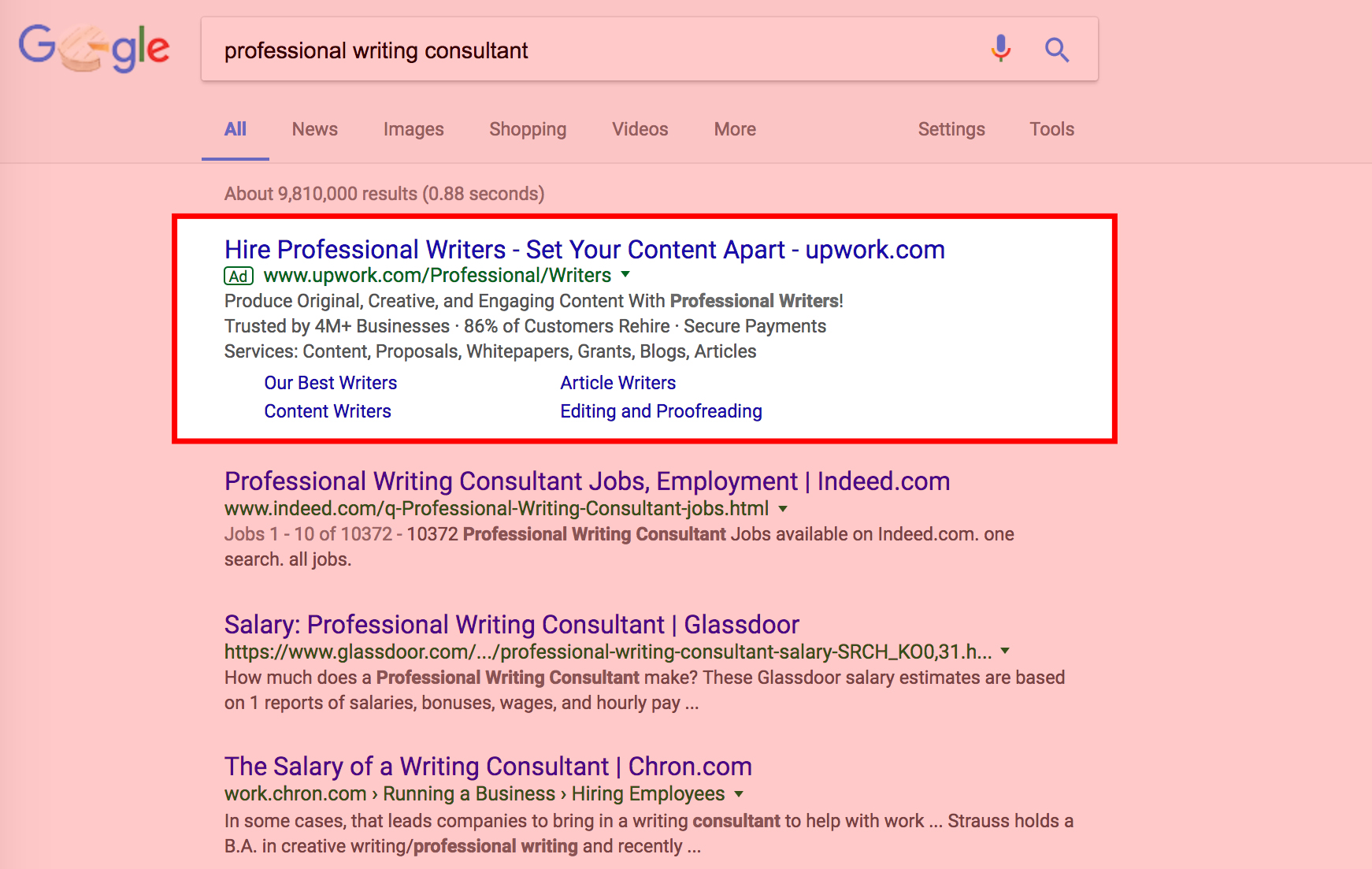
Let’s start with an example. Say your potential customer needs some writing done. When they search, Google will display results and ads from businesses that are relevant to the query phrase.

Professional writers advertising their services, are able to extend the reach of their online brand and appear right in front of the eyes of people searching for their services.

This is something that isn’t as easily achievable with simply implementing a SEO strategy.

Display advertising

Display ads aren’t found in search results, instead they can be seen on websites and mobile apps and can feature interactive formats of images, videos or even animations to engage the user.

You can choose to be strategic too, putting your message only in front of the people who are most likely to be your potential customers.

This is done by customizing your ad placements to a specific geographic location or when someone is watching a related video on YouTube, or browsing the web in a specific language.

There are many display advertising platforms that you can use, with Google Display Network being the largest one; Google claims that their display network sites reach over 90% of Internet users worldwide.

How much does SEM cost?

This depends on your budget and how you want to use SEM to work for you. You can mix and match different SEM strategies to make the best out of your advertising budget.

If the goal is awareness and you may just be interested in people seeing your ad, then you want to focus on cost per impression (CPM).

If you’re priority is website traffic, cost per click (CPC) could be the best metric.

If your goal is to increase lead calls or transactions, then you can use cost per acquisition (CPA) to optimize the campaign based on actual conversions.

CPC is the most popular metric used for SEM bidding. The average CPC in Google AdWords is between $1 to $2 on the search network. The average CPC on the Display Network is under $1.

Who can use SEM?

Anyone. Access to SEM tools is usually free and search engines provide tools to easily setup and manage ads right from your computer.

Google has AdWords, Bing has AdCenter, and Yahoo! has its Yahoo! Advertising too. Third party platforms can also be used to manage ads in more than one publisher.

You simply pay for the viewed and clicked advertisements, based on how you setup the process (which this industry calls a “campaign”).


Topics:

Climb the Ladder, Skills & Expertise
Skills & Expertise

7 KPIs of an Effective Website (And How to Measure)

Learn some of the most important key performance indicators (KPIs) of websites that convert

7 KPIs of an Effective Website (And How to Measure)
Amirah icon
By Alex Jasin
Alex Jasin is an entrepreneur, songwriter, speaker, and CEO of  Metapress and X3 Digital. Connect with Alex directly on Twitter, Medium and LinkedIn. Read more of Jasin’s writing on Business Insider, Entrepreneur, The Huffington Post, Internet Retailer, The Next Web and other major publications.
6 min read • Originally published May 8, 2017 / Updated March 19, 2026
Amirah icon
By Alex Jasin
Alex Jasin is an entrepreneur, songwriter, speaker, and CEO of  Metapress and X3 Digital. Connect with Alex directly on Twitter, Medium and LinkedIn. Read more of Jasin’s writing on Business Insider, Entrepreneur, The Huffington Post, Internet Retailer, The Next Web and other major publications.
6 min read • Originally published May 8, 2017 / Updated March 19, 2026

Are you looking to generate more phone call leads? Or drive more email sign-ups? Maybe you want to test new content on your website?

Well, you simply can’t measure what you don’t track.

The fundamentals of any successful digital marketing campaign begin with setting goals and key performance indicators (KPIs).

KPIs allow you to determine what metrics define success for your business. This way, you can track all of your website’s data to understand your company’s performance over time.

By definition, a KPI is a quantifiable measure that gauges a company’s achievements based on pre-set goals and objectives.

Before you start measuring, you have to first set “SMART” goals based on your business objectives.

This will help you get a clearer and more definite picture of what you want to achieve and when you achieve it.

Below are seven of the most important KPIs of effective websites with tips on how to start tracking them so you’ll know how to tweak your website moving forward.

Note: You’ll notice that Google Analytics appears as the tool of measurement for most of the KPIs. I decided to use it as the primary tool. It’s loaded with features, it’s popular and it’s absolutely free. Also, chances are, it’s what you use on your website. If it’s not, use the KPIs to tell if your analytics tool matches up to Google Analytics.

MARKETING KPIs

These KPIs help you achieve your website goals based on marketing goals, such as generating more qualified leads, improving the subscriber rate and increasing awareness and trust.

1. Conversion Rate

Conversion rate is probably the most common KPI. Everyone wants to know how many people become buyers on their site. I use “buyers” very loosely here.

This is because conversion doesn’t have to be just about sales. Conversion could be getting visitors to sign up to your newsletter, download an e-book or contribute to a cause.

As much as you want to reach a certain conversion rate, you’ll also want to analyze why a large percentage of visitors don’t convert.

2. Number of Qualified Leads

Some website owners are easily excited about the wrong things like a high number of website visitors. These are what are commonly referred to as vanity metrics.

You want to know how many of the visitors might actually buy from you. These are the qualified leads because they meet the qualification criteria you’ve set.

Traditionally, you’d track the URL on the “Thank You” page after the visitor fills out a form. This would be your overall conversion rate as discussed above. However, with this method you can’t track qualified leads, only the total number of leads. To get to the number of qualified leads, you’ll want to use customer relation management (CRM) software.

When a user fills out a lead generation form and clicks “submit”, Google Analytics transmits that data to your CRM platform. You can then score and rank the different leads to determine which are “qualified.”

3. Awareness Level

When you feel like you’re really pushing your brand out there, you’ll want to know exactly how effective your efforts are. There are several factors that indicate more people are getting familiar with your brand.

To help you with this, Google Analytics breaks down site traffic based on the source. If you look at these results (over time), you’ll get a sense of the percentage of your website visitors who already knew your brand by the time they made it there.

After you’ve started to track your current stats,  you can begin working towards increasing your website’s traffic based on your results.

SALES KPIs

These KPIs indicate if your website is doing enough to help you achieve sales goals like boosting your revenue.

4. Sales Conversion Rate

If you’re focused on the number of sales you make on your website, sales conversion rate is a metric to watch. Even though this is focused on sales, in Google Analytics, it’s measured like the aforementioned conversion rate.

Google Analytics has a built in E-commerce report, so if your sales are happening on your website, you can easily get to a variety of data about your sales conversion rate, including the total revenue, number of transactions and quantity of items purchased.

You can take this data further by looking at your most valuable sources of traffic in terms of where your biggest spenders come from or where your highest converting audience comes from. This sort of data can help inform your marketing plans.

5. Time Before Purchase

This is one of the least considered metrics. Most businesses just look at conversion, without caring to ask about how long it took a customer to convert.

If it takes multiple visits to your site before a customer buys from you, this doesn’t immediately mean trouble. They could just be taking time to get more familiar with your company, reading your site’s blog (you should have one), or a number of other acceptable reasons.

The problem comes if people don’t buy because your marketing message isn’t fined-tuned enough. You want to be closing deals as quickly as possible.

Most analytics tools offer this metric and Google Analytics shows this under E-commerce as “Visits to Purchase” and “Days to Purchase.” You should use it even if you’re not an online store. Setting up your analytics account to track the other kinds of non-purchase conversions (like those we discussed earlier) as part of the E-commerce reporting, does require some technical expertise, but it is possible.

6. Average Order Value

If you’re selling one product, it’s easy to understand that each conversion results in an amount equal to the product price. However, if you have several products, you want to know the average value of each order.

This tells you truly how much your efforts are paying off in converting customers. On its own, it’s not very valuable. But when coupled with context, you get a clear picture. In Google Analytics, it also appears under E-commerce.

UX KPIs

Last, but certainly not least, you need to consider your customer experience. Nothing will matter if the customer isn’t satisfied.

You want to make sure that whether on desktop or mobile, visitors get the best experience. The key metric here is customer satisfaction.

All other factors like navigation, page load time, mobile responsiveness, etc. boil down to improving customer satisfaction. They are factors you should test and tweak on your end based on the customer satisfaction.

7. Customer Satisfaction

To most people, customer satisfaction is highly subjective. This makes it a really hard metric to track—but it’s possible.

You need more than Google Analytics for this, though. One of the most qualitative ways you can measure customer satisfaction is through surveys.

Using a tool like SurveyMonkey, you can send out surveys to your customers to get a better understanding of what they think of your website. Qualaroo allows you to track more quantitative data according to user ratings. Temper lets you graph customer satisfaction trends.

You may also be able to get an idea from cart abandonment and bounce rate. Through these metrics, you can see where you started losing your customers.

You can also review and track your Net Promoter Score (NPS). This tells you, on a scale of 1 – 10, the likelihood of a customer buying from you based on their experience.

Measuring is the Surest Way to Grow

Successful digital marketing comprises much more than just a solid content marketing strategy, high search engine results page (SERP) rankings and spending money on social media ads.

It hinges on what is probably the most basic element of them all: your website. All the digital marketing effort is pointless if you didn’t make a website that’s effective for reaching your goals.

Start implementing these 7 key performance indicators on your site, and begin to track and review your progress over time. This is a surefire way to understand exactly where you stand right now, and plan for a stronger business in the future.

Alex Jasin can be found on Twitter, Facebook and LinkedIn.


Topics:

Climb the Ladder, Skills & Expertise
Skills & Expertise

Best Influencer Marketing Campaigns of 2017 So Far

From cosmetics to clothing, these brands generated the best in influencer marketing content

Best Influencer Marketing Campaigns of 2017 So Far
Amirah icon
By Amirah Bey
Amirah Bey is a digital marketing strategist with over 10 years of experience across global brands including Amazon Web Services, Procore Technologies, and Mediabistro. A Howard University graduate and Army National Guard veteran, she specializes in lifecycle marketing, analytics-driven strategy, and digital experience optimization.
4 min read • Originally published May 22, 2017 / Updated March 19, 2026
Amirah icon
By Amirah Bey
Amirah Bey is a digital marketing strategist with over 10 years of experience across global brands including Amazon Web Services, Procore Technologies, and Mediabistro. A Howard University graduate and Army National Guard veteran, she specializes in lifecycle marketing, analytics-driven strategy, and digital experience optimization.
4 min read • Originally published May 22, 2017 / Updated March 19, 2026

Weight-loss tea anyone? Hair-growth pills? What about at-home teeth whitening kits?

If you’re an active Instagram user, you’ve probably scrolled down your Instagram timeline and caught one of your favorite social media celebrities casually mentioning their love for one of the aforementioned products.

You know this is called influencer marketing, and while you can’t argue with its impact on brand awareness, some brands do it better than others.

Influencer marketing has become such a buzzword in the marketing industry, it’s being used to describe any celebrity’s (D-list or otherwise) involvement in a marketing campaign.

But I think there’s a line between celebrity endorsements and real influencer marketing. The distinction is really about content creation. The best influencer campaigns are those where influencers create their own content in support of the brand’s goals.

From fitness to travel and cosmetics, here’s a look at the brands who’ve generated some of the best influencer marketing content so far this year.

Tarte Cosmetics
In late January, Tarte cosmetics flew a gang of makeup and fitness gurus to Hayman Island, a private island off the coast of Australia, for a few days of sun, fun and beach. They followed this trip up with a jaunt to the Florida Keys and most recently the Maldives. Each time they had a gaggle of influencers in tow.

These trips have been branded #TrippinWithTarte and the social media influencers participate in Snapchat-worthy excursions every day like morning yoga, lunch by the pool, dinner on the beach, hikes and massages.

The influencers all possess huge followings. For example, fitness and makeup guru Tammy Hembrow, who attended Tarte’s Hayman island trip, has more than 6.5 million Instagram followers, more than 700K YouTube subscribers, 34K plus Twitter followers and a successful blog.

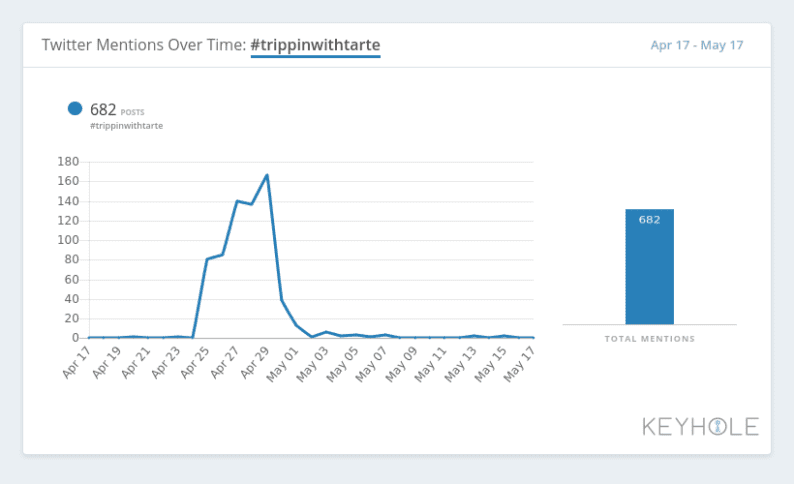
Keyhole #TrippinWithTarte Report

In just the last month the #TrippinWithTarte hashtag was mentioned more than 680 times according to social analytics platform Keyhole.

Axe
With most influencer marketing targeting women, it was interesting to see Axe Hair enlist 30 top male influencers to promote their styling products.

One influencer tapped by the brand was actor Josh Peck who has more than 4 million Instagram followers. Peck along with the other 29 influencers are referred to by the brand as the AXE Hair Creators. Their goal is to show everyday guys how styling has impacted their success.

Another popular influencer marketing tactic is for influencers to host events sponsored by the brand. At these events the Axe Hair Creators are tasked with showcasing not just why they style everyday but how they achieve their looks. The collective wants to inspire men who want to do more with their hair, but just don’t know where to start.

Fashion Nova
Fashion Nova is a brand that has become successful largely due to it’s ongoing and aggressive influencer marketing efforts.

“We work with 3,000 to 5,000 influencers,” said Fashion Nova’s founder and CEO, Richard Saghian, via a phone interview published by Vice.

Fashion Nova views itself as a “viral store.” The digital storefront relies on the popularity of celebrity and model influencers to spread word-of-mouth advertising to their eager followers.

They count among their influencer ranks it-girl Kylie Jenner, whose sole Instagram post about the brand’s jeans received tons of engagement: 2.7 million likes and 558K comments.

Jenner, to date, has 93.8 million Instagram followers and lands in eighth place for most number of Instagram followers in the world, but Fashion Nova also takes special care to engage micro influencers as well.

Many in the industry categorize micro-influencers as creators with under 100K followers or subscribers, like YouTube beauty vlogger BlissfulBrii who has 93K subscribers. Since the start of the year, BlissfulBrii has posted two videos featuring Fashion Nova clothing. The vlogs reached a combined total of 200K views, 4,300 like and almost 200 comments.

Glossier
Glossier is a relatively new brand (founded in 2014) that has skyrocketed quickly thanks to strong influencer marketing. The brand doesn’t focus on follower count but prioritizes the engagement rates of potential partners.

For instance they’ve worked with Instagram user Cecilia Gorgon who possesses about 8,500 followers. Gorgon isn’t a content creator or celebrity, in fact she described herself as a student at the University of Michigan living in Ann Arbor and majoring in Fine Arts, in an Into the Gloss article published late last year.

She posted a photo of the brand’s Priming Moisturizer Rich encouraging her followers to purchase it because she’d “been testing it out the past few days and it’s so moisturizing.” Gorgon added that face cream made her “skin feel like a baby’s booty.”

Another example of Glossier’s micro-influencer strategy is their Glossier reps program. Glossier recently flew 13 of their reps to NYC for 48 hours.

One of those reps is YouTube vlogger Amy Serrano. She has a strong following of 47K YouTube subscribers. The beauty vlogger documented the whole excursion and just 2 days after posting, the video boasted more than 5K views, 350 likes and 57 comments.

Serrano also dedicated 4 of her Instagram posts to the trip for a combined total of of more than 2,900 likes and almost 50 comments. With a dozen other reps documenting their trips the reach and engagement was sure to be significant.


Topics:

Climb the Ladder, Skills & Expertise

Posts navigation

Older posts
Newer posts
Featured Jobs
Kirkus Media
Editorial Intern
Kirkus Media
New York City, New York (US)

Gaia Inc
MEDIA COORDINATOR
Gaia Inc
Louisville, CO

Gaia Inc
Global Paid Media Specialist
Gaia Inc
Louisville, CO

Gaia Inc
Director of Media Strategy
Gaia Inc
Louisville, CO

Hearst Television
Account Executive
Hearst Television
Milwaukee, WI, United States

All Jobs »
PREMIUM MEMBER
AB

Ashley Bradbury

Baltimore, MD
0 Years Experience
View Full Profile »
Join Mediabistro Membership Today

Stand out from the crowd with a premium profile

Mediabistro Logo Find your next media job or showcase your creative talent
  • Job Search
  • Hot Jobs
  • Membership
  • Newsletter
  • Career Advice
  • Media News
  • Hiring Tips
  • Creative Tools
  • About
Facebook YouTube Instagram LinkedIn
Copyright © 2026 Mediabistro
  • Terms of Use
  • Terms of Service
  • Privacy