Mediabistro Logo Mediabistro Logo
  • Jobs
    Search Creative Jobs Hot Jobs Remote Media Jobs Create Job Alerts
    Job Categories
    Creative & Design Marketing & Communications Operations & Strategy Production Sales & Business Development Writing & Editing
    Quick Links
    Search All Jobs Remote Jobs Create Job Alerts
  • Career Resources
    Career Advice & Articles Media Industry News Media Career Interviews Creative Tools Resume Writing Services Interview Coaching Job Market Insights Member Profiles
  • Mediabistro Membership
    Membership Overview How to Pitch (Premium Tool) Editorial Calendars (Premium Access) Courses & Training Programs Membership FAQ
  • Showcase
    Featured Creative Stories Submit your Story
  • Log In
Post Jobs
Mediabistro Logo Mediabistro Logo
Search Creative Jobs Hot Jobs Remote Media Jobs Create Job Alerts
Job Categories
Creative & Design Marketing & Communications Operations & Strategy Production Sales & Business Development Writing & Editing
Quick Links
Search All Jobs Remote Jobs Create Job Alerts
Career Advice & Articles Media Industry News Media Career Interviews Creative Tools Resume Writing Services Interview Coaching Job Market Insights Member Profiles
Membership Overview How to Pitch (Premium Tool) Editorial Calendars (Premium Access) Courses & Training Programs Membership FAQ
Featured Creative Stories Submit your Story
Log In
Post Jobs
Log In | Sign Up

Follow Us!

Managing

How Mentors and Mentees Can Help Each Other Succeed in Advertising

When everyone shares their gifts and talents, it’s a win-win

mentor helping a mentee
By David Gianatasio
2 min read • Originally published January 9, 2016 / Updated March 19, 2026
By David Gianatasio
2 min read • Originally published January 9, 2016 / Updated March 19, 2026

Carter Murray, worldwide chief executive officer at Interpublic Group’s FCB, believes that mentoring in the ad industry has grown increasingly crucial in recent years. Today, agency employees at all levels can teach and learn from each other, making the industry stronger through a constructive give-and-take of information, he said.

In this Q&A, Murray, who recently was named among Adweek’s 100 most influential leaders in marketing, media and technology, explains how mentors and mentees can benefit from one another’s experience.

Q: Is mentoring different today than five or 10 years ago?

A: The fundamentals of mentorship remain the same. You’ve got to listen, you’ve got to be honest and build on people’s strengths and candidly point out weaknesses. It’s a two-way street where those coming into the business have a ton to teach to those who are already pretty high up on the corporate ladder.

Q: Is it harder now or easier than in the pre-Internet age?

A: The only real difference between mentorship before the digital age and now is that mentorship is no longer limited by geography or industry. The opportunities are endless. I love when I get a text from one of my all-time favorite interns who is now a senior at American University and I hope joins FCB when he graduates. In the past, changing jobs or industries or moving to a new location might have resulted in mentors and mentees losing touch. Now, more than ever, it’s easier for us to text our mentor with quick questions or arrange a FaceTime meeting when a situation needs a little more attention. It’s really quite amazing.

Q: Did you have a mentor?

A: Harry MacAuslan from Leo Burnett was a great mentor. He taught me two things that have stayed with me always: Sometimes, you’ve just got to shut up and listen; you’ve got to understand before you are understood. And, always be yourself.

Q: What’s your view on reverse mentoring, younger staffers showing older ones the digital ropes?

A: It’s paramount, and I’m grateful. Young staffers feel needed and empowered, and they teach more senior staffers who are not always as comfortable with technology how to navigate without fear. It’s a win-win. Everyone has different skills and gifts that should be shared with others. I want the people of FCB of all generations to be eager and open to learning new things every day. I can honestly say that I learn something new every day, and, sometimes those learnings come from the new ways of thinking millennials bring to the table.

This article was originally published on Adweek.com.

Topics:

Climb the Ladder, Managing
Job Search

Ridiculously Creative Ways Media Job Seekers Are Landing Gigs

Here's how to go beyond the standard resume to land the job

job-seeker resume in a glass bottle with thumb drive cork
John icon
By John Lombard
John Lombard is a content strategist and writer with over a decade of experience creating interactive and video content for brands like Apple, IBM, and Samsung. He previously worked at Mediabistro and now serves as a Client Strategist at Ceros.
3 min read • Originally published January 13, 2016 / Updated March 19, 2026
John icon
By John Lombard
John Lombard is a content strategist and writer with over a decade of experience creating interactive and video content for brands like Apple, IBM, and Samsung. He previously worked at Mediabistro and now serves as a Client Strategist at Ceros.
3 min read • Originally published January 13, 2016 / Updated March 19, 2026

You’ve got the skills, the talent, the fresh pair of Warby Parkers. Now you just need that media job. But getting your foot in the door isn’t easy, and sometimes in order to stand out, you need to make a big entrance.

To give you some inspiration, here are a few ridiculously awesome tactics job-seekers (and landers) have used to get noticed.

Spoiler alert: After reading you’ll seriously want to up your job search game.

Message in a Bottle

DDB message in a bottle job application

Canhür Aktuglu landed his dream job at DDB Istanbul with a crazy-inventive approach: A message in a bottle. With a thumb drive cork—holding his resume and portfolio—and a rolled up cover letter inside the agency-branded bottle, this delivery method and packaging didn’t just wash ashore, it hit home.

Ten days later, Aktuglu found himself in the DDB Istanbul office as an art director. This goes to show the importance of zeroing in on the job you want and spending the time and energy to show how much you want it. Read more about it Aktuglu’s success here.

2. Customized Resume

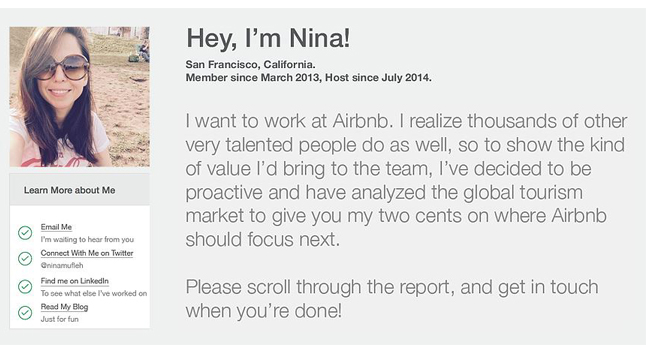
Airbnb job seeker website resume

Nina Mufleh, a marketer and communications specialist, had a dream to work at one of her favorite companies, Airbnb. And with the typical application process yielding no results, Mufleh decided to take matters into her own hands by developing a resume site that very closely resembled the look and feel of Airbnb.

And she didn’t stop there. On the Airbnb-like site, Mufleh analyzed the global tourism market, providing a report as to where Airbnb should focus their efforts. Sharing it on social media with the company’s founders helped as well, garnering her immediate attention from the CMO and from media outlets across the web.

And while Nina did not land a job at Airbnb, the media attention helped open many more doors for her as she began receiving calls from companies all over the world. Ultimately, Mufleh landed a sweet job at Upwork as a freelance growth marketer.

3. Choose Your Own Resume Adventure

job seeker using youtube to land a job

While many have taken to the Youtube video resume idea lately, there’s one guy who helped to really get the ball rolling. Meet Graeme Anthony, a communications expert who used Youtube’s in-video links as a table of contents where employers could click through different areas such as “Skills” and “Timeline.” And, yes, it worked. Shortly after uploading his video, Anthony was offered a job at one of the UK’s top PR agencies, Frank PR.

Others have used this technique in search of their respective dream jobs, too. This programmer did a great job of mixing fun visual elements to further drive home his data points and light quirky humor to show his character, and this mustachioed digital strategist used Ron Burgundy-esque humor in an attempt at getting Google’s attention.

Looking to up your job search game? You can break out of your rut and get insightful pointers with the help of a pro. Mediabistro’s Career Services offer everything from a resume retread to several sessions of career counseling to work on your elevator pitch, networking skills, career transition, and more.

Topics:

Get Hired, Job Search
Job Search

4 Essential Steps to Repair Your Online Reputation

SEO experts tell how to appear favorably in the king of search engines

google search
Admin icon
By Andrea Williams
@AndreaWillWrite
Andrea Williams is an author, journalist, and columnist for The Tennessean with over 16 years of experience in journalism and 20 years in copywriting and communications strategy. Her work spans national outlets and high-traffic digital brands.
5 min read • Originally published January 25, 2016 / Updated March 19, 2026
Admin icon
By Andrea Williams
@AndreaWillWrite
Andrea Williams is an author, journalist, and columnist for The Tennessean with over 16 years of experience in journalism and 20 years in copywriting and communications strategy. Her work spans national outlets and high-traffic digital brands.
5 min read • Originally published January 25, 2016 / Updated March 19, 2026

Here’s a hard truth: You’ve been Googled. It’s a paradox of sorts, this notion that we want to be recognizable and known, but that we only want the most favorable aspects of our lives divulged. So when every ill-advised photo or insensitive slip of the post has potentially far-reaching ramifications, and when having no online presence can also be just as damaging to career aspirations, it’s important that we all learn how to give good Google. How do you ensure that every result for your name is the best one possible? Read on. Here are 4 things you can do right now to fix your online reputation.

1. Build a Website and Optimize It

Lists like these usually don’t start with the most important tip in first place, but we will because it’s just that crucial to getting favorable search results. In fact, let’s just italicize it, so you get the point: If your domain is YourFullName.com, Google will rank it higher when people search for you.

Now, to the fine print: Just because you build a website doesn’t mean people will automatically visit it. SEO (search engine optimization) may sound like a dirty word to the tech adverse, but it’s a fairly straightforward concept that, when leveraged, can help Google find your online home and bump it up in search results.

“It really boils down to keywords for the homepage optimization,” says Collin Jarman, SEO technician at Click Optimize, LLC, a North Carolina-based Web design and Internet marketing firm. “So, in this instance, your keyword is going to be your own name because that’s what you want to rank for.”

Jarman suggests using your name as your domain, but if that’s not possible it’s not a total deal breaker. Just be liberal in putting your name everywhere else: in page titles, in the About page copy and even in little blurbs at the bottom of every blog post. In this case, humility gets you nowhere. “You need to talk about yourself because, at the end of the day, if your website doesn’t use your name, then Google’s not going to see it when it gets called, and it won’t rank for your own name,” cautions Jarman.

2. Create Plenty of Content, Regularly

If a person builds a website, but never posts any content, does it really make a sound? Of course not. So, now that YourFullName.com is firing on all cylinders, it’s time to get crazy with blogs and video to really fly up the Google rankings fast.

“One of the many things that Google considers within its algorithm, everyone believes, is fresh and updated content,” says Nick Barron, social media manager at Fannie Mae.

“So, if you publish a website and you don’t update it and a year goes by, Google’s going to view that as not-so-fresh content. If someone with your name or with similar spelling of your name comes behind and has a blog or has a fresher website, then they’re likely to rank more highly on Google than you would, because your content is just sort of stagnant.”

Creating sticky content that lots of people link back to is important, as well. “What you want to do is publish content that you think other people would be interested in reading or linking to from their blogs or their social media websites, because that linking in to your content can really help your content rank well in Google,” adds Barron.

3. Get Social Media Savvy

Social media also provides an excellent way to build an online platform quickly and easily, but all networks are not created equally. While Facebook might reign supreme for sharing pics from last night’s happy hour soiree, LinkedIn is the unofficial boss when it comes to landing atop search results with 100 percent user-controlled content.

So, if you’re concerned that news about your leading a protest in 2015 is hurting your chances for job interviews, get a LinkedIn page—now. Employers are much more likely to dig there for info on you.

“The way that the Google algorithms work is a website that is as strong as LinkedIn is much more likely to show up towards the top of a name search, because Google obviously trusts that it’s really a strong website,” explains John Leo Weber, SEO specialist at Geek Powered Studios, LLC. “LinkedIn acts as a person’s digital resume, so it’s very important that people take time filling out [their profiles] and replicating their real life connections on LinkedIn.”

And, again, if your name is John Smith or something equally common, being active on social media is imperative. “[If] you join Twitter but you don’t tweet for a year, Google’s going to say, ‘Well, if this person’s even still alive, I wouldn’t know it based on the fact that they’re not tweeting,'” adds Barron. “And if you have a common name, it just increases the likelihood that someone else with your name is going to [be tweeting]. It’s just a competition.”

When it comes to Facebook, Weber encourages users to spend time filtering through the site’s ever-changing security settings to ensure that unfavorable content stays hidden during searches. Or, even better: Use a nickname or pseudonym to be certain that said happy hour photos never see the light of day.

4. Build Your Personal Brand

Certainly, getting a basic grasp of SEO concepts and learning how Google’s algorithm works will help improve your personal search results, but according to Jay Jessup, brand strategist with Platform Strategy Branding and Publicity and author of Fame 101: Powerful Personal Branding & Publicity for Amazing Success, there’s a better, more effective way.

“I don’t want to call it gaming the system, [but] too many people are focused on just getting their name out rather than doing something that will enhance their brand—the result of which will be to get their name out,” he says.

Jessup recommends that individuals, regardless of industry, write a book and/or try their hand at public speaking. Besides generating additional revenue streams, these offline efforts create buzz (and perhaps regional or national publicity) that is sure to populate search results—no tech training necessary.

“Sure you should have a LinkedIn, Facebook, et cetera, but that isn’t much,” adds Jessup. “It doesn’t get your reputation out; it doesn’t get the thing that’s going to help you in your career out. So, instead, you do some other things that Google and the other search engines will reward you for that you ought to be doing anyway to help your career.”

If you’d like to improve your social media profile even more, consider getting the help of a pro. Mediabistro’s Career Services offer everything from a LinkedIn rewrite to several sessions of career counseling to tackle your cover letter, networking skills, career transition and more.

Topics:

Get Hired, Job Search
Journalism Advice

Write Better Headlines and Land More Freelance Assignments

Walk the line between clickable and sensationalist click bait

freelance writer developing a headline on a computer
John icon
By Amanda Layman Low
@AmandaLaymanLow
Amanda Layman is a B2B tech content writer and strategist with over 15 years of experience creating content for startups and enterprise brands. She founded Tigris, a content agency serving leading tech companies, and authored The New Freelance: A Book for Writers.
4 min read • Originally published January 26, 2016 / Updated March 19, 2026
John icon
By Amanda Layman Low
@AmandaLaymanLow
Amanda Layman is a B2B tech content writer and strategist with over 15 years of experience creating content for startups and enterprise brands. She founded Tigris, a content agency serving leading tech companies, and authored The New Freelance: A Book for Writers.
4 min read • Originally published January 26, 2016 / Updated March 19, 2026

Headlines are arguably the most important part of your article. Without an attention-grabbing title, fewer people are going to read your content, and that could make it harder to land assignments. To get people clicking, you need a curiosity-invoking, promise-of-problem-solving headline that’s actually backed up by quality content. Here are tips for crafting headlines that land assignments, and ultimately garner clicks and loyalty from your audience.

1. Put Your Headline First

Brainstorming headlines before you even write a piece can focus to your article. “If you can’t lead with a strong headline, it means you don’t quite understand yourself or what the article is going to be about,” says Danny Groner, manager of blogger partnerships and outreach at Shutterstock.

And when it comes to pitching, it’s crucial to feature your headline front and center, typically in the subject line. For instance, I pitched the story you’re reading with this subject line: “Story pitch from Amanda Low: How to Craft Can’t-Miss Headlines.”

2. Make Your Headline Click-worthy, Not Click Bait

There’s pressure for content strategists and editors to increase traffic to their sites, and it can be tempting to write extreme headlines that pander to people’s curiosity.

To walk the line between clickable and sensationalist click bait, “Lead with intrigue or mystery,” suggests Ashley Watkins, marketing communications specialist at Trimark Associates. “Give enough information so the reader knows the article is legitimate and relevant to them, but not so much that they don’t read further.”

A piece titled “Coffee Grounds: The Secret Ingredient to Plant Growth” isn’t as attention-grabbing as “Grow Your Plants 10 Times Faster with This Household Item.” The first one gives away the punch line, where the second one only hints at it.

Being genuine and helpful is important, too. “Some brands over-promise with headlines and can disappoint their readers, which can also mean losing a potential customer,” says Groner. “It’s best practice to stick to direct headlines that tell people why they should click in, and then to give them more than they even expected.”

3. Know a Publication’s Headline Conventions

When you’re pitching, the best way to generate an effective headline is to study your target publication. For instance, if you’re writing a rags-to-riches story about an entrepreneur, and you’re pitching a profile on her to a regional magazine, your headline should mention the city she lives in.

However, if you’re pitching it as a how-to piece for the general population, your headline may focus instead on the incredible circumstances of her life.

4. Use Numbers Intelligently

We’ve all seen the proliferation of “listicles” that lead with “7 Ways to Overcome a Case of The Mondays” or “6 Ways to Get Organized.” There’s a reason content creators use numbers: They actually work, as readers are drawn to the promised structure of a list.

The trick to using numbers in your headlines is to place them strategically. Watkins suggests using numbers to emphasize duration or scale, especially when it’s integral to the story. “‘Paralyzed Woman to Run 50 Marathons in 2016’ is a headline I’ve written for a client,” she says. “Reporters turned into supporters and wanted to know about her condition, and how and why she planned to run so much in one year.”

Numbers can also help communicate statistics in a powerful way. “They help the reader quantify the scenario in their head and add a layer of context,” says Watkins. For instance, “Four of Seven Main Street Restaurants to Close After Bacterial Infections Reported.” These numbers serve a purpose beyond sensationalism.

5. Be SEO Savvy

You don’t have to understand everything about search-engine optimization to make your headlines SEO friendly; if your headline includes the main point, and your article is accurate to that headline, you’re off to a great start.

According to Dan Benton, editor in chief of SportsMedia101.com, search-engine optimized headlines should also use:

  • Full names and lead with nouns, if possible
  • Fewer than fifteen words
  • Phrases people interested in your topic will search

Don’t be wordy or vague. Says Benton: “There’s a key ‘sweet spot’ each author must find that is tuned to their target audience.”

Looking to up your headline writing skills? Consider Mediabistro’s online course Skills in 60: Headlines and Taglines. This quick take on copywriting can help you craft headlines that get noticed, and give you ideas when you think you’re tapped out.

Topics:

Go Freelance, Journalism Advice
Skills & Expertise

6 Proven Secrets to Thriving as a Social Media Manager

Drive engagement, prove your worth, repeat

social media manager
John icon
By Amanda Layman Low
@AmandaLaymanLow
Amanda Layman is a B2B tech content writer and strategist with over 15 years of experience creating content for startups and enterprise brands. She founded Tigris, a content agency serving leading tech companies, and authored The New Freelance: A Book for Writers.
3 min read • Originally published January 27, 2016 / Updated March 19, 2026
John icon
By Amanda Layman Low
@AmandaLaymanLow
Amanda Layman is a B2B tech content writer and strategist with over 15 years of experience creating content for startups and enterprise brands. She founded Tigris, a content agency serving leading tech companies, and authored The New Freelance: A Book for Writers.
3 min read • Originally published January 27, 2016 / Updated March 19, 2026

Being a social media manager is a multifaceted job: You’re a data analyst one minute, a community moderator the next and an innovator and entrepreneur after that. Whether you’re a freelancer looking to score your next big client or a job seeker eager to land a new opportunity, here are tactics you can employ right now to rise up in social media management.

1. Know Your Channels

You won’t land gigs, or an interview, if you’re not experienced in programming content on the top social media channels. Being comfortable in Facebook and Twitter is a good start, but depending on your skills and client list, consider taking some time to work with other platforms like StumbleUpon, Pinterest and YouTube. Also on your to-do list: Keep up with channels that are gaining momentum like video hub Vine, shopping site Wanelo and slide hosting service SlideShare.

2. Beef Up Your Graphic Design Skills

You don’t have to be a Photoshop god, but having a keen eye for design will place you far above the competition. Social media is saturated with content, and the posts with fine-tuned images are the ones that stand out. Graphic design skills carry over into every corner of marketing, as well.

3. Make an Infographic to Show ROI

One of the biggest challenges in social media management is showing return on investment (ROI): in short, proving to clients and potential employers that your hard work generates real results. Take the data from your best campaigns and put it all in one place.

Then, use that finely tuned graphic design skill (or hire a designer) to make a stunning infographic that you can send to future employers and hand out at conferences to promote yourself. The benefit is vast: Not only will an infographic support your claims with stats, but you will demonstrate that ability to communicate visually.

4. Demonstrate Your Ability to Handle Sticky Situations

Responding quickly and tactfully to online disasters not only proves your aptitude as a social media manager, but it proves your ability to stay calm amidst chaos—a skill essential to any media job.

5. Get Some Testimonials

Can you think of a time you got some excellent feedback after a stellar social media campaign? Whether it’s from a coworker, client or former employer, a few affirmative sentences from others can go a long way. Post these on your website or solicit them on LinkedIn to lend some real-world credibility to your hard work.

6. Target Your Next Goal

The strategy you employ now will vary depending on the role you seek. If you’re striving for a social media manager job at a targeted company, you’ll want to keep honing your skills as a jack of all trades. But if your long-term hope is to secure a C-level position or start your own company, now would be a great time to build a social media consulting practice. Work on your sales know-how to grow your client base and follow the big players in your field of choice.

If you’d like to hone your social media skills even more, consider taking a class. Mediabistro’s Online Social Media Courses teach you how to do everything from creating a social media strategy to using social media for business.

Topics:

Climb the Ladder, Skills & Expertise
Advice From the Pros

Behind the Scenes With The Talk’s Julie Chen and EP John Redmann

Daytime TV power players serve up words of wisdom for would-be broadcasters

The Talk's Julie Chen
By Susan Hornik
5 min read • Originally published January 28, 2016 / Updated March 19, 2026
By Susan Hornik
5 min read • Originally published January 28, 2016 / Updated March 19, 2026

It’s no easy feat to create a daytime talk show that consistently attracts viewers. Yet John Redmann, executive producer of CBS’s “The Talk,” has done just that for six seasons, with the help of creator, co-host and fellow EP Sara Gilbert, and her co-hosts Julie Chen, Sheryl Underwood, Aisha Tyler and Sharon Osbourne. Here, show moderator Chen, who admits she never set out to be a talk show host, and Redmann offer a bit of career insight for anyone aspiring to work in broadcasting.

Mediabistro: Julie, you’ve worn several hats in your career. What’s the difference between anchoring the news, being the co-host of a talk show and hosting a show like Big Brother?

Julie Chen: All three jobs are extremely different and require different skill sets. For anchoring the news, you must be impartial and never show your personal opinion or your own political slant. No editorializing allowed. Hosting “The Talk” requires showing your opinion on a topic, which is the exact opposite. And hosting Big Brother, you have to be fair and make judgment calls quickly during the live show competitions. It sounds frivolous, but it’s not because a bad call on my part could unfairly cost someone a half a million dollars.

MB: At what point did you know you’d achieved professional success?

JC: I knew I’d made it when I got a personal handwritten note from Connie Chung saying, don’t let the critics get you down. I was attacked for being a news person hosting Big Brother.

MB: Since you mention Connie, do you think there are enough inroads being made for Asian people in journalism or specifically on television?

JC: There have not been many obvious inroads made for Asians in any area. It was the unsaid inside joke amongst Asians that being Asian worked against us to get into Ivy League schools—because there were too many of us there. The Asian culture is not known historically for fighting openly and loudly for what we want. Good or bad, we are more of a pacifist culture. This is bad in one sense, because as the old adage goes, the squeaky wheel is the one that gets oiled.

That being said, I see a lot more Asians being represented on television. I like to think hard work, perseverance and changes in society are all reasons why we see many more people of all cultures represented today.

MB: What advice do you have for people just starting out in the broadcasting industry?

JC: My advice is to watch yourself [on screen] each and every day until you stop cringing. You’ll never be totally happy with your work, but if you stop cringing you’re probably as good as you can be and can self-regulate in the moment when you’re broadcasting.

MB: What mistakes have you learned in your career that you wish you could have done differently?

JC: I wouldn’t do anything over. All mistakes lead to good things so long as you learn from them and change!

John Redmann on set at The Talk

MB: John, did you ever imagine “The Talk” would be as successful as it is?

John Redmann: Once the chemistry clicked, once we had the right five [hosts], I think then we knew it had a trajectory of success that you couldn’t stop.

MB: Outside of the celebrity stuff, what kinds of stories interest you enough to talk about on the show?

JR: We go more for celebrity and human-interest stories. We’re not too political, so if they’re non-celebrity stories, we make sure they are stories that everyone has an opinion on that lend themselves to a good discussion—whether it’s a viral video or it’s a new law or something that has happened in the school system. We look for topics that all viewers may be discussing in their own homes and with their friends. We’re an extension of those conversations. We are a part of their lives.

MB: Your job must require you to be constantly online. Ever unplug?

JR: I’m addicted to my phone. I’m always checking all of the news sites and celebrity stories to see what is going on and what’s the latest breaking news. I always think, ‘Oh, that will make a good topic.’ So I’m always connected!

MB: What’s the hardest part of your job as executive producer?

JR: The hardest part is getting the women to get into hair and makeup in the morning on time! They are very chatty about their lives, about the show topics and they naturally want to share their opinions with each other… so I find myself constantly saying, ‘Save it for the show!’

MB: And the most fulfilling part?

JR: I think at the end of the day, you want to entertain people and brighten their day and hopefully we have the right balance of humor and heart, mixed with some topical news… So you learn a little something, laugh and, we hope, have a great time.

MB: Was producing a talk show always a goal of yours?

JR: From a young age, I always wanted to do a talk show. Instead of watching cartoons, I was watching “The Phil Donahue Show” and “Sally Jessy Raphael” as a kid, so I knew I’d wind up doing talk shows. I knew I made it when I won my first Emmy working at “Rosie.”

MB: What advice do you have for people just starting out in production?

JR: No matter what you’re asked to do, do it well. Even a food order! Get it right, because that’s all that people have to judge you by. Even though you think you’re asked to do something that’s really mundane, you can still do it well and with a good energy.

MB: What mistakes have you learned in your career that you wish you could have done different?

JR: Don’t tolerate toxic people in your environment. And if you’re in charge of staffing a show, get rid of those types right away! Because you don’t want them to bring others down. It’s your job to set the appropriate tone in the workplace.

Topics:

Advice From the Pros, Be Inspired
Career Transition

How to Bounce Back After Multiple Layoffs in Media

Take these key steps to get yourself rehired

woman dealing with multiple layoffs
Admin icon
By Dana Robinson
Dana Robinson is a freelance health, beauty, and culture writer with 20 years of experience creating content for publications including Shape, WeightWatchers, Wine Enthusiast, AARP, and Southwest: The Magazine. She holds a master's degree in mass communication from California State University-Northridge.
6 min read • Originally published January 29, 2016 / Updated March 19, 2026
Admin icon
By Dana Robinson
Dana Robinson is a freelance health, beauty, and culture writer with 20 years of experience creating content for publications including Shape, WeightWatchers, Wine Enthusiast, AARP, and Southwest: The Magazine. She holds a master's degree in mass communication from California State University-Northridge.
6 min read • Originally published January 29, 2016 / Updated March 19, 2026

Dealing with one job loss is bad enough, but media professionals have found themselves downsized once, twice, sometimes even three times. Repeated blows to the income, and in some cases the self-esteem, could be enough to convince anyone that she’ll never again be able to get a job and leave on her own terms (like back in the old days).

But there is hope. If you’ve found yourself doing the job-hunt shuffle one too many times, read on for a few ways to get through it and get back out there.

1. Move On

“You’ve got to stay in the game,” says Garret Kramer, mental health coach and author of The Path of No Resistance. “Those people who recognize that will flourish and actually grow from that experience.”

Kramer believes that staying in the game, or simply doing what you need to do to get to the next step in your life, will keep you out of the “low place” of depression and anger over losing your job again. In other words, you have to let your mind naturally dispose of the negative thoughts that can hold you back.

“The human mind will self-correct all on its own, back to clarity,” continues Kramer. “It’s going to be obvious from a higher state of mind what you’re supposed to do next.”

2. Get Out There

And one of the things that you can do next is prepare yourself for your next gig. This can entail anything from taking classes to taking on freelance assignments. “Developing new skills can be a positive distraction during a difficult time and may enhance your networks through faculty and school colleagues,” says Dr. Tracey Wilen-Daugenti, managing director of the Apollo Research Institute and author of the upcoming book Employed for Life.

“Target certifications and skills that will help you expand your employment options and add to your experience.”

If you’ve already mastered your writing and editing skills, for example, this may be the time to look into taking an InDesign or social media class or learn the latest version of Photoshop. You never know when new skills may come in handy.

“I would say to network, keep in touch with all contacts, and try to freelance as that floated me for awhile,” says James Bradley*, a PR specialist who has lost three jobs since 2008. “[The] first [lost job] was due to the economy… second was a sales job… and I was terrible at sales. Third, I had taken over for someone on maternity leave; then she came back and they really couldn’t afford to keep us both.”

After battling the ups and downs of getting and losing so many jobs he has once again managed to find full-time work. “It was quite difficult on my self esteem,” he continues. “It was tough.” But to keep your head above water he also recommended staying active on LinkedIn and other social networks.

3. Revamp Your Resume

Now that you have a resume that reflects a number of short-term jobs, you may think that any HR director would immediately banish it to the bottom of the applicant pile. Thankfully, that just isn’t how it works.

“These days, it’s entirely possible that an employee has two or three short-term jobs at the top of his resume as a result of mergers, acquisitions, reductions in force or budget cuts,” says Sally Haver, careers editor for the online magazine The Connector. “[You] can address the choppy chronology either in the cover letter or in one sentence per job.”

For example:

ABC International, May-December, 2015
Fashion Editor
(ABC International was acquired in December by XYZ Corp. and my job was eliminated.)

DEF, Inc., 20013-2015
Style Editor
(DEF, Inc. downsized the editorial department in 2015.)

Charles Purdy, managing editor at Adobe and author of Urban Etiquette, agrees with the idea of being forthcoming about your work history on your resume. “Recruiters get turned off by resumes that seem to be hiding something,” he says. “You don’t have to be ashamed about being laid off or having some short-term assignments.”

4. Aim Your Next Dart

Many career experts agree that sometimes it’s best to be mindful about the kind of job you apply for next, rather than just submitting a resume to any job that may pay the bills.

“If you are attracted to startup firms, then you should understand that these types of organizations are more likely to downsize because of how they are funded,” says Wilen-Daugenti. “You might be better off targeting a more stable category of positions, including non-profit, government, education or healthcare situations.”

The key is to transfer the skills that you already have and make them applicable to the industries that do have jobs available. “If you’re a journalist who was recently laid off, consider applying for an internal communications position at a hospital or marketing position at an IT firm,” says Kathy Kane, chief human resources officer for Emergency Medical Associates. “Your writing skills and ability to quickly digest and distill complex information will be very helpful for these companies.”

It’s also important to note that, once you get the interview with a new firm, it’s best not to dwell too much on the short-term jobs that are on your resume. “You don’t have to belabor the topic in interviews or even address it,” says Allison O’Kelly, founder/CEO of Mom Corps. “Keep the conversation focused on the breadth and depth of your expertise and what you’ve been able to take away from each of your professional experiences.”

5. Drop Your Baggage at the Door

Like anyone who’s been unwillingly dismissed from a relationship one too many times, you may feel a bit ill at ease once you do land a new job, fearful that the unemployment ax will drop once again at any moment. This can impact your work performance and simply make your life miserable.

“Easing anxiety about being laid off again can be a challenge, but making yourself indispensable to your new employer will help you feel more in control of your career,” says Kane. She recommends taking on activities that are outside your typical set of responsibilities and finding a mentor. “The more connected and integral you are to the organization, the more secure you’ll feel in your new job.”

Haver also recommends scheduling monthly meetings with your boss or supervisor to ascertain that you’re on the right track. “You can ask if there are areas he/she would like you to spend a greater percentage of time on or skills that you should be acquiring. This will show your supervisor that you want things to work out well for both you and the company.”

But we all know that life is unpredictable and there’s always the possibility of being let go again, even though you’re doing everything right. In those cases, it helps to be smart and have a plan. “If you have done your homework and you are valuable and the company wants you, then all you can do is keep your eyes and ears open, look for the proverbial handwriting on the wall, and listen to rumors on the grapevine,” says Donald J. Marotto, senior career consultant for the IMPACT Group.

“If the ax does fall again, either see it falling and get out of harm’s way, or explain to your new prospective employer that despite your best efforts [things just didn’t work out.] This shows loyalty, determination, leadership, work ethic and most of all, character.”

*Name has been changed.

Topics:

Be Inspired, Career Transition
Skills & Expertise

5 Secrets to Building a Successful Public Relations Career

Landed an entry-level job in PR? Here’s how to rock it

public relations professional reading a trade magazine
By Rebecca Borison
@borisonr
Rebecca Borison is a tech reporter at The Street.
3 min read • Originally published January 29, 2016 / Updated March 19, 2026
By Rebecca Borison
@borisonr
Rebecca Borison is a tech reporter at The Street.
3 min read • Originally published January 29, 2016 / Updated March 19, 2026

Getting a job in public relations can seem difficult, but once you’ve got that gig, you’ve just accepted a whole new challenge. It’s time to prove yourself and show you’ve got the chops. To help you out, we reached out to some PR pros and asked them to share the best advice they’ve learned over their careers in the industry. Soak it all in.

1. Foster strong relationships with journalists.

“Treat the media the way you’d like to be treated. Take the time to get to know writers and editors and their work; don’t just blast them with a standard pitch.” –Diane Zuniga, global campaign manager for Babel PR

“My secret weapon has always been to say ‘Nice to see you’ as opposed to ‘Nice to meet you’ because it implies you’re important enough to recall… even if you’ve never met. [Journalists] will silently curse themselves for being forgetful and give you whatever you want. It works every time.” –Alana Yankowitz, publicist at Ink Public Relations

2. Embrace rejection.

“Learning how to take rejection as a way to grow your media and client skills will only strengthen your relationships and network.” –Stacy Berns, founder and president of Berns Communications Group

3. Support your coworkers.

“Your job as an entry-level team member is to take some of the load off your new teammates. If you are not delivering for your teammates, you won’t have to wait for your boss to get mad; your team will likely throw you overboard if you are dead weight.” –Mike Harris, co-founder of Uproar PR

4. Recognize you don’t know it all…

“Be confident about the things you do well and humble enough to admit when you have no idea what you’re doing. Showing people you know the difference will make them trust your instincts, and your strengths will become your calling card, making you invaluable.” –Alana Yankowitz

“The most successful people I know in PR have incredibly open minds. In 18 years working in media and PR, I have never seen a know-it-all make it to the top. PR changes every day with new technology and techniques, and if you can’t embrace those changes, you won’t last very long.” –Mike Harris

5. …And learn as much as you can.

“Be open and fully committed to learning… you’re bound to excel in one area over the others (such as media, strategy or client relations), but commit to developing the entire PR skill set, and success will follow.” –Stacy Berns

“Great PR people take the time to read, analyze and understand the market and media they interact with. Where is the market heading? Why will the company matter five or 10 years down the line? What is being built today that will shape the world of tomorrow? A forward-looking mindset encourages you to constantly think strategically.” –Diane Zuniga

Looking to get your foot in the door and launch your PR career? Mediabistro’s online class, Fundamentals of Public Relations, covers all the basics, from crafting press releases to determining which jobs and firms to target in your job search.

Topics:

Climb the Ladder, Skills & Expertise
Job Search

Industry Pros Reveal Insider Tips for Landing an Advertising Job

"It's all in the pitch—and your first client is yourself"

job-seeker meeting with advertising professional
Admin icon
By Joel Schwartzberg
Joel Schwartzberg is a workplace communications coach, speechwriter, and bestselling author whose books include "Get to the Point!" and "The Language of Leadership," with articles published in Harvard Business Review, Fast Company, and Newsweek. He brings over two decades of senior communications and editorial leadership experience at organizations including the ASPCA, PBS, and Time Inc.
6 min read • Originally published February 1, 2016 / Updated March 19, 2026
Admin icon
By Joel Schwartzberg
Joel Schwartzberg is a workplace communications coach, speechwriter, and bestselling author whose books include "Get to the Point!" and "The Language of Leadership," with articles published in Harvard Business Review, Fast Company, and Newsweek. He brings over two decades of senior communications and editorial leadership experience at organizations including the ASPCA, PBS, and Time Inc.
6 min read • Originally published February 1, 2016 / Updated March 19, 2026

The truth in advertising is that the field is so competitive, and open positions so few, that getting a gig in the modern ad business is as difficult as landing a major account. Even internships are hard to get, and that route is hardly a secret.

So, if you’re a journalist or other media professional looking to transition, what can you do to get a leg up on your competition? Well, as they say in the ad game, it’s all in the pitch—and your first client is yourself. We spoke with industry experts to get their inside tips on getting your best foot in the door.

“Portfolios are the #1 must have for ad peeps,” says Allie Freeland, PR director at iAcquire, a digital marketing agency based in Phoenix and New York. “You can talk the talk, but you have to walk the walk with specific examples of your writing, design and media placements.”

John Farquhar, chief creative officer for brand marketing agency Rain43, advises tailoring your portfolio to the kind of work the agency does. “If they’re already doing your kind of work and there’s a job available, why wouldn’t they hire you?” he says.

To Tony Wright, CEO of WrightIMC, a Dallas-based digital advertising agency, work examples count more than training or credentials. “As someone who hires creatives, I want to know what you’ve done,” he says.

Target Your Favorite Agencies

At the start of your quest, Farquhar recommends picking the top five agencies you’d like to work for. “Find out the one person at each of those agencies, usually the creative director, who can hire you,” then “use every contact possible to get in front of that person.”

Freeland says it helps early in your career to work at an agency, versus in-house at one company, to develop a wide range of skills. “Employers also look very highly upon agency experience; it breeds a hard-working, creative, competitive, agile worker,” she says.

Once inside, take any job you can and make the most of every opportunity you get. “If you can’t break in on the creative side, try to land a job in another department,” says Nathan Crow, VP and creative director at advertising agency RPA. “Strategic planning, design, digital and social departments are some great options.”

Talk About Results

Remember that advertising is still a business where creative work is designed to meet professional, not artistic, goals. Your self-pitch should reflect that. “When trying to get a job as a creative, don’t just show off your creativity; show off how your creativity can affect bottom-line outcomes,” says Wright, who appreciates candidates with “an understanding for business.”

“I don’t care if you had an exhibit at the local gallery; I do care if you created a meme or online campaign for the local non-profit that showed an increase in donations,” he says. “Creatives don’t just make pretty pictures and witty copy. Good creatives create results.”

Duran Inci, co-founder and chief operating officer of Internet marketer Optimum7, agrees that job seekers should have a solid understanding of the business they’re getting into. “Advertising doesn’t just consist of coming up with slogans, graphic billboards, creatives or placing ads on TV and newspapers anymore,” he said.

“It’s pure branding: being able to represent that brand as transparently as possible, building a following through social media, managing the messages in online conversations and more.”

Know Digital

One of your biggest must-knows is that the Internet and social networks have changed the rules of the advertising game, so be aware of the new landscape and how to navigate it. “If you come to an interview and tell me, ‘I’m not sure I know how to use social media,’ I don’t care how much experience you have. You won’t get the job,” says Wright.

“When hiring entry level online marketing specialists, I’m attracted to those who’ve built a website on their own,” says Kurt Krejny, director of online marketing for digital marketing agency Fathom. “This could be a website or blog, side business or a personal domain name resume. I feel that people who have a better understanding of website operations have a leg up on those who don’t.”

And make sure your own online profiles speak well of you. “Be mindful of your social presence online,” says Krejny. “If you don’t want a social post to be on the front of The New York Times, you might want to refrain from posting it altogether.”

Meet People in the Field

You’ve heard it before: “It’s all about who you know.” And that’s also true for advertising.

“Reach out to people you know—and even those you don’t,” says Crow. “Informational interviews are a great way to get to know people working in advertising, as well as to learn about the culture of an agency.”

A great way to insert yourself into advertising industry conversations is through MeetUp.com. Just search for “advertising” or “marketing” in your area, and in no time you’ll be connected to a wide range of people in the field.

Remember, you never know when a conversation will turn into a career lead. So be alert, especially at events. “Attendees may have an opening on their team or point you in the direction of another company that does,” said Krejny.

Know Your Stuff

Anyone interested in joining the advertising business needs to know about the business of advertising. Sites Krejny recommends for industry updates, best practices and new technology include SEOmoz, SearchEngineLand, SearchEngineJournal, TechCrunch and Mashable. For the 411 on the latest hiring, firings and big account wins, follow AgencySpy.

To understand success on the modern creative front, Crow recommends studying advertising award publications including Communication Arts, One Show and Creativity. “Just make sure it’s for inspiration, rather than recreation,” he says.

Be Persistent

Pre-requisites for any advertising job hunter: thick skin and strong determination. “You’re going to get a lot of unanswered emails and phone calls, but don’t let that dissuade you. Keep on keeping on, and stay on top of it,” says Crow.

Farquhar agrees, especially if you’re in communication with a potential agency. “Be relentless. There may not be a job for you there at that moment, but stay in contact,” he says. “If you’re new to the industry, you don’t cost much, so if they really like you they’ll take a chance. But if they forget you and there’s a slot to fill, you’re out.”

Learn All You Can

Having more interests makes you more interesting, says Crow. So he encourages you to “saturate yourself with information to constantly feed the creative beast.” This includes watching movies, TV shows and plays, downloading mobile apps, reading books and taking classes in painting, sculpture, drawing, typography, screenwriting, poetry, children’s books, coding, after-effects, flash, design and improvisation.

“Show an advertising hiring professional that you have a passion for learning, not that you already know it all. You don’t,” says Wright. “Check your ego at the door and use your experience to help you continue learning.”

“If you don’t change, you’ll never be a constant in our industry,” he adds.

Put that on a bumper sticker.

Topics:

Get Hired, Job Search
Managing

Why Your Company Needs to Hire a Chief Marketing Technology Officer

How to define and recruit the right lead tech-marketing role

tech-marketing cmto leading a meeting
By Sheldon Monteiro
4 min read • Originally published February 2, 2016 / Updated March 19, 2026
By Sheldon Monteiro
4 min read • Originally published February 2, 2016 / Updated March 19, 2026

When they were in college, your CMO and CIO did not have the same major. Their first jobs out of school were probably not the same, and no decent hiring manager would consider them for the same position today.

Yet here we are, increasingly asking them to do one another’s jobs.

As marketers depend more and more on technology to connect with consumers in an always-on world, and as IT is increasingly responsible for creative executions, the boundaries between CMO and CIO are rapidly blurring. Consider the now-famous prediction from Gartner analysts Laura McLellan and Michael Smith that “by 2017, the CMO will spend more on IT than the CIO.” As we approach that date, their forecast seems less and less far-fetched.

This is not a bad thing. Consumers today want seamless brand experiences. They want to move fluidly among a company’s advertising, its shopping platform, its social media and its customer service. This means that marketing and IT must learn to work more closely together. Leading organizations are centralizing accountability for investments in marketing technology by establishing a newly created executive position: the chief marketing technology officer.

They are introducing this person either as a fully decorated member of the executive team or, more commonly, as accountable directly to the CMO, with close to the full mandate of a CIO or CTO. Ten years ago, the CMTO position didn’t exist, but lately it’s become something of a hot topic.

As important as departmental alignment is, the CMTO charter is not to bring technology to marketing. There are plenty of application vendors who are happy to do that on their own, selling to the CMO.

What, then, should the CMTO charter be? This person’s most important work focus is to change marketing, customer experience and IT—including what those functions do and how they work together—in service of creating competitive advantage.

Three meta-trends fuel this charter. First, empowered consumers demand seamless brand experiences. Second, connected martech systems, built in thoughtfully organized layers, are replacing stand-alone products as enablers of competitive advantage. Third, organizations must consider how they go about transforming their entire businesses for a digital world, rather than digitizing a piece of them or adding limited digital revenues as an adjunct.

Despite excitement around the CMTO role, the ambiguity as to who these individuals are, the skills they possess and where they sit organizationally has led to considerable confusion. To help us understand the state of martech talent, SapientNitro conducted a first-of-its-kind study of marketing technologists’ skills, career paths, attitudes and behaviors.

The results are striking. For example, we discovered six distinct professional archetypes, differing in background and competencies and which, consequently, are not equivalent or interchangeable. Organizations in search of the best person to steward marketing technology through a period of profound disruption need to define the role more specifically than simply as “marketing technologist.”

But regardless of how each organization defines the CMTO, there is, without question, an enormous industry skill gap to fill these roles. In 2013, SapientNitro decided to do something about it and created CMTO University. Each year, up to 20 of our best technologists—talented people who are already in the business of creating beautiful experience platforms and e-commerce systems—spend an entire year learning to become full-fledged marketing technologists.

We’ve leveraged the best thinkers from across our agency and from every discipline, including business strategy and branding, research and analytics, creative and interaction design, experience and enterprise technology, and data management and data science.

This program takes a three-pronged approach to creating these hybrid individuals. First, CMTOs should be immersed in the business and culture of marketing and advertising, understanding concepts like segmentation and positioning, ROI and NPV, branding, media and mix modeling. Second, they should be exposed to the vast and ever-expanding marketing technology landscape, its categories and evolving vendor landscape, and advanced practices in software and product life-cycle management.

Lastly, they must possess the influence and management skills to foster cross-departmental collaboration. If they’re going to break down silos, they must be able to speak to and influence people coming from different backgrounds.

To move beyond ads, we need people who can see around corners, paint the big picture and allow customers to experience brand stories through integrated story systems. We need to move beyond thinking in terms of channels and platforms.

The truth is, employees rarely come equipped with that breadth of perspective, or the charisma to evangelize it.

It’s up to us to grow our talent.

Sheldon Monteiro (@sheldon_tm) is CTO of SapientNitro and founder of SapientNitro CMTO University.

This story first appeared in Adweek magazine. Click here to subscribe.

Topics:

Climb the Ladder, Managing

Posts navigation

Older posts
Newer posts
Featured Jobs
Kirkus Media
Editorial Intern
Kirkus Media
New York City, New York (US)

Gaia Inc
MEDIA COORDINATOR
Gaia Inc
Louisville, CO

Gaia Inc
Global Paid Media Specialist
Gaia Inc
Louisville, CO

Gaia Inc
Director of Media Strategy
Gaia Inc
Louisville, CO

Hearst Television
Account Executive
Hearst Television
Milwaukee, WI, United States

All Jobs »
PREMIUM MEMBER

Sydne George

Great Falls, MT
6 Years Experience
As a recipe developer, food writer and food photographer, I create delicious recipes and menus based on specific themes and provide the accompanying...
View Full Profile »
Join Mediabistro Membership Today

Stand out from the crowd with a premium profile

Mediabistro Logo Find your next media job or showcase your creative talent
  • Job Search
  • Hot Jobs
  • Membership
  • Newsletter
  • Career Advice
  • Media News
  • Hiring Tips
  • Creative Tools
  • About
Facebook YouTube Instagram LinkedIn
Copyright © 2026 Mediabistro
  • Terms of Use
  • Terms of Service
  • Privacy