Mediabistro Logo Mediabistro Logo
  • Jobs
    Search Creative Jobs Hot Jobs Remote Media Jobs Create Job Alerts
    Job Categories
    Creative & Design Marketing & Communications Operations & Strategy Production Sales & Business Development Writing & Editing
    Quick Links
    Search All Jobs Remote Jobs Create Job Alerts
  • Career Resources
    Career Advice & Articles Media Industry News Media Career Interviews Creative Tools Resume Writing Services Interview Coaching Job Market Insights Member Profiles
  • Mediabistro Membership
    Membership Overview How to Pitch (Premium Tool) Editorial Calendars (Premium Access) Courses & Training Programs Membership FAQ
  • Showcase
    Featured Creative Stories Submit your Story
  • Log In
Post Jobs
Mediabistro Logo Mediabistro Logo
Search Creative Jobs Hot Jobs Remote Media Jobs Create Job Alerts
Job Categories
Creative & Design Marketing & Communications Operations & Strategy Production Sales & Business Development Writing & Editing
Quick Links
Search All Jobs Remote Jobs Create Job Alerts
Career Advice & Articles Media Industry News Media Career Interviews Creative Tools Resume Writing Services Interview Coaching Job Market Insights Member Profiles
Membership Overview How to Pitch (Premium Tool) Editorial Calendars (Premium Access) Courses & Training Programs Membership FAQ
Featured Creative Stories Submit your Story
Log In
Post Jobs
Log In | Sign Up

Follow Us!

Be Inspired

How to Start a Career in Event Planning [Infographic]

Set yourself up for success in the event planning field

How to Start a Career in Event Planning [Infographic]
Yana icon
By Ayana Young
Ayana Young is a communications and PR strategist with 15+ years of experience spanning media relations, lifestyle brands, professional sports, and publishing.
1 min read • Originally published August 2, 2017 / Updated March 19, 2026
Yana icon
By Ayana Young
Ayana Young is a communications and PR strategist with 15+ years of experience spanning media relations, lifestyle brands, professional sports, and publishing.
1 min read • Originally published August 2, 2017 / Updated March 19, 2026

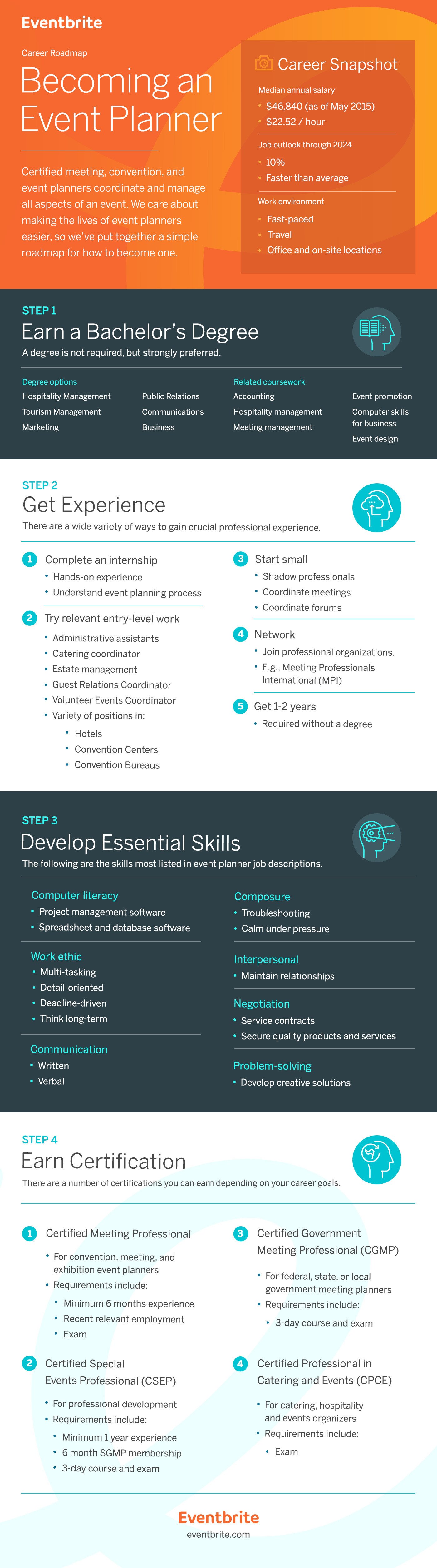
To many, event planning sounds like a dream job with endless possibilities. You can execute someone’s vision for the most important day of their life as a wedding planner or help fundraise for a meaningful cause as a nonprofit event planner. You can plan meetings for corporations or organize conventions for cosplayers. The options are diverse, and a combination of your interests and experience can guide you to the right niche within the field.

So how do you enter this field and start off strong? The basic first steps are to earn a relevant degree and gain the right experience, but in a competitive market, it’s important to set yourself apart.

Everything from specialization, continued education and a strong network can make a big difference in your success. The following career roadmap details a step-by-step process to launch your career as an event planner.

With these tips in hand, head over to our job board and find your next gig in the events world.

Topics:

Be Inspired, Get Hired
Hot Jobs

10 Hot Jobs for Creative Professionals to Explore Now

These jobs jobs place high importance on creative thinking skills and coming up with new and original ideas

10 Hot Jobs for Creative Professionals to Explore Now
Yana icon
By Ayana Young
Ayana Young is a communications and PR strategist with 15+ years of experience spanning media relations, lifestyle brands, professional sports, and publishing.
1 min read • Originally published August 8, 2017 / Updated March 19, 2026
Yana icon
By Ayana Young
Ayana Young is a communications and PR strategist with 15+ years of experience spanning media relations, lifestyle brands, professional sports, and publishing.
1 min read • Originally published August 8, 2017 / Updated March 19, 2026

Calling all creatives!

From graphic design to UX & UI and production to video if you’re looking for a position to utilize those creative juices we’ve pulled out 10 of our favorite innovative jobs.

No jobs were found


Topics:

Get Hired, Hot Jobs
Advice From the Pros

13 LinkedIn Tips to Unlock Your Next Job Opportunity

Opportunities are right there for the taking if you optimize your profile to take advantage of them

13 LinkedIn Tips to Unlock Your Next Job Opportunity
Yana icon
By Ayana Young
Ayana Young is a communications and PR strategist with 15+ years of experience spanning media relations, lifestyle brands, professional sports, and publishing.
6 min read • Originally published August 14, 2017 / Updated March 19, 2026
Yana icon
By Ayana Young
Ayana Young is a communications and PR strategist with 15+ years of experience spanning media relations, lifestyle brands, professional sports, and publishing.
6 min read • Originally published August 14, 2017 / Updated March 19, 2026

Here is a bold (but true) statement for anybody out there seeking a new job. If you are looking for a job and you are still not active on LinkedIn, you are behind. As you read this article, you are literally missing out on opportunities by not having LinkedIn. Or, if you have a profile and it’s not updated, you might as well be in the former camp. You’re completely missing out.

There are over 100 million active users on LinkedIn every month. That’s roughly a third of the United States population. A huge chunk of those people are recruiters, managers and people you can leverage to get a new opportunity.

Fortunately, it’s fairly easy to make sure you have an all-star profile that will attract recruiters and hiring managers. Use the below tips to make sure you have a top notch profile and before you know it you will be on the phone with your next opportunity.

1. Think of LinkedIn as a search engine for recruiters

When you are writing your summary, your bullet points under each job and listing your skills, think of what terms recruiters in your industry will be searching for. It’s almost like SEO. You will show up higher, and you will be more relevant to them.


2. Focus on completeness

When your profile is simply complete, meaning it has a photo and has each section filled out, you are automatically putting yourself in a better place than people you’re competing against. To recruiters, you come off as somebody who cares, puts the extra effort in and realizes what’s important. Imagine you’re looking to buy a piece of furniture off Craigslist. Would you be more likely to purchase one with a clear image and detailed description, or would you gravitate towards one with no picture, no description and just a title?


3. Ask for recommendations from anyone you’ve done anything for

Recommendations are the same as reviews for a product or business. There is no better way to build trust than for a recruiter to read that you’ve been effective in the past. Make a list of 5-10 old colleagues, managers or former clients. Reach out to them and ask for a quick recommendation for your LinkedIn profile. Even if only 1 or 2 of them respond, that will be plenty.


4. Write a stand-out headline

At the top of your profile, write a headline that will catch the eye of a recruiter without being cheesy. For instance, if non-profit is your niche, instead of “Seeking a New Marketing Position,” try “Digital Marketing Expert for Non-Profits.” If you’re just getting started, rather than “Student at Some University” or “Business Management Graduate” go with something like “Financial Analyst seeking a new position” or “Digital Marketer seeking media roles.”


5. Write industry articles

LinkedIn Pulse allows anybody to be an author. Go the extra mile and write a few insightful articles about your industry. When a recruiter goes to a profile with quality content written about a particular subject, the candidate is seen as a subject matter expert and immediately has more potential to be contacted.


6. Have a clear and decent-quality photo

It doesn’t even need to be entirely professional or taken with an expensive camera. Any new-ish smartphone can take a clear enough photo that will suffice for your LinkedIn. Find an area with good lighting on either a solid color background or somewhere outside with a neutral background. Just make sure the photo is a headshot from the shoulders up so that your face is the primary focus. Wear a collar or something professional on your top half, and you are ready to go. No need to go crazy with it—just have a clear photo.


7. Link to your LinkedIn from your email signature

Having an email signature is just another subtle way to position yourself as a professional who cares. In most professional roles, you will have an email signature with your name, email, phone number and a few relevant links. Make one for your personal email as well. Include a link to your LinkedIn profile and make the link text say “Connect With Me on LinkedIn!” or something similar. This is another small step that could set you apart from other candidates who just end emails with Sincerely, Joe.


8. Add links to a personal website or portfolio

LinkedIn is the new resume. Fortunately, it’s way better than a traditional resume because not only does it list all of the same information as a resume, but it also allows you to include links to external sources as well. Take advantage of this and link to all relevant projects, websites and pages that describe what you’ve done in more detail.


9. Edit the default LinkedIn URL you’re provided

This is just a quick way to increase the “completeness” of your profile, and it’s also another touchpoint for a recruiter to remember your name. You can click “Edit” on your profile and change the random letters and numbers to your actual name or something else unique to you.


10. Join groups where your ideal targets will be

LinkedIn allows you to join Groups that cover just about any industry or topic. Once you’re accepted into the groups (yes, you must make a request to join), post some of the industry articles you’ve written, and be sure to include a call-to-action stating you’re seeking a position or would be interested in speaking to recruiters. Just don’t post too much, or make it too obvious and have people tune you out for being spammy.


11. Write a strong 3-5 sentence summary

At the beginning of your LinkedIn profile, take advantage of the ability to write a summary. Introduce yourself, give clear insights into where you are professionally and what you’re looking to do. Do not overdo it with buzzwords, don’t be vague about who you are or what you do, and don’t come off as too much of a salesperson. If it ends up being longer than a few sentences, break it up into multiple paragraphs. Remember, most people view your profile on mobile, and text can end up seeming very long even if it’s not.


12. Post at the right times

If you are looking for a job, and you’re actively posting articles, sharing updates or reposting interesting content, do it at the right times so people see it. Recruiters will likely be on LinkedIn in the early morning and during business hours. Other people might be on in the evenings after work. Just tailor your posts to the times your ideal audience will actually see them.


13. Leverage your existing connections

Occasionally, creeping on LinkedIn is fine. Use your connections to find some relevant 2nd and 3rd level connections in your industry. View their profile, and your name will pop up for them as “Viewed Your Profile”—and you will be on their radar. Combine that with a complete and efficient profile, and you will have people reaching out in no time.

LinkedIn is the most powerful tool in the world for developing new professional connections and unlocking opportunities that could change your life. It’s right there for the taking. Take advantage of the opportunity to make yourself shine.

Has LinkedIn helped you earn opportunities in the past? Do you have any other tips to add for those who may be new to the platform and are currently seeking jobs?


Topics:

Get Hired, Job Search
Be Inspired

5 Powerful Ways to Think Outside the Box as a Writer

When deadlines have you down, revitalize your mind with these exercises

5 Powerful Ways to Think Outside the Box as a Writer
Yana icon
By Ayana Young
Ayana Young is a communications and PR strategist with 15+ years of experience spanning media relations, lifestyle brands, professional sports, and publishing.
4 min read • Originally published August 16, 2017 / Updated March 19, 2026
Yana icon
By Ayana Young
Ayana Young is a communications and PR strategist with 15+ years of experience spanning media relations, lifestyle brands, professional sports, and publishing.
4 min read • Originally published August 16, 2017 / Updated March 19, 2026

After a long day of writing and editing, your creative juices are most likely depleted. If you work in the writing industry, day-to-day deadlines can get you down, give you writer’s block, and leave you physically and emotionally drained. But, in order to come up with killer pitches, deliver awesome stories and ultimately impress your editors, you need to be on your A game. Keep your mind fresh and boost your creativity with these 5 tips to get yourself to think outside of the box.

Take long walks

Exercise will encourage your endorphins and sunlight provides a necessary infusion of vitamin D, but that’s not all a walk will do. Seeing and experiencing life away from your desk will get your creative juices flowing. In Drew Magary’s inspirational essay Walk: A Message To The Class Of 2017 about the benefits of walking, he writes “walking is writing” and “you think of cool ideas,” which you know is true.

Think about the last time you took a walk and how refreshed you felt afterwards. Think about all the interesting things you saw and thought of that left you feeling motivated. “The most important moments in life usually happen when you’re walking,” writes Magary.

Make a point to talk to strangers

Whether you are an introvert or extrovert, after serendipitously chatting with a stranger at the grocery store or on the subway, have you found yourself lifted up and enlightened? Have you ever thought, ‘Gosh, that person is a character out of a novel?’ People are characters and the way they speak, the stories they tell and their overall demeanor can spark a story idea. Chatting with a stranger can inspire a character for a fictional novel or an idea for a journalistic story.

Work in public

In a study published by Oxford University Press, it was found that “moderate noise can enhance creativity,” meaning that the background buzz in a public place like a coffee shop boosts your inspiration level. If you’ve ever crammed for exams in the college cafeteria or written a brilliant poem while waiting at the bus stop, it’s because just the right amount of background noise triggers abstract thinking.

On the other hand, keep in mind that loud noises are distracting and will in turn impair your creativity and productivity. If you want to give the noise-creativity theory a go, head to your local coffee shop or the website Coffitivity, where you can listen to several ambient soundtracks, such as “morning murmur” or “lunchtime lounge,” from the comfort of your home.

Write for yourself

Remember when you were young and you wrote for yourself—not for an editor, a publication or an instructor? You came up with creative stories; you chronicled memories; you kept a bedside journal. While you always have loved writing and you have turned your passion into a profitable career, your writing assignments aren’t always for yourself. They are for editors, readers and in the end, a paycheck.

Try writing for yourself. It’s therapeutic, eye-opening and energizing. Keep a journal or make yourself write for 10 minutes and submit your piece to the flash nonfiction website Life in 10 Minutes. The site was created by Richmond, Virginia-based author and writing instructor Valley Haggard who publishes short stories by writers of all levels and backgrounds from around the world.

“It’s important for people who are writing professionally to write for themselves because I think that if you lose contact with that creative force—that isn’t writing for a purpose for someone else—you will burn out in your job a lot faster,” says Haggard. “I have lots of people who come into my classes who write for a living and lose their joy for writing. This is a way of refreshing yourself and revitalizing the writing process just for yourself.

Or, don’t write at all

If your workday is spent writing, editing, brainstorming and pitching, words may be the last thing you want to look at or think about. Instead tap into another creative outlet. Pick up a paint brush, download a Podcast, dirty your hands in the garden, or just sit in silence and do some meditating. Stimulate your mind in other ways that will get your wheels churning if you’re maxed out on words.


Topics:

Be Inspired, Productivity
Hot Jobs

Hot Jobs in Advertising and Creative Services Right Now

Hot Jobs in Advertising and Creative Services Right Now
Yana icon
By Ayana Young
Ayana Young is a communications and PR strategist with 15+ years of experience spanning media relations, lifestyle brands, professional sports, and publishing.
1 min read • Originally published August 22, 2017 / Updated March 19, 2026
Yana icon
By Ayana Young
Ayana Young is a communications and PR strategist with 15+ years of experience spanning media relations, lifestyle brands, professional sports, and publishing.
1 min read • Originally published August 22, 2017 / Updated March 19, 2026

“Good advertising does not just circulate information. It penetrates the public mind with desires and belief.”

– Leo Burnett

Do you have the creative wit, writing skills and technical savviness to catapult a brand to the next level? If so, check out these new openings in the advertising field.


No jobs were found

Topics:

Get Hired, Hot Jobs
Skills & Expertise

What Do Fact Checkers Do? Inside This Essential Media Career

Fact checkers are more essential to journalism than ever

What Do Fact Checkers Do? Inside This Essential Media Career
Amirah icon
By Jenell Talley
Jenell Talley is a journalist and program analyst with a background spanning media, government, and editorial work. She holds a journalism degree from Howard University and a master's in human resources management from the University of Maryland.
5 min read • Originally published August 23, 2017 / Updated March 19, 2026
Amirah icon
By Jenell Talley
Jenell Talley is a journalist and program analyst with a background spanning media, government, and editorial work. She holds a journalism degree from Howard University and a master's in human resources management from the University of Maryland.
5 min read • Originally published August 23, 2017 / Updated March 19, 2026

Robert McGuire, currently publisher and editor of Nation1099.com, and owner of McGuire Editorial & Consulting, once worked as a reporter at weekly newspaper publisher, Community Newspapers, Inc. One thing that’s stuck with McGuire from his tenure at the paper, was the authority of the staff’s junior-level fact-checker.

“She could pull the brake on the train in ways nobody else could,” McGuire recalled. “Even the desk editors were afraid of her. They had worked on and approved stories that now someone less senior had the power to shove right back at them and say, ‘We can’t print this.’” Ouch.

Just the Facts, Ma’am

So what does a fact-checker, or researcher, do exactly? They check facts, sure. But what’s that really mean? Like, what facts? What are we talking here, Reese Witherspoon’s government name or how many times 50 Cent got shot? Gigi Hadid’s diet? Or the stats and statements candidates make during a presidential debate? The short answer: all the above. Fact-checkers verify it all, even the seemingly obvious.

Fact-checkers help a source of news or information maintain credibility and integrity. To that end, McGuire tells his team not to take anything for granted. “If the source says [his] name is Bob, ask how it’s spelled”—a lesson McGuire learned the hard way, as an obituary writer. “The first time it’s your fault that a misspelling of the deceased or of their bereaved shows up in print, you learn how important it is to check everything,” he added.

The Devil’s in the Details

In fact (pun intended), sometimes the lighter stuff is tougher to verify than hard news. “Because all of the material can seem less significant, the story lies in the small details,” says Sharmila Venkatasubban, BuzzFeed copy editor. “And in pieces that involve celebrities, the most minute details can be really important.” In pop-culture writing, misidentifying the type of shampoo a celebrity uses or the car she drives is big, as those particulars could be the result of contractual brand obligations.

Fact-checkers verify that all the facts and claims in a story are accurate and represented fairly, says Venkatasubban, who splits her time between copy editing and fact-checking. This involves reading through a reporter’s notes, audio and transcripts. Checking court records, video footage, research documents, any materials that the reporter used (or didn’t) in researching and reporting on a piece is imperative.

“Fact-checkers also look for holes in stories. They research sources to make sure they don’t have their own conflicts of interest and what they’re providing can be relied upon. And they read very closely on a sentence level to make sure the research and reporting [haven’t] been framed in a way that makes for good copy but doesn’t represent what exactly the reporter found. This involves what is often described as reporting in reverse,” adds Venkatasubban.

Attribution is Everything

Publications rely on fact-checkers to help them maintain their credibility. Of course, writers and reporters bear responsibility too. If they write it, they better be able to attribute it. Submitting notes accumulated while writing a piece, a list of credible sources (sorry, Wikipedia doesn’t count) and source contact information may be required. But not every publication uses fact-checkers.

“Many magazines, particularly those that publish longer reporting, employ fact-checkers,” says Venkatasubban. “News desks that publish breaking news and shorter stories—that are responding quickly to the news cycle—often don’t.” This may explain why many newspapers don’t use fact-checkers, though some have a research department that may assist with investigative pieces with longer turnaround times.

“For many industry-specific sites, specifically those that are not entertainment-related, I think the reporters themselves are policing their own articles,” offers Jake Tully, editor-in-chief and de facto fact-checker for Truckdrivingjobs.com. “Certainly, the larger news sources have a department or team dedicated solely to fact-checking, but I suspect that many other writers are doubling up on their duties. I don’t predominantly consider myself a fact-checker, per se; it’s more of an inherited duty.”

Politically Correct

But mags aren’t the only game in town for fact-checkers. There’s plenty work for those committed to verifying the veracity of political claims at outfits such as Politifact, a Tampa Bay Times offshoot. The process at Politifact is a bit different, but the mission is the same: truth-telling.

A typical day for a fact-checker at Politifact begins with reviewing the news and checking out a list of factual claims, usually gathered by interns who comb transcripts of TV interviews, explains Bill Adair, Politifact’s founder and former editor. Reporters reach out to the person who made the statement, or that person’s press secretary, and request background to verify any claims made.

This evidence is usually government data or a report from a think tank, explains Adair, also a Knight professor of the practice of journalism and public policy at Duke University and director of the DeWitt Wallace Center for Media and Democracy. Next, the fact-checkers find their own sources—independent experts whenever possible—and start their check.

The process is similar at Verbatim, the fact-checking arm of nonprofit, nonpartisan collaborative political encyclopedia, Ballotpedia. First, freelance researcher Kent Klein gets assigned a claim made by an elected official or other public figure. He researches the claim and then assembles an outline in which he answers a series of questions posed by editors, including whether the claim can be proven or disproven and who’d be interested in the outcome.

Truth Seeking

Klein is quick to point out that fact-checkers—at least at Verbatim and other such projects—aren’t on a witch hunt. They’re not conspiring to take someone down. “Contrary to what some may believe, reputable fact-checkers do not have a partisan agenda, but are simply interested in finding the truth.”

As is any fact-checker worth his or her salt. Because the fact of the matter is (yep, another pun intended) good writing can’t exist without stone-cold facts.


Topics:

Climb the Ladder, Skills & Expertise
Hot Jobs

Hot Media Jobs in San Francisco You Should Apply For

Want a media job in The Bay? We've got just what you're looking for

Hot Media Jobs in San Francisco You Should Apply For
Yana icon
By Ayana Young
Ayana Young is a communications and PR strategist with 15+ years of experience spanning media relations, lifestyle brands, professional sports, and publishing.
1 min read • Originally published August 29, 2017 / Updated March 19, 2026
Yana icon
By Ayana Young
Ayana Young is a communications and PR strategist with 15+ years of experience spanning media relations, lifestyle brands, professional sports, and publishing.
1 min read • Originally published August 29, 2017 / Updated March 19, 2026

Ready to cross the Golden Gate bridge and take over the media industry of the Bay Area? From rolling hills, to fogy mornings, and cable cars, San Francisco is home to major companies including Levi Strauss & Co., Gap Inc., Square, Inc., Airbnb, Weebly, Yelp, Pinterest, Twitter, Uber, Lyft, Mozilla, Wikimedia Foundation, and Craigslist.

There are always lots of media jobs in San Francisco on our job board.

Below, find a list of 12 of our favorites– from local news organizations to websites, one of these opportunities may be your next big career move.

No jobs were found

Topics:

Get Hired, Hot Jobs
Go Freelance

Feeling Unmotivated? 6 Tips to Jumpstart Your Freelance Hustle

Get Your Freelance Game Back On Point

Feeling Unmotivated? 6 Tips to Jumpstart Your Freelance Hustle
By Anni Irish
5 min read • Originally published August 30, 2017 / Updated March 19, 2026
By Anni Irish
5 min read • Originally published August 30, 2017 / Updated March 19, 2026

Freelancing as a full-time or part-time endeavor is hard, any way you cut it. Working in a gig economy as a writer, editor, marketer or in another field, where projects ebb and flow can be challenging. And at times, these circumstances can make it hard to stay motivated. Keeping your clients happy, maintaining the quality of your work, being communicative and keeping your mood up are all key aspects of being a successful and happy freelancer. However, if you aren’t motivated, then your work suffers.

When it comes to the freelance grind, these six important tips will help improve your productivity, grow your client base and most importantly, keep you motivated!

1. Have a routine

Being a freelancer often means that your schedule can vary from one day to the next. Having a routine can help add stability to your evolving career path. Getting up early, making coffee, walking the dog, working out, then getting to your emails can make all the difference in your day.

Set aside time to take breaks. Take an hour for lunch. Keep regular business hours and try not to respond to emails after 7 PM unless there is an emergency. By having a structure in your daily life, this can help give you some solace and give you routine. Setting aside the time each day to work is essential to keeping you happy and healthy.

2. Be creative with how you find your contacts and your clients

Finding new clients can be a challenge. But once you realize anyone is a potential client, and there are various ways to obtain their contact information, the sky’s the limit. Networking can be an essential way for a freelancer to build a client base.

Always be at the ready with business cards. Once you get someone’s contact information, remember to follow up in a few days so that you are fresh in their mind. Your peer network is also an untapped resource for potential clients and leads. Networking within your own group can result in unexpected leads and, in the long run, help you in ways you didn’t realize.

When looking for contacts, one good source is social media. Searching platforms such as Twitter can result in a wealth of knowledge. Keyword searches of editors, writers, academic and other people working across various fields via Twitter can tell you a lot. More times than not, people’s individual social media bios are more up to date than company websites and can give you an idea of where someone is working. Twitter bios will often include a link to their website or possibly their email address. Also, remember to follow influential people in your field on Twitter and engage with their content. This can be another way for you to network and stand out, helping you pitch the story or project you want.

Facebook can also be another way to connect with people. Share your projects online, engage your friends—and friends of friends—about the content you are producing. And make a professional Facebook page to keep people up to date about your successes and engage the projects you are working on. Ask questions, pose ideas and use it as an extension of the project or article you’re working on.

3. Be open to different ways of working

Although we all get into the habit of working the same kinds of ways, it is important to learn how to mix it up. Being open to different modes of working also means being flexible, receptive to constructive criticism and learning new skills that might be required for a particular job. The new computer system you learned on your previous job may help you in your next position. Keep an open mind and be creative about the connections you are making.

Continue to grow your knowledge with one of our self-guided courses and get a jump-start on today’s must-have digital skills.

4. Be flexible and remember to breathe

Being able to adjust to any situation quickly is a great skill set to have. As a freelancer, it is something you will find yourself doing time and again. While contracted jobs can get stressful—remember to breathe. Try not to be too rigid or set in your ways. Adjust your expectations accordingly and, more times than not, the client will respond accordingly.

In more complicated situations, it is still important to be able to maintain your cool. Over-communicate and be as clear as possible when speaking to your client about what is going on. This will help you identify how the issue can be addressed. With some quick thinking and some deep breathing, hopefully, it will be an easy fix.

5. Put time aside each week to set your goals

It’s important to prioritize and keep up with the tasks you have on hand. Each week, put aside a few minutes to review your upcoming projects.

Keeping track of what’s coming down the pipeline can also help you set your goals for the week. Set them around the parameters of the projects you have going on, but also try to think big.

Pitch out-of-the-box ideas to editors and project managers. You never know what they may be looking for, and if you don’t bring the idea up, you never know what could have been. Set manageable weekly goals for the things that have to get done. Additionally, set long-term goals that can help keep you engaged and your creative juices flowing.

6. Keep in touch with other freelancers to help keep you motivated

Talking to other freelancers is important because they understand the same kinds of struggles, and ups and downs you are experiencing. Try to join an online or physical group of other freelancers and make bigger connections. Chatting with other people in your industry can help you develop working relationships—and friendships—that will help you in the long-run.

Make time to check in with one another. Your freelance friends can be a great source of knowledge and can give you advice about how to handle potentially sticky situations that may come up. They can also offer guidance on projects and be a second pair of eyes. With someone else looking out for you in this gig economy, it can help keep you motivated to do your best.

Topics:

Go Freelance, Skills & Expertise
Advice From the Pros

Are You a Workaholic? How to Finally Find Work-Life Balance

You can love what you do, without doing it all of the time

Are You a Workaholic? How to Finally Find Work-Life Balance
Yana icon
By Ayana Young
Ayana Young is a communications and PR strategist with 15+ years of experience spanning media relations, lifestyle brands, professional sports, and publishing.
4 min read • Originally published September 4, 2017 / Updated March 19, 2026
Yana icon
By Ayana Young
Ayana Young is a communications and PR strategist with 15+ years of experience spanning media relations, lifestyle brands, professional sports, and publishing.
4 min read • Originally published September 4, 2017 / Updated March 19, 2026

You glance at the time in the corner of your computer monitor. Somehow, it’s already nearly 7PM—a half hour past the time when you had promised yourself you’d pack up and leave the office.

You tie up a few loose ends, shut down your computer, and leave the rest of your work for tomorrow—or so you think. In reality? You spend the rest of your evening checking emails, doing research and getting a jump-start on your to-do list for the next day.

Sound familiar? You aren’t alone. We’re all more connected to work than ever, which makes it tough to truly unplug. And, for self-proclaimed workaholics, it can feel almost impossible to step back and get that necessary time to recharge.

However, giving yourself a break from that constant mental grind is crucial for feeling healthy and happy—inside the office and out. With that in mind, here are four essential tips workaholics can use to strike a better work-life balance.

1. Schedule in Your Personal Time

Meetings, seminars, appointments and coffee dates. As someone who lives and breathes your work, you probably rely on your calendar as your lifeline.

So, why not leverage that to your advantage and literally schedule in some personal time for yourself? Whether it’s a workout class you’ve been meaning to take, dinner with friends, or even an uninterrupted hour or two when you can read a book or do something you enjoy, block out some time on your calendar.

Then, honor that personal time like you would any other professional commitment. It’s a small step, but it instills a sense of accountability in making sure that you’re leaving enough time for some rest and relaxation.

2. Tailor Your To-Do List

When is the last time you managed to check off every single item on your to-do list? If you’re like most people, hardly ever. In fact, a whopping 90% of professionals admit to being unable to accomplish all of the tasks on their lists each day.

This presents a problem for people who call themselves workaholics, as it’s increasingly tough to shut off that work portion of your brain if those undone items are lingering over your head.

Here’s a simple solution: Make a shorter, more focused to-do list for yourself. Rather than treating that notepad as a chance to jot every single action item—whether it needs to be done tomorrow or three weeks from now—use it as a roster of only the things that need to be done today.

Challenge yourself to stick to only three (yes, three!) items on your to-do list each day. Experts say that’s the perfect number to keep you focused, motivated and productive.


3. Enlist Help

Nobody works in a vacuum, and enlisting help from others can be a great way to keep your workaholic tendencies at bay.

This can work in two different ways. The first is to ask for some assistance with the work that’s on your plate. If you’re feeling particularly swamped, asking your colleagues to pitch in every now and then can help you get caught up, pull yourself out from under that pile and start escaping the office at a reasonable hour.

Another way you can enlist the help of others? Choose a trusted coworker or close friend to help keep you accountable. Tell him or her what time you plan to shut down or that you’re intending to spend the whole weekend relaxing—rather than working. He or she can then check in on you to prevent you from slipping back into your old workaholic habits.

It can seem a little strange to have someone keep an eye on you. But, it’s also incredibly effective.

4. Quite Literally Unplug

With laptops, tablets, phones and remote work on the rise, it’s harder than ever to actually disconnect from the office—your work can follow you everywhere.

This is why a total digital detox can be so helpful. Pick a time each evening when you’ll shut off your phone or leave it in another room. Challenge yourself to do an entirely screen-free weekend. Or, delete your work email app from your phone altogether!

Spending some time without your work constantly in front of your face will empower you actually to unplug and relax. And, you’ll likely even rediscover some passions and hobbies that you previously let fall by the wayside—thus further improving your sense of work-life balance.

Ultimately, there’s nothing wrong with loving what you do. But, some time away from your day job is still important—so you need to figure out some strategies to help you leave work at work. Give these a try, and you’ll be well on your way to changing your workaholic ways!

Topics:

Advice From the Pros, Be Inspired
Hot Jobs

Hot Jobs: Media and Communications Careers in Academia

Experienced media professionals wanted

Hot Jobs: Media and Communications Careers in Academia
Yana icon
By Ayana Young
Ayana Young is a communications and PR strategist with 15+ years of experience spanning media relations, lifestyle brands, professional sports, and publishing.
1 min read • Originally published September 5, 2017 / Updated March 19, 2026
Yana icon
By Ayana Young
Ayana Young is a communications and PR strategist with 15+ years of experience spanning media relations, lifestyle brands, professional sports, and publishing.
1 min read • Originally published September 5, 2017 / Updated March 19, 2026

Interested in passing on your knowledge and inspiring the next generation of media industry movers and shakers? If so, a career in academia may be just what you’re looking for! Explore some of our favorite academia based job opportunities now available on our job board below and apply today.

Topics:

Get Hired, Hot Jobs

Posts navigation

Older posts
Newer posts
Featured Jobs
Kirkus Media
Editorial Intern
Kirkus Media
New York City, New York (US)

Gaia Inc
MEDIA COORDINATOR
Gaia Inc
Louisville, CO

Gaia Inc
Global Paid Media Specialist
Gaia Inc
Louisville, CO

Gaia Inc
Director of Media Strategy
Gaia Inc
Louisville, CO

Hearst Television
Account Executive
Hearst Television
Milwaukee, WI, United States

All Jobs »
PREMIUM MEMBER
JB

Juliet Bennett Rylah

Los Angeles, CA
11 Years Experience
I am a versatile freelancer with a passion for well-researched, people-driven stories told with accuracy and empathy. At home in L.A., I've written...
View Full Profile »
Join Mediabistro Membership Today

Stand out from the crowd with a premium profile

Mediabistro Logo Find your next media job or showcase your creative talent
  • Job Search
  • Hot Jobs
  • Membership
  • Newsletter
  • Career Advice
  • Media News
  • Hiring Tips
  • Creative Tools
  • About
Facebook YouTube Instagram LinkedIn
Copyright © 2026 Mediabistro
  • Terms of Use
  • Terms of Service
  • Privacy