Mediabistro Logo Mediabistro Logo
  • Jobs
    Search Creative Jobs Hot Jobs Remote Media Jobs Create Job Alerts
    Job Categories
    Creative & Design Marketing & Communications Operations & Strategy Production Sales & Business Development Writing & Editing
    Quick Links
    Search All Jobs Remote Jobs Create Job Alerts
  • Career Resources
    Career Advice & Articles Media Industry News Media Career Interviews Creative Tools Resume Writing Services Interview Coaching Job Market Insights Member Profiles
  • Mediabistro Membership
    Membership Overview How to Pitch (Premium Tool) Editorial Calendars (Premium Access) Courses & Training Programs Membership FAQ
  • Log In
Post Jobs
Mediabistro Logo Mediabistro Logo
Search Creative Jobs Hot Jobs Remote Media Jobs Create Job Alerts
Job Categories
Creative & Design Marketing & Communications Operations & Strategy Production Sales & Business Development Writing & Editing
Quick Links
Search All Jobs Remote Jobs Create Job Alerts
Career Advice & Articles Media Industry News Media Career Interviews Creative Tools Resume Writing Services Interview Coaching Job Market Insights Member Profiles
Membership Overview How to Pitch (Premium Tool) Editorial Calendars (Premium Access) Courses & Training Programs Membership FAQ
Log In
Post Jobs
Log In | Sign Up

Follow Us!

media-news

New to The Street Broadcasts Show #752 on Bloomberg Television Featuring Graphene Manufacturing Group (OTCQX:GMGRF), T-REX Acquisition Corp (NASDAQ:TRXA), KITON, and Roadzen (NASDAQ:RDZN)

By Media News
2 min read • Published May 9, 2026
By Media News
2 min read • Published May 9, 2026

The show broadcasts as sponsored programming with commercials by Synergy CHC Corp. (NASDAQ:SNYR), YY Group Holding Limited (NASDAQ:YYGH), DataVault AI (NASDAQ:DVLT), Medicus Pharma Ltd. (NASDAQ:MDCX), and IGC Pharma (NYSE American:IGC)

NEW YORK, NY / ACCESS Newswire / May 9, 2026 / New to The Street , one of the longest-running U.S. and international sponsored television business brands, announces the nationwide Bloomberg Television broadcast of Show #752 airing Saturday at 6:30 PM EST as sponsored programming. The episode features executive interviews and corporate updates from innovative public and private market leaders spanning advanced materials, acquisition platforms, luxury fashion, and AI-driven insurance technology.

The nationally televised episode features:

  • Graphene Manufacturing Group (OTCQX:GMGRF) – Discussing its next-generation graphene aluminum-ion battery technology, energy-saving solutions, and the growing global demand for advanced battery materials and clean technology innovation.

  • T-REX Acquisition Corp (NASDAQ:TRXA) – Providing insight into its acquisition strategy, growth initiatives, and market opportunities within today’s evolving capital markets environment.

  • KITON – Highlighting the continued expansion of the globally recognized luxury fashion house and its growing U.S. visibility through strategic media and branding initiatives.

  • Roadzen (NASDAQ:RDZN) – Showcasing its AI-powered insurance technology ecosystem and discussing how automation and artificial intelligence are transforming underwriting, claims processing, and mobility solutions worldwide.

The broadcast will also feature sponsored television commercials from:

  • Synergy CHC Corp. (NASDAQ:SNYR)

  • YY Group Holding Limited (NASDAQ:YYGH)

  • DataVault AI (NASDAQ:DVLT)

  • Medicus Pharma Ltd. (NASDAQ:MDCX)

  • IGC Pharma (NYSE American:IGC)

About New to The Street

New to The Street is one of the longest-running U.S. and international sponsored television business brands, broadcasting sponsored programming weekly on Bloomberg Television and Fox Business Network. For more than 17 years, the platform has featured some of the fastest-growing public and private companies through long-form executive interviews, television commercials, earned media placements, digital syndication, and iconic outdoor billboard campaigns throughout New York City’s financial district and Times Square.

The company’s expanding media ecosystem includes one of the largest financial-focused YouTube platforms in the industry with millions of subscribers across its channels, alongside distribution through LinkedIn, X, Instagram, Facebook, and additional digital media networks. New to The Street films interviews from the NYSE and Nasdaq MarketSite while continuing its global expansion across the U.S., MENA, and Latin American markets.

Media Contact:
Monica Brennan
Communications Director
New to The Street
Monica@NewtoTheStreet.com

SOURCE: New to The Street

View the original press release on ACCESS Newswire

Topics:

media-news
Careers & Education

Khan Academy’s founder says AI tutoring revolution hasn't come for education, yet

Khan Academy’s founder says AI tutoring revolution hasn't come for education, yet
By Matt Barnum for Chalkbeat
5 min read • Published May 8, 2026
By Matt Barnum for Chalkbeat
5 min read • Published May 8, 2026

Khan Academy CEO Sal Khan (left) and Microsoft Chief Technology Officer and Executive Vice President of Artificial Intelligence Kevin Scott (right) presenting at the Microsoft Briefing event in Seattle, Washington, USA.

JASON REDMOND // AFP via Getty Images

Khan Academy’s founder says AI tutoring revolution hasn’t come for education, yet

Three years ago, as Khan Academy founder Sal Khan rolled out an AI-powered tutoring chatbot, he predicted a revolution in learning.

So far, the revolution hasn’t happened, he acknowledged.

“For a lot of students, it was a non-event,” Khan told Chalkbeat about his eponymous chatbot, Khanmigo. “They just didn’t use it much.”

Khan gives this analogy: Imagine he walked into a class, sat in the back of the room, and waited for students to seek out help. “Some will; most won’t,” he said. That’s been the experience with AI tutoring, he said. It doesn’t necessarily make students motivated to learn or fill in gaps in knowledge needed to ask questions.

Khan’s comments are an acknowledgment that AI has not quickly allowed for the creation of an effective super-tutor, as some initially hoped. It’s an early indication of the limits of AI to drive massive learning gains, long an unrealized goal of various technologies. While Khan remains optimistic about various uses of AI in education, he’s also come to see its limits.

“I just view it as part of the solution; I don’t view it as the end-all and be-all,” Khan said.

In the summer of 2022, OpenAI leaders Sam Altman and Greg Brockman reached out to Sal Khan. They were months away from releasing ChatGPT, and were hoping Khan Academy — a large nonprofit that works with schools across the country — could showcase the technology’s potential benefits. “I didn’t realize it yet, but the world was about to be turned upside down,” Khan wrote in his 2024 book “Brave New Words: How AI Will Revolutionize Education (and Why That’s a Good Thing).”

OpenAI provided Khan Academy with early access to a more advanced AI model, GPT-4. With that, the Khan Academy team then built a specialized chatbot, Khanmigo, designed to help students learn and restricted from simply giving them the answer. Khan himself quickly became an evangelist for the technology’s uses in schools.

“We’re at the cusp of using AI for probably the biggest positive transformation that education has ever seen,” Khan said in a widely viewed TED Talk in 2023. “The way we’re going to do that is by giving every student on the planet an artificially intelligent but amazing personal tutor.”

He suggested that eventually AI could turn the average student into an academic standout, citing a seminal but controversial 1984 study on the value of individualized tutoring.

Khan also appeared in a “60 Minutes” segment that featured northwest Indiana’s Hobart High School, which was an early adopter of Khanmigo.

Kristen Musall, a geometry teacher at Hobart High, gave Khanmigo a try when it first rolled out. Musall appreciated its encouraging, teacher-like tone, but she found that students didn’t really care for the bot. They found it frustrating — Khanmigo sometimes made mistakes, but also wouldn’t give away the answer. “If students don’t engage with the material enough to know what they’re looking for, then an AI like Khanmigo doesn’t necessarily help,” she recently told me.

Musall no longer uses Khanmigo in her class. She says there’s been more enthusiasm for the product among administrators than teachers in her school.

A few of Musall’s most advanced students have taken advantage of AI to learn new topics. But, as far as she can tell, more students are using it to just find answers, which has created a massive headache for teachers. Nationally, a majority of teenagers say AI-powered cheating is at least somewhat prevalent in their schools, according to a late 2025 Pew survey.

Peggy Buffington, Hobart’s superintendent, said there’s been a range of reactions from teachers and students to AI. There was initially a learning curve for students to ask Khanmigo questions, but they’ve gotten a lot better, she said: “It’s like anything in education. You have to learn how to use the tool and use it appropriately.”

Buffington says that schools need to prepare students to use AI responsibly and Khanmigo is preferable to commercial products they would use on their own. Overall, she’s found the tool beneficial. “Our kids can log in at home and they can get help with their homework and it won’t give them the answer,” she said.

But Khan Academy officials have seen that many students won’t take advantage of that option or don’t know how to. Kristen DiCerbo, the organization’s chief learning officer, said AI can only respond to students based on what they ask. And it turns out, she said, “Students aren’t great at asking questions well.”

DiCerbo was initially hopeful that AI would be able to personalize instruction to students’ needs and interests. That hasn’t happened. “So far, I am not seeing the revolution in education,” she said.

AI is still poised to shake up American education in many ways — by making cheating easier, reshaping how teachers approach their work, and changing the broader economy in ways that affect schools. So far, the evidence base for AI in education remains “extremely limited,” according to an overview paper released last month.

Khan Academy officials say they’re learning from their experience with Khanmigo and pairing it with other offerings.

A 2025 study found that when teachers used Khan Academy to help students practice academic content, their classes made slightly faster learning gains. Lower-performing students, though, saw few if any improvements from Khan Academy. This was before Khanmigo.

Khan Academy recently announced an overhaul of its product that provides students with additional academic practice. Now Khanmigo is incorporated directly as a way for students to get advice as they’re working through specific problems. A spokesperson said the organization made this change because “students were not seeking out Khanmigo’s help as much as we had hoped.”

“AI is going to help,” said Khan of this reimagined Khan Academy. “But I think our biggest lever is really investing in the human systems.”

This story was produced by Chalkbeat and reviewed and distributed by Stacker.

Topics:

Careers & Education
media-news

Sony Runs on Anime Now. Ad Tech Talent Runs to AI.

When your revenue depends on one thing working, everything else becomes negotiable.

By Mediabistro Team
6 min read • Published May 8, 2026
By Mediabistro Team
6 min read • Published May 8, 2026

Sony Pictures Entertainment posted $9.9 billion in revenue for fiscal 2025. A flat line that looks stable until you see what’s holding it up.

Crunchyroll anime titles and the global success of “Demon Slayer: Kimetsu no Yaiba Infinity Castle” propped up numbers that would have sagged without them, as Variety reports. Meanwhile, the shutdown of Pixomondo, Sony’s VFX division, dragged profits down even as the topline held.

This is a story about anime becoming “load-bearing walls” holding up a legacy entertainment conglomerate.

When one format category has to offset weakness across theatrical releases and other divisions, you’re looking at structural dependency, the kind that reorients where talent flows and where investment decisions get made.

That same resource allocation pressure is showing up across advertising and news. The Trade Desk beat revenue estimates but posted its slowest growth since Covid, then lost its chief strategist to OpenAI. Lee Enterprises is adding reporters after years of cuts. Axios is publishing less and getting more traffic. The Wall Street Journal committed six months and 20 staffers to a single investigation.

Three different theories of where to put resources, all emerging at once because the old distribution of effort no longer maps to results.

Anime Is Now Load-Bearing at Sony

Sony Pictures closed its fiscal year at $9.917 billion in revenue, essentially unchanged from 2024. That flat line masks real composition shifts.

Deadline’s breakdown shows Crunchyroll’s anime catalog and the “Demon Slayer” film franchise delivered the growth needed to compensate for lower theatrical revenue elsewhere. Without anime, the number moves backward.

Operating income took a hit from the Pixomondo shutdown too. The VFX unit worked on major film and streaming projects before being closed as part of cost realignment.

Double pressure: revenue composition shifting toward a single high-performing category while cost cuts eat into profitability even when the topline holds steady.

Career Signal: Anime and adjacent global IP formats are profit engines at scale. Studios, streamers, and distributors investing in localization, licensing, and original production are building structural advantage. If you work in content acquisition, international distribution, or franchise development, this is where budget gravity is moving.

Sony acquired Crunchyroll in 2021 for $1.175 billion and has been building out the catalog and global reach since. The fiscal 2025 results validate that acquisition thesis at a time when other entertainment bets are underperforming. When a format category becomes essential to holding a $10 billion revenue line, it stops being a side play.

The Trade Desk Is Fine. That’s the Problem.

The Trade Desk reported $689 million in quarterly revenue, beating analyst expectations. Revenue grew 12% year-over-year, which sounds healthy until you realize it’s the slowest growth rate the company has posted since 2020.

Adweek’s analysis notes the deceleration comes alongside ongoing negotiations with Publicis Groupe, one of its largest agency clients.

Beating estimates while posting your slowest growth in five years creates an awkward narrative. The company is performing well relative to expectations that have already adjusted downward. The programmatic sector is maturing, and maturity means lower growth rates and tighter competition for incremental gains.

The other signal came from personnel. Samantha Jacobson, The Trade Desk’s chief strategy officer, left for OpenAI the same week earnings dropped, as Digiday reported.

Jacobson was responsible for translating product capabilities into market narrative. Her departure to an AI company reflects where top strategic talent sees the next inflection point.

AI companies are pulling senior operators out of ad tech because they’re building the infrastructure layer beneath programmatic, the models that will determine how targeting, creative optimization, and measurement work in the next cycle.

Read the room on skill adjacency. Staying in programmatic is viable. Opportunities for career advancement and compensation upside are concentrating in companies building AI tooling for advertising rather than companies operating ad exchanges.

The gap between “fine” and “where the action is” widens fast when talent flows in one direction and capital follows.

Three Theories of Editorial Investment

Three stories from the past quarter lay out competing hypotheses about where to put editorial capacity. Lee Enterprises, Axios, and The Wall Street Journal are making radically different bets.

Lee Enterprises, one of the largest newspaper chains in the country, is adding reporters after years of cuts. David Hoffmann, the billionaire investor who became Lee’s new chairman, told Poynter the company has reduced corporate overhead and redirected resources to key markets where it’s hiring journalists.

A reversal of the consolidation playbook that defined Lee for most of the past decade. The bet: more reporters producing more local coverage in markets where the company believes it can build subscriber density. The risk is execution. Adding reporters doesn’t automatically translate to subscriber growth, especially in markets where news consumption habits already shifted away from daily papers.

For journalists considering newsroom opportunities, this signals which chains are moving resources back into editorial versus continuing to extract value through cuts.

Axios is running the opposite experiment. Output dropped 22% in Q1 compared to a year earlier. Page views increased 30%.

That’s according to Press Gazette. A deliberate shift from volume to value, testing whether publishing less and focusing on higher-impact stories drives better engagement and business outcomes.

Key Insight: If less output drives more engagement, the premium shifts to story selection and execution quality over production velocity. Newsrooms that can identify the 30% of stories generating 70% of value will outperform those optimizing for volume.

Editors and reporters who operate effectively in a lower-volume, higher-stakes environment have more leverage than those trained primarily for churn.

The Wall Street Journal represents the third model: massive resource commitment to singular investigations. The paper’s recent story on Donald Trump and Jeffrey Epstein required six months and 20 staff members, Press Gazette reported, and faced legal threats before publication.

Investigative journalism as high-risk capital allocation. Twenty people not producing other stories for half a year. The WSJ can afford this because it operates in a financial ecosystem that still rewards this kind of journalism. Most newsrooms cannot. Investigative reporters need to be strategic about which organizations can actually support the work they want to do.

Lee’s scale bet, Axios’s efficiency play, the WSJ’s prestige investment. Shaped by very different financial constraints, but connected by the same underlying question: what does editorial investment mean when legacy assumptions about coverage breadth no longer hold?

What This Means

The pattern is reallocation under pressure. The sectors and formats where investment is concentrating are visible: anime and global IP at entertainment studios, AI tooling in advertising, and high-signal editorial models in news.

The gap between high-growth categories and everything else is widening. Career optionality depends on positioning near where resources are flowing, not where they used to be.

So pay attention to resource signals. Is the company adding capacity in your area or managing decline? Is talent moving in or out, and where are the people leaving going? Looking for your next move in media, content, or advertising? Browse open roles on Mediabistro to find opportunities at companies investing in growth categories. And if you’re hiring for editorial, strategy, or production roles, post a job on Mediabistro to reach the 110,000+ media professionals reading this each week.


This media news roundup is automatically curated to keep our community up to date on interesting happenings in the creative, media, and publishing professions. It may contain factual errors and should be read for general and informational purposes only. Please refer to the original source of each news item for specific inquiries.

Topics:

media-news
Hot Jobs

International News, Fiction Publishing, and Agency Jobs Hiring Today

From the Australian Broadcasting Corporation's DC bureau to a fiction publisher scaling acquisitions by 50 percent, today's roles reward specialists with range.

mediabistro hot jobs
Mediabistro icon
By Mediabistro
The Mediabistro editorial team draws on 25 years of media industry expertise to cover jobs, careers, and trends shaping the industry.
5 min read • Published May 8, 2026
Mediabistro icon
By Mediabistro
The Mediabistro editorial team draws on 25 years of media industry expertise to cover jobs, careers, and trends shaping the industry.
5 min read • Published May 8, 2026

Specialists With Range Are in Demand

A pattern keeps surfacing in today’s listings: employers want deep expertise paired with operational versatility. The most compelling roles posted right now aren’t looking for generalists who dabble. They want people who’ve mastered one discipline and can stretch confidently into adjacent ones.

Consider what’s on the board. A foreign news bureau needs someone who can toggle between editorial logistics and financial administration. A commercial fiction publisher wants an acquisitions leader who thinks in data systems. A multicultural agency is hiring account executives who can shift between client strategy and content creation within the same afternoon. Even the most senior digital role on today’s list, a director-level position paying up to $155K, explicitly asks for someone who can operate at high strategy and in day-to-day execution simultaneously.

This is a market that rewards T-shaped professionals: deep vertical knowledge with a wide horizontal bar of adjacent skills. If your resume tells only one story, today’s listings suggest it may be time to broaden the narrative.

Today’s Hot Jobs

Office / Production Assistant at Australian Broadcasting Corporation

Why this one deserves a closer look: International news bureau jobs in Washington, DC, are rare finds on any job board. The ABC’s Washington bureau covers American politics and breaking news for Australian audiences, which means you’d be working at the intersection of two media cultures. The role blends editorial support (assisting producers on breaking news, coordinating out-of-town assignments, preparing risk assessments) with full bureau administration, including bank reconciliation and vendor management. For someone early or mid-career who wants to understand how a foreign news operation actually runs from the inside, this is an unusually well-rounded entry point.

What the bureau needs:

  • Experience supporting news producers with planning and executing coverage of breaking news and assignments
  • Ability to manage logistical coordination including travel, visas, accreditations, and communications
  • Financial administration skills including reconciling bank accounts and credit cards
  • Willingness to be available outside normal working hours for emergency bureau issues

Apply to the ABC Washington Bureau Production Assistant role

Head of Content Strategy, Commercial Fiction at Crooked Lane Books / Alcove Press

The real draw here: This role sits at the exact point where editorial instinct meets business intelligence. Crooked Lane and Alcove Press want to scale commercial fiction acquisitions by 50 percent, and they’re hiring someone to own the entire pipeline, from trend spotting and agent outreach through negotiations and contracts. You’d have direct authority to approve or decline titles based on strategic buying criteria, backed by data systems rather than gut feeling alone. The salary range of $80K to $110K with benefits is solid for an independent publisher, and the listing is open to remote candidates despite being based in New York. The flat organizational structure and Penguin Random House distribution backbone give this role a startup energy with major-house reach.

Core qualifications:

  • 5 to 8 years of experience, ideally with a background in acquisitions or editorial strategy in commercial fiction
  • Analytical, systems-focused approach to building and managing a high-velocity acquisitions pipeline
  • Ability to prioritize and align an 11-plus-person editorial team with strategic buying criteria
  • Comfort with data-backed decision-making while maintaining strong agent and author relationships

Apply to the Head of Content Strategy position at Crooked Lane Books

Account Executive at Yellow House Creative Consulting

What caught my attention: Yellow House is a Boston-based agency whose benefits package reads like someone actually thought about what employees want. The $70K to $95K salary comes with a path to equity after five years, an annual learning stipend, a technology stipend, and a permanently remote work option with optional office access downtown. The role itself is a hybrid of account management and light social media execution across CPG, lifestyle, healthcare, and hospitality clients. For account professionals curious about how PR and marketing are evolving alongside AI-driven tools, working at a smaller agency like this provides direct exposure to the full strategic picture.

The ideal candidate brings:

  • Two or more years of agency experience with strong client relationship management skills
  • Ability to translate client goals into clear internal briefs for creative, strategy, and influencer teams
  • Experience maintaining timelines, budgets, and scopes across multiple accounts
  • Comfort assisting with monthly content calendars and social media approvals

Apply to the Account Executive role at Yellow House Creative Consulting

Director of Digital and Social Media at TransLash Media

This role signals where mission-driven media is heading: TransLash, a multi-platform organization centering transgender and gender nonconforming stories, is hiring a director-level strategist at $135K to $155K, fully remote. The position reports directly to the CEO and requires someone who can shape platform strategy across podcasts, film, journalism, and community content while also managing day-to-day execution. That combination of strategic altitude and hands-on involvement is exactly the T-shaped profile the market keeps demanding. For digital leaders ready to help shape how an award-winning media organization reaches and grows its audience, this is a meaningful opportunity with compensation that respects the seniority required.

Key requirements:

  • Strategic leadership experience shaping digital and social engagement across multiple platforms
  • Team-building ability with a track record of executing content with clarity, creativity, and consistency
  • Experience managing both high-level strategy and day-to-day platform operations
  • Strong alignment with TransLash’s mission and understanding of TGNC communities

Apply to the Director of Digital and Social Media position at TransLash

Professional Takeaways

Today’s strongest listings all share one trait: they describe roles where the boundaries between disciplines are intentionally blurred. Editorial and operations. Acquisitions and data analysis. Account management and content creation. Strategy and execution. If you’ve been building skills across adjacent areas, now is the time to make that range visible. Before you apply, update your LinkedIn profile to reflect cross-functional experience, not just your primary job title. Hiring managers reading today’s applications are scanning for evidence that you can hold two lenses at once.

Also on the Web

Beyond Mediabistro, these roles are also making waves across the media job landscape.

Managing Editor at WHYY (Remote)

Public media continues to invest in regional editorial leadership. WHYY’s Delaware-focused managing editor role is open to remote candidates, a signal that public broadcasters are increasingly willing to separate editorial oversight from physical newsroom presence.

Apply to the WHYY Managing Editor position

Part-Time Managing Editor, American Journal of Education at Penn State

Academic publishing rarely surfaces on mainstream job boards, but this part-time managing editor role at one of the field’s most respected journals is worth noting for editors seeking flexible, intellectually rigorous work outside the commercial publishing cycle.

Apply to the Penn State Managing Editor role

Managing Editor at The Christian and Missionary Alliance (Reynoldsburg, OH)

Faith-based publishing often offers competitive compensation with strong mission alignment. This managing editor position pays $67K to $74K, a respectable range for a nonprofit editorial leadership role in central Ohio.

Apply to the Managing Editor role at The Christian and Missionary Alliance

Topics:

Hot Jobs
Entertainment

The salary you need to live comfortably in 100 US cities

The salary you need to live comfortably in 100 US cities
By Jaclyn DeJohn, CFP for SmartAsset
5 min read • Published May 8, 2026
By Jaclyn DeJohn, CFP for SmartAsset
5 min read • Published May 8, 2026

A view of the San Antonio River walkway in San Antonio, Texas.

Meyta // Shutterstock

The salary you need to live comfortably in 100 US cities

To truly understand the context of a household’s income, it must be compared to local costs and long-term goals, which both may fluctuate over time. For most people, the same pillars will make up the biggest nonnegotiables in their budget. These include basic necessities like housing, groceries, utilities, and transportation, and likely some discretionary spending on hobbies, activities, and other enrichment. In an attempt to secure this lifestyle for the future, many households aim to save some of their income for emergencies, investments, retirement, education, and other long-term goals. A common budgeting technique that encapsulates these three pillars is called the 50/30/20 rule: 50% of your post-tax income goes to needs, 30% to your wants, and 20% gets set aside for the future.

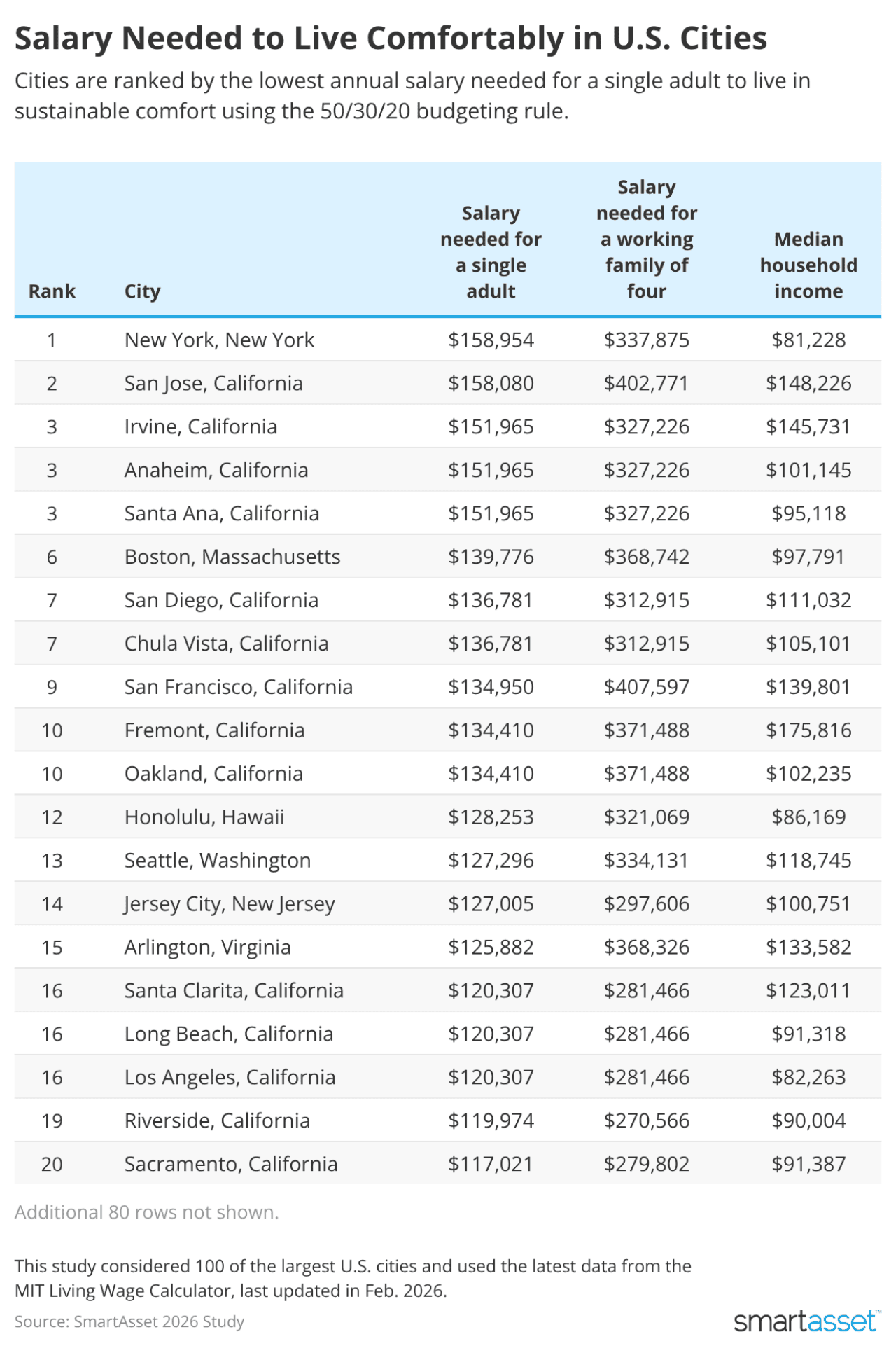
With this in mind, SmartAsset assessed the salary needed to reach this 50/30/20 ideal — designated as a comfortable salary — based on the local costs in 100 of the largest U.S. cities.

Key Findings

  • A single adult needs to earn $150,000 to live comfortably in these places. New York has the highest individual salary needed to live comfortably at $158,954. San Jose, California, follows closely at $158,080. Orange County cities Irvine, Anaheim, and Santa Ana require an estimated $151,965 in income for a single adult.
  • These cities have the lowest salary needed to live comfortably. San Antonio has the lowest salary threshold for both single adults and families of four at $83,242 and $192,608, respectively. New Orleans has the second-lowest salary needed for a single adult to live comfortably at $84,406, followed by Memphis, Tennessee, at $86,320.
  • The Bay Area is the most expensive place for a family to live comfortably. Bay Area cities make up the top four of the five places with the highest salary needed for a family of four to live comfortably. Incomes across two parents are projected at $407,597 in San Francisco, $402,771 in San Jose, and $371,488 in both Fremont and Oakland. Boston rounds out the top five at $368,742.
  • Families in these Texas cities are closest to a comfortable salary. In Frisco, the median household earns $145,444 — substantially higher than the national median of $83,730. This figure also accounts for 63.1% of the $230,464 income a family of four in Frisco needs to live comfortably. In McKinney, the $124,177 median household income accounts for 53.9% of the $230,464 needed.

Table listing the top cities by the lowest annual salary needed for a single adult to live in sustainable comfort using the 50/30/20 budgeting rule.

SmartAsset

10 Cities With the Highest Salary Needed to Live Comfortably

1. New York, New York

  • Salary needed for a single adult: $158,954
  • Salary needed for a working family of four: $337,875
  • Median household income: $81,228

2. San Jose, California

  • Salary needed for a single adult: $158,080
  • Salary needed for a working family of four: $402,771
  • Median household income: $148,226

3. (tie) Irvine, California

  • Salary needed for a single adult: $151,965
  • Salary needed for a working family of four: $327,226
  • Median household income: $145,731

3. (tie) Anaheim, California

  • Salary needed for a single adult: $151,965
  • Salary needed for a working family of four: $327,226
  • Median household income: $101,145

3. (tie) Santa Ana, California

  • Salary needed for a single adult: $151,965
  • Salary needed for a working family of four: $327,226
  • Median household income: $95,118

6. Boston, Massachusetts

  • Salary needed for a single adult: $139,776
  • Salary needed for a working family of four: $368,742
  • Median household income: $97,791

7. (tie) San Diego, California

  • Salary needed for a single adult: $136,781
  • Salary needed for a working family of four: $312,915
  • Median household income: $111,032

7. (tie) Chula Vista, California

  • Salary needed for a single adult: $136,781
  • Salary needed for a working family of four: $312,915
  • Median household income: $105,101

9. San Francisco, California

  • Salary needed for a single adult: $134,950
  • Salary needed for a working family of four: $407,597
  • Median household income: $139,801

10. (tie) Fremont, California

  • Salary needed for a single adult: $134,410
  • Salary needed for a working family of four: $371,488
  • Median household income: $175,816

10. (tie) Oakland, California

  • Salary needed for a single adult: $134,410
  • Salary needed for a working family of four: $371,488
  • Median household income: $102,235

10 Cities With the Lowest Salary Needed to Live Comfortably

  1. San Antonio, Texas
  • Salary needed for a single adult: $83,242
  • Salary needed for a working family of four: $192,608
  • Median household income: $66,176
  1. New Orleans, Louisiana
  • Salary needed for a single adult: $84,406
  • Salary needed for a working family of four: $197,766
  • Median household income: $58,821
  1. Memphis, Tennessee
  • Salary needed for a single adult: $86,320
  • Salary needed for a working family of four: $193,939
  • Median household income: $52,679
  1. Oklahoma City, Oklahoma
  • Salary needed for a single adult: $86,861
  • Salary needed for a working family of four: $213,325
  • Median household income: $70,040
  1. Baltimore, Maryland
  • Salary needed for a single adult: $87,485
  • Salary needed for a working family of four: $224,224
  • Median household income: $64,778
  1. Louisville, Kentucky
  • Salary needed for a single adult: $88,234
  • Salary needed for a working family of four: $212,742
  • Median household income: $67,251
  1. Tulsa, Oklahoma
  • Salary needed for a single adult: $88,317
  • Salary needed for a working family of four: $215,238
  • Median household income: $60,930
  1. Winston-Salem, North Carolina
  • Salary needed for a single adult: $88,442
  • Salary needed for a working family of four: $205,421
  • Median household income: $57,758
  1. Tucson, Arizona
  • Salary needed for a single adult: $88,899
  • Salary needed for a working family of four: $218,400
  • Median household income: $60,483
  1. Fort Wayne, Indiana
  • Salary needed for a single adult: $88,982
  • Salary needed for a working family of four: $233,126
  • Median household income: $61,436

Data and Methodology

SmartAsset used MIT Living Wage Calculator data to gather the basic cost of living for an individual with no children and for two working adults with two children. Data includes the cost of necessities, including housing, food, transportation, and income taxes. It was last updated to reflect the most recent data available on Feb. 15, 2026.

Applying these costs to the 50/30/20 budget for 100 of the largest U.S. cities, MIT’s living wage is assumed to cover needs (i.e., 50% of one’s budget). From there, the total annual wage was extrapolated for individuals and families to spend 30% of the total on wants and 20% on savings or debt payments. Median household income data for cities comes from the U.S. Census Bureau’s 1 Year American Community Survey for 2024.

This story was produced by SmartAsset and reviewed and distributed by Stacker.

Topics:

Entertainment
media-news

Newsmax Audience Surges in April, Hits Records in Growth

By Media News
3 min read • Published May 7, 2026
By Media News
3 min read • Published May 7, 2026

Key Programs See Ratings Surges

BOCA RATON, FL / ACCESS Newswire / May 7, 2026 / Newsmax Inc. (NYSE:NMAX) ("Newsmax" or the "Company") today announced that the Company continues to deliver strong audience growth across its cable channel, streaming services, digital properties and social media platforms – further solidifying its position as one of America’s fastest-growing news brands.

Now carried on all major cable systems, Newsmax has significantly expanded distribution over the past year with the addition of Hulu Live TV while also successfully renewing all major existing pay-TV agreements, including DISH, Verizon, Mediacom, FUBO, Optimum and Charter.

According to Nielsen data, the Newsmax channel continues its impressive upward trajectory:

  • Total audience reach climbed to 16.6 million viewers in April 2026 – up 27% year-over-year

  • More than 7 million viewers in the key 35-64 demographic tuned in during April 2026

  • Q1 2026 total viewership reached 30.4 million – up 29% versus Q4 2025

Newsmax also posted major ratings gains across its programming lineup in April versus Q1 averages:

  • Wake Up America up 17%

  • Carl Higbie Frontline up 8%

  • Rob Schmitt Tonight up 7%

  • Finnerty up 11%

  • Greg Kelly Reports up 9%

Importantly, all Newsmax dayparts and key demographics witnessed substantial growth in Q1 2026, underscoring the network’s broad-based momentum and expanding appeal with viewers nationwide.

Beyond television, Newsmax is rapidly growing its digital footprint.

The Company recently surpassed 25 million social media followers, marking a record-breaking milestone with strong growth across all major platforms.

Newsmax CEO Christopher Ruddy said the Company’s multi-platform strategy is clearly delivering results.

"Our strategy is working. We are continuing to build audiences and engagement across every platform and for every audience," Ruddy said.

"We have a tremendous foundation in the pay-TV ecosystem, and as ratings continue to grow, so do our cable affiliate revenues."

The Company is already projecting a 13% revenue increase in 2026, fueled by accelerating growth in advertising, affiliate fees, streaming and international licensing.

Newsmax also expects significant expansion for Newsmax+, its paid streaming service and Newsmax2, its free streaming channel now available on nearly all major OTT platforms.

The Company has also indicated it is seeing significant growth in international distribution and brand licensing and expects to make announcements on this segment soon.

Today, Newsmax content is available in more than 100 countries worldwide, creating additional opportunities for advertising revenue, licensing partnerships and global brand growth.

For more information, please visit Investor Relations | Newsmax Inc.

About Newsmax

Newsmax Inc. is listed on the NYSE (NMAX) and operates, through Newsmax Broadcasting LLC, one of the nation’s leading news outlets, the Newsmax channel. The fourth highest-rated network is carried on all major pay TV providers. Newsmax’s media properties reach more than 50 million Americans regularly through Newsmax TV, the Newsmax App, its popular website Newsmax.com, and publications such as Newsmax Magazine. Through its social media accounts, Newsmax reaches over 25 million combined followers. Reuters Institute has said Newsmax is one of the top U.S. news brands and Forbes has called Newsmax "a news powerhouse."

Investor Contacts
Newsmax Investor Relations
ir@newsmax.com

SOURCE: Newsmax Inc.

View the original press release on ACCESS Newswire

Topics:

media-news
Careers & Education

Teachers say there’s a rise in misbehavior even among the littlest kids

Teachers say there’s a rise in misbehavior even among the littlest kids
By Jackie Mader for The Hechinger Report
9 min read • Published May 7, 2026
By Jackie Mader for The Hechinger Report
9 min read • Published May 7, 2026

A sign in a classroom at Lead Elementary encourages children to take a break when feeling big emotions. Teachers across the country say student behavior is still challenging post-pandemic, and more support is needed.

Jackie Mader // The Hechinger Report

Teachers say there’s a rise in misbehavior even among the littlest kids

School had been in session at Lead Elementary for less than an hour, but already Andrea Quinn had paused teaching her first graders nearly 20 times, she told The Hechinger Report.

First, there was the child who had zipped his entire face inside the hood of his green sweatshirt.

“Is that a good choice?” Quinn asked.

“Yeah?” responded a muffled voice.

Then, there was the girl in pink leggings who stood up from her seat, wandered over to Quinn as she was teaching and stood next to her at the front of the room.

“Can you go sit in your spot?” Quinn whispered. The girl stayed put.

A few minutes later, there was the boy spinning around uncontrollably from his corner of the carpet in the front of the room, kicking students near him with his black and white sneakers.

“Your feet are not safe,” Quinn told him. He stopped and sat on his knees, bouncing up and down as Quinn continued her lesson.

Teaching first grade has always involved dealing with wiggly and talkative kids. But it hasn’t always been quite like this. Over the past 10 years, Quinn has seen an increase in challenging behavior and more emotions among her 6- and 7-year-olds, with a particular ramp-up since the pandemic.

Elementary teachers nationwide say they’re seeing the same trend: worsening and increasingly severe behavior problems in young children. Students are more disruptive. They sometimes lash out physically at classmates and teachers. They’re more defiant. It’s pushing many teachers and schools to try new methods to bring classrooms under control, with districts and states sharply divided over the right approach.

While policymakers have been focused on stalled academic progress and math and reading interventions, far less attention has been paid to understanding why students are displaying more challenging behavior and supporting and training teachers as they try to manage it. Federal data shows educators want help: The percentage of elementary schools where educators say they need more training on classroom management increased from 51% in May 2022 to 65% last year.

Even though these children were toddlers, infants or not even born when the pandemic began, experts say that the disruption has had long-lasting repercussions. In 2021, researchers at Brown University found that toddlers who were born during the pandemic had significantly lower verbal, motor and overall cognitive performance compared to toddlers born in the previous decade. Those “pandemic babies” would now be around 6 years old and in first grade.

In a 2025 National Center for Education Statistics survey, 76% of elementary school leaders said they “agree” or “strongly agree” that the pandemic has continued to negatively affect the behavioral development of students.

Many young children missed out on preschool and other social experiences during the pandemic that could have helped prepare them for school. A study published last year showed that children whose early childhood education was highly disrupted by the pandemic suffered from more emotional problems and lower reading skills compared to students who were in more stable programs.

These children are also entering challenging environments. Over the past two decades, schools have started requiring even the youngest children to focus on more challenging academic tasks. At the same time, children are getting less time for recess, even though recess is proven to improve behavior and learning. Children are also on screens now more than ever, which is believed to contribute to more anxiety, depression, aggression and hyperactivity.

“A lot of things have changed since the pandemic,” said Wendy Reinke, co-director of the Missouri Prevention Science Institute, a research group, and a professor of school psychology at the University of Missouri. Those years “really disrupted a lot of children’s social-emotional development and routines, and the profession of teaching is not as sought after as it used to be. There are a lot of staffing shortages and there’s a lot of mental health indicators going on,” she added. “I think teachers are seeing that and feel undertrained to deal with some of those things.”

Dealing with disruptive kids makes it harder to teach and harder for kids to learn, whether they are the ones with the behavioral challenges or the ones watching it all unfold in their classroom.

“There has been — in research for decades — very clear, established connections between kids’ academic skills and kids’ behavioral skills,” said Brandi Simonsen, a professor of special education at the University of Connecticut and co-director of the university’s Center for Behavioral Education and Research. A child may act up in class to avoid lessons that are too hard for them or get kicked out of class because of their behavior and then miss academic time.

“Then you get into this vicious cycle where both skills are struggling,” Simonsen added.

Quinn, who has taught at the same Northern California school for 21 years, says child misbehavior was relatively minimal during the first decade of her career: kids who couldn’t sit still or who would blurt things out when she was speaking.

In the years leading up to 2020, she started to notice students weren’t as independent and struggled more to manage their emotions, get started on assignments and ask for help when they didn’t know what to do. Then the pandemic hit, and as kids navigated tough situations at home, isolation, more screen time and school closures, misbehavior got worse.

“They’re just so much more physical,” she said. “We’re struggling with kids being able to talk to each other and talk to adults in a respectful manner, and say, ‘I need a new pencil. That’s why I’m angry,’” she added. “It’s a lack of understanding how to interact with others.”

Educators are overhauling their classroom management approach to cut down on the chaos.

In New Jersey, kindergarten teacher Tahnaira Clark said she has seen more challenging behaviors with her current class of “Covid babies” than previous student cohorts. Her students have more trouble controlling their bodies and expressing their feelings. They also spend more time on phones and tablets outside of school, which she believes has contributed to noticeably shorter attention spans. “Getting them to sit on the carpet for a long book can be challenging,” she said.

Clark spent six weeks at the beginning of this school year setting up and practicing classroom routines and procedures with her students. She was as explicit as possible about her expectations. “I’m explaining everything from how you throw your trash in the trash can to how you hold your pencil,” Clark said. She rewards good behavior in her young students with a sticker.

Kindergarten teacher Cristina Lignore, who teaches in New York City, said, “There’s a lot of interruptions. And a lot of times when I have to pause and address behaviors over and over again, that can interfere with students who are 100 percent ready to learn.”

From 2022 until 2025, Lignore says she benefited from a behavior coach sent from the Child Mind Institute, a nonprofit focused on child mental health. Her coach observed her frequently and gave feedback on classroom management, something she felt she didn’t learn much about even after getting her master’s degree in education.

The coach also pulled small groups of challenging students out of Lignore’s class to teach them social and emotional skills and helped Lignore make and consistently use behavior charts with her students. She still uses many of the strategies she learned, though she tweaks them based on the needs of students in her class.

“It’s hard teaching a class, especially by yourself when you don’t have an aide or assistant, trying to balance behaviors and trying to teach,” Lignore said. “You have to find what works for you and make it your own.”

Across the country, schools are divided on how to handle these problems. Some are backing away from exclusionary discipline like suspensions and expulsions and have embraced schoolwide approaches that reward positive behavior and provide social skills practice through games and role-playing. Others are opting for restorative practices, which emphasize group conversations where students share feelings and perspectives to build community and resolve conflict.

In Texas, the International Leadership of Texas charter school network hired more behavior coaches and specialists to support teachers after seeing an increase in “pretty severe behavior issues” post-pandemic, said Laura Carrasco, assistant superintendent of the network. Each K-8 school in the network now has three counselors, each of whom focuses on specific grade levels.

“They help remove some of the barriers that prohibit kids from learning, or in some cases, their peers,” Carrasco said. The team also offers more support for teachers: If they are struggling with a student, they can call their school’s administrative team and a counselor will be in their classroom within 90 seconds.

Research has found restorative practices can improve student behavior and academic performance. Still, these schoolwide systems are not always rolled out correctly or get all teachers to buy in, which can affect their success.

Some states are taking a different approach to student misbehavior, saying that the answer is to bring in more consequences and give teachers more power to punish disruptive students.

For example, a West Virginia law passed in early 2025 gives teachers more power to exclude disruptive students from their classrooms. The law also creates a discipline process for preschool and elementary students where there was none before. Young children who are violent must go through a behavioral intervention program and can be removed from the classroom if they don’t make adequate progress.

President Donald Trump has also called for a return to what he called “common sense discipline policies” in an April executive order. The directive repealed federal guidance that schools work to avoid racial disparities in school punishments.

As behavior challenges persist, educators say teacher preparation programs could better prepare new teachers. Only 27% of teacher preparation programs surveyed by the National Council on Teacher Quality in 2020 mandate that aspiring teachers practice the effective management skill of reinforcing positive behavior before they graduate. Only 53% of programs require aspiring teachers to practice addressing serious misbehavior. Difficulty managing student behavior is frequently cited as one of the main reasons why teachers quit.

Some teacher preparation programs are trying to evolve to meet the need. At Relay Graduate School of Education, a nonprofit, independent institution of higher education that offers teacher and administrator preparation programs and professional development, Challa Flemming, the assistant dean of clinical experience, said the program has added a focus on trauma-informed teaching practices and restorative practices over the past few years. They now teach aspiring educators strategies like having a “calm down corner,” where students can go when they are having big emotions, and a system to check in with each student daily to see how they’re doing.

“Behavior has meaning,” said Flemming. “If we can reposition ourselves to be curious about why students are doing what they’re doing, and help them move through that, then we can end up in a much stronger place in terms of classroom culture.”

Quinn has cycled through various management techniques over the past two decades. She no longer relies on popular strategies like offering treasure chest prizes for good behavior or a “clip chart,” where clothespins with student names are moved up and down a chart based on how good or bad their behavior is. Not only were they ineffective, Quinn said, but the public shaming made behavior worse.

Now, she focuses on affirming positive behavior, hoping students will want to then emulate it. She tries to assume there’s a reason behind students acting out. It’s an immensely challenging, exhausting job that on some days feels impossible to do alone. “I’m just one person,” Quinn said. “My real purpose is to teach them content. … I’m not trained in psychology. I’m not trained in social work,” she added.

Simonsen, from the University of Connecticut, said there’s a need to provide more education on research-backed strategies that can support teachers and improve behavior at school, like teaching social skills and improving school environments, so they’re not going it alone.

“We know a lot about the science of behavior,” she said. “It’s never talked about as much as it should be. To me, it all starts with this.”

This story was produced by The Hechinger Report, a nonprofit, independent news organization focused on inequality and innovation in education, and reviewed and distributed by Stacker.


Topics:

Careers & Education
media-news

Pet Expert Kristen Levine Offers Pet Health, Safety and Wellness Tips for National Pet Month on TipsOnTV

By Media News
3 min read • Published May 7, 2026
By Media News
3 min read • Published May 7, 2026

Author of Pampered Pets on a Budget Kristen Levine Highlights Practical Ways Pet Owners Can Manage Costs, Embrace New Tools and Support Happier Pets

ATLANTA, GA / ACCESS Newswire / May 7, 2026 / With more than 25 years in the pet industry, Kristen Levine has been tracking how pet care is changing and what it means for today’s pet owners. As May marks National Pet Month, Levine breaks down rising costs, shifting pet care habits, popular pet trends and the growing link between pet ownership and overall well-being.

She also offers practical, budget-friendly tips viewers can use immediately to help keep pets healthy, happy and safe. From AI health monitoring technology to pet-friendly outdoor products and nutritious cat treats, these ideas focus on simple ways to improve pet health, behavior and daily life at home.

NEWEST INNOVATIONS FOR PETS

One of the most exciting innovations is the PetPace AI Health Monitoring Collar. It is more than just a common activity tracker-it’s clinically validated to deliver real-time health insights, analytics and alerts. It is the only one that monitors vital signs like pulse, respiration and temperature, and detects signs of pain before symptoms appear. It also includes built-in 24/7 telemedicine with licensed vets. PetPace allows pet owners to stay ahead of potential health issues and make more informed decisions about their pet’s care and overall well-being. It is $100 off in May at PetPace.com.

KEEP PETS SAFE

This time of year, many homeowners are busy taking care of their yards, so it is important to choose products that are safe for use around their pets. Spruce Weed and Grass Killer is a pet-friendly and weed-deadly alternative for National Pet Month. Spruce is safe for use around people, pets and even bees when used as directed. It also works fast, with visible results in as little as an hour. The Spruce EZ-AIM is perfect for grab-and-go spot treatment, and the Power Wand is made for easy refills, so pet owners can spend less time weeding and more time enjoying the outdoors with pets. For more information, visit SpruceIt.com.

SOMETHING PET OWNERS OFTEN OVERLOOK

Something a lot of pet owners overlook is that treats are not just extras; they can actually make up a meaningful part of a pet’s daily intake. For cats, try INABA’s Churu Complete. It is that lickable experience cats are obsessed with while being fully nutritious. It comes in a variety of textures and flavors and is made with high-quality ingredients plus essential nutrients like vitamins, minerals, taurine and fish oil to support coat health. Churu Complete is also incredibly hydrating, with up to 88% moisture, which is so important as many cats may not drink enough water. Find it at Walmart.com.

POST/VIDEO

About TipsOnTV

TipsOnTV is a lifestyle blog featuring content as seen on national and local media outlets. Expert hosts share advice for viewers, listeners, and readers. TipsOnTV covers a variety of topics, including food, entertaining, personal finance, technology, travel, health, lifestyle, and more.

CONTACT:

TipsOnTV@gmail.com

SOURCE: TipsOnTV

View the original press release on ACCESS Newswire

Topics:

media-news
media-news

Independent Media Keeps Winning. The Infrastructure Is Finally Catching Up.

A Pulitzer for a solo podcast, a startup newsroom hiring, and OpenAI building the next ad platform.

By Mediabistro Team
6 min read • Published May 7, 2026
By Mediabistro Team
6 min read • Published May 7, 2026

Pablo Torre walked away from ESPN in 2023 to launch a daily sports podcast with no institutional backing. That podcast just won a Pulitzer Prize.

The recognition matters, but the business model matters more. Torre’s win lands at the same moment a UK investigative startup is expanding its newsroom and a legacy research institution is building services specifically for independent journalists.

The infrastructure around independent media is solidifying fast enough that going solo looks less like a leap of faith and more like a legitimate career path.

Meanwhile, OpenAI is pushing ChatGPT advertising from limited brand experiments to a self-service platform competing directly with Google and Meta for ad budgets. If you work in media sales, ad ops, or content strategy: a major new distribution channel just opened, and the skill sets around it are not yet commoditized.

The counterweight: legal and financial risks keep rising for standard media practices. A freelance journalist in the UK just lost a freedom of information case that could cost him tens of thousands of pounds. Forbes set aside $10 million to settle a California privacy claim over website tracking.

Independence is gaining traction, but the operating environment is tightening around everyone.

The Case for Going Solo Just Got Stronger

Torre left ESPN, one of the most recognizable sports media operations in the world, to launch “Pablo Torre Finds Out” as an independent podcast. The Poynter Institute reports the show won a Pulitzer for audio reporting, a category that has historically gone to well-funded public radio operations.

One person with a microphone and editorial control, validated by the most prestigious award in American journalism.

Key Takeaway: Torre built a daily show with direct audience relationships and monetization that doesn’t require splitting revenue with legacy infrastructure. That model now has the profession’s highest-profile validation.

Six months ago, a group of former Observer journalists in the UK launched The Nerve, an investigative newsroom focused on holding power accountable. Press Gazette reports the outlet is expanding, adding two investigative journalists and two high-profile columnists.

That’s noteworthy because investigative journalism is expensive and hard to monetize. If a startup newsroom can add headcount in its first six months, the funding model is working. The Nerve operates on membership revenue and philanthropic support, a combination that has sustained operations like The Markup and 404 Media. The difference is speed: The Nerve is growing faster than most institutional newsrooms are backfilling attrition.

The infrastructure layer is catching up too. Poynter launched a research service designed for independent journalists and small newsrooms, offering research and fact-checking expertise to solo reporters who can’t afford in-house teams.

Poynter isn’t trying to absorb independents into a larger newsroom model. It’s building services for them, which tells you the Institute sees solo and small-team journalism as permanent rather than a phase.

For media professionals considering starting a freelance career, the support infrastructure around that decision is stronger than it was even two years ago.

OpenAI Wants the Ad Dollars. All of Them.

OpenAI is opening ChatGPT advertising to any advertiser who wants to buy it. Adweek reports the company launched a self-service ads platform with measurement tools and bidding options, positioning ChatGPT as a direct competitor for budgets flowing to Google and Meta.

The strategic shift is clear: OpenAI is moving from AI research company to advertising platform. ChatGPT has massive user engagement and distribution that doesn’t rely on social feeds or search results. If advertisers can buy placement in conversational AI responses with the same ease they buy Google search ads, that’s a new category of media inventory entirely.

The operational details make it real. Digiday reports OpenAI dropped the $50,000 minimum spend requirement, added third-party measurement through DoubleVerify and Integral Ad Science, and introduced cost-per-action bidding.

Those are table-stakes features that make ad buyers comfortable shifting spend. Third-party measurement means advertisers don’t have to trust OpenAI’s internal data. CPA bidding means they can optimize for conversions, not impressions.

Career Implication: If you work in programmatic advertising, media sales, or ad operations, a major new platform is forming and nobody has five years of experience on it yet. The first wave of people who understand how ChatGPT ads work will have leverage. The second wave will be competing for commoditized roles.

For publishers and content creators, the monetization model matters too. Google search sends traffic to websites where publishers control the ad inventory. ChatGPT keeps users inside the conversation and controls the ad experience itself. That’s a structural shift in how content gets monetized.

The Cost of Doing Journalism (and Running a Website) Keeps Rising

Barnie Choudhury is a freelance journalist in the UK who filed a freedom of information request to investigate potential misconduct by a public body. Denied. He appealed, but lost.

Press Gazette reports he now faces a legal costs bill that could reach tens of thousands of pounds, a punitive outcome for exercising a statutory right to request public records.

If freelancers and small newsrooms face financial ruin for losing FOI appeals, fewer of them will file requests. The ruling comes amid broader government plans to curb the Freedom of Information Act, so the legal environment around transparency reporting is tightening from multiple directions.

This is a UK story, but the dynamic crosses borders. Legal costs as a deterrent to public records requests exist in multiple countries, and the financial risk falls hardest on independent journalists without institutional legal support.

Forbes is setting aside $10 million to settle a California class action over website tracking. Press Gazette reports the lawsuit alleged Forbes.com violated California privacy laws by using tracking technologies without proper consent.

Website tracking is standard infrastructure for most digital publishers. Forbes has legal resources most outlets don’t. If they’re paying $10 million to settle a privacy claim, smaller publishers using similar tracking should be reviewing their compliance posture now.

For media professionals in ad ops, product management, or business operations, privacy compliance is no longer theoretical risk. It’s a line item. Managing consent frameworks, auditing third-party scripts, ensuring tracking practices align with state and federal privacy laws: this work is becoming as essential as understanding how ad servers work.

What This Means

Independent journalism is gaining institutional validation as new advertising infrastructure is forming around conversational AI.

The career math: if you’re building a solo media operation, the support systems are more robust than they were two years ago. If you work in programmatic advertising or media sales, a new platform is opening, and nobody owns it yet.

The constraint is legal and financial risk. Transparency reporting carries punitive costs in some jurisdictions, and privacy compliance is becoming mandatory for anyone operating digital media properties.

If you’re looking to make a move, browse open editorial roles on Mediabistro or explore advertising and media sales positions. If you’re hiring for these skills, post a job on Mediabistro and reach 110,000+ media professionals who read this briefing every week.


This media news roundup is automatically curated to keep our community up to date on interesting happenings in the creative, media, and publishing professions. It may contain factual errors and should be read for general and informational purposes only. Please refer to the original source of each news item for specific inquiries.

Topics:

media-news
Hot Jobs

Content Strategy Meets Publishing and Nonprofit Growth Roles Today

A commercial fiction publisher, a nonprofit scaling nationally, and a mission-driven media company are all hiring leaders who can build systems from scratch.

mediabistro hot jobs
Mediabistro icon
By Mediabistro
The Mediabistro editorial team draws on 25 years of media industry expertise to cover jobs, careers, and trends shaping the industry.
5 min read • Published May 7, 2026
Mediabistro icon
By Mediabistro
The Mediabistro editorial team draws on 25 years of media industry expertise to cover jobs, careers, and trends shaping the industry.
5 min read • Published May 7, 2026

Building From Scratch Is the Skill of the Moment

Three of today’s most compelling listings share an unusual thread: each organization needs someone to construct an entirely new operational engine, not simply maintain an existing one. Crooked Lane Books wants a content strategist to scale acquisitions by 50%. A children’s hospital charity in Chicago is launching a national expansion and needs someone to build the marketing infrastructure to support it. And TransLash Media is looking for a director who can architect a full digital and social strategy from the ground up.

These aren’t “keep the trains running” roles. They require candidates who can “design the tracks,” schedule the departures, and convince people to ride. If you’ve spent your career optimizing someone else’s playbook, these positions may feel like a stretch. If you’ve ever stood in front of a whiteboard and mapped out a content system that didn’t exist before you arrived, this is your day.

The salary transparency is also worth noting. Two of today’s featured roles publish clear compensation ranges, and they’re competitive. That signals organizations serious about attracting experienced talent quickly rather than dragging through months of negotiation.

Today’s Hot Jobs

Head of Content Strategy, Commercial Fiction at Crooked Lane Books / Alcove Press

Why this role is rare: Content strategy positions in book publishing almost never look like this. Crooked Lane wants someone who can use data to drive acquisition decisions, scaling their commercial fiction list by 50% while maintaining quality. The role carries real authority: you’ll have autonomy to approve or decline titles. At $80,000 to $110,000 with hybrid flexibility and openness to remote candidates, the compensation reflects the seniority. The Penguin Random House distribution partnership gives this indie publisher reach that most small houses can only dream about.

The core requirements:

  • 5-8 years of experience, with a strong background in commercial fiction acquisitions
  • Ability to master and improve a high-velocity acquisitions pipeline from trend spotting through final contracts
  • Experience managing and prioritizing the work of an 11+ person editorial team
  • Comfort with data-backed decision-making and systems-oriented thinking over traditional editorial instinct alone

Apply for the Head of Content Strategy position at Crooked Lane Books

Brand and Growth Marketing Content Manager at Open Heart Magic

What makes this different: Open Heart Magic (rebranding to “Bring Magic to Kids in Hospitals”) reached over 8,400 hospitalized children last year through trained hospital magicians. Hospitals are requesting more, and this $70,000 hybrid role in Chicago is the linchpin of their national expansion. You won’t be joining an established marketing department. You’ll be constructing one. For anyone who has wanted to apply commercial content marketing chops to a cause that produces immediate, visible impact on children’s lives, this is that rare alignment. If you’re considering how to build a successful content marketing campaign in the nonprofit space, this role is a masterclass waiting to happen.

What they need from you:

  • Proven experience building and running content and marketing systems that produce measurable results
  • Ability to drive community growth and public engagement across channels
  • Comfort working in a hybrid Chicago environment during a period of organizational rebrand
  • Experience translating mission-driven storytelling into scalable growth strategies

Apply for the Brand and Growth Marketing Content Manager role

Director of Digital and Social Media at TransLash Media

The strategic weight here: TransLash has built deep credibility producing award-winning podcasts, films, and original journalism centering transgender and gender nonconforming communities. This fully remote director-level role at $135,000 to $155,000 reports directly to the CEO and carries both strategic authority and hands-on execution responsibility. You’ll shape how the entire organization presents itself across digital and social platforms. For senior social strategists who want ownership over a brand’s full digital presence rather than managing one channel inside a larger machine, this is the kind of scope that typically only exists at organizations this size.

Essentials for the role:

  • Strategic leadership experience shaping digital and social media presence for a media organization
  • Ability to operate at a high strategic level while executing day-to-day
  • Team-building experience with a focus on clarity, creativity, and consistency
  • Deep understanding of community-driven storytelling and audience engagement

Apply for the Director of Digital and Social Media position at TransLash

Video Producer at Council on Foreign Relations

A production role with policy-world prestige: CFR is one of the most influential foreign policy institutions in the country, and this Washington, DC-based role focuses on brand marketing videos, event recaps, sizzle reels, and short-form social content. If you’ve been producing video in news or media and want to bring those skills into the think tank and policy space, this is a strong entry point. The requirement for motion graphics proficiency alongside traditional editing suggests CFR is modernizing how it reaches audiences beyond the Beltway. Anyone looking to sharpen their social video content skills in a high-profile institutional setting should look closely.

Key qualifications:

  • Demonstrated experience writing, producing, and editing video content across multiple formats
  • Strong hands-on background in video editing and motion graphic production
  • Portfolio reflecting familiarity with social video formats and brand storytelling
  • Available to work on-site in Washington, DC at least three days per week (moving to four days in September 2026)

Apply for the Video Producer role at the Council on Foreign Relations

Professional Takeaways

Today’s listings reward builders over maintainers. If your resume focuses primarily on optimizing existing programs, consider reframing your experience around moments where you created something new: a content workflow, a social strategy, a production pipeline that didn’t exist before you designed it. Three of these four roles explicitly ask for someone who can construct systems, not inherit them. That means your cover letter should lead with the messiest, most ambiguous project you turned into a repeatable process. Hiring managers filling these positions want evidence that you can thrive without a roadmap, because the whole point of these roles is to draw one.

Also on the Web

Beyond Mediabistro, these roles are also making waves across the industry.

Senior Creative Director at Adobe

Adobe is hiring a Senior Creative Director across multiple locations in California and beyond. For senior creatives who want to shape the tools and brand that millions of designers use daily, this carries obvious gravity.

Apply for the Senior Creative Director role at Adobe

VP Creative Director at Syneos Health

Healthcare marketing continues to attract top-tier creative talent. This Santa Monica-based VP Creative Director role at $200,000 to $210,000 is one of the highest-paying creative positions currently listed anywhere.

Apply for the VP Creative Director position

Content Strategist and Producer at Guardian Life

Financial services firms are increasingly building in-house content teams. Guardian Life’s fully remote Content Strategist and Producer role covering financial protection and wealth management signals that trend accelerating into 2026.

Apply for the Content Strategist role at Guardian Life

Topics:

Hot Jobs

Posts navigation

Older posts
Newer posts
Featured Jobs
Monterey County Weekly
Publisher
Monterey County Weekly
Monterey, CA, USA

Hearst Television
Account Executive
Hearst Television
Array

All Jobs »
PREMIUM MEMBER
NB

Natalka Burian

,
Years Experience
View Full Profile »
Join Mediabistro Membership Today

Stand out from the crowd with a premium profile

Mediabistro Logo Find your next media job or showcase your creative talent
  • Job Search
  • Hot Jobs
  • Membership
  • Newsletter
  • Career Advice
  • Media News
  • Hiring Tips
  • Creative Tools
  • About
Facebook YouTube Instagram LinkedIn
Copyright © 2026 Mediabistro
  • Terms of Use
  • Terms of Service
  • Privacy