Mediabistro Logo Mediabistro Logo
  • Jobs
    Search Creative Jobs Hot Jobs Remote Media Jobs Create Job Alerts
    Job Categories
    Creative & Design Marketing & Communications Operations & Strategy Production Sales & Business Development Writing & Editing
    Quick Links
    Search All Jobs Remote Jobs Create Job Alerts
  • Career Resources
    Career Advice & Articles Media Industry News Media Career Interviews Creative Tools Resume Writing Services Interview Coaching Job Market Insights Member Profiles
  • Mediabistro Membership
    Membership Overview How to Pitch (Premium Tool) Editorial Calendars (Premium Access) Courses & Training Programs Membership FAQ
  • Log In
Post Jobs
Mediabistro Logo Mediabistro Logo
Search Creative Jobs Hot Jobs Remote Media Jobs Create Job Alerts
Job Categories
Creative & Design Marketing & Communications Operations & Strategy Production Sales & Business Development Writing & Editing
Quick Links
Search All Jobs Remote Jobs Create Job Alerts
Career Advice & Articles Media Industry News Media Career Interviews Creative Tools Resume Writing Services Interview Coaching Job Market Insights Member Profiles
Membership Overview How to Pitch (Premium Tool) Editorial Calendars (Premium Access) Courses & Training Programs Membership FAQ
Log In
Post Jobs
Log In | Sign Up

Follow Us!

Hot Jobs

Media Startups and Niche Brands Are Hiring Storytellers Today

From men's telehealth to hospitality media, companies building audiences in specialized verticals need experienced content and PR talent now.

mediabistro hot jobs
Mediabistro icon
By Mediabistro
The Mediabistro editorial team draws on 25 years of media industry expertise to cover jobs, careers, and trends shaping the industry.
4 min read • Published May 28, 2026
Mediabistro icon
By Mediabistro
The Mediabistro editorial team draws on 25 years of media industry expertise to cover jobs, careers, and trends shaping the industry.
4 min read • Published May 28, 2026

Niche Verticals Are Where the Action Is

Forget the generalist content factory. The most compelling roles on Mediabistro’s job board right now come from companies operating in tightly defined verticals: men’s telehealth, hospitality media, and independent digital publishing. Each of these organizations needs someone who can speak to a specific audience with authority and nuance, not just churn out posts for the algorithm – as this isn’t what’s rewarded anymore.

What connects today’s featured listings is a shared demand for people who understand how content drives business in specialized markets. They require real editorial instincts, existing media relationships, or the ability to close revenue deals around content properties. The companies are typically quite lean. The mandates are broad. And the upside for the right candidate is significant ownership over a growing brand’s public identity.

Today’s Hot Jobs

Social Media Content Lead at Analyte Health

Why This One Is Worth a Close Look: Analyte Health operates Stallion, a men’s telehealth brand covering testosterone therapy, hair loss, weight management, and sexual health. The Social Media Content Lead will shape how this brand communicates across platforms on topics that are inherently tricky to discuss publicly. That requires a content sensibility that blends medical credibility with approachable, stigma-free messaging. If you’ve ever wanted to build a social voice from near-scratch in a booming health category, this is the opportunity.

For guidance on making social content resonate with diverse audiences, Mediabistro’s tips on making social media content more inclusive are a strong starting point.

What They Need From You:

  • Proven experience creating and managing social media content strategies
  • Comfort with health and wellness topics, particularly men’s health verticals
  • Ability to develop platform-specific content that balances brand voice with medical accuracy
  • Experience working within a telehealth or direct-to-consumer health brand is a strong plus

Apply for the Social Media Content Lead role at Analyte Health

Public Relations Specialist at Osprey Studios

The Pitch: Osprey Studios is a lean digital media startup, and this PR role is refreshingly specific about what it demands. You won’t be drafting press releases that disappear into the void. You’ll be pitching news-driven stories and long-form digital content to journalists you already know, on tight timelines, while also supporting podcast visibility. The listing explicitly values relationships across “mainstream, digital, and heterodox media,” which signals a company that understands today’s fragmented attention landscape and wants someone plugged into all of it.

The Requirements That Matter:

  • 5+ years of PR experience with a demonstrated track record in journalism, digital media, or news-adjacent verticals
  • Deep, active relationships with journalists, editors, and media producers in NYC and national markets
  • Ability to respond to fast-moving news cycles with rapid pitching and placement
  • Comfort working cross-functionally in a startup environment with minimal structure

Apply for the PR Specialist position at Osprey Studios

Partnerships Manager at Branded Hospitality

What Makes This Role Stand Out: Branded Hospitality sits at the intersection of hospitality investment, advisory services, and media. Their content arm produces podcasts, newsletters, events, and digital storytelling for the foodservice industry. The Partnerships Manager owns revenue across that entire media platform, from prospecting corporate sponsors to managing renewals. This is a sales role wrapped in a media company, which means you’ll need to understand both the content and the commerce. You’ll report directly to the Managing Partner and CMO from their New York City headquarters.

If you’re curious about how business development leadership works in media environments, Mediabistro’s overview of what a Business Development Director does provides useful context.

Core Qualifications:

  • Proven track record in media sales, sponsorship, or partnership development
  • Experience managing client relationships from contract signing through renewal and expansion
  • Familiarity with the foodservice or hospitality industry is a clear advantage
  • Comfort working directly with senior leadership in a fast-growing organization

Apply for the Partnerships Manager role at Branded Hospitality

The Takeaway for Job Seekers

The strongest signal in today’s job listings is that true vertical expertise is becoming a valued differentiator. Companies in men’s health, hospitality, and independent digital media aren’t looking for generalists who can write bland copy about anything. They want people who understand their specific audience, or who can learn it fast enough to build credibility.

If you’ve spent your career bouncing between industries, now is the time to pick a lane and lean into it. Tailor your portfolio and your pitch around the vertical that genuinely interests you. The companies building audience-first brands in niche categories are hiring, and they’re hiring for depth.

Also on the Web

Beyond Mediabistro, these roles are also some interesting opportunities:

B2B Creative Director at Power Digital Marketing

A fully remote creative director role focused on B2B campaigns at a well-regarded performance marketing agency. Posted just yesterday, making it one of the freshest CD listings available right now.

Apply for the B2B Creative Director role at Power Digital Marketing

Senior Director, Big Think Creative at Freethink

Freethink’s Big Think brand is a recognized name in ideas-driven media. This New York-based senior director role pays $125K to $135K and sits at the intersection of editorial vision and creative execution.

Apply for the Senior Director role at Freethink

Creative Director, Lifecycle and Organic Growth at Jerry

A remote creative director role at Jerry, an AI-powered car ownership platform, focused on lifecycle marketing and organic growth channels. An interesting opportunity for CDs who think in funnels as much as visuals.

Apply for the Creative Director role at Jerry

Topics:

Hot Jobs
media-news

Journalists Love AI for Themselves, Just Not When You Use It on Them

The tools reshaping newsroom workflows are redrawing power lines across music, broadcast, and Hollywood.

Mediabistro icon
By Mediabistro
The Mediabistro editorial team draws on 25 years of media industry expertise to cover jobs, careers, and trends shaping the industry.
5 min read • Originally published May 28, 2026 / Updated May 28, 2026
Mediabistro icon
By Mediabistro
The Mediabistro editorial team draws on 25 years of media industry expertise to cover jobs, careers, and trends shaping the industry.
5 min read • Originally published May 28, 2026 / Updated May 28, 2026

Four out of five journalists now use AI in their work, according to Press Gazette. That’s up from two-thirds a year ago.

The same survey found that 86% of those journalists don’t want to receive AI-generated pitches or press releases. Obvious contradiction. Sound logic.

When you control the tool, AI is productivity. When someone else points it at you, AI is someone offloading their work onto yours. That asymmetry tells you something about how media professionals actually view these systems: great for transcription, research, and drafting. Insulting when it arrives in your inbox from a publicist who decided writing a coherent pitch was optional.

This tension runs through every corner of media right now. Technology is reorganizing who holds power, and everyone has strong opinions about which side of that reorganization they want to be on.

AI in the Newsroom: The Double Standard That Makes Perfect Sense

Journalists are adopting AI at a pace that would have seemed impossible two years ago. Otter and Fireflies for transcription. ChatGPT and Claude for background research, first-draft outlines, headline variations. Descript for editing audio and video.

Only 20% of journalists surveyed said they don’t use AI at all, down from 33% in 2024.

But that enthusiasm stops cold when AI shows up on the other side of the relationship. A good pitch is valuable because someone with knowledge made editorial judgments about what matters and why. An AI-generated pitch is someone asking you to do their thinking for them. Journalists can tell the difference instantly.

Key Takeaway: Professionals who use AI to amplify their judgment will outperform professionals who use AI to replace it. Reporter, content strategist, producer, whatever. If your value comes from knowing what matters, protect that.

Same goes for story ideas, interview transcripts sent without context, and “personalized” outreach that’s obviously templated. The objection isn’t to the technology. The objection is to the relationship it implies: you’re a distribution endpoint, not a professional counterpart.

Playlist Curators and the New Gatekeeping

In music, the question of who controls access to audiences has already been answered. Playlist editors at Spotify, Apple Music, Amazon Music, and YouTube Music hold more power than radio programmers or A&R executives ever did.

The role didn’t exist 15 years ago. Today, playlist curators are the most influential tastemakers in the industry.

Getting added to Spotify’s RapCaviar or Apple Music’s Today’s Hits can generate millions of streams overnight. Getting left off means your song doesn’t exist for most listeners, regardless of quality.

Most music fans couldn’t name a single playlist curator, even though those curators collectively decide what hundreds of millions of people hear. The power shifted from dozens of regional gatekeepers to a handful of platform employees making decisions at global scale. And those employees work for companies that also control the distribution infrastructure, the payment systems, and the listening data.

For anyone in content strategy, audience development, or distribution, this is how platform power works in practice. When a company controls both discovery and delivery, it controls the market. Spotify and music. Netflix and television. Amazon and e-commerce. Google and search. Your job might be making podcasts, writing newsletters, or producing video, but your career depends on knowing how those formats get distributed and discovered.

Where the Next Media Markets Are Being Built

While Western media markets consolidate around existing platforms, East Africa is building new infrastructure from scratch. The East Africa Broadcast Convention in Nairobi featured cloud technology and AI integration as core themes, according to Broadcast Media Africa.

The signal here is investment. African media markets are growing faster than saturated Western ones, and that growth is attracting infrastructure spending from companies that see opportunity where legacy systems don’t create friction.

Cloud-based production tools let broadcasters scale without expensive physical buildouts. AI-powered translation and localization make it viable to serve diverse linguistic markets that traditional broadcast economics couldn’t touch.

For media professionals watching their own markets tighten, this is a forward indicator. Production companies, streaming platforms, and news organizations expanding into African markets need people who understand both the technology and the regional context. Narrow category, but growing.

Prestige Season Starts Early

Andrew Scott and Brendan Fraser face off in “Pressure,” a WWII drama about the meteorologist whose weather forecast shaped the timing of D-Day. Dual reviews from Variety and Deadline signal that the distributor is positioning the film for awards consideration.

The casting strategy is smart: pair a critical darling (Scott, coming off “All of Us Strangers”) with a comeback narrative (Fraser, post-“The Whale” Oscar win). It de-risks the project while giving Academy voters two different emotional entry points.

Reviews are respectful without being rapturous, which suggests “Pressure” will compete in craft categories (cinematography, production design, maybe score) rather than major races. The real story is how distributors think about talent positioning and narrative framing months before voting begins.

What This Means

Power and proximity. That’s the common thread and signal.

Journalists want AI tools they control, not AI systems that treat them as endpoints. Playlist curators consolidated power by controlling both discovery and distribution. African broadcast markets are integrating new technology from the ground up instead of retrofitting legacy systems. Hollywood casting reflects calculated thinking about prestige, risk, and voter psychology.

Understanding who controls access to audiences, how technology shifts that control, and where new markets are emerging gives you better career navigation than following any single trend.

For those evaluating their next move, browse open roles on Mediabistro. If you’re hiring and need to reach this audience, post a job on Mediabistro.


This media news roundup is automatically curated to keep our community up to date on interesting happenings in the creative, media, and publishing professions. It may contain factual errors and should be read for general and informational purposes only. Please refer to the original source of each news item for specific inquiries.

Topics:

media-news
media-news

The AMAs Bet on Clips, Star Wars Holds the Line, Jazz Loses Sonny Rollins

A Memorial Day weekend that tested three very different theories of attention.

By Mediabistro Team
5 min read • Published May 27, 2026
By Mediabistro Team
5 min read • Published May 27, 2026

The Memorial Day weekend stretched across three very different entertainment ecosystems, but the same question ran through all of them: do the old attention engines still work?

The American Music Awards programmed for social distribution rather than linear viewership, banking on performances engineered to travel as clips. Star Wars carried a Memorial Day box office that fell short of last year’s record. And jazz lost Sonny Rollins at 95, closing the bebop era and surfacing harder questions about how cultural legacies get preserved when the editorial infrastructure around them has thinned.

The AMAs found an answer. The box office is still searching. And Rollins’s death asks whether we’ve built the right systems to carry forward what we claim to value.

The AMAs Are Building a Highlight Reel, and It’s Working

The American Music Awards have spent years searching for a reason to exist. Network-hopping and format changes failed to reverse ratings erosion.

So the show has landed on something deliberate: treat the broadcast as a content pipeline. Produce visually extravagant performances engineered to travel on social media, where the clip economy rewards spectacle over coherence. Monday night delivered two clean examples.

Katseye, a five-member K-pop-adjacent group, won Best New Artist and performed “Pinky Up” in a brightly colored tearoom set that split the difference between rave aesthetics and hyperactive pop surrealism. The performance and win signal a demographic bet: the AMAs are leaning into global pop fanbases that organize around streaming playlists and TikTok virality, not radio airplay.

Katseye’s Best New Artist win is curation more than recognition. The AMAs are telling audiences what counts as American music in 2026, and the answer increasingly looks like globally distributed pop acts with strong digital footprints.

Sombr’s performance of “Homewrecker” took a different route to the same thesis. The New York-based artist closed his set with a rain-drenched climax, water cascading across the stage in a production moment Variety described as a splashy tribute to the city’s Memorial Day weather. The rain was the shareable visual hook, the detail designed to separate the performance from every other live music clip competing for attention across feeds.

Key Takeaway: The AMAs have accepted that the three-hour broadcast matters less than the 90-second clips that escape it. Awards shows that still think of themselves as television events keep losing audiences. Shows that think of themselves as content factories for social distribution at least have a functional theory of attention.

For media professionals tracking live event production, the AMAs model matters. The shift from broadcast-first to clip-first programming changes talent booking, set design, camera work, and segment pacing. The skills required to produce a television event and the skills required to produce shareable social content overlap but aren’t identical. Creative directors navigating format transitions increasingly need fluency in both.

Star Wars Opens Strong, but the Holiday Weekend Tells a Bigger Story

Star Wars: Mandalorian & Grogu led the weekend with $100 million domestic across the four-day frame, a genuinely solid opening after the sequel trilogy’s diminishing returns. The overall Memorial Day frame hit $221.9 million, down 33% from last year’s all-time record of $330.1 million.

Star Wars carried the weekend without lifting it. Disney’s franchise did its job (pulled strong numbers from an established fanbase) but didn’t create the rising tide that expands the theatrical market beyond franchise loyalists. For studios and exhibitors, that’s the persistent tension: franchise IP remains the safest bet for theatrical release, but safe bets don’t grow the pie.

The global picture adds a layer. Mandalorian & Grogu hit $163 million worldwide, a healthy international showing. But China’s “Dear You” touched $151 million the same weekend, operating on its own axis with minimal crossover to Western markets.

The top 10 global box office increasingly reflects fragmentation: regional hits dominating home territories without traveling, Hollywood franchises traveling without dominating. The monoculture theatrical event, the film that moves the needle everywhere at once, feels more like an anomaly than a baseline.

That fragmentation matters practically. International distribution strategies can no longer assume Hollywood IP automatically translates. Regional content production capabilities matter more when local hits routinely outperform imports. The theatrical market isn’t shrinking uniformly. It’s consolidating around fewer, bigger bets.

Jazz’s Last Giant

Sonny Rollins died Monday at his home in Woodstock, New York. He was 95.

Variety’s obituary called him the “Saxophone Colossus,” and that wasn’t honorific exaggeration. Rollins was one of the few jazz musicians whose reputation transcended genre boundaries, a tenor saxophonist schooled by bebop’s legends who became their peer through six decades of recording and performance.

His catalog includes “St. Thomas” and “Airegin,” compositions that remain standards, material that defines a genre’s vocabulary. Sixty-plus albums of sustained creative output that few artists in any genre match.

His death closes the bebop era in a way that feels genuinely final. The musicians who shaped that movement are gone. The recordings remain. The question is whether the infrastructure exists to contextualize that work for audiences who didn’t come of age when it was contemporary.

Jazz criticism has thinned dramatically over two decades. The publications that once employed dedicated jazz writers have cut those roles. The editorial infrastructure that historically introduced Rollins’s work to new listeners, that explained his place in the continuum, that argued for his relevance beyond historical interest, no longer operates at scale. Streaming platforms surface jazz catalog based on algorithmic recommendation rather than curatorial judgment. The question of how cultural legacies get preserved when the editorial layer erodes deserves a real answer.

Succession Question: Who carries forward the institutional knowledge, the contextual understanding that makes legacy artists accessible to new audiences? When the editorial infrastructure contracts, that work doesn’t disappear. It shifts to fewer people, often with smaller budgets and narrower reach.

For media professionals in arts coverage or cultural preservation, the loss of figures like Rollins is a reminder that contextualization and curation remain essential even as the business models supporting them fracture.

What This Means

The AMAs found an answer by rebuilding around social distribution. The theatrical box office leans on franchise IP without solving underlying audience fragmentation. Rollins’s death surfaces whether we’ve built the right systems to preserve cultural legacy when the editorial infrastructure has contracted.

For media professionals, these are the daily questions: what formats make sense for which audiences, how distribution strategies need to evolve, where to invest editorial resources when legacy institutions no longer carry the full load.

If you’re looking for roles at the intersection of content strategy, live event production, or cultural journalism, browse open roles on Mediabistro. And if you’re hiring for positions that require fluency in evolving distribution models, post a job on Mediabistro to reach candidates who understand the terrain.


This media news roundup is automatically curated to keep our community up to date on interesting happenings in the creative, media, and publishing professions. It may contain factual errors and should be read for general and informational purposes only. Please refer to the original source of each news item for specific inquiries.

Topics:

media-news
Hot Jobs

International Media and Health Content Roles Hiring Now

From Prague newsrooms to telehealth startups, today's freshest listings reward specialists who can work across borders and disciplines.

mediabistro hot jobs
By Mediabistro Team
5 min read • Published May 27, 2026
By Mediabistro Team
5 min read • Published May 27, 2026

Specialist Knowledge Is the New Currency

Two of today’s latest listings share something unusual: they require deep subject-matter expertise in areas most generalist communicators can’t fake. One demands fluency in Near East geopolitics and multilingual newsroom management. The other needs someone who can talk about testosterone therapy and hair restoration without flinching.

They sound pretty different, but they have a common thread. Both employers are betting that domain knowledge matters more than a polished portfolio of interchangeable clips.

That’s a meaningful signal. For years, the media hiring market rewarded versatility above all else. You could pivot from fashion to fintech to pharma as long as your writing samples were clean. The pendulum is swinging back. Employers with complex subject matter are tired of onboarding generalists who need six months to learn the landscape. They want people who already live in it.

Today’s strongest postings also show healthy activity in PR and growth marketing, with lean teams looking for experienced operators who can execute without layers of approval. If you’ve been building niche expertise or thrive as a one-person department, this is your kind of market.

Today’s Hot Jobs

Regional Director, Near East at RFE/RL, Inc.

Why This Role Matters: Radio Free Europe/Radio Liberty is hiring an executive to oversee its Afghan (Azadi) and Iranian (Farda) services from Prague. This is a rare editorial leadership position with genuine geopolitical weight, covering two of the most challenging media environments on earth. You’ll sit on the Editorial Board and shape coverage strategy using market research and data insights while managing everything from investigative reporting initiatives to security protocols for correspondents in the field.

  • Oversight of editorial performance, budgeting, staffing, security, compliance, and infrastructure across two language services
  • Experience leading multimedia and breaking news operations in complex environments
  • Ability to develop investigative and enterprise reporting focused on Iran and Afghanistan
  • Must work closely with the Editor-in-Chief and senior editorial leadership as a member of the Editorial Board

Apply to the Regional Director, Near East position

Social Media Content Lead at Analyte Health

What Makes This Interesting: Analyte Health runs Stallion, a direct-to-consumer men’s telehealth brand covering testosterone therapy, sexual health, hair restoration, and weight management. The Social Media Content Lead will own content strategy for a brand operating in categories where platform restrictions, stigma, and regulatory sensitivity make standard playbook tactics useless. If you’ve figured out how to build audience engagement in health and wellness categories that social platforms actively suppress, this role was written for you. For those looking to sharpen their platform strategy before applying, Mediabistro’s guide to social media marketing for creative job seekers is a solid refresher.

  • Lead social content strategy across a men’s telehealth brand portfolio
  • Manager-level role requiring experience navigating regulated or sensitive health categories
  • Create content that drives engagement for stigma-free healthcare positioning
  • Collaborate with medical professionals and wellness experts on messaging

Apply to the Social Media Content Lead position

Public Relations Specialist at Osprey Studios

The Draw Here: Osprey Studios is a lean startup looking for a PR professional with real relationships in NYC and national media markets. This isn’t a “write press releases and hope for the best” role. They want someone who can pitch on tight timelines, support podcast growth, and work across both mainstream and heterodox media outlets. The emphasis on existing journalist relationships tells you they’re hiring for a rolodex as much as a skill set. If you’re curious about what senior-level media relations work looks like day to day, Mediabistro’s breakdown of what a media relations director actually does offers useful context.

  • 5+ years of PR experience with a track record in journalism, digital media, or news-adjacent verticals
  • Deep, active relationships with journalists, editors, and producers
  • Ability to execute on fast-moving news cycles with quick-turnaround pitching and placement
  • Cross-functional collaboration within a small startup team

Apply to the Public Relations Specialist position

Marketing Manager and Growth Lead (D2C) at Amos Media Company

Why This Caught Our Eye: Amos Media publishes Coin World and Amos Advantage, brands with 150 years of history. They need a remote “full-stack” marketing manager who can maintain a $20 CPA benchmark for magazine subscriptions while managing Meta and Google Ads campaigns on a $8,500+ monthly budget. This is a Department of One position with high autonomy, legacy software challenges, and direct access to ownership. If you’re a performance marketer who thrives without a team around you, this is a rare fit.

  • Hands-on daily management of Meta and Google Ads with strict CPA targets
  • Ability to write copy, wireframe creative, and optimize campaigns without agency support
  • Strategic maturity to advise ownership on long-term growth and risk mitigation
  • Remote-eligible, high-autonomy role requiring comfort with proprietary legacy software

Apply to the Marketing Manager and Growth Lead position

The Takeaway for Job Seekers

Today’s listings reward depth over breadth. The strongest candidates for these roles won’t be the ones with the longest resumes. They’ll be the ones who can demonstrate genuine fluency in a specific domain, whether that’s Near East journalism, regulated health content, media relationships in real newsrooms, or performance marketing with hard CPA accountability. If you’ve spent years going deep in one area and worried that made you too narrow, stop worrying. The market is catching up to you.

Also on the Web

Beyond Mediabistro, these roles are also making waves across the creative leadership landscape.

Senior Director, Big Think Creative at Freethink

Freethink is hiring a Senior Director to lead creative for Big Think, one of the most recognized ideas-driven media brands online. The $125K to $135K salary range is transparent and competitive for a New York-based editorial creative leadership role.

Apply to the Senior Director, Big Think Creative role

VP, Creative Director (B2B Conferences) via Aquent

A VP-level Creative Director role for B2B conferences in Norwood, MA, with a salary range of $150K to $225K. The compensation signals that experiential and event-driven creative leadership commands serious premiums right now.

Apply to the VP Creative Director role

Creative Director, Shark Beauty at SharkNinja

SharkNinja is building out creative leadership for its Shark Beauty line, a consumer brand investing heavily in visual identity as it expands into the beauty hardware category. A strong signal that DTC product brands continue pulling senior creative talent away from traditional agencies.

Apply to the Creative Director, Shark Beauty role

Topics:

Hot Jobs
media-news

Dolphin Celebrates The 2026 Cannes Film Festival with Legacy Talent, High-Profile Premieres, Emerging Filmmakers, And Prestigious Brands

By Media News
5 min read • Published May 27, 2026
By Media News
5 min read • Published May 27, 2026

Subsidiary 42West Spearheads Major Activations on the Croisette with Guillermo del Toro, Bruce Dern, Clarissa directors Arie and Chuko Esiri and producer Theresa Park, and The American Pavilion Presented by IndieWire

LOS ANGELES, CA / ACCESS Newswire / May 27, 2026 / Dolphin (NASDAQ:DLPN), a leading entertainment marketing and premium content production company, today celebrated an exceptionally successful presence at the 2026 Cannes Film Festival. Throughout the prestigious two-week event, Dolphin’s flagship public relations powerhouse, 42West, handled high-impact publicity campaigns, world-class talent, market launches, and elite panel programming on behalf of long standing clients and industry partners.

"The Cannes Film Festival remains the pinnacle of global cinema, and we are incredibly proud of the work 42West handled on the Croisette this year," said Bill O’Dowd, CEO of Dolphin Entertainment. "From helping to launch acclaimed new independent cinema and a documentary celebrating legendary cinematic filmmakers and actors, and leading impactful industry panels and talks at The American Pavilion Presented by IndieWire, our teams at 42West demonstrated once again why they are the absolute best in the business at driving cultural conversation and maximizing value for creators and studios alike."

Key highlights from Dolphin Entertainment’s successful activations at the 2026 Cannes Film Festival include:

Mega Successful 20th Anniversary Re-Release of PAN’S LABYRINTH in 4K

Representing client Cineverse, 42West executed the celebration of the 20th Anniversary Re-Release screening of Oscar®-winning director Guillermo del Toro’s dark fantasy masterpiece, Pan’s Labyrinth. The highly anticipated Cannes Classic event was completely sold out, with del Toro introducing the film to fans, which was meticulously restored and presented for the first time in breathtaking 4K. Also, 42West coordinated a press junket for del Toro, culminating in an exclusive, private celebratory reception. Cineverse Chief Executive Officer Chris McGurk also participated in a high-profile press circuit on behalf of the landmark release, highlighting the film’s enduring legacy and technological restoration.

Critically Acclaimed World Premiere of DERNSIE: THE AMAZING LIFE OF BRUCE DERN

Audiences loved the world premiere of the documentary: Dernsie: The Amazing Life of Bruce Dern in the Cannes Classics section. Two-time Oscar nominee Bruce Dern completed press interviews and photos together with his daughter, the Oscar-winning actress Laura Dern, while director Mike Mendez and his subject attended the official Cannes Photo Call and completed two days of international press arranged by the 42West team. It all culminated in a triumphant red carpet arrival, a six-minute standing ovation, and widespread critical acclaim.

Powerful Cannes Market Launch for 3-part documentary TV Series HOLA MAMÁ

42West executed the high-profile launch of the gripping three-part documentary series Hola Mamá in the Marché du Film (Cannes’ Film Market).. The Chile/U.S.-produced series uncovers the devastating, state-sanctioned illegal adoptions of Chilean babies during the oppressive Pinochet regime and is the directorial debut of Adrian Reamey and producer Jonathan T. Baker. The powerful series generated immediate buzz and strong international buyer interest at the market, underscoring 42West’s continued commitment to amplifying vital, mission-driven global stories.

Critical Triumph for CLARISSA Directors Arie and Chuko Esiri, and Producer Theresa Park

42West proudly celebrated the world premiere of its clients’ film, Clarissa, from directors Arie and Chuko Esiri (who also penned the script) and producer Theresa Park. The Neon film emerged as one of the definitive critically darlings of Cannes from the prestigious Director’s Fortnight sidebar, starring Sophie Okonedo, David Oyelowo, Ayo Edebiri, and India Amarteifio, earning widespread praise for the Esiri brothers’ creative vision. Clarissa was singled out by New York Times critic Manohla Dargis and featured by Variety as one of the event’s best films, establishing strong momentum for a major awards-season run.

Industry Leadership at The American Pavilion Presented by IndieWire

42West produced the official panel programming at The American Pavilion on behalf of Penske Media Corporation (PMC) trade brand IndieWire. With over 20 panels and talks, it brought together influential filmmakers, executives, and thought leaders. These heavily attended panels drove critical discourse around the future of filmmaking. Special guests included Diego Luna, Tim Heidecker, Hannah Einbinder, Gillian Anderson, Jane Schoenbrun, Ira Sachs, and Arie and Chuko Esiri, among many others. 42West also handled all public relations for the Pavilion, providing hospitality in Cannes for journalists from around the globe.

"Our multi-faceted presence at Cannes this year reflects the breadth, depth, and unparalleled expertise of 42West," added Amanda Lundberg, CEO of 42West. "Whether managing international press for icons like Guillermo del Toro and Bruce Dern, elevating critical darlings like the acclaimed Esiri brothers for their latest film Clarissa, or producing elite industry panels for The American Pavilion Presented by IndieWire, our objective is always to deliver flawless execution on the world’s grandest promotional stage."

###

ABOUT 42WEST

42West, a subsidiary of Dolphin Entertainment, is one of the entertainment industry’s leading full-service public-relations firms. With offices in New York and Los Angeles, 42West features four divisions: Talent, Strategic Communications, Entertainment Marketing, and Fandoms & Franchises, the award-winning firm’s gaming, consumer products and publishing practice. The agency has developed and executed impactful marketing and publicity strategies for hundreds of film and television series, as well as a diverse roster of actors, filmmakers, recording artists, content creators, personalities, and authors. In addition, 42West provides strategic counsel to a wide variety of high-profile individuals and corporate clients-ranging from movie and pop stars to major studios and streamers, charitable organizations, and media conglomerates looking to raise, reposition, or rehabilitate their public profiles.

ABOUT DOLPHIN

Dolphin (NASDAQ:DLPN) is where cultural creation meets marketing execution. Founded in 1996 by Bill O’Dowd, Dolphin operates as both a venture studio-developing and investing in breakthrough content, products, and experiences-and a marketing consortium, featuring leading agencies across every communications discipline.

At its core, the venture studio creates, produces, finances, markets, and promotes new businesses and cultural ideas – ranging from acclaimed film, television, and digital content to consumer goods, live events and partnerships that define entertainment and lifestyle. Surrounding this entrepreneurial engine, Dolphin’s marketing prowess brings together best-in-class firms including 42West, The Door, Shore Fire Media, Elle Communications, Special Projects and The Digital Dept. Together, this collective delivers unmatched cross-marketing expertise and relationships across every vertical of pop culture – from film, television, music, influencers, sports, hospitality, and fashion to consumer brands and purpose-driven initiatives. Dolphin marketing has been the recipient of many accolades, including #1 Agency of the Year on the Observer PR Power List in 2025, The PR Net 100, and the PR News Elite 120.

Follow us on Instagram here.

Contact:

James Carbonara
HAYDEN IR
(646)-755-7412
james@haydenir.com

SOURCE: Dolphin Entertainment

View the original press release on ACCESS Newswire

Topics:

media-news
media-news

Mesothelioma Hope Marks National Cancer Research Month With Latest Advances in Mesothelioma Treatment and Diagnostics

By Media News
3 min read • Published May 26, 2026
By Media News
3 min read • Published May 26, 2026

New data from the CheckMate 743 trial, FDA-approved immunotherapy combinations, and emerging therapies are offering renewed hope to mesothelioma patients and families.

CHESTNUT HILL, MA / ACCESS Newswire / May 26, 2026 / Mesothelioma Hope, a leading online resource providing education, patient advocacy, and support for those diagnosed with mesothelioma, is recognizing National Cancer Research Month this May by highlighting significant advances in mesothelioma research that are improving survival rates and quality of life for patients across the United States.

Approximately 3,000 people in the U.S. receive a mesothelioma diagnosis each year. Because this rare asbestos-caused cancer is often not detected until its later stages, advances in early detection, treatment, and clinical trial access are critically important.

This year’s National Cancer Research Month theme, "United by Cancer Research," reflects a growing coalition of patients, caregivers, researchers, and advocates working together to accelerate progress. Mesothelioma Hope is proud to be part of that effort, tracking the latest developments and connecting patients with the resources they need.

Key Mesothelioma Research Milestones in 2026

Immunotherapy Extends Survival – Long-term follow-up data from the CheckMate 743 study showed that 14% of patients receiving nivolumab plus ipilimumab (Opdivo® + Yervoy®) were alive at 5 years, compared to 6% on chemotherapy alone. For patients with non-epithelioid mesothelioma, 5-year survival improved from approximately 1% to 12%, which is a landmark result.

FDA-Approved Combination Therapy – The KEYNOTE-483 trial demonstrated that pembrolizumab (Keytruda®) combined with chemotherapy shrank or controlled tumors in 62% of patients, following the FDA’s approval of this regimen in 2024.

Emerging Treatments – CAR T-cell therapy, gene therapy, photodynamic therapy, and proton beam therapy are all showing promise in early-stage trials. As of May 2026, more than 50 mesothelioma clinical trials are actively recruiting patients.

Advanced Diagnostics – Cryobiopsy, liquid biopsy, and AI-assisted imaging analysis are helping doctors detect mesothelioma earlier and match patients to more targeted treatments.

"Things have improved somewhat, but not as much as I would like. That’s why we continue to do research – to try and make the treatment better. The rate of research is accelerating substantially."

– Dr. Edward Levine, mesothelioma specialist, Atrium Health Wake Forest Baptist

How Mesothelioma Hope Supports Patients During National Cancer Research Month

In recognition of National Cancer Research Month, Mesothelioma Hope is encouraging patients and families to explore available clinical trials and connect with specialists to learn more about their treatment options.

Mesothelioma Hope’s Patient Advocates are available 24/7 to help:

  • Connect patients with mesothelioma specialists and leading cancer centers

  • Find clinical trials that match a patient’s diagnosis and treatment history

  • Provide free educational guides covering treatments, prognosis, and legal options

  • Facilitate access to support groups and financial assistance resources

A free 2026 Mesothelioma Guide is available at www.mesotheliomahope.com/mesothelioma-guide.

About Mesothelioma Hope

Mesothelioma Hope is a comprehensive patient support resource dedicated to helping individuals diagnosed with mesothelioma and their families access the information, specialists, and support they need. Through its team of Patient Advocates, the organization provides free guidance on treatment options, clinical trials, financial assistance, and legal resources. Mesothelioma Hope can be reached 24/7 by calling (866) 608-8933 or by visiting www.mesotheliomahope.com.

MEDIA CONTACT

Chris Carberg
(855) 346-6101
chris@mesotheliomahope.com
1330 Boylston St, Suite #400, Chestnut Hill, MA 02467

SOURCE: Mesothelioma Hope

View the original press release on ACCESS Newswire

Topics:

media-news
Careers & Education

Nearly half of America has quietly considered the trades. What’s stopping them?

Nearly half of America has quietly considered the trades. What’s stopping them?
By Daniel Donovan for Skillit
10 min read • Published May 26, 2026
By Daniel Donovan for Skillit
10 min read • Published May 26, 2026

A worker welding a very large steel pipe.

Shelly Short // Shutterstock

Nearly half of America has quietly considered the trades. What’s stopping them?

For decades, the dominant story about skilled trades in America has been a story of decline. Shop class disappeared from high schools. Career counselors pushed four-year degrees. Parents quietly steered kids away from work boots and toward laptops. The cultural script was simple: Trades were what you did if college didn’t work out.

That script is unraveling, and faster than the industry seems to realize.

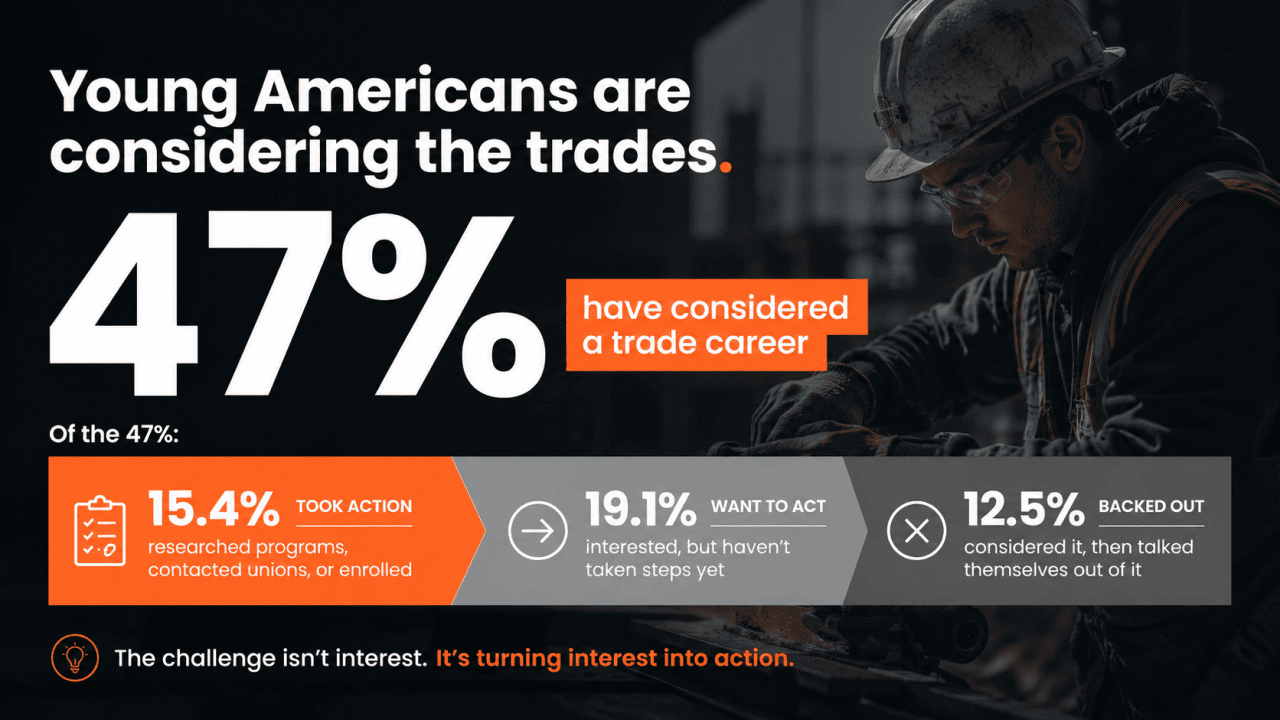
A new national survey from Skillit of 1,000 U.S. adults conducted on April 21 found that 47% of Americans have at some point considered a career in the skilled trades. Most never told anyone, and then they did nothing, because nobody told them where to start.

That silent demand collides with a workforce crisis that’s getting louder by the month. JLL projects roughly 2.1 million skilled trades positions could go unfilled by 2030, with potential economic losses reaching $1 trillion annually, according to U.S. Department of Education estimates. The supply gap is staggering: Last year, nearly 600,000 jobs were posted for major skilled trades positions while only about 150,000 new workers entered through apprenticeships. The interest is there, but what’s missing is the on-ramp.

Key Findings

  • 47% of Americans have considered a career in the skilled trades, but only 15.4% have taken active steps (researching programs, contacting unions, enrolling in courses).
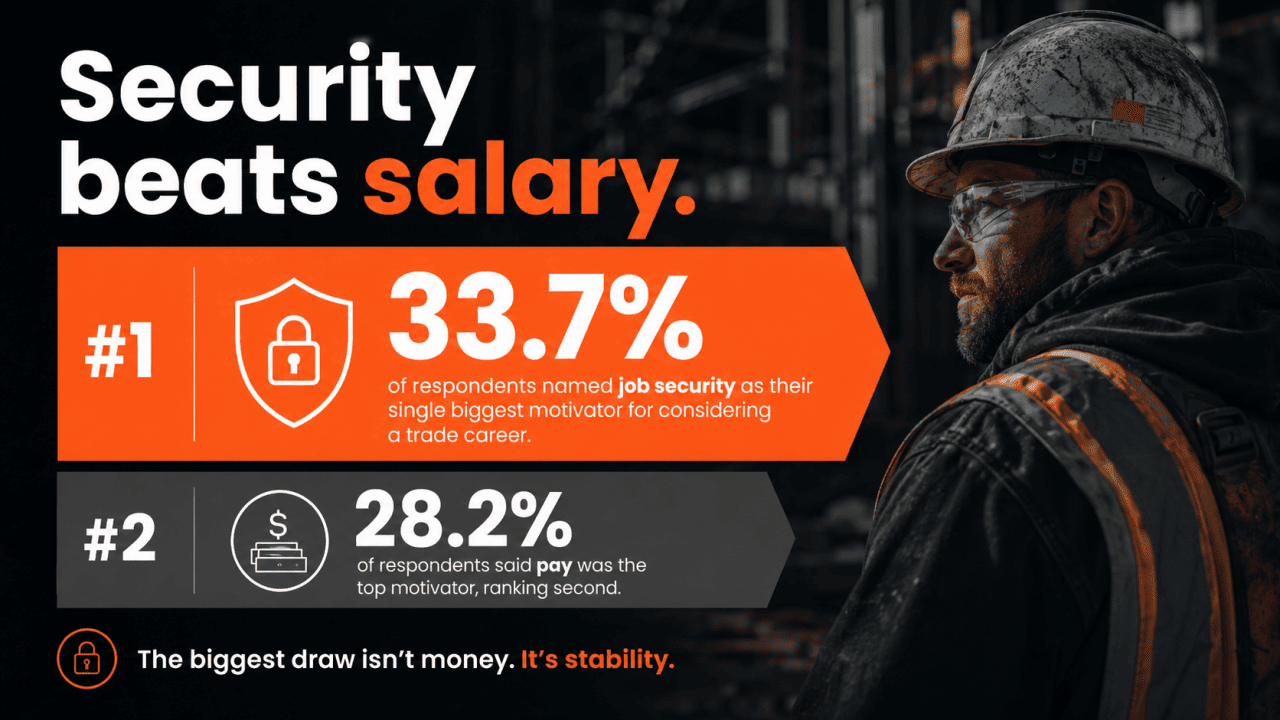
  • 33.7% cite job security (work that can’t be outsourced or automated) as their #1 motivation, edging out pay (28.2%).
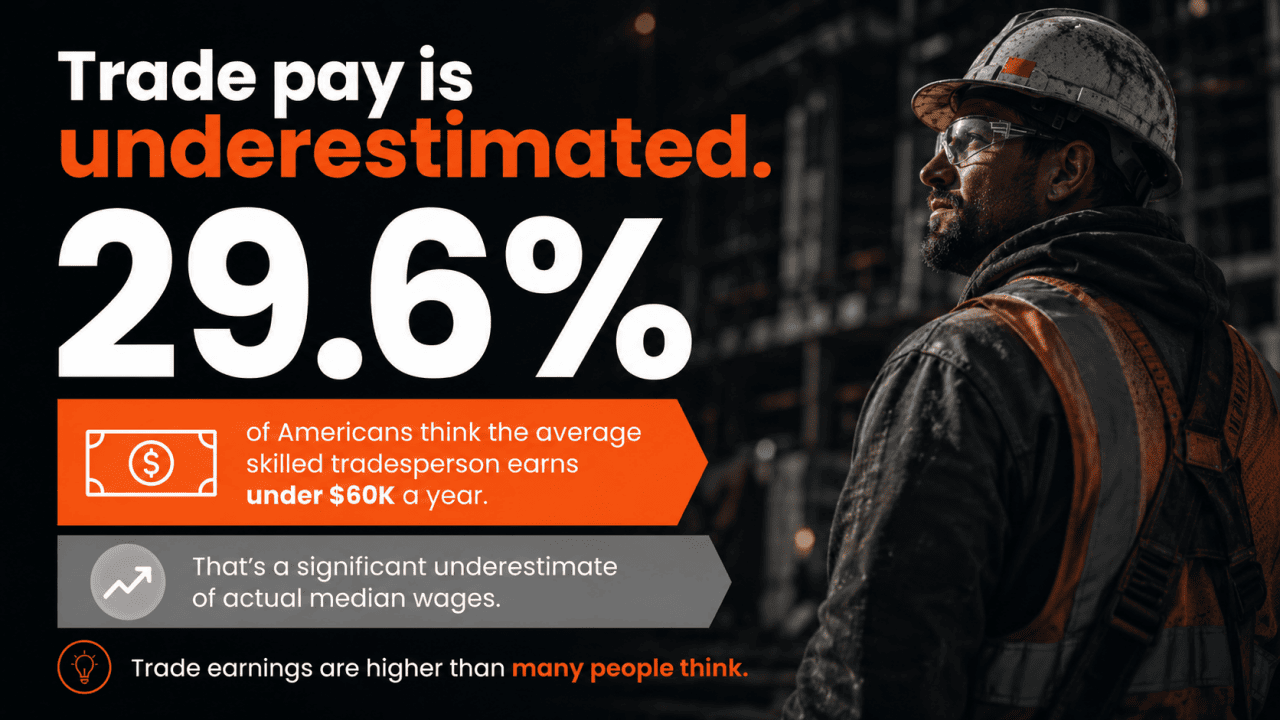
  • 29.6% of Americans think the average tradesperson earns under $60,000 a year, with that figure rising to 65.1% among the lowest earners.
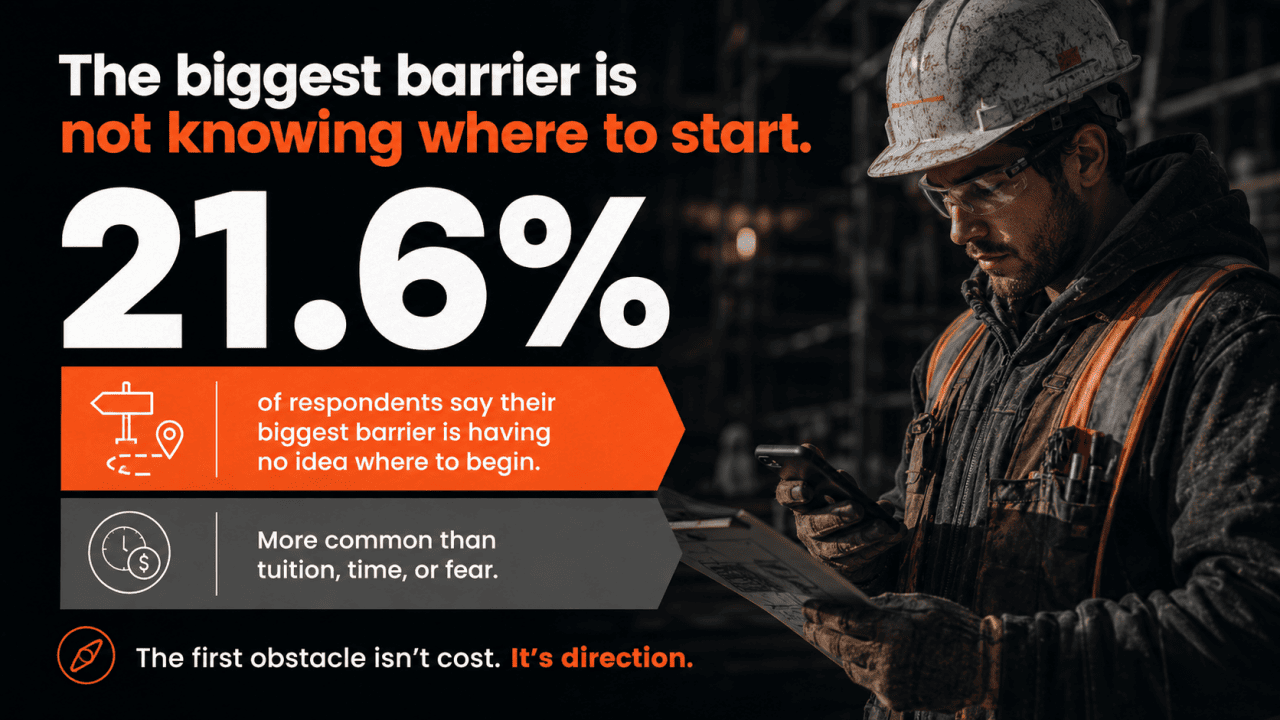
  • 21.6% say their single biggest barrier is simply not knowing where to start. Among women, that climbs to 25.1%.
  • 39.1% wouldn’t know where to begin looking for a trustworthy apprenticeship. Only 11.7% know exactly where to look.
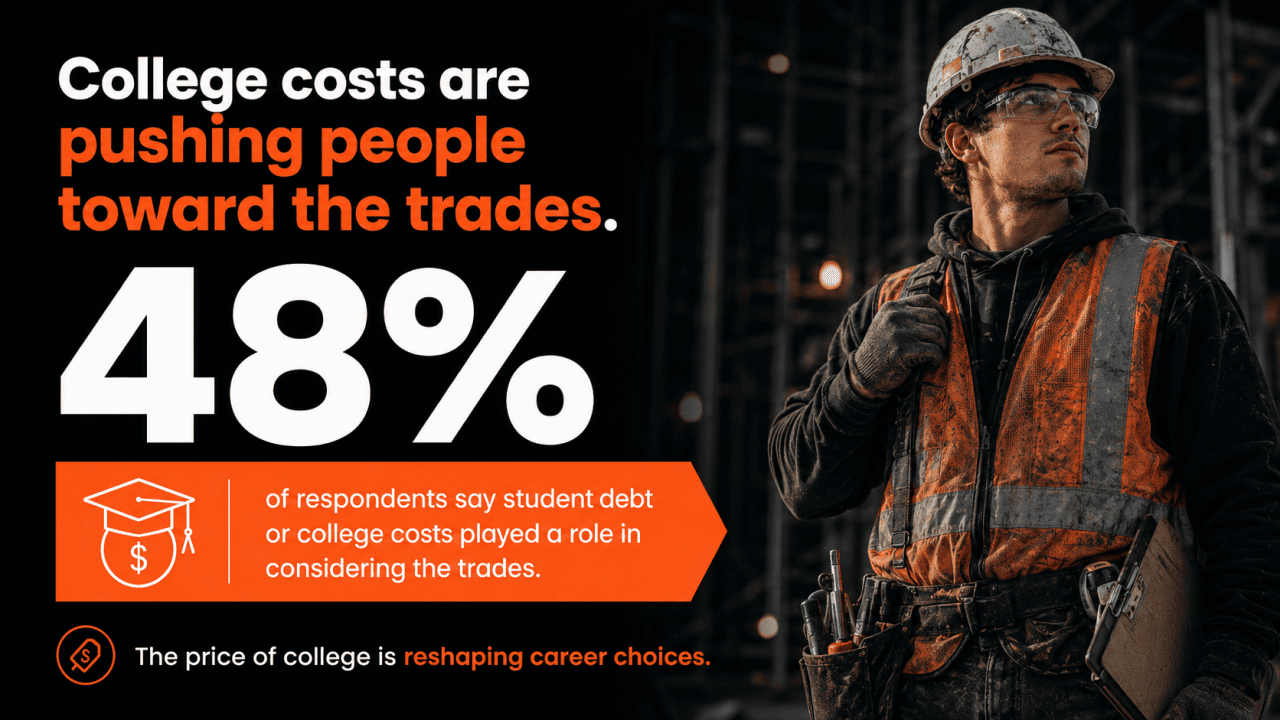
  • 48% say student debt or college costs have factored into their consideration of trades.
  • 73% believe the skilled trades suffer from a prestige problem that actively keeps talented people out.
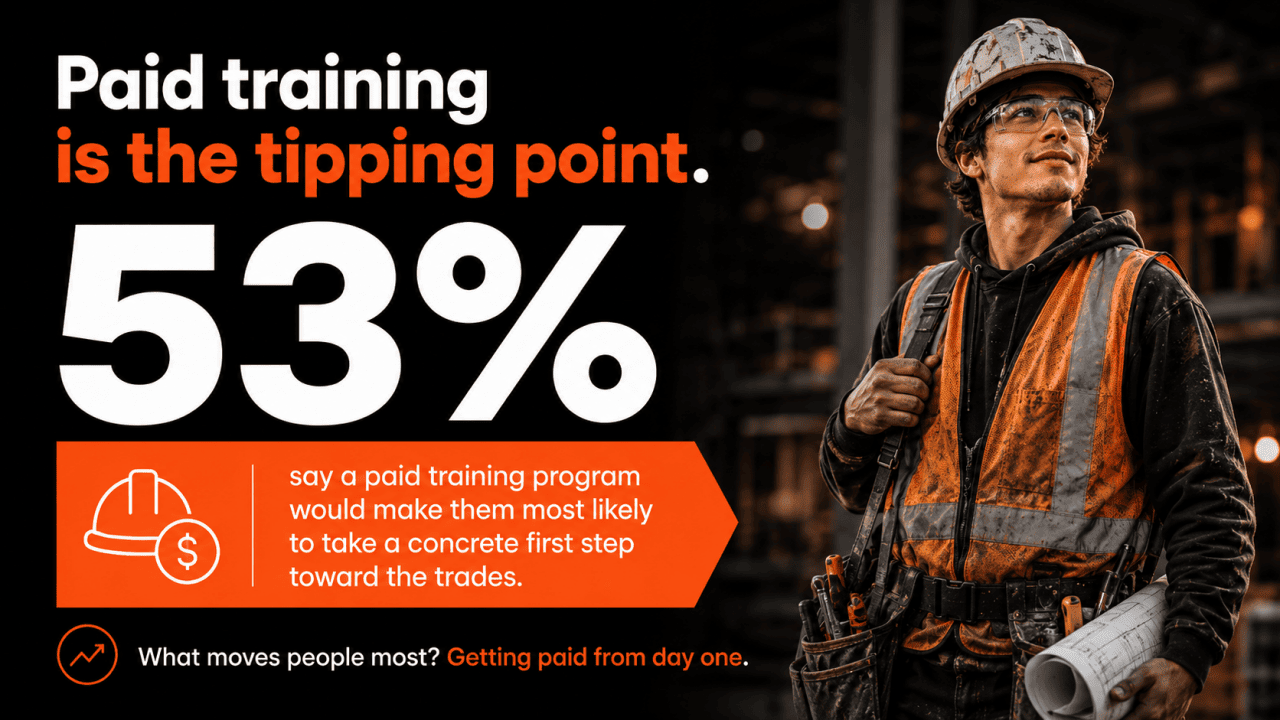
  • 53% say a paid training program where they earn from day one would be the single biggest motivator to take a first step.

The Hidden Demand Nobody’s Counting

An infographic stating that 47% of young Americans have considered a trade career.

Skillit

The conventional wisdom says that the trades have a recruitment problem because young Americans don’t want the work. The data tells a different story. Of the 47% who’ve considered a trade career, 15.4% have already taken active steps, meaning they’ve researched programs, contacted unions, or enrolled in courses. Another 19.1% want to but haven’t acted, and 12.5% thought about it before talking themselves out of it.

That last group is the most revealing. These are people who got close enough to the door to imagine themselves walking through, then turned around, usually without telling a soul. Their interest never showed up in any recruitment funnel because nobody knew it existed.

The picture shifts further when broken down by demographic. Nearly a quarter (24.8%) of Black respondents and 24.7% of Hispanic respondents have already taken concrete steps toward a trade career, nearly double the rate of white respondents (13.3%).

The industry faces a multimillion-job deficit, not due to a lack of available talent, but because that talent remains undiscovered.

Job Security Beats Pay, and the Most Educated Are Listening Hardest

An infographic stating that 33.7% of respondents named job security as their single biggest motivator for considering a trade career.

Skillit

Ask someone why they’re eyeing a trade career, and most people assume the answer is money. The survey points somewhere else. More than a third (33.7%) of respondents named job security, work that can’t be outsourced or automated, as their single biggest motivator. Pay came in second at 28.2%.

The most striking part: That preference intensifies with income and education. Among Americans earning between $100,000 and $249,000, 39.7% put job security first. Among postgraduate professionals, it is 43.7%.

These are highly credentialed people doing the math on a specific set of changes:

  • Tech sector layoffs that have erased hundreds of thousands of white-collar jobs over the past two years.
  • AI tools that are rapidly absorbing analytical and creative work.
  • The quiet collapse of the assumption that a graduate degree equals stability.

A licensed electrician’s work, by contrast, can’t be automated, offshored, or restructured out of existence by a quarterly board decision. As JLL’s research puts it, skilled trades offer the resilience of hands-on expertise that AI is positioned to augment but not replicate for any foreseeable horizon.

For a growing slice of the workforce, the trades have stopped looking like a step down and started looking like a strategic move.

Most Americans Have No Idea What Tradespeople Actually Earn

An infographic stating that 29.6% of Americans think the average skilled tradesperson earns under $60K a year.

Skillit

Pull on any thread of the skilled trades pipeline, and you eventually hit a perception problem. About 3 in 10 (29.6%) Americans think the average skilled tradesperson earns under $60,000 a year, a significant underestimate of actual median wages once licensing and overtime are factored in.

Among Americans earning under $25,000 themselves, the demographic with arguably the most to gain from a career switch, 65.1% believe tradespeople earn under $60,000. Only 10.7% of all respondents correctly estimate that experienced tradespeople earn $100,000 or more.

The cost of that misperception is measurable. When asked how they’d react to learning that a licensed electrician or plumber in their area earns $80,000 or more, 23.7% of Americans said they would seriously reconsider their current career immediately.

Among Hispanic respondents, that figure jumps to 39.7%. Among parents with kids under 18, it’s 34.5%. Add the people who said the information would simply make them more curious, and over 60% of the country sits one accurate paycheck figure away from a real career conversation.

The #1 Barrier Isn’t Money

An infographic stating that 21.6% of the respondents say the biggest barrier is not knowing where to begin.

Skillit

When asked what’s stopping them, the single most common answer was navigation, not tuition, time, or fear. 21.6% of all respondents said their biggest barrier is not knowing where to even begin. Among women, it rises to 25.1%. Among Americans earning under $25,000, it climbs to 27.9%.

Drill deeper, and the picture gets worse. About 2 in 5 (39.1%) Americans say they wouldn’t know where to look for a trustworthy apprenticeship or training program. Only 11.7% say they know exactly where to look. Among women, 45.9% have no confidence in their ability to find a program. Among Baby Boomers thinking about a second-act career, it’s a striking 53.1%.

There’s a second barrier that gets less attention but matters just as much: the body. Nearly 2 in 5 (18.9%) respondents cite long-term physical wear and tear as their biggest concern, and that figure jumps to 34.7% among Baby Boomers and 22% among women. Most trades industry messaging focuses on getting people in the door. This data suggests the harder conversation is about what happens 15 years later, when knees and backs start sending warning signals. Career changers won’t commit to a path that has no clear answer to that question.

Together, these two barriers reframe the entire shortage. The trades are losing prospects to a Google search that goes nowhere and to legitimate questions about long-term sustainability that nobody is answering, not to competing industries.

Student Debt Is Quietly Rewriting the Calculation

An infographic stating that 48% of respondents say student debt or college costs played a role in considering the trades.

Skillit

The college-versus-trades debate used to be largely theoretical. Now it’s a financial decision being made in real time at kitchen tables across the country.

Nearly half (48%) of respondents say student debt or college costs have played a role in pushing them toward considering trades. 13.8% call it the main reason. Among Millennials, the generation that took on the most debt and saw the slowest wage growth, 45.9% factor it in. Among Black respondents, it’s 50.8%.

The macro picture confirms the shift. Soaring college tuition costs, $1.8 trillion in student loan debt, and growing AI disruption of white-collar professions are all reshaping career decisions, and enrollment in community colleges has risen 12% over the past five years, with trades-related majors among the fastest-growing disciplines.

What’s notable is how few people lead with debt as their motivation. Most cite security, meaning, or independence first. But debt sits underneath every conversation, the silent variable that’s already changed the answer.

The Prestige Problem Is Real

An infographic stating that 73% of Americans believe skilled trades face a prestige problem that blocks entry.

Skillit

About 3 in 4 (73%) Americans believe skilled trades suffer from a prestige problem that actively blocks entry, as people mistakenly think that skilled trades are not as good as desk jobs. Among Gen Z, that figure jumps to 87.9%. Among postgraduate professionals, the most credentialed Americans in the survey, 80.8% agree.

The prestige problem refers to the negative connotation people have of trade jobs. This can be due to outdated cultural stigma, pressure to attend a four-year university, and the stereotype that manual labor requires “less intelligence.” These perceptions are changing, though, as demand continues to climb for trade jobs. Additionally, celebrities like Mike Rowe and social media platforms help to shed light on the necessity of trade jobs in society.

That last number (80.8% of postgraduates) is the one to sit with. The people the formal education system has rewarded most are also the ones who most acutely feel the cultural penalty attached to trade work. While they believe in the trades, they don’t believe their social circle would.

About 2 in 5 (39.7%) respondents say their friends and family would be “supportive but secretly surprised” if they entered a trade. Another 14% expect their circle to think they were settling. Career decisions are rarely made in isolation. They’re filtered through what people imagine others will think, and right now, that imagined reaction is suppressing decisions the data shows are financially rational.

As one workforce analyst recently argued in The Hill, the country’s stigma around blue-collar careers is no longer just a cultural inconvenience. It’s an economic liability.

Day-One Pay Exists, But Nobody Knows It

An infographic stating that 53% of respondents say a paid training program would make them most likely to take a concrete first step toward the trades.

Skillit

Ask Americans what would actually move them off the fence, and one answer eclipses every other. More than half (53%) say a paid training program, one where they earn from day one, would make them most likely to take a concrete first step toward the trades. Among Gen Z, it’s 58.1%. Among Baby Boomers eyeing a second career, 48%.

Here’s the twist: Registered apprenticeships in the United States already pay from day one. Apprentices earn a wage while they train, with structured pay increases as they progress through the program. The model the majority of Americans say would unlock their interest is the model the industry has been running for decades.

The Gen Z number sharpens the point. This is the generation most convinced the trades have a prestige problem (87.9% agree it actively blocks entry), and also the generation most likely to act if the financial picture is clear. The cultural skepticism doesn’t disqualify the trades for Gen Z. It sets a condition. The same generation also asks for something the industry rarely advertises clearly: 54.1% of Gen Z respondents named clear, transparent salary information at each career stage as their top motivator. They watched the college ROI argument fall apart in real time. They want a spreadsheet, not a pep talk.

The two findings together point to a quieter conversion path than most workforce coverage assumes. The most powerful motivator in the study, paid training from day one, is something the trades pipeline already delivers. The most underused asset in the trades industry is its own pay story. Career changers in their 30s and 40s, the cohort respondents named as the most blocked, aren’t being asked to walk away from a paycheck, since apprenticeships in the trades are fully paid. They just don’t know that yet.

The good news is that the market is responding. BlackRock’s $100 million Future Builders initiative, federal grants supporting apprenticeship and skills training programs, and state-level commitments across California, Maryland, and Massachusetts all point to a growing recognition that cash flow is the bottleneck, not curiosity.

Summary

For years, the skilled trades crisis was told as a story of disinterest. That framing has been shifting, and this survey makes clear what the new story actually is: a story of friction.

Nearly half the country has imagined a different career path. A third want it for reasons that have nothing to do with desperation. They want stability, they want work that AI can’t replace, and they want a profession that won’t disappear in the next layoff cycle. They’re asking the industry to point them toward the door, not to convince them.

For employers, the implication runs in parallel. The 600,000 unfilled jobs aren’t waiting on a workforce that doesn’t exist. They’re waiting on infrastructure that can connect builders to the candidates already raising their hands. The companies that crack the access problem first will fill roles faster, and they’ll define what construction hiring looks like for the next decade.

A working on-ramp wouldn’t require reinventing the trades. It would require fixing three things the data already names: a discovery layer that meets people at the moment of curiosity instead of leaving them to navigate alone, transparent salary information that corrects the perception gap pricing millions out of their own consideration, and clearer public communication about apprenticeships, including the paid-from-day-one structure most Americans don’t realize already exists.

The country has the workforce already. What it lacks is the on-ramp. Whoever builds it first will be the one shaping how the next generation of Americans defines a stable career.

Methodology

To understand how Americans approach the skilled trades, 1,000 adults were surveyed across the country. Participants answered a series of questions about their interest in trade careers, the motivations driving that interest, the barriers preventing them from taking action, and what changes to the trades pipeline would most likely move them off the fence. Responses were analyzed by demographic groups, including age, gender, income, education, ethnicity, and parental status, to identify trends and disparities.

This story was produced by Skillit and reviewed and distributed by Stacker.

Topics:

Careers & Education
media-news

Roadzen's Long-Form TV Commercial Continues Delivering Record-Breaking Digital Performance Across New to The Street TV Platform

By Media News
3 min read • Published May 26, 2026
By Media News
3 min read • Published May 26, 2026

Roadzen’s long-form television commercial surpasses 6 million views on the New to The Street TV YouTube channel alone, demonstrating the continued long-tail audience power of nationally distributed business television content and digital investor media distribution

NEW YORK CITY, NY / ACCESS Newswire / May 26, 2026 / Roadzen (NASDAQ:RDZN) and New to The Street TV announced continued exceptional audience performance surrounding Roadzen’s long-form television commercial and executive feature distributed through New to The Street’s national television and digital media platform.

The featured commercial and interview segment, originally released over one year ago, continues generating significant organic engagement and audience discovery across YouTube and social media platforms, further validating the long-tail value of evergreen business television content and strategic digital syndication.

The featured Roadzen television commercial can be viewed here:

Roadzen Commercial on New to The Street TV YouTube Channel

The Roadzen campaign highlights the company’s rapidly expanding AI-powered insurance and mobility ecosystem, including:

  • AI-driven insurance technologies

  • Automotive telematics

  • Driver monitoring systems

  • Claims automation

  • Embedded insurance platforms

  • Global mobility infrastructure

Roadzen has continued positioning itself as a major AI-powered insurance and mobility technology company operating across the United States, Europe, India, and additional international markets. The company’s technology platform supports insurers, automotive manufacturers, fleets, brokers, and mobility providers through advanced artificial intelligence and mobility intelligence systems.

"What makes this campaign stand out is that the audience continues discovering and engaging with the commercial more than a year after its original release," said Vince Caruso, Founder of New to The Street. "The combination of national television broadcasts, YouTube search visibility, social media amplification, and long-form business storytelling continues creating long-term media value for companies like Roadzen."

Unlike traditional short-cycle advertising campaigns, New to The Street’s long-form television and digital interview strategy is designed to provide companies with ongoing visibility through:

  • National sponsored television broadcasts

  • Search-indexed YouTube distribution

  • Continuous social media syndication

  • Investor-focused digital discovery

  • Long-tail organic audience traffic

The campaign’s continued growth reinforces increasing investor and consumer interest surrounding:

  • Artificial intelligence in mobility

  • Embedded automotive insurance

  • Fleet safety technologies

  • Driver monitoring systems

  • Automotive AI infrastructure

Roadzen has also recently expanded visibility surrounding its European initiatives ahead of major automotive and mobility conferences, including VECS 2026, while continuing broader international growth efforts.

About Roadzen

Roadzen Inc. (NASDAQ: RDZN) is a global AI-powered insurance technology company focused on transforming auto insurance, mobility, and road safety through artificial intelligence, telematics, and computer vision technologies. The company serves insurers, automotive manufacturers, fleets, brokers, and mobility providers globally.

About New to The Street TV

New to The Street is one of the longest-running U.S. and international sponsored television brands, broadcasting weekly as sponsored programming on Bloomberg Television and FOX Business. The platform combines national television distribution, long-form business interviews, digital media syndication, social media amplification, and iconic outdoor billboard campaigns across Times Square and the New York Financial District.

New to The Street’s YouTube platform https://youtube.com/@newtothestreettv?si=DeVo900E8KQMUBIt has grown into one of the largest business television audiences in the financial media sector, with over 4.74 million subscribers and millions of monthly viewers globally.

Subscribe to the channel here:
New to The Street TV YouTube Channel

Media Contact:
Monica Brennan
New to The Street Media Relations
Monica@NewtoTheStreet.com

SOURCE: New to The Street

View the original press release on ACCESS Newswire

Topics:

media-news
Advice From the Pros

PMI’s CMO on Why Membership Marketing Looks a Lot Like Media

Menaka Gopinath on engagement as the universal problem, paywall decisions at a global membership org, the return of live events, and where the C-suite is getting AI wrong.

Menatha Gopinath
Miles icon
By Miles Jennings
@milesworks
Miles Jennings is CEO of Mediabistro and its parent CognoGroup. He previously founded and led Recruiter.com through its NASDAQ listing, executing more than 10 acquisitions over nearly a decade as CEO and COO.
12 min read • Originally published May 26, 2026 / Updated May 26, 2026
Miles icon
By Miles Jennings
@milesworks
Miles Jennings is CEO of Mediabistro and its parent CognoGroup. He previously founded and led Recruiter.com through its NASDAQ listing, executing more than 10 acquisitions over nearly a decade as CEO and COO.
12 min read • Originally published May 26, 2026 / Updated May 26, 2026

Menaka Gopinath has spent her career on the audience side of the table. She came up running publicity for music acts in the late 1990s, freelanced for Flavorpill for a decade, and co-produced an ongoing music video and short film series with her husband called The Wilcox Sessions. She built one of the first social listening practices at Ipsos, grew it from 20 people to 100 with double-digit revenue growth every year, ran ops at a sustainable DTC fashion brand, and now leads brand, communications, and marketing as Chief Marketing Officer of Project Management Institute (PMI), the global body serving the project management profession.

PMI isn’t a media company, so you might wonder why we’re talking about this. It’s a not-for-profit membership organization with global certifications, standards, an online community at ProjectManagement.com, and a worldwide chapter network. But spend a few minutes inside its marketing operation and the parallels are hard to ignore: a content engine spanning channels, an AI-powered member tool, major live events, partnerships with culture brands from OK Go to Cannes Lions, and a paywall that raises the same questions every subscription publisher is asking right now.

We caught up with Menaka to talk membership content strategy, what events are doing for engagement in a loneliness epidemic, where she thinks the C-suite is getting AI wrong, what running a small DTC operator taught her, and what she tells mid-level marketers of color about reaching the executive tier.

PMI is a membership organization for the project management profession, but when you look at how membership groups market with content, community, events, newsletters, and retention programs, it looks a lot like a media company. Do you think about it that way internally?

Our center of gravity at Project Management Institute (PMI) is all about serving the profession and that really drives how we operate, whether it’s through our certifications, our standards, our learning, and most critically, our global community. But I do think there are parallels to a media company as we are producing so much content across multiple channels, not just within Marketing. In that sense, we are incredibly focused on earning attention and deepening engagement with our audiences just as a media company does.

I guess the main distinction is that while media companies are often focused on the attention and eyeballs first and foremost, PMI is focused on helping our profession grow in relevance and impact. We want people to engage with our content sure, but it’s to serve our larger purpose, helping our profession maximize project success to elevate our world.

You came up in music publicity and independent media before pivoting into consumer insights and then brand leadership. Does that history still show up in how you think about audiences and content today?

Absolutely – I have always been audience-first throughout my career – how to create engaging experiences, what drives connection with people – and I’m constantly inspired by culture, art, music. My husband and I produced a long-running music video series, The Wilcox Sessions, as a passion project and have made multiple short films over the years. We just love telling stories, showcasing great music, and having fun with art and the moving image, and it definitely impacts what I bring into my work as a Marketing leader.

Where’s the hardest editorial decision you make: what to give away free versus what lives behind the membership wall?

Our focus with all of our content is to consider the job it is doing in serving our purpose. We have plenty of content that is free and accessible, including access to our ProjectManagement.com online community. That’s because we want people to see the possibilities of the profession and inspire them to consider how they can grow their own careers, make meaningful connections, and advance how our profession makes an impact. This accessibility is important to us in considering how we serve the profession as a whole.

But as a membership organization, our content and tools are a critical component of what we provide our members to give them deeper access, more practical utility, and to push the opportunities of professional unlocks further. One of our most popular membership benefits is our PMI Infinity tool, an AI-powered project management assistant designed for professionals, offering curated, trustworthy guidance grounded in PMI’s global standards. I just used it to help me build a work breakdown structure for a Marketing assistant agent I’m building in Copilot. It was so useful as it’s much more rigorous and thoughtful in the answers you receive, particularly related to project management discipline.

Retention is essentially an engagement problem, which is the same problem every newsletter publisher and subscription media brand is dealing with right now. What’s the PMI playbook there, and do you think media companies could steal any of it?

Engaging consumers has been a throughline in my career, and the basic truth is that engagement comes down to value. It’s the simple question of: are you delivering something of value to the audience? Going deeper, for us at PMI, I would say it boils down to three key areas:

Deeply understand the experience of the audiences we serve. This means pushing ourselves to understand what our members are going through, whether it’s that new graduate just entering the workforce, the project professional pursuing their PMP certification, or the first time someone checks out a chapter event. Our team needs to understand these experiences first-hand and have a POV on where we have the opportunity to build micro moments of joy or magic throughout.

Don’t forget to have fun. It’s also about not always taking yourself too seriously – finding humor and common points of connection that build that sense of belonging. Identifying those opportunities to align with culture in authentic ways, but that might be unexpected, like when we did our Behind the Project series with OK Go.

Lead with purpose. PMI is a purpose-based, not-for-profit organization and our purpose guides everything we do. This clarity in why it matters and what it is actually serving helps our community unify, connect, and collectively feel like they are part of something bigger than themselves.

You spent a decade at Ipsos building social listening and online community practices before most brands had a real framework for it. How much of that early infrastructure thinking applies to what you’re doing now?

When I joined PMI I felt like it was a really nice triangulation of things I had been passionate about and doing throughout my career coalescing. 1) Community has been part of my career trajectory since the late 90s, and fundamentally PMI is a community-led organization. 2) Marketing with purpose is incredibly important to me, and at PMI I get to market growth and learning, something that truly has no upper limit. And even better, we’re working to grow this profession to elevate our world. 3) Critical thinking and curiosity were major drivers of the work we did during my time at Ipsos, and that is so essential to the work we do at PMI as we push the boundaries of what our profession is capable of delivering in this world, particularly at a time of massive disruption and transformation.

Events seem to be having a real moment as both a content format and a conversion channel. PMI runs major conferences. How do you think about live programming as part of the media mix?

I love events so much, and think they are definitely making a broader comeback post-COVID. We are living in the midst of a loneliness epidemic, people can spend full days without ever leaving their home, and as humans, we thrive on tactile, tangible connection. Our PMI events bring our profession to life, the vibrancy, the passion, the possibilities. I never leave a PMI event – from our largest Global Summit, to my local Los Angeles chapter event – without learning something and meeting someone new. Every time.

As I said before, there is no upper limit to learning, and a critical part of how we learn is experiencing things IRL and together with other humans. And you might be surprised to hear this, but wow does our community LOVE TO DANCE. So I guess, check out a PMI event if for nothing else, a rockin’ dance floor!

Events for us also represent an opportunity to expand our sphere of influence, knowing that project management really shows up in all types of areas. For example, we started partnering with Cannes Lions a couple years ago, specifically with the Lions Learning program. Marketers are being challenged with more complexity than ever before, and the need for stronger systems thinking and project management discipline is clear. We love being able to show up and provide value to audiences that might not expect it, but can find genuine utility in what we have to offer.

AI is reshaping what skills professionals need to stay current, which puts PMI right at the center of an urgent conversation. How are you positioning the brand around that?

A few years ago we really started with getting ahead of the implications for the profession and how AI might change it. That has evolved to also guiding how our profession is essential in the broader AI transformation happening everywhere. Today this continues to be the focus – we lead both the AI transformation of the project management profession, and the project management of AI transformations. I already mentioned our PMI Infinity tool, but in addition to that, we have multiple AI-focused courses, an AI certification (PMI-CPMAI) and a new Standard coming early-June.

It’s been fascinating to see the larger discourse as people are working through how to tackle “AI transformation,” and recognizing so much of it comes down to system discipline, which is really the crux of what project management rigor provides, particularly as agentic AI becomes more widespread. Your team is no longer just humans; the resources you have to use for a project includes agents too, but those agents aren’t going to be great without context on the system and work breakdown structure they are working within. These are challenges hitting the C-suite right now, particularly around the clear gap between strategic ambition and executional delivery. We are elevating the executive conversation, guiding how to ensure the required systems discipline and shared language for successful AI transformation, and being a trusted source people and AI tools can turn to for guidance on turning AI ambition into measurable outcomes.

You went from a global research firm to COO of a small DTC sustainable fashion brand before landing at PMI. That’s an unusual path. What did running a small operator teach you that you couldn’t have learned anywhere else?

At a small company, every dollar counts. This teaches you to be much more intentional with every decision you make, whether it’s about what channels to spend your paid media dollars, if it’s worth it to do that creator collab, or if you’re going to take a risk and buy ahead of demand for the newest product launch. These decisions are much more tangible at a small company because one decision could impact how you make payroll, for example. You feel the impact on the people you lead, and it reiterates the responsibility you have as a leader and understanding downstream impacts at a much more heightened scale.

My experience at Graf Lantz also pushed me into the world of hard goods manufacturing, and all the things that come with that, from material sourcing, product design, production, logistics, shipping, inventory planning… so many things. I really appreciate what the experience gave me, and it truly offered a much deeper understanding of what small business owners have to grapple with on a daily basis to bring their passions to the world.

You’ve been on the Monday Night Mentorship board for six years now. What’s the most important thing you tell mid-level marketers of color who are trying to break into the executive tier?

You are your best advocate. I had to learn this over many years, but the importance of trusting your abilities, knowing your worth, and advocating for the things you want in your career is essential. No one is going to do it for you. BUT, having a supportive community around you will help. Which is why I really love MNM and the community Jabari and Julian have built. Sometimes you need others to remind you that you need to believe in yourself, or to know that you’re not the only one experiencing XYZ challenges, or to be an accountability partner and a touchstone as you push to reach your next big milestone. Lastly I’ll say, always look to make new connections, not just when you need something – consider how you can be of service, and starting with that can be even more rewarding.

Given that upskilling is central to PMI’s work, where should media professionals be focusing their development efforts, and how can they go about building those skills within the industry?

We’ve been doing a lot of work to define what our profession needs to deliver in the AI-enabled modern workplace, and more pointedly on what our profession needs to do to maximize project success to elevate our world. I think much of what we have defined as this vision can apply to media professionals as well as fundamentally it’s about what it takes to drive project success. 

Based on research we have done over the past two years, we found that as a professional, if you are focused on four key areas in how you deliver, it will directly impact the likelihood of the projects you work on to succeed. We call it M.O.R.E. – M for manage perceptions, O for own success, R for relentless reassess, and E for expand perspective. Much of this comes down to things we’re seeing as fundamental skills to succeed with AI: orchestration, accountability, critical thinking, change resilience and creativity. And don’t forget to just try working with the AI tools, build a mini agent, create skills, take a hands-on course – play and experiment! If you want to see how to elevate your skills in M.O.R.E., you can check out our introductory course here: PMI Essentials M.O.R.E. Maximizing Project Success.

Last one, since we’re a platform for media professionals. What are you reading right now, or who are you paying attention to that’s shaping how you think? Or heck, we’ll take some Netflix recommendations if you have any.

So many things, but I’ll give you three. Earlier this year I read Unreasonable Hospitality by Will Guidara – I highly recommend, as it will give you a new appreciation of how to approach elevating the experience and building engagement with your audience. I just finished watching the Dark Wizard about the climber, Dean Potter, and it’s an invigorating series of passion, nature, freedom, fear… just watch it!

And if you haven’t already seen Project Hail Mary, go see it. In a time when so much feels bleak and dystopian, it’s a beautiful movie about the power of working together with diverse perspectives to overcome impossible odds.

About Menaka Gopinath: Menaka Gopinath is Chief Marketing Officer at Project Management Institute, where she leads brand, communications, and marketing. Before PMI, she was President and COO of Graf Lantz, a direct-to-consumer sustainable fashion brand. She previously led the Social Media Exchange (SMX) service line at Ipsos, growing the practice from 20 to 100 people with double-digit revenue growth every year. She has worked with brands including Coca-Cola, Apple, Nike, Uber, P&G, and Meta. She sits on the Board of Mentors at Monday Night Mentorship, a career accelerator for marketers of color, and helped establish BRIDGE, an Anti-Racism ERG, during her time at Ipsos. She holds a BA in Journalism and Economics from New York University and an MBA from the University of San Francisco. Find her on LinkedIn.

Topics:

Advice From the Pros
media-news

Authors Richard J. Goossen and R. Paul Stevens Take a Distinct Look at the Christian Perspective and Fundamental Dynamics of Entrepreneurship

By Media News
3 min read • Published May 26, 2026
By Media News
3 min read • Published May 26, 2026

What if entrepreneurship is about more than building a business?

TORONTO, ON / ACCESS Newswire / May 26, 2026 / Most entrepreneurship texts focus on mechanics-financing, growth, marketing, and execution. The Christian worldview asks deeper questions about purpose, creativity, ethics, and responsibility. Goossen and Stevens argue that entrepreneurship is not merely an economic activity. They see it as a divinely inspired calling, rooted in God’s creative nature and expressed through entrepreneurial leadership.

In Entrepreneurship: A Christian Perspective, well-known leaders Richard J. Goossen and R. Paul Stevens offer a compelling vision of entrepreneurship grounded in biblical faith and moral clarity. Drawing on decades of research and work with entrepreneurial leaders, they show how a Christian worldview reshapes purpose, leadership, risk, wealth, and legacy.

Moving beyond technique to transformation, this book connects innovation with servant leadership-and business success with spiritual depth. It challenges readers to pursue opportunity under God’s agenda, not merely their own.

For entrepreneurs, students, and leaders seeking coherence between faith and work, this is an invitation to practice entrepreneurship with integrity, courage, and eternal purpose.

About the Authors:

Richard J. Goossen JD and Ph.D., is an entrepreneur, educator, and founder of the Entrepreneurial Leaders Organization (ELO). He advises leaders globally and writes on entrepreneurship, leadership, and calling. His work bridges research and real-world practice, equipping leaders to integrate faith with enterprise. He has written eight books, translated into multiple languages, and approximately 1,000 articles and blog posts.

R. Paul Stevens, DMin., is Professor Emeritus of Marketplace Theology at Regent College, Vancouver, and a pioneer in the global faith-and-work movement. A former pastor, tradesman, and business owner, he writes and speaks on following Jesus in every sphere of work. He has written more than 40 books and Bible studies, translated into over 8 languages, which have collectively sold more than 230,000 copies including titles Liberating the Laity (IVP), Married for Good (IVP), Marriage Spirituality, The Complete Book of Everyday Christianity (IVP), and Revelation, The Triumph of God. He is coauthor with Pete Hammond and Todd Svanoe of The Marketplace Annotated Bibliography.

What people are saying about this book:

"Full of practical wisdom and biblical insight … a great encouragement to entrepreneurs who want their business to reflect their Christian convictions."

–John Lennox, Professor Emeritus of Mathematics, University of Oxford

"Entrepreneurship isn’t just compatible with a Kingdom mindset-it can be an expression of it. This book will reframe the way you view and live out your calling."

– Bobby Gruenewald, Founder and CEO, YouVersion Bible App

"This book is a marvellous synthesis and overview of entrepreneurship from a Christian perspective. Well written, succinct, and clear. Just like we like it in our businesses."

– Rob Wildeboer, Cofounder and Executive Chair, Martinrea International, Inc.,

"Goossen and Stevens have given the church and the marketplace a much-needed roadmap…showing us how ordinary business leaders can live out an extraordinary calling-using innovation, risk, and leadership to serve people and advance the Kingdom, not just profits."

– Rick Rusaw, Executive Leadership Team, Gloo, Author and Pastor, Boulder, Colorado

"Drs Goossen and Stevens have captured the appropriate tension between thriving as an entrepreneur while remaining grounded in one’s Christian faith. I highly recommend this book for any Christian who embraces the entrepreneurial gifting and calling."

– Andy J. Hughes, DBA, Dean, DeVoe School of Business, Technology and Leadership, Indiana Wesleyan University

Entrepreneurship: A Christian Perspective is available on-line and at most bookstores, or on the Castle Quay Books web site www.castlequaybooks.com.

ISBN 978-1-998815-46-3 soft cover –$19.95
e-book 978-1-998815-47-0 –$9.95
192 pages, size 6" x 9"

For review copies, cover images, interviews with authors or more information about this title, please contact Larry N Willard:

Phone: 1-416-573-3249
Email: lwillard@castlequaybooks.com

Distributed in Canada by Anchor/Word Distribution
Customer Service in Canada
1-800-665-1468
orderdesk@wordalive.ca

Distributed in the USA by Anchor/Word Distribution and Ingram International
Customer Service in the USA
1-800-444-4484
customercare@anchordistributors.com

For more information visit:

www.castlequaybooks.com

SOURCE: Castle Quay Books

View the original press release on ACCESS Newswire

Topics:

media-news

Posts navigation

Older posts
Newer posts
Featured Jobs
6AM City
Revenue Operations Manager
6AM City
USA

Hanford Pharmaceuticals LTD
Virtual Assistant
Hanford Pharmaceuticals LTD
Anchorage, KY, USA

Lakeside Pediatrics
Online Chat Representative (Remote)
Lakeside Pediatrics
Sioux Falls, SD, USA

Lakeside Pediatrics
Product Manager (remote)
Lakeside Pediatrics
Philadelphia, PA, USA

Lakeside Pediatrics
Administrative Operations Analyst (Remote)
Lakeside Pediatrics
Sparks, NV, USA

All Jobs »
PREMIUM MEMBER

Vikash Deendyal MD

Philadelphia, PA
2 Years Experience
Interested in the use of AI in the medical setting.
View Full Profile »
Join Mediabistro Membership Today

Stand out from the crowd with a premium profile

Mediabistro Logo Find your next media job or showcase your creative talent
  • Job Search
  • Hot Jobs
  • Membership
  • Newsletter
  • Career Advice
  • Media News
  • Hiring Tips
  • Creative Tools
  • About

Browse media and creative jobs

Explore popular job searches across creative, editorial, marketing, production, and top media markets.

Popular searches

  • Remote Media Jobs
  • Graphic Design Jobs
  • Photography Jobs
  • Writing Jobs
  • Marketing Jobs
  • Library Jobs
  • Journalism Jobs
  • PR / Communications Jobs

Creative and content

  • Video Production Jobs
  • Audio / Podcasting Jobs
  • Technical Writer Jobs
  • Social Media Manager Jobs
  • Copywriter Jobs
  • Publishing Jobs
  • Editor Jobs
  • Freelance Writing Jobs

Locations and specialties

  • Content Creator Jobs
  • Creative Director Jobs
  • Art Director Jobs
  • Advertising Jobs
  • Chicago Creative Jobs
  • Los Angeles Media Jobs
  • New York City Media Jobs
  • Boston Creative Jobs
Facebook YouTube Instagram LinkedIn
Copyright © 2026 Mediabistro
  • Terms of Use
  • Terms of Service
  • Privacy Policy