
Mediabistro Logo Mediabistro Logo
  • Jobs
    Search Creative Jobs Hot Jobs Remote Media Jobs Create Job Alerts
    Job Categories
    Creative & Design Marketing & Communications Operations & Strategy Production Sales & Business Development Writing & Editing
    Quick Links
    Search All Jobs Remote Jobs Create Job Alerts
  • Career Resources
    Career Advice & Articles Media Industry News Media Career Interviews Creative Tools Resume Writing Services Interview Coaching Job Market Insights Member Profiles
  • Mediabistro Membership
    Membership Overview How to Pitch (Premium Tool) Editorial Calendars (Premium Access) Courses & Training Programs Membership FAQ
  • Log In
Post Jobs
Mediabistro Logo Mediabistro Logo
Search Creative Jobs Hot Jobs Remote Media Jobs Create Job Alerts
Job Categories
Creative & Design Marketing & Communications Operations & Strategy Production Sales & Business Development Writing & Editing
Quick Links
Search All Jobs Remote Jobs Create Job Alerts
Career Advice & Articles Media Industry News Media Career Interviews Creative Tools Resume Writing Services Interview Coaching Job Market Insights Member Profiles
Membership Overview How to Pitch (Premium Tool) Editorial Calendars (Premium Access) Courses & Training Programs Membership FAQ
Log In
Post Jobs
Log In | Sign Up

Follow Us!

Business Basics

Project Management Tips That Will Make You a Better Freelancer

Borrow key skills from project managers and keep your gigs rolling in

project manager tools
John icon
By Amanda Layman Low
@AmandaLaymanLow
Amanda Layman is a B2B tech content writer and strategist with over 15 years of experience creating content for startups and enterprise brands. She founded Tigris, a content agency serving leading tech companies, and authored The New Freelance: A Book for Writers.
4 min read • Originally published December 5, 2015 / Updated March 19, 2026
John icon
By Amanda Layman Low
@AmandaLaymanLow
Amanda Layman is a B2B tech content writer and strategist with over 15 years of experience creating content for startups and enterprise brands. She founded Tigris, a content agency serving leading tech companies, and authored The New Freelance: A Book for Writers.
4 min read • Originally published December 5, 2015 / Updated March 19, 2026

The more experienced I became as a freelance writer, the more I realized how little time I actually spent on writing. Sure, I expected to have to build a website, market myself and develop story ideas. But I felt a bit overwhelmed when it came to organizing my work, keeping track of deadlines and communicating with clients—in short, everything a project manager does.

After a brief stint as a salaried writer in a corporate environment and working closely with professional project managers, I saw how their skills could be applied to the freelance life. Here’s some insight on how freelancers can become better project managers, and drive more projects to completion while staying on budget.

Create (and stick to) a schedule.

There’s no need to track every moment of your day down to the minute, but it’s important to have a set work schedule. Show up at your computer around the same time every day, and stop working around the same time every day. Kimberly Fellman, creative project manager at BuzzFeed, recommends that freelancers who work from home get out of their home environment from time to time. “Don’t just work from the couch in your PJs,” she says—it can hurt your productivity. Following a routine like spending your mornings at a coffee shop or the library will get you in a consistent “work” state of mind.

But don’t try to wing it. Put due dates, scheduled calls and goals on a single calendar you can refer to frequently. Also, for the sake of convenience, structure your time by grouping similar tasks together, recommends freelance writer Kristi Waterworth. For instance, book all of your expert interviews on the same day.

Take advantage of organization tools.

Keeping track of short- and long-term tasks can be as simple as setting up a kanban board. “As cheesy as it sounds, I make goals and post them up so I can see them,” says Lindsay Arnold, a certified project manager and business analyst at Q1Media. Your kanban board can literally be a three-column chart on a whiteboard, where you stick Post-it notes based on their status: to do, working on and completed. “It allows you to see all your work and the [ability to physically move] tasks to ‘complete,’ which is so refreshing,” Arnold says.

Freelancers who prefer digital methods should consider which apps might help in their day-to-day work. Fellman likes to use TinyGrab to easily share screenshots of design projects with her collaborators (you could use it to get feedback from clients on drafts), and Teamweek, a scheduling tool that helps her see a visual map of ongoing projects.

It’s also essential to pick a cloud-storage service like Dropbox, Google Drive or OneDrive for your files, which is far safer than having them on your hard drive where they could get damaged or lost.

Remember all communications with your clients matter.

Great communication skills are imperative to being an effective project manager. After all, they could mean the difference between a one-time project and a long working relationship.

Now imagine you’re a key decision maker at a company and you’ve hired a writer to deliver content. Your inbox is frequently flooded with requests from all directions, and you’re working on multiple projects at once. Then you receive content from a writer that’s incomplete. The writer sends another email rambling on about his first mistake, and tries to send a new version. Finally, the writer sends another email with a file attachment—and the file is named “RKS#EJ0132=9.doc.” Can you imagine how frustrating this would be?

When communicating with the editor or agency that hired you, read over the body of your email several times before sending it. And get to the main point quickly. Arnold suggests paying special attention to the subject line of your emails and keeping it consistent so your email recipients can easily find your work. If you’re addressing many things in the email, include a bulleted or numbered list to cover one question or topic at a time.

Draft a scope-of-work document.

Sooner or later, every freelancer has that project—the one with 13 revisions, or the one that winds up taking 10 times as long to write as you expected, essentially bringing your income down below minimum wage. Keeping a writing project from getting out of scope is largely about preventive measures. Waterworth always makes sure to conduct a conference call before the start of her blogging projects. Then she works with clients to assemble very thorough instructions about each assignment. “Make sure everybody is in agreement that this is the way it’s going to go,” she says.

Fellman recommends creating a scope of work, or SOW, document. “It’s a wonderful way to protect yourself as a freelancer and help set expectations for everyone.” In the SOW—which acts like an unofficial contract—you’ll want to include at the very least:

  • A timeline
  • The project deliverables
  • The fee for work

It’s also important to ask lots of questions and be clear about payment procedures from the get-go. Fellman says asking questions like, “To whom should I submit a W-9?” or “Is payment via EFT an option?” shows you’re a business professional—one who expects to be paid on time.

Topics:

Business Basics, Go Freelance
Journalism Advice

7 Ways Writers Can Use Social Media to Build a Powerful Personal Brand

Here's how to make social networks work for you

writer using social media to boost personal brand
John icon
By Alisha Tillery
@Nicole8151
Alisha Tillery is a freelance journalist, essayist, and PR agency director whose work spans culture, lifestyle, business, and women's issues. She has written for ESPN, ESSENCE, EBONY, and AARP, and brings 15 years of storytelling experience to her work with small businesses, nonprofits, and education clients.
6 min read • Originally published December 9, 2015 / Updated March 19, 2026
John icon
By Alisha Tillery
@Nicole8151
Alisha Tillery is a freelance journalist, essayist, and PR agency director whose work spans culture, lifestyle, business, and women's issues. She has written for ESPN, ESSENCE, EBONY, and AARP, and brings 15 years of storytelling experience to her work with small businesses, nonprofits, and education clients.
6 min read • Originally published December 9, 2015 / Updated March 19, 2026

In a short time, Britni Danielle, a Los Angeles-based author and freelance journalist, transitioned from part-time to full-time freelancer, penning stories for Essence magazine and online publications like the Guardian and xoJane. How did she snag assignments from publications on the East Coast and abroad? Along with her writing skills and work ethic, she used social media to build a strong personal brand. Online exposure of her work garnered stellar referrals from fellow writers and eventually led to requests from editors.

Now, more than ever, writers are taking their careers to the next level because of their solid personal brands. Their unique identities boost readership, business and attention from editors. Fusion editor at large Latoya Peterson, for one, is open to finding fresh talent through social media. “It’s very easy, as an editor, to fall back into the same pool [of writers] you always use. Social media not only allows you to find new writers, but also to figure out things that are trending or peaking.”

Here are a few tips on how you can raise the bar on your writing career via social media.

Establish your identity.

The first step to gaining the attention of readers and editors is telling them who you are, and how you’re different from other writers. That is your brand. Beth Sanders, a social media strategist based in the Greater Memphis area, says there’s no way around establishing one.

“I don’t think it’s a question of ‘Should I?’ The question is ‘How do I?'” she says. If you have a digital footprint (and who doesn’t these days?), you already have a brand. So it’s important to share accurate information and pay attention to small yet significant slipups like typos in your posts, which could make or break your brand. Establish your credibility early on, or your audience will do it for you.

Peterson says failure to maintain a positive online persona by “being very belligerent [or] intellectually dishonest on social media” has cost many writers jobs. It could also undermine both your reputation and that of your publication.

Decide how much of your life you’d like to share with your audience. Sanders, who discusses everything from writing to St. Louis Cardinals baseball on her Twitter account, says, ultimately, that is a decision writers must make for themselves. But a hint of personality can go a long way. “People want to do business with a real person and not just a cardboard cut-out,” she says.

Tighten up your profile bio.

Your bio is usually the first thing visitors read on your social media profile. Use this space to share your interests, who you’ve worked with and topics you cover. And make it memorable.

“One of the reasons I follow somebody back or decide to follow somebody’s work is because they have this witty profile — it’s intriguing,” explains Peterson. “It’s enough for me to want to click on it and know more about this person. And if I’m making a decision between a lot of writers, that might make the difference.”

Sanders suggests writing a brief bio, as well as a lengthy one, so your audience, especially editors, know exactly what they’re getting when they visit your social media sites.

Surf social media platforms daily for potential content.

The better your content is, the better your brand. Love it or hate it, social media has become a legitimate player as a news source, overtaking some traditional news outlets, so use it to your advantage. Scour social media platforms for current events that are aligned with your brand — and keep up with what editors are talking about on their pages.

Danielle admits that asking open-ended questions and sharing the latest issue of the day have been effective tactics for getting feedback and eliciting story ideas.

In fact, one story Danielle wrote about the online reaction over a photo of Sasha Obama and friends received over 100,000 page views the first day it was posted. “I get probably 75 percent, maybe more, of the things I end up writing about from some sort of media or social media conversation,” she says.

Engage with your audience in real time.

If using Facebook, Twitter or Instagram has become mundane, experiment with live-streaming apps like Periscope. Interact with your audience on camera to allow them to get an inside look at who you are and what kind of work you do. Follow editors and other writers to make new connections. Before you jump in head first, though, Sanders recommends doing your research.

“The first step is to figure out where your audience is, and you do that by hanging out [on various platforms] and listening,” she says. “If your audience is not on Periscope or even Twitter, that’s not where you need to focus your time.”

Other streaming apps like Meerkat and Blab have different features, such as streaming for groups or embedding capabilities, which might garner more reach. Adds Sanders, “I would recommend trying everything at least once, knowing about it and evaluating how effective it’s going to be in reaching your audience.”

Show your work.

You’ve mastered the art of navigating social media and engaging your audience, but this doesn’t matter as much if you don’t have content to share. Peterson says when writers apply for jobs, one of the first steps editors take is to look at their social media profiles to see their latest work and how they interact with others online.

“[Social media] allows people to discover you. It allows people to serve you. It allows people to have more of a dialogue around your work, but at the same time, it also acts as almost a resume for an employer,” Peterson says. “Most of my friends who are editors will say the same thing.”

Peterson adds that writers should be using the pinning feature such as on Twitter, which allows you to pin a stagnant tweet to the top of your timeline, to showcase links to your most recent work. “For the most part, your content is what’s going to speak the loudest,” she says. “Your content — 100 percent — is always king no matter what platform you’re on.”

Share content that aligns with yours.

Remember, a core principle of social media engagement is to give as much as you take in shares, likes and shout-outs. Simply put, it’s not all about you.

“If you’re on social media, it can’t always be about sharing your links to your things,” Danielle says. “You have to talk about things that people care about that aren’t [about] you.” Make an effort to strategically connect with (read: do not pitch) editors and other writers of note online. Rather than bombarding them with direct messages or comments with links to your writing, engage in a conversations about their latest projects if you’re a fan their work.

Be consistent on every social media platform.

From your social media handles to the frequency of posts and interaction, consistency counts. If you’re savvy, you probably have more than one social media account. Make sure each of them have the same or similar names so your audience and editors know where to find you.

Using social media regularly counts for a lot in building your brand. “The only thing I would do is caution people against abandoning their social profiles,” Peterson warns. “It’s almost better to not have a page at all, instead of looking like you’re not paying attention to the technology or a part of the community there.”

Topics:

Go Freelance, Journalism Advice
Skills & Expertise

Ask MB: What Makes a Good Magazine Story Pitch?

Check these 12 tips before starting your story

magazine opened to a good magazine story
John icon
By Celeste Mitchell
Celeste Mitchell is an editorial writer and editor with nearly 30 years of experience creating consumer lifestyle content for publications including Marie Claire, Cosmopolitan, Good Housekeeping, and SELF. She previously served as Deputy Editor at Cosmopolitan and taught journalism courses through Mediabistro.
3 min read • Originally published December 21, 2015 / Updated March 19, 2026
John icon
By Celeste Mitchell
Celeste Mitchell is an editorial writer and editor with nearly 30 years of experience creating consumer lifestyle content for publications including Marie Claire, Cosmopolitan, Good Housekeeping, and SELF. She previously served as Deputy Editor at Cosmopolitan and taught journalism courses through Mediabistro.
3 min read • Originally published December 21, 2015 / Updated March 19, 2026

Regardless of how many years you’ve been in the magazine biz, there is one thing that never seems to change: Whenever you pitch a story idea, it’s impossible to predict whether an editor will jump at your idea or pass on it.

And, sadly, all writers are in the same boat; veteran writers are often no better at hedging their bets than fledgling reporters who are sending pitches for the first time.

Part of what contributes to the mystery, of course, has little to do with us. Timing plays a major role. An editor will often turn down a perfect story idea because a similar piece is waiting in inventory to be scheduled for an upcoming issue. Or it could be that the magazine recently published an article on your topic and is therefore unable to cover it again until years pass—if ever. These variables are beyond any writer’s control.

But there is something you can—and must do—to improve your chances for success: Make sure you deliver a solid story idea.

It may sound simple, but it is often hard to tell the difference between an idea that rocks and one that flops. And what’s a good idea? To find out, we turned to a friend of Mediabistro, an accomplished magazine editor who’d just as soon remain nameless, to reveal the must-have ingredients for a quality piece of journalism. If you can nail even a few of these essential elements, and you still get a rejection letter, then it’s your editor’s loss!

According to our friend, a great magazine story:

1. Is about someone appealing or intriguing or remarkable or abominable, someone to whom aggressive adjectives can be applied or someone caught up in circumstances that fit these adjectives.

2. Relies on tension, conflict and drama to move the story along at a steady pace, without bizarre detours which may in themselves be interesting but which do not contribute to an uninterrupted narration of the story.

3. Has a beginning, middle and end—in that order, preferably.

4. Tells you something new and unexpected, or takes a totally fresh new look at something familiar.

5. Has compelling anecdotes that illustrate specific points, but do so with some subtlety so the reader will not feel beaten upside the head.

6. Includes carefully chosen quotes that reveal the subject’s personality and perspective, quotes that might be cleaned up for grammar and clarity but never to change meaning or intent.

7. Leaves no unanswered questions and never strays off course with tangential musings from the writer and irrelevant anecdotes or quotes.

8. Is easy to follow and doesn’t confuse the reader, meaning that flashbacks and flash forwards should be employed with caution.

9. Evokes an honest emotional response, not a manipulated one—so resist the temptation to twist your story a tad to make sure readers get your message.

10. Has a resolution—a triumphant one is preferred, but if it’s a downer both prepare the reader for it as you go along and make sure you personally can live with that kind of ending.

11. Wraps with a kicker that clings to the reader’s memory, whether clever or noble or heartrending or even funny.

12. Is factually correct, not only for your sake as a writer of integrity but also for the sake of our profession at large which has had more than enough reportorial fiction in 2003.

Topics:

Climb the Ladder, Skills & Expertise
Advice From the Pros

4 Tips for Landing an Ad Agency Gig Using Snapchat

A recruiter dishes on dos and don'ts

job seeker using snapchat
By Lauren Johnson
2 min read • Originally published December 21, 2015 / Updated March 19, 2026
By Lauren Johnson
2 min read • Originally published December 21, 2015 / Updated March 19, 2026

Snapchat video views have tripled since May and now total 6 billion every day, according to a Financial Times story. The report only solidifies the notion that the messaging app is the hottest thing going on among marketers.

So if you want to land an ad agency gig, the language of “snaps” is really good to know at this juncture in digital-media history. What better way of communicating your Snapchat expertise to your prospective employer than via the mobile app itself?

We chatted with Alan Cutter, CEO of recruitment firm AC Lion, whose clients include WPP and Horizon Media. Cutter had some useful advice on how to make every post count:

1. There is no chance for a second impression. “This isn’t iMovie or a text resume that you can edit, perfecting each shot or word,” says Cutter. “Have a well-thought-out blueprint.”

2. Keep it visual. Make a Snapchat Story by taking pictures of the work you’re most proud of, to show employers what you can do. “If you have a project you worked on, a deck or a clip, use it,” says Cutter. “Show your best slide, your biggest win.”

3. Sweat the small stuff. Little details, like paying attention to the background of a video, are crucial, says Cutter. “Is the job part of a team? Have other people in there. Like to work in a coffee shop? Film it in there.”

4. Do your research. Cutter recommends that job seekers snoop around on an agency’s other social channels to get a feel for the place before sending a snap. “Those people already have what you want—a job,” he says. “Showcase yourself fitting in to the company, contributing to their success.”

Topics:

Get Hired, Networking, Uncategorized
Managing

7 Tips for Managing an Employee Who’s Significantly Older Than You

How to strike a balance that works for both sides

younger employee managing older employee
John icon
By Jenell Talley
Jenell Talley is a journalist and program analyst with a background spanning media, government, and editorial work. She holds a journalism degree from Howard University and a master's in human resources management from the University of Maryland.
2 min read • Originally published December 27, 2015 / Updated March 19, 2026
John icon
By Jenell Talley
Jenell Talley is a journalist and program analyst with a background spanning media, government, and editorial work. She holds a journalism degree from Howard University and a master's in human resources management from the University of Maryland.
2 min read • Originally published December 27, 2015 / Updated March 19, 2026

The younger-boss dynamic is one that’s becoming more and more commonplace, especially as entrepreneurial millennials are rising from the ranks at warp speed.

When managing someone who is 10 to 20 or more years older than you, just remember: “You’re on the same team, and there are things each of you is going to learn from the other,” says Shani Hilton, executive editor of news at BuzzFeed. At 30, Hilton knows a thing or two about managing older employees, and after several years at the company, she’s as buoyant as ever about her gig and everything that comes with it. “I think the only real challenge is to create a dynamic where we’re truly in a give-and-take relationship.” Difficult? Maybe. Doable? Definitely. Use these tips to help you avoid potential missteps and get the most out of your older employees.

1. Be authoritative but not authoritarian.

You aren’t helming a dictatorship. Researchers find that workers with autonomy report higher rates of job satisfaction. Seasoned workers have been in the workforce for decades. They’ve earned the right to have a say in how they do their job.

2. Ask questions.

You’re the boss, but that doesn’t mean you know more than your employees. They’ve been at this (a lot) longer than you, and they have years of industry- or company-specific knowledge. Use that.

3. Involve employees in the decision-making process.

Treat seasoned workers like the priceless assets they are. Show them their perspective and experience are valued.

4. Be open to feedback.

This isn’t older employees’ first rodeo, so they have insight you may not. They were building digital brands while you were finishing Integrated Marketing 101. Take advantage of their expertise.

5. Get to know your employees.

Older workers often feel overlooked amidst a sea of millennials. You don’t have to be best buds, but talk to your workers. Are they married? Do they have kids? Do they skydive?

6. Encourage continued professional growth.

Find out your employees’ goals and offer support in achieving them. Maybe the print magazine’s managing editor would rather work on Web content. Recommend a digital journalism course—and get the company to pay for it!

7. Keep an open mind.

“What I’ve learned,” says Hilton, “is age has very little to do with whether someone does well in this environment: 22-year-olds can be overly cautious sticks in the mud, and 52-year-olds can be wonderfully experimental.”

Topics:

Climb the Ladder, Managing, Skills & Expertise
Networking

No-Cringe Networking: How to Job Hunt the Right Way

Tactful methods to connect with media pros during your job search

crowd of millennials networking
By Ellen Gordon Reeves
7 min read • Originally published December 28, 2015 / Updated March 19, 2026
By Ellen Gordon Reeves
7 min read • Originally published December 28, 2015 / Updated March 19, 2026

When I talk to people of all ages about “networking,” they have valid reasons for bristling. They are shy. They fear rejection. But with networking being a key player in you scoring that dream job, you need to know how to reach out the right way.

Because we are all in the business of communicating, and thanks to the ease of the Internet, a faux pas can be sent into instant orbit. But the same button can send your tactful and legitimate query to scores of people who might really help you. Let’s take a look at a few tactics for networking, the right way.

Stop looking for a job and start looking for a person

This is my mantra: Stop looking for a job and start looking for a person. The right person will lead you to the right job. This applies whether you’re looking for a job or just personal and professional connections in general.

But you have to help people help you, and this is where many people bog down. I am a big fan of what I call the “inside informational interview,” a chance to talk with people within the company or organization you want to work for.

Since more than 80 percent of all jobs reside in what’s known as the “hidden job market,” you need to get inside a place and find out what’s really going on in terms of openings, their needs, future plans and so on.

Stop sending your résumé hurtling blindly into the black hole of cyberspace. Start talking to people.

Line up inside informational interviews

So how do you set up inside informational interviews, and where do you look to set them up? There are three resources I think are often overlooked, basically because they’re so obvious that they become invisible.

1. People where you work or freelance now. Once you’ve done anything for anyone in a company, even as a freelancer, intern or volunteer, you are an “insider” and you need to think of yourself that way—without being presumptuous. Make the most of that status in seeking new opportunities.

Describe what you’re looking for as specifically as possible (“I want to pitch a culinary travel feature about Japan since I’m going there this summer” or “I’m exploring the managing editorial side of publishing”) and ask your existing company contact for an introduction and whether or not you may use his/her name.

Ask for the name, email address and phone number of people you should talk to or ask whether your contact would be willing to forward a query from you, whether it’s a pitch or a request for an informational interview. Keep in touch with people at places you used to work and let them know what you’re looking for.

2. Your references. References are one of the most underutilized sources of leads around. You should always be in touch with your references and should be keeping them up to date on your search. Presumably, they already know and love you.

Don’t just ask them for a letter of recommendation or permission to have someone contact them for a verbal recommendation; ask for leads and contacts! Professors, particularly those who have published books, are great contacts, as well. They have publishers, editors and increasingly, agents—or know colleagues who do.

3. Your college/graduate school and high school alumni associations, career services and periodicals. These offices and associations range from the highly structured to informal or nonexistent; private institutions in particular place great emphasis on maintaining these kind of networks.

You can call up the alumni association, career or magazine office, explain that you’re interested in talking with alumni in your industry or area and see what they come up with.

Some schools have online databases or alumni magazines, some with “class notes” sections. Read these to find names of like-minded alumni and find out if they’re willing to be contacted and what their preferred mode of communication is.

Your class may have regional officers or representatives; reach out to them. The people who volunteer to serve in these roles are generally connectors. Attend local gatherings or reunion events.

The rules are the same whether you’re reaching out in person or virtually: Be respectful of people’s time, respect their right to say “no” to a request and don’t take it personally (they don’t know you!) if they do. Be clear about what you’re asking for, and avoid these surefire ways to turn people off.

Don’t be the person people want to flee from

After a party I hosted once, several friends told me that they had been accosted by an acquaintance trying to start a new business.

She had invited herself, cornered my guests and given them a hard sell in an invasive way. She had no sense of boundaries. Yes, social gatherings are obviously a way to meet new people, but they are not business meetings or professional networking events!

Yes, you want to meet as many people as possible, thus increasing your odds of landing in the right place. But know when to back off. Be prepared when you attend a social function but understand the limits of the situation.

Have business cards (yes, even before you’re in business—especially before you’re in business—you must have a card with your name and contact information) and have your elevator pitch ready, but don’t launch into a monologue at a social gathering.

Ask the person you’re talking with for guidance: “I’d love to tell you more. May I be in touch? What’s best for you?” Offer your card and ask if the person would like you to be in touch (in which case you need his/her contact information) or if he/she prefers to contact you at their convenience.

If you don’t hear from them within a week, send a brief reminder email (“Great to meet you at John’s birthday party last week; let me know if you have time to talk in the next week or so.”)

If you hear nothing, let it go. You never know what’s going on in people’s lives or minds.

Avoid artificial dissemination

A few weeks ago, at a cocktail party explicitly billed as a networking event for people in media, arts and entertainment, a guy came up to me, said “I’m Charlie” and stuck out his business card. That was it.

I had been talking with a friend; we stopped and I asked what business he was in. It turned out that in fact, we all had interests in the education arena, but after a few moments of conversation, he ran off.

He never once said what he was interested in or what he was looking for, did not describe his business or ask us any questions.

I guess he had been told to put his card in the hands of as many people as possible, but his Captain Literal interpretation was ludicrous. This is what I call artificial dissemination, and I don’t recommend it. His approach was tactless and useless.

In sum, don’t approach other people in a way you wouldn’t want to be approached. It gets really clear and simple when you think about it this way. Help people help you. When you’re reaching out, put your stock in The Golden Rule; it’s one asset that never loses its value.

The do’s and don’ts of helping people help you:

Don’t take people’s time for granted. Be up front and specific: “I’d like to talk with you about…” Be prepared for all encounters.
Don’t tell people “I’ll do anything” or “I’m interested in everything.” They can’t help you without specific guidelines about what you want. You are not being flexible; you are being naïve. I’m willing to talk to you and open my Rolodex but I need parameters: specific jobs, industries, geographical areas. Help me help you!
Do thank people who help you. In some cases, a meal or drink or gift is appropriate. Thank both the person you speak with and the person who makes the introduction.
Do keep your intermediaries in the loop; if you’re not going to follow up on a lead, let them know. If offered a contact you won’t use, decline politely.
Don’t pretend you’ll follow up if you know you won’t. “You know, I don’t think I should bother him at this point, but thanks for the lead—and I’ll keep that in mind.”

Topics:

Climb the Ladder, Get a Media Job, Networking
Managing

How Mentors and Mentees Can Help Each Other Succeed in Advertising

When everyone shares their gifts and talents, it’s a win-win

mentor helping a mentee
By David Gianatasio
2 min read • Originally published January 9, 2016 / Updated March 19, 2026
By David Gianatasio
2 min read • Originally published January 9, 2016 / Updated March 19, 2026

Carter Murray, worldwide chief executive officer at Interpublic Group’s FCB, believes that mentoring in the ad industry has grown increasingly crucial in recent years. Today, agency employees at all levels can teach and learn from each other, making the industry stronger through a constructive give-and-take of information, he said.

In this Q&A, Murray, who recently was named among Adweek’s 100 most influential leaders in marketing, media and technology, explains how mentors and mentees can benefit from one another’s experience.

Q: Is mentoring different today than five or 10 years ago?

A: The fundamentals of mentorship remain the same. You’ve got to listen, you’ve got to be honest and build on people’s strengths and candidly point out weaknesses. It’s a two-way street where those coming into the business have a ton to teach to those who are already pretty high up on the corporate ladder.

Q: Is it harder now or easier than in the pre-Internet age?

A: The only real difference between mentorship before the digital age and now is that mentorship is no longer limited by geography or industry. The opportunities are endless. I love when I get a text from one of my all-time favorite interns who is now a senior at American University and I hope joins FCB when he graduates. In the past, changing jobs or industries or moving to a new location might have resulted in mentors and mentees losing touch. Now, more than ever, it’s easier for us to text our mentor with quick questions or arrange a FaceTime meeting when a situation needs a little more attention. It’s really quite amazing.

Q: Did you have a mentor?

A: Harry MacAuslan from Leo Burnett was a great mentor. He taught me two things that have stayed with me always: Sometimes, you’ve just got to shut up and listen; you’ve got to understand before you are understood. And, always be yourself.

Q: What’s your view on reverse mentoring, younger staffers showing older ones the digital ropes?

A: It’s paramount, and I’m grateful. Young staffers feel needed and empowered, and they teach more senior staffers who are not always as comfortable with technology how to navigate without fear. It’s a win-win. Everyone has different skills and gifts that should be shared with others. I want the people of FCB of all generations to be eager and open to learning new things every day. I can honestly say that I learn something new every day, and, sometimes those learnings come from the new ways of thinking millennials bring to the table.

This article was originally published on Adweek.com.

Topics:

Climb the Ladder, Managing
Job Search

Ridiculously Creative Ways Media Job Seekers Are Landing Gigs

Here's how to go beyond the standard resume to land the job

job-seeker resume in a glass bottle with thumb drive cork
John icon
By John Lombard
John Lombard is a content strategist and writer with over a decade of experience creating interactive and video content for brands like Apple, IBM, and Samsung. He previously worked at Mediabistro and now serves as a Client Strategist at Ceros.
3 min read • Originally published January 13, 2016 / Updated March 19, 2026
John icon
By John Lombard
John Lombard is a content strategist and writer with over a decade of experience creating interactive and video content for brands like Apple, IBM, and Samsung. He previously worked at Mediabistro and now serves as a Client Strategist at Ceros.
3 min read • Originally published January 13, 2016 / Updated March 19, 2026

You’ve got the skills, the talent, the fresh pair of Warby Parkers. Now you just need that media job. But getting your foot in the door isn’t easy, and sometimes in order to stand out, you need to make a big entrance.

To give you some inspiration, here are a few ridiculously awesome tactics job-seekers (and landers) have used to get noticed.

Spoiler alert: After reading you’ll seriously want to up your job search game.

Message in a Bottle

DDB message in a bottle job application

Canhür Aktuglu landed his dream job at DDB Istanbul with a crazy-inventive approach: A message in a bottle. With a thumb drive cork—holding his resume and portfolio—and a rolled up cover letter inside the agency-branded bottle, this delivery method and packaging didn’t just wash ashore, it hit home.

Ten days later, Aktuglu found himself in the DDB Istanbul office as an art director. This goes to show the importance of zeroing in on the job you want and spending the time and energy to show how much you want it. Read more about it Aktuglu’s success here.

2. Customized Resume

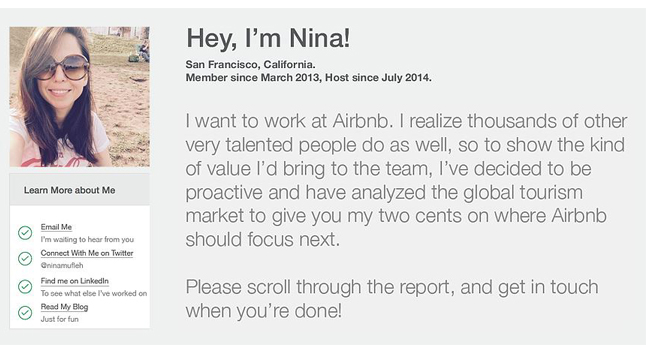
Airbnb job seeker website resume

Nina Mufleh, a marketer and communications specialist, had a dream to work at one of her favorite companies, Airbnb. And with the typical application process yielding no results, Mufleh decided to take matters into her own hands by developing a resume site that very closely resembled the look and feel of Airbnb.

And she didn’t stop there. On the Airbnb-like site, Mufleh analyzed the global tourism market, providing a report as to where Airbnb should focus their efforts. Sharing it on social media with the company’s founders helped as well, garnering her immediate attention from the CMO and from media outlets across the web.

And while Nina did not land a job at Airbnb, the media attention helped open many more doors for her as she began receiving calls from companies all over the world. Ultimately, Mufleh landed a sweet job at Upwork as a freelance growth marketer.

3. Choose Your Own Resume Adventure

job seeker using youtube to land a job

While many have taken to the Youtube video resume idea lately, there’s one guy who helped to really get the ball rolling. Meet Graeme Anthony, a communications expert who used Youtube’s in-video links as a table of contents where employers could click through different areas such as “Skills” and “Timeline.” And, yes, it worked. Shortly after uploading his video, Anthony was offered a job at one of the UK’s top PR agencies, Frank PR.

Others have used this technique in search of their respective dream jobs, too. This programmer did a great job of mixing fun visual elements to further drive home his data points and light quirky humor to show his character, and this mustachioed digital strategist used Ron Burgundy-esque humor in an attempt at getting Google’s attention.

Looking to up your job search game? You can break out of your rut and get insightful pointers with the help of a pro. Mediabistro’s Career Services offer everything from a resume retread to several sessions of career counseling to work on your elevator pitch, networking skills, career transition, and more.

Topics:

Get Hired, Job Search
Journalism Advice

Write Better Headlines and Land More Freelance Assignments

Walk the line between clickable and sensationalist click bait

freelance writer developing a headline on a computer
John icon
By Amanda Layman Low
@AmandaLaymanLow
Amanda Layman is a B2B tech content writer and strategist with over 15 years of experience creating content for startups and enterprise brands. She founded Tigris, a content agency serving leading tech companies, and authored The New Freelance: A Book for Writers.
4 min read • Originally published January 26, 2016 / Updated March 19, 2026
John icon
By Amanda Layman Low
@AmandaLaymanLow
Amanda Layman is a B2B tech content writer and strategist with over 15 years of experience creating content for startups and enterprise brands. She founded Tigris, a content agency serving leading tech companies, and authored The New Freelance: A Book for Writers.
4 min read • Originally published January 26, 2016 / Updated March 19, 2026

Headlines are arguably the most important part of your article. Without an attention-grabbing title, fewer people are going to read your content, and that could make it harder to land assignments. To get people clicking, you need a curiosity-invoking, promise-of-problem-solving headline that’s actually backed up by quality content. Here are tips for crafting headlines that land assignments, and ultimately garner clicks and loyalty from your audience.

1. Put Your Headline First

Brainstorming headlines before you even write a piece can focus to your article. “If you can’t lead with a strong headline, it means you don’t quite understand yourself or what the article is going to be about,” says Danny Groner, manager of blogger partnerships and outreach at Shutterstock.

And when it comes to pitching, it’s crucial to feature your headline front and center, typically in the subject line. For instance, I pitched the story you’re reading with this subject line: “Story pitch from Amanda Low: How to Craft Can’t-Miss Headlines.”

2. Make Your Headline Click-worthy, Not Click Bait

There’s pressure for content strategists and editors to increase traffic to their sites, and it can be tempting to write extreme headlines that pander to people’s curiosity.

To walk the line between clickable and sensationalist click bait, “Lead with intrigue or mystery,” suggests Ashley Watkins, marketing communications specialist at Trimark Associates. “Give enough information so the reader knows the article is legitimate and relevant to them, but not so much that they don’t read further.”

A piece titled “Coffee Grounds: The Secret Ingredient to Plant Growth” isn’t as attention-grabbing as “Grow Your Plants 10 Times Faster with This Household Item.” The first one gives away the punch line, where the second one only hints at it.

Being genuine and helpful is important, too. “Some brands over-promise with headlines and can disappoint their readers, which can also mean losing a potential customer,” says Groner. “It’s best practice to stick to direct headlines that tell people why they should click in, and then to give them more than they even expected.”

3. Know a Publication’s Headline Conventions

When you’re pitching, the best way to generate an effective headline is to study your target publication. For instance, if you’re writing a rags-to-riches story about an entrepreneur, and you’re pitching a profile on her to a regional magazine, your headline should mention the city she lives in.

However, if you’re pitching it as a how-to piece for the general population, your headline may focus instead on the incredible circumstances of her life.

4. Use Numbers Intelligently

We’ve all seen the proliferation of “listicles” that lead with “7 Ways to Overcome a Case of The Mondays” or “6 Ways to Get Organized.” There’s a reason content creators use numbers: They actually work, as readers are drawn to the promised structure of a list.

The trick to using numbers in your headlines is to place them strategically. Watkins suggests using numbers to emphasize duration or scale, especially when it’s integral to the story. “‘Paralyzed Woman to Run 50 Marathons in 2016’ is a headline I’ve written for a client,” she says. “Reporters turned into supporters and wanted to know about her condition, and how and why she planned to run so much in one year.”

Numbers can also help communicate statistics in a powerful way. “They help the reader quantify the scenario in their head and add a layer of context,” says Watkins. For instance, “Four of Seven Main Street Restaurants to Close After Bacterial Infections Reported.” These numbers serve a purpose beyond sensationalism.

5. Be SEO Savvy

You don’t have to understand everything about search-engine optimization to make your headlines SEO friendly; if your headline includes the main point, and your article is accurate to that headline, you’re off to a great start.

According to Dan Benton, editor in chief of SportsMedia101.com, search-engine optimized headlines should also use:

  • Full names and lead with nouns, if possible
  • Fewer than fifteen words
  • Phrases people interested in your topic will search

Don’t be wordy or vague. Says Benton: “There’s a key ‘sweet spot’ each author must find that is tuned to their target audience.”

Looking to up your headline writing skills? Consider Mediabistro’s online course Skills in 60: Headlines and Taglines. This quick take on copywriting can help you craft headlines that get noticed, and give you ideas when you think you’re tapped out.

Topics:

Go Freelance, Journalism Advice
Skills & Expertise

6 Proven Secrets to Thriving as a Social Media Manager

Drive engagement, prove your worth, repeat

social media manager
John icon
By Amanda Layman Low
@AmandaLaymanLow
Amanda Layman is a B2B tech content writer and strategist with over 15 years of experience creating content for startups and enterprise brands. She founded Tigris, a content agency serving leading tech companies, and authored The New Freelance: A Book for Writers.
3 min read • Originally published January 27, 2016 / Updated March 19, 2026
John icon
By Amanda Layman Low
@AmandaLaymanLow
Amanda Layman is a B2B tech content writer and strategist with over 15 years of experience creating content for startups and enterprise brands. She founded Tigris, a content agency serving leading tech companies, and authored The New Freelance: A Book for Writers.
3 min read • Originally published January 27, 2016 / Updated March 19, 2026

Being a social media manager is a multifaceted job: You’re a data analyst one minute, a community moderator the next and an innovator and entrepreneur after that. Whether you’re a freelancer looking to score your next big client or a job seeker eager to land a new opportunity, here are tactics you can employ right now to rise up in social media management.

1. Know Your Channels

You won’t land gigs, or an interview, if you’re not experienced in programming content on the top social media channels. Being comfortable in Facebook and Twitter is a good start, but depending on your skills and client list, consider taking some time to work with other platforms like StumbleUpon, Pinterest and YouTube. Also on your to-do list: Keep up with channels that are gaining momentum like video hub Vine, shopping site Wanelo and slide hosting service SlideShare.

2. Beef Up Your Graphic Design Skills

You don’t have to be a Photoshop god, but having a keen eye for design will place you far above the competition. Social media is saturated with content, and the posts with fine-tuned images are the ones that stand out. Graphic design skills carry over into every corner of marketing, as well.

3. Make an Infographic to Show ROI

One of the biggest challenges in social media management is showing return on investment (ROI): in short, proving to clients and potential employers that your hard work generates real results. Take the data from your best campaigns and put it all in one place.

Then, use that finely tuned graphic design skill (or hire a designer) to make a stunning infographic that you can send to future employers and hand out at conferences to promote yourself. The benefit is vast: Not only will an infographic support your claims with stats, but you will demonstrate that ability to communicate visually.

4. Demonstrate Your Ability to Handle Sticky Situations

Responding quickly and tactfully to online disasters not only proves your aptitude as a social media manager, but it proves your ability to stay calm amidst chaos—a skill essential to any media job.

5. Get Some Testimonials

Can you think of a time you got some excellent feedback after a stellar social media campaign? Whether it’s from a coworker, client or former employer, a few affirmative sentences from others can go a long way. Post these on your website or solicit them on LinkedIn to lend some real-world credibility to your hard work.

6. Target Your Next Goal

The strategy you employ now will vary depending on the role you seek. If you’re striving for a social media manager job at a targeted company, you’ll want to keep honing your skills as a jack of all trades. But if your long-term hope is to secure a C-level position or start your own company, now would be a great time to build a social media consulting practice. Work on your sales know-how to grow your client base and follow the big players in your field of choice.

If you’d like to hone your social media skills even more, consider taking a class. Mediabistro’s Online Social Media Courses teach you how to do everything from creating a social media strategy to using social media for business.

Topics:

Climb the Ladder, Skills & Expertise

Posts navigation

Older posts
Newer posts
Featured Jobs
6AM City
Revenue Operations Manager
6AM City
USA

Hanford Pharmaceuticals LTD
Virtual Assistant
Hanford Pharmaceuticals LTD
Anchorage, KY, USA

Lakeside Pediatrics
Online Chat Representative (Remote)
Lakeside Pediatrics
Sioux Falls, SD, USA

Lakeside Pediatrics
Product Manager (remote)
Lakeside Pediatrics
Philadelphia, PA, USA

Lakeside Pediatrics
Administrative Operations Analyst (Remote)
Lakeside Pediatrics
Sparks, NV, USA

All Jobs »
PREMIUM MEMBER

Nora Wertz

Bloomfield, NJ
25 Years Experience
Creative, competent and quick! PRINT ADS, WEB ADS, E-BLASTS, CATALOGS, BOOKS, BROCHURES. Producing successful designs on time and within budget has...
View Full Profile »
Join Mediabistro Membership Today

Stand out from the crowd with a premium profile

Mediabistro Logo Find your next media job or showcase your creative talent
  • Job Search
  • Hot Jobs
  • Membership
  • Newsletter
  • Career Advice
  • Media News
  • Hiring Tips
  • Creative Tools
  • About

Browse media and creative jobs

Explore popular job searches across creative, editorial, marketing, production, and top media markets.

Popular searches

  • Remote Media Jobs
  • Graphic Design Jobs
  • Photography Jobs
  • Writing Jobs
  • Marketing Jobs
  • Library Jobs
  • Journalism Jobs
  • PR / Communications Jobs

Creative and content

  • Video Production Jobs
  • Audio / Podcasting Jobs
  • Technical Writer Jobs
  • Social Media Manager Jobs
  • Copywriter Jobs
  • Publishing Jobs
  • Editor Jobs
  • Freelance Writing Jobs

Locations and specialties

  • Content Creator Jobs
  • Creative Director Jobs
  • Art Director Jobs
  • Advertising Jobs
  • Chicago Creative Jobs
  • Los Angeles Media Jobs
  • New York City Media Jobs
  • Boston Creative Jobs
Facebook YouTube Instagram LinkedIn
Copyright © 2026 Mediabistro
  • Terms of Use
  • Terms of Service
  • Privacy Policy