Mediabistro Logo Mediabistro Logo
  • Jobs
    Search Creative Jobs Hot Jobs Remote Media Jobs Create Job Alerts
    Job Categories
    Creative & Design Marketing & Communications Operations & Strategy Production Sales & Business Development Writing & Editing
    Quick Links
    Search All Jobs Remote Jobs Create Job Alerts
  • Career Resources
    Career Advice & Articles Media Industry News Media Career Interviews Creative Tools Resume Writing Services Interview Coaching Job Market Insights Member Profiles
  • Mediabistro Membership
    Membership Overview How to Pitch (Premium Tool) Editorial Calendars (Premium Access) Courses & Training Programs Membership FAQ
  • Log In
Post Jobs
Mediabistro Logo Mediabistro Logo
Search Creative Jobs Hot Jobs Remote Media Jobs Create Job Alerts
Job Categories
Creative & Design Marketing & Communications Operations & Strategy Production Sales & Business Development Writing & Editing
Quick Links
Search All Jobs Remote Jobs Create Job Alerts
Career Advice & Articles Media Industry News Media Career Interviews Creative Tools Resume Writing Services Interview Coaching Job Market Insights Member Profiles
Membership Overview How to Pitch (Premium Tool) Editorial Calendars (Premium Access) Courses & Training Programs Membership FAQ
Log In
Post Jobs
Log In | Sign Up

Follow Us!

Mediabistro Archive

Bob Schieffer on Texas Pride, the Evolution of Political Conventions, and His Role Model Tom Brokaw

The CBS News anchor on a lifetime in political journalism, the conventions that shaped his career, and the colleague whose professionalism he admires most.

mediabistro interview
By Mediabistro Archives
17 min read • Originally published August 22, 2008 / Updated April 17, 2026
By Mediabistro Archives
17 min read • Originally published August 22, 2008 / Updated April 17, 2026
Archive Interview: This interview was originally published by Mediabistro in the mid-2000s. It is republished here as part of the Mediabistro archive.

Thirty-six years after covering his first presidential campaign, native Texan Bob Schieffer is back in the saddle once again. The 2008 election — what he calls “the most exciting one of all” — is heating up, and Schieffer is front and center as CBS News covers the action.

He not only will help lead his network’s reporting on the Democratic and Republican National Conventions, but feels “truly honored” to have been selected by the Commission on Presidential Debates to moderate the third John McCain vs. Barack Obama matchup on October 15.

It’ll be Schieffer’s second time as a presidential debate moderator, having presided over the third Bush vs. Kerry showdown four years ago. “What is so good this time is that the format is designed to produce real debates,” Schieffer explains. “The program will be divided into eight 10-minute segments.

“I’ll be moderating the debate on foreign policy and I will open each segment with a question on some specific topic, and then it will be my job to get them to respond directly to the question and to each other. If they don’t ask pertinent follow ups, I will encourage them to do so. It should really be interesting and informative.”

At 71, Schieffer has abandoned his once-declared intention to retire after the 2009 inauguration. Instead, he recently signed a long-term contract to stay at CBS News, but says he’ll likely step down from the specific role of hosting Face the Nation in the near future. “There’s no fixed date,” he says. “That may be sometime next year, or it may be sometime the year after that.”

Schieffer says he’ll “always have an office at CBS”. And what an office it is, having once been occupied by one of ‘Murrow’s Boys’, legendary newsman Eric Sevareid. “He was really my hero,” says Schieffer. “He was the one I kind of most wanted to be like… I still think of it as his office – I don’t think of it as my office. I feel very honored to be able to sit in the same room where he sat.”


Name: Bob Schieffer
Position: CBS News’ chief Washington correspondent and moderator of Face the Nation
Resume: Schieffer has been with CBS News since 1969. He was named chief Washington correspondent in 1982 and moderator of Face the Nation in 1991. He has worked a variety of beats for the network: the Pentagon (1970-74), White House (1974-79), State Department (1982-85), and Capitol Hill (1989-2003). Schieffer anchored the CBS Evening News Sunday Edition from 1973-76, and the CBS Evening News Saturday Edition from 1976-96. He also served as CBS Morning News anchor (1979-80) and CBS Evening News anchor from March 2005 to August 2006. Prior to joining CBS, Schieffer worked for local stations WTTG-TV (Washington, DC) and WBAP-TV (Dallas, Texas). He started his career while still in college, reporting for Ft. Worth radio station KXOL. After serving in the United States Air Force, Schieffer worked as a reporter for the Ft. Worth Star-Telegram before starting his television career. He is also the author of four books: Acting President (1989), This Just In, What I Couldn’t Tell You On TV (2003), Face The Nation (2004), and Bob Schieffer’s America (slated for release next month).
Birthdate: February 25, 1937
Hometown: Ft. Worth, Texas
Education: B.A. in Journalism and English, Texas Christian University, 1959 (In 2005, TCU honored Schieffer by renaming its journalism department the Schieffer School of Journalism.)
Marital status: Married to wife Patricia since 1967; has two daughters and three granddaughters.
First section of Sunday Times: I read the first sections of the Times and the Post, then I go to the op-eds and the editorials. And I check the editorial cartoons in the Post!
Favorite television show: Mystery! on PBS on Sunday nights. And, I love baseball — I watch baseball whenever it’s on.
Guilty pleasure: I hate to say this, but my guilty pleasure is politics [laughing]! I love politics and love covering politics, and it’s my guilty and not-guilty pleasure, I suppose.
Last book read: A Splendid Exchange: How Trade Shaped the World by William J. Bernstein. It is about the history of trade, which is kind of a wonky book to be reading, but it is a wonderful book. And the book I read before that was A World Without End by Ken Follett. I also re-read [Follett’s] Pillars of the Earth — these are both novels, but they’re about medieval England and the time of building the great cathedrals, and the Black Plague and all that. They’re just wonderful books — they’re both about 1,000 pages long, so I spent a good part of the summer on those.


You’ve been covering presidential politics for many years. How does covering the 2008 race compare to elections past?
This is without question maybe the most exciting one of all.
I actually went to my first convention in 1968, which was the Democratic convention in Chicago. Now, that one really stands out in family history. My wife and I thought we were not going to have children, and we had taken steps to adopt a child, just very preliminary steps. And exactly nine months to the day after the 1968 convention, our daughter Susan was born. Susan was in high school when she sort of figured out the numbers… and she said one day to her mother, “I guess it wasn’t all fighting out in the streets [at the convention], huh, Mom?”

So the 1968 convention will always be the one that stands out. But what is kind of interesting is that when we came back for the convention in 1996 in Chicago — the first time the Democrats had gone back [to Chicago] since ’68 — my daughter Susan… was a grown woman and came out there with us, and met the guy that she married. She had known him in grad school, but they had sort of been friends and reconnected in Chicago in 1996 and got married. So Chicago conventions are really a big thing in our family history!

“[Political conventions] are worth covering because any time you get that many politicians together in one place, at one time, you need to be there to find out what they’re doing, and what they’re talking about, and what they’re agreeing and disagreeing about, and what they’re cooking up. It’s very, very important.”

There’s been a lot of buzz about whether the media is ‘in the tank’ for Barack Obama. How do you think the press has handled the Obama/McCain coverage?
You know, I’ve been accused of being ‘in the tank’ for so many different politicians that I think that’s just part of the game we go through here. You always find that the candidate who is running behind thinks the press is against him or her. It’s just sort of the way of the world. So I try to take it all in stride, I try to be very careful, and play it down the middle as much as I can. But no reporter who’s out there doing his job is not going to be accused at some point of being biased toward the other candidate — that’s just the way it is.

As you well know, the political conventions of today hardly provide the drama of conventions past. Do you believe conventions are, nonetheless, still worth covering?
They’re worth covering because any time you get that many politicians together in one place, at one time, you need to be there to find out what they’re doing, and what they’re talking about, and what they’re agreeing and disagreeing about, and what they’re cooking up. It is very, very important.

The truth of the matter is that these conventions now are more infomercials than they are the conventions that we used to know. I compare them kind of to an auto show, where the automakers roll out the new models. You know, the trade press comes along, kicks the tires, writes an evaluation of the new models, and there you are.

It’s the same way now with these conventions: you come, you get to hear the nominees, and you sort of put them under the spotlight, and that’s that. They are not nominating conventions, which is what they used to be. So they’re still important, but they’re just a totally different thing than what conventions used to be.

With cable and the Web providing extensive convention coverage, how much time do you think networks like CBS should devote to coverage — are the current programming plans appropriate, or would you like to see a more extensive commitment?
I think it’s about right. I think we’re giving it the coverage it deserves. I think what we have to be in a position to do is sort of summarize at one place, at one time, what we think are the most important developments. I think we’re prepared, if someone actually commits news, we’re prepared to expand our coverage. But right now, I think we’re giving it about what it needs.

How do you describe your behind-the-scenes role at CBS with regard to political coverage? As chief Washington correspondent and Face the Nation moderator, what are your day-to-day responsibilities and what influence do you have on the nature of CBS News’ coverage?
Basically what I do — my main job — is to prepare for Face the Nation and to try to get the key newsmakers on [the show] every Sunday. We start planning the next Sunday’s program on Sunday morning — that’s the first thing we do after we get off the air on Sundays. Executive producer Carin Pratt and I get together and start talking about what’s ahead.

My job is to just sort of stay up on what’s going on and make sure I have a good feel for what’s happening and what we expect to happen that week. I just sort of try to keep [up to speed], talk to sources, talk to colleagues, and get ready for Face the Nation.

Now, the second thing that I do is try to provide analysis of news events whenever the morning news or evening news ask me to do that. For example, I started my day this morning on the morning news — I did an analysis of the new polls that are out. So it’s just to try to stay [up to speed] and in contact with the people making the news. I spend a lot of time on the phone, a lot of time reading the paper, reading the blogs, and reading the wires.

In January of this year you announced you’d be retiring after the 2009 inauguration, but you later changed your mind and signed what’s been described as a long-term contract to stay on at CBS News. When [CBS News president] Sean McManus asked you to stay, why did you reverse course? And what does ‘long-term’ mean — do you have plans to retire at some point?
No, [not] at this point. Sean just asked me to stay, and he wanted me to be here for the transition, when someone else comes along to do Face the Nation. Basically, what I’m going to do is stay on board until we get a new person to do that — and that’ll be probably over the next couple of years. I mean, I’m 71, and I really am trying to dial back.

The reason I decided not to retire is because [McManus] asked me not to. And it was no more complicated than that. He said, “I’d really like for you to be around for a while, so we can make a good transition on Face the Nation.” So that’s why I did that. My brother says that he thinks that I’ve taken Roger Clemens as my role model — I announce my retirement, then I un-announce it, then I announce it again!

But right now I’m not planning to retire for a while. And as far as the contract, once we have a new person to do Face the Nation, then I will just be here to sort of provide analysis, when called upon, to be available for major events. I’ll always have an office at CBS, and this’ll always be the place that I will be. That part of it is just sort of indefinite. Basically what that means is that I’m never going to work any place else. When I finally hang it up for good, it will be at CBS, it won’t be someplace else. I’ve sort of taken Tom Brokaw as my model for the golden years!

With the death of your friend and colleague Tim Russert in June, the Sunday morning news scene obviously has been altered dramatically. With a few months having gone by now, how have things changed so far?
The competition is just as fierce as it always was. And like Tom Brokaw, Tim and I really became close friends. We had seats at the Nationals ballpark that were next to each other. We watched a lot of baseball games together. Tim was a remarkable figure. He really had carved out a special place in television journalism. I always felt like whenever I scooped him or I got a guest that he didn’t get and wanted, that I’d hit a home run off the best pitcher in the league, because he was just very good at what he did. Tom [Brokaw] has stepped in, and he’s doing a very, very good job. But as far as getting the guests, the competition is just as tough as it always was, maybe even a little more so now, because NBC is sort of working even harder because Tim’s gone.

You’ll never replace Tim Russert. You’ll find someone to come after him eventually, but he was sort of unique. I said they’ll need five people to replace him, because you need someone to run the Washington bureau — they’ve found that person — but you need someone to moderate Meet the Press, and then to do the analysis for the early morning shows, and Nightly News, and cable. He was just everywhere, so he’ll be a hard person to replace.

Do you have any thoughts as to who should fill Russert’s moderator seat permanently? Might a panel of hosts be a wiser choice than a single moderator?
I’m going to leave that to NBC to figure that out. Who knows, I might come up with an idea so good it would hurt me at Face the Nation if I told them!

It’s been nearly two years since your last day as CBS Evening News anchor. With much so buzz surrounding Katie Couric’s tenure at the broadcast, have you been asked to be on stand-by for the main anchor job — either to fill in or as permanent anchor? Are you interested in returning to that chair?
No, I have not been asked. As far as I know, Katie’s going to be at CBS for the future, and I wouldn’t expect to be asked to [anchor] again. And I would have real reservations about doing it again. I really enjoyed doing it, for that year and a half that I did it — I felt like it all came out well. I think I’m just going to kind of leave that part at that.

It’s been a tough time of late for CBS News, ratings-wise. Why do you think that is, and what can the network do to turn things around?
I think that we just have to keep concentrating on the news. We have to put the news first, and I think we’re doing a good job, and that’s about all you can do. You put together the best newscast that you can and hope people will watch it. In the long run, if you do that, eventually it pays off. Sometimes that takes a long time.

We all worry about the ratings — the ratings are important — but in the end, the only way you can have an impact on the ratings is to put together a good newscast and make sure people know that you’re doing that. If you do, eventually it pays off, I think.

Your new book, Bob Schieffer’s America, comes out in September. It features many of your Face the Nation commentaries, plus new material you call “commentaries on my commentaries.” What motivated you to do this book, and how do you balance your commentary work with your main role as a journalist?
The book is a collection of my commentaries. The way you separate them is you label them commentary, and people know that’s my opinion. In a way, it’s almost like disclosure. People will have an idea of what my opinion is on certain things. I don’t endorse partisan causes, I obviously don’t endorse presidential candidates — I just don’t do that sort of thing. These are just general observations, my thoughts on the issues of the day, and they’re clearly labeled as such. And that’s basically how I do it.

You’ve been very public about recent health problems, specifically your battle with bladder cancer in 2003 [Schieffer’s been declared cancer-free now], life as a diabetic [after being diagnosed with Type 2 diabetes in 2001], and having ulcerative colitis. Was that a difficult decision, to be this open about your health?
Yes, it was in the beginning, and I’ve never talked much about my health problems. But when I developed bladder cancer, Hamilton Jordan, who was Jimmy Carter’s chief of staff… he died this year [of cancer]… Hamilton spent his life trying to help other people who had cancer. And when I had it, he called me and said, “You can really help other people if you’ll talk about this.” And I was very reluctant to do it.

But at his urging, I decided to do that, and I was just overwhelmed from the response — I mean, the emails, especially on the bladder cancer, that said “I didn’t realize I had the symptoms until I heard you talk about it.” Or, “It just made me feel better to know someone else has gone through this.” In many ways, for me personally, it’s one of the most rewarding things that I’ve ever done. And it took very little effort on my part to just simply talk about it and be open about it.

It’s very interesting: bladder cancer and ulcerative colitis are both what we kind of call ‘below-the-belt’ diseases — people are reluctant to talk about them, for the obvious reasons. And that’s why I think it is very important for those of us who have experienced this, to talk about it. The only real symptom for bladder cancer is blood in your urine. And people don’t like to talk about that. Especially men, when they see this a lot of times, they think they may have strained themselves, or they ignore it — men are reluctant to go to do the doctor. And you simply have to go to the doctor immediately when you find out about this. So I just kind of felt like it was my duty, as it were, to [be open about it], and so I have. And I must say, I’m really glad that I have.

CBS News has a tradition of its anchors hailing from Texas — Walter Cronkite, Dan Rather and you all grew up in the Lone Star state. Was there something in the water? How do your Texan roots affect your perspective and your work?
Being from Texas is sort of like an ethnic type of thing! We feel like we’re part of a particular group. I think it’s probably fair to say that we’re generally smarter [laughing]. That may have something to do with it… But I’ll tell you what also may have something to do it: in the early days, in the cowboy days, cowboys were out there all by themselves, out there with their cattle, and when they would finally run into a stranger, they had somebody to talk to! Storytelling — tall tales — became a great Texas tradition, so there may be some of that in our DNA, that may be the reason you see so many of these broadcast journalists come out of Texas, I really don’t know.

It is a fun thing. People from Texas, they like you to know they’re from Texas. Just like I guess, people from Boston, they’re very proud of that. Or people from San Francisco. There are just certain places around the country where people who from there are not bashful about telling you about it.

How are things on the Honky Tonk Confidential [Schieffer’s country music band] front?
They’re great! We were down at TCU [Texas Christian University], which is my alma mater — we had the TCU symphony orchestra, the TCU jazz band, the TCU kettle drum band, and Honky Tonk Confidential, all there, under one big tent, to kick off the school’s capital fund drive campaign. I wrote a new song just for the occasion. It was actually just kind of a Texas geography lesson, and how we teach geography at the Schieffer School of Journalism. The first thing we try to tell people is that it is the ‘Ft. Worth/Dallas’ area, not the ‘Dallas/Ft. Worth’ area [Schieffer is a Fort Worth native, and TCU is in Ft. Worth]. I wrote a little song — it went:

Dallas, Dallas, how we love ya,
So why is our airport DFW?
Move that D,
Shift that letter,
‘Ft. Worth-Dallas’ is so much better!

And since it was kind of a Ft. Worth-oriented audience, it was a real hit, I have to tell you!

Looking back at your career, what are you most proud of?
What I am most proud of is that I have just managed to hang in there. I just feel like I’m somehow blessed. If my career ended tomorrow, I wouldn’t feel shortchanged, because this is what I wanted to do when I was a little boy. I’m one of the lucky people who got to do what he wanted to do as a little boy.

It’s just that I got to go, and see, and interview, and be around all these news events that have happened at this particular point in our history. I’m just proud I was able to stay around and get to see and do so much. The honor that I’m most proud of is when TCU named the journalism school for me. To me, that was the thing that I felt the happiest about. I think it’s probably undeserved. But having said that, I’m still very proud of it.


Alissa Krinsky is a contributor for TVNewser

Topics:

Mediabistro Archive


Mediabistro Archive

Will Leitch on Deadspin, His Newest Book, and Working for Gawker Media

The Deadspin founder and sports media critic on the blog he built, the book he just wrote, and the boss who gave him room to do both.

mediabistro interview
Mediabistro icon
By Noah Davis
Noah Davis is a freelance writer and co-founder of Three Point Four Media whose work has appeared in The New Yorker, The New York Times, GQ, The Wall Street Journal, ESPN The Magazine, Sports Illustrated, and Wired, among others. He served as an editor at Mediabistro's FishbowlNY and SportsNewser, and later as a senior editor at Street Fight. He holds a B.A. in Rhetoric from Bates College.
16 min read • Originally published May 29, 2008 / Updated April 17, 2026
Mediabistro icon
By Noah Davis
Noah Davis is a freelance writer and co-founder of Three Point Four Media whose work has appeared in The New Yorker, The New York Times, GQ, The Wall Street Journal, ESPN The Magazine, Sports Illustrated, and Wired, among others. He served as an editor at Mediabistro's FishbowlNY and SportsNewser, and later as a senior editor at Street Fight. He holds a B.A. in Rhetoric from Bates College.
16 min read • Originally published May 29, 2008 / Updated April 17, 2026
Archive Interview: This interview was originally published by Mediabistro in the mid-2000s. It is republished here as part of the Mediabistro archive.

The best adjective to describe Will Leitch, and I mean this in the nicest way possible, is spastic. He talks nonstop about anything and everything — mostly sports, the primary subject of Deadspin, the Gawker Media blog he founded in 2005 and for which he remains the principle contributor. For a man who spent the past five months blogging full-time for Deadspin and penning his third book, God Save The Fan: How Preening Sportscasters, Athletes Who Speak in the Third Person, and the Occasional Convicted Quarterback Have Taken the Fun Out of Sports (And How We Can Get It Back) (seriously), this energy is necessary. Most days, he worked from 7 a.m. until 11 p.m., only taking a break to hit the gym and eat.

Among Gawker Media’s bloggers, Leitch exists in a unique space, sheltered from the harassment of his notorious boss, Nick Denton, because of his blog’s subject matter. (He told me that he can only remember three IM conversations with Denton, one when he asked, “Was the March Madness over?” It was June.) Leitch works from home, penning the majority of Deadspin’s posts during the day and working on his book at night. With God Save hitting shelves nationwide, we met for vodka sodas at a bar near his Brooklyn apartment to discuss the book, the blog, and, of course, the boss.


You’re writing the book and blogging full-time. What was the day like? Did you have a schedule?
Yeah, I get up typically about seven [a.m.]. If I know I have a really busy day, I’ll get up around six. One of the nice things things about Deadspin is that because it spawned its own culture of sports blogs, my job is essentially to write about my mail. I dig through everything and plan out what I’m going to do for the day. There’s a little change now because I have to have all these new writers because of the new Gawker mandate, but generally speaking, I dig through everything, figure out what I’m going to do and plan out my day and write like crazy, until the late afternoon. Then I would go to the gym.

That worked out well for me as a good separation of the day for the book. I’d go, come back, shower and straighten up. Then I would check and make sure [baseball player Roger] Clemens hadn’t shot somebody, or there was no breaking Deadspin stuff, and then I would write the book.

To me it was important to have that separation. I actually have a separate computer that doesn’t connect to the Web, specifically for writing things that have nothing to do with the site. It runs Microsoft Word and unfortunately Mindsweeper, which I can’t get off the computer. I would love to get it off the computer because you know when you write you’ll do anything to be distracted, even a game you played your freshman year of college.

As a whole, the book took me about five months to write while doing the site every day. During the writing of the book, I took three days off to go to Argentina last New Years, and that was it. I had to do it every day. I have an essay in Publishers Weekly about writer’s block. I’ve never worried about writer’s block because writer’s block is for people who don’t have anybody waiting for what they are going to say or waiting for you to post something. Writer’s block is not something that I see people who work online having a problem with because you have to write all the time whether you feel like it or not. That helped me with the book. That said, [God Save] took me longer than Catch [Leitch’s second book] did. Catch took me about four months.

The actual process was we’d been working with David [Hirshey], my editor [at HarperCollins] and soccer columnist. Kate [Lee], my agent, had been talking to him about doing something, and I put together a little pitch, probably the least professional proposal ever. Mine was literally three pages, and three pages the way you did it in college, where you extend the font to make it look longer. Originally the idea was that the book was going to be 25 3,000-word essays, and that was all it was going to be. I wrote like four or five of those and I was like, “I’ve got to break this up. It’s boring me.” So we broke them up into shorter things. Kate put together the pitch back when I was in St. Louis for the [2006] World Series and the Cardinals were in it. I was literally driving up from Mattoon [IL], my hometown, to Game 5 when the phone rang and Kate said, “We have the deal. It’s secured.” I was like, “Alright, you guys [Cardinals] better fucking win now. I’m having a really good day, don’t blow it.” So that turned out to be a pretty good day. [EDITORS’ NOTE: The Cardinals won Game 5 and the World Series.]

To me it was nerve-wracking — I’ve been pleased that most of the notes have been positive so far. It’s one thing to write online where you have a bunch of people telling you you’re an idiot. I’ll always remember what Bob Dylan said after he wrote Chronicles: Vol. 1. He got incredible reviews from book critics and he said, “The reviews from book critics mean so much more than any album review I’ve ever gotten in my entire life. It validates me.” I understand I’m not a moron. I understand that idea. You have no idea if anyone is going to like it. At Deadspin, you know immediately if someone is going to like it. It’s kind of fun to have something put away for awhile.

You wrote all new stuff for the book but a lot of the material seems inspired by Deadspin. How much would you say is?
There’s certain nods to Deadspin like the Carl Monday thing. They are in there because I personally find them so amusing and I wanted to put them somewhere so they aren’t lost in the annals of cyberspace. To me, my natural mode is to write natural stuff. I have to stop myself from writing 1,000 words on every post. I’d written the Life as a Loser essays back in the day, and that kind of form writing is a little more comfortable for me than doing the “introduction to topic. Quote. Pithy turn.” That’s fun, there’s a good moment for that, but this is more comfortable for me, so it was fun to be able to transfer some of the perspectives I gained from doing Deadspin into the old style. Frankly, I didn’t know if it was going to work. I think the mindset is very similar between Deadspin and the book. They are both based on the idea that the way sports is presented and packaged and put together for the average sports fan is wrong. If any other industry treated its customers the way that sports treats its customers, people would not ever buy its product anymore. Unfortunately, sports fans are suckers and they aren’t like, “I’m not going to not watch baseball.” Deadspin has a lot of readers but I didn’t want to count on them. I think it’s a mistake that a lot of people make when they have a popular blog, they think “Well, if just people on the site buy it, it will be a hit.” Well that doesn’t tend to work. That’s one thing I wrote in the Publishers Weekly essay, that blog books are like a gender or an ethnicity or something, as if they are all sort of the same-minded thing. For me, I was writing long before I did a blog.

It seems like it’s really different writing between doing a blog and writing the book. Was it difficult to go back and forth? Did taking a break in the middle of the day help?
Yeah, it did, but that was more of a mindset break than a topic break. I think the mindset’s similar in that people always talk about the royal “we” I use on the site. The reason I chose to do that in the first place was you see so much in sports commentary being like, “Well, here’s what I think,” “Well here’s why I disagree with you,” “Well, let’s yell at each other and have points rack up as we discuss it, with sounds and beeps.” So I wanted to depersonalize it a little bit, to show that it was actually a discussion and that I don’t know anything more about this than anyone else does.

I used to freak out my old roommates because they’d come home and literally the only light in the entire place was my computer.

Certainly in the book I felt a little bit more comfortable using more personal examples. People have asked if the Deadspin commentators will find things too earnest in the book because they are notorious for being … I prefer sardonic and ribald, but no one knows what the hell I’m talking about so I’ll say snarky. I think there’s a level of earnestness in the site that I think’s in the book too. I never wanted the site, or definitely not the book, to be like, “Here’s something wrong with the world, let’s crap on it.” You see that a lot because it’s an easy, default way to write online. I never really wanted to have that. I think the book is born of that sensibility.

As for the different type of writing, it’s actually a little bit more fun [to write the book] because I can really delve into something and run with it until I have nothing left to say, as opposed to being like, “Okay, I have 20 of these things to write today, so don’t focus too much on one.” It’s a little bit more fun this way. Plus, people copy edit, which is always nice.

This is your third book. Does it get easier? Harder?
This one was a little bit more stressful because I think there’s more on the line. The first two were these little cute books for small publishers and if they did well, great, but if not, “Hey look, Will’s got a book.” This is HarperCollins. It’s hardcover. There are expectation for the book. To me, it was more important to make this book appeal to people who weren’t inherently sports fans. I think the regular Deadspin readers will enjoy this, but the idea was to make everyone enjoy it. I worked harder on getting the jokes right, as opposed to Catch, where I was just telling the story of my hometown, and if they don’t like it, screw ’em, it’s my book. This was more of a conscious effort to make sure I didn’t get too wrapped up in my own head. I want people to like the book. I’m doing promotion this week and next week. This [interview] is an oasis in the desert compared to what I’ll be going through this week and next week. It’s like, “You’re talking to Tommy J and the Mad Frog from Boise,” and I’ll be trying to type posts in between. The nice thing about it is that the writing is my favorite thing. You always hear writers complaining about filling up the page, but I feel more comfortable writing than I do pretty much doing anything else. I used to freak out my old roommates because they’d come home and I’d have every light in the house off and my headphones on and literally the only light in the entire place was my computer and the only sound would be me tapping and occasionally [singing] “My heart will go on,” or whatever I happened to be listening too. (Not that, of course.) That’s my zone. That’s my favorite place to be in the world. The writing part, that’s the easy part. The hard part is organizing it and putting it together. I wrote everything individually. I had the general idea, the four sections, “Fans,” “Players,” “Media,” and “Owners.” I had that mindset a little bit, but I was just filing stuff as I finished it. I ended up turning the whole book in a day early. David famously said, “Will, you’re the first person to turn your book in on time since [professional golfer] John Daly, and I don’t think he’d read it,” which I thought was a pretty good point.

Okay, the title. Why is it so long?
That is not my fault. The original title was The Ballad of Ron Mexico…

That’s incredible. No one would have bought it, but that’s a great title.
Yeah, it’s a great title. And sales, justifiably, was like, “Who’s Ron Mexico.” And I had a whole sales pitch about why it was a smart commercial thing but I might have been completely wrong. I don’t know why they did that. I think what they found was the more stuff you put in the subhead, the better. I think if they could have fit it on the book, they would have taken my name out and Deadspin out and Britney Spears would have been in there. I think we came up with about 15 different phrases to fit in the space, and unfortunately we picked three that had a lot of long words. I prefer to just call it God Save The Fan.

Your HarperCollins bio says “always a fan first and journalist second.” I don’t know if you’ll take offense to this, but it sounds very Bill Simmons-esque. How do you feel about this new dimension to sports journalism?
First of all, I think that that’s probably a bit of a copywriter’s license, but I think that the idea is generally true. There have been concrete times when that’s not been the case — like when I had to write about Rick Ankiel for example — but I think that’s more a matter of perspective. I would prefer they had used the term “sportswriter” rather than “journalist.” Certainly, I went to journalism school and I’ve worked as a journalist forever. I still write for The New York Times and I write for New York. But on the whole, it’s more a matter of mindset, fan rather than sports writer. I’d rather be known as a fan rather than a sportwriter, although I’d rather be a journalist than a fan, which tells you a little bit about how far the profession of sportswriting has sunk.

There are some things in the past that Gawker Media has done that I might disagree with, but that’s a personal thing, not a professional one.

Generally speaking, if you work in the world of sports, whether you’re a member of the media or an athlete or a coach, you tend to think sports are more important than they are. Everyone is “buddy, buddy, pal, pal,” and they think fans are these weird people who drink beer and paint their face and are shirtless in Green Bay when it’s 10 below. They are the groundlings and the swarthy masses. I don’t think that’s how fans actually are and I identify with the average fan. I think they are more intelligent than the media gives them credit for. When you work in the world of sports, you lose touch with the fact that the average sports fan deals with sports to get away from their everyday lives. When they are stuck at their desk, and they want some entertainment during the day. They watch on Sunday because they don’t have to pay bills or worry if the kids are set for college or whether someone’s going to drop a bomb on our heads. To me, that’s the important thing. Yes, we really, really care about our teams, but at the end of the day, we recognize that this is all just entertainment. The athletes are paid entertainers. We can try to mythologize them, but I don’t think smart fans think that anymore. And that’s fine. It doesn’t make us enjoy the game any less. It doesn’t make us cynics. It helps us put things in perspective, and I don’t think the average sportswriter understands that. That said, when it comes to sports, my initial reaction is always more the fan.

What are you doing to promote the book?
I go on almost a month long tour. It’s crazy. I’m starting at the Super Bowl, where I’ll be for the week. Then I go to Los Angles, San Francisco, Seattle, Chicago, Champagne (my college), St. Louis (my hometown) — I don’t think they have the arts and crafts fair at the mall that day so I think I’m the replacement — and then back out here to Philadelphia, D.C., Boston, and then New York.

How did Gawker feel about you writing the book? Was that difficult to get it approved?
I ran it by Lockheart [Steele], who I joke in the acknowledgements is the lone, heterosexual, non-Euro male at Gawker Media at the time. He said, “No, we encourage this. We want to promote the site.” They’ve been nothing but supportive. Originally, [HarperCollins] was toying with the idea of putting Deadspin in the title, which is something I never wanted to do, and I think there might have been some issue with that.

They’ve been very supportive of everything, which is great. You know it’s funny because I know Denton’s taken a lot of hits right now. I can’t speak for people who have worked more closely with him than I have, but I have never had a single negative issue with Nick. There are some things in the past that Gawker Media has done that I might disagree with, but that’s a personal thing, not a professional one. I’ve never had a single issue with him. I’ve never had overdirection of the site, although I think I have an advantage because they don’t know what the hell I write about. Every interaction I’ve ever had with Nick has been completely positive. People always ask me, “How have you ever dealt with such a stressful environment.” I’ll be honest with you, I think people come into Gawker Media and they’re like, “We work for Gawker Media. They are slave drivers over there.” I’m like, “Please, these people have obviously never worked for a trade publication and had to pretend they had to care about Merrill Lynch.” You get to write funny stuff all day. That’s kind of cool.

Say this book takes off and you get a contract to write another one. How much longer do you write Deadspin?
Deadspin is the most fun job I’ve ever had by 50-fold. I’ve been offered things by places since I’ve started doing Deadspin, but the majority of them are, “Come to our mainstream publication and do our sports blog.” It doesn’t work that way. I have a captive audience that grows every month, that understands my system and understands how I want Deadspin to be. I have no complaints about my job. I have no plans to leave. This book would not exist without Deadspin. When I was writing for the New York Times Web site during the baseball playoffs, I wrote a column from my sister’s old desk at like 3 in the morning, listening to my father snoring in the other room. I woke up, and it was on the front page of the Web site. That doesn’t happen without Deadspin. There’s a loyalty there. Even though there have been changes made that aren’t necessarily up my alley in a lot of ways, I respect that and I have no complaints about my job now. It would take a pretty massive thing to leave. Even with all the changes, Denton continues to leave me alone.

Is there another book in the future?
Oh yeah. I’m working on one right now, actually. I’m way behind, obviously, because of all the things that are going on. It’s from the publisher of Catch, called Come As You Are, about a kid that wants to kill himself on the anniversary of Kurt Cobain’s suicide. That will get done someday, when I have five months to sit down and write it. I plan on writing … this is what I do.


Three tips for writing a book while blogging full-time
1. Recognize that your shit does in fact stink
“I never understand writers that say, ‘I just can’t write today, I’m not inspired,” Leitch says. “As if a carpenter ever says, ‘I can’t build this shelf today.’ It’s a job, it’s work. It requires time and effort and dedication.”
2. Separate the blog from the book
“I wrote most of Deadspin in the morning, and then took a break in the middle of the day to go to the gym,” Leitch says.
3. Unplug
Leitch wrote much of God Save from a computer that wasn’t attached to the Internet, only transferring files when he was ready.


Noah Davis is mediabistro.com’s associate editor.

Topics:

Mediabistro Archive
media-news

Amazon Wants 15 Films a Year. One Magazine Doubled Its Staff.

Two revenue models creating jobs in different corners of media, and what that split means for your next move.

Mediabistro icon
By Mediabistro
The Mediabistro editorial team draws on 25 years of media industry expertise to cover jobs, careers, and trends shaping the industry.
4 min read • Published April 17, 2026
Mediabistro icon
By Mediabistro
The Mediabistro editorial team draws on 25 years of media industry expertise to cover jobs, careers, and trends shaping the industry.
4 min read • Published April 17, 2026

Amazon MGM Studios walked into CinemaCon and told Hollywood this is permanent. Mike Hopkins, head of Prime Video and Amazon MGM Studios, promised theater owners a minimum of 15 films annually for theatrical release.

“While some of our competitors have dipped their toes in and out of the theatrical waters, for us, this isn’t a test or an experiment,” Hopkins said. The slate backed it up: a Henry Cavill-led Highlander reboot, a Sylvester Stallone origin story called I Play Rocky, and Verity, the latest Colleen Hoover bestseller adaptation starring Dakota Johnson and Anne Hathaway.

Meanwhile, BBC Science Focus quietly doubled the size of its editorial team. The fuel? Revenue from Apple News subscriptions.

One magazine, one platform deal, enough recurring income to hire writers and editors rather than cut them.

Together, these stories sketch where content money is actually moving. One company is pouring resources into multiplexes and franchise IP. One publication found sustainable growth through platform distribution that pays. Both are hiring.

Amazon MGM Told Hollywood This Isn’t a Side Project

Hopkins’s line matters because it answers the question studios have danced around since streaming became the default: does theatrical still warrant dedicated investment, or is it just premium marketing for streaming libraries?

Amazon’s answer is a $1 billion-plus annual theatrical commitment, backed by a studio that now employs thousands across development, production, marketing, and distribution.

The CinemaCon slate shows what that looks like in practice. Highlander, directed by Chad Stahelski and starring Henry Cavill, got a first-look featuring brutal fight choreography and a rave club sequence that reportedly drew audible reactions from exhibitors.

Stahelski directed the John Wick franchise. That’s a specific action filmmaking pedigree, and it signals Amazon is pairing recognizable titles with directors who have theatrical audience loyalty.

I Play Rocky, directed by Peter Farrelly, takes a different angle. Anthony Ippolito plays a young Stallone during the chaotic, low-budget production of the 1976 boxing film that made him famous. A behind-the-scenes origin story mining cultural history rather than sequel potential. Farrelly won an Oscar for Green Book, giving this awards-season credibility alongside nostalgia.

Then Verity, directed by Michael Showalter, adapted from Hoover’s psychological thriller. Her It Ends with Us grossed over $350 million theatrically last year, proving that her fanbase will leave the house for adaptations.

Amazon is betting the BookTok-to-theater-seats pipeline is repeatable. Showalter’s track record with character-driven material (The Eyes of Tammy Faye, romantic comedy work with Hathaway) suggests they’re taking the adaptation seriously.

What This Means for Hiring: Amazon MGM’s 15-film annual floor requires staffing across every phase. Development executives who can spot adaptable IP. Producers managing nine-figure budgets. Marketing teams who know how to position franchise reboots and literary adaptations to distinct audiences. Line producers, VFX coordinators, the full physical production chain. This makes Amazon one of the steadiest employers in theatrical at a time when most studios are releasing fewer films each year.

A Magazine Doubled Its Staff on Apple News Revenue

BBC Science Focus is a niche magazine covering science, technology, and the natural world for a curious general audience.

What makes this relevant is the specificity: Apple News subscription revenue generated enough income to double the editorial team. Not “supplement budgets.” Not “partially offset losses.” Double the team.

Apple News runs an all-you-can-read model at $10 monthly, distributing revenue to publishers based on engagement. For BBC Science Focus, that stream proved reliable enough to fund full-time editorial positions.

The publication didn’t disclose exact figures, but platform revenue directly translating into editorial hiring complicates the easy narrative that digital distribution only extracts value from journalism.

This isn’t universal. Apple News works for publications with content that holds attention and serves a specific audience well enough to drive real engagement within the app. BBC Science Focus fits that profile: evergreen science explainers, feature-length reporting on emerging research, content that rewards sustained reading. A breaking news operation or hyper-local outlet might see completely different results.

For writers and editors thinking about where to build careers, publications with sustainable platform partnerships are hiring. Others are still searching. BBC Science Focus is a single data point, but one worth tracking to see if other niche titles replicate the outcome.

What This Means

Amazon’s theatrical push and Apple News’s editorial funding look nothing alike, but they point toward the same professional reality: sustainable revenue models create jobs.

The question for media professionals isn’t which model is “better.” It’s where your skills align with the companies that have figured out how to fund content reliably.

Amazon MGM is hiring across development, production, and marketing for a theatrical slate that isn’t going away. Publications with functional platform deals are selectively adding editorial staff. Both are concrete opportunities in an industry where stability remains rare.

If you’re navigating your next move, browse open roles on Mediabistro to see where these strategies translate into hiring. If you’re building teams around theatrical production or editorial growth, post a job on Mediabistro to reach the professionals watching these shifts closely.

The content economy isn’t consolidating into a single model. It’s splitting into distinct paths with different funding sources and different kinds of work. Knowing which path you’re on matters more than betting on which one wins.


This media news roundup is automatically curated to keep our community up to date on interesting happenings in the creative, media, and publishing professions. It may contain factual errors and should be read for general and informational purposes only. Please refer to the original source of each news item for specific inquiries.

Topics:

media-news
Weekly Drop Media Newsletter

The New Corporate Superpower Is Storytelling. Yes, Really.

From corporate punchline to six-figure skill: why storytelling is now the most valuable thing you can bring to work

mediabistro weekly drop media newsletter
Miles icon
By Matt Charney
@mattcharney
Matt Charney is a talent acquisition analyst, journalist, and marketing leader with nearly two decades of experience at the intersection of recruiting, HR technology, and media. He has held editorial and content leadership roles at ERE Media, Recruiting Daily, and Recruiter.com, and served as Chief Content Officer at Allegis Global Solutions. As Principal Analyst at Kyle & Co, he covers HR tech funding, M&A, and market strategy. Matt currently serves as Executive Editor at Mediabistro, where he leads editorial, partnerships, and multimedia content for the creative professionals who power the media industry. He holds a degree in Writing for Screen and Television from the University of Southern California.
11 min read • Originally published April 17, 2026 / Updated April 17, 2026
Miles icon
By Matt Charney
@mattcharney
Matt Charney is a talent acquisition analyst, journalist, and marketing leader with nearly two decades of experience at the intersection of recruiting, HR technology, and media. He has held editorial and content leadership roles at ERE Media, Recruiting Daily, and Recruiter.com, and served as Chief Content Officer at Allegis Global Solutions. As Principal Analyst at Kyle & Co, he covers HR tech funding, M&A, and market strategy. Matt currently serves as Executive Editor at Mediabistro, where he leads editorial, partnerships, and multimedia content for the creative professionals who power the media industry. He holds a degree in Writing for Screen and Television from the University of Southern California.
11 min read • Originally published April 17, 2026 / Updated April 17, 2026

Once upon a time…

…in the fluorescent-lit fiefdoms of Corporate America, there lived a somewhat peculiar, somewhat misunderstood tribe known as “Storytellers.”

These mythic creatures were easy to spot, for they spoke not like most men, but instead, in the cadence of a narcissist delivering a TEDx Talk, plied their trade in aggressively obvious, superficial observations disguised as wisdom, and dressed in Patagonia puffer vests, or, if they were of higher rank, patterned sport coats with designer jeans.

In these simpler, easier and less enlightened times, being a “storyteller” was less of a profession, and more of a warning that this person spoke in gratuitous analogies (“achieving our goals this quarter will be like climbing Everest”), sent emails the length of Russian novels, and transformed mundane meetings into exercises in creative ideation, much to the chagrin of the rest of the kingdom.

Alas, dear reader, that legendary age has long ago passed into the mists of time.

Now, we live in a more enlightened time – and storytelling has moved from the corporate margins to the business mainstream, becoming one of the hottest skillsets in corporate America today not involving artificial intelligence healthcare.

It’s not because the C-Suite suddenly developed an appreciation for Joseph Campbell or Syd Field, but because businesses have finally realized that data without context is just a bunch of numbers. Empirical evidence needs emotional resonance, and that’s why storytelling is something of a proverbial silver bullet when it comes to building a business case, bolstering a brand or boosting the bottom line.

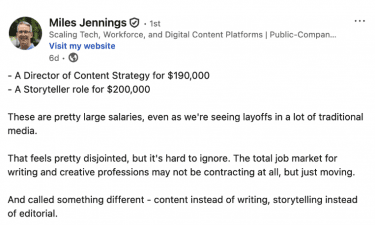
As our CEO recently pointed out on LinkedIn (see image).

Humans are hardwired to respond to stories. No matter how sophisticated analytics might be, no matter how compelling an argument the data might make, at the end of the day, we don’t make decisions based on pure logic or reason (although we’d be way better off if we did, honestly).

Instead, we continue to make decisions based mostly on vibes and gut feelings, then reverse engineer the underlying logic after the fact to justify those decisions (a discipline that’s become known as “data storytelling,” which is really just consultant speak for confirmation bias).

In a market drowning with AI slop (and the occasional, OG human generated crap content, like this here newsletter), dashboards and decks featuring 17 bullet points when a single, simple sentence would work, the people who have the ability to transform all that information into a compelling, comprehensive narrative are increasingly becoming the professionals who get hired, promoted and funded.

After all, data represents a single moment in time, and most of it ages about as well as an avocado or Dogma 95. Stories, on the other hand, are timeless. Even the whole “AI is displacing human jobs” thing is basically just “man versus machine,” which was already a well-worn cliche back when Plato first categorized content thousands of years ago.

Which brings us to this week’s theme – and one that’s apropos for anyone working in media or entertainment – why, exactly, has storytelling gone from corporate commodity (or “creative fluff,” depending on the company) to one of the most competitive, and valuable, skills in the modern workplace?

And, more importantly, what does that mean if your career involves some aspect of content creation, media production, marketing, editorial strategy, executive leadership or, frankly, anything that involves human interaction and interpersonal communication?

Let me tell you a story…

Act 1. Companies Are Literally Hiring “Storytellers” Now

Look, this shift to storytelling lacks the subtlety or subtext of most job trend analysis; this time, there’s no need to read the tea leaves or take deep dives into the data to see obvious signs of this seismic skills shift. Corporations are quite literally posting jobs for “storytellers.”

Yeah, that’s a job title now. And a pretty damn lucrative one, too.

According to reporting from the Wall Street Journal (our favorite Fox News property), big tech has emerged as early adopters of this nascent trend, with companies like Google, Microsoft, Notion and Anthropic building corporate storytelling functions or dedicated teams to shape the narratives around their businesses and brands.

Job postings using the term “storyteller” as either a required skill or as an actual job title surged throughout 2025, a trend that’s only accelerated so far in 2026.

Apparently, “Senior Manager, Narrative Synergy Enablement” was too obtuse and esoteric, even for big tech (and too embarrassing for top storytelling talent, likely).

Read more: Companies are Desperately Seeking Storytellers (Wall Street Journal)

What it means for your career:

While hiring might be down across the board in journalism, media, copywriting, content, PR, production and brand marketing, the shift from corporate outcasts to “top talent” should come as something of a relief – and good news for stuff like salary and stability (if not for creativity and originality).

The exact same companies that spent the last decade basically breaking linear media models and centralized content distribution while gutting editorial budgets and headcount are the exact same ones trying to recruit the same former journalists and creatives their business models displaced.

That’s because, while their engineering and product teams are world-class, many have finally recognized that their austerity approach to content has gutted their internal capabilities, with the few content specialists left creating copy that sounds like a mishmash between a legal disclaimer and a malfunctioning LLM.

The conclusion these businesses – and many others outside traditional media and entertainment companies – have come to is pretty simple. It’s a lesson that every enterprise will likely be forced to learn – the ability of a brand to tell a coherent story and compelling narrative today isn’t “adjacent” to business value.

It drives business value – and that’s the bottom line.

Act 2. AI Drives Demand for Quality Writing.

There’s a common misconception amongst many companies that leveraging AI makes “writing” easy, given its ability to produce infinite, instantaneous content. The problem with LLMs, however, is that pattern recognition inherently generates output that’s inherently average, in the best-case scenario.

Too often, though, it’s unreadable slop. Most AI generated content makes 50 Shades of Grey look like it belongs on the Booker Prize shortlist, or Jackie Collins look like a Nobel Laureate. That canon of crappy content continues to grow exponentially, showing no signs of stopping. This matters, because AI isn’t writing. It’s algorithmic output that’s set up camp deep in the uncanny valley, replete with bulleted lists and misplaced emojis.

Organizations are increasingly catching onto the fact that machine-generated mediocrity might make flooding every channel expedient and efficient, but when it comes to driving actual business results, it’s also completely ineffective.

Authentic, strategic, and compelling content has become something of an endangered species, and that scarcity has driven a significant spike in demand for good writers, which is good news for most of us. The pivot in corporate content away from AI-generated algorithmic efficiency towards emotional engagement places a premium on quality, not quantity, and even more so on the handful of humans capable of objectively good writing.

You know who you are. And even though the job market feels really tough, there are signs that you’re actually becoming in demand. Turns out, when everyone can generate copy ad nauseum, the differentiator is no longer just content creation, but rather, creativity and human ideation – and businesses are finally recognizing there’s a pretty big difference between prompt engineering and good writing. Their consumers always have.

Read more: Businesses Hiring Storytellers to Cut Through the “AI Slop” (The Times on Sunday)

As organizations flood every channel with machine-generated mediocrity, authentic and strategic communication has become more scarce, and therefore more valuable. Businesses are increasingly hiring human communicators specifically to cut through what one publication memorably described as “AI slop.”

Turns out, when everyone can generate copy, the differentiator is no longer who can write words. It is who can think.

What it means for your career:

Simple. If you’re good at writing, you’re a little more in demand than you were last year. As any writer can tell you, this is kind of unprecedented territory, given the historic surfeit of paying gigs, much less ones with starting salaries in the six figures. That’s not quite showrunner money, but it’s close enough.

If your value proposition is the ability to synthesize and simplify complexity, identify signals while tuning out the noise, and create a compelling narrative that can change minds (and purchasing decisions), then congratulations. You’re finally in demand – and imminently employable. The competition is no longer with other great writers, but between the companies whose businesses depend on them.

Feels pretty good, doesn’t it?

Act 3. Communication Most In-Demand Skill on LinkedIn

Love it or hate it, LinkedIn – aka Facebook for Unemployed Thought Leaders – has become an integral, entrenched part of how hiring works today (even if it largely refutes the whole ‘quality content’ narrative, if your feed looks anything like ours). LinkedIn is for recruiters what TikTok is for sorority members – their primary source of news and biggest influence (however skewed) on their worldview.

That’s why a recent report from the Microsoft-owned “professional network” is yet another encouraging sign for anyone in the business of crafting stories and shaping narratives; LinkedIn data shows that communication remains the most in-demand professional skill employers are looking for when hiring for open roles.

Fully 9 in 10 executives surveyed report that soft skills remain their most critical hiring need. Surprisingly, an additional 70% rank communication skills as more valuable than AI-specific technical skills.

Given the fact that storytelling is the most sophisticated and complex form of communication, this is one media and entertainment story that just might have a happy ending.

Read more: Communication remains the most wanted job skill on LinkedIn (Axios)

What it means for your career:

Being good with data isn’t enough anymore, nor is simply being “strategic” (whatever the hell that means).

Thing is, if you can’t explain your ideas in a way that makes people actually give a crap, nothing else really matters. Without strong communication skills, you’re basically an Excel spreadsheet with a LinkedIn profile.

Corporate America loves to pretend it worships logic, but anyone who’s spent more than ten minutes in a meeting knows decisions are rarely made because the best analysis won. They’re made because someone told the most convincing story in the room.

Data supports decisions. It doesn’t drive them. In business today, finding information is easy. True value, however, requires the ability to extract meaningful insights from that data in an emotionally engaging way.

The people who advance aren’t always the smartest (raises hand). They’re the ones who can make complexity understandable, who can connect data to driving decisions, and package insights and analysis in a way that drives the business- and bottom line – forward.

Act 4. Turning Numbers into Narratives: the evolution of data storytelling

Analytics are an integral component of pretty much every business out there. While data is an inextricable part of every business function (with the possible exceptions of brand marketing and human resources, which are sort of like the liberal arts of corporate America).

From scenario analysis to demand forecasting, from historic financials to FP&A forecasts, the role of analytics has produced a big problem for big business: everyone has dashboards, data lakes, and deep analytics – but almost nobody knows how to explain what any of them mean (although management consultants have become adept at playing pretend).

Research on data storytelling has repeatedly proven that narrative framing improves decision-making capabilities, comprehension of complex information, and better business outcomes. In other words, people process quantitative evidence way better when it’s told as a story instead of a spreadsheet.

Which should really come as no surprise to anyone outside of B Schools or C Suites.

Read more: Storytelling in an AI Era is Shifting from Control to Credibility (BW Marketing World)

What it means for your career:

Even in the most data-heavy organizations, from investment banks to actuarial firms, the workers who win aren’t necessarily the ones with the deepest data or the most advanced analytics. They’ll be the ones who can make all of those numbers relevant, accessible and actionable.

How the pivot tables have turned.

Act 5: Deconstructing The Denouement

Corporate America, fundamentally, is predicated on stories – and always has been. Whether those stories manifest themselves as “brand messaging,” or the finely honed narratives which unfold on every earnings call, press release or media placement.

The Greeks, in fact, would likely be familiar with the characters and structure at play in late-stage capitalism. From the origin myth (the Silicon Valley garages from which tech titans emerged, or the college side hustles morphing into multinational conglomerates), to the Homeric tragic hero (think Steve Jobs, Sam Altman or Mike Ovitz), to the running commentary of the chorus (which is why Glassdoor exists), the conventions of corporate storytelling gained currency thousands of years before the invention of, well, currency.

The concept of storytelling as a dedicated business discipline or area of professional expertise, however, is only starting to emerge. What was long dismissed as a tangential “soft skill” (executive speak for ‘something that can’t be captured on a spreadsheet or P&L) is becoming one of the most in demand – and most lucrative – professional capabilities on the market.

After years of digital noise, the proliferation of AI slop, the commoditization of “content creation” and the slow realization that people are moved far more by emotional connections than empirical evidence, companies are finally starting to realize the inherent value of storytelling, and the people capable of crafting them.

Talk about irony. For years, creatives were told to stop telling stories and start looking for “real jobs.” Now, those people with real jobs are desperately trying to become creatives. The market has finally remembered something media and entertainment professionals have known forever:

If you control the story, you control the outcome; if you control the narrative, you can write your own ending. And in an era of rapid media consolidation, the decimation of creative industries and the reinvention of the entire entertainment landscape, the plot twist is one that should encourage creatives out there:

We just might all live happily ever after, after all.

The end.

Until next week,

Matt Charney

Executive Editor, MediaBistro

Topics:

Weekly Drop Media Newsletter
Hot Jobs

Brand Strategy and Public Sector Comms Jobs Hiring Now

From nonprofit brand leadership to government communications, today's standout roles reward candidates who can blend strategy with execution.

mediabistro hot jobs
Mediabistro icon
By Mediabistro
The Mediabistro editorial team draws on 25 years of media industry expertise to cover jobs, careers, and trends shaping the industry.
4 min read • Published April 17, 2026
Mediabistro icon
By Mediabistro
The Mediabistro editorial team draws on 25 years of media industry expertise to cover jobs, careers, and trends shaping the industry.
4 min read • Published April 17, 2026

The Strategy Layer Is Where the Action Is

Scroll through enough job boards, and you start to see patterns before they become trends. Today’s most compelling media openings share a common thread: organizations that have outgrown tactical execution and need senior people who can build the strategic layer on top. These aren’t “post content and check the box” roles. They’re positions where the hire will define how an entire brand talks to the world.

What’s striking is the variety of sectors converging on the same need. A beloved nonprofit, a public infrastructure agency, and a food-innovation startup are all looking for the same core skill set: someone who can translate organizational mission into cohesive, cross-channel brand narrative. That convergence tells us something. Regardless of industry, the organizations gaining ground right now are the ones investing in senior communicators who think in systems, not just campaigns.

If your experience lives at the intersection of brand positioning and hands-on execution, today’s featured roles deserve a close look.

Today’s Hot Jobs

Senior Director, Brand Marketing at Common Sense Media

Why this one matters: Common Sense Media reaches over 150 million users globally and is expanding its reach to a new generation of parents. This role sits directly under the CMO and owns integrated campaign development, brand positioning, and cross-channel consistency. The salary range of $140,000 to $166,250 reflects how seriously the organization takes this hire. You’ll manage a brand strategy team and have real authority over how one of the most trusted names in family media shows up everywhere from social to streaming partnerships.

The ideal candidate brings:

  • 12+ years of brand marketing experience with a track record of leading integrated campaigns
  • Deep expertise in brand strategy, creative development, and audience segmentation
  • Experience managing teams and cross-functional collaboration with product, editorial, and revenue stakeholders
  • Comfort with data-driven decision-making and translating analytics into creative direction

Apply for the Senior Director, Brand Marketing role at Common Sense Media

Director of Communications at Delaware River Joint Toll Bridge Commission

What caught our eye: Public-sector communications roles rarely get the attention they deserve, but this one is unusually interesting and it’s really a super important role. The DRJTBC oversees bridges connecting Pennsylvania and New Jersey, and the Director of Communications will lead social media strategy, website content, public relations, and media outreach for an agency that touches millions of commuters. The position requires coordinating with external consultants and interacting across nearly all areas of Commission operations, giving the right candidate a wide lens on infrastructure storytelling. If you’ve ever wanted to shape how a government entity communicates with the public in real time, this is that job.

Qualifications that matter:

  • Bachelor’s degree in marketing, journalism, communications, business administration, or public administration
  • Demonstrated experience managing social media strategy and website content at an organizational level
  • Strong media relations skills, including experience coordinating press events and managing public information
  • Ability to work with considerable independence while aligning to broader organizational strategy

Apply for the Director of Communications at DRJTBC

Customer Marketing Manager at Row 7 Seed Company

A role worth digging into: Row 7 was founded by Chef Dan Barber to change how America grows and eats vegetables, and the company launched a ready-to-eat product line earlier this year. This Customer Marketing Manager position bridges brand storytelling and retail execution, making it ideal for marketing managers who want to see their work on actual shelves. The job is remote with up to 30% travel to retail partners, and the $90,000 to $105,000 salary range is competitive for a mission-driven food brand. You’ll build a shopper marketing strategy, optimize paid media plans, and personally activate in-store campaigns.

What Row 7 wants to see:

  • Experience in CPG shopper marketing, retail marketing, or customer marketing
  • Ability to develop retailer sell-in decks and translate brand story into retail-ready materials
  • Comfort toggling between strategic planning and on-the-ground store activations
  • Familiarity with paid media optimization and promotional campaign management

Apply for the Customer Marketing Manager role at Row 7

Professional Takeaways

Today’s listings highlight a skill that’s becoming nonnegotiable at the senior level: the ability to operate across channels simultaneously. Every one of these roles expects candidates to think strategically about brand positioning and then execute across print, digital, social, events, and retail.

If your résumé currently siloes your experience by channel (“managed social media” or “led email campaigns”), consider reframing it around integrated outcomes. Hiring managers filling these positions want to see that you’ve orchestrated campaigns across multiple touchpoints, not just optimized one.

For those looking to sharpen that cross-channel perspective, Mediabistro’s breakdown of what a digital marketing manager actually does is a useful benchmark for understanding how these roles are evolving.

Also on the Web

Beyond Mediabistro, these roles are also making waves across the content strategy landscape.

Content Strategist at Google (12-Month Fixed-Term Contract)

Google’s Boulder, CO office is hiring a content strategist on a fixed-term basis at $141,000 to $204,000 annually. Contract roles at this pay level signal that content strategy is treated as a specialized function, not a temporary patch.

Apply for the Content Strategist role at Google

Senior Digital Strategist, Content Strategy and Operations at Adobe

Adobe is building out its content operations function in Austin, with a role that blends digital strategy and workflow design. Worth watching for anyone interested in how enterprise companies are structuring content teams in 2026.

Apply for the Senior Digital Strategist position at Adobe

Associate Content Strategist at MissionWired

A fully remote, entry-friendly content strategist role at $60,000 for a firm specializing in nonprofit digital fundraising. A solid stepping stone for early-career professionals who want mission-driven work without relocating.

Apply for the Associate Content Strategist role at MissionWired

Topics:

Hot Jobs
Job Search

4 Essential Steps to Repair Your Online Reputation

SEO experts tell how to appear favorably in the king of search engines

google search
Admin icon
By Andrea Williams
@AndreaWillWrite
Andrea Williams is an author, journalist, and columnist for The Tennessean with over 16 years of experience in journalism and 20 years in copywriting and communications strategy. Her work spans national outlets and high-traffic digital brands.
5 min read • Originally published January 25, 2016 / Updated April 17, 2026
Admin icon
By Andrea Williams
@AndreaWillWrite
Andrea Williams is an author, journalist, and columnist for The Tennessean with over 16 years of experience in journalism and 20 years in copywriting and communications strategy. Her work spans national outlets and high-traffic digital brands.
5 min read • Originally published January 25, 2016 / Updated April 17, 2026

Here’s a hard truth: You’ve been Googled. It’s a paradox of sorts, this notion that we want to be recognizable and known, but that we only want the most favorable aspects of our lives divulged. So when every ill-advised photo or insensitive slip of the post has potentially far-reaching ramifications, and when having no online presence can also be just as damaging to career aspirations, it’s important that we all learn how to give good Google. How do you ensure that every result for your name is the best one possible? Read on. Here are 4 things you can do right now to fix your online reputation.

1. Build a Website and Optimize It

Lists like these usually don’t start with the most important tip in first place, but we will because it’s just that crucial to getting favorable search results. In fact, let’s just italicize it, so you get the point: If your domain is YourFullName.com, Google will rank it higher when people search for you.

Now, to the fine print: Just because you build a website doesn’t mean people will automatically visit it. SEO (search engine optimization) may sound like a dirty word to the tech adverse, but it’s a fairly straightforward concept that, when leveraged, can help Google find your online home and bump it up in search results.

“It really boils down to keywords for the homepage optimization,” says Collin Jarman, SEO technician at Click Optimize, LLC, a North Carolina-based Web design and Internet marketing firm. “So, in this instance, your keyword is going to be your own name because that’s what you want to rank for.”

Jarman suggests using your name as your domain, but if that’s not possible it’s not a total deal breaker. Just be liberal in putting your name everywhere else: in page titles, in the About page copy and even in little blurbs at the bottom of every blog post. In this case, humility gets you nowhere. “You need to talk about yourself because, at the end of the day, if your website doesn’t use your name, then Google’s not going to see it when it gets called, and it won’t rank for your own name,” cautions Jarman.

2. Create Plenty of Content, Regularly

If a person builds a website, but never posts any content, does it really make a sound? Of course not. So, now that YourFullName.com is firing on all cylinders, it’s time to get crazy with blogs and video to really fly up the Google rankings fast.

“One of the many things that Google considers within its algorithm, everyone believes, is fresh and updated content,” says Nick Barron, social media manager at Fannie Mae.

“So, if you publish a website and you don’t update it and a year goes by, Google’s going to view that as not-so-fresh content. If someone with your name or with similar spelling of your name comes behind and has a blog or has a fresher website, then they’re likely to rank more highly on Google than you would, because your content is just sort of stagnant.”

Creating sticky content that lots of people link back to is important, as well. “What you want to do is publish content that you think other people would be interested in reading or linking to from their blogs or their social media websites, because that linking in to your content can really help your content rank well in Google,” adds Barron.

3. Get Social Media Savvy

Social media also provides an excellent way to build an online platform quickly and easily, but all networks are not created equally. While Facebook might reign supreme for sharing pics from last night’s happy hour soiree, LinkedIn is the unofficial boss when it comes to landing atop search results with 100 percent user-controlled content.

So, if you’re concerned that news about your leading a protest in 2015 is hurting your chances for job interviews, get a LinkedIn page—now. Employers are much more likely to dig there for info on you.

“The way that the Google algorithms work is a website that is as strong as LinkedIn is much more likely to show up towards the top of a name search, because Google obviously trusts that it’s really a strong website,” explains John Leo Weber, SEO specialist at Geek Powered Studios, LLC. “LinkedIn acts as a person’s digital resume, so it’s very important that people take time filling out [their profiles] and replicating their real life connections on LinkedIn.”

And, again, if your name is John Smith or something equally common, being active on social media is imperative. “[If] you join Twitter but you don’t tweet for a year, Google’s going to say, ‘Well, if this person’s even still alive, I wouldn’t know it based on the fact that they’re not tweeting,'” adds Barron. “And if you have a common name, it just increases the likelihood that someone else with your name is going to [be tweeting]. It’s just a competition.”

When it comes to Facebook, Weber encourages users to spend time filtering through the site’s ever-changing security settings to ensure that unfavorable content stays hidden during searches. Or, even better: Use a nickname or pseudonym to be certain that said happy hour photos never see the light of day.

4. Build Your Personal Brand

Certainly, getting a basic grasp of SEO concepts and learning how Google’s algorithm works will help improve your personal search results, but according to Jay Jessup, brand strategist with Platform Strategy Branding and Publicity and author of Fame 101: Powerful Personal Branding & Publicity for Amazing Success, there’s a better, more effective way.

“I don’t want to call it gaming the system, [but] too many people are focused on just getting their name out rather than doing something that will enhance their brand—the result of which will be to get their name out,” he says.

Jessup recommends that individuals, regardless of industry, write a book and/or try their hand at public speaking. Besides generating additional revenue streams, these offline efforts create buzz (and perhaps regional or national publicity) that is sure to populate search results—no tech training necessary.

“Sure you should have a LinkedIn, Facebook, et cetera, but that isn’t much,” adds Jessup. “It doesn’t get your reputation out; it doesn’t get the thing that’s going to help you in your career out. So, instead, you do some other things that Google and the other search engines will reward you for that you ought to be doing anyway to help your career.”

If you’d like to improve your social media profile even more, consider getting the help of a pro. Mediabistro’s Career Services offer everything from a LinkedIn rewrite to several sessions of career counseling to tackle your cover letter, networking skills, career transition and more.

Topics:

Get Hired, Job Search
media-news

Evercast Launches Presenter, First Plugin for 4K, Stutter-Free Video Sharing on Zoom, Meet, and Teams

By Media News
3 min read • Published April 16, 2026
By Media News
3 min read • Published April 16, 2026

For meetings that matter – Presenter is a first-of-its-kind plugin that lets professionals share high-impact presentations with unmatched quality and security, all within the video conferencing tools they already use.

LOS ANGELES, CA / ACCESS Newswire / April 16, 2026 / Evercast, the gold standard in Hollywood for real-time collaborative review, today announced the launch of Evercast Presenter, a new plugin that brings their award-winning streaming technology to Zoom, Google Meet, and Microsoft Teams. To be showcased at NAB Show 2026 in Las Vegas, Evercast Presenter enables professionals across industries to share stutter-free, 4K video and high-impact presentations with unparalleled clarity, near-zero latency, and advanced security – all within the conferencing tools they already use.

"We built Presenter for anyone who’s felt frustrated when their screen share starts stuttering or pixelating," said Tram Le-Jones, General Manager at Evercast. "Standard screen share wasn’t designed for high-quality content, especially video. Lag, compression, and dropped frames don’t just waste time, they dilute the message. With Presenter, we’re raising the bar for everyday video conferencing and presentations."

Evercast Presenter is built on the same technology that powers Evercast Studio, the industry-leading platform used by top film and television productions, advertising agencies, and game developers for real-time collaborative review. Presenter brings this proven tech into an accessible plugin format for the broader professional market.

Key features

  • Compatibility with Zoom, Google Meet, and Microsoft Teams

  • Up to 4K resolution at 60 frames per second with less than 100ms average latency

  • Support for any video file or 100+ apps and cloud integrations

  • Watermarking and permissions controls for secure content sharing

  • Built-in adaptive bandwidth to ensure reliability on any connection speed

  • Adjustable settings for resolution, frame rate, and bit rate

  • Collaborative draw tool with a unique color per user

  • Simple setup (only the person presenting needs to install the plugin)

Evercast Presenter is designed for teams who cannot afford for their content to look anything less than its best. Use cases include pitches, town halls, creative sessions, trainings, clinical consultations, and any other high-stakes situation where quality and security really count.

Availability

Evercast Presenter is available starting today at presenter.evercast.com, with a 30-day free trial. Attendees at the 2026 NAB Show can see a live demo at Evercast’s booth, N2861 (North Hall), from April 19-22, 2026 in Las Vegas. To schedule an in-person demo at NAB Show, visit https://calendly.com/d/ctwc-4hb-d2z/evercast-presenter-nab-2026?month=2026-04

About Evercast

Evercast solutions combine secure video conferencing and studio-grade content streaming, powering collaborative work and review sessions with unparalleled quality and airtight security. Known for having built the first cloud-based, real-time collaboration tool made for creative professionals, Evercast continues to enable teams across industries to collaborate efficiently, regardless of their physical location. Trusted by every major Hollywood studio, as well as top advertising agencies, game developers, and more, Evercast sets the standard for meetings that matter. For more information, visit evercast.com or presenter.evercast.com.

Media contact
Jessica Cyrell
Marketing & Communications
Evercast
press@evercast.com
(310) 634-0663

###

SOURCE: Evercast

View the original press release on ACCESS Newswire

Topics:

media-news
media-news

Publishers Are Turning AI Into Ad Revenue. Everyone Else Is Fighting to Survive.

Major outlets are monetizing chatbots. Local news is missing payroll. The media business is splitting in two.

By Mediabistro Team
5 min read • Published April 16, 2026
By Mediabistro Team
5 min read • Published April 16, 2026

The media industry’s AI moment just split into two paths. Major publishers are installing ad-funded chatbots on their sites and calling it a revenue strategy. A legacy metro daily nearly shut down because it couldn’t make payroll.

Both happened in the same week.

This isn’t about digital transformation roadmaps. It’s about which organizations have the resources to experiment and which ones are rationing printer paper. The gap is getting wider.

The AI Revenue Play Publishers Have Been Waiting For

Taboola launched an ad-supported AI chatbot for publishers, and Reach (owner of the Mirror, Express, and dozens of regional titles) plus The Independent signed on immediately. The Press Gazette breakdown positions this as conversational AI that keeps users on-site longer while serving ads based on query intent.

Smart move. Instead of worrying about ChatGPT or Perplexity “siphoning search queries”, these publishers are embedding the experience directly into their own properties and monetizing it.

The chatbot doesn’t replace articles. It sits alongside them, answering follow-up questions and generating additional pageviews while ad tech does what ad tech does best: targeting.

Career Implication: Ad product managers who understand answer engine optimization and conversational interfaces will be in demand at publishers trying to replicate this. Revenue strategists who can pitch advertisers on intent-based placements inside AI experiences have a new vertical opening up.

This is an offensive bet that publishers can own the AI search experience for their audiences instead of ceding it to platforms. Only if you have the engineering resources, the advertiser relationships, and the traffic scale to make it work.

Local News Is Still on Life Support

The Pittsburgh Post-Gazette came within hours of shutting down permanently. Poynter’s account describes a last-minute financial intervention that kept the paper operating.

This is a 238-year-old newsroom serving 2.3 million people, and it nearly went dark because the money ran out.

Survival isn’t the same as success, though. Indianapolis proves it.

A public editor analysis examined local coverage of two Asian ICE detainees who died in Indiana facilities and found systemic failures. The deaths went largely unreported. The context, the accountability, the community impact reporting? Missing or minimal.

These two stories together tell you where local journalism’s crisis actually sits. Pittsburgh is about economics: can a legacy institution generate enough revenue to keep paying reporters? Indianapolis is about capacity: even when outlets exist, are they covering everyone, or just the audiences advertisers care about?

The professionals navigating this are making brutal tradeoffs. Take a reporting job at an understaffed metro that might fold, or pivot to corporate comms where the paychecks clear?

Prioritize beat coverage serving underrepresented communities, or chase the traffic that keeps the lights on?

Netflix Proves Again That More Isn’t Better

Netflix turned “Beef” into an anthology series. Variety’s review of Season 2 calls it “overcrowded and unfocused.”

That’s what happens when a platform extends IP past its natural endpoint because the algorithm demands more content.

The original “Beef” was a standalone story. It worked because it knew what it was. Season 2 has new characters, new conflicts, new settings, and no compelling reason to exist beyond franchise logic. Make another one because the first one performed. Whether the creative justifies it is secondary.

Every streamer does this. Turn limited series into multi-season anthologies (“The White Lotus,” “True Detective”). Extend successful shows past their creative expiration date because subscriber retention models reward familiar IP over risky originals.

The people stuck in this system know the tensions. You want to make great work. The platform wants tentpole franchises that justify the licensing spend and keep churn low. Sometimes those goals align. Often they don’t. And when “Beef” Season 2 lands with a critical thud, everyone involved knows exactly why.

Live Is Where the Money Is (With Caveats)

The Pollstar Awards confirmed what the touring business already knew: live entertainment is printing money. Variety’s coverage spotlights Oasis’s reunion tour winning Major Tour of the Year, alongside honors for Kendrick Lamar, SZA, Benson Boone, and the Weeknd.

Legacy reunions and contemporary superstars both generating massive revenue. Live remains the most reliable growth engine in music.

Film wants in on that energy. Amazon MGM Studios used CinemaCon to preview Henry Cavill in a new “Highlander” reboot, with Russell Crowe as his mentor. Deadline’s first-look report emphasizes the theatrical ambition, the star power, the IP nostalgia bet. Same formula that works in live music: familiar property, expensive casting, the event itself as the draw.

But live’s “boom times” come with hard constraints.

Kanye West postponed his Marseille concert after the French government signaled it was exploring options to ban the event outright, citing his antisemitic statements and pro-Nazi declarations. Deadline reports that West announced the postponement on X following days of public pressure from French officials and community groups.

The Reality: Touring revenue depends on access to venues, cities, and institutional cooperation. When governments decide a performer’s presence is a public safety or political liability, the economics hit a wall. Doesn’t matter how many tickets you could theoretically sell.

What This Means

The media business is sorting itself into tiers, and the strategies available at each level look nothing alike.

If you’re Reach or The Independent, you can pilot ad-funded AI chatbots as an R&D expense. If you’re a smaller publication like the Pittsburgh Post-Gazette, you might be more focused on fighting to make next week’s payroll.

For professionals, the playbook depends on which tier you’re in. AI integration and ad tech roles are opening at well-capitalized publishers. Local news reporters are deciding whether to stay in an industry that can’t reliably pay them. Content strategists in streaming are managing the tension between creative integrity and franchise logic. Live entertainment professionals are watching venue access and government relations become as important as ticket sales and routing.

If you’re looking for your next move, browse open roles on Mediabistro. And if you’re hiring for roles at these pressure points (AI product strategy, local accountability reporting, content development under franchise pressure) post a job on Mediabistro to reach professionals who already understand the tradeoffs.


This media news roundup is automatically curated (yes, we know, it’s not ideal, but it actually works pretty well) to keep our community up to date on interesting happenings in the creative, media, and publishing professions. It may contain factual errors and should be read for general and informational purposes only. Please refer to the original source of each news item for specific inquiries.

Topics:

media-news
Hot Jobs

Multicultural Marketing and B2B Editorial Jobs Hiring Today

Culture-forward agencies, mission-driven nonprofits, and niche B2B publishers are all looking for senior talent with crossover skills.

mediabistro hot jobs
Mediabistro icon
By Mediabistro
The Mediabistro editorial team draws on 25 years of media industry expertise to cover jobs, careers, and trends shaping the industry.
5 min read • Published April 16, 2026
Mediabistro icon
By Mediabistro
The Mediabistro editorial team draws on 25 years of media industry expertise to cover jobs, careers, and trends shaping the industry.
5 min read • Published April 16, 2026

The Crossover Skill Set Is the New Hiring Currency

Something worth watching in today’s listings: the most compelling roles all ask candidates to operate across traditionally separate disciplines. The multicultural account lead, who also guides creative. The editorial director who runs live events alongside print production. The brand marketer who blends data analytics with cause-driven storytelling. Clean specialization is fading. Employers want people who can translate between worlds.

This shift is especially visible at smaller, culture-focused organizations. Two of today’s featured companies have fewer than 200 employees, yet they’re hiring for roles with the strategic scope you’d expect at agencies five times their size. That’s a signal.

Growing organizations with ambitious mandates are compressing their org charts, which means the people they hire get broader authority and faster career acceleration.

If you’ve spent your career building expertise across multiple channels or audiences, today’s market is rewarding that range more than it has in years.

Today’s Hot Jobs

Senior Account Executive at IW Group

Why This Role Matters: IW Group was named Ad Age’s 2025 Multicultural Agency of the Year, and this San Francisco role puts you at the center of campaigns that connect national brands with multicultural media and community organizations. The position blends PR strategy, creative guidance, and media outreach in a single seat. You’ll also manage a direct report, making it a genuine leadership opportunity at a recognized agency.

What They Need From You:

  • 4+ years of experience in PR, marketing, or communications (multicultural focus preferred)
  • Proven ability to develop campaign strategies and draft press materials
  • Experience managing media events and community outreach programs
  • Comfort leading cross-functional teams and managing direct reports

Apply to the Senior Account Executive position at IW Group

Editorial Director (B2B Media Portfolio)

The Opportunity Here: This is a rare chance to run editorial across three B2B media brands spanning print, digital, and live events. The role demands someone who can build annual editorial calendars, manage freelance writers and industry contributors, and oversee WordPress-based daily publishing, all while producing content aimed at senior-level executives. It’s the kind of position where your fingerprints end up on everything from magazine issues to conference programming.

The Ideal Candidate Brings:

  • Experience developing and executing editorial calendars across print and digital platforms
  • Production oversight skills for managing four print issues per year end-to-end
  • CMS proficiency (WordPress) for daily publishing and long-form content
  • Ability to manage a mix of freelance writers, industry contributors, and production workflows

Apply to the Editorial Director position

Senior Director, Brand Marketing at Common Sense Media

What Sets This Apart: Common Sense Media reaches over 150 million users globally and more than 100,000 schools, making this one of the highest-visibility brand marketing roles in the nonprofit media space. Reporting to the CMO, you’ll translate brand strategy into integrated campaigns and lead a team focused on reaching a new generation of parents. The salary range of $140,000 to $166,250 reflects the seniority and scope. If you’ve been looking to apply commercial brand-building chops to a mission-driven organization, this is the one.

Core Requirements:

  • Proven track record in brand strategy and integrated campaign development
  • Experience managing brand positioning, tone, and messaging across all channels
  • Data-driven approach with demonstrable success in campaign execution
  • Ability to blend creative marketing strategies with mission-driven storytelling

Apply to the Senior Director of Brand Marketing position at Common Sense Media

Customer Marketing Manager at Row 7 Seed Company

Why This One Caught Our Eye: Row 7 was co-founded by Chef Dan Barber to reinvent how vegetables get bred, grown, and sold. The company just launched a ready-to-eat vegetable line in early 2026, and this $90,000 to $105,000 remote role is all about bridging brand story and retail execution. You’ll build shopper marketing strategies, optimize paid media plans, and activate in-store promotions. It’s a genuine crossover position for marketers who think equally about brand narrative and shelf presence. If you’re curious about building a career at the intersection of digital marketing and brand strategy, this role is a strong model for where that path leads.

Key Qualifications:

  • Experience developing and owning annual customer marketing and shopper marketing strategies
  • Comfort building retailer sell-in decks and managing paid media plans
  • Willingness to travel up to 30% for in-store activations and retail partner meetings
  • Ability to work across brand, sales, and product teams in a growing startup environment

Apply to the Customer Marketing Manager position at Row 7 Seed Company

Professional Takeaways

Today’s strongest listings share a common thread: they all reward candidates who refuse to stay in one lane. The account executive who can guide creative. The editorial director comfortable running events. The brand marketer who reads a spreadsheet as fluently as a creative brief.

If your resume reads like a series of neatly siloed roles, consider reframing it around the cross-functional problems you’ve solved. Hiring managers at growing organizations are less interested in your title history than in your ability to connect strategy to execution across multiple formats and audiences. Lead with that range.

Also on the Web

Beyond Mediabistro, content strategy continues to be one of the most active hiring categories across the industry. Here are a few roles making waves right now.

Content Strategist (Remote US) at Directive

Directive is a performance marketing agency known for its work with B2B tech brands. This fully remote role offers $75,000 to $95,000 and focuses on developing content strategies that tie directly to revenue, a useful signal that content strategy is increasingly expected to prove its ROI.

Apply to the Content Strategist role at Directive

Content Strategist (12-Month Contract) at Google

Google’s Boulder, CO office is hiring a contract content strategist at $141,000 to $204,000 annually. The compensation reflects enterprise-level expectations, and contract roles at major tech companies often convert to full-time for strong performers.

Apply to the Content Strategist contract at Google

Senior Digital Strategist, Content Strategy and Operations at Adobe

Adobe is looking for a senior-level strategist to lead content operations across multiple locations including Austin, TX. For anyone building a career in content operations at scale, Adobe’s internal tools ecosystem makes this a particularly rich learning environment.

Apply to the Senior Digital Strategist role at Adobe

Topics:

Hot Jobs
media-news

New to The Street's KITON Interview Series Surpasses 1 Million Views Across All Segments

By Media News
3 min read • Published April 15, 2026
By Media News
3 min read • Published April 15, 2026

Outdoor Billboard Campaigns Continue to Amplify Brand Visibility Across Iconic Times Square

NEW YORK CITY, NY / ACCESS Newswire / April 15, 2026 / New to The Street, the premier business television and digital media platform, today announced that its exclusive interview series featuring luxury fashion house KITON has achieved a major milestone, with all interviews in the series surpassing 1 million views across its distribution ecosystem.

The multi-part series, broadcast nationally as sponsored programming on Bloomberg Television and Fox Business Network, and amplified across New to The Street’s 4.5+ million subscriber YouTube channel, underscores the platform’s ability to deliver high-impact, measurable audience engagement at scale.

In parallel, KITON’s campaign continues to benefit from strategic outdoor dominance in Times Square, with high-frequency billboard placements reinforcing brand visibility in one of the most influential advertising markets globally.

The KITON series joins a growing portfolio of viral interview milestones, including:

  • Ford Motor Company (NYSE:F) – 3.2M+ views
    https://youtu.be/b0AWGf5YhzU

  • Goldman Sachs (NYSE:GS) – 1.5M+ views
    https://youtu.be/oFzQfZwMFrg

  • IMG Academy – 1.3M+ views
    https://youtu.be/k2YSY802cXk

  • 1-800-Flowers.com (NASDAQ:FLWS) – 1M+ views

  • KITON – 1M+ views and growing
    https://youtu.be/fRB9jTCmyNA

These results reinforce New to The Street’s ability to consistently produce institutional-grade content that achieves mass-market reach and engagement.

"This is exactly what we look for in a media partner-real reach, real engagement, and consistent global visibility," said Antonio Paone, President of KITON. "The results we’ve seen with New to The Street have exceeded expectations. The combination of national television, digital scale, and iconic outdoor exposure has significantly elevated our brand and connected us with a highly engaged global audience."

Vince Caruso, Co-Founder and CEO of New to The Street, added:

"The data tells the story-when you combine national television, a 4.5 million subscriber digital audience, and iconic outdoor media, you don’t just produce content-you create market visibility at scale. Our clients aren’t looking for impressions on paper; they’re looking for real audience engagement, and that’s why our interviews consistently cross the million-view threshold. In today’s market, distribution is everything-and New to The Street owns that distribution."

New to The Street’s fully integrated media model-combining long-form interviews, national television broadcasts, digital amplification, earned media, and outdoor advertising-continues to differentiate it from traditional PR and IR firms by delivering predictable, repeatable visibility for its clients.

About New to The Street

New to The Street is one of the longest-running U.S. and international sponsored business television brands, broadcasting weekly as sponsored programming on Bloomberg Television and Fox Business Network. With over 743 shows produced, the platform features in-depth interviews with public and private company executives across its national and global distribution channels.

The brand’s rapidly expanding digital footprint includes a YouTube audience of more than 4.5 million subscribers, positioning it among the largest financial media channels globally. Through its proprietary "equity for media" model, New to The Street aligns its success with the companies it features, offering a unique combination of national TV exposure, global digital distribution, earned media, and iconic outdoor advertising across Times Square and the New York Financial District.

By integrating television, digital, social, and outdoor media into a single platform, New to The Street provides companies with unmatched visibility, credibility, and scale-transforming content into measurable market awareness.

About KITON

Founded in Naples, Italy, KITON is one of the world’s most prestigious luxury menswear and lifestyle brands, renowned for its commitment to craftsmanship, quality, and exclusivity. The company specializes in handmade garments produced by highly skilled artisans using the finest materials sourced globally.

With a philosophy rooted in "the best of the best +1," KITON has built a global reputation for excellence, serving an elite clientele through its network of flagship boutiques and select retail partners worldwide. The brand continues to expand its presence across key international markets while maintaining its dedication to traditional Italian tailoring and innovation in luxury fashion.

Media Contact

Monica Brennan
New to The Street
Monica@NewtoTheStreet.com

SOURCE: New to The Street

View the original press release on ACCESS Newswire

Topics:

media-news

Posts navigation

Older posts
Newer posts
Featured Jobs
Hearst Television
Account Executive
Hearst Television
Array

All Jobs »
PREMIUM MEMBER

Michael David McGuire

New York, NY
40 Years Experience
Extensive national media experience - radio, TV and film. Ghost writer - top sales rank on Amazon. One of the Industry’s best-known media trainers....
View Full Profile »
Join Mediabistro Membership Today

Stand out from the crowd with a premium profile

Mediabistro Logo Find your next media job or showcase your creative talent
  • Job Search
  • Hot Jobs
  • Membership
  • Newsletter
  • Career Advice
  • Media News
  • Hiring Tips
  • Creative Tools
  • About
Facebook YouTube Instagram LinkedIn
Copyright © 2026 Mediabistro
  • Terms of Use
  • Terms of Service
  • Privacy