Mediabistro Logo Mediabistro Logo
  • Jobs
    Search Creative Jobs Hot Jobs Remote Media Jobs Create Job Alerts
    Job Categories
    Creative & Design Marketing & Communications Operations & Strategy Production Sales & Business Development Writing & Editing
    Quick Links
    Search All Jobs Remote Jobs Create Job Alerts
  • Career Resources
    Career Advice & Articles Media Industry News Media Career Interviews Creative Tools Resume Writing Services Interview Coaching Job Market Insights Member Profiles
  • Mediabistro Membership
    Membership Overview How to Pitch (Premium Tool) Editorial Calendars (Premium Access) Courses & Training Programs Membership FAQ
  • Log In
Post Jobs
Mediabistro Logo Mediabistro Logo
Search Creative Jobs Hot Jobs Remote Media Jobs Create Job Alerts
Job Categories
Creative & Design Marketing & Communications Operations & Strategy Production Sales & Business Development Writing & Editing
Quick Links
Search All Jobs Remote Jobs Create Job Alerts
Career Advice & Articles Media Industry News Media Career Interviews Creative Tools Resume Writing Services Interview Coaching Job Market Insights Member Profiles
Membership Overview How to Pitch (Premium Tool) Editorial Calendars (Premium Access) Courses & Training Programs Membership FAQ
Log In
Post Jobs
Log In | Sign Up

Follow Us!

media-news

Trustpoint Xposure Launches Industry's First AEO-Certified PR Program Guaranteeing Brand Placement Inside AI-Generated Answers

By Media News
4 min read • Published April 28, 2026
By Media News
4 min read • Published April 28, 2026

As ChatGPT Gemini, Perplexity and Google AI Overviews Replace Traditional Search, Trustpoint Xposure Gives Brands a Proven, Guaranteed Path to Becoming the New Answer AI Recommends

POST FALLS, ID / ACCESS Newswire / April 28, 2026 / Trustpoint Xposure, a pioneering digital authority and public relations agency, today announced the launch of its Answer Engine Optimization(AEO) Certified PR Program industry to guarantee brand placements inside AI-generated answers across ChatGPT Gemini, Claude, Perplexity, and Google AI Overviews.

The announcement comes as AI-powered answer engines now serve hundreds of millions of daily queries, delivering a single synthesized answer instead of a list of results. For brands and subject-matter experts, this shift creates an unprecedented opportunity: The brand that earns that citation captures immediate authority. The brand that doesn’t cedes that authority to a competitor.

"Trustpoint Xposure helped us appear inside AI answers, instantly boosting credibility and how people find and trust us." – Edward F. Cohn, CEO · Edward F. Cohn, Attorney at Law

What Makes This Different

Traditional PR measures success in impressions and placements. Traditional SEO measures it in keyword rankings. The Trustpoint Xposure AEO Certified PR Program measures success in AI citations, verified appearances inside the answers that ChatGPT, Gemini, Claude, and Perplexity deliver to users who are actively looking for an expert.

The program addresses the five authority signals AI models weigh most: entity clarity, third-party media verification, structured schema content, Google Knowledge Graph presence, and consistent citation patterns across authoritative sources.

"We built this because no other agency was addressing it," said a spokesperson for Trustpoint Xposure. "SEO gets you ranked. AEO gets you chosen. Those are completely different outcomes, and they require completely different strategies."

How It Works

The program integrates four components:

  1. Guaranteed top-tier media placements that function as verifiable third-party authority signals recognized by AI systems.

  2. Google Knowledge Panel acquisition and management to verify entity identity within Google’s knowledge graph.

  3. Wikipedia entity establishment to build foundational credibility used across AI training data.

  4. Structured AEO content architecture , including schema markup and extractable Q&A content, aligned with the signals AI models use to select citations.

Industry Context

More than 73% of users now report trusting AI-generated answers over traditional search results. High-value decision-makers, executives, investors, attorneys, and medical professionals are among the fastest adopters of AI-first discovery behavior. In this environment, being cited in an AI answer is no longer a differentiator; it is rapidly becoming the baseline expectation for any expert who wants to be found.

"The window is open right now," the spokesperson added. "Brands that establish AI authority in 2026 benefit from compounding citation advantages as these models reinforce existing source preferences. Brands that wait will find that window has closed."

About Trustpoint Xposure

Trustpoint Xposure is the only AEO-certified PR and digital authority agency that guarantees brand placements inside AI-generated answers across ChatGPT, Gemini, Claude, Perplexity, and Google AI Overviews. The agency’s integrated methodology combines Answer Engine Optimization (AEO), top-tier media placements, Google Knowledge Panel verification, and Wikipedia entity establishment to position brands as the definitive answer AI recommends. Clients include attorneys, physicians, financial executives, technology founders, and authors across North America.

FAQs

Q What is Answer Engine Optimization (AEO)?

A Answer Engine Optimization (AEO) is the practice of structuring a brand’s content, media authority, and entity data so that AI platforms, including ChatGPT, Gemini, Claude, Perplexity, and Google AI Overviews, can confidently select and cite that brand as the authoritative answer to a relevant query. Unlike traditional SEO, which helps people find links, AEO helps AI choose a specific brand or expert as the definitive answer.

Q What does Trustpoint Xposure do?

A Trustpoint Xposure is an AEO-certified PR and digital authority agency that guarantees brand placements inside AI-generated answers. The agency secures top-tier media placements, establishes Google Knowledge Panels, builds Wikipedia entity presence, and implements structured AEO content strategies to make its clients the answer AI recommends in their field.

Q Who should use AEO services?

Any professional or brand that relies on being found and trusted by high-value clients or decision-makers should invest in AEO. This includes attorneys, physicians, financial advisors, executives, authors, technology companies, and consultants, particularly those in competitive categories where AI is increasingly the first point of discovery.

Q How is AEO different from traditional PR or SEO?

A Traditional PR builds awareness and credibility through media coverage. Traditional SEO improves rankings in search result lists. AEO specifically targets AI answer engines, systems that deliver a single answer, not a list. AEO requires structured entity data, extractable answer content, and verified third-party authority signals that AI models use to select citations. Trustpoint Xposure is the only agency that combines all three disciplines with a guaranteed outcome.

Q How quickly can a brand start appearing in AI answers?

For live-search AI platforms such as Perplexity, results from media placements can appear within weeks of publication. For model-trained platforms such as ChatGPT and Claude, meaningful signal typically develops within 60 to 90 days, with compounding authority gains over six to 12 months as citation patterns reinforce themselves across model updates.

Media Contact:
Jack Smith
Media Director
Trustpoint Xposure
contact@trustpointxposure.com

SOURCE: Trustpoint Xposure

View the original press release on ACCESS Newswire

Topics:

media-news


Careers & Education

The hourly-salaried divide: Why flexibility is not created equal

The hourly-salaried divide: Why flexibility is not created equal
By Eric Czerwonka for Buddy Punch
7 min read • Published April 28, 2026
By Eric Czerwonka for Buddy Punch
7 min read • Published April 28, 2026

A vector illustration of a businessman working and a clock on a seesaw balance, as a concept of balancing flexible hours.

Yellow_man // Shutterstock

The hourly-salaried divide: Why flexibility is not created equal

For years, workplace flexibility has been framed as a transformation.

But what does work actually look like today inside organizations?

To answer that, Buddy Punch surveyed 527 U.S.-based business owners, HR leaders, and managers responsible for scheduling and workforce planning. The goal was simple: understand how work is really structured, how flexibility is being applied, and where coordination breaks down.

The data points to a more grounded picture.

Rather than reinventing work from the ground up, it’s being adjusted, layered, and in many cases, reinforced. Structure remains the foundation. Flexibility is being added carefully, unevenly, and within clear limits.

What emerges is less a clean shift to new ways of working and more a complex system, one where organizations are balancing operational demands with evolving expectations.

Key Findings

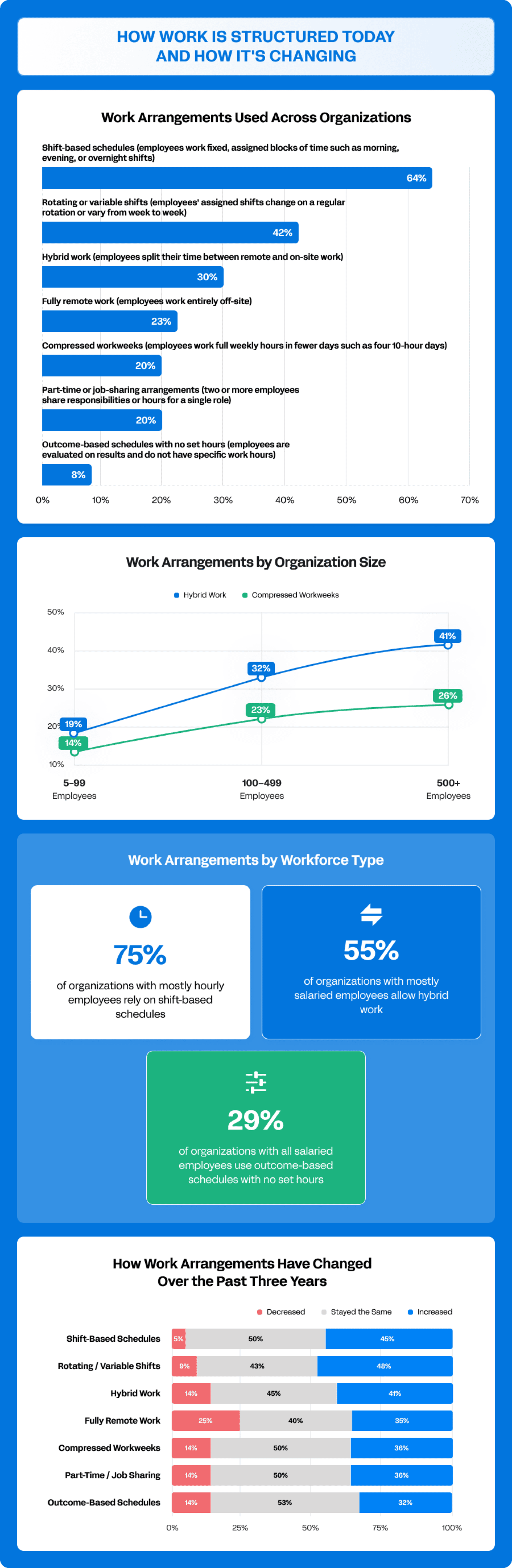
  • Structured schedules aren’t going anywhere. Nearly two-thirds (64%) of organizations rely on shift-based schedules, while 45% say their use has increased. This reinforces the idea that fixed, time-bound work remains the foundation.
  • Flexibility is growing, but not in a straight line. Hybrid work is expanding (41% increased) but also pulling back (14% decreased). Meanwhile, fully remote work shows even more volatility (35% increased versus 25% decreased), signaling recalibration rather than steady expansion.
  • Where you work depends on what you do. Hourly workforces remain anchored to shift-based schedules (75%). Hybrid and outcome-based models are significantly more common in salaried environments.
  • Hybrid work adds complexity, not just flexibility. Coordination challenges are widespread but fragmented. These challenges increase significantly in larger and more salaried organizations, where alignment and cross-team coordination become harder to manage.

A set of data charts showing how work is structured today and how it is changing.

Buddy Punch

Structured Work Still Sets the Foundation

Structured schedules still dominate how work gets done. Nearly two-thirds of organizations (64%) rely on shift-based schedules, making fixed, time-bound work the clear standard. Despite ongoing conversations about flexibility, most organizations continue to anchor work around defined hours and coverage needs.

Flexibility tends to happen within structure, not instead of it. A sizable share (42%) uses rotating or variable shifts. This suggests organizations are adapting schedules to changing demands while still maintaining control over when work happens. This reinforces a pattern seen before: Flexibility operates within existing structures rather than replacing them, often creating trade-offs between autonomy and coordination.

Remote work is present, but not the norm. Only 30% report hybrid models and 23% fully remote work, indicating that most organizations still center work around physical presence or set schedules rather than location flexibility.

Where differences emerge is in how these models are distributed.

Larger organizations are significantly more likely to offer hybrid and compressed work models. Hybrid work rises from 19% among smaller organizations to 41% among large organizations, while compressed workweeks increase from 14% to 26%. Scale appears to enable more structured flexibility.

Workforce composition shapes this even more. Organizations with mostly hourly employees are significantly more reliant on shift-based schedules (75%), while hybrid and outcome-based models are concentrated in salaried environments. Outcome-based schedules, for example, rise from just 4% to 7% in hourly settings to 29% in fully salaried organizations.

This divide is reflected in the 2025 McKinsey American Opportunity Survey, which highlights that workers with higher levels of education and income are significantly more likely to have access to remote or hybrid models, while those in lower-income or labor-intensive roles remain largely tethered to physical job sites.

Flexibility isn’t evenly distributed. It follows the realities of the work itself.

Flexibility Is Expanding But Unevenly

Traditional scheduling models are holding steady and, in many cases, expanding.

Half of organizations (50%) say shift-based schedules have stayed the same, while 45% report increased use. Rotating shifts follow a similar pattern, with 48% increasing.

Hybrid work shows net growth (41% increased), but also a meaningful pullback, with 14% reporting decreased use.

And fully remote work is even more mixed, with 35% increasing and 25% decreasing. Some organizations are expanding flexibility, while others are actively recalibrating it.

Other flexible models are evolving more gradually. Compressed workweeks and job-sharing arrangements show modest growth (36%) but are just as likely to remain unchanged. These are incremental additions, not core shifts.

Outcome-based work remains the exception. While 32% report growth, most organizations (53%) say it has stayed the same.

Two donut charts showing percentage of how structure scheduling holds up in practice: How well shift structures cover peak demand and how employees experience rotating and changing schedules.

Buddy Punch

Why Structure Still Works

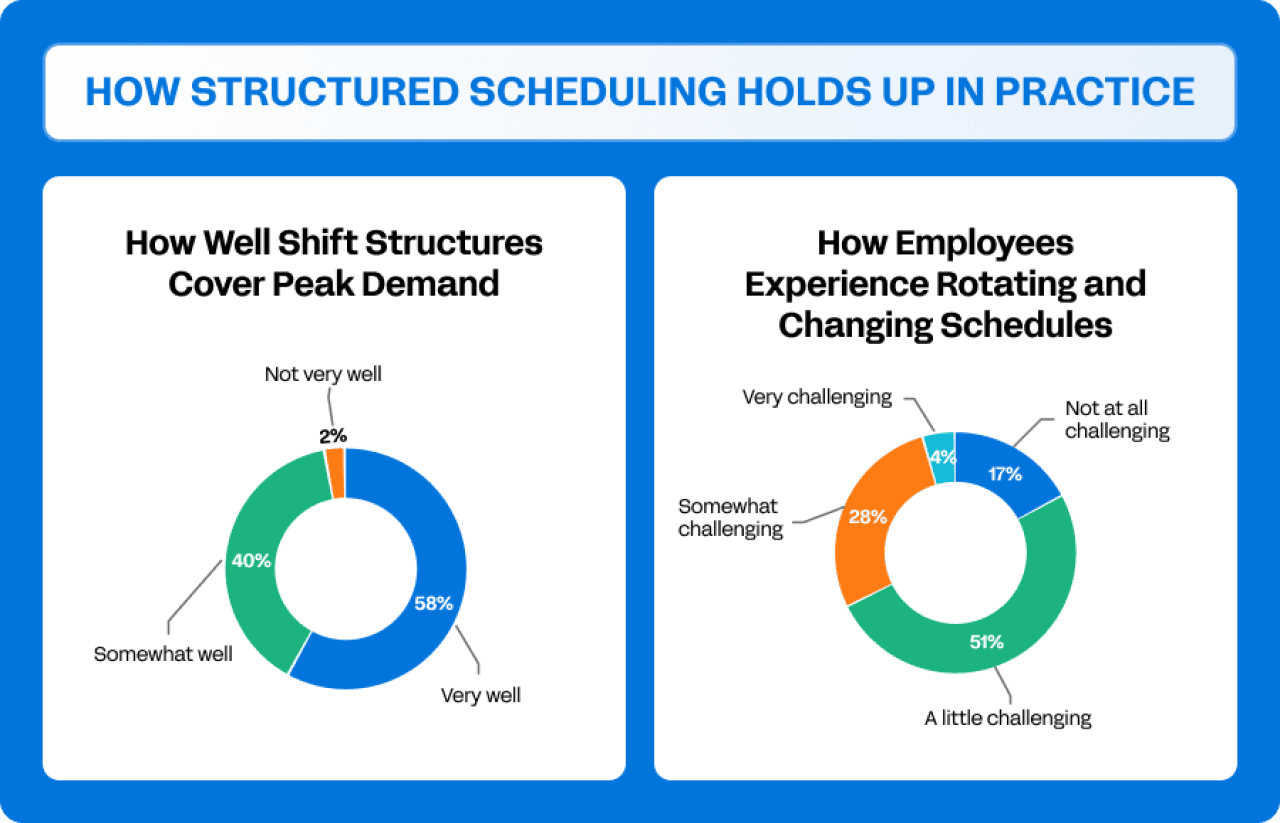
If structure is still dominant, the next question is whether it’s actually working. Nearly all (97%) organizations that use shift-based schedules say these structures provide coverage during peak times, including 58% who say they do so very well. Gaps are rare, reported by just 3%.

In organizations that use rotating or variable shifts, most employees are able to adapt to changing schedules without major difficulty. Over two-thirds (68%) say adjusting to rotating or frequently changing shifts isn’t at all or only a little challenging. That said, the strain isn’t insignificant. Nearly one-third (32%) report that it is at least somewhat challenging, including 4% who find it very challenging, suggesting that while rotating schedules are manageable for many, they still create meaningful friction for a sizable share of employees.

A set of data charts showing how hybrid works is managed and where it breaks down.

Buddy Punch

How Hybrid Work Is Actually Managed

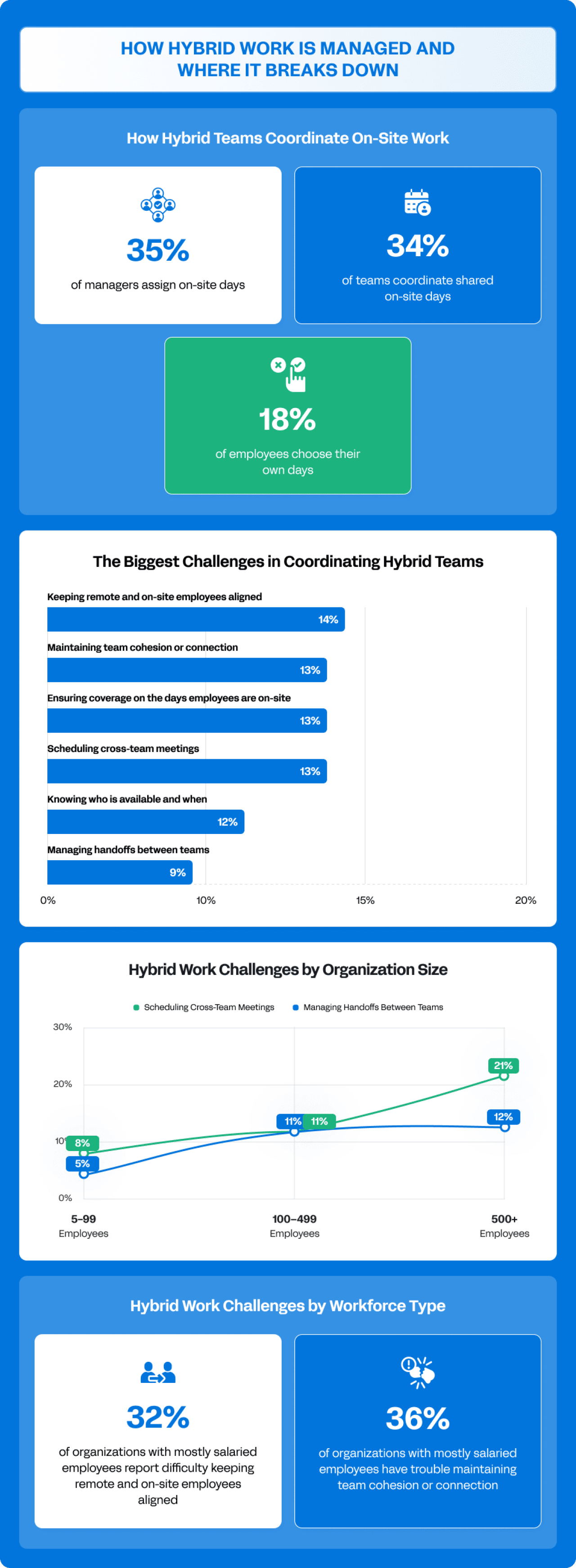
As flexibility expands, hybrid work has become one of the most common ways organizations try to balance structure with autonomy, but it is rarely left to chance. In organizations that allow hybrid work, managers assigning on-site days (35%) and teams coordinating shared schedules (34%) are the most common approaches. Fully autonomous models are less common, with only 18% allowing employees to choose their own days.

This reflects a broader pattern: Hybrid work requires coordination. And coordination requires some level of control.

The Real Friction in Hybrid Teams

But even with these structures in place, coordination just shifts where friction shows up.

Recent findings from the Cisco 2025 Global Hybrid Work Study underscore this disconnect, revealing that 86% of employees believe regular office attendance remains essential for career progression. Furthermore, 82% of professionals report that effective mentorship, which is a cornerstone of team integration, is significantly harder to achieve in a hybrid format compared to being on-site full-time.

The Buddy Punch survey found that the top hybrid work challenges all cluster within a narrow range (12%-14%), suggesting that organizations aren’t dealing with one central breakdown, but a series of smaller, persistent friction points.

Alignment and connection are at the core, but not evenly across all organizations.

As work becomes less time-bound, maintaining alignment becomes harder. Ensuring coverage, scheduling meetings, and knowing availability all reflect day-to-day complexity. These challenges intensify with scale. Scheduling cross-team meetings, for example, rises significantly from 8% in smaller organizations to 21% in large ones. Managing handoffs follows a similar pattern.

Keeping remote and on-site employees aligned and maintaining team cohesion are significantly more pronounced in salaried and mixed workforces. Alignment rises from just 9% in hourly environments to 32% in mostly salaried teams. Cohesion follows a similar pattern, increasing from 6%-7% to as high as 36%.

What changes isn’t just the type of challenge, but the nature of coordination itself. Smaller or hourly-based organizations manage time. Larger and more salaried organizations manage interdependence.

A set of data charts showing the tools powering modern work coordination.

Buddy Punch

The Tools Behind Modern Coordination

Behind all of this is a layer of infrastructure.

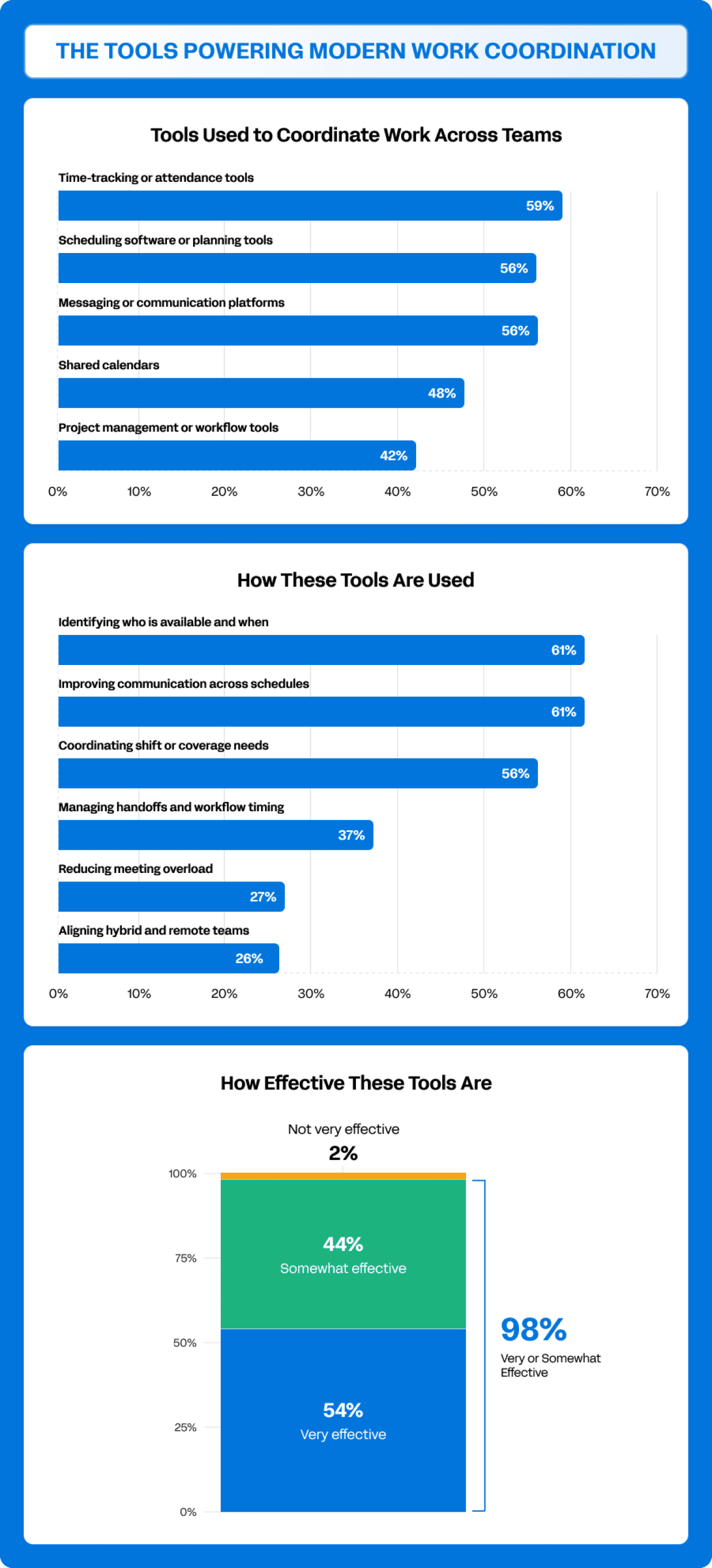
Indeed, work coordination today is driven by a mix of tools. Time-tracking systems (59%), scheduling software (56%), and messaging platforms (56%) form the core, supported by shared calendars (48%) and project management tools (42%).

These tools are primarily used to create visibility.

Most organizations rely on them to know who is available and when (61%) and to improve communication across schedules (61%). They also support operational needs like coverage (56%) and workflow timing (37%).

Fewer organizations use these tools to reduce meeting overload (27%) or align hybrid teams (26%), suggesting that while tools handle logistics well, they do less to address deeper coordination challenges.

Research Lokalise conducted on digital workplace habits in 2025 underscores this, revealing that the average worker loses nearly an hour a week simply switching between platforms. While digital tools are essential, the fragmentation — with many employees navigating three to 10 platforms daily — leads to significant tool fatigue that hampers productivity rather than enhancing it.

Even so, most organizations feel equipped. Nearly all (98%) say their tools are effective at coordinating work across schedules and locations. The systems are in place. The complexity lies in how work itself is structured.

The Takeaway: Evolution, Not Reinvention

Across every measure, the pattern is consistent.

Structure remains dominant. Flexibility is expanding, but selectively. And the experience of work varies significantly depending on organization size, workforce composition, and operational complexity.

What’s changing isn’t the foundation of work but how it is managed, as organizations continue to rely on structure while adapting it. The result is a workplace that is more flexible but also more complex, where coordination, clarity, and alignment matter more than ever.

Methodology

This survey was conducted with 527 U.S.-based adults aged 18 or older who are currently employed full-time or part-time and work in business owner, HR, or HR-adjacent roles with responsibility for managing or influencing employee time, schedules, or workplace policies. All respondents actively participate in scheduling or managing employee work hours, time off, flexibility policies, or workforce planning, and have been in their current role for at least three months. Respondents worked at organizations with five or more employees across a range of organization sizes, industries, and workforce compositions, including hourly, salaried, and mixed workforces. The survey was fielded online from Dec. 4 to Dec. 10, 2025. Results reflect descriptive statistics with no weighting applied.

This story was produced by Buddy Punch and reviewed and distributed by Stacker.

Topics:

Careers & Education
media-news

The Last Click: How AI Agents Are Reshaping the News Business

From Facebook referrals to Google AI summaries to agentic browsers, the way audiences find news is changing fast. Here's what it means for publishers building for what's next.

Miles icon
By Miles Jennings
@milesworks
Miles Jennings is CEO of Mediabistro and its parent CognoGroup. He previously founded and led Recruiter.com through its NASDAQ listing, executing more than 10 acquisitions over nearly a decade as CEO and COO.
8 min read • Published April 28, 2026
Miles icon
By Miles Jennings
@milesworks
Miles Jennings is CEO of Mediabistro and its parent CognoGroup. He previously founded and led Recruiter.com through its NASDAQ listing, executing more than 10 acquisitions over nearly a decade as CEO and COO.
8 min read • Published April 28, 2026

In March 2016, Emily Bell wrote what turned out to be a call to action. “Facebook is eating the world,” she declared in the Columbia Journalism Review, and she meant it structurally, not metaphorically. News publishers had ceded control over distribution to platforms.

The four horsemen — Google, Facebook, Apple, Amazon — were at war over whose infrastructure would win, and journalism was caught in the middle, dependent on systems it did not own and could not influence.

Nearly a decade later, Bell’s diagnosis looks prescient — but so does the industry’s response. Each wave of platform disruption has pushed publishers to build more direct relationships with their readers. The current wave, driven by AI, may be the most significant yet. And it is producing the most fundamental rethinking of the news business model in a generation.

Phase One: Facebook and the Referral Era

For most of the 2010s, Facebook referral traffic was a primary growth engine for digital publishing. Outlets built editorial strategies, audience teams, and revenue models around the assumption that social sharing would keep readers flowing to their websites. Then, gradually and then all at once, Meta decided to move on from news.

The shift accelerated in 2023. CNBC documented the scale of the change in January 2024: the top 100 global news publishers saw Facebook referral traffic drop sharply year over year, continuing a decline that had been building for years.

Mother Jones reported a 99% drop from its Facebook referral peak. Meta’s rationale was direct: “We know that people don’t come to Facebook for news and political content” — and the company deprecated its News Tab in the US and multiple European markets.

What made the contraction so severe was how unevenly it fell. National publishers with established subscription bases — The Atlantic, The New York Times — absorbed the shock better than local and regional outlets that had never built an alternative revenue floor. The warning signs had been visible for years, but the economic logic of chasing platform scale was difficult to resist when the traffic was still flowing.

The fundamental lesson — that distribution built on someone else’s platform is always conditional — had to be relearned at painful cost. Publishers who had diversified into newsletters, direct subscriptions, and owned audiences were better positioned than those who hadn’t.

Phase Two: Search Changes the Deal

Search had always felt like the more stable relationship. Unlike social, where virality was unpredictable, Google Search was transactional: someone types a query, Google returns links, and readers arrive. That model sustained publishing economics for more than two decades.

It is worth noting that the zero-click problem predates AI. Google’s featured snippets, introduced in 2014, began appearing on the results page to answer simple queries. Knowledge panels, shopping carousels, and local packs all eroded click-through rates over time. AI Overviews are not a new phenomenon so much as an acceleration of a trend that was already underway — which is precisely what makes them so consequential.

Reuters Institute’s January 2026 Trends and Predictions report, surveying 280 senior newsroom executives across 51 countries, found that Google search traffic to publishers fell by roughly a third globally in the prior year. Traffic from Google Discover was down 21%. News organizations now forecast a 40% decline in search referrals over the next three years.

The mechanism is familiar: AI synthesizes answers from publisher content at the top of the results page, resolving many queries before a click is needed. Publishers supply the reporting. Google surfaces the answer.

PPC Land’s December 2025 analysis found that 51% of the Google Discover feed in the US now consists of AI Summaries, with the remainder increasingly shifting toward YouTube. Google’s Q2 2025 earnings reflected the same dynamic: Network advertising (which includes publisher partners) declined 1%, while YouTube advertising grew 13% to $9.8 billion.

Jim Albrecht, who spent six years as Senior Director of News Ecosystem Products at Google, argued in a February 2024 Washington Post opinion piece that generative AI represents something categorically different from earlier disruptions. Radio, television, and the internet each changed how news was distributed. AI changes whether a news visit happens at all.

The implication for publishers is not despair but urgency: the value has to live somewhere other than the pageview.

Some publishers have responded not through litigation or advocacy alone, but by cutting deals directly. The Associated Press, Axel Springer, and News Corp have each signed licensing agreements with major AI developers — trading structured content access for a revenue stream that doesn’t depend on clicks.

The terms of these deals remain largely private, which makes it difficult to assess whether they represent a meaningful alternative or a modest concession. But they establish a precedent: AI companies have acknowledged, at least commercially, that publisher content has value beyond what the pageview economy has ever priced it at.

Phase Three: Agentic Browsers and the Next Frontier

The next shift is already visible on the horizon. Digiday’s December 2025 report on agentic browsers describes tools like Perplexity’s Comet, OpenAI’s Atlas, and Google’s Gemini-in-Chrome features that are designed to handle browsing tasks on behalf of users. Rather than a reader navigating to a news site, an AI agent retrieves, reads, and summarizes the content, returning an answer without a visit occurring.

Publishers are paying close attention. The concern is not simply traffic loss — it is that the advertising, subscription, and relationship infrastructure that supports journalism is built around the visit. No visit means no ad impression, no subscription prompt, no chance to convert a reader into a supporter.

The Digiday report notes that publishers want platforms to clearly distinguish human traffic from agentic traffic so that measurement and monetization remain meaningful.

The subscription model faces a particular tension here that has not yet been fully addressed. Agentic browsers do not subscribe. If a user’s AI assistant can pull the text of a paywalled article — through cached versions, through previews, through inference from available fragments — the subscription wall that sustains direct-relationship publishing is effectively bypassed without anyone making a deliberate choice to circumvent it.

This is the core challenge of what some analysts are calling the relationship economy: the relationship itself has to be desirable enough that readers seek it out directly, rather than delegating it to an agent.

The JournalismAI Festival 2025 in London framed the shift precisely: news media is “becoming part of AI systems.” That is both a challenge and a commercial opportunity. Publishers whose content is valuable enough to be ingested into AI systems are in a position to negotiate for compensation — if they act collectively.

What Publishers Have Tried, and What Comes Next

The most concrete attempt to restructure the platform relationship came from Australia. As CJR documented in 2022, Australia’s News Media Bargaining Code extracted more than $200 million from tech companies in its first year, funding dozens of new journalism positions. The model required a concentrated media market and a determined competition regulator, but it demonstrated that collective action could shift the economics.

California’s attempt in 2024 produced a more modest result. Google agreed to $172 million over five years, administered through UC Berkeley, plus an AI accelerator program. Critics called it inadequate. But it established a precedent that AI companies have obligations to the publishers whose content trains and informs their systems.

Madhav Chinnappa, the former Google and BBC News executive, has proposed a more ambitious framework: a “NATO for News” collective licensing model in which publishers negotiate AI data access terms together rather than individually. He calls it “the least worst option” — pragmatic about the power imbalance, but clear that collective leverage is the only kind that works at scale.

What these negotiations have clarified, perhaps more than anything else, is that publishers are only beginning to understand what their content is actually worth in an AI context.

The pageview economy priced journalism by the click. The AI economy will price it by something closer to knowledge value — a metric that favors deep, authoritative, well-sourced reporting over volume-optimized content. That is a structural shift that changes who the winners are.

The Business Model Hiding in Plain Sight

Every platform disruption has pointed toward the same answer: direct audience relationships. Newsletters. Subscriptions. Membership. Events. Products where the reader and the publisher have a connection that no algorithm can interrupt.

The New York Times offers the clearest illustration of what this looks like at scale. It has reduced its reliance on advertising and search traffic while growing subscribers, partly through journalism and partly through products — Wordle, Connections, the Cooking app — that create daily habit loops independent of the news cycle.

The strategy is not replicable for most publishers, but the underlying principle is: build something people want to come back to directly, not something they arrive at accidentally through search.

The Reuters Institute 2025 Digital News Report found that 65% of people now consume social video news, up from 52% in 2020 — but it also found that overall news trust has held at 40% for three consecutive years, and that audiences still want journalism they can rely on. The appetite is there, but the delivery mechanism is what’s in flux.

Nieman Lab’s 2026 Predictions, drawing on 210 expert forecasts, found broad consensus on what sustainable news organizations look like: ones that treat editorial independence and community connection as the core product, with distribution as a secondary consideration. Publishers who have diversified revenue, built owned audiences, and stopped measuring success primarily in pageviews are the ones facing this transition from a position of strength.

The news business has effectively split in two. On the one hand, organizations that built direct reader relationships before the AI transition have revenue that doesn’t depend on intermediaries and are positioned to negotiate with AI platforms from a position of something approaching parity. On the other: outlets still reliant on platform traffic, facing the prospect of a 40% decline in search referrals with no structural alternative in place.

It is worth noting what this means for the people working in these organizations. Publishers investing in owned technology and direct audience infrastructure need people who understand both journalism and product thinking — audience development, data analysis, engagement strategy, and reader experience design.

The skills that are gaining value in newsrooms are not the traditional traffic-driving skills but those that build durable relationships. That shift is already visible in where media organizations are hiring.

The arc from Facebook to Google to agentic browsers is a single story about what happens when journalism’s value is delivered through someone else’s infrastructure. The publishers rewriting that story are the ones worth watching.


Mediabistro is a leading career platform for media, journalism, content, and marketing. We publish media news, career advice, and featured interviews with practitioners at the forefront of media. Employers can post jobs to reach mid and senior level talent.

Topics:

media-news
media-news

Anubis Lane Productions Signals Growth in Colorado's Creative Corridor with Dual Literature and Media Launch

By Media News
3 min read • Published April 28, 2026
By Media News
3 min read • Published April 28, 2026

LAS ANIMAS, CO / ACCESS Newswire / April 28, 2026 / Anubis Lane Productions, a rising force in the Rocky Mountain independent media landscape, today announced the simultaneous release of a new relationship guide and a cinematic music project. The dual launch highlights a growing trend of "creative multi-hyphenates" revitalizing local economies through digital-first storytelling across literature, music, and film.

Leading the literary release is Adam Anubis, whose new book, Love Like They Dream Of, has arrived on global platforms. Moving beyond traditional self-help tropes, the work provides a framework for building deep romantic intimacy and sustainable connection in the modern age. The guide focuses on the "science of attention," offering 52 actionable techniques designed to foster relationship wellness and emotional resilience.

"The modern relationship landscape is often described as transactional," said Adam Anubis. "Our goal with this book was to provide a roadmap for couples to rediscover playfulness and profound connection as a counter-narrative to the digital disconnect we see today."

Complementing the book’s focus on connection is the premiere of "Break You," the latest single and music video from artist Kalista Anubis. The project is a study in cinematic storytelling, featuring a high-intensity, military-themed visual narrative. Filmed on location in Colorado, the production showcases the region’s diverse topography, including a demanding quicksand sequence performed by lead actor Daniel Lane.

The production was managed with a strict focus on creative consent and performer safety, a core pillar of the company’s "Artist-First" philosophy. By integrating rigorous safety protocols with bold visual themes, Anubis Lane Productions aims to set a new standard for independent film crews operating outside of major coastal hubs.

"Whether through literature or film, our mission is to explore the complexities of human desire and power dynamics in a way that is fearless yet responsible," said Kalista Anubis. "By keeping our production base in Las Animas, we are proving that bold storytelling doesn’t require a Hollywood zip code; it requires a dedicated community of creators."

With a casting call currently open for their upcoming project, "Grown Woman," Anubis Lane Productions continues to serve as a hub for local artistic talent and a contributor to the regional economy.

About Anubis Lane Productions

Anubis Lane Productions is a multifaceted creative firm based in Las Animas, Colorado. Led by the collaborative team of Daniel Lane, Kalista Anubis, and Adam Anubis, the company specializes in cross-platform storytelling, including independent publishing, music production, and cinematic music videos. They are committed to fostering community-driven projects that challenge creative conventions.

Media Contact:

Adam Anubis
Anubis Lane Productions
Email: adam@adamanubis.com
Phone: 719-468-4285
Website: https://www.anubislane.com/

Links: Book: Love Like They Dream Of – Available now on Amazon: https://www.amazon.com/gp/aw/d/B0GXQ35HW4/ref=tmm_pap_swatch_0

"Break You" Official Music Video: https://youtu.be/zwx_rWTlZWA?si=oKU3OnmeLgYTybEd

SOURCE: Anubis Lane Productions

View the original press release on ACCESS Newswire

Topics:

media-news
media-news

New to The Street Launches "In$ane Influencers" Series with Chris Sain, bridging 6M+ Combined YouTube Subscribers to Decode Public and Private Company Stories

By Media News
3 min read • Published April 28, 2026
By Media News
3 min read • Published April 28, 2026

Filming begins today in New York City as Chris Sain interviews Rohan Malhotra, CEO of Roadzen (RDZN), delivering a new investor-focused format that simplifies complex business models for a global digital audience.
 

NEW YORK, NY / ACCESS Newswire / April 28, 2026 / New to The Street, one of the longest-running financial media brands broadcasting as sponsored programming on Fox Business Network and Bloomberg Television, today announced the launch of its newest digital-first series, "In$ane Influencers," hosted by renowned financial content creator Chris Sain.

Filming officially begins today in New York City, with the debut episode featuring Rohan Malhotra, CEO of Roadzen (NASDAQ:RDZN). The series is designed to break down complex corporate narratives into accessible, high-impact conversations tailored for modern retail and institutional investors alike.

"In$ane Influencers" represents a strategic evolution in financial media-combining the scale and credibility of New to The Street’s national television distribution with the reach and engagement of influencer-driven digital platforms. By integrating audiences across New to The Street’s 4.5M+ subscriber YouTube channel, the NewsOut
Channel, and Chris Sain’s rapidly growing following, the series delivers a combined reach exceeding 6 million subscribers.

A New Format for a New Investor Audience

The program will feature:

CEO interviews and real-time company breakdowns Simplified analysis of business models, revenue drivers, and growth catalysts Ongoing news-driven segments translating corporate developments into actionable insights Cross-platform distribution across YouTube, social media, and national television.

Unlike traditional financial interviews, "In$ane Influencers" is engineered to meet audiences where they are-offering clarity, relatability, and scale in a fragmented media landscape.

Leadership Commentary

Vince Caruso, CEO, Co-Founder of New to The Street, stated: "Public companies don’t need more interviews-they need audience. With Chris Sain, we are combining credibility with reach, delivering a format that not only tells a company’s story-but ensures it’s understood and seen at scale."

Host Chris Sain added:
"This is about breaking it down so everyday investors and serious market participants alike can understand what’s really happening inside these companies. We’re bringing transparency and clarity to the forefront."

Distribution Power

New to The Street continues to differentiate itself through its unmatched multi-channel platform, including:

  • Weekly national broadcasts on Bloomberg Television and Fox Business Network

  • One of the largest financial YouTube channels globally with over 4.55 million subscribers

  • The NewsOut Channel video press release platform with rapidly expanding digital reach over 755,000 subscribers

  • Iconic outdoor billboard placements across Times Square and the NYC Financial District

About New to The Street

New to The Street is a 17-year financial media platform producing and distributing long-form interviews and corporate storytelling across television, digital, and outdoor media. Broadcasting weekly as sponsored programming on Fox Business Network and Bloomberg Television, the platform reaches millions of households across the U.S., MENA, and Latin America, while maintaining one of the largest investor-focused YouTube audiences in the world.

About Chris Sain

Chris Sain is a leading financial content creator, investor, and educator known for translating complex market strategies into clear, actionable insights for a global digital audience. As the creator of the YouTube channel "Chris Sain," he has built a rapidly growing following by delivering high-impact content focused on stock market investing, wealth building, and financial literacy.

A former Division I athlete turned full-time investor, Chris Sain specializes in technical analysis, risk management, and income-generating strategies designed to help individuals build
long-term financial independence. His content spans stock picks, portfolio strategy, macro commentary, and real-time market breakdowns-often framed in a direct, relatable style that resonates with both new and experienced investors.

Through flagship series such as market overviews, investment challenges, and financial education segments, Chris has positioned himself as a trusted voice in the retail investor community. His platform also extends into coaching, digital communities, and partnerships aimed at empowering audiences to take control of their financial futures.

Chris Sain continues to expand his influence across media, combining education, entertainment, and real-world investing strategies to reach millions of viewers seeking clarity in today’s evolving financial landscape.

Media Contact:

Monica Brennan
Head of Communications
New to The Street
Monica@NewtoTheStreet.com

SOURCE: New to The Street

View the original press release on ACCESS Newswire

Topics:

media-news
media-news

Shore Fire Client and Afrobeat Pioneer Fela Kuti is the First African Solo Artist to Be Inducted Into The Rock & Roll Hall of Fame

By Media News
3 min read • Published April 28, 2026
By Media News
3 min read • Published April 28, 2026

‘Fela Kuti: Fear No Man’ Wins Peabody Award for Arts

NEW YORK, NY / ACCESS Newswire / April 28, 2026 / Shore Fire Media, a subsidiary of entertainment marketing and content production company Dolphin (NASDAQ:DLPN), congratulates the estate of Fela Kuti – the pioneering Nigerian musician, activist, composer and creator of Afrobeat, who is being inducted into the Rock & Roll Hall of Fame. Widely regarded as one of the most influential artists of the 20th century, Kuti is being honored with the early influence award – and is the first African solo artist to be inducted. Recognizing Kuti’s profound global impact on music, culture and political expression, the posthumous honor will take place at the Rock & Roll Hall of Fame induction ceremony at the Peacock Theater in Los Angeles on Nov. 14.

Just announced as one of this year’s Peabody Award winners in the arts category, "Fela Kuti: Fear No Man" – a 12-episode podcast series presented by Audible and Higher Ground, and produced by Talkhouse and Western Sound – premiered this past fall. Hosted by now four-time Peabody Award-winner Jad Abumrad, this in-depth documentation of Kuti’s life and legacy was culled from over 200 conversations with his family, friends, historians, activists, luminaries and fans including President Barack Obama, Ayo Edebiri, David Byrne, Brian Eno and Santigold – and also includes previously recorded interviews with Paul McCartney, Questlove and Burna Boy. Landing at No. 1 on the New Yorker’s Best Podcasts of 2025, the magazine described it as "bursting with life, humor, pain, interesting ideas, and, of course, sharp, catchy, hypnotic music" and "both danceable and, by its end, profoundly heartbreaking."

The Peabody win is the latest news in what has been a tremendous year for Kuti’s music and legacy. In January, the Recording Academy® honored him with a lifetime achievement award – which was accepted by his children Femi Kuti, Yeni Kuti, Kunle Kuti and Shalewa Kuti during the Special Merit Awards Ceremony. Earlier last week, "Fela Kuti: Fear No Man" also earned the 2026 Webby Award for best limited series in the podcasts category.

Shore Fire’s work with the Fela Kuti estate is exemplary of the company’s success in amplifying the narratives of time-honored talent for new generations. From jazz icons including Miles Davis and John Coltrane – both celebrating their centennials in 2026 – to hip-hop royalty like Biz Markie, Shore Fire is honored to be trusted with the legacies of some of contemporary music’s most influential figures.

###

ABOUT DOLPHIN
Dolphin (NASDAQ:DLPN) is where cultural creation meets marketing execution. Founded in 1996 by Bill O’Dowd, Dolphin operates as both a venture studio – developing and investing in breakthrough content, products and experiences – and a marketing consortium, featuring leading agencies across every communications discipline.

At its core, the venture studio creates, produces, finances, markets and promotes new businesses and cultural ideas – ranging from acclaimed film, television and digital content to consumer goods, live events and partnerships that define entertainment and lifestyle. Surrounding this entrepreneurial engine, Dolphin’s marketing prowess brings together best-in-class firms including 42West, The Door, Shore Fire Media, Elle Communications, Special Projects and The Digital Dept. Together, this collective delivers unmatched cross-marketing expertise and relationships across every vertical of pop culture – from film, television, music, influencers, sports, hospitality and fashion to consumer brands and purpose-driven initiatives. Dolphin marketing has been the recipient of many accolades, including No. 1 Agency of the Year on the Observer PR Power List in 2025, The PR Net 100 and the PRNEWS Agency Elite Top 120.

Follow Dolphin on Instagram.

ABOUT SHORE FIRE MEDIA
Shore Fire Media represents artists, talent, creators, authors, athletes, cultural institutions, businesses, brands and entrepreneurs at the forefront of their respective fields – including some of the most exciting emerging and established voices in the arts, entertainment and beyond. With dedicated teams in New York, Los Angeles and Nashville, Shore Fire leverages extensive expertise and relationships to strategically amplify narratives and shape reputations that facilitate career advancement in an ever-evolving media landscape. To learn more, visit ShoreFire.com and follow Shore Fire on Instagram: @shorefire.

CONTACT:
James Carbonara
HAYDEN IR
(646)-755-7412
james@haydenir.com

SOURCE: Dolphin Entertainment

View the original press release on ACCESS Newswire

Topics:

media-news
media-news

The Week Journalism Got Shot At and Threatened from the Top

By Mediabistro Team
5 min read • Published April 28, 2026
By Mediabistro Team
5 min read • Published April 28, 2026

The White House Correspondents’ Association dinner went from celebration to crime scene in seconds on April 25. Shots fired inside the hotel sent attendees scrambling.

The journalists in the room did something reflexive: they started reporting. Phones out. Notes taken. Sources called. Professional muscle memory, even in chaos.

What happened next tells you as much about the media industry as what happened in the ballroom. Within minutes, false claims about the shooter, the motive, and the victims flooded social media. The misinformation spread faster than the facts.

Meanwhile, the political pressure campaign against ABC and Jimmy Kimmel, already building before the shooting, took on sharper edges in the aftermath.

Three tests at once: physical safety for journalists, editorial independence under direct presidential threats, and the information ecosystem’s ability to separate signal from noise.

The Room Where It Happened

The WHCA dinner has always been an odd ritual, a night when journalists and the people they cover share the same ballroom and pretend the power dynamics don’t exist for a few hours.

Critics had already questioned whether the event made sense in the current climate. The shooting settled that debate.

What stood out was the response. As Poynter documented, the dinner stopped, but the reporting did not. Reporters who moments earlier had been in formal wear were on the ground doing what they’re trained to do: gather information, verify sources, file updates.

Outside the ballroom? A different story entirely.

False claims spread immediately, according to Poynter’s fact-checking team. Fabricated details about the shooter’s identity. Invented connections to political groups. Completely fictional casualty numbers on social media while law enforcement was still securing the scene.

Some of the misinformation came from verified accounts. Some from automated bots. All of it exploited the gap between what happened and what people knew.

Key Takeaway: The journalists in the room had the training, access, and editorial standards to get the story right. The platforms that distributed the story to millions had none of those constraints and every incentive to move fast.

A two-tier information system where the people doing the actual reporting get drowned out by the people doing the speculating.

The Firing Demand That Became a Line in the Sand

Before the WHCA dinner became a national story, the week’s dominant media narrative was Trump’s demand that Disney fire Jimmy Kimmel over a joke.

The joke was a throwaway line about Melania having “the glow of an expectant widow.” Trump and the First Lady posted separate statements calling it a despicable call to violence and demanding Kimmel’s termination.

Kimmel’s response was unequivocal: “It was not by any stretch of the definition a call to assassination. And they know that.”

No apology. No walkback. He called the demand what it was: a political pressure campaign aimed at a corporate parent.

Disney has not responded publicly, which is itself a response. The silence suggests the company is not treating the demand as credible, or at least not as something requiring a public defense. That calculation could shift depending on how long the pressure lasts and whether it escalates to regulatory threats.

The entertainment industry’s reaction was unusually unified. George Clooney told Variety that “jokes are jokes” and defended Kimmel directly, at a moment when public statements of support carry real professional risk.

At the Chaplin Award ceremony at Lincoln Center, Clooney used his acceptance speech to address political violence and hostility toward media and creative speech. “There’s a struggle that has to be won against hatred,” he said. The room understood he was not talking about abstract principles.

This is a corporate-pressure test for Disney, and the industry knows it. If a direct presidential demand to fire a host over a joke becomes standard practice, the calculation for every network, studio, and platform shifts. Editorial independence stops being a principle and starts being a liability.

What the Profession Honors Right Now

The Poynter Institute announced the 2026 Poynter Journalism Prizes, honoring journalists and news organizations across 12 categories.

The prizes recognize work that takes time, resources, and institutional backbone: investigative series, explanatory journalism, public service reporting. Work that does not go viral, does not generate immediate revenue, and requires editors willing to defend it when the pushback comes.

The kind of work that’s harder to sustain when newsroom budgets are under pressure and political hostility toward the media is the baseline.

World Press Freedom Day falls on May 3, and Press Gazette’s news diary flags it alongside other events in the week ahead. The observance exists to highlight threats to journalists globally, but the domestic threats are no longer hypothetical. Journalists were under fire at the WHCA dinner. A late-night host faces a presidential firing demand. The misinformation ecosystem is faster and more sophisticated than anything built to counter it.

What’s Holding: The Poynter Prizes recognize the work. The industry defends Kimmel. The journalists in the ballroom kept reporting. Those are the signals that matter when the noise gets loud.

What This Means

The week ahead will clarify whether the Kimmel pressure campaign was a one-off outburst or the start of a sustained effort to make editorial decisions subject to political approval.

Watch Disney. Watch whether other networks face similar demands. Watch whether the unified defense holds.

For journalists, the WHCA dinner attack is a reminder that physical safety is no longer a given, even at events designed to celebrate the profession. Newsrooms will need to reassess security protocols for public events, travel assignments, and office spaces.

For media professionals navigating this climate, the opportunities are in institutions willing to invest in the work that matters and defend it when the pressure comes.

If you are looking for your next role, browse open journalism roles on Mediabistro and look for employers with a track record of supporting editorial independence. If you are hiring, post a job on Mediabistro and make clear where your organization stands.

The talent you attract will depend on the answer.


This media news roundup is automatically curated to keep our community up to date on interesting happenings in the creative, media, and publishing professions. It may contain factual errors and should be read for general and informational purposes only. Please refer to the original source of each news item for specific inquiries.

Topics:

media-news
Hot Jobs

Editorial and Digital Strategy Roles Hiring Across Media Today

From B2B publishing leadership to fellowship programs and mission-driven digital teams, today's listings reward candidates who can think editorially and execute strategically.

mediabistro hot jobs
By Mediabistro Team
4 min read • Published April 28, 2026
By Mediabistro Team
4 min read • Published April 28, 2026

The Editorial Strategist Is Back in Demand

Something worth watching in today’s listings: organizations are hiring for roles that blend editorial judgment with strategic leadership in ways that go well beyond “manage the blog.” Three of today’s most compelling postings ask candidates to own full content ecosystems, from print production calendars and newsletters to social platforms and community engagement.

The common thread is that these employers want people who understand story and audience at a fundamental level, and then can translate that understanding into measurable growth across channels. These days, pure content mills get automated. What can’t be automated is the person who knows which stories matter, which formats serve them best, and how to build a team around that vision.

Today’s picks also span an unusual range of organizations: a B2B media portfolio, an Ivy League fellowship program, a nonprofit tackling political polarization, and an award-winning trans media company. If you have editorial instincts and operational chops, this is your market.

Today’s Hot Jobs

Editorial Director — B2B Media Portfolio, Monmouth County, NJ

The Real Draw Here: This is a rare chance to shape the editorial direction of three distinct B2B brands across print, digital, and events. The role involves building annual editorial calendars, managing freelancer networks, overseeing four print issues per year, and running daily website content through WordPress. For editors who’ve felt boxed into one channel, this position offers genuine range. The audience is senior-level executives, which means the content bar is high and the work carries weight.

  • End-to-end production management across print and digital platforms
  • Experience developing and executing annual editorial calendars for multiple brands
  • Ability to manage freelance writers and industry contributors
  • Strong editing, proofreading, and CMS skills (WordPress required)

If you’ve been sharpening your editorial instincts and want to understand what editors really look for in writers, this role sits on the other side of that equation. Apply for the Editorial Director position.

Executive Director, Knight Bagehot Fellowship Program — Columbia University, New York

Why This Role Matters: The Knight Bagehot Fellowship is the premier program for mid-career business and economics journalists, and this position oversees the entire operation. That includes stewardship of a $35 million endowment, an annual operating budget exceeding $1.8 million, and the strategic direction of a program that shapes the next generation of financial journalism leaders. The salary range of $170,000 to $200,000 reflects the seniority. Columbia wants a thought leader who can fundraise, build relationships across the journalism ecosystem, and operate with significant autonomy.

  • Demonstrated leadership in journalism, media, or higher education
  • Fundraising experience with authority over major financial resources
  • Ability to define and execute multiyear strategic plans independently
  • Deep credibility in business and economics journalism circles

Apply for the Knight Bagehot Executive Director position.

Director of Digital and Social Media — TransLash Media, Remote

What Makes This Compelling: TransLash Media has built a reputation as an award-winning, multi-platform organization producing podcasts, films, journalism, and zines. This director-level role reports directly to the CEO and carries both strategic authority and hands-on execution responsibility. At $135,000 to $155,000 with full remote flexibility, it’s a leadership position at an organization where the content genuinely matters to its community. You’d be shaping how a respected media brand shows up across every digital touchpoint.

  • Strategic leadership experience across digital and social platforms
  • Team-building capability with direct reports
  • Track record of translating brand voice into consistent, creative digital execution
  • Comfort operating at both high-level strategy and daily content realities

For candidates building their digital leadership toolkit, Mediabistro’s guide on what a digital media manager actually does is a useful foundation before stepping into director-level roles like this one. Apply for the Director of Digital and Social Media position.

Senior Content Writer — Resetting the Table, Remote

A Distinctive Angle: Resetting the Table works at the intersection of conflict resolution, media, and democratic engagement, and their content writer will help translate that complex methodology into accessible storytelling. The organization has reached more than 100,000 participants across the U.S., including faith leaders, TV writers, and higher education administrators. This is a remote, full-time role with openness to part-time arrangements, which signals real flexibility. If you write well about complicated ideas and care about civic life, this is a rare fit.

  • Strong writing ability with experience making complex topics accessible
  • Comfort working in mission-driven environments focused on polarization and dialogue
  • Remote within the contiguous U.S., open to part-time arrangements
  • Reports directly to the Co-CEO

Apply for the Senior Content Writer position at Resetting the Table.

Professional Takeaways

Today’s strongest listings share a pattern: they all require candidates who can move fluidly between strategic thinking and hands-on content work. The editorial director managing three B2B brands, the fellowship director stewarding a $35 million endowment, the digital leader at TransLash reporting to a CEO. None of these roles lets you stay in one lane.

If you’re positioning yourself for this tier of opportunity, build your case around versatility, backed by evidence. Show that you’ve owned a content calendar and also managed a budget. Demonstrate that you’ve written the piece and also decided why that piece needed to exist. The market right now is rewarding people who can explain their editorial decisions in business terms and their business decisions in editorial ones.

Topics:

Hot Jobs
media-news

New to The Street to Air Show #747 Tonight on Fox Business Network Featuring Performance Golf, CitroTech, Lee Gause, CISO Global, and Lost Soldier Oil and Gas

By Media News
2 min read • Published April 28, 2026
By Media News
2 min read • Published April 28, 2026

The show broadcasts as sponsored programming and features integrated TV commercial sponsorships from Synergy CHC Corp. (NASDAQ:SNYR), CISO Global Inc. (NASDAQ:CISO), Virtuix Holdings Inc. (NASDAQ:VTIX), IGC Pharma Inc. (NYSE American:IGC), and DataVault AI Inc. (NASDAQ:DVLT), creating a multi-channel synergy between long-form interviews and national commercial exposure.

NEW YORK, NY / ACCESS Newswire / April 27, 2026 / New to The Street ("NTTS"), the 17-year financial media brand and one of the largest investor-focused television and digital platforms globally, will broadcast Show #747 tonight at 10:30 PM PST on the Fox Business Network as sponsored programming.

Tonight’s broadcast features in-depth interviews and company profiles with:

  • Performance Golf – A leading digital golf instruction and training platform delivering data-driven coaching solutions to golfers worldwide.

  • CitroTech (NASDAQ:CITR)– An emerging technology company advancing innovative solutions across industrial and consumer applications.

  • Lee Gause – Founder of I Am Business Development, discussing sales leadership, revenue growth strategy, and a real-world perspective on career decision-making-comparing entrepreneurial paths such as launching an art gallery versus pursuing structured professions like dentistry for young professionals.

  • CISO Global Inc. (NASDAQ:CISO) – A global cybersecurity company providing enterprise-grade security, compliance, and threat intelligence solutions.

  • Lost Soldier Oil and Gas – A U.S.-based energy company focused on strategic oil and gas development initiatives.

"Each week, New to The Street brings audiences directly into the conversations shaping today’s fastest-growing companies," said Vince Caruso, Co-Founder of New to The Street. "Show #747 continues to demonstrate how we combine national television, digital scale, and commercial integration to ensure our clients’ stories are not just produced-but seen, understood, and acted upon."

New to The Street continues to distinguish itself by integrating national television distribution, one of the largest investor-focused YouTube audiences (4.51M+ subscribers), earned media, and iconic outdoor billboard placements across Times Square and the NYC Financial District. This multi-channel approach ensures featured companies achieve meaningful visibility and engagement across both institutional and retail investor audiences.

About New to The Street
New to The Street is a leading business television brand broadcasting as sponsored programming on the Fox Business Network and Bloomberg Television. With over 17 years of experience and more than 700 shows produced, the platform delivers long-form executive interviews, national TV commercials, and integrated multi-channel distribution across linear television, digital, and social media. The NTTS YouTube channel exceeds 4.5 million subscribers , https://youtube.com/@newtothestreettv?si=JtgPBZKhBbUw6Z_3, making it one of the largest investor-facing media platforms globally.

Media Contact:
Monica Brennan
New to The Street
Monica@NewtoTheStreet.com

SOURCE: New to The Street

View the original press release on ACCESS Newswire

Topics:

media-news
media-news

EQ Inc. Delivers Profitable Fourth Quarter and 28% Sequential Revenue Growth in 2025 Year End Financial Results

By Media News
7 min read • Published April 27, 2026
By Media News
7 min read • Published April 27, 2026

Integrated Rewards delivers record revenue with 91% sequential growth as Company achieves positive adjusted EBITDA for the quarter

TORONTO, ON / ACCESS Newswire / April 27, 2026 / EQ Inc. (TSXV:EQ.V) ("EQ Works" or the "Company"), a leader in AI and data driven software and solutions, today announced its financial results for the fourth quarter and the year ended December 31, 2025. Revenue for the fourth quarter was $3.2 million, an increase of over 28% from Q3 2025, and the Company generated a positive adjusted EBITDA of $214,000, demonstrating EQ’s continued focus on profitability and sustainable growth.

The revenue increase was the result of continued client demand for EQ’s data-driven media solutions and the exceptional performance of Integrated Rewards, which delivered its best quarter ever with 91% sequential growth over Q3 2025 and 17% growth over Q4 2024. Gross margin for the quarter was approximately 41% and the Company’s adjusted EBITDA represented a 569% improvement over the same period in 2024.

Revenue for the year ended December 31, 2025 was $10.1 million, a 3% increase over the prior year. After years of investing in technology, data, and AI-driven solutions, the Company made a deliberate strategic decision to focus on higher margin, recurring revenue lines of business while exiting lower margin campaigns that did not fully leverage EQ’s data and analytics capabilities. This discipline drove a 51% improvement in adjusted EBITDA loss for the year, narrowing from $0.9 million in 2024 to $0.4 million in 2025, and contributed to a profitable quarter in Q4.

Significant Milestones and Highlights During the Year:

  • Generated positive cash flow from operating activities of approximately $0.8 million, reflecting improved operational efficiencies.

  • Integrated Rewards delivered record annual revenue with a 44% increase over 2024, including its best quarter ever in Q4 with 91% sequential growth.

  • Secured multi-year deal for new AI-powered real estate platform with one of Canada’s leading QSR organizations.

  • Card-linked offers on the Integrated Rewards platform more than doubled in 2025, reflecting strong merchant and partner demand.

  • Secured a $1.45 million media engagement with a leading automotive brand, demonstrating the confidence in EQ’s strong targeting and audience profiling technology.

  • Launched new white label platforms for several Integrated Rewards customers expanding the reach of its card-linked rewards infrastructure across new partner networks.

  • Continued to invest in and expand EQ’s proprietary data and AI capabilities, driving meaningful advances in audience targeting, rewards intelligence, and market insights for clients across multiple verticals.

Throughout 2025, EQ continued to invest in and expand its proprietary technology and AI data platforms, with ClearLake emerging as a key driver of client interest and engagement across multiple verticals. These investments have built a strong foundation of proprietary data assets and AI capabilities that are difficult to replicate and are increasingly being recognized by brands, agencies, and partners across Canada. The expansion of ClearLake into audience intelligence, real estate site selection, and operator performance capabilities reflects the growing demand for EQ’s platform and positions the Company well for deeper, longer term partner relationships and a stronger recurring revenue base in 2026.

"2025 was the year our strategy began to translate into tangible results," said Geoffrey Rotstein, President and CEO of EQ Works. "Integrated Rewards delivered record revenue, we generated positive adjusted EBITDA in Q4, and new client wins across multiple verticals validated the investments we’ve made in proprietary data and AI-driven solutions. Our focus on higher-margin, recurring-revenue opportunities improved margins and reduced our adjusted EBITDA loss for the year. That discipline remains central to our strategy as we head into 2026 and positions us to continue improving profitability and long-term growth."

Subsequent Events:

During March 2026, the Company granted 150,000 stock options to employees. These stock options are exercisable at $0.94 per share and will expire on March 17, 2031. The stock options vest 1/3 every 12 months over the thirty-six months following the grant date and are governed by the terms and conditions of the Company’s stock option plan. During March 2026, the Company also granted 60,000 stock options to a consultant. These stock options are exercisable at $0.94 per share and will expire on March 17, 2027. The stock options vested immediately and are governed by the terms and conditions of the Company’s stock option plan.

Non-IFRS Financial Measures

EQ Works measures the success of the Company’s strategies and performance based on Adjusted EBITDA, which is outlined and reconciled with net loss in the section entitled "Reconciliation of Net Loss for the period to Adjusted EBITDA" in the MD&A. The Company defines Adjusted EBITDA as net loss from operations before: (a) depreciation of property and equipment and amortization of intangible assets, (b) share-based payments, (c) finance income and costs, net, (d) depreciation of right-of-use assets (e) impairment of goodwill and intangible assets (f) gain from acquisition related transactions (g) restructuring costs. Management uses Adjusted EBITDA as a measure of the Company’s operating performance because it provides information on the Company’s ability to provide operating cash flows for working capital requirements, capital expenditures, and potential acquisitions. The Company also believes that analysts and investors use Adjusted EBITDA as a supplemental measure to evaluate the overall operating performance of companies in its industry.

The non-IFRS financial measure is used in addition to, and in conjunction with, results presented in the Company’s consolidated financial statements prepared in accordance with IFRS and should not be relied upon to the exclusion of IFRS financial measures. Management strongly encourages investors to review the Company’s consolidated financial statements in their entirety and to not rely on any single financial measure. Because non-IFRS financial measures are not standardized, it may not be possible to compare these financial measures with other companies non-IFRS financial measures having the same or similar names. In addition, the Company expects to continue to incur expenses similar to the non-IFRS adjustments described above, and exclusion of these items from the Company’s non-IFRS measures should not be construed as an inference that these costs are unusual, infrequent, or non-recurring.

The table below reconciles net loss from operations and Adjusted EBITDA for the periods presented:

Adjusted EBITDA for three and twelve months ended December 31, 2025 and 2024

(In thousands of Canadian dollars)

Three months ended
December 31,

Twelve months ended
December 31,

2025

2024

2025

2024

Net income (loss)

(79

)

(141

)

(1,405

)

(897

)

Add:
Finance (income) costs, net

50

65

239

200

Depreciation of property and equipment

2

3

8

21

Amortization of intangible assets

159

103

634

738

Share-based payments

82

2

83

11

Gain from acquisition-related transaction

–

–

–

(975

)

Adjusted EBITDA

214

32

(441

)

(902

)

About EQ Works

EQ Works (www.eqworks.com) enables businesses to understand, predict, and influence customer behaviour. Using proprietary data assets, advanced analytics, and artificial intelligence, EQ Works creates actionable intelligence for businesses to attract, retain, and grow the customers that matter most. The Company’s proprietary ClearLake SaaS platform delivers audience intelligence, real estate site selection, and operator performance capabilities, while its data driven media solutions help Canadian organizations make faster, more confident decisions that translate into measurable business outcomes.

Neither the TSX-V nor its Regulation Services Provider (as that term is defined in policies of the TSX-V) accepts responsibility for the adequacy or accuracy of this release.

Forward-Looking Statements

Certain statements contained in this press release constitute "forward-looking statements". All statements other than statements of historical fact contained in this press release, including, without limitation, those regarding the Company’s future financial position and results of operations, strategy, plans, objectives, goals and targets, and any statements preceded by, followed by or that include the words "believe", "expect", "aim", "intend", "plan", "continue", "will", "may", "would", "anticipate", "estimate", "forecast", "predict", "project", "seek", "should" or similar expressions, or the negative thereof, are forward-looking statements. These statements are not historical facts but instead represent only the Company’s expectations, estimates, and projections regarding future events. These statements are not guarantees of future performance and involve assumptions, risks, and uncertainties that are difficult to predict. Therefore, actual results may differ materially from what is expressed, implied, or forecasted in such forward-looking statements. Additional factors that could cause actual results, performance, or achievements to differ materially include, but are not limited to, the risk factors discussed in the Company’s MD&A for the year ended December 31, 2024. Management provides forward-looking statements because it believes they provide useful information to investors when considering their investment objectives but cautions investors not to place undue reliance on forward-looking information. Consequently, all of the forward-looking statements made in this press release are qualified by these cautionary statements and any other cautionary statements or factors contained herein, and there can be no assurance that the actual results or developments will be realized or, even if substantially realized, that they will have the expected consequences to, or effects on, the Company. These forward-looking statements are made as of the date of this press release, and the Company assumes no obligation to update or revise them to reflect subsequent information, events, or circumstances or otherwise, except as required by law.

EQ Inc.
Michael Kahn, Chief Financial Officer
2 Bloor Street West, Suite 700 | Toronto, Ontario | M4W 3E2
press@eqworks.com

SOURCE: EQ Inc.

View the original press release on ACCESS Newswire

Topics:

media-news

Posts navigation

Older posts
Newer posts
Featured Jobs
6AM City
Revenue Operations Manager
6AM City
USA

Hanford Pharmaceuticals LTD
Virtual Assistant
Hanford Pharmaceuticals LTD
Anchorage, KY, USA

Lakeside Pediatrics
Online Chat Representative (Remote)
Lakeside Pediatrics
Sioux Falls, SD, USA

Lakeside Pediatrics
Product Manager (remote)
Lakeside Pediatrics
Philadelphia, PA, USA

Lakeside Pediatrics
Administrative Operations Analyst (Remote)
Lakeside Pediatrics
Sparks, NV, USA

All Jobs »
PREMIUM MEMBER

Jason White

Hanover, PA
30 Years Experience
Highly knowledgeable contributor with 15+ years of experience delivering impactful content and messaging solutions to support midmarket and Fortune...
View Full Profile »
Join Mediabistro Membership Today

Stand out from the crowd with a premium profile

Mediabistro Logo Find your next media job or showcase your creative talent
  • Job Search
  • Hot Jobs
  • Membership
  • Newsletter
  • Career Advice
  • Media News
  • Hiring Tips
  • Creative Tools
  • About

Browse media and creative jobs

Explore popular job searches across creative, editorial, marketing, production, and top media markets.

Popular searches

  • Remote Media Jobs
  • Graphic Design Jobs
  • Photography Jobs
  • Writing Jobs
  • Marketing Jobs
  • Library Jobs
  • Journalism Jobs
  • PR / Communications Jobs

Creative and content

  • Video Production Jobs
  • Audio / Podcasting Jobs
  • Technical Writer Jobs
  • Social Media Manager Jobs
  • Copywriter Jobs
  • Publishing Jobs
  • Editor Jobs
  • Freelance Writing Jobs

Locations and specialties

  • Content Creator Jobs
  • Creative Director Jobs
  • Art Director Jobs
  • Advertising Jobs
  • Chicago Creative Jobs
  • Los Angeles Media Jobs
  • New York City Media Jobs
  • Boston Creative Jobs
Facebook YouTube Instagram LinkedIn
Copyright © 2026 Mediabistro
  • Terms of Use
  • Terms of Service
  • Privacy Policy