Mediabistro Logo Mediabistro Logo
  • Jobs
    Search Creative Jobs Hot Jobs Remote Media Jobs Create Job Alerts
    Job Categories
    Creative & Design Marketing & Communications Operations & Strategy Production Sales & Business Development Writing & Editing
    Quick Links
    Search All Jobs Remote Jobs Create Job Alerts
  • Career Resources
    Career Advice & Articles Media Industry News Media Career Interviews Creative Tools Resume Writing Services Interview Coaching Job Market Insights Member Profiles
  • Mediabistro Membership
    Membership Overview How to Pitch (Premium Tool) Editorial Calendars (Premium Access) Courses & Training Programs Membership FAQ
  • Showcase
    Featured Creative Stories Submit your Story
  • Log In
Post Jobs
Mediabistro Logo Mediabistro Logo
Search Creative Jobs Hot Jobs Remote Media Jobs Create Job Alerts
Job Categories
Creative & Design Marketing & Communications Operations & Strategy Production Sales & Business Development Writing & Editing
Quick Links
Search All Jobs Remote Jobs Create Job Alerts
Career Advice & Articles Media Industry News Media Career Interviews Creative Tools Resume Writing Services Interview Coaching Job Market Insights Member Profiles
Membership Overview How to Pitch (Premium Tool) Editorial Calendars (Premium Access) Courses & Training Programs Membership FAQ
Featured Creative Stories Submit your Story
Log In
Post Jobs
Log In | Sign Up

Follow Us!

Hot Jobs

AI Content Roles and Independent Media Jobs Hiring Now

hot media and creative jobs on Mediabistro
Mediabistro icon
By Mediabistro
The Mediabistro editorial team draws on 25 years of media industry expertise to cover jobs, careers, and trends shaping the industry.
4 min read • Originally published February 25, 2026 / Updated March 19, 2026
Mediabistro icon
By Mediabistro
The Mediabistro editorial team draws on 25 years of media industry expertise to cover jobs, careers, and trends shaping the industry.
4 min read • Originally published February 25, 2026 / Updated March 19, 2026

Autonomy Is the New Currency

The most interesting jobs posted right now share a common thread: they all require you to think and act independently. Whether it’s a freelance editor serving as the final human checkpoint in an AI content pipeline, a senior producer running editorial operations for an independent newsroom, or a showrunner building a sports media property from scratch, these roles assume you can make decisions without waiting for a committee to weigh in.

That shift tells us something about where mid-career media professionals have the most leverage right now. Smaller organizations and startups can’t afford layers of management. They need people who combine creative judgment with operational discipline. If you’ve spent years navigating corporate approval chains, this is a good moment to consider whether your skill set translates to leaner environments where ownership is real and immediate.

Today’s featured roles also reflect the ongoing integration of AI into editorial workflows, a trend that’s creating new job categories faster than most people realize. The human editors working alongside AI tools aren’t being replaced. They’re becoming more essential and more specialized.

Today’s Hot Jobs

AI Content Editor, Fiction and Nonfiction at Research on Point

Why this role matters right now: This is one of the clearest examples of an emerging job category: the human quality gate in an AI-assisted editorial pipeline. The company is upfront about using AI-generated drafts, and equally upfront about the fact that every piece moves through human hands at every stage. You’re the final editor ensuring accuracy, tonal consistency, and readability before publication. For anyone browsing writing and editing jobs on Mediabistro, this listing signals a growing niche worth watching.

The key requirements:

  • Experience as a writer/editor with a strong eye for flat, generic, or repetitive language
  • Ability to compare AI-generated content against original human-crafted inputs for accuracy and completeness
  • Skill in rewriting passages and smoothing transitions, not just proofreading
  • Must reside in the USA; remote, freelance, $25-$35/hour

Apply to the AI Content Editor position

Senior Producer at Status Coup News

What makes this compelling: Status Coup is an independent news outlet built around on-the-ground reporting, and this senior producer role is essentially an editorial operations lead. You’d manage a growing team of reporters, producers, editors, and freelancers while overseeing the editing pipeline for both live and recorded content. The posting is refreshingly direct about the newsroom’s editorial perspective, which means you’ll know before you apply whether it’s the right fit. At $80K-$85K with benefits and full remote flexibility, the compensation is competitive for independent media.

What they need from you:

  • Ability to assign, oversee, and organize video edits across a team of producers and editors
  • Experience reviewing edited video and communicating specific re-edit instructions
  • Skill managing freelance contributors and keeping organized tracking systems
  • Alignment with the outlet’s mission of covering stories mainstream media overlooks

Apply to the Senior Producer position at Status Coup News

Producer and Showrunner, Sports Video Series at Mustard Squad HQ

The opportunity here: This is a startup play. Mustard Squad HQ is launching a sports-focused YouTube series with a three-month proof of concept running April through June, and they need someone to function as the operational backbone. You’d research stadiums, write scripts with an educational and comedic tone, coordinate freelance hosts and videographers, and manage the entire production cycle. The initial compensation is $2,500/month part-time, with a clear path to $4,500/month full-time plus performance bonuses if the format proves out. For producers who’ve wanted to help build something from the ground floor, this is that chance.

The non-negotiables:

  • 5+ years of media production experience with a portfolio of content you’ve produced or managed
  • Proven track record managing teams and freelancers with minimal oversight
  • Strong written communication skills for an async-first workflow
  • Comfort making 90% of decisions independently

Apply to the Producer/Showrunner position at Mustard Squad HQ

Marketing Manager at Cascade Public Media

A strong fit if you care about public media: Cascade PBS (the organization behind KCTS 9 and Crosscut) is hiring a marketing manager to lead campaign planning and execution across the organization. The $96K-$109K salary range is solid, and the benefits package stands out: half-day Fridays in summer, an immediately vested 401(k) match, and an employer-paid transit pass. This is a hybrid role based in Seattle, reporting to the Director of Programming, Marketing and Communications.

Core qualifications:

  • Experience leading marketing and communications campaigns with consistent cross-channel messaging
  • Ability to manage an Email and Digital Marketing Specialist and Campaign Specialist
  • Proficiency using data and analytics to benchmark campaign success
  • Alignment with Cascade PBS’s values of integrity, community, innovation, and diversity

Apply to the Marketing Manager position at Cascade Public Media

The Takeaway for Job Seekers

If you’ve been building your career inside large organizations, today’s listings are a reminder that smaller companies and startups often offer something bigger shops can’t: genuine decision-making authority. Three of these four roles explicitly describe environments where you won’t be waiting for approvals. That autonomy comes with accountability, of course. Before you apply, make sure your portfolio and cover letter demonstrate moments when you led without being told to: “Managed a project end-to-end.” “Made a call that shaped the final product.”

And if you’re considering a move to a leaner organization, it’s worth reviewing how to leave your current role gracefully before you get deep into interviews.

Topics:

Hot Jobs
Advice From the Pros

The Quiet Splintering of Social Media Manager Jobs (And Where They Went)

The Quiet Splintering of Social Media Manager Jobs (And Where They Went)
Mediabistro icon
By Mediabistro
The Mediabistro editorial team draws on 25 years of media industry expertise to cover jobs, careers, and trends shaping the industry.
6 min read • Originally published February 25, 2026 / Updated March 19, 2026
Mediabistro icon
By Mediabistro
The Mediabistro editorial team draws on 25 years of media industry expertise to cover jobs, careers, and trends shaping the industry.
6 min read • Originally published February 25, 2026 / Updated March 19, 2026

In this article: Where the Jobs Actually Are | What Gets You Past the Screener | Standing Out in the Stack | Start Your Search

Mediabistro has noticed a decline in job search volume for “social media manager” positions, but it tells a misleading story. The work hasn’t dried up. The title has splintered.

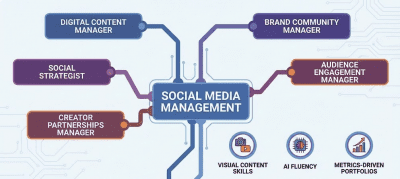
What was once a single job listing appears as five or six specialized roles: digital content manager, social strategist, brand community manager, audience engagement manager, and creator partnerships manager. Each reflects a specific slice of what social media management has become.

If you’re searching only for the exact phrase “social media manager,” you’re running a narrower hunt than the market offers. And employer expectations have climbed. Visual content skills, AI fluency, and metrics-driven portfolios are baseline requirements, not nice-to-haves.

Here’s how to search smarter and meet the raised bar.

Where the Jobs Actually Are

Search Wider Than the Title

Run parallel searches across multiple titles. The roles demand similar skill sets, but the listing language has diversified. Set up alerts for all of these:

  • Digital Content Manager
  • Social Strategist
  • Brand Community Manager
  • Audience Engagement Manager
  • Creator Partnerships Manager
  • Social Media Specialist (often equivalent to manager-level work despite the title)

Cross-industry demand is broader than most candidates realize. Consumer packaged goods brands, healthcare systems, financial services firms, nonprofits: they all need this work done. Don’t box yourself into agencies and tech companies.

social media management

Go Beyond the Aggregators

Major job boards surface a fraction of what’s available. The roles matching your specific skills often appear first on niche platforms and in professional communities.

Niche job boards: Mediabistro’s job board focuses on media, marketing, and creative positions where social media management sits. The American Marketing Association board skews toward marketing-adjacent roles. Industry-vertical boards in whatever sector interests you (healthcare marketing associations, fintech career sites, entertainment industry job boards) surface openings before they hit LinkedIn.

For a broader look at how social media professionals break into their first positions, our guide on landing social media jobs covers the fundamentals across experience levels.

Professional communities: Slack groups, Discord servers, and industry-specific forums regularly surface openings before they go public. The value isn’t just job leads. It’s context about what specific companies are actually like to work for.

LinkedIn strategy: Skip the “Easy Apply” grind. Follow hiring managers at companies whose work you respect. Engage with their content meaningfully: comment on campaign posts, share their team’s work with your own analysis. When a relevant posting appears, your prior engagement puts you at the front of mind.

Direct outreach: Identify brands whose social presence you genuinely admire. Reach out to their marketing leads with a specific observation about their channels and a concrete idea for building on it. This works particularly well at mid-sized companies where the social team is small and constantly stretched. You’re not asking for a job. You’re demonstrating what you’d bring.

Reality Check: Many social media manager jobs remain remote-friendly given the digital nature of the work. But hybrid and on-site requirements have crept back, particularly at agencies and brands with in-house content studios. Factor location flexibility into your search filters, but don’t assume everything is remote.

What Gets You Past the Screener

The Technical Skills That Are Non-Negotiable

Scheduling and automation tool proficiency is table-stakes. Buffer covered seven post-scheduling apps in February 2026 alone; the tool landscape keeps shifting. Familiarity with at least two or three platforms in this category (Planable for collaborative planning, Loomly for approval workflows, native schedulers across major platforms) is expected from any manager-level candidate.

Visual content creation is essential. The line between social media manager and content creator has blurred. You don’t need to match a motion graphics specialist, but you should be comfortable designing static posts, editing short videos for Reels or TikTok, and understanding basic composition and typography. These graphic design skills are increasingly mentioned alongside traditional social media manager jobs.

AI fluency is showing up in job descriptions with growing frequency. Not deep technical expertise: practical application. Using generative tools to draft copy variations and brainstorm campaign concepts. Using predictive tools that suggest optimal posting times based on historical engagement. Understanding how AI-driven algorithm shifts affect reach.

Grit Daily reported on AI and social media algorithms this month, highlighting how these shifts are actively reshaping the space. Candidates who can articulate how they’d adapt strategy to algorithmic changes demonstrate the thinking that gets you past the screener.

Analytics and attribution have moved from a bonus to a requirement. Managers are expected to read data, not just post content. Familiarity with social listening tools like Brandwatch and native platform analytics (Meta Business Suite, LinkedIn Analytics, TikTok Analytics) is baseline.

But knowing what to do with the numbers matters more than pulling them. Which content themes drive actual engagement? Which channels produce conversions versus vanity metrics? Can you explain performance to stakeholders who don’t live on social media daily?

What Your Portfolio Must Prove

Hiring managers expect metrics-backed case studies, not screenshots of posts. A portfolio without quantified results often dies in initial screening.

Frame two to three case studies (even from freelance or personal projects) with clear before-and-after metrics:

  • What was the engagement rate before your content strategy shift? What happened after?
  • Did follower growth accelerate, and was it the right audience?
  • Can you show conversion attribution: newsletter signups driven by Instagram Stories, product page visits from a TikTok campaign, event registrations from LinkedIn posts?
Portfolio Formula That Works: Here’s the problem I inherited, here’s the strategic approach I took, here’s what changed. Numbers without narrative feel hollow. Narrative without numbers feels like guesswork.

Red flags employers catch immediately:

  • Portfolios that only show content samples with no performance context
  • Résumés that list platform names as “skills” without strategic substance (“proficient in Instagram” tells a hiring manager nothing; show a campaign you ran and what it accomplished)
  • Generic cover letters that don’t reference the company’s actual social channels

That last one matters more than candidates realize. Spend 20 minutes reviewing a brand’s social presence before writing your cover letter. Reference a recent campaign. Note a channel they’re underusing. Suggest a content format they haven’t tried. This signals you’re already thinking about their challenges.

For tactical advice on presenting your work once you land the interview, our social media manager success tips break down what strong candidates emphasize.

Standing Out in the Stack

If You’re Stepping Up From Coordinator to Manager

Your application needs to show strategic thinking and cross-functional collaboration, not just execution. Use your cover letter to demonstrate you understand:

  • Channel strategy: Why you’d prioritize one platform over another for specific business goals
  • Budget allocation: How you’d distribute paid social spend
  • Team coordination: How you’ve worked with designers, copywriters, and product teams on cohesive campaigns

A hiring manager can teach someone a new scheduling tool. Strategic thinking is harder to install.

The Follow-Up That Gets Noticed

A short, specific note that adds value (“I noticed your team launched this campaign last week; here’s a quick thought on extending that momentum”) stands out. A generic “just checking in” gets ignored. One demonstrates you’re paying attention. The other feels like template spam.

Start Your Search With a Strategy

The market for social media management work is broader than a single job title suggests. Search wider. Present sharper. Demonstrate results.

The Bureau of Labor Statistics projects 6% job growth for advertising, promotions, and marketing managers (the closest federal classification encompassing social media management) at a rate faster than average across all occupations. The demand is there. The title is just dressed differently than it was three years ago.

Start on Mediabistro’s job board, where media and marketing roles, including the social media manager jobs hiding under new titles, are posted daily. Set alerts for the alternative titles discussed above.

The strongest applications aren’t the ones that check every listed requirement. They’re the ones that prove you’ve already started thinking about the company’s specific challenges before you’ve landed the interview.

Hiring for media and marketing roles? Post your job on Mediabistro to reach qualified social media professionals actively searching.

Topics:

Advice From the Pros
Entertainment

Nexstar, Sinclair spend millions lobbying to rewrite TV station ownership rules

Nexstar, Sinclair spend millions lobbying to rewrite TV station ownership rules
By Hien An Ngo for OpenSecrets
6 min read • Originally published February 25, 2026 / Updated March 19, 2026
By Hien An Ngo for OpenSecrets
6 min read • Originally published February 25, 2026 / Updated March 19, 2026

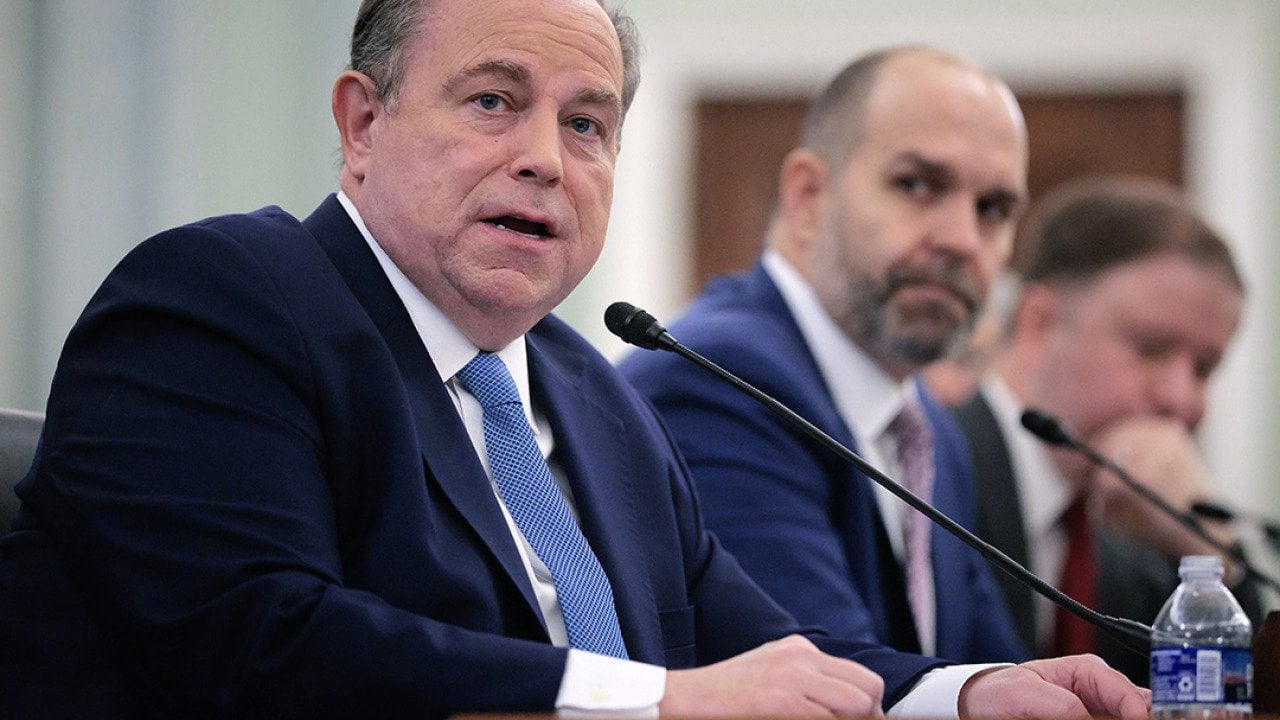
Newsmax CEO, Chris Ruddy, testifies during Senate hearing about media ownership on Capitol Hill, Washington D.C.

Chip Somodevilla // Getty Images

Nexstar, Sinclair spend millions lobbying to rewrite TV station ownership rules

Broadcast giants are pouring millions into lobbying as they push federal regulators to loosen limits on how much of the national TV market one company can control, a change that could reshape local television across the country.

OpenSecrets examined lobbying disclosures and congressional testimony to trace how the industry is working to rewrite the rules.

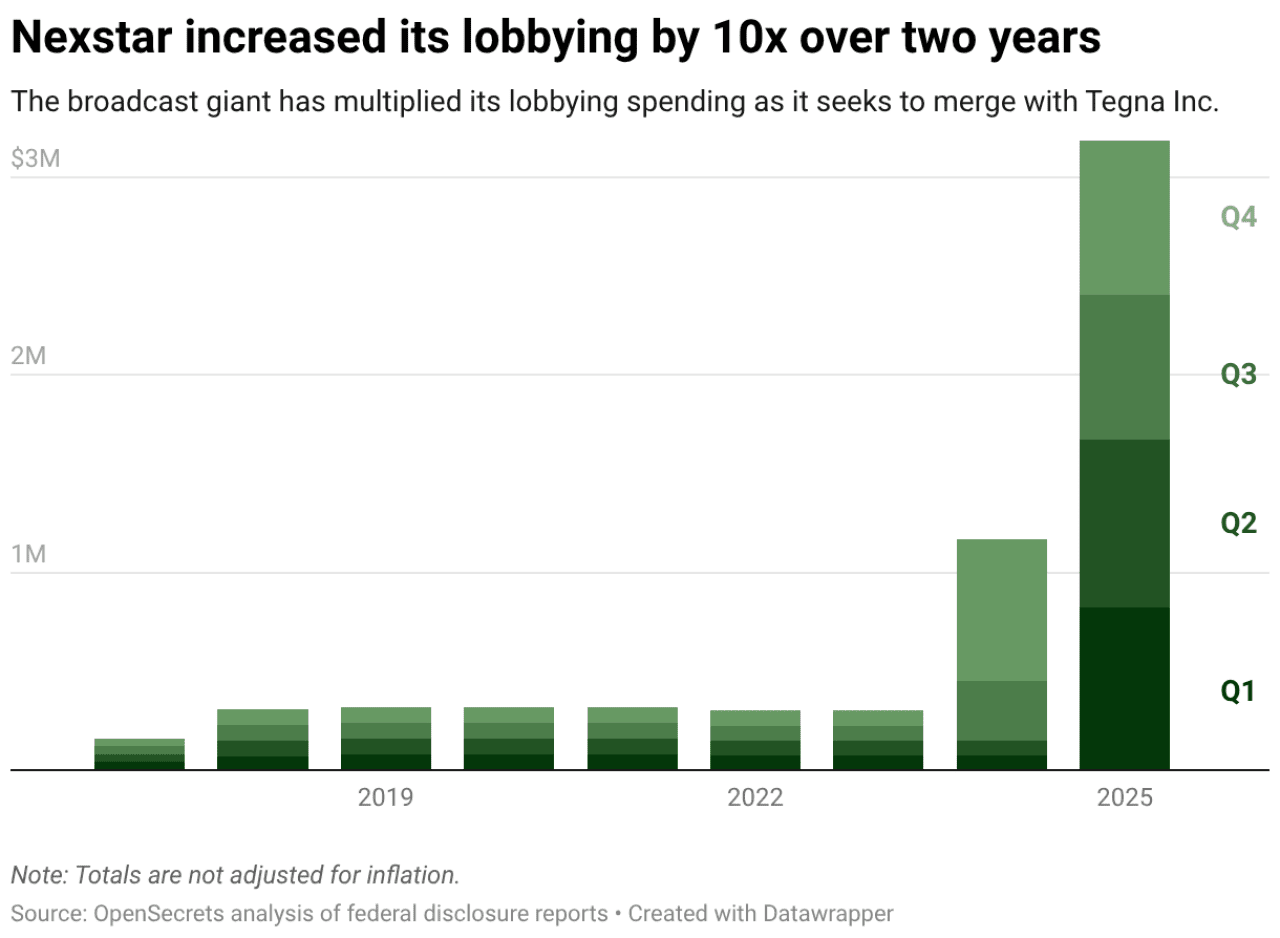
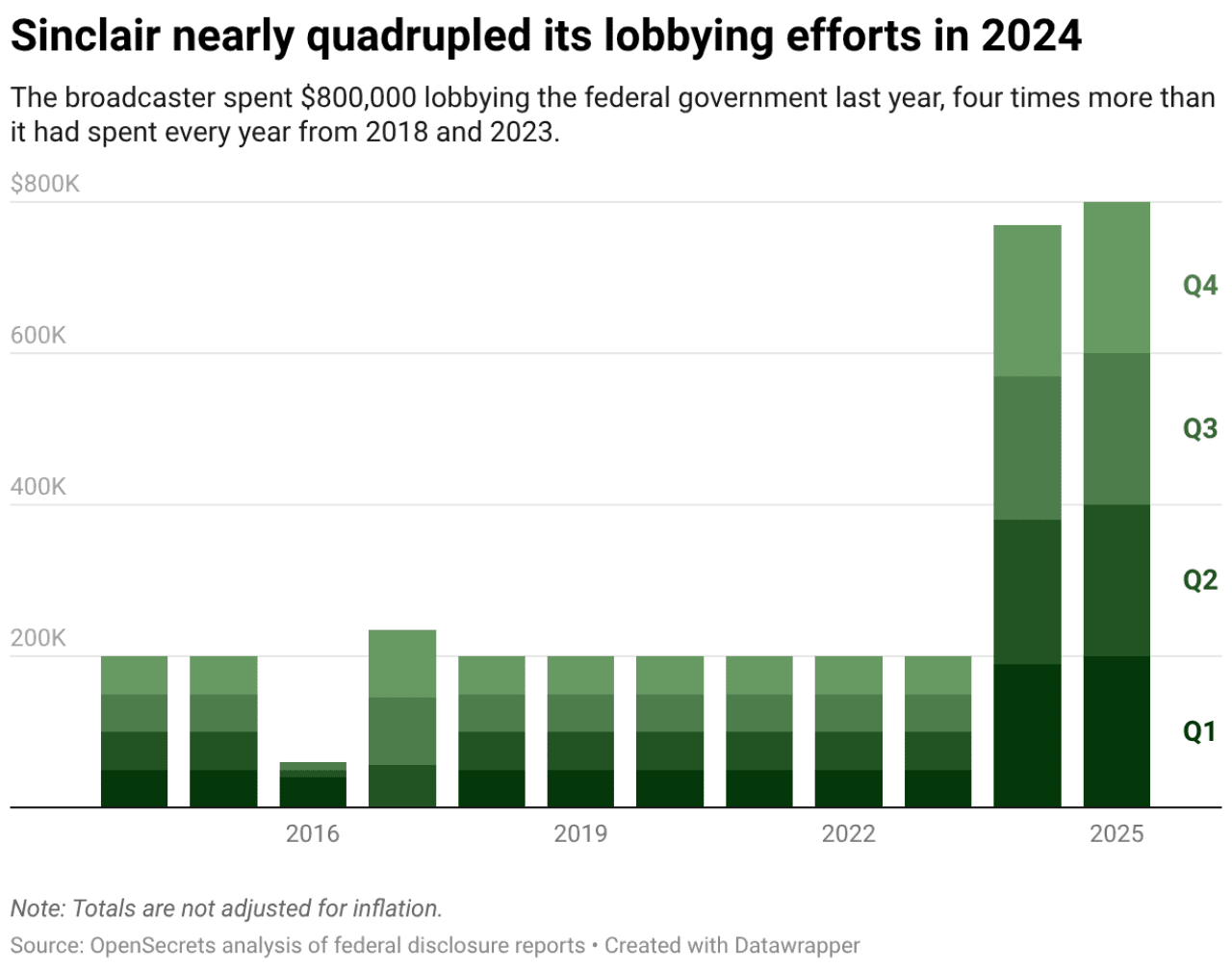
Nexstar Media Group, which owns the most TV stations in the country, spent $3.2 million lobbying the Federal Communications Commission in 2025, roughly 10 times more than it did every year from 2018 to 2023, when its lobbying activity remained steady. Sinclair Broadcast Group, the second-largest station owner, last year spent four times its 2023 federal lobbying total.

Both organizations are lobbying to change regulations that restrict their growth.

National station owners are limited to owning stations that collectively reach no more than 39 percent of the national audience, but a regulatory loophole known as the UHF discount lets some stations be counted as reaching fewer households than they actually do.

Without the discount, Nexstar serves 70 percent of national television households; with the UHF discount applied, however, its reach only extends to 39 percent.

Potential Nexstar-Tegna merger drives record lobbying

A data chart showing Nexstar increased its lobbying by 10x over two years.

OpenSecrets

Nexstar’s 2025 federal disclosure reports show the company lobbied on the ownership cap and a potential merger with Tegna, another major broadcaster.

In August 2025, Nexstar announced a deal to acquire Tegna for $6.2 billion. The proposed merger would send the cumulative household reach soaring past the 39 percent ownership cap. Thus, the deal is pending while the FCC determines whether to change the ownership rules.

To help sway the FCC, Congress and the White House, Nexstar hired lobbyist Jeff Miller, who served as finance chair on President Donald Trump’s second inaugural committee, at the start of 2025. Miller heads Miller Strategies, one of the firms that has benefited most from their close connection with the Trump administration. Nexstar paid the firm $510,000 over the course of the year, although most of its lobbying was handled by the company’s in-house team.

Tegna reported its first year of lobbying in 2025, spending $550,000 exclusively on Miller Strategies. Combined, the lobbying firm raked in over a million dollars from just the potential Nexstar-Tegna merger.

Sinclair multiplies spending as it eyes acquisition

Sinclair spent $800,000 lobbying the FCC last year on issues such as media ownership and the communications ecosystem. When it nearly quadrupled its previous lobbying spending in 2024, it cited the same issues.

A data bar chart showing Sinclair's lobbying efforts and that it nearly quadrupled in 2024.

OpenSecrets

While Sinclair reaches a smaller share of TV households than Nexstar — about 24 percent when the UHF discount is applied — the company still sees the national ownership cap as limiting its ability to expand.

The company has been in conversations with multiple potential merger partners and launched a strategic review in August, pointing to a desire to acquire one of its peers. Discussions with E.W. Scripps, a smaller broadcast station owner, began in 2024. The conversations never progressed, and in November, Sinclair announced it would pursue a hostile takeover of Scripps.

Who gets to make the call?

Rudy Brioche, a former vice president and policy counsel at Comcast, said that increases in lobbying from broadcast companies are centered on pending mergers and implementation of the ATSC 3.0 standard, which would change how television is transmitted to households. Before working for Comcast for 16 years, Brioche served as chief of staff at the FCC.

“It is primarily about pending transactions, the ATSC standard 3.0, which is a new technology that would allow broadcasters to use the digital airwaves for other streams of revenue,” Brioche said.

That push for regulatory changes is unfolding as broadcasters see a more favorable political climate in Washington.

Trump’s push for deregulation has created hope for the largest station owners that they may gain more flexibility. The FCC has signaled its intention to do away with the 39 percent ownership cap, and its chairman, Brendan Carr, has shown support for allowing station owners to expand their reach.

However, the jurisdiction over the ownership cap was one of the topics discussed in a recent Senate hearing that examined the rules around broadcast media ownership in the digital age. The debate in Congress over who has the authority to change the 39 percent ownership cap is central to Nexstar’s and Sinclair’s expansion plans. In 2004, Congress set the 39 percent cap and explicitly prohibited the FCC from using its forbearance authority to avoid enforcing the limit.

Sen. Jacky Rosen (D-Nev.) made clear that the authority to change the cap lay with Congress.

“Just because large corporations like Nexstar and Tegna want to merge, it doesn’t mean they can simply ignore the laws that Congress has put in place,” Rosen said. “In order for there to be a merger that results in ownership above the 39 percent cap, Congress would have to change the law.”

Proponents of change to the ownership cap argue that Congress didn’t set a permanent statutory limit, but instead directed the FCC to modify its rules at specific moments in time, leaving the underlying cap as a regulatory creation that the agency can revisit.

The hearing also featured the National Association of Broadcasters’ chief executive officer, Curtis LeGeyt. NAB, the entertainment industry’s largest lobbying client, has long advocated for allowing station owners to expand past the ownership cap and for deregulation of the broadcast industry.

“These outdated regulations distort today’s video and advertising marketplace,” LeGeyt said. “They advantage giant tech platforms, global streaming services, pay TV providers and national cable programmers, while placing local broadcasters at a severe disadvantage.”

Chris Ruddy, CEO of Newsmax, a relatively small conservative broadcaster, urged members of Congress to protect the ownership cap, saying it blocks monopolization of the industry and promotes localism of stations.

Whether that cap holds may depend not only on Congress but on how the FCC responds to political pressure from the White House and industry. The FCC historically has acted independently from past administrations, but has become increasingly politicized under Trump.

During a congressional probe of the FCC focused on censorship and free speech in December 2025, Carr said the agency wasn’t independent of the administration, a contradiction to the mission statement that included the word “independent” prior to the hearing.

Brioche, who served as former chief of staff at the FCC, noted how much things have changed under Trump.

“It is different from past administrations, because past administrations viewed the FCC as an independent agency. This administration does not view the FCC as an independent agency,” Brioche said. “It views the FCC as a tool, an instrument of advancing its political interest.”

Trump has recently reversed his position: Last November, he responded to a warning by Newsmax’s Ruddy against lifting the ownership cap by railing against the potential expansion of station owners because it would help enlarge “Radical Left Networks.”

Nexstar has sought to represent the potential merger as aligned with the administration’s deregulation agenda. Its efforts seem to have worked. Trump reversed his position on the merger a few days before the congressional hearing, writing it would negatively impact the networks he doesn’t like and said, “GET THAT DEAL DONE!”

Tom Bettag, a lecturer at the University of Maryland and former producer at ABC, said the Trump administration’s approach to regulating broadcasters and journalists was a way to control the media’s portrayal of him.

“His real goal is to control the message that goes out to the American people, and to the degree that he can exercise control over the information that Americans get, he can work his will,” Bettag said. “In theory, he says that he is trying to fight anti-Trump bias, but in fact, his definition of anti-Trump bias is anything that isn’t pro-Trump.”

This story was produced by OpenSecrets and reviewed and distributed by Stacker.

Topics:

Entertainment
media-news

Hollywood’s Biggest Dealmaker Just Showed Up at the State of the Union

Mediabistro icon
By Mediabistro
The Mediabistro editorial team draws on 25 years of media industry expertise to cover jobs, careers, and trends shaping the industry.
5 min read • Originally published February 26, 2026 / Updated March 19, 2026
Mediabistro icon
By Mediabistro
The Mediabistro editorial team draws on 25 years of media industry expertise to cover jobs, careers, and trends shaping the industry.
5 min read • Originally published February 26, 2026 / Updated March 19, 2026

David Ellison spent Tuesday evening in the House gallery watching President Trump deliver his State of the Union address. Hours earlier, his Paramount Skydance had raised its Warner Bros. Discovery bid to $31 per share.

Sen. Lindsey Graham posted the invitation on X that afternoon. The timing was not subtle.

This is how entertainment consolidation works in 2026. The biggest media deals in a generation require more than bankers and board presentations. They require proximity to the people writing the regulatory environment.

Three stories from Tuesday night illustrate this. Ellison’s attendance, which shows you the political dimensions of mega-deal execution. The substance of Trump’s speech, which carried regulatory and trade signals that will shape how media companies operate over the next 12 months. And the fact-checking apparatus that has become its own journalism product line.

The Gallery Seat That Advanced a $31-Per-Share Bid

Ellison’s presence at the State of the Union was announced by Graham on social media the same day Paramount Skydance raised its Warner Bros. Discovery offer. The bid had been expected. Paramount completed its Skydance acquisition in 2025, and analysts have been waiting for the combined entity to move on another legacy media company. Warner Bros. Discovery, with its film library, HBO, and streaming infrastructure, is the obvious target.

What nobody expected was Ellison sitting in the House chamber that same night. That positioning matters because the Warner Bros. Discovery deal, if it proceeds, will face Justice Department antitrust review, FCC scrutiny on broadcast licenses, and likely Congressional attention given the sheer size of the combined companies.

A State of the Union invitation from a sitting senator signals access. Full stop.

Deal Reality: A combined Paramount-Skydance-Warner Bros. Discovery entity would control HBO, Showtime, MTV, Paramount Pictures, Warner Bros. Pictures, CNN, and major sports rights. That footprint demands open channels to Washington.

This is about structural reality. Media consolidation at this scale requires political relationships. The Paramount-Skydance merger itself faced months of negotiation and regulatory approval.

If you work at Warner Bros. Discovery, Paramount, or any legacy media company in consolidation conversations, Ellison’s gallery seat is a reminder: your next employer may be decided as much by regulatory appetite as by strategic fit. The antitrust posture of the current administration, the composition of the FCC, the Congressional committees overseeing media mergers: all live variables in your career trajectory.

What the Speech Said About Media, Trade, and Regulation

Trump’s address focused heavily on economic achievements and immigration policy, but the regulatory and trade signals embedded in it carry direct implications for media and entertainment.

Trump criticized the Supreme Court for striking down his emergency tariffs, which suggests renewed tariff pressure is coming. For media companies with international production and distribution, tariff policy is not an abstraction. Netflix, Disney, Amazon, and Warner Bros. Discovery all maintain substantial production infrastructure outside the U.S. and import content, equipment, and services across borders. Trade policy will affect production budgets, distribution costs, and the viability of international co-productions.

The tone on institutional conflict matters too. Trump’s criticism of the Supreme Court and his framing of political opponents as obstacles signal an administration comfortable with confrontation. That posture extends to regulatory agencies. The FCC, the FTC, and the Justice Department’s antitrust division all operate within this political environment. Companies navigating merger reviews should expect the administration’s public combativeness to filter into enforcement posture and negotiation dynamics.

Then there’s immigration. The framing took up a large share of speech time, and it has real workforce implications for entertainment and media. The industry relies on international talent across production, engineering, journalism, and creative roles. Policy shifts that tighten visa requirements or expand enforcement will hit hiring pipelines and project staffing, particularly for companies with distributed production models.

The Fact-Checking Operation That Runs Parallel to the Event

While Trump spoke, PolitiFact ran a live fact-check operation drawing on an archive of 1,144 previously fact-checked Trump statements dating back to 2011. The practice is familiar. The infrastructure behind it is worth examining.

Fact-checking a State of the Union in real time requires reporters who can cross-reference claims against years of prior statements, policy positions, and public records. It requires database systems that surface relevant past fact-checks instantly. And it requires editorial processes that can publish verified corrections without sacrificing accuracy for speed.

Career Signal: If you can work with data, understand archival systems, and write clear explanatory copy under deadline pressure, you are building around capabilities with durable value.

This type of journalism is expensive. It demands specialized skills in data journalism, archival research, and rapid verification. For news organizations competing with social-first outlets and AI-generated content, it is also one of the few sustainable differentiation strategies. A live fact-check operation demonstrates editorial capacity that newer entrants cannot easily replicate.

If you’re a journalist or editor evaluating career moves, track the investment in structured, database-driven journalism. Newsrooms that prioritize this work are building infrastructure that outlasts individual news cycles and creating roles that require a different skill set than traditional reporting.

What This Means

Tuesday night showed you the operating environment for the next phase of media consolidation. Deals get made in boardrooms. They get approved in Washington. Ellison’s State of the Union attendance was a demonstration of how power works when the companies reshaping entertainment need regulatory clearance to proceed.

If you work at a legacy media company, pay attention to who is building political relationships and how those relationships map to deal timelines. If you are evaluating job offers, consider that the company hiring you today may be part of a larger entity within 18 months.

If you are a journalist or editor, watch where newsrooms are investing in structured, archival journalism infrastructure. That investment signals editorial priorities and creates specialized roles.

If you are navigating these shifts and looking for your next role, browse open roles on Mediabistro. If you are hiring for positions that require political savvy, data journalism skills, or M&A experience, post a job on Mediabistro and reach the professionals who understand this landscape.


This media news roundup is automatically curated to keep our community up to date on interesting happenings in the creative, media, and publishing professions. It may contain factual errors and should be read for general and informational purposes only. Please refer to the original source of each news item for specific inquiries.

Topics:

media-news
Hot Jobs

Media Operations and Strategy Roles Hiring Now Across the Industry

hot media and creative jobs on Mediabistro
Mediabistro icon
By Mediabistro
The Mediabistro editorial team draws on 25 years of media industry expertise to cover jobs, careers, and trends shaping the industry.
4 min read • Originally published February 26, 2026 / Updated March 19, 2026
Mediabistro icon
By Mediabistro
The Mediabistro editorial team draws on 25 years of media industry expertise to cover jobs, careers, and trends shaping the industry.
4 min read • Originally published February 26, 2026 / Updated March 19, 2026

The Behind-the-Scenes Roles Are Having Their Moment

For years, the media industry’s most visible hiring has centered on creators: writers, designers, and on-camera talent. Today’s listings tell a different story. The roles being posted with the strongest compensation and clearest growth trajectories are operational. Production managers, marketing strategists, compliance specialists, communications coordinators. These are the people who keep content organizations from collapsing under their own ambitions.

What’s driving this? Scale. As media companies expand into new platforms, membership models, and community products, the complexity of actually running these operations has outpaced many organizations’ infrastructure. You can see it in today’s listings: a literary agency needs someone to standardize its financial and legal workflows, a public media station wants a marketing manager to wrangle cross-departmental campaigns, and a digital education powerhouse is hiring coordinators to keep its social channels on schedule.

If you’ve built your career on the operational side of media, on project management, the process design, the logistics that make creative work possible, your skills are in high demand right now. And several of today’s job postings come with salaries that reflect it.

Today’s Hot Jobs

Marketing Manager at Cascade Public Media

Why you should pay attention: Cascade PBS (formerly KCTS 9 and Crosscut) is one of the Pacific Northwest’s most respected media organizations, and this role sits at the intersection of brand strategy and campaign execution. The salary range of $96,000 to $109,000 is notably strong for a regional public media operation. Add in half-day Fridays during summer, a fully-vested 401(k) match from day one, and a hybrid schedule, and this becomes one of the more complete compensation packages in today’s listings.

What they need from you:

  • Experience leading marketing and communications campaigns with data-driven benchmarking
  • Ability to manage direct reports, including an Email and Digital Marketing Specialist and a Campaign Specialist
  • Strong alignment with organizational values, including integrity, community, innovation, and diversity
  • Comfort supporting organization-wide strategic and operational leadership alongside a Director of Programming

Apply for the Marketing Manager position at Cascade PBS

Operations, Finance, and Legal Compliance Manager at Park Fine and Brower Literary Management

What makes this role rare: Operations roles at literary agencies rarely get posted publicly because they’re usually filled through industry networks. PFB is looking for someone to oversee commission processing, royalty reporting, contract management, and data governance. If you’ve ever wanted to understand exactly how the business side of book publishing works, this is a masterclass disguised as a job. The position requires on-site presence in New York, which makes sense given the volume of sensitive financial and legal documents involved.

The ideal candidate brings:

  • Strong operational mindset with experience in publishing, entertainment, or professional services
  • Ability to manage financial workflows between a CFO and staff while ensuring accuracy in commission and royalty reporting
  • Experience in maintaining and updating contract boilerplates to meet industry standards
  • Impeccable attention to detail and strong cross-departmental communication skills

Apply for the Operations Manager role at Park Fine and Brower

Content and Community Manager at Hay House

The draw here: Hay House, the personal development publishing giant founded by Louise Hay, is hiring someone to manage two membership communities for author Rebecca Campbell. This role blends community engagement, digital content production, and virtual event coordination into a single position. The four-day work week is a genuine differentiator, and the $65,000 to $75,000 salary for a fully remote role with that schedule represents real value. You’ll be working closely with a bestselling author to steward her community, which means high visibility and creative latitude.

Core requirements:

  • Experience managing online membership communities and digital content production
  • Ability to coordinate virtual events and collaborate directly with a high-profile author
  • Comfort stewarding brand voice across community platforms
  • Alignment with Hay House’s mission of personal development and positive impact

Apply for the Content and Community Manager role at Hay House

Campus Master Plan Communications Coordinator at University of Texas at Austin

Why this deserves a closer look: This role is almost like a technical writing position for one of the largest university systems in the country. You’ll be translating complex campus planning concepts into clear, accessible messaging for a multi-year master plan initiative. The scope is enormous: you’ll work with campus leadership, planning teams, and external consultants to communicate a vision that will shape UT Austin’s physical campus for decades. For anyone with experience in institutional communications or planning-adjacent writing, this is a portfolio-defining opportunity.

Key qualifications:

  • Experience gathering information and coordinating clear, consistent communications for complex projects
  • Ability to translate technical planning concepts into messaging for diverse campus and community stakeholders
  • Comfort working across multiple teams, including campus leadership, planning consultants, and communications staff
  • Strong organizational skills for managing a multi-year initiative with evolving deliverables

Apply for the Communications Coordinator position at UT Austin

The Takeaway for Job Seekers

If your resume leans heavily on operational accomplishments, stop burying them beneath creative credits. Today’s listings show that companies are specifically seeking people who can build systems, manage workflows, and keep complex organizations running smoothly. Frame your experience around outcomes: the processes you standardized, the teams you coordinated, the reporting structures you improved.

Before you start applying, make sure your online presence reflects your current skill set. Here’s a solid guide on when and how to update your LinkedIn profile so recruiters find the version of you that matches what these roles demand. The media industry has always celebrated its front-of-house talent. Right now, the back-of-house people are getting their due.

Topics:

Hot Jobs
Job Search

The Remote Design Jobs Still Out There (And How to Actually Find Them)

UX designer working at desk
Mediabistro icon
By Mediabistro
The Mediabistro editorial team draws on 25 years of media industry expertise to cover jobs, careers, and trends shaping the industry.
8 min read • Originally published February 26, 2026 / Updated March 19, 2026
Mediabistro icon
By Mediabistro
The Mediabistro editorial team draws on 25 years of media industry expertise to cover jobs, careers, and trends shaping the industry.
8 min read • Originally published February 26, 2026 / Updated March 19, 2026

In this article: Where Remote Design Jobs Actually Live | What Remote Hiring Managers Are Filtering For | How to Position Yourself to Win the Role | Start the Search

The pandemic created a gold rush for remote design work. That rush is over. But the gold didn’t vanish.

Companies that went all-remote in 2020 started calling people back by late 2023, and positions explicitly advertised as “remote” have contracted sharply. Fully remote graphic design work didn’t disappear, though. It redistributed.

The roles moved to different employers, got listed under different titles, and started getting filled through different pipelines. Most designers are still searching the same three job boards, using one job title, competing in the noisiest possible channels.

Here’s how to find the graphic design jobs remote they’re missing.

Where Remote Design Jobs Actually Live

The conventional search starts and ends with Indeed, LinkedIn, and maybe Upwork. Those platforms work for discovery, but the signal-to-noise ratio has deteriorated badly. Remote design positions on major boards routinely attract hundreds of applicants within 48 hours.

Designers landing offers in 2026 are searching parallel channels where competition is lighter and relevance is higher.

Beyond the Big Boards

Niche job boards exist specifically for creative professionals, and their applicant pools are smaller by design.

Mediabistro specializes in media and creative roles, meaning you’re competing against a self-selected group rather than every designer with a LinkedIn profile. Dribbble’s project briefs listings attract design-fluent employers who understand portfolios. AIGA maintains a board that skews toward agencies and studios.

We Work Remotely and Remote.co filter exclusively for distributed positions, eliminating the “remote with occasional office days” ambiguity that wastes application time.

The advantage isn’t just lower volume. Employers posting on niche boards are already design-literate. You’re not explaining what a design system is in your cover letter.

The Employers Nobody Thinks to Check

Tech companies and agencies dominate the mental model of where design jobs live. But some of the most stable remote design work comes from organizations that don’t think of themselves as “design employers” at all.

International organizations hire remote designers constantly. The United Nations, World Bank, and development agencies need multimedia and graphic design work for campaigns, reports, and digital platforms. UNFPA Pacific recently advertised a remote multimedia and graphic design consultancy, the kind of work that exists well outside the startup ecosystem and rarely shows up on mainstream boards.

Media companies, publishers, and content brands need constant design output: social media assets, infographics, email templates, branded content packaging. Editorial design translates cleanly to remote work because collaboration happens in shared files and Slack threads.

E-commerce brands produce an endless stream of product visuals, seasonal campaign assets, and landing page graphics.

Pro Tip: Set Google Alerts for “remote graphic design” combined with terms like “international organization,” “NGO,” “publisher,” or “nonprofit.” These roles often appear on specialized boards or organization career pages before they hit Indeed.

Search Smarter: The Title Problem

The same remote role gets posted as “brand designer” at one company, “digital content creator” at another, “visual communications specialist” at a third, and “marketing designer” at a fourth.

Candidates searching only for “graphic designer” miss a huge portion of available positions. Build a list of title variations and set alerts for each:

  • Brand designer
  • Visual designer
  • Creative specialist
  • Digital designer
  • Communications designer
  • Content designer
  • Marketing designer
  • Multimedia designer

If you have a niche, add industry-specific variants: editorial designer, publication designer, UX visual designer.

This isn’t about applying to roles you’re unqualified for. Companies don’t standardize titles. You have to search like they post.

The Contract Pipeline

A significant share of remote design positions get filled through referrals and existing contractor relationships before being publicly listed. Hiring remote workers carries perceived risk, so employers de-risk by converting freelancers they’ve already tested.

The contract-to-hire path is especially common at startups and mid-sized companies without formal design hiring processes. They “try out” a remote designer on project work, then extend a permanent offer if the collaboration clicks.

Get onto rosters at creative staffing agencies. The Creative Group (a division of Robert Half) specializes in creative and marketing placements, including remote contract roles. Aquent and Vitamin T maintain similar networks. These aren’t just temp agencies, think of them more like audition platforms.

Treat every freelance project as a potential permanent role. Deliver early. Communicate proactively. Make the transition from contractor to employee feel like the obvious next move.

What Remote Hiring Managers Are Filtering For

Remote graphic design jobs attract a crush of applicants. Hiring managers develop fast filters to cope. Understanding what gets you past the first cut matters more than perfecting details that come later.

The Portfolio Carries Outsized Weight

In remote hiring, there’s no in-person meeting to build rapport or read body language. The portfolio is the first impression, the primary evaluation tool, and often the only reason you get a callback.

The fatal mistake: submitting work without context. A polished layout means nothing if the hiring manager can’t tell what problem you solved, what constraints you faced, or what role you played on the project.

For each portfolio piece, include a brief that covers:

  • The client or company
  • Your specific role
  • The problem or brief you were solving
  • Your process (including tools and collaboration methods)
  • The outcome

If you have metrics (engagement rates, conversion lift, impressions), include them. If you don’t have hard numbers, describe the qualitative result: “This rebrand launched at a trade show and generated the highest booth traffic the company had seen in five years.”

Platform-wise: Behance integrates cleanly with Adobe workflows and has wide recognition. A personal website gives you more control over presentation and demonstrates basic web literacy. Dribbble offers community visibility and doubles as a job search channel.

Don’t bury your best work on page three because it’s chronologically older. Lead with your strongest pieces. Remote hiring managers spend about 90 seconds on a portfolio before deciding whether to keep looking.

Remote-Specific Soft Skills

Remote hiring processes weigh asynchronous communication, self-management, and cross-timezone experience far more heavily than in-office roles do.

If you’ve worked with distributed teams, managed projects across time zones, or used collaborative tools like Figma, Slack, Notion, or Loom in design workflows, name them explicitly. Don’t assume it’s implied by “remote work experience.” Spell it out.

Specific examples land harder than vague claims: “Collaborated with a product team across US and EU time zones using Figma for design handoff and Loom for async feedback loops.”

That sentence signals you understand the mechanics of remote work, not just the lifestyle appeal.

Remember: Your application itself is a work sample. Is it clear, concise, and well-structured? Does it show you can convey ideas without a meeting? Hiring managers evaluate your communication style from the first email.

The AI Fluency Signal

A growing number of employers want designers who can demonstrate fluency with AI-assisted tools like Midjourney, Adobe Firefly, and generative fill workflows. This doesn’t mean AI replaces the designer. It means employers want to see you accelerate ideation, iteration, and production without sacrificing creative judgment.

Free online design education continues to expand globally, which means the entry-level candidate pool is growing. Mid-level designers need to differentiate on experience and specialization.

One way to do that: showing you’re comfortable with emerging tools. Include at least one portfolio piece or case study demonstrating an AI-integrated workflow. Show the prompt engineering, the iteration process, and the human refinement. The story isn’t “I used AI.” It’s “I used AI to solve this problem faster while maintaining creative control.”

For context on where design technology is heading, see how augmented reality is changing the landscape of graphic design. Demonstrating awareness of adjacent tech trends signals you’re anticipating tomorrow’s briefs, not just executing on what’s in front of you.

How to Position Yourself to Win the Role

When graphic design jobs, in particular, are remote, they attract heavy competition, and generic applications get filtered out instantly. Positioning isn’t about exaggerating your qualifications. It’s about making your fit obvious.

Tailor Every Application

Mirror the job listing’s language. If they say “brand designer,” don’t call yourself a “graphic designer” in the cover note. If they emphasize “visual storytelling,” use that exact phrase when describing your work.

This isn’t about gaming applicant tracking systems. It’s about demonstrating you read the posting and understand what they need.

Many companies specify time zone requirements in remote listings. Address your availability proactively: “Based in EST, available for synchronous collaboration during standard US business hours and flexible for occasional cross-timezone meetings.”

That removes a question from the hiring manager’s mental checklist before they even think to ask it.

Treat the Application as a Remote Work Sample

A three-paragraph cover note that clearly states what role you’re applying for, why you’re qualified, and what you’d bring to the team beats a five-paragraph essay that buries the thesis every time.

If the application format allows attachments beyond a resume and portfolio, consider including a Loom video walkthrough of a relevant piece. Two minutes of you narrating your process, explaining decisions, and showing the final output signals remote communication fluency better than any bullet point on a resume.

Update your LinkedIn profile before you start applying. Hiring managers will look. Make sure your headline, summary, and experience section align with the types of roles you’re targeting. For timing and strategy, see when to update LinkedIn.

Follow Up Strategically

One follow-up email five to seven business days after applying is appropriate. More than one reads as pushy. Zero means you’re indistinguishable from the 200 other applicants who also didn’t bother.

Reference something specific about the company or role: “I saw your team recently launched [specific campaign]. The visual approach reminded me of the brand refresh work I did for [client], which is why this role stood out to me.”

If you advance to the interview stage and they ask for references, be ready. For email templates and strategy, see how to provide job references professionally.

When you receive an offer, know your next steps. Review what to do when you get a job offer to navigate negotiations and acceptance professionally. If you need to withdraw from consideration at any point, handle it gracefully with this sample letter to withdraw consideration for a job.

Start the Search

Remote graphic design work hasn’t disappeared. It’s scattered across niche boards, unexpected employers, and contract pipelines that reward relationship-building over mass applications. The designers winning these roles search broadly, present their work with context, and treat every touchpoint as proof they can thrive outside an office.

Browse open design and creative roles on Mediabistro to start your search where the competition is lighter, and the employers already speak your language.

Hiring for a remote design position? Post your role on Mediabistro to reach qualified creative professionals actively looking for distributed work.

Topics:

Job Search
media-news

The Post Cuts Deep, Brands Go Small, and TV Bets on Memory

Mediabistro icon
By Mediabistro
The Mediabistro editorial team draws on 25 years of media industry expertise to cover jobs, careers, and trends shaping the industry.
5 min read • Originally published February 27, 2026 / Updated March 19, 2026
Mediabistro icon
By Mediabistro
The Mediabistro editorial team draws on 25 years of media industry expertise to cover jobs, careers, and trends shaping the industry.
5 min read • Originally published February 27, 2026 / Updated March 19, 2026

The Washington Post just made its largest single-day layoffs of 2026, adding to a year that has already gutted newsrooms across the industry. Press Gazette’s running tracker documents hundreds of journalism positions eliminated since January, and the Post’s cuts are the biggest institutional contraction so far.

The pattern is familiar: legacy newsrooms reducing headcount, digital outlets pulling back on expansion, the stable full-time journalism job getting harder to find.

Meanwhile, the career paths that do exist look increasingly non-traditional. Marketing follows a similar logic, with brands abandoning broad reach for smaller, more intentional communities. Television applies the same risk calculus in reverse, favoring proven IP over original development.

The through-line: when resources contract, decision-makers choose what feels safest. What “safest” means depends on what you’re trying to accomplish.

The Post’s Biggest Cuts of the Year, and a Career That Never Needed the Ladder

The Post layoffs matter for what they represent structurally. This is one of the most resourced newsrooms in American journalism, owned by one of the wealthiest people alive, and it still cannot maintain its current staffing level.

Press Gazette’s 2026 tracker shows the cumulative damage: the Post joins regional papers, digital publishers, and broadcast networks all reducing their workforce. The stable institutional journalism job that defined the profession for decades? There are far fewer of them than five years ago.

Which makes the profile of Liz Cookman land differently right now.

Cookman is an award-winning war correspondent who dropped out of school and built her career entirely outside traditional newsroom structures. Freelance. Conflict zones. Major journalism awards. No masthead ladder. She was diagnosed with ADHD in 2024, which helped explain challenges she faced earlier in her education and career.

Key Takeaway: Journalism careers have never been exclusively institutional, and the ratio is shifting fast. The Post layoffs show institutions withdrawing resources. The Cookman profile shows what professional life looks like when you never had those resources to begin with.

This is a practical acknowledgment that serious, consequential reporting can happen outside legacy structures. It also shows what that requires: constant hustle, financial instability, and building your own support systems from scratch.

Urban Outfitters and Reddit Are Selling the Same Idea to Brands

Urban Outfitters shifted its influencer strategy, moving away from reach-based deals toward a program called Me@UO. The focus: micro-creators with smaller, highly engaged communities that already have genuine affinity for the brand.

People whose audiences actually care about what they recommend.

Separately, Reddit pitched itself to brand advertisers as upper-funnel real estate built on niche communities. The sell is straightforward: specialist subreddits offer access to deeply engaged audiences organized around specific interests and purchase behaviors. Brands like JC Penney are spending there for meaningful brand exposure to people actively seeking recommendations.

Same insight, different directions. Urban Outfitters is a brand choosing depth over breadth. Reddit is a platform selling depth as its core product. Both are responding to the same measurement shift: impression volume matters less when engagement quality proves more predictive of actual business outcomes.

For anyone in influencer marketing, content strategy, or media buying, this is the operating logic now. The big undifferentiated play is losing ground to the small, targeted, authentic connection.

If you’re building an audience, the incentive structure rewards specificity and genuine community over raw scale. If you’re buying media or planning campaigns, the partnerships that win budget demonstrate real affinity. This shift is structural. It will persist.

One Show Ends on Its Own Terms. Another Returns Because the Brand Still Works.

Adult Swim’s Smiling Friends is ending after three seasons. Creators Zach Hadel and Michael Cusack say the decision was theirs.

This is genuinely unusual. Smiling Friends is the most distinctive original comedy Adult Swim has produced in recent years, with strong ratings and real cultural traction. Most shows in that position get cancelled or extended until they stop working. Hadel and Cusack are walking away while it still has momentum. That kind of creator autonomy almost never happens in television.

Meanwhile, Scrubs returned to ABC with most of its original cast and creative team, more than a decade after its original run ended. The producers and cast were thoughtful about why they came back. But it is clearly a bet on proven IP and built-in audience affection over original development.

Key Takeaway: Smiling Friends is creator-driven, original, ending by choice. Scrubs is network-driven, IP-based, returning because the brand value persists. Both can produce good work. Only one model gets consistently funded at scale.

If you’re writing, producing, or developing for television, the question is which path you’re navigating and what leverage you actually have. The Scrubs return is the default mode of television in 2026: mine existing IP, bring back familiar faces, reduce perceived risk. The Smiling Friends ending is the outlier: original work that generates real creative autonomy. One is much rarer than the other. That tells you where the industry is directing its resources.

What This Means

The connective tissue is contraction. Newsrooms cutting staff. Brands narrowing their marketing focus. Networks choosing familiarity over risk.

In each case, institutions with resources are choosing what feels safest. For journalism: fewer stable jobs, more freelance precarity. For marketing: better creator-brand alignment, but only for those who can demonstrate genuine community engagement. For television: more revivals, less space for original voices.

If you’re building a media career right now, institutional paths are narrowing while alternative structures become more viable out of necessity. That doesn’t make them easier. Audience-building, community engagement, the ability to operate independently: these matter more than they did when institutions were hiring at scale.

If you’re hiring, the same contraction creates opportunity. Talented people are available who wouldn’t have been six months ago. Post a job on Mediabistro and reach experienced professionals actively navigating this transition.

If you’re looking for your next role, browse open positions on Mediabistro and focus on where your specific skills create disproportionate value. The generic media job is disappearing. The specialized, high-leverage role still exists, but you need to know what makes you specifically valuable to find it.


This media news roundup is automatically curated to keep our community up to date on interesting happenings in the creative, media, and publishing professions. It may contain factual errors and should be read for general and informational purposes only. Please refer to the original source of each news item for specific inquiries.

Topics:

media-news
Advice From the Pros

The Creative Jobs No One Sees (And How to Find Them)

The Creative Jobs No One Sees (And How to Find Them)
Mediabistro icon
By Mediabistro
The Mediabistro editorial team draws on 25 years of media industry expertise to cover jobs, careers, and trends shaping the industry.
8 min read • Originally published February 27, 2026 / Updated March 19, 2026
Mediabistro icon
By Mediabistro
The Mediabistro editorial team draws on 25 years of media industry expertise to cover jobs, careers, and trends shaping the industry.
8 min read • Originally published February 27, 2026 / Updated March 19, 2026

In this article: What Creative Jobs Are Called | Where to Find Them | What Gets You Hired | How to Stand Out | Start Your Search

There are more creative jobs open than most job seekers ever see. The listings aren’t hidden; they just don’t say “creative” anywhere in the title.

The freelance creative market has been rough lately, with some questioning if it’s the “end” of creative careers. Senior-level creative leadership roles, though, keep moving across agencies, studios, and in-house teams. The full-time market is active but fractured, with openings at healthcare companies, fintech startups, ed-tech firms, and e-commerce brands. They’re posted as “content designer” at one company, “brand strategist” at another, “visual storyteller” at a third.

The biggest obstacle for most creative job seekers is a visibility problem. You’re searching for creative jobs and missing the 30 other titles that describe the same work.

Why You Can’t Find Creative Jobs: The Title Problem

“Creative jobs” is nearly useless as a search term. A content strategist at a SaaS company does fundamentally similar work to a brand voice strategist at an agency, but those titles will never appear in the same search results.

The creative job market operates across at least five distinct discipline clusters, each with its own vocabulary:

Design Roles

  • Graphic Designer
  • Visual Designer
  • Brand Designer
  • Product Designer
  • UX/UI Designer
  • Experience Designer
  • Design Systems Lead

Content and Writing Roles

  • Copywriter
  • Content Strategist
  • Content Designer
  • Editorial Director
  • Brand Voice Strategist
  • UX Writer
  • Communications Specialist

Video and Motion Roles

  • Video Producer
  • Motion Designer
  • Multimedia Artist
  • Animator
  • Creative Editor
  • Post-Production Specialist

Strategy and Leadership Roles

  • Art Director
  • Creative Director
  • Brand Strategist
  • Design Director
  • Head of Creative

Emerging and Hybrid Roles

  • Visual Storyteller
  • Creative Technologist
  • Design Engineer
  • Content Production Lead

The Bureau of Labor Statistics still projects above-average growth for several of these categories through the late 2020s, including web developers, digital designers, and multimedia artists. But you won’t reach those opportunities searching only one phrase.

AI Fluency Is a Hiring Factor: Postings increasingly reference Midjourney, Adobe Firefly, or generative AI tools alongside traditional creative software. Candidates who demonstrate thoughtful integration of AI into their workflow have an edge. The expectation is augmentation, not replacement.

The practical takeaway: run searches for every title in your discipline cluster. A “UX writer” and a “content designer” are often the same job at different companies. Missing one search term means missing half the market.

Where Creative Jobs Actually Live

Creative hiring happens across channels most job seekers never check. The obvious platforms matter, but they’re only the starting point.

Niche Job Boards Give You a Competitive Edge

Mediabistro focuses on media, marketing, and creative roles with editorial insight into the industries where these jobs cluster. Dribbble runs a job board integrated directly into designer portfolios. AIGA Design Jobs lists roles from the oldest and largest professional design organization in the U.S. Behance, Adobe’s portfolio platform, maintains job listings visible to the exact audience employers want to reach.

These boards attract fewer applicants per posting than Indeed or LinkedIn because they require job seekers to know they exist. That’s your advantage.

Industries You’re Probably Overlooking

Healthcare, fintech, e-commerce, and ed-tech companies all employ creative teams but attract fewer applicants from creative backgrounds.

A content designer at a fintech startup is still a creative job. It often pays more than the same role at a traditional agency because tech companies compete on compensation in ways agencies structurally can’t.

The work may feel less “creative” in the romantic sense. You’re designing email flows for a banking app, not art-directing a Super Bowl spot. But the craft standards are identical, the teams are smaller, and the path to senior roles is often faster.

LinkedIn Strategy That Actually Works

Don’t search by job titles. Search by skill keywords.

“Figma” surfaces product designers who may not have “designer” in their posted title. “Brand guidelines” finds strategists listed as project managers. “Video editing” catches producers hired under operations roles.

Follow creative directors at your target companies. When they post about hiring, you see it before the formal listing goes live.

Set alerts for non-obvious titles from the list above. LinkedIn’s alert system works best when you teach it the vocabulary your industry actually uses.

Professional Communities and Staffing Firms

AIGA hosts local chapter events where creative directors talk openly about what they’re hiring for. The One Club for Creativity runs portfolio reviews and mentorship programs that double as informal recruiting pipelines. Industry-specific Slack groups often have jobs channels where roles get posted before they hit public boards.

Creative staffing firms like The Creative Group place candidates in roles that never appear on job boards at all. These are contract-to-hire or direct placements where the employer has outsourced the entire search.

When Direct Outreach Works

For senior or specialized roles, cold outreach to creative directors works if it’s portfolio-led.

Two sentences and a link: “I’m a motion designer who specializes in kinetic typography for brand films. Here’s a 90-second reel of recent work: [link].”

If they’re hiring or about to hire, you’re on the list. If they’re not, you’ve lost 10 minutes. This works because creative directors can evaluate your work in under two minutes. It doesn’t work for entry-level roles where formal HR processes gate every hire.

What Gets You Hired (and What Gets You Filtered Out)

Portfolio quality separates finalists from applicants. But what counts as a strong portfolio has shifted.

A gallery of finished work is of course the first step. But what separates candidates from the rest of the pack is process, strategic thinking, and business impact. A brief case-study format for three to four projects beats 20 thumbnail images with no context. Hiring managers want to see how you got there, why you made those choices, and what the work achieved.

Show Business Impact: “Redesigned the homepage” doesn’t highlight impact. “Redesigned the homepage to reduce bounce rate from paid search traffic, which cut cost-per-acquisition over two quarters” shows you understand that creative work solves business problems.

Red Flags That Kill Your Application

  • Generic cover letters that could apply to any company
  • Portfolios with no explanation of your role on collaborative projects
  • Listing tools instead of capabilities — “Proficient in Adobe Creative Suite” is filler; “Art directed a rebrand across print, digital, and environmental graphics” describes what you actually do
  • Applying for roles clearly outside your level without acknowledging the stretch

If you’re three years into your career and applying for a creative director role, your cover letter needs to explain what makes you ready for that leap. Silence on the gap signals you don’t understand what the role requires.

The Skills That Matter in 2026

Strategic thinking alongside craft. Creative work increasingly happens embedded in product, marketing, or engineering teams, not in siloed creative departments.

Can you present and defend creative decisions to non-creative stakeholders? Can you translate feedback from a product manager into design direction? That’s what hiring managers filter for.

The market has strong demand at the senior/strategic level and at entry-level production, with intense competition in the middle tier. If you’re a mid-level designer competing against laid-off senior designers willing to take a title step back, your differentiation has to be sharper. Show work that required strategic input, not just execution.

How to Stand Out in a Crowded Field

Tailor every application. Reference something specific about the company’s recent creative work. This alone eliminates most of your competition, who sent the same PDF to 40 companies.

Bridge the Gap to Non-Traditional Industries

If you’re applying to healthcare or fintech companies, don’t make them figure out why a designer who’s spent five years at fashion brands can handle a hospital system rebrand. Write one paragraph explaining why your creative background applies to their context. Do the cognitive work for them.

The One Follow-Up That Works

One follow-up email, five to seven business days after applying. Keep it brief.

Attach or link one additional relevant portfolio piece you didn’t include in the original application. Frame it as “I realized after submitting that this project is a closer match to what you’re hiring for.” You’re giving them new information, not pestering them about a decision.

Remote Jobs and Geographic Flexibility

Remote and hybrid arrangements remain more common in creative fields than in many other sectors because the work is digital and deliverable-based. Some employers have pulled back toward hybrid models, but geographic flexibility still helps.

Be prepared to discuss your remote collaboration workflow concretely. Hiring managers want to know you’ve successfully shipped work with distributed teams, not that you’re “comfortable with Zoom.”

Adjacent Skills That Expand Your Market

If you’re a writer, technical writing is an adjacent skill set that broadens your options.

If you’re a designer who can write basic HTML and CSS, you’ve just made yourself hireable for content design and email production roles that pure designers can’t touch. Small adjacencies compound.

Start Searching Smarter

You know the real titles, the overlooked industries, and what hiring managers filter for. Stop searching for “creative jobs” alone. Search every title variant in your discipline cluster. Expand into industries you’ve been ignoring. Build a portfolio that shows process and impact, not just finished work. Tailor every application to reference specific work the company has done.

Start your search on Mediabistro, where creative jobs across media, marketing, and content are posted daily. Use the expanded search vocabulary from this guide. You’ll see opportunities you’ve been missing.

If you land an interview, here’s what to do when you get the offer. If you’re earlier in the process, start with résumé tips specifically for creative roles.

The jobs are there. You just have to know what they’re called.

Looking to hire creative talent for your team? Post your opening on Mediabistro to reach qualified candidates actively searching for their next role.

Topics:

Advice From the Pros, Job Search
Entertainment

‘Heated Rivalry’ is quietly changing how autism looks on screen, and fans are taking notice

‘Heated Rivalry’ is quietly changing how autism looks on screen, and fans are taking notice
By Hannah DeWitt for Thriveworks
9 min read • Originally published February 27, 2026 / Updated March 19, 2026
By Hannah DeWitt for Thriveworks
9 min read • Originally published February 27, 2026 / Updated March 19, 2026

'Heated Rivalry' stars Corrie Storries and Hudson Williams attend its premiere at TIFF Lightbox in Toronto.

Harold Feng // Getty Images

‘Heated Rivalry’ is quietly changing how autism looks on screen, and fans are taking notice

If you’ve been online in the last few months, you’ve probably heard about “Heated Rivalry.” The Canadian series has become an unexpected smash hit with more than 10 million viewers in the U.S. alone. The show follows two professional male hockey players—Shane Hollander (Hudson Williams) and Ilya Rozanov (Connor Storrie)—who go from athletic rivals to secret lovers over a tumultuous 10-year relationship.

The show is a significant moment for LGBTQIA+ representation, showcasing a thoughtful, racy, and poignant love story between two masculine athletes in a way that feels fresh and inspiring. But the nuances of the show also make room for another type of representation: the subtle portrayal of autism through Shane’s character.

In the weeks following the premiere, there’s been significant online discourse about this portrayal. But if you watched and thought, “I didn’t notice that,” you may have hit the nail on the head. Thriveworks spoke with experts to explore Shane’s behavior, what’s behind it, and why this kind of subtle representation is resonating so powerfully.

What makes Shane’s autism portrayal different?

Autism representation in the media has improved in recent years, but many people still associate autism with a narrow set of symptoms: overt meltdowns, refusing eye contact, and extreme difficulty socializing or functioning. While this describes some people on the higher end of the autism spectrum (level two or three), many autistic people navigate daily life much like anyone else—just in a world not designed for them.

Autism affects about one in 100 people worldwide. Many autistic people—particularly those with lower support needs—can mask their symptoms effectively, which means they often go undiagnosed or receive diagnoses as adults.

Autism presents differently across individuals. “One thing I wish more people knew is that no one character has to represent all autistic people,” says Noor Pervez, community engagement coordinator at the Autistic Self-Advocacy Network (ASAN). “The more ways people see autism existing, the more ways people learn autistic people can be. That’s really key for people to recognize and to better understand themselves and others.”

Thriveworks’ Kate Hanselman, PMHNP, sees this value reflected in her clinical work. “A lot of my clients on the spectrum don’t want autism to define their whole life. It touches many areas and is part of what makes them who they are, but it’s not all of who they are. I think that’s beautifully demonstrated in the show: You can have a character on the spectrum in a story about many different marginalized identities, and the autism isn’t the focus.”

Hollander’s character has many facets: He’s a hockey player, half Japanese, a gay man, highly competitive, and inescapably earnest. By highlighting these other dimensions, the show allows his autism to be just another facet—a part of the whole that makes up Shane Hollander.

Why Shane’s autism isn’t the focus—and why that matters

Shane’s autism is never mentioned on screen. Instead, it was confirmed by the book’s author and the show’s creators.

This wasn’t an afterthought. Hudson Williams, the actor who plays Shane Hollander, told The Hollywood Reporter that he was aware of Shane’s autism from the start and modeled his portrayal after his father, who is on the autism spectrum. “I took a huge page out of living my life with him,” Williams said.

While visible representation is crucial, representation that centers on a character’s difference can sometimes reduce that person to a single defining trait. When the goal is solely to spotlight that difference, the focus can shift away from normalization. Both approaches are necessary, but subtle representation like this is rarer—which may be why audiences find it so refreshing.

7 subtle signs of Shane’s autism in the show

Though never explicitly mentioned, Shane’s autism appears throughout his behavior. Here are some of the traits you may have noticed while watching that hint at autism.

1. He folds his clothes before hookups.

Some scenes that stick out involve Shane pausing to fold his clothes. On its own, it’s not unusual—but stopping a hookup to neatly fold shirts, pants, underwear, and even ties might strike neurotypical people as odd.

“Part of autism is an insistence on order,” Hanselman says. Shane likes things neat, clean, and tidy, following that routine to a nearly compulsive extent. He doesn’t notice this might be strange. It doesn’t occur to him not to do it. Later, viewers see him relax more with Ilya, but when nerves are high or he’s out of his element, Shane reaches for order.

2. He’s on a strict diet.

Shane’s macrobiotic diet is mentioned several times in episodes one and four. He maintains it strictly and refuses to drink alcohol during hockey season, all framed as keeping his body in top physical form, though his commitment is shown to be stricter than that of other professional hockey players in Shane’s circle.

Restrictive eating frequently accompanies autism. Many autistic people eat only specific foods due to sensory sensitivities around textures, while others develop strict routines around meals or use food to maintain control and familiarity.

Viewers rarely see Shane break this diet. In episode four, he doubles down on it with his parents during a high-stress moment. This inflexibility helps him feel in control, finding security in a stable, predictable routine, explains Isabelle Mathewes, a researcher in the psychology department at the University of Virginia and autism advocate.

3. He sometimes struggles with eye contact (and sometimes doesn’t).

Shane struggles to make eye contact with family and friends, especially when stressed or uncomfortable. In locker rooms, for example, he often talks shoulder-to-shoulder with teammates rather than face-to-face. His mother, Yuna, even draws attention to this during conversations where Shane is frustrated or uncomfortable, likely because she taught him social skills like eye contact that came naturally to other children.

For autistic people, eye contact is often overstimulating. Autistic brains are already working overtime to process conversation and social cues while filtering sensory stimuli—something neurotypical brains do automatically. Eye contact only adds pressure.

However, Shane makes noticeable, even prolonged, eye contact with one person: Ilya. This highlights how Ilya becomes a safe, familiar space where Shane feels less need to mask and can simply be himself.

4. He feels deeply (but might not show it).

Shane isn’t highly expressive. He struggles to admit how he feels, even to himself, and struggles more to put feelings into words. However, he’s deeply earnest and can’t fully conceal his emotions.

Williams conveys this beautifully through Shane’s eyes: Fans noted how he expresses emotion through eye contact while maintaining limited facial expression. Shane’s eyes often fill with tears, though they rarely fall until the final episode. He doesn’t feel he can express feelings outright, but is incapable of fully hiding them.

For people with autism, facial expressions often don’t come naturally—they have to be learned, sometimes through training. This leads to “flat affect” (showing no emotion) or “blunted affect” (showing minimal emotion). Autistic people may also struggle to understand and communicate their emotions, though they feel them intensely.

“When I work with clients on the spectrum on expressing emotions,” Hanselman says, “I often hear confusion about why their emotions aren’t being understood: ‘I’m feeling a lot—why is it not coming across?’ The show exemplifies how intense emotions can hide under the surface.”

Mathewes also notes how this representation diverges from societal assumptions about autism. “There are many stereotypes about autistic people being emotionally stunted or limited, and autistic characters in media often have an emotionally reserved air,” she says. “It was such a breath of fresh air to see Shane cry, get mad, joke around—generally experience a full range of emotions.”

5. He’s hard to flirt with.

Shane and Ilya’s approaches to flirting couldn’t be more different. Ilya is forward and loves pushing Shane out of his comfort zone with innuendo-laden comments and texts—innuendo that Shane struggles to match or might miss entirely.

Abstract communication like sarcasm or double-entendres doesn’t translate naturally for autistic brains. Everything is literal, and implied meaning is often lost.

Shane’s literalism appears vividly in text conversations with Ilya, where Shane follows flirtatious messages with charmingly earnest answers. More subtle examples appear when Shane reacts to jokes—especially about Ilya—with alarm or confusion rather than humor, taking statements literally rather than parsing out intended meaning.

6. He struggles to process overwhelming emotions.

The clearest glimpses of Shane’s autism appear in moments of high stress or discomfort. His emotions become too strong to manage internally and escape externally, often reading as irritation or panic.

Two key moments stand out: the infamous tuna melt scene in episode four, and two scenes in episode six—at the cottage and after. In the tuna melt scene, something disrupts Shane’s emotions to an overwhelming degree. His panic causes him to leave abruptly, stumbling over words, needing physical and emotional distance from the source of his distress.

In the cottage scenes, viewers see him spiral differently—in a safer, more understanding environment. He’s given space to freak out and express disjointed thoughts with a trusted person who eventually grounds him in the present moment. His emotions are validated; there’s no rush to fix things, and he’s allowed to just be.

7. He leans heavily on his parents.

Shane’s family, especially his mother, is deeply involved in his life as both a teenager and an adult. Yuna acts as his professional manager, but viewers also see her check in consistently: reminding him about endorsement deals, telling him what to focus on, and managing his screen time.

This could simply be “momager” behavior, but Hanselman notes parallels to her clinical practice. “I’ve worked with parents whose kids on the spectrum needed far more parental support than other kids their age—involvement that extended well beyond the typical developmental period.”

Hanselman continues, “eventually Shane pushes back more, but he still spends significant time with his family. The reliance and comfort he has with his parents that he doesn’t have with the rest of the world felt related to what I see in my clients. They played that beautifully.”

Why this representation resonates

Pervez emphasizes that normalizing autism in the media is essential for acceptance. “Making autism an everyday, normal part of the human experience is key to the world treating us as people who deserve to be living our lives, among our loved ones—not people to be pitied or looked down on, but as everyday people,” he says. “Media representation, either coming directly from or with input from the autistic community, is a tool to combat fear of autistic people with acceptance.”

“I loved that the show featured someone with a successful family life, social life, and love life,” Hanselman adds. “There was acceptance—not pushing it to the background or making fun, but acknowledgment in a way that felt loving and supportive.” She goes on to say, “Here’s someone with autism who might be socially awkward at times or struggle to make eye contact, but it’s still fine to those who care about him. He gets to be successful and be a regular person. I thought that was huge for the neurodivergent community: We can know someone is autism-coded without it being ‘a portrayal of autism.’”

Finally, Mathewes hits on the importance of the “love” part of the story: “Many stereotypes paint autistic people as either uninterested in or incapable of romantic relationships,” she says. “It’s powerful to see a show that portrays an autistic man as capable of both desiring and being desired.”

The bottom line

Shane Hollander’s character shows that autism doesn’t have to be loud to be meaningful. By making it just one part of who he is, “Heated Rivalry” offers a refreshing model of acceptance—one where autistic people can simply exist, thrive, and be loved exactly as they are.

This story was produced by Thriveworks and reviewed and distributed by Stacker.

Topics:

Entertainment
Career Transition

Media Industry Jobs Are Being Rewritten. This Is the New List.

A sector-by-sector breakdown of AI-era roles in journalism, film, marketing, gaming, and beyond.

four professionals debating content placement in a wework style corner office
Miles icon
By Mediabistro
The Mediabistro editorial team draws on 25 years of media industry expertise to cover jobs, careers, and trends shaping the industry.
14 min read • Originally published March 2, 2026 / Updated March 19, 2026
Miles icon
By Mediabistro
The Mediabistro editorial team draws on 25 years of media industry expertise to cover jobs, careers, and trends shaping the industry.
14 min read • Originally published March 2, 2026 / Updated March 19, 2026

The headlines change by the hour. AI writes award-winning art on Tuesday. By Thursday, it’s hallucinating facts in a major news story. The narrative lurches between utopian creativity and mass unemployment, and if you work in media, you’re standing right in the middle of it, perhaps even in its crosshairs, if you’re listening to an AI-doomer.

Here’s what’s actually happening. According to Challenger, Gray & Christmas, entertainment and media companies cut more than 17,000 jobs in 2025, an 18% increase from the year before. Bureau of Labor Statistics data from May 2025 showed the advertising, PR, and related services sector at 488,600 total jobs, a 9.9% drop from twelve months prior. That’s 54,000 positions gone in a single year. And according to the World Economic Forum, 41% of employers say they plan to reduce headcount because of AI.

But the picture is more complicated than a pink-slip tally. PwC’s 2025 Global AI Jobs Barometer found that wages are actually rising faster in industries most exposed to AI. Revenue growth in AI-exposed sectors has nearly quadrupled since 2022. The BLS itself projects that employment in advertising and related services will grow 8% from 2023 to 2033, outpacing the average across all occupations.

So which is it? Both can’t really be true. It seems to be that the jobs aren’t disappearing. They’re changing shape. As Marc Andreessen recently said eloquently on a podcast: “The job is not actually the atomic unit of what happens in the workplace. The atomic unit of what happens in the workplace is the task. A job is a bundle of tasks. Everybody wants to talk about job loss, but really, what you want to look at is task loss. As the tasks change enough, then that’s when the jobs change.”

The question is whether you’re going to let the wave hit you or learn to ride it.

The Math Has Flipped

Here’s the shift in plain terms. Five years ago, a media professional spent roughly 80% of their time on execution: transcribing, cutting raw footage, drafting social posts, and “coding” basic assets. The remaining 20% went to strategy and creative thinking.

Now that ratio is inverting. AI transcribes in seconds. It generates rough cuts from text commands. It produces dozens of copy variations before your coffee gets cold. The human’s job is moving upstream: deciding which of those variations is right, injecting brand voice, catching factual errors, and building the emotional core of a story.

You’re not just a “writer” or an “editor” anymore. You’re the person who knows what good looks like and can steer the machine toward it.

Jack Hardy, CMO at jam 7, a company that built an agentic marketing system called AMP, has watched this play out in real time. “We stopped hiring for production capacity and started hiring for strategic judgment,” he says. “The ratio of thinking to doing has shifted sharply. Two years ago, a decent chunk of a marketer’s week was production, drafting, formatting, and scheduling. Now those tasks are largely handled by agents.” The new bottleneck, Hardy says, isn’t AI capability. It’s human readiness to direct it. His firm created a role that didn’t exist two years ago: AI workflow designer, a senior marketer who defines the brief, sets the guardrails, and quality-checks outputs at speed.

Journalism, Content & Publishing

The newsroom is being rewired, and it’s happening faster than most people outside the industry realize.

Reuters now has a suite of internal AI tools in active daily use. Fact Genie, a summarization tool, scans entire press releases in under five seconds and suggests newsworthy alerts. Their speed teams, which publish around 100,000 business news alerts monthly, can now send a first alert within six seconds of receiving a document. LEON, an AI headline assistant, and AVISTA, a machine-learning tool for finding and tagging photos and video, are part of the daily stack. Reuters’ Bangalore newsroom, now its largest globally, has become a hub for AI-driven journalism experiments.

A recent AP study found that nearly 70% of newsroom staffers are now using generative AI for tasks like crafting social posts, translating content, transcribing interviews, and drafting story elements. The Financial Times, for example, built an internal “AI playground” that connects published and draft content to a large language model in a sandboxed environment, allowing every person in the newsroom to experiment without sending proprietary content to external servers.

Meanwhile, the Reuters Institute’s 2025 survey found that only 12% of the public feels comfortable with news made entirely by AI. That number jumps to 43% when a human is doing most of the work with some AI assistance. The message for newsrooms is clear: audiences want humans in the driver’s seat. They just want those humans to be faster and better-informed.

Here’s what the new job list looks like in the publishing sector:

  • AI-Augmented Reporter – Uses AI to sift through public records, analyze datasets for patterns, and transcribe interviews, freeing up time for source-building and narrative work.
  • Newsroom Automation Specialist – Identifies repetitive workflows like earnings recaps or sports scores and builds AI pipelines to produce first drafts for human editors to review.
  • Investigative Data Journalist (AI Focus) – Runs machine learning against leaked documents, government databases, and public filings to find patterns a human team couldn’t process manually.
  • AI Fact-Checking Analyst – Operates specialized tools to verify claims, detect deepfakes, and cross-reference information at speed. The last human firewall before publication.
  • Audience Engagement Strategist – Uses AI analytics to predict trending topics, tailor content formats by platform, and personalize newsletters for specific subscriber segments.
  • Generative Content Editor – Oversees AI writing output, editing for tone, accuracy, and brand voice. Less about grammar. More about shaping raw ideas into something with a point of view.
  • Headline & SEO Optimization Specialist – Works with AI to generate dozens of headline and meta description variations, then uses A/B testing data to pick the winners.
  • Newsletter Curator & Personalization Manager – Uses AI to build personalized reading lists for subscribers based on behavior and interests, turning a mass email into something that feels individual.
  • Archive Monetization Manager – Applies AI tagging and summarization to a publisher’s deep archive, repackaging older content for new audiences or licensing deals.

Film, TV & Video Production

Hollywood is bracing for what TheWrap called “an AI wave” that could sweep through the entire VFX pipeline. Runway, one of the early leaders in AI tools for production, can currently produce key frames at 720p. Erik Weaver, director of virtual and adaptive production at the USC Entertainment Technology Center, has predicted that could reach 2K resolution soon, making AI packages far more attractive for post-production work. Weaver produced about 80 VFX shots for his recent short film Europa, and estimated that around 12 of them, which would have taken a team of two or three people working three to four months, got done in a couple of hours using AI tools.

The implications are enormous. A major film’s end credits sometimes list more than 1,000 VFX workers. AI-assisted compositing tools are already handling technical QC passes that used to eat 15-20% of a compositor’s time. Studio Freewillusion, a Seoul-based startup, launched a production-ready AI VFX pipeline in Hollywood in late 2025 that combines neural rendering, AI video outpainting, and automated multi-language lip sync. They claim it cuts production time by up to 50% compared to traditional workflows. MARZ’s Vanity AI, used in more than 100 productions for digital aging and de-aging, reports it works up to 300x faster than traditional VFX pipelines.

But the creative jobs aren’t evaporating. They’re morphing. Here’s where they’re headed:

  • AI Pre-production Supervisor – Uses generative tools to create animatics, storyboards, and concept art directly from scripts, enabling fast iteration of visual ideas before cameras roll.
  • Script Analysis & Optimization Lead – Uses AI to analyze scripts for pacing, emotional arcs, and audience demographic appeal, then delivers data-driven notes to creatives.
  • Virtual Production Specialist – Works on LED volume stages, using real-time engines and AI to generate and manipulate photorealistic 3D backgrounds live during a shoot.
  • Generative Video Editor – Operates AI-powered editing software for automated rough cuts, color matching, audio cleanup, and text-based video editing to speed up post.
  • AI VFX Artist – Specializes in AI tools for rotoscoping, background removal, crowd generation, and digital doubles, reclaiming time for complex hero shots.
  • Synthetic Voice Designer – Creates and manages AI-generated voice clones for dubbing, ADR, or character voices in animation, with heavy emphasis on ethical use and quality.
  • Subtitle & Localization Manager – Oversees AI translation and subtitling workflows, performing critical QA on cultural nuance and accuracy across languages.
  • Content Compliance & Ratings Analyst – Uses AI to scan video libraries and flag potential issues with age ratings, copyright, or brand safety before human review.
  • Prompt-Based Cinematographer (Virtual) – In virtual production environments, crafts detailed prompts to generate lighting setups, camera angles, and environmental detail within a game engine.
  • Deepfake Detection Technician – Works for studios or platforms to analyze incoming content for malicious or unauthorized synthetic media.

Marketing, Advertising & Creative Agencies

This sector is moving the fastest, and bleeding the most.

The Omnicom-IPG merger, completed in late 2025, created the world’s largest ad holding company by revenue. Within weeks, Omnicom announced more than 4,000 layoffs as part of integration, with an additional 10,000 positions impacted by sell-offs. Iconic agency brands like DDB, FCB, and MullenLowe were shuttered or absorbed. IPG had already cut around 4,000 roles in 2024 and another 2,400 in the first half of 2025. Omnicom itself trimmed 3,000 the prior year. The combined toll since the deal was announced: roughly 10,000 positions eliminated, about 8% of the merged workforce.

The pressure isn’t just coming from inside the industry. Meta and Google now offer AI-driven tools that let businesses generate ad creative, images, and video at a fraction of the cost and time that agencies charge. That competitive threat is reshaping how agencies think about value. As Omnicom CEO John Wren told the Financial Times, the company plans to orient 85% of remaining roles toward clients, with only 15% in admin.

IDC has estimated that generative AI will increase marketing productivity more than 40% by 2029. The question for agency professionals is what role you want to play in this transformed environment.

Burkan Bur, Managing Director and Head of SEO at The Ad Firm, who also teaches at UC San Diego, puts it bluntly: “Jobs are not being killed off. They are being reduced to smaller numbers of people doing more work.” He says the junior production layer took the hardest hit. Tasks that once required three or four full-time staffers, social copy, weekly performance reports, basic QA, are now handled by one person running AI-assisted workflows. Meanwhile, his agency now hires for roles that didn’t exist before 2024: prompt engineers, AI content auditors, and automation architects. “Writers spend 30% of their time on writing new content and 70% editing, fact-checking, and enhancing AI output,” he says. “Two years ago, that ratio was reversed.”

  • AI Marketing Strategist – The architect of the modern marketing stack, mapping where AI drives efficiency and personalization across the entire customer journey.
  • Generative Brand Storyteller – Uses AI text and image generators to brainstorm concepts, draft campaign narratives, and build mood boards, acting as the creative director of the machine’s output.
  • Personalization at Scale Specialist – Manages complex workflows that generate thousands of unique ad variations from user data, ensuring the right message hits the right person at the right moment.
  • AI Copywriter / Prompt Engineer – Crafts prompts to get usable drafts from large language models for blogs, social, websites, and ads, then refines the output until it sounds human.
  • Synthetic Media Creative Director – Leads teams building AI-generated campaigns, from virtual influencers to generative video ads, holding the line on aesthetic standards.
  • Dynamic Creative Optimization (DCO) Manager – Oversees platforms that automatically assemble ad units from a bank of assets based on real-time performance data.
  • Marketing Data Analyst (Predictive Focus) – Uses AI-powered predictive analytics to forecast consumer trends, campaign performance, and customer lifetime value.
  • Community Manager with AI Tools – Uses AI to monitor brand sentiment across social channels, identify emerging crises, and draft initial responses to common customer questions.
  • SEO & Content Performance Lead – Uses AI to reverse-engineer search signals, find content gaps, and optimize existing pages at scale.
  • Conversational AI Experience Designer – Designs the personality, scripts, and user flows for brand chatbots and virtual assistants.

Gaming & Interactive Media

The number of use cases are staggering in gaming. The global AI in gaming market is projected to grow from $3.28 billion in 2024 to more than $51 billion by 2033. According to GDC’s 2025 State of the Game Industry report, 36% of game workers are already using generative AI. A Google Cloud survey of 615 developers found that over 90% now use AI agents for tasks like voice, code, media processing, and more. One in three developers, per GDC, is using generative AI to speed up production, with reports of development time reductions of up to 30%.

Ubisoft debuted “Teammates” in late 2025, a prototype built by the developers behind its 2024 “Neo NPC” project. In it, AI-driven NPCs respond to real-time voice commands, adapt behavior to each situation, and develop distinct personalities. The company built an API layer that embeds guardrails against hallucinations, bias, and toxicity. “Creativity remains deeply human,” said Ubisoft CEO Yves Guillemot. “AI provides tools that help bring creative visions to life in new ways.”

But there is also the controversial side: Embark Studios’ ARC Raiders, released in November 2025, caught backlash for using generative AI voices on some NPCs. Eurogamer rated it 2 out of 5, specifically penalizing the AI voices. The tension between cost savings and creative quality is real, and it’s going to define the next few years of game development.

  • AI Gameplay Designer – Designs systems where AI controls NPC behavior, enemy tactics, and dynamic world events that react to player choices in ways that feel unscripted.
  • Procedural Content Artist / Technical Artist – Builds pipelines that use AI to generate assets like trees, buildings, and textures at scale, curating the output to match the game’s art direction.
  • AI Narrative Designer – Uses large language models to create dynamic dialogue systems where NPCs can have unique conversations within defined character parameters.
  • Game Data Analyst (Player Behavior) – Uses machine learning to analyze billions of telemetry data points, identifying how players interact with the game and where the design breaks down.
  • AI-Driven QA Tester – Develops and manages AI bots that playtest thousands of times faster than humans, catching bugs, balance issues, and exploits.
  • Level Design Automation Specialist – Uses AI to generate first passes on game levels based on design constraints. Human designers then refine for flow and feel.
  • Generative Audio Designer – Uses AI models to create dynamic soundscapes and sound effect variations that adapt in real-time to in-game events.
  • Player Experience Personalization Manager – Uses AI to analyze a player’s style and skill level, then dynamically adjusts difficulty, suggests content, or tailors in-game offers.
  • Virtual World Architect – Oversees the creation of massive persistent worlds, using AI to populate them with content, characters, and evolving narratives.

The New Frontier: Pure-Play AI Roles

The transformation hasn’t just changed existing jobs but has created brand-new categories and job families. These roles exist to manage the technology itself, and to deal with the ethical, legal, and operational consequences of putting AI at the center of media operations.

  • Chief AI Officer / Head of AI Strategy – An executive role responsible for the organization’s AI vision, adoption roadmap, ethical guidelines, and vendor partnerships.
  • AI Ethicist & Compliance Manager – Audits models for bias, ensures copyright compliance, and builds transparent disclosure policies for AI-generated content.
  • AI Prompt Engineer / Library Manager – Develops, tests, and maintains a library of effective prompts for different company use cases. Think of it as the internal style guide for talking to machines.
  • AI Output Auditor / Quality Controller – Reviews raw AI output at scale, catching hallucinations, factual errors, and off-brand content before it enters the human refinement pipeline.
  • Synthetic Media Rights Manager – Handles IP issues around AI: licensing training data, protecting company assets from unauthorized scraping, and managing the new gray areas of generative content.
  • Human-in-the-Loop Workflow Designer – Designs operational processes that define where, when, and how human judgment gets inserted into an AI-automated workflow.
  • AI Model Fine-Tuner / Trainer – Works with technical teams to fine-tune foundation models on the company’s proprietary data, creating a brand-specific AI tool.

The Skills That Still Matter

Look across every sector from above, and a pattern shows up. The technical skills required to operate AI tools will become easier over time. Interfaces improve. Barriers to entry drop and tokens get cheaper to use. What won’t get easier is the human stuff.

  • Taste. Knowing which of a million AI-generated options is actually the right one. Having the creative instinct to combine ideas in ways a model trained on past data can’t anticipate.
  • Context. AI is terrible at understanding the “why.” You need to be the person who grasps the business situation, the cultural moment, and the long-term play – figuring out the significance.
  • Empathy. Whether you’re interviewing a source, understanding a player’s frustration, or writing a message that actually connects with another human being.
  • Ethics. An algorithm doesn’t know right from wrong. It knows patterns. Someone has to make the hard calls about bias, accuracy, and societal impact.
  • Adaptability. The tools you’re using today will likely be outdated in two years or less. The ability to pick up new systems without losing your creative identity is a real career insurance policy.

Ali Malik, founder of Bezier Labs, which runs social media marketing for companies selling to developer audiences, has seen this firsthand. “Analyzing a month of LinkedIn metrics used to take four hours,” he says. “Now I upload the CSV to a Claude project and get a full performance report in minutes.” The efficiency gain is real, but Malik says it has also exposed a gap: “If you were just creating average creative assets, your work has been taken over.” He points to Wall Street Journal reporting from December 2025 that found LinkedIn job postings mentioning “storyteller” doubled in a single year, with roughly 50,000 marketing listings and 20,000 media and communications listings using the term. “That skill was always the job,” Malik says. “AI just made it impossible to avoid.”

Catherine Hansen, Digital PR Manager at seoplus+, sees the same pattern from the agency side. “The skills that have risen to the top are adaptability, a genuine drive to learn, media literacy, and strong writing and communication,” she says. “Agencies need people who are actively testing new tools, vetting emerging trends, and willing to unlearn old habits.”

What Comes Next

The media industry isn’t dying. It’s just being rebuilt while the plane is still in the air. The jobs coming out of this transition are more strategic, more interesting, and (in many cases) better paid than the ones they’re replacing. Remember, PwC found that wages are rising even in the most highly automatable roles when workers have AI skills.

That’s the real takeaway. The people who figure out how to work alongside these tools, who bring judgment, creativity, and editorial instinct to the table, aren’t getting replaced. But the window to get comfortable with this stuff is closing. Your distinctive voice matters more now than it ever has. Make sure it’s the loudest thing in the room.

Topics:

Career Transition

Posts navigation

Older posts
Newer posts
Featured Jobs
Kirkus Media
Editorial Intern
Kirkus Media
New York City, New York (US)

Gaia Inc
MEDIA COORDINATOR
Gaia Inc
Louisville, CO

Gaia Inc
Global Paid Media Specialist
Gaia Inc
Louisville, CO

Gaia Inc
Director of Media Strategy
Gaia Inc
Louisville, CO

Hearst Television
Account Executive
Hearst Television
Milwaukee, WI, United States

All Jobs »
PREMIUM MEMBER
JB

Joseph Bacchus

,
Years Experience
View Full Profile »
Join Mediabistro Membership Today

Stand out from the crowd with a premium profile

Mediabistro Logo Find your next media job or showcase your creative talent
  • Job Search
  • Hot Jobs
  • Membership
  • Newsletter
  • Career Advice
  • Media News
  • Hiring Tips
  • Creative Tools
  • About
Facebook YouTube Instagram LinkedIn
Copyright © 2026 Mediabistro
  • Terms of Use
  • Terms of Service
  • Privacy