Mediabistro Logo Mediabistro Logo
  • Jobs
    Search Creative Jobs Hot Jobs Remote Media Jobs Create Job Alerts
    Job Categories
    Creative & Design Marketing & Communications Operations & Strategy Production Sales & Business Development Writing & Editing
    Quick Links
    Search All Jobs Remote Jobs Create Job Alerts
  • Career Resources
    Career Advice & Articles Media Industry News Media Career Interviews Creative Tools Resume Writing Services Interview Coaching Job Market Insights Member Profiles
  • Mediabistro Membership
    Membership Overview How to Pitch (Premium Tool) Editorial Calendars (Premium Access) Courses & Training Programs Membership FAQ
  • Showcase
    Featured Creative Stories Submit your Story
  • Log In
Post Jobs
Mediabistro Logo Mediabistro Logo
Search Creative Jobs Hot Jobs Remote Media Jobs Create Job Alerts
Job Categories
Creative & Design Marketing & Communications Operations & Strategy Production Sales & Business Development Writing & Editing
Quick Links
Search All Jobs Remote Jobs Create Job Alerts
Career Advice & Articles Media Industry News Media Career Interviews Creative Tools Resume Writing Services Interview Coaching Job Market Insights Member Profiles
Membership Overview How to Pitch (Premium Tool) Editorial Calendars (Premium Access) Courses & Training Programs Membership FAQ
Featured Creative Stories Submit your Story
Log In
Post Jobs
Log In | Sign Up

Follow Us!

Hot Jobs

Mission-Driven Media Jobs Hiring Now With Strong Benefits

hot media and creative jobs on Mediabistro
Mediabistro icon
By Mediabistro
The Mediabistro editorial team draws on 25 years of media industry expertise to cover jobs, careers, and trends shaping the industry.
4 min read • Originally published February 23, 2026 / Updated March 19, 2026
Mediabistro icon
By Mediabistro
The Mediabistro editorial team draws on 25 years of media industry expertise to cover jobs, careers, and trends shaping the industry.
4 min read • Originally published February 23, 2026 / Updated March 19, 2026

The Mission-Driven Media Hiring Surge

Something striking is happening across today’s listings: organizations with a clear social purpose are posting senior roles with genuinely competitive packages. These aren’t scrappy nonprofits hoping someone will work for passion alone. They’re established organizations with real budgets, offering four-day work weeks, fully paid medical insurance, and salaries that hold up against their commercial counterparts.

The common thread is that each of these employers needs someone who can think strategically about audiences while caring deeply about the work itself. A behavioral science agency wants a Media Director who understands how campaigns change behavior. A literary nonprofit needs a Deputy Editor who can steward one of the most respected magazines in American letters. A public media station is looking for a Marketing Manager who can make regional journalism feel essential. And a personal development publisher is offering remote flexibility plus a compressed schedule for the right community builder.

For mid-career professionals feeling restless at purely commercial shops, today’s batch represents a real alternative. The pay is solid, the missions are specific, and the roles carry genuine authority.

Today’s Hot Jobs

Marketing Manager at Cascade Public Media

The draw here: Cascade PBS is the public media organization behind some of the Pacific Northwest’s most essential journalism and programming. This Marketing Manager role pays $96,000 to $109,000, which puts it well above average for similar positions at regional media organizations. Add in a hybrid schedule, half-day Fridays during summer, an employer-paid transit pass, and an immediately vested 401(k) match, and you’re looking at one of the more complete compensation packages in today’s listings.

Key requirements:

  • Experience leading marketing and communications campaigns with consistent cross-channel messaging
  • Ability to manage a team including an Email and Digital Marketing Specialist and Campaign Specialist
  • Proficiency using data and analytics to benchmark campaign success
  • Alignment with organizational values of integrity, community, innovation, and diversity

Apply for the Marketing Manager role at Cascade Public Media

Media Director at Marketing for Change

Why this deserves your attention: Marketing for Change is an independent national advertising firm that uses behavioral science to drive social change campaigns at the regional, state, and national level. This is a senior leadership role where you’d build and scale an entire media planning, buying, and earned exposure practice. The agency explicitly describes media as “a catalyst, not simply a service offering,” which signals a workplace where strategic thinking is valued over rote execution.

The profile they’re building:

  • Deep expertise across specialized media channels with the ability to lead a growing team
  • Experience driving agency profitability alongside client satisfaction
  • Entrepreneurial mindset with a track record of scaling media operations
  • Comfort at the intersection of behavioral insight, creative storytelling, and media investment

Apply for the Media Director role at Marketing for Change

Deputy Editor at Poets and Writers Magazine

What makes this rare: Deputy Editor positions at legacy literary publications rarely open up. Poets & Writers Magazine is the flagship publication of an organization that has served the literary community for decades, and this role sits directly below the editor-in-chief. You’d shape editorial direction across the print magazine, pw.org, and a premium newsletter. The position comes with fully paid medical insurance and generous paid time off, plus a $75,000 salary for a role based in New York City with home/office flexibility. If you’re exploring editorial jobs right now, this one belongs at the top of your list.

Core qualifications:

  • Ability to assign and edit articles, essays, and features for both print and digital
  • Experience bringing in new contributors and managing freelancer relationships
  • Strong editorial judgment aligned with practical advice about writing, publishing, and technology
  • Willingness to write articles for the magazine and website as needed

Apply for the Deputy Editor position at Poets and Writers

Content and Community Manager, Rebecca Campbell at Hay House

A standout detail: Hay House, the largest publisher of personal development books, events, and courses, is hiring a remote Content and Community Manager to steward two membership communities for author Rebecca Campbell. The role pays $65,000 to $75,000 and comes with a four-day work week. You’d blend community engagement, digital content production, and virtual event coordination, working closely with a single author brand. For community-minded content professionals who want to own the full lifecycle of member experience without commuting, this is a strong fit.

What they need:

  • Experience managing online membership communities with active engagement strategies
  • Digital content production skills across multiple formats
  • Virtual event coordination and logistics management
  • Collaborative working style with the ability to partner directly with an author

Apply for the Content and Community Manager position at Hay House

The Takeaway for Job Seekers

Mission-driven organizations have upgraded their hiring game. The roles above come with salaries, benefits, and flexibility that would have been unusual in the purpose-driven sector even three years ago. If you’ve been telling yourself that meaningful work requires a pay cut, today’s listings challenge that assumption directly. These employers are competing for the same experienced talent that agencies and commercial publishers want, and they know it.

One practical move: if any of these roles interest you, prepare to articulate why the specific mission resonates with you. Hiring managers at purpose-driven organizations can spot generic enthusiasm quickly. Do the homework. Reference their campaigns, their authors, and their programming.

And if you’re weighing multiple offers, our guide on what to do when you get a job offer can help you evaluate the full picture beyond base salary.

Topics:

Hot Jobs


media-news

Animation Wins Everything. A Fake Logo Wins the Internet.

Mediabistro icon
By Mediabistro
The Mediabistro editorial team draws on 25 years of media industry expertise to cover jobs, careers, and trends shaping the industry.
5 min read • Originally published February 23, 2026 / Updated March 19, 2026
Mediabistro icon
By Mediabistro
The Mediabistro editorial team draws on 25 years of media industry expertise to cover jobs, careers, and trends shaping the industry.
5 min read • Originally published February 23, 2026 / Updated March 19, 2026

Animation spent the weekend collecting institutional validation and international distribution money. “KPop Demon Hunters” swept the 53rd Annie Awards with 10 wins, including best feature, character animation, direction, and production design.

Meanwhile, India’s Fragrant Nature Film Creations picked up all Indian rights to the Oscar-nominated French animated feature “Little Amélie or the Character of Rain” from Paris-based Goodfellas Animation. The deal marks the Kochi-based banner’s first international acquisition.

Awards bodies, international distributors, audiences who used to treat the medium as kids’ stuff: they’re all moving in the same direction at once.

Elsewhere, a Broadway musical about Imelda Marcos arrives in Los Angeles with uncomfortable timing. A fictional tennis school logo becomes a career strategy case study. And remote work splits into two futures, one more functional, one more expensive.

Animation Keeps Gaining Ground

The Annie Awards have always been animation’s highest honor, but this year’s ceremony felt less like validation and more like a victory lap. Director Ugo Bienvenu’s “KPop Demon Hunters” dominated across technical and creative categories. Ten wins. The kind of sweep that happens when every department is at full strength.

That message is landing with money behind it. The Little Amélie deal isn’t a major studio hedging on a prestige project. It’s a regional Indian production company deciding that French animation is worth investing in for their market.

Fragrant Nature Film Creations operates out of Kerala, not Mumbai or Bangalore. That detail matters. When smaller players in secondary markets start buying international animation rights, the discipline is expanding beyond the festival circuit and the streaming algorithm.

Key Takeaway: Animation jobs are no longer concentrated in a handful of studios doing franchise work. The discipline is absorbing talent from live-action production, gaming, and advertising. The barriers between animation and everything else are collapsing, and the commercial appetite is following.

David Byrne’s Marcos Musical Arrives in L.A. With a Message About Now

Fascism is the subject, not the subtext. David Byrne and director Snehai Desai are bringing “Here Lies Love” to the Mark Taper Forum, and the Los Angeles production arrives with explicit political framing.

The dance musical about Imelda Marcos was always a story about power and spectacle. The California premiere is being positioned as a lens on contemporary American authoritarianism, and nobody involved is pretending otherwise.

This matters because live entertainment is differentiating itself from streaming by being willing to say things plainly. Digital platforms hedge. They worry about offending subscribers in different markets, about algorithm penalties, about advertiser comfort.

Theater doesn’t have those constraints, and producers are using that freedom strategically. “Here Lies Love” is making a direct comparison between the Marcos-era Manila and present-day America, in a city where the entertainment industry is concentrated.

If you’re wondering why certain stories aren’t getting made for streaming, this is part of the answer. Theater can afford to be explicit because it doesn’t need 100 million subscribers. It needs to fill 700 seats a night with people who want to see something that takes a position.

A Fictional Logo, a Real Reputation

The Paris Tennis School doesn’t exist, but its logo went viral anyway. The mark is a spec project, and it demonstrates something useful about building a creative career right now: speculative work that shows taste and craft can generate more professional visibility than billable hours.

The designer didn’t wait for a tennis club to hire them. They made the work they wanted to be known for, and the work did the networking.

Client briefs come with constraints. Spec work lets you demonstrate what you can do when you control every variable. The Paris Tennis School logo is clean, confident, and smart. It solves a problem that doesn’t exist, but solves it so well that people in the industry noticed.

Portfolio Strategy: Writers create sample pitches. Producers create sizzle reels for shows without buyers. Editors cut spec trailers. The work you make for yourself can be more valuable than the work you make for clients, particularly early in a career or when you’re trying to shift directions.

The Two Sides of Working From Anywhere

Remote work is maturing in contradictory directions. On one side, AI productivity tools are making distributed work more sustainable and helping remote workers manage burnout.

On the other, the UAE just doubled its bank statement requirements for Remote Work Visa applicants, raising the financial bar for digital nomads who want to operate legally in one of the world’s most popular remote hubs.

The AI story is about making the work itself more manageable. Distributed teams deal with coordination overhead, communication lag, and the constant low-grade stress of never being fully offline. AI tools that handle scheduling, summarize meetings, and automate routine tasks are functioning as burnout prevention.

The UAE policy change is about governments recognizing that digital nomads represent taxable economic activity and deciding to raise the cost of entry. Higher bank balance requirements effectively price out younger professionals and freelancers who depend on location flexibility to make their economics work.

So the tools are getting better. The bureaucracy is getting harder. If your career depends on being able to work from anywhere, plan for a future where “anywhere” comes with more paperwork and higher financial thresholds.

What This Means

Animation is absorbing talent and money from multiple directions. If you’ve been considering animation work, the market conditions are better than they’ve been in decades.

Theater is taking risks that streaming platforms won’t, which matters if you’re trying to make work with a point of view. Spec work remains the most efficient way to build a creative reputation. And remote work is splitting into two tiers: people who can afford the new visa requirements and people who can’t.

If you’re navigating any of these shifts, the job market is adapting in real time. Browse open roles on Mediabistro to see how animation studios, production companies, and media organizations are hiring. If you’re building a team, post a job on Mediabistro and reach the people already tracking these changes.

The through-line across all of this: pay attention to where leverage is moving. Animation has it. Theater has it when it’s willing to be explicit. Designers have it when they make the work they want to be known for. Remote workers are losing some to government policy, gaining some back from better tools. Track who has leverage and who’s losing it. That’s the career signal that matters most.


This media news roundup is automatically curated to keep our community up to date on interesting happenings in the creative, media, and publishing professions. It may contain factual errors and should be read for general and informational purposes only. Please refer to the original source of each news item for specific inquiries.

Topics:

media-news
Hot Jobs

Niche Media Jobs Hiring Now in Publishing and Community

hot media and creative jobs on Mediabistro
Mediabistro icon
By Mediabistro
The Mediabistro editorial team draws on 25 years of media industry expertise to cover jobs, careers, and trends shaping the industry.
4 min read • Originally published February 24, 2026 / Updated March 19, 2026
Mediabistro icon
By Mediabistro
The Mediabistro editorial team draws on 25 years of media industry expertise to cover jobs, careers, and trends shaping the industry.
4 min read • Originally published February 24, 2026 / Updated March 19, 2026

Specialists Are in Demand Across Media’s Most Interesting Corners

Generalist fatigue is real, and today’s most compelling job postings reflect it. Employers are looking for people who know a specific world inside and out, whether that’s literary publishing, behavioral science, or author-driven digital communities. The common thread across today’s featured roles: each one requires genuine fluency in a particular subject area, and each company is willing to pay for it.

That’s a meaningful shift from the “do everything, know everything” content roles that dominated listings even a year ago. These positions ask you to go deep rather than wide. If you’ve spent years building expertise in a niche and wondered whether it would ever pay off in the job market, this is your signal.

Two of the roles below come from independent organizations with distinct editorial missions. The other two sit at the intersection of community building and content strategy, a combination that’s becoming its own discipline. All four offer something increasingly rare: clarity about what the job actually is and who should apply.

Today’s Hot Jobs

Deputy Editor at Poets and Writers Magazine

Why You Should Pay Attention: Poets and Writers is one of the most respected names in literary publishing, and the Deputy Editor role is a genuine senior editorial position with real responsibility across print, digital, and newsletter products. The salary is $75,000 with fully paid medical insurance, and the role reports directly to the editor-in-chief. For anyone with a background in literary journalism or publishing, this is one of the more prestigious mastheads you can join. If you’re browsing editorial jobs on Mediabistro, this one deserves a close look.

What They Need From You:

  • Experience editing long-form articles, essays, and features for both print and web
  • Ability to assign work, manage freelance contributors, and maintain strong writer relationships
  • Familiarity with the literary publishing landscape, including grants, contests, and MFA programs
  • Strong writing skills for producing original articles as needed

Apply to the Deputy Editor position at Poets and Writers

Content and Community Manager, Rebecca Campbell at Hay House

What Makes This One Stand Out: Hay House, the largest publisher of personal development books, is hiring a dedicated Content and Community Manager for author Rebecca Campbell’s brand. The role involves stewarding two membership communities and blending content production with virtual event coordination. It’s fully remote, pays $65,000 to $75,000, and comes with a four-day work week. That last detail alone sets it apart from nearly every comparable community management role on the market right now.

The Core Requirements:

  • Experience managing online membership communities and driving engagement
  • Digital content production skills, including virtual event coordination
  • Ability to collaborate directly with an author to maintain brand voice and community tone
  • Comfort working independently in a fully remote environment

Apply to the Content and Community Manager role at Hay House

Media Director at Marketing for Change

The Bigger Picture Here: Marketing for Change is an independent ad firm that applies behavioral science to social change campaigns. The Media Director will lead media planning, buying, and earned exposure across regional, state, and national campaigns designed to influence how people think and act. This is a senior, entrepreneurial role for someone who wants to build a media practice rather than maintain one. If you’ve spent a career in traditional media buying and want your work to carry more weight, this is worth a serious look.

Key Qualifications:

  • Recognized expertise in media planning and buying across specialized channels
  • Experience scaling a media practice and growing a team
  • Strategic thinking that connects behavioral insight to media investment
  • Track record managing a portfolio of campaigns at the regional or national level

Apply to the Media Director position at Marketing for Change

Marketing Manager at Cascade Public Media

Worth Noting: Cascade PBS is the public media organization behind some of the Pacific Northwest’s most essential journalism and programming. This Marketing Manager role pays $96,000 to $109,000 with a hybrid schedule in Seattle, and the benefits package includes half-day Fridays in summer, an immediately vested 401(k) match, and an employer-paid transit pass. You’ll lead marketing and communications campaigns across the organization, manage a small team, and use data to benchmark success.

What They’re Looking For:

  • Experience planning and executing multi-channel marketing campaigns
  • Ability to manage direct reports, including email and digital marketing specialists
  • Data and analytics fluency to measure campaign performance and refine strategy
  • Commitment to consistent messaging aligned with organizational values

Apply to the Marketing Manager role at Cascade Public Media

The Takeaway for Job Seekers

If your resume reads like a list of every platform and skill you’ve ever touched, today’s listings are a reminder that depth wins. Each of these roles rewards candidates who can demonstrate sustained expertise in a specific domain, whether that’s literary editing, community management, behavioral marketing, or public media storytelling.

Before you apply, take thirty minutes to rewrite your summary and top bullet points to emphasize your deepest area of knowledge rather than your broadest range. And if you’re currently employed but considering a move, make sure to leave on good terms. In niche industries, your reputation travels faster than your resume.

Topics:

Hot Jobs
media-news

Formats Cross Borders, Press Freedom Hits Walls

Mediabistro icon
By Mediabistro
The Mediabistro editorial team draws on 25 years of media industry expertise to cover jobs, careers, and trends shaping the industry.
5 min read • Originally published February 24, 2026 / Updated March 19, 2026
Mediabistro icon
By Mediabistro
The Mediabistro editorial team draws on 25 years of media industry expertise to cover jobs, careers, and trends shaping the industry.
5 min read • Originally published February 24, 2026 / Updated March 19, 2026

Fremantle just secured worldwide rights to a Japanese comedy competition show through its Amsterdam-based label. ZDF Studios is packaging a factual series around the completion of Barcelona’s Sagrada Familia.

These aren’t entertainment industry footnotes. They’re indicators of how sophisticated global content distribution has become, and how much demand exists for professionals who understand international co-production mechanics.

At the same time, UK police-press relations are being formally reconstructed after 15 years of institutional chill. American student newspapers are getting squeezed by funding cuts and censorship. Political figures are testing the limits of low-gatekeeping media environments.

The format economy and the journalism ecosystem don’t share an orbit anymore, but they’re both reshaping what it means to work in media.

The Global Format Pipeline Keeps Growing

Fremantle locked down production, development, and distribution rights outside Japan for “Special Delivery,” a comedy game show co-developed by Blue Circle (Fremantle’s Amsterdam operation) and Tokyo Broadcasting System. Contestants navigate absurd physical challenges while delivering packages.

Blue Circle has been building a track record in international format development, and this deal extends Fremantle’s entertainment portfolio into Japanese comedy territory. Read the full story at Variety.

Key Takeaway: The Amsterdam-Tokyo connection shows how format licensing works at global scale. You don’t just buy a show. You buy the adaptation framework, the production infrastructure, and the network relationships that come with it.

People who understand how to structure these deals and adapt formats across cultural contexts are increasingly hard to find and easy to employ.

ZDF Studios took a different angle with “Ancient Superstructures” Season 4, securing international distribution rights for a premium factual series produced by Pernel Media in association with RMC Découverte. The series features Barcelona’s Sagrada Familia, and ZDF timed the acquisition to the landmark’s completion milestone scheduled for June. Read the full story at Variety.

This is distribution packaging at its most strategic. ZDF is selling programming with a built-in cultural event that broadcasters can anchor coverage around. The skill set here is distinct from traditional documentary production: part editorial judgment, part cultural trend forecasting, part business development.

Both deals point to the same professional reality. Content distribution has become a specialized discipline with its own career infrastructure. Format adaptation specialists, international licensing executives, co-production coordinators: these roles require understanding regulatory frameworks across territories as much as understanding storytelling.

Press Freedom: Thawing in One Place, Freezing in Others

UK police forces have issued new media interaction guidelines that formally end the post-Leveson chill defining police-press relations for 15 years. The updated rulebook encourages all officers to engage with journalists and explicitly protects the right to cover public incidents. Read the full story at Press Gazette.

After the Leveson Inquiry, officers became cautious about engaging with reporters, worried about professional repercussions. The informal conversations that used to provide essential context for reporting effectively stopped. These new guidelines are institutional acknowledgment that the overcorrection damaged accountability journalism. Whether the cultural shift follows the policy shift is another question entirely.

The contrast with American student newspapers is stark. University papers face simultaneous threats from funding cuts and administrative censorship. Advertising revenue has collapsed. Administrators increasingly view student publications as institutional liabilities rather than training grounds. Read the full story at Poynter.

Student newspapers have historically been the primary pipeline into professional journalism. When that pipeline gets cut off, the industry doesn’t just lose entry-level talent. It loses the diversity of perspective that comes from people who chose journalism early enough to do unpaid apprenticeship work in college. The business model collapse and the censorship pressure are compounding each other.

Meanwhile, C-SPAN dealt with a caller who identified himself as “John from Florida” and sounded remarkably similar to President Trump, raising questions about verification standards in live broadcast environments. Read the full story at Poynter.

C-SPAN’s call-in segments provide unmediated access to broadcast reach. The network’s commitment to minimal editorial intervention creates opportunities for precisely this kind of spectacle.

The Pattern: The UK is repairing institutional relationships that broke down after a crisis. American student newspapers are being starved and constrained at the source. Political figures are learning which media environments let them perform without consequences. These dynamics all speak to how fragile the conditions under which journalism operates actually are.

Stewart, Satire, and the Accountability Gap

Jon Stewart called FBI Director Kash Patel a “Make-a-Wish Man” after Patel joined Team USA in the locker room to celebrate their Olympic hockey victory over Canada. Stewart used the segment to dissect the spectacle of political figures inserting themselves into athletic achievements they had nothing to do with. Read the full story at Variety.

Political satire still commands cultural real estate that straight news coverage can’t access. When Stewart punctures the absurdity of a photo-op with surgical precision, it reaches audiences who would scroll past a conventional news story about the same event. The accountability function hasn’t disappeared. It’s migrated to formats that deliver criticism with enough wit to break through.

The Tools Are Open. The Bar Is Higher.

Athena Productions shared a detailed tutorial on creating horror game concept art using ZBrush, Blender, and Photoshop, covering sculpting, texturing, and atmospheric lighting techniques for tension-filled keyframes. Read the full story at Creative Bloq.

Professionals at every level now have access to the same software that major studios use. When the tools become universally available, execution quality and artistic vision are the only meaningful differentiators. Studios share techniques publicly because the real competitive advantage is the cumulative judgment that comes from using those tools thousands of times under deadline pressure. That can’t be tutorialized.

What This Means

The format economy operates with increasing sophistication while journalism’s institutional support structures continue to fracture. Both dynamics matter for media professionals navigating career decisions.

Understanding international co-production frameworks is becoming table stakes for content distribution roles. And recognizing which media institutions are gaining ground versus losing it helps you make better bets about where to invest your professional energy.

If you’re looking for your next role in media, entertainment, or journalism, browse open roles on Mediabistro. If you’re hiring for positions that require international distribution expertise, format adaptation experience, or investigative journalism skills, post a job on Mediabistro to reach professionals who understand how these industries work.


This media news roundup is automatically curated to keep our community up to date on interesting happenings in the creative, media, and publishing professions. It may contain factual errors and should be read for general and informational purposes only. Please refer to the original source of each news item for specific inquiries.

Topics:

media-news
Job Search

Your “Near Me” Search Is Missing Most of the Social Media Jobs

Job search tips for fall
Mediabistro icon
By Mediabistro
The Mediabistro editorial team draws on 25 years of media industry expertise to cover jobs, careers, and trends shaping the industry.
6 min read • Originally published February 24, 2026 / Updated March 19, 2026
Mediabistro icon
By Mediabistro
The Mediabistro editorial team draws on 25 years of media industry expertise to cover jobs, careers, and trends shaping the industry.
6 min read • Originally published February 24, 2026 / Updated March 19, 2026

Most applicants search the same way, maybe you just did: they type “social media jobs near me” into a search bar and apply to whatever comes back. That’s more like a reflex than a strategy.

Social media jobs are abundant but fragmented across inconsistent titles, varied industries, and a mix of local, remote, and hybrid structures. The “near me” instinct makes sense, but it’s one search in what should be a multi-pronged campaign.

The Job Titles You’re Missing

Searching only for “social media jobs” skips a huge share of relevant openings. Organizations use wildly different titles for the same role, and many file social media positions under marketing or communications departments, where they never surface in aggregator results unless you know the alternate labels.

Common Title Variations You Should Also Search
Social Media Manager Social Media Strategist, Digital Community Manager, Brand Voice Manager, Social Content Lead
Social Media Coordinator Digital Engagement Coordinator, Social Media Associate, Content Coordinator
Content Creator Social Content Producer, Short-Form Video Creator, Digital Storyteller, UGC Strategist
Social Media Analyst Social Intelligence Analyst, Digital Analytics Specialist, Social Listening Manager
Community Manager Online Community Specialist, Audience Engagement Manager, Digital Community Lead
Pro Tip: Search company career pages directly, filtering by department. A university’s “Communications Coordinator” role might spend 80% of its time managing Instagram and TikTok. You’d never find it by typing “social media jobs near me” into Indeed.

Healthcare systems, universities, nonprofits, government agencies, tourism boards, retail brands: they all hire social media professionals. Most list these roles under marketing or communications umbrellas rather than as standalone positions.

Where to Actually Look: Channel by Channel

Job aggregators surface the obvious postings. The roles with less competition live elsewhere.

Niche Job Boards

Curated, industry-specific boards surface roles that get buried on general platforms. If you’re targeting media-focused social media work, browse social media jobs on Mediabistro. Publications, production companies, agencies, and media brands post here first because they want applicants who already understand the industry.

LinkedIn Beyond the Job Tab

Follow social media hiring managers at companies you’re targeting. Engage with their content. Set up job alerts using the alternate titles from the table above.

Many roles are filled through network referrals before they’re publicly posted. Being visible to the right people matters more than clicking “Easy Apply.”

Company Career Pages Directly

Pick 20 organizations you’d actually want to work for. Bookmark their career pages. Check weekly.

A state university system might post a Digital Engagement Coordinator role under “Marketing and Communications” on their own site two weeks before it hits LinkedIn. A healthcare network might hire a Social Media Strategist under “Public Affairs.” You’ll only catch these at the source.

Professional Communities

Social media professionals share job leads in Slack groups, Facebook communities, and Discord servers before those roles hit public boards. Participate for real. When someone posts an opening, you’re competing with 30 people instead of 300.

Recruiters and Staffing Agencies

Some agencies specialize in digital marketing and social media placements. Early-career candidates underuse this channel badly. Recruiters have relationships with hiring managers and can get your resume seen even when a role isn’t formally posted.

Local vs. Remote

A growing share of social media positions offer remote or hybrid flexibility, making geographic restrictions less relevant. Expanding your radius opens significantly more opportunities.

That said, local roles still exist, especially at agencies, small businesses, and organizations that need on-site content creation for events, product photography, or behind-the-scenes video. Run both searches simultaneously.

Your own social media presence matters here, too. How your social media presence affects your job search carries more weight in this field than almost any other. Hiring managers will check your profiles. Make sure they show platform fluency and strategic thinking, not just personal posting.

What Hiring Managers Actually Filter For

Platform fluency is table stakes. Everyone lists Instagram, TikTok, LinkedIn, and Facebook on their resume. What separates candidates is evidence of strategic thinking: understanding why you chose a specific platform for a particular audience matters more than proving you can post on it.

Portfolio Expectations by Level

  • Entry-level candidates need to show platform-native thinking. Personal projects count. Volunteer social media work counts. A well-run personal brand counts. Hiring managers want to see that you understand how content performs differently across platforms, can write in a brand voice that isn’t your own, and pay attention to what drives engagement beyond vanity metrics.
  • Mid-level candidates need campaign results with real numbers. Paid social experience. Cross-platform strategy examples. The ability to tie social performance to business outcomes, not just follower growth. If you managed social for a nonprofit and drove a measurable increase in event registrations through a targeted Instagram campaign, that’s the evidence hiring managers need.
  • Senior candidates need to demonstrate team leadership, budget management, and stakeholder communication. Show strategic frameworks, not just execution. How have you built social strategies from scratch? Managed crises? Advocated for resources with skeptical leadership?

Tool Literacy and Emerging Skills

Familiarity with scheduling and management tools like Buffer, Sprout Social, Hootsuite, and Later is widely expected at mid-level and above. Mention what you’ve used, but don’t oversell this. Everyone has.

  • The emerging edge is AI fluency. AI is reshaping social media workflows, and familiarity with AI-powered tools for content creation, scheduling, and analytics increasingly matters to employers. Can you use AI to draft caption variations, analyze comment sentiment, or spot trending topics faster? Say so.
  • Visual content skills are non-negotiable. Canva, Adobe Creative Suite, and short-form video editing: these make you more competitive across all levels. You don’t need to be a professional designer, but you need to create scroll-stopping content without a creative team backing you up. For creative professionals seeking parallel opportunities, explore graphic design jobs near me to expand your search.

Red Flags Employers Notice

  • Generic portfolios that show volume but no strategy
  • Resumes that list platforms instead of outcomes
  • Candidates who can’t articulate the why behind their content decisions

If you can’t explain why you posted a carousel instead of a reel, or why you chose LinkedIn over Instagram for a specific campaign, you’re not ready for a strategic role.

Standing Out in a Crowded Applicant Pool

Tailor every application. Reference the company’s actual social channels in your cover letter. Note what’s working and what you’d approach differently. This alone eliminates most of your competition.

Social media hiring frequently involves practical assessments: content calendars, sample posts, and platform audits. Prepare a ready-to-go sample content calendar you can customize quickly for each employer. Have three sample posts drafted for different industries. Be ready to demonstrate skills in real time, not just narrate them.

After applying, engage authentically with the company’s social content. Being visible and thoughtful in their mentions before an interview is a legitimate strategy. Hiring managers notice when candidates already understand their brand voice.

Network into the role whenever possible. Join industry communities, attend local marketing meetups or virtual events, and build relationships with people in roles you want. This is how hiring actually happens in this field.

For more tactical advice on the application and interview process, see what it takes to land social media jobs.

Start Your Search

The “near me” search is a fine starting point. The full strategy includes alternate job titles, multiple search channels, expanded geography, and applications that demonstrate strategic thinking rather than just platform familiarity.

Social media roles exist across virtually every industry. The competition is real, but so is the demand. Run a smarter search than the applicants who stopped at step one.

Browse social media jobs on Mediabistro to start building your targeted list. When you land the offer, here’s how to handle navigating the job offer process.

Employers looking to reach qualified social media professionals can post a role on Mediabistro.

Topics:

Job Search
media-news

The Infrastructure Behind the Information Is Thinner Than You Think

Mediabistro icon
By Mediabistro
The Mediabistro editorial team draws on 25 years of media industry expertise to cover jobs, careers, and trends shaping the industry.
6 min read • Originally published February 25, 2026 / Updated March 19, 2026
Mediabistro icon
By Mediabistro
The Mediabistro editorial team draws on 25 years of media industry expertise to cover jobs, careers, and trends shaping the industry.
6 min read • Originally published February 25, 2026 / Updated March 19, 2026

Canada had one particularly famous full-time fact-checking journalist. His name is Daniel Dale, and he works for CNN covering U.S. politics. The country that shares a 5,525-mile border with the United States, where political misinformation crosses as freely as weather systems, has effectively outsourced its verification infrastructure to a single person who left for an American news organization years ago.

This is not a Canadian problem. It’s a newsroom resource allocation problem that happens to be most visible in Canada because the gap is so stark. Poynter’s reporting lays it out: Canadian news organizations have failed to build dedicated fact-checking capacity even as the demand for verified information has become structural.

The skills required (political sourcing, scientific literacy, verification methodology) represent a clear career differentiator for journalists. The jobs just don’t exist at scale.

On the entertainment side, two stories about performers illuminate a different kind of scaffolding: how individual actors create catalog value that outlasts their screen time, and how international co-productions are reshaping where that value gets built.

The through-line is fragility. The structures holding up the media are thinner than they look from the outside.

Who’s Checking the Facts? Almost Nobody

Poynter’s analysis makes clear that Canadian audiences face the same disinformation flows as U.S. audiences, particularly around border policy, trade, and disclosure politics. What’s missing is dedicated editorial capacity. Canadian newsrooms have investigative teams, political desks, and science reporters. Almost no one whose full-time job is real-time verification.

Daniel Dale became Canada’s de facto fact-checking infrastructure by accident. He covered Toronto politics, developed a reputation for meticulous accuracy, then moved to The Washington Post and later CNN to cover Donald Trump. His methodology (obsessive transcript review, source triangulation, historical pattern recognition) became a reference point for Canadian journalists. No Canadian news organization built the role after he departed.

The structural failure shows up most clearly when verification demand spikes. Donald Trump announced that he will direct multiple U.S. government agencies to declassify files related to aliens and UFOs, five days after Barack Obama made public comments about unexplained phenomena during a podcast interview.

The disclosure conversation immediately became a fact-checking stress test: competing government statements, historical claims requiring context, scientific plausibility questions, and political motivations that need transparent sourcing.

Career Opening: Fact-checking as a dedicated beat remains undersupplied relative to demand. The skills transfer across platforms (broadcast, digital, social), and the methodology applies to any subject requiring verification: health, finance, climate, technology. Journalists who build fact-checking expertise have leverage precisely because so few newsrooms have invested in hiring for it.

This is exactly the kind of story that requires a dedicated verification infrastructure. It spans politics, science, military sourcing, and historical records. It moves faster than traditional investigative timelines allow. It generates high social media velocity, meaning corrections have to be immediate and authoritative.

Canadian audiences are consuming the same information as American audiences. Canadian newsrooms are mostly covering it through wire services and aggregation.

The Long Tail of a Good Character Actor

Robert Carradine died at 71. Variety’s obituary identifies his two most commercially durable roles: Lewis Skolnick in “Revenge of the Nerds” (1984) and Sam McGuire in “Lizzie McGuire” (2001-2004).

Two performances, separated by 17 years, aimed at completely different demographics, that became permanent catalog assets for studios.

“Revenge of the Nerds” has generated four sequels, endless cable reruns, and streaming residuals for more than 40 years. “Lizzie McGuire” remains a Disney Channel anchor property, the kind of IP that drives Disney+ subscriber retention and merchandise sales long after production ended.

Carradine’s value to those projects was never star power. It was specificity: he made Lewis Skolnick and Sam McGuire feel like real people, which gave both properties emotional durability that outlasted their original cultural moments.

This is the economics of character actors. They make franchises sustainable. They create the texture that keeps audiences returning to a property years later. Studios depend on this labor. The dependency shows up most clearly in obituaries, when you can trace how two roles in a 50-year career generated more downstream revenue than most leading performances.

The present-tense version of this dynamic is playing out in international co-productions. Adam Pally has been cast as the lead in “The Sanctuary,” a comedy from New Zealand’s Kevin & Co. and Sky. He’ll play an eccentric American billionaire hiding from the law in New Zealand, forced to convert his doomsday bunker into a wellness retreat.

International co-productions need global distribution hooks, and American comic actors provide built-in audience recognition that travels across platforms and territories. Pally’s casting signals that New Zealand production companies understand what Canadian, Australian, and UK producers have understood for years: a recognizable American performer makes it easier to sell a show to U.S. streamers and international distributors, which stabilizes the financing structure.

Production Opportunity: International co-productions are a real employment pipeline for U.S. talent (actors, writers, directors, producers, crew). The budgets are competitive, and the projects often have more creative latitude than U.S. studio productions. Production professionals who understand how these deals get structured and financed have leverage, particularly as U.S. tax incentives become less predictable and international incentives get more competitive.

The Olympic Ripple Effect

Team USA defeated Canada 2-1 in overtime for the gold medal in hockey at the 2026 Winter Olympics. Variety’s affiliate commerce reporting pegs the victory to a measurable spike in NHL regular-season ticket sales.

The data comes from online ticket platforms, and the piece is structured as a shopping guide, so treat the specifics cautiously. The underlying phenomenon is real: live sports demand cascades. A major Olympic win increases casual interest in professional hockey, which drives ticket sales, merchandise, and broadcast viewership for weeks after the event. NHL teams and their media partners price this into rights negotiations.

NBC, ESPN, and Turner pay billions for NHL rights for the downstream conversion: marquee events (Olympics, playoffs, outdoor games) create spikes in casual fan engagement that convert into season-long audience behavior.

Sports media, analytics, and rights negotiation remain growth areas even as other editorial beats contract. Sports is one of the few content categories where live appointment viewing still commands premium ad rates and subscription revenue. The people who can quantify the ripple effects (how an Olympic win translates into ticket sales, app downloads, streaming sign-ups) are the people who structure the deals that keep sports media profitable.

What This Means

The infrastructure under media keeps getting tested, and the tests keep revealing the same thing: fewer people are holding it up than you’d guess.

Fact-checking is undersupplied. Character actors create more catalog value than their salaries reflect. International co-productions are hiring American talent because the financing math requires it. Live sports drive commerce conversions that justify rights deals.

If you’re a journalist with verification skills, a production professional who understands international co-production financing, or a media analyst who can quantify live sports conversion, you have leverage. These are gaps where supply does not meet demand.

Browse open roles on Mediabistro to see where newsrooms are hiring for verification and analysis skills. If you’re an employer looking for talent in these areas, post a job on Mediabistro to reach the professionals who already understand the infrastructure and know where the gaps are.

The scaffolding is thinner than it looks. The people who see that clearly tend to be the ones with the most options.


This media news roundup is automatically curated to keep our community up to date on interesting happenings in the creative, media, and publishing professions. It may contain factual errors and should be read for general and informational purposes only. Please refer to the source of each news item for specific inquiries.

Topics:

media-news
Hot Jobs

AI Content Roles and Independent Media Jobs Hiring Now

hot media and creative jobs on Mediabistro
Mediabistro icon
By Mediabistro
The Mediabistro editorial team draws on 25 years of media industry expertise to cover jobs, careers, and trends shaping the industry.
4 min read • Originally published February 25, 2026 / Updated March 19, 2026
Mediabistro icon
By Mediabistro
The Mediabistro editorial team draws on 25 years of media industry expertise to cover jobs, careers, and trends shaping the industry.
4 min read • Originally published February 25, 2026 / Updated March 19, 2026

Autonomy Is the New Currency

The most interesting jobs posted right now share a common thread: they all require you to think and act independently. Whether it’s a freelance editor serving as the final human checkpoint in an AI content pipeline, a senior producer running editorial operations for an independent newsroom, or a showrunner building a sports media property from scratch, these roles assume you can make decisions without waiting for a committee to weigh in.

That shift tells us something about where mid-career media professionals have the most leverage right now. Smaller organizations and startups can’t afford layers of management. They need people who combine creative judgment with operational discipline. If you’ve spent years navigating corporate approval chains, this is a good moment to consider whether your skill set translates to leaner environments where ownership is real and immediate.

Today’s featured roles also reflect the ongoing integration of AI into editorial workflows, a trend that’s creating new job categories faster than most people realize. The human editors working alongside AI tools aren’t being replaced. They’re becoming more essential and more specialized.

Today’s Hot Jobs

AI Content Editor, Fiction and Nonfiction at Research on Point

Why this role matters right now: This is one of the clearest examples of an emerging job category: the human quality gate in an AI-assisted editorial pipeline. The company is upfront about using AI-generated drafts, and equally upfront about the fact that every piece moves through human hands at every stage. You’re the final editor ensuring accuracy, tonal consistency, and readability before publication. For anyone browsing writing and editing jobs on Mediabistro, this listing signals a growing niche worth watching.

The key requirements:

  • Experience as a writer/editor with a strong eye for flat, generic, or repetitive language
  • Ability to compare AI-generated content against original human-crafted inputs for accuracy and completeness
  • Skill in rewriting passages and smoothing transitions, not just proofreading
  • Must reside in the USA; remote, freelance, $25-$35/hour

Apply to the AI Content Editor position

Senior Producer at Status Coup News

What makes this compelling: Status Coup is an independent news outlet built around on-the-ground reporting, and this senior producer role is essentially an editorial operations lead. You’d manage a growing team of reporters, producers, editors, and freelancers while overseeing the editing pipeline for both live and recorded content. The posting is refreshingly direct about the newsroom’s editorial perspective, which means you’ll know before you apply whether it’s the right fit. At $80K-$85K with benefits and full remote flexibility, the compensation is competitive for independent media.

What they need from you:

  • Ability to assign, oversee, and organize video edits across a team of producers and editors
  • Experience reviewing edited video and communicating specific re-edit instructions
  • Skill managing freelance contributors and keeping organized tracking systems
  • Alignment with the outlet’s mission of covering stories mainstream media overlooks

Apply to the Senior Producer position at Status Coup News

Producer and Showrunner, Sports Video Series at Mustard Squad HQ

The opportunity here: This is a startup play. Mustard Squad HQ is launching a sports-focused YouTube series with a three-month proof of concept running April through June, and they need someone to function as the operational backbone. You’d research stadiums, write scripts with an educational and comedic tone, coordinate freelance hosts and videographers, and manage the entire production cycle. The initial compensation is $2,500/month part-time, with a clear path to $4,500/month full-time plus performance bonuses if the format proves out. For producers who’ve wanted to help build something from the ground floor, this is that chance.

The non-negotiables:

  • 5+ years of media production experience with a portfolio of content you’ve produced or managed
  • Proven track record managing teams and freelancers with minimal oversight
  • Strong written communication skills for an async-first workflow
  • Comfort making 90% of decisions independently

Apply to the Producer/Showrunner position at Mustard Squad HQ

Marketing Manager at Cascade Public Media

A strong fit if you care about public media: Cascade PBS (the organization behind KCTS 9 and Crosscut) is hiring a marketing manager to lead campaign planning and execution across the organization. The $96K-$109K salary range is solid, and the benefits package stands out: half-day Fridays in summer, an immediately vested 401(k) match, and an employer-paid transit pass. This is a hybrid role based in Seattle, reporting to the Director of Programming, Marketing and Communications.

Core qualifications:

  • Experience leading marketing and communications campaigns with consistent cross-channel messaging
  • Ability to manage an Email and Digital Marketing Specialist and Campaign Specialist
  • Proficiency using data and analytics to benchmark campaign success
  • Alignment with Cascade PBS’s values of integrity, community, innovation, and diversity

Apply to the Marketing Manager position at Cascade Public Media

The Takeaway for Job Seekers

If you’ve been building your career inside large organizations, today’s listings are a reminder that smaller companies and startups often offer something bigger shops can’t: genuine decision-making authority. Three of these four roles explicitly describe environments where you won’t be waiting for approvals. That autonomy comes with accountability, of course. Before you apply, make sure your portfolio and cover letter demonstrate moments when you led without being told to: “Managed a project end-to-end.” “Made a call that shaped the final product.”

And if you’re considering a move to a leaner organization, it’s worth reviewing how to leave your current role gracefully before you get deep into interviews.

Topics:

Hot Jobs
Advice From the Pros

The Quiet Splintering of Social Media Manager Jobs (And Where They Went)

The Quiet Splintering of Social Media Manager Jobs (And Where They Went)
Mediabistro icon
By Mediabistro
The Mediabistro editorial team draws on 25 years of media industry expertise to cover jobs, careers, and trends shaping the industry.
6 min read • Originally published February 25, 2026 / Updated March 19, 2026
Mediabistro icon
By Mediabistro
The Mediabistro editorial team draws on 25 years of media industry expertise to cover jobs, careers, and trends shaping the industry.
6 min read • Originally published February 25, 2026 / Updated March 19, 2026

In this article: Where the Jobs Actually Are | What Gets You Past the Screener | Standing Out in the Stack | Start Your Search

Mediabistro has noticed a decline in job search volume for “social media manager” positions, but it tells a misleading story. The work hasn’t dried up. The title has splintered.

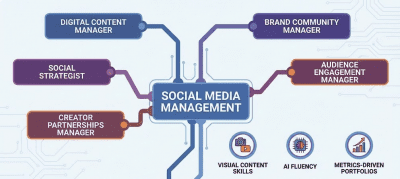
What was once a single job listing appears as five or six specialized roles: digital content manager, social strategist, brand community manager, audience engagement manager, and creator partnerships manager. Each reflects a specific slice of what social media management has become.

If you’re searching only for the exact phrase “social media manager,” you’re running a narrower hunt than the market offers. And employer expectations have climbed. Visual content skills, AI fluency, and metrics-driven portfolios are baseline requirements, not nice-to-haves.

Here’s how to search smarter and meet the raised bar.

Where the Jobs Actually Are

Search Wider Than the Title

Run parallel searches across multiple titles. The roles demand similar skill sets, but the listing language has diversified. Set up alerts for all of these:

  • Digital Content Manager
  • Social Strategist
  • Brand Community Manager
  • Audience Engagement Manager
  • Creator Partnerships Manager
  • Social Media Specialist (often equivalent to manager-level work despite the title)

Cross-industry demand is broader than most candidates realize. Consumer packaged goods brands, healthcare systems, financial services firms, nonprofits: they all need this work done. Don’t box yourself into agencies and tech companies.

social media management

Go Beyond the Aggregators

Major job boards surface a fraction of what’s available. The roles matching your specific skills often appear first on niche platforms and in professional communities.

Niche job boards: Mediabistro’s job board focuses on media, marketing, and creative positions where social media management sits. The American Marketing Association board skews toward marketing-adjacent roles. Industry-vertical boards in whatever sector interests you (healthcare marketing associations, fintech career sites, entertainment industry job boards) surface openings before they hit LinkedIn.

For a broader look at how social media professionals break into their first positions, our guide on landing social media jobs covers the fundamentals across experience levels.

Professional communities: Slack groups, Discord servers, and industry-specific forums regularly surface openings before they go public. The value isn’t just job leads. It’s context about what specific companies are actually like to work for.

LinkedIn strategy: Skip the “Easy Apply” grind. Follow hiring managers at companies whose work you respect. Engage with their content meaningfully: comment on campaign posts, share their team’s work with your own analysis. When a relevant posting appears, your prior engagement puts you at the front of mind.

Direct outreach: Identify brands whose social presence you genuinely admire. Reach out to their marketing leads with a specific observation about their channels and a concrete idea for building on it. This works particularly well at mid-sized companies where the social team is small and constantly stretched. You’re not asking for a job. You’re demonstrating what you’d bring.

Reality Check: Many social media manager jobs remain remote-friendly given the digital nature of the work. But hybrid and on-site requirements have crept back, particularly at agencies and brands with in-house content studios. Factor location flexibility into your search filters, but don’t assume everything is remote.

What Gets You Past the Screener

The Technical Skills That Are Non-Negotiable

Scheduling and automation tool proficiency is table-stakes. Buffer covered seven post-scheduling apps in February 2026 alone; the tool landscape keeps shifting. Familiarity with at least two or three platforms in this category (Planable for collaborative planning, Loomly for approval workflows, native schedulers across major platforms) is expected from any manager-level candidate.

Visual content creation is essential. The line between social media manager and content creator has blurred. You don’t need to match a motion graphics specialist, but you should be comfortable designing static posts, editing short videos for Reels or TikTok, and understanding basic composition and typography. These graphic design skills are increasingly mentioned alongside traditional social media manager jobs.

AI fluency is showing up in job descriptions with growing frequency. Not deep technical expertise: practical application. Using generative tools to draft copy variations and brainstorm campaign concepts. Using predictive tools that suggest optimal posting times based on historical engagement. Understanding how AI-driven algorithm shifts affect reach.

Grit Daily reported on AI and social media algorithms this month, highlighting how these shifts are actively reshaping the space. Candidates who can articulate how they’d adapt strategy to algorithmic changes demonstrate the thinking that gets you past the screener.

Analytics and attribution have moved from a bonus to a requirement. Managers are expected to read data, not just post content. Familiarity with social listening tools like Brandwatch and native platform analytics (Meta Business Suite, LinkedIn Analytics, TikTok Analytics) is baseline.

But knowing what to do with the numbers matters more than pulling them. Which content themes drive actual engagement? Which channels produce conversions versus vanity metrics? Can you explain performance to stakeholders who don’t live on social media daily?

What Your Portfolio Must Prove

Hiring managers expect metrics-backed case studies, not screenshots of posts. A portfolio without quantified results often dies in initial screening.

Frame two to three case studies (even from freelance or personal projects) with clear before-and-after metrics:

  • What was the engagement rate before your content strategy shift? What happened after?
  • Did follower growth accelerate, and was it the right audience?
  • Can you show conversion attribution: newsletter signups driven by Instagram Stories, product page visits from a TikTok campaign, event registrations from LinkedIn posts?
Portfolio Formula That Works: Here’s the problem I inherited, here’s the strategic approach I took, here’s what changed. Numbers without narrative feel hollow. Narrative without numbers feels like guesswork.

Red flags employers catch immediately:

  • Portfolios that only show content samples with no performance context
  • Résumés that list platform names as “skills” without strategic substance (“proficient in Instagram” tells a hiring manager nothing; show a campaign you ran and what it accomplished)
  • Generic cover letters that don’t reference the company’s actual social channels

That last one matters more than candidates realize. Spend 20 minutes reviewing a brand’s social presence before writing your cover letter. Reference a recent campaign. Note a channel they’re underusing. Suggest a content format they haven’t tried. This signals you’re already thinking about their challenges.

For tactical advice on presenting your work once you land the interview, our social media manager success tips break down what strong candidates emphasize.

Standing Out in the Stack

If You’re Stepping Up From Coordinator to Manager

Your application needs to show strategic thinking and cross-functional collaboration, not just execution. Use your cover letter to demonstrate you understand:

  • Channel strategy: Why you’d prioritize one platform over another for specific business goals
  • Budget allocation: How you’d distribute paid social spend
  • Team coordination: How you’ve worked with designers, copywriters, and product teams on cohesive campaigns

A hiring manager can teach someone a new scheduling tool. Strategic thinking is harder to install.

The Follow-Up That Gets Noticed

A short, specific note that adds value (“I noticed your team launched this campaign last week; here’s a quick thought on extending that momentum”) stands out. A generic “just checking in” gets ignored. One demonstrates you’re paying attention. The other feels like template spam.

Start Your Search With a Strategy

The market for social media management work is broader than a single job title suggests. Search wider. Present sharper. Demonstrate results.

The Bureau of Labor Statistics projects 6% job growth for advertising, promotions, and marketing managers (the closest federal classification encompassing social media management) at a rate faster than average across all occupations. The demand is there. The title is just dressed differently than it was three years ago.

Start on Mediabistro’s job board, where media and marketing roles, including the social media manager jobs hiding under new titles, are posted daily. Set alerts for the alternative titles discussed above.

The strongest applications aren’t the ones that check every listed requirement. They’re the ones that prove you’ve already started thinking about the company’s specific challenges before you’ve landed the interview.

Hiring for media and marketing roles? Post your job on Mediabistro to reach qualified social media professionals actively searching.

Topics:

Advice From the Pros
Entertainment

Nexstar, Sinclair spend millions lobbying to rewrite TV station ownership rules

Nexstar, Sinclair spend millions lobbying to rewrite TV station ownership rules
By Hien An Ngo for OpenSecrets
6 min read • Originally published February 25, 2026 / Updated March 19, 2026
By Hien An Ngo for OpenSecrets
6 min read • Originally published February 25, 2026 / Updated March 19, 2026

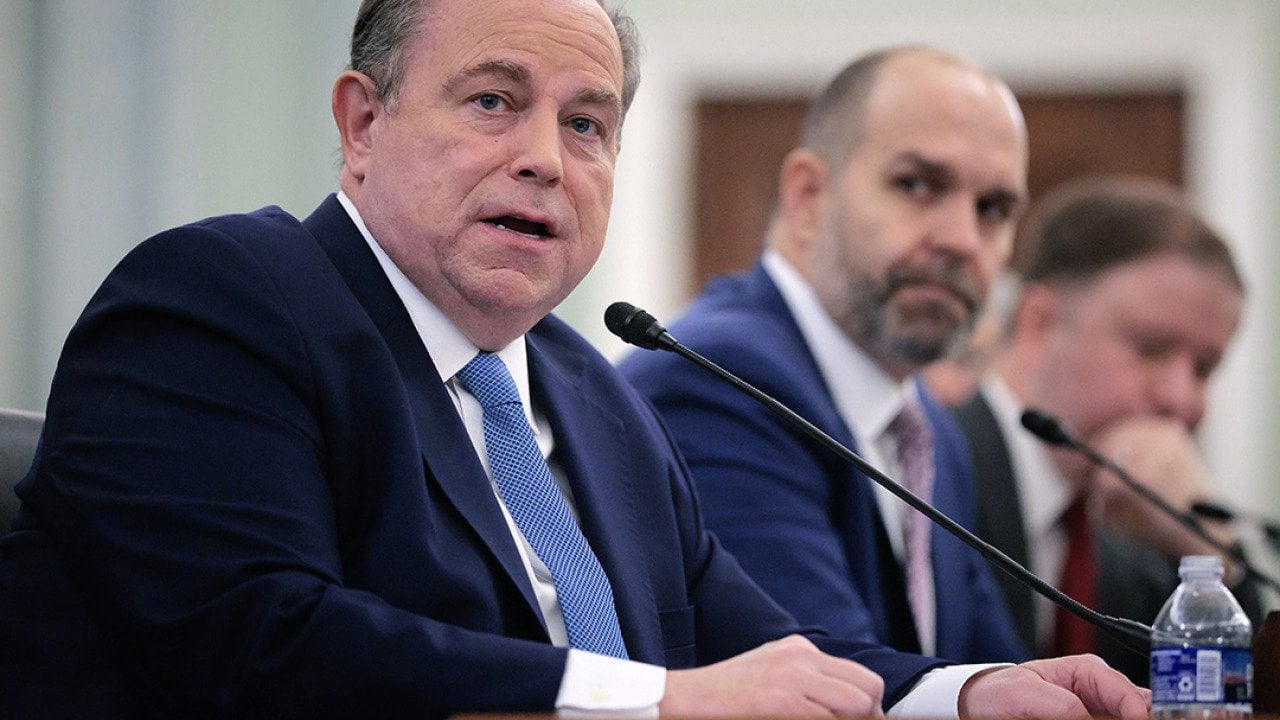
Newsmax CEO, Chris Ruddy, testifies during Senate hearing about media ownership on Capitol Hill, Washington D.C.

Chip Somodevilla // Getty Images

Nexstar, Sinclair spend millions lobbying to rewrite TV station ownership rules

Broadcast giants are pouring millions into lobbying as they push federal regulators to loosen limits on how much of the national TV market one company can control, a change that could reshape local television across the country.

OpenSecrets examined lobbying disclosures and congressional testimony to trace how the industry is working to rewrite the rules.

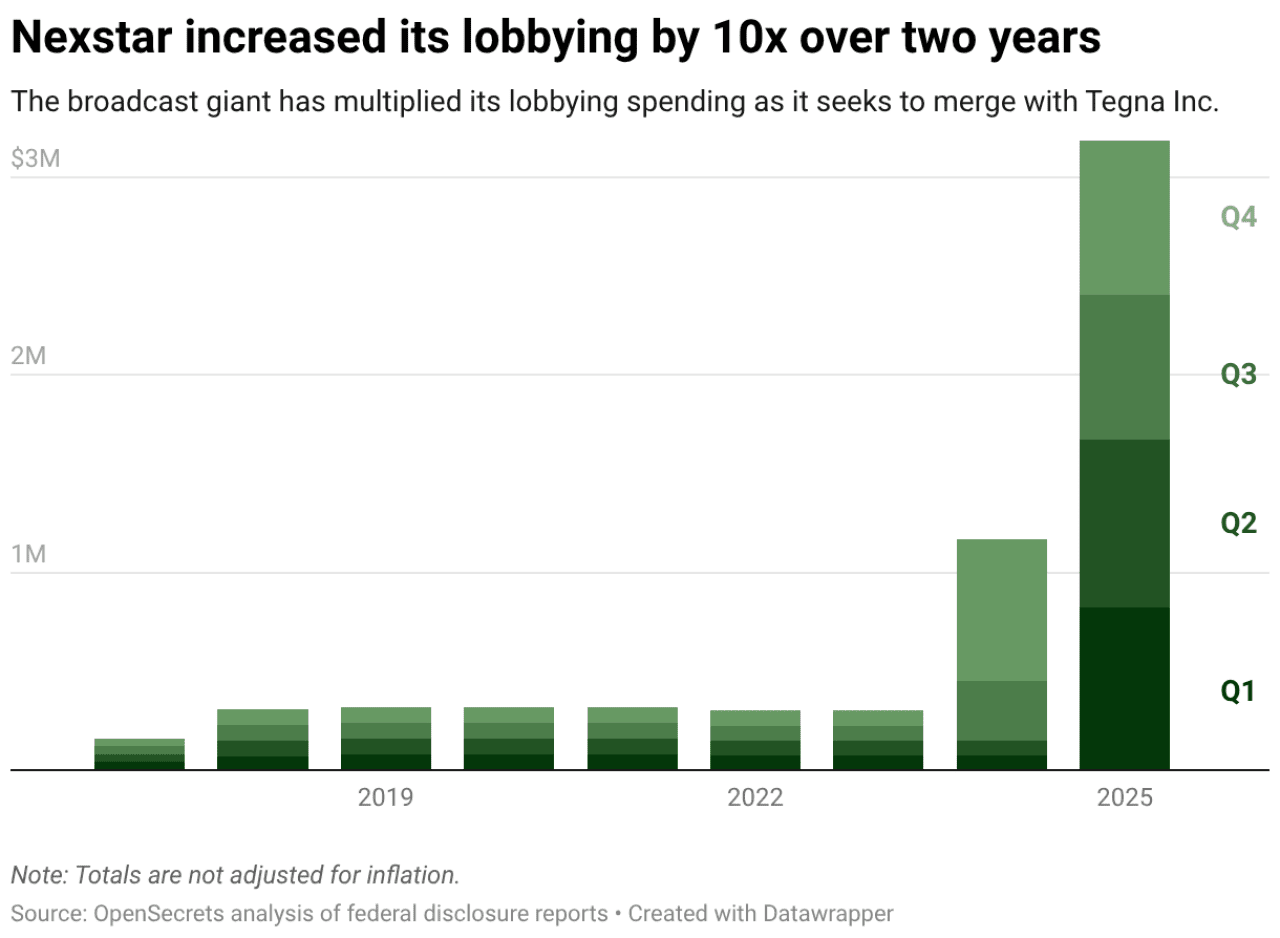
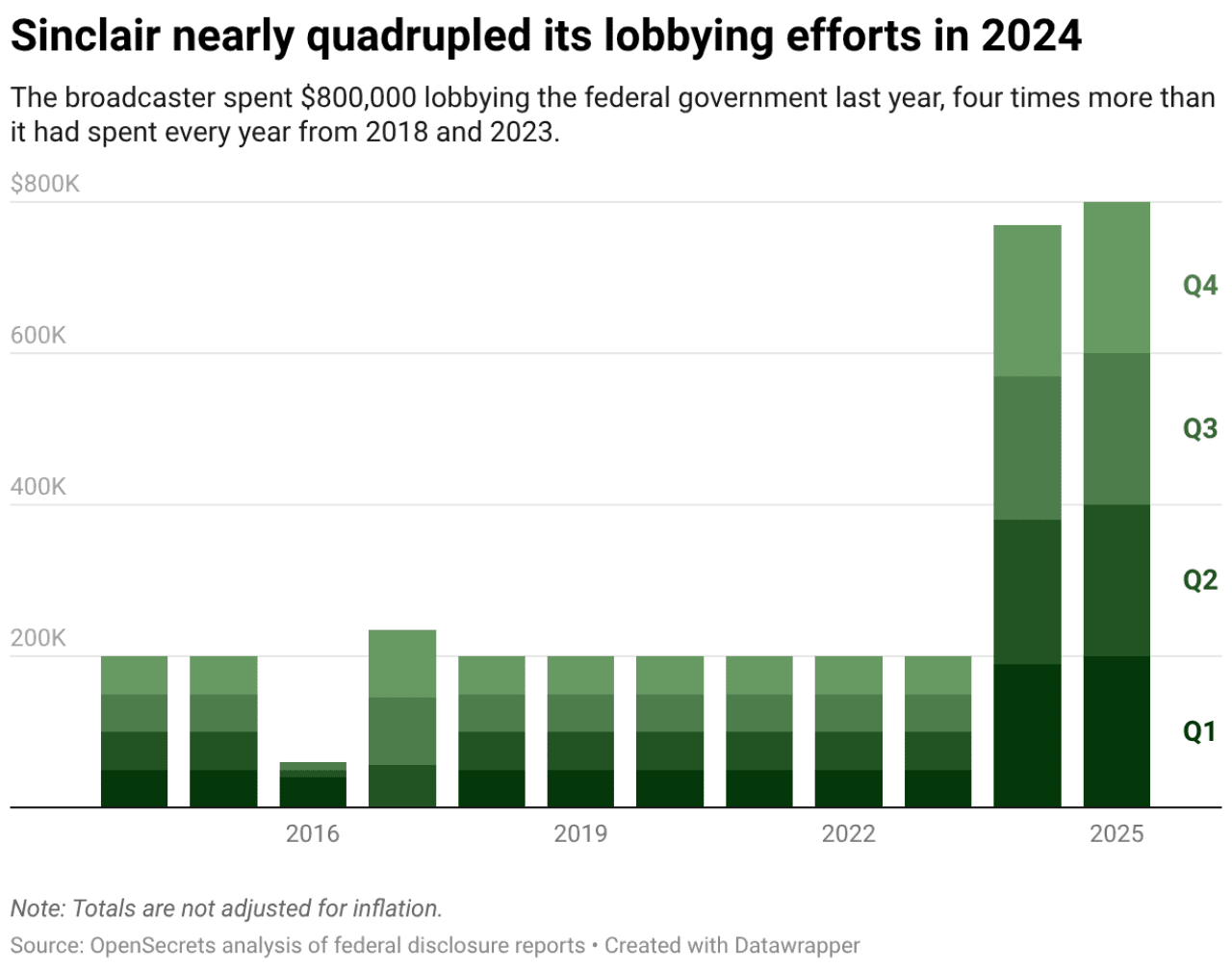
Nexstar Media Group, which owns the most TV stations in the country, spent $3.2 million lobbying the Federal Communications Commission in 2025, roughly 10 times more than it did every year from 2018 to 2023, when its lobbying activity remained steady. Sinclair Broadcast Group, the second-largest station owner, last year spent four times its 2023 federal lobbying total.

Both organizations are lobbying to change regulations that restrict their growth.

National station owners are limited to owning stations that collectively reach no more than 39 percent of the national audience, but a regulatory loophole known as the UHF discount lets some stations be counted as reaching fewer households than they actually do.

Without the discount, Nexstar serves 70 percent of national television households; with the UHF discount applied, however, its reach only extends to 39 percent.

Potential Nexstar-Tegna merger drives record lobbying

A data chart showing Nexstar increased its lobbying by 10x over two years.

OpenSecrets

Nexstar’s 2025 federal disclosure reports show the company lobbied on the ownership cap and a potential merger with Tegna, another major broadcaster.

In August 2025, Nexstar announced a deal to acquire Tegna for $6.2 billion. The proposed merger would send the cumulative household reach soaring past the 39 percent ownership cap. Thus, the deal is pending while the FCC determines whether to change the ownership rules.

To help sway the FCC, Congress and the White House, Nexstar hired lobbyist Jeff Miller, who served as finance chair on President Donald Trump’s second inaugural committee, at the start of 2025. Miller heads Miller Strategies, one of the firms that has benefited most from their close connection with the Trump administration. Nexstar paid the firm $510,000 over the course of the year, although most of its lobbying was handled by the company’s in-house team.

Tegna reported its first year of lobbying in 2025, spending $550,000 exclusively on Miller Strategies. Combined, the lobbying firm raked in over a million dollars from just the potential Nexstar-Tegna merger.

Sinclair multiplies spending as it eyes acquisition

Sinclair spent $800,000 lobbying the FCC last year on issues such as media ownership and the communications ecosystem. When it nearly quadrupled its previous lobbying spending in 2024, it cited the same issues.

A data bar chart showing Sinclair's lobbying efforts and that it nearly quadrupled in 2024.

OpenSecrets

While Sinclair reaches a smaller share of TV households than Nexstar — about 24 percent when the UHF discount is applied — the company still sees the national ownership cap as limiting its ability to expand.

The company has been in conversations with multiple potential merger partners and launched a strategic review in August, pointing to a desire to acquire one of its peers. Discussions with E.W. Scripps, a smaller broadcast station owner, began in 2024. The conversations never progressed, and in November, Sinclair announced it would pursue a hostile takeover of Scripps.

Who gets to make the call?

Rudy Brioche, a former vice president and policy counsel at Comcast, said that increases in lobbying from broadcast companies are centered on pending mergers and implementation of the ATSC 3.0 standard, which would change how television is transmitted to households. Before working for Comcast for 16 years, Brioche served as chief of staff at the FCC.

“It is primarily about pending transactions, the ATSC standard 3.0, which is a new technology that would allow broadcasters to use the digital airwaves for other streams of revenue,” Brioche said.

That push for regulatory changes is unfolding as broadcasters see a more favorable political climate in Washington.

Trump’s push for deregulation has created hope for the largest station owners that they may gain more flexibility. The FCC has signaled its intention to do away with the 39 percent ownership cap, and its chairman, Brendan Carr, has shown support for allowing station owners to expand their reach.

However, the jurisdiction over the ownership cap was one of the topics discussed in a recent Senate hearing that examined the rules around broadcast media ownership in the digital age. The debate in Congress over who has the authority to change the 39 percent ownership cap is central to Nexstar’s and Sinclair’s expansion plans. In 2004, Congress set the 39 percent cap and explicitly prohibited the FCC from using its forbearance authority to avoid enforcing the limit.

Sen. Jacky Rosen (D-Nev.) made clear that the authority to change the cap lay with Congress.

“Just because large corporations like Nexstar and Tegna want to merge, it doesn’t mean they can simply ignore the laws that Congress has put in place,” Rosen said. “In order for there to be a merger that results in ownership above the 39 percent cap, Congress would have to change the law.”

Proponents of change to the ownership cap argue that Congress didn’t set a permanent statutory limit, but instead directed the FCC to modify its rules at specific moments in time, leaving the underlying cap as a regulatory creation that the agency can revisit.

The hearing also featured the National Association of Broadcasters’ chief executive officer, Curtis LeGeyt. NAB, the entertainment industry’s largest lobbying client, has long advocated for allowing station owners to expand past the ownership cap and for deregulation of the broadcast industry.

“These outdated regulations distort today’s video and advertising marketplace,” LeGeyt said. “They advantage giant tech platforms, global streaming services, pay TV providers and national cable programmers, while placing local broadcasters at a severe disadvantage.”

Chris Ruddy, CEO of Newsmax, a relatively small conservative broadcaster, urged members of Congress to protect the ownership cap, saying it blocks monopolization of the industry and promotes localism of stations.

Whether that cap holds may depend not only on Congress but on how the FCC responds to political pressure from the White House and industry. The FCC historically has acted independently from past administrations, but has become increasingly politicized under Trump.

During a congressional probe of the FCC focused on censorship and free speech in December 2025, Carr said the agency wasn’t independent of the administration, a contradiction to the mission statement that included the word “independent” prior to the hearing.

Brioche, who served as former chief of staff at the FCC, noted how much things have changed under Trump.

“It is different from past administrations, because past administrations viewed the FCC as an independent agency. This administration does not view the FCC as an independent agency,” Brioche said. “It views the FCC as a tool, an instrument of advancing its political interest.”

Trump has recently reversed his position: Last November, he responded to a warning by Newsmax’s Ruddy against lifting the ownership cap by railing against the potential expansion of station owners because it would help enlarge “Radical Left Networks.”

Nexstar has sought to represent the potential merger as aligned with the administration’s deregulation agenda. Its efforts seem to have worked. Trump reversed his position on the merger a few days before the congressional hearing, writing it would negatively impact the networks he doesn’t like and said, “GET THAT DEAL DONE!”

Tom Bettag, a lecturer at the University of Maryland and former producer at ABC, said the Trump administration’s approach to regulating broadcasters and journalists was a way to control the media’s portrayal of him.

“His real goal is to control the message that goes out to the American people, and to the degree that he can exercise control over the information that Americans get, he can work his will,” Bettag said. “In theory, he says that he is trying to fight anti-Trump bias, but in fact, his definition of anti-Trump bias is anything that isn’t pro-Trump.”

This story was produced by OpenSecrets and reviewed and distributed by Stacker.

Topics:

Entertainment
media-news

Hollywood’s Biggest Dealmaker Just Showed Up at the State of the Union

Mediabistro icon
By Mediabistro
The Mediabistro editorial team draws on 25 years of media industry expertise to cover jobs, careers, and trends shaping the industry.
5 min read • Originally published February 26, 2026 / Updated March 19, 2026
Mediabistro icon
By Mediabistro
The Mediabistro editorial team draws on 25 years of media industry expertise to cover jobs, careers, and trends shaping the industry.
5 min read • Originally published February 26, 2026 / Updated March 19, 2026

David Ellison spent Tuesday evening in the House gallery watching President Trump deliver his State of the Union address. Hours earlier, his Paramount Skydance had raised its Warner Bros. Discovery bid to $31 per share.

Sen. Lindsey Graham posted the invitation on X that afternoon. The timing was not subtle.

This is how entertainment consolidation works in 2026. The biggest media deals in a generation require more than bankers and board presentations. They require proximity to the people writing the regulatory environment.

Three stories from Tuesday night illustrate this. Ellison’s attendance, which shows you the political dimensions of mega-deal execution. The substance of Trump’s speech, which carried regulatory and trade signals that will shape how media companies operate over the next 12 months. And the fact-checking apparatus that has become its own journalism product line.

The Gallery Seat That Advanced a $31-Per-Share Bid

Ellison’s presence at the State of the Union was announced by Graham on social media the same day Paramount Skydance raised its Warner Bros. Discovery offer. The bid had been expected. Paramount completed its Skydance acquisition in 2025, and analysts have been waiting for the combined entity to move on another legacy media company. Warner Bros. Discovery, with its film library, HBO, and streaming infrastructure, is the obvious target.

What nobody expected was Ellison sitting in the House chamber that same night. That positioning matters because the Warner Bros. Discovery deal, if it proceeds, will face Justice Department antitrust review, FCC scrutiny on broadcast licenses, and likely Congressional attention given the sheer size of the combined companies.

A State of the Union invitation from a sitting senator signals access. Full stop.

Deal Reality: A combined Paramount-Skydance-Warner Bros. Discovery entity would control HBO, Showtime, MTV, Paramount Pictures, Warner Bros. Pictures, CNN, and major sports rights. That footprint demands open channels to Washington.

This is about structural reality. Media consolidation at this scale requires political relationships. The Paramount-Skydance merger itself faced months of negotiation and regulatory approval.

If you work at Warner Bros. Discovery, Paramount, or any legacy media company in consolidation conversations, Ellison’s gallery seat is a reminder: your next employer may be decided as much by regulatory appetite as by strategic fit. The antitrust posture of the current administration, the composition of the FCC, the Congressional committees overseeing media mergers: all live variables in your career trajectory.

What the Speech Said About Media, Trade, and Regulation

Trump’s address focused heavily on economic achievements and immigration policy, but the regulatory and trade signals embedded in it carry direct implications for media and entertainment.

Trump criticized the Supreme Court for striking down his emergency tariffs, which suggests renewed tariff pressure is coming. For media companies with international production and distribution, tariff policy is not an abstraction. Netflix, Disney, Amazon, and Warner Bros. Discovery all maintain substantial production infrastructure outside the U.S. and import content, equipment, and services across borders. Trade policy will affect production budgets, distribution costs, and the viability of international co-productions.

The tone on institutional conflict matters too. Trump’s criticism of the Supreme Court and his framing of political opponents as obstacles signal an administration comfortable with confrontation. That posture extends to regulatory agencies. The FCC, the FTC, and the Justice Department’s antitrust division all operate within this political environment. Companies navigating merger reviews should expect the administration’s public combativeness to filter into enforcement posture and negotiation dynamics.

Then there’s immigration. The framing took up a large share of speech time, and it has real workforce implications for entertainment and media. The industry relies on international talent across production, engineering, journalism, and creative roles. Policy shifts that tighten visa requirements or expand enforcement will hit hiring pipelines and project staffing, particularly for companies with distributed production models.

The Fact-Checking Operation That Runs Parallel to the Event

While Trump spoke, PolitiFact ran a live fact-check operation drawing on an archive of 1,144 previously fact-checked Trump statements dating back to 2011. The practice is familiar. The infrastructure behind it is worth examining.

Fact-checking a State of the Union in real time requires reporters who can cross-reference claims against years of prior statements, policy positions, and public records. It requires database systems that surface relevant past fact-checks instantly. And it requires editorial processes that can publish verified corrections without sacrificing accuracy for speed.

Career Signal: If you can work with data, understand archival systems, and write clear explanatory copy under deadline pressure, you are building around capabilities with durable value.

This type of journalism is expensive. It demands specialized skills in data journalism, archival research, and rapid verification. For news organizations competing with social-first outlets and AI-generated content, it is also one of the few sustainable differentiation strategies. A live fact-check operation demonstrates editorial capacity that newer entrants cannot easily replicate.

If you’re a journalist or editor evaluating career moves, track the investment in structured, database-driven journalism. Newsrooms that prioritize this work are building infrastructure that outlasts individual news cycles and creating roles that require a different skill set than traditional reporting.

What This Means

Tuesday night showed you the operating environment for the next phase of media consolidation. Deals get made in boardrooms. They get approved in Washington. Ellison’s State of the Union attendance was a demonstration of how power works when the companies reshaping entertainment need regulatory clearance to proceed.

If you work at a legacy media company, pay attention to who is building political relationships and how those relationships map to deal timelines. If you are evaluating job offers, consider that the company hiring you today may be part of a larger entity within 18 months.

If you are a journalist or editor, watch where newsrooms are investing in structured, archival journalism infrastructure. That investment signals editorial priorities and creates specialized roles.

If you are navigating these shifts and looking for your next role, browse open roles on Mediabistro. If you are hiring for positions that require political savvy, data journalism skills, or M&A experience, post a job on Mediabistro and reach the professionals who understand this landscape.


This media news roundup is automatically curated to keep our community up to date on interesting happenings in the creative, media, and publishing professions. It may contain factual errors and should be read for general and informational purposes only. Please refer to the original source of each news item for specific inquiries.

Topics:

media-news

Posts navigation

Older posts
Newer posts
Featured Jobs
Kirkus Media
Editorial Intern
Kirkus Media
New York City, New York (US)

Gaia Inc
MEDIA COORDINATOR
Gaia Inc
Louisville, CO

Gaia Inc
Global Paid Media Specialist
Gaia Inc
Louisville, CO

Gaia Inc
Director of Media Strategy
Gaia Inc
Louisville, CO

Hearst Television
Account Executive
Hearst Television
Milwaukee, WI, United States

All Jobs »
PREMIUM MEMBER

Cari Shane

Washington, DC
30 Years Experience
Based in the Washington DC area, I am a former television and radio reporter, working currently as a freelance journalist and 21st Century Media...
View Full Profile »
Join Mediabistro Membership Today

Stand out from the crowd with a premium profile

Mediabistro Logo Find your next media job or showcase your creative talent
  • Job Search
  • Hot Jobs
  • Membership
  • Newsletter
  • Career Advice
  • Media News
  • Hiring Tips
  • Creative Tools
  • About
Facebook YouTube Instagram LinkedIn
Copyright © 2026 Mediabistro
  • Terms of Use
  • Terms of Service
  • Privacy