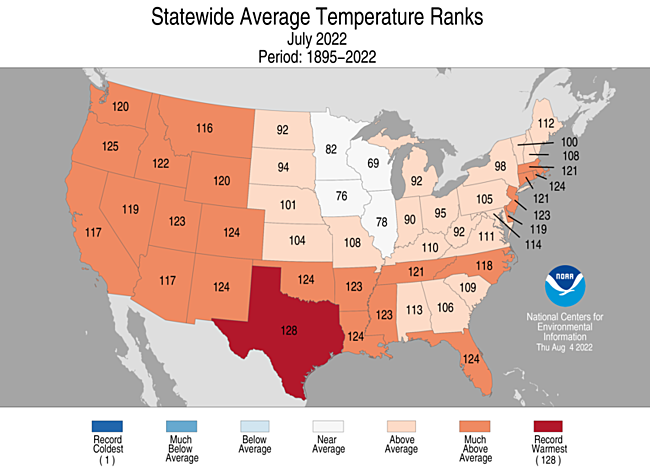
Climate change is driving rising temperatures and more record heat. The Earth’s temperature has climbed each decade since 1880 by about .14 degrees Fahrenheit, or roughly 2 degrees Fahrenheit total.
Stacker compiled a ranking of the hottest Aprils in New York since 1895 using data from the National Centers for Environmental Information. Rankings are based on the highest average temperature in each month. For each of the hottest months listed below, we’ve included the average state temperature, state-wide highs and lows for the month, and the total precipitation.
#10. April 1991 (tie) – Average temperature: 47.4°F – Monthly high temperature: 58°F – Monthly low temperature: 36.9°F – Total precipitation: 3.88″
#10. April 1987 (tie) – Average temperature: 47.4°F – Monthly high temperature: 57.9°F – Monthly low temperature: 36.9°F – Total precipitation: 4.13″
#9. April 1968 – Average temperature: 47.5°F – Monthly high temperature: 60.9°F – Monthly low temperature: 34.1°F – Total precipitation: 2.69″
#7. April 2023 (tie) – Average temperature: 48°F – Monthly high temperature: 60.2°F – Monthly low temperature: 35.8°F – Total precipitation: 3.91″
#7. April 1945 (tie) – Average temperature: 48°F – Monthly high temperature: 59.5°F – Monthly low temperature: 36.6°F – Total precipitation: 4.21″
#5. April 1941 (tie) – Average temperature: 48.1°F – Monthly high temperature: 61.7°F – Monthly low temperature: 34.6°F – Total precipitation: 1.57″
#5. April 1915 (tie) – Average temperature: 48.1°F – Monthly high temperature: 59.7°F – Monthly low temperature: 36.5°F – Total precipitation: 1.59″
#4. April 2008 – Average temperature: 48.4°F – Monthly high temperature: 61.3°F – Monthly low temperature: 35.5°F – Total precipitation: 2.81″
#3. April 2017 – Average temperature: 48.8°F – Monthly high temperature: 59.6°F – Monthly low temperature: 37.9°F – Total precipitation: 4.85″
#2. April 2010 – Average temperature: 49.2°F – Monthly high temperature: 62°F – Monthly low temperature: 36.4°F – Total precipitation: 2.09″
#1. April 1921 – Average temperature: 49.7°F – Monthly high temperature: 61.9°F – Monthly low temperature: 37.5°F – Total precipitation: 3.34″
Climate change is driving rising temperatures and more record heat. The Earth’s temperature has climbed each decade since 1880 by about .14 degrees Fahrenheit, or roughly 2 degrees Fahrenheit total.
Stacker compiled a ranking of the hottest Aprils in California since 1895 using data from the National Centers for Environmental Information. Rankings are based on the highest average temperature in each month. For each of the hottest months listed below, we’ve included the average state temperature, state-wide highs and lows for the month, and the total precipitation.
#8. April 2021 (tie) – Average temperature: 58.2°F – Monthly high temperature: 72.5°F – Monthly low temperature: 44°F – Total precipitation: 0.29″
#8. April 2019 (tie) – Average temperature: 58.2°F – Monthly high temperature: 70.3°F – Monthly low temperature: 46.1°F – Total precipitation: 1.22″
#8. April 2013 (tie) – Average temperature: 58.2°F – Monthly high temperature: 71.7°F – Monthly low temperature: 44.7°F – Total precipitation: 0.71″
#8. April 1985 (tie) – Average temperature: 58.2°F – Monthly high temperature: 72.1°F – Monthly low temperature: 44.3°F – Total precipitation: 0.24″
#8. April 1962 (tie) – Average temperature: 58.2°F – Monthly high temperature: 72.6°F – Monthly low temperature: 43.8°F – Total precipitation: 0.47″
#7. April 1939 – Average temperature: 58.3°F – Monthly high temperature: 72.4°F – Monthly low temperature: 44.2°F – Total precipitation: 0.55″
#6. April 1990 – Average temperature: 58.4°F – Monthly high temperature: 71°F – Monthly low temperature: 45.7°F – Total precipitation: 0.83″
#5. April 1959 – Average temperature: 58.8°F – Monthly high temperature: 73°F – Monthly low temperature: 44.6°F – Total precipitation: 0.55″
#4. April 1992 – Average temperature: 58.9°F – Monthly high temperature: 72°F – Monthly low temperature: 45.9°F – Total precipitation: 1.03″
#3. April 1987 – Average temperature: 59.3°F – Monthly high temperature: 74.1°F – Monthly low temperature: 44.5°F – Total precipitation: 0.4″
#2. April 1934 – Average temperature: 59.8°F – Monthly high temperature: 74.2°F – Monthly low temperature: 45.4°F – Total precipitation: 0.6″
#1. April 1989 – Average temperature: 60°F – Monthly high temperature: 73.5°F – Monthly low temperature: 46.4°F – Total precipitation: 0.83″
Matt Charney is a talent acquisition analyst, journalist, and marketing leader with nearly two decades of experience at the intersection of recruiting, HR technology, and media. He has held editorial and content leadership roles at ERE Media, Recruiting Daily, and Recruiter.com, and served as Chief Content Officer at Allegis Global Solutions. As Principal Analyst at Kyle & Co, he covers HR tech funding, M&A, and market strategy. Matt currently serves as Executive Editor at Mediabistro, where he leads editorial, partnerships, and multimedia content for the creative professionals who power the media industry. He holds a degree in Writing for Screen and Television from the University of Southern California.
17 min read • Originally published February 12, 2026 / Updated April 2, 2026
Matt Charney is a talent acquisition analyst, journalist, and marketing leader with nearly two decades of experience at the intersection of recruiting, HR technology, and media. He has held editorial and content leadership roles at ERE Media, Recruiting Daily, and Recruiter.com, and served as Chief Content Officer at Allegis Global Solutions. As Principal Analyst at Kyle & Co, he covers HR tech funding, M&A, and market strategy. Matt currently serves as Executive Editor at Mediabistro, where he leads editorial, partnerships, and multimedia content for the creative professionals who power the media industry. He holds a degree in Writing for Screen and Television from the University of Southern California.
17 min read • Originally published February 12, 2026 / Updated April 2, 2026
This week, the Super Bowl ended with the Seahawks dominating the Patriots, but the real story, as always, had nothing to do with the action on the field.
That’s because the Super Bowl is more than a sporting event – it’s a cultural touchstone, a uniquely American spectacle (even when the halftime show is in Spanish, it’s somehow more mutually intelligible with English than Bawitdaba or the seminal Po Dunk).
It’s also the last true appointment viewing event in American media, the kind of shared cultural moment that disappeared along with the MASH finale, the ‘Who Shot JR’ cliffhanger on Dallas, or Liza Minnelli appearing on any daytime talk show.
For comparison, only about 8 million people globally have watched Oscar frontrunner Marty Supreme (about 7 million more than Melania); the most recent White Lotus season captured the Zeitgeist, but only around 6 million viewers to date; or 2025 Best Musical Tony winner Maybe Happy Ending, which has sold just over half a million tickets since its debut in 2016.
That sort of viewership is why the Super Bowl remains an unprecedented media and advertising machine, with companies shelling out an eye-watering $8 million for a single 30-second spot, with some ads selling for as much as $10 million. That’s basically like throwing the equivalent of the annual GDP of a developing nation towards a crypto commercial with a questionable celebrity cameo, or the entire average budget of an A24 release on a single spot.
Is it worth it? Well, the Super Bowl drives the one mass audience moment remaining in American media, and brands are willing to pay exorbitant fees for that concentrated attention, even though ads are optimized for word of mouth and brand awareness – not direct sales impact.
Break-even analysis shows that to justify spending, Super Bowl advertisers require tens of millions in incremental revenue before generating any revenue from their spend, and tens of millions more to justify the resulting ROI. And yet, ad space sells out months in advance, with demand (and pricing) soaring every year.
The stupid money generated by the biggest of Big Games is great news for anyone working in the media industry, too, with thousands of jobs created around the periphery of this multi-ring circus – the game is a reliable boon for roles ranging from production crews to live technicians and post production editors to event marketers, media planners, account teams, and more.
A recent study by a Bay Area think tank (hella) estimated that the most recent Super Bowl would create over 5,000 local jobs, plus an additional 15,000 roles from increased demand in tourism, logistics, and event support.
These numbers are a bit misleading; the overwhelming majority of these roles are obviously temporary, gig, or contract work that’s both inherently seasonal and highly unstable. Even then, the competition is fierce.
The people you see working the game are not “the lucky few.” They’re actually the survivors of a brutally competitive labor market that chews up ambition while restricting opportunities.
For the 60 jobs created for local youth through the Juma program in partnership with the Super Bowl, thousands of applicants competed for roles with an average pay of around $18.70 an hour; staying above the poverty line in the Bay Area, by contrast, requires at least $27/hr minimum hourly wage.
But this low pay, extreme competition for a handful of unstable opportunities, isn’t just reserved for the big events like the Super Bowl – it’s endemic throughout the multi-billion-dollar economic driver that is the sports industry.
That’s why this week, we’re taking a closer look at sports-related careers and job trends. We’ll look at what the numbers say, where hiring is actually happening, and what the future holds for jobs in the sports media and industry.
Super Bowl LX didn’t just deliver TV ratings; it underscored how many people you need behind the scenes to deliver that spectacle.
From sideline reporters flying between franchises to influencers-turned-broadcast contributors, the industry’s talent pipeline extends far beyond the field.
But before we dive into our deep dive into careers in sports, let’s take a look at the week’s biggest stories, and break down what the headlines really mean for industry professionals and media careers.
1. The Labor Economics of the Super Bowl
The Super Bowl isn’t just a football game; it’s a content factory, with everyone from podcasters, producers, and technical crews to sportswriters, broadcasters, and on-site coordinators creating the engine driving a week’s worth of multi-platform coverage that generates more eyeballs than any other entertainment event of the year.
In just the last few years, credentialed media covering the show has skyrocketed – the NFL now includes social, streaming, and even influencers in the accredited press pool of almost 6500 media professionals, compared to only 2400 in 2021.
Under license from Creative Commons, God and the USA
Additionally, networks, newsrooms, and digital platforms add an estimated 4,800-5,000 roles each year to simply meet demand from viewers, visitors, and voyeurs. And that’s not even including the cast of thousands backing halftime performer Bad Bunny – or the 3 temporary PAs responsible for the Kid Rock-led “alternative” halftime debacle.
That show was for the questions that don’t have any answers, the midnight glancers, and the topless dancers (and whoever Lee Brice is).
While you probably hadn’t heard of any of the performers at the Turning Point halftime extravaganza unless you’re a big fan of American Idol deep cuts, chances are you’ve heard of one of the army of YouTube stars the NFL enlisted to cover the big game.
From Mr. Beast to Haylie Kalil (who’s probably hoping to avoid a hung jury in her impending libel case – boom), the league turned to exclusive streaming partner YouTube in a deliberate attempt to court a younger audience of viewers.
While those elusive Gen Z viewers probably have no idea what the hell that Good Will Dunkin’ ad was referencing, nor who Ben Affleck or Jennifer Aniston are (lucky them), they’re also not turning grown men giving each other CTE into event viewing – a cause for concern for a league that’s trying to soften its image as a blood sport controlled by really rich, old, stodgy white dudes. Look no further than the GOP to see how that perception resonates with the younger generation.
YouTube’s Super Bowl LX blitz included a full roster of content produced in partnership with the NFL, Google and capitalist pawns (er, creators), including an influencer flag football game, stand ups from the Levi Stadium field and access normally reserved for traditional media, such as interview opportunities with players and coaches, who no doubt were happy to trade Al Michaels for Kay Adams for their locker room sound bites.
This resulted in non-traditional coverage and behind-the-scenes access to live moments that most traditional sports media wouldn’t touch with a ten-foot pole. It’s an experiment that leans hard into the NFL embracing influencers as distribution and branding partners, rather than just those crazy kids from the interwebs who would have never before been considered for credentials.
The “sports reporter” job used to be about wire copy and beat notes; today, the business is aggressively pivoting toward creator economics, where audiences follow personalities and develop parasocial relationships with individual influencers rather than with networks or mainstream media outlets.
That means opportunities for anyone who can build an engaged online audience, produce compelling short-form content, and game the algorithm for relevance and reach. Sports leagues and broadcast rights holders (like Google) are increasingly outsourcing more of their media strategy to creators with built-in fan bases and millions of followers.
This growing push towards non-traditional content isn’t a one-off; it’s proof that you can build a viable career by leveraging social media skills and making sports feel relevant to non-traditional audiences and younger viewers. Talking heads on TV will always have a place in sports media, but the playing field continues to widen – as do the opportunities for savvy sports streamers.
3. The Economics of Advertising
Love it or hate it, advertising drives the economic engine, generating billions of dollars in annual revenue for sports media. The Super Bowl is the closest thing the US has to a monoculture moment (Incluso cuando Bad Bunny canta en español, es un crack) – and brands are paying 8 to 10 million dollars for half a minute of airtime because it’s really the only legacy brand left capable of consistently capturing an otherwise fragmented audience.
That’s some expensive paid media, but it’s more than big companies burning brand marketing budgets. Those spots represent entire payrolls, teams of strategists, media buyers, creatives, data scientists, production crews, and agency account leads whose entire year can hinge on how they rank on the USA Today Ad Meter. Of course, the on-air ad is only a small part of the all-out blitz that starts months before kick-off.
If they’re buying big for the big game, even the most mundane consumer packaged good will be working for months on integrated campaigns involving teasers, influencer tie-ins, event activation, media planning, brand lift studies, and other really exciting marketing motions.
After the confetti falls, analysts will pore over engagement metrics, sentiment data, conversion signals and Q ratings (among other made-up agency “analytics”) to prove to their clients that they generated ROI on their ten million dollar ad spend, and that it was definitely not a forgettable, regrettable budgetary bonfire.
For anyone in sports media, this one’s pretty obvious. The Super Bowl is more than a big-time broadcast; it’s a marketing machine that generates billions of dollars in brand spend every year.
According to Nielsen, live sports are one of the only formats that consistently reach millions of viewers in real time – a big reason why ad dollars keep going up, even as linear television goes down for the count. That sustained demand fuels what jobs in creative direction, performance marketing, audience analytics, and media buying, among other disappearing disciplines.
Many aspiring sports media professionals approach their nascent careers like fans; they should remember that, in this industry, the real action is never on the field. It’s in the boardrooms and war rooms where brands decide how and where to allocate that 8-figure ad spend. If you can turn thirty seconds into sustained relevance, well, you’ve probably got a pretty promising career ahead of you (or a really killer sex tape).
4. Do the Rights Thing
Sports media is about more than highlight reels and hot takes; the entire industry is funded primarily by broadcast rights revenue, not advertising dollars. This week, the increasingly lucrative, increasingly competitive battle for broadcast rights returned to the Worldwide Leader in Sports (and largest media brand in Bristol, CT).
In a heated bidding war, ESPN secured rights to the NFL Network and NFL RedZone, effectively consolidating a significant portion of the league’s image, narrative, and presentation into a single ecosystem controlled by a single corporate conglomerate. Hint: it’s the same one charging like $200 for one-day passes to their mediocre theme parks, ostensibly to recoup this profligate spend through margins on Dole Whips and old-timey paper silhouette making.
This is a pretty big structural issue. When one platform has an effective monopoly on premium properties and associated IP, it not only controls distribution but also how advertising dollars are allocated, how production budgets are set, and how supporting headcount is determined.
The NFL is already the nation’s most valuable media property, dominating the list of most-watched live broadcasts every year (unlike, say, whatever midseason replacement Fox greenlit this time around). With its new deal in place, though, the league is just another billion-dollar brand in the same IP stable as the Marvel Universe, Star Wars, and the Lizzie McGuire franchise.
Consolidation isn’t unique to sports media, and like other sectors of the media industry, it’s effectively an opportunity and a red flag. Larger, vertically integrated platforms require deeper infrastructure – more editors, streaming engineers, analytics specialists, sponsorship strategists, and other mundane, but necessary, high-paying corporate gigs.
Similarly, integrated ecosystems require increased content operations, digital packaging, cross-platform programming, and audience engagement. That means while the machine gets bigger, so too do the job opportunities.
This is obviously a double-edged sword. When rights are concentrated, so too is power; more inventory is controlled by fewer companies, which means fewer decision makers, stakeholders, and, in short order, staff across siloes and specialties.
If you’re in sports media, your career trajectory will be determined as much by proximity to whoever happens to control distribution as by luck, timing, or talent. Better start sucking up to the good folks over at Netflix, or start sending care packages over to the Team Disney Building.
When rights consolidate – and for the NFL and most other major sports, they look to be locked down for the indeterminate future – production centralizes, and jobs become tightly clustered, rather than evenly spread. The question is, are you positioned inside that cluster, or do you live outside of the friendly confines of the Nutmeg State?
This brings us to the part no one likes to say out loud: if you want a career in sports but don’t have the athletic skills, you’d better have the pedigree or the connections already in place.
The truth is, this is one industry where getting your foot in the door requires genes more than grit, where who you know is more important than what you know, and networking is the only talent that really matters when building a sustainable career in sports.
But then again, that’s probably true of most industries, too.
The Job Market Reality
Sports media jobs are among the most disproportionately competitive roles in the market, at least relative to total pay and projected growth.
According to BLS data, sports broadcasting, operations, production, and support roles are projected to grow more slowly than general entertainment or media jobs.
The already finite amount of open roles available generally opens only due to periodic attrition, rather than expansion- particularly for full-time roles, making the odds of working in sports almost as infinitesimal as actually playing professionally.
But even if you land a gig, much like an NFL player, there’s no guaranteed money; career longevity is limited to a couple of years on average; and the only way to make the active roster is if someone else gets cut, which rarely happens in off-the-field roles.
MEDIABISTRO SPOTLIGHT
While there aren’t a ton of open jobs in sports media or production, the good news is that the latest openings and hottest jobs from across the industry get posted every day directly on Mediabistro.
So, if you’re looking to break into the business of sports, or just trying to figure out your professional game plan, head on over to Mediabistro.com to check out thousands of new job listings from across the entire media and entertainment landscape, too.
You Don’t Need to Be An Athlete to Work in Sports. Just an expensive degree.
The background of people working professionally in sports, from broadcasting to production to marketing and PR, is relatively consistent, even if their roles are anything but.
An analysis of full-time workers in the sports industry reveals some telling trend lines. Here’s how you score a spot at the career Combine:
Early access. Many professionals in sports started out as unpaid interns (like graduate assistants, in NCAA parlance) or in underpaid seasonal roles, such as event promotions or corporate ticket sales; these jobs generally pay only on commission or are limited to a few weeks or months a year.
According to BLS data, the entry-level salary in the sports industry is a whopping 22k a year (the silver lining is that’s so low it’s completely tax-free). Many professionals enter the industry before completing their education, so these roles are subsidized through college credits, student loans, or, most commonly, family support.
Let’s just say Media Row isn’t exactly crammed with first-generation college grads or people who need to be financially independent in their twenties.
Elite institutions. There are a handful of blue-chip institutions that, because of their proximity to networks and reputations, tend to act as pipelines to the pros. These include top-tier journalism schools like Indiana, Northwestern, Michigan, and Missouri, each of which has a disproportionate number of J-School grads currently employed in sports media.
They also include a handful of highly reputable, top-ranked sports management or sports business programs, such as UT Austin, UMass, Miami, and Rice – schools with prime alumni pipelines and trusted connections with the networks and leagues looking to hire.
Sure, you don’t need a college degree or academic pedigree to succeed in a sports media career, but it’s perhaps the most imperative factor in determining who gets hired for the few coveted openings on the market; referrals dominate hiring in this industry.
Where your degree came from, sadly, often matters more in the sports industry than what your reel looks like or what relevant experience you might have in related roles or industries.
Flexibility Jobs in sports are rare and highly competitive, meaning that talent often can’t afford to stick around in a single market. These roles reward those who can relocate on short notice, who have no expectations for work-life balance, who are open to the grind of constant travel, and who will live in the most expensive media markets for poverty-level pay without blinking.
If you want free time, a family, stability, or disposable income, this probably isn’t the right career for you in the first place.
Talk about trade-offs. So if you don’t check any of the standard sports industry boxes listed above, or are having trouble breaking in or landing a gig, don’t worry.
You’re probably better off doing literally anything else.
The Blind Side of Jobs in Sports
There’s no doubt that for many, sports is a fantasy job – the kind of gig you dream about your entire life. But the thing about fantasy sports is that it’s arbitrary, difficult to keep up with, and almost impossible to win, even with impeccable planning and management. And if you do beat the odds, well, the payoff is mostly pride (with a few bucks thrown in to make it interesting).
That “dream job” discount is real: early-career production assistants, editors, and reporters routinely earn less than their peers in corporate media or branded content roles; this trend continues even for more experienced positions. These roles trade mostly on prestige and passion, not pay.
As mentioned, the hours are brutal, and predictability isn’t an option. Neither is working nights, weekends, holidays, and a ton of overtime, just to keep up.
Unsurprisingly, burnout is common; live events compress stress, deadlines are tight, and public scrutiny is constant, intense, and ubiquitous. One mistake can be broadcast to millions of people, a pressure that’s constantly felt by everyone with credentials.
Stability is non-existent; rights deals shift, networks restructure, and entire production teams or sports departments can disappear when contracts move platforms or content switches to other providers. Freelancing is not a phase- in sports, it’s a structural part of how professionals make ends meet in between full-time gigs, which are mostly anything but.
Additionally, while competition for sports-related media roles is fierce, it’s even more intense for experienced professionals; the ladder narrows quickly, with many entry points leading to very few executive roles.
Advancement slows dramatically after the 3-year mark, according to Nielsen data, and the average sports media career lasts only marginally longer than that, around 4.2 years, according to the same report.
None of this is a secret; it’s just not the reality most professionals looking to break into the industry ever really hear before choosing to make the (somewhat suspect) jump.
WHY PEOPLE STILL DO IT: THE FUTURE OF JOBS IN SPORTS
Here’s the part that nobody puts in the training montage or highlight reel. Sure, there are some glamorous gigs in sports – mostly on-air roles like announcers, sideline reporters, or whoever gets to mop the lane after every NBA possession.
The former athletes with bad blazers and worse hot takes, and the professional broadcasters with great diction and bad toupees are iconic – and they’ll always exist. But the hiring curve isn’t exactly bending upwards for the aspiring Bob Ueckers or Chick Hearns of the world.
The real growth is happening off camera, off the air, and off the field. Every snap on Sunday, every pitch thrown by a journeyman pitcher making fifty million bucks, every hockey faceoff that no one really watches because, you know, it’s hockey – every one of these moments still requires a small army of support staff.
From digital producers to motion designers, from platform strategists to rights lawyers (the worst), from sponsorship analysts to partnership managers (here’s hoping they fired whoever blew the Farmer John’s-Dodger Dog deal), every moment of live drama requires decades of experience and dozens of skilled professionals. The broadcast is what the world sees; the real power and the real job opportunities stay squarely behind the scenes.
Sports is a business. And the bigger it gets, the more opportunities it should create, particularly for non-traditional platforms and creators who have more fans than the New York Jets (and are much happier, too). Sure, if you want a career in sports media, you’ve got to believe a little in the mythology of sports. Just understand that once the final whistle blows and the last piece of popcorn is swept off the concrete, the real work begins.
The business, and the paychecks, happen behind the scenes; people turning raw footage into narrative story arcs and short films, strategists mapping spot ratings and forecasting overnights, and data scientists mining stat lines for better predictions and deeper fan insights – a perpetual cycle that turns with every sports season.
Sure, it’s not nearly as romantic as everybody’s favorite gym teacher kissing everyone’s favorite English teacher after winning the Super Bowl (barf). But it’s also way more stable and far more future-proof, too.
It might be a bit cynical, but the thing is, industries run on infrastructure and scale, not nostalgia and emotional attachment. The future of sports careers has little to do with sports; instead, it belongs to the builders and creatives who understand the games are nothing more than content, a product that has to be distributed as widely and monetized as much as possible.
In other words, the business of sports media is increasingly just like any other business. It might not be glamorous, it isn’t exactly visible, and it’s not exactly stable or financially viable, either.
But for those who are willing to fight for their dream, it might not be easy, but if you build it, your sports career will come.
Matt Charney is a talent acquisition analyst, journalist, and marketing leader with nearly two decades of experience at the intersection of recruiting, HR technology, and media. He has held editorial and content leadership roles at ERE Media, Recruiting Daily, and Recruiter.com, and served as Chief Content Officer at Allegis Global Solutions. As Principal Analyst at Kyle & Co, he covers HR tech funding, M&A, and market strategy. Matt currently serves as Executive Editor at Mediabistro, where he leads editorial, partnerships, and multimedia content for the creative professionals who power the media industry. He holds a degree in Writing for Screen and Television from the University of Southern California.
Matt Charney is a talent acquisition analyst, journalist, and marketing leader with nearly two decades of experience at the intersection of recruiting, HR technology, and media. He has held editorial and content leadership roles at ERE Media, Recruiting Daily, and Recruiter.com, and served as Chief Content Officer at Allegis Global Solutions. As Principal Analyst at Kyle & Co, he covers HR tech funding, M&A, and market strategy. Matt currently serves as Executive Editor at Mediabistro, where he leads editorial, partnerships, and multimedia content for the creative professionals who power the media industry. He holds a degree in Writing for Screen and Television from the University of Southern California.
6 min read • Published April 2, 2026
FADE IN:
It’s been the kind of year at the box office that makes you wonder if audiences collectively decided to take a gap year. And honestly, who could blame them?
If you were one of the handful of people who actually showed up for Snow White, Tron: Ares, or Captain America, you probably walked out wondering if you could file a class action lawsuit against the Walt Disney Company for lost time and emotional distress, much like paying full price for California Adventure admissions.
Thing is, these weren’t just soft releases. They were the cinematic equivalent of those legacy enterprise platforms that keep getting “refreshed” even though no one asked for an upgrade.
Weak turnouts and even weaker grosses led many industry watchers to confidently announce that moviegoers were finally done with reboots, remakes, and sequels. It was a nice theory until reality walked in wearing a pair of mouse ears.
For most of 2025, the box-office narrative seemed to be entering some sort of death spiral. Every Friday brought another hopeful “maybe next week.” Then next week brought M3gan 2. At a certain point, you start rooting for the streamers and the spreadsheets.
This week, though, the spell finally broke. Zootopia 2 blasted out of the gate, Wicked: For Good kept defying gravity, and together they delivered the kind of combined box office studios used to treat as a baseline instead of a miracle.
If you work in film, production, media, or development, this weekend felt like a reminder that audiences will actually show up when the content hits. Turns out people still want stories built on IP they care about. Just maybe not a live-action Lilo & Stitch.
And with that bit of good news for an industry that’s been living off antacids and optimism, it’s time for Mediabistro’s Weekly Drop, your quick scan of what actually matters in the entertainment industry this week.
LEAD STORY
Zootopia 2 Hits a Record Opening and Turns the Box Office Into an Actual Party
Disney’s Zootopia 2 came in swinging with a massive opening weekend that topped industry projections and delivered one of the biggest animated debuts of the decade. Families showed up in force and kept showing up through the long weekend.
At the same time, Wicked: For Good continued its breakout run. The two films combined for a domestic haul that pushed the weekend past the strongest two-title box office total of the year and one of the best since 2019.
Why this matters: For the first time all year, the numbers do not need asterisks or excuses. Zootopia 2 gave theaters a genuine win, Wicked brought repeat viewership, and together they moved the totals into territory that finally resembles a normal holiday corridor.
Year-to-date comparison:
This weekend outperformed every previous 2025 frame that relied on a single tentpole to carry results.
Combined, Zootopia 2 and Wicked outpaced the best two-movie weekends of the summer by a wide margin.
The surge puts the 2025 domestic box office closer to the pre-Thanksgiving forecasts studios were praying to hit.
Studios will read this as a very simple message. Audiences will still show up for event films. Families still fuel holiday corridors.
Animation and musical fantasy can still mint money. And original mid-budget creatives should probably call their agents.
THE STREAMING WARS
Netflix Keeps Pushing the Boundaries While Regulators Keep Taking Notes
While theaters were celebrating, Netflix spent the week quietly making its case to lawmakers that owning a major studio is not the same as contracting one.
The company continues to explore its options around Warner Bros. Discovery, even as antitrust voices grow louder – and even as there’s fairly well-established case law prohibiting vertical integration within the industry (see: US v Paramount).
Of course, Netflix’s most recent quarterly results suggest that slowing subscriber numbers mean that the company must quickly find alternative revenue streams – meaning this marriage of convenience could effectively provide the same sort of moat now enjoyed by The Walt Disney Company and Sony.
Why It Matters: If Netflix succeeds, it becomes a vertically integrated content machine with unparalleled leverage. If the deal stalls, the entire sector could experience a slowdown in acquisitions and hiring.
Either way, the next move reshapes the development, distribution and rights ecosystem. Let’s just hope Larry Ellison isn’t involved this time, as TikTok gears up as a pretty handy native distribution tool for Paramount properties.
Fresh data from the International Confederation of Societies of Authors and Composers, a global network representing 5 million creators across 228 management organizations, showed that streaming growth in several key European markets has cooled. For creators, despite seeing royalty payouts hit historic highs this year, the impact of Generative AI is expected to erode payouts to creators by over 25% in the next two years.
Platforms are shifting their focus from expansion to retention, especially on higher-margin ad tiers. And, of course, buying legacy media properties. Meanwhile, creators should start feeling the squeeze – particularly given the EU’s traditional positioning as a reliable leading indicator for compliance and consumer trends.
Career takeaway:
Jobs tied to analytics, localization, rights management, and audience modeling are trending up. Writers’ rooms and prestige development pipelines are growing slower than the operational roles that keep platforms profitable – as are the payouts for creators. AI and IP seem to be headed for a collision course, and AI’s victory seems like an inevitability that’s already influencing the media landscape.
Even with the Zootopia 2 bump, analysts have pointed out that next year’s slate remains underdeveloped. With some productions delayed and others rewritten for cost efficiency, studios could face a quieter release calendar than anyone expected.
Why it matters: A strong holiday corridor does not hide the structural gaps. If 2026 opens with a light slate, production teams, VFX houses, and below-the-line talent will feel the turbulence first.
MEDIA CAREERS + INDUSTRY JOBS
Creators Keep Walking Away from Streamers to Find Stability
This week brought another wave of creators signing with traditional studios. The promise of stability, clearer ownership structures, and predictable development cycles remains appealing in a market where greenlights change with the algorithm.
Why the shift is real: Creators want partners with consistent editorial judgment rather than data-driven volatility. That is changing the talent landscape faster than streamers expected.
Spotify is hiring creatives, marketers, and engineers who want to shape how the world listens. If you’re driven by storytelling, data, and culture, Spotify’s open roles offer a front row seat to what’s next in audio.
Check out their latest openings on Mediabistro: Spotify Jobs
THE BOTTOM LINE
For the first time in a while, the week finally didn’t feel like Hollywood was in full-blown crisis mode. Distributors and theatres got a win. Streamers showed their cards. And, of course, media careers continue to evolve along with the industry.
When I was at my very first job at Focus Features, the producer I was assisting once offered me a piece of advice that I clearly didn’t follow: “If you go the business route, no one will ever hire you on the creative side again.” Good advice, back when Netflix shipped physical copies of DVDs and Warner Bros. was the crown jewel of the AOL empire. Today?
There’s no choice for media professionals. If you want to make it, you’ve got to be able to handle both business and creativity. Today, there’s no such thing as “above the line” and “below the line.” There’s just the bottom line.
Matt Charney is a talent acquisition analyst, journalist, and marketing leader with nearly two decades of experience at the intersection of recruiting, HR technology, and media. He has held editorial and content leadership roles at ERE Media, Recruiting Daily, and Recruiter.com, and served as Chief Content Officer at Allegis Global Solutions. As Principal Analyst at Kyle & Co, he covers HR tech funding, M&A, and market strategy. Matt currently serves as Executive Editor at Mediabistro, where he leads editorial, partnerships, and multimedia content for the creative professionals who power the media industry. He holds a degree in Writing for Screen and Television from the University of Southern California.
10 min read • Originally published December 17, 2025 / Updated April 2, 2026
Matt Charney is a talent acquisition analyst, journalist, and marketing leader with nearly two decades of experience at the intersection of recruiting, HR technology, and media. He has held editorial and content leadership roles at ERE Media, Recruiting Daily, and Recruiter.com, and served as Chief Content Officer at Allegis Global Solutions. As Principal Analyst at Kyle & Co, he covers HR tech funding, M&A, and market strategy. Matt currently serves as Executive Editor at Mediabistro, where he leads editorial, partnerships, and multimedia content for the creative professionals who power the media industry. He holds a degree in Writing for Screen and Television from the University of Southern California.
10 min read • Originally published December 17, 2025 / Updated April 2, 2026
THE MEDIABISTRO WEEKLY DROP: CAN’T HANDLE THE TRUTH EDITION
December 17, 2025
I’ll be real with you; because this dumpster fire of a year just isn’t done with us quite yet, the headlines on Sunday hit me harder than I expected. The Rob Reiner reporting was a news story so tragic and out of the blue that my first thought was that it had to be a mistake, or a sick joke.
But sure enough, Rob Reiner and his wife were found dead in their home in what authorities are investigating as a homicide.
The tributes poured in; so too did the tears. And while the industry, inevitably, stopped just long enough to acknowledge his contribution, business as usual feels like anything but, really. The absence of one of the most influential and ubiquitous hyphenates in history feels conspicuous, to put it mildly.
Reiner was one of the last of his kind – a guy whose work not only filled seats (at least for a good couple of decades) but also actually shaped how a lot of us understand storytelling, character development, and comedic timing.
Reiner’s films feel like a relic – they assume that the audience is as smart as the characters on the screen, and every bit as invested (without a lot of heavy-handed exposition or pandering voiceovers). His works trusted the power of tone, and believed that the characters and the worlds they inhabit matter more than some studio algorithm.
I remember watching The Princess Bride on a grainy VHS tape so much that the tracking went fuzzy (yeah, I’m old) – and realizing for the first time that not everything has to follow a familiar formula or a genre, or rely on traditional casting conventions (I’d love to have been at a table read featuring André the Giant, Wallace Shawn and Mandy Patinkin), or narrative arc (ditto Peter Falk and Fred Savage).
Reiner taught us that accessibility and sensibility weren’t enemies, and that the best written characters in film offer the kind of insight and understanding into human nature (and the state of the world) that no other medium can replicate.
I know that was a depressing opening to a friggin’ newsletter, but Reiner’s work is worth thinking about this week, if only because one quick glance at the media business headlines this week seem to be trending in the exact opposite direction.
You want the truth? You can’t handle the truth. Because the truth is, these stories from the last week suggest that the entertainment industry is moving in a direction that’s got a lot to do with industry, and precious little to do with entertainment.
Full slop.
As You Wish: “Slop” is Merriam-Webster Word of the Year, Because of Course
In a move that feels less like a decision and more like a resignation letter, Merriam-Webster named “slop” the 2025 Word of the Year.
The Hollywood Reporter notes that the term’s use exploded as shorthand for low-effort, algorithm-fed content designed to be consumed, forgotten, and immediately replaced by more slop.
Kind of like a Substack newsletter.
The timing is impeccable. At the exact moment executives are arguing that scale and efficiency will save the industry, the dictionary is essentially saying, yes, but at what cost to taste.
“Slop” isn’t subtle. It’s not aspirational. It’s the linguistic equivalent of infomercials (and because we live in a world where the Sham-Wow guy is making a GOP congressional bid).
Normally, this “word of the year” exercise makes us anti-semantic, but for anyone whose streams are suddenly taken over by Kirk and Candace Cameron-Bure, the Jonas and Lawrence Brothers, or Medea holiday-themed movies, we’ve got to say, the dictionary people nailed it.
Side note: If lexicographers still have jobs at dictionary companies, there’s hope for us yet.
The bidding war for Warner Bros. Discovery has officially crossed the line from “strategic interest” into the War Room from Dr. Strangelove, but with more focus on posturing and less on policy.
According to Reuters, The New York Times, and anyone who’s taken a basic business class, this isn’t a normal acquisition. It’s more or less a referendum on what the next version of Hollywood even is. It’s likely, however, that the sequel is going to disappoint, as they do.
Reports circulating this week make the subtext clearer than a Bollywood dance number. This really isn’t about whether Netflix can afford Warner Bros., or whether David Ellison can talk daddy into buying him a new toy via hostile takeover. It’s about what happens when creation, distribution, discovery, and monetization stop pretending they’re separate businesses.
Decisions accelerate. Layers collapse. Creative debates get filtered through dashboards that smile politely while quietly deprioritizing your passion project. On Monday, Netflix CEO Ted Sarandos insisted a WBD deal would be “good for the entertainment industry,” and doesn’t mean “the end of Hollywood.”
It does, however, mean the end of the entertainment industry as we know it. For better or worse (although Wall Street has already weighed in pretty firmly on the side of the latter, with media stocks plunging in the past several days).
If this deal happens, Warner Bros stops being an institution and becomes a very prestigious tab within a product roadmap. That doesn’t automatically mean the future of work in the industry is going away anytime soon.
But it’s going to be different, harder to find, and likely, freed from guild minimums, union scales, or per diems. Unless, of course, you happen to land a gig as a Netflix exec, in which case, you’ve pretty much got it made.
Regulators are circling this deal because it breaks the old rules in ways that make policy people nervous. Historically, antitrust meant studios buying studios. Networks buying networks.
This is, after all, vertical consolidation on oligarchy mode.
A Netflix-owned Warner Bros wouldn’t just make content. It would control how that content is surfaced, recommended, prioritized, monetized, and measured.
In plain terms, they’d own the movie, the theater, the marquee, and the whisper in your ear telling you this is exactly what you’re in the mood for right now.
As Reutershas reported, the concern isn’t abstract. It’s leverage.
Who gets visibility. Who gets buried. Who sets the terms for talent. Who decides what “success” looks like when the same company defines distribution and performance.
There’s also a quieter anxiety that doesn’t show up neatly in filings.
Studios like Warner Bros used to function as buffers. Institutions that played a tastemaker role for the general public. Or at least, cultural arbiters.
Places where creative, innovative projects could survive a few down weeks at the box office. Studios used to convince us they put art and magic before profit and stock performance, mainly because they were vanity subsidiaries within bigger multinational conglomerates. Gulf and Western, GE, or MCA.
Or, contemporaneously, Sony Pictures Entertainment, whose relative financial autonomy proves the wisdom of this ownership model.
Instead, get ready for viewership minutes to replace box office as the key financial indicator for the industry- and if we don’t keep consuming more slop, then the future looks even more dire for the entire media landscape.
According to reporting by Variety this week, generative AI is moving from experimentation to infrastructure across film and animation workflows.
Studios and platforms are accelerating adoption in storyboarding, pre-visualization, animation passes, and localization.
Executives tell Variety that AI-assisted tools are already reducing early-stage production timelines by 30 to 50 percent in some animation and VFX pipelines, a shift that’s already impacting workforce planning.
Variety reports that studio executives increasingly anticipate double-digit reductions in entry-level and first-pass production roles over the next two years. Not through mass layoffs, but through attrition, role consolidation, and slower rehiring as AI absorbs repetitive and mechanical tasks.
As one animation executive put it, “We’re not firing departments. We’re just not refilling them.”
Turns out, Tweety Bird might be the canary in the coal mine.
A Few Good Men (And a Lot of AI): Career Spotlight
What’s being automated isn’t creativity. It’s the process. The roles most exposed are the ones built around first drafts, initial passes, and mechanical execution. Practically, this means fewer first passes, more snap judgements, and much quicker production time.
There are a lot of jobs out there, from production assistants to art directors, which are already feeling the first line of AI displacement; these, and myriad other below-the-line roles, likely aren’t coming back.
But that doesn’t mean jobs aren’t being created; according to Variety, studios are aggressively prioritizing employees or new hires capable of supervising complex projects, generating and refining AI-assisted output, and effectively making both creative and technical decisions. Seen another way, it’s essentially auteurship, with a touch of automation.
This means that judgment, taste, learning agility, and contextual decision-making are the skills most in demand. The introduction of AI essentially levels the production playing field in terms of speed and volume, which is why “slop” is the word of the year.
Creativity, clarity, and vision are what will differentiate the most successful media pros – just like they have since the codification of the industry. Practically, that suggests a few adjustments for anyone working in film, animation, or adjacent media roles:
Early Career (0-5 years): Learn the tools, the techniques, and the theory. Prompt engineering is table stakes, but knowing how to iterate and improve means also knowing why something works, or what doesn’t. Approach projects with the intention of getting better, not just getting it done, and you’ll find your place in the industry.
Mid Career (5-15 years): For those of us in the middle of our careers, focus must shift from execution to orchestration. AI is infrastructure, and knowing how to deal with the kind of agents that don’t take 10% is key. Managing multiple projects and influencing outcomes is where the real value lies; LLMs have commoditized raw material, so assembling that material has emerged as one of the most critical career competencies in creative work today.
Executive Leadership (15+ years): If you’re in leadership, know that your scope will broaden significantly, while your headcount and budget will continue to shrink. Managing to produce high quality creative content with significant resource limitations is the new power play.
With the traditional army of specialists in the studio being replaced by a handful of hybrid workers, expect faster feedback loops and far less tolerance for leaders who only manage process, rather than people and productions.
The uncomfortable truth is that AI doesn’t reduce expectations. It raises them. When output becomes easier and quantity increases, quality becomes the ultimate currency, with algorithms and analytics removing the subjectivity and painstaking processes that once defined production.
The people whose careers will continue to thrive in the future – at any level – will have the confidence to know what’s working, what’s not, what should never be released, how to make a product worth watching, and knowing what viewers will respond to before any LLM does.
At least development hell will soon be a thing of the past. Just don’t turn around.
As You Wish: This Week’s Hottest Media and Entertainment Jobs
Even after the layoffs, the restructurings, and the “so what exactly do I do now” existential crises, companies are still hiring. Every week, thousands of new jobs are posted on Mediabistro for some of the industry’s coolest roles and hottest companies.
From social media management to book publishing, from digital design to theatrical distribution, if you’re looking for your next big thing, then make sure to check out all the open roles right now, only at Mediabistro. Here are just a few of the interesting job posts on Mediabistro this week:
It’s a scary time for everyone – personally and professionally. But looking back at the often hilarious, always moving directorial career of Rob Reiner can offer us all some hope about what happens when we trust audiences, value craft, and have a story worth telling, and telling with intention.
There’s always been a lot of slop out there (think the Poverty Row studios or Jerry Bruckheimer productions), but the projects we remember – and reason we chose this crazy, unpredictable and completely impractical line of work in the first place is because we value work that has a point of view, that’s made by a human hand, that tells us something new about ourselves or our world.
That’s not nostalgic or sentimental. That’s pattern recognition.
No matter how the tools change or how much the industry continues to consolidate, the appetite for engaging, authentic, memorable, and thoughtful content doesn’t disappear. It just becomes easier to spot in all that slop.
Matt Charney is a talent acquisition analyst, journalist, and marketing leader with nearly two decades of experience at the intersection of recruiting, HR technology, and media. He has held editorial and content leadership roles at ERE Media, Recruiting Daily, and Recruiter.com, and served as Chief Content Officer at Allegis Global Solutions. As Principal Analyst at Kyle & Co, he covers HR tech funding, M&A, and market strategy. Matt currently serves as Executive Editor at Mediabistro, where he leads editorial, partnerships, and multimedia content for the creative professionals who power the media industry. He holds a degree in Writing for Screen and Television from the University of Southern California.
Matt Charney is a talent acquisition analyst, journalist, and marketing leader with nearly two decades of experience at the intersection of recruiting, HR technology, and media. He has held editorial and content leadership roles at ERE Media, Recruiting Daily, and Recruiter.com, and served as Chief Content Officer at Allegis Global Solutions. As Principal Analyst at Kyle & Co, he covers HR tech funding, M&A, and market strategy. Matt currently serves as Executive Editor at Mediabistro, where he leads editorial, partnerships, and multimedia content for the creative professionals who power the media industry. He holds a degree in Writing for Screen and Television from the University of Southern California.
10 min read • Published April 2, 2026
The final episode of Stranger Things finally dropped last week, the highly anticipated movie-length episode, crashing Netflix’s servers while crushing the hopes that the wait would be worth it. Early reviews seem pretty much mixed, with most viewers’ reactions reminiscent of the Sopranos finale:
What the hell just happened?
This is apropos, considering that anyone watching the media industry these past couple of weeks could easily interpret the Duffer Brothers’ carefully constructed coda as an extended metaphor for the business of entertainment that no one asked for, but everyone deserves.
Because looking at the industry landscape right now, it looks a lot like Hawkins during most of Season 5 – a war zone where everyone’s surrounded by tangible and existential threats alike, fighting for survival and staving off the apocalypse against the forces of evil (or, in this case, the Ellisons).
For nearly a decade, Stranger Things found an audience – and created as close to a pop culture sensation as we get in today’s fragmented media landscape – by doing something that most execs (and every line producer) see as wildly inefficient and largely specious.
Sure, the show might have jumped the shark sometime around when the gang went from actual teenagers to the Hawkins equivalent of that Steve Buscemi “Hello, fellow kids” meme – or somewhere in that Russian POW camp – but the reason the show set records wasn’t that it was particularly original (most of its plot points were cloyingly cliche), but because it created characters that audiences could invest in, and a tone and style that was simultaneously familiar and wildly unique.
And, most importantly, it did so with first-time showrunners more concerned with storytelling than serving up an algorithmic content smoothie or creating the sort of IP that leads to dozens of spinoffs and licensing rights. Those only came after it established its popularity, not before – the Hollywood equivalent of the Upside Down, where only established properties with outlicensing potential and bold above-the-line names seem to get greenlights these days.
All Your Streams Belong To Us
But here’s the catch. For as much of an outlier as Stranger Things proved to be, the show has been rightfully anointed as the first original breakout series hit for Netflix, and estimates suggest that the franchise grossed over a billion dollars in direct revenue from new subscribers alone.
That cash, and proof of concept, firmly cemented Netflix as a major production house rather than a distributor, a precedent that created direct competition with the entrenched studio system – and fundamentally altered the industry as we know it.
Since Stranger Things debuted, Netflix’s spending on original content has increased from an estimated $3.5 billion in 2015 to a whopping $25 billion just a decade later, meaning that any incremental increase in revenue required not only more content, but also, less competition: which brings us to today, where the company that started off as a mail order DVD rental service is now positioned to become the dominant studio in Hollywood.
And while every production house might be looking for the next Stranger Things, in the economics of today’s industry, there’s a good chance that no one would take the chance on greenlighting the original concept in the first place. When creativity meets commerce, capitalism remains undefeated.
Of course, as this week’s highest-grossing box office blockbuster demonstrated, creativity or even cogent storytelling is pretty passe. Let’s take a look at the week’s biggest entertainment stories, and what they say about media careers and where the industry is headed.
Welcome to the real Upside Down.
Kind of Blue: Avatar Delivers with Little Buzz, Huge Profits
Here’s a kind of shocking statistic. James Cameron is one of only a handful of directors in Hollywood history to have directed multiple films that each grossed over a billion dollars worldwide. He has directed four of these billion-dollar films, three of them in the Avatar franchise.
As an event movie whose biggest enticement seems to be its positioning as “event entertainment,” complete with 3D glasses, special screenings, and more brand tie-ins than your average Pixar film, the stunning success and short-term windfall created by a three-hour-plus extended metaphor on colonization and environmentalism seems to have reignited Hollywood’s enthusiasm for theatrical releases.
Why take five seasons to gross 10 figures when you can do it in 10 days?
This enthusiasm, however, is likely to be short-lived. Obviously, few movies have the ability to gross a billion dollars, and this seems to be pretty hit or miss, unless, you know, you’ve got James Cameron attached. And with the overall box office still down precipitously over pre-pandemic highs, it doesn’t appear that audiences have fallen back in love with going to theaters.
Avatar should be seen as an outlier, and one of a dying breed of franchises whose releases become experiential events rather than just another title at the multiplex. With a rumored production budget of $400M, which would easily land it in the top 10 all-time, and an additional $200M allocated to marketing, Avatar cost over half a billion dollars to produce.
Infinite Credit Roll: The Pandora’s Box for Entertainment Jobs
Big movies cost big money – and that’s good news for production jobs. Avatar: Fire and Ash has (according to an imperfect IMDB search) over 1,000 credited cast and crew members – and that’s not counting another 960 visual artists.
As recently as the early 2000s, it would be pretty blase to have half a dozen similarly staffed shoots happening at the studios at any given time. In 2000, the average studio production averaged around 300 credited below-the-line crew members, a number that actually trended up through 2020 – growth driven, like Avatar: Fire and Ash, almost exclusively by the ubiquity of VFX and digital post-production.
Now, of course, the industry has largely shifted to leaner, more efficient, and cost-effective production models – meaning, of course, smaller budgets and even smaller crews; the average crew size for a studio movie has shrunk by about half since the halcyon days before the pandemic (from which the industry still hasn’t fully recovered).
Where Have All The Production Jobs Gone?
A quick look at trend data for new production job postings since March 2022 clearly illustrates the accelerating decline in demand for entertainment and media production positions (data courtesy of Revelio Labs):
According to Revelio’s workforce data, the week of March 18, 2022, entertainment companies had approximately 12,500 active job postings for production-related positions across television, film, and animation; of these postings, around 3,800 were for new jobs, with hiring demand surpassing the estimated 3,620 production jobs that were closed during the same week.
That week also saw the premieres of such seminal classics as Robert Pattinson’s The Batman, the noir Academy darling The Outfit starring Mark Rylance, and Mia Goth’s over-the-top turn in the slasher film X, which also featured the film premiere of Wednesday star Jenna Ortega. In other words, a lifetime ago.
Fast forward to the final week of December 2025, which saw fewer than 8,000 active production-related job postings. While that year-over-year drop doesn’t seem too precipitous, only 840 of those postings represented new jobs – coincidentally, the exact same amount of production jobs filled during that period.
While job postings don’t always equate to hires (or even real jobs, in many cases), the trendline is painfully clear – traditional production jobs are going the way of elevator operators and Miramax Oscar Parties.
And with more competition for less work than ever before, even those production pros lucky enough to find their name on a call sheet or in the end credits are being paid significantly less than just 3 years ago for the same roles and responsibilities (except for union members, whose long-term CBAs have led to slight salary increases).
In March of 2022, the average annualized salary of production staff and crew sat just above $50,000 a year – well below the estimated $76,000 Los Angeles residents needed to “live comfortably” at the time, but there were enough job opportunities to almost make living with 6 strangers in a crash pad in the Valley a reasonable opportunity cost for chasing the dream.
Today, however, the only professionals with a bleaker future than production and crew members looking for work are those still employed full-time in these roles. As the chart above shows, the average salary for production professionals was around $39,000 annually, approximately the same as Avatar’s per-screen average in its first week.
Given that it now takes a whopping $195,000 a year to enjoy a comfortable standard of living in Southern California (a number that’s still lower than in London and New York, the two other global production hubs), production jobs might be as much of a relic of the past as Technicolor processing, 35MM film, and Will Smith’s career.
The concept of studio culture is dissolving. Institutional buffers that once protected creative risk are thinning. Conversely, jobs tied to IP management, platform strategy, and cross-portfolio thinking will continue to grow, while those that rely on legacy processes and siloed authority will quietly evaporate (sorry, best boys and film loaders).
TL;DR: These changes are structural, not cyclical. Entry-level and first-pass roles are thinning out fast. The ladder didn’t break. It got shorter. Careers now skip rungs, which means fewer on-ramps and far less tolerance for learning on the job.
Unless, of course, James Cameron decides to make another billion-dollar blockbuster.
Silver Screen, Silver Linings
If your role exists primarily to execute someone else’s decision, you’re standing on thin ice. The good news is that many media and entertainment companies are still actively hiring. Don’t believe us?
Head on over to Mediabistro for a complete list of open media and entertainment jobs – including dozens of openings for production professionals, proving that no matter how bad the market might look, hiring never stops – and neither do we.
Featured Jobs
Senior Social & Digital Media Manager (Sports). Prosport Management | Charlotte, NC | $60K–$100K | Full-time. Prosport Management seeks a senior-level social and digital lead to own the online presence of NASCAR professional athletes. This is a hands-on role combining strategy, high-end photo/video production, athlete voice, and sponsor integration.
Head of Audience and Growth. 70 Faces Media | Remote (NY preferred) | $120K–$140K | Full-time70 Faces Media is hiring a senior marketing leader to drive audience growth, engagement, and consumer revenue across brands, including JTA, My Jewish Learning, Kveller, Hey Alma, The Nosher, and the New York Jewish Week. This role leads growth strategy across SEO, platforms, newsletters, fundraising, paid experiences, and emerging channels in a fast-shifting AI-driven media landscape.
News Editor. TRT World | Washington, DC | Full-time TRT World is hiring an experienced News Editor to produce broadcast and digital news from its Washington bureau. The role includes scriptwriting, coordinating coverage, booking guests, commissioning graphics, and collaborating across TV and online platforms.
Publisher. Piedmont Journalism Foundation | Warrenton, VA | From $125K | Full-time Piedmont Journalism Foundation seeks an experienced publisher to lead two award-winning local newsrooms, Fauquier Times and Prince William Times. This executive role oversees strategy, financial performance, community engagement, digital growth, advertising, fundraising, and newsroom operations.
Life in the Upside Down
Here’s the throughline most people miss while they’re busy panicking.
Speed is abundant now. So is volume. Output has never been cheaper. What that does is open doors, not close them. When production advantages flatten, opportunity spreads to the people who know how to move quickly and choose wisely.
AI is compressing the mechanics of making things. Consolidation is compressing the org charts that used to slow everything down. What doesn’t compress is judgment. Knowing what works. Knowing what doesn’t. Knowing when not to ship, even when you absolutely could.
That’s where flexibility lives. When tools lower the cost of execution, the ability to adapt, reframe, and pivot becomes the real leverage. Careers stop being ladders and start being maps. Messier, yes. But far more navigable if you know how to read terrain.
Stranger Things didn’t break through because Netflix had better algorithms than everyone else. It broke through because someone trusted tone long enough for an audience to find it and grow with it. That kind of patience isn’t obsolete. It’s just rarer. Which makes it more valuable.
That’s the opportunity.
In a landscape overflowing with content, work with taste still travels. Careers built around clarity, context, and conviction don’t just survive. They move laterally, diagonally, and sometimes unexpectedly upward.
The Upside Down isn’t the end of the world. It’s the moment where rigid paths fall apart, and adaptable ones start to matter. The lights are flickering. The walls are thin. But the people who know how to make something worth watching, and can adjust when the ground shifts, are still very much needed on the other side.
Matt Charney
Executive Editor, Mediabistro
Editor’s note: An earlier version of this post misstated the title of James Cameron’s latest Avatar film. It has been corrected.
Matt Charney is a talent acquisition analyst, journalist, and marketing leader with nearly two decades of experience at the intersection of recruiting, HR technology, and media. He has held editorial and content leadership roles at ERE Media, Recruiting Daily, and Recruiter.com, and served as Chief Content Officer at Allegis Global Solutions. As Principal Analyst at Kyle & Co, he covers HR tech funding, M&A, and market strategy. Matt currently serves as Executive Editor at Mediabistro, where he leads editorial, partnerships, and multimedia content for the creative professionals who power the media industry. He holds a degree in Writing for Screen and Television from the University of Southern California.
11 min read • Originally published April 2, 2026 / Updated April 2, 2026
Matt Charney is a talent acquisition analyst, journalist, and marketing leader with nearly two decades of experience at the intersection of recruiting, HR technology, and media. He has held editorial and content leadership roles at ERE Media, Recruiting Daily, and Recruiter.com, and served as Chief Content Officer at Allegis Global Solutions. As Principal Analyst at Kyle & Co, he covers HR tech funding, M&A, and market strategy. Matt currently serves as Executive Editor at Mediabistro, where he leads editorial, partnerships, and multimedia content for the creative professionals who power the media industry. He holds a degree in Writing for Screen and Television from the University of Southern California.
11 min read • Originally published April 2, 2026 / Updated April 2, 2026
Matt Damon has earned the right to tell it like it is. He isn’t just an actor. He is an Oscar-winning screenwriter who has spent decades inside the machinery of Hollywood.
That kind of track record means that he’s not afraid to publicly criticize the entertainment industry and its major players, something he’s done on innumerable red carpets and on the record.
Few actors are so entrenched in the Hollywood firmament that their offhand remarks can reveal something real about the state of media and its future, which is why Damon’s recent sit-down with Ben Affleck on the Joe Rogan Experience landed the way it did.
The Retention Rewrite
Let’s just say it’s about as depressing as Damon’s work in the seminal classics The Great Wall or The Legend of Bagger Vance. As reported by Variety:
“Damon pointed out that because viewers give a “very different level of attention” to a movie at home versus in a theater, Netflix wants to push the action set pieces towards the front of the runtime. He also says that there are behind-the-scenes discussions about reiterating “the plot three or four times in the dialogue” to account for people being on their phones.”
He later insinuated that this is Netflix’s house style, closely enforced for its original productions and more driven by algorithm than auteurship. Obviously, this phenomenon isn’t new. Viewers aren’t always, you know, viewing. Unlike theatrical audiences, they’re not captive, and most of the time, they’re multitasking.
There’s a five-million-dollar car chase sequence with a licensed Hank Williams song and two Oscar winners shooting Uzis playing on a seventy-two-inch plasma screen, and yet audiences are too busy scrolling and texting to be fully invested.
Damon’s comments, while framed as an explanation, landed like a confession. Or a warning.
Because what Damon was really describing has nothing to do with creative preference, production values, or studio rewrites. It is a constraint. A resigned acceptance that the audience is not listening most of the time, and that full attention can no longer be taken for granted.
Content has to survive that reality. Creativity becomes optional. Complexity is blacklisted.
Based on Netflix’s growing hegemony and our rapidly shrinking attention spans, there’s really no use in fighting this trend, arguing its relative merits, or even trying to pretend that content serves any greater purpose these days than background noise.
We’re becoming distracted from our distractions, and the only option that anyone who wants to remain competitive, or at least, relevant, is to follow Damon’s lead and learn to adapt. The Streaming Wars might still be going on, but the battle for our attention span seems to have ended in a pyrrhic victory, at best.
Enter The Rip, the project Damon was promoting (and mildly trash-talking) on the Joe Rogan junket. You probably saw it last weekend. It was Netflix’s #1 original release of all time, garnering almost 42 million viewer hours in its first three days alone.
Like most top Netflix originals, it’s anything but prestige. And it’s not trying to be. It is designed as a second-screen companion. It allows the audience to multitask, miss a few beats, and still follow the narrative closely enough to retain the plot and later form strong opinions about it.
They’re probably positive – the repetition seems to act as positive reinforcement, since the incessant recaps politely assume you weren’t paying attention the first time, don’t judge you for it, and wouldn’t punish you by making you press rewind.
It’s the opposite of the golden years at HBO, where if you missed one scene in The Wire or a throwaway line in The Sopranos, the entire episode was pretty much ruined.
Damon’s comments landed like a minor scandal, mostly because they confirmed what everyone already knew but preferred not to say out loud. Netflix isn’t writing for rapt attention. It’s writing for partial attention.
Then, Netflix head honcho Ted Sarandos went a step further, naming Instagram as Netflix’s real competition. Not Disney+. Not Max. Not Peacock.
Nope. A content feed optimized for mobile devices and designed to tell stories entirely in fragments, not arcs, produced by amateurs and monetized by Facebook. “Instagram is coming,” Sarandos said. “TV is not what we grew up on. TV is now just about everything.”
The Rip, however, quietly demonstrates the truth that neither side can escape.
This is what “dual device” entertainment looks like when it works. And whether or not creatives like it, it’s what’s reshaping media jobs, skill sets, and career paths in real time.
Because once storytelling is designed for distraction, the work around it fundamentally changes, too.
Repetition Is Resilience In Disguise.
Netflix repeating plot points isn’t creative rot, as tempting as it is to be dismissive of the systemic dumbing down of content. It’s adaptive design, the film industry moving from the New York Times to USA Today (the latter having a daily circulation that’s multiples more than the Gray Lady, for the record).
Stories now have to survive interruption; messaging has to be delivered independent of deeper context. Character arcs are stunted by the need for continual reintroduction or repetition of expository details or backstories, but when you’re writing for an audience that’s simultaneously scrolling through their FYP, those are the accommodations you’ve got to make.
That design-thinking mentality is omnipresent once you really start looking for it. Headlines that restate the obvious.
AI summaries for every search query. Explainers at the top of news articles that distill everything down to a few bullet points, just in case you don’t have time to make it through an inverted lead. Push notifications that boil down complex stories or breaking news into one or two lines of characters.
This shift isn’t subtle. And the current job market within the media industry rewards resilience and adaptability more than vision or innovation.
If you want creative control, start a YouTube channel. Or better yet, step up your IG game.
Because no one’s going to read that screenplay you’ve been slaving away at since film school.
In plain English, attention doesn’t sit still anymore. It leaks.
And wherever attention leaks, work follows.
Media Jobs, Minus The Media
Dual-device consumption has created work that legacy media still treats as secondary. That’s a mistake bordering on malpractice.
Social producers today operate less like schedulers and more like live operators. They coordinate clips in real time, track sentiment shifts minute by minute, and adjust tone while a broadcast is still happening. That’s not junior work. That’s control-room work.
Audience development roles now sit somewhere between editorial, product, and analytics. Understanding how a segment performs on TikTok during minute twelve of a show can matter more than overnight ratings. Distribution literacy now shapes editorial power, whether newsrooms like it or not.
Editorial roles are shifting, too. Writers and producers who understand fragmentation, repetition, and reinforcement aren’t compromising craft. They’re adapting to it.
Advertising hasn’t escaped either. Dual-device behavior has revived synchronized ads, live overlays, and shoppable formats. But only if someone knows how to orchestrate them across platforms. That’s not classic media buying. It’s systems thinking with a creative spine.
None of this fits neatly into legacy job titles, which is why so many restructures feel chaotic yet completely predictable.
The roles below reflect this shift. They reward people who can operate across platforms, survive fragmented attention, and tie editorial decisions to measurable outcomes.
Mediabistro Jobs of the Week
That’s where the theory stops, and the job postings start.
Because once advertising turns into orchestration instead of placement, and storytelling becomes something that has to survive multiple screens at once, the roles that matter don’t look like the ones most people trained for. They look messier. Broader. Harder to label. And very real.
Which is why this week’s Featured Jobs are on point with what’s new and what’s next in this business. These aren’t legacy media roles with new buzzwords taped on. They’re jobs built for the way content, attention and revenue actually move now.
Let’s take a look:
Executive Editor: Association for Computing Machinery, New York City, NY
Journalism job cuts aren’t slowing down. They’re settling in. Tracking of newsroom layoffs shows journalism job cuts rolling steadily through 2025, with hundreds of roles eliminated across UK and US publishers and no real rebound in sight.
This isn’t a bad quarter or a temporary correction. It’s the industry finding a smaller, leaner shape and sticking with it. Newsrooms are flattening; beats are disappearing; specialist roles are getting absorbed.
What’s left favors journalists who can report, package, distribute, and defend their work across platforms, often at the same time. The message isn’t particularly sexy, but it’s crystal clear: journalism might not be dead (yet), but the days of stable newsroom staffing, single-channel output, clear career paths, and chasing the story before profits are long gone.
Streaming engagement continues to dominate entertainment consumption. Recent streaming usage data highlights that nearly every American household pays for at least one streaming subscription, with a shocking 99 % reporting actively streaming content, with a whopping 10% subscribing to more than 5 streaming services.
Americans have an average of 2.9 paid streaming subscriptions per person, and Netflix remains the most popular platform, used by 55% of respondents. Streaming has become the baseline behavior and default medium for modern audiences.
For media jobs, that reinforces the reality that creating content that plays well across platforms, formats, and attention spans matters more than channel loyalty.
Advertising economics are evolving, not collapsing
Recent data suggest that the business of monetizing attention – formerly the sole domain of blue chip brands and consumer goods – is expanding well beyond traditional advertisers, with major AI firms and non-traditional media channels rapidly increasing both ad offerings and prices.
This underscores a broader shift in how ad dollars flow and where media companies find revenue; what once looked like a stable ecosystem of brand buys, paid placements, and agency planning now includes ride-share apps, tech platforms, and algorithmic attention markets.
This is forcing publishers and media operators to rethink standard ad strategies and measurement frameworks, rather than relying on old playbooks.
This isn’t a short-term trend – and it’s creating long-term career demand for hybrid roles that bridge creative, analytics, and platform expertise with revenue and business outcomes. In other words, Don Draper is being displaced by Logan Roy.
Entertainment job cuts aren’t just high in California. They’re baked in.
California once again led the nation in job cuts in 2025, and if you work in entertainment, that probably didn’t surprise you. Film, TV, and streaming accounted for a meaningful share of the damage as studios pulled back on production, delayed greenlights, and quietly restructured teams that were built for a volume era that never really paid off.
This isn’t a pause between booms. It’s the industry settling into a leaner, less forgiving shape. Fewer shows. Smaller crews. More contract work. And a growing expectation that roles stretch across production, digital distribution, and audience engagement, rather than living safely within a single job title. The work isn’t disappearing. The version of the job people are trained for is.
Dual Devices, One Career: What This Means for Media Professionals
Dual-device entertainment rewards people who work across mediums, have extreme adaptability, can produce attention-grabbing, short-form content, and have an understanding of the digital media ecosystem – and more importantly, how to monetize it.
That means linear career paths are largely giving way to more latticed growth that emphasizes skills and results, not tenure or pedigree. Specialists who can optimize or create only for a single workflow, or whose expertise is limited to a single discipline or niche, will soon find themselves replaced by generalists with sharp edges and a quick learning curve.
The winners of the changing job market will be those who not only have a deep understanding of such disparate disciplines as narrative development, platform distribution, data analysis, and behavioral psychology, but also the ability to intentionally design for human distraction – and consistently win at least a few fleeting seconds.
This is already clear in hiring data. Mediabistro job postings show an increased demand for blended skill sets; stuff like: editorial plus analytics, production plus social, creative plus growth.
If you can’t explain how your work survives when the audience looks down, someone else probably already can. And the bad news is, they’re probably way closer to the budget than you are.
This Content is Repetitive, For A Reason. Get It?
The Rip didn’t succeed in spite of distraction; it succeeded because it leveraged distraction as a production assumption and designed around it.
Netflix repeating plot points isn’t a creative failure; it’s an honest response to how people actually consume media now. We live in a world of fragmented attention, with multiple screens demanding stories built to withstand interruption and even direct competition – and still land.
That reality isn’t the end of creativity; it’s simply a new constraint. And constraints are nothing new to any creative or production professional; in fact, like low budgets, limited equipment, or last-minute reshoots, they often elevate the work and the end product.
The media jobs that are growing right now don’t require chasing every platform, going all in on digital or AI, or hacking the algorithm to grab eyeballs and engagement.
They’re about understanding how attention actually works and using this framework to build stories, systems, and careers that meet audiences where they are. Even if that involves being in multiple places at once.
Dual-device entertainment didn’t kill storytelling. It just added a second stage where relevance is decided.
The media jobs growing right now understand attention as fragmented, participatory, and aggressively measurable. The ones fading are built around the fantasy that audiences still sit still and behave.
They don’t. They won’t. And the job market has already moved on.
Matt Charney is a talent acquisition analyst, journalist, and marketing leader with nearly two decades of experience at the intersection of recruiting, HR technology, and media. He has held editorial and content leadership roles at ERE Media, Recruiting Daily, and Recruiter.com, and served as Chief Content Officer at Allegis Global Solutions. As Principal Analyst at Kyle & Co, he covers HR tech funding, M&A, and market strategy. Matt currently serves as Executive Editor at Mediabistro, where he leads editorial, partnerships, and multimedia content for the creative professionals who power the media industry. He holds a degree in Writing for Screen and Television from the University of Southern California.
Matt Charney is a talent acquisition analyst, journalist, and marketing leader with nearly two decades of experience at the intersection of recruiting, HR technology, and media. He has held editorial and content leadership roles at ERE Media, Recruiting Daily, and Recruiter.com, and served as Chief Content Officer at Allegis Global Solutions. As Principal Analyst at Kyle & Co, he covers HR tech funding, M&A, and market strategy. Matt currently serves as Executive Editor at Mediabistro, where he leads editorial, partnerships, and multimedia content for the creative professionals who power the media industry. He holds a degree in Writing for Screen and Television from the University of Southern California.
12 min read • Published April 2, 2026
The Editorial Control Edition
There was a time, not so long ago, when being an editor was more than a job – it was a career, one with a familiar ladder and a proven path to work your way up, which you could, with a little passion and a ton of sweat equity.
You started out as a junior editor, if you were lucky enough to land one of the handful of highly competitive openings at a publishing company.
You spent a lot of time learning the house style, suffered through the traditional mix of petty errands and ritualistic hazing from people who dutifully double-spaced sentences, and got shown the ropes by dubious “mentors” who reeked of correction fluid and cheap gin, even first thing in the morning.
If you somehow survived your coworkers, deadlines and office politics, and managed not to unintentionally piss off the wrong person (no easy task in publishing), then you slowly gained authority, stability, and maybe, if you were a glutton for punishment, then you’d get a door with your name on it – or a perfunctory thanks in the “acknowledgments” page from an author whose work you guided from ideation to ISBN number.
That career ladder, and any semblance of stability in publishing, is as long gone as galley proofs and broadsides.
Today, software has replaced slush piles; getting your foot in the door requires more industry connections than your average acquisitions editor, and that familiar career ladder is a perpetual WIP that never gets to galleys.
Here’s the publishing paradox: editorial work has never been more important, and editorial jobs have never been more disposable.
Trust is ephemeral, attention is fragmented, and AI has become a ubiquitous and omniscient beta reader for pretty much every publication.
Faced with the most disruption the industry has seen since Gutenberg printed his first Bible, publishers and imprints responded by cutting those experienced editors en masse.
Gone are the professional arbiters of judgment, coherence, and taste, replaced by freelance beta readers and DIY self-publishing shops, ready to turn any middling manuscript and a pile of money into an “Amazon bestseller.”
The few remnants of the publishing industry, meanwhile, are slowly but surely splitting at the seams. On one side, you’ve got the big, legacy imprints that are still trying to cost-cut their way back to profitability while trying desperately (if futilely) to return to relevance, and regain some modicum of the prestige that’s long ago left traditional publishing.
On the other hand, you’ve got smaller, niche, and nonprofit outlets breaking rules and conventions to offset the decline in book sales, using mechanisms like memberships, monetized newsletters, podcasts, and community-driven models that more closely hew to how the masses consume mass media today.
Editors can feel caught in the middle of this growing divide, staring down endemic, but profound, professional and existential crises.
The past is history; the future is unclear. And if you’re in this business, you’re probably worried about how to beat the odds and stick around. It’s a perilous existence.
Let’s be honest: the data is clear, and it’s not encouraging. Since the late 1990s, when the Internet was still in its infancy, employment in the American publishing industry has dropped by a staggering 40%, from an estimated 91,000 jobs to around 55,000 today, according to a recent Publishers Weekly analysis.
At the same time, the Bureau of Labor Statistics estimates that editor roles will grow at an average annual rate of 1% over the next decade. That’s a rounding error away from what’s effectively an industry-wide hiring freeze.
For those few publishing professionals left, it can feel like every day requires running faster and pushing harder simply to stay in the same place. That’s more or less true.
But the good news is that for those of us who have managed to carve editorial careers, even in the face of steep cutbacks and shrinking headcounts, this is a working draft that’s hurdling through predictable plot points, working its way to a resolution that hasn’t been written yet.
And until the ending is finally written, there will always be room for experienced editors to push the narrative arc to a satisfying, if improbable, payoff.
Better get to those galleys.
But in the meantime, here’s your weekly look at the top news and trends in media careers, along with some…
While Amazon’s leaked memo confirming 16,000 job cuts dominated the headlines documenting the ongoing war between Jeff Bezos and the proletariat, the staff at the Washington Post is similarly bracing for significant newsroom layoffs.
Reporting suggests that WaPo plans on cutting around 100 news jobs, or around 10% of its staff; the paper already announced it was axing its coverage of the upcoming Winter Olympics and World Cup in what’s widely anticipated to be a complete shutdown of its sports desk; other coverage areas, particularly metro beats and foreign bureaus, are also expected to see steep cuts.
Reporting in The Guardian on Washington Post staffers fearing major cuts paints what should be a familiar picture to most publishing professionals: widespread anxiety, confusion, and existential angst amongst staffers, while leadership refuses to comment, beyond the obligatory objections that the problems are structural, not editorial, right before decimating wide swaths of their editorial teams.
Additional reporting captures the internal mood more thoroughly. The widespread sentiment seems to be that strong reporting and impeccable journalism can’t overcome weak business results or a lack of clarity.
No amount of Pulitzer or George Polk wins can ever beat a spreadsheet when the owner is trying to cut costs. And unfortunately, even with the world’s richest man writing the checks, mastheads matter less than margins.
It’s a story so familiar these days that it’s almost a cliché. Just like Jeff Bezos’s ongoing method performance as a Bond villain.
Career Reality Check:
If your relative job security depends on a single legacy brand with a billionaire owner and a vague “digital vision” in lieu of a solid plan for a successful pivot into the future, assume that volatility is about the only thing that’s guaranteed.
When news jobs have approximately the same shelf life as a news cycle, it’s imperative to continually build new skills, enhanced visibility, and a professional portfolio that transcends a single role or position.
There is no ladder left to climb; instead, it’s about doing everything to avoid falling off entirely. It’s a long drop, and the masthead is anything but a safety net, even for the most venerable and prestigious of publications – or publishing professionals.
Editor Vs Machine: The Ultimate Showdown
In publishing, like in so much else these days, the conversation about AI has moved from think pieces and abstract theory to professional reality, and, increasingly, core editorial competency. The question is no longer whether or not AI should be a core component of editorial workflows. Rather, it’s about practical concerns such as who controls the LLMs, who audits the output, and who’s ultimately responsible (and accountable) when the algorithms fail or fall apart.
This shift was recently documented in an eye-opening report from Publishers Weekly, which noted that roughly 63% of publishing companies surveyed currently use AI in some editorial capacity, a number projected to grow significantly in 2026 (and beyond).
Most professional editors, of course, remain a bit unsettled by the rise of the machines, and justifiably so; after all, hallucinations are hard to fact-check, and reporting that happens behind a black box is the antithesis of journalistic standards. But the trend line is clear – the utilization curve has already bent in the direction of inevitability.
The future implications of AI adoption in publishing and editing seem to be following a familiar playbook, with plenty of precedents from other industries and job functions. As Publishers Weekly reports, AI isn’t replacing human editors, at least not entirely.
Instead, it’s fundamentally being used as a force multiplier to reshape and optimize workflows, redistributing tasks and redefining jobs for maximum efficiency and productivity. AI is also pushing media professionals into roles that look less like traditional editorial gigs. Instead of supervising the ideation and output of the work, AI is transforming editorial oversight into a combination of a system designer, a quality-control coordinator, and an algorithmic ombudsman.
Career Reality Check:
Editors who refuse to engage with or adopt AI risk following print journalism down the same road of impending obsolescence as moveable type or carbon copies.
Editors who understand how to deploy and optimize AI, how to design processes that maximize its output while constraining its impact, and who can balance its limitations with its potential, will remain not only relevant, but in demand – the operational core of future newsrooms and publishing models.
This isn’t about prompt engineering. It’s about editorial quality, and most importantly, editorial accountability. Ultimately, even in the age of algorithmic overload, editorial oversight and outcomes are still the ultimate responsibility of professional editors – and AI will never replace human intuition where it matters the most.
The Future of Publishing is Local
While national media properties and newsrooms continue to consolidate, contract, or close down entirely, local and niche outlets have been more successful in reinventing themselves and pivoting towards profitability, or at least, sustainability.
Editor & Publisher recently highlighted how local news has experimented with several models that are quietly working: public media collaborations, university partnerships, community-funded newsrooms, membership-driven revenue models, and other initiatives that prioritize trust over scale and reputation over circulation.
None of this looks like the Big 4 (broadcast) or Big 5 (publishing) prestige pipeline, but it does look like local and niche media outlets have instead become the proving grounds for the future of the entire industry, and the training grounds for the next generation of editorial and business leaders actively shaping it.
All news is local. But in this case, the implications are pretty much universal.
Career Reality Check:
Local and niche publishers lack the kind of resources or reach that national imprints or prestige publishers have long enjoyed, which may ultimately prove to be a competitive advantage in an era of austerity and belt-tightening.
The role of an editor in these environments is far more entrepreneurial and less segmented; local news requires staff to straddle a wide breadth of responsibilities, ranging from reporting to revenue, and from ad sales to audience engagement – and everything in between.
It’s that type of hybrid experience that the broader industry is quickly adopting: larger institutions and legacy publications increasingly demand this sort of agility and adaptability from their editorial staff, but limited training and traditional hierarchies keep staff within large institutions from gaining the broad exposure and experience that come with it.
This reinforces the idea that not only is the industry being disrupted, but the core tools and skills required for a successful, relatively stable media career are being disrupted as well.
And for an industry where getting your foot in the door has always proven notoriously difficult, and climbing the ladder even harder, this represents an unprecedented opportunity for the next generation of media professionals to emerge today – and lead the industry tomorrow, too.
The Jobs That Disappeared Are Not Coming Back
Long-term employment data doesn’t put a positive spin on the state of the publishing industry, and as much as editors embrace a good comeback story, in this business, it’s looking increasingly unlikely.
That’s what makes the numbers so uncomfortable; 40% of jobs eliminated isn’t a shift in consumer preferences, or a circulation problem, or even an example of increased audience fragmentation – all oft-cited villains in the publishing industry narrative.
None, however, is the true culprit for the decline in news and editorial jobs – the truth is far less glamorous. What we’re experiencing is a reallocation of labor that both precedes and transcends the rise of AI and the decline of print and prestige publishing.
As the industry consolidated, so too did the number of positions, with many deemed redundant or unnecessary, particularly as automation compressed workflows and the shift to digital required far less labor than its print predecessors.
Cost pressures and corporate buyouts pushed many jobs from salaried staff to an ad hoc, freelancer model and project-based or contract roles that are ubiquitous at most publishers, of course, don’t show up in employment numbers, further exacerbating what’s already a somewhat grim and extremely depressing jobs picture within publishing.
Data from Revelio Labs on editors and publishers confirms this stasis. Pay has increased, reinforcing the appearance of the status quo even as it’s been entirely disrupted. Growth is much more managed, driven more by business than editorial needs; job openings, when they do occur, happen because someone retires, burns out, or leaves the industry entirely.
Net new jobs, or newly created roles, are largely a thing of the past. Few, if any, editors are staffing up or expanding coverage or capabilities – in fact, the data is trending solidly in the opposite direction.
But here’s the interesting part. Revelio data also shows a fairly dramatic increase in tenure within the news and publishing industries, as experienced professionals realize that there’s no real incentive to jump – and likely, nowhere obvious to go if they were to make a move.
When headcount growth and mobility slow down, pressure increases. Work piles up, expectations and responsibilities expand, cost and budget pressures mount, and, eventually, something has to give. That’s why the shakeup the industry is experiencing feels so inevitable.
Publishing today isn’t a growth industry; fewer people are tasked with doing more work, revenues have replaced reporting as a primary area of focus, margins are tightening, and accountability (and risk) is more concentrated.
Any future headcount growth won’t look like a hiring boom – just like another redistribution of labor throughout an industry that’s experienced this phenomenon countless times. Somehow, against all odds, this industry has managed to survive – and thrive – countless revolutions.
And if this business survived the rise of radio, television, cable news, the Internet, social media, and Amazon, it can survive the rise of AI.
TL;DR
If you’re still here, still editing, still publishing, still trying to make sense of this industry in 2026, you’re not doing it wrong. Your timing just sucks, since we’re in the middle of an unprecedented reset across our industry.
The editor of the future isn’t just a guardian of grammar rules or arbiter of the written word. They’re also a systems thinker who knows what both leadership and readers want, can negotiate working with both humans and algorithms simultaneously, and understands that credibility isn’t pretense in publishing – it’s the ultimate career asset.
So, if you’re reading this while updating your resume, forcing yourself to post some trite nonsense on LinkedIn, are juggling a bunch of freelance balls, are learning new tools or skills, or maybe just quietly freaking out, here’s the bottom line:
If you’re updating your resume this week, lead with AI workflow experience. It’s what hiring managers are scanning for.
While all this is exhausting (and a little depressing), and even though the industry sometimes makes it hard to believe in itself and its future, at the end of the day, editing still matters.
Matt Charney is a talent acquisition analyst, journalist, and marketing leader with nearly two decades of experience at the intersection of recruiting, HR technology, and media. He has held editorial and content leadership roles at ERE Media, Recruiting Daily, and Recruiter.com, and served as Chief Content Officer at Allegis Global Solutions. As Principal Analyst at Kyle & Co, he covers HR tech funding, M&A, and market strategy. Matt currently serves as Executive Editor at Mediabistro, where he leads editorial, partnerships, and multimedia content for the creative professionals who power the media industry. He holds a degree in Writing for Screen and Television from the University of Southern California.
11 min read • Originally published April 2, 2026 / Updated April 2, 2026
Matt Charney is a talent acquisition analyst, journalist, and marketing leader with nearly two decades of experience at the intersection of recruiting, HR technology, and media. He has held editorial and content leadership roles at ERE Media, Recruiting Daily, and Recruiter.com, and served as Chief Content Officer at Allegis Global Solutions. As Principal Analyst at Kyle & Co, he covers HR tech funding, M&A, and market strategy. Matt currently serves as Executive Editor at Mediabistro, where he leads editorial, partnerships, and multimedia content for the creative professionals who power the media industry. He holds a degree in Writing for Screen and Television from the University of Southern California.
11 min read • Originally published April 2, 2026 / Updated April 2, 2026
These days, I’m lucky enough to hear from dozens of entertainment and media professionals every month – one of the perks of this gig – and among the deluge of disparate, career-related questions that I’m asked (ranging from the esoteric to the mundane), one, in particular, seems to be appearing with greater frequency. It’s a good one, though it’s also pretty limiting:
“Where should I move if I want to develop my media career?”
For some reason, I think they’re expecting – or at least hoping – that I reinforce their availability heuristic and point them towards one of the usual suspects: Los Angeles, New York, or maybe, if they’re feeling progressive, Atlanta, Austin, or Albuquerque (aka “Tamalewood,” which is great branding, if nothing else). If they’re looking for production capabilities and creative opportunities, New Orleans and Chicago generally find themselves on the shortlist, too.
This mindset is not as outdated as shooting on film, publishing with newsprint, or logging onto Facebook. It’s empirically – and strategically – wrong.
Just as Hollywood shifted from a Los Angeles neighborhood to an eponym for the entertainment industry, how Madison Avenue became shorthand for the top advertising agencies, and how Nashville became a shibboleth for the country music industry, the correlation between location and entertainment opportunities is becoming increasingly tenuous.
As media expands its audience from regional to global and the global monoculture becomes increasingly homogenized, it’s important to recognize that careers have followed a similar trajectory. The industry has gone global, not because it’s fashionable, but because of the seismic shifts we’re seeing in both workforce economics and labor markets.
It’s a Small World, After All
In the media industry, most jobs have already been expatriated. According to UNESCO data, employment within the creative economy has grown exponentially faster than within the United States (where it’s been slowly contracting for years, now) since 2020, particularly in the Asia-Pacific, Latin America, and a handful of European markets – all regions where creative job growth has exceeded 25% over the past five years.
While production has slowed to a crawl in markets like LA, New York, or even Vancouver (the 818 of the Great White North), the UK screen sector alone has added tens of thousands of jobs in the years after the pandemic. This has been driven by production demand that consistently outstrips the supply of local talent, the growth of regionalized streamers, and existing production infrastructure.
Similarly, India’s media and entertainment workforce is projected to exceed 4.5 million full time jobs by 2027, fueled by streaming, gaming and the expansion of regional, highly niche microindustries (beyond Bollywood, the increased production demands and growing audiences for Tollywood, Kollywood, Sandalwood, Mollywood and Bengali-language cinema led to the release of around 2,500 feature length films last year, compared to 500-600 releases in the US and Canada).
Their reach, of course, is no longer limited to specific regions but is increasingly embraced by global audiences as well.
At the same time, the mature US entertainment market is consolidating and cutting costs, freezing hiring, and decimating its production pipeline to a handful of tentpole productions or franchise-driven IP. The BLS projects that US film, video, and publishing employment will remain flat over the next few years, after five consecutive years of net job losses. So, that’s the good news, I guess.
This structural reset hasn’t made Hollywood or the US media market irrelevant; it’s just no longer the dominant player in an increasingly decentralized, global industry. Content financing is moving across borders, with productions driven more by financial incentives than by talent density or the availability of skilled workers. Entertainment and media are effectively becoming localized at scale; streamers are location-agnostic, and so too are the audiences for these platforms.
Global entertainment growth isn’t limited to above-the-line talent like writers or directors. Data show exponential increases in demand for niche specializations, including production technologists, localization and audience strategists, formatting developers, VFX and media designers, and production operations roles, outside the US, particularly in South Asia and Latin America.
These fast-growing, highly in-demand roles sit at the intersection of the most critical factors driving media job growth today: creativity and technology at scale. The talent pools aren’t limited to the traditional media hubs.
That’s why this week’s stories matter; for this edition of the Mediabistro Weekly Drop, we’re looking around the world, past celebrity gossip, clickbait or algorithmic induced panic and looking at where investment is flowing; how talent pipelines are being relocated and rebuilt; and, most importantly, which markets matter most for career growth and job stability over the next decade in the entertainment industry.
But first, here are the headlines that mattered most for media professionals this week.
The Five Stories Shaping Global Entertainment Careers This Week
1. The Mouse House and the End of an Era
The Walt Disney Company this week announced that the chief of their parks and experiences group, Josh D’Amaro, will succeed Bob Iger as the CEO of the world’s largest entertainment conglomerate. There seems to be general optimism about this announcement, despite the fact that the last time a Parks chief was tapped by Iger for a top job, Tom Staggs (my former boss while TWDC CFO) was an unmitigated (albeit brief) disaster for shareholders and “Cast Members” alike.
Iger’s decision to step aside and spend some quality time with Willow Bay and to cosplay as an angel investor was reportedly long in the works, and D’Amaro’s selection reinforces Disney’s doubling down on experiences, IP licensing, and global brand monetization at the expense of streaming. In other words, Disney is staking its future – and its shareholder value – outside of its traditional bailiwicks of TV and film.
The new regime on the top floor of the Team Disney Building matters more for careers than any single content slate. It reinforces that experiential media, operational leadership, immersive design, and global execution roles are more important to major conglomerates than traditional entertainment experiences. Coincidentally, a significant percentage of these roles exist outside of the United States.
If your skill set in entertainment is limited to traditional content production or legacy mediums, career options are quickly closing – and unlikely to return. If you want to climb the new corporate ladder, particularly at the majors, focus on building expertise in experiential entertainment, global business, and operational efficiency (or, optimally, some combination thereof).
If not, you’d be better served trying to sell scripts on spec; the odds of success today are about the same. Which is to say, not so great.
2. National Heritage: The UK Turns Entertainment Into Infrastructure
The United Kingdom has renewed its push to provide governmental funding for film and television talent, with the supply of available talent lagging behind the demand created by a significant uptick in British productions. This public-private push is also being underwritten by both trade associations and studios, a tacit admission that the country’s past reliance on apprenticeships or subsidized job schemes is broken.
According to the Guardian, studios and UK production companies are struggling to find below-the-line and support staff fast enough to keep pace with slated projects – particularly in post production, VFX, and technical operations roles.
This isn’t a job creation scheme, nor is it being funded as a social program. It’s a restructuring of entertainment and media talent that looks a lot like workforce triage.
The UK understands that without domestic talent, its ability to attract international projects and financing – an unquestionable success story – could quickly stall, with long-term implications for both the industry and the domestic economy. For now, though, UK production recorded its highest year to date, generating a staggering $9.2B, suggesting that the center of the entertainment universe may well be shifting across the pond.
The UK government’s push to formalize training pathways across film, TV, and media isn’t a social subsidy or a political initiative. It’s a decidedly practical response to a growth industry that lacks the talent supply needed for traditional media business models.
The new governmental scheme fundamentally alters the career landscape – and the outlook for the UK media industry. Paid apprenticeships, accredited training programs, and public-private partnerships, largely funded by studios and broadcasters, provide clear entry points and predictable career paths, along with regular, reliable income.
The larger implication is a bit more muddled. The UK is implicitly acknowledging that making creatives work for free isn’t a sustainable strategy for long-term industry growth – or even short-term demand. By essentially professionalizing media jobs and standardizing career paths, the British are approaching media careers less as an outlier and more as a labor market and an economically essential industry.
This facilitates creativity by making media careers possible without professionals essentially mortgaging their financial future in pursuit of passion – a trend every US film school grad really wishes would make it across the Pond sooner rather than later.
3. Media Consolidation and the Changing Geography of Media Jobs
We’ve extensively covered the ongoing consolidation of media jobs across studios, streamers, publishers, and production companies, a trend that shows no sign of slowing down any time soon – nor do the job cuts that inevitably follow every closed transaction or M&A deal. The jobs that remain, however, tend to be much more complex and business-focused; the industry is becoming dominated by MBAs, not BFAs, for better or worse.
As Variety reports, the most in-demand skills major media companies are prioritizing hiring for include cross-platform efficiency, projects and properties built to scale globally, and having the operational acumen to transform creative chaos into sustainable revenue growth. Much of this is driven by the influx of foreign financing that’s transforming the industry’s fundamentals, with the domestic media industry increasingly beholden to sovereign wealth funds rather than studio execs.
Pedigree or professional experience matter less today than business acumen and agility. The traditional power structure has shifted, with a focus on properties that can succeed across markets and platforms, with creative vision being a minor consideration compared to commercial success.
Media professionals need to realize that the fabled thirty-mile zone has shifted from the West Side to worldwide. Globalization has finally reached an industry that has long resisted it, and media professionals must broaden their perspectives and connections beyond borders.
From LA to London, from New York to New Delhi, the geography of media jobs is rapidly changing, which doesn’t look like a great long-term trend for US workers or for an industry that’s quickly contracting.
4. The Global Economy Now Driven by the Creative Economy
The World Government Summit just released its annual Creative Futures report this week, and the takeaway isn’t exactly subtle: the creator economy is no longer a side gig or driven by a handful of “influencers.” It’s emerging as a core engine for global economic growth, and it’s already profoundly, but quietly, impacting the US media industry.
Globally, the creator economy now accounts for an eye-opening 3.1% of total GDP and 6% of global employment. Surprisingly, the US is a frontrunner in this shift, with the creator economy generating around 4.3% of GDP in 2025. This is no longer a niche industry, but one that’s now almost as large an economic driver as manufacturing – only with fewer smokestacks and more MacBooks.
The WGS benchmark report makes it clear that the creator economy isn’t just focused on creative or media roles; it includes design, digital content, gaming, and technical operations, and while it’s hard to get a clear view of the bigger picture, the relatively invisible creator economy is now embedded across every modern industry and market.
For media and entertainment professionals, the implications are uncomfortable, but straightforward. First, creative jobs are becoming project-based, freelance-heavy, and far more volatile in terms of income and monetization potential. Traditional employment structures, compensation and benefits, and job opportunities are still firmly entrenched in what’s becoming an outdated, obsolete legacy model.
Creative skills are no longer optional in the global economy, with demand now extending beyond traditional industries such as media, publishing, and entertainment. Employers across sectors and functions want problem-solving, storytelling, design thinking, and originality in every role – reinforced, of course, by a high degree of technical competence and business acumen.
Degrees and professional experience no longer matter as much as portfolios, proof of work, and adaptability when building a sustainable, stable career in entertainment and beyond.
While the US remains the world leader in the creative economy and will continue to produce talent, without a systemic shift in education, IP protections, and real support for freelancers and gig workers, industry churn will only accelerate. Creative careers will continue to grow; stability will not. It’s going to take policymakers and employers to stop treating creators like a hobby and realize that, increasingly, the creator economy is actually infrastructure.
Mediabistro Weekly Job Spotlight
For all the noise about contraction, consolidation, and whatever euphemism we’re using this quarter, the thing is, the entertainment and media industries are still hiring. Sure, it’s a little uneven, and the jobs look pretty different from what they used to be, even a couple of years ago. “Storyteller” job openings, for example, have actually doubled. But there are opportunities out there, particularly for people who understand that the meaning of “media careers” is undergoing a seismic shift.
That’s why we’re highlighting some of the newest openings and hottest job postings on Mediabistro this week. Check out these roles, and thousands more, available right now, only on Mediabistro.
The global entertainment and media industries are no longer American by default, with a smattering of international offices to provide regional support. It’s now global by default – both structurally and economically – whether or not legacy power players and their leadership are ready to admit it.
Careers in this industry are now forming wherever talent, incentives, infrastructure, and audiences intersect, which means that prestige, logos, and proximity no longer matter as much as content and capability. This trend towards globalization expands the competitive playing field and the opportunities available. The question is no longer “will it play in Peoria,” but instead, “will it play in Pune or Pretoria?”
These changes don’t mean the death of media or entertainment careers. It just means the map is being redrawn, and careers are no longer centered on a physical location but on an interconnected digital audience. And while that might sound scary, the truth is, the upsides are endless.
As Tony Montana reminded us, the world is yours. Just don’t blow it.
So from all of us here at Mediabistro, adios, auf wiedersehen, zàijiàn, and namaste – until next week.
Miles Jennings is CEO of Mediabistro and its parent CognoGroup. He previously founded and led Recruiter.com through its NASDAQ listing, executing more than 10 acquisitions over nearly a decade as CEO and COO.
5 min read • Originally published April 2, 2026 / Updated April 2, 2026
Miles Jennings is CEO of Mediabistro and its parent CognoGroup. He previously founded and led Recruiter.com through its NASDAQ listing, executing more than 10 acquisitions over nearly a decade as CEO and COO.
5 min read • Originally published April 2, 2026 / Updated April 2, 2026
LinkedIn drove 18 subscribers to our media careers newsletter. The Substack recommendation network drove 10x that.
Three months ago, we brought Mediabistro to Substack. We migrated 100,000+ subscribers, intentionally cut 30,000 of them, and ended up with 67,270 subscribers, a 62% open rate, and 326 publications recommending us. Here’s everything we learned.
Quick backstory: Mediabistro has been the career hub for media and creative professionals since 1999. Multiple ownership changes, a full rebrand, an identity crisis or two or three. We went independent again in January 2026 and bet on Substack as the home for our editorial voice.
We hit publish with a new editor and started learning. Seven posts later, here’s what the data actually says.
The Numbers
Current Subscribers: 67,270
Imported: 6,345 (additional)
Substack network: 426
Direct: 44
LinkedIn: 18
Shares: 15
From recommendations: 189 subscribers via Substack recommendations.
Open rates: Started at ~48%. Climbed to 62% by end of February
Send volume per post: 104,220 in November. Down to 67,890 by February. We’ll explain why. It was on purpose.
The Recommendation Network Is the Whole Game
I was skeptical of recommendations. It felt like a feature that works for Substack’s biggest names and nobody else.
Wrong.
It’s the primary engine of Substack. 326 Substacks recommend us. Recommendations alone brought 189 subscribers. Onboarding flows (new Substack users seeing recommendations at signup) added another 162.
Eighteen subs from LinkedIn. For a media careers newsletter. From the platform where professionals go to advance their careers.
The Substack recommendation network drove 10x as many subscribers as LinkedIn, Google, and Facebook combined. If you’re spending hours on social posts to drive Substack growth, redirect that energy into the Substack ecosystem itself.
The Content That Grows Your List Isn’t What You Think
Our weekly drops pull big numbers. Industry roundups about Hollywood, the business behind media, publishing, media layoffs, and big company moves. Sent to 65,000-100,000 inboxes. 60%+ open rates. The goal is to serve the existing audience well.
But the post that drove the most new subscribers (subscribers, not traffic)? We never even emailed it.
Our weekly editions, which reach tens of thousands of inboxes, drive between 2 and 10 new subs each.
Good advice attracts subscribers even when no one emails it out. Weekly news drops retain them. You need both, and you need to measure them differently.
Open Rates Are a Trailing Indicator
49% to 62% over seven posts.
The early openings were maybe a curiosity. A familiar brand in a new format. By January, the curious had filtered out, and the real audience remained. 62% open rates on a 67,000-person list is exceptional. Now we just have to keep it that way.
For Views, Email Is 99% of Everything of Course
Email opens: 742,037 views, 557,230 users Direct: 2,879 views Direct to app: 2,184 views Everything else: noise
Your publication page, your archive, your “SEO”: none of it matters like what lands in the inbox. The email is the product, after all.
Prune Hard and Prune Early
Send volume dropped from 100,812 to 66,738 over seven posts. That was intentional.
A legacy list built over decades carries dead weight. Addresses from 2016 that haven’t opened since. Corporate inboxes that no longer exist. Sending to them tanks your deliverability. ISPs watch engagement ratios, and dead weight drags everything down. I’d guess Substack factors engagement into how they surface publications, but I have no data on that.
We cut over 30,000 subscribers. Open rates went from 49% to 60%+.
If you’re migrating a legacy list, plan to prune 30-40% in the first few months. It hurts to watch the number drop. Do it anyway, as we now know we have a solid audience worth building a relationship with.
What Flopped
The pattern across all seven posts is consistent with what other Substack publishers have found analyzing their own data at scale: content that makes people feel something outperforms content that simply informs.
Our weakest post was one I wrote myself. It was process-oriented and inward-facing, and it read more like a company blog post than something written for readers. I thought transparency about how we were thinking about the relaunch would be interesting. It wasn’t. The lesson is simple: nobody cares about your process. They care about what your process means for them.
What We’d Do Differently
More standalone advice content. The Beckwith piece showed that advice posts can gain subscribers without email distribution. We should publish these once a month, or once a week, alongside the weekly drops.
Track subscriber source by content type from the start. We’re doing this now. Should have done it from post one.
Notes. Notes are likely your way to grow if you’re starting out fresh. We don’t have good data on this because we didn’t start doing it at first. But I had a personal one that drove 25+ subs, and I’ve seen others get hundreds. And you can see the direct effect transparently, which matters.
The Bigger Picture
Substack’s incentives are aligned with ours. The algorithm exists to surface good work to the right readers. Your growth is how they make money. The incentives are clean, and for a 25-year-old media brand rebuilding its voice, that’s the right platform.
Seven posts in. 67,270 subscribers. 60% open rates. 326 publications recommending us.
We’re just getting started. Thanks for reading with us.
Mediabistro is the career hub for media and creative professionals. If you’re in media or trying to break in, check out Mediabistro.
If you publish on Substack, here’s what our first seven posts taught us. The recommendation network is the growth engine. Invest there first and recommend generously, because it comes back. Publish standalone advice content and let Substack’s discovery surface it organically. Write headlines that make people feel something. Use Notes more than you think you should. And if you’re migrating a legacy list, prune hard and early. Everything else we tried was a rounding error.