
Mediabistro Logo Mediabistro Logo
  • Jobs
    Search Creative Jobs Hot Jobs Remote Media Jobs Create Job Alerts
    Job Categories
    Creative & Design Marketing & Communications Operations & Strategy Production Sales & Business Development Writing & Editing
    Quick Links
    Search All Jobs Remote Jobs Create Job Alerts
  • Career Resources
    Career Advice & Articles Media Industry News Media Career Interviews Creative Tools Resume Writing Services Interview Coaching Job Market Insights Member Profiles
  • Mediabistro Membership
    Membership Overview How to Pitch (Premium Tool) Editorial Calendars (Premium Access) Courses & Training Programs Membership FAQ
  • Showcase
    Featured Creative Stories Submit your Story
  • Log In
Post Jobs
Mediabistro Logo Mediabistro Logo
Search Creative Jobs Hot Jobs Remote Media Jobs Create Job Alerts
Job Categories
Creative & Design Marketing & Communications Operations & Strategy Production Sales & Business Development Writing & Editing
Quick Links
Search All Jobs Remote Jobs Create Job Alerts
Career Advice & Articles Media Industry News Media Career Interviews Creative Tools Resume Writing Services Interview Coaching Job Market Insights Member Profiles
Membership Overview How to Pitch (Premium Tool) Editorial Calendars (Premium Access) Courses & Training Programs Membership FAQ
Featured Creative Stories Submit your Story
Log In
Post Jobs
Log In | Sign Up

Follow Us!

Skills & Expertise

What Does a Social Media Manager Do? Job Description, Skills & Salary

Everything you need to know about social media management careers

social media manager
John icon
By Jenell Talley
Jenell Talley is a journalist and program analyst with a background spanning media, government, and editorial work. She holds a journalism degree from Howard University and a master's in human resources management from the University of Maryland.
7 min read • Originally published February 1, 2016 / Updated March 19, 2026
John icon
By Jenell Talley
Jenell Talley is a journalist and program analyst with a background spanning media, government, and editorial work. She holds a journalism degree from Howard University and a master's in human resources management from the University of Maryland.
7 min read • Originally published February 1, 2016 / Updated March 19, 2026

Last updated: March 2026
In this article: What They Do | Skills Required | Salary | Tools | Career Path | How to Get Started | FAQs

Social media managers are responsible for building and maintaining a brand’s presence across social platforms. They create content, engage with audiences, analyze performance data, and develop strategies to grow followers and drive business results. It’s a role that combines creativity, analytics, and communication skills.

If you’re considering a career in social media management, here’s what you need to know about the role, required skills, salary expectations, and how to break into the field.

What Does a Social Media Manager Do?

“The short answer: a lot!” says Suzanne Samin, social media editor at Romper, where she manages Facebook, Instagram, Twitter, Pinterest, and Snapchat accounts.
Social media managers are responsible for curating a brand’s social channels. Core responsibilities include:

  • Content creation – Developing posts, videos, graphics, and stories for social platforms
  • Community management – Monitoring, moderating, and responding to audience comments and messages
  • Strategy development – Planning content calendars and campaigns aligned with business goals
  • Analytics and reporting – Tracking performance metrics and adjusting strategy based on data
  • Brand partnerships – Managing collaborations with other brands and influencers
  • Paid social – Creating and managing promoted posts and social advertising
  • Trend monitoring – Staying current with platform changes, features, and viral content

“I track how much traffic is driven to Romper via social media and note what content is performing best, so the editorial team can use those analytics to grow the site’s audience,” Samin explains.

Platforms Social Media Managers Work With

  • Instagram – Feed posts, Stories, Reels, shopping features
  • TikTok – Short-form video content, trends, sounds
  • Facebook – Pages, Groups, Marketplace, advertising
  • LinkedIn – B2B content, thought leadership, company pages
  • X (Twitter) – Real-time engagement, news, customer service
  • YouTube – Long-form video, Shorts, community posts
  • Pinterest – Visual discovery, product pins, idea pins
  • Threads – Text-based conversations, community building

Skills Required for Social Media Managers

Technical Skills

  • Platform expertise – Deep knowledge of how each social platform works, including algorithms and best practices
  • Content creation – Writing, basic graphic design, video editing
  • Analytics – Interpreting data from platform insights and third-party tools
  • Paid social advertising – Creating and optimizing ad campaigns
  • SEO fundamentals – Understanding how social content supports search visibility
  • Basic HTML/design tools – Canva, Adobe Creative Suite, or similar

Soft Skills

  • Communication – Clear, engaging writing adapted for different platforms and audiences
  • Creativity – Developing fresh content ideas and jumping on trends
  • Thick skin – Handling criticism, trolls, and negative feedback professionally
  • Organization – Managing content calendars, multiple platforms, and deadlines
  • Adaptability – Pivoting quickly when platforms change or crises emerge
  • Brand awareness – Maintaining consistent voice and messaging

“You should know Facebook, Twitter, and Instagram like the back of your hand,” says Vince Buscemi, director of digital communications and social media at McDaniel College. “You also need to understand how each platform differs to maximize them all.”
And being a “master-level GIF hunter” never hurts, adds Samin.

Social Media Manager Salary

Social media manager salaries vary based on experience, location, company size, and industry:

Experience Level Salary Range
Entry-Level (0-2 years) $40,000 – $55,000
Mid-Level (3-5 years) $55,000 – $80,000
Senior (6+ years) $80,000 – $120,000
Director/Head of Social $100,000 – $150,000+
Freelance $50 – $150/hour

Factors affecting salary:

  • Location – Major metros (NYC, LA, SF) pay significantly more
  • Industry – Tech, finance, and entertainment typically pay higher
  • Company size – Enterprise companies often have larger budgets
  • Scope of role – Managing paid social and larger teams commands higher pay

Social Media Management Tools

Social media managers rely on various tools to work efficiently across platforms:

Scheduling and Publishing

  • Sprout Social – Enterprise-level scheduling, analytics, and social listening
  • Hootsuite – Multi-platform scheduling and team collaboration
  • Buffer – Simple scheduling for small teams
  • Later – Visual planning, especially for Instagram
  • Sprinklr – Enterprise social media management

Analytics

  • Native platform analytics – Instagram Insights, Facebook Analytics, etc.
  • Google Analytics – Tracking social traffic to websites
  • Brandwatch – Social listening and sentiment analysis

Content Creation

  • Canva – Graphics, templates, and simple video editing
  • Adobe Creative Suite – Professional design and video tools
  • CapCut – Video editing, especially for TikTok and Reels
  • Figma – Collaborative design

Career Path and Advancement

Typical Progression

Level Titles Experience
Entry Social Media Coordinator, Social Media Specialist 0-2 years
Mid Social Media Manager, Community Manager 2-5 years
Senior Senior Social Media Manager, Social Media Strategist 5-8 years
Leadership Director of Social Media, Head of Social, VP of Social 8+ years

Similar Roles

Jobs with overlapping responsibilities include:

  • Social Media Specialist
  • Community Manager
  • Digital Communications Specialist
  • Content Manager
  • Social Media Strategist
  • Influencer Marketing Manager

Who Do Social Media Managers Report To?

Reporting structure varies by organization:

  • Large corporations – Head of communications, marketing director, or CMO
  • Small companies/startups – May report directly to the CEO or founder
  • Media companies – Managing editor or editorial director
  • Agencies – Account director or agency leadership
  • Freelance – Direct to clients

Emerging Trends in Social Media Management

Short-Form Video Dominance

Platforms like TikTok, Instagram Reels, and YouTube Shorts have made short-form video essential. Social media managers must be comfortable creating and curating engaging video content.

AI-Powered Tools

AI is transforming social media management—from content generation and caption writing to predictive analytics and chatbots. Understanding how to leverage AI tools while maintaining authentic brand voice is increasingly important.

Social Commerce

Shopping features on Instagram, TikTok, and Pinterest mean social media managers often play a direct role in driving revenue, not just awareness.

Privacy and Ethics

Social media managers must navigate privacy regulations (GDPR, CCPA), handle user data responsibly, and maintain transparency around sponsored content and partnerships.

How to Become a Social Media Manager

Education

A bachelor’s degree in marketing, communications, journalism, or public relations can help, but it’s not required. What matters most is demonstrable social media expertise.

Build Your Personal Brand

“You might not think your intimate knowledge of Facebook, Snapchat, or Twitter is a marketable skill,” says Samin, “but it absolutely is.”
Consider your personal social profiles as your portfolio. Demonstrate your skills by:

  • Growing an engaged following on one or more platforms
  • Creating high-quality content consistently
  • Showing you understand different platform strategies
  • Engaging authentically with your community

Gain Experience

  • Internships – Social media internships at agencies, brands, or media companies
  • Freelance work – Manage social for small businesses or local organizations
  • Volunteer – Run social for nonprofits or community groups
  • Side projects – Build niche accounts to demonstrate your skills

Get Certified

Certifications can boost credibility:

  • Meta Blueprint Certification
  • Google Analytics Certification
  • Hootsuite Social Marketing Certification
  • HubSpot Social Media Certification

What Gets You Ahead

To advance as a social media manager, focus on:

  • Staying on top of emerging trends and platform changes
  • Developing strong analytics and reporting skills
  • Building expertise in paid social advertising
  • Learning video production and editing
  • Understanding how social ties fit into a broader marketing strategy

Frequently Asked Questions

What does a social media manager do?

A social media manager creates and curates content for a brand’s social channels, engages with the audience, monitors analytics, develops strategy, and manages paid social campaigns. They’re responsible for building and maintaining a brand’s presence across platforms like Instagram, TikTok, Facebook, LinkedIn, and X.

What skills do social media managers need?

Key skills include platform expertise, content creation (writing, design, video), interpreting analytics, community management, knowledge of paid advertising, and strong communication. Soft skills like creativity, adaptability, organization, and the ability to handle criticism are equally important.

How much do social media managers make?

Entry-level social media managers earn $40,000–$55,000 annually. Mid-level managers make $55,000–$80,000, while senior managers and directors can earn $80,000–$150,000+. Freelance rates range from $50–$150 per hou,r depending on experience and project scope.

Is a social media manager a good career?

Yes, for people who enjoy creativity, staying current with trends, and engaging with audiences. The field offers good job growth, competitive salaries, and opportunities across virtually every industry. However, it can be demanding—requiring constant learning and sometimes dealing with negative feedback or crises.

Do I need a degree to be a social media manager?

A degree isn’t required, though backgrounds in marketing, communications, or journalism are common. What matters most is demonstrable social media expertise—whether through personal accounts, freelance work, or internships. A strong portfolio of social content often matters more than formal credentials.

What tools do social media managers use?

Common tools include scheduling platforms (Sprout Social, Hootsuite, Buffer), analytics tools (native platform insights, Google Analytics), content creation apps (Canva, Adobe Creative Suite, CapCut), and social listening tools (Brandwatch, Sprinklr).

What’s the difference between a social media manager and a social media specialist?

Social media specialists typically focus on execution—creating content, scheduling posts, and monitoring channels. Social media managers have broader responsibilities, including strategy development, analytics, team management, and often budget oversight. Specialist roles are often more entry-level.

How important is video content for social media managers?

Extremely important. Short-form video (TikTok, Reels, Shorts) dominates social algorithms and engagement. Social media managers need to be comfortable creating, editing, and curating video content—even if they work with dedicated video teams on larger productions.

How can I get experience as a social media manager?

Start by building your own social presence and portfolio. Offer to manage social media for small businesses, nonprofits, or local organizations. Pursue internships at agencies or brands. Create niche accounts that demonstrate your ability to grow and engage an audience.

Looking for social media management roles? Browse social media manager jobs on Mediabistro. Hiring a social media manager? Post your job on Mediabistro.


Topics:

Climb the Ladder, Skills & Expertise
Advice From the Pros

So What Do You Do, Lola Ogunnaike? From the NY Times to CNN and Beyond

'Make sure editors and TV producers know who you are.'

Lola-Ogunnaike-feature
By Marcus Vanderberg
8 min read • Originally published October 19, 2015 / Updated March 19, 2026
By Marcus Vanderberg
8 min read • Originally published October 19, 2015 / Updated March 19, 2026

Lola Ogunnaike was working her way up the ranks as a features reporter, making the jump from the New York Daily News to the New York Times, when her career took its first lump in 2006: a one-week suspension from NYT, reportedly for appearing on The View without her editor’s permission.

“If you can really get the answer to that question, then you will be able to tell me something I don’t know,” said Ogunnaike, regarding the suspension. “I can’t answer that question because, at the end of the day, I don’t really know why.”

Regardless of the reason, Ogunnaike’s newfound national TV exposure didn’t go unnoticed as CNN made her an offer that she “couldn’t refuse,” ensuring that millions would know her as more than just a byline for years to come.


Name: Lola Ogunnaike
Position: Today Show contributor, Arise Entertainment 360 host.
Resume: Features reporter at the New York Daily News and, later, The New York Times. Made her first appearance as a guest host on The View in 2006. Became an entertainment correspondent for CNN’s American Morning in 2007, where she covered the Academy Awards, Grammys and Sundance Film Festival. Interviewed First Lady Michelle Obama for the 2011 BET special Michelle Obama: Impact Africa. Provided commentary for television programs on CNN, MTV and VH1. Currently, a contributor for Today and MSNBC and a freelance reporter. Has penned more than two dozen cover stories and been published in Rolling Stone, Vibe, New York magazine, Elle and Glamour. Currently contributes her pop culture knowledge to the Today Show as well as hosts Arise Entertainment 360, a daily culture and entertainment series airing on Sky TV and available on BET CENTRIC.
Birthday: September 13
Hometown: Fairfax, Va.
Education: B.A., English Literature, University of Virginia. Master’s degree in journalism from New York University.
Marital status: Married
Media idol: Barbara Walters, Charlie Rose, Oprah Winfrey
Favorite TV show: Revenge and Game of Thrones
Guilty pleasure: French fries
Last book read: The Thing Around Your Neck by Chimamanda Ngozi Adichie
Twitter handle: @lolaogunnaike


You’re one of the elite few freelancers who seem to get bylines and cover stories in all the big publications. If you had to name one thing that got you to that point, what would it be?

I have always had side hustles. So, when I was at the [New York] Daily News, I was on contract with Vibe magazine. When I was at The New York Times, I was often called to appear on television to discuss the pieces that I had written for the style section and the arts and leisure section. I’ve just always found that having my hand in many different pots has served me well over the years.

Every writer hates pitching. How much pitching do you do these days, and what’s the key to building great relationships with editors?

I don’t have to pitch nearly as much as I used to when I was young, because I’ve managed to cultivate some strong relationships with editors along with television producers. I think one of the key things is to make sure they know who you are. That can be as simple as asking them out for coffee or tea or asking them out to dinner and offering to pay for both of those things, which is very important.

But it’s also just following up with a link to a story that you may have written, something as simple as “You may not have gotten the chance to see my New York Times piece in the style section, thought you may be interested in this.” Things like that really go a long way, because the truth of the matter is, what I found in my years in the industry is that most people don’t follow up. So, if you actually do, then that puts you head and shoulders above the pack.

Where does your BET interview with Michelle Obama rank in the hundreds of interviews you’ve conducted in your career?

I think it’s safe to say that she’s number one. Meeting her was definitely its own unique and amazing experience, but actually interviewing her on the continent of Africa was also really powerful and a really full-circle moment for me given the fact that my parents are actually immigrants from Nigeria. For me to return to the motherland and interview the first black First Lady on the continent from where my parents came was just really powerful.

You earned your Master’s degree in journalism from NYU. What’s your stance on future journalists going to grad school in order to study the craft? Do you recommend it if you didn’t study it in undergrad?

If you studied journalism in undergrad, then I don’t think a graduate school degree in journalism is necessary. But if you’re new to the craft, I definitely think some education is required. Now, you might not decide to pay $70,000 or $80,000 for the degree; maybe you will take a series of classes on mediabistro.com.

But what I found is I think people underestimate how difficult journalism is. It’s not just sitting at your computer and spouting off your opinions about Beyoncé’s dress at the Met Gala. There is a structure to it, and I feel like that is sorely lacking in a lot of what’s being passed off as journalism today.

Why did you decide to leave New York Times for CNN in 2007? Looking back, would you do things differently?

I would absolutely not do anything differently. CNN made me an offer that I couldn’t refuse. I had been at The New York Times for five and a half years and I was ready to try something different. And when CNN comes knocking on your door, it’s really hard to say no.

How would you describe your time on American Morning at CNN?

The hours were absolutely brutal. You hear about people like the Matt Lauers and Katie Courics of the world making astronomical amounts of money — they completely deserve it because waking up at the crack of dawn is no joke. The show would begin at 6 a.m. and end at 9 a.m., which means we often had to be in the building by 4-4:30 a.m. And if you were turning a story for the next day, you essentially work anywhere between 12-15 hours.

With that said, it was a thrilling experience and I met some of the funniest and most entertaining people that I’ve ever had the chance to work with. CNN was definitely a blast.

How much would you credit your 2006 suspension from The New York Times for jump-starting your TV career?

I credit The View for jumpstarting my television career. When I appeared on The View, I mainly had been known to people as just a byline. So, when they saw a face attached to the byline, I think it just intrigued people more about who I was.

Getting the opportunity to go to lunch with Barbara Walters was a thrill of a lifetime as not many people can say they were able to do that and they’ve been able to do that. I’m very fortunate and whatever happened as a result of that experience was well worth it.

What obstacles did you have to overcome as a Nigerian woman in a mostly white male journalism industry?

One of the things that’s always been important to me as a journalist is making it clear to my editors and producers that I can do all sorts of stories. I can report on all sorts of stories. I think there’s an assumption that if you’re black or a woman, you will only want to write about things that interest women or subjects that interest black people.

For me, I’ve always wanted to make it clear to people that I’m not only curious about a number of things, but that I have the ability to report on a number of things as well.

What was your initial reaction when you heard that Beyoncé won first place in the Arts & Entertainment category of the New York Association of Black Journalists awards? Is this award a total slap in the face to real journalists?

You mean other than the fact that I didn’t win? [Laughs] I’m not outraged about it because I see it for what it is. To me, it was an obvious publicity stunt and it worked because you’re asking me about it and it got picked up everywhere. So, it’s a win-win for both parties involved if you’re taking the cynical look at it.

Now, would I have voted for her? No. I’m sure Beyoncé’s not losing sleep over the fact that she robbed a young journalist of their award. I’m sure she’s never even heard of the New York Association of Black Journalists.

How has social media helped you in covering celebrities? Have they made themselves too available to not only the media but also the general public?

Twitter has made my job a bit easier because you no longer have to wait for a publicist to give you a quote about an incident or not give you a quote about an incident. You can actually go to the celebrity’s Twitter page and usually find the answer right there.

And, as a reporting tool, I wasn’t on Twitter before I went to South Africa with the First Lady. Part of my contract for that project was I had to tweet from South Africa while I was there. I realized just how important it is, because I could give instant updates, and it allowed my readers and eventual viewers of the documentary to feel like they were really involved and instantly involved. I gave them a bird’s eye view of what it was like to travel with the First Lady.

I sent pictures of her with her daughters and her grandmother. I sent pictures of Secret Service men. I gave them updates of what it was like to be in the motorcade and all of those things. I came to understand just how important of a tool Twitter and Facebook can be if employed properly.

This interview has been edited for length and clarity.

Topics:

Advice From the Pros, Be Inspired, Interviews
Skills & Expertise

Influencer Marketing Jobs: The Complete Career Guide for 2026

The creator economy is growing up, and it’s hiring. Discover the high-paying roles, the shift toward B2B, and the exact skills you need to manage a multi-million dollar influencer budget in 2026.

woman cell phone laptop
Mediabistro icon
By Mediabistro
The Mediabistro editorial team draws on 25 years of media industry expertise to cover jobs, careers, and trends shaping the industry.
7 min read • Originally published March 13, 2026 / Updated March 19, 2026
Mediabistro icon
By Mediabistro
The Mediabistro editorial team draws on 25 years of media industry expertise to cover jobs, careers, and trends shaping the industry.
7 min read • Originally published March 13, 2026 / Updated March 19, 2026

Last updated: March 2026

In this article: The Influencer Marketing Job Market | Types of Roles | Salary & Compensation | Skills Employers Want | How to Get Hired | FAQ

Five years ago, “influencer marketing manager” was barely a real job title. Today, it’s one of the fastest-growing roles in media and marketing, with companies spending an estimated $24 billion on influencer marketing in 2024. Projections for 2026 are over $32 billion. That money needs people to manage it.

The result is an entirely new career track that sits at the intersection of social media, PR, media buying, and talent management. Brands, agencies, and platforms are all hiring, and they’re finding that the best candidates often come from unexpected backgrounds: former journalists, social media managers, talent agents, and even former influencers themselves.

Here’s what influencer marketing jobs look like in 2026, what they pay, and how to get into the field.

The Influencer Marketing Job Market

Influencer marketing has matured from a scrappy experiment into a core marketing channel. Companies that once threw free products at Instagram accounts now run sophisticated programs with six-figure budgets, contractual obligations, performance tracking, and dedicated teams.

That maturation has created real career infrastructure. Three shifts are driving current hiring:

In-house teams are expanding. Companies that previously outsourced influencer work to agencies are building internal departments. Beauty, fashion, food, fitness, tech, and entertainment brands all maintain dedicated influencer marketing teams now. In-house roles offer stability, deeper brand knowledge, and typically better compensation than agency equivalents.

B2B influencer marketing is emerging. It’s not just consumer brands anymore. SaaS companies, financial services firms, and professional services organizations are hiring influencer marketers to work with industry thought leaders, LinkedIn creators, and podcast hosts. This B2B angle opens the field to people with media and marketing backgrounds who might not connect with consumer influencer culture.

Regulation is creating compliance roles. FTC enforcement of influencer disclosure requirements, plus new state-level regulations, means companies need people who understand both marketing and legal compliance. Influencer marketing managers who can navigate partnership agreements, disclosure requirements, and content rights are in particularly high demand.

Market Reality: LinkedIn data shows influencer marketing spend grew 55% year-over-year in 2025. The catch is that the field is young enough that many hiring managers aren’t sure what “good” looks like, which creates an opportunity for candidates who can articulate a clear approach.

Types of Influencer Marketing Roles

Influencer Marketing Coordinator / Associate

The entry-level role. Coordinators handle the operational side: researching potential influencer partners, maintaining databases of creator contacts, managing outreach emails, tracking campaign deliverables, and compiling performance reports. This role is all about organization and attention to detail. You’ll be managing dozens of relationships and deadlines simultaneously.

Influencer Marketing Manager

The core strategic role. Managers develop influencer strategies, select and negotiate with creators, manage campaign budgets, oversee content creation and approval processes, and report on ROI. This is the level where you move from executing someone else’s plan to building your own. Most managers handle 10 to 30 active influencer relationships at any given time.

Influencer Partnerships / Talent Relations

Focused specifically on the relationship side. These roles sit at agencies or talent management companies and focus on matching brands with the right creators. The skill set is closer to talent agent than traditional marketer: negotiation, relationship building, contract management, and an encyclopedic knowledge of who’s who in the creator economy.

Head of Influencer Marketing / Director

Senior leadership overseeing the entire influencer function. Directors set strategy, manage teams, own budgets that can reach seven figures, and integrate influencer marketing with broader brand and content strategy. This role requires both marketing sophistication and people management skills. Most directors have 5 to 8 years of experience in influencer or social media marketing.

Creator Economy Analyst

A newer role that’s gaining traction at agencies, platforms, and larger brands. Analysts track creator economy trends, evaluate influencer performance data, build measurement frameworks, and advise on strategy based on quantitative analysis. If you’re more data-oriented than relationship-oriented, this is the influencer marketing path for you.

Influencer Marketing Salaries in 2026

Role Salary Range Notes
Coordinator / Associate $42,000 – $58,000 Entry-level, agency or in-house
Influencer Marketing Manager $65,000 – $95,000 2-5 years experience
Senior Manager $85,000 – $120,000 Team lead, budget ownership
Director / Head of Influencer $110,000 – $170,000 Senior leadership, major brands
VP (at agencies) $140,000 – $200,000+ Overseeing practice area

Compensation in influencer marketing tends to be higher than equivalent roles in traditional PR or social media management, partly because the specialization is newer and demand outpaces supply. Brands in beauty, fashion, and tech tend to pay at the higher end of these ranges.

Skills Employers Are Looking For

Platform expertise. Deep understanding of how Instagram, TikTok, YouTube, LinkedIn, and emerging platforms work, including their algorithms, content formats, monetization features, and audience demographics. This isn’t about being a power user. It’s about understanding the mechanics well enough to evaluate influencer performance and predict what content will resonate.

Negotiation and relationship management. You’ll be negotiating rates with creators, managing expectations on both sides, and maintaining relationships that last beyond a single campaign. The best influencer marketers are the ones creators actually want to work with again.

Data analysis. Proficiency with influencer marketing platforms (Grin, CreatorIQ, Traackr, Aspire, or similar) and the ability to calculate and communicate ROI. Brands are past the point of measuring success by follower counts. They want engagement rates, conversion data, brand lift studies, and cost-per-acquisition numbers.

Content sense. Understanding what makes content perform on each platform. This means knowing the difference between content that looks polished and content that feels authentic, and being able to brief creators in a way that gives them creative freedom while staying on brand.

Legal and compliance awareness. FTC guidelines, usage rights, exclusivity clauses, content ownership, and disclosure requirements. You don’t need to be a lawyer, but you need to know enough to structure partnerships that protect both the brand and the creator.

Pro Tip: The most common mistake candidates make in influencer marketing interviews is talking about follower counts and celebrity partnerships. Hiring managers want to hear about micro-influencer strategy, performance measurement, and how you’d handle a creator who goes off-script. Show that you understand the operational complexity, not just the glamorous surface.

How to Get Into Influencer Marketing

Start with adjacent experience. Most people in influencer marketing didn’t start there. They transitioned from social media management, PR, brand marketing, talent management, or media. If you’re working in any of these fields, you’re closer than you think. Look for opportunities to manage influencer relationships within your current role, even informally.

Build your own creator knowledge. Follow the influencer marketing trade press: Creator Economy on LinkedIn, Tubefilter, Passionfruit, and the influencer marketing sections of Digiday and Adweek. Know who the major platforms, tools, and agencies are. When you can speak fluently about the creator economy in an interview, you stand out from candidates who just “use social media.”

Get certified. Several platforms offer influencer marketing certifications that, while not required, signal seriousness to employers. HubSpot, Traackr, and the Influencer Marketing Hub all have free or low-cost programs. They also teach you the frameworks and vocabulary that hiring managers expect.

Network in the right places. Attend creator economy conferences and events. Follow and engage with influencer marketing professionals on LinkedIn and Twitter. Join communities like the Influencer Marketing Association or creator economy Slack groups. Many roles in this space are filled through referrals, so visibility matters.

Apply on specialized boards. Mediabistro lists marketing and media roles, including influencer marketing positions at publishers, agencies, and media companies. The specialization means you’ll find better-matched opportunities than on general job sites.

Frequently Asked Questions

Do I need to be an influencer myself to work in influencer marketing?

No. Most influencer marketing professionals have never been creators themselves. What you need is an understanding of how the creator ecosystem works, strong marketing fundamentals, and good relationship skills. That said, having run even a small social media presence gives you a useful perspective on what creators deal with.

Is influencer marketing a stable career?

As stable as any marketing specialization, and arguably more so right now, given the growth trajectory. Companies that invest in influencer marketing tend to expand those teams over time, not shrink them. The risk is platform dependence. If a major platform changes its algorithm or loses relevance, the brands and roles built around it shift. Professionals who stay platform-agnostic and focus on strategy rather than tactics are more resilient.

What’s the career ceiling for influencer marketing?

The field is young, so the ceiling is still being defined. At major brands and agencies, the top of the influencer marketing ladder is currently VP or SVP of Influencer/Creator Partnerships. As the field matures, expect to see Chief Creator Officer or equivalent titles at forward-thinking companies. Many influencer marketing leaders also transition into broader marketing leadership (CMO track) or launch their own agencies.

Can I do influencer marketing remotely?

Yes. Influencer marketing is one of the most remote-friendly specializations in marketing. The work is primarily digital: communication happens via email, DMs, and video calls. Content review is done online. Data analysis is done in platforms. Many agencies and brands in this space are fully remote. Event-based activations and shoots occasionally require in-person presence, but the day-to-day work can be done from anywhere.

Ready to start your influencer marketing career? Browse current marketing and media jobs on Mediabistro.

Topics:

Skills & Expertise
Climb the Ladder

Thank You Email After a Bad Interview: How to Recover (With Templates)

Sample templates and strategies to salvage an imperfect interview

Thank You Email After a Bad Interview: How to Recover (With Templates)
Scouted.io icon
By Scouted
Scouted was a hiring marketplace that matched candidates to roles based on potential, serving clients from high-growth startups to Fortune 500 companies.
8 min read • Originally published May 15, 2020 / Updated March 19, 2026
Scouted.io icon
By Scouted
Scouted was a hiring marketplace that matched candidates to roles based on potential, serving clients from high-growth startups to Fortune 500 companies.
8 min read • Originally published May 15, 2020 / Updated March 19, 2026

Last updated: January 2026

In this article: Why It Works | Recovery Strategies | Sample Templates | Writing Tips | FAQs

Sometimes you leave an interview knowing you nailed it. And sometimes, you walk out thinking—I blew it.

Maybe your train was delayed, and you arrived late. Perhaps there was a technical issue during your presentation. Or maybe the interviewer asked a question and your mind went completely blank.

It happens. Even to the most prepared candidates.

The good news? A well-crafted thank you email can help you recover from an imperfect interview. It’s your chance to address what went wrong, clarify your qualifications, and leave a positive final impression before the hiring decision is made.

Why a Thank You Email Can Save a Bad Interview

A thank you email serves multiple purposes beyond basic courtesy:

  • It keeps you top of mind – Hiring managers often interview multiple candidates; your email is a reminder of who you are
  • It demonstrates professionalism – Handling setbacks gracefully shows maturity and self-awareness
  • It gives you a second chance – You can address gaps, clarify answers, and showcase your best self
  • It shows genuine interest – Taking time to follow up signals you really want the job

Most candidates send generic thank you emails (if they send one at all). A thoughtful, strategic follow-up can set you apart—especially after a rough interview.

4 Strategies to Recover in Your Thank You Email

1. Reiterate Your Interest

No matter how the interview went, express continued enthusiasm for the role. Reference specific details from your conversation to show you were engaged and listening.

Example: If you learned the company’s biggest marketing challenge is growing their social media presence, mention that you’re excited about the opportunity to develop new audience engagement strategies.

2. Acknowledge Missteps Briefly

If something clearly went wrong—you arrived late, had technical difficulties, or froze on a question—acknowledge it briefly, apologize if appropriate, and move on. Don’t dwell on the negative.

What to address:

  • Arriving late due to circumstances beyond your control
  • Technical issues with presentations or portfolio materials
  • Providing incomplete or unclear answers
  • Nervousness that affected your performance

What NOT to do: Don’t over-apologize, make excuses, or spend more than 1-2 sentences on what went wrong.

3. Elaborate on Questions You Struggled With

If you blanked on a question or gave a weak answer, your thank you email is the perfect opportunity to provide a better response. Frame it positively—you’ve “given more thought” to the question, not that you “forgot” the answer.

Good phrasing:

  • “After our conversation, I gave more thought to your question about…”
  • “I wanted to add to my earlier response about…”
  • “I’m excited to share some additional thoughts on…”

4. Provide Information You Missed

If you were asked for metrics, examples, or specific details you didn’t have on hand, include them in your follow-up. This shows initiative and thoroughness.

Examples:

  • Specific numbers or results from past projects
  • Links to relevant work samples
  • Corrected or updated presentation files
  • References or recommendations you mentioned but didn’t provide

Sample Thank You Email Templates

Template 1: General Recovery Email (After a Rough Interview)

Subject: Thank You – [Position Title] Interview

Dear [Interviewer’s Name],

Thank you for taking the time to meet with me today about the [Position Title] role. I enjoyed learning more about [Company Name] and the team’s goals for [specific project or initiative discussed].

After our conversation, I’ve given more thought to your question about [topic you struggled with]. I believe [provide your improved answer or additional insight].

I remain very excited about the opportunity to contribute to [specific company goal or project]. My experience in [relevant skill/area] aligns well with what you’re looking for, and I’m confident I could make an immediate impact.

Thank you again for your time and consideration. Please don’t hesitate to reach out if you have any additional questions.

Best regards,
[Your Name]
[Phone Number]
[LinkedIn URL]

Template 2: Apologizing for Being Late

Subject: Thank You – [Position Title] Interview

Dear [Interviewer’s Name],

Thank you so much for meeting with me today regarding the [Position Title] position. I truly appreciate your understanding about my delayed arrival—the [brief explanation: train delay/accident on the highway/etc.] was unexpected, and I’m grateful you were able to accommodate me.

Despite the rocky start, I thoroughly enjoyed our conversation about [specific topic]. Learning about [company initiative or challenge] reinforced my enthusiasm for this opportunity.

I’m confident that my background in [relevant experience] would allow me to contribute meaningfully to [specific goal discussed]. I would welcome the chance to discuss how I can help [Company Name] achieve [objective].

Thank you again for your flexibility and time. I look forward to hearing from you.

Best regards,
[Your Name]

Template 3: Addressing Technical Difficulties

Subject: Thank You + Updated Presentation Materials

Dear [Interviewer’s Name],

Thank you for the opportunity to interview for the [Position Title] role today. I apologize for the technical issues with my presentation—I’ve attached a PDF version that should display correctly on any device.

[If applicable: The presentation includes the [specific section] I wasn’t able to show during our meeting, which demonstrates [relevant skill or achievement].]

Technical hiccups aside, I really enjoyed learning about [specific aspect of the role or company]. The work your team is doing on [project] is exactly the kind of challenge I’m looking for.

Please let me know if you have any trouble accessing the attached file or if you’d like any additional information.

Thank you again for your time and consideration.

Best,
[Your Name]

Template 4: Clarifying a Weak Answer

Subject: Thank You – Additional Thoughts on [Topic]

Dear [Interviewer’s Name],

Thank you for meeting with me today about the [Position Title] position. I appreciated the thoughtful questions and the chance to learn more about [Company Name]’s approach to [relevant area].

I wanted to follow up on your question about [specific question]. After giving it more thought, I believe [provide your improved, more complete answer]. In my previous role at [Company], I [specific example that demonstrates your point].

I’m very enthusiastic about this opportunity and believe my experience in [relevant area] would be valuable to your team. Please don’t hesitate to reach out if you’d like to discuss further.

Thank you again for your time.

Best regards,
[Your Name]

Template 5: General Nervousness or Poor Performance

Subject: Thank You – [Position Title] Interview

Dear [Interviewer’s Name],

Thank you for taking the time to speak with me today about the [Position Title] role. I genuinely enjoyed learning about [Company Name] and the exciting work your team is doing.

I’ll admit I was more nervous than I expected during our conversation—this opportunity means a lot to me. I want to reiterate my strong interest in the position and my confidence that I can deliver results in [specific area discussed].

To give you a better sense of my capabilities, I wanted to share [specific example, metric, or achievement that demonstrates your qualifications].

Thank you again for considering me for this role. I would be thrilled to contribute to [Company Name] and welcome any opportunity to discuss my qualifications further.

Warm regards,
[Your Name]

Tips for Writing Your Recovery Email

Do:

  • Send within 24 hours – Sooner is better; same day is ideal
  • Keep it concise – 150-250 words is plenty
  • Stay positive – Focus on what you can offer, not what went wrong
  • Be specific – Reference actual conversation points
  • Proofread carefully – Errors in your recovery email will hurt, not help

Don’t:

  • Over-apologize – One brief acknowledgment is enough
  • Make excuses – Take responsibility and move forward
  • Use negative language – Avoid “I forgot,” “I didn’t,” “I failed to”
  • Write a novel – Keep it focused and scannable
  • Sound desperate – Confidence is key, even when recovering

Positive Language Swaps

Instead of… Try…
“I forgot to mention…” “I’d like to add…”
“I didn’t answer well…” “I’ve given more thought to…”
“I was too nervous…” “This opportunity means a lot to me…”
“I messed up when…” “I wanted to expand on…”
“I’m sorry I couldn’t…” “I’m excited to share…”

Frequently Asked Questions

Can a thank you email really save a bad interview?

It can help, but it’s not a guarantee. A strategic thank you email can address concerns, demonstrate professionalism, and leave a better final impression. However, if you were fundamentally unqualified or the interview revealed serious red flags, an email alone won’t change the outcome.

How soon should I send my thank you email after a bad interview?

Ideally, within 24 hours, the same day. The sooner you send it, the fresher the interview is in the hiring manager’s mind—and the sooner you can start repairing any damage.

Should I apologize in my thank you email?

If something clearly went wrong (you arrived late, had technical issues, etc.), a brief acknowledgment is appropriate. Keep it to one sentence, then move on to positive content. Don’t over-apologize or dwell on mistakes.

How do I address a question I answered poorly?

Frame it positively: “After our conversation, I gave more thought to your question about [topic]…” Then provide your improved answer. This shows reflection and follow-through without admitting you “failed.”

What if I was just nervous and performed poorly overall?

Acknowledge that the opportunity means a lot to you (which explains the nerves) and use the email to demonstrate your qualifications more clearly. Provide specific examples or achievements that you didn’t articulate well during the interview.

Should I attach additional materials to my thank you email?

If you had technical difficulties with a presentation or mentioned work samples you didn’t provide, yes. Otherwise, only include attachments if they directly address something discussed in the interview.

How long should a thank you email be after a bad interview?

Keep it to 150-250 words. You want to make your points without overwhelming the reader. Be concise, specific, and positive.

Is it okay to send a thank you email if I don’t want the job anymore?

Yes. Even if the interview revealed the role isn’t right for you, sending a gracious thank you email maintains the professional relationship. You never know when you might encounter these people again.

Looking for your next opportunity? Browse open positions on Mediabistro’s job board.

Topics:

Candidates, Climb the Ladder
Skills & Expertise

What Does a Digital Marketing Manager Do? Job Description, Skills & Salary

Everything you need to know about digital marketing management careers

digital marketer holding ipad
John icon
By Jenell Talley
Jenell Talley is a journalist and program analyst with a background spanning media, government, and editorial work. She holds a journalism degree from Howard University and a master's in human resources management from the University of Maryland.
7 min read • Originally published July 18, 2016 / Updated March 19, 2026
John icon
By Jenell Talley
Jenell Talley is a journalist and program analyst with a background spanning media, government, and editorial work. She holds a journalism degree from Howard University and a master's in human resources management from the University of Maryland.
7 min read • Originally published July 18, 2016 / Updated March 19, 2026

Last updated: March, 2026

In this article: What They Do | Skills Required | Salary | Tools | Career Path | How to Get Started | FAQs
Digital marketing managers oversee a company’s online marketing efforts across channels like search, social media, email, and paid advertising. They develop strategies, manage campaigns, analyze performance data, and work to drive brand awareness, website traffic, and customer acquisition.

If you’re analytical and business-savvy but also creative and curious, digital marketing management could be an ideal career path. Here’s what you need to know about the role.

What Does a Digital Marketing Manager Do?

A digital marketing manager is responsible for developing, implementing, and managing marketing campaigns that promote a company and its products or services. They play a major role in enhancing brand awareness within the digital space, driving website traffic, and acquiring leads and customers.

“This person is responsible for driving relevant consumers with the goal of improving brand recognition, trust, and ultimately purchase intent,” says Justin Emig, director of search marketing at digital marketing agency Web Talent Marketing.

Core Responsibilities

  • Strategy development – Creating digital marketing strategies aligned with business goals
  • Campaign management – Planning, executing, and optimizing marketing campaigns across channels
  • SEO and SEM – Managing search engine optimization and paid search advertising
  • Social media marketing – Overseeing social media strategy and content
  • Email marketing – Developing email campaigns for lead nurturing and customer retention
  • Content marketing – Coordinating content creation that supports marketing objectives
  • Analytics and reporting – Measuring campaign performance and ROI using web analytics tools
  • Budget management – Allocating and managing digital marketing budgets
  • Team leadership – Managing direct reports and coordinating with cross-functional teams
  • Vendor management – Working with agencies, freelancers, and technology vendors

Emig describes his day-to-day as “everything from developing media strategies that put clients’ brand or product in front of their target audience to writing and pitching content and digging through the trenches of web analytics to unearth invaluable info about target consumers.”

Digital Marketing Channels

Digital marketing managers typically work across multiple channels:

Channel Activities
Search (SEO/SEM) Organic optimization, Google Ads, Bing Ads
Social Media Organic content, paid social, and community management
Email Newsletters, drip campaigns, marketing automation
Content Blog posts, ebooks, webinars, video
Display/Programmatic Banner ads, retargeting, programmatic buying
Affiliate/Partnerships Affiliate programs, influencer partnerships

Skills Required for Digital Marketing Managers

Technical Skills

  • SEO/SEM expertise – Understanding search algorithms, keyword research, and paid search management
  • Analytics – Proficiency with Google Analytics, data visualization, and reporting tools
  • Marketing automation – Experience with platforms like HubSpot, Marketo, or Salesforce Marketing Cloud
  • Paid media – Managing campaigns on Google Ads, Meta Ads, LinkedIn, and other platforms
  • CRM knowledge – Understanding customer relationship management and lead scoring
  • Basic HTML/CSS – Helpful for email marketing and landing page optimization
  • A/B testing – Designing and analyzing experiments to optimize conversion

Soft Skills

  • Leadership – Managing teams and driving results through collaboration
  • Communication – Writing compelling copy and presenting to stakeholders
  • Analytical thinking – Extracting insights from data to inform strategy
  • Adaptability – Keeping pace with the ever-changing digital landscape
  • Consumer empathy – Thinking like your target audience
  • Risk tolerance – Willingness to test new approaches and learn from failures

“This job requires you to influence others and drive results through collaboration,” says Sandra Rand, director of marketing at OrionCKB. “You must be able to work with colleagues and contacts at all levels of an organization to develop compelling offers and drive growth.”
Emig adds that adaptability and courage are essential: “A digital marketing manager has to not be afraid to try new things, take chances, fail, and test everything.”

Digital Marketing Manager Salary

Digital marketing manager salaries vary based on experience, location, company size, and industry:

Experience Level Salary Range
Entry-Level / Coordinator (0-2 years) $45,000 – $60,000
Digital Marketing Manager (3-5 years) $65,000 – $90,000
Senior Digital Marketing Manager (6-9 years) $90,000 – $120,000
Director of Digital Marketing (10+ years) $120,000 – $175,000+
VP of Digital Marketing $150,000 – $250,000+

Factors affecting salary:

  • Location – Major metros (NYC, SF, LA) pay 20-40% more
  • Industry – Tech, finance, and e-commerce typically pay higher
  • Company size – Enterprise companies often have larger budgets
  • Specialization – Expertise in high-demand areas like paid media or marketing automation can command premiums

Digital Marketing Tools

Digital marketing managers work with a variety of platforms and tools:

Analytics and Data

  • Google Analytics 4 – Website and app analytics
  • Google Search Console – Search performance data
  • Looker Studio (Data Studio) – Dashboard and reporting
  • Tableau / Power BI – Advanced data visualization

Advertising Platforms

  • Google Ads – Search, display, YouTube, Performance Max
  • Meta Ads Manager – Facebook and Instagram advertising
  • LinkedIn Campaign Manager – B2B advertising
  • Microsoft Advertising – Bing search ads
  • The Trade Desk / DV360 – Programmatic advertising

Marketing Automation and Email

  • HubSpot – All-in-one marketing platform
  • Marketo – Enterprise marketing automation
  • Salesforce Marketing Cloud – Enterprise email and automation
  • Mailchimp / Klaviyo – Email marketing platforms

SEO Tools

  • Ahrefs / SEMrush – Keyword research, backlink analysis, competitive intelligence
  • Screaming Frog – Technical SEO audits
  • Moz – SEO tools and metrics

Project Management

  • Asana / Monday.com – Campaign and project management
  • Trello – Kanban-style task management

Career Path and Advancement

Typical Progression

Level Titles Experience
Entry Digital Marketing Coordinator, Marketing Specialist 0-2 years
Mid Digital Marketing Manager, Growth Marketing Manager 3-5 years
Senior Senior Digital Marketing Manager, Head of Digital 6-9 years
Leadership Director of Digital Marketing, VP of Marketing, CMO 10+ years

Who Does a Digital Marketing Manager Report To?

A digital marketing manager typically reports to a Director or VP of Marketing and may have one to two direct reports executing social, email, and other digital marketing tactics. In smaller companies, they may report directly to the CMO or CEO.

Similar Roles

Roles with overlapping responsibilities include:

  • Growth Marketing Manager
  • Performance Marketing Manager
  • Demand Generation Manager
  • Marketing Campaign Manager
  • Acquisition Marketing Manager
  • Paid Media Manager

How to Become a Digital Marketing Manager

Education

There’s no single path to digital marketing management. A degree in marketing, communications, or business helps, but it’s not required.
“You don’t need a fancy Ivy League degree to break into digital marketing,” says Rand. “Internships and job experience are far more valuable than where you went to school or even what you studied.”

Certifications

“Certifications are the new degree,” says Emig. “Having a healthy collection of certifications adds credibility to your resume that’s sure to catch a potential employer’s eye.”
Valuable certifications include:

  • Google Ads Certification
  • Google Analytics Certification
  • HubSpot Inbound Marketing Certification
  • Meta Blueprint Certification
  • SEMrush SEO Certification

Building Experience

  • Start in a specialist role – Focus on one channel (SEO, paid media, email) before expanding
  • Take on side projects – Run marketing for a small business, nonprofit, or personal brand
  • Learn analytics deeply – Data skills differentiate managers from specialists
  • Develop business acumen – Understand how marketing ties to revenue and business goals

What Gets You Ahead

“A never satisfied and unwilling to stop testing mindset,” says Emig. “In other words, don’t take your foot off the pedal.”
To advance as a digital marketing manager:

  • Stay current with platform changes and industry trends
  • Develop strong leadership and team management skills
  • Build expertise in marketing analytics and attribution
  • Learn to communicate results to executives and stakeholders
  • Understand the full marketing funnel and customer journey

Frequently Asked Questions

What does a digital marketing manager do?

A digital marketing manager develops, implements, and manages online marketing campaigns across channels like search, social media, email, and display advertising. They’re responsible for driving brand awareness, website traffic, and customer acquisition while analyzing performance data to optimize results.

What skills do digital marketing managers need?

Key skills include SEO/SEM expertise, analytics proficiency, marketing automation knowledge, paid media management, leadership, communication, and analytical thinking. Adaptability is crucial given how quickly the digital landscape changes.

How much do digital marketing managers make?

Entry-level digital marketing coordinators earn $45,000–$60,000. Digital marketing managers with 3-5 years of experience make $65,000–$90,000. Senior managers earn $90,000–$120,000, while directors can earn $120,000–$175,000+. Location and industry significantly affect salary.

Do I need a degree to be a digital marketing manager?

A degree in marketing, business, or communications is helpful but not required. Experience and demonstrated skills often matter more. Certifications from Google, HubSpot, and other platforms can add credibility to your resume.

What’s the difference between a digital marketing manager and a marketing manager?

A digital marketing manager focuses specifically on online channels—search, social, email, display advertising, and content marketing. A general marketing manager may oversee both digital and traditional marketing (print, events, TV, radio). In practice, the roles often overlap, especially at smaller companies.

What tools do digital marketing managers use?

Common tools include Google Analytics, Google Ads, Meta Ads Manager, marketing automation platforms (HubSpot, Marketo), SEO tools (Ahrefs, SEMrush), email platforms (Mailchimp, Klaviyo), and project management tools (Asana, Monday.com).

Is a digital marketing manager a good career?

Yes. Digital marketing offers strong job growth, competitive salaries, and opportunities across virtually every industry. The field rewards continuous learning and provides clear advancement paths to director and VP roles. However, it requires staying current with rapidly changing platforms and technologies.

How do I become a digital marketing manager?

Start in a specialist role (SEO, paid media, social media) to build expertise in one channel. Earn relevant certifications. Develop analytics skills to differentiate yourself. Build a portfolio of results. Over time, expand your knowledge across channels and develop leadership skills to move into management.

Looking for digital marketing roles? Browse digital marketing manager jobs on Mediabistro. Hiring a digital marketer? Post your job on Mediabistro.

Topics:

Climb the Ladder, Skills & Expertise
Advice From the Pros

Interview with Brendan Deneen, Executive Editor of Macmillan Entertainment

'The primary role is that I create ideas for books'

brendan-deenen-feature
Admin icon
By Andrea Williams
@AndreaWillWrite
Andrea Williams is an author, journalist, and columnist for The Tennessean with over 16 years of experience in journalism and 20 years in copywriting and communications strategy. Her work spans national outlets and high-traffic digital brands.
8 min read • Originally published October 15, 2015 / Updated March 19, 2026
Admin icon
By Andrea Williams
@AndreaWillWrite
Andrea Williams is an author, journalist, and columnist for The Tennessean with over 16 years of experience in journalism and 20 years in copywriting and communications strategy. Her work spans national outlets and high-traffic digital brands.
8 min read • Originally published October 15, 2015 / Updated March 19, 2026

For many writers, getting a book published with a major publishing house is the ultimate mark of success, a validation of talent and proof that years of toiling in anonymity were worth it. But for a select few — authors like John Grisham, J.K. Rowling, Nicholas Sparks and others — there’s an even greater pinnacle: when their books are optioned for movies.

It’s a sweet gig for Deneen, a lifelong storyteller. His own novel, The Ninth Circle, was released in January, and he has written several graphic novels in the Flash Gordon and Casper the Friendly Ghost series. He even recruits writers to pen books based on ideas that he’s developed in house (and that will hopefully soon be playing at a cinema near you).

Here, Deneen discusses Hollywood’s love affair with the literary world and how new writers can get in on the book-to-film fun.At Macmillan Publishers, authors who hope to see their stories on the silver screen must undoubtedly go through Brendan Deneen.

As the executive editor of the brand-new Macmillan Entertainment Group, he shops TV and film rights for all of the company’s signees. For example, Deneen successfully sold the crime novel American Blood by young New Zealand author Ben Sanders to Warner Bros. — and Bradley Cooper has signed on to star in the film.


Name: Brendan Deneen
Position: Executive editor, Macmillan Entertainment Group
Resume: Moved to New York to write and act; landed a job at William Morris Agency (now William Morris Endeavor) at 28. After a year, left to become a junior associate at Scott Rudin Productions, facilitating the book-to-film process for two years. Became an executive in the same book-to-film capacity for Bob and Harvey Weinstein, which provided the opportunity to dabble in production and development work. Four years later became a literary agent before landing a job as editor at Thomas Dunne Books (a division of Macmillan/St. Martin’s Press). After closing a deal with a film company, was ultimately called on to represent all titles for Macmillan.
Birthday: “Only my hairdresser knows for sure.”
Hometown: Windsor, Conn.
Education: University of Scranton, with a pit stop at the University of Glasgow in Scotland
Marital status: Married
Media mentor(s): Mark Roybal (currently at 20th Century Fox), Andrew Rona (most recently at Joel Silver Pictures), Thomas Dunne
Best career advice received: Shut up and listen.
Guilty pleasure: Entertainment Weekly
Last book read: Catching Fire, by Suzanne Collins
Twitter handle: @BrendanDeneen


What are the primary functions of your new role as executive editor of Macmillan Entertainment?

The primary role is that I create ideas for books. I create the ideas by myself or with other editors, write the outlines, and then hire authors to write the books. We control the rights, so I then turn around and, using my experience in Hollywood, hopefully sell those rights to film or television companies.

And do you still work in the traditional sense, acquiring books from authors?

Yes. Traditionally, agents and authors don’t give publishing companies movie and TV rights; that’s just not the way it’s done.

So I am still getting submissions the old-fashioned way, and I welcome and love those because you never know what’s going to come your way. But because of this new division, I am looking for an opportunity to at least shop them on behalf of the agents.

A lot of agencies will hire or work with other film agencies to sell the rights, so I’m just replacing that for some of the literary agencies out there, taking the same commission that a film agent would take. So it’s a win-win because they would be doing this anyway.

Instead of using another agent to do this, they can use me — somebody who’s working for the publishing company, who’s invested in the book already, who wants the book to succeed.

With Macmillan retaining the rights to works developed in house, how do you ensure the authors are not taken advantage of?

I really believe in honoring authors. [They] get an advance, just like they always would in a book deal. They get their name on the cover. They get a piece of all profits — royalties, movie money, foreign sales, merchandising, everything. It’s very author friendly.

As a former agent and an author myself, I’m not in this to take advantage of people. I happen to have a ton of ideas that I’ve created and I continue to create, and I can’t write them all myself. Not a single one of my authors has written one of these and not put their own information or ideas into the book, and I love that.

When we work together it’s very collaborative. And it’s a great opportunity, especially for up-and-coming authors who haven’t been able to sell their books and are looking for their big break, or someone who’s looking for a commercial idea to break them through. And also, I’m not so cynical as to want to churn out bad books just to hopefully make a movie.

How can authors position themselves to have an opportunity to write for you?

I go to agents when I have an idea and I’m looking for authors who are a good match. So the key is for an author to get an agent. I know it’s easier said than done, but that’s the most important thing.

And then, for me specifically, because I’m doing Macmillan Entertainment, I need to have some kind of hand in the film rights, even if it’s just six months to shop the material on behalf of the literary agent. But the good news is that I have a pretty decent success rate, so it’s not something that’s like a shot in the dark.

So if the agent has unsuccessfully pitched you on an original idea, you would still keep the author in mind for one of your ideas developed in house?

Absolutely. Or an agent calls me and says, I have this great author, really hungry, is totally open to collaborating, what do you have? And I’m like, ‘Oh, I have this one thing,’ and then I’ll pitch it, and they may say it’s perfect for them, or, no, it’s probably not, what else do you have? So we go out fairly wide, and we have people write sample chapters.

It’s almost like a reality show. We pick a winner; they write the book; they win the book contract. But we take it very seriously, and we want the perfect match for each book. And like I said, it’s a circumstance in which everybody wins.

Why does Hollywood turn to published books so often for content? And what does that mean for writers?

As a writer, I think you gotta write what’s in your heart. I think that trying to adjust your story or style for any other reason than just the book is a mistake, honestly.

If you happen to have a commercial instinct, then that’s great. But there’s no guarantee that your book will ever, first off, get published — let alone get optioned. So I think you have to be true to what you believe as an artist.

As to why [Hollywood likes published books], I think the idea of a book means that it’s been vetted. It’s been looked at by an agent already, by an editor. It’s a source material that’s got fans, marketing, publicity and sales that are already in place. Hollywood likes that; that’s why they’re always looking for franchises.

That’s why you hear about exciting stuff like Hunger Games and Harry Potter. They’ll go for anything these days. Ouija board is being made into a movie; Battleship was made into a movie. They want stuff that has pre-existing fans, and sometimes it works and sometimes it doesn’t.

So what is the best way for an established author to break into TV and film, aside from being lucky enough to work with you?

It’s really up to your agent. If you have an agent at CAA, ICM, William Morris or one of the big agencies, they have TV and film divisions, so hopefully your agent will pass your stuff on. One of the things I’ve said in other interviews is that patience is key. I’m 41 and I wrote my first book when I was 18, and I sold my novel this year. It took me forever.

And that doesn’t mean you have to not be putting yourself out there and working your ass off; it just means you may get rejected over and over again like I did when I was 18 and I wallpapered my bathroom in college with rejection letters. It should be a badge of honor. It means you’re getting stuff out there.

And you just have to keep trying. Finish one book, but don’t just spend your life sending out query letters. Send out the query letters to agents, but be writing book two. And finish book two, send out query letters for that and then write book three.

You need to be constantly writing. If you’re a screenwriter, you should be writing a new screenplay every three or four months. If you’re an author, honestly, you should have a new book every year if you’re serious about it — two years at the most.

If your legacy is based solely on your work with Macmillan, and no one ever reads your books, will you be OK with that?

I’ve always wanted to be a writer. I wrote Flash Gordon for a while; I worked on Casper the Friendly Ghost. I actually sold two of my novels this year, and I’m writing a very high-profile graphic novel for next Christmas.

I’m not saying I’m a well-known author by any stretch of the imagination, but I’ve gotten fan mail from random people, and if that’s all I get for the rest of my life, I can live with it. It’s nice that I’ve made any impact.

Would I like more? Yeah, who wouldn’t? But if I just get this little piece of the pie as an author then that’s great. And then, for my day job, if I can break out new authors or find someone who goes on like Kara [Taylor] to do bigger and better things, or if I create a franchise that becomes a huge hit, it’ll be a cool legacy.

I’m having fun and that’s really, honestly, the most important thing for me. I love creating stories. So if I can make a living creating stories for myself and for other people, then I’m living the life I want.

This interview has been edited for length and clarity. 

Topics:

Advice From the Pros, Be Inspired
Careers & Education

How to Start a Career as a Fitness Instructor: Training, Skills & Steps

How to Start a Career as a Fitness Instructor: Training, Skills & Steps
By Joy Prouty for Zumba
9 min read • Originally published December 8, 2025 / Updated March 19, 2026
By Joy Prouty for Zumba
9 min read • Originally published December 8, 2025 / Updated March 19, 2026

A group having a Zumba party at the top floor of a hotel.

Maffi // Shutterstock

How to start a career as a fitness instructor

The fitness industry provides various programs and services that motivate individuals to exercise regularly. Exercise is known to have positive effects on mental health, including reducing symptoms of anxiety and depression. Additionally, group classes foster a sense of community and provide social support that can help people stay motivated and stick to their fitness goals.

Fitness instructors create engaging and enjoyable workouts to make the fitness experience more enjoyable for their clients. If you have a strong motivation to make a positive impact on people’s lives and inspire them to prioritize their health and fitness, Zumba shows how you can start a career as a fitness instructor.

The Role of a Fitness Instructor

A fitness instructor holds a multifaceted role in guiding individuals and groups toward achieving their fitness goals. Fitness instructors are professionals who lead and teach exercise classes, provide guidance and support clients in their fitness journeys.

The job outlook for fitness instructors and trainers is projected to grow 14% from 2023 to 2033, indicating a strong demand for qualified professionals in the fitness industry. This growth reflects the increasing emphasis on health and wellness, as more people prioritize their fitness and seek guidance from knowledgeable instructors.

Fitness instructors have several responsibilities.

  • Leading classes: Instructors lead group exercise sessions, such as aerobics, Zumba, yoga or strength training, creating a motivating and energetic environment for participants.
  • Demonstrating techniques: Instructors demonstrate proper exercise techniques to minimize injuries and ensure clients perform exercises safely and effectively.
  • Monitoring progress: They track clients’ progress, adapt programs as needed and provide feedback to help clients stay on track.
  • Providing support: Instructors offer motivation and encouragement to help clients overcome challenges and maintain commitment to their fitness routines.

Fitness instructors possess several skills, particularly communication, motivation and adaptability. You need clear communication to instruct clients and ensure they understand the exercises and techniques in the class. You also need to inspire and motivate clients to achieve their fitness goals and maintain a positive mindset. Finally, fitness instructors must adapt workouts to meet the diverse needs of clients, as each individual or group may have different fitness levels and goals.

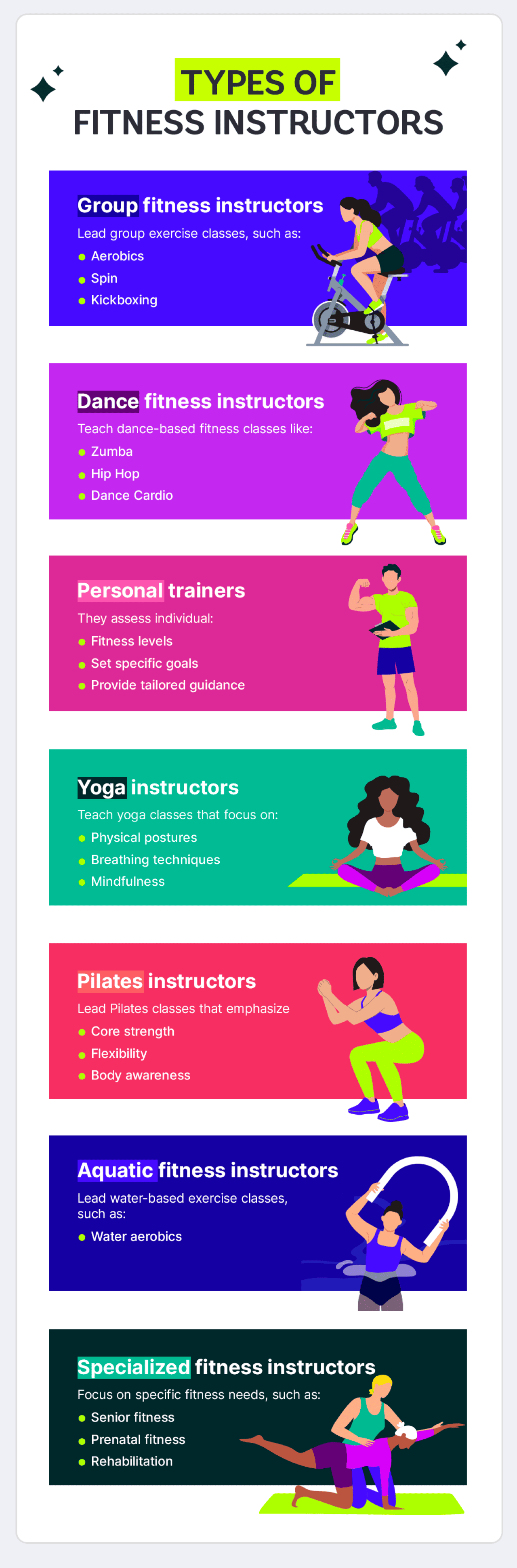
An infographic on the different types of fitness instructors.

Zumba

There are various types of fitness instructors, each specializing in different areas and adding unique contributions to the fitness industry. Here are some examples:

  • Group fitness instructors lead group exercise classes, such as aerobics, spin or kickboxing. They create a motivating and energetic environment for participants with music and choreography.
  • Dance fitness instructors teach dance-based fitness classes. These instructors focus on rhythm, coordination and enjoyment of movement by combining dance moves with fitness to create a fun workout experience.
  • Personal trainers usually work with clients one-on-one to develop personalized fitness programs. They assess individual fitness levels, set specific goals and provide tailored guidance and support.
  • Yoga instructors teach yoga classes that focus on physical postures, breathing techniques and mindfulness.
  • Pilates instructors lead Pilates classes that emphasize core strength, flexibility and body awareness.
  • Aquatic fitness instructors lead water-based exercise classes, such as water aerobics. Water sets the stage for low-impact workouts suitable for various fitness levels.
  • Specialized fitness instructors focus on specific populations or fitness needs, such as senior fitness, prenatal fitness or rehabilitation. They tailor programs to meet the unique needs of these groups while ensuring safety.

How to Become a Fitness Instructor

Becoming a fitness instructor involves the right type of training and skills, depending on what you want to specialize in.

Getting the Right Training

Training will vary depending on the type of fitness instructor you want to be. Instructors can also pursue specialized certifications in specialized areas, such as yoga, indoor cycling or high-intensity interval training (HIIT). They can also choose to specialize in specific areas, such as senior fitness, prenatal fitness or sports performance. Focusing on a niche can enhance your marketability and the opportunity to work with diverse populations.

The fitness industry is constantly evolving. Some organizations require ongoing education to remain current with the latest trends, techniques and research. Many fitness facilities also require instructors to undergo cardiopulmonary resuscitation (CPR) and automated external defibrillator (AED) training. These skills help ensure client safety during workouts.

Developing Skills and Experience

Developing a combination of skills and gaining relevant experience will empower you to help clients achieve their fitness goals. You’ll understand the challenges clients face while sharing your journey and insights.

There are a few options to gain experience as a fitness instructor. You can seek internships or volunteer at local gyms, community centers or fitness studios. This hands-on experience will allow you to observe seasoned instructors, learn group session management and understand client interactions. You could also consider starting with a part-time role in a fitness facility. A flexible schedule can help you gain experience as you begin building a client list.

Another route to build experience and presence is to showcase your expertise on platforms like Facebook, Instagram, TikTok and YouTube. Share your fitness journey, post workout tips and engage with your audience and potentially attract clients. You can also consider starting a fitness blog to share insights, tips and personal experiences.

In addition, developing these skills will help you stand out as a fitness instructor.

  • Motivational skills: Learn techniques to inspire clients, as achieving fitness goals can be challenging. Positive reinforcement and encouragement can significantly enhance their motivation.
  • Communication: Effective communication is vital for demonstrating exercises, explaining their benefits and correcting techniques. Clear communication fosters trust and understanding between you and your clients.
  • Active listening: Being an active listener helps you understand clients’ abilities, limitations and goals, allowing you to tailor your approach to their needs.
  • Customer service: Treating clients with respect and care can help you build loyalty and a positive reputation in the fitness community.
  • Problem-solving: Each client is unique, and strong problem-solving skills will enable you to find appropriate fitness solutions for individual needs.
  • Empathy: Every client’s fitness journey is unique. Being adaptable and empathetic allows you to tailor your approach to meet their individual needs. Creating a safe and inclusive environment encourages clients to share their concerns and challenges.

How to Start a Career as a Fitness Instructor

An infographic on how to start a career as a fitness instructor.

Zumba

After you’ve gained some experience and the right training, you can start a career as a fitness instructor. Here are some steps to help you get started.

Build a Client Base

Building a client base as a group fitness instructor is essential for establishing a successful career in the fitness industry. Here are several strategies to attract and retain participants for your classes:

  • Use your network: Encourage friends, family and acquaintances to attend your sessions. Personal recommendations can be powerful in attracting new participants. You can also participate in local events, health fairs or community gatherings to promote your classes and connect with potential clients.
  • Offer free introductory classes: Host free or discounted introductory classes to allow potential clients to experience your teaching style and the benefits of your classes without a financial commitment. Otherwise, you could organize special events, such as themed classes or fitness challenges, to attract new participants and create excitement around your offerings.
  • Build relationships with participants: Provide positive reinforcement and support during classes. Celebrate participants’ achievements and progress to foster a sense of community and belonging. Building rapport can enhance their experience and encourage loyalty.
  • Collaborate with other fitness professionals: Collaborate with other fitness instructors, personal trainers or wellness professionals to cross-promote each other’s services. This can help you reach a broader audience and attract new clients. Use these connections to establish referral programs where you can refer clients to each other and offer incentives for successful referrals.
  • Promote your sessions: Use a combination of traditional and online marketing efforts to promote your classes. Create eye-catching flyers, posters and social media graphics to distribute in local gyms, community centers, and online platforms.
  • Offer incentives: Consider offering discounts for new participants or package deals for multiple classes. This can encourage people to try your classes and commit to attending regularly.

Create Your Fitness Programs

You’ll want to create fitness plans that are effective, safe and customizable to your clients’ needs. These steps can help you create detailed, effective programs.

1. Set clear objectives. Define the primary objectives of your fitness program. For example, you may want to improve cardiovascular fitness or promote flexibility. Establish what you want your participants to achieve by the end of each class. Do you want them to complete a specific number of exercises or master a new skill?

2. Design the class structure: Start each class with a warmup to prepare your clients for exercise. Include dynamic stretches and light cardio to increase heart rate and flexibility. Then, plan the core portion of your session by incorporating a mix of exercises and choreographies. Finally, end each class with a cool-down period that includes static stretching and relaxation techniques to promote recovery and flexibility.

3. Create a weekly schedule: Determine how often you’ll hold classes and create a consistent schedule that participants can rely on. Consider incorporating themed classes to attract participants and create excitement.

4. Plan for progression: Gradually raise the intensity or complexity of exercises over time to challenge your clients and promote improvement. This can include increasing repetitions or introducing new movements.

5. Demonstrate and monitor: Clearly demonstrate each exercise and explain proper form to minimize the risk of injury. Provide modifications for different fitness levels when necessary. It’s important to continuously observe participants during the session to ensure they’re using correct techniques and to provide assistance as needed.

6. Gather feedback and adapt: Get regular feedback from participants about their experiences and preferences. This information can help you make necessary adjustments to the program. Be prepared to adapt sessions based on participant needs, preferences and any changes in group dynamics.

Stay Current in the Fitness Industry

Staying current in the fitness industry is essential for fitness instructors to provide the best possible service to their clients and maintain their professional credibility. These strategies can help you stay updated and informed.

  • Take online courses and webinars: Use online platforms that offer courses and webinars on various fitness topics. Webinars often cover the latest research, trends and practical applications in fitness.
  • Network with other professionals: Build relationships with other fitness professionals through social media, local fitness events or networking groups. Sharing experiences and insights can help you stay informed about industry developments.
  • Read industry publications: Subscribe to fitness magazines, journals and online newsletters that cover the latest trends, research and techniques.
  • Talk with clients: Pay attention to the types of workouts and fitness trends that clients are interested in. This can help you tailor your classes and offerings to meet their demands.
  • Experiment with new techniques: Participate in different fitness classes or training methods to experience new techniques firsthand. You’ll broaden your knowledge and be able to share personal insights with your clients.

You Can Make Physical Activity Fun as a Fitness Instructor

The fitness industry promotes health and wellness by encouraging physical activity, improving mental health, providing education, fostering community and preventing chronic diseases. Its impact extends beyond individual health — it’s contributing to healthier societies overall.

Building a sense of community and fostering relationships with clients can be rewarding experiences for fitness instructors. No matter what type of fitness instructor you choose to become, with passion and dedication, you can inspire others to lead healthier lives.

This story was produced by Zumba and reviewed and distributed by Stacker.

Topics:

Careers & Education
Managing

Your Company Froze Raises. Here’s What You Can Still Negotiate.

Dominoes Public Relations
Mediabistro icon
By Mediabistro
The Mediabistro editorial team draws on 25 years of media industry expertise to cover jobs, careers, and trends shaping the industry.
9 min read • Originally published March 3, 2026 / Updated March 19, 2026
Mediabistro icon
By Mediabistro
The Mediabistro editorial team draws on 25 years of media industry expertise to cover jobs, careers, and trends shaping the industry.
9 min read • Originally published March 3, 2026 / Updated March 19, 2026

In this article: What a Freeze Actually Means | The Non-Salary Menu | How to Frame the Conversation | The External Offer Option | Know Your Market Rate | Don’t Wait for Permission

The Email Everyone in Media Recognizes

You open the company-wide email. The subject line says something neutral like “Organizational Update” or “Compensation Planning for 2026.” Three paragraphs in, there it is, probably not in bold: “Merit increases and salary adjustments will be paused at this time.”

Your stomach drops. Not because you’re shocked, but because you just shipped the biggest project of your career. You’ve been here five years. You haven’t had a meaningful raise in eighteen months.

The instinct is to stay quiet. Colleagues are losing jobs. Entire departments are being restructured. Asking for more money feels tone-deaf.

But here’s what most media professionals miss: a raise freeze defines what’s frozen. Everything else is still in play.

What a Raise Freeze Usually Means (And What It Doesn’t)

A raise freeze means base salary increases are paused company-wide. It’s a single line item in a budget spreadsheet.

It does not automatically freeze bonuses, title promotions, additional PTO, professional development budgets, or any of the dozen other levers that make up total compensation.

Look at what media organizations actually do after announcing freezes. Many continue to hire for specific roles: revenue-generating positions, AI and tech specialists, and audience growth strategists. Budgets are being reallocated, not eliminated. Money is still flowing. It’s just flowing differently.

Freezes Are Often More Flexible Than They Sound

Top performers and hard-to-replace specialists may receive exceptions, particularly when framed as retention risk. The freeze is the opening position. It’s rarely the final answer.

The real question is whether you can tie your work directly to revenue or audience metrics. If your project meaningfully grew subscriber numbers, if your video series generated sponsorship interest, and if your content strategy reduced churn, you have leverage. Document it.

The psychological barrier is usually bigger than the policy barrier. You feel guilty asking for more when colleagues are being laid off. That guilt is understandable. It’s also the thing preventing you from advocating for yourself in a moment when retention matters more than ever to your employer.

Key Insight: Retaining strong performers is actively in the company’s interest. A good manager knows this. The conversation is about retention strategy, not entitlement.

What Media & Creative Professionals Can Actually Negotiate

“Ask for other benefits” is the advice you’ll find everywhere. It doesn’t help if you don’t know which items come from budget lines unaffected by the freeze.

Here’s the specific menu, tailored to media and creative roles:

Compensation Category Examples Specific to Media Roles Why It May Still Be Available
Bonuses Retention bonuses, project completion bonuses, performance bonuses Often funded from different budget pools than base salary
Title and Advancement Promotion without an immediate raise, expanded scope with a deferred raise agreement Costs the company nothing now; resets your market rate for future roles
Flexibility Additional PTO, remote/hybrid arrangements, compressed schedules No direct budget impact; increasingly standard in media
Professional Development Conference attendance, tuition reimbursement, certification budgets, and industry memberships Often a separate line item from compensation budget
Side Project Permission Freelance clauses, byline permission for outside publications, consulting carve-outs Common in media; costs the company nothing if non-competitive
Equipment and Stipends Home office stipend, technology upgrades, software subscriptions Especially relevant for remote/hybrid media workers
Deferred Raise Written agreement tying a specific increase to a date or financial trigger Availability varies; worth exploring as a documented commitment

The High-Value Items Worth Prioritizing

  • Title promotions have long-term leverage. A move from “Content Manager” to “Senior Content Manager” or “Content Director” resets your market rate for every future role. It signals an upward trajectory on your resume. It strengthens your position when the freeze lifts. And it costs your employer nothing in the present budget cycle. If your responsibilities have expanded, the title should reflect it, and this can be a tangible career asset.
  • Deferred raise agreements get it in writing. You negotiate a documented commitment that a specific salary increase kicks in once the freeze lifts, tied to either a calendar date or a financial trigger. If your manager agrees, make sure it’s documented. Verbal promises evaporate.
  • Freelance and side-project permission is uniquely valuable in media. If your employment agreement restricts outside work, negotiating explicit permission for non-competitive projects can meaningfully increase your total compensation without costing your employer a dime.
  • Conference attendance and professional development budgets double as networking opportunities and skill-building. A $2,000 conference budget can translate into connections that lead to your next role or freelance clients.

How to Frame the Conversation: The “Stay Interview” Approach

The framing matters as much as the ask.

Walk into your manager’s office demanding a raise during a freeze, and you’ll hit a wall. Reframe it as a retention or advancement discussion, and you’ve changed the dynamic entirely.

The “stay interview” concept has gained traction in HR. Instead of waiting for exit interviews after employees quit, forward-thinking managers proactively ask: What keeps you here? What would make you leave?

You can initiate this conversation yourself. Position it as collaborative, not adversarial.

The Script Framework

Start with documented value. Open with quantifiable results. Be specific: “I led the redesign that doubled our mobile engagement over six months. I managed the video series that brought in our first branded content sponsor in two years.”

Acknowledge the freeze explicitly. “I know we’re in a raise freeze, and I understand why.” This shows you’re realistic.

Pivot to retention and the future. “I want to have a conversation about what keeps me here and how we can set things up for when conditions improve.”

Present two to three specific asks from the non-salary menu. “I’d like to talk about a title adjustment to Senior Editor to reflect the expanded team I’m managing, a deferred raise agreement we can document for when the freeze lifts, and approval to take on a quarterly freelance column that wouldn’t compete with our work here.”

Notice what this script avoids: guilt-tripping, comparisons to colleagues, threats, and emotional appeals. It’s grounded in value. It gives your manager something concrete to work with.

Timing Matters: Don’t initiate this conversation during active layoffs or in the immediate aftermath of a restructuring announcement. Wait until the dust settles. Ideally, schedule it shortly after you’ve delivered visible, measurable results.

Managing the Guilt Factor

The guilt you feel about asking is real. Colleagues may be losing their jobs.

But here’s the uncomfortable truth: if you’re a strong performer, your leaving would hurt your organization more than giving you a retention bonus or a title bump. Good managers understand this. They’d rather make an exception than replace you.

If your manager says everything is truly frozen, ask what timeline they’d recommend for revisiting the conversation. Get that timeline documented in a follow-up email.

The External Offer: Nuclear Option or Smart Strategy?

An external offer is the strongest leverage in any compensation negotiation, freeze or not. But it only works if you’re genuinely willing to leave.

The media job market is tighter than it was three years ago. Fewer outlets are hiring. More experienced professionals are competing for the same roles. Bluffing is riskier than it used to be. If you tell your manager you have an offer, they might say, “We’ll be sorry to see you go.”

If You’re Seriously Exploring Other Opportunities

Handle it strategically. Update your LinkedIn profile thoughtfully, signaling openness without broadcasting desperation. Strengthen your network. Have genuine conversations about roles that interest you.

If you receive an offer you’re considering, present it honestly. Don’t frame it as an ultimatum. Frame it as information: “I’ve been approached about a role at [organization]. The compensation is significantly higher. Before I make a decision, I wanted to talk with you about whether there’s a path forward here.”

When the Freeze Is the Signal to Leave

Sometimes the freeze is the signal to leave, not negotiate. If your company is in genuine financial distress, if leadership has no clear path to stability, if the culture has deteriorated beyond repair, the smartest move might be taking the external offer. Leave professionally, maintain relationships, and move forward.

Salary Benchmarks: Know Your Number Before You Negotiate

You can’t negotiate effectively without knowing your market rate.

Three Reliable External Resources for Media Salary Benchmarks

  • Bureau of Labor Statistics Occupational Employment and Wage Statistics (OEWS): Federal data, lagging by about a year but authoritative and free. Search for occupations like “Editors” (27-3041), “Public Relations Specialists” (27-3031), or “Graphic Designers” (27-1024).
  • Payscale: Crowdsourced salary data with filters for location, experience, and skills. More current than BLS but based on self-reported data.
  • Levels.fyi: Originally focused on tech, but increasingly used by professionals in product, design, and content roles that overlap with media. Useful for understanding total compensation packages.

A content strategist in New York City earns more than the same role in a mid-size Midwest market. A senior editor at a legacy publication has a different pay band than a senior editor at a digital-native startup. Use these tools as directional guides, not gospel.

General Benchmarks for Media Roles

Experience Level Estimated Range Key Factors
Entry-Level (0-2 years): editorial assistants, junior content creators, associate producers $38,000–$55,000 Market (NYC/LA vs. mid-size cities), outlet size, digital vs. legacy
Mid-Career (3-7 years): editors, content strategists, producers, digital marketers $55,000–$85,000 Specialization (SEO, video, audience growth), management responsibility, revenue impact
Senior (8+ years): senior editors, editorial directors, heads of content, VP-level $85,000–$140,000+ Team size, P&L responsibility, platform/brand recognition, skills in AI/analytics

New York City and Los Angeles command premiums over national medians. Remote roles have narrowed geographic pay gaps but haven’t eliminated them. Some organizations use location-adjusted pay scales; others maintain consistent rates regardless of where employees live.

Skills That Command Premiums

  • Audience analytics and data literacy
  • AI-assisted content workflows
  • Revenue and monetization strategy
  • Video production and editing
  • Cross-platform content management

If you’ve built expertise in any of these areas, it strengthens your case.

For professionals earlier in their careers, negotiating salary as a recent graduate involves different dynamics, but the core principle remains the same: know your market value before you walk into the conversation.

Don’t Wait for Permission

Raise freezes reward passivity if you let them.

The professionals who come out ahead redefine the negotiation. Whether that means securing non-salary compensation, getting a deferred raise in writing, pushing for a title promotion, or realizing it’s time to explore opportunities elsewhere, the worst move is to remain silent.

The media industry will continue to contract and restructure. Your job is to position yourself for whatever comes next, and that starts with understanding your value, documenting your results, and initiating the conversations most people avoid.

If you’re ready to explore what else is out there, browse media roles on Mediabistro’s job board. Sometimes the right next move is internal negotiation. Sometimes it’s external opportunity. Either way, you need to be active.

For employers looking to attract and retain top media talent in tight budget environments, competitive total compensation packages matter. Post your open roles on Mediabistro to reach experienced professionals who know their value.

The freeze is the opening position. What you negotiate from here is up to you.

Topics:

Managing
Advice From the Pros

Nicole Williams on Building a Career Brand, LinkedIn Tips & Entrepreneurship

LinkedIn's career pro shares insights for entrepreneurs

nicole-williams-feature
Admin icon
By Valerie Berrios
@valerieberrios
Valerie Berrios is a published author and senior content manager with nearly two decades of experience in digital publishing, including roles at Audible, Disney Streaming, Everyday Health, and Mediabistro. She specializes in content strategy, editorial operations, and international content launches.
10 min read • Originally published May 28, 2014 / Updated March 19, 2026
Admin icon
By Valerie Berrios
@valerieberrios
Valerie Berrios is a published author and senior content manager with nearly two decades of experience in digital publishing, including roles at Audible, Disney Streaming, Everyday Health, and Mediabistro. She specializes in content strategy, editorial operations, and international content launches.
10 min read • Originally published May 28, 2014 / Updated March 19, 2026

You could say Nicole Williams was born to be a career adviser and motivator. Watching her mother toil away at an unsatisfying job in a small town in Canada was all she needed to spark her own desire for a fulfilling career — and to help other young women land and excel in jobs they love. Her dream came to fruition with the launch of her website, WORKS by Nicole Williams, which offers lifestyle content for career-minded women in their 20s and 30s.

Williams has written three best-selling books on her area of expertise, the latest of which, Girl on Top: Your Guide to Turning Dating Rules Into Career Success, has been optioned for a film by Academy-Award-winning producers Dan Jinks and Bruce Cohen. Williams is also a frequent contributor to women’s service magazines, newspapers like U.S. News & World Report and shows like Good Morning America and The Big Idea with Donny Deutsch, so it’s no wonder “the world’s largest professional network,” LinkedIn, tapped Williams to be its official career expert. Here’s how Williams started her business and what you can do to optimize your own success.


Positions: LinkedIn’s career expert, best-selling author, business owner, career enthusiast
Resume: Williams’ first career job was as the director of career and technology for the Canadian National Institute for the Blind (CNIB). In 2006, she founded WORKS by Nicole Williams, a media company focused on career development for young professional women. Williams is the author of three best-selling books: Wildly Sophisticated: A Bold New Attitude for Career Success; Earn What You’re Worth; and Girl on Top. She co-created the career reality television series Making It Big, which aired for two seasons on the Life Network in Canada and on the Oxygen Network in the U.S. In 2011, Williams became the career expert for LinkedIn. Along with LinkedIn, Williams contributes career advice to U.S. News & World Report.
Birthday: September 7, 1970
Hometown: Ajax, Ontario, Canada
Education: Bachelor of political science and bachelor of social work, University of British Columbia, Canada
Marital status: Committed but not married
Media mentor: Arianna Huffington
Best career/life advice received: “Don’t tell me, show me.” –Doreen Saunders
Guilty pleasure: Gossip mags
Last book read: Eleanor & Park by Rainbow Rowell
Twitter handle: @thegirlontop
LinkedIn profile: Nicole Williams


Tell us what led you to start your own lifestyle brand, WORKS by Nicole Williams?

Essentially it was a personal experience that launched this company. I grew up in a small town in Canada, just across the border from Detroit, a very blue-collar industrial town. My mom worked in the local paint factory, which pretty much everyone in town did.

When I was a little kid, she would come home and drop off McDonald’s and head to the casino or bar or whatever was up for that night, and I could see the degree to which working in this capacity that didn’t fulfill you, that didn’t excite you, really affected the rest of your life.

Seventy percent of your waking life is spent at work, so if you hate your work, you’re inevitably going to not enjoy the rest of your life. And so I was very young asking the question of anyone who would answer, ‘What do you do for a living? How did you get to do that? Where did you go to school? How much do you make? What kind of skills do you have?’

My first career job was with the Canadian National Institute for the Blind. I was their director of career and technology. From there, I just used my own career as a testing method.

I’d be like, ‘OK, how do you get a raise? Well, let me try this, let me see how this works…’ And I think what I realized is that, for a lot of young women, it’s not about building a resume. It’s a lot of soft skill; it’s a lot of just the person you are and the people you surround yourself with. You know, those elements have so much more to do with your potential for success than pretty much anything else.

So I was always focused on more of the lifestyle elements of career, and that’s how this business came to be.

How did you eventually branch out on your own and come up with the concept for your business?

I stayed [at the CNIB] for about a year and a half, and what happened for me was I loved working with individual people on their career. It was truly thrilling.

But at a certain point, I started to understand that I wanted to create content that would help more than just one person. And at the time, our program was federally funded, and the program was being audited by an outside consulting firm and they looked at one of the programs I developed and they decided to institute that nationally. And that was sort of my first foray into more of a macro level of career development.

I was looking at Martha Stewart’s model of taking content that an individual can consume and use to better her life and bringing that to the masses. Her model is, frankly, quite brilliant. And from there, I was like, ‘OK, could this be a book? Could this be a television show? Could this be a line of career clothing?’

And essentially, that’s what I’ve built. I did a line with The Limited, I have three books, one of which is being turned into a movie.

What do you consider your career philosophy?

It’s funny, the time at which I was thinking about this business and [my first] book and could I grow this, I remember one of my friends was reading Jitterbug Perfume, by Tom Robbins. And I read these two sentences [that resonated with me]: ‘The price of self-destiny is never cheap, and in certain circumstances it’s unthinkable. But to achieve the marvelous, it is precisely the unthinkable that must be thought.’

You know, no one in my family had gone to [college]. It really was unthinkable for me to have graduated university, to have worked at the CNIB. These were jobs and opportunities that so far exceeded what the expectations were for me in my life.

That somehow is true to the way I want to live and the philosophy I want to espouse as part of this business. And literally in that day, I wrote down a list of everything that was unthinkable for me, and it included being on the Today show, it included creating a television show for the Oxygen Network, which I ended up doing. It was to publish with the largest publishing house in the world. It was to get a six-figure advance. These were all jokes at the time.

And as I started to accomplish those unthinkables, I started to really develop that philosophy as it pertains to career. So I’m a big believer in stretching that muscle. And, yes, there’s work attached to that. It doesn’t just come true because you believe that it will. But it’s essentially an orientation that helps you to see opportunity in the world that you might not otherwise.

How can job seekers market themselves during these tough economic times?

Ten, 15 years ago, when I was getting my book published, the vice president of Penguin was sitting in on my meeting. And for some reason, I had done an Internet search and knew that this guy came from Toronto, Canada, which is where I was born, and it was that affinity that allowed me to get a record-breaking advance. We got a quarter of a million dollars for a book on careers, which never happens!

Use every method possible to prepare yourself and then to market yourself so that you’re someone that gets noticed. There are opportunities out there. And sometimes in a bad economy there’s actually more opportunity than less. It’s just a matter of going after it more strategically.

And I think now, because of the Internet and social media, that ‘strategically’ becomes much easier because there’s a platform like LinkedIn, where you’re able to really create a professional brand from soup to nuts and demonstrate who you are as a professional, upload examples of the work that you’ve done, and put that along with an amazing photograph that allows an employer to envision you in this particular situation.

As LinkedIn’s career expert, give us your top three tips for optimizing your profile.

OK so the first is a picture. Profiles that contain a photograph are 11 times more likely to be viewed than those that don’t. And I use the analogy of either the online dating site or the real estate site, where you’ve got this wonderful description, but no photograph. And your instant fear is that it’s decrepit, like there’s a reason why there’s no photograph, and/or it’s not legitimate.

And this profile shot is meant to be professional. A lot of young people I encounter, they’re taking the picture of themselves on the beach, or with their boyfriend, or with their dog, and those kinds of photos in this instance are really, frankly, inappropriate. It doesn’t have to be a professionally taken headshot, but you want this to exude some level of professionalism. I like smiles. I think you can exude a lot of energy when you smile.

Secondly, people think that, ‘OK, I’m just going to post my most recent position.’ But in a lot of instances, employers are looking for someone with 10 years’ work experience, and a lot of the skill sets are transferable.

So even though you worked in marketing and you’re looking for a web design job, you definitely want to have both of those opportunities listed. And we know that profiles that list more than one job are 12 times more likely to be viewed by a hiring manager.

This is kind of different than what we were accustomed to in a resume, in which you only had one page. In this instance, you’ve got as much space as you need to demonstrate who you are as a professional. You also want to upload presentations, works, decks, your portfolio. Allow your work to speak for itself.

Then share content. LinkedIn offers an influencer program whereby you can essentially get mentored by these amazing business people, like Bill Gates and Meg Whitman, and you can literally just share an article, share a quote of inspiration. Sharing [content] demonstrates that you’re active in your career, you’re invested in your career and you’re not just looking to take.

So what’s one big mistake that LinkedIn users often make?

Well, definitely it’s using the connection request that’s just the standardized, ‘I’d like you to be a part of my network.’ At the end of the day, this is a valuable request, and you’re making it of professionals who you have some relationship with.

But I could’ve met you five days ago and if you don’t contextualize where and you don’t contextualize why we would make a good connection, you’re likely to be ignored. So just always personalize that note. It doesn’t have to be a lengthy letter. It can just be: ‘Hey, great to talk to you, Valerie. Let’s connect.’

And I think one of the things that’s much different in the usage of LinkedIn versus Twitter or Facebook, it’s all about quality. It’s not about quantity. You could have 1,000, 2,000, 8,000 connections, but if none of these are people who know you as a professional, trust you as a professional, are willing to look out for opportunity or answer a professional question or introduce you to someone, they’re worthless.

So I’d rather someone have a smaller concentrated number of really valuable connections versus mass connections.

What else do professionals need to keep in mind when using social media, in general?

It’s consistency now that’s really so important.

It’s ensuring that all your social media platforms are sending the same professional message. Think about what your professional brand is: What kind of tone do you want to have, what kind of issues do you want to comment on, what kind of articles do you want to respond to? You’ve got to decide that early on, and then you’ve got to kind of have that theory in place so that you are using social media in an integrated fashion, where it’s all consistent.

Our personal lives are connected to our professional lives, and they tend to overlap in ways that we wouldn’t necessarily expect.

But just because it’s on Twitter or Facebook, don’t think that that space is personal so you can have whatever you want up there, because you’re still going to be judged by it. When it comes to your personal stuff, get a diary. You know, write some letters to your friends. Get a Gmail account that’s not attached to your company’s website or URL. Don’t think of social media as a personal place. I think that’s incredibly naïve.

This interview has been edited for length and clarity. 

Topics:

Advice From the Pros, Be Inspired, Interviews
Careers & Education

What Is a GTM Engineer? A High-Impact Career to Consider in 2026

What Is a GTM Engineer? A High-Impact Career to Consider in 2026
By Millie Beetham for ZoomInfo
10 min read • Originally published January 27, 2026 / Updated March 19, 2026
By Millie Beetham for ZoomInfo
10 min read • Originally published January 27, 2026 / Updated March 19, 2026

Software engineer working on coding a project.

DC Studio // Shutterstock

GTM engineer: A high-impact career to consider in 2026

As companies race to scale revenue operations efficiently, a new role is emerging at the intersection of technology and business strategy: the GTM (go-to-market) engineer. According to ZoomInfo data, hiring for the role has doubled year over year for the last two years, with hiring peaks in January and July. In mid-2025 LinkedIn had over 1,400 postings for GTM engineering roles, with over 3,000 listed in January of 2026 and salaries ranging from low to high six figures. This position combines technical skills with commercial acumen to build, automate, and optimize the systems that power lead generation, sales intelligence, and customer acquisition.

A graphic showing data on the rise of GTM engineer.

ZoomInfo

For professionals looking to pivot into a high-impact role in 2026, GTM engineering offers a compelling opportunity. The position is in demand, commands competitive compensation, and sits at the center of how modern companies drive growth through automated lead generation and sales prospecting tools.

What Is GTM Engineering?

GTM engineering is the application of an engineering mindset to revenue operations. GTM engineers design and automate the systems that power growth—from data pipelines and workflow automation to tool integrations and AI-powered processes.

The role spans software infrastructure, data management, and workflow automation, all working together to help revenue teams move faster, stay aligned, and execute without friction.

Some describe it as revenue systems engineering. Others see it as the next evolution of revenue operations. Either way, it’s a critical function for companies building scalable, efficient, and intelligent go-to-market motions.

Wait—Isn’t This Just Demand Generation?

The short answer: no. While GTM engineering and demand generation both touch marketing systems and care about growth, they sit in fundamentally different parts of the value chain.

Demand generation has historically focused on creating top-of-funnel leads through campaigns and programs. The role centers on volume: running ads, executing email campaigns, hosting events, and optimizing channels to drive more prospects into the pipeline. Demand gen teams answer questions like “How do we get more leads?” and “Which channels drive the most pipeline?”

GTM engineering operates differently. Rather than running individual campaigns, GTM engineers build the underlying systems that make revenue generation repeatable, automated, and scalable across the entire funnel.

Here’s the distinction:

Demand generation asks: “How do we get more people in?”

GTM engineering asks: “How does the entire system work once they’re in—and how do we make it automatic, intelligent, and compounding?”

Demand gen is about execution. GTM engineering is about architecture.

Consider the evolution: Demand generation traditionally ran one-off programs to generate leads. That approach worked when sales cycles were simpler and tech stacks were smaller. But as buying processes became more complex, the role needed to evolve. Modern demand generation now operates in an “always-on” mode—identifying signals that indicate demand and routing those signals to the right person to act on them.

GTM engineers take that evolution further. They’re still responsible for systems that drive top-of-funnel demand, but they also own what happens after the lead comes in: routing, enrichment, scoring, nurturing, and conversion optimization. They build the infrastructure that turns signals into action and action into revenue.

A simple test: If the role primarily involves running programs, that’s demand generation. If it involves designing how revenue happens at a systems level, that’s GTM engineering.

How GTM Engineering Differs from RevOps, Marketing Ops, and Sales Ops

The confusion doesn’t stop with demand generation. GTM engineering also overlaps with revenue operations, marketing operations, and sales operations—roles that have existed for years and already handle pieces of what GTM engineers do.

So what’s the difference?

Revenue Operations (RevOps) focuses on process optimization, reporting, and tool administration across the revenue organization. RevOps professionals ensure teams follow consistent processes, maintain data hygiene, and have visibility into performance metrics. They answer questions like “Are our processes efficient?” and “What’s our pipeline forecast?”

Marketing Operations manages campaign execution, marketing automation platforms, and lead lifecycle management. Marketing ops teams build email workflows, manage lead scoring models, and ensure marketing technology runs smoothly. They focus on making marketing programs scalable and measurable.

Sales Operations handles territory planning, quota management, compensation structures, and sales forecasting. Sales ops professionals optimize how sales teams are organized and ensure they have the resources and data needed to close deals.

GTM Engineering sits at a different level. Rather than optimizing individual functions, GTM engineers design cross-functional systems that connect sales, marketing, and customer success. They build the technical infrastructure that allows data to flow seamlessly between systems, automate workflows that span multiple teams, and implement AI tools that make the entire revenue engine more intelligent.

The reality is that existing operations roles do handle pieces of what GTM engineers do. A marketing ops professional might build a lead scoring model. A RevOps analyst might create a dashboard. A sales ops specialist might integrate two tools.

But GTM engineers approach these tasks from a systems-thinking perspective. They’re not just solving point problems—they’re designing how the entire revenue machine operates.

This creates an important organizational consideration: Companies can’t simply hire a GTM engineer and expect them to replace existing operations roles. These historical functions still need to exist. Instead, forward-thinking companies are rethinking how their entire go-to-market organization works together, with GTM engineers serving as the architects who design systems that operations teams then maintain and optimize.

For professionals in demand gen, RevOps, marketing ops, or sales ops roles, GTM engineering represents an evolution—an opportunity to expand from functional optimization into cross-functional system design.

The Role Is New—and Growing Fast

GTM engineering is still an emerging discipline. The job title only recently began appearing in recruiting platforms and LinkedIn profiles. But the pattern is clear: tech-forward companies are creating dedicated positions to own the technical infrastructure behind their revenue engines.

The role emerged due to several converging forces:

Pressure for efficiency: In an era of tighter budgets, companies need to scale revenue without proportionally scaling headcount. GTM engineers build systems that multiply team output.

Tech stack complexity: Most B2B companies now run dozens of tools across sales, marketing, and customer success. Without tight integration, these tools create data silos and slow execution. GTM engineers connect these systems.

Rise of accessible automation: No-code and low-code platforms, combined with AI tools, have made sophisticated automation accessible to non-developers. GTM engineers leverage these tools to build revenue infrastructure.

Demand for personalization at scale: Generic outreach no longer works. GTM engineers build systems that use data enrichment and AI to personalize interactions at scale.

What Do GTM Engineers Actually Do?

GTM engineers sit at the intersection of strategy and technical execution. Their day-to-day work includes:

Integrating tools: Connecting CRMs, marketing automation platforms, analytics systems, enrichment tools, and product usage platforms so data flows seamlessly across the tech stack.

Automating workflows: Building systems that automate lead routing, follow-ups, data entry, and campaign execution, freeing revenue teams to focus on high-value interactions.

Managing data quality: Ensuring data accuracy, resolving identity issues, and maintaining clean schemas so every system runs on reliable information.

Building dashboards and alerts: Creating real-time visibility into GTM performance so teams can iterate quickly and act on what’s working.

Implementing AI: Integrating machine learning tools for predictive lead scoring, personalized outreach, and identifying high-intent prospects.

For example, a GTM engineer might connect product usage data with CRM records and trigger automated alerts to customer success teams when engagement drops—giving them time to intervene before churn occurs.

Why Consider This Career Path

Several factors make GTM engineering an attractive career option for 2026:

High demand, limited supply: The role is new enough that talent pipelines haven’t caught up with demand. Companies are actively hiring, and competition for qualified candidates is intense.

Competitive compensation: Because the role requires both technical and business skills, compensation tends to be strong. Professionals with this hybrid skill set command premium salaries.

Cross-functional impact: GTM engineers work across sales, marketing, customer success, and leadership. The role offers visibility and influence across the organization.

Future-proof skills: As companies increasingly rely on systems-led growth, the technical and strategic skills GTM engineers develop will remain valuable.

Rapid learning curve: The role exposes professionals to the full revenue lifecycle, modern tech stacks, AI implementation, and strategic decision-making.

Measurable impact: GTM engineers build systems that directly affect revenue metrics. Companies implementing automated GTM systems often report reduced customer acquisition costs and improved conversion rates.

Evolution opportunity: For professionals already in demand generation, RevOps, marketing ops, or sales ops roles, GTM engineering represents a natural next step—expanding from functional optimization into cross-functional system design.

Who Should Consider GTM Engineering

GTM engineers come from several backgrounds:

From operations roles: Sales operations, marketing operations, or revenue operations professionals who want to deepen their technical skills represent the most common pathway. These individuals already understand GTM processes and pain points—they just need to add technical capabilities.

From demand generation: Demand gen professionals who want to move from campaign execution to system design can transition by learning automation, integration, and data management skills.

From engineering or data roles: Software engineers or data analysts interested in the commercial side of business can transition by learning sales cycles, marketing fundamentals, and GTM-specific tools.

From sales or marketing roles: High-performing sales development representatives or marketers who are technically inclined can learn automation and data skills to build systems that scale their own manual work.

The ideal candidate combines curiosity about technology with interest in how businesses generate revenue.

Skills You’ll Need

GTM engineers blend technical ability with commercial understanding. Key skills include:

Technical proficiency

– Experience with CRMs like Salesforce or HubSpot
– Familiarity with automation platforms such as Zapier or Make
– Familiarity with – Basic scripting knowledge (Python or SQL helpful but not always required)
– Understanding of APIs and data integration
– Comfort with analytics and business intelligence tools

Commercial acumen

– Understanding of sales cycles and pipeline stages
– Knowledge of marketing fundamentals and campaign mechanics
– Familiarity with customer lifecycle and retention strategies
– Ability to translate business goals into technical requirements

Problem-solving mindset

– Identifying bottlenecks in in revenue processes
– Designing scalable technical solutions
– Testing and iterating on workflows
– Measuring and optimizing system performance

Communication skills

– Explaining technical concepts to non-technical stakeholders
– Collaborating across sales, marketing, and customer success teams
– Documenting systems and processes clearly

Where GTM Engineers Work

GTM engineers are most commonly found in:

High-growth B2B SaaS companies. These organizations need to scale efficiently and experiment rapidly. They often hire generalist GTM engineers who can bridge multiple functions.

Mid-size to large enterprises. Larger organizations use GTM engineers to break down data silos, manage complex tech stacks, and implement sophisticated operations like predictive analytics and account-based marketing.

Product-led growth companies. Organizations with PLG motions generate significant user data that needs to be operationalized for sales. GTM engineers build the systems that turn product signals into revenue actions.

How to Break Into GTM Engineering

There’s no single formal path, but most successful transitions follow these steps:

Build a portfolio: Create and document projects that solve real business problems. Showcase quantifiable impact such as “automated lead scoring system, reducing manual effort by 60 percent” or “integrated three tools via API, eliminating data entry for 10-person team.”

Understand the full revenue lifecycle: Study how leads move through the funnel, how marketing and sales collaborate, and how customer success drives retention. Read case studies and follow GTM thought leaders.

Network strategically: Join professional communities and online groups focused on revenue operations and GTM engineering. Many roles are filled through referrals and community connections.

Position your experience: When applying, emphasize projects where you built systems, automated processes, or integrated tools—even if those weren’t your primary responsibilities. Frame your experience around impact on revenue metrics.

Real-World Impact: What Success Looks Like

GTM engineers create measurable business value by replacing manual work with automated systems. Consider a B2B sales team where 10 sales development representatives manually research prospects using LinkedIn and search engines, then write personalized outreach emails one by one. The process caps output at roughly 20 quality touches per person per day.

A GTM engineer might design an automated system using a no-code platform, data enrichment APIs, and an email sequencer. The system identifies prospects based on specific signals—such as recent funding, new executive hires, or competitor mentions—then enriches contact data and generates personalized email copy using AI.

The automated system handles thousands of personalized outreach efforts while the sales team focuses on conversations with engaged prospects. Customer acquisition costs drop, qualified leads increase, and representatives spend time on high-value activities rather than research and data entry.

This type of force multiplication defines the GTM engineering role.

Is GTM Engineering Right for You?

Consider this career path if you:

– Enjoy solving problems through systems and automation
– Want to work at the intersection of technology and business strategy
– Prefer building infrastructure over managing day-to-day operations
– Are comfortable learning new tools and technologies quickly
– Want measurable impact on company revenue and growth
– Thrive in cross-functional environments
– Are currently in demand gen, RevOps, or operations roles and want to expand your scope

The role may not suit professionals who prefer deep specialization in a single domain or those who want to avoid technical work entirely.

Looking Ahead in 2026

As companies continue prioritizing efficient growth and systems-led revenue operations, demand for GTM engineers will likely accelerate. The role offers an opportunity to develop valuable hybrid skills, work on high-impact projects, and position yourself at the center of how modern businesses scale.

For professionals considering a career move in 2026, GTM engineering represents a path worth exploring—particularly for those who want to combine technical capabilities with strategic business impact.

The discipline is still emerging, which means early adopters have the opportunity to shape the role, build expertise while competition is limited, and establish themselves as specialists in a growing field.

Whether you’re in operations and want to build more, in demand generation and want to design systems rather than run campaigns, in engineering and want commercial context, or in sales and marketing and want to create leverage through systems, GTM engineering offers a compelling next step.

This story was produced by ZoomInfo and reviewed and distributed by Stacker.

Topics:

Careers & Education

Posts navigation

Older posts
Newer posts
Featured Jobs
Kirkus Media
Editorial Intern
Kirkus Media
New York City, New York (US)

Gaia Inc
MEDIA COORDINATOR
Gaia Inc
Louisville, CO

Gaia Inc
Global Paid Media Specialist
Gaia Inc
Louisville, CO

Gaia Inc
Director of Media Strategy
Gaia Inc
Louisville, CO

Hearst Television
Account Executive
Hearst Television
Milwaukee, WI, United States

All Jobs »
PREMIUM MEMBER

Bradley Weaver

San Diego,
25 Years Experience
With more than 25 years of experience as a journalist, marketing manager and media relations manager, Bradley Weaver understand the value of hard...
View Full Profile »
Join Mediabistro Membership Today

Stand out from the crowd with a premium profile

Mediabistro Logo Find your next media job or showcase your creative talent
  • Job Search
  • Hot Jobs
  • Membership
  • Newsletter
  • Career Advice
  • Media News
  • Hiring Tips
  • Creative Tools
  • About
Facebook YouTube Instagram LinkedIn
Copyright © 2026 Mediabistro
  • Terms of Use
  • Terms of Service
  • Privacy