
Mediabistro Logo Mediabistro Logo
  • Jobs
    Search Creative Jobs Hot Jobs Remote Media Jobs Create Job Alerts
    Job Categories
    Creative & Design Marketing & Communications Operations & Strategy Production Sales & Business Development Writing & Editing
    Quick Links
    Search All Jobs Remote Jobs Create Job Alerts
  • Career Resources
    Career Advice & Articles Media Industry News Media Career Interviews Creative Tools Resume Writing Services Interview Coaching Job Market Insights Member Profiles
  • Mediabistro Membership
    Membership Overview How to Pitch (Premium Tool) Editorial Calendars (Premium Access) Courses & Training Programs Membership FAQ
  • Showcase
    Featured Creative Stories Submit your Story
  • Log In
Post Jobs
Mediabistro Logo Mediabistro Logo
Search Creative Jobs Hot Jobs Remote Media Jobs Create Job Alerts
Job Categories
Creative & Design Marketing & Communications Operations & Strategy Production Sales & Business Development Writing & Editing
Quick Links
Search All Jobs Remote Jobs Create Job Alerts
Career Advice & Articles Media Industry News Media Career Interviews Creative Tools Resume Writing Services Interview Coaching Job Market Insights Member Profiles
Membership Overview How to Pitch (Premium Tool) Editorial Calendars (Premium Access) Courses & Training Programs Membership FAQ
Featured Creative Stories Submit your Story
Log In
Post Jobs
Log In | Sign Up

Follow Us!

How to Pitch

How to Pitch Mediabistro: A Freelancer’s Guide

This career resource for media pros wants stories that will help their readers land a job, develop expertise or inspire their careers

How to Pitch Mediabistro: A Freelancer’s Guide
Leah icon
By Mediabistro
The Mediabistro editorial team draws on 25 years of media industry expertise to cover jobs, careers, and trends shaping the industry.
4 min read • Originally published April 18, 2017 / Updated March 19, 2026
Leah icon
By Mediabistro
The Mediabistro editorial team draws on 25 years of media industry expertise to cover jobs, careers, and trends shaping the industry.
4 min read • Originally published April 18, 2017 / Updated March 19, 2026

Monthly Unique Visitors: 220K+

Updated: Bi-weekly

Background: Geared towards developing careers in media-focused roles, Mediabistro offers something for every stage of an individual’s professional journey. Whether just starting out or looking to find the next opportunity, visitors to mediabistro.com can find job listings, online courses for today’s most sought-after skills, articles helping digital media job-seekers find opportunities and grow their careers, and expert career services from resume evaluations and rewrites to interview prep and one-on-one coaching.

Founded in 1996 by Laurel Touby as “a gathering place for professionals in journalism, publishing and other media-related industries in New York City,” Mediabistro has grown into a valuable resource for media professionals across the US.

“Many people remember Mediabistro as the best place to find writing, publishing and freelance gigs, as well as being the go-to source for daily industry news, gossip and career moves. While we’re still the best place to find traditional media jobs, the digital world has certainly caused us to broaden the definition of ‘media’ to include marketing, PR, sales and visual content,” says Leah Paul, Mediabistro’s director of marketing.

“Being a ‘media professional’ today requires making sure you learn how to use every new tool and tactic that will help you get better at your job. So we chose to move away from the industry news content in order to focus on helping digital media professionals find work, improve their careers, gain skills and excel at their jobs.”

What to pitch: Editors at Mediabistro are looking for pitches that provide actionable, tangible value to readers. Before pitching, ask yourself, “In what ways will this information help a job-seeker get closer to landing a gig, or advance in their career?”

Pitches about resume and cover letter tips are great, but here, the challenge is making the content hyper-relevant for media and digital roles, as well as having a unique angle that hasn’t been covered ad nauseam in other publications. If your pitch includes how the story can be repurposed into shareable assets like infographics, slideshows or videos, it will certainly grab the editor’s attention.

The editors are also interested in stories about professional development and the skills needed to be a well-rounded, highly marketable media professional. In today’s world of hybrid roles and demand for T-shaped expertise, it’s more important than ever for writers to have marketing skills, marketers to have writing skills and everybody needs to understand SEO, social media and analytics.

Let’s not forget about the ability to use a variety of creative applications, web-based platforms or just general tech literacy. Pitching an explainer, how-to or case study that can teach a trending skill to the Mediabistro audience will certainly get noticed. Even better if it’s a topic that can be tied to a Mediabistro course.

Stories about teams or individuals who are finding success in their careers, or breaking new ground, are very popular with the Mediabistro audience. Everybody loves a good Q&A that provides advice or career inspiration.

Finally, the Recruit and Hire section features articles geared towards employers, recruiters and hiring managers. Mediabistro is always looking for pitches with an interesting perspective on recruiting, retaining and managing media roles and teams.

What publicists should pitch: Publicists are encouraged to pitch information about media professionals who can offer solid advice to Mediabistro’s audience. If the pitch covers finding a job or excelling in the field, the editors may be interested.

If you’re a publicist representing a magazine or digital publication that accepts freelance stories, Mediabistro is always looking for more publications to add to the How to Pitch section.

Etiquette: Email the editor listed below with a concise query and links to clips. Another way to boost your chances of hearing back are to list the skills or value the reader will take away from your article (“Shows readers how to craft a unique LinkedIn summary”).

Lead time: Varies depending on the type of story being proposed and whether it has a time-sensitive element.
Pay rate: From $75-$150 per post
Payment schedule: Invoice upon editor’s acceptance of completed draft
Kill fee: None

Contact Info:
Mediabistro Holdings, LLC
825 8th Avenue, 29th Floor
New York, NY 10019
mediabistro.com
Twitter handle: @Mediabistro | Facebook

Direct pitches to:
EDITORS AT MEDIABISTRO.COM

Topics:

How to Pitch

Skills & Expertise

Increase Your Brand Profile With Search Engine Marketing (SEM)

Get an intro to driving more and better qualified traffic to your website from search engines

Increase Your Brand Profile With Search Engine Marketing (SEM)
By Mai Alowaish
4 min read • Originally published May 1, 2017 / Updated March 19, 2026
By Mai Alowaish
4 min read • Originally published May 1, 2017 / Updated March 19, 2026

Be sure to check back in for Part II of this series – an introduction to implementing your own campaign.

When consumers decide they’re in need of, or curious about, a product or service they intuitively head to a search engine. Trillions of Google searches happen every year.

Those queries represent opportunities to attract potential customers to your site.

Search engine optimization (SEO) can help increase the ranking of your site without spending money, but search engines often enhance and alter their ranking criteria, making it difficult to maintain your rankings.

So how else can you promote your brand, drive new visitors to your site and increase site traffic? With search engine marketing (SEM).

It’s the yin to SEO’s yang. While not free, it is a great low cost solution to help you enhance your brand’s profile and connect with customers at the right moment. And it’s something anybody can do on their own.

Search Engine Marketing

SEM is the practice of marketing through paid advertisements that appear on relevant search engine results pages and websites. These ads can have different formats and are paid for through a bidding process.

Think of it this way, before the internet, popcorn ads weren’t everywhere. People saw physical ads for the snack in the movie theater, when they were hungry and thinking about getting something to eat.

The ads were provided where people were, when they wanted food, and where they had access to buy popcorn. SEM does this on the internet.

Your ads won’t be just anywhere, they’ll be placed in front of people who are considering your type of product or service, who live near your company and who want to buy what you sell.

You can even choose which search engines to use and where/when you want your ads displayed so that you can best reach your audience using your style of advertising.

Search Advertising

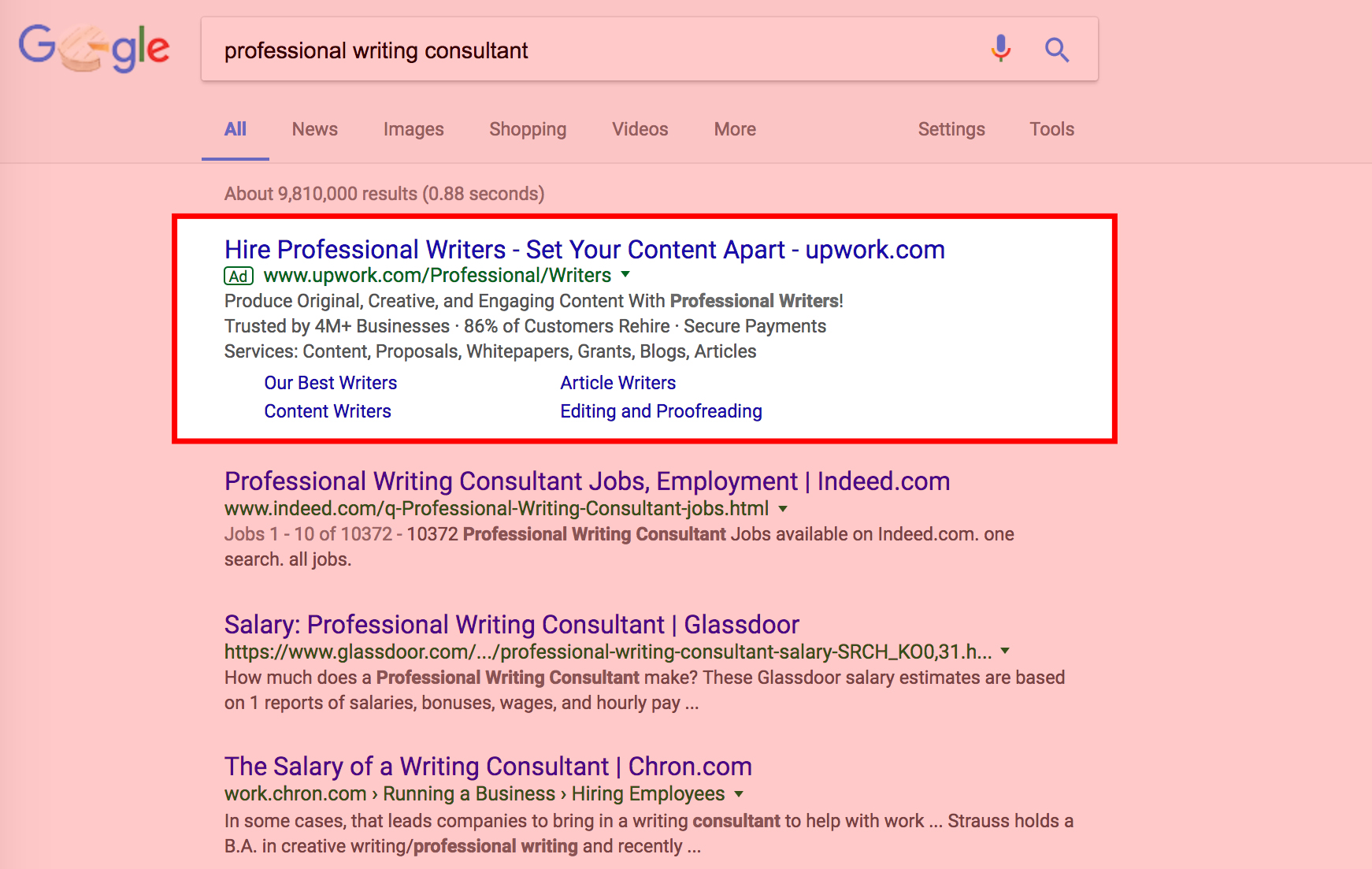
Let’s start with an example. Say your potential customer needs some writing done. When they search, Google will display results and ads from businesses that are relevant to the query phrase.

Professional writers advertising their services, are able to extend the reach of their online brand and appear right in front of the eyes of people searching for their services.

This is something that isn’t as easily achievable with simply implementing a SEO strategy.

Display advertising

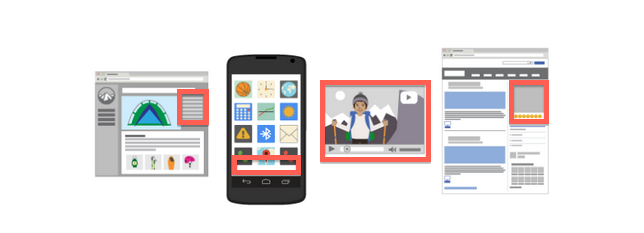
Display ads aren’t found in search results, instead they can be seen on websites and mobile apps and can feature interactive formats of images, videos or even animations to engage the user.

You can choose to be strategic too, putting your message only in front of the people who are most likely to be your potential customers.

This is done by customizing your ad placements to a specific geographic location or when someone is watching a related video on YouTube, or browsing the web in a specific language.

There are many display advertising platforms that you can use, with Google Display Network being the largest one; Google claims that their display network sites reach over 90% of Internet users worldwide.

How much does SEM cost?

This depends on your budget and how you want to use SEM to work for you. You can mix and match different SEM strategies to make the best out of your advertising budget.

If the goal is awareness and you may just be interested in people seeing your ad, then you want to focus on cost per impression (CPM).

If you’re priority is website traffic, cost per click (CPC) could be the best metric.

If your goal is to increase lead calls or transactions, then you can use cost per acquisition (CPA) to optimize the campaign based on actual conversions.

CPC is the most popular metric used for SEM bidding. The average CPC in Google AdWords is between $1 to $2 on the search network. The average CPC on the Display Network is under $1.

Who can use SEM?

Anyone. Access to SEM tools is usually free and search engines provide tools to easily setup and manage ads right from your computer.

Google has AdWords, Bing has AdCenter, and Yahoo! has its Yahoo! Advertising too. Third party platforms can also be used to manage ads in more than one publisher.

You simply pay for the viewed and clicked advertisements, based on how you setup the process (which this industry calls a “campaign”).


Topics:

Climb the Ladder, Skills & Expertise
Skills & Expertise

7 KPIs of an Effective Website (And How to Measure)

Learn some of the most important key performance indicators (KPIs) of websites that convert

7 KPIs of an Effective Website (And How to Measure)
Amirah icon
By Alex Jasin
Alex Jasin is an entrepreneur, songwriter, speaker, and CEO of  Metapress and X3 Digital. Connect with Alex directly on Twitter, Medium and LinkedIn. Read more of Jasin’s writing on Business Insider, Entrepreneur, The Huffington Post, Internet Retailer, The Next Web and other major publications.
6 min read • Originally published May 8, 2017 / Updated March 19, 2026
Amirah icon
By Alex Jasin
Alex Jasin is an entrepreneur, songwriter, speaker, and CEO of  Metapress and X3 Digital. Connect with Alex directly on Twitter, Medium and LinkedIn. Read more of Jasin’s writing on Business Insider, Entrepreneur, The Huffington Post, Internet Retailer, The Next Web and other major publications.
6 min read • Originally published May 8, 2017 / Updated March 19, 2026

Are you looking to generate more phone call leads? Or drive more email sign-ups? Maybe you want to test new content on your website?

Well, you simply can’t measure what you don’t track.

The fundamentals of any successful digital marketing campaign begin with setting goals and key performance indicators (KPIs).

KPIs allow you to determine what metrics define success for your business. This way, you can track all of your website’s data to understand your company’s performance over time.

By definition, a KPI is a quantifiable measure that gauges a company’s achievements based on pre-set goals and objectives.

Before you start measuring, you have to first set “SMART” goals based on your business objectives.

This will help you get a clearer and more definite picture of what you want to achieve and when you achieve it.

Below are seven of the most important KPIs of effective websites with tips on how to start tracking them so you’ll know how to tweak your website moving forward.

Note: You’ll notice that Google Analytics appears as the tool of measurement for most of the KPIs. I decided to use it as the primary tool. It’s loaded with features, it’s popular and it’s absolutely free. Also, chances are, it’s what you use on your website. If it’s not, use the KPIs to tell if your analytics tool matches up to Google Analytics.

MARKETING KPIs

These KPIs help you achieve your website goals based on marketing goals, such as generating more qualified leads, improving the subscriber rate and increasing awareness and trust.

1. Conversion Rate

Conversion rate is probably the most common KPI. Everyone wants to know how many people become buyers on their site. I use “buyers” very loosely here.

This is because conversion doesn’t have to be just about sales. Conversion could be getting visitors to sign up to your newsletter, download an e-book or contribute to a cause.

As much as you want to reach a certain conversion rate, you’ll also want to analyze why a large percentage of visitors don’t convert.

2. Number of Qualified Leads

Some website owners are easily excited about the wrong things like a high number of website visitors. These are what are commonly referred to as vanity metrics.

You want to know how many of the visitors might actually buy from you. These are the qualified leads because they meet the qualification criteria you’ve set.

Traditionally, you’d track the URL on the “Thank You” page after the visitor fills out a form. This would be your overall conversion rate as discussed above. However, with this method you can’t track qualified leads, only the total number of leads. To get to the number of qualified leads, you’ll want to use customer relation management (CRM) software.

When a user fills out a lead generation form and clicks “submit”, Google Analytics transmits that data to your CRM platform. You can then score and rank the different leads to determine which are “qualified.”

3. Awareness Level

When you feel like you’re really pushing your brand out there, you’ll want to know exactly how effective your efforts are. There are several factors that indicate more people are getting familiar with your brand.

To help you with this, Google Analytics breaks down site traffic based on the source. If you look at these results (over time), you’ll get a sense of the percentage of your website visitors who already knew your brand by the time they made it there.

After you’ve started to track your current stats,  you can begin working towards increasing your website’s traffic based on your results.

SALES KPIs

These KPIs indicate if your website is doing enough to help you achieve sales goals like boosting your revenue.

4. Sales Conversion Rate

If you’re focused on the number of sales you make on your website, sales conversion rate is a metric to watch. Even though this is focused on sales, in Google Analytics, it’s measured like the aforementioned conversion rate.

Google Analytics has a built in E-commerce report, so if your sales are happening on your website, you can easily get to a variety of data about your sales conversion rate, including the total revenue, number of transactions and quantity of items purchased.

You can take this data further by looking at your most valuable sources of traffic in terms of where your biggest spenders come from or where your highest converting audience comes from. This sort of data can help inform your marketing plans.

5. Time Before Purchase

This is one of the least considered metrics. Most businesses just look at conversion, without caring to ask about how long it took a customer to convert.

If it takes multiple visits to your site before a customer buys from you, this doesn’t immediately mean trouble. They could just be taking time to get more familiar with your company, reading your site’s blog (you should have one), or a number of other acceptable reasons.

The problem comes if people don’t buy because your marketing message isn’t fined-tuned enough. You want to be closing deals as quickly as possible.

Most analytics tools offer this metric and Google Analytics shows this under E-commerce as “Visits to Purchase” and “Days to Purchase.” You should use it even if you’re not an online store. Setting up your analytics account to track the other kinds of non-purchase conversions (like those we discussed earlier) as part of the E-commerce reporting, does require some technical expertise, but it is possible.

6. Average Order Value

If you’re selling one product, it’s easy to understand that each conversion results in an amount equal to the product price. However, if you have several products, you want to know the average value of each order.

This tells you truly how much your efforts are paying off in converting customers. On its own, it’s not very valuable. But when coupled with context, you get a clear picture. In Google Analytics, it also appears under E-commerce.

UX KPIs

Last, but certainly not least, you need to consider your customer experience. Nothing will matter if the customer isn’t satisfied.

You want to make sure that whether on desktop or mobile, visitors get the best experience. The key metric here is customer satisfaction.

All other factors like navigation, page load time, mobile responsiveness, etc. boil down to improving customer satisfaction. They are factors you should test and tweak on your end based on the customer satisfaction.

7. Customer Satisfaction

To most people, customer satisfaction is highly subjective. This makes it a really hard metric to track—but it’s possible.

You need more than Google Analytics for this, though. One of the most qualitative ways you can measure customer satisfaction is through surveys.

Using a tool like SurveyMonkey, you can send out surveys to your customers to get a better understanding of what they think of your website. Qualaroo allows you to track more quantitative data according to user ratings. Temper lets you graph customer satisfaction trends.

You may also be able to get an idea from cart abandonment and bounce rate. Through these metrics, you can see where you started losing your customers.

You can also review and track your Net Promoter Score (NPS). This tells you, on a scale of 1 – 10, the likelihood of a customer buying from you based on their experience.

Measuring is the Surest Way to Grow

Successful digital marketing comprises much more than just a solid content marketing strategy, high search engine results page (SERP) rankings and spending money on social media ads.

It hinges on what is probably the most basic element of them all: your website. All the digital marketing effort is pointless if you didn’t make a website that’s effective for reaching your goals.

Start implementing these 7 key performance indicators on your site, and begin to track and review your progress over time. This is a surefire way to understand exactly where you stand right now, and plan for a stronger business in the future.

Alex Jasin can be found on Twitter, Facebook and LinkedIn.


Topics:

Climb the Ladder, Skills & Expertise
Skills & Expertise

Best Influencer Marketing Campaigns of 2017 So Far

From cosmetics to clothing, these brands generated the best in influencer marketing content

Best Influencer Marketing Campaigns of 2017 So Far
Amirah icon
By Amirah Bey
Amirah Bey is a digital marketing strategist with over 10 years of experience across global brands including Amazon Web Services, Procore Technologies, and Mediabistro. A Howard University graduate and Army National Guard veteran, she specializes in lifecycle marketing, analytics-driven strategy, and digital experience optimization.
4 min read • Originally published May 22, 2017 / Updated March 19, 2026
Amirah icon
By Amirah Bey
Amirah Bey is a digital marketing strategist with over 10 years of experience across global brands including Amazon Web Services, Procore Technologies, and Mediabistro. A Howard University graduate and Army National Guard veteran, she specializes in lifecycle marketing, analytics-driven strategy, and digital experience optimization.
4 min read • Originally published May 22, 2017 / Updated March 19, 2026

Weight-loss tea anyone? Hair-growth pills? What about at-home teeth whitening kits?

If you’re an active Instagram user, you’ve probably scrolled down your Instagram timeline and caught one of your favorite social media celebrities casually mentioning their love for one of the aforementioned products.

You know this is called influencer marketing, and while you can’t argue with its impact on brand awareness, some brands do it better than others.

Influencer marketing has become such a buzzword in the marketing industry, it’s being used to describe any celebrity’s (D-list or otherwise) involvement in a marketing campaign.

But I think there’s a line between celebrity endorsements and real influencer marketing. The distinction is really about content creation. The best influencer campaigns are those where influencers create their own content in support of the brand’s goals.

From fitness to travel and cosmetics, here’s a look at the brands who’ve generated some of the best influencer marketing content so far this year.

Tarte Cosmetics
In late January, Tarte cosmetics flew a gang of makeup and fitness gurus to Hayman Island, a private island off the coast of Australia, for a few days of sun, fun and beach. They followed this trip up with a jaunt to the Florida Keys and most recently the Maldives. Each time they had a gaggle of influencers in tow.

These trips have been branded #TrippinWithTarte and the social media influencers participate in Snapchat-worthy excursions every day like morning yoga, lunch by the pool, dinner on the beach, hikes and massages.

The influencers all possess huge followings. For example, fitness and makeup guru Tammy Hembrow, who attended Tarte’s Hayman island trip, has more than 6.5 million Instagram followers, more than 700K YouTube subscribers, 34K plus Twitter followers and a successful blog.

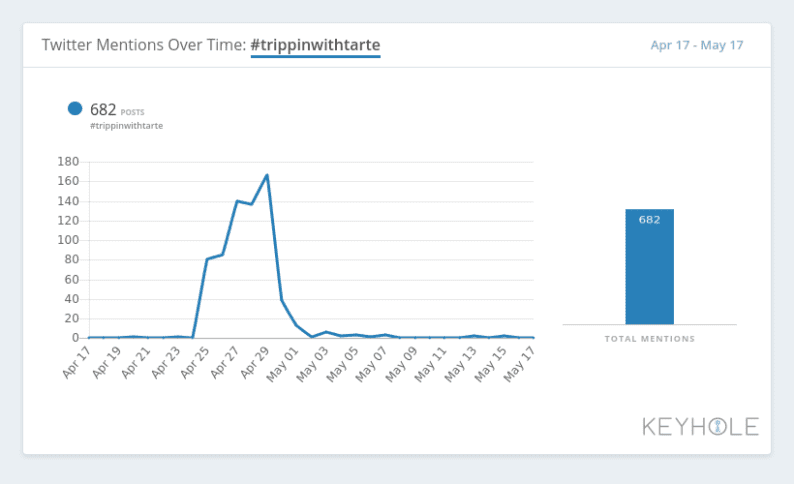
Keyhole #TrippinWithTarte Report

In just the last month the #TrippinWithTarte hashtag was mentioned more than 680 times according to social analytics platform Keyhole.

Axe
With most influencer marketing targeting women, it was interesting to see Axe Hair enlist 30 top male influencers to promote their styling products.

One influencer tapped by the brand was actor Josh Peck who has more than 4 million Instagram followers. Peck along with the other 29 influencers are referred to by the brand as the AXE Hair Creators. Their goal is to show everyday guys how styling has impacted their success.

Another popular influencer marketing tactic is for influencers to host events sponsored by the brand. At these events the Axe Hair Creators are tasked with showcasing not just why they style everyday but how they achieve their looks. The collective wants to inspire men who want to do more with their hair, but just don’t know where to start.

Fashion Nova
Fashion Nova is a brand that has become successful largely due to it’s ongoing and aggressive influencer marketing efforts.

“We work with 3,000 to 5,000 influencers,” said Fashion Nova’s founder and CEO, Richard Saghian, via a phone interview published by Vice.

Fashion Nova views itself as a “viral store.” The digital storefront relies on the popularity of celebrity and model influencers to spread word-of-mouth advertising to their eager followers.

They count among their influencer ranks it-girl Kylie Jenner, whose sole Instagram post about the brand’s jeans received tons of engagement: 2.7 million likes and 558K comments.

Jenner, to date, has 93.8 million Instagram followers and lands in eighth place for most number of Instagram followers in the world, but Fashion Nova also takes special care to engage micro influencers as well.

Many in the industry categorize micro-influencers as creators with under 100K followers or subscribers, like YouTube beauty vlogger BlissfulBrii who has 93K subscribers. Since the start of the year, BlissfulBrii has posted two videos featuring Fashion Nova clothing. The vlogs reached a combined total of 200K views, 4,300 like and almost 200 comments.

Glossier
Glossier is a relatively new brand (founded in 2014) that has skyrocketed quickly thanks to strong influencer marketing. The brand doesn’t focus on follower count but prioritizes the engagement rates of potential partners.

For instance they’ve worked with Instagram user Cecilia Gorgon who possesses about 8,500 followers. Gorgon isn’t a content creator or celebrity, in fact she described herself as a student at the University of Michigan living in Ann Arbor and majoring in Fine Arts, in an Into the Gloss article published late last year.

She posted a photo of the brand’s Priming Moisturizer Rich encouraging her followers to purchase it because she’d “been testing it out the past few days and it’s so moisturizing.” Gorgon added that face cream made her “skin feel like a baby’s booty.”

Another example of Glossier’s micro-influencer strategy is their Glossier reps program. Glossier recently flew 13 of their reps to NYC for 48 hours.

One of those reps is YouTube vlogger Amy Serrano. She has a strong following of 47K YouTube subscribers. The beauty vlogger documented the whole excursion and just 2 days after posting, the video boasted more than 5K views, 350 likes and 57 comments.

Serrano also dedicated 4 of her Instagram posts to the trip for a combined total of of more than 2,900 likes and almost 50 comments. With a dozen other reps documenting their trips the reach and engagement was sure to be significant.


Topics:

Climb the Ladder, Skills & Expertise
Advice From the Pros

UX and Usability: What’s the Difference?

It’s key to user experience, but it is not debatable

UX and Usability: What’s the Difference?
Yana icon
By Ayana Young
Ayana Young is a communications and PR strategist with 15+ years of experience spanning media relations, lifestyle brands, professional sports, and publishing.
3 min read • Originally published June 7, 2017 / Updated March 19, 2026
Yana icon
By Ayana Young
Ayana Young is a communications and PR strategist with 15+ years of experience spanning media relations, lifestyle brands, professional sports, and publishing.
3 min read • Originally published June 7, 2017 / Updated March 19, 2026

User experience (UX) is a hot topic these days. As our lives grow ever more digital, every company is focused on improving UX, and even non-technical teams need to be involved.

But a big problem for those of us who aren’t part of the tech or product teams is that there’s a lot of confusion around what exactly UX is.

A frequent misconception is that UX is all about usability; people often use the terms interchangeably. Without a doubt, usability is important to UX, but it’s only one of many factors that influence UX.

One reason this is such a common misunderstanding is probably because usability is one of the easiest aspects of UX to measure. It’s critical to understand the difference between usability and UX while also recognizing the importance of usability—what it means, what your usability goals are and how usability testing can measure it.

Difference Between Usability and User Experience

While usability has an important impact on UX, usability is about how the structure of the site affects functionality. In other words, how easy it is for a user to successfully perform tasks according to your usability goals. Usability goals can vary, but they are typically speed, accuracy, satisfaction and overall success.

For example, a usability goal that you might have for an e-commerce site would be to reduce the amount of time it takes a user to checkout once they have finished adding items to their cart. Another usability goal might be to reduce the number of errors a user will encounter when filling out a form.

It’s easy to assume how a long, slow checkout process (or repeatedly encountering errors when trying to submit a form) will impact the user’s experience, but it will not tell you everything about the user experience. That’s because user experience is about how the user feels when using your site or product.

While user experience is subjective, usability is not; it is not an arguable factor. Usability can be objectively measured by employing specific methods of usability testing. However, if you don’t know what makes something usable, it’s kind of hard to conduct or evaluate any tests.

Usability Testing Across Five Dimensions

In order for a site to be usable, it must be designed to achieve five core functions. It’s these core functions, or dimensions of usability, that need to be evaluated in usability tests.

  1. Learnability: A site must be easy to learn so that you can quickly start accomplishing tasks. The more time you spend using the site, the easier the tasks should be and eventually, you’ll go from being a novice to an expert user.
  2. Efficiency: How quickly can you accomplish a task? This is ultimately impacted by learnability, but once a user has learned your site, a high degree of productivity should be possible.
  3. Memorability: Your site needs to be easy to remember so that a casual user who has not visited in a while doesn’t have to relearn it.
  4. Error Free: This one is probably the most obvious factor of usability. Users shouldn’t be prone to making the wrong moves. It should be obvious what the right moves are without encountering error messages.
  5. Satisfaction: The site should be pleasant to use so that users are subjectively satisfied while using it. Although satisfaction is subjective in nature, there are objective ways to measure it relative to the site’s purpose and the needs of your users.

The last dimension is the one that is most closely tied to UX. Remember, UX is about how your users feel when they are using your site, and what is satisfaction if not a feeling?

Now that you know the difference between usability and UX, you can start to think about UX in a broader context.


Topics:

Advice From the Pros
Skills & Expertise

Skills-Based Training: Why Upskilling Is Essential for Media Professionals

Identifying ways to enhance the professional skills needed to advance your career

Skills-Based Training: Why Upskilling Is Essential for Media Professionals
Yana icon
By Ayana Young
Ayana Young is a communications and PR strategist with 15+ years of experience spanning media relations, lifestyle brands, professional sports, and publishing.
3 min read • Originally published June 26, 2017 / Updated March 19, 2026
Yana icon
By Ayana Young
Ayana Young is a communications and PR strategist with 15+ years of experience spanning media relations, lifestyle brands, professional sports, and publishing.
3 min read • Originally published June 26, 2017 / Updated March 19, 2026

Your job is changing. If it’s not changing now, it will change in the very near future.

Almost all companies rely on a digital way of branding and commerce, even if they are not inherently digital products.

Journalists are not only responsible for writing, but they’re also expected to know the data and optimization behind their content. Marketers too are evaluated by their analytical skills and social media savvy. A brand marketer who has climbed the ranks as an expert could suddenly find herself face to face with the brand’s fledgling Facebook community and tasked with developing the strategy to save it.

Much of professional learning is on the job—we get thrown into scenarios, and we are asked to spin gold from thin air—but there is a way to learn before your feet are in the fire.

Enter online skills-based learning—short courses that teach working professionals new trends and new information within their job function. Professional skills training is becoming a popular option for learning and a new access point to acquire targeted skills. It’s a down-and-dirty way to learn what you need, right when you need it.

The choices are plentiful and range from free, 5-minute videos on YouTube to multi-week intensives that can cost as much as $10,000. What you choose can depend on how deep you want to go or how much time and money you are comfortable investing. While there is plenty of free information out there, much of it can be generic, untargeted or produced by non-reputable sources.

Even courses that cost money can be questionable; many providers of online training videos aren’t involved in the development of course content and allow anyone to create and post a course for sale.

So what’s the middle ground for someone who wants quality content but doesn’t want to invest in a comprehensive program? The answer: on demand, self-paced courses taught by pros whose day jobs are in the topic areas which they teach.

On-demand courses enable working professionals—whose resumes already have some heft—to elevate themselves in their current role or pivot to an entirely new one, without the time and money of a long program.

Before you enroll, ask yourself a few questions:

  • Will this course give me the information and tactical skills that I need in my work? (hint: check the syllabus or course description carefully)
  • How much money am I comfortable spending on a single course? (pro-tip: signup for newsletters to get discounts)
  • Who is leading the course? (Read instructor bios to learn about their experience)
  • How much time am I willing to devote to this? (1 hour, 3 hours? 2 weeks?)
  • What name would I trust to provide me with relevant, accurate information?

Mediabistro offers on-demand training for the top skills needed in digital media. All courses are developed and led by professionals with current working expertise. Mediabistro thoroughly evaluates the credentials of our instructors and works closely with them to develop the content and structure of the course.

Ultimately, opting for additional training in your field gives you an edge—it’s a smart, strategic approach to managing your career. On-demand courses are designed for busy professionals that already have the experience and simply want to add a layer of expertise to move up.

Check out Mediabistro’s on demand course library, available for as low as $49 per course. New courses are added monthly to keep up with the rapid pace of change in digital media.

Topics:

Climb the Ladder, Skills & Expertise
Skills & Expertise

Beyond Grammar: The Solid Writing Skills Employers Actually Want

Learn these six kinds of writing, and employers/clients will be knocking down your door

Beyond Grammar: The Solid Writing Skills Employers Actually Want
Yana icon
By Ayana Young
Ayana Young is a communications and PR strategist with 15+ years of experience spanning media relations, lifestyle brands, professional sports, and publishing.
3 min read • Originally published June 28, 2017 / Updated March 19, 2026
Yana icon
By Ayana Young
Ayana Young is a communications and PR strategist with 15+ years of experience spanning media relations, lifestyle brands, professional sports, and publishing.
3 min read • Originally published June 28, 2017 / Updated March 19, 2026

Think you know how to write?

Think again.

Nearly 75% of employers want employees with strong writing skills. Yet, almost half of employers say young job applicants can’t write well enough.

These days, writing is so much more than basic grammar, correct spelling and proper punctuation. You need to be able to communicate complex messages in dozens of different ways, for wildly different audiences.

Here are six kinds of writing everyone needs to master—no matter what industry you’re in.

1. Video

Literally every brand has jumped on the video content wagon, and scriptwriting is an art form unto itself. It requires a special kind of creativity to tell a story using both audio and visuals.

Scriptwriters also need to know specific formatting practices that are standard in the industry. For example, you may need to write a video script in screenplay format or two-column advertising format.

If you can quickly turn around a well-written and professionally formatted script, you have an undeniable advantage over the competition.

2. Audio

Listen. Do you hear that? It’s the sound of podcasts and radio shows taking over the planet!

There’s more audio content being generated than ever before, and you never know when you might be called on to write a podcast script, radio commercial, podiobook or audio blog.

Writing audio content is completely different than writing content that’s meant to be read (like a blog post) or seen (like a video).

3. Social Media

Sure, you might have a killer social media following for yourself, but do you know how to write social content for brands? It’s a whole different ballgame.

Writers need to understand the stylistic nuances of each platform, while at the same time being true to the brand. Facebook, Twitter, Instagram, LinkedIn, Pinterest, Snapchat, YouTube… it’s a lot for a writer to learn.

And don’t forget social media advertising. Promoted tweets, YouTube pre-roll videos and Facebook ads are all created by writers.

4. B2C Copywriting

As technology continues to evolve at a rapid-fire pace, B2C (business-to-consumer) copywriting is becoming more multi-faceted. Writers must keep on top of these industry changes to stay employable.

But if we go back to basics, every successful B2C writer has to master these three skills:

Writing for highly targeted niche audiences
Writing across drastically different platforms (websites, email, print ads, digital ads, email, social media, etc.)
Coming up with an endless stream of new strategies and ideas to present well-worn ideas in a fresh new light.

5. Sponsored Content

One of the fastest-growing areas of B2C is sponsored content, also known as advertorial, native advertising or promoted stories.

To create effective sponsored content, a writer has to marry a brand’s content and message with a publication’s style and tone. It’s a tricky tightrope to walk, and it’s why sponsored content writers are in such high demand.

6. B2B Copywriting

Writing B2B (business-to-business) is 10x harder than writing B2C.

Why?

It’s easy to put yourself in an individual consumer’s shoes because you’re an individual consumer yourself. It’s much harder to write compelling copy aimed at a business.

What does a business want? How can you convince them of your unique value proposition? How do you handle all the different channels of B2B marketing: trade publications, blog content, email newsletters, case studies, white papers and press releases?

We recommend that all writers take the time to learn B2B writing skills forwards, backward and upside-down.

Go Forth and Write!

Remember, 75% of employers want you to walk in the door with strong writing skills under your belt. Become a fantastic writer, and you’ll have great companies knocking down your door.

Topics:

Climb the Ladder, Skills & Expertise
Skills & Expertise

How to Build a Social Media Strategy for Your Company

Tips for scaling your social media activities

How to Build a Social Media Strategy for Your Company
Yana icon
By Ayana Young
Ayana Young is a communications and PR strategist with 15+ years of experience spanning media relations, lifestyle brands, professional sports, and publishing.
6 min read • Originally published July 3, 2017 / Updated March 19, 2026
Yana icon
By Ayana Young
Ayana Young is a communications and PR strategist with 15+ years of experience spanning media relations, lifestyle brands, professional sports, and publishing.
6 min read • Originally published July 3, 2017 / Updated March 19, 2026

Snapchat. Instagram. Facebook. Twitter. Linkedin. Quora. Reddit. Pinterest.

The list of social channels goes on and on. But should your company be on every channel? Or just one?

And how do you know if you’re focused on the best social channel for you?

Well, take a deep breath. We’re here to help you successfully navigate the social media jungle.

First, it’s important to evaluate if social media is right for your business and marketing plan. Understand that these social channels command a lot of attention, and regardless of your business type (B2B or B2C), your customers are people that are active on some form of social media.

Once you truly understand your audience and how to connect with them, then there is a social channel for you. But which one?

How to evaluate the right social media channels for your company

Before you start posting the same thing on every channel, let’s take a more strategic approach.

Quantitative Approach: What do the numbers say?

To get a full grasp on social media’s impact, you should start by researching what channels are working in your industry. Make a list of your top five competitors or top five brands whose customers align with your target demographic and identify what channels work for them.

Using an online tool like SimilarWeb or Spyfu to look at each company’s social traffic volume can provide a comparable scope.

Let’s say you have an audience that’s similar to the Bonobos audience—working males that are stylish and active. SimilarWeb shows that Bonobos gets 11% of their traffic from social. The next question is what are the top social channels for them? The results indicate that Reddit is #1 and Facebook is #2. There you go, two channels that should be worth evaluating further.

For a macro approach, reference Social Sprout’s 2017 Social Media Demographic Report, here you can understand the demographic of every social channel and see where your user personas live on social.

Qualitative Approach: What makes sense based on your insight?

You know your customers better than anyone because you engage with them on a daily basis. So what’s next? Ask yourself these simple questions:

  • How can you add the most value to them on social media?
  • What type of content would they want?
  • What questions do they normally ask?

If it’s lots of detailed how-to questions, then educational videos and tutorials could be great on Youtube. If you have an aspirational brand that’s very visual, then channels like Snapchat and Instagram could be ideal for showcasing how to use your product with artsy videos and photos.

Based on your qualitative and quantitative research, determine the social channels that make sense for you right now. Prioritize them and determine which ones you can deliver on.

TIP: If you’re a team with limited resources, you’re going to want to do all of them but you might not be able to do all of them well. It’s okay to start with one to three.

How do you measure social success?

Start with the end in mind.

It happens, you get busy focusing on pumping out social content, and you don’t concentrate on the results. It’s easy to fall into this rhythm, but that’s why you need to start with your goal in mind.

What is your goal with each channel? Here are some common goals that you can use to measure success with social media metrics:

  • Awareness: You simply care about spreading the word and connecting with potential customers. You care about followers, likes and reach.
  • Conversion: Your goal is to turn social media followers into customers with your content. Increase sales and leads. You care about your click thru rate (CTR) and conversion rate (CR).
  • Customer Service: Use Social Media as a way to interact with customers—one to one messaging through DM or comments. You care about positive brand mentions and social shares.
  • Retention: Social media can be great for reengaging customers and bringing them back to your website. You care about traffic from repeat users per week.
  • Referrals: Ask users to share your post or page with their network or their friends. Turn your customers into marketers. You care about shares and how many friends your followers tag on a post.

TIP: Instagram comments are great for referrals

How do you track your goals:

Here are some tools to use so you can determine if you’re hitting those goals.

  • Mention: Scour the web to see if you’re being mentioned on any social platforms.
  • Simply Measured: See how your social media campaigns drive results through your conversion funnel.
  • Google Analytics: Track traffic that’s coming in from social media.

How to design your social media strategy:

Okay, you’ve determined your channel goals. Now, how do you design a content strategy that gets results?

Start by getting a head start with current best practices and competitive analysis.

TIP: Always lean on the side of content that adds value to the customer. Put them first.

Begin by understanding what the best practices are on each channel. Buffer and Social Sprout publish frequency guides every year to give an idea on how often to post on each channel; use this as a starting point.

Next, pick five competitors in your space and five of the most innovative companies on your desired channels and stalk them. Yes, stalk them online and take notes. Here are the things to watch out for:

  • Frequency: How many posts per week / month? What time of day?
  • Types of content: How would you categorize their content? Aspirational shots, product shots (for ecommerce brands), How-to guides, inspiring quotes or typography, types of videos, thought pieces, behind-the-scenes shots, witty quotes, etc.
  • Partnerships & Guest Posts: Do Influencers take over their twitter handle or run their Instagram stories? How do they handle partnerships?
  • Giveaways: Do they run giveaways on their accounts? Are they promoting collaborations with other brands? What’s driving their spike in likes, comments or shares?
  • Hashtags: Especially for Instagram and twitter, what hashtags are they using or not using?
  • Engaging with People (Actually, Being Social): How are they interacting with users? Do they talk in the comments or take the conversation to direct message? What type of content creates the most comments?

Last, sign up for the blog of every social channel you’re on. This allows you to be the first to know when they roll out a new feature. They’re tech companies, so they’re always innovating.

Make it a priority to be the first one to test these new features. You never know what feature or tool could be the next big breakthrough for engaging with users.

How to execute and scale your strategy with limited resources (Time and Money):

After you perform this analysis, put your content ideas into at least five categories. Create a pipeline of content for each category so you can run experiments to see if the content resonates with your network.

Take advantage of scheduling tools like Buffer, Hootsuite, MeetEdgar, CoSchedule or Social Sprout. Plan out your evergreen content by two weeks. By getting ahead with the evergreen content, you have more time actually to be social on these channels and engage with people.

Final Thought

The best way to know if a social channel works is by testing it the right way. Be strategic about your content and how you measure it. As a business owner or a social media leader, your time is limited and valuable so make it count when experimenting with social media channels.

Topics:

Advice From the Pros, Skills & Expertise
Skills & Expertise

7 Ways to Overcome Writer’s Block Fast

Proven techniques to get unstuck and start writing again—whether you have five minutes or five hours.

7 Ways to Overcome Writer’s Block Fast
Yana icon
By Aja Frost
Aja Frost is a growth marketing leader who has spent nearly a decade at HubSpot building and scaling the company's growth engine across SEO, AEO, content, and product-led acquisition. She is also the co-founder of Platonic Love, a media brand with a bestselling Substack newsletter.
6 min read • Originally published July 3, 2017 / Updated March 19, 2026
Yana icon
By Aja Frost
Aja Frost is a growth marketing leader who has spent nearly a decade at HubSpot building and scaling the company's growth engine across SEO, AEO, content, and product-led acquisition. She is also the co-founder of Platonic Love, a media brand with a bestselling Substack newsletter.
6 min read • Originally published July 3, 2017 / Updated March 19, 2026

Last updated: January 2026

In this article: Relax Your Mind | Work on Something Else | Make an Outline | Talk It Out | Use a Writing App | Change Your Environment | Force Yourself to Write | FAQs

Nothing is more terrifying to writers than writer’s block—especially when you’re on a deadline. It’s always hardest to find the right words when you need them the most.

The good news: if you’re currently stuck (or suspect you will be sometime soon), these seven techniques can help you break through. You’ll make your deadline—and the next one, and the one after that.


1. Relax Your Mind (Yes, That Includes a Glass of Wine)

When you’re struggling to find the right words—or any words at all—relaxation might be exactly what you need.

Research shows that humans are more creative when we’re relaxed. A study from the University of Illinois at Chicago found that people are 30% more likely to find unexpected solutions when their inhibitions are lowered. A separate experiment pitted two groups of ad executives against each other—one drinking water, the other drinking alcohol. The relaxed group produced four out of the five best ideas, as judged by an independent panel.

Whether you choose wine, a warm bath, meditation, or a short nap, the goal is the same: quiet your inner critic so the ideas can flow. Just remember Hemingway’s advice: write relaxed, edit sharp.


2. Work on Something Else

Not feeling your current topic? Give your brain a change of pace by working on something completely different.

This technique is especially helpful if you’ve got another piece you’re eager to write. Maybe you’re in the middle of an article for work, but can’t stop thinking about an essay for your personal blog. Give yourself permission to write the essay first. Once it’s out of your system, you’ll find it much easier to tackle the original assignment.

If you’re just plain stuck, turn to a more practical project: send emails, organize your files, go for a walk, or even clean. After a break, you’ll return recharged and ready to write.


3. Make an Outline

Figuring out the direction of your piece as you write often leads to dead ends. When you’re struggling to figure out where to go next, take a step back.

First, outline the sections you’ve already written. Then think about what would logically follow. Seeing your structure on paper often reveals the obvious next step.

If you’re still stuck, describe what you have so far to a friend or editor and ask what they’d expect to read next. An outside perspective can quickly clarify your path forward.


4. Talk It Out

If writing were as easy as speaking, everyone would do it. But here’s a trick: turn on your voice recorder and pretend you’re explaining your piece to a friend.

Describe your premise, your main points, and the details you want to include. Speaking aloud engages different parts of your brain, and you’ll typically generate a few new ideas in the process. Transcribe the best parts, and you’re back in business.

No friend available? Talk to yourself, your pet, or even record a voice memo on your phone.


5. Use a Distraction-Free Writing App

Many writers struggle because they edit as they write, tweaking the same sentence over and over. When you can’t get in the zone, try switching to a focused writing app.

Minimalist options:

  • iA Writer — Clean, distraction-free interface for focused writing
  • Google Docs in full-screen mode — Simple and accessible
  • Your phone’s Notes app — Sometimes the simplest tool works best

More intense options:

  • Freewriting timers — Set a 10-minute timer and write without stopping, no matter what comes out
  • Word count goals — Commit to writing 500 words before you’re allowed to edit anything

The key is removing the temptation to edit before you’ve finished drafting.


6. Change Your Environment

A new setting can work wonders for creativity. If you’re at home, grab your laptop and head to a coffee shop, library, or coworking space. Research shows that spending time in nature has a significant positive impact on creative thinking.

You can also switch mediums. If you’re typing on a computer, try writing longhand in a notebook. The physical act of handwriting engages your brain differently and can help unlock new ideas.

Even something as simple as opening a fresh document can help. A blank page sometimes feels less intimidating than a half-finished draft you’ve been staring at for hours.


7. Force Yourself to Write (Badly)

Sometimes you try every technique in the book—and you’re still stuck. In these situations, the best solution is to sit down and force yourself to write. Give yourself explicit permission to write badly.

Your only goal is quantity, not quality. Don’t worry about word choice, structure, or whether any of it makes sense. Just keep your fingers moving.

Most of what you write in the first few minutes probably won’t be usable. But most writers find their rhythm somewhere in the middle. Once you’ve broken through the block, you can go back and delete or revise the rough parts.

Remember: a bad first draft is infinitely better than a blank page.

Need a change of pace? Browse freelance writing jobs on Mediabistro.


FAQs About Writer’s Block

What causes writer’s block?

Writer’s block is typically caused by perfectionism, fear of failure, burnout, a lack of clarity about what to write, or external pressure, such as tight deadlines. Sometimes it’s simply mental fatigue—your brain needs rest before it can produce creative work again.

How long does writer’s block last?

Writer’s block can last anywhere from a few minutes to several months, depending on the underlying cause. For most deadline-driven blocks, the techniques above can help you break through within an hour or two. Chronic writer’s block may require addressing deeper issues like burnout or anxiety.

Is writer’s block real?

Yes, writer’s block is real—though some argue it’s better described as creative resistance or fear. Whatever you call it, the experience of being unable to write despite wanting or needing to is well-documented among writers of all levels.

How do professional writers overcome writer’s block?

Professional writers use many techniques: setting daily word count goals, writing at the same time each day, using outlines, allowing themselves to write bad first drafts, changing environments, and taking breaks to recharge. Many also rely on deadlines (external or self-imposed) to push through resistance.

Should you push through writer’s block or take a break?

Both strategies work depending on the situation. If you have a deadline, forcing yourself to write (even badly) is often necessary. If you have time, stepping away to rest, exercise, or work on something else can help you return refreshed with new ideas.

Can changing your environment help with writer’s block?

Yes. Research shows that new environments—especially natural settings—can boost creativity. Even small changes like moving to a different room, going to a coffee shop, or switching from typing to handwriting can help break a creative block.

Topics:

Climb the Ladder, Skills & Expertise
Advice From the Pros

How to Run a Writing Agency: From Freelancer to Business Owner

Former independent freelance writer Wintress Odom describes how she went from a one-woman show to establishing a successful writing agency

How to Run a Writing Agency: From Freelancer to Business Owner
Yana icon
By Ayana Young
Ayana Young is a communications and PR strategist with 15+ years of experience spanning media relations, lifestyle brands, professional sports, and publishing.
7 min read • Originally published July 12, 2017 / Updated March 19, 2026
Yana icon
By Ayana Young
Ayana Young is a communications and PR strategist with 15+ years of experience spanning media relations, lifestyle brands, professional sports, and publishing.
7 min read • Originally published July 12, 2017 / Updated March 19, 2026

When is a freelance writer not a freelance writer? When she gets so busy that she morphs into an agency with admin staff, project managers and 25-plus writers in her stable.

That is Wintress Odom’s story. About 15 years ago, she started as a freelance writer on a whim when she graduated college. As an early adopter of SEO best practices, her one-woman business grew quickly, and she was forced to consider turning away clients. Instead, Odom, now 40, learned the art of managing other writers. After several years, she launched The Writers for Hire, which now has an office and a handful of full-time staff members with a client list that includes Forbes, Mitsubishi and International Trade Center.

Like any job, managing and owning a writing agency has its ups and downs.

Mediabistro asked Odom about her journey, as well as the pros and cons of running a company, and why a freelancer might want to write for an agency like The Writers for Hire.

When you were in college, what did you imagine you would do with your career?

At one point, I was convinced I was going to be a science fiction author, so I wrote about an eighth of a book, and I never finished it. Then I started writing other people’s books for money, and that was much more lucrative.

I have a degree in ecology and evolutionary biology. If I weren’t going to do something in writing, which is my passion, I would have done something outside; working at a state park or a zoo, working with or studying animals. When I got out of college, my husband and I had a bazillion ideas about what we wanted to do—baseball training camps, vending machines, etc.

The one thing we didn’t talk about was working for other people, so we were destined to work for ourselves.

What does an average day look like for you?

I’m the owner, so I do everything that needs to be done that doesn’t get done by other people. That is the definition of a small business owner.

Right now, we are redoing our website, so that is taking up a lot of my time. But on a daily basis, I do a lot of sales calls, quoting and proposing, assigning projects and some project management. I don’t handle all of the sales anymore since I have some help with that—but if it is a larger job, I am part of the final sale and proposal.

I also work with our accountant, adjusting plans and pricing to make sure we are staying on target. And coming up with ideas that make the company grow.

How does being a writer help you manage writers?

I think it is a very different skill set writing and managing. Some people make good managers, but poor writers and many writers can barely manage themselves, let alone other people.

Being a writer does have its advantages because I understand the work. I can tell them when something isn’t right. A client can be totally satisfied with junk if they don’t know any better. They come to you because you are the expert. When I’m managing, I can give that level of insight that is really important to maintaining the quality of the work.

What can you do as an agency that you wouldn’t be able to do on your own?

First of all, we can take on very large and complex jobs that there is no possible way an individual freelancer could handle. For example, we are currently rewriting all of the content for a university here in Texas. There were 300 pages in the first phase and 300 in the second. It has to be done in three months. There is a project manager and seven to eight writers who are each devoting 20 to 25 hours a week. If you don’t have the systems in place, it can be an email nightmare to try to pull together 300 pages with edits flying around. There are few places I know who can handle that, so in that way we are pretty unique.

For clients, it means that when a writer goes on vacation, there is always someone who can do whatever they need when they need it to their style guidelines. Because we have a large group of writers, if a client needs something in two hours we can do that, whereas for an individual freelancer they might have other projects and deadlines.

As a team, we are focused on sharing knowledge and encourage people within the team to reach out to our other writers if a client needs a specialist in an area. A client might need a copywriter, but also they come to us for a technical manual. The person doing the copywriting may not be great at a technical manual. That way someone else in our company can help that writer get up to speed and the client doesn’t need to find a different freelancer.

Price-wise, do you feel like you can compete with a single freelancer or do overhead costs of running an agency bump up the price for clients?

I think we are competitive. Most of the freelancers we work with charge us less than they would charge the client directly. That is because we provide an incredible service. We take a lot of the cost and load off them. We pay all the marketing costs. They don’t worry about accounting or collections. That is the business end of writing. They just get to write. If an individual freelancer has 40 hours in a work week, they might spend 20 hours finding work or managing non-billable hours writing up proposals or networking. They have to then charge more for the hours they are actually billing. With us, they can charge less but make the same at the end of the week because they are not tied up in all those other activities.

What are some of the challenges of running an agency?

You have to be really, really good at organization. I suggest that anyone who intends on running a business at least take some college course or find a seminar or go to an accountant or small business consultant to give you some starting advice. I had to learn every financial mistake the hard way.

You have to like managing people, and you need to be comfortable giving feedback that is not always good. And this might sound cliche, but you need to have the spirit and desire to be an entrepreneur.

Do you still do any writing?

Not really, however I still do some editing. It happened gradually—one day I woke up and thought, “Gee, I haven’t written in awhile.”

Do you miss writing on a day to day basis?

For a while, I did miss it. When I get to write, I still enjoy it, but at this point, I am also happy managing.

How lucrative is running an agency compared to freelancing, bearing in mind there are six-figure freelancers out there?

Over the years I have made a ton of money, more than I thought I could, and certainly more than I could have as a single freelancer. However, some years, my freelancers have made more than I did. I am also building something that will have worth in and of itself—that end worth will eventually be the payout. My desire is to have something that is a saleable asset. That is something you can’t have as an individual freelancer because you are the asset, you are the business.

I do not intend to sell anytime soon though; I love to work. I would have to find something else to do, and I like doing this.

How do you find freelancers and what type of writer piques your interest?

Where the agency really thrives is more technical writing with industries such as medical, oil and gas, financial, petrochemical, logistics, business consultants (as in high-level business consulting, like Accenture). That type of writing requires somebody that is passionate about learning very difficult subjects, then taking that material and making something useful out of that. What I don’t have a ton of need for are those with stronger desire to be on the lighter side of writing—travel writers, fashion bloggers. That is not our clientele.

Usually, potential writers email us, and we try to get back pretty quickly. We do an interview and give them an internal assignment like writing a post for our blog. The ones we bring on get internal training on our process, and then we start them out on smaller projects under a veteran team manager.

Topics:

Advice From the Pros, Be Inspired

Posts navigation

Older posts
Newer posts
Featured Jobs
Kirkus Media
Editorial Intern
Kirkus Media
New York City, New York (US)

Gaia Inc
MEDIA COORDINATOR
Gaia Inc
Louisville, CO

Gaia Inc
Global Paid Media Specialist
Gaia Inc
Louisville, CO

Gaia Inc
Director of Media Strategy
Gaia Inc
Louisville, CO

Hearst Television
Account Executive
Hearst Television
Milwaukee, WI, United States

All Jobs »
PREMIUM MEMBER

Linda Andrews

Milwaukee, WI
33 Years Experience
Writing about health and psychology is my passion. A prolific journalist and author, I focus on health, medicine, mental health, psychology, and the...
View Full Profile »
Join Mediabistro Membership Today

Stand out from the crowd with a premium profile

Mediabistro Logo Find your next media job or showcase your creative talent
  • Job Search
  • Hot Jobs
  • Membership
  • Newsletter
  • Career Advice
  • Media News
  • Hiring Tips
  • Creative Tools
  • About
Facebook YouTube Instagram LinkedIn
Copyright © 2026 Mediabistro
  • Terms of Use
  • Terms of Service
  • Privacy