Jess Focht is a writer and content strategist with 6+ years of experience in media, publishing, and brand storytelling. She has contributed to Insider, Grammarly, and The Creative Independent.
1 min read • Originally published December 16, 2022 / Updated March 19, 2026
Jess Focht is a writer and content strategist with 6+ years of experience in media, publishing, and brand storytelling. She has contributed to Insider, Grammarly, and The Creative Independent.
1 min read • Originally published December 16, 2022 / Updated March 19, 2026
New month, new Mediabistro roles.
Mediabistro is the #1 job board, community, and career destination for media and content professionals. Once a week, we’ll be updating this list with different types of creative jobs featured. Take a look below:
How Gen Z Job Seekers Can Use Social Media to Land Their Dream Role
By
Miles Oliver
Miles is an independent writer with a background in business and passion for tech, design, and news. When he is not writing, he is most likely mountain biking or kicking back with a cup of tea.
5 min read • Originally published December 20, 2022 / Updated March 19, 2026
By
Miles Oliver
Miles is an independent writer with a background in business and passion for tech, design, and news. When he is not writing, he is most likely mountain biking or kicking back with a cup of tea.
5 min read • Originally published December 20, 2022 / Updated March 19, 2026
As the years go by and technology continues to advance, many young people are growing up with the internet, cell phones, and social media. While the folks who make up Gen Z have been using social media for the typical practice of connecting with friends and family, many are taking their use of sites like Facebook, TikTok, and LinkedIn up a notch. Now, many members of Gen Z job seekers are utilizing social media to land a gig.
You can use the sites you frequent every day to build your brand, find out about new job opportunities, and connect with employers on a whole new level. Let’s talk about how to use this technology to your advantage to find your dream job.
Why many are moving to social media
If you aren’t using social media to find potential job opportunities yet, then it could be time to jump on the bandwagon. Recent numbers show that 48% of those in Gen Z have already been using social media to find promising employment. Young people who find jobs by utilizing websites like TikTok and LinkedIn are finding that not only is this a unique way to find jobs but employers are using the same tools to find you.
Many companies are using social recruiting, which is the process of finding employees through social media platforms because they generally get a further reach and they can find more qualified customers. By expanding their reach, employers gain access to a more diverse candidate pool, and they may find some hidden gems that they may not have otherwise found while going through a pile of resumes. Plus, the human resources team can reach out to more candidates in a fraction of the time and save money in the process.
As a job seeker, you can use social media to look for job listings, make your own posts that describe your abilities and your desire for a job, and you can talk to family and friends who may know of job opportunities that fit your skill set.
Just keep in mind that while there are many advantages of social media and smartphone usage, you also need to be sure to use these devices in moderation. People post a lot of things on social media, and not everything is helpful or positive, so you need to be cautious of who you befriend. Also, be cautious of the physical ailments associated with smartphone usage, including the strain you can put on your hands and thumbs by constantly swiping and the damage you do to your spine by constantly bending over your phone. When in doubt, unplug or put the phone down, walk away from your screens, and do something else for a while.
Using social media to find jobs
Although many social media apps are different, they all have their perks and tools that you can use to try and find your next job. According to statistics, most young people are using LinkedIn as an integral part of their job search. LinkedIn is essential because that is where employees can post their skills and credentials, and employers can discuss their business and what they desire out of their workforce.
One way that you can use LinkedIn to your advantage is to write out your professional objectives and what you bring to the table. While writing these statements, fit in keywords that match the job position that you are searching for and sprinkle them throughout your profile. You can also build your professional network by joining professional groups on LinkedIn. You can introduce yourself, speak up when you have a question or intriguing thought, and find out about job fairs and openings at companies that fit your expertise.
While LinkedIn is what many people think about when discussing social media in their job search, other networks can also help you along, including Facebook. Many companies also post professional business profiles on Facebook, and you can find them there and follow them to get news and updates about potential employment opportunities. You can also use Facebook to simply update your personal status to say that you are looking for work while describing the skills you possess and your past experience. The friends that see your post may be able to help.
Consider TikTok
When employers are looking for the ideal candidates, they are looking for hard skills and qualifications, but they also want to ensure that you have a personality that fits in with their culture. One way you can show that is through attention-grabbing videos on TikTok. Many people are using this incredibly popular app to post personal clips that show their smiling faces as they describe their skills and why they deserve to be hired. There is even a TikTok resumes feature that is in development, so employers have a place to go to find you.
If you are new to TikTok then know that it is free to join, and it is easy to immediately start connecting with people and employers around the world. Once you complete your profile, all you have to do to create your first TikTok is stand in a well-lit spot and hold the red button to start recording. Just be sure that you know what you want to say beforehand. You can re-record or add multiple scenes until it is perfect. Then, you can add text and captions that describe your skills and highlight the most important aspects of your video.
You can increase your chances of getting noticed by implementing strategies to get more views. One idea is to add hashtags to attract a certain audience. You could even use a hashtag for the name of the company that you are trying to attract. Another idea is to make each second count. Don’t make your TikTok too long, or employers may move on. Instead, describe your best professional attributes, mention when you are available to start, and let your personality shine from beginning to end.
In the end, it is no mystery why so many Gen Z job seekers are using the major social media platforms to show off their skills and find work. Consider the advice and tips described here, and good luck on your job hunt!
Jess Focht is a writer and content strategist with 6+ years of experience in media, publishing, and brand storytelling. She has contributed to Insider, Grammarly, and The Creative Independent.
1 min read • Originally published January 3, 2023 / Updated March 19, 2026
Jess Focht is a writer and content strategist with 6+ years of experience in media, publishing, and brand storytelling. She has contributed to Insider, Grammarly, and The Creative Independent.
1 min read • Originally published January 3, 2023 / Updated March 19, 2026
New month, new Mediabistro roles.
Mediabistro is the #1 job board, community, and career destination for media and content professionals. Once a week, we’ll be updating this list with different types of creative jobs featured. Take a look below:
Jess Focht is a writer and content strategist with 6+ years of experience in media, publishing, and brand storytelling. She has contributed to Insider, Grammarly, and The Creative Independent.
5 min read • Originally published January 5, 2023 / Updated March 19, 2026
Jess Focht is a writer and content strategist with 6+ years of experience in media, publishing, and brand storytelling. She has contributed to Insider, Grammarly, and The Creative Independent.
5 min read • Originally published January 5, 2023 / Updated March 19, 2026
There are many careers to choose from in the book publishing world, and Penguin Random House is a place with ample opportunities. We sat down with Andy Chown, Director of Talent Acquisition, to discuss what his team looks for when reviewing candidates.
1. What kind of background and qualifications are you and your team typically looking for when looking at candidates for Penguin Random House jobs?
It depends on a couple of things: one, the job level, and two, the job function. What I mean by that is, for example, there’s a difference in what we’re looking for if we’re hiring for editorial versus IT. Also, the desirable background and qualifications for more entry-level roles have adjusted. We don’t want to be missing out on amazing, creative talent, even if they may not have the standard qualifications. We tend to look for skills rather than qualifications. For example, if you are going into any of our entry-level jobs, attention to detail is really key. Particularly if you think about our product, we want to make sure that with anyone within this position has great attention to detail.
Teamwork is also an important factor—and being able to demonstrate that. The ability to self-manage is important. If the last two years have taught us anything, it’s that one needs to be able to manage their own workload within a remote-based environment. But ultimately, we look at the skills you need to complete tasks within the realms of your job.
2. For those who are new to book publishing, can you speak to the different roles and departments within Penguin Random House?
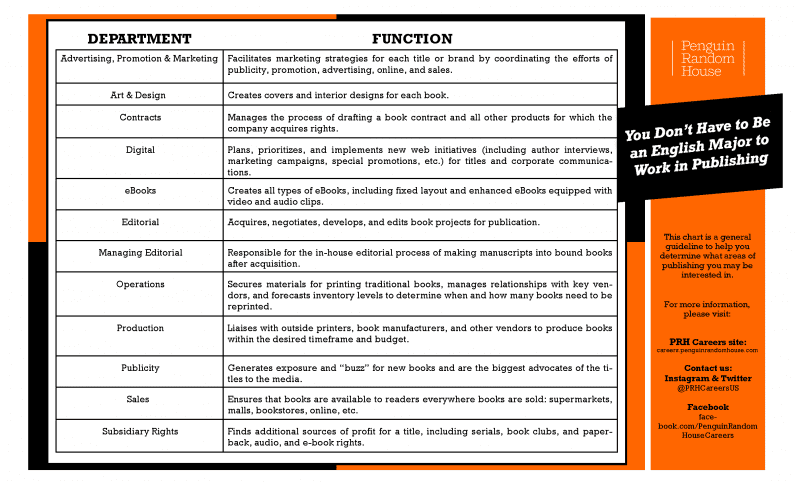
There are so many different opportunities! There’s the publishing side and the corporate side. What I mean by the corporate side are the HR, Finance, Legal, Tech, Corporate Communications teams, among other departments. Then you have the publishing side, which is the more creative side—the one involved with getting the manuscript of a book into a reader’s hands (or ears!).
The editorial department oversees the acquisition and development of a book collaborating with the author to create a finished story. Managing editorial is responsible for the process of getting the book through the individual stages—from the manuscript through all the varying departments and managing the timeline. Publicity creates excitement around new books and new authors. Design is also a crucial department. The irony of not judging a book by its cover is that we have a lot of people who are dedicated to building beautiful books and covers. Sales is another important department at Penguin Random House, as they directly connect retailers (like your local independent bookstores) with our authors’ books so they can be available in stores. Those are just some of our teams and departments. There’s such a wide range of opportunities.
Once you start in publishing, you’ll quickly experience just how many opportunities there are. As a business, we often promote from within, so people sometimes end up in different departments from the ones they started in.
(photo provided by PRH Careers)
3. Do you encourage people who are new to publishing to apply for your jobs?
It depends on the role. The higher up you get, the more relevant the experience must be. For entry-level jobs, you don’t need publishing experience. Will it help? Of course, as in any role.
One of the things we’re trying to identify [when hiring] is the exact skills we’re looking for. Rather than looking for specific types of experience, we want to look for the skills that suggest a candidate is a good fit. As a result, we’re also adjusting our interview process. We’re asking how one’s skills could equate to a position in the publishing sphere.
We’ve added a new team, our Campus Partnership and Outreach team, to go and identify people who maybe haven’t considered publishing before. It really depends on the role and comes back to what the skills are that we’re looking for.
4. Say someone applied for a PRH job through our job board and landed an interview. Can you share your top interview tips?
Do your research. The main thing I’d encourage a prospective candidate to do is familiarize themselves with the job description. If you really understand the relevant parts of the job and you know what your background is, try and link that as much as possible to the role. Research shouldn’t be just limited to the company.
Also, familiarize yourself with your own resume and refer to it. It’s not just a ticket to get in the door—it’s your best sales tool throughout the whole process. When you’re interviewing, you can point to relevant experiences on your resume that can address from the questions you’re asked. The more specific you can make your answer, the higher chance you’ll have at taking that opportunity to showcase your skills.
5. What’s your favorite thing about working for Penguin Random House?
Books have always been a release for me. I’ve always loved reading. Even before I started working here, if a book had the Penguin logo on it, I knew I’d like it. Knowing that I’m heading up the talent acquisition team for that same company is surreal and I have to pinch myself sometimes.
From a professional standpoint, it’s the fact that we have careers for life. Numerous people on my team have been here for a long time. There are many opportunities to try new things—and knowing that one has career expansion across many different areas is really motivating and encouraging.
Apply to jobs at Penguin Random House on our job board today.
Jess Focht is a writer and content strategist with 6+ years of experience in media, publishing, and brand storytelling. She has contributed to Insider, Grammarly, and The Creative Independent.
2 min read • Originally published January 9, 2023 / Updated March 19, 2026
Jess Focht is a writer and content strategist with 6+ years of experience in media, publishing, and brand storytelling. She has contributed to Insider, Grammarly, and The Creative Independent.
2 min read • Originally published January 9, 2023 / Updated March 19, 2026
New month, new Mediabistro roles.
Mediabistro is the #1 job board, community, and career destination for media and content professionals. Once a week, we’ll be updating this list with different types of creative jobs featured. Take a look below:
The senior writer reports features, analysis, breaking news and other articles for Inc.com to drive traffic and fulfill Inc.com’s editorial mission to serve its readers. They work closely with website editors, pitching story ideas and filing posts and addressing issues through the editing process. They also create videos, infographics and other data visualizations and may occasionally write magazine features and contribute to podcasts and appear at Inc. events.
You will be responsible for creating and organizing unique content for all digital platforms. You will work with news crews, producers and assignment editors to assign, produce and promote content every day. This person will also work with the sales department and creative services department. The ideal candidate will have working knowledge of digital technology as well as strong writing and editorial skills.
In this role, you’ll be responsible for managing BravoTV.com’s weekend news coverage, which involves creating digital content around Bravo shows and talent for BravoTV.com’s The Daily Dish and Style & Living verticals. BravoTV.comis the number one destination for news from the Bravo universe, including programming and cast member updates, and fashion, beauty, food, and home & design-related features.
Prospective candidates must reside in Broward, Palm Beach, or Miami-Dade counties and have a minimum of 3 years’ experience in publishing. Must have experience working with corporate liaisons and proven written and oral communications skills. Must be skilled at conducting online research.
Jess Focht is a writer and content strategist with 6+ years of experience in media, publishing, and brand storytelling. She has contributed to Insider, Grammarly, and The Creative Independent.
2 min read • Originally published January 11, 2023 / Updated March 19, 2026
Jess Focht is a writer and content strategist with 6+ years of experience in media, publishing, and brand storytelling. She has contributed to Insider, Grammarly, and The Creative Independent.
2 min read • Originally published January 11, 2023 / Updated March 19, 2026
A new year naturally brings new year’s resolutions as people look forward and set goals for themselves. And while there’s much discourse about whether you should make resolutions or not, it can boil down to making reasonable ones you can keep. Have you set your resolutions yet? And if so, did freelancing full-time make the cut?
Making the jump to freelancing full-time can seem intimidating for those who have mainly worked traditional jobs, but countless statistics point to the fact that full-time employees are rapidly moving to freelance jobs due to a few key findings.
Here are some reasons to go freelance in 2023.
1. Freelance talent is in demand
If you’ve been curious about making the leap to freelancing, but aren’t sure there are enough opportunities, think again; the gig economy is just expected to grow. 2023 is the year to go freelance, according to Fiverr. A large majority of business owners—78%—say they are more likely to hire freelancers this year.
“Changes to headcount and working arrangements are unfortunately necessary during cost-cutting periods, and yet businesses need to ensure staff still feel supported and morale remains intact. It’s encouraging to see that savvy business leaders are turning to freelancers in order to fill any talent gaps in their workforce to avoid things such as burnout and reduced productivity,” said Shany Malbin, Fiverr Business General Manager.
2. Freelancers have a high earnings potential
While starting out as a full-time freelancer may have some growing pains like keeping track of invoices, maintaining a schedule, and planning your business and goals far ahead, it also can lead you to eventually being more in charge of your career than you would’ve as an employee. For example, you can set your own rates, manage your own clients, and not have to worry about things that may come with working full-time such as being micromanaged and monitored. Another perk of working for yourself, especially in the current economic climate, is being able to avoid layoffs or company turmoil.
3. Freelancers have flexibility
At the end of the day, freelancing equals flexibility. Freelancers can work from home (or wherever they’d like to), have full control of their schedules, and decide their own workload. According to Upwork, 50% of freelancers said because of personal circumstances they could not work for a traditional employer, but freelancing gives them the flexibility they need.
With traditional, in-person 9-5 jobs in the rear-view mirror and the gig economy approaching ahead, think about these perks of freelancing as you drive into 2023.
Jess Focht is a writer and content strategist with 6+ years of experience in media, publishing, and brand storytelling. She has contributed to Insider, Grammarly, and The Creative Independent.
2 min read • Originally published January 17, 2023 / Updated March 19, 2026
Jess Focht is a writer and content strategist with 6+ years of experience in media, publishing, and brand storytelling. She has contributed to Insider, Grammarly, and The Creative Independent.
2 min read • Originally published January 17, 2023 / Updated March 19, 2026
New month, new Mediabistro roles.
Mediabistro is the #1 job board, community, and career destination for media and content professionals. Once a week, we’ll be updating this list with different types of creative jobs featured. Take a look below at our jobs roundup:
The Marketing Manager fulfills a critical role within a matrixed environment and will oversee the strategy, implementation, and execution of central digital marketing campaigns through email, social media, SMS, and web platforms.
The Digital Strategy Associate assists SfN’s Digital Strategy team in the execution and oversight of content on the SfN website (SfN.org). The ideal candidate is comfortable in a fast-paced environment, working collaboratively across departments and teams on interdependent projects, and should be interested in utilizing the latest digital innovations to achieve membership engagement goals.
The ideal candidate for this startup within a major media company must be able to operate at a high level, executing the strategic direction set in concert with the publisher/executive editor. Strong editing skills, as well as the ability to identify content that will engage and grow our audience are essential.
The User Experience Coordinator designs digital marketing content, such as paid social media creative and email communications, that promote resources on the First Book Marketplace and exciting programs that support educators and their students. A successful candidate is a strong copywriter and skilled visual designer who is comfortable with Photoshop and interested in multi-channel digital marketing.
Jess Focht is a writer and content strategist with 6+ years of experience in media, publishing, and brand storytelling. She has contributed to Insider, Grammarly, and The Creative Independent.
2 min read • Originally published January 23, 2023 / Updated March 19, 2026
Jess Focht is a writer and content strategist with 6+ years of experience in media, publishing, and brand storytelling. She has contributed to Insider, Grammarly, and The Creative Independent.
2 min read • Originally published January 23, 2023 / Updated March 19, 2026
New month, new Mediabistro roles.
Mediabistro is the #1 job board, community, and career destination for media and content professionals. Once a week, we’ll be updating this list with different types of creative jobs featured. Take a look below at our jobs roundup:
340B needs someone who knows the drug pricing beat, enjoys this subject, likes beating the competition, works hard, meets deadlines, is flexible, is a team player, and above all can write and edit well and supervise other reporters and members of the editorial production team.
The New York Independent Bookstore Representative will be based in Hachette Book Group’s NY office and is responsible for selling Hachette Book Group and Client publisher titles to an established territory of independent bookstores and two national accounts, Bookazine and Brodart, in the New York Metro area and Connecticut.
Reporting to the Associate Director of Communications with a dotted line to the Executive Director of Strategic Communications, the Communications Officer is responsible for researching, writing, and producing a wide range of stories to highlight the impact of the School’s teaching and scholarship on the environment and the achievements of its faculty, students, staff, and alumni.
The Director of Communications develops and implements comprehensive communications strategies to build national visibility for the Levitt Foundation and the national network of Levitt music venues and Levitt AMP concert sites.
Jess Focht is a writer and content strategist with 6+ years of experience in media, publishing, and brand storytelling. She has contributed to Insider, Grammarly, and The Creative Independent.
2 min read • Originally published January 24, 2023 / Updated March 19, 2026
Jess Focht is a writer and content strategist with 6+ years of experience in media, publishing, and brand storytelling. She has contributed to Insider, Grammarly, and The Creative Independent.
2 min read • Originally published January 24, 2023 / Updated March 19, 2026
You may look at your resume as one—sometimes two—pieces of paper. But really, it’s much more than that. It’s your first chance to make a first, and hopefully lasting impression on HR professionals and hiring managers for the job you’re applying to. There’s limited space on a resume, and this doesn’t always have to be a negative thing. It can be your chance to utilize the space as best as you can. This is true, especially, for creative jobs.
Depending on the position and level, hiring managers sometimes expect a full portfolio that will enhance your application. But that doesn’t mean you can’t sell them immediately with your resume. If you’re in search of a creative job, here are some ways you can have your resume stand out.
Use a creative template
Most of us have seen the basic Microsoft Word resume templates. Think twice before creating your resume in such word processors. Why? The answer is simple: most creative jobs require creative resumes.
Yes, hiring managers will want to see your creative work beyond your resume, but you still should think about every angle you can stand out as a candidate. Look into programs such as Canva and Adobe to ensure your creativity sparks off the page.
Communicate your voice & style
Your resume is a way to not only show your creativity, but it is a chance to immediately communicate your voice, style, and personality. What sets you apart from other creative candidates? Figure the answer to that question out—and then portray it on your resume. Sometimes your lists of accomplishments, previous jobs, and experience can’t change, but they way you creatively communicate them can.
Lean into your creative freedom and have fun designing your resume; odds are that it will shine through in a positive way as employers review your application.
Create different resume versions
So you’ve tailored your resume to communicate your voice and apply for your dream creative job. What’s next is making sure you have different versions of the document tailored to the specific jobs you’re applying for, because you may need to change the wording and/or design depending on it. Having a few versions on hand is a good idea for this reason.
Ultimately, applying to creative jobs can be more complicated than a one-click apply, but your dream role is worth the work you’ll pour into an inventive resume.
Creative Job Security in the Age of AI Art: What You Need to Know
By
Miles Oliver
Miles is an independent writer with a background in business and passion for tech, design, and news. When he is not writing, he is most likely mountain biking or kicking back with a cup of tea.
4 min read • Originally published February 1, 2023 / Updated March 19, 2026
By
Miles Oliver
Miles is an independent writer with a background in business and passion for tech, design, and news. When he is not writing, he is most likely mountain biking or kicking back with a cup of tea.
4 min read • Originally published February 1, 2023 / Updated March 19, 2026
While AI art isn’t necessarily new, it’s seen a recent rise in popularity thanks to apps like Dream and Lensa. These apps have become popular because they’re easy to use and affordable. Plus, they are the only ways AI art is utilized. Everyone from book authors to business owners are recognizing the benefits. They can type what they’re looking for into an AI art generator and get a completely original piece of artwork to fit their needs.
But, not everyone is thrilled about the popularity of AI art. One of the main controversies surrounding it is that it might, eventually, become sophisticated enough to replace actual artists.
If you’re in the creative industry, you might be wondering how AI art could eventually impact your career. Thankfully, there are ways to maintain job security in a world where AI can create paintings, scripts, and more. Let’s cover some helpful tips that can offer you peace of mind as you pursue a creative career in this tech-savvy world.
Understanding How AI Works
If you truly want to maintain creative job security in the age of AI art, you have to understand how AI works – including some of its benefits. You might run into artificial intelligence applications more than you realize in your daily life. If you’ve ever talked to a chatbot on a website or used a rideshare app, you’ve encountered AI. Nearly every industry is utilizing AI in some way, from healthcare to marketing and manufacturing.
There’s no denying that certain aspects of AI could eventually “take over” tasks that are done solely by humans today. On one hand, that reduces the risk of human error. On the other hand, it could leave millions of people without jobs.
Howevre, AI is only as good as its ability to learn. Without humans to “teach” it, it will never grow, advance, or learn the right patterns to do things correctly. In the creative world, the more you understand AI and its limits, the easier it will be for you to maintain job security. First, recognize that AI has certain requirements to function properly, including:
A high-bandwidth network
Computing capacity
Data storage
Strong security
Simply put, network designers have a lot to consider when they’re creating artificial intelligence programs. So, you can rest assured that AI isn’t going to completely take over the creative industry any time soon. It has a long way to go to be able to capture the characteristics of human creativity.
It’s also important to understand how AI can actually help creatives. It can take care of some of the “tedious” tasks and patterns that can actually hinder creativity. For example, AI can generate websites in minutes, while it might take humans several weeks. You can provide the data and designs and let tech do the work for you, so you can stay in the creative driver’s seat while it does more of the “mundane” work.
Furthering Your Education
One of the best ways to protect yourself from an AI takeover is to keep learning. Some people might feel reluctant to go back to school as an adult. But, furthering your education is a great way to boost your resume and become more appealing to companies and clients alike.
One of the interesting things about many creative careers is that they constantly evolve. Whether you’re a writer, a designer, or a creative director, there are things you need to know today that weren’t relevant ten years ago, and things that will be important in five years that you’re not yet doing today. AI is so effective and impressive because it learns at a rapid pace and understands how to use patterns to create something new.
While you might not be able to retain information as quickly as a machine, you can stay competitive within the industry by keeping up your education and becoming a lifelong learner.
Humanize Your Art
Whether you’re a painter, a graphic designer, an author, or a scriptwriter, there’s one thing you’ll always have that AI can never compete with – the human touch. It’s ironic that we’re living in a world filled with technology, and people are craving human relationships more than ever. Consumers want it from brands, businesses want it from their employees, and the average person wants it from their entertainment.
While AI is more than a trend, it will never be able to understand emotion – the very crux of creativity. If you’re a writer, for example, you’ll never have to worry about AI experiencing things like:
Excitement
Jealousy
Anger
Depression
However, without those emotions (and so many more), you’re not going to have a very interesting story.
If you’re a painter, there’s no denying that AI can create beautiful and unique works of art, but nothing can replace the raw emotion and meaning behind a piece created by a person.
So, while the ethical debate surrounding AI art is likely to continue, don’t worry too much about your job security in the creative industry. Keep these suggestions in mind, dedicate yourself to a life of learning, and continue to foster your passion for what you love, recognizing that your human emotions are exactly what set you apart from AI technology.